


United Nations
Pak Export Factory of Terror: Sushma SwarajBy Deepak Arora
Addressing the 72nd session of the UN General Assembly, Sushma Swaraj said India and Pakistan became free within hours of each other. "Why is it that today India is a recognised IT superpower in the world, and Pakistan is recognised only as the pre-eminent export factory for terror?" She said India has risen despite being the principal destination of Pakistan's nefarious export of terrorism. There have been many governments under many parties during 70 years of Indian freedom, for we have been a sustained democracy. The Minister said "Every government has done its bit for India's development. We have marched ahead, consistently, without pause, in Education, Health and across the range of human welfare. We established scientific and technical institutions which are the pride of the world." "But what has Pakistan offered to the world and indeed to its own people apart from terrorism? We produced scholars, doctors, engineers. What have you produced? You have produced terrorists. Doctors save people from death, terrorists send them to death. If Pakistan had spent on its development what it has spent on developing terror, both Pakistan and the world would be Safer and better-off today," Sushma Swaraj said amidst loud applause. She said "Terrorism is at the very top of problems for which the United Nations is searching for solutions. We have been the oldest Victims of this terrible and even traumatic terrorism. When we began articuiating about this menace, many of the world's big powers dismissed this as a law and order issue. Now they know better. The question is: what do we do about it?" Sushma Swaraj said "We must all introspect and ask ourselves whether our talk is anywhere close to the action We take. We all condemn this evil, and piously resolve to fight it in all our declaratory statements. The truth is that these have become rituals. The fact is that when we are required to fight and destroy this enemy, the self-interest of some leads them towards duplicity. "This has been going on for years. Although, India proposed a Comprehensive Convention on International Terrorism (CCIT) as early as in 1996, yet two decades later the United Nations has not been able to agree upon a definition of terrorism. If we cannot agree to define our enemy, how can we fight together? If we continue to differentiate between good terrorists and bad terrorists, how can we fight together? If even the United Nations Security Council cannot agree on the listing of terrorists, how can we fight together?" She urged "the august assembly to stop seeing this evil with self-defeating and indeed meaningless nuance. Evil is evil. Let us accept that terrorism is an existentialist danger to humankind. There is absolutely no justification for this barbaric violence. Let us display our new commitment by reaching agreement on the Text of Sushma Swaraj's speech at UN General AssemblyUNITED NATIONS, Sept 23: Sushma Swaraj addressed the 72nd session of United Nations General Assembly today. Mr. President Let me begin by offering my heartiest congratulations on your election as President of the 72nd United Nations General Assembly. For those of us fortunate to represent our nations as Foreign Minister this is a particularly happy event: one of us has this honour. Mr. President 2: India welcomes your efforts to place people at the heart of international diplomacy as you shape policy and lend direction to world affairs from your august chair. I thank you for the theme you have chosen: ‘Focusing on people: Striving for peace and a decent life on a sustainable planet’. People, peace, decency, sustenance and focus define a noble objective. Mr. President 3: The United Nations was established for the welfare, security, harmony, rights and economic progress of the people of our world. India fully supports your efforts in this great mission. 4: I had spoken before this Assembly last year as well. It is a year that has seen much change both in this Assembly and in the world it represents. We have a new Secretary General at the United Nations. He is determined to prepare and strengthen the United Nations to meet the challenges of the 21st century. We welcome his efforts, and see in him a leader who can give practical shape to a vision. Mr. President 5: Our contemporary world is trapped in a deluge of troubles of which, surely, the most dangerous is the relentless rise of violence, Terrorism, and the ideas that engineer this evil, are spreading at the pace of a conflagration. Climate change stares us in the face, and threatens us with its dimension. There is a growing question mark over maritime security. For a mix of reasons, provocative and inflammatory, people are leaving the psychological, cultural and economic comfort of their traditional home space to seek refuge on distant shores causing global anxiety. A large part of the globe's population is still tortured by hunger and poverty. The young are beginning to lose hope as they confront unemployment. Women, victims of historic discrimination, are demanding what they must get: gender empowerment. Nuclear proliferation is back in the zone of dangerous headlines. Cyber security has become a source of deep insecurity. 6: In 2015, we set ourselves a target of 2030 to find solutions to many challenges on this Agenda. Two of these years have already passed. Surely it is already time to ask how much has happened. If complacency defines the next 13 years then we are in danger of losing control. We need a sense of urgency as well as unshakeable fortitude to take decisions that can avert catastrophe. 7; I am pleased that India has displayed the courage and leadership to take tough decisions which have launched the interlinked process of sustainable development. The complete eradication of poverty is the most important priority of the present government. Mr. President, There are two ways of addressing the curse of poverty. The traditional method is through incremental levels of aid and hand-holding. But our Prime Minister Narendra Modi has chosen the more radical route, through economic empowerment. The poor are not helpless: we have merely denied them opportunity. We are eliminating poverty by investing in the poor. We are turning them from job-seekers into job-providers. 8: All our economic programmes have a principal purpose, die empowerment of the poor; Jan Dhan, Mudra, Ujjwala, Skill India, Digital India, Clean India, Start-Up India, Stand-Up India. To describe them all would take up more time than 1have at my disposal, and I shall therefore dwell on only three core programmes. 9: The Jan Dhan plan must surely count as the world's largest financial inclusion scheme. At least 300 million Indians who had never crossed the doors of a bank today have bank accounts; this is equivalent to the population of the United States of America. This was, understandably, not easy to complete in three years, but our banks, achieved this visionary goal set by our Prime Minister. While some remain to be included, the target has been set — every Indian family will have a bank account. 10; Mudra yojana has enabled government to fund the unfunded. Those who had never dreamt that bank credit was within their options, today, through Mudra, are getting soft loans without collateral to begin micro businesses. 1 am particularly delighted to inform you that over 70 per cent of these loans have gone to women. Unemployment spreads despair. Through Skill India, Start-Up India and Stand-Up India poor and middle class youth are being trained to match their honed talent with bank credit and become self-employed or small-scale entrepreneurs. 11: Ujjwala is a signature scheme of our government. Free gas cylinders are being provided to the poor so that women do not have to suffer the dangerous consequences of wood-fired kitchens. Uniquely, gender emancipation is at the creative core of this programme. 12: Demonetisation was a courageous decision to challenge one of the by products of corruption, the "black money" that disappeared from circulation. Today, India has passed the Goods and Services Tax legislation, through which there is one-tax across the country, without the untidy and punishing system of multiple taxes under differing categories in different parts of the country. Our "Save the girl, Educate the girl" campaign is reducing gender inequality. Our Clean India programme is generating what can only be described as a revolutionary change in social attitudes and habits. 13: I would like to note, at this point, that nations with rising capabilities will be able to generate such change, but the developed world must become an active partner in helping those vulnerable countries which are still mired in stagnant poverty reach SDG horizon within 2030. That is why the principle of Global Partnership was included in SDGs. I am happy to report that India has started, this year, the India-UN Development Partnership Fund. Mr. President 14: We are completely engaged in fighting poverty; alas, our neighbour Pakistan seems only engaged in fighting us. On Thursday, from this dais, Pakistan's Prime Minister Shahid Khakan Abbasi wasted rather too much of his speech in making accusations against us. He accused India of State-sponsored terrorism, and of violating human rights. Those listening had only one observation: "Look who's talking!" A country that has been the world's greatest exporter of havoc, death and inhumanity became a champion of hypocrisy by preaching about humanity from this podium. 15: Pakistan's Prime Minister claimed that his nation's founder Mohammad Ali Jinnah had bequeathed a foreign policy based on peace and friendship. I would like to remind him that while it remains open to question whether Jinnah Sahab actually advocated such principles, what is beyond doubt is that India's Prime Minister Narendra Modi has, from the moment he took his oath of office, offered the hand of peace, and friendship. Pakistan's Prime Minister must answer why his nation spurned this offer. 16: Prime Minister Abbasi has recalled old resolutions that have been long overtaken by events. But his memory has conveniently failed him where it matters. He has forgotten that under the Shimla Agreement and the Lahore Declaration India and Pakistan resolved that they would settle all outstanding issues bilaterally. The reality is that Pakistan's politicians remember everything, manipulate memory into a convenience. They are masters at "forgetting" facts that destroy their version. 17: Pakistan's current Prime Minister spoke of a "Comprehensive Dialogue" between our two countries. I would like to remind him that on 9 December 2015, when I was in Islamabad for the Heart of Asia conference, a decision was made by his leader Mian Nawaz Sharif, then still Prime Minister, that dialogue between us should be renewed and named it a "Comprehensive Bilateral Dialogue". The word "bilateral" was used consciously to remove any confusion or doubt about the fact that the proposed talks would be between our two nations and only between our two nations, without any third-party present. And he must answer why that proposal withered, because Pakistan is responsible for the aborting that peace process. 18: I would like today to tell Pakistan's politicians just this much, that perhaps the wisest thing they could do is to look within. India and Pakistan became free within hours of each other. Why is it that today India is a recognised IT superpower in the world, and Pakistan is recognised only as the pre-eminent export factory for terror? 19: India has risen despite being the principal destination of Pakistan s nefarious export of terrorism. There have been many governments under many parties during 70 years of Indian freedom, for we have been a sustained democracy. Every government has done its bit for India's development. We have marched ahead, consistently, without pause, in Education, Health and across the range of human welfare. We established scientific and technical institutions which are the pride of the world. But what has Pakistan offered to the world and indeed to its own people apart from terrorism? We produced scholars, doctors, engineers. What have you produced? You have produced terrorists. Doctors save people from death; terrorists send them to death. If Pakistan had spent on its development what it has spent on developing terror, both Pakistan and the world would be safer and better-off today. Mr. President 20: Terrorism is at the very top of problems for which the United Nations is searching for solutions. We have been the oldest victims of this terrible and even traumatic terrorism. When we began articulating about this menace, many of the world's big powers dismissed this as a law and order issue. Now they know better. The question is: what do we do about it? 21: We must all introspect and ask ourselves whether our talk is anywhere close to the action we take. We all condemn this evil, and piously resolve to fight it in all our declaratory statements. The truth is that these have become rituals. The fact is that when we are required to fight and destroy this enemy, the self-interest of some leads them, towards duplicity. 22: This has been going on for years. Although India proposed a Comprehensive Convention on International Terrorism (CCIT) as early as in 1996, yet two decades later the United Nations has not been able to agree upon a definition of terrorism. If we cannot agree to define our enemy, how can we fight together? If we continue to differentiate between good terrorists and bad terrorists, how can we fight together? If even the United Nations Security Council cannot agree on the listing of terrorists, how can we fight together? Mr. President 23: Through you, with utmost sincerity I would like to request this august assembly to stop seeing this evil with self-defeating and indeed meaningless nuance. Evil is evil. Let us accept that terrorism is an existentialist danger to humankind. There is absolutely no justification for this barbaric violence. Let us display our new commitment by reaching agreement on the Comprehensive Convention on International Terrorism this year itself. Mr. President 24: I had- identified climate change as one of the significant dangers to our existence. India has already said that it is deeply committed to the Paris Accord. This is not because we are afraid of any power, influenced by friend or foe, or tempted by some imagined greed. This is an outcome of a philosophy that is at least 5000 years old. Our Prime Minister has, on his personal initiative, launched the International Solar Alliance as witness to our abiding commitment to a cause. 25: When we talk of world peace, we mean peace not only among, human beings but also peace with nature. We understand that human nature is sometimes inimical to nature, but we would like to amend human nature when it tends in the wrong, directions. When we inflict our greed upon nature, nature sometimes explodes. We must learn to live with the imperatives, cycles and creative urges of nature; in that lies, our own salvation. 26: We have just witnessed hurricanes, earthquakes, rains that inundate, storms which terrify. This is not a mere coincidence. Nature sent its warning to the world even before the world's leadership gathered in New York at the United Nations through Harvey. Once our gathering began an earthquake struck Mexico and a hurricane landed in Dominica. We must understand this requires more serious action than talk. The developed world must listen more carefully than others, because it has more capacities than others. It must help the less fortunate through technology transfer and Green Climate Financing – that is the only way to save future generations. Mr. President 27: We are discussing turbulence and change across the world, but the one organisation created to address world affairs is beset by its own problems. It seems to believe that it can afford not to change from the precepts and perceptions that determined its birth. On 18 September, there was a meeting here on UN reform. I participated. I witnessed an evident desire for change, to do something. But 1do want to remind you that at the 2005 World Summit there was a consensus that the early reform of the Security Council is an essential element of our overall effort to reform the United Nations. 28: Efforts at text-based negotiations on the reform and expansion of the Security Council were initiated in the last session and more than 160 nations had expressed support for this effort. If we are serious, then the least we can do is produce one text that can be the basis for negotiation. I hope that under your enlightened leadership, Mr. President, this will become a priority. If that happens it will be a significant achievement. 29: We also have high expectations from the new Secretary General of the United Nations. If he wants to reform the peace and security architecture, he will also need to address reforms related to peacekeeping that have been urged for long. Without improvements in UN Peacekeeping this goal can't be achieved. Mr. President 30: There is no shortage of issues; there is even less shortage of problems which should be recognised from this podium. But time is not always on the side of those who would like to raise issues and problems in the interests of a better, more peaceful and progressive future. The issues you have chosen are relevant to the UN Charter as well as to the ancient traditions of my land. Mr. President 31: My country's culture and thought has been shaped by a history and philosophy that believes in peace as humankind's only rational and practical objective. We truly believe that the world is one family and we hope that every member of this family deserves that elixir of life, happiness. Let me end by reciting a verse that is a synthesis of thought: May all be happy; May all be healthy; May all see what is good; May all be free from suffering. Thank you, Mr. President. Pakistan is now Terroristan: IndiaBy Deepak Arora
Responding Pakistan Prime Minister Shahid Khaqan Abbasi’s remarks on Kashmir, India's First Secretary Eenam Gambhir said: “In its short history, Pakistan has become a geography synonymous with terror.” She said "it is extraordinary that the state which protected Osama Bin Laden and sheltered Mullah Omar should have the gumption to play the victim. By now, all Pakistan’s neighbours are painfully familiar with these tactics to create a narrative based on distortions, deception and deceit. This august Assembly and the world beyond know that efforts at creating alternative facts do not change reality." In its short history, Eenam Gambhir siad Pakistan has become a geography synonymous with terror. The quest for a land of pure has actually produced “the land of pure terror”. Pakistan is now ''Terroristan', with a flourishing industry producing and exporting global terrorism. Its current state can be gauged from the fact that Hafiz Mohammed Saeed, a leader of the UN designated terrorist organization Lashkar-i-Taiba, is now sought to be legitimized as a leader of a political party. "This is a country whose counter terrorism policy is to mainstream and upstream terrorists by either providing safe havens to global terror leaders in its military town, or protecting them with political careers," she added. None of this can justify Pakistan’s avaricious efforts to covet the territories of its neighbours. In so far as India is concerned, Pakistan must understand that the State of Jammu and Kashmir is and will always remain an integral part of India. However much its scales up cross-border terrorism, it will never succeed in undermining India’s territorial integrity. Even as terrorists thrive in Pakistan and roam its streets with impunity, she said we have heard it lecture about the protection of human rights in India. The world does not need lessons on democracy and human rights from a country whose own situation is charitably described as a failed state. Eenam Gambhir said "Terroristan is in fact a territory whose contribution to the globalisation of terror is unparalleled. Pakistan can only be counseled to abandon a destructive worldview that has caused grief to the entire world. If it could be persuaded to demonstrate any commitment to civilization, order, and to peace, it may still find some acceptance in the comity of nations." India, US, Japan call for respecting territorial integrity in a dig at China
“On connectivity initiatives, the importance of basing them on universally recognised international norms, prudent financing and respect for sovereignty and territorial integrity was underlined,” a statement released by the three countries said. The remarks came at the end of a trilateral meeting that external affairs minister Sushma Swaraj held with Rex Tillerson and Taro Kono — her US and Japanese counterparts — on the sidelines of the UN general assembly meeting here. This was her first meeting with Tillerson. The three ministers “emphasised the need for ensuring freedom of navigation, respect for international law and peaceful resolution of disputes”, a clear reference to China’s muscle-flexing in the South China Sea and its dispute with littoral states, including Japan. India has opposed the BRI, a component of which — the China-Pakistan Economic Corridor — traverses Pakistan occupied Kashmir. The government has repeatedly called for respect of territorial integrity and sovereignty, and skipped a recent meeting hosted by China of the project’s various stakeholders. New Delhi’s concerns on the issue were reflected in letter — word for word — and spirit in the India-US joint statement issued after Prime Minister Narendra Modi and President Donald Trump met in June. At the New York meet, Swaraj also sought attention on “proliferation linkages” of North Korea, whose recent actions nuclear and missile tests have posed a direct and immediate danger to Japan and the US. She “deplored the DPRK’s recent actions and stated that its proliferation linkages must be explored and those involved be held accountable”, a release by the ministry said, referring to North Korea by its official name, the Democratic People’s Republic of Korea. The ministry’s release did not name Pakistan, which supplied North Korea with key equipment for enriching uranium, including gas centrifuges. The father of Pakistan’s nuclear bomb, AQ Khan, confessed in 2004 to supplying nuclear technology and components to North Korea, Iran and Libya. Donald Trump Bats For Reform In United Nations, Says US Will Help
Addressing a meeting on UN reforms a day ahead of his address at the General Assembly, President Trump said he encouraged member states to strike out for change and not hold onto past systems that were not working. All members of the world body should take "bold stands with an eye towards changing business as usual", President Trump said. India has been making a strong bid for a permanent seat in an expanded Security Council, which currently has five permanent members -- China, France, Russia, the United Kingdom, and the US. Calling for inclusion of the world's largest democracies in an expanded permanent security council, Prime Minister Narendra Modi had earlier said it would carry "greater credibility and legitimacy" and be effective in addressing the challenges of the 21st century." Last year, India's ambassador to UN Syed Akbaruddin said the current structure and working methods of the Security Council are "divorced from reality and represent a bygone era". President Trump is known for his strong views on UN Security Council. In past, he had labeled it as weak, incompetent and "not a friend of the United States". Once he had even described it as a "club for people to get together, talk and have a good time". His tone today was thus seen as an indication of the need for global support against North Korea after its latest round of nuclear tests. The US, President Trump said, will "pledge to be partners" in order to make the UN "a more effective force" for peace. "In recent years, the United Nations has not reached its full potential due to bureaucracy and mismanagement," he said, adding, "We are not seeing the results in line with this investment." In a show of strength today, the US flew four F-35B stealth fighters and two B-1B bombers over the Korean peninsula, US ally South Korea said today, to "demonstrate the deterrence capability" of their alliance against North Korea's "nuclear and missile threats". President Trump will address the UN General Assembly on Tuesday, where he is expected to address concerns around his "America First" policy, questions on his support for the UN and a series of global crises. Sushma Swaraj arrives in New York to attend UN General Assembly meet
During her week-long stay, Swaraj, leading a high-powered Indian delegation, is expected to hold about 20 bilateral and trilateral meetings with leaders attending the session. Swaraj, was received at the airport by the Indian Ambassador to the US Navtej Sarna, and India’s permanent Representative to the United Nations Syed Akbaruddin. She would kick off her official engagement later on Monday with a trilateral meeting with her American and Japanese counterparts Rex Tillerson, and Taro Kono respectively. Aimed at lending momentum to cooperation between the three countries, the meeting also turns significant amid China flexing its muscles in the region. In a day jam-packed with consecutive meetings, Swaraj will also participate in a high-level meeting on UN reforms, hosted by the US and chaired by president Donald Trump. India is among the 120 countries who have supported the reform efforts of the UN Secretary General. India has said that the UN reforms need to be “broad- based and all-encompassing” and the changes should not be restricted to its Secretariat only. In a preview of the Swaraj’s engagements during her week-long stay in the US, Akbaruddin had said that issues of climate change, terrorism, people centric migration and peacekeeping are other key focus areas for India this year. Swaraj will also participate in a special panel of selected countries by the UN Secretary General on climate action, he said earlier. She will address the UNGA on September 23. The minister is scheduled to have a series of meetings today including that with Tunisian foreign minister Khemaies Jhinaoui, Bhutanese Prime Minister Tshering Tobgay, Danish foreign minister Anders Samuelsen, Latvian foreign minister Edgars Rinkevics and her Bolivian counterpart Fernando Huanacuni Mamani. Akbaruddin in an interaction with Indian reporters ruled out a bilateral meeting between Swaraj and her Pakistani counterpart. However, the two leaders are likely to see each other during several multilateral meetings including that of SAARC and the Shanghai Cooperation Organisation (SCO). Swaraj is scheduled to leave for India, a day after her address to the UN General Assembly. UN reforms need to be broad-based, all encompassing: India
“We feel that reforms need to be much more broad-based. You cannot have reform only of the Secretariat. Reforms cannot side step issues related to governance of UN bodies,” India’s Permanent Representative to the UN Syed Akbaruddin told reporters at a news conference here. His remarks came as US President Donald Trump was set to deliver his first speech to the UN General Assembly next week. “For us reform is broad based, it’s all encompassing. And we look to engage with all our friends and colleagues from other countries on this,” Akbaruddin said adding that India is in touch with countries that are pro-reforms. Trump is scheduled to chair a high-level meeting of the UN at its headquarters in New York on September 18 on UN reforms. India, among the 120 countries who have supported the reform efforts of the UN Secretary General will participate in the meeting. “Winds of change are blowing globally so therefore UN cannot be left aside. So, reform is a major issue in the UN,” Akbaruddin said. India's External Affairs Minister Sushma Swaraj is expected to have 15-20 bilateral meetings with world leaders and attend several multilateral meetings, during her week-long stay here. In a preview of the Swaraj’s engagements at the UN and her meetings here, Akbaruddin said that issues of climate change, terrorism, people centric migration and peacekeeping are other key focus areas for India this year. Swaraj will also participate in a special panel of selected countries by the UN Secretary General on climate action, he said. Part of Swaraj’s interaction would be a focus on how India is working with other countries on global solar initiative. “Our goals are broad. They are global in nature. Some of them are inspirational. There are some of them where we are working for several years and there are some where we hope to have an outcome this year,” Akbaruddin said. Raveesh Kumar, spokesperson of the Ministry of External Affairs, said officials are working on a number of regional meetings including SAARC, BRICS, G-77 and G-4. “We are also working on several bilateral and tri-lateral meetings,” he said. UN Security Council imposes harsher sanctions on North KoreaUNITED NATIONS, Sept 11: The United Nations Security Council (UNSC) on Monday unanimously adopted new sanctions on North Korea for conducting its sixth and largest nuclear test. Citing a US official familiar with negotiations, CNN reported that the resolution is designed to accomplish six major goals: cap North Korea's oil imports, ban textile exports, end additional overseas laborer contracts, suppress smuggling efforts, stop joint ventures with other nations and sanction designated North Korean government entities. On Monday, the US circulated a draft resolution that called for a full ban on exports of oil to North Korea and an asset freeze on leader Kim Jong Un, the Worker's Party and the government of North Korea. But later in the day, the US put forward another draft that removed the full oil embargo, asset freeze, travel ban for Kim and softened the language on foreign workers and other issues. Although the resolution won unanimous backing from all 15 council members, the weakened penalties reflected the power of Russia and China, which had objected to the original language and could have used their votes to veto the measure. Ahead of the vote, North Korea warned that United States will pay a "due price," if harsh sanctions against Kim Jong Un and the country are agreed at a United Nations Security Council meeting. North Korea's Foreign Ministry said in a statement published on state media that if the US "does rig up the illegal and unlawful 'resolution,'" it would respond in kind. "The forthcoming measures to be taken by the DPRK will cause the US the greatest pain and suffering it had ever gone through in its entire history." The International community condemned North Korea for testing the hydrogen bomb on August 27, marking the sixth time the isolated state has tested a nuclear weapon. The major powers then convened an emergency session of the security council where U.S. Ambassador to the United Nations Nikki Haley argued forcefully for harsher sanctions, saying, "enough is enough," and that Kim was "begging for war." "We have taken an incremental approach, and despite the best of intentions, it has not worked," Haley said. "War is never something the Unites States wants -- we don't want it now. But our country's patience is not unlimited. We will defend our allies and our territory." Moreover, South Korea Prime Minister Lee Nak-yon said that North Korean leader is likely to launch another intercontinental ballistic missile (ICBM) "on September 9. Miroslav Lajcák sworn in as new President of UN General AssemblyBy Deepak Arora
Placing his hand on the Charter of the United Nations, the President said, “I solemnly declare that I shall truthfully perform my duties and exercise the functions entrusted to me as President of the General Assembly of the United Nations in all loyalty, discretion and conscience, and that I shall discharge these functions and regulate my conduct with the interest of the United Nations only in view and in accordance with the Charter of the United Nations and the code of ethics for the President of the General Assembly, without seeking or accepting any instruction in regard to the performance of my duties from any Government or other source external to the Organization.” Lajcák became the second President of the General Assembly to take this oath of office, which was established by General Assembly resolution A/RES/70/305 on 13 September 2016. The resolution, entitled “Revitalization of the work of the General Assembly”, also established a code of ethics for the President. The President, a national of the Republic of Slovakia, has served as his country’s Minister of Foreign and European Affairs since 2012. His priorities for the 72nd session include peace and conflict prevention; migration; a sustainable planet; human dignity; and modernizing the United Nations. The first official meeting of the 72nd session of the United Nations General Assembly will be held on Tuesday (12 September). UN human rights chief deplores India's move to deport Rohingyas
UN official Zeid Ra’ad Al Hussein specifically mentioned a statement by the Minister of State for Home, Kiren Rijiju, in his speech at the UN Human Rights Council’s 36th session in Geneva. The Indian government has not reacted to the statement. Al Hussein said India “cannot carry out collective expulsions” and return people to a place where they face persecution. “I deplore current measures in India to deport Rohingyas at a time of such violence against them in their country. Some 40,000 Rohingyas have settled in India, and 16,000 of them have received refugee documentation. The Minister of State for Home Affairs has reportedly said that because India is not a signatory to the Refugee Convention, the country can dispense with international law on the matter, together with basic human compassion. However, by virtue of customary law, its ratification of the International Covenant on Civil and Political Rights, the obligations of due process and the universal principle of non-refoulement, India cannot carry out collective expulsions, or return people to a place where they risk torture or other serious violations.” Rohingyas have fled to India and Bangladesh after army action against them in the Rakhine state of Myanmar. Many of them have settled in Jammu and Kashmir. Rijiju had recently said that nobody should preach to India about allowing in refugees as the country has absorbed the maximum number of them. “I want to tell the international organisations whether the Rohingyas are registered under the United Nations Human Rights Commission or not. They are illegal immigrants in India,” Rijiju had said. Al Hussein’s comments are the strongest by an international diplomat against India regarding Rohingya refugees. The UN official also spoke about the murder of journalist Gauri Lankesh and the general rise of intolerance in India which, he said, had “dismayed” him. “I am also dismayed by a broader rise of intolerance towards religious and other minorities in India. The current wave of violent, and often lethal, mob attacks against people under the pretext of protecting the lives of cows is alarming. People who speak out for fundamental human rights are also threatened. Gauri Lankesh, a journalist who tirelessly addressed the corrosive effect of sectarianism and hatred, was assassinated last week,” Al Hussein said. “I have been heartened by the subsequent marches calling for protection of the right to freedom of expression, and by demonstrations in 12 cities to protest the lynchings. Human rights defenders who work for the rights of India’s most vulnerable groups — including those threatened with displacement by infrastructure projects such as the Sardar Sarovar Dam in the Narmada river valley — should be considered allies in building on India’s achievements to create a stronger and more inclusive society. Instead, many are subject to harassment and even criminal proceedings, or denied protection by the state,” he said. Al Hussein, a diplomat from Jordan, has been at loggerheads with Indian diplomats in the past. In September last year, India had objected to Al Hussein’s reference of Jammu and Kashmir as “Indian-administered Kashmir” and “Pakistan-administered Kashmir”. Ajit Kumar, India’s permanent representative to the UN office in Geneva, had said the phrase was “artificial”. “The whole state of Jammu and Kashmir is an integral part of India. Pakistan remains in illegal occupation of a part of our territory. The two cannot and should not be equated.” Up to three quarters of children and youth face abuse, exploitation and trafficking on Mediterranean migration routes: UNICEF, IOMBy Deepak Arora NEW YORK/BRUSSELS, Sept 12: Migrant and refugee children and youth trying to reach Europe face appalling levels of human rights abuses, with 77 per cent of those traveling along the Central Mediterranean route reporting direct experiences of abuse, exploitation, and practices which may amount to human trafficking – UNICEF and IOM, the UN Migration Agency, said today in a new report. Children and youth traveling alone or over longer periods, along with those possessing lower levels of education, were also found to be highly vulnerable to exploitation at the hands of traffickers and criminal groups over the course of their journeys. According to the report, the Central Mediterranean route is particularly dangerous, with most of the migrants and refugees passing through Libya which remains riven with lawlessness, militias and criminality. On average young people pay between $1,000-5,000 for the journey and often arrive in Europe in debt, which exposes them to further risks. The report calls on all concerned parties - countries of origin, transit and destination, the African Union, the European Union, international and national organizations with support from the donor community – to prioritize a series of actions. These include establishing safe and regular pathways for children on the move; strengthening services to protect migrant and refugee children whether in countries of origin, transit or destination; finding alternatives to the detention of children on the move; working across borders to combat trafficking and exploitation; and combatting xenophobia, racism and discrimination against all migrants and refugees. UN Secretary-General Offers Support to Victims of Monsoon Floods in Bangaldesh, India, NepalUNITED NATIONS, Sept 1: UN Secretary-General António Guterres is saddened by the loss of life and the devastation caused by widespread floods and landslides due to torrential monsoon rains in Bangladesh, India and Nepal, according to Spokesperson for UN Secretary-General. The Secretary-General extends his condolences to the Governments and the people of Bangladesh, India and Nepal and salutes the respective Governments’ leadership in responding to the needs of those affected. The United Nations remains ready to support the relief efforts. UN Secretary-General Voices Concern Over Reported Myanmar Security Excesses, Urges Calm, RestraintUNITED NATIONS, Sept 1: UN Secretary-General António Guterres is deeply concerned by the reports of excesses during the security operations conducted by Myanmar's security forces in Rakhine State and urges restraint and calm to avoid a humanitarian catastrophe. The Secretary-General underlines the responsibility of the Government of Myanmar to provide security and assistance to all those in need and to enable the United Nations and its partners to extend the humanitarian support they are ready to provide. The current situation underlines the urgency of seeking holistic approaches to addressing the complex root causes of violence. The Secretary-General urges the Government of Myanmar to implement the recommendations of the Advisory Commission on Rakhine. The Secretary-General appreciates the efforts of the Bangladesh authorities and communities to meet the dire needs of recent arrivals. He encourages the Government to ensure refugees are able to avail themselves of the support the United Nations and partners are mobilized to provide. |
|
||||||
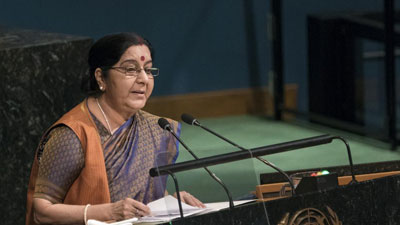 UNITED NATIONS, Sept 23: India's External affairs minister Sushma Swaraj on Saturday called Pakistan “the pre-eminent export factory for terror” that gave its own people and the world nothing but terrorism, and accused its leaders of hypocrisy in talk and actions in regard to bringing peace to the subcontinent.
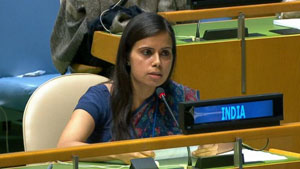 UNITED NATIONS, Sept 22: India called Pakistan ‘Terroristan’ as it exercised the right of reply in response to Pakistan’s defense of terrorism at the United Nations General Assembly.
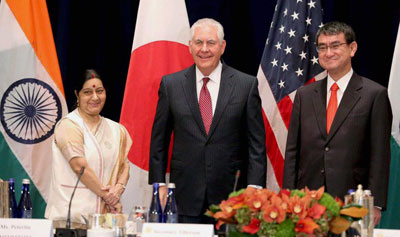 NEW YORK, Sept 18: India, Japan and the United States on Monday called for the respect of “international norms” and “sovereignty and territorial integrity” on connectivity initiatives, delivering a thinly veiled joint reminder to China on its ambitious Belt and Road Initiative (BRI).
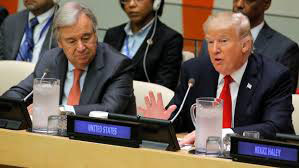 UNITED NATIONS, Sept 18: US President Donald Trump, once a harsh critic of the United Nations, took a measured tone today and called for reforms in the body - a view India has taken for long.
 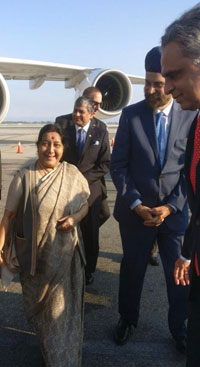 NEW YORK, Sept 18: External affairs minister Sushma Swaraj arrived here on Monday to represent India at the annual UN General Assembly (UNGA) session with a packed schedule of super diplomacy among an array of world leaders.
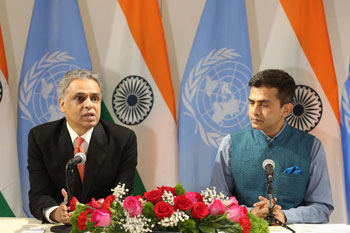 NEW YORK, Sept 16: India has said that the UN reforms need to be “broad-based and all-encompassing” and the changes should not be restricted to its Secretariat only.
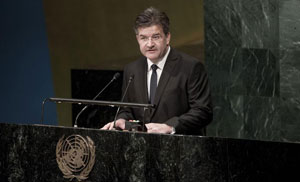 UNITED NATIONS, Sept 11: Miroslav Lajcák was sworn in today as the President of the 72nd session of the United Nations General Assembly.
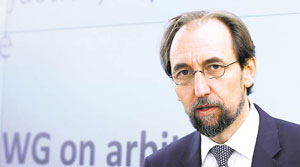 GENEVA, Sept 12: The United Nations High Commissioner for Human Rights on Monday said he “deplored” the Indian government’s plans to deport Rohingya refugees “at a time of such violence against them in their country”.
Aviation
| Business | Defence | Foreign
Affairs | Communication | Health
| India | United Nations
India-US
| India-France | Entertainment
| Sports | Photo Gallery |
Tourism | Advertise with Us
| Contact Us
© Noyanika International, 2003-2009. All rights reserved.