


United Nations
|
Iran Crisis Hampering Aid To Refugees As Supply Chain Costs SOAR, UN WarnsGENEVA, May 1: The cost of sending some aid to Sudan - the world's largest displacement crisis - has more than doubled due to the Iran war, as shipping disruption pushes up costs and delays the delivery of relief, the U.N. refugee agency said on Friday. Heightened insecurity around key Gulf shipping routes, including the Strait of Hormuz, as well as congestion at ports, rising fuel prices and higher insurance premiums have all hampered the delivery of aid, particularly in Africa, the agency said. Ships with aid that previously passed from Dubai through the Strait of Hormuz are being replaced by ships coming from Europe around the Cape of Good Hope, adding up to 25 days to delivery times, UNHCR spokesperson Carlotta Wolf told reporters in Geneva. "People in dire need are receiving things that are ready later than what's needed," she said. UNGA President Annalena Baerbock Calls for Renewed Commitment to Multilateralism During Visit to IndiaBy Deepak Arora NEW DELHI, April 28: The President of the United Nations General Assembly, Annalena Baerbock, today called for strengthened global cooperation and renewed commitment to the United Nations Charter amid rising geopolitical tensions and growing pressure on the international system. Speaking at a press briefing at UN House here, the President cautioned that multilateralism and international law are facing serious challenges. “Today, the United Nations, multilateralism, and international law are not only under pressure, but under direct attack,” she said, pointing to increasing fragmentation and strain across the pillars of peace and security, development, and human rights. She stressed that no country can address today’s interconnected global challenges alone, citing climate change, global health crises such as COVID-19, and the economic impact of conflicts, including the war in Ukraine and disruptions to global trade routes. “Complying with international law and delivering on the Sustainable Development Goals is in the interest of all,” she added. During her visit, President Baerbock held bilateral discussions with India’s External Affairs Minister, Dr. S. Jaishankar, focusing on strengthening cooperation on shared global priorities. Highlighting India’s role, she described the country as an essential partner in advancing multilateral solutions. The President also underscored the need for a more efficient and responsive United Nations, noting ongoing UN80 reform efforts to strengthen delivery at the country level and improve impact on people’s lives. President Baerbock was in India at the invitation of the Government of India as part of a broader visit to Asia. During her stay, she met with senior government officials, representatives of India’s Ministry of Electronics and Information Technology, and the UN Country Team in India, as well as representatives of the UN Country Team in Bhutan. She will travel onward to China from 29 to 30 April for further high-level engagements. UNGA President Baerbock to hold bilateral meetings with Jaishankar during India visitBy Deepak Arora
As India and China are two key supporters of the United Nations and multilateralism, the President of the General Assembly will discuss current global issues and challenges for the international order and stress the importance of upholding the UN Charter, strengthening the United Nations, and intensifying multilateral cooperation on all three pillars of the United Nations. In India, the President of the General Assembly will hold bilateral meetings with External Affairs Minister of India, Dr. Subrahmanyam Jaishankar. She will also meet with representatives from India’s Ministry of Electronics and Information Technology to learn about the country’s AI regulation and governance model, and meet with the UN Country Team led by Resident Coordinator Stefan Priesner. Her day-long programme will also include a press conference at UN House and a visit to a UNESCO World Heritage Site, before her onward trip to China. Interactive Dialogues with Secretary-General candidates – a pivotal moment in selecting UN’s next leaderBy Deepak Arora
On April 21 and 22, candidates for the position of Secretary-General will take part in interactive dialogues in which they will outline their vision for the United Nations and answer Member State and civil society questions about their leadership experience and qualifications, reform of the UN as well as the three pillars of the United Nations – peace and security, development and human rights. The President of the UN General Assembly, Ms. Annalena Baerbock, will convene the interactive dialogues and has stressed that they are a pivotal moment in the selection and appointment process for the UN’s next leader. She said “At a time of growing challenges and when fundamental principles of the UN Charter are put into question, the world needs the United Nations more than ever and a Secretary-General who can provide strong, principled, and effective leadership. The next Secretary-General will be entrusted not only with navigating political and financial challenges, but also with advancing essential reforms to ensure the United Nations is fit for the future. In times in which the UN and international law are under direct attack, the role of the Secretary-General is crucial – she or he must be the strongest defender of the UN Charter which is the foundation of the international rules-based order.” During the three-hour dialogues, candidates will be invited to present an opening statement of up to 10 minutes which will be followed by questions from UN Member States and civil society representatives to further explore their leadership skills and experience. How candidates respond to the range of questions will be a defining moment in the selection process and allow them to demonstrate their accountability to 193 Member States. The interactive exchange will follow two thematic segments: 1) Proven leadership abilities, experience and skills of the candidates for a strong and fit-for-the-future organization; and 2) The three pillars of the United Nations: peace and security, development, and human rights. “The choice for Secretary-General will also demonstrate whether the United Nations truly represents the 8 billion people we serve and the diversity of the global community in the 21st century. In this regard, civil society participation is key,” said President of the General Assembly Baerbock. During the interactive dialogues civil society organizations from around the world will be able to pose questions to each candidate. The candidates or Interactive Dialogues on April 21 2026 are Ms. Michelle Bachelet Jeria UN Secretary-General Welcomes Middle East CeasefireBy Deepak Arora UNITED NATIONS, April 8: The UN Secretary-General has welcomed the announcement of a two-week ceasefire by the United States and Iran. He called on all the parties to the current conflict in the Middle East to comply with their obligations under international law and to abide by the terms of the ceasefire in order to pave the way toward a lasting and comprehensive peace in the region, according to Stéphane Dujarric, Spokesman for the Secretary-General. In a statement, the Secretary-General underscored that an end to hostilities was urgently needed to protect civilian lives and alleviate human suffering. He expressed sincere appreciation for the efforts of Pakistan and other countries involved in facilitating the ceasefire The Secretary-General’s Personal Envoy Jean Arnault was in the region to support efforts toward lasting peace, added the spokesman. Russia, China block Bahrain-backed UN resolution to reopen Strait of HormuzUNITED NATIONS, April 7: Russia and China on Tuesday vetoed a UN Security Council resolution that had been repeatedly diluted in an effort to secure their abstentions, aimed at reopening the Strait of Hormuz. The vote ended 11-2, with Pakistan and Colombia abstaining. It followed US President Donald Trump's stark warning that "a whole civilisation will die tonight" if Iran did not reopen the strategic waterway and reach an agreement by his 8 pm Eastern deadline. The strait is critical, as about one-fifth of the world’s oil supply passes through it, and Iran’s control during the conflict has driven energy prices higher. Abdullatif bin Rashid Al Zayani, speaking after the vote, said failure to adopt the resolution sent a troubling message about threats to international waterways going unchecked by the international body responsible for peace and security. Before the vote, Al Zayani questioned whether the global community would accept being "held hostage to economic blackmail," referring to Iran’s threats to international trade and food security through its blockade of the strait. The resolution, proposed by Bahrain, had been significantly weakened to encourage Moscow and Beijing to abstain rather than veto. Even if adopted, it was unlikely to influence the ongoing conflict, now in its sixth week. The original proposal would have authorised the use of "all necessary means," a phrase encompassing military action, to ensure safe passage through the Strait of Hormuz and prevent its closure. The United States supported this initial draft but criticised those opposing it. Mike Waltz, the US ambassador to the UN, condemned Russia and China for tolerating what he described as Iran holding the global economy "at gunpoint." He accused them of siding with a regime that intimidates the Gulf region while repressing its own citizens during a nationwide internet blackout. Following opposition from Russia, China and France, all permanent members of the Security Council, the resolution was revised to remove references to offensive force, authorising only "all defensive means necessary." The vote was expected on Saturday but the resolution was further weakened to exclude any Security Council authorisation for action and to limit its scope strictly to the Strait of Hormuz, dropping adjacent waters. The final draft, vetoed on Tuesday, encouraged states using the strait for commercial maritime routes to coordinate defensive measures to ensure safe navigation. It called for escorting merchant vessels and deterring attempts to obstruct or interfere with passage. The resolution also demanded Iran immediately cease attacks on commercial vessels and refrain from impeding navigation or targeting civilian infrastructure. Since February 28, in response to US and Israeli attacks, Iran has targeted civilian sites including hotels, airports and residential buildings across more than ten countries, among them Gulf neighbours that are major oil and gas exporters. Gulf nations view Iran’s blockade of the strait as a severe threat. Bahrain, which hosts the US Fifth Fleet and serves as the Security Council’s Arab representative and its president this month, has advocated strongly for UN intervention. Russia’s UN Ambassador Vassily Nebenzia and China’s Ambassador Fu Cong have blamed the US and Israel for initiating the conflict and escalating a global crisis. They have called for an immediate halt to military operations. In response to Iran’s attacks on Gulf neighbours, the Security Council passed a Bahrain-sponsored resolution on March 11 condemning the "egregious attacks" and demanding Tehran stop its strikes. That resolution passed 13-0, with Russia and China abstaining, and also condemned Iran’s actions in the Strait of Hormuz as threats to international peace and security, calling for an end to all shipping blockades. |
|
||||||
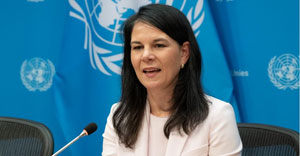 UNITED NATIONS, April 27: The President of the United Nations General Assembly, Ms. Annalena Baerbock, will travel to India on Tuesday and to China on April 29 and 30, at the invitation of the Governments of India and China, respectively.
 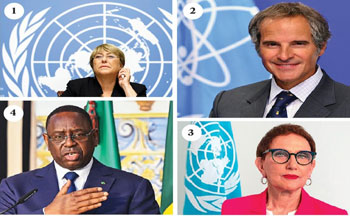 UNITED NATIONS, April 16: For the first time in ten years the United Nations will select a new Secretary-General to lead the organization at a time of unprecedented challenges.
India-US | India-France | Entertainment | Sports | Photo Gallery | Tourism | Link Partners | Contact Us
© Noyanika International, 2003-2024. All rights reserved.