


United Nations
Zeid calls for ICC probe into Myanmar Rohingya crisisBy Deepak Arora
Addressing the Human Rights Council after giving an update on the refugee crisis that has seen more than 700,000 Rohingya people flee to Bangladesh to escape a security clampdown in Myanmar, Zeid urged the UN Security Council to refer the Member State to the International Criminal Court (ICC) immediately. “We are not fools,” he said. The High Commissioner for Human Rights also responded to the Myanmar Government representative’s comments that it was a “body committed to the defence of human rights”. This, Mr. Zeid said, “almost creates a new category of absurdity” – a first during his mandate as the UN’s top human rights official. “In the four years that I have been High Commissioner I have heard many preposterous claims,” he said. “This claim, that I have just stated now, almost creates a new category of absurdity. Have some shame sir. Have some shame. We are not fools.” Earlier at the Human Rights Council, Mr. Zeid said that Myanmar had “expended considerable energy” challenging allegations that its security forces carried out ethnic cleansing against the mainly Muslim Rohingya. In January, he continued, the Government of Myanmar had signed a repatriation deal with Bangladesh, which continues to host the communities who fled their homes last August. Despite this agreement, “not a single Rohingya refugee has returned under the formal framework agreed with Bangladesh”, he said, while “many – if not all – of those who have returned … have been detained”. Citing one example, the High Commissioner said that between January and April this year, 58 Rohingya who returned were arrested and convicted on unspecified charges. “They then received a Presidential pardon, but have simply been transferred from Buthidaung prison (in northern Rakhine province) to a so-called ‘reception centre’,” he explained. All the while more Rohingya continue to seek shelter in Bangladesh, he continued, noting that as of mid-June, there have been 11,432 new arrivals there. On the issue of ICC involvement in the issue, as he had urged, Mr. Zeid noted that the results of its fact-finding mission to Myanmar were due to be submitted “in a matter of weeks”. The UN official also repeated a call for access to northern Rakhine state on behalf of the Human Rights Council and his own office, OHCHR. Myanmar should do this “instead of coming out with one bogus national commission after another”, the High Commissioner said – a reference to the country’s recent announcement that it intended to set up an “Independent Commission of Enquiry” to investigate alleged rights violations by Rohingya militants known as the Arakan Rohingya Salvation Army (ARSA) last year. While the Government claimed these attacks the cause of the current crisis, the UN rights chief explained that this was not possible since “cycles of violence” against the Rohingya “long pre-date ARSA, which was reportedly established in 2013”. Barring any special meetings called by the Council after this 38th scheduled session, Mr. Zeid’s address was his last in his official capacity as UN High Commissioner for Human Rights before he steps down. Noting this, he cautioned that “if a Member State of this organization can force out 700,000 people in almost three weeks, with practically minimal response by the International Community, then how many others in this Chamber are beginning to entertain something similar?” Myanmar, speaking as a concerned country, said that many of the allegations in the address by the High Commissioner were flawed, incorrect and misleading. ARSA had committed heinous and shocking atrocities, its delegatation said, adding that the root cause of the tragedy was terrorism. On the subject of repatriation, Myanmar was doing its utmost to repatriate the displaced persons as soon as possible, the delegation insisted. UN chief says Rohingya refugees sufferings most tragicBy Deepak Arora
“It is unacceptable that these people who have suffered so much in Myanmar now have to live in the difficult circumstances that these camps inevitably represent,” he added. The UN chief also praised the Government and people of Bangladesh for “generously” receiving the refugees and for providing them with basic protection and support. At the same time, he also called on the international community to “translate” its solidarity into sufficient support for the minority-Rohingya still living in Myanmar and those displaced across the border in Bangladesh. “My appeal to the international community is to step up to the plate and to substantially increase the financial support to all those working in Bangladesh to protect and assist the Rohingya refugees,” urged Mr. Guterres. He also said that the UN will continue to insist on the voluntary “right of return” of the Rohingya to their homes in Myanmar, but “only when the conditions are there for them to live in full dignity.”
The UN chief was accompanied by the World Bank Group President, Jim Yong Kim, which on Friday announced nearly $500 million in grant-based support to help Bangladesh address the needs of refugees. Speaking alongside Mr. Guterres at the press conference, Mr. Kim called on everyone to “stand in solidarity” with the Rohingya so that they can live a life of dignity, as well as with “their demand for such basic things that just about everyone else in the world enjoys.” “We as the World Bank Group are committed to doing more and more to make sure that the Rohingya … get some justice,” he declared. The complex Rohingya refugee crisis erupted last August following attacks on remote police outposts by armed groups alleged to belong to the community. These were followed by systematic counter attacks against the minority, mainly Muslim, Rohingya, which human rights groups, including senior UN officials, have said amounted to ethnic cleansing. In the weeks that followed, over 700,000 Rohingya – the majority of them children, women and the elderly – fled their homes for safely in Bangladesh, with little more than the clothes on their backs. Prior to the latest exodus, well over 200,000 Rohingya refugees were sheltering in Bangladesh as a result of earlier displacements. UN agencies and humanitarian partners have been on the ground, responding to the needs of both the refugees and communities hosting them. However, their efforts have often been overwhelmed by the sheer scale of the crisis and extreme weather. One of the most pressing challenges is the monsoon season which brings torrential rains as well as the threat of cyclones, landslides and flash-floods. “The heavy rains and their impact are already compounding the suffering of the refugees, even as they try to rebuild their lives,” said Natalia Kanem, the Executive Director of UN Population Fund (UNFPA), who was part of the Secretary-General’s delegation. She also applauded the support extended by the host communities. “We pledge to continue to do all we can to provide life-saving services for women and girls within the refugee population as well as the host communities who have been so generous in welcoming the Rohingya people,” added Dr. Kanem. In addition to the weather, severe lack of resources has also hampered the humanitarian response. A Joint Response Plan, launched by the UN in March, urging $951 million to provide life-saving assistance the refugees and host communities remains only 18 per cent funded. Against this backdrop, the support announced by the World Bank will help improve the conditions and step up the assistance from a “purely humanitarian and day-to-day to medium-term and developmental” response, said UN High Commissioner for Refugees Filippo Grandi, who was also in Cox’s Bazar as part of the high-level delegation. “We are really counting on these additional resources, and perhaps more resources that the Secretary-General and President of the World Bank will be able to mobilize in the future, to stabilize the conditions and create durable solutions,” said the UNHCR chief. Alongside UNFPA and UNHCR, the whole of the UN system remains engaged in ensuring refugees and host communities have access to much needed aid and protection. On the ground in Cox’s Bazar, the humanitarian response is being coordinated by the Inter-Sector Coordination Group (ISCG), which is led by the UN International Organization for Migration (IOM). Other agencies, such as the UN Children’s Fund (UNICEF) and the UN World Food Programme (WFP) are taking the lead in the protection of children and emergency nutrition, respectively. Afghanistan: Bring ‘architects’ of latest ‘appalling’ suicide bombing to justice, says deputy UN mission chiefNEW YORK, July 2: In the wake of dozens of civilian deaths – the most recent, a suicide attack in Jalalabad on Sunday – a high-level United Nations representative on the ground called for “the architects of this appalling crime” to be brought to justice. The UN Assistance Mission in Afghanistan (UNAMA) condemned the suicide attack that left at least 19 civilians dead, and expressed concern over a recent spate of incidents targeting schools and medical centres. More than 20 others, including children, were injured in the blast. “The architects of this appalling crime must be brought to justice,” said Ingrid Hayden on Monday, the deputy head of UNAMA, and Deputy Special Representative. According to a statement from the mission, most of the suicide bomber’s victims were from Afghanistan’s small Sikh and Hindu community – part of a delegation on its way to meet President Ashraf Ghani, who was visiting the capital city of Nangarhar province, in the Khogyani district. Media reports noted that among the dead in the overwhelmingly Muslim nation, was the only Sikh candidate who was standing in upcoming legislative elections. UN chief, António Guterres also condemned the attack, in a statement, extending his deepest condolences to the families of the victims. "Any attack deliberately targeting civilians is unjustifiable and in clear violation of international law," said the UN chief, calling on "all parties to uphold their obligation to protect civilians, including minority communities, and cease targeting civilians and civilian facilities." Elsewhere in Nangarhar, two civilian night watchmen were beheaded, a third killed and a school torched on Saturday in an attack by a local affiliate of the ISIL terrorist group, known as the Islamic State Khorasan Province (ISKP), which has been carrying out a campaign against schools and educational workers in the region. And on Monday, missiles were fired into Jalalabad – hitting the Najmuljihad high school, with other projectiles landing nearby. There were no reports of casualties. UNAMA also expressed concern over recent incidents impacting health facilities. On 25 June, a mortar hit the Andar district hospital in Ghazni province killing a doctor and a vaccination worker, and on 1 July, in the northern province of Faryab, three civilians, including a woman and child, were killed. Several others, mainly women and children, were injured in an Afghan National Army helicopter attack in the Pashtun Kot district. The attack allegedly targeted Taliban combatants at a health clinic where civilian patients were also receiving treatment, said UNAMA. The UN stressed that all parties to the conflict must at all times uphold their obligations to protect civilians and reiterated its call to immediately cease targeting civilians and civilian objects, including schools and health facilities, in compliance with the international humanitarian law. The UN in Afghanistan expressed its condolences to the loved-ones of all those killed and wished a full and speedy recovery to the injured. NPT an ‘essential pillar’ of international peace: UN chiefBy Deepak Arora
In a statement by his spokesperson, Secretary-General Guterres said that the NPT is an “essential pillar” of international peace and security, and the “heart” of the nuclear disarmament and non-proliferation regime. “Its unique status is based on its near universal membership, legally-binding obligations on disarmament, verifiable non-proliferation safeguards regime, and commitment to the peaceful use of nuclear energy,” he highlighted. In the statement, Mr. Guterres also welcomed the joint statement by the NPT’s depositories – Russia, the United Kingdom and the United States – including their recommitment to the elimination of nuclear weapons, a central priority of his agenda for disarmament, Securing our Common Future, which he unveiled in May. The NPT is a landmark international treaty whose objective is to prevent the spread of nuclear weapons and weapons technology, to promote co-operation in the peaceful uses of nuclear energy, and to further the goal of achieving nuclear disarmament. It represents the only binding commitment in a multilateral treaty to the goal of disarmament by the nuclear-weapon States. Since opening for signature on 1 July 1968, 191 States have joined the Treaty, including the five nuclear-weapon States. More countries have ratified the NPT than any other arms limitation and disarmament agreement. NPT entered into force in 1970 and in May 1995, it was extended indefinitely. In 2020, the review conference of the Treaty will be held, during which the States parties will examine the implementation of its provisions. UN chief applauds Bangladesh for ‘opening borders’ to Rohingya refugees in need
On mission in Bangladesh, the Secretary-General praised the country for keeping its borders open and receiving those in need of international protection. “In a world where so many borders are closed, [the people and Government of Bangladesh] have opened their borders and received their brothers and sisters coming from Myanmar and from the terrible events there,” said Mr. Guterres in the capital Dhaka on Sunday. The UN chief also praised the World Bank for its recently announced multi-million-dollar grant for Bangladesh to support both refugees and the communities hosting them. Mr. Guterres noted the progress made by Bangladesh since its independence and highlighted the country’s integration of the 2030 Agenda for Sustainable Development and the Sustainable Development Goals (SDGs) into its national planning frameworks, as an “example that many others can follow.” Mr. Guterres also warned of the impact of climate change, particularly for countries such as Bangladesh, where much of the land lies close to sea-level. He called for greater political will to realize the commitments made through the 2015 Paris climate change agreement and urged countries to raise their ambition to limit temperature rises.
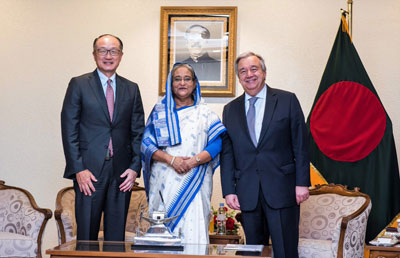
The Secretary-General arrived in Bangladesh early on Sunday as part of a joint trip with the President of the World Bank Group, Jim Yong Kim. On Sunday, Mr. Guterres and Mr. Kim also met with Sheikh Hasina, the Prime Minister of Bangladesh, where they discussed collaboration with her government to address the complex Rohingya crisis. They spoke about how they could work together to create conditions conducive for the return of Rohingya refugees to Myanmar, while at the same time, improving condtions for them in Bangladesh. “By hosting the Rohingya, Bangladesh has done a great service for the world. We will support this effort any way we can,” said Mr. Kim in a tweet following the meeting. The Secretary-General and the World Bank Group President also visited the Bangabandhu Memorial Museum which was the house of Bangabandhu Sheikh Mujibur Rahaman, the first President of Bangladesh and father of the current Prime Minister. He and other members of his family were assassinated there in August 1975 by a group of soldiers. Later in the evening, the Secretary-General and his delegation were hosted for an official dinner by the Prime Minister of Bangladesh. On his mission, Mr. Guterres is being accompanied by number of senior UN officials, including the High Commissioner for Refugees, Filippo Grandi, and the Executive Director of the UN Population Fund (UNFPA), Natalia Kanem. On Monday, they are due to travel to Cox’s Bazar in southern Bangladesh to visit Rohingya refugee communities and humanitarian workers. Since late August 2017, violence against Myanmar’s mainly-Muslim minority Rohingya, forced hundreds of thousands to flee their homes in Rakhine state and seek refuge across the border, in Bangladesh. Prior to that, well over 200,000 Rohingya refugees were already sheltering in Bangladesh as a result of earlier displacements. Even though the number of new arrivals has tapered off, and an agreement has been reached between the UN on the ground and the government, over establishing conditions in Myanmar to allow refugees’ voluntary and safe return, UN agencies there have reported that such conditions have not yet materialized. As of 24 May, there are an estimated 905,000 refugees in Cox’s Bazar. To address the ongoing and increasing needs, the UN launched a Joint Response Plan in March, urging $951 million to provide life-saving assistance the refugees and host communities. However, the appeal remains only 18 per cent funded. |
|
||||||
 UNITED NATIONS, July 4: Myanmar should “have some shame” after attempting to convince the world that it is willing to take back hundreds of thousands of refugees who fled an “ethnic cleansing campaign” last year, given that “not a single” one has returned officially, the United Nations human rights chief warned on Wednesday.
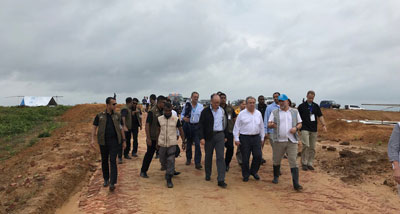 DHAKA, July 2: Speaking to the press in Cox’s Bazar, the region in southern Bangladesh where nearly one million Rohingya are living under constant threat of flash-floods and landslides, UN Secretary General Antonio Guterres said that the violence they had faced at home in Myanmar since last August, was probably one of the most “tragic stories” of “systematic violation” of human rights ever recorded.
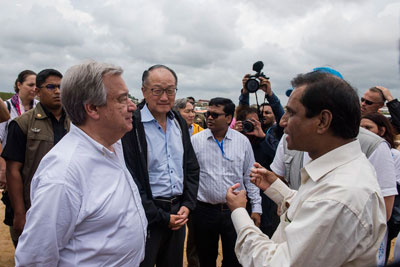 Mr. Guterres arrived in Bangladesh on Sunday early morning local time, to draw attention to the plight of the Rohingya refugees as well as to impress the need on the international community to do more to support them.
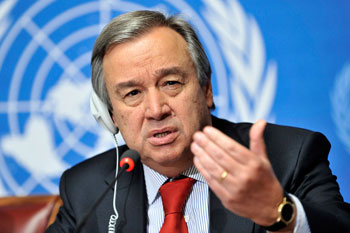 UNITED NATIONS, July 1: On the 50th anniversary of the opening for signature of the Treaty on the Non-Proliferation of Nuclear Weapons (NPT), United Nations Secretary-General António Guterres urged all State parties to ensure the Treaty’s continued strength and importance in the years ahead.
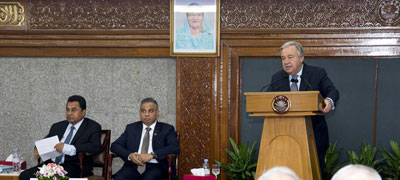 DHAKA, July 1: United Nations Secretary-General António Guterres has applauded Bangladesh for giving a safe haven to hundreds of thousands of Rohingya refugees driven from their homes in Myanmar by systematic and widespread violence.
 The UN chief also underscored the importance of empowering women and youth, calling for young people to be given more opportunities and great access to education.
Aviation
| Business | Defence | Foreign
Affairs | Communication | Health
| India | United Nations
India-US
| India-France | Entertainment
| Sports | Photo Gallery |
Tourism | Advertise with Us
| Contact Us
© Noyanika International, 2003-2009. All rights reserved.