


United Nations
Green economy is the future: UN chief António GuterresBy Deepak Arora
“To put it simply, we need green development. We need sustainable development. And we need it now,” the UN chief told world leaders in Beijing, discussing ways to boost green development as part of a conference on China’s Belt and Road Initiative. Painting a sobering picture of the challenges ahead – for the planet and the broader effort to secure improved human well-being while reducing environmental risks – Guterres recalled that the last four years were the hottest on record and that natural disasters have wreaked havoc in nearly every region of the globe. “No country or community is immune. And, as we know, the poor and vulnerable are the first to suffer, and the worst hit,” said Guterres, warning that the climate crisis threatens decades of progress and jeopardizes all our plans for inclusive, sustainable development. “And the clock is ticking. Science has clearly told us that we have only 12 years for this transformation, if we want to limit temperature rise to 1.5 degrees Celsius and avoid the worst impacts of climate change.”
To help generate ambition and to showcase practical, feasible and ambitious solutions to meet globally agreed goals, Guterres is convening a Climate Action Summit in New York on 23 September. "I am calling on leaders to come with concrete, realistic plans to enhance their Nationally Determined Contributions (NDCs) by 2020,” he said, referring to efforts by each country under the Paris Agreement to reduce national emissions and adapt faster to the impacts of climate change. The Secretary-General said these plans must show how greenhouse gas emissions can be reduced by 45 per cent over the next decade and how the world can get to net zero emissions globally by 2050 through strong mitigation and adaptation measures. “It is why I have been asking leaders around the world to adopt carbon pricing that reflects the true cost of emissions, end subsidies on fossil fuels, and stop construction of new coal plants beyond 2020,” he explained, noting that he is also counting on leaders to make sure their plans include women as key decision-makers and address the disproportionate impacts many women experience from climate change. In all this, Chinese leadership will continue to be crucial, said Guterres, stressing that new renewable energy jobs in China now outnumber those created in the oil and gas industries. China also played a pivotal role in building bridges and securing an agreement at last December’s UN Climate Conference in Katowice – and will host next year’s second Global Sustainable Transport Conference. The Belt and Road Initiative, with its huge volume of investment, said, Mr. Guterres, is an opportunity to propel the world into a green future and help countries transition to low-carbon, clean-energy pathways with new infrastructure that is sustainable and equitable. “The momentum for transformational change is growing,” said the Secretary-General, stressing that the “green economy is the future,” and more governments, cities and businesses than ever understand that climate solutions strengthen economies and protect the environment at the same time. New technologies are delivering energy at a lower cost than the fossil-fuel-driven economy, he continued, and solar and onshore wind are now the cheapest sources of new power, in virtually all major economies. Protect women’s rights ‘before, during and after conflict’: UN chiefBy Deepak Arora
At the meeting marking the 10th anniversary of the adoption of resolution 1888, which created the mandate of the Special Representative on Sexual Violence in Conflict, the Council passed a German-drafted resolution to reduce sexual violence in conflict and end rape as a weapon of war, with 13 in favour, and two countries, Russia and China, abstaining. Lengthy negotiations reportedly took place over the wording of the final resolution, with some Members arguing against the establishment of a formal new reporting mechanism, and also references to womens' reproductive and sexual health service provisions. Addressing the overall scourge, Guterres said that “Local civil society organizations, many of them women’s organizations, are on the frontlines of our efforts to prevent and provide redress for this crime, and they deserve our strong and consistent support." Sexual violence in war “largely affects women and girls because it is closely linked to broader issues of gender inequality and discrimination”, Guterres said, adding that “prevention” must be based on “promoting women’s rights and gender equality in all areas, before, during and after conflict”. “This must include women’s full and effective participation in political, economic and social life and ensuring accessible and responsive justice and security institutions”, he said. Guterres also recognized the links between sexual violence in conflict, gender inequality and discrimination, and violent extremism and terrorism. “Extremists and terrorists often build their ideologies around the subjugation of women and girls and use sexual violence in various ways, from forced marriage to virtual enslavement”, he explained. “Sexual violence continues to fuel conflict and severely impacts the prospects for lasting peace”. “I encourage this Council to include the prevention of conflict-related sexual violence in all your country-specific resolutions, and in the mandates of peace operations”, he said. Guterres stressed the need to strengthen justice and accountability, saying that despite a handful of high-profile convictions, “there is widespread impunity for sexual violence in conflict” and that most “are never reported, investigated and much less prosecuted”. He encouraged the Council to continue working together “to reconcile differences”, as the “global “response to these crimes must ensure punishment of the perpetrators and comprehensive support to survivors with full respect for their human rights”. “Together, we can and must replace impunity with justice, and indifference with action”, stressed the Secretary-General. Although stigma and other social barriers contribute to the chronic underreporting of sexual violence, the UN Special Representative on Sexual Violence in Conflict, Pramila Patten, told the Council that “we now understand much more about its many forms, drivers, and impacts, and about the devastating physical, psychological, and social burdens survivors bear”. And yet, after a decade of concerted attention and action to deal with this crime, she spelled out: “Wars are still being fought on, and over, the bodies of women and girls”. “Sexual violence fuels conflict and severely impacts the prospects for lasting peace” Ms. Patten stated, adding that it is used “precisely because it is such an effective means to target individuals and devastate entire communities”. The UN envoy painted a picture of victims targeted because of their ethnic, religious, political or clan affiliation. Ms. Patten recounted a visit to South Sudan where she was “horrified” by the “sheer brutality of the sexual violence, perpetrated along ethnic lines against women and girls, even children as young as 4 years”. She described “utterly shell-shocked” communities in the UN Protection of Civilian site in the capital, Juba, who were ganged raped and abducted for sexual slavery. “Imagine a desperation so raw that parents would marry their daughter off to one stranger to spare her rape by many”, she asserted. “If we are ever to prevent these crimes from occurring in the first place, we must confront the unacceptable reality that it is still largely cost-free to rape a woman, child or man in armed conflicts around the world”, she said. “To turn the tide, we must increase the cost and consequences for those who commit, command or condone sexual violence in conflict”. “We must convert a centuries-old culture of impunity into a culture of accountability,” concluded the Special Representative. World-renowned human rights lawyer, Amal Clooney, recounted some of the “important milestones” she had reached advocating on behalf of Yazadi women and girls from northern Iraq, thousands of whom were sold into sexual slavery by extremist group ISIL. She said that two weeks ago in Germany, she had represented the mother of a five-year old Yazidi child, at the first trial against an ISIS terrorist fighter, facing war crimes charges. Ms. Clooney said the mother had been “enslaved, chained outdoors to a window, and left to slowly die of thirst in the scorching heat” but now justice was being served and he “faces charges of murder as a war crime”. “Crimes committed by ISIS against women and girls are unlike anything we have witnessed in modem time” she said, adding that “the question of bringing them to justice has barely raised a whisper…if we don’t act now, it will be too late”. “This is your Nuremberg moment”, she told the Council, referring to the trials carried out in Germany after World War Two that prosecuted Nazis and others indicted on charges of crimes against humanity. Sexual violence crimes committed against women across the world have become “a dangerous phenomenon” that requires action by all, UN Office on Drugs and Crime Goodwill Ambassador Nadia Murad told the Council. The Yazidi survivor of rape-turned-advocate, spoke of how the thousands of Yazidi women and girls had been enslaved of in front of the local and international community, remarking that “no one intervened to stop them”. Moreover, the genocide of the Yazidis continues. “The social fabric of an entire society has been torn, the hopes and aspirations of generations were wasted”, she bemoaned. “We were prevented from practicing our traditions… [and] there were dozens of mass graves across our region. She said that the international community must “shoulder the responsibility” to rescue those still missing and in captivity since 2014. Ms. Murad said that some Yazidi women who had been subjected to sexual violence at the hand of ISIS had “broken the barrier of silence” and “told their stories to the world”, hoping for justice. “However, so far, not a single person was tried for sexual enslavement crimes against the Yazidis”, she informed the Council, adding that more than 350,000 Yazidis are still displaced in camps. “After five years since the genocide against my people, as the world stood and watched, no clear steps have been taken to save the surviving Yazidis”, she said. Asking that those perpetrators who “used Yazidi women as weapons of war” be brought to justice, Ms. Murad urged that they be tried before an international tribunal “for crimes of genocide and sexual violence against women and children” to send a message to others that would “prevent such crimes in the future." 45 children among victims during Easter Sunday attacks in Sri LankaBy Deepak Arora COLOMBO, April 23: Jean Gough, Regional Director, UNICEF South Asia, and Tim Sutton, Representative UNICEF Sri Lanka have said that 45 children have been killed, scores of children injured, many children orphaned during the bomb blasts in Sri Lanka on Easter Sunday. News of how these attacks have affected children and adolescents is still coming in, but we now know that 45 children– both Sri Lankan and other nationalities – have been killed, with scores more injured and fighting for their lives in intensive care units across the country. Many children have lost one or both parents, and countless children have witnessed shocking and senseless violence. UNICEF is working closely with Government partners to collect reliable information on the situation of affected children and adolescents. UNICEF condemned this violence in the strongest possible terms. "No child or parent should experience such violence or loss. Every child has the right to safety and security," added the statement. Yemen has already lost two decades of human developmentBy Deepak Arora AMMAN, April 23: Ongoing conflict in Yemen has already reversed human development by 21 years, according to a UNDP-commissioned study released today. The study warns of exponentially growing impacts of conflict on human development. It projects that if the war ends in 2022, development gains will have been set back by 26 years — almost a generation. If it continues through 2030, that setback will increase to four decades. Commissioned by the United Nations Development Programme (UNDP) in Yemen and conducted by researchers from the Frederick S. Pardee Centre for International Futures, Josef Korbel School of International Studies, University of Denver, the study entitled Assessing the Impact of War on Development in Yemen considers the impact of conflict on the priorities articulated in the globally agreed Agenda 2030 for Sustainable Development and its Sustainable Development Goals. The study compares three potential quantitative modelling scenarios for the conflict ending in 2019, 2022 and 2030 against a hypothetical scenario where the conflict did not escalate after 2014. Based on the scenarios, the study attempts to quantify the impact of conflict on multiple dimensions of development, including demographic outlook, economic conditions, infrastructures, health and education. “Human development has not just been interrupted. It has been reversed,” asserted UNDP Yemen Resident Representative, Auke Lootsma. “Even if there were to be peace tomorrow, it could take decades for Yemen to return to pre-conflict levels of development. This is a big loss for the people of Yemen.” The study projects that, if this conflict ends in 2019, economic output losses will add up to around US$88.8 billion –a reduction of US$2,000 (purchasing power parity) in the GDP per capita. By 2030, the study estimates that 71 percent of the population will be living in extreme poverty; 84 percent will be malnourished; and estimated losses in economic output will amount to around US$657 billion—more than doubling the decrease in GDP per capita to a staggering a US$4,600 (purchasing power parity). Indirect deaths, caused by lack of access to food, health care, and infrastructure services, will be five times greater than direct deaths. “The long-term impacts of conflict are vast and place it among the most destructive conflicts since the end of the Cold War,” states the report; and further deterioration of the situation “will add significantly to prolonged human suffering, retard human development in Yemen, and could further deteriorate regional stability.” UN leaders condemn Sri Lanka terror attacks
According to news reports, three churches were targeted, in the cities of Batticaloa, Negombo, and the capital, Colombo. The Shangri-La, Kingsbury, Cinnamon Grand and another hotel, all in the capital, were also hit. The Secretary-General said in a statement that on what was "a sacred day for Christians around the world", he recalled "the sanctity of all places of worship". The statement issued by his Spokesperson said the UN chief "expresses his deepest condolences to the families of the victims, the people and Government of Sri Lanka, and wishes a speedy recovery to the injured". Guterres also commended "the leadership demonstrated by the authorities and unity of the people in Sri Lanka in the wake of the attacks" In a tweet, the UN’s Resident Coordinator for the Indian Ocean island, Hanaa Singer, said the UN "strongly condemns the horrific attacks carried out against civilians and worshippers...Heartfelt condolences to the families, victims, Government and people”. She also urged Sri Lankans to stand united” in the face of the carnage. The President of the UN General Assembly, Maria Fernanda Espinosa, also expressed her “deep sadness” in a tweet, saying that her thoughts were with the people of Sri Lanka, “affected by yet another act of senseless violence”. “We must unite in our common humanity to condemn these heinous acts and stop targetting innocent people, practicing their faith in peace”, she added. Pope Francis, in his Easter Address outside St. Peter’s in Rome, reportedly expressed his “affectionate closeness” for the Christian community in Sri Lanka which had been struck while gathering for one of its biggest celebrations of the year, and his thoughts to “all the victims of such cruel violence” UN chief Guterres, concluded his statement reiterating the "supprt and solidarity of the United Nations, with the people and the Government of Sri Lanka, in this difficult moment for the nation." UNAOC condemns Terror Attacks in Sri LankaBy Deepak Arora NEW YORK, April 21: Miguel Moratinos, the High Representative for the United Nations Alliance of Civilizations (UNAOC) condemns in the strongest terms the multiple terrorists attacks in Colombo, Sri Lanka. The barbaric attacks targeted Christian worshippers attending Easter Mass, the culmination of Holy Week. The horrific attacks also targeted civilians in a hotel. The High-Representative reiterated that such heinous terrorist attacks that knows no religion, country or ethnicity are unjustifiable regardless of whomever and wherever they are being perpetrated. He stresses that today’s unspeakable terrorist attacks should not dissuade us from taking a collective stand against terrorism in all its forms and to continue to work to promote tolerance and respect of the other. The High Representative for UNAOC pledges to continue to work on developing his Plan of Action for safeguarding religious sites to guarantee that worshippers can observe their rituals in a spirit of peace and compassion. On behalf of UNAOC, the High Representative expresses his deepest condolences to the families of the victims and stresses his solidarity with the people and the Government of Sri Lanka. China faces ‘tentative’ ultimatum on blacklisting Masood Azhar
The three powers want China to allow the UNSC designation of Azhar “tentatively” by April 23, or they will move to the next step by moving a formal resolution for discussion, vote and passage at the UNSC, according to a report, which could not be verified independently. In response to a request for comment, the United States said, “We decline to comment”. A response was awaited from the permanent mission of France, which had taken the lead in introducing the fourth proposal yet to designate the JeM terrorist. The US and the UK jointly sponsored the proposal. Moved before the 1267 sanctions committee of the UN Security Council after Pulwama, the proposal stalled after a technical hold was put on it by China, which blocked all three previous attempts acting on behalf of Azhar’s host country Pakistan. Under the rules, China could keep the hold in place for six months and then three more. But, out of patience, the US, the UK and France are determined to force China’s hand this time by going around the sanctions committee, whose opaque operational rules of confidentiality and anonymity allowed China to block the designation without explaining its reasons or taking responsibility for it. The three powers moved a draft resolution before the Security Council late last month to trigger “informal discussions” on the designation with the understanding amongst themselves that China cannot be allowed to take forever to decide. It had a choice now: relent, or protect a terrorist from designation in full view of the world. Beijing bristled at being pushed and complained the three powers were setting a bad precedent by going around the sanction committee. But it was met with even more determination and resolve. The United States said it was prepared to “utilize all available resources” to blacklist Azhar. Discussions have been on since. And Beijing has claimed it is working hard to resolve the issue. Some progress has been reported indeed but the US, the UK and France and India, which is not a member of the UNSC, are unwilling to let Beijing “run the clock” on it, as it has done before. The next stage of the plan put into motion by the three powers after China put the hold early March was to move a formal resolution before the and seek an open debate and vote, in a rare move to blacklist a man whose outfit was designated a terrorist organization in 2001. There has been no reaction from China yet to the reported ultimatum. |
|
||||||
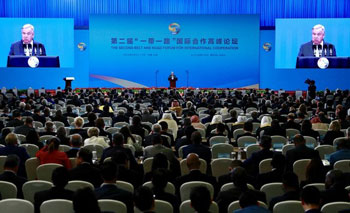 BEIJING, April 27: Winning the race against climate change to keep our planet livable and on a healthy trajectory requires action rooted in sustainable solutions aligned with the Paris Agreement and the UN-driven 2030 Agenda for sustainable development, Secretary-General António Guterres said on Saturday.
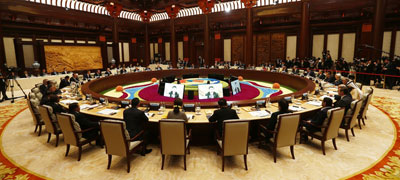 Yet the race to head off a climate catastrophe and ensure a safe and secure planet for all can be won, he said, with global action rooted in solutions that are sustainable and aligned with the landmark Paris accord and the UN 2030 Agenda.
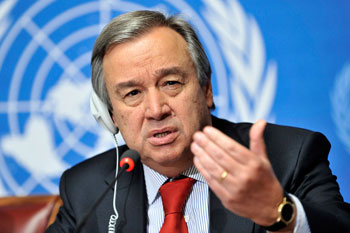 UNITED NATIONS, April 23: Over the course of the past decade, there has been “a paradigm shift” in understanding the devastating impact of sexual violence in conflict on international peace and security, UN Secretary-General António Guterres told the Security Council during a high-level debate on Tuesday.
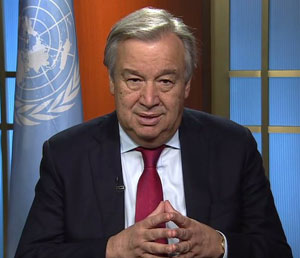 UNITED NATIONS, April 21: UN chief António Guterres said he was "outraged by the terror attacks" in Sri Lnaka and called for the perpetrators to be "swiftly brought to justice".
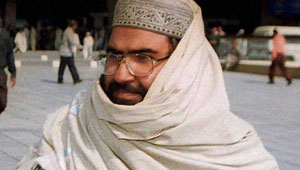 WASHINGTON, April 13: The United States, France and the United Kingdom are reported to have posted a deadline for China to lift its hold on their proposal for a UN Security Council body to blacklist Masood Azhar, founder of Pakistan-based Jaish-e-Mohammad, which has claimed responsibility for the Pulwama terror attack in February.
Aviation
| Business | Defence | Foreign
Affairs | Communication | Health
| India | United Nations
India-US
| India-France | Entertainment
| Sports | Photo Gallery |
Tourism | Advertise with Us
| Contact Us
© Noyanika International, 2003-2009. All rights reserved.