


United Nations
UN chief appeals to G20 leaders for stronger commitment to climate action, economic cooperationBy Deepak Arora
“We have global warming, but we have also global political warming, and this can be seen in relation to trade and technology conflicts, it can be seen in relation to situations in several parts of the world, namely the Gulf”, he told reporters before addressing the summit, referring to recent attacks on oil tankers around the Strait of Hormuz and the Gulf of Oman, which have heightened tensions between Iran and the United States. Turning to “uncertainties about the global economy”, he pointed to trade conflicts, high debt levels, potentially unstable financial markets and the risk of global growth slowdown. In the UN chief’s view, it “will be very difficult to have a breakthrough in relation to some of the most difficult challenges that the international community is facing”. The Secretary-General spotlighted the urgency of addressing climate change as a main priority. Painting a picture of “heat waves in Europe, drought in Africa, storms happening also in Africa and the Caribbean” and a “multiplication” more intense, more frequent natural disasters “with worsening humanitarian consequences” he repeated his passionate refrain that “climate change is running faster than what we are”. “All the analyses that can be made show the situation, in practical terms, is worse than what we could have forecasted, and the political will has been failing”, he said, calling it “a paradox that needs to be addressed”. Avowing his belief in climate science, Guterres cited the landmark Intergovernmental Panel on Climate Change (IPCC) report of last October, which spells out that by the end of the 21st Century, temperatures must not exceed 1.5 degrees Celsius above pre-industrial levels. This necessitates the world reaching carbon neutrality by 2050, which requires more ambition by governments and others. He spoke about the UN’s September Climate Action Summit in New York where he will appeal to world leaders for a stronger commitment for climate action, including by “putting a price on carbon, ending subsidies to fossil fuels, [and] not accepting the idea that we still have an acceleration of the construction of coal power plants”, all of which are “absolutely essential to rescue the planet”. The 2030 Agenda for Sustainable Development is another main challenge where “we are lagging behind”, according to the UN chief. “If we project the different Sustainable Development Goals (SDGs), the evolution since the beginning until now to 2030, we will be more or less at midway of what the international community has determined when the Agenda 2030 was approved”, he said, arguing the need to accelerate resource mobilization. “Countries need to do more, mobilizing their own internal resources, improving their governance, reducing corruption, implementing the rule of law”. Guterres highlighted that G20 nations represent 80 per cent of climate change emissions and appealed for a stronger commitment to international financial and economic cooperation. After delivering his prepared text, the UN chief took questions on a variety of subjects, including rising tensions between the United States and Iran, where he reiterated his support for the Joint Comprehensive Plan of Action (JCPOA), commonly known as the Iran nuclear deal. “I have always believed and will go on believing that the JCPOA is a very important instrument…and it was a factor of stability, and that it will be very important to preserve it”, he stated. “Obviously, it is essential to de-escalate the situation in the Gulf” to avoid a confrontation that “the world couldn’t afford". When asked to what extent the UN chief held President Trump responsible for disagreements among the G20 leaders, he stressed the importance of dialogue between the presidents of China and the US, saying theirs was “probably the most relevant bilateral meeting that will take place”. On the digital economy, the UN chief spoke of the recently concluded high-level panel on the digital cooperation, noting the “huge impact” that it – along with artificial intelligence – will have on the global economy. “We will see a massive destruction of jobs and the massive creation of jobs, but the jobs will be different,” he said, adding that there must be “a strong commitment” by countries to guarantee the education, social protection and job creation needed to “minimize the negative impacts” and “optimize the positive contributions of the fourth industrial revolution”. India to overtake China as most populous country in next 8 years: UNUNITED NATIONS, June 18: The world’s population will increase to 9.7 billion by 2050, going up by 2 bn from the earlier 7.7 bn, shows a new United Nations report launched on Monday. The global population could reach its peak around the end of the current century, with an estimated population of 11 bn. India is projected to overtake China as the world’s most populous country in next 8 years, according to the report. The global fertility rate, which fell from 3.2 births per woman in 1990 to 2.5 in 2019, will decline further to 2.2 in 2050. India’s current total fertility rate stands at 2.2 births per woman. Nine countries will make up more than half of the projected growth of the global population between now and 2050: India, Nigeria, Pakistan, the Democratic Republic of the Congo, Ethiopia, the United Republic of Tanzania, Indonesia, Egypt and the United States of America. The population of sub-Saharan Africa is projected to double by 2050, up 99%. Regions that may experience lower rates of population growth between 2019 and 2050 include Oceania excluding Australia/New Zealand (56%), Northern Africa and Western Asia (46%), Australia/New Zealand (28%), Central and Southern Asia (25%), Latin America and the Caribbean (18%), Eastern and South Eastern Asia (3%), and Europe and Northern America (2%). People are growing older due to increasing life expectancy and falling fertility levels, and that the number of countries experiencing a reduction in population size is growing. “Many of the fastest growing populations are in the poorest countries, where population growth brings additional challenges in the effort to eradicate poverty, achieve greater equality, combat hunger and malnutrition and strengthen the coverage and quality of health and education systems to ensure that no one is left behind,” said Liu Zhenmin, UN Under-Secretary-General for Economic and Social Affairs. In the poorest of countries, people still live seven years less than the global average. “In 2019, life expectancy at birth in the least developed countries lags 7.4 years behind the global average, due largely to persistently high levels of child and maternal mortality, as well as violence, conflict and the continuing impact of the HIV epidemic,” says the report. The World Population Prospects 2019: Highlights, which is published by the Population Division of the UN Department of Economic and Social Affairs, provides a comprehensive overview of global demographic patterns and prospects. India backs Israel to keep Palestinian group out of UN bodiesNEW YORK, June 11: India voted in favour of a resolution moved by Israel at a UN body to bar a Palestinian rights organisation called Shahed being given observer status at UN institutions, with Israeli diplomats describing the move as a significant development. According to the Israeli foreign ministry, the UN Economic and Social Council (ECOSOC) “overwhelmingly rejected” Shahed’s request to obtain observer status at UN institutions. The resolution initiated by the Israeli delegation to the UN was passed in a 28-14 vote on June 6. India, the US, the UK, France, Germany and Japan were among the 28 countries that voted in favour of the resolution, which was opposed by China, Pakistan, Egypt, Morocco and Russia. There was no immediate word from the Indian government on the matter. Though the vote happened on June 6, it came to light on Tuesday when Maya Kadosh, deputy chief of mission at the Israeli embassy, tweeted: “Thank you India for standing with @IsraelinUN and rejecting the request of terrorist organization “Shahed” to obtain the status of an observer in #UN. Together we will continue to act against terrorist organizations that intend to harm.” The Israeli foreign ministry described Shahed as a Palestinian organisation based in Lebanon that “claims to deal with human rights and humanitarian issues, but in practice is an organisation that Israel has declared a terrorist organization”. People familiar with developments said Israel considers Shahed an arm of Hamas and the Islamic Jihad Movement. They said Israel had moved the resolution after ascertaining Shahed’s links to terror groups. They added India’s vote on the matter was a good sign for bilateral relations. St. Vincent and the Grenadines breaks a record, as smallest ever Security Council seat holderBy Deepak Arora UNITED NATIONS, June 7: Following a secret ballot held on Friday, the UN General Assembly elected five countries to the Security Council, including St. Vincent and the Grenadines, the smallest nation ever to secure a seat. Also elected were Estonia, Niger, Tunisia, VietNam. The five States will take up their seats as non-permanent members of the Security Council in January 2020, replacing Cote d’Ivoire, Equatorial Guinea, Kuwait, Peru and Poland. Every year, five countries are elected to the 15-member Council (10 of whom are non-permanent) for a two-year term, according to a geographical rotation set by the Assembly in 1963, to ensure fair regional representation: five from African and Asian and Pacific States; one from Eastern Europe; two from Latin American States; and two from Western European and Other States (WEOG). Whilst Niger, Tunisia and Viet Nam were elected unopposed, two of the five seats were contested: El Salvador competed with Saint Vincent and the Grenadines to represent the Latin American and Caribbean group; and Romania lost out to Estonia in the East European group. Speaking to the press outside the General Assembly Hall, Ralph Gonsalves, Prime Minister of St. Vincent and the Grenadines, described the election of his multi-island nation of around 110,000 people, as a “historic occasion”. Gonsalves added that the country is committed to the principle of sustainable development and, as a Small Island Developing State in danger of inundation by rising seas, is very concerned about the consequences of adverse climate change and intends to work very closely with the other members of the Security Council. The UN, he added, has limitations, but it also has “profound strengths.” Following a 2014 General Assembly resolution, elections to the non-permanent Security Council seats were moved from October to June, to give incoming countries more time to prepare for their terms, before assuming their responsibilities. |
|
||||||
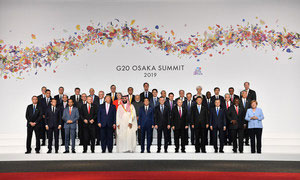 OSAKA, June 28: The annual G20 summit of leaders from the largest and fastest-growing economies, got underway on Friday in Osaka, Japan, against a backdrop of what UN Secretary-General António Guterres described as “a moment of high political tension”.
Aviation
| Business | Defence | Foreign
Affairs | Communication | Health
| India | United Nations
India-US
| India-France | Entertainment
| Sports | Photo Gallery |
Tourism | Advertise with Us
| Contact Us
© Noyanika International, 2003-2009. All rights reserved.