


DEFENCE
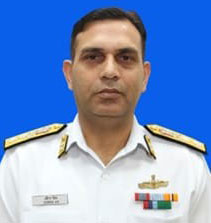
India Needs a National Maritime Commission to Safeguard Strategic and Economic Interests: ExpertsBy Rear Admiral Dhiren Vig (Retd)
Strategic analysts and maritime experts argue that recent geopolitical developments, including disruptions to oil and gas supply routes in the Indian Ocean Region (IOR), have exposed vulnerabilities in India’s maritime preparedness and highlighted the urgent need for an apex-level maritime body. The debate has gained momentum following the first anniversary of Operation Sindoor on May 7, during which the Indian Navy’s strategic role in safeguarding national interests without direct military engagement was widely acknowledged. India’s geographical position, with an 11,000-km coastline and island territories across both seaboards, places it at the centre of critical sea lanes in the Indian Ocean. Experts say this provides the country with significant strategic and economic advantages that remain underutilised. Historically, maritime dominance has shaped the rise of global powers, from the Phoenicians and British Empire to the United States and China. Indian historian and diplomat K. M. Panikkar had argued as early as 1945 that India’s security and prosperity were inseparable from maritime strength and influence in the Indian Ocean. Global trade and economic activity continue to depend heavily on the oceans. Nearly 90 per cent of world trade by volume is transported through maritime routes, while the global ocean economy is estimated to be worth around $3 trillion annually. Offshore oil and gas production, renewable energy projects and deep-sea mining are also expanding rapidly. India’s blue economy currently contributes nearly 4 per cent to the national GDP and supports around 30 million livelihoods. The country conducts 95 per cent of its trade through maritime routes and remains one of the world’s largest fish-producing nations. Prime Minister Narendra Modi launched the SAGAR (Security and Growth for All in the Region) initiative in 2015 to enhance maritime cooperation and security in the Indian Ocean Region. In 2025, the initiative was expanded and renamed MAHASAGAR (Mutual and Holistic Advancement for Security and Growth Across Regions) to reflect a broader global maritime vision. India has also accelerated investments in port modernisation, shipbuilding and maritime logistics through programmes such as Sagarmala and Maritime Vision 2047. The recently enacted Merchant Shipping Bill, 2025 aims to modernise India’s maritime regulatory framework and align it with global standards. In the energy and resource sector, the government has launched initiatives such as the Deep Ocean Mission and Samudra Manthan Mission to promote offshore exploration, deep-sea mining and domestic oil and gas production. India has already tested deep-sea mining systems at depths exceeding 5,000 metres in the Central Indian Ocean Basin. Despite these advances, experts warn that India’s maritime governance structure remains fragmented across multiple ministries and agencies, including defence, home affairs, ports and shipping, fisheries, petroleum, external affairs and finance. Security responsibilities are also divided among several organisations, including the Indian Navy, Indian Coast Guard, marine police units, customs authorities and port agencies. Analysts say this fragmented structure often hampers coordination and rapid response to maritime threats. The National Committee on Strengthening Maritime and Coastal Security, established after the 2008 Mumbai attacks, has reportedly struggled to ensure sustained coordination among stakeholders due to infrequent meetings and overlapping jurisdictions. Experts now argue that a National Maritime Commission could serve as a unified institutional framework to coordinate maritime security, economic development, resource management and strategic policymaking. According to the proposal, the commission would include senior naval officers, coast guard officials and experienced civil administrators to oversee initiatives related to maritime security, shipping, shipbuilding, the blue economy and ocean resource utilisation. Supporters of the idea say the proposed body would help India achieve its long-term goal of becoming a developed nation by 2047 by leveraging the strategic and economic potential of the seas more effectively. @ Rear Admiral Dhiren vig (Retd) is currently Member of the Armed Forces Tribunal |
|
||||||
 NEW DELHI, May 12: The growing instability in West Asia and the increasing weaponisation of maritime choke points have renewed calls for India to establish a National Maritime Commission (NMC) to strengthen maritime security, streamline governance and accelerate the country’s blue economy ambitions.
India-US | India-France | Entertainment | Sports | Photo Gallery | Tourism | Link Partners | Contact Us
© Noyanika International, 2003-2024. All rights reserved.