


Foreign Affairs
|
, |
Modi Holds Bilateral Talks With South Africa, Philippines, Egypt LeadersNEW DELHI, Sept 13: Prime Minister Narendra Modi on Sunday held bilateral discussions with South African President Cyril Ramaphosa, Philippines President Ferdinand Marcos Jr, and Egyptian President Abdel Fattah El-Sisi on the sidelines of the BRICS summit, with a focus on boosting trade and investment ties. Modi also held a series of meetings with other global leaders, including Kazakh President Kassym-Jomart Tokayev, Indonesian President Prabowo Subianto, Burundi President Evariste Ndayishimiye, Ugandan Vice President Jessica Alupo, and Nigerian Vice President Kashim Shettima. Officials said boosting cooperation in trade, investment, defence and people-to-people ties was a dominant theme at the meetings. In a social media post, Modi said he and Ramaphosa reviewed the full breadth of the India-South Africa strategic partnership including cooperation in mining and critical minerals, infrastructure, food security, digital public infrastructure and emerging technologies. "Our partnership is rooted in history and firmly focused on the future. We will work closely for Africa's progress, the priorities of the Global South and a more balanced global order," he said. The Ministry of External Affairs (MEA) said the two leaders exchanged views on a range of global issues of mutual interest and agreed to maintain close coordination in multilateral fora. "In the context of the successful translocation of cheetahs from South Africa to India, the prime minister invited South Africa to consider joining the International Big Cat Alliance," it said. The prime minister said he and Marcos Jr reviewed the growing momentum in the India-Philippines strategic partnership with a key focus on economic linkages, cooperation in technology, trade, space and innovation. "We also discussed ways to further strengthen India-ASEAN engagement," he said. The MEA said the two leaders expressed satisfaction at the progress made in bilateral cooperation across all areas and agreed to further deepen and expand collaboration in the fields of defence and security, trade and investment, space, railway infrastructure, fintech, education, tourism, science and technology, and innovation. Modi said on social media that he had a "wonderful interaction" with President El-Sisi. "We talked about various issues, notably regional issues and the India-Egypt friendship that is significantly growing in recent times." On his meeting with Tokayev, Modi said he had "productive discussions" with the Kazakh President on giving "fresh momentum" to the India-Kazakhstan strategic partnership. "We see immense potential to deepen cooperation in trade, investment, energy, technology, connectivity and innovation, while further strengthening our close cultural and people-to-people ties," he said. Modi said he congratulated Burundi President Ndayishimiye on becoming chair of the African Union. "We discussed strengthening India-Burundi ties in development cooperation, capacity building, youth skilling, agriculture and clean energy," the prime minister said. The MEA said the two leaders, while recalling India's role in bringing the African Union into the G20 fold during its presidency in 2023, stressed that the India-African Union partnership is a key pillar of cooperation within the Global South. Modi also commended the AU leadership for successfully combating the Ebola outbreak. The prime minister and Nigerian Vice President Shettima discussed cooperation in areas such as trade, power, clean energy, fertilisers and defence. "We also reviewed cooperation in health, capacity building, technology and more," Modi said. Modi, on his interaction with President Subianto, said India and Indonesia will keep strengthening their partnership across a wide range of sectors. The prime minister said he and Uganda Vice President Alupo discussed ways to deepen bilateral cooperation in healthcare, agriculture, digital technologies and capacity building. ‘Differences should not become disputes’: Modi tells Xi peace on border key to India-China ties
“Prime Minister emphasized that peace and tranquility in the border areas remains an essential basis for the continued development of bilateral relations,” the ministry of external affairs said in a statement following the meeting. Xi landed in Delhi on Saturday to participate in India-hosted BRICS Summit – his first visit in seven years. Xi had come to India in 2019 when he visited Mahabalipuram, Tamil Nadu. India-China ties suffered major setback in the following months after military clashes in Ladakh's Galwan Valley. Xi and Modi welcomed the ‘steady progress’ in India-China ties since their last meeting in Tianjin in August 2025. “They reaffirmed that both countries should take a strategic and long term perspective of their ties. Differences should not become disputes,” the ministry said, adding that Modi highlighted that both sides must be guided by three mutuals- mutual respect, mutual sensitivity and mutual interest. As India-China border issue featured in the bilateral talks, Xi and Modi expressed ‘commitment to a fair, reasonable, and mutually acceptable resolution’, MEA said. Modi and Xi had met Tianjin, China last year in August on the sidelines of the SCO Summit 2025. In talks with Modi, Xi described India and China as ‘important members’of the Global South and said the two nations ‘shoulder significant responsibilities’. “In the face of a complex international landscape marked by intertwined changes and challenges, China and India, as the world's two most populous countries and important members of the Global South, shoulder significant responsibilities. Both sides should keep the future of humanity in mind and the well-being of their peoples at heart, and work together to advance high-quality cooperation within the greater BRICS framework. We should advocate an equal and orderly multipolar world and an inclusive, mutually beneficial form of economic globalisation, injecting more positive energy into the promotion of world peace, stability, development and prosperity,” Xi said. Earlier in the day, Xi said that the Middle East war does not serve ‘common interests', adding that the BRICS countries to oppose violations of other countries' sovereignty, interference in their internal affairs, Reuters reported. Addressing the BRICS Summit in New Delhi, Xi Jinping said that China would work with other members of the BRICS bloc towards that goal, as the conflict in the Middle East "does not serve the common interests of the international community", state-run CCTV quoted Xi as saying. "Chinese President Xi Jinping urged the BRICS bloc to be a peacemaker in the Middle East conflict, in an address to a summit of member countries in New Delhi today. China will work with other BRICS members in that role, as the war "does not serve the common interests of the international community", state-run CCTV quoted Xi as saying. Two-state solution for Palestine, concerns over ‘unilateral tariff’: Highlights from BRICS New Delhi declaration
The declaration also condemned the Pahalgam terror attack in Jammu and Kashmir in 2025 and raised concerns about “deliberate attacks on civilian infrastructure and peaceful nuclear facilities”. Here are the top highlights of the 45-page comprehensive document: 1. Two-state solution for Palestine BRICS reiterated its backing for a lasting two-state solution to the Israeli-Palestinian conflict. It also called for stronger international institutional support for Palestine and reaffirmed Israel’s legal responsibility to ensure humanitarian aid reaches Gaza. “We reaffirm that a just and lasting solution to the Israeli-Palestinian conflict can only be achieved by peaceful means and depends on the fulfilment of the legitimate rights of the Palestinian people, including the rights to self-determination and return,” the declaration said. The BRICS reiterated its support for Palestine becoming a full member of the United Nations, as part of its “unwavering commitment” to a two-state solution. The declaration said the goal was to realise “the vision of two States living side by side, in peace and security.” 2. Concern over unilateral tariffs The BRICS countries raised strong objections to unilateral tariffs and other measures that restrict trade. It said such steps could turn into discriminatory and protectionist barriers, with developing economies facing a disproportionate impact. "We voice serious concerns about the rise of unilateral tariff and non-tariff measures which distort trade and are inconsistent with WTO rules," the declaration said. It also warned that growing trade restrictions, including "indiscriminate rising of tariffs and non-tariff measures, or protectionism under the guise of environmental objectives," could "further reduce global trade, disrupt global supply chains, and introduce uncertainty into international economic and trade activities." 3. Condemnation of Pahalgam terror attack The declaration condemned the April 2025 terror attack in Pahalgam and called for a zero-tolerance approach to cross-border terrorism. It also called for those responsible for the attack, along with their sponsors, to face justice. “We condemn in the strongest terms the terrorist attack in Jammu and Kashmir on 22 April 2025, during which 26 people were killed and many more injured,” it said. It added, “We reaffirm our commitment to combating terrorism in all its forms and manifestations, including the cross-border movement of terrorists, terrorism financing and safe havens.” 4. Lebanon ceasefire welcomed, Israel called on to withdraw BRICS welcomed the ceasefire in Lebanon and called for the complete implementation of UN Security Council Resolution 1701. It also urged Israel to pull its forces out of Lebanese territory, where they are still present. “We condemn the continued violations of the ceasefire and of the sovereignty and territorial integrity of Lebanon. We call on Israel to respect the terms agreed with the Lebanese government and to withdraw its occupying forces from all of the Lebanese territories, in which they remain,” it said. 5. Concern over attacks on nuclear sites under IAEA safeguards It expressed deep concern over the continued rise in tensions in West Asia and urged all sides to exercise maximum restraint and avoid steps that could worsen the situation. The declaration specifically raised concerns about deliberate attacks on civilian infrastructure and peaceful nuclear facilities protected by full International Atomic Energy Agency (IAEA) safeguards. “We express serious concern over deliberate attacks on civilian infrastructure and peaceful nuclear facilities under full safeguards of the International Atomic Energy Agency (IAEA), in violation of international law and relevant resolutions of the IAEA. Nuclear safeguards, safety, and security must always be upheld, including in armed conflicts, to protect people and the environment from harm,” it said. 6. Support for India and Brazil’s UNSC aspirations The declaration backed the ambitions of India and Brazil to take on a larger role at the United Nations, including its Security Council. “...China and Russia, as permanent members of the UN Security Council, reiterate their support to the aspirations of Brazil and India to play a greater role in the UN, including its Security Council,” it said. 7. Condemnation of secondary sanctions The declaration criticised unilateral coercive measures, which it said violate international law. It also reiterated its opposition to unilateral economic sanctions and secondary sanctions, saying they have “far-reaching negative implications for the human rights, including the rights to development, health and food security, of the general population of targeted states, disproportionally affecting the poor and people in vulnerable situations, deepening the digital divide and exacerbating environmental challenges.” It called for “the elimination of such unlawful measures”, arguing that these actions weaken international law and the principles and purposes of the UN Charter. 8. Carbon border measures opposed BRICS opposed unilateral and protectionist measures linked to climate policy, including carbon border adjustment mechanisms. The grouping also called for more financial and technological assistance to developing countries as they deal with climate change. “We oppose unilateral, punitive, discriminatory and protectionist measures that are not in line with international law, such as carbon border adjustment mechanisms, and express concern that such measures undermine efforts by countries, specifically the developing countries, aimed at addressing the adverse impacts of climate change, increasing adaptive capacity and resilience,” it said. 9. Support for WTO reform and rules-based trading system The declaration reaffirmed BRICS’ support for reforming the World Trade Organization (WTO). It called for a multilateral trading system that is open, fair, transparent, inclusive, predictable, and rule-based, with the WTO continuing to play a central role. “...We reaffirm our unwavering support for reform of the World Trade Organization (WTO) and to strengthening a non-discriminatory, open, equitable, transparent, fair, inclusive, predictable and rules-based multilateral trading system, with the WTO at its core, while upholding the foundational principles, such as Most-Favoured-Nation Treatment and Special and Differential Treatment for developing members, particularly LDCs,” it said. The BRICS nations also said they would continue to participate in multilateral negotiations in Geneva, particularly discussions on WTO reform. 10. Faster, safer cross-border payments sought The declaration sought practical steps to improve cross-border payments between BRICS members. It said payments should become faster, cheaper, more transparent and secure as the grouping works towards closer financial cooperation. “We encourage the BPTF (BRICS Payment Task Force) to continue discussions, building on the ongoing work, to facilitate practical solutions for cross-border payments among BRICS countries, which are fast, low-cost, more accessible, efficient, transparent, and safe,” it said. 11. Discussions on India's proposal to host BRICS Risk Lab The declaration said member countries showed interest in continuing discussions on India’s proposal to establish a BRICS Risk Lab. The facility would be open to interested members and would be based at the GIFT City International Financial Services Centre (IFSC) in Gujarat. “...Members expressed interest in taking forward the discussions on India's proposal to host a BRICS Risk Lab, open to participation by interested members, at the GIFT City International Financial Services Centre (IFSC) in Gujarat,” it said. It added, "We look forward to further discussions regarding enhancing BRICS members' (re)insurance capacity, with the voluntary participation of relevant stakeholders, comprising regulators and reinsurance companies from BRICS countries.” 12. Commitment to implement BRICS AI governance statement The declaration called for broader access to Artificial Intelligence resources and greater international cooperation to make AI safe, secure, inclusive and reliable. It also called for measures to address potential risks as members committed to implementing the grouping’s statement on 'Global Governance of Artificial Intelligence'. “We congratulate India on the successful holding of the AI Impact Summit in February 2026 and acknowledge that the Summit will contribute to strengthening international cooperation to advance common priorities,” it said. “We commit to implement the BRICS Leaders' Statement on the Global Governance of Artificial Intelligence,” it added. 13. Endorsement of Big Cats Alliance The declaration welcomed India’s initiative to establish an International Big Cats Alliance and encouraged BRICS members to work together to protect and conserve big cat species. “While appreciating the efforts of our countries to preserve rare species and noting the high vulnerability of big cats, we take note of the Republic of India’s initiative to create an International Big Cats Alliance and encourage BRICS countries to work together for the conservation of big cats,” it said. BRICS nations condemn Pahalgam attack, seek action against terror safe havens
Backed by the Pakistani state, UN-designated terrorist Hafiz Saeed-led Lashkar-e-Taiba (LeT) and its proxy The Resistance Front (TRF) carried out the Pahalgam terror attack on the morning of April 22 last year, killing 25 Hindu tourists and one local pony operator from the Kashmir Valley. The National Investigation Agency (NIA) has already filed two charge sheets in the terror attack, including one against Saeed. The three Pakistani terrorists who carried out the killings were killed in an encounter with security forces in July last year and now India is preparing to conduct a trial in absentia for Hafiz Saeed. In a joint statement issued in New Delhi, the 11-nation grouping said, “We condemn in the strongest terms the terrorist attack in Jammu and Kashmir on 22 April 2025, during which 26 people were killed and many more injured. We reaffirm our commitment to combating terrorism in all its forms and manifestations, including the cross-border movement of terrorists, terrorism financing and safe havens”. While reiterating that terrorism should not be associated with any religion, nationality, civilisation, or ethnic group, the BRICS declaration stated that “all those involved in terrorist activities and their support must be held accountable and brought to justice in accordance with relevant national and international law.” “We urge to ensure zero tolerance for terrorism and reject double standards in countering terrorism”. The BRICS leaders further emphasized that the primary responsibility is that of States of combating terrorism. “Global efforts to prevent and counter terrorist threats must fully comply with their obligations under international law, including the Charter of the UN, in particular the purposes and principles thereof, and relevant international conventions and protocols, in particular international human rights law, international refugee law and international humanitarian law, as applicable”, the statement added. The member states on Saturday welcomed the activities of BRICS Counter-Terrorism Working Group (CTWG) and its five subgroups based upon the BRICS counter-terrorism strategy, the Brics counter-terrorism action plan and the CTWG Position Paper. “We look forward to further deepening counter-terrorism cooperation. We call for an expeditious finalization and adoption of the Comprehensive Convention on International Terrorism in the UN framework. We call for concerted actions against all UN designated terrorists and terrorist entities,” the statement added. The BRICS nations further emphasized the importance of “countering extremism and radicalization” specially among the younger generations. In response to the terror attack, India had launched Operation Sindoor bombing nine terror camps in Pakistan and Pakistan-occupied Kashmir (PoK) in pre-dawn strikes --- in which at least 100 terrorists were killed --- and sparked a series of attacks and counter-attacks across the western border, involving fighter jets, missiles, armed drones, and fierce artillery and rocket duels. In one such attack on the night of May 9-10, the Indian Air Force struck targets at 13 Pakistani airbases and military installations. After four days of fighting, military hostilities were stopped on May 10 evening as the two nations reached an understanding. Iran President, UAE Crown Prince meet on BRICS sidelines, back joint statement urging restraint in West Asia warNEW DELHI, Sept 12: Iranian President Masoud Pezeshkian met Abu Dhabi Crown Prince Sheikh Khaled bin Mohamed bin Zayed Al Nahyan on the sidelines of the first day of the New Delhi summit, marking the highest-level meeting between the two countries since the start of the West Asia conflict. The two leaders discussed regional and international issues, de-escalation, stability, and efforts to promote regional peace and development, the Abu Dhabi Media Office said on X. It did not provide details of any specific outcomes from the meeting. The meeting came just hours after Iran and the UAE joined other BRICS nations in signing a joint statement calling for restraint in the West Asia war on Saturday, signalling potential diplomatic progress between the two countries amid tensions linked to the conflict. The joint BRICS declaration called for "exercising maximum restraint" and avoiding action that could worsen the situation. "We express deep concern over the continued escalation of tensions in Middle East/West Asia ... call for exercising maximum restraint, as well as avoiding actions that could further aggravate the situation," the joint BRICS declaration read. It also called for the protection of civilians, urged respect for the sovereignty and territorial integrity of states, and stressed the need to protect global trade, supply chains, energy flows and maritime security. Modi nudges Putin to end Ukraine War; flags West Asia conflict, seafarer safety
Modi and Putin met for the second time in less than a fortnight on the margins of the Brics Summit in New Delhi – they last held talks on the sidelines of the Shanghai Cooperation Organisation Summit in Bishkek on August 31 – and reviewed bilateral ties and exchanged notes on global and regional issues. The PM “again reiterated that dialogue and diplomacy was the way forward in resolving conflicts and India stood ready to assist in peace efforts”, the external affairs ministry said in a readout on the meeting held at Bharat Mandapam, the venue for the Brics Summit. Among the regional and global issues that figured in their talks were the “conflicts in West Asia and the Black Sea region which have impacted maritime trade and the safety and security of Indian seafarers”, the readout said. In the context of bilateral ties, the two leaders reviewed progress in political, economic, defence, energy and space cooperation, the mobility of skills and people-to-people contacts, the readout said. People familiar with the matter said the trade target of $100 billion, including enhanced cooperation in key areas such as railways and the steel value chain and bolstering access to the Russian market, figured in the discussions. The issue of expanding opportunities for Indian skilled workers in Russia, collaboration in critical minerals, and the supply of fertilisers also came up, the people said. The two leaders also visited Russia’s international industrial exhibition Innoprom India, being held for the first time at Bharat Mandapam during September 9-11. They emphasised its importance in expanding trade and industrial ties. India and Russia have set a target for expanding two-way trade from the current level of around $60 billion to $100 billion by 2030. However, India's exports have languished at around $5 billion for the past few years while Russian exports have swelled, largely on the back of India's purchases of Russian energy. Modi and Putin also discussed India-Russia engagement in the multilateral sphere, especially at Brics under India’s presidency of the bloc for 2026. They agreed to remain engaged to further strengthen the special and privileged strategic partnership between the two countries, which “continues to register significant growth and has shown resilience in the backdrop of geopolitical uncertainties”, the readout said. Modi accepted Putin's invitation to visit Russia for the 24th India-Russia Summit. The dates for the annual summit will be decided through diplomatic channels. Jaishankar flags global uncertainty at BRICS forum: 'Political and economic order under churn'NEW DELHI, Sept 11: External Affairs Minister S Jaishankar on Friday flagged growing uncertainty in the global political and economic order, saying volatility and complexity had become defining features of the world. Speaking at the BRICS Business Forum, Jaishankar said geopolitical conflicts, pandemics and climate-related disruptions were having economic consequences, while rapid digitisation and technological advances were creating new opportunities for growth, productivity and development. "We meet at a time when global political and economic order is under churn. Volatility, uncertainty, and complexity have become defining features of the world around us. We are witnessing the economic consequences of geopolitical conflicts, of pandemics, and of climate-related disruptions," he said. He also said rapid digitisation and technological advances are opening up new possibilities for growth, productivity and development. “The result is an economic landscape where both risks and opportunities are becoming more widely distributed and where the ability to anticipate, adapt and respond is acquiring greater importance,” he added. New Delhi is all set to host the BRICS Summit on September 12 and 13, with several world leaders and senior delegations arriving in the national capital from late Thursday evening through early Friday morning. Russian President Vladimir Putin arrived in New Delhi on Friday, marking the beginning of a three-day visit to India to participate in the BRICS Summit and meet Prime Minister Narendra Modi to discuss expanding bilateral trade, investment and energy cooperation. Putin is accompanied by a high-level delegation. His visit marks his first in-person participation at a BRICS summit outside Russia since the war in Ukraine began in February 2022. Brazilian Foreign Minister Mauro Vieira also arrived in New Delhi to attend the 18th BRICS Summit. The Ministry of External Affairs announced Vieira's arrival, saying he is representing Brazilian President Luiz Inácio Lula da Silva at the summit, as Lula remains in Brazil for his election campaign. Chinese President Xi Jinping, Iranian President Masoud Pezeshkian, South African President Cyril Ramaphosa, Indonesian counterpart Prabowo Subianto, Egyptian President Abdel Fattah El-Sisi, Malaysian Prime Minister Anwar Ibrahim, Abu Dhabi Crown Prince Mohamed bin Zayed Al Nahyan, Ethiopian Prime Minister Abiy Ahmed Ali and Vietnamese Prime Minister Le Minh Hung are among the top leaders attending the summit. Delhi Police has put in place a multi-layered security for the upcoming BRICS Summit, with around 15,000 personnel and 200 companies of paramilitary forces to be deployed across the national capital, a senior police officer said on Thursday. The police have also installed more than 500 CCTV cameras, including high-resolution and specialised surveillance cameras, to keep a round-the-clock watch over key areas. Xi Jinping to attend BRICS summit in New Delhi, China confirmsNEW DELHI, Sept 10: Chinese President Xi Jinping will visit India for the first time in nearly seven years to attend the 18th BRICS Summit in New Delhi on September 12-13, China’s foreign ministry said on Thursday. Xi’s visit, at the invitation of Prime Minister Narendra Modi, will also provide an opportunity for the two leaders to review the gradual improvement in India-China ties and the efforts to resolve outstanding border issues. Xi last visited India in October 2019, when he met Modi in Mamallapuram. Relations between the two countries deteriorated sharply months later after a military standoff erupted along the Line of Actual Control (LAC) in eastern Ladakh in 2020. The Galwan Valley clash in June that year, in which 20 Indian soldiers and at least four Chinese troops were killed, pushed bilateral ties to their lowest point in decades. The four-year military face-off began to ease after India and China reached an understanding in October 2024 on disengagement at the remaining friction points of Depsang and Demchok. Modi and Xi met days later on the sidelines of the BRICS summit in Kazan and agreed to revive mechanisms for addressing the border dispute and normalising relations. Since then, the two sides have taken several steps to rebuild ties, including resuming direct flights and reviving the Kailash Mansarovar Yatra. India and China have also continued discussions through diplomatic and military channels on maintaining peace and tranquillity along the LAC. In May this year, the Working Mechanism for Consultation and Coordination on India-China Border Affairs reviewed the situation and noted progress in maintaining peace along the frontier. The effort to improve relations has continued in recent months. At talks in August, National Security Adviser Ajit Doval and Chinese Foreign Minister Wang Yi, who are the two countries’ Special Representatives on the boundary question, reached an eight-point consensus that included additional military meeting points, new hotline channels and the reopening of three designated border trading points. India and China also held their first corps commander-level meeting in the eastern sector in Arunachal Pradesh on September 6. New Delhi, however, continues to maintain that peace and tranquillity along the border are essential for normal ties. External affairs minister S Jaishankar reiterated this position during a meeting with Wang in July, saying that progress on the border remains a prerequisite for fully normalising India-China relations. Xi’s visit and his meeting with Modi are therefore expected to be closely watched for indications of how far the two countries are prepared to take the ongoing process of stabilising relations while addressing the unresolved boundary dispute. India is hosting the 18th BRICS Summit in New Delhi, with the grouping’s leaders expected to discuss a range of global political and economic issues. Xi’s presence will make his bilateral meeting with Modi one of the most closely watched engagements on the margins of the summit, particularly against the backdrop of the efforts by India and China to stabilise relations. The summit will also provide an opportunity for India to engage with other major BRICS members on issues including global conflicts, economic cooperation and reforms of multilateral institutions. |

|
||||||
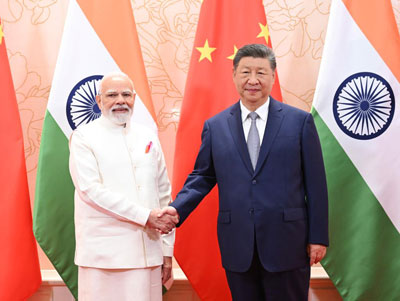 NEW DELHI, Sept 12: Prime Minister Narendra Modi held a bilateral meeting with Chinese President Xi Jinping on the sidelines of the BRICS Summit in New Delhi on Saturday, as India and China seek to reset ties. India said the two countries must ensure that “differences should not become disputes.”
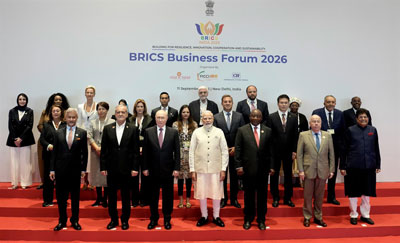 NEW DELHI, Sept 12: The BRICS nations un-animously approved the 45-page New Delhi Declaration on Saturday at the summit led by India, expressing concerns about “the rise of unilateral tariff and non-tariff measures” and backing a two-state solution to the Israeli-Palestinian conflict.
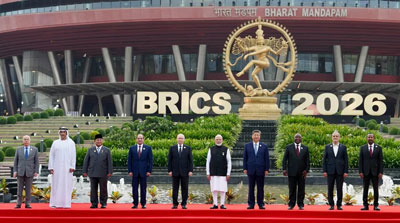 NEW DELHI, Sept 12: BRICS nations on Saturday strongly condemned the April 2025 terror attack in Jammu and Kashmir’s Pahalgam that killed 26 people, and called for concerted action against all UN-designated terrorists and strict accountability for those supporting terror.
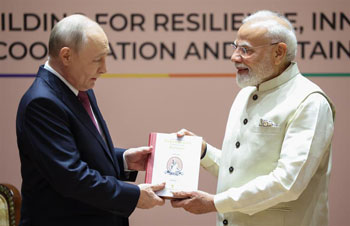 NEW DELHI, Sept 11: Prime Minister Narendra Modi again nudged Russian President Vladimir Putin on Friday to end the conflict in Ukraine, reiterating that dialogue and diplomacy is the way forward, as the two leaders assessed progress in economic, defence and energy cooperation and mobility of workers.
India-US | India-France | Entertainment | Sports | Photo Gallery | Tourism | Link Partners | Contact Us
© Noyanika International, 2003-2024. All rights reserved.