


United Nations
|
India welcomes UN Secretary General's initiative to create counter-terrorism officeBy Deepak Arora
Speaking at the informal meeting on the strengthening of the capability of the United Nations sytem to assist member States in implementing the United Nations Global Counter-Terrorism strategy, India's Permanent Representative to the UN Ambassador Syed Akbaruddin said "every day our collective conscience is being ravaged by terrorists in some part of the world or other." Ambassador Akbaruddin said it is variously estimated that since the beginning of 2017, there have been 150 cases of terrorist violence with more than a 1,000 deaths. Just last week, Bill Gates speaking at the Munich Security conference, drew attention to how unprepared we were to a new kind of terrorism -- bio-terrorism. Quoting Bill Gates, he said "the next epidemic could originate on the computer screen of a terrorist, intent on using genetic engineeing to create a synthetic version of a small virus or a super contagious and deadly strain of flu". According to Gates, epidemiologists say that a fast moving air borne pathogens could kill more than 30 million people in less than a year. "It is in this background of growing concerns, that we greatly appreciate the Secretary General's initiative to promptly address the need to enhance coordination of the UN’s counter-terrorism efforts." Guterres mooted the proposal to move the Counter-Terrorism Implementation Task Force (CTITF) Office and the UN Counter-Terrorism Centre out of the Department of Political Affairs and create a new office for counter-terrorism. This office would be headed by a new Under Secretary General. The UN Chief said the only objective of the new body is to improve efficiency in combating terrorism and not to change the different mandates in the field of counter-terrorism. Akbaruddin said India envisages the Under Secretary General for counter-terrorism to be able to take positions and speak on behalf of "all of UN" and develop a comprehensive narrative on terrorism including on all issues relating to counter-terrorism. He saidd that there are differing mandates of various UN bodies and if the counter-terrorism coordinator is to have credibility, the individual needs to be seen as the UN’s voice on counter-terrorism issues, not merely a voice on counter-terrorism. The Ambassador said "let us not allow turf battles to hobble this initiative, if we have to maintain its credibility." Akbaruddin said "as terrorism thrives on and is sustained by its trans-boundary networks for ideology, recruitment, propaganda, funding, arms, training and sanctuary, no single nation alone can tackle this menace decisively. There is no stronger case for more multilateral action, more coordination and more cooperation on any matter amongst all stakeholders than on terrorism." UN Secretary-General Proposes to Create New Counter-Terrorism Office
Guterres said the main goal of this initiative is to improve efficiency. The Office will report to the General Assembly through the secretary-general himself. The Secretary-General invited UN General Assembly members to share their views on the initiative. UNAIDS urges everyone to make some noise for zero discriminationBy Deepak Arora GENEVA, Feb 23: Everyone will have experienced discrimination of some kind during their lives; however, non-discrimination is a human right. Equally, states and individuals have a legal obligation not to discriminate. This year, on 1 March, Zero Discrimination Day, UNAIDS is urging people to make some noise around zero discrimination, to speak up and prevent discrimination from standing in the way of achieving ambitions, goals and dreams. Discrimination has many forms, from racial or religious discrimination to discrimination based on gender, sexual orientation or age, and to bullying at school or at work. In only three out of 10 countries worldwide do equal numbers of girls and boys attend upper secondary school, and people living with disabilities are nearly three times more likely to be denied health care than other people. “Everyone has the right to be treated with respect, to live free from discrimination, coercion and abuse,” said Michel Sidibé, Executive Director of UNAIDS. “Discrimination doesn’t just hurt individuals, it hurts everyone, whereas welcoming and embracing diversity in all its forms brings benefits for all.” Zero discrimination is an integral part of UNAIDS’ vision and for this year’s Zero Discrimination Day UNAIDS is calling for zero discrimination in health-care settings. The right to health is a fundamental human right that includes access to affordable, timely and quality health-care services for all, yet discrimination remains widespread in health-care settings, creating a serious barrier to access to HIV services. “Health-care settings should be safe and supportive environments. It is unacceptable that discrimination is inhibiting access to care today,” said Mr Sidibé. “Eliminating discrimination in health-care settings is critical, and we must demand that it become a reality.” Data from 50 countries from the People Living with HIV Stigma Index show that one in eight people living with HIV report being denied health care. Around 60% of European Union/European Economic Area countries report that stigma and discrimination among health-care professionals remains a barrier to the provision of adequate HIV prevention services for men who have sex with men and people who inject drugs. This year, UNAIDS is calling on everyone to make some noise for #zerodiscrimination. Zero Discrimination Day is an opportunity to highlight how everyone can be part of the transformation and take a stand for a fair and just society. UN seeks urgent funding to tackle famine in 4 countries
United Nations Development Programme Administrator Helen Clark hailed the move as a “new way of working in crisis” that deals with short-term emergency needs as well as planning for a more sustainable future that would help avoid other disasters. Aid workers are working across U.N. agencies and other multilateral organizations to respond to the short- and long-term needs of the 20 million people in the four countries that the U.N. has declared are on the “tipping point” of famine. What’s needed, now, is the speedy delivery of the substantial resources that will help “avert catastrophe,” U.N. Secretary-General António Guterres said during a press conference on Wednesday. Guterres announced a combined U.N. appeal for $4.4 billion by the end of March to tackle food security, health, water sanitation and nutrition. Only $90 million has been received so far, explained Guterres, speaking alongside Clark, emergency relief coordinator Stephen O’Brien and World Food Programme Executive Director Ertharin Cousin. “Funding shortages have already forced the World Food Programme to cut rations in Yemen by more than half since last year. Without new resources, critical shortages will worsen within months,” Guterres said. “These four crises are very different, but they have one thing in common. They are all preventable.” In total, humanitarian operations in these four countries will require more than $5.6 billion this year. For context, the U.N.’s largest funding appeals — the Syrian Refugee and Resilience Plan, the Nigerian refugee, the Burundi and South Sudan refugee response plans — each total $5.6 billion. All remain funded at just 17 percent. The hunger crises, while unique, also share a few other common factors, Guterres said. They are rooted in conflicts and are also exacerbated by some effects of climate change: desertification and water scarcity. While a famine has been declared in South Sudan — impacting approximately 100,000 people — 1 million more are considered to be facing immediate risk of famine, as well. In northeast Nigeria, 5.1 million people urgently need food assistance; in Yemen, the number of people immediately is at 7.3 million; and in Somalia, 2.9 million immediately require food and livelihood aid, according to U.N. estimates. Guterres has tasked the UNDP with establishing a steering committee that will link the U.N. agency with the Inter-Agency Standing Committee for humanitarian assistance, a membership coalition of leading U.N. and other organizations tasked with responding to emergencies. Guterres highlights global significance of a peaceful EuropeBy Deepak Arora
The Security Council meeting at which the UN chief delivered this message started with a moment of silence in memory of the Permanent Representative of Russia to the United Nations, Vitaly Churkin, who passed away yesterday. “I think [the Ambassador's] passing represents a deep loss for all of us in the UN, including in this Council, where his distinctive voice was ever-present for the past decade, and where, I think, we will all miss that voice in the sessions to come,” said Guterres in his tribute. Turning to the subject at hand, the Secretary-General, who briefed the Council alongside Lamberto Zannier, the Secretary-General of the Organization for Security and Cooperation in Europe (OSCE), and Helga Schmid, Secretary-General, European External Action Service of the European Union (EU), said crises in Europe could also adversely impact economic progress and sustainable development. “Conflict in Europe is not only a tragedy for those directly involved: those killed, injured, displaced, who have lost loved ones, who may be unable to access healthcare and are missing vital years of their education,” Guterres said, adding: “It is also reversing development gains and preventing communities and societies from achieving their full potential and contributing to regional and global prosperity.” Noting that no single factor is responsible for the emergence and continuation of conflicts, he said that in many cases, peace agreements were “simply not being implemented.” Other factors included challenges to democratic governance and the rule of law, and the manipulation of ethnic, economic, religious and communal tensions for personal or political gain. “Whatever the causes may be, the inability of regional and international institutions, including our own, to prevent and resolve conflicts is seriously undermining their credibility and making it more difficult for them to succeed in future,” added the UN chief. Speaking specifically on the conflict in Ukraine, Guterres said the UN remains committed to supporting a peaceful resolution, in a manner that fully upholds the sovereignty, territorial integrity and independence of Ukraine, and in accordance with relevant Security Council and General Assembly resolutions. He also noted that the UN fully supported the efforts within the Normandy Four, the Trilateral Contact Group, and the OSCE Special Monitoring Mission, and that it has repeatedly called for the full implementation by all sides of all of their commitments under the Minsk Process, both in letter and in spirit. “I urge all stakeholders to avoid unilateral steps or attempts to create facts on the ground, which further complicate and endanger efforts to find negotiated settlements. This is especially relevant in view of the latest actions taken in relation to the conflicts in eastern Ukraine and the South Caucasus,” he highlighted, urging all sides to give the highest priority to protecting civilians. In his remarks, Guterres also spoke of challenges to peace in other parts of Europe, such as in the Balkans, Cyprus, Georgia, Moldova and South Caucasus, as well as on the long-standing name issue between Greece and the former Yugoslav Republic of Macedonia. He also noted new challenges and threats such as the phenomenon of populism, nationalism, xenophobia and violent extremism were both causes and effects of conflict. “I encourage Member States, this Council, regional mechanisms and all stakeholders to intensify their efforts to define a peace and security agenda to address today's complex challenges,” urged Secretary-General Guterres. “The status quo is not sustainable.” Churkin was outstanding diplomat: UN Secretary GeneralBy Deepak Arora
He said Ambassador Churkin served the Ministry of Foreign Affairs of the Russian Federation with distinction through some of the most challenging and momentous periods of recent history. The Secretary General said "he was appointed as the Permanent Representative of the Russian Federation to the United Nations in 2006. For more than a decade, Ambassador Churkin was a forceful presence on the Security Council." "Ambassador Churkin was a uniquely skilled diplomat, a powerful orator with great wit, and a man of many talents and interests." "Although we served together for a short time, I greatly appreciated the opportunity to work with him and will deeply miss his insights, skills and friendship. I pay tribute to his contributions to the United Nations and offer my deepest condolences to his family and loved ones, and to the Government and people of the Russian Federation," said the Secretary General. Churkin name will live on in annals of UN histroy: Peter ThomsonBy Deepak Arora
Speaking at a condolence meeting at the Trusteeship Council Chamber, Mr Peter Thomson said "We have lost one of the most respected and influential members of the UN family. His name will live on in the annals of UN history. We will remember him for his intellect and diplomatic skill, his good humour and consideration for others. We all experienced and respected the pride he took in serving his country and the passion and resolution he brought to his job." On behalf of the General Assembly, President Thomson expressed heartfelt condolences to Mrs Irina Churkin, to his family, to all the staff of the Permanent Mission of Russia to the UN and to the Government of the Russian Federation, which this day has lost one of its truest sons. He said that he would convene at the appropriate moment in the coming period of mourning a formal meeting of the General Assembly to pay tribute to the memory of the late Vitaly Churkin. Russia’s Ambassador to UN Vitaly Churkin is deadBy Deepak Arora
Churkin, 64, was rushed to a hospital in New York, where he died, Russia’s deputy U.N. ambassador, Vladimir Safronkov, said. His cause of death wasn’t immediately known. Churkin had been Russia’s envoy at the United Nations since 2006 and was considered Moscow’s great champion at the U.N. He had a reputation for an acute wit and sharp repartee, especially with his American and Western counterparts. He was currently the longest-serving member of the Security Council, the U.N.’s most powerful body. His death, the day before his 65th birthday, stunned officials at the U.N.’s headquarters. The President of the United Nations General Assembly Peter Thomson said he was "Greatly saddened at the news of the passing of dear friend Ambassador Vitaly Churkin. The Russian Federation and the United Nations have lost a true son and a great international intellect." Russia’s foreign ministry called Churkin an “outstanding” diplomat and expressed condolences to his friends and family. Spokeswoman Maria Zakharova said in a Facebook post that Churkin was “an extraordinary person. A bright man. We have lost a dear one.”
India's Permanent Representative to UN Syed Akbaruddin said "Russia loses a stalwart diplomat; the world of diplomacy a consummate practitioner; India a friend." Calling Churkin a “diplomatic maestro and deeply caring man,” former U.S. Ambassador to the U.N. Samantha Power said on Twitter that Churkin had done all he could to bridge differences between the U.S. and Russia. French U.N. Ambassador Francois Delattre, too, said he and Churkin had “always worked together in a spirit of mutual respect and personal friendship,” despite their divides. One of Delattre’s predecessors, Gerard Araud, now French ambassador to the U.S., recalled Churkin as “abrasive, funny and technically impeccable.” Britain’s U.N. ambassador, Matthew Rycroft, tweeted that he was “absolutely devastated” to hear of the death of Churkin, “a diplomatic giant and wonderful character.” Churkin was previously ambassador at large and earlier served as the foreign ministry spokesman. Churkin had a doctorate in history and was a graduate of the Moscow State Institute of International Relations. And he was a child actor in what was then the Soviet Union. India laments as UN fails to define terrorism
It also sought to differentiate the peace of a garden from that of a graveyard, saying terrorists invest in a graveyard and terrorism has the potential to destabilise societies with consequences that could cast a dark shadow over the 21st century if not confronted with unity. Addressing the Foreign Ministers of G-20 countries in Bonn, India's Minister of State for External Affairs M J Akbar said it is naive to believe that terrorists have no political objectives. "Radical terror factories like Daesh, Boko Haram and their allies or surrogates like Lashkar-e-Taiba are challenging the nation state, which is the principle building block of the architecture of stability after the collapse of the age of empires and colonisation," he said. Asserting that the UN was born as the answer to war, the minister said that responsibility has not diminished but to fight an enemy one must define an enemy. "The UN has been, alas, unable to define terrorism," he said, noting that the UN peace keeping mission is often hampered by uncertain strategy and contradictory tactical response. Akbar's strong remarks come in the backdrop of the UN's Sanctions Committee failing to proscribe JeM chief and Pathankot mastermind Masood Azhar as a terrorist in view of China's strong opposition. Guterres announces steps towards reforming UN’s peace and security architectureBy Deepak Arora UNITED NATIONS, Feb 14: United Nations Secretary-General António Guterres today announced the establishment of an internal review team that will take forward the reforms to the UN Secretariat peace and security strategy, functioning and architecture, which he outlined when he was appointed the Secretary-General last year. According to a statement issued today by the UN chief’s office, the team will be led by Tamrat Samuel, who held numerous senior UN appointments. The review team has been tasked to submit recommendations to Mr. Guterres by June this year, which will then initiate a process of consultations with UN Member States and other relevant entities. In the statement, he further noted that pending those evolutions, the mandates of senior officials working in the peace and security pillar would be maintained for until 1 April next year. “The mandates of Jeffrey Feltman, as Under-Secretary-General for Political Affairs, Oscar Fernandez-Taranco, as Assistant-Secretary-General for Peacebuilding Support, and Atul Khare, as Under-Secretary-General for Field Support, will be extended for one year until the 1 April 2018,” the statement read. Jean-Pierre Lacroix, of France, takes helm of Department of Peacekeeping OperationsAlso in the statement, Mr. Guterres announced his intention to appoint Jean-Pierre Lacroix, of France, as Under-Secretary-General for Peacekeeping Operations, for one year beginning 1 April. He is currently the Director for the UN and International Organizations at the Ministry of Foreign Affairs of France and has over 25 years of political and diplomatic experience, mostly handling multilateral organizations, UN activities and programmes. Mr. Lacroix succeeds Hervé Ladsous, who informed Mr. Guterres that he would be unavailable for an extension at the end of its current term, until end-March. “I would like to express my gratitude [to Mr. Ladsous] for his service to the United Nations, his tireless efforts and dedication to peacekeeping, especially in modernizing capacities both to address multidimensional crisis and protect civilian populations,” said Secretary-General Guterres. UN Security Council condemns North Korea missile launchingUNITED NATIONS, Feb 13: The UN Security Council on Monday denounced North Korea`s weekend missile launch, urging members to "redouble efforts" to enforce sanctions against the reclusive state. Pyongyang`s ballistic missile firing on Sunday was its first direct challenge to the international community since US President Donald Trump took office on January 20. At a news conference on Monday, Trump said: "Obviously North Korea is a big, big problem and we will deal with that very strongly." US, Japanese and South Korean military officials held a teleconference on Monday in which they condemned the launch as "a clear violation" of multiple Security Council resolutions. The United States "reaffirmed its ironclad security commitments" to South Korea and Japan, the Pentagon said. The Security Council did not specify what steps might be taken beyond the U.N.-sponsored sanctions regime imposed on North Korea since 2006 over its nuclear and ballistic missile tests. "The members of the Security Council deplore all the Democratic People’s Republic of Korea ballistic missile activities, including these launches," the council said in a statement that also referred to North Korea`s missile launch on October 19. The statement "called upon all member states to redouble their efforts to implement fully the measures imposed on the Democratic People’s Republic of Korea by the Security Council." Japan, which called for the emergency meeting of the Security Council along with the United States and South Korea, said it was pleased with the council`s resolve in discussing North Korea`s latest missile firing. "There was unanimity in condemning the launch and an expression of concern about the situation," said Koro Bessho, the Japanese ambassador to the world body. "Obviously we have to implement the very robust strong resolution that we already have. That is a starting point." In December, the Security Council adopted a resolution in response to North Korea`s nuclear test in September. The resolution aimed to slash North Korea`s exports of coal and other metal exports, designed to cost it $800 million a year. US ambassador to the United Nations, Nikki Haley, had tough words for North Korea after the Security Council meeting on Monday. "It is time to hold North Korea accountable – not with our words, but with our actions,” Haley said in a statement. Late on Monday, the South Korean Defense Ministry said the United States and South Korea would deploy U.S. strategic assets during their annual joint exercise - in what appeared to be a response to the missile launch. Japanese Prime Minister Shinzo Abe said on Monday that he expected the Trump administration would adopt a tougher stance against North Korea. "I believe that the stance of the United States towards North Korea will become much tougher, that is clear," Abe said on a NHK public broadcasting news program after returning from meetings with Trump in the United States. North Korea has said any sanctions against its missile or nuclear programs are a violation of its sovereignty and right to self-defense. North and South Korea are technically still at war because their 1950-1953 conflict ended in a truce, not a peace treaty. The North regularly threatens to destroy the South and the South`s main ally, the United States. Israeli legislation on settlements violates international law: GuterresBy Deepak Arora
A statement from the UN spokesperson noted that the bill, adopted yesterday, reportedly provides immunity to settlements and outposts in the occupied West Bank that were built on privately-owned Palestinian land. “The Secretary-General insists on the need to avoid any actions that would derail the two-state solution,” the statement said, adding that all core issues should be resolved between the parties through direct negotiations on the basis of relevant Security Council resolutions and mutual agreements. “The United Nations stands ready to support this process,” it concluded. U.S. Ambassador to U.N. blames Russia for new violence in eastern Ukraine
"I consider it unfortunate on the occasion of my first appearance here I must condemn the aggressive actions of Russia," Haley said, making her first public remarks inside the Security Council since being sworn in as the United States' representative to the United Nations last month. "It shouldn't happen, or be that way. We do want to better our relations with Russia. However, the dire situation in eastern Ukraine is one that demands clear and strong condemnation of Russian actions." Her remarks came amid speculation over U.S. President Donald Trump's intentions towards Moscow. Trump has praised Russia's President Vladimir Putin and expressed a wish for improved relations between the two countries. Haley made clear that tensions over the Ukraine would not end soon, including the matter of sanctions slapped on Russia related to the annexation of Crimea three years ago. "Eastern Ukraine of course is not the only part of the country suffering because of Russia’s aggressive actions. The United States continues to condemn and call for an immediate end to the Russian occupation of Crimea," Haley said. "Crimea is a part of Ukraine. Our Crimea related sanctions will remain in place until Russia returns control of the peninsula to Ukraine." The United States and other Western powers imposed sanctions on Russia in 2014 over its annexation of the Crimea peninsula from Ukraine and its support for pro-Russia separatists in eastern Ukraine. Russia's ambassador to the United Nations, Vitaly Churkin, disputed Haley's commentary on Crimea, but welcomed his American counterpart. "It was friendly enough, given the circumstances and given the subject we were discussing," the Russian ambassador told reporters. He noted the chance for a new start after ties between Russia and United States frayed in Obama's second term. "If there is an opportunity to have better relations with the United States, if there is an opportunity for us to work better with the United States... then we should take this opportunity." He faulted the Obama administration for not doing enough to end the conflict in Ukraine and called on the Trump government to bring its influence to bear. "Clearly they are the people who are listened to in Kiev." Ukraine and Russia had blamed each other for a surge in fighting in recent days around the government-held industrial town of Avdiivka that has led to the highest casualty toll in weeks and cut off power and water to thousands of civilians on the front line. At the Thursday Security Council session, Ukraine's U.N. ambassador, Volodymr Yelchenko, who holds the presidency of the Security Council for February, said the strife around Avdiivka started with artillery shelling by the Russian army and Russian-backed fighters from the two suburbs they control abutting the town. Churkin blamed Ukrainian security forces for starting the bloodshed. U.N. under-secretary-general for political affairs, Jeffrey Feltman, painted a grim picture of the situation on the ground. "Hundreds of thousand of civilians on both sides of the contact line are still at risk of losing all access to water, heating and electricity, bringing the specter of further displacements closer," Feltman said. "With every new day of fighting, the conflict becomes more entrenched and difficult to resolve. There is no military solution to this conflict."
|
|
||||||
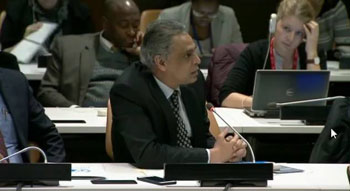 UNITED NATIONS, Feb 22: India has welcomed an initiative by UN Secretary General Antonio Guterres to create a new office for counter-terrorism and promised all possible support in taking the proposal to fruition.
 UNITED NATIONS, Feb 22: The United Nations system should have a new office for counter-terrorism, UN Secretary-General Antonio Guterres told the UN General Assembly.
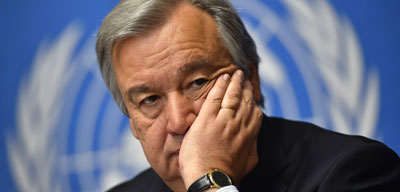 UNITED NATIONS, Feb 22: The United Nations has announced a $4.4 billion appeal to respond to the escalating risk of famine in Nigeria, South Sudan, Somalia and Yemen in a move defined by strengthened coordination between development and humanitarian agencies.
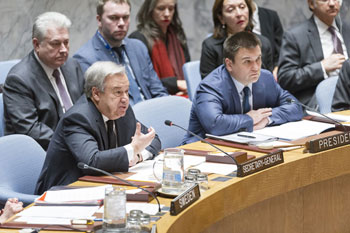 UNITED NATIONS, Feb 21: Noting that recent crises in Europe show that the continent remains at risk from new outbreaks of conflict, United Nations Secretary-General António Guterres called for reinforcing mutual trust and respect to strengthen stability and cooperation both within Europe and beyond.
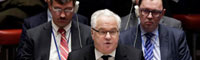 UNITED NATIONS, Feb 21: Expressing his shock and sadness of the news of the sudden passing of Ambassador Vitaly Ivanovich Churkin, UN Secretary General Antonio Guterres said he was an outstanding diplomat.
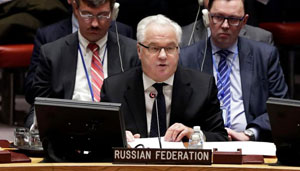 NEW YORK, Feb 20: Russia’s ambassador to the United Nations, Vitaly Churkin, has died after falling ill Monday in his office at the mission, according to Russian officials.
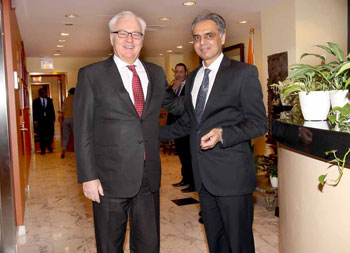 “Our thoughts go to his family, to his friends and to his government,” said U.N. deputy spokesman Farhan Haq.
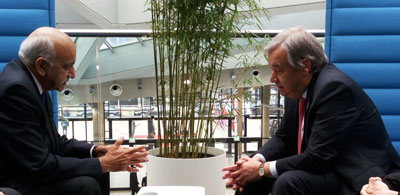 BONN, Feb 17: India has lamented that the UN has been unable to define terrorism at a time when radical terror factories like Daesh and their surrogates like LeT are challenging the nation state and asked the national governments to make policies for sustaining peace.
 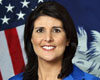 NEW YORK, Feb 2: U.S. Ambassador to the United Nations Nikki Haley blamed Russia on Thursday for the recent surge of violence in eastern Ukraine and warned Ukraine-related sanctions against Russia will not be lifted until Moscow returns Crimea to Kiev.
 India's Amb. Gopinathan re-appointed to UN Joint Inspection Unit
Aviation
| Business | Defence | Foreign
Affairs | Communication | Health
| India | United Nations
India-US
| India-France | Entertainment
| Sports | Photo Gallery |
Tourism | Advertise with Us
| Contact Us
© Noyanika International, 2003-2009. All rights reserved.