


United Nations
3 in 10 young people in conflict or disaster-stricken countries are illiterate: UNICEFBy Deepak Arora NEW YORK, Jan 31: Nearly 3 in 10 young people aged between 15 and 24 years old – 59 million – living in countries affected by conflict or disaster are illiterate, triple the global rate, UNICEF said today. Niger, Chad, South Sudan and Central African Republic – all countries with a long history of instability and high levels of poverty – are home to the highest illiteracy rates among young people with 76 per cent, 69 per cent, 68 per cent and 64 per cent of 15 to 24 year olds, respectively, unable to read or write. “These numbers are a stark reminder of the tragic impact that crises have on children’s education, their futures, and the stability and growth of their economies and societies,” said UNICEF Executive Director Henrietta H. Fore. “An uneducated child who grows into an illiterate youth in a country ripped apart by conflict or destroyed by disasters may not have much of a chance.” This new analysis – calculated using UNESCO’s literacy rates in 27 emergency countries featured in UNICEF’s 2018 Humanitarian Action for Children appeal – is released ahead of this week’s Global Partnership for Education Replenishment Conference in Dakar, Senegal. The analysis also notes that girls and young women are at the biggest disadvantage when it comes to reading and writing, with 33 per cent of them in emergency countries failing to learn even the basics, compared to 24 per cent of boys. Yet, despite its role in leveling the playing field for the most vulnerable children and young people, education remains severely underfunded. Currently, only 3.6 per cent of humanitarian funding goes toward providing education for children living in emergencies, making it one of the least funded sectors in humanitarian appeals. Overall, UNICEF estimates that it will spend approximately $1 billion a year on education programmes over the next four years. Just yesterday, UNICEF launched a humanitarian appeal for $900 million for education in countries affected by conflicts and natural disasters. UNICEF works in countries around the world to get children into school and learning including by providing accelerated education and non-formal learning opportunities, training teachers, rehabilitating schools and distributing school furniture and supplies. In West and Central Africa, home to emergency countries with the highest rates of illiteracy among youth at 39 per cent and where the third replenishment conference will be hosted, UNICEF works with a range of partners to help children learn despite conflict and insecurity. A partnership with the governments of Cameroon and Niger, for example, is helping expand an innovative radio education programme that provides an alternative learning platform for children and youth affected by crises. More than 144 episodes on literacy and numeracy are broadcast across radio in French, Fulfulde, Hausa and Kanouri. The programme will soon be rolled out in Burkina Faso, Central African Republic, Guinea, and Guinea Bissau. UNICEF urges governments and other partners to take action to tackle the education crisis affecting children and young people in emergencies including by: - Providing young children with access to quality early education programmes to support their development and set them up to continue learning throughout their childhood; - Offering illiterate young people the opportunity to learn to read and write and further their education through specially designed alternative and accelerated education programmes; - Increasing investment in education, particularly for the most disadvantaged children and youth. “Education can make or break a child’s future,” Ms. Fore said. “For all children to fully reap the benefits of learning, it is key that they get the best quality education possible, as early as possible.” Hunger continues to intensify in conflict zones, UN agencies report to Security CouncilBy Deepak Arora
Highlighting the extremely critical importance of humanitarian support for affected communities, the report was generated by the Food and Agriculture Organization (FAO) and the World Food Programme (WFP) as part of bi-annual briefings to the UN Security Council on food security. Conflict is a common factor undermining food security in all 16 countries covered in the report, according to which the intensification of conflicts is a key reason behind the recent resurgence of world hunger levels, following decades of steady declines. The 16 countries that are monitored are: Afghanistan, Burundi, the Central African Republic (CAR), the Democratic Republic of the Congo (DRC), Guinea-Bissau, Haiti, Iraq, Lebanon, Liberia, Mali, Somalia, South Sudan, Sudan, Syria, Ukraine and Yemen. Among them, Yemen, South Sudan, Syria, Lebanon, CAR, Ukraine, Afghanistan, and Somalia have a quarter or more of the population facing crisis or emergency levels of hunger. In Yemen, 60 per cent of the population, or 17 million people, are affected by acute hunger. These figures are 45 per cent, or 4.8 million, in South Sudan, 33 per cent, or 6.5 million, in Syria, and 33 per cent, or 1.9 million, in Lebanon – a country hosting large numbers of Syrian refugees. But these are far from being the only countries flagged as cause for concern. In the DRC, where serious food security concerns have been overshadowed by crises in other parts of Africa, the situation is rapidly deteriorating, the report warns. There, 11 per cent of the population is now in the crisis phase or above, adding up to 7.7 million people who are coping with acute hunger. In Sudan, 3.8 million people are in the crisis phase or above. In Iraq, that figure is 3.2 million while in the Lake Chad basin, the number is 2.9 million people. In Burundi and Haiti, it is 1.8 and 1.3 million, respectively. According to data released last October, the number of hungry people worldwide rose to 815 million people in 2016, up from 777 million the year before. The majority of the hungry, or 489 million people, live in countries wracked by conflict. International Holocaust Remembrance DayBy Deepak Arora NEW YORK, Jan 29: On the occasion of the International Holocaust Remembrance Day, the Permanent Representative of Italy to the United Nations, Ambassador Sebastiano Cardi, took part today in the commemorative ceremony and reading of the names of the Jews deported from Italy and territories under Italian occupation. The ceremony was organized by the Consulate General of Italy, together with Centro Primo Levi, the Italian Cultural Institute, Casa Italiana Zerilli Marimò at NYU, the Calandra Institute for Italian American Studies and the Italian Academy at Columbia University. Speaking at the ceremony were also the UN Under-Secretary-General for Global Communications Alison Smale and the Italian Consul General Francesco Genuardi, who hosted the event. “Today – Ambassador Cardi recalled – Foreign Minister Alfano is chairing the Rome Conference on the Responsibility of States, Institutions and of Individuals in the Fight against Antisemitism in the OSCE Area: one of the initiatives Italy has decided to launch as it takes on the Chairmanship of the Organization for 2018, confirming the priority our Country gives to the protection of human rights. It is an objective that guides our action bilaterally and in every multilateral forum we take part in. We intend to uphold this commitment at the United Nations, in continuity with what we have done last year in the Security Council, putting our focus on the concept of responsibility.” The OSCE Chairperson in Office, Italy’s Minister of Foreign Affairs and International Cooperation, Angelino Alfano, appointed Professor Salvatore Martinez as his Personal Representative on Combating Racism, Xenophobia and Discrimination. Among the priority issues for the Italian Chairmanship in Office of the OSCE are human trafficking and the protection of victims, especially women and children. On these issues Italy promoted a resolution that was unanimously adopted by the UN Security Council in November 2017. At African Union Summit, Guterres lauds strong AU-UN partnership, outlines areas for more cooperationBy Deepak Arora
“I stand here on behalf of the United Nations system and reaffirm our strong commitment to the member states and the people of Africa,” Mr. Guterres told the 30th Ordinary Session of the Assembly of the African Union (AU) on Sunday, adding: “I strongly believe Africa is one of the greatest forces for good in our world.” The UN chief said that in just his first year in office, the Organization has entered a “new era” of partnership with the AU, recalling the holding of the first UN-AU Annual Conference at the summit level, as well as the signing of two landmark framework agreements, respectively on enhanced partnership in peace and security, and, just yesterday, on implementing the 2030 Agenda for Sustainable Development and the African Union's Agenda 2063. Spotlighting these and other initiatives as key examples of the successful work the two organizations are carrying out across the continent, Mr. Guterres said this partnership could be further strengthened in five key areas: addressing corruption; cooperation in peace and security; inclusive and sustainable development; climate change; and international migration. Combatting the “far-reaching and devastating” impact of corruption, tax evasion and illicit financial flows, a main theme of this year's AU Summit, “requires an unimpeachable commitment to transparency and accountability,” he said, commending the decision to highlight this scourge, and offering the strong support of the UN. He also welcomed the designation of 2018 as African Anti-Corruption Year. Specifically on international migration, the UN chief expressed that the global phenomenon not only powers economic growth, reduces inequalities and connects diverse societies but also help ride the demographic waves of population growth and decline “We must maximize the benefits of orderly migration, while stamping out abuses and prejudice,” he said, highlighting the benefits of the Global Compact for Safe, Orderly and Regular Migration for all countries. “I urge you to bring your moral leadership and unique experience to this important collective priority for 2018,” added Mr. Guterres. On the peace and security sector, the UN chief expressed his appreciation to African governments for contributing troops and police to UN peacekeeping operations to help save lives and keep the peace around the world. He, however, noted that UN peacekeeping is not the solution to all crisis situations, and said that partnership with the African Union and sub-regional organizations can be the means to address the varied contexts which necessitate peacekeeping, including peace enforcement and counter-terrorist operations. On inclusive and sustainable development, Secretary-General Guterres expressed that the UN 2030 Agenda for Sustainable Development and African Union's Agenda 2063 are mutually reinforcing, and underscored the need to ensure sufficient means of implementation to ensure sustainable development. But he acknowledged that while poverty elimination is a shared priority across the tow agendas, significant gaps persist, particularly with regard to industrialization, water, energy, infrastructure and the environment. “We must place quality education within the reach of all,” he underscored. In that context, he urged all UN Member States to uphold their commitments to official development assistance ODA), outlined in the Addis Ababa Action Agenda on financing for development Mr. Guterres also said the international community has a role to play in combating tax evasion, money laundering and the elimination of illicit financial flows that deprive Africa of its essential resources. The UN chief also stressed that women and young people must lead the development agenda, stressing that: “Women's full participation makes economies stronger and peace processes more successful.” He said that around the world, there is skepticism about multilateralism. But he strongly believed that moving forward together, “the United Nations and the African Union can show that multilateralism is our best and only hope.” At African Union Summit, Guterres outlines UN-AU approach to combatting terrorismBy Deepak Arora
“The African Union (AU) is a vital partner in confronting the global challenge posed by terrorist groups, said Mr. Guterres, adding that he had been calling for a “higher platform of cooperation” with the AU, and he is proud the two organizations are indeed building that platform across the range of challenges and opportunities confronting the continent. He recalled that in April 2017, the two organizations signed the Joint UN-AU Framework for Enhanced Partnership in Peace and Security, which includes cooperation in the field of countering terrorism and preventing violent extremism. “I believe this work can be strengthened even further with a Memorandum of Understanding (MOU) setting out a road map for future collaboration and capacity-building support on countering terrorism within the context of that Framework, he explained. One of the first reforms Mr. Guterres instituted as Secretary-General was the creation of the UN Office of Counter-Terrorism, which, he told the African leaders, has worked closely with the AU and other partners to develop regional strategies and national action plans for the prevention of terrorism and violent extremism in the Horn of Africa and Africa, as well as central and southern Africa. Looking ahead, the UN chief said he believed a comprehensive approach to combatting the transnational threat of terrorism in Africa can be developed around four key priorities: By addressing the deficit in international counter-terrorism cooperation at the global, regional and national levels. Mr. Guterres will in June convene the first-ever UN Summit of Heads of Counter-Terrorism Agencies to build on Member States' priorities and his discussion today; Enhanced ratification of existing legal counter-terrorism instruments, conventions and protocols; Placing a special focus on expanding opportunities for young people – especially since youth under the age of 25 form the largest demographic group in most developing countries and they are often the ones most at risk of being recruited and radicalized by terrorists. Underscoring that terrorism is not only a threat to peace and security but also to sustainable development, Mr. Guterres called on the international community to mobilize resources in support of African countries as they strive to balance security and development. “We face a serious challenge – but I believe it is one that we can meet with solidarity, common action and a shared resolve,” he said. UN condemns massive vehicle bomb attack in Kabul that leaves scores dead and wounded
The Taliban have claimed responsibility for the deadly incident, in which the attackers reportedly used a vehicle painted to look like an ambulance, including bearing the distinctive medical emblem, what the UN Assistance Mission in the country, known as UNAMA, flagged as a “clear violation of international humanitarian law.” In a statement from his Spokesman, Mr. Guterres said that indiscriminate attacks against civilians are grave violations of human rights and international humanitarian law and can never be justified. “Those responsible for today's attack must be brought to justice,” he added. The Secretary-General extended his deepest condolences to the families of the victims and wished a speedy recovery to those injured. He also expressed solidarity with the Government and people of Afghanistan. Separately, Tadamichi Yamamoto, the Secretary-General's Special Representative for Afghanistan and head of UNAMA, noted that the explosion occurred near a High Peace Council facility in a civilian-populated area of Kabul. “While the Taliban claim suggested the purpose of the attack was to target police, a massive vehicle bomb in a densely populated area could not reasonably be expected to leave civilians unharmed,” he emphasized. Calling the attacks “nothing short of an atrocity,” the UNAMA chief said those who organized and enabled it must be brought to justice and held to account. He reiterated that under no circumstances are such attacks justifiable, and he called on the Taliban to uphold their obligations under international humanitarian law, at all times. Issuing its own condemnation, the UN Security Council said the “heinous and cowardly terrorist attack” resulted in at least 95 people killed and 158 injured. The members of the Council underlined the need to hold perpetrators, organizers, financiers and sponsors of these reprehensible acts of terrorism accountable and bring them to justice. Ahead of Pyeongchang Games, UN Assembly President appeals for nations to honour ‘Olympic Truce’By Deepak Arora
“I solemnly appeal to all Member States to demonstrate their commitment to the Olympic Truce for the 2018 Pyeongchang Olympic and Paralympic Games and to undertake concrete actions at the local, national, regional and world levels to promote and strengthen a culture of peace and harmony based on the spirit of the Truce,” said Mr. Lajcák. He also called upon all warring parties of current armed conflicts around the world to “boldly agree to true mutual ceasefires for the duration of the Olympic Truce, thus providing an opportunity to settle disputes peacefully.” The ancient Greek tradition of the ekecheira, or ‘Olympic Truce,’ began in the eighth century B.C., and serves as a hallowed principle of the Olympic Games. The International Olympic Committee (IOC) renewed this tradition in 1992 by calling upon all nations to observe the Truce. The Peyonchang Olympics will be held 9-25 February and the Paralympics 9-18 March. On 13 November last year, the General Assembly adopted a resolution that urges Member States to observe the truce individually and collectively throughout the period from the seventh day before the start of the Olympics until the seventh day following the end of the Paralympics. The Assembly also expressed its expectation that “Pyeongchang 2018 will be a meaningful opportunity to foster an atmosphere of peace, development, tolerance and understanding on the Korean Peninsula and in Northeast Asia.” In a statement on 9 January, UN Secretary-General António Guterres welcomed the decision of the Democratic People’s Republic of Korea (DPRK) to send a delegation to the Olympic Winter Games. 'We are all at risk' when humanity's values are abandoned; UN honours memory of Holocaust victimsBy Deepak Arora
Mr. Guterres recalled that the International Day, marked annually on 27 January, was created to honour the memory of six million Jewish men, women and children that perished in the Holocaust and countless others lost their lives as cruelty convulsed the world. Yet, decades since the Second World War, there is still the persistence of anti Semitism and an increase in other forms of prejudice. Citing Neo-Nazis and white supremacy groups as among the main purveyors of extreme hatred, the UN chief said that too often, vile views are moving from the margins to the mainstream of societies and politics. “Whenever and wherever humanity's values are abandoned, we are all at risk,” stressed the Secretary-General. “All of us have a responsibility to quickly, clearly and decisively resist racism and violence,” he stated, adding: “Through education and understanding, we can build a future of dignity, human rights and peaceful coexistence for all.” For his part, UN High Commissioner for Human Rights Zeid Ra'ad Al Hussein held the painful day of remembrance for Holocaust the victims as forcing us “to contemplate the horrors to which bigotry, racism and ultimately lead.” “The sadistic brutality of the atrocities inflicted by the Nazi regime on Jews, Roma, Slavs, disabled people, political dissidents, homosexuals and others was nourished by layer upon layer of propaganda, falsifications and incitement to hatred,” he stated, adding how they were denigrated and smeared, “one after another, their rights were refused, and finally, even their humanity was denied.” Mr. Zeid pointed to the statement of Primo Levi, who survived the Auschwitz Birkenau concentration camp: “It happened, therefore it can happen again.” “As we honour the victims of the Holocaust,” Mr. Zeid continued, “we must also acknowledge the need to prevent the recurrence of anti-Semitism and all forms of racial and religious hatred and discrimination today.” He specified the importance of upholding independent rule of law institutions and a free press; maintaining respect for human rights; and education, which must be at the core of all efforts to combat anti-Semitism, racism, and all forms of discrimination. “In honouring the victims of the Holocaust, we must recognise that only if we regard each other as fully equal in dignity and rights will we be able to come together to overcome the many challenges facing humanity,” he concluded. At the same time, Audrey Azoulay, the Director-General of the UN Educational, Scientific and Cultural Organization (UNESCO), citied the Day as a call to strengthen nations' commitment to peace. Recalling the possibility of the worst, also carries a memory that must be forward-looking, she said, adding that combating anti-Semitism, in whatever form, “is at the heart of this fight” in which everyone has a role to play. “We can build up awareness against forgetting, denial, historical revisionism, relativization of crimes and the return of stereotypes that fuel hatred. We can oppose the manipulation of facts by speaking the truth,” she asserted. Among a series of events taking place across the UN system, the annual United Nations Holocaust Memorial Ceremony hosted by Ms. Alison Smale, UN Under-Secretary-General for Global Communications, will take place on Wednesday 31 January. The Secretary-General, President of the seventy-second session of the General Assembly, Representatives of Israel, Germany and the United States, will deliver remarks. Davos: UN rights chief stresses leading role of businesses in ending LGBTI discrimination
Speaking at the annual meeting of the World Economic Forum in Davos, Switzerland, UN High Commissioner for Human Rights Zeid Ra'ad Al Hussein said that “companies that take action to end discrimination and support LGBTI communities can be a motor for change.” The standards, developed by the Office of the UN High Commissioner for Human Rights (OHCHR), draw on good practice from around the world, setting out actions that can be taken by employers. These include eliminating unfair treatment against LGBTI people in the workplace, making sure business operations do not contribute to discrimination against customers, suppliers or members of the public, and working with business partners to address discriminatory practices up and down the supply chain. They also encourage companies to stand up for the rights of LGBTI people in the countries where they operate – including through advocacy and support for local organizations. “These standards provide the most comprehensive set of benchmarks for responsible corporate behaviour on LGBTI issues. A company of any nationality, size and location or sector can find no better vehicle to correct inequities and end discrimination brought about by prejudice,” Mr. Zeid said. The High Commissioner was speaking at a panel discussion titled “Free and Equal: Standing Up for Diversity”, which also included Vittorio Colao, Vodafone Group Chief Executive Officer, and Jin Xing, Choreographer and Founder of the Jin Xing Dance Theatre Shanghai, and was moderated by Zanny Minton Beddoes, Editor-in-Chief, of The Economist magazine. The Standards of Conduct build on the UN Guiding Principles on Business and Human Rights, adopted by the UN Human Rights Council in 2011. They are the product of a year-long process of consultations facilitated by the OHCHR and the Institute for Human Rights and Business. Nineteen more companies have joined a growing list of early adopters, including Airbnb, Airbus, AXA, Barilla, Bloomberg L.P., Cisco Systems Inc., Gol, Hermes Investment Management, Lloyd's, Lush Fresh Handmade Cosmetics - North America, Marriott International, MAS Holdings, Nasdaq, New York Life, Santander Group, Tesco, Trillium Asset Management, Unilever, Vert Asset Management, and Xerox. Time to stop ‘managing’ Israeli-Palestinian conflict, show leadership to resolve it, Security Council told
“Twenty-five years after the Oslo Accords, we are at a critical point in the peace process,” said Nickolay Mladenov, Special Coordinator for the Middle East Peace Process, at a Security Council briefing, referring to a set of agreements, the first of which was signed in 1993, establishing a timetable for achieving peace between the two sides. The uncertainty and volatility of the current environment, he continued, is hardening positions and sharpening the rhetoric on all sides, “a situation that plays directly into the hands of extremists and increases the risk of another conflict.” He said that absent a credible proposal that can become the basis of final status negotiations, the international community must continue to build the conditions necessary for a resumption of talks. “We must also reaffirm the international consensus that the two-State solution remains the only viable option for a just and sustainable end to the conflict. We must be unwavering in this position,” he said. The two-State solution means having Israel and Palestine as two separate States living side by side in peace, security and mutual recognition. Mr. Mladenov noted that there are those who believe that the conflict can be solved through peaceful bilateral negotiations and compromises, by addressing the final status issues of borders, security, refugees and the status of Jerusalem on the basis of prior agreements and relevant UN resolutions. Some believe in malting unilateral moves that can only lead to a one-state reality that is incompatible with the aspirations of both peoples. And there are those who believe in violence, he said. “We – the United Nations, the Security Council, the international community – have a responsibility to prove that those who believe in violence and confrontation are wrong,” he said. With this year marking the 25th anniversary of the Oslo Accords, it is time to push for policies on the ground that rebuild trust; to engage on final status issues on the basis of international consensus; to show political leadership to remove the obstacles to a sustainable solution. This paralysis has elicited a heavy price: continued violence and insecurity; Israel’s ever-expanding, illegal settlement enterprise; a persistent Palestinian political divide; and a deteriorating, unsustainable situation in Gaza under the control of Hamas. Taken together, these elements kill hope, breed frustration, and increase radicalization on the ground, he explained. While the Accords’ “daring” vision for peace remains to be fulfilled, “now is not the time to give up on Oslo. The alternative is not a better deal, but a worsening reality of occupation and humiliation,” he stated. Congo violence displaced 800,000 children in 2017: UNICEFKINSHASA/NEW YORK, Jan 25: At least 1.3 million people, including more than 800,000 children, have been displaced by inter-ethnic violence and clashes between the regular army, militia and armed groups in the provinces of Tanganyika and South Kivu in the eastern Democratic Republic of the Congo (DRC), UNICEF said today. The DRC is now home to one of the largest displacement crises in the world for children. “Children in the eastern DRC continue to suffer devastating consequences as waves of violence destabilize the region,” said Dr. Tajudeen Oyewale, UNICEF Acting Representative in the DRC. “Hundreds of thousands of children in the region no longer have access to health care and education, while many have suffered atrocities at the hands of combatants. It is simply a brutal situation for children with no end in sight.” Children in eastern DRC are also being sexually abused and recruited to fight. UNICEF and its partners have identified more than 800 cases of sexual abuse, although the true scale of sexual violence being perpetrated against children is believed to be much larger. Recent UNICEF data shows that more than 3,000 children have been recruited by militias and armed groups over the past year. UNICEF is deeply concerned by how the fighting has impacted children’s health and nutritional wellbeing. Many health centres are no longer functioning and there is a heightened risk of food insecurity as violence has prevented many people from working the fields to grow their crops. There is a very real possibility that thousands of children could suffer from malnutrition due to the lack of food. This comes in addition to disease epidemics in both South Kivu and Tangyanika. In 2017, the two provinces recorded 18,250 suspected cholera cases, twice as many as in 2016, and 18,000 suspected cases of measles. As part of its emergency response program in Tanganyika and South Kivu, UNICEF is providing multi-sectoral support to the displaced population, including: Immunization of children against measles; Cholera prevention and treatment; Assistance to malnourished children; Distribution of school kits and the training of teachers in peace education; and Protection, treatment and psychosocial support for children affected by violence, along with those who are injured or unaccompanied. UNICEF continues to call on all parties to the conflict to guarantee humanitarian access to people in urgent need of assistance. To assist the children affected by the crises in the Provinces of Tanganyika and South Kivu, UNICEF has appealed for $65 million in support of its response over the next six months. UN Chief urges India, Pakistan to resolve disputes through dialogue
The office of Secretary-General António Guterres’ has said he is available to help with mediation, but both parties need to agree on involving the UN, PTI reported on Tuesday. “In principle, good offices of Guterres are always available for mediation, but everyone needs to agree on involving the UN,” said his spokesperson Stéphane Dujarric. “As a matter of principle I’m not talking specifically about this issue, but about any issue where there is conflict between parties, the secretary-general’s good offices are always available.” Alleged ceasefire violations by Pakistan have been reported from the Line of Control nearly everyday this month, with reports putting the number at 134 until Sunday. UN chief spotlights potential offered by cooperation among countries of Central Asia and Afghanistan
“Regional cooperation offers opportunities to address common concerns, including counter-terrorist financing, improving border security, fostering dialogue with religious institutions and leaders, and countering human trafficking and drug smuggling,” said the Secretary-General, briefing a Security Council meeting on building regional partnership in Afghanistan and Central Asia. Convened by Kazakhstan in its capacity as the President of the Security Council for the month of January, the ministerial-level debate was chaired by the country’s Foreign Minister, Kairat Abdrakhmanov. The debate was addressed by other senior ministers from the region, including: Abdulaziz Kamilov, Minister for Foreign Affairs of Uzbekistan; Erlan Abdyldaev, Minister for Foreign Affairs of Kyrgyzstan; Sirodjidin Aslov, Minister for Foreign Affairs of Tajikistan; and Hekanat Khalil Karzai, Deputy Minister for Foreign Affairs of Afghanistan. The day-long session will focus on the link between security and development and the need to integrate the economies of Afghanistan and its Central Asian neighbours. “With greater regional cooperation and investment, Central Asia and Afghanistan have the potential to become symbols of dialogue, peace, and the promotion of contacts between cultures, religions and civilizations,” Mr. Guterres continued. The Secretary-General also highlighted significant opportunities for intra-regional trade and said that even “modest” improvements can result in substantial gains for all the people of the region. In that context, he noted ongoing recent intensification of cooperation between Central Asian governments on water resources through bilateral water commissions and agreements. “These developments hold important lessons for Afghanistan, where water-dependent farming and agriculture make up nearly half the economy,” he said, noting also developments in energy cooperation and projects on strengthening trade and transport connectivity. Mr. Guterres went on to underscore the importance of sustainable development to enable communities and societies flourish and fulfil their potential and in that context, urged Governments to make education, vocational training and jobs “an absolute priority” in national and regional development cooperation. Inclusive and sustainable development, he underlined, is vital to preventing and ending conflict, and in sustaining peace. “Only by addressing the root causes of crisis, including inequality, exclusion and discrimination, will we build peaceful societies resilient to terrorism and violent extremism,” added the Secretary-General. Concluding his remarks, Mr. Guterres also spoke of the work of the UN Regional Centre for Preventive Diplomacy for Central Asia (UNRCCA) and the UN Assistance Mission in Afghanistan (UNAMA) in supporting the region and countries. “The entire UN family stands ready to assist in promoting greater cooperation and integration among the countries of Central Asia and Afghanistan, toward achieving the goals of peace, sustainable development, stability and security,” he said. UNSC must step up pressure on Pakistan to change its behaviour: Nikki Haley
Briefing reporters after returning from a UN Security Council visit to Afghanistan, she said Kabul has asked the 15-member powerful wing of the world body to step up pressure on Pakistan. “They did ask us for consensus to put further pressure on Pakistan to come to the table and change their behaviour,” Haley said. She said the Afghan government “continue to make 10 steps forward, and with Pakistan, they feel like they continue to take steps backwards.” The Kabul visit of the Security Council members comes ahead of the Kabul Process meeting next month where the Afghan government is expected to present its strategy for reaching a settlement with the armed opposition. Haley said the Afghan government is starting to see the Taliban concede, they are starting to see them move towards coming to the table. But her country has conveyed to Pakistan that it will continue funding the component of the aid which allows for military training despite the suspension of the security assistance package, media reports said on Thursday. Pakistan’s foreign secretary Tehmina Janjua informed the Senate’s foreign affairs committee on Wednesday that the US will keep funding the aid components that support their national interest, including the International Military Education and Training (IMET) part, Dawn reported. The IMET programme, which focuses on military education, is meant to establish a rapport between the US military and the recipient country’s military for building alliances for the future. Pakistan’s army officers have been trained in the US at a cost of $52 million over the past 15 years and an allocation of another $4 million has been made for the current year under this programme. While the IMET would continue, the US has frozen the aid provided under the programmes that are more important to Pakistan, particularly the Foreign Military Financing (FMF). The recipients of FMF can use the funds under this programme for procurement of defence hardware produced by the US. Foreign minister Khawaja Asif, while briefing the lawmakers on the current state of Pakistan’s ties with the US, said the relationship was not going “very smooth” and problems were persisting. He said the US was trying to shift the blame to Pakistan for its failures in Afghanistan. “We have to stand up to those who accuse us of harbouring terrorists,” he remarked. The US says that the Afghan Taliban and Haqqani networks that target American troops inside Afghanistan are allowed to take shelter in Pakistan. Pakistan denies this and, in turn, accuses the US of ignoring its vast sacrifices - casualties have numbered in the tens of thousands - in fighting terrorism. Early this month, the US froze nearly $2 billion in security assistance to Pakistan arguing that Islamabad is not taking any decisive action against terrorists operating from its soil. The White House said it stood President Donald Trump’s comment that Pakistan had given the US nothing but “lies and deceit” in return for $33-billion aid. “Yes,” White House press secretary Sarah Sanders told reporters at her daily news conference on Wednesday when asked if she stands by the comments the president made in the tweet. “Our position is firm: that we believe that withdrawing that aid is important,” Sanders told reporters in response to another question. Near-record warm temperatures fuel deadly, costly weather events in 2017: UNUNITED NATIONS, Jan 18: The upward trend in global temperatures marked by record-shattering warmth in 2015 and 2016 kept pace last year, with the United Nations weather agency warning Thursday that continued pressure on the Arctic in 2017 will have “profound and long-lasting repercussions on sea levels, and on weather patterns in other parts of the world.” “The long-term temperature trend is far more important than the ranking of individual years, and that trend is an upward one,” Petteri Taalas, Secretary-General of the World Meteorological Organization (WMO) said. A WMO analysis showed that while measuring 1.2°C above the preindustrial era that 2016 holds the warmest year record, 2017, which measured approximately 1.1° C above the pre-industrial era, was the warmest year without an El Niño, which can boost global annual temperatures. Describing the accelerating pace of climate change as “an existential threat to the planet,” the Secretary-General’s Special Representative for Disaster Risk Reduction, Robert Glasser, said, “A three-year streak of record hot years, each above 1° Celsius, combined with record-breaking economic losses from disasters in 2017 should tell us all that we are facing an existential threat to the planet which requires a drastic response. “We are getting dangerously close to the limit of the 2°C temperature rise set out in the Paris Agreement and the desired goal of 1.5° will be even more difficult to maintain under present levels of greenhouse gas emissions,” he underscored. Recording the same global average temperatures, 2017 and 2015 were virtually indistinguishable because the difference is less than one hundredth of a degree, which is less than the statistical margin of error. “Seventeen of the 18 warmest years on record have all been during this century, and the degree of warming during the past three years has been exceptional,” Mr. Taalas pointed out, stressing: “Arctic warmth has been especially pronounced and this will have profound and long-lasting repercussions on sea levels, and on weather patterns in other parts of the world.” The globally averaged temperature in 2017 was about 0.46°C above the 1981-2010 long-term average of 14.3°C – a 30-year baseline used by national meteorological and hydrological services to assess averages and variability of key climate parameters, which are important for climate-sensitive sectors, such as water management, energy, agriculture and health. Climate also has a naturally occurring variability due to phenomena such as El Niño, which has a warming influence, and La Niña, which has a cooling influence. “Temperatures tell only a small part of the story. The warmth in 2017 was accompanied by extreme weather in many countries around the world,” Mr. Taalas continued, saying that the United States had its most expensive year ever in terms of weather and climate disasters, “whilst other countries saw their development slowed or reversed by tropical cyclones, floods and drought. In March, WMO will issue its 2017 full Statement on the State of the Climate, which will provide a comprehensive overview of temperature variability and trends, high-impact events, and long-term indicators of climate change such as increasing carbon dioxide concentrations, Arctic and Antarctic sea ice, sea level rise and ocean acidification. The final statement will include information submitted by a wide range of UN agencies on human, socio-economic and environmental impacts as part of a drive to provide a more comprehensive, UN-wide policy brief for decision makers and the Sustainabel Development Goals (SDGs). Mr. Glasser expressed concern that climate change, combined with poverty, eco-systems destruction and inappropriate land use are pushing more people to leave home. “We need increased levels of ambition to reduce greenhouse gas emissions combined with concrete actions to reduce disaster risk especially in least developed countries which contribute little to climate change,” he underscored. Warning that ‘peace remains elusive,’ UN chief outlines areas for action in 2018By Deepak Arora
“I took office last year calling for us to make 2017 a year for peace. One year later, we must recognize that peace remains elusive,” the Secretary-General said in his informal briefing to the UN Member States on his top concerns for 2018. He said that conflicts have deepened and new dangers have emerged, global anxieties about nuclear weapons are the highest since the Cold War, and climate change is moving faster than counter-measures. Further, inequalities are growing, horrific violations of human rights are ongoing, and nationalism, racism and xenophobia are on the rise, he added, stressing the need for greater unity and courage to “set the world on track towards a better future.” Noting that it is up to Member States to define the priorities of UN action, the Secretary-General went on to highlight some parts of the world requiring attention. On the Korean Peninsula, Mr. Guterres reiterated the need to avoid sleepwalking into calamity. To that end, he welcomed the firm decisions the Security Council has taken in response to nuclear tests and ballistic missile launches by the Democratic People’s Republic of Korea (DPRK), while also welcoming the reopening of inter-Korean communication channels, especially military-to-military. He said he was also encouraged by the decision of the DPRK to participate in the upcoming Winter Olympics in the Republic of Korea. “We need to build on these small signs of hope, and expand diplomatic efforts to achieve the peaceful denuclearization of the Korean Peninsula in the context of regional security,” he said. On the broader Middle East region, including Yemen, Syria and Iraq, he said the situation has become a Gordian knot, stressing the need for “disentangling the mess.” “With so many inter-related flashpoints, the risk of an escalatory cycle is real,” he said. As for the conflict between Israelis and Palestinians, there is no alternative to a two-State solution, he stressed. The UN chief also stressed the need for pushing back the dangerous tide of nationalism in Europe, and the need for revitalizing the relevant mediation initiatives for Eastern Ukraine, Nagorno-Karabakh, Georgia and Transnistria. A concerted effort is also urgently needed for solutions leading to long-term stability in the Western Balkans, he added. Turning to the need to reverse the large-scale exodus of Myanmar’s Rohingya Muslims, Mr. Guterres called on the Government to ensure unfettered humanitarian access in Rakhine State, and appealed to the international community to support those who have fled to Bangladesh. Uneven benefits of globalization Mr. Guterres stressed the need for promoting a true new deal for fair globalization. “It is not by chance that eight people have as much wealth as the poorest half of humankind,” he said. The workings of the global economy and international trade are the product of human choices. The 2030 Agenda for Sustainable Development is a bold vision to build prosperous, peaceful societies for all, leaving no one behind. “This work depends crucially on financing,” he said. The UN chief also underscored the need to greatly increase ambition in the fight against climate change. “The year 2016 saw the first rise in CO2 emissions in three years. The past five years have been the hottest period on record,” he said, adding that he will convene a climate summit next year to build momentum among the international community for more ambitious reductions in emissions, as well as adaptation and the much-needed energy transition. On migration, Mr. Guterres said that it is a positive global phenomenon, and therefore the adoption of the Global Compact for Safe, Orderly and Regular Migration is an important task for this year. Regarding technological advances, he said it is important to reap the benefits of the Fourth Industrial Revolution while guarding against the threats. Technological advances can help provide answers to many of today’s most pressing challenges, but at the same time, technology can exacerbate inequality. Mr. Guterres also underlined the needs to strengthen African Union-UN partnership, maintain a strong focus on counter-terrorism, strengthen UN peace operations, and overcome the false contradiction between human rights and national sovereignty. “Human rights and national sovereignty go hand in hand. The achievement of human rights strengthens states and societies, thereby reinforcing sovereignty,” he said. Empowerment of women – cross-cutting issue One cross-cutting imperative, he said, is the empowerment of women. He said he has launched a roadmap for achieving gender parity at all levels of the United Nations, now reaching full parity in the 44 member UN Senior Management Group. He also explained how he is taking action on preventing sexual exploitation and abuse against women, and preventing and addressing sexual harassment. “All our challenges – everything, everywhere, demand an investment of time, money, energy, political capital and more. Member States must assume their leadership,” Mr. Guterres said. “But everyone, everywhere, can do something to make our world more safe, sustainable and secure,” he said. Migration, sustaining peace, development high on UN General Assembly’s agenda for 2018By Deepak Arora
“We are nearly four months into the 72nd Session of the General Assembly. And I believe we can say we have achieved a lot in this time,” said Miroslav Lajcák in his briefing to UN Member States, noting that the body has already adopted more than 250 resolutions and a new regular budget for 2018-2019 period, among other accomplishments. “We need to see these eight months as an opportunity; as a chance to ensure that, when we get to September 2018, we will have even more achievements to point to,” he added. Such achievements would include, he said, agreement on the world’s first-ever Global Compact on Migration. When negotiations on the Compact begin on 20 February, Member States will all have to compromise and mobilize support at home, he said, adding that an agreement must be in place in July so that the compact will be adopted in December. A second achievement relates to sustaining peace, and he will convene a high-level meeting on peacebuilding and sustaining peace on 24 and 25 April, he said. On this subject, he stressed the need for a stronger focus on conflict prevention. “We should be acting faster, and sooner, when there is a peace to keep – rather than scrambling for solutions once it has been lost,” he said. Underscoring the importance of partnerships and the participation of women and youth, he also highlighted the need for better financing for the chronically underfunded UN peacebuilding and sustaining peace activities, and the need to integrate UN efforts in this regard. “Sustaining peace is not a task for one office, or one team at the United Nations. Instead, it must be mainstreamed […] Everything the United Nations does must be seen through a lens of peace,” he said. As for development, he plans to convene three major events in the resumed part of the session. The first will focus on water. On 22 March, he will convene a high-level launch of the International Decade for Action, ‘Water for Sustainable Development.’ The second event will be a youth dialogue on 30 May. A wide range of topics will be covered – from education, employment and opportunities, to prevention of violent extremism and radicalization. The third contribution from his Office to the ongoing implementation of the Sustainable Development Goals (SDGs) is an event on financing on 11 June. It should act as a platform for stronger public-private partnerships. The discussions and outcomes of these events will feed into the High-Level Political Forum in July. Mr. Lajcák said he also intends to focus on human rights “because there can be neither peace nor development without respect for dignity and fundamental rights.” That is why human rights must be mainstreamed throughout all of our activities – from peacebuilding and sustaining peace, to SDGs implementation and migration, he said. Important tasks remain to be done for UN reform. The first round of intergovernmental negotiations for Security Council reform will take place at the end of January. After the Secretary-General’s concrete proposals to reposition the UN development system are considered by the Economic and Social Council in February and March, the General Assembly will have an important role to play. As for management reform, further discussions will be needed once the Secretary-General submits his comprehensive report. And work must continue on the reform of the UN’s peace and security pillar once the Secretary-General submits his second report. Mr. Lajcák stressed the need to revitalize the work of the General Assembly, as it is the most representative body in the world. The Assembly’s agenda also includes many mandated processes, such as planning for the diplomatic conference on a legally binding instrument on the conservation and sustainable use of marine biological diversity beyond areas of national jurisdiction. Preparations for the first-ever high-level meeting on ending tuberculosis will also begin. And the Assembly will also convene the first comprehensive review of the prevention and control of non-communicable diseases since the adoption of the SDGs in 2015, and organize the first informal interactive hearings with indigenous people, on the margins of the Permanent Forum on Indigenous Issues, in April. In June, the biennial review of the Global Counter Terrorism Strategy will take place. For the first time, the Assembly will be conducting dialogues with the candidates for the position of President of the General Assembly for the 73rd session. Wrapping up his remarks, Mr. Lajcák warned that “multilateralism is under threat” because the very purpose of the United Nations is being questioned not by one actor but by many. Up for debate now are truths, accepted for decades, such as that we are stronger together, than apart; that all voices should be heard – not just those belonging to the most powerful; and that a compromise or agreement for all is better than a win for one, or a few, he said. “We all have a responsibility to push back, against this trend,” he urged. UN chief welcomes progress on inter-Korean talks as vital to reducing tensions in regionBy Deepak Arora
“The Secretary-General [has welcomed] particularly the agreement to work to ease military tensions, hold military-to-military talks, and reopen the inter-Korean military hotline,” said a statement from UN Spokesman Stéphane Dujarric, who added that the re-establishment and strengthening of such channels is critical to lowering the risk of miscalculation or misunderstanding and to reduce tensions in the region. Mr. Guterres also welcomed the decision of the Democratic People's Republic of Korea (DPRK) to send a delegation to the Olympic Winter Games, which will be held from 9 to 25 February in PyeongChang, Republic of Korea. “As the United Nations General Assembly has recognized, the holding of the Olympic Games can foster an atmosphere of peace, tolerance and understanding among nations. This is particularly relevant on the Korean Peninsula and beyond,” the statement said. The Secretary-General seized the opportunity to acknowledge other efforts that have contributed to reducing tensions. “He hopes such engagement and efforts will contribute to the resumption of sincere dialogue leading to sustainable peace and denuclearization on the Korean Peninsula,” the Spokesman concluded. Nearly 386,000 children will be born worldwide on New Year’s Day: UNICEFBy Deepak Arora NEW YORK, Jan 1: UNICEF challenges nations around the world to make sure more newborns survive their first days of life NEW YORK, Jan 1: Approximately 386,000 babies will be born on New Year’s Day, UNICEF said today. Of these, over 90 per cent will be born in less developed regions. Kiribati’s Christmas Island in the Pacific will most likely welcome 2018’s first baby; the United States, its last. Globally, over half of these births are estimated to take place in nine countries: India — 69,070; China — 44,760; Nigeria — 20,210; Pakistan — 14,910; Indonesia — 13,370; the United States — 11,280; The Democratic Republic of Congo — 9,400; Ethiopia — 9,020; and Bangladesh — 8,370. While many babies will survive, some will not make it past their first day. In 2016, an estimated 2,600 children died within the first 24 hours every day of the year. For almost 2 million newborns, their first week was also their last. In all, 2.6 million children died before the end of their first month. Among those children, more than 80 per cent died from preventable and treatable causes such as premature birth, complications during delivery, and infections like sepsis and pneumonia. “This New Year, UNICEF’s resolution is to help give every child more than an hour, more than a day, more than a month — more than survival,” said Stefan Peterson, UNICEF’s Chief of Health. “We call on governments and partners to join the fight to save millions of children’s lives by providing proven, low-cost solutions.” Over the past two decades, the world has seen unprecedented progress in child survival, halving the number of children worldwide who die before their fifth birthday to 5.6 million in 2016. But despite these advances, there has been slower progress for newborns. Babies dying in the first month account for 46 per cent of all deaths among children under five. Next month, UNICEF will launch Every Child Alive, a global campaign to demand and deliver affordable, quality health care solutions for every mother and newborn. These include a steady supply of clean water and electricity at health facilities, the presence of a skilled health attendant during birth, disinfecting the umbilical cord, breastfeeding within the first hour after birth, and skin-to-skin contact between the mother and child. “We are now entering the era when all the world’s newborns should have the opportunity to see the 22nd century,” added Peterson. “Unfortunately, nearly half of the children born this year likely won’t. A child born in Sweden in January 2018 is most likely to live to 2100, while a child from Somalia would be unlikely to live beyond 2075.” |
|
||||||
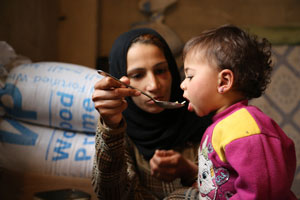 UNITED NATIONS, Jan 29: Food insecurity – or lack of access to enough food – continues to worsen in places torn by conflict, United Nations agencies reported Monday, listing Yemen, South Sudan and Syria among the countries most affected by acute hunger.
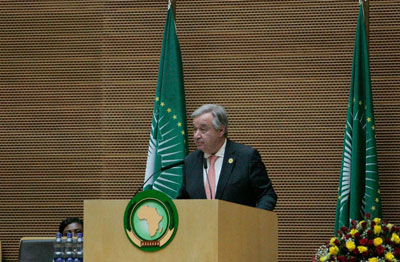 ADDIS ABABA, Jan 28: Hailing the partnership between Africa and the United Nations as “solid, and grounded on sound principles of human rights and good governance,” Secretary General, Antonio Guterres told leaders gathered in Addis Ababa, Ethiopia, for the African Union Summit, that with Africa in the lead, “we can and will do more” to bolster successful cooperation throughout the continent.
 ADDIS ABABA, Jan 27: No single nation, institution, or organization can defeat terrorism in Africa or anywhere else, United Nations Secretary-General António Guterres told a special meeting of the African Union Peace and Security Council in Addis Ababa, Ethiopia, on Saturday, as he called for a sustained, cooperative and coordinated approach in tackling this complex, ever-evolving menace.
 ADDIS ABABA, Jan 27: United Nations Secretary-General António Guterres, the Security Council and the UN in Afghanistan have strongly condemned Saturday's massive vehicle bomb attack on a street near Government buildings in the Afghan capital, Kabul, which reportedly left 95 people dead and scores wounded.
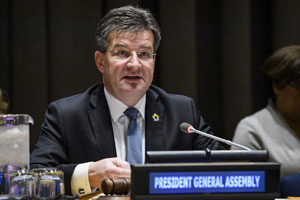 UNITED NATIONS, Jan 26: Ahead of next month’s Olympics and Paralympics in the Republic of Korea (ROK), United Nations General Assembly President Miroslav Lajcák on Friday appealed to all UN Member States to observe the historic 'Olympic Truce' during the Games.
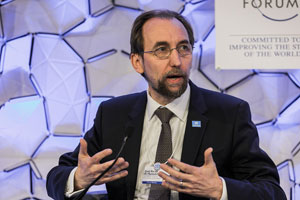 DAVOS, Jan 26: With major companies joining the growing list of early adopters of United Nations standards to promote equality for lesbian, gay, bi, trans and intersex (LGBTI) people, the UN human rights chief on Friday highlighted the private sector's crucial leadership role in ensuring the dignity and equal opportunities of LGBTI employees in the workplace and beyond.
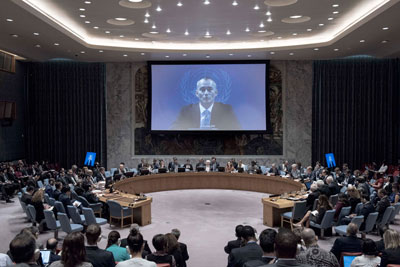 UNITED NATIONS, Jan 25: The United Nations, the Security Council and the wider international community all have fallen into a pattern of “managing, rather than resolving” the Palestinian-Israeli conflict, the UN envoy on the Middle East peace process warned Thursday, saying it was time to end this paralysis, show political leadership and push for policies on the ground that rebuild trust.
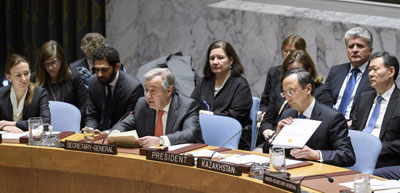 UNITED NATIONS, Jan 19: The threats of violent extremism and transnational organized crime in Afghanistan reverberate across Central Asia and the world and countering them cannot be the responsibility of one country alone, United Nations Secretary-General António Guterres said Friday, urging regional and multilateral cooperation, based firmly on human rights.
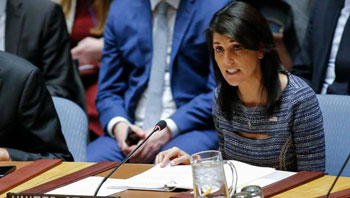 UNITED NATIONS, Jan 18: US ambassador to the United Nations Nikki Haley said on Thursday that the UN Security Council should step up pressure on Pakistan to “change its behaviour”.
 UNITED NATIONS, Jan 12: Migration, sustaining peace and development are among the priorities of the United Nations General Assembly for the remainder of the current session through September 2018, the President of the main UN deliberative and policymaking body said Friday.
Aviation
| Business | Defence | Foreign
Affairs | Communication | Health
| India | United Nations
India-US
| India-France | Entertainment
| Sports | Photo Gallery |
Tourism | Advertise with Us
| Contact Us
© Noyanika International, 2003-2009. All rights reserved.