


United Nations
Asia Pacific Climate Meet from July 11 at SingaporeBy Deepak Arora BONN, May 28: It has been confirmed that Asia Pacific Climate Week (APCW2018) will be convened in Singapore from July 11 to 13. The event – which lands two months ahead of both the Global Climate Action Summit in California and New York Climate Week – will be instrumental in demonstrating that there is genuine international support for stepping-up climate action by mobilizing actors across the Asia Pacific region. APCW2018, which is being organized by the Nairobi Framework Partnership with support from the Singapore Government, will provide a critical stepping-stone on the wider journey towards completing the operational guidance for the Paris Climate Change Agreement at the international climate negotiations at COP24 in Katowice, Poland. UN Climate Change Executive Secretary, Patricia Espinosa, will participate in the event, alongside the High-Level Climate Champions, Minister Inia Seruiratu from Fiji and Tomasz Chruszczow, Special Envoy for Climate Change from Poland, as well as city and business leaders. Patricia Espinosa said, “I welcome the hosting of Asia Pacific Climate Week at this critical moment, as it will make an invaluable contribution to spurring enhanced national climate ambition ahead of COP24.” The theme of APCW2018 is “Climate Action for Sustainable Development: Driving Change in Asia”. The high-level segment that takes place on Wednesday, 11 July will bring together the business community and focus on areas, such as: visions for NDC enhancement and implementation; challenges and opportunities for cities in the Asia Pacific region; the role of transport for sustainable development and climate action; and climate finance. Other highlights at the event include the Asia Pacific Carbon Forum and a technical session on the cross-linkages between markets and the Sustainable Development Goals. Owing to the political significance of the upcoming Talanoa Dialogue this year, APCW2018 will explore strategies for accelerating global climate action, including by realigning finance flows in the Asia Pacific region consistent with a pathway towards low greenhouse gas emission and climate-resilient development for the implementation of the Paris Agreement. APCW2018 follows-on from the success of Africa Climate Week (ACW2018) hosted in Nairobi earlier this year. On 20-25 August, the Latin America and Caribbean Climate Week will take place in Montevideo, Uruguay. The goal of these Climate Weeks is to support the implementation of countries’ Nationally Determined Contributions (NDCs) under the Paris Agreement and climate action to deliver on the Sustainable Development Goals. In so doing, they will bring together diverse array of international stakeholders in the public and private sectors around the common goal of enhancing climate action. Tackling corruption ‘from the top down’ essential: António Guterres
“It all begins with setting an example. By tackling corruption, Governments can show they mean business,” said Secretary-General António Guterres, speaking at a high-level event marking the 15th anniversary of the UN Convention Against Corruption. “Society cannot function equitably and efficiently when public officials – from doctors to police, judges and politicians – enrich themselves rather than perform their duties with integrity,” he added. Adopted in 2003, the Convention Against Corruption is the only legally-binding universal instrument, drawn up to fight corruption in all its forms. In his remarks, Mr. Guterres also underlined that in addition to robbing vital resources from public services such as schools and hospitals, corruption also fuels human trafficking and the black market in natural resources, weapons, drugs and cultural artifacts. “It fuels conflict, and when a hard-won peace is achieved, corruption undermines recovery. Corruption and impunity are corrosive, breeding frustration and fostering further corruption when people see no other way of achieving their goals,” said the UN chief, calling for greater political and popular support for the fight against corruption. He described the Convention Against Corruption as one of the most effective tools the world has to achieve the common goals of good governance, stability and prosperity. “The UN will continue to support Member States every step of the way, from helping to engage and empower citizens in this fight, to helping build and enhance institutions that can deliver on their promise,” said Guterres. Corruption ‘destroys everything in its path’Speaking alongside the Secretary-General, Miroslav Lajcák, the President of the UN General Assembly also reiterated that corruption hurts all sections of the society and that it “destroys everything in its path.” Ultimately, corruption causes suffering to ordinary people going about their daily lives, he stressed, citing common examples: “When they are stopped at checkpoints, for bribes. When a bus does not come – or a clinic does not open – because budgets were mismanaged. Or when they lose all of their savings, from extortion,” said Lajcák. He also highlighted the link between the 2030 Agenda for Sustainable Development and good governance. “If we want to achieve the Sustainable Development Goals (SDGs), we need to take concrete steps. This will mean allocating budgets. It will mean raising more funds. It will mean new policies and new legislation”, he said, adding that more innovative ways needed to be found of “working together”. Yury Fedotov, the Executive-Director of the UN Office on Drugs and Crime (UNODC) also underscored the importance of the Convention for sustainable development. Noting that while Sustainable Development Goal 16 (SDG16) explicitly urges action against corruption, tackling the problem is a prerequisite for overall economic growth. “Anti-corruption responses are also crucial to ensuring access to healthcare, water, education and other vital services; protecting forests, oceans and wildlife; and reducing inequalities,” he added. Save our planet by protecting migratory birds and their ‘epic journeys’: Antonio GuterresBy Deepak Arora
“Migratory birds connect people, ecosystems and nations. They are symbols of peace and of an interconnected planet,” Secretary-General António Guterres said in a statement to mark the Day. “Their epic journeys inspire people of all ages, across the globe,” he continued, adding: “World Migratory Bird Day is an opportunity to celebrate the great natural wonder of bird migration – but also a reminder that those patterns, and ecosystems worldwide, are threatened by climate change.” The Day highlights the need to conserve migratory birds and their habitats by raising awareness of the threats they face, their ecological importance and the need for international cooperation to conserve them. Migratory birds fly hundreds and thousands of kilometres, along historic routes, to find the best habitats available for feeding, breeding and raising their young. The perilous journeys involve a wide and diverse array of threats. Of the 11,000-bird species on the planet, one-in-five is considered migratory. Forty per cent of them are in decline, with one-in-eight under threat of global extinction. Major threats include habitat-loss and degradation, caused by agricultural and coastal development; collision with badly placed wind turbines and powerlines; unsustainable harvesting, and illegal killing and taking. Migratory birds are also greatly affected by poisoning, such as through ingesting lead released into the environment, through spent ammunition, or toxic weights used for fishing. “Migratory birds are under threat from every corner: they are losing their habitats, subjected to illegal killing and suffering from the impacts of climate change,” said Erik Solheim, Executive Director of the UN Environment Programme, UNEP, adding that we all have a responsibility to “save such a precious component of the natural world.” By protecting them, we protect our planet. Key supporters and partners globally, are adamant that successful migratory bird conservation can only be achieved through a united effort. Beginning this year, World Migratory Bird Day will be observed annually each May and October, to coincide with the cycle of migration, making it possible to organize events in countries around the world at peak migration times. “I urge Governments and people everywhere to take concerted conservation action that will help to ensure the birds’ survival – and our own,” the Secretary-General concluded. India celebrates Ambedkar Jayanti at UNBy Deepak Arora
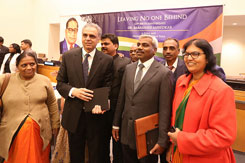
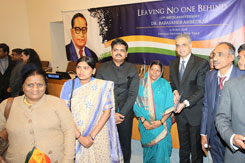
Speaking on the occasion, India's Permanent Representative Ambassador Syed Akbaruddin said Babasaheb’s influence on modern India was not merely restricted to India’s domestic policies. "His striving to be the voice of the marginalized is also reflected in India’s policy commitment and resolve to work collectively for poverty eradication across the globe and to leave no one behind," he added. In this spirit, Ambassador Syed Akbaruddin said "India is working with fellow developing countries by providing development assistance in their endeavours to implement the 2030 UN Agenda. Development cooperation with Least Development Countries and Small Island Developing States is the focus." With this aim, Ambassador Syed Akbaruddin said the India-UN Development Partnership Fund has been set up, in association with the UN Office of South-South Cooperation, under the auspices of United Nations Development Programme (UNDP).
Building on this, he said "we are also opening a Commonwealth window of this Fund and allocating additional resources for developing countries from the Commonwealth. The new window too will be managed through the UNDP. These are all small measures that we take in solidarity with our vision of working together with our friends and partners amongst developing countries across the globe." Ambassador Syed Akbaruddin said this event is a testimony to Dr. Ambedkar’s life and the enduring nature of the vision that he embodied. It is also reflection of the belief that the principle of ‘Leaving No One Behind’ is a treasured one. In his keynote address, UN Development Programme Administrator Achim Steiner said that Ambedkar's legacy lives on in a remarkable way in the difficult work undertaken in the UN headquarters everyday. "We are as much entrapped by the contradictions of the world in which we serve and which we confront as Dr Ambedkar was in his time," he said and added “Ambedkar understood that rising and persistent inequalities pose fundamental challenges to the economic and social well-being of nations and people.”
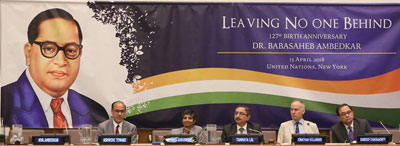
He highlighted Ambedkar’s immense contribution to the vision of social justice and equality, saying this vision underpins the UN’s 2030 Agenda for Sustainable Development. Steiner said that by placing ‘sabka saath, sabka vikas’ at the centre of its development agenda, the Indian government had demonstrated its “deep commitment” to upholding the ideals of the principal architect of the Indian Constitution. After the opening remarks of the Ambassador Syed Akbaruddin and keynote address by Achim Steiner, a panel discussion immediately followed. The panelists included Dr Menaka Guruswamy, B R Ambedkar Research Scholar and lecturer at the Columbia University; Jonathan Hollander, Founder of Battery Dance Company; India's Consul General Sandeep Chakravorty; and Ashwani Tewari, SBI Country Head. Ambassador Tanmaya Lal, Deputy Permanent Representative of India, moderated the discussion. Menaka Guruswamy said that Ambedkar's rise from an "untouchable family" to become the architect of India's Constitution "is really the poetry of an inspired constitution-crafting project". She said "Ambedkar's Constitution is a quest for equality and it amends historic injustices."
Ashwini Tewari said that the answer to promoting equality and inclusion lies in technology and organisation. He gave a presentation on how SBI was using mobile technology to reach the poor and deliver financial services and assistance. Sandeep Chakravorty said that the government was acting as a disrupter in shaking up the established ways for the better. One of the disruptions with far reaching consequences was Swachh Bharat with the building of millions of toilets and another was the direct transfer of funds to people cutting out middlemen and corruption. He said the government had introduced a scholarship programme for Dalits to study abroad and his consulate was involved with four students at elite universities who had all their expense paid. A short film on Dr Ambedkar’s inspiring life story was also screened on the occasion. Jonathan Hollander showed the trailer for Moving Stories and spoke about Battery Dance and dancing to connect. UN SC rejects Russian request to condemn airstrikes in SyriaBy Deepak Arora
The meeting was held following overnight airstrikes in Syria launched by the United States, with support from France and the United Kingdom, which targeted installations connected to the country’s chemical weapons capabilities. It was called by Russia which failed to get the other 14 Council members to adopt a resolution condemning the airstrikes. Speaking prior to the vote on the draft resolution, the Secretary-General urged countries to avoid actions that would escalate the situation in Syria and worsen the suffering of its people. “As Secretary-General of the United Nations, it is my duty to remind Member States that there is an obligation, particularly when dealing with matters of peace and security, to act consistently with the Charter of the United Nations and with international law in general,” he told ambassadors, echoing a statement issued in the wake of the airstrikes. The US and its allies launched the airstrikes in response to last week’s suspected chemical attack in the Syrian city of Douma. The World Health Organization (WHO) said its partners reported some 500 people there had exhibited “signs and symptoms consistent with exposure to toxic chemicals.” “More than 70 people sheltering in basements have reportedly died, with 43 of those deaths related to symptoms consistent with exposure to highly toxic chemicals,” according to an agency statement on Wednesday. UN partner the Organisation for the Prohibition of Chemical Weapons (OPCW) has dispatched a fact-finding team to the location. The airstrikes were reportedly limited to three military locations, but the Secretary-General said the UN is unable to independently verify these details or if there were any casualties. Russian President Vladimir Putin has condemned the airstrikes as “an act of aggression,” the country’s representative informed the Council. “This is hooliganism in international relations, and not minor hooliganism given that we’re talking about major nuclear powers,” Ambassador Vassily Nebenzia said. “Several strikes were conducted against the scientific research centre in Barzeh and Jamraya. Recently, two inspections by the OPCW were conducted with unimpeded access to all facilities. Experts didn’t find any trace of activity that would contravene the chemical weapons convention. The scientific facilities in Syria are used only for peaceful activity which is aimed at enhancing the effectiveness of the economic activity of Syria.” US Ambassador Nikki Haley defended the joint operation with France and the UK, expressing confidence that the airstrikes had “crippled” Syria’s chemical weapons programme. “With yesterday’s military action, our message was crystal clear. The United States of America will not allow the Assad regime to continue to use chemical weapons,” she said. “Last night, we obliterated the major research facility that it used to assemble weapons of mass murder. I spoke to the President this morning and he said if the Syrian regime uses this poison gas again, the United States is locked and loaded. When our President draws a red line, our President enforces the red line.” For UK Ambassador Karen Pierce, Syria has presented one of the most serious challenges to international efforts on non-proliferation. “A State Party has violated the chemical weapons convention, it has defied the Security Council, and it has broken international law . Repeated attempts over several years to hold them to account have been meet with Russian obstruction and resistance. We have repeatedly in this Council attempted to overcome this obstruction, without success.” The Syrian crisis is now in its eighth year, and is the most serious threat to international peace and security, as the UN chief stated in his briefing. “In Syria, we see confrontations and proxy wars involving several national armies, a number of armed opposition groups, many national and international militia, foreign fighters from everywhere in the world, and various terrorist organizations,” he said. The Secretary-General reiterated that there is no military solution to the crisis, only a political one. French Ambassador François Delattre said the three allies will submit a draft resolution aimed at finding a political solution to the Syrian crisis. “When it ordered the chemical attack on 7 April, the Syrian regime knew fully what it was doing. Once again, it wanted to test the limit of tolerance of the international community – and it found it,” he said. “In the face of this attack on the principles and values and the laws underpinning the action of the United Nations, the silence was no longer a solution. We cannot no longer tolerate the trivialization of the use of chemical weapons which presents an immediate danger to the Syrian people and to our collective security.” UN Chief Guterres calls for unity in Security Council over SyriaBy Deepak Arora
“I have also been closely following developments in the Security Council and regret that the Council has so far been unable to reach agreement on this issue,” Secretary-General António Guterres said in a statement issued late Wednesday night. “Let us not forget that, ultimately, our efforts must be about ending the terrible suffering of the Syrian people,” he added. Guterres said that he called the ambassadors of the five permanent Council members – China, France, Russia, the United Kingdom and the United States – on Wednesday to reiterate his “deep concern about the risks of the current impasse” and stressed the need to “avoid the situation spiraling out of control.” On Tuesday, the 15-member body voted on three separate draft resolutions in response to recent allegations of a chemical weapons attack in the Syrian town of Douma. None of the texts garnered enough support. The first draft considered today – penned by the United States – which would have established a new investigative mechanism for one year, as well as identify those responsible for the use of chemical weapons, was rejected owing to a negative vote – or veto – from Russia. Similarly, a competing draft – penned by Russia – which would have established the mechanism for one year as well but would have given the Security Council the responsibility to assign accountability for the use of chemical weapons in Syria, was also not adopted. The Council rejected a third text – also proposed by Russia – which concerned the work of the fact-finding mission of the Organization for the Prohibition of Chemical Weapons (OPCW), the implementing body of the Chemical Weapons Convention (CWC), which entered into force in 1997. Despite the deadlock in the Security Council, OPCW has said that it would shortly send a team to Syria to “establish the facts” surrounding the incident. On Wednesday, the UN World Health Organization (WHO) said that it has received reports that an estimated 500 patients at Syrian health facilities have exhibited signs and symptoms consistent with exposure to toxic chemicals, after the shelling of a Damascus suburb over the weekend. WHO has demanded immediate unhindered access to the area to provide care to those affected, to assess the health impacts, and to deliver a comprehensive public health response. Security Council fails to adopt three resolutions on chemical weapons use in SyriaBy Deepak Arora
Had one of the two mechanisms proposed in the drafts been approved, it could have filled the vacuum left by the Organisation for Prevention of Chemical Weapons (OPCW)-UN Joint Investigative Mechanism (JIM) when its mandate expired last November. The first draft considered today – penned by the United States – which would have established a new investigative mechanism for one year, as well as identify those responsible for the use of chemical weapons, was rejected owing to a negative vote from Russia. The draft received 12 votes in favour, two against (Bolivia and Russia) and one abstention (China). A negative vote – or veto – from one of the Council's five permanent members – China, France, Russia, United Kingdom and the United States – blocks passage of a resolution. Today’s meeting marked the twelfth time Russia has used its veto to block Council action on Syria. Similarly, a competing draft – penned by Russia – which would have established the mechanism for one year as well but would have given the Security Council the responsibility to assign accountability for the use of chemical weapons in Syria, was also not adopted. This draft received six Council members’ votes in favour (Bolivia, China, Ethiopia, Equatorial Guinea, Kazakhstan and Russia), seven against (France, the Netherlands, Peru, Poland, Sweden, United Kingdom and United States) and two abstentions (Cote d’Ivoire and Kuwait). The Council rejected a third text – also proposed by Russia – which concerned the work of the OPCW Fact-Finding Mission (FFM). The draft received five votes in favour (Bolivia, China, Ethiopia, Kazakhstan and Russia), four against (France, Poland, the United Kingdom and the United States), and six abstentions (Cote d’Ivoire, Equatorial Guinea, Kuwait, the Netherlands, Peru, and Sweden). Ahead of the Security Council meetings today, UN Secretary-General António Guterres had repeated his call on 15-member body to “find unity” on the issue of use of chemical weapons in Syria and ensure accountability. “The norms against chemical weapons must be upheld. I appeal to the Security Council to fulfil its responsibility and find unity on this issue,” he said. “I also encourage the Council to redouble its efforts to agree on a dedicated mechanism for accountability.” UN Chief Guterres Offers Assistance For Diplomatic Solution on Korean PeninsulaBy Deepak Arora
In a meeting with Chinese President Xi Jinping here on Sunday, Guterres expressed his appreciation for President Xi's support to the UN’s work and told him that the UN continues to count on China’s leadership and commitment to the implementation of the 2030 Agenda, including through international cooperation under the Belt and Road Initiative. He congratulated President Xi on his recent re-election. Moreover, he underlined the UN's commitment to assist in supporting a process of sincere dialogue, leading to sustainable peace and denuclearization on the Korean Peninsula. UN GA Prez commends NAM for promoting peace, security, developmentBy Deepak Arora
In his remarks, the President commended the role of the Non-Aligned Movement in promoting peace, security and development around the world. He said, “We cannot address the link between peace and sustainable development without acknowledging that we are facing major challenges in both areas… Institutions are crumbling to conflict… people’s prayers and calls for peace remain unanswered… climate change is waging an invisible war, across new battlegrounds, and… the gap between the rich and the poor gets even wider.” He added, “Some areas in the world feel these challenges more than others. But no country, land, or group is immune. So, we need to recommit to working together. To cooperation. To multilateralism. And to the United Nations.” That same day in Baku, President Lajčák met with Azerbaijani Government officials and the United Nations Country Team. With Mr. Ilham Heydar oglu Aliyev, President of the Republic of Azerbaijan, the President discussed a wide range of themes, including the United Nations budget, migration, regional developments, and his upcoming events on sustaining peace, youth and financing for the Sustainable Development Goals. In a meeting with Mr. Elmar Maharram oglu Mammadyarov, Minister for Foreign Affairs of the Republic of Azerbaijan, the topics of discussion were United Nations reform processes, in particular Security Council reform; and the President’s High-Level Event on Peacebuilding and Sustaining Peace, which Foreign Minister Mammadyarov agreed to attend. The President also met with the Minister for Media and Communication Affairs of the Hashemite Kingdom of Jordan, Mr. Mohamed Al-Moumni. They agreed on the importance of strengthening multilateralism and discussed President Lajčák’s Youth Dialogue, which will be held in May, and the ongoing negotiations on the Global Compact for Safe, Orderly and Regular Migration. The President visited ASAN, an Azerbaijani Government project, which makes Government services more accessible to citizens through technology supported by the United Nations Country Team. He also participated in an interactive lecture with students at the Azerbaijan Diplomatic Academy (ADA) University on the topic “The state of multilateralism”. The President said that multilateralism is critical to our futures – but also in a critical condition. Therefore, everyone must play a role in defending and strengthening it. Other topics raised included sustaining peace, sustainable development, migration and the work and role of the General Assembly. The discussion was co-moderated by Mr. Hafiz Pashayev, Deputy Minister for Foreign Affairs of the Republic of Azerbaijan and Rector of the ADA University, and Mr Yashar Aliyev, Permanent Representative of the Republic of Azerbaijan to the United Nations. In a meeting with the United Nations Country Team in Azerbaijan, he was briefed on the challenges and opportunities related to the work of the different agencies on the ground, the implementation of the Sustainable Development Goals in the country, and relations between Azerbaijan and the United Nations. At UNSC, Russia calls nerve agent attack accusations absurd; UK stands by chargeBy Deepak Arora
Russia “is not responsible” for the attack in Salisbury, that country's Ambassador to the UN, Vassily Nebenzia, said, stressing that the origin of the substance used in the incident has not been confirmed. Today’s meeting, requested by Russia, took place amid expectations that the results of tests of samples collected from individuals exposed to a nerve agent in Salisbury will be known by early next week. The United Kingdom sent the Organisation for the Prohibition of Chemical Weapons (OPCW) samples of the nerve agent within days of the incident, which left Sergei Skripal and his daughter, Yulia, hospitalized. After the incident, the UK wrote a letter to the UN Security Council, stating that it was “highly likely” that Russia was behind the incident using deadly nerve-agent Novichok. At the 14 March Security Council meeting requested by the UK, Russia – a State Party to the Chemical Weapons Convention (CWC) – firmly denied the allegations. The Convention, which came into force in 1997, outlaws the production, stockpiling, and use of chemical weapons and their precursors. At today’s meeting, Mr. Nebenzia accused the UK of engaging in a “theatre of the absurd,” and wondered why Russia would want to wage such an attack, eight years after Skripal was granted amnesty, and before the Russian presidential elections and the 2018 World Cup soccer event. Further, the Russian delegate said that his country does not have a copyright on Novichok and that line of toxic substances has been developed in many countries, including the United States and the UK. “Yet people are demanding that the Russian Federation acknowledged its guilt,” he said.
“We have told our British colleagues that ‘you’re playing with fire and you’ll be sorry’,” said Ambassador Vassily Nebenzia during a more than 30-minute speech. At an OPCW Executive Council special meeting on Wednesday, Russia proposed a joint investigation with the UK, which was rejected by the UK and its allies. Speaking after Nebenzia was UK Ambassador to UN, Karen Pierce, who said that her Government’s investigations into the use of chemical weapons involved 250 police detectives interviewing more than 500 witnesses, supported by a range of experts and partners that have gone through more than 5,000 hours of video footage. A military-grade nerve agent – a weapon of mass destruction – has been used in an attempt to kill civilians on British soil in a reckless fashion, she said. Telling the meeting that she would “take no lectures” from Moscow, Pierce said: “There is one country, Russia, which is playing a fast and loose with our collective security and the international institutions that protect us.” Noting that Yulia is now able to communicate and is getting better, Pierce said that the UK Government received a request from the Russian consulate for access to Yulia, which was already conveyed to her. Global food price index rises for second consecutive month: UN agencyBy Deepak Arora
According to the UN Food and Agriculture Organization, the rise was driven by “robust increases” in the prices of cereals (165.6 points) and dairy products (197.4 points), averaging 2.7 per cent and 3.3 per cent higher, respectively, than their prices the previous month. Wheat prices increased mostly on weather worries, including prolonged dryness in the United States of America and cold wet conditions in parts of Europe. Similarly, maize – another major cereal – saw its prices rise on back of strong global demand and deteriorating crop prospects also in Argentina. FAO also anticipates that 2018 world maize and wheat production could decline based on early forecasts. Worldwide wheat output could drop to 750 million tonnes, about 1 per cent below its near-record level of the previous year. In 2017, worldwide cereal production, including wheat, hit a record level, up 33 million tonnes from 2016, to nearly 2,646 million tonnes globally. Price indices for sugar and vegetable oils, however, recorded declines in March, averaging 186 points and 156.8 points, respectively. The meat price index (169.8 points) remained almost unchanged from February. Mine action is ‘concrete step towards peace,’ says UN chief on International Mine Awareness DayBy Deepak Arora
“An unprecedented volume of landmines and unexploded weapons contaminates rural and urban war zones, maiming and killing innocent civilians long after conflict has ended,” Guterres said in his message on International Mine Awareness Day, marked annually on April 4. Noting that roads cleared of explosive devices enable peacekeepers to patrol and protect civilians, he said: “Mine action is vital.” “And when fields are cleared and schools and hospitals are made safe, normal life can resume,” he added. According to the UN Mine Action Service, or UNMAS, after nearly two decades of steadily diminishing casualty rates, the total number of people killed or injured by landmines and other explosive hazards in recent and current intense conflicts has leapt to its highest since 1999; the human suffering caused by mines, explosive remnants of war and other explosive hazards, including roadside bombs or booby traps, is devastating. Mine action, including clearance, risk education and assistance to victims is critical for advancing protection, peace and development. “In our turbulent world, mine action is a concrete step towards peace,” stated the Secretary-General. UNMAS says that mine action entails more than removing landmines from the ground; it includes five types of actions: Clearance: Removing and destroying landmines and marking/fencing off contaminated areas Education: Helping people understand risks they face, learn how to stay out of harm’s way Victim Assistance: Providing medical assistance and rehabilitation services to victims Advocacy: Advocating for a world free from the threat of landmines Stockpile destruction: Helping countries destroy their stockpiles Most places affected by armed conflicts are contaminated by a variety of explosive hazards, said Daniel Craig, the UN Global Advocate for the Elimination of Mines and Explosive Hazards. Whether landmines, improvised explosive devices (IEDs), artillery shells or cluster bombs, he said in his message on the Day: “They are equal opportunity killers.” “When triggered, they kill indiscriminately. Soldier or civilian. Male or female. Old or young,” he continued, explaining that over time they can more and more easily be detonated to the point when “they can easily be triggered by a child jumping a rope.” Craig, best known for his role as ‘007’ in the James Bond films, outlined how mines curtail freedom – the freedom to play, collect food and water, farm and even vote. “We the peoples of the United Nations must join forces to defeat these deadly devices and win the fight against fear and inhumane suffering.” “Join me. Join us. Let’s win,” said Craig. Test sample results from Salisbury nerve agent attack expected next week: chemical weapons watchdog
“Once the results of the analyses of the samples are received, the Secretariat will produce a report on the basis of these results and will transmit a copy of this report to the United Kingdom,” Ahmet Üzümcü, the Director-General of the Organisation for the Prohibition of Chemical Weapons (OPCW), told the body’s Executive Council. “The UK has expressed its wish to be as transparent as possible and has already indicated its preference for disclosure of the report to other States Parties,” he added. The samples were collected from Sergei Skripal and his daughter, Yulia, who have been hospitalized since when they were found on a public bench in the English city of Salisbury in early March, after reported exposure to a toxic chemical. In the immediate aftermath of the incident, the UK said that it was “highly likely” that Russia was behind the incident using a deadly nerve-agent. The accusations were met by a firm denial by Russia, which as a State Party to the Chemical Weapons Convention (CWC), requested today’s Executive Council meeting. The UK sent the OPCW samples of the nerve agent within days of the incident. According to OPCW, samples were also collected from a third individual – a police official – reportedly exposed to the chemical. The samples were sealed and brought to the OPCW laboratory on 23 March. An OPCW expert team was deployed to the UK at the country’s request seeking technical assistance in identifying the nature of the toxic chemical reportedly used. In his update, Mr. Üzümcü also said that OPCW team worked independently and in not involved in the national investigation by the UK authorities and that no State Party is involved in the technical work that is being carried out by the Secretariat. The OPCW is the implementing body of the Convention, which came into force in 1997 and outlaws the production, stockpiling, and use of chemical weapons and their precursors. |
|
||||||||||||
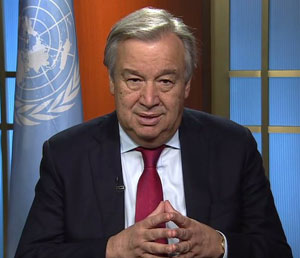 UNITED NATIONS, May 23: Corruption and complicity know no geographical boundaries, and it is society’s most vulnerable who get hurt the most, senior United Nations officials said on Wednesday, calling on Government leaders to fight the scourge, “from the top down”.
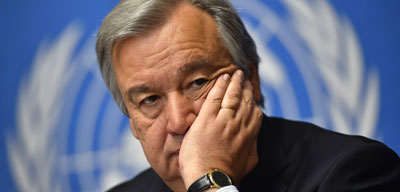 UNITED NATIONS, May 11: That’s one of the key messages from United Nations chief Antonio Guterres, for World Migratory Bird Day, celebrated on Saturday, with the soaring message: “Unifying Our Voices for Bird Conservation.”
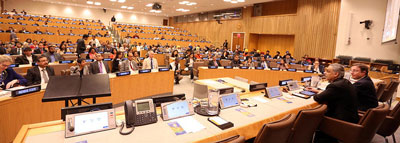
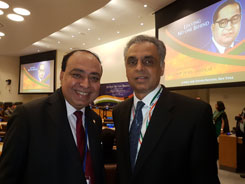
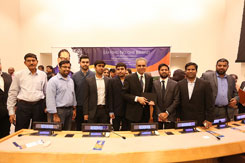
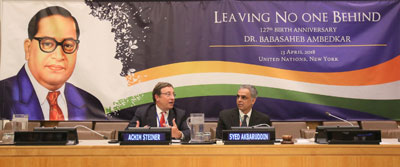 UNITED NATIONS, April 13: Dr Babasaheb Ambedkar's legacy of fighting inequality and inspiring inclusion is not only being implemented in India but also at the United Nations. Several speakers said this at a function to celebrated Ambedkar's 127th birth anniversay with the theme "Leaving No One Behind" here on Friday at the United Nations.
 The $ 100 million, allocated under this Fund, are non-earmarked to ensure sustained predictable funding for implementation of Sustainable Development Goals, he added.
  Achim Steiner said “His tireless efforts to ensure that excluded groups were politically and socially empowered, that workers were fairly treated, and that every person had access to education, made him a pioneer in India and in other countries.”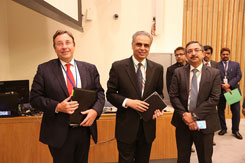
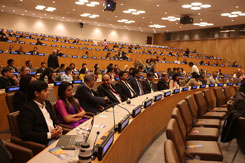
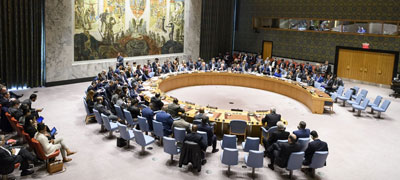 UNITED NATIONS, April 14: In an address to an emergency meeting of the Security Council on Saturday, United Nations Secretary-General António Guterres cautioned against the crisis in Syria “spiraling out of control."
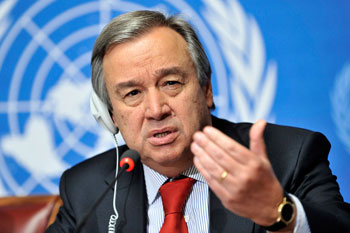 UNITED NATIONS, April 12: Amid the risks of the situation in Syria “spiraling out of control,” the United Nations chief has appealed to the five permanent members of the Security Council to break the current impasse on reported use of chemical weapons in the war-torn country.
 UNITED NATIONS, April 10: Days after alleged chemical weapons attack in the Damascus suburb of Douma, the United Nations Security Council failed to adopt two competing resolutions that would have established a mechanism to investigate use of such weapons in Syria, as well as another concerning a fact-finding mission in the war-torn country.
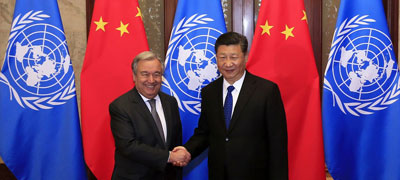 BEIJING, April 8: United Nations Secretary-General António Guterres has underlined the UN's commitment to assist in supporting a process of sincere dialogue, leading to sustainable peace and denuclearization on the Korean Peninsula.
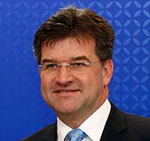 UNITED NATIONS, April 6: President of the United Nations General Assembly. Miroslav Lajčák returned to New York today following a visit to Baku, Azerbaijan, where he addressed the opening of the Mid-term Ministerial Conference of the Non- Aligned Movement (NAM) on April 5.
 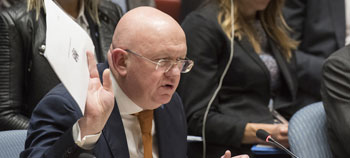 UNITED NATIONS, April 5: During a heated debate in the United Nations Security Council on Thursday, Russia again rejected allegations levelled by the United Kingdom that Moscow was behind a deadly nerve-agent attack in the English city of Salisbury on March 4.
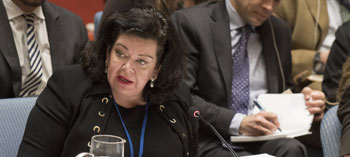 His delegation has prepared a draft statement for the Council that will be a litmus test as to whether the UK and its allies are true to their words; rejecting that test will be a confirmation of their “dirty games,” he added.
 UNITED NATIONS, April 5: Global food prices rose for the second consecutive month with the index for these commodities averaging 172.8 points in March, 1.1 per cent higher than in February, the United Nations food security agency announced Thursday.
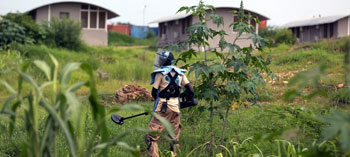 UNITED NATIONS, April 5: On the day set aside to raise awareness about the threat of landmines, unexploded grenades and other munitions that impede the return to normal life after conflict, United Nations Secretary-General António Guterres is urging Governments to provide political and financial support to keep up the vital work of mine action wherever it is needed.
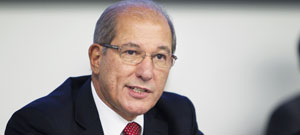 UNITED NATIONS, April 4: Results of tests of samples collected from individuals exposed to a nerve agent in Salisbury, the United Kingdom, are expected to be received by early next week, the head of the United Nations-backed body working to rid the world of chemical weapons said on Wednesday.
Aviation
| Business | Defence | Foreign
Affairs | Communication | Health
| India | United Nations
India-US
| India-France | Entertainment
| Sports | Photo Gallery |
Tourism | Advertise with Us
| Contact Us
© Noyanika International, 2003-2009. All rights reserved.