


United Nations
As conflicts become more complex, ‘mediation is no longer an option; it is a necessity’, UN chief tells Security CouncilBy Deepak Arora
Speaking alongside the UN chief were the Archbishop of Canterbury, Justin Welby, a member of his High-Level Advisory Board on Mediation, and Mossarat Qadeem, the co-founder of PAIMAN Alumni Trust, a civil society group working to prevent violent extremism in Pakistan. As speakers at the day-long debate warned that the maintenance of international peace and security faces multiple challenges, Mr. Guterres noted that many internal conflicts feature a deadly mix of fragmented armed groups and political interests, funded by criminal activities, and that peace agreements are becoming more elusive and short-lived. Archbishop Justin expressed concern that the international rules-based order is struggling, with national interests too often allowed, “even in this chamber”, to overcome the wisdom of those who have lived through war. For this reason, the Secretary-General has made diplomacy for peace one of his key priorities, with a focus on prevention and investment in mediation, peacebuilding and sustainable development. As an example of his commitment, he pointed to the creation of the High-Level Advisory Board on Mediation in September 2017, which aims to allow the UN to work more effectively with regional organizations, non-governmental groups and others involved in mediation around the world. Mr. Guterres pointed to the work of Board member and former Nigerian President Olusegun Obasanjo – who travelled to Liberia on behalf of the Secretary-General to support the peaceful transfer of power after the 2017 elections – as an example of how the Board can be deployed in the cause of conflict prevention. He added that the UN is already has a wide range of mediation resources at its disposal, including special envoys and representatives pursuing consultations, good offices and formal talks. An example is the UN Standby Team of Senior Mediation Advisers, a group with expertise on a wide range of issues connected to peace negotiations. The group, part of the UN Mediation Unit, is providing crucial advice in areas of conflict, from the Central African Republic to Yemen and South Sudan. Archbishop Justin described the Unit as a vital component of the UN’s cross-agency and cross-departmental reconciliation strategy, which is helping to build shared understanding between the UN and its partners. Mr. Guterres told the Council that the UN recognizes the important role played by an “enormous range” of actors, from national bodies to civil society group, women’s organisations, religious leaders and young activists. In South Sudan, where a peace deal has recently been agreed, the UN envoy there is supporting local efforts to address communal conflicts and, as Archbishop Justin explained, church leaders are playing an increasingly important role in moving the South Sudanese peace process beyond its current roadblocks. The Secretary-General and Ms. Qadeem both emphasised the importance of investing in women’s meaningful participation and leadership in peace processes. Mr. Guterres cited the emergence of regional networks of women mediators, such as the Nordic Women’s Mediators’ Network and the African Union’s FemWise group. Ms. Qadeem highlighted ways in which women have been excluded from mediation, with many sceptical of their ability to talk to violent extremist groups like the Tamil Tigers or the Taliban. In fact, women have played mediation roles in both cases. For example, several years ago a group of mothers of missing soldiers in Sri Lanka successfully mediated a ceasefire, which was followed by peace talks. And Ms. Qadeem shared her own experience of speaking with the Taliban in Pakistan. “I found the courage not only to speak with them to release my staff members they had captured, but I took the chance to seek support for the implementation of health and education projects. This is mediation.” The UN chief told the Council that a changed conflict landscape calls for bold, creative thinking in international mediation: using social media effectively as a tool to bring communities together, speaking with one voice, and supporting the mediation efforts of regional and sub-regional organisations. “Innovative thinking on mediation”, he said, “is no longer an option; it is a necessity.” Nuclear test ban treaty critical to global collective security: UN chiefBy Deepak Arora
His appeal came in a message for the International Day Against Nuclear Tests, observed annually on 29 August. “The history of nuclear testing is one of suffering, with the victims of more than 2,000 nuclear tests often from the most vulnerable communities around of the world,” Mr. Guterres said. “The devastating consequences – which were not confined by international borders -- encompassed impacts on the environment, health, food security and economic development.” The UN has been pressing for the Comprehensive Nuclear-Test-Ban-Treaty (CTBT) to become law. The treaty prohibits nuclear explosions anywhere – whether on the Earth’s surface, in the atmosphere, underwater or underground. It also makes it difficult for countries to develop nuclear bombs for the first time, and prevents nations that already possess nuclear technology from developing even more powerful bombs. More than 180 countries have signed the treaty, most of whom have also ratified it. However, while nearly universal, the treaty will only enter into force after it is signed and ratified by eight countries with nuclear technology capacity: China, Egypt, India, Iran, Israel, North Korea, Pakistan and the United States. “The Comprehensive Nuclear-Test-Ban Treaty has an essential role within the nuclear disarmament and non-proliferation regime,” the UN chief said. “It fosters international peace and security by constraining the development of nuclear weapons. Our collective security demands that every effort should be made to bring this essential treaty into force.” Lassina Zerbo, Executive Secretary of the UN commission which promotes the treaty, known as the CTBTO, also called on the international community to “take the final steps” to ensure its entry into force. “As long as the Treaty is not in force, the established international norm against nuclear testing and the global verification system that has been developed over the past two decades are at risk. I urge the last eight countries to ratify the Treaty and I appeal to others to renew their efforts in supporting it,” he said, also in a message to mark the International Day. Mr. Zerbo said his conviction regarding the role the treaty can play on the Korean Peninsula was strengthened following a visit to the region last week. The CTBTO is hosting a meeting in Kazakhstan this week, which brings together international experts and young people to look at key issues surrounding denuclearization. “The significance of being in Kazakhstan on 29 August where nuclear testing has left a poisonous legacy is immense,” Mr. Zerbo added, recalling that the date also commemorates the 1991 shutdown of the Semipalatinsk test site, where the Soviet Union undertook what he called “one of the most extensive nuclear test programmes in history.” “For Kazakhstan, it was very important to share its own experience in having the nuclear tests conducted in its territory,” said Ambassador Kairat Umarov, the Permanent Representative of Kazakhstan to the UN, emphasizing that nuclear weapons are not only destructive when they are used, but also that their harmful effects continue to linger on, devastating people’s lives and the environment where they are used. “If we talk in figures, the after effects of the nuclear tests in the air, on the ground and under the ground, it is like spraying 300 kilograms of weapons-grade plutonium over 18,000 square kilometers […] a huge territory that is rendered useless,” he explained. Some Saudi-led coalition air strikes in Yemen may amount to war crimes: UNSANAA, Aug 28: Air strikes by the Saudi-led coalition in the war in Yemen have caused heavy civilian casualties and some may amount to war crimes, U.N. human rights experts said on Tuesday. The experts’ panel also said that fighters of the rebel Houthi movement had fired missiles into Saudi Arabia and shelled the Yemeni city of Taiz. It accused them of committing torture and deploying child soldiers, both war crimes. Saudi Arabia is leading a Western-backed alliance of Sunni Muslim Arab states trying to restore the internationally recognized government of Yemeni President Abd-Rabbu Mansour Hadi, ousted from the capital Sanaa by the Iran-aligned Houthis in 2015. The experts said they did not examine the United States and Britain, who supply weapons and intelligence to the alliance, or Iranian support for the Houthis but other U.N. bodies were doing so. They urged all states to restrict arms sales to help end the war. “I think it fair to say, that of those parties that we have investigated -- and we have not been able to look at for example al-Qaeda and Daesh (Islamic State) who are also involved in Yemen -- of those parties, none have clean hands,” panel member Charles Garraway told a news conference. The report to the U.N. Human Rights Council was the first United Nations investigation into possible war crimes in Yemen although international human rights groups have regularly documented abuses. It was released ahead of U.N. peace talks between Hadi’s government and Houthis scheduled for Sept. 6 in Geneva. More than 10,000 people have been killed in the war in Yemen and 8.4 million are on the brink of famine, the panel said. “Coalition air strikes have caused most of the documented civilian casualties. In the past three years, such air strikes have hit residential areas, markets, funerals, weddings, detention facilities, civilian boats and even medical facilities,” it said. Coalition forces have imposed severe restrictions on Red Sea ports and Sanaa airport, depriving Yemenis of vital supplies, which may also constitute international crimes, the experts said. United Arab Emirates (UAE) personnel and proxy forces which are part of the coalition have raped detainees and migrants, they said. The Saudi-led coalition said it had referred the U.N. report to its legal team for review. “The Coalition will take an appropriate position on this matter and make an announcement about it once the legal team submits its observations,” it said in a statement. UAE Minister of State for Foreign Affairs Anwar Gargash, said the report merited a response. But he added the region needed to be preserved from “Iranian encroachment”. Officials could not immediately be reached for comment. The panel said its investigation of 11 incidents raised serious concerns about the coalition’s targeting process. Attacks that fail to spare people or structures protected by international humanitarian law would be unlawful violations, it said. But its investigation showed that field commanders “routinely failed to consult with those in the (coalition) Joint Command holding information about the No-Strike Lists”. Garraway said that despite requests, the panel had not been given full access to the coalition’s targeting process, making it extremely difficult to reach firm conclusions. “But what we have seen from the ground indicates that there may be systemic problems in that targeting process,” he said. The experts, who made about a dozen visits to Yemen, said that they had compiled a confidential list of suspects. Panel chairman Kamel Jendoubi said three bombs hit a fish market near a hospital in Hodeidah on Aug 2, killing 40-55 people. The coalition has denied responsibility. “It would seem that the strikes came from the south, where the Emirati forces and forces of President Hadi are concentrated, near the airport,” Jendoubi said. Garraway said: “It does fit the pattern...If hospitals are being struck, one asks if the commanders giving orders for shelling have actually got sight of the No-Strike List.” Myanmar military chiefs should face ‘genocide’ case, says UN teamGENEVA, Aug 27: Investigators working for the UN’s top human rights body said today that top Myanmar military leaders should be prosecuted for genocide against Rohingya Muslims. The call, accompanying a first report by the investigators, amounts to some of the strongest language yet from UN officials who have denounced alleged human rights violations in Myanmar since a bloody crackdown began last August. The three-member “fact-finding mission” working under a mandate from the UN-backed Human Rights Council meticulously assembled hundreds of accounts by expatriate Rohingya, satellite footage and other information to assemble the report. The UN-backed Human Rights Council created the mission six months before a rebel attack on security posts set off the crackdown that drove hundreds of thousands of Rohingya fleeing to neighbouring Bangladesh. Through hundreds of interviews with expatriate Rohingya and use of satellite footage, the team compiled accounts of crimes including gang rape, the torching of hundreds of villages, enslavement, and killings of children — some before their eyes of their own parents. The team was not granted access to Myanmar and has decried a lack of cooperation or even response from the government, which received an early copy of the report. The team cited a “conservative” estimate that some 10,000 people were killed in the violence, but outside investigators have had no access to the affected regions — making a precise accounting elusive, if not impossible. Above all, the investigators said the situation in Myanmar should be referred to the International Criminal Court, and if not, to a special tribunal. Last week, Myanmar’s government rejected any cooperation with the ICC, to which it is not a party. China, a permanent member of the UN Security Council with veto power over whether the issue will be brought before the ICC, has been reticent about condemning Myanmar’s government during the crisis. UN officials and human rights watchers have for months pointed to evidence of genocide in Myanmar, and the United States late last year said that “ethnic cleansing” was occurring in Myanmar. But few experts have studied the issue as in-depth and in such an official way as the fact-finding team, with a mandate from a body that has Myanmar’s approval: The country is among the 47 members of the Human Rights Council. The United Nations does not apply the word “genocide” lightly. The fact-finding team’s assessment suggests the crimes against the Rohingya could meet the strict legal definition — which was last met over crimes in Bosnia and Rwanda nearly a quarter-century ago. Human rights watchers say determining “genocidal intent” is perhaps the most difficult criteria to meet: In essence, it’s the task of assessing the mindsets of perpetrators to determine if ethnicity, race, religion or another attribute had motivated them. “The crimes in Rakhine state, and the manner in which they were perpetrated, are similar in nature, gravity and scope to those that have allowed genocidal intent to be established in other contexts,” the report said, alluding to a region of Myanmar that is home for many Rohingya. Adding into their assessment: The extreme brutality of the crimes; “hate rhetoric” and specific speech by perpetrators and military commanders; policies of exclusion against Rohingya people; an “oppressive context;” and the “level of organization indicating a plan for destruction.” The investigators cited six Myanmar military leaders by name as “priority subjects” for possible prosecution, led by the commander-in-chief, Min Aung Hlaing. A longer list of names is to be kept in the office of the UN human rights chief for possible use in future judicial proceedings. The United States and European Union have already slapped sanctions on some Myanmar military leaders, though Min Aung Hlaing is not among them. The authors called for the creation of a special body, or “mechanism,” to keep watch on the still-evolving human rights situation in Myanmar. They said the United Nations’ own role in the country since 2011 should be reviewed to see if the world body did all it could to prevent such a crisis. They also faulted Aung San Suu Kyi for not using her role as head of Myanmar’s government, nor her “moral authority” — she is a Nobel peace prize laureate — to stop the events in embattled Rakhine state. Kofi Annan is dead
“It is with immense sadness that the Annan family and the Kofi Annan Foundation announce that Kofi Annan, former Secretary General of the United Nations and Nobel Peace Laureate, passed away peacefully on Saturday 18th August after a short illness,” the foundation said in a statement. “His wife Nane and their children Ama, Kojo and Nina were by his side during his last days.” The Ghanaian national, who lived in Switzerland, was a career diplomat who projected quiet charisma and who is widely credited for raising the world body’s profile in global politics during his two terms as UN chief, from 1997 to 2006. He quickly became a familiar face on television, with his name making newspaper headlines, and he was a sought-after guest at gala events and New York dinner parties. Current UN chief Antonio Guterres voiced deep sadness at the news, describing his predecessor as “a guiding force for good”. “In many ways, Kofi Annan was the United Nations,” he added. “He rose through the ranks to lead the organisation into the new millennium with matchless dignity and determination. “Like so many, I was proud to call Kofi Annan a good friend and mentor.” North Korea has not stopped nuclear, missile programs: UN reportUNITED NATIONS, Aug 4: North Korea has pressed ahead with its nuclear and missile programs and continues to evade UN sanctions through increased illegal ship-to-ship transfers of oil products at sea, a UN report said Friday. In a 62-page report sent to the Security Council, the UN panel of experts also listed violations of a ban on North Korean exports of coal, iron, seafood and other products that generate millions of dollars in revenue for Kim Jong Un’s regime. Pyongyang “has not stopped its nuclear and missile programs and continued to defy Security Council resolutions through a massive increase in illicit ship-to-ship transfers of petroleum products, as well as through transfers of coal at sea during 2018,” said the report. The transfer of petroleum products to North Korean tankers at sea remains “a primary method of sanctions evasion” involving 40 vessels and 130 associated companies, it added. The violations have rendered the latest batch of sanctions “ineffective” by flouting the cap on oil, fuel and coal imposed in a raft of UN resolutions adopted last year, it added. At a historic June summit with US President Donald Trump, North Korean leader Kim Jong Un signed up to a vague commitment of “denuclearization of the Korean Peninsula” in the hope of getting UN and US sanctions relief. Trump however has repeatedly warned Pyongyang that the sanctions must remain in place and could even be tightened as long as there is no progress on ending its nuclear and ballistic missile programs. Arms sales via Syria North Korea also “attempted to supply small arms and light weapons (SALW) and other military equipment via foreign intermediaries” to Libya, Yemen and Sudan, said the report. It named Syrian arms trafficker Hussein Al-Ali who offered “a range of conventional arms, and in some cases ballistic missiles to armed groups in Yemen and Libya” that were produced in North Korea. With Ali acting as a go-between, a “protocol of cooperation” between Yemen’s Huthi rebels and North Korea was negotiated in 2016 in Damascus that provided for a “vast array of military equipment.” The panel continues to investigate such military cooperation that would be in violation of an arms embargo on North Korea. North Korea continued to receive revenue from exports of banned commodities, for instance deliveries of iron and steel to China, India and other countries that generated nearly $14 million from October to March. “Financial sanctions remain some of the most poorly implemented and actively evaded measures of the sanctions regime,” said the panel. North Korean diplomats play a key role in sanctions evasion by setting up multiple bank accounts, it added. Despite a ban on joint ventures with North Korea, the panel has uncovered more than 200 such jointly-run firms, many of which are involved in construction and other businesses in Russia. The panel is tasked by the council with monitoring the implementation of the raft of sanctions imposed in response to North Korea’s sixth nuclear test and ballistic missile tests. The United States last month asked a UN sanctions committee to order a halt to all deliveries of oil products to North Korea after reporting that Pyongyang had exceeded the cap through the illegal ship supplies. Russia and China however put a six-month hold on that request. The report cited US figures estimating that North Korea had procured over 500,000 barrels of petroleum products in the first five months of 2018. |
|
||||||
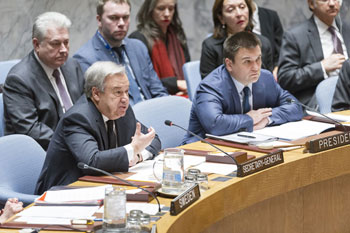 UNITED NATIONS, Aug 29: As war and the mediation of peace have become increasingly complex, innovative thinking is needed to save and improve the lives of millions, United Nations Secretary-General António Guterres told the Security Council on Wednesday.
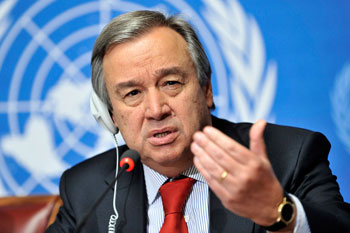 UNITED NATIONS, Aug 29: Every effort should be made to bring a global treaty into force that prevents more countries from developing nuclear weapons, UN Secretary-General António Guterres has said.
 GENEVA, Aug 18: Former United Nations Secretary General and Nobel Peace Prize laureate Kofi Annan died at the age of 80 on Saturday after a short illness, his foundation announced.
Aviation
| Business | Defence | Foreign
Affairs | Communication | Health
| India | United Nations
India-US
| India-France | Entertainment
| Sports | Photo Gallery |
Tourism | Advertise with Us
| Contact Us
© Noyanika International, 2003-2009. All rights reserved.