


United States
US Ambassador Sergio Gor calls Jammu and Kashmir important part of India after meeting Omar Abdullah
Ambassador Gor calls for stronger India-US economic partnershipBy Deepak Arora
IOC USA Expands Footprint, Launches Connecticut Chapter Under Kamal SwamyBy Deepak Arora
Modi Speaks With Trump, Review Trade, Defence CooperationNEW DELHI, Sept 30: Indian Prime Minister Narendra Modi on Wednesday said that he spoke to US President Donald Trump during which the two reviewed bilateral cooperation in trade, defence, energy, critical technology and other areas. In a post on X, Modi said that they also agreed to maintain close engagement to take the Comprehensive Global Strategic Partnership forward. "Had a productive conversation with President Trump. We reviewed our bilateral cooperation in trade, defence, energy, critical technologies and other areas. We agreed to maintain close engagement to take our Comprehensive Global Strategic Partnership forward," Modi posted on X after the phone call. Had a productive conversation with President Trump. We reviewed our bilateral cooperation in trade, defence, energy, critical technologies and other areas. We agreed to maintain close engagement to take our Comprehensive Global Strategic Partnership forward. He added that the two leaders also spoke about issues beyond their own relationship. "We also exchanged views on regional and international issues, including ongoing efforts to advance global peace and security," he added. According to a statement issued by the Prime Minister's Office, both leaders restated their commitment to advancing the India-US Comprehensive Global Strategic Partnership. They also agreed to stay closely engaged so that cooperation can deepen for the benefit of people in both countries. The statement said the leaders looked at how cooperation has progressed so far. "The two leaders reviewed progress in bilateral cooperation across trade, defence, energy, critical technologies and other areas of mutual interest," the statement said. Elon Musk to co-lead US effort to study future of warfare, War Secretary Pete Hegseth announcesWASHINGTON, Sept 30: United States Secretary of War Pete Hegseth on Thursday announced that SpaceX and Tesla CEO Elon Musk will co-lead a new War Department effort to study the future of warfare, Fox News reported. Making the announcement during his 'State of the Force' address, Hegseth unveiled the initiative, titled "Project Meridian." According to Fox News, the high-level advisory panel will be co-led by Elon Musk alongside defence-tech czar Palmer Luckey and former US House Speaker Newt Gingrich. The project will operate under the supervision of the department's Chief Technology Officer, Emil Michael. Highlighting the objective of the mission, Hegseth described Project Meridian as "an effort led by America's best minds to study the future of warfare," Fox News reported. Explaining the decision to bring private-sector giants into the high-level defence fold, Hegseth said, "The best forecasters of future conflict do not solely reside inside the Pentagon. There are obvious biases and risks to asking ourselves to both ask the questions and answer them," as reported by Fox News. According to the channel, the panel is set to begin work immediately, with Hegseth meeting Musk, Luckey, and Gingrich in a secure facility near the stage right after his speech. Project Meridian has been given a strict 120-day deadline to "ruthlessly map the trajectory of wars, domains and technologies." The assessment will culminate in a public presentation of its broad findings alongside a classified annex for military leadership. Hegseth outlined an expansive mandate stretching "from under the Earth to beyond the moon." Rather than formulating new military strategies and policies, the group will focus on identifying "the domains that we must conquer and capabilities we must master," while actively steering the process of "discovering, developing, and fielding" systems and weapons for future generations of American troops, Fox News reported. Both Musk and Luckey bring firsthand experience developing technology for the U.S. military. Musk’s SpaceX serves as a major Pentagon contractor, while Luckey’s Anduril Industries specialises in autonomous weapons and other advanced military systems, as per Fox News. The unveiling of Project Meridian is part of an overarching push by Hegseth to reorient the American military around autonomous warfare and rapidly emerging technology. As part of this overhaul, Hegseth announced the establishment of the Autonomous Warfare Command (AUTOWARCOM), a brand-new four-star combatant command endowed with "service-like authorities" designed to rapidly scale autonomous and robotic capabilities across the joint forces. The department will also introduce dedicated occupational frameworks to build career tracks for a new generation of "autonomous warfighters," Fox News reported. "We should have been thinking about Autonomous Warfare Command ten years ago," Hegseth remarked, stressing that Project Meridian is intended to anticipate future technological shifts before American forces find themselves outpaced. Trump issues order ‘inaugurating era of Super Intelligence’WASHINGTON, Sept 29: For US President Donald Trump, artificial intelligence is suffering from a branding problem, and he intends to fix it by attempting to officially rename the technology “super intelligence.” Hours after hosting nearly two dozen Silicon Valley leaders at the White House for lunch to discuss AI risks, Trump signed an executive order on Tuesday requiring US federal government agencies to refer to the technology as “Super Intelligence” and “SI” in all official communications. The name change is aimed at shifting increasingly negative public perceptions of AI, whose rollout across the US has sparked a nationwide backlash over concerns that it’s driving up electricity prices and costing Americans their jobs. A Quinnipiac University poll, reported by Bloomberg, found that 71% of those surveyed preferred stricter AI guardrails, while 73% said they would oppose construction of a new data centre in their community. Trump open to ‘more talks with Iran’ in coming week after rejecting Tehran’s peace plan to reopen HormuzWASHINGTON, Sept 27: US President Donald Trump said he remains open to talks with Iran in the coming week, a day after he reportedly rejected a peace plan shared by Tehran to reopen the Strait of Hormuz. “I expect more talks with Iran (this week). They want to make a deal, but it is not the deal that I want to make. It is what we would have maybe agreed to a year ago. They overplayed their hand,” Trump told Axios in a phone interview. In a typically Trumpian remark, the US president said, “I am always thinking about it,” when asked whether he would resume strikes on Iran. US envoys Steve Witkoff and Jared Kushner reportedly held negotiations with Iranian foreign minister Abbas Araghchi on the sidelines of the 81st session of the United Nations General Assembly in New York last Tuesday, with Qatar acting as a mediator. Araghchi reportedly shared Iran’s conditions for reopening the Strait of Hormuz and resuming nuclear talks. Under the proposal, Iran would reopen the strait and restart nuclear negotiations within a week if the US lifted its naval blockade, eased sanctions on Iranian oil sales and reinstated a ceasefire across the region. The US has imposed an economic blockade on Iran to pressure Tehran to stop attacks on vessels in the Strait of Hormuz, which have drastically reduced shipping through the strategic waterway. Trump has said he rejected the plan. However, Araghchi said he would not take Trump’s remarks as an official rejection, saying the US had not formally communicated its response to Tehran. Araghchi said mediators facilitating talks between Tehran and Washington had not officially conveyed a US rejection of the proposal. “We are waiting for the mediators to convey the definitive views to us, and we will make a decision based on them,” Araghchi posted on X. Over the weekend, Qatari mediators shuttled between Iranian and US negotiators as they discussed changes to the proposed text, Axios reported. Qatar could hold another round of separate meetings with the two sides as early as Monday, according to the report. Gangster Goldy Brar added to FBI's 10 Most Wanted list with $1 million rewardWASHINGTON, Sept 28: America’s Federal Bureau of Investigation has placed gangster Goldy Brar on its list of 10 Most Wanted Fugitives on Monday for his alleged involvement with the Lawrence Bishnoi gang. US law enforcement authorities have offered a reward of up to $1 million for information leading to Brar’s arrest. Brar is currently thought to be based in the United States. The hunt for Brar comes close on the heels of Operation Hard Ball, a multinational effort led by U.S. and Canadian authorities to crack down on members of three India-linked crime groups operating in North America and beyond. The Bishnoi gang, the Dhanda organised crime group and the Bhagwanpuria gang were the three groups targeted in the operation, which led to the charging of 37 individuals with a number of offences related to extortion, racketeering and drug trafficking among others. “Satinderjeep Singh, also known as Goldy Brar, is a dangerous individual, and the FBI and our partners have made it our priority to apprehend him, which is why we’re adding him to the FBI’s list of Top Ten fugitives and offering a reward of up to $1 million dollars for his capture,” said FBI Los Angeles Field Office Assistant Director in Charge Patrick Grandy. “The amount of attention this list will bring to his face and description cannot be overstated; his photo will be found on every FBI-affiliated website and social media platform, and will be publicized on every phone around the world until he’s caught,” Grandy went on to say. Brar has been charged by US authorities with a number of offences related to his role as a key leader within the Lawrence Bishnoi gang, including racketeering influenced and corrupt organizations conspiracy, conspiracy to interfere and attempted interference with commerce by extortion and conspiracy to distribute and possess with intent to distribute controlled substances. 24 individuals had been arrested or were already in custody when Operation Hard Ball was announced in July this year. Following this, the FBI and its foreign partners captured four more fugitive defendants with another determined to be deceased. An additional five defendants continue to be sought by US authorities, including Brar. Goldy Brar and his network have wreaked devastating havoc on countless lives—through high-profile murders, shootings, death threats, extortion, arson, and drug trafficking,” said Lisa Moreland, the deputy commissioner of federal policing for the Royal Canadian Mounted Police. “His addition to the FBI Ten Most Wanted Fugitives list speaks to the collective resolve to capture him. The RCMP is committed to continue working with partners in the FBI to bring Goldy Brar to justice,” she added. Among other offences, the Bishnoi gang was also charged with involvement in the assassination of pro-Khalistan figure Hardeep Singh Nijjar in Canada in June 2023. From farm goods to toys: US, China finalise $30 billion tariff dealWASHINGTON, Sept 27: The United States and China have reached an agreement on tariffs for $30 billion worth of goods traded between the two countries, while also agreeing to establish a trade council for future economic discussions. The new arrangement covers US exports, including agricultural products, wood and cosmetics, to China. Chinese goods such as small appliances, toys and decorations will also receive more favourable tariff treatment, according to the White House. This came after Chinese President Xi Jinping held a three-day visit to the US and held bilateral meets with US President Donald Trump. The visit marked Xi’s first trip to Washington since 2015. China’s Ministry of Foreign Affairs said the two countries agreed to carry forward the outcomes of their earlier discussions in Kuala Lumpur and establish a trade council to continue economic and trade talks. The latest agreement comes after the US and China agreed to extend their existing trade truce by two months. The extension gives the two countries additional time to work towards a broader trade agreement, US Treasury Secretary Scott Bessent had said. Trump and Xi met at the White House on Thursday for several hours before joining a state dinner attended by senior government officials and business leaders. Those present included Alphabet CEO Sundar Pichai, Microsoft CEO Satya Nadella, Nvidia CEO Jensen Huang and OpenAI CEO Sam Altman. Both leaders highlighted the importance of stability and cooperation in US-China relations. Xi called for greater “win-win cooperation” between the US and China and said competition should be kept within appropriate limits. Alongside the trade discussions, the US and China agreed to establish a dialogue on artificial intelligence, with talks expected to cover both the opportunities presented by the technology and the risks associated with its development. The two countries are expected to hold another round of AI discussions in November. They will also establish a channel through which officials can communicate about incidents involving AI, according to statements from the White House and China’s Foreign Ministry. The White House said Trump and Xi agreed during their meeting to use the term “super intelligence” instead of “artificial intelligence”. Beijing welcomed the terminology and called for greater exchanges between the two countries on the development of AI, its Foreign Ministry said. Trade and AI were not the only areas covered during Xi’s visit. The US and China also agreed to cooperate on hosting major international meetings, including the Asia-Pacific Economic Cooperation (APEC) leaders’ meeting and the Group of 20 (G20) summit. Trump and Xi plan to attend meetings hosted by the other country, according to statements from Washington and Beijing. The two sides also decided that international waterways should not be subject to transit tolls imposed by individual countries or entities, according to the agreements reached during the visit. Trump rejects Iran’s 7-day peace proposal, plans to resume bombing after midterms: ReportWASHINGTON, Sept 25: US President Donald Trump has rejected an Iranian proposal to reopen the Strait of Hormuz and halt fighting across the region for seven days, The Wall Street Journal reported, citing unnamed US officials. Trump has also told aides that he expects the United States to resume bombing Iranian territory after the November congressional elections, according to the report published on Friday. The development came hours after Iranian foreign minister Abbas Araqchi said Tehran had conveyed its peace proposal to Washington through Qatari mediators. Under the plan, a deal would trigger a seven-day countdown for reopening the Strait of Hormuz and a pause in fighting across the region. "If the necessary conditions are met, the strait can be reopened, and normal maritime passage restored within seven days. The choice now rests with the United States," said Araghchi at the UN on Friday. A US official separately told Reuters that Washington and Tehran were engaged in "positive and constructive discussions through the mediators". However, Trump remained privately sceptical that Iran would meet his demands, according to the WSJ report. Trump has told his staff that he sees a renewed bombing campaign as likely, the report said. Under Tehran’s proposal, the two sides would move towards broader negotiations "on mutually agreed subjects", with talks on Iran’s nuclear programme beginning immediately. The Strait of Hormuz would be reopened on the final day of the proposed seven-day period, while hostilities would end across all fronts, including Lebanon, news agency Reuters reported. In return, Iran wants Washington to release its frozen assets, estimated at no less than $12 billion, waive sanctions on Iranian oil and lift its naval blockade of Iranian ports. Araqchi also made clear that Tehran would not accept pressure as part of any deal. “Iran does not accept coercion, threats or intimidation, and Iran will not surrender its sovereign rights under pressure.” Diplomatic push Xi Jinping says US, China have ‘responsibility to ensure AI development under human control’By DeepaK Arora WASHINGTON, Sept 24: China and the United States have the “responsibility” to ensure that the development of artificial intelligence remains under human control, Chinese President Xi Jinping said on Thursday. Jinping is in Washington for his second state visit to the United States. “We have both the capability and responsibility to develop and manage AI for good and ensure that the development of AI is always under human control,” the Chinese President said at the White House. Xi's remarks come hours after China's commerce ministry confirmed that its senior trade negotiators had held their first talks with the US on artificial intelligence, CNBC reported. US President Donald Trump had too, in a post on Truth Social, suggested that AI would be a key topic of discussion between the two leaders. “A big day with President Xi of China. Super Intelligence (SI) will be a big topic of discussion, but I want to leave it exactly where it is. That is China’s position also. Our guardrail is the DOJ!” Trump said. Trump hails ‘truly great friendship’, Xi highlights ‘deeply intertwined interests’ Xi, meanwhile, said both US and China were different but had “deeply intertwined” interests, and can therefore “build up mutual trust”, BBC reported. The Chinese President invited 100,000 young Americans to visit China for student exchanges over the coming five years. “Just as our people worked together to win that war, President Xi and I will continue working together to forge a better future for both of our nations,” the US President said in brief opening remarks at the White House, recalling America's role in World War II. Xi, in his opening remarks, said the leaders did not “need to avoid mentioning competition”, but said the competition must be “a healthy one, and should be kept within bounds.” “It should be a race of catching up with one another, not a wrestle in which when either wins, or loses,” said Xi. The Chinese President spoke about “coexisting in peace”. “As I have said many times, China and the United States as two major countries stand to gain from cooperation and will both lose in confrontation,” Xi said. Trump rolls out the red carpet as China's Xi Jinping lands in US for 3-day state visitWASHINGTON, Sept 23: Chinese President Xi Jinping arrived in Washington on Wednesday for a three-day state visit, with President Donald Trump personally greeting him at Joint Base Andrews. Trump and first lady Melania Trump were at the Maryland military base for Xi’s arrival ceremony, along with Xi’s wife Peng Liyuan. The airport welcome is unusual because US presidents generally receive visiting leaders at the White House rather than meeting them at the airport. Xi’s visit is his first state visit to Washington in more than a decade. The two leaders are expected to discuss trade, artificial intelligence, Taiwan and Iran during their meetings. Trump weclomed Xi with rolling a red carpet for China's president. Trump’s decision to meet Xi at the airport comes after the US president received a large welcome during his visit to China in May. Trump has spoken positively about his relationship with Xi and has said he wants the Chinese leader to receive a high-level welcome in Washington. Melania Trump also explained why her husband chose to meet Xi personally. During an interview with Fox News Channel’s Fox & Friends, she said, “they have a great relationship.” “He’s coming on our soil, and we need to welcome them with the most respect,” she added. The White House has planned several formal events during Xi’s visit. On Thursday, Xi and Peng are scheduled to attend a ceremony at the White House before Trump and Xi hold talks. A formal state dinner is also planned for Thursday evening. The friendly welcome comes as Washington and Beijing continue to deal with several difficult issues. Trade is expected to be a major part of the talks, while artificial intelligence has become another important area of competition between the two countries. Taiwan and China’s relationship with Iran are also expected to be discussed. Reuters reported that the leaders are looking to keep stability in their relationship after months of disagreements over trade and other issues. The visit follows Trump’s trip to China in May and marks another direct meeting between the two leaders this year. Both governments have stressed the importance of keeping communication open even as disagreements continue. Xi’s visit continues through Friday. After Thursday’s White House events and state dinner, Xi and Peng are expected to return to the White House on Friday for private tea with Trump and Melania. The Chinese president and first lady are also scheduled to visit the National Archives in Washington with the Trumps. The visit will include a look at historic documents connected to the relationship between the United States and China. US Secretary of State Marco Rubio defended the high-level contact with Beijing, saying the two countries are “the two largest economies in the world” and “probably the two most powerful militaries in the world.” Russia has 'lost control' of its diesel industry: Trump says Ukraine war has put several refineries out of commissionNEW YORK, Sept 21: US President Donald Trump on Monday said Russia has "lost control" of its diesel oil industry, linking the disruption to the ongoing war with Ukraine. Trump made the remarks in a social media post a day before he was due to meet Ukrainian President Volodymyr Zelenskiy on the sidelines of the UN General Assembly. "Russia has unfortunately lost control of its Diesel Oil Industry due to its War with Ukraine. A large number of their Diesel refineries have been blown up and are, at least temporarily, out of commission," Trump said in the post. He did not provide further details in the post about the refineries or the extent of the disruption. Trump also renewed his call for an end to the war, describing the conflict as "ridiculous and never ending". "This ridiculous and never ending War with Ukraine must be ended," he said. Trump further claimed that the continuing conflict was affecting the wider world, saying, "The whole World suffers as 25,000 people, mostly soldiers, are being killed each month." He ended the post with: "What a shame! President DJT". Trump Meets Mamdani; Discusses Immigration, Housing ProjectsNEW YORK, Sept 21: President Donald Trump heaped praise Monday onto New York Mayor Zohran Mamdani as the pair set aside their political differences to discuss immigration enforcement and a multi-billion dollar housing project. Trump, a Republican, heavily criticized Mamdani before he took office in January -- calling him "my little communist" and a "total nut job" -- but the two men have since struck a surprisingly warm relationship. "Hopefully, you're going to be a great (mayor). I'll be able to say you're going to be a great one, and you're off to a start," Trump told Mamdani at a news conference. Their closed-door talks in Manhattan, which lasted around an hour, marked the pair's third public meeting since Mamdani swept the mayoral election last year. "We appreciate the president's commitment to the city," Mamdani said of Trump, who was visiting his hometown New York ahead of the United Nations General Assembly. The 34-year-old said he expressed his "very strong opinions about how we can keep New Yorkers safe" when asked about Trump's culling of Temporary Protected Status for thousands of immigrants as part of mass deportation plans. Mamdani said they also spoke about a 12,000-home building proposal in New York, which the pair previously discussed in February and would require an estimated $21 billion in federal government funding. He said he planned to continue cooperating with Trump, despite acknowledging they have "many disagreements." "We've both spoken about very different approaches, very different beliefs, and I will continue to have conversations with the president, and frankly with anyone who can deliver relief to the people of this city," Mamdani said. Trump's visit came as top US television networks essentially boycotted coverage of the president in protest of his decision to ban three outlets, CNN, MS NOW and Politico, from the White House. Mamdani said he had told Trump that all members of the press would be welcome at their joint press conference, held in front of the mayor's official residence. "That is something that I believe in, is everyone, no matter the opinion or the critique, that we engage," he told reporters. Trump, meanwhile, brushed off a suggestion that he had issued the media bans to distract the public from criticism of the war in Iran. "It's interesting because they (the media) said they were going to boycott me, but they never boycott me, so I wasn't very worried about that," he said. Hundreds Of US Flights Cancelled After Air Traffic Control MalfunctionNEW YORK, Sept 21: Hundreds of flights from US east coast airports were canceled or delayed Monday due to a telecommunications line outage caused by a construction mistake, US officials said. Transportation Secretary Sean Duffy said on X that around 1900 GMT, flights were resuming at LaGuardia Airport and Philadelphia, while flights into Newark and JFK Airports were paused. "An Amtrak construction crew accidentally cut into a fiber line in New Jersey which caused a telecom outage and forced FAA to pause flights in the Northeast," Duffy said. Amtrak is the US passenger train company. Around 1900 GMT, Newark Airport, a key New York City-area hub, had 168 flights canceled and 97 delayed, while Philadelphia had 63 canceled flights and 189 delays, according to FlightAware. Monday's airport disruption stemmed from two problems, according to Bryan Bedford, head of the Federal Aviation Administration. After identifying an outage in the primary telecom line, "we discovered that the backup fiber had a break," Bedford said following a briefing to reporters on new air traffic technologies. Bedford described the rupture on the backup line as "massive" due to the construction mistake. He said he expected the primary system to be restored by early afternoon but estimated that repairing the backup line would need 13 hours. Lebanon needs international force after peacekeepers leave, PM tells UN chiefUNITED NATIONS, Sept 21: Lebanese Prime Minister Nawaf Salam told United Nations chief Antonio Guterres on Monday that Lebanon needed a UN-sponsored international force to stay in the country's south after the current UN peacekeeping mandate expires. The UN Interim Force in Lebanon , which currently counts around 7,500 peacekeepers from 46 countries, has acted as a buffer between Lebanon and Israel since 1978. But under US pressure, the UN Security Council voted last year to halt the force's mandate at the end of this year. Meeting Guterres at the UN headquarters in New York, Salam "stressed the importance of maintaining an international presence under the umbrella of the United Nations in the south in the post-UNIFIL phase", according to a statement from the premier's office. This should be in a way that "ensures the continuation of the functions of monitoring, reporting and liaison, contributes to preserving stability, and supports the process of extending the Lebanese state's authority over all its territory", Salam added, according to the statement. UNIFIL's looming departure comes as Israel maintains troops in a self-declared "security zone" running around 10 kilometres deep inside south Lebanon along the border. Israel launched heavy airstrikes and a ground invasion after Hezbollah drew Lebanon into the Middle East war in March by attacking Israel in support of the militant group's backer Iran. Last week, Lebanese President Joseph Aoun said that Lebanon wanted a new force, European or otherwise, to prevent a security vacuum after the peacekeepers depart, but that "the best and most optimal option remains extending UNIFIL's mandate". The creation of a new force to succeed UNIFIL was also on the agenda of a meeting last week in Paris between Aoun, French President Emmanuel Macron and King Abdullah II of Jordan. France and Italy have said they want to set up a multinational coalition to succeed UNIFIL. In a June report, Guterres said peacekeepers would be needed after UNIFIL's mission expires. Salam also told Guterres that around 329,000 people are still displaced in Lebanon since the latest conflict erupted, urging support for the humanitarian response. Trump in ‘deciding mode’ on Iran war, outlines 3 options amid deadlockWASHINGTON, Sept 21: US President Donald Trump said on Sunday that he was in “deciding mode” over the Iran war, warning that “big things are going to happen”. His remarks came after Tehran said it had shared its conditions with Washington, through mediators, for reopening the Strait of Hormuz. Trump’s comments come ahead of Iranian President Masoud Pezeshkian’s expected visit to New York to attend the United Nations General Assembly. A senior delegation is likely to accompany him, Iran’s semi-official news agency Tasnim reported. In a reported conversation with Fox News, Trump said he was in “deciding mode” and warned that "very big things are going to be happening in the not-so-distant future” if the Iranian regime does not “behave”. "My question is, if and when do I blow the entire nation up? They had better behave,” he said. He reportedly discussed three possible options for the war: “wiping Iran out,” “letting them rot economically”, or “making a deal.” Regarding other conflicts in the region, Trump said Washington remains in contact with Yemen’s Houthi rebels following their recent ballistic missile attacks targeting Saudi Arabia. He added that the group had agreed not to attack American personnel. Trump was also asked about Pezeshkian’s planned visit to the US for the UN General Assembly and whether he would consider meeting the Iranian president. He said he would “probably be open” to meeting Pezeshkian, who is also expected to meet and consult leaders from several countries on the sidelines of the UN gathering. Notably, Iran has communicated seven conditions to the United States through Qatar to resume negotiations aimed at bringing the ongoing war to an end, the country's top negotiator Mohammad Bagher Ghalibaf said on Sunday. Mohsen Rezaei, who heads Iran's Supreme National Security Council, said a day earlier that Tehran had sent its demands to Washington through Qatar, which is acting as a mediator. "Our conditions are an end to the war on all fronts, the release of our frozen funds and an end to the naval blockade," he told Al-Jazeera. Meanwhile, Iran’s central military command said on Sunday that it had received information indicating that the US, with support from several regional countries, was preparing for another military operation against Tehran. It warned that countries supporting Washington would be considered partners in the “mischief” and “could no longer expect restraint from the powerful Iranian Armed Forces.” Team Trump Warns India, China Over Russian Oil TradeWASHINGTON, Sept 17: The Donald Trump administration has sent a blunt message to India and China: Reduce reliance on Russian oil and gas or risk facing unprecedented economic penalties from the United States. Addressing the media after the passage of the Russia Sanctions Bill in the US Congress, Republican Senator Richard Blumenthal warned New Delhi and Beijing to 'get their act together' and buy their energy from 'somewhere else.' "To China and India: You better clean up your act. Buy your oil and gas somewhere else. Appeasement is not a strategy," he said. India, the world's third-biggest oil importer, is among the biggest buyers of Russian oil, which is seen as helping Moscow replenish its budget since it launched its full-scale invasion of Ukraine in 2022 and was hit with sweeping Western sanctions. Blumenthal, who wrote the bill with late Senator Lindsey Graham, said he hopes the sanctions will help force Putin to the negotiating table and end the war. "To Vladimir Putin -- we have your number. And to Ukraine -- you are not alone," Blumenthal said. The Lindsey O Graham Sanctioning Russia and Iran Act of 2026 aims to sanction Russian officials, banks and a shadow fleet of tankers that keeps Russian energy moving. It also directs Trump to impose up to 100 per cent tariffs on the top five importers of Russian oil or natural gas -- including India and China-- with an exception for countries that import less than 15 per cent of Russia's natural gas exports and have taken significant steps to reduce those imports. The legislation was approved by the House in a 262-159 vote on Wednesday and will now go to Trump to be signed into law. India, meanwhile, said that it remained firmly committed to ensuring energy security for its people and will continue to source supplies from diverse sellers based on market dynamics after the US made a new move to punish such buyers. New Delhi also said that it had warned Washington that any such new moves could impact ties between the two countries. The foreign ministry said that it had noted the passage of the bill, adding that New Delhi had raised the issue with various U.S. interlocutors in recent months, and had "very clearly articulated" the potential implications for the bilateral relationship and the international energy market. "The Indian side has also made clear its determination to take all necessary measures to protect its trade and economic interests," it said in a statement. The government would work closely with trade and industry bodies to deal with the implications of the legislation, it added. New Delhi has repeatedly sought to resist pressure to scale back its oil trade with Russia, saying its large population and economy need secure, affordable and reliable energy supplies. Trump welcomes Modi's efforts against opium as India among US' list of ‘major illicit drug producing countries’WASHINGTON, Sept 16:United States President Donald Trump welcomed Prime Minister Narendra Modi's efforts against opium cultivation as India was among the US' list of “major illicit drug producing countries” on Wednesday. “I welcome Prime Minister Modi and the Government of India’s efforts to address illicit opium poppy cultivation and bolster supply chain integrity. I look forward to continued cooperation through the United States-India Drug Policy Framework,” read an official statement by the US. Along with India, Pakistan and China are also among the countries that the US has deemed as “major drug transit or major illicit drug producing” nations. The US listed a total of 23 countries in the list, which includes, apart from the aforementioned three countries — Afghanistan, The Bahamas, Belize, Bolivia, Burma, Colombia, Costa Rica, the Dominican Republic, Ecuador, El Salvador, Guatemala, Haiti, Honduras, Jamaica, Laos, Mexico, Nicaragua, Panama, Peru, and Venezuela. However, the US clarified that mere inclusion in the list was not a reflection of the respective government's efforts against drugs. It said that the countries have been placed on the list “due to a combination of geographic, commercial, and economic factors that allow drugs or precursor chemicals to transit or be produced, even if a government has engaged in robust and diligent narcotics control and law enforcement measures”. The statement said that four countries — Afghanistan, Bolivia, Burma, and Colombia — have “failed demonstrably” over the past one year to make substantial efforts to “adhere to their obligations under international counternarcotics agreements” and to take necessary counternarcotics measures. Trump also claimed his administration had made “historic progress” in combating drug trafficking and narcoterrorist organisations, citing tighter border security, a decline in drug seizures and a drop in overdose deaths. He said drug seizures at the US southern border had fallen by more than half following what he described as four years of “open border chaos”. He also claimed that drug overdose deaths had “plunged”, saying his administration had saved tens of thousands of American lives. “The narcoterrorists responsible for this invasion are either dead, in jail, or living in fear knowing they will be next to face American justice,” Trump said. He further claimed that US law enforcement agencies had recorded “record drug seizures” and that allied countries were extraditing more cartel leaders to the US than ever before. “We have inflicted unprecedented losses on our enemies, and we are just getting started,” Trump said. US Confirms It Has Deployed First-Ever 'On-Orbit' Weapon In SpaceWASHINGTON, Sept 15: The United States has weapons deployed in space, the US Space Force said in the first-ever acknowledgement of possessing such offensive capabilities. US Air Force Secretary Troy Meink said the "on-orbit" weapon was necessary to safeguard American forces against hostile enemies, in a not-so-subtle warning to China and Russia. Meink, who made the announcement at the annual Air, Space, and Cyber Conference at National Harbour in Maryland, did not specify what type of US weapon is in space. But he hinted that it will be used for "space control" against "evolving threats." Meink's remarks came as the Trump administration rushed to build outer space capabilities for its "Golden Dome" missile defence system to protect the US from missiles and other airborne threats. The militarisation of space is as old as the space race itself -- as soon as Sputnik was launched into orbit in 1957, Washington and Moscow began exploring ways to both arm and destroy satellites. The biggest worry was once about nuclear weapons in space, but the superpowers and other countries signed the Outer Space Treaty in 1967, banning weapons of mass destruction in orbit. Since then, global powers like the US, Russia, China, and India have been trying to develop capabilities outside the treaty, like ways to target rivals' satellites -- a key to military communications, surveillance and navigation. "The US has on-orbit space control weapons capable of defending the Joint Force against hostile adversary action," a US Space Force spokesperson said in a statement that did not provide specifics on the weapons. "Space control encapsulates the mission areas required to contest and control the space domain -- employing kinetic and non-kinetic means to affect adversary capabilities," the statement said, adding that "these capabilities can be employed for offensive and defensive purposes." Both Russia and China -- the two main geopolitical rivals of the United States -- pose potential threats to US interests in space. China "develops and operates space and counterspace capabilities as part of a military modernization strategy," while Russia "views space as a warfighting domain and believes space supremacy will be a decisive factor in future conflicts," according to the US Space Force. US Democrats list India for potential 100% duties over Russian oilWASHINGTON, Sept 15: India could face a fresh and potentially significant trade threat from Washington as House Democrats move a series of amendments to the sweeping Russia-Iran sanctions legislation that would specifically identify India among countries eligible for duties of up to 100% over purchases of Russian crude oil or natural gas, or for facilitating sanctions evasion. The House Rules Committee has formally listed the amendments for consideration Monday as lawmakers take up the Senate-passed Lindsey O. Graham Sanctioning Russia and Iran Act of 2026. One amendment, sponsored by Rep. Steny Hoyer, would name India, China, Trkiye, Azerbaijan, Hungary, Slovakia, the UAE, Singapore, Kazakhstan and Kyrgyzstan as the initial countries eligible for duties of up to 100% under the legislation. The language does not itself impose a 100% tariff on India. Instead, it would establish India as a country eligible for such duties under the bill’s secondary-tariff mechanism. That distinction is important: the legislation would give the US president authority to impose the additional duties, rather than automatically applying a 100% tariff to Indian goods. The issue is India’s continued purchase of Russian energy. Since Russia’s invasion of Ukraine, Indian refiners have dramatically increased purchases of discounted Russian crude, helping India secure cheaper supplies while providing Moscow with an important source of export revenue. India has consistently defended those purchases as an energy-security decision and has maintained that it complies with applicable international and US sanctions. The US legislation, however, takes a different approach: it seeks to use access to the American market as leverage against countries that continue buying Russian energy. The Senate-passed bill already gives the president the ability to impose tariffs of up to 100% on countries that are major purchasers of Russian energy. Reuters reported that the Senate legislation specifically creates the possibility of targeting major Russian-energy buyers including India and China. The House amendment would go further by explicitly putting India on the initial list of countries eligible for those duties. If the authority ultimately becomes law and is used against India, the impact would extend well beyond the oil trade. The proposed mechanism is aimed at imports from the targeted country into the United States. A 100% additional duty could therefore sharply increase the cost of Indian products entering the American market. That could put pressure on major Indian export sectors, depending on how the administration implements the authority and which products are covered. Potentially exposed areas could include: * Pharmaceuticals * Textiles and apparel * Engineering goods and machinery * Chemicals * Auto components * Gems and jewelry * Electronics and technology-related goods The actual economic impact would depend on the tariff rate imposed, the products covered, exemptions and whether Indian exporters or American importers absorb the additional cost. The United States is one of India’s largest export markets, making any broad-based additional tariff a potentially significant issue for Indian manufacturers and exporters. The House amendments create an unusual dynamic. While one Democratic amendment explicitly names India as eligible for duties of up to 100%, other Democratic amendments seek to remove or narrow the broad secondary-tariff authority contained in the Senate bill. Rep. Gregory Meeks and Democratic colleagues have submitted an amendment that would strike the section authorizing broad secondary tariffs altogether. Another would clarify that the European Union is not treated as a single “country” for purposes of the secondary tariffs. (House Rules Committee ) That means the House debate could become a fight not simply over whether to sanction Russia, but over how much tariff power Congress should give the president and how that power should be applied to countries such as India. A separate Meeks amendment would tighten the president’s ability to waive sanctions. Under the proposed amendment, sanctions against Russia or countries helping Russia could be waived only when doing so is considered “vital to the national security of the United States.” For India, that provision could matter because Washington-New Delhi relations increasingly involve strategic considerations beyond the Russia question — including China, the Indo-Pacific, defense cooperation, technology, supply chains and energy security. A narrower waiver standard could therefore reduce the administration’s flexibility to make exceptions based on broader diplomatic or economic considerations. ‘Only control AI needs is high IQ President’: Trump after calls for new rules, terms concerns ‘sick conspiracy’WASHINGTON, Sept 14: US President Donald Trump has rejected calls for tighter government oversight of artificial intelligence, saying the technology does not need any additional restrictions other than a “high IQ” president, which the country already has. Trump made the remarks on Monday while hitting out at efforts of technology leaders to introduce greater government oversight of AI. He described attempts to limit the technology as part of a “Sick conspiracy” and argued that tighter controls could benefit China. “The only control or ‘guardrails’ that AI needs is a STRONG AND SMART (High IQ!) PRESIDENT, and the U.S.A. has that, in spades!” Trump posted on social media. Trump said his administration had already prevented AI company Anthropic from doing “bad, or potentially bad” things. Anthropic has had a difficult relationship with the Trump administration. The Pentagon has sought to classify the company’s models as a security risk, while one of its more advanced models was also temporarily banned. Trump’s comments came after technology leaders, including Anthropic CEO Dario Amodei, OpenAI chief Sam Altman and Elon Musk, called for stronger government oversight of AI. Their stated aim is to ensure the technology is developed with safety, legal liability, economic growth, scientific progress and national security in mind. Amodei published a 3,800-word essay on Saturday calling for slower AI development. Microsoft also released its own code of conduct on Monday aimed at ensuring that humans remain in control of AI. Trump said efforts to constrain AI could allow China to overtake the US in the technology. “There is a SICK conspiracy going on against AI and Data Centers, and the only one that is happy about it is China,” Trump said. Trump has previously opposed greater government oversight of AI. After returning to the White House last year, he revoked a Biden administration executive order on AI oversight and issued a more detailed order of his own more than 16 months later in June. The debate over AI has also emerged as a political issue ahead of November’s midterm elections. Many voters have expressed opposition to the construction of additional data centres, while concerns have also grown over possible job losses and the impact of AI on children’s education. The prospect of a slower AI expansion pushed stocks lower in Monday morning trading, as demand for advanced computer chips and data-centre construction materials could decline. Rahm Emanuel, the former Chicago mayor, Democratic congressman and White House chief of staff, criticised Trump’s approach after Amodei’s essay. Emanuel said the essay was “an admission that we’re driving down a dark, winding road on wet pavement with the headlights off. And where’s President Trump? Looks like he nodded off again. It’s time to turn the lights on, put both hands on the wheel, and regain control before it’s too late.” Trump, however, defended the rapid expansion of AI, saying the concerns were linked to America’s lead in the sector. In a separate Monday social media post, he said the concerns about AI are only because “the United States is leading, by a lot, every other country. Don’t kill the Golden Goose!” Vice President JD Vance said Monday that Americans should not be afraid of AI, while acknowledging that the administration wants to regulate the technology carefully. “I don’t think Americans should be scared of anything,” Vance told reporters as he prepared to fly to Kansas for a midterm election campaign event. Trump says Ukraine, Russia agreed not to hit each other's energy sitesWASHINGTON, Sept 14: United States President Donald Trump made a big declaration on Monday that Ukraine and Russia have agreed to not hit each other's energy targets. He also attributed the recent hike in diesel prices globally to war between Russia and Ukraine and not the US' war with Iran. “Ukraine has agreed not to hit Russian Energy targets. Russia has agreed to do, likewise! The World’s Diesel price rise is mostly caused by the Russia/Ukraine War, not Iran,” Trump wrote in a post on Truth Social. Trump's post comes day after he criticised Kyiv for striking Russian oil refineries. On Monday, NATO chief Mark Rutte said that the alliance will step up its support for Ukraine following a series of Russian drone attacks near the Ukraine-Poland border. Rutte said that the Russian strikes “close to NATO territory” show Russian President Vladimir Putin’s “desperation and also his desire to sow fear and terror”. “Russia is growing increasingly reckless as it continues its terrible war against Ukraine,” he added. “He thinks that he can stop us from supporting Ukraine and that he can undermine our unity. He is wrong,” Rutte said. After the rare strike at the Polish border, Russia said that it will continue to attack targets across the "whole" of Ukraine. When asked about the strikes, Kremlin spokesman Dmitry Peskov said, "If I understand correctly, this is about Ukrainian territory." "Our military are fulfilling their tasks on the whole territory of Ukraine... They will continue to do so," he added. Poland is a long standing ally of Ukraine. “These coming weeks and months will be a time of very intensified actions on the Russian side, and unfortunately we cannot rule out that this escalation will also affect our territory,” Polish Prime Minister Donald Tusk said on Sunday in Warsaw. Tusk also said that Poland had information that Russia could target Ukraine's border areas. "We knew that in the Russian plan there will be an attempt to de-organise, paralyse and maybe even destroy Ukrainian border crossings, which also affects our country," he said. The Polish PM added that he would consult with NATO allies to come up with a possible coordinated response. Saudi Crown Prince called Trump twice to strike Houthis, he rejected request: ReportWASHINGTON, Sept 11: As the conflict in West Asia continues to escalate beyond the US-Israeli war on Iran, Saudi Crown Prince Mohammed bin Salman reportedly called on the United States to launch strikes against the Yemeni militant group the Houthis. This request from Saudi Arabia comes as the kingdom sees an escalation in its conflict with the Iran-backed proxy in Yemen. According to a report by Axios, Saudi Arabia's MBS called US President Donald Trump twice and urged him to launch a strike against the Houthis amid their blockade of the vital Red Sea chokepoint. While Trump flagged his concerns regarding the escalating conflict in Yemen, the US president declined to launch strikes against the group. Two US officials stressed that the Trump administration has no plans to intervene directly against the Houthis for now, the report further added. People familiar with the matter also stated that Commander of the US Central Command, Admiral Brad Cooper, visited Riyadh for "urgent coordination meetings." No official comment has been made from the White House or the Kingdom of Saudi Arabia. Saudi-Houthi confrontation escalates The conflict between Saudi Arabia and the Houthis reignited in July 2026 after Riyadh prevented an Iranian plane carrying a senior Houthi official from landing in the Yemeni capital of Sana'a. In response to this, the Houthis began attacking Saudi tankers in the Red Sea, threatening the kingdom's route for oil exports in view of the blockade of the Strait of Hormuz. Since then, Saudi Arabia, along with its allies in Yemen, has responded with airstrikes and ground operations against the Houthis. The Houthis have also struck Saudi Arabia and targeted the oil giant Aramco in their recent strikes. The 2026 flare-up marks the first such grave escalation between Saudi Arabia and the Houthis since their 2022 ceasefire, brokered by the United Nations, collapsed. US marks 25th anniversary of 9/11WASHINGTON, Sept 11: The United States commemorated the 25th anniversary of 9/11 attacks carried out by the al-Qaida on September 11, 2001. As many as 2,977 people were killed when hijackers crashed three planes into the World Trade Center in New York City and the Pentagon in Virginia. The terrorists also crashed a fourth plane in a field near Shanksville, Pennsylvania. The US on Friday saw memorial rituals, including wreath-laying, flag-flying, moments of silence, vigils and readings of victims' names as people will pay tributes to the victims. US President Donald Trump attended the Pentagon's anniversary ceremony on Friday. Addressing a 9/11 remembrance in Washington earlier this week, the president said, "In the course of history, there are a few moments that divide time into, really, what came before and after." US Says It Destroyed 5 Iranian Tankers After Attacks On American WarshipWASHINGTON, Sept 9: The US military has destroyed five Iranian crude oil tankers following attacks on a US warship by Iran's Revolutionary Guard, US Central Command said in a social media post on Tuesday. The US strikes were in response to two Iranian efforts to hit the warship with ballistic missiles over the past two days, the statement added. Iranian state television also reported the strikes, saying US forces attacked at least three Iranian oil tankers near the southern port of Jask and near Kharg Island in the Persian Gulf. It said the crews were evacuated. CENTCOM forces destroyed five Iranian crude oil carriers, Sept. 8, after the Islamic Revolutionary Guard Corps (IRGC) targeted a U.S. Navy warship with ballistic missiles twice over the past two days. The U.S. warship successfully evaded the attempted Iranian attacks and… pic.twitter.com/Gi8a2tloN1 The latest tit-for-tat strikes come as Washington and Tehran lurch back toward fighting during more than six months of war. Secretary of State Marco Rubio said the US will not allow Iran's attacks to go unanswered. "Iran continues to try to hit US naval ships. And for every time they do that or try to do that, they're going to lose tankers. And I think you'll see that again today," Rubio told reporters Tuesday when asked about the latest attacks in Iran while on a trip to Colombia. An Iranian state TV reporter in Jask said an Iranian tanker was struck near the coast of Yekbeni, while another explosion was heard in the area whose source and location were not immediately clear. State TV later reported that the US military attacked a second tanker near waters off Jask. It said the crews of both vessels were being evacuated by lifeboat toward the Jask coast. Separately, state television reported that another Iranian tanker was attacked in Kharg Island anchorage area. It said the crew was safely evacuated shortly after the strike. Iran's Revolutionary Guard Navy on Tuesday warned crews of oil tankers near ports in Kuwait and Bahrain to immediately leave their vessels, saying the ships could be targeted in retaliation for US attacks on Iranian tankers. It accused Kuwait and Bahrain of hosting US forces and assisting in the attacks. US envoy sees 'movement' toward three-way talks with Russia, UkraineWASHINGTON, Sept 7: A top US envoy on Monday touted progress in weekend discussions with Ukraine and Russia, raising the prospect of reviving three-way peace talks to end Europe's deadliest conflict since World War II. Russian President Vladimir Putin and Ukraine's Volodymyr Zelensky met separately with top US envoys in a renewed push to end the fighting, which began when Russian forces invaded neighboring Ukraine more than four years ago. "Substantive progress was made, including movement on scheduling additional trilateral talks," US Special Envoy Steve Witkoff wrote on X. Witkoff, a business ally of US President Donald Trump, traveled to Russia and Ukraine over the weekend alongside negotiating partner Jared Kushner, who is Trump's son-in-law. Sunday's appearance in Kyiv was their first official trip to the Ukrainian capital. A senior Ukrainian official said on Sunday that the two envoys had brought new and "more effective" proposals on ending the war, but Zelensky warned that fighting appeared likely to continue into the winter. The Kremlin on Monday did not rule out three-way talks with the United States and Ukraine aimed at ending the conflict. "But it is too early to say anything about the venue or the exact dates at this stage," Kremlin spokesman Dmitry Peskov told reporters. Also on Monday, Zelensky said he and his negotiating team were "coordinating our next steps" following the talks with Trump's envoys and European officials, but the Ukrainian leader did not elaborate on what those steps would be. Negotiators from Moscow and Kyiv last met for US-mediated talks in Geneva in February, but did not reach an agreement on territorial issues. Sergio Gor, ISRO chief discuss expanding India-America partnership in spaceBENGALURU, Sept 7: United States Ambassador to India Sergio Gor met Indian Space Research Organisation (ISRO) Chairman Dr V Narayanan on Monday to discuss expanding space cooperation between the two countries, including possible collaboration in human spaceflight. The meeting comes as India advances its human spaceflight programme and sets its sights on deeper space exploration. ISRO is currently working on the Gaganyaan mission, while its longer-term plans include the proposed Bharatiya Antariksh Station and a future crewed mission to the Moon. Gor described the discussions with Narayanan as a “productive chat” and said the two sides explored ways to take the US-India space partnership further. "Productive chat with@isro Chairman Dr. V. Narayanan on taking U.S.-India space cooperation even further, including in the human spaceflight progam. @NASA’s recent invitation to bring ISRO into its Moon Base program signals how far this partnership can go – to the Moon and beyond," Sergio Gor wrote on X. Earlier, Gor said Washington wanted India “by our side” as the United States returns to the Moon. He also revealed that NASA had officially invited ISRO to join its Moon base programme. “India is a proud signatory of the Artemis Accords, and NASA has officially invited ISRO to join us in the Moon base program. Make no mistake: we're going back to the Moon, and we want India by our side on the lunar surface,” Gor said while speaking at the Bengaluru Space Expo 2026. His remarks come as, under Artemis missions, NASA will send astronauts on increasingly difficult missions to explore more of the Moon for scientific discovery, economic benefits, and to build a foundation for the first crewed missions to Mars. India joined the Artemis Accords in June 2023, becoming the 27th signatory to the US-led framework for cooperation in lunar and other space exploration. The Moon Base programme envisages a phased approach combining robotic and human missions. The first phase, through 2029, will focus on robotic missions to explore the lunar South Pole, demonstrate technologies and develop the foundations for a sustained presence. The second phase, from 2029 to 2032, will focus on building systems and infrastructure for a long-term presence, while the third phase will begin assembling a permanent lunar outpost where astronauts can live and work for extended periods. US CENTCOM says it struck three Iran oil tankers after IRGC attacks on Navy shipsWASHINGTON, Sept 5: The United States Central Command on Saturday said it had stuck three Iranian oil tankers following IRGC missile attacks targeting two American Navy warships. “US Central Command (CENTCOM) forces struck three Iranian crude oil carriers, Sept. 5, after the Islamic Revolutionary Guard Corps (IRGC) launched ballistic missiles toward two US Navy warships patrolling regional waters,” the American military said in a statement. The US CENTCOM said the targeted Navy warships had “successfully evaded” the multiple Iranian attacks, calling the strikes “unprovoked”. It said that no American personnel were harmed in the attack. Following the strikes, US CENTCOM issued a warning to the IRGC. “Let the message to the IRGC be clear: If you shoot at two of our ships, we will impose an even higher economic cost —taking out three of yours,” US Admiral and CENTCOM Commander Brad Cooper said. “We will not hesitate to defend American forces, and if necessary, destroy Iran’s limited and exposed oil fleet,” Cooper added. Sharing information on the strikes, the CENTCOM said it had “permanently disabled the IRGC crude oil carriers M/T Downy off the coast of Kharg Island and M/T Stark 1 near Jask.” They said that the US military had also “completely destroyed” an unladen oil carrier, M/T Kylo, in the Gulf of Oman. The M/T Kylo, also known as the Noxen, was struck in “multiple critical locations to render it inoperable” after the crew members onboard were directed to abandon the ship, the CENTCOM stated. “The three Iranian crude oil tankers are part of a multibillion-dollar shadow network that funds the IRGC and its regional proxies. Iran has no means by which to defend them,” the US military said. Witkoff, Kushner To Visit Russia, Ukraine For Peace Talks: ReportMOSCOW, Sept 4: US negotiators Steve Witkoff and Jared Kushner, who have spearheaded efforts to broker a Ukraine peace agreement, will visit Russia and Ukraine on Saturday and Sunday, Russian news agency TASS reported, citing a source. There was no immediate confirmation. Witkoff and Kushner last visited Moscow in January, when they held four hours of late-night talks with President Vladimir Putin in the Kremlin. Discussions on US negotiators going to Ukraine were still ongoing, and the teams have spoken about September 6 as a possible date, a source familiar with the matter said. If they come, it would be their first visit to Kyiv. "The Russians don't want them to visit Kyiv and are trying to make them change the plan," the source added. A vast gulf remains between Russia and Ukraine on how to end the 4-1/2-year war, the deadliest in Europe since World War Two. Putin has repeatedly demanded that Ukraine give up more territory, while Ukraine rejects terms that it considers tantamount to surrender. The last US-mediated talks between Russia and Ukraine took place in February, shortly before the United States and Israel launched a war against Iran. Trump lauds Syria 'pitching itself' as alternative to Strait of Hormuz amid Iran warWASHINGTON, Sept 3: US President Donald Trump on Thursday responded to a recent media report suggesting Syria is pitching itself as an alternative transit corridor to the Strait of Hormuz amid the ongoing Iran war, calling the proposal "GREAT!". This comes at a volatile time as the Strait of Hormuz, a vital maritime corridor, faces escalating tensions amid an ongoing conflict between the United States and Iran. Both nations continue to assert power and seek control over the strategic waterway. According to a report by The Washington Post, the trade push started in April as a trial run, with trucks moving between refineries in southern Iraq and the Syrian port of Baniyas. This overland alternative emerged after the US and Israel launched joint strikes on Iran on February 28 earlier this year, triggering a conflict that is now in its sixth month. As the war broke out, Tehran tightened control over maritime passage through the Strait of Hormuz. Under its new president, Ahmed al-Sharaa, Syria is now leveraging its Mediterranean access at Baniyas and its access to Europe. The report noted that Syria is pitching itself as an overland corridor offering relatively stable conditions for energy and goods transport, and an alternative to the Strait of Hormuz. Foreign governments and major energy players have already expressed interest. The Trump administration endorsed a new Chevron-led pipeline project designed to transport 2 million barrels of crude oil per day along the stretch between Basra and Baniyas. The infrastructure will take at least two and a half years to complete. Trump rejects Iran talks, says US has ‘total control’ of HormuzWASHINGTON, Sept 2: US President Donald Trump rejected reports that his administration was pushing to bring Iran to the negotiating table, stating that he has little interest in pursuing a diplomatic agreement with Tehran. He reiterated “almost total control” over the Strait of Hormuz and pointed to economic collapse in Iran. In a post on his Truth Social handle, the President rubbished media reports claiming that the White House is trying to force Iran to the bargaining table. “I’m not trying to force Iran to the bargaining table, as ABC Fake News reported. I couldn’t care less if they sign a worthless, to them, agreement. I like our position now much better, with almost total control of the Hormuz Strait, and their economy totally collapsing. They are just playing out the inevitable. When are the Iranian people going to rise up and fight? President DJT,” Trump wrote on Truth Social. US Army Says It Completed 'Wave Of Strikes' Against Iranian MilitaryWASHINGTON, Sept 2: The United States Central Command Forces said that it completed the wave of strikes against Iranian military targets, which included air defence sites, mine-laying capabilities, and communications sites, among others. However, Iran's Foreign Ministry Spokesperson said that the American strikes also targeted a wedding celebration in Sirik, which resulted in more than 50 people being injured or killed. Sharing the details in a post on X, CENTCOM said, "US forces struck Islamic Revolutionary Guard Corps (IRGC) targets including air defence sites, radar systems, maritime assets and facilities, mine laying capabilities, and communications sites." It said that the strikes follow recent "attempted attacks" by the IRGC against commercial shipping in the Strait of Hormuz and against American service members. The CENTCOM post further mentioned that more than 50,000 US service members are currently operating across West Asia, and they "remain vigilant, lethal, and prepared to continue executing operations directed by the Commander in Chief." It also shared a video clip which comprised of visuals of several sites struck by American forces. US President suggests renaming Strait of Hormuz as ‘Trump Strait’WASHINGTON, Sept 2: US President Donald Trump on Wednesday suggested the idea of renaming the Strait of Hormuz as the “Trump Strait”, even as the vital waterway remains at the centre of tensions amid the war with Iran. Trump made the suggestion on his Truth Social network, saying, “Now that we have it under U.S.A. control, should we change the name Hormuz Strait to TRUMP STRAIT??? Like America itself, it would be 'hotter' than ever before!” The proposal is the latest geographical name change suggested by Trump. It comes a week after he ordered Lake Ontario to be renamed “Lake America” amid a trade war with Canada. Top diplomats from Egypt and Qatar have called on the US and Iran to return to negotiations in line with their collapsed ceasefire agreement. Egyptian Foreign Minister Badr Abdelatty spoke by phone with his Qatari counterpart, Sheikh Mohammed bin Abdulrahman Al Thani, on Wednesday. The two ministers said the continued escalation could have “dire consequences on the region’s security and stability”, according to Egypt’s foreign ministry. US warns citizens in Middle East of potential flight cancellations, airspace closures, and travel disruptionsWASHINGTON, Sept 2: The United States issued urgent security alerts for American citizens across West Asia over potential flight cancellations, airspace closures, and travel disruptions. The advisory cautioned that Iran and alignment groups backing it may target US interests, facilities, businesses, and citizens globally. “Due to tensions in the Middle East, the security environment remains complex with the potential for unforeseen escalation. Americans currently in the Middle East should exercise heightened vigilance and be aware of potential flight cancellations, airspace closures, and travel disruptions. Americans traveling to and from the region should monitor information about airport and airline operations. Iran and groups supportive of Iran may target U.S. interests overseas or at locations associated with the United States and Americans throughout the world, including U.S. businesses and other institutions,” the advisory stated. US Begins Strikes In Iran After Attacks On American Bases In Middle EastWASHINGTON, Sept 1: US military said that it has begun strikes on Iran after attempted attacks by the Islamic Revolutionary Guard Corps on shipping in the Strait of Hormuz and against US service members in the Middle East. In a post on X, the US Central Command said that at 9:30pm IST, US forces started striking IRGC targets in Iran. "Today at 12 p.m. ET, U.S. forces began striking Islamic Revolutionary Guard Corps (IRGC) targets in Iran. The strikes follow recent attempted attacks by the IRGC against commercial shipping in the Strait of Hormuz and against American service members deployed to the region", the post read. Meanwhile, Iran's state media has said that four projectiles have hit cities east of the Strait of Hormuz. "Four projectiles had hit areas within the counties of Chabahar and Konarak," said the official IRNA news agency, citing provincial official Ali Khalilabadi. It did not specify if there was any damage. The Strait of Hormuz remains closed even after six months of war and the US continues its counter naval blockade of Iranian ports. On Sunday, the US carried out its first strike on Iran in several weeks, hitting an Iranian island. The US said that its army attacked Iranian rocket launchers on the island of Larak to prevent the Islamic Republic from further planting mines in the shipping lane. Iran responded to the attacks by launching missiles at US bases in Jordan, which were successfully intercepted. The United Arab Emirates also said that it stopped an Iranian drone over its waters. |
|
 SRINAGAR: US Ambassador to India Sergio Gor has described Jammu and Kashmir as an “important part of India” after meeting Chief Minister Omar Abdullah in Srinagar. Ambassador Gor, who arrived in Srinagar as part of his first visit to Jammu and Kashmir since assuming office, held discussions with Omar Abdullah on India-US relations and areas where Washington could engage with the Union Territory.
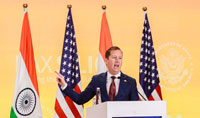 MUMBAI: US Ambassador to India Sergio Gor on Tuesday called for India and the United States to work together as “true partners” to address friction points and unlock the full potential of their economic relationship. Addressing the Indo-American Chamber of Commerce (IACC) National Convention in Mumbai, Ambassador Gor called for stronger India-US economic partnership. He stressed the need for predictable taxation and regulatory frameworks to provide businesses with greater certainty and encourage investment and innovation.
 CONNECTICUT (USA): The Indian Overseas Congress USA has strengthened its political and community presence in the Northeast with the launch of its Connecticut Chapter, led by Kamal Swamy, as the organization moves to expand its grassroots network among Indian Americans. The new chapter was formally inaugurated in Connecticut in the presence of senior IOC USA leaders, community members and supporters. The launch marks another step in the organization's nationwide expansion under President Mohinder Singh Gilzian.
India-US | India-France | Entertainment | Sports | Photo Gallery | Tourism | Link Partners | Contact Us
© Noyanika International, 2003-2024. All rights reserved.