


Aviation Archives
|
Deccan's
chopper service to Vaishno Devi a great hit
"Our chopper service is popular with all the age groups. But, of course, the aged and businessmen and the non-resident Indians (NRIs) who are hard pressed for time make use of our package that includes darshans and return to the base the same day," said Major Yoginder Kandhari, Chief of the helicopter operations at Katra in Jammu and Kashmir.
Nine-year-old Noyanika, who as a child was thrilled with the additional advantage of a chopper ride, echoed similar sentiments. A visually thrilled Noyanika said she took the helicopter, as she had to return to school on Monday. "I, along with my parents, made best use of the weekend to have darshans of Mata Vaishno Devi, which I have been wanting to do for a long time." Noyanika said she walked the three-km stretch from Sanji Chhat to Mata Vaishno Devi Darbar but took a pony ride on return. Major Kandhari informed that Deccan Aviation was invited by the Sri Mata Vaishno Devi Shrine Board to commence its Katra - Sanji chhat operations in November 2002. "The service has been running uninterrupted for over two years to the delight and satisfaction of thousands of devotees."
In its first year of operation ending November 2003, Major Kandhari said "Deccan carried 27,935 devotees. This figure jumped to 38,683 in the second year ending November 2004 showing a growth of 38.48 per cent. With a view to further enhance its carrying capacity the company replaced its Bell 206 L 3 with two state of the art and more effective Bell 407 helicopters. It is visualized that in current year there will be further increase in passenger traffic by 25 per cent." At the outset, he said Deccan Aviation had to contend with indefinite passenger response as earlier attempts by other operators had failed to establish credibility as a dependable and worthwhile means of visiting the shrine. "Deccan Aviation meticulously analyzed the follies of the past and made quick amends to arrive at an effective customer friendly formula, which to date is working to the entire satisfaction of all concerned." The erstwhile passenger waiting area has been transformed into a modern, air-conditioned waiting lounge. The ticketing and reservation system has been streamlined to near perfection with the appointment of a vast, countrywide network of agents. "Today you can book your pilgrimage from the comforts of your home, on the Internet," informed Major Kandhari. Deccan has also introduced a number of packages in conjunction with some of the best hotel properties in Jammu and Katra. In addition, the company has also formalized a seamless package with the Shrine Board that covers the entire ambit of requirements of the Yatris, including air bookings, to and from Jammu, hotel accommodation, helicopter flight to the shrine helipad and return, night stay at the shrine and special darshan at the shrine. To further improve the infrastructure at Katra Heliport, Deccan Aviation, under the aegis of the Mata Vaishno Devi Shrine Board, is working on a project of constructing a hangar for servicing and maintenance of the helicopters. "This facility will obviate the requirement of ferrying the helicopters to Delhi for their periodic maintenance," said Major Kandhari. Mr Rohit Kansal, Additional CEO of Mata Vaishno Devi Shrine Board, said "our endeavor is to provide all level of facilities to the devotees to make his pilgrimage comfortable and memorable one. The helicopter service is an endeavor towards that." Deccan Aviation is India's largest and most versatile helicopter charter operator in the private sector with a fleet of nine helicopters and two fixed wing aircraft. Besides having a nationwide presence with six bases, Deccan is also the first Indian aviation company to have an ongoing joint venture overseas, in Sri Lanka. Deccan aircraft have been and are currently deployed to perform an array of multifarious tasks from conveyance of political and corporate VIPs, evacuation of casualties, geophysical surveys, heliskiing, aerial photography, flower dropping at religious functions, tourism to conveyance of pilgrims to places of religious interest. India
gets ready to receive world's largest plane A380
"The runways at Mumbai, Delhi, Chennai and Kolkata airports will be modified to be able to handle 550-seater Airbus A380. Similarly, modifications to taxiways will be undertaken to cater for the wider wheel-base of the aircraft," said Mr K Ramalingam, Chairman of the Airports Authority of India. The AAI maintains and operates 126 airports in the country. Mr Ramalingam informed that adequate fillets would be provided on the turning points of the taxiways to cater to these widened wheelbases. "Parking stands are being provided at all the four metro airports to provide for the A380 that has a wing span of 80 meters." The AAI Chairman said "few clearances between runways and taxiways, which are mandatory, will be provided to be able to handle Airbus A380 at these airports." With its larger wingspan giving greater lift and its new-generation engines, the A380 can take off and land in less distance than other large aircraft. This makes it capable of using existing runways. Major world hubs, which have already geared up to take the A380, include San Francisco and Singapore. Besides the Indian metros, others that would be ready in 2006 include Sydney, London's Heathrow, New York's John F Kennedy International, Los Angeles, Tokyo, Seoul, Hong Kong, Bangkok and Frankfurt. The super jumbo's entry into service next year is a challenge to already stretched airport infrastructure. Research group Frost & Sullivan says Airbus' biggest problem isn't the demand for the super jumbo, which it sees as potentially even higher than Airbus' own estimates. ``This is all very nice, but if you don't have airports that can handle the A380 it won't work,'' said Johan Orsingher, a senior consultant with the group. London's Heathrow airport says it is spending over US $800 millions (euro 640 millions), providing everything from double-decker passenger ramps to enlarged baggage conveyors capable of processing 555 passengers on one flight. Other airports are spending billions more on similar improvements, but there is concern that some may not be ready in time. Even Paris Charles de Gaulle, home to A380 customer Air France, has just two A380-ready gates. Operator Aeroports de Paris insists its airport will be ready for the plane despite last year's partial collapse of the new terminal where they are both situated. Airports in the United States are also thought to be behind, although Orsingher said major airports in New York, Los Angeles, Chicago and Atlanta would have no choice but to catch up quickly. ``We've put some friendly pressure on two or three airport authorities that we consider to be a bit behind,'' Forgeard told France's La Tribune newspaper. The delay in some of the major airports worldwide has forced Virgin Atlantic that has ordered six A380s with options for a further six, worth a total of $3 billion to postpone acquisition of the super jumbos to later date. Virgin was originally scheduled to take delivery of the aircraft in 2006 but delayed the plans due to concerns that some major airports, particularly Los Angeles, would not be ready to accommodate the plane in time, as well as delays in sourcing components for some design innovations. The first aircraft is scheduled for delivery in May 2008, according to the airline's half-owner Richard Branson. Branson said Virgin Atlantic was now confidant that airports were prepared and suggested the company would take up its options for a further six planes sooner rather than later. "The chances are we are going to want more than six," he said. How the plane's extra space is used will be left up to airlines, whose A380 cabin designs have remained closely guarded. In the future, low-cost carriers could operate the A380 with a single economy class configuration accommodating as many as 800 passengers. Virgin's Branson said his airline would offer private double beds for first-class passengers and gambling area offering blackjack and roulette for both economy and business class passengers. Besides, he said the super jumbos would have gyms and beauty parlours. He said "since you have gaming and you have private double beds maybe there are two ways of getting lucky on a Virgin plane." Virgin Atlantic, which already offers seats that convert into double beds on some of its existing aircraft, plans to install 35 private double beds on each A380. The Chairman of Dubai-based carrier Emirates, which is so far the largest A380 customer with 45 orders, said the plane was a ``key element in our future growth'' and offers ``the widest cabin of any aircraft in the world.'' ``It provides lower seat-mile costs and carries more passengers further and consumes less fuel than its competitors,'' Sheikh Ahmed bin Saee Al Maktoum, said. Chew Choon Seng, CEO of Singapore Airlines, said the A380 would increase passenger and cargo capacities ``without increasing aircraft movements and without congesting the skies and adding to congestion on airport taxiways and runways.'' Singapore Airlines will begin using the plane for services to London and Sydney when it becomes the first carrier to carry commercial passengers aboard the A380 in 2006, he said. Airbus hopes to sell 750 of these jumbos to airlines operating services between the busiest airports, mainly in Asia, which serve as hubs, or stopovers between connecting flights. Airbus
unveils world's largest aircraft
The super jumbo has an 80-meter (262-foot) wingspan and a tail as tall as a seven-story building. It cost euro10 billions (US$13 billions) to develop. In a three-class cabin layout, the A380 will seat 33 per cent more passengers than Boeing's veteran 747 and offers 49 percent more floor space -- leaving additional room for features such as on-board shops, bars, casinos or even nurseries. The French President, Mr Jacques Chirac, the British Prime Minister, Mr Tony Blair, the German Chancellor, Mr Gerhard Schroeder,and the Spanish Prime Minister, Mr Jose Luis Rodriguez Zapatero along with 5,000 guests from the world's aviation sector and media including and CEOs from the 14 airlines and freight companies that have so far ordered the A380 attended the elaborate unveiling at company headquarters in Toulouse, southern France. "Under
the name Airbus, Europe has written one of the most beautiful
pages in its history," Airbus chief Noel Forgeard told
the packed hall. The A380 has wingspan of 80 metres (262 feet), overall length of 73 metres (239 feet), height of 24 metres (79 feet) and maximum take-off weight of 560 tonnes. It far exceeds the 747 by US rival Boeing by being able to transport between 500 passengers in a typical first-business-economy class configuration and 840 passengers in an all-economy set-up on its two full decks. The 747, which had ruled the commercial skies since 1975, typically carry 416 passengers in comparison. Mr
Chirac said the "big success" of the A380 project showed
that Europe should cooperate further in other industrial domains,
notably in high technology. "We can, and we must, go further
on this path of European construction so essential for growth
and employment," he said. Mr Schroeder took the opportunity to make a barely-veiled jab at the United States, whose secretary of defence, Donald Rumsfeld, dismissed France, Germany and other countries as "Old Europe" for opposing the Iraq war. "Good old Europe has made this possible," the German leader said, hailing Europe's leading position in civil aviation. Airbus has already taken 149 orders for the US$280 million planes, ``which for a plane of this size that has not yet flown is an extraordinary commercial performance,'' said Noel Forgeard. The A380 will take to the skies next year. Airbus says companies have options on dozens more and that the programme will break even after 250 sales -- an objective it hopes to reach within three years. In all, the company expects to sell 700-750 aircraft. ``It is a plane that will fly for 30 to 40 years,'' Forgeard said. Airbus trailed Boeing until 2003, when it delivered more planes than its US rival for the first time -- a feat it matched last year, with 320 deliveries to Boeing's 285, and is likely to repeat this year. How the plane's extra space is used will be left up to airlines, whose A380 cabin designs have remained closely guarded. In the future, low-cost carriers could operate the A380 with a single economy class configuration accommodating as many as 800 passengers. Virgin company chief Richard Branson, said his airline, which has ordered six A380s, will offer private double beds for first-class passengers and casinos. The Chairman of Dubai-based carrier Emirates, which is so far the largest A380 customer with 45 orders, said the plane was a ``key element in our future growth'' and offers ``the widest cabin of any aircraft in the world.'' ``It provides lower seat-mile costs and carries more passengers further and consumes less fuel than its competitors,'' Sheikh Ahmed bin Saee Al Maktoum, said. Chew Choon Seng, CEO of Singapore Airlines, said the A380 would increase passenger and cargo capacities ``without increasing aircraft movements and without congesting the skies and adding to congestion on airport taxiways and runways.'' Singapore Airlines will begin using the plane for services to London and Sydney when it becomes the first carrier to carry commercial passengers aboard the A380 in mid-2006, he said. India, US sign open skies aviation agreement
Mineta said the agreement means the two countries "will be closer than ever before" and begins "a new era where American and Indian consumers, airlines and economies can reap the rewards of cheaper flights, more choices and faster air service." He said the agreement would strengthen commercial aviation in a number of ways, including more direct flights to serve the approximately two million passengers a year travelling between the two countries. The agreement allows airlines from both countries to select routes and destinations based on consumer demand, providing for open routes, capacity, frequencies, designations, and pricing as well as opportunities for cooperative marketing arrangements. That includes code sharing with domestic Indian carriers to aid in making reservations and giving a greater choice of flights. The deal also allows all-cargo operators to operate in either country without directly connecting to their homeland. India and the United States are the world's two largest democracies and two of world's fastest growing economies, Mineta noted in a statement. Indus
Airways: Reasonable fares with best of frills
To start with, Brig Kapil Mohan said the Indus Airways would connect cities such as Chandigarh, Amritsar, Delhi, Varanasi, Kolkata, Chennai, Mumbai, Goa and Srinagar. "We plan to connect the hitherto uncovered sectors and also connect the metros and other major cities."
He said the airline would provide "very reasonable fares with best of frills." On the long-haul flights, he said the airline would provide good quality food for which we have hired some specialists. He said "it will be service with a smile." Brig Kapil Mohan, who is known is known as a doer, said he is talking of the project today, as "I feel good about it. Had it not been so I would not have talked about. We have hired professionals to make sure that all the talks has to be airworthy." Brig Kapil Mohan of the Mohan Meakins heads the Board of Indus Airways. Three Directors on the Board are Mr Krishan Gopal Beri, who is Managing Director of M/s Beri and Beri Cold Storage and General Mills (P) Ltd; Mr Parminder Lakhanpal, a London-based NRI; and Mr Baldev Seth, a garment exporter. Mr Amarjit Sangha, a Toronto-based NRI, is one of the investors in the airline that has a starting equity base of Rs 10 crore. Mr Krishan Gopal Beri said the emphasis would be on quality - be it food, service or inflight comforts. He said there would also be emphasis on on-time performance and intelligent schedules. "In other words, a passenger could catch a flight early morning and return home by night after completing his task. That will also save him on his hotel bills." Mr Parminder Lakhanpal said ERJ 145 a pressurized jet for regional transport and has a good turnaround that would help us meet our on-time targets. The ERJ 145 is also characterized by its high performance and low operating costs. It is equipped with quiet, fuel-efficient turbofan engines. He said the leased aircraft that airline is initially taking would be only one to two years old. He said the passengers would get attracted to Indus for the great comfort ERJ offers. Mr Baldev Seth said ERJ 145 cabin has a maximum pressure differential of 7.8 psi, offering passengers the comfort of a smooth, relaxed flight above bad weather. Since first delivery in December of 1996, more than 700 of these successful Embraer jet aircraft have been delivered to airlines around the world.
Mr Beri said the airline had submitted the proposal to the Indian Government on April 22 last year and the high-level committee of the Civil Aviation Ministry approved it in December and the company was now waiting for a final nod from the Civil Aviation Minister. He said the airline meets all the stipulated guidelines for floating and running a scheduled private carrier. He said the airline has hired two best aviators for its operations in Northern and Central and Southern India. Capt A P C Kapoor, ex-Director (operations) Air India and a senior Commander and instructor of Boeing 747-400, would be based in Mumbai and head the operations of Central and Southern India. Similarly, Capt M S Sandhu, ex-General Manager, Air India and Boeing 747 instructor, would be based in Chandigarh and head the operations of Northern India. Other airlines that are planning to launch operations in 2005 include Vijay Mallya's Kingfisher Airways, the Wadia family's Go Air, Royal Airlines (former ModiLuft) and East West. The civil aviation ministry has granted its no-objection certificate to Kingfisher, Go and Royal that would enable them to launch scheduled flight operations this year. The launch of the several new airlines is expected to unleash a fresh round of fare wars in the domestic aviation market with all the players promising to introduce services at fares that are about 25 to30 per cent cheaper than existing rates. Go Air is expected to take to the skies in the next couple of months. While Mallya plans to launch his airline venture by April next year, Royal Air is slated to take off a month later in May. "We will be starting our airline operations with a fleet of leased aircraft and substantial investments will be made in the venture," said Jehangir Wadia, director of the Wadia group, which also includes Britannia and Bombay Dyeing. "Though we have named the venture Go Air for now, we are conducting consumer studies to finalise the brand for the airline." Nair
takes over as Member AAI Board
By Deepak Arora
Speaking to this correspondent, Mr Nair said his endeavor in the new position would be to bring in desired efficiency in the organization. "Though we have excellent technical talent we need to harness and come up to everybody's expectations and achieve corporate excellence," he added. The Corporate Mission of the AAI is "Progress through excellence and customer satisfaction with world-class airports and air traffic services fostering economic development." Mr Nair stated that though the physical integration of erstwhile International Airports Authority of India (IAAI) and National Airports Authority of India (NAAI) took place in April 1995, but still we do not have a common policy towards employees. He said he would ensure common recruitment and promotion policy and common seniority of the employees of the two organizations that were merged to create AAI. The new Member also stated that his endeavour would be increase the non-traffic revenue from 40 per cent of total revenue at Rs 4,500 crore to 60 per cent that is a global standard. Mr Nair joined the erstwhile IAAI in 1977 as the first professional manager, when the country's maiden international cargo terminal was commissioned at Mumbai airport. Since then he has held various key positions in the erstwhile IAAI, including a stint in the National Dairy Development Board where he was responsible for major port operations and nationwide distribution of dairy commodities donated by EEC countries under "Operation Flood" programme. Since 1996, Mr Nair has been an Executive Director of the AAI, holding key positions such as Airport Director, Trivendrum and Mumbai airport's Commercial, Cargo and Key infrastructure Development. Prior to his elevation as Member (P&A), Mr Nair was the Director of Capital's Indira Gandhi International Airport for nearly three years. Widely traveled, Mr Nair has represented AAI in various high-level delegations and working groups and has also presented several papers in national and international levels, seminars and workshops. Mr Nair has undergone 12 weeks Public Enterprise Management training at Ilkley Management Centre, UK under the Colombo Plan and six weeks intensive training in Airport Handling Systems under the aegis of Frankfurt Airport Authority at Frankfurt, Germany. ATR inks deal with Air Deccan for 30 aircraft
An agreement for delivering the new-cum-leased aircraft was signed here Thursday by ATR CEO Filippo Bagnato and Air Deccan's managing director G.R. Gopinath. "The ATR 72-500 aircraft have the lowest seat-mile costs in their category and a high degree of commonality with ATR 42, which leads to major cost savings and flexibility," Bagnato said. In addition to the 30 aircraft, ATR will deliver six second-hand aircraft, including three 42-500 models and three 72-500 models. These aircraft will replace six of the existing fleet of ATR aircraft operated by Air Deccan. Currently, Air Deccan operates nine ATR-42s on its feeder routes and three Airbus A-320s on trunk routes across India. The airline is acquiring three more ATR 42-500 this month and February to expand its feeder service. "The sticker price for each ATR 72-500 aircraft is $17.6 million. The exact price will be negotiated in consultation with export credit agencies like Sace Bank of Italy and COFAS of France, who will stand guarantee for 80-85 percent of the cost," Bagnato said. As part of the deal, ATR has agreed to set up a training facility in Bangalore with a simulator to train rookie pilots. The first of its kind in India, the centre will have well-advanced, integrated product support. According to Gopinath, Air Deccan will acquire 15 ATR aircraft on a monthly lease of 0.75-1 percent of the total cost of the aircraft. Though five years old, these aircraft will join the fleet after overhauling and refurbishing by the manufacturers. ATR is owned by the European Aeronautic Defence and Space Co. NV based in France and Germany, and Italy's Alenia. IA to lease 6 more ATRs NEW DELHI, Jan 6: The Indian Airlines board on Thursday approved leasing of six more ATR-42 aircraft for its subsidiary Alliance Air in a bid to enable it to serve more short sector regional routes. The board's clearance came as part of its approval of recommendations of the Committee of Officers, which studied the feasibility of extending domestic operations to regional routes. The committee recommended 50-seater operations to 18 new destinations that include stations as diverse as Cooch Behar, Agatti, Gwalior, Ludhiana, Kanpur, Dehra Doon, Nasik, Simla, Surat and Jaisalmer. The hub and spoke pattern of operations will have bases in Delhi, Mumbai, Chennai and Kolkata. The board considered it appropriate that Alliance Air should undertake these operations with similar aircraft type as was currently in use - ATR-42-320. THE `IN' THING: The Communication and Information Technology Minister, Dayanidhi Maran, presenting a certificate to Ratan Tata, Chairman, Tata Group, to mark the extension of the .in domain name registry services by the National Internet Exchange of India, at a function in New Delhi on Thursday. IA launches Guwahati-Bangkok flight TTO News Service
The airline has offered a special inaugural fare for two months besides a six month excursion fare in economy class. The economy class one way inaugural fare from Guwahati, which is the eighth station in India to be linked to the Thai capital, is Rs 7,645 (round trip Rs 14,300) and business class fare of Rs 9,940 (Rs 18,590), the airline said. The six month excursion fare is Rs 13,655. Guwahati was earlier linked to Bangkok by a twice a week A310 flights of Air-India, which were subsequently withdrawn. India allows private airlines to fly overseas
"The cabinet today approved domestic private airlines to fly overseas, apart from the Gulf countries," Patel told newsmen after a cabinet meeting in New Delhi. The move will boost the prospects of private airlines such as Jet Airways and Sahara Airlines. A ministry statement said domestic airlines planning to fly overseas needed to have been in the business for five years and have a fleet of at least 20 aircraft. But Patel said the two state-owned carriers will be allowed to retain their monopoly to fly to the Gulf region for the next three years to protect their businesses. "Most
of their operational revenue and profit on international
routes accrue from these routes," a ministry statement
said. A large number of Indian professionals, most of
whom travel regularly to the country, are working in
Gulf countries such as Saudi Arabia, Kuwait and the
United Arab Emirates. Domestic air travel market expanded 26.5 percent in the first half of the fiscal year to March to 18.52 million passengers. As a result, almost all airlines have chalked out ambitious expansion plans and some corporates have rushed to start budget carriers as well. The Cabinet also approved the Ministry's proposals and course of action suggested for strengthening Air India and Indian Airlines and for establishing the improved operational synergy between Air India and Indian Airlines. Further the Cabinet has approved the proposal to discontinue the practice of mandating commercial agreements on all new services, to review the existing commercial agreements and phase them out over the next five years. Request of all eligible airlines for additional entitlements will henceforth be taken into account in bilateral negotiations. Efforts will be made to obtain traffic entitlements commensurate to the requirements of all eligible airlines. However, in case the total entitlement fall short of requirements projected by the eligible airlines, inter-se allocation of entitlements among eligible airlines will be in the ratio of Available Seat Per Kilometer (ASKM) deployed by them on domestic routes over the last five years. Due consideration will be given to the operational plan of Air India/Indian Airlines while allotting entitlements to Indian Scheduled Carriers. The Ministry of Civil Aviation will draw detailed guidelines in this regard.
With a view to encouraging greater connectivity, creating
a level playing field, reducing passenger tariffs and
ensuring viability of operations, the practice of demanding
compensation from foreign airlines by way of commercial
agreements mandated by the government will be discontinued.
All new operations by foreign carriers, both on new
destinations as well as on existing routes, will be
free from the obligations of the mandated commercial
agreements. All existing government mandated commercial
agreements will be reviewed and phased out over the
next five years. However, the airlines will be free
to enter into such cooperative marketing arrangements
as are mutually agreed upon by them. Air Deccan seeks new heights By
Deepak Arora
To extend his support for the growth of aviation in the country, the Civil Aviation Minister, Mr Praful Patel, had gone to the Delhi airport to flag off the inaugural flight to Dehradun. Mr Patel along with Capt Gopinath and Mr Jean_luc Establie, Sales Director, ATR, had addressed the newsmen to mark Air Deccan's launch to smaller cities in Northern India. Capt Gopinath said the airline's endeavor is to connect the unconnected routes. "In the past we connected unconnected cities like Hubli, Belgaum and Vijaywada with the metros of Bangalore, Chennai, Hyderabad and Mumbai. Now we are connecting cities like Dehradun, Amritsar, Kanpur and Jabalpur to Delhi."
For example, he said a Delhi-Bangalore ticket on a conventional airline like Jet Airways cost Rs 11,400 per ticket, in Air Deccan the highest price of the ticket is Rs 6,400. "Passenger buying tickets closer to the date of the flight, running as close an hour before take off from the airport will pay such fares. Total number of tickets sold at Rs 500 is Rs 64,000," he added.
He said air connectivity to interiors and 'low fares' across the country would increase mass travel, give fillip to trade and commerce, and boost tourism as all the major tourist destinations and wild life parks are in remote areas and tourism being the largest employer of people in the world and also the largest foreign exchange earner would generate employment in rural areas. From operating a modest four flights a day in August 2003, Air Deccan has grown today into a reliable and efficient airline flying over 80 flights a day connecting 28 airports. The airline is presently operating a modern fleet of nine ATR 42 500 aircraft and three Airbus A320s. Two of the ATRs are based in Delhi to connect seven States to and from Delhi. Capt Gopinath said three more 48-seater ATRs would be joining the in January and February. Only a few days ago, Air Deccan had announced plans to buy 30 A320 planes from Airbus. Air Deccan said the deliveries of the aircraft are to begin in 2007. Airbus chief commercial officer John Leahy said "the deal is worth $1.8 billion at catalog prices." The purchase by Air Deccan, owned by Bangalore-based helicopter charter firm Deccan Aviation Private Ltd., is part of an ambitious plan to quadruple its fleet from 15 to 60 planes in five years. Capt Gopinath said the Airbus deal would be financed partly from $40 million raised earlier this month from ICICI Venture Funds and US-based Capital International. He said Air Deccan also had options for an additional $10 million from the two firms. Mohan Kumar, director of finance at Air Deccan, said that 85 per cent of the funds was expected to come from a consortium of banks comprising France's Coface, German credit insurer Hermes and Britain's Export Credits Guarantee Department (ECGD) which would provide guarantee support or direct funding. The rest would be from equity financing or funds from banks. IA evacuates record number of people NEW DELHI, Dec 29: Indian Airlines has evacuated a record 1,117 passengers from Port Blair on a single day on Wednesday. It operated 11 flights to and from Port Blair. Seven flights were operated from Kolkata and four from Chennai. According to a press release, Indian Airlines will operate three flights to Port Blair tomorrow - two from Kolkata and one from Chennai - in view of a decrease in the demand for evacuation of passengers. Indian Airlines has, since the day of the tragedy, operated 26 relief flights to Port Blair. Regional Directors of Indian Airlines can be contacted for transportation of relief material on the following numbers: Northern region (Delhi): 25672800; Eastern region (Kolkata): 22116953; Southern region (Chennai): 22561070 and Western region (Mumbai): 26156788. Special cells have also been set up to disseminate flight information. The telephone numbers of these are: Kolkata: 22116869 and 22110041; Chennai: 22560022; Delhi: 25674270 and 25672226; Mumbai: 26256986. Jet evacuates over 1,300 from Andamans
The Airline's flights from Chennai and Kolkata to Port Blair have flown over 13,000 kgs of relief supplies comprising packaged drinking water, foodstuffs, clothing and medicines for relief efforts in the beleaguered Islands. Sensing the shortage of drinking water the Airline purchased over 6,000 bottles of water and also 360 boxes of meals, 30 kgs each of samosas and kachoris and flown to Port Blair from Kolkata. Jet Airways will operate one Boeing 737 flights to Port Blair from Chennai and another from Kolkata on Thursday. Air India to ferry relief material free for Tsunami victims
The airline would give priority booking in return travel to those who may have curtailed their visit to Thailand after being affected by the tragedy, he said. The AI employees would also contribute one-day's salary, including Productivity Linked Incentive, to the Prime Minister's Relief Fund in the wake of the tragedy caused by tsunami floods in the southern states of the country, he added.
The planes also carried water from Kolkata and medicines from Chennai to the island group where an estimated 4,000 people were killed by tsunami waves on Sunday. As a large number of people are still stranded, the airline planned to operate 15 relief flights to Port Blair on Wednesday - seven from Chennai and eight from Kolkata - which are expected to evacuate 1,785 people. As a result, many scheduled flights of Alliance Air will be cancelled, the spokesman said. On Monday, Indian Airlines had operated five relief flights and evacuated 593 passengers and on Sunday it had operated two relief flights. Jet operates 5 relief flights
Jet Airways also operated five Boeing 737 flights in all from Chennai and Kolkata on Tuesday to and from Port Blair. Two flights each were operated on Chennai-Port Blair-Chennai sectors and three each on Kolkata-Port Blair-Kolkata sectors. These flights have also been carrying relief and medical supplies from Governmental and other recognised voluntary agencies to Port Blair from Chennai and Kolkata free of charge. In
view of the national catastrophe, Jet stated that it would
not collect any cancellation charges for tickets issued
for travel on Chennai-Port Jet Airways has also contributed Rs 50 lakhs to the Prime Minister's Relief Fund for rehabilitation of the tsunami victims of India. A cheque for the amount was handed over to the Principal Secretary to the Prime Minister, Mr TKA Nair, late Monday evening by Jet Airways' Executive Vice President, Lt. Gen (Retd.) Inder Varma on behalf of the airline. Jet
Airways also made another contribution of USD 55,000 for
similar efforts in the Island Nation of Sri Lanka. The
cheque to the President's IA evacuates tourists from Andaman By Deepak Arora
On Sunday, Indian Airlines had operated two flights and brought back about 293 tourists. On Tuesday, the airline would send nine flights from Kolkatta and Chennai to bring back over 1,000 stranded tourists. Most of these flights went almost empty with only a small number of residents of Andaman and Nicobar, who were in the mainland and wanted to return following reports of the catastrophe, said the spokesman. Some relief materials were also despatched by these flights. The IA management under the supervision of a high powered team had taken the decision to arrange for special flights to evacuate the stranded tourists in the islands, the spokesman said. Meanwhile, Jet Airways also announced that it will fly medical and relief supplies from Governmental or other recognized voluntary agencies free of charge for rescue and rehabilitation work, from Chennai to Port Blair with immediate effect. Jet Airways operates one Boeing 737 flight daily between Chennai and Port Blair. On Monday Jet Airways operated two Boeing 737 flights between Chennai and Port Blair. Jet Airways also operated its special seasonal flight Kolkata-Port Blair-Kolkata as scheduled on Sunday and also on Monday. "This flight will continue to be operated daily till tomorrow. Medical and Relief supplies can also be sent in the Kolkata-Port Blair sector," Jet spokesperson said. Air
India poised to regain top slot
In an interview with this correspondent, Mr Thulasidas said that this fleet acquisition plan, which covers a period up to 2012-2013, provides for an increase in fleet size from the present 34 to 74 - a net addition of 40 aircraft. Air-India proposes to increase seat capacity by 12 per cent annually over this period. In a passionate interview with this correspondent in Kuala Lumpur, he said "our country is one of the largest and strongest and I don't see why we cannot do well in the world. Today I have been given the responsibility to get Air India on the top. And I don't see why we cannot achieve this target." In plain words he has made this very clear to the Air India staff too. Perform or perish. Either you all go up or you all will go down. The choice is yours. But he adds in the same breath that there was no reason why Air India cannot achieve its past glory of becoming one of the top airlines of the world. He said "the unions are supporting the management. We also are receiving excellent support from the Minister of Civil Aviation, Mr Praful Patel, and the Government." Mr Thulasidas said "Indian travel market is booming. Five millions are traveling abroad. Three millions foreign tourists are coming to India. That makes it a total of 8 million air traffic. At present all foreign airlines are taking away traffic. But if national airlines get a good part of this traffic it is good for the national economy." The Chairman and Managing Director said "we are not against foreign airlines. Let them also come. But let there be competition and let us all make our national carrier strong to face the competition." Today, Mr Thulasidas said "Air India is poised at a very decisive moment. It needs to grow in size to meet the competition from the large international airlines. It has to be profitable. The service has to be top class and productivity has to be good." The CMD said "This is a mission. It is not just my mission. There are people who are proud to see an Air India aircraft in their own country. People plead to us to give them a chance to fly Air India." He said "right now the airline is increasing its fleet strength through the lease route. We hope to get approvals from the Government for 50 aircraft for Air India and 18 aircraft for Air India Express next year." With this, he said, Air India would have more flights and more network. "We are also in the process of upgrading our existing aircraft with internet and telephone facilities and better seats." On December 7, the Board of Air-India Charters Limited, a subsidiary of Air-India, at its meeting held in Delhi, had approved the project report for acquisition of 18 Boeing 737-800W aircraft for use by Air India Express. These aircraft on induction will replace the ones being taken on lease by AICL for Air-India Express for commencing operations effective April 2005. While a firm price for the entire order is yet to be fixed, the deal will be worth close to $1 billion at the current list price of $60 million per aircraft. The project report revised on the basis of low cost and low fares was later submitted to the Ministry of Civil Aviation for securing Government's approval. It may be recalled that Air-India Board had last year approved the purchase of these aircraft for its own use but consequent upon the creation of Air-India Express, which will serve destinations in the Gulf and South East Asia, the project report was revised. On November 24, The Air-India Board approved the floating of tenders for inviting offers for acquisition of 50 aircraft - of which two-third will be on firm basis and one-third on option. Air-India proposes to acquire three types of aircraft for its fleet, viz. Medium Capacity Ultra Long Range aircraft (A340-500/B777-200LR); Medium Capacity Long Range - 350 seater in three-class configuration (A340-600/B777-300ER); and Medium Capacity Long Range -- 250 seater in two class configuration (A330-200/B7E7-8). The airline has now invited offers from Aircraft and Engine manufacturers and subsequently undertakes a techno-economic review of the offers received. Mr Thulasidas informed that Air India is now connected with Los Angeles five times a week. Air India that commenced flight to LA in June this year added two more frequencies effective December 2. With five flights now available to passengers per week, travel between Mumbai and Los Angeles will become more convenient as Air-India is the only airline to offer direct connectivity between the two cities, without change of aircraft en route. These flights, operated via Frankfurt, also provide seamless hub and spoke connections from Bangalore, Chennai, Hyderabad and Kolkata to Los Angeles and convenient connections on Indian Airlines on the return leg. All the five flights to Los Angeles will be operated with Boeing 747-400 aircraft, the First and Executive Class cabins of which have newly installed flat beds and slumberettes respectively. These cabins have also been recently retrofitted to provide personal video entertainment and a choice of popular movies. The United States has been a major growing market for Air-India. To cater to the increased demand, Air-India has been gradually increasing its presence in Europe and the USA. With the introduction of the two new flights to Los Angeles, Air-India's flights to the USA will be increased to 25 per week -- seven to New York via London, seven to Newark via Paris, six to Chicago -- three each via London and Frankfurt, and five to Los Angeles via Frankfurt. By April 2005 the national carrier is, in fact, proposing to operate a daily service to Los Angeles and also to Chicago. Air-India will thus have daily services to each of its four online stations in the USA -- New York, Newark, Chicago and Los Angeles by the summer 2005 schedule. Air China shares open higher at debut in Hong Kong stock exchange HONG KONG, Dec 16: Shares of China's biggest airline Air China Ltd. opened 6 percent higher at their debut on the Hong Kong stock exchange on Wednesday, in line with market expectations. Air China, the third Chinese carrier to list in Hong Kong, opened at 3.15 Hong Kong dollars, compared with its initial public offering price of HK$ 2.98. Analysts had expected the airline's shares to open 5 percent to 10 percent above its IPO price. The Beijing-based carrier was listed in London later on Wednesday, making it the first Chinese company to have a dual listing in Britain and Hong Kong in recent years. Air China Chairman Li Jailing, said the airline chose London over New York because it has a greater exposure to European destinations. "The dual listing of Air China in Hong Kong and London is a great milestone for the company,'' Li said. Ma Xulun, President of Air China, said: ``The listing enables us to expand our fleet, strengthen our position as one of China's largest commercial airlines.'' Air China raised HK$8.36 billions (US$1.07 billions; euro 812 millions) by selling 2.806 billion shares, or a 30 percent stake. The airline, which has a fleet of 136 aircraft, said the funds raised from the offering will be used to buy 10 Airbus and four Boeing jets and to repay debts. Air China said it expects a strong rebound in its full-year earnings, with net profit rising to 2.29 billion yuan (US$276.57 millions; euro 208.56 millions) _ from 159.60 million yuan in 2003 when the airline was hit hard by the SARS outbreak. Last month, Hong Kong's flag carrier Cathy Pacific Airways Ltd. signed a memorandum of understanding with Air China to buy 9.9 percent of the Chinese airline's IPO shares. The deal, which includes coordinated schedules and joint marketing efforts, will give Cathay a bigger presence in the booming mainland market from which the Hong Kong carrier has so far been largely excluded. Two other mainland Chinese carriers have already listed in Hong Kong -- China Southern Airlines Co. and China Eastern Airlines Corp. Cosmic Air launches India operations NEW DELHI, Dec 10: Cosmic Air, a leading private carrier of Nepal, has launched its India operations, offering two flights daily between Delhi and Kathmandu. The airline, with a wide network within Nepal, is offering promotional fare of "Buy One, Get One Free" on the Delhi-Kathmandu sector. Capt. R. D. Pradhan, Executive Chairman of SOI group, of which Cosmic Air is a subsidiary, said the airline aimed at developing Indian market for tourism and business traffic. He said that affordable fares and value for money would be the hallmark of services of Cosmic Air. The airline plans to fly to other cities in India such as Mumbai, Bangalore, Lucknow, Varanasi and Bodh Gaya by early next year. It is offering promotional fare of Rs. 2,700 plus taxes on the Delhi-Kathmandu sector till December 31 but tickets would be valid for a year. Indian Airlines posts Rs. 44 crore net profit By Sushma Arora
The CMD attributed the turnaround to several cost-cutting measures, better utilisation of aircraft, carrying more passengers, improving overall load and seat factors. He said the airline saved Rs. 73 crores in 2001-02, Rs. 102 crores and Rs. 190 crores in the next two years on several counts. Mr. Arora said the company showed improvement in its financial performance despite hike in average domestic ATF price to Rs. 21,000 per kilolitre during 2003-04 as against Rs. 19,900 in the previous year. ATF price is a major cost component of the carrier, about 30 per cent of the operating cost in India as against global norm of 15 to 18 per cent. He said advance purchase (APEX) fares and other discounted schemes also accounted for 25 to 30 per cent of the seats. "For all practical purposes APEX fares are here to stay,'' he added. The public sector carrier recently got the nod from the Public Investment Board for acquiring 43 aircraft from Airbus and it needs the Government's approval to begin the price negotiations for the Rs. 10,000-crore deal that would give it added capacity as well as renew its aging fleet. ACAAI meet helps boost trade between India, Malaysia By Deepak Arora
The convention succeeded in bringing India and Malaysia together in seizing further opportunities to develop the trade between the two friendly nations. It also helped in developing bonhomie and comradeship between the freight agents and the airlines. The Malaysian Deputy Transport Minister, Yang Mulia Tengku Dato Sari Azlan Ibini Sultan Abu BaKar, opened the ACAAI annual convention by lighting the tradition Indian lamp. The Indian Civil Aviation Secretary, Mr Ajay Prasad, the Indian High Commissioner, Mr R L Narayan, and the ACAAI President also participated in lighting the lamp ceremony. In his key note address, Yang Mulia Tengku Dato Sari Azlan Ibini Sultan Abu BaKar said "Malaysia has strong historical links with India, and over the years the relationship between these two friendly countries has strengthened. India continues to be a valuable trading partner of Malaysia." The Minister stressed on the need for consolidating the strengths and pooling of resources by the freight forwarders in the light of horizontal and vertical integration that is taking place in the segments of airline industry. Therefore, he said, the airlines and freight forwarders were in the process of understanding and appreciating the need for closer relationship. The Civil Aviation Secretary, Mr Ajay Prasad, assured that the much-awaited new Civil Aviation policy would see the light of the day some time early next year. He assured better infrastructure in terms of ultra modern airports and cargo hubs. He said the restructuring of Delhi and Mumbai airports in collaboration with new private partner would be completed by June next year. Mr Prasad assured the delegates that a new thrust is being given to cargo in the country. He assured that many new cargo complexes would be developed at many airports. He informed that Indian Airlines and Air India would launch dedicated freighter services sometime next year. This is the third convention in a row being held outside India and it displays ACAAI's confidence in attempting to reach out and expose to the trends and influences in the Cargo Industry, beyond India's shores and skies. The 30th annual convention was held in Colombo, Sri Lanka and the next one in Dubai, UAE. The theme of this year's Kuala Lumpur convention was "Airlines & Forwarder: Leveraging their Strengths." The top people from the cargo and airline industry addressed the six business sessions that helped the trade partners in leveraging their strengths and move forward to a better and brighter tomorrow. Some of the top names that were present included the Indian Airlines Chairman and Managing Director, Mr Sunil Arora; the Air India Chairman and Managing Director, Mr V Thulasidas; the Senior General Manager, Malaysia Airlines, Mr J J Ong; the FIEO Chairman, Mr Rafeeque Ahmed; and the Coke Vice President, Mr Adil Malia. The convention also decided that ACAAI would play an active role by recommending the views of the industry in the formation of the civil aviation policy as advised by the Civil Aviation Secretary. It also called for business transparency and engaging in constructive dialogue with the partners on issues concerning both to strengthen the relationship. In his presidential address, Mr Sam Katgara said it was well-declared policy of our two countries to co-operate with each other under the Southeastern umbrella. This Convention, he said would certainly strengthen the regional co-operation and close relationship between the Air Cargo Industry in India and Malaysia. Mr Katgara said in the global cargo scenario, cargo growth outstripped passenger levels. "It is heartening to know that cargo traffic growth improved by 12 per cent in the first five months of this year compared to the same period in the year 2003. The global cargo traffic is 13.6 per cent higher and has outstripped passenger traffic levels, which are 8.8 per cent." He said "traffic growth for the first five months of 2004 is testimony to the resilience of air transport. Not only have we recovered from the impact of SARs and war in Iraq, all major regions of the world are reporting traffic levels above those of 2000 - the last normal year for the industry. Despite the shocks that have rocked the airline industry in recent years, the underlying industry growth rate is 3.6 per cent. Efficiency gains and cost cutting remain priorities to return the industry to health." Highlighting the tradition warm ties between the countries, the Indian High Commissioner, Mr R L Narayan, the trade and economic ties between India and Malaysia were growing in leaps and bounds. He hoped that Malaysian Government would take note of the tremendous opportunities being offered by India in building its infrastructure network. IA en route to numero uno slot By Deepak Arora
Welcoming
the PIB approval, the IA Chairman and Managing Director,
Mr Sunil Arora, said "the entire IA family is relieved
and elated. We are thankful to the Ministries of Civil Aviation
and Finance that they finally took cognizance of the long
felt need of the airline to replace and add capacity." In fact, he said, "its tribute to the entire operational staff that they have been able to enhance the utilization of Airbus aircraft from 2,800 to 2,900 hours per annum to 3,400 hours per annum in the last four years. However, if they are given new equipment they can be reasonably expected to do much better." Mr Arora said "in the absence of equipment, the comparison of Indian airlines of Indian Airlines with the competitors is almost like comparing apples with oranges. There are other factors pertaining to product upgrade which are constantly being looked into, but the matching equipment by itself is almost 50 per cent of the battle won. The rest is to enhance maintenance, cleanliness of the cabin, in-flight service, cuisine and all other aspects related to passenger traffic." The proposal has been hanging fire since March 2002 when the Indian Airlines Board cleared it. Unlike the private carriers, it needs government approval before placing orders for the planes. This will be the first fleet acquisition by the airline in 15 years. The last purchase took place when Rajiv Gandhi was prime minister. The proposal would now be put up before the Cabinet Committee on Economic Affairs (CCEA), according to Mr D Swarup, Expenditure Secretary. The Finance Ministry has also agreed to provide sovereign guarantees to help Indian Airlines raise funds in the international markets for purchasing the aircraft. Around 90 per cent of the deal will be funded through external commercial borrowings and the remaining 10 per cent will be funded by way of government equity infusion in Indian Airlines. It is expected that the final Cabinet approval would come through by January and the aircraft would start arriving in the later half of 2006. All aircraft will be fitted with CFM-56 engines made jointly by General Electric Co. and Snecma, a state-controlled French aerospace company. Indian Airlines would now commence price negotiations with Airbus for the planes. Under the deal, Airbus has agreed to invest in India 30 per cent of the total value of the airframes (the aircraft minus the engine). The investment would be for buying aircraft doors from Hindustan Aeronautics (HAL) and software from Indian firms. The Airbus Senior Vice-President, Mr Kiran Rao, has welcomed the announcement. India's air travel market is small even though the country has one of the world's fastest-growing economies. The air travel market is small because of high fuel cost and high taxes that inflate the air fares. It is for this reason, India's billion-plus people use the subsidised rail network. Only 15 million people travelled by air in Asia's fourth-largest economy in 2003-2004, a little more than the number who use the much cheaper rail network in a single day. Still, air travel demand is expected to rise by nearly 9 per cent annually for the next 20 years as incomes rise at a fast clip, fuelling demand for 290 new jets valued at $22 billion, according to Boeing. The Indian Airlines deal was crucial to both Airbus and arch-rival American company, Boeing, caught in a fierce battle for market share in a recovering global aviation industry. Airbus overtook Boeing as the world's biggest commercial jet maker in 2003. Airbus is 80-percent-owned by European Aeronautic Defence & Space Co NV, based in France and Germany. BAE Systems Plc, a British aerospace company, owns the rest. Indian Airlines' fleet of 65 aircraft includes 15 leased Airbus A320s and four turboprop planes. The average age of the aircraft is around 15 years and they are pending replacement. The new fleet of 43 Airbus planes will be used to retire this aging lot. Malaysia
Airlines to connect Ahmedabad NEW
DELHI, Nov18: Malaysia Airlines, the national carrier of
Malaysia, will launch return direct flights from Ahmedabad
to Kuala Lumpur, on December 16. The thrice-weekly flights
from Ahmedabad are on Tuesday, Thursday and Saturday. The
five-hour-and-five-minute flight will depart from the Sardar
Vallabhai Patel International Airport in Ahmedabad, India,
at 2335 hrs (Local time) and arrive at the Kuala Lumpur
International Airport (KLIA), Kuala Lumpur at 0705 hrs (Malaysia
Time). The return flight will depart from KLIA, Kuala Lumpur
at 1930 hrs (Malaysia Time) and arrive at 2205 hrs (Local
time) at Ahmedabad. Eurocopter hands over 2 new copters to Pawan Hans
The two AS 365 N3's have undergone several technical advancements, which include modular design of the mechanical assemblies and use of composite materials leading to considerable reduction in maintenance costs. Speaking on the occasion, Mrs Marie-Agnes Veve, Head of Dauphin said " One thing which is constant all across the world is the confidence that Dauphin operators have in the reliability of the helicopter. We cherish this trust and always strive to provide value added services to our customers. In researching future technologies, our approach is to target reductions in development time, operating cost, noise and pilot workload. Our major research goals are to increase safety, passenger comfort, enhance performance and customize it to suit all weather conditions." On Eurocopter's association with Pawan Hans, Mrs Veve said, "We share a very special relationship with Pawan Hans, which is India's leading helicopter operator as well as the biggest customer of Eurocopter in India." On Eurocopter's plans for India, Mrs. Veve mentioned, "The Indian aviation industry is witnessing tremendous growth. The aviation sector has become more receptive to new models and fresh technology. State governments, helicopter operators and leading corporates are now using our helicopters. We are receiving an increasing number of inquiries from various business houses. This is very encouraging, we will soon start with flight demonstrations here." Pawan Hans is the largest helicopter operator in India. It's fleet of helicopters is used for transportation of personnel to offshore platforms, for shuttle flights between drill barges and for transport of state officials and VIPs. It also provides charter services for tourists. Eurocopter launched the Dauphin Helicopters in India in 1986.Since then, Pawan Hans has logged over 270,000 flying hours and over 1 million safe landings with its Dauphins. In July 2002, Pawan Hans was appointed as a "Eurocopter Dauphin Helicopter Maintenance Centre" in India and South Asia. This gives Pawan Hans, an unique position as the sole approved Maintenance Centre with D level capabilities for the complete Eurocopter Dauphin fleet in South Asia. Eurocopter helicopters are owned and used by prominent state Governments, reputed helicopter charter operators and prominent business groups in India. Worldwide, US Coast Guard is one of the biggest customers of Dauphin. The US Coast Guard owns a fleet of 96 Dauphins and has logged more than 700,000 flight hours with them. Eurocopter was formed in the early 90's by
the merger of the helicopter divisions of Messerschmitt-Bolkow-Blohm
(MBB) from Germany and Aerospatiale from France. The group
is now a 100% subsidiary owned by EADS (European Aeronautic,
Defense and Space Company), the second largest aerospace
group in the world. Eurocopter offers a wider range of civil
and military products than any other manufacturer, from
the EC120 single-engine light helicopter up to a medium
weight transport helicopter in the ten-tonne class, the
Cougar MK2, thus covering about 80 percent of the global
market demands. IA fare discount to business class
The scheme is available for one-way or round-trip travel on IA's domestic and international sectors for both Indian and foreigners residing here. It will be valid between November 5 and February 4, 2005. The scheme cannot be combined with any other current offer and may not be available on sectors and flights having a high frequency. Pawan Hans gains new heights By Deepak Arora
The paid up capital of the company is Rs 113.76 crores with the Government holding 78.5 per cent and balance 21.5 per cent being held by ONGC. The Company has been consistently paying dividend since 1992-93 and till date has paid Rs 128.52 crore. Mr Sridhar, who took over as CMD in June, 2002, has brought in professionalism in the company through his astute administration. His astute management skills could be gauged from the fact that under his administration Pawan Hans paid pending annual dividends of Rs 66.70 crore for the three financial years 1991-2000, 2000-01 and 2001-02. In other words, the company during Mr Sridhar's tenure of little over two years has paid dividends for five financial years. The recent dividend cheque of Rs 13.73 crores (Government of India share) was presented by Pawan Hans Chairman and Managing Director to the Civil Aviation Minister, Mr Praful Patel. The Civil Aviation Secretary, Mr Ajay Prasad, and the Joint Secretary, Mr A.K. Upadhayay, were present on the occasion. Mr Sridhar said the Company has been able to secure good long term business with the institutional clients mainly in the oil industry and the Government sector which has resulted in improved utilization of helicopter fleet. "The Company was able to achieve improved financial performance as compared to previous year on account of long term contracts, better charter rate structure with high revenue yield and increased utilization of helicopters through improved serviceability of fleet," he added. Mr Sridhar said the company achieved a total flying task of 23,020 revenue hours for the year 2003-04 with an average monthly deployment of over 23.7 helicopters under long term contracts as compared to 20,173 hours and 21.2 helicopters in the previous financial year. While accepting the cheque, the Civil Aviation Minister expressed happiness. Further, the Minister also said that he is proud of Pawan Hans and its employees for making all out efforts for this achievement. Pawan Hans is one of India's leading helicopter company is known for its reliable helicopter operations. Since inception in 1985, the company has operated number of helicopters by offering wide range of services to its clients by operating a well balanced fleet of 32 helicopters consisting of Robinson(R-44), Bell 206L4, Bell 407, Dauphin SA 365N, Dauphin AS 365N3 and Mi-172. It is the only aviation company in India being awarded ISO 9001: 2000 certification for its entire gamut of activities. Since its inception, Pawan Hans fleet has clocked over 3,30,000 hours and has done over 12,00,000 landings. Pawan Hans gives top priority to safety and security of the passengers and has set stringent inspection rules. At Pawan Hans standing instructions of the Managing Director are do not clear the machine for flight even if there is an iota of doubt. "We are a public sector undertaking and we follow stringent guidelines on maintenance and with us safety comes before economic considerations," said Mr Sridhar. It is a different story that Pawan Hans has been showing profits and has declared the highest ever dividend for the last financial year. The CMD said every helicopter goes through mandatory inspection at 25 hours; 50 hours or 30 days; and 100 hours or four months. Then there are T1, T2 or T3 inspections carried out at 500 hours or 18 months; 1,000 hours or 36 months; and 2,500 hours or 72 months. Then there is the G-Inspection that is carried out at every 5,000 hours or 10 years. In this the whole chopper is stripped to the last except for the label and every part is checked and changed. Mr Sridhar said "our helicopters are properly maintained and overhauled as per the procedures prescribed by the manufacturers." Pawan Hans has a team of dedicated highly motivated and skilled manpower which includes pilots, engineers, executives and support staff. The company makes sure that these professionals receive the best possible training possible to upgrade their skills. A DGCA approved Training School is being run for the technical personnel and simulators are installed at Delhi and Mumbai to provide periodic instrument training to the pilots. The company prides itself on being an extremely self-contained organization, with workshops covering different requirements (instruments, electrical, safety equipment, synthetic panel, component repair shop, Spectrometric Oil Analysis Procedure Lab and radio including Full Test Data checks) that are available on site at Mumbai. It carries out all periodic inspections as well as overhaul in-house. Pawan Hans is an approved maintenance centre to carry out servicing of Dauphin series helicopters and is part of Eurocopter network of Authorized Maintenance Centre (AMC) worldwide to carry out the servicing in India and other South East Asian Countries. Kingfisher Airlines - a fashion statement By Deepak Arora
Speaking to this correspondent, Dr Vijay Mallya, Chairman of the UB Group and Rajya Sabha member, said Kingfisher Airlines has signed a deal with Airbus to acquire 12 Airbus A-320 aircraft and the company may launch an IPO to raise funds. The company will be investing $750 million to acquire these new state-of-the-art aircraft from Airbus and firm deliveries of four aircraft will commence in October 2005. For the time being, Kingfisher Airlines is taking on lease four A-320s from GE Capital Aviation Services for Rs 100 crore. Thereafter, he said investments in new airplanes will commence which will be financed through a variety of options that are available worldwide. The company may launch an initial public offering (IPO) at appropriate time to raise funds for the fleet acquisition. Kingfisher Airlines is currently a wholly owned subsidiary of UB Holdings. All the aircraft in the Kingfisher fleet will seat 180 passengers in a one class "Funliner" configuration. CFM engines sourced from CFM International, a joint company of Snecma Moteurs, France and GE, USA, will power the Airbus A 320s. On the group's foray into aviation Dr Mallya said, "The UB group was the first to launch a non-government commercial air service in 1990. We now feel a compelling need to re-enter the aviation sector which is one of the fastest growing markets in the world." He said "Kingfisher Airlines will have a 'Fly the Good Times' approach and this will reflect in the experience we will offer to passengers. With costs lower than economy class travel on full service Airlines and marginally more than the 'bus services' type low cost competition, Kingfisher offers a far better proposition. The aircraft and service will reflect the Kingfisher lifestyle imagery and credibility that has been built over the years." Kingfisher "Funliner" aircraft interiors would be styled by India's leading fashion designers who have been signed on. The staff uniforms will be designed by Kingfisher fashion designers and flight attendants would be chosen in a "Kingfisher Flying Models contest" to be launched all over India. Kingfisher Airlines "Funliners" will offer in-flight entertainment on demand encompassing the very latest in-flight entertainment options available in the world. The "Funliners" will also offer multi-channel audio entertainment with built-in channel selectors on its slim line seats. Other in-flight events include the "Kingfisher Flying Face of the Month Contest", in flight silent auctions for lifestyle products, in-flight sales of branded merchandise at attractive discounts and a host of other innovations. Kingfisher Airlines also proposes in-flight sales of dry packaged food and beverages. Kingfisher would have the lowest per seat mile cost in India by virtue of a combination of leased and purchased aircraft. It will have maximum capacity utilization with the lowest turnaround times. It proposes to maintain low operating overheads by maximizing outsourcing of ground handling with emphasis on quality of service and competitiveness. Dr Mallya said the airline planned to outsource many of the functions to Indian Airlines, which operates the same family of aircraft to minimize costs. Also proposed is the extensive use of IT to lower costs and allow for constant dynamic models on pricing, aircraft utilization and route planning. "We intend to save on our labour costs by having under 70 employees per plane as against around 500 in Indian Airlines and 150 in Jet Airways," stated Dr Mallya. Kingfisher would also offer an attractive loyalty rewards programme for its passengers and would be negotiating bulk deals with corporate sector. He said at Kingfisher we would follow the Jet Blue budget airline model. "It will not be at the lowest end of the value chain but will seek to keep its costs low and fares very affordable." He said "I do not believe in putting wings on buses even though we chose Airbus aircraft." There will not be any Rs 500 fares but 15 per cent of the seats will be priced at the level of a second-class AC train fare. "Of
the 14 million traveling by train daily in India, 12 to
15 per cent travel in AC coaches. We are targeting these
passengers," he added. The airline will fly on all trunk routes like New Delhi, Mumbai, Kolkata, Chennai, Bangalore, Hyderabad, Ahmedabad, Indore, Guwahati, Dibrugarh, Kozhikode, Thiruvananthapuram, Mangalore and Goa. "We are also looking at catering to international destinations if the Government permits it. However, we would not like to restrict ourselves to ASEAN and SAARC countries. The government should allow a level playing field," Dr Mallya said. Mr Alex Wilcox, who has had a long stint in various international airlines, including Jet Blue, informed that the fares would fall into different price buckets in an ascending order. Pawan Hans maintains stringent safety norms By Deepak Arora
We must not forget that the most affected by any tragedy are the immediate members of the victim’s family. Similarly, we should not forget that pilots also do have families and none of them want to die. In other words, a pilot would not like to fly a machine that is unsafe. However, it has been noticed many a times that soon after an air accident the so-called aviation experts – be it the politicians or the general public or the media persons -- start ogling out comments that normally do no good either for the public or for an operator. Somebody has rightly said “prejudging is criminal” and wrong reporting leads to disinformation. Take the case of a recent helicopter crash at Barapani, about 20 km from Shillong. The public sector, Pawan Hans, chopper was on a routine flight from Guwahati to Shillong. All the eight passengers on board and two crewmembers were killed. Among them were Meghalaya community development minister Cyprian Sangma, legislators H N Marak and Ardhendu Chowdhury and former deputy speaker Aira Marak. It is learnt that the weather was bad and visibility poor in the hills around Barapani when the ill-fated Dauphin helicopter on September 22 met with the accident. The preliminary inquiry suggests that bad weather was responsible for the Shillong mishap.
However, the media reports quoting the high profile politicians were quick to blame Pawan Hans for flying an ageing machine and having poor maintenance record. Those who said so were unaware of the stringent maintenance work schedules at Pawan Hans workshops and were unknowledgeable of as to how an age of an helicopter is calculated. Before I explain this, lets understand that either the men on top ie the owners or the people behind ie passengers are generally considered responsible for an accident. The owner of a small fixed wing aircraft or a helicopter is responsible if he insists on clearing the machine in spite of some defects or prevailing bad weather conditions to get some quick economic gains. A quick turnaround means more money. At times, VVIPs hopping from one destination to another nearby disregard norms and authorities or private air operators yield under political pressure. Experts say the safety norms that are in place are adequate but their implementation should be stringent.
It is a different story that Pawan Hans has been showing profits and is expected to declare record dividend for the last financial year. “For us every life matters and therefore safety is given top priority. We do not put our pilots to risk. They also do have families,” said Mr Sridhar expressing his concern on the lives lost in Meghalaya crash. The crash near Barapani was the eighth involving Pawan Hans helicopter in the country, and the second in the northeast. This eight-seater Dauphin helicopter, four of which are in operation in northeast, had logged 14,400 hours and was to go for G-Inspection at the completion of 15,000 hours. Contrary to statements made by some local politicians, a helicopter does not have a fixed life span. This chopper had received airworthiness certificate in March this year that was valid till March, 2005. Every helicopter goes through mandatory inspection at 25 hours, 50 hours or 30 days, and 100 hours or four months. Then there are T1, T2 or T3 inspection carried out at 500 hours or 18 months, 1,000 hours or 36 months and 2,500 hours or 72 months. In the G-Inspection is carried out at every 5,000 hours or 10 years. In this the whole chopper is stripped to the last except for the label and every part is checked and changed. In other words, a helicopter has no fixed life span so long it goes through these checks and inspections. Denying the allegations, Mr Sridhar said “our helicopters are properly maintained and overhauled as per the procedures prescribed by the manufacturers.” The Shillong chopper had Since its inception in 1985, Pawan Hans fleet has clocked over 3,30,000 hours and has done over 12,00,000 landings. Weather has been the biggest troubleshooter for Pawan Hans. Out of its eight accidents, six had been due to bad weather/ disorientation, one due to human error and one has been purely due to mechanical snag. Out of these eight mishaps, four have been on the hilly region that include the first accident on July 14, 1988 at Sanjhi Chat, Jammu; Kohima in February 1989; Itanagar in May 2001 and the recent one in Shillong. Three accidents have been over the sea ie near Bombay High in May 1997, off the Pondicherry coast in August 1988, and Lakshdweep in October 2003. One accident was over land ie in Patna in December 1989. Bad weather has been the biggest worry for airlines, especially the helicopter operators. Unlike the big aircraft that cruise at 30,000 to 40,000 ft altitude, the helicopters normally fly at 6,000 ft at which level it faces clouds that deplete visibility. If a helicopters gets into CV (Cumulo Nimbus) clouds it results into death and destruction. Cumulo Nibus is cauliflower type of cloud that generates high velocity with fast moving positive and negative charges. It gets into a very dynamic situation and the artificial horizon instrument goes haywire and makes it difficult for the pilot to save the situation. Even when a big aircraft gets closure to CV cloud it faces turbulence. Malaysia
Airlines goes hot on India NEW DELHI:Malaysia Airlines has received approvals to commence flights to Ahmedabad and Kolkatta. The airline plans to start three flights to Ahmedabad from Dec 16and three flights to Kolkata from January 2 next year, according to Syed Abdillah Aziz, airline's Regional Manager, South Asia. At present, Malaysian Airlines has four flights to Delhi, daily flight to Chennai, two to Bangalore, four to Mumbai and one to Hyderabad. It plans to add one more flight to Bangalore, three to Mumbai and two to Hyderabad and place into service Boeing 747-400 to Chennai thereby adding 100 seats from the South gateway to Kaulalumpur. With these new additions, the airline's total flights would go up from 18 to 30 per week from India. Only last year, the airline had seven flights out of India, informed Syed Aziz.
However, Dr Toyad said in the first seven months of this year this figure has already crossed more than 105,000 and the Ministry of Tourism expects these figures to touch 200,000 by the end of this year. During his visit to India, the Minister announced a strategic plan for Tourism Malaysia to promote Malaysia as a preferred tourist destination among the Indians. The plan based on the principle of "Consolidation" and "Value for Money" specifies three broad objectives - active public-private participation, strengthening of the distribution network and customized positioning of products. The Malaysia Tourism Promotion Board Director, Mr Manoharan, said the Malaysian Tourism Ministry anticipates 25 per cent growth in the tourist receipts from India, which at present stands at US $ 71.15 million. Mr Manoharan also hopes to achieve and sustain average growth of stay to 11 to 12 days from 9.1 days in 203. It also plans to lay special stress doubling the business arrivals from India, which at present stands at 23.4 per cent. To provide more seats to his country, Dr Toyad said his government would welcome all public and private airlines to fly between the two countries. "The government is ready to facilitate and accommodate the needs of existing and potential airlines which would help in augmenting the seat capacity and connectivity." He said the Ministry of Tourism would continue joint promotions with not only the national carrier Malaysia Airlines but with other airlines too which has a direct or indirect link between the two countries. We also have to learn from the Malaysians on how not to kill the goose that lays the golden eggs. It's a known fact that Malaysia knows the importance of tourism and its contribution towards development of its economy. The country has come a long way from the doldrums of 1997-98 when tourist arrivals was at its lowest at 5.5 million to record high of 13.25 million in 2002 and 10.6 million in 2003. Realizing the importance of tourism as a significant foreign exchange earner and employment tool of the country's workforce, Malaysian Government keeps introducing new steps to attract foreign tourists. One such step taken early this year was launch of I-Visa (Internet Visa) to woo tourists from China and India. A pilot project was launched on March 15 this year in Chennai. Though, the I-Visa has become an instant hit, the Travel Agents Association of India (TAAI) objected to demand of Rs 3.5 lakh bank guarantee from travel agents by the Malaysian High Commission.
Mr Mayal and his TAAI team had a meeting with the Malaysian Tourism Minister during his recent visit to New Delhi. "Dr Toyad was very receptive to us and promised to look into the matter and discuss the issue with the Home Ministry," said Mr Balbir Mayal. Mr Mayal said TAAI was ready to take responsibility and guarantee of its agents and this was conveyed to the visiting Minister. However, he said if any travel agent defaults the Malaysian Government should blacklist him. The Malaysian Minister said "the I-Visa is more for the convenience of travelers and travel agents, who have to provide customer's proof online." In the I-Visa, once a customer gets an online okay from the High Commission, he can take the slip from the travel agent and get the visa stamped from the High Commission office. It saves travel time and long queues at the High Commission. The Malaysian idea behind bank guarantee is to make the travel agent more responsible. However taking into account concerns of TAAI, Dr Toyad assured this correspondent that his Ministry was preparing a Cabinet paper and also discuss the issue with the Ministries of Foreign Affairs and Home. Thus, he showed how Malaysia cares and ready to take all concerns into account to be an attractive tourist destination. Giving details of the I-Visa issued from Chennai, he said in March 4,673 visas were issued and out of that I-Visas were 1,090. In April the total figure was 6,407 (I-Visa 3,893); in May 5,681 (I-Visa 4,000); in June 3,544 (I-Visa 2722), July 4,661 (I-Visa 3,666) and till August 20 the total visas issued were 2,800 that included 2,242 I-Visas. The Minister said the I-Visa has taken off well in the two cities of China. Air Deccan slashes fares; IA, Jet, Sahara hike it By
Deepak Arora
On the rising Aviation Turbine Fuel (ATF) prices, Capt Gopinath mentioned "the incremental revenue from passengers will offset the cost of increase in ATF." He added "with Air Deccan operating out of 22 airports every increase in flights to these airports would bring the ticket costs down further." Capt Gopinath said "we will continue to operate the 'Dynafares scheme' under which tickets are priced from Rs 700 onwards. The top-end fares, which are available to passengers booking tickets two days prior to travel, have now been dropped. Air Deccan is offering fares up to 55 per cent lower than other airlines." Unlike other domestic airlines, Air Deccan is the only profit making airline in the country. Under the new discount scheme of Air Deccan, the Delhi-Mumbai fare for tickets booked even hours before the travel date will be available for Rs 3,400 as against Rs 4,400 earlier. The other airlines on this sector offer tickets after 10 per cent hike at Rs 7,250. The Delhi-Bangalore top-end fare has been cut from Rs 6,600 earlier to Rs 5,200. Other airlines offer stands at Rs 11,400. On Bangalore-Mumbai sector, new Deccan price is Rs 2,600 while others offer stands at Rs 5,600. On Delhi-Hyderabad, Deccan tickets would cost Rs 4,000 as compared to Rs 9,600 of bigger carriers. Deccan has priced Delhi-Chennai sector at Rs 4,500 as compared to Rs 11,800 of other airlines. On Friday, Indian Airlines and Jet in separate announcements had announced to hike their fares by 10 per cent from October 14 citing the rise in fuel prices as the reason. According to a Jet release, the upward revision has been necessitated by the 19 per cent price increase in aviation turbine fuel (ATF) since June, 2004. The ATF component in Jet Airways' operating costs has increased from 28 per cent to 33 per cent now, translating into an additional expense of Rs 13 crore on ATF, compared to the June figures. For both Indian Airlines and Jet there would also be proportional increases in other promotional fares, apart from the economy and business class tickets. This means that excursion fares, advance purchase fares and the positioning flight fares would also be revised. Air Sahara would, however, not affect any increase in its promotional scheme, which offers a Delhi-Mumbai ticket for Rs 4,444. The prevailing high ATF prices have added substantially to the operating costs of Indian Airlines and its subsidiary Alliance Air, necessitating an increase in fares, an IA spokesperson said. The continued increase in ATF prices has added substantially to the input costs of airlines and thrown their projections out of gear. The ATF price has touched an all time high in October, 2004, which is a matter of concern to IATA and the member airlines. The rise in ATF prices this year has added $9 to10 billion to the industry's fuel costs for international operations alone. Rono
Dutta's mantra for success KOLKATA, Sept 24: The CEO of Air Sahara, Mr Rono Dutta, has said that network; city share; product; yield management; loyalty programme; and alliances are the key to success of any airline. In his keynote address titled "Struggle for profits" at the 53rd TAAI annual convention here, Mr Dutta, said network is the backbone and key flow area of any airlines. Access is most important to create financial center hubs. India must create aviation hubs outside India to get out of the black hole. Every other successful airline has done it, be it British Airways or Lufthansa or Singapore Airlines. He reminded that every aviation hub creates a financial center that creates US $ 35 million to the local economy. Mr Dutta stressed that privatization and more access to foreign carriers were important, but the Government must take a balanced view otherwise it could lose to India becoming a financial hub like Dubai or Singapore. In his address, he said City Share was important to be clear on your points of strengths. On the Product, he said failure points here are the human contacts. It is important to upgrade technology or be at par with tech and innovate product. On Yield management, he mentioned that "Time value to Money" was important to stimulate demand. He said airlines have to be price sensitive, capture customer behavior at different price points, and have seven to eight different price structures for attracting customers. He informed that Loyalty Programme such as frequent flyers contributes to 15 per cent of loyalty. Price of course alone contributes 45 per cent, schedules are 20 per cent and product commands another 20 per cent in terms of loyalty programs. Elaborating on Alliances, Mr Dutta said we must learn what the British always did. Never fight a battle alone. We need to learn from Lufthansa, Singapore and all others what alliances can mean to the revenue of an airline. He said that it has proven that airlines and customers are commodities. Mr
Dutta warned that the current competition through airfares
between airlines would lead to closure of some carriers. To
succeed in this tough environment, he said that two carrier
hubs would not work. Instead, the airlines should focus and
specialize on few cities. IA takes private carriers by the horn By
Deepak Arora
Explaining how IA’s scheme is better than the rivals, Mr Goyal said “the main advantage is that our scheme is available for one-way flights as well. The other scoring point is that we offer the least number of days for advance purchase of tickets as compared to 30-day offer by other private players.” The new fares are available on metro sectors and has been introduced to match the increased competition in the market as also to attract AC 2-tier train passengers, he said. The Apex D-28 fares would be available with immediate effect and would be valid for sale upto October 15. Ms Manjira Khurana, Director in-flight services and Coordinator Marketing Services, said any change in booking from D-7 and D-21 (the two other schemes already being offered) to D-28 would be permitted without application of any cancellation charge. She said the passenger could also be allowed to convert from Apex D-28 to normal fare without applicable of cancellation charge till August 15. Mr Goyal said Indian Airlines had introduced the Smart Apex fares which offered advance purchase options on 7-day and 21-day basis. It was now felt that that there was a market for similar fare on an advance purchase beyond three weeks prior to the date of travel. The D-28 is being offered on eight sectors. These include with one way ticket price Delhi-Mumbai (Rs 2,500); Delhi-Kolkata and Delhi-Hyderabad (Rs 3,000 each); and Delhi-Bangalore, Delhi Chennai, Kolkata-Mumbai, Kolkata-Bangalore and Chennai-Kolkatta (all for Rs 3,500 each). With these new discounts, Indian Airlines has shown that it continues to set the agenda in the aviation market, particularly on fares. Way back in May 2001, the airline introduced the international practice of juxtaposing the fares on market requirement and yields, with the concept of Flexi-Fares. The underlying philosophy being that once the place has taken off, vacant seats are an opportunity lost forever. Under the flexi-fare concept, the fares were restructured sector-to-sector, season-to-season, peak time to non-peak time. The market had not seen anything like this and before long, this concept had caught up with the others in the field too. The air traveler looked forward to something exciting coming his way all the time. Mr Goyal said Indian Airlines took a conscious decision that instead of having a static and stagnant fare policy, it would have to keep a fluid and dynamic fare structure which was both cost driven and market driven. The various schemes and promotions that followed were only variants of the flexi-fare module. The Apex (Advance Purchase Excursion Fares) which was a corollary to the flexi-fare strategy module, followed soon in December 2001. They aimed at attracting more passengers especially the top end of rail traffic. The response to Apex fares, which have been periodically reviewed and improvised upon, has been overwhelming, with as many as 1,000 to 1,500 more passengers traveling Indian Airlines every day. The Smart Apex fare introduced in June last year, offered advance purchase options of seven days and 21 days on as many as 56 sectors. Presently, it is available on 67 domestic sectors. The longer period of 21 days found favour with vacationers and travelers without deadlines. The Super Saver and Super Saver Golden Edge schemes introduced last August were a bonanza for regular travelers. While the former offered four economy class domestic sectors for Rs 25,000, the later offered eight economy class domestic sectors for Rs 50,000. Next came positioning flight fares from April this year. Fares were cheaper by as much as 50 per cent to 60 per cent on the domestic leg of IA’s international flights. Like on Ahmedabad-Hyderabad sector IC 563/ 564 and IC981/ 982, the fare was Rs 3,500 as against the normal fare of Rs 5,975. A special fare for flights from Mumbai to destinations to Gujarat called the Common Promotional Fare of Rs 2,000 was introduced in May this year and has been a hit with the locals. A flat fare of Rs 2,000 was charged on sectors Mumbai-Vadodara, Mumbai-Bhavnagar and Mumbai-Rajkot, as against the normal fare of Rs 2,830, Rs 2,725 and Rs 3,130 respectively. Significantly, Mr Goyal said the airline saw a record carriage of passengers from April to June this year. The average daily carriage was over 25,000 passengers, which the airline had not witnessed since December 2000. The spurt in carriage can be attributed to a large part on the various marketing initiatives of Indian Airlines including the discounted fares. The recent offering this time to boost air travel to and from smaller cities and mini metros is the IA Metro Non-Metro Fares from July 16 to October 15. Under this scheme, a passenger traveling on non-metro sector in conjunction with a metro sector has to just pay Rs 1,000 for the non-metro sector. For instance, from Bangalore-Delhi-Patna, the fare under this scheme is Rs 11,630 as against the normal Rs 15,985. Or from Udaipur-Mumbai-Chennai the metro non-metro fare is Rs 7,030 against the normal fare of 10,645. While the fares initiative stands out for its tremendous impact on the domestic aviation market, several other marketing initiatives taken by Indian Airlines have simultaneously helped in boosting air travel. The marketing initiatives along with the attractive fares and other product upgrades aimed at giving value addition to the corporate travelers, frequent fliers and leisure travelers. Helicopter
service to Kedarnath relaunched
Recognising the importance of tourism as a key GDP driver, the State has accorded industry status to tourism. Uttaranchal, cradled in the Himalayas, has unparallel natural beauty. It is home to famous pilgrimage and spiritual centers for all religions like Badrinath, Kedarnath, Hemkunt Sahib and Pirankaliyar, source of the mighty Ganga and Yamuna and land of hundreds of lakes.
The USP of the state is that it is 150 km from the national capital of Delhi, has high literacy rate and is completely safe and secure destination. It has a tourist friendly environment where people follow the motto "Atithi Devo Bhava" (Guest is God). The State Government is doing all to improve its connectivity by rail, road and air to develop Uttranchal as an all year round tourist destination.
The Uttaranchal Tourism Secretary, Mr N N Prasad, informed that the helicopter service would help the devotees who for various constrains such as time, health and age cannot visit the holy shrine. "This would ease the journey of pilgrims and save their precious time," he added. Pawan Hans has signed a memorandum of understanding with Garhwal Mandal Vikas Nigam Ltd (GMVN), a Government of Uttranchal undertaking, for promoting pilgrimage tourism, eco tourism, adventure tourism in the State on August 18 this year. As per the MOU, Pawan Hans would connect the important places such as Shree Kedarnath Dham, Badrinath Dham, Ghangaria, Hemund Sahib from Gauchar airport near Rudraprayag from the next year onwards by helicopter. Mr Nagar Sridhar said Pawan Hans along with GMVN would make efforts to provide the basic framework for working together in future on a long term basis for growth and business development. Pawan Hans is one of India's leading helicopter company is known for its its reliable helicopter operations. The company was incorporated in 1985 with the objective of providing helicopter services to the petroleum sector, linking inaccessible areas of the country and operating charters for promotion of tourism. Mr Sridhar said last year Pawan Hans had carried 750 passengers to Kedarnath and the weather gods had also played truants and curtailed service during the season. "However, the company had made cash profit. But in real sense it did not because of depreciation etc. However, this year the company should do much better." This year, he said, we have placed one Bell 407 helicopter on service with four flights a day. "Next year, we plan to press two helicopters in service from summer somewhere in April/ May," added Mr Sridhar. To realize the full tourism potential, Mr Prasad informed that the State Government has developed three airstrips at Gaucher, Chinyalisaur and Pithoragarh. "These are ready to be operationalised," he added. He informed that a master plan for airstrips has also been prepared. Pawan Hans CMD said Gauchar is a beautiful airstrip. "We plan to develop it as our base where we plan to build helicopter hangers and build a passenger terminal that can be used to bring passengers from Delhi and transported further by helicopters to religious and tourist places," said Mr Sridhar. "It is for this reason we have signed an MOU with the State agency," he added. Mr Prasad said that Jolly Grant airport at Dehradun is to be expanded and operationalised. Similarly, Pantnagar and Haridwar airstrips are to be expanded and operationalised. He said the State Government is exploring the possibility of commencing an airline called Mountain Airline. "The airline is a vision and we are looking at its viability. The Government of India has given us Rs 15 lakhs to conduct a feasibility study. We plan to purchase about six helicopters to commence this airline that would take tourist to mountain and Himalayan rides," added Mr Prasad. Besides expanding the air connectivity, the State is also focusing on train connectivity. Dehradun has recently been connected with a new Jan Shatabdi train from New Delhi and a new train to Chennai. A Sampurna Kranti train between Delhi and Kathgodam would also commence shorty, informed Mr Prasad. He said National Highway (NH 58) was also being upgraded to a four-lane expressway. "We also plan to develop nine ropeways." SIA
commences flights from Amritsar NEW DELHI, Oct 4: Singapore Airlines (SIA) has commenced direct flights between Amritsar and Singapore, three times a week from Monday. Amritsar is the tenth Indian destination to be served by SIA and its subsidiary, Silk Air. These direct flights designated as SQ 471 (Amritsar - Singapore) and SQ 472 (Singapore -Amritsar) will operate on Wednesday, Friday and Sunday every week. Boeing
pitches for IA, AI
With the rapid changes in domestic travel market and global aviation industry, the Indian carriers would have competitive advantages if they go in for Boeing aircraft, said Dr Dinesh Keskar, senior vice president (Sales), Boeing. Dr Keskar said that in the past few years, the aviation industry has gone through tremendous changes. "After a few years of downturn in the aviation industry, air traffic is back on track, and is growing especially in India and Asia. However, now we are faced with new challenges such as rising price of jet fuel and appreciation of the Euro, but also opportunities for traffic growth." Rising jet fuel price, combined with consistent newly introduced non-stop, point-to-point routes to India by major international carriers and introduction of low cost carriers throughout the region, requires established Indian carriers to reduce cost while enhancing its product and service offerings, he added. Dr Keskar said "it is encouraging that Air India and Indian Airlines are now considering lease airplanes for their fleet expansion plans. Leased airplanes will allow the national carriers to induct much needed capacity immediately while required thorough evaluations of long-term fleets are being conducted." He said that Boeing has offered to replace the aircraft leased by Air-India from South Korea with new generation ones at a "great price" and said Indian Airlines would save over Rs 700 crore if it bought planes from it. "We have made a proposal to Air India to replace the aircraft it has leased from South Korea with new generation planes. It will be a great solution at a great price," he said. He said B-747s would be replaced by similar aircraft with "new interiors of B-777s and private televisions on each economy class seats". The lease of the Korean Boeings expires in 2006-07. To compete with current eight international airlines that use Boeing 777s to fly 160 flights per week into various Indian destinations, the national flagship carrier will need the competitive advantages of superior economics, revenue potential and passenger comfort. "The 777-200ER/LR is the right choice for Air India to increase its market share, enhance passengers' flying experience, and maximize profitability," said Dr Keskar. He said that Air India has a mission to be one of the top airlines in the world and one airplane that can help Air India reach this goal is Boeing 777. Once reevaluations are complete, there will be no doubt that Boeing airplane families are the most suitable for Indian carriers as they begin to dramatically expand to connect India to the rest of the world, he added. The 777-200ER (extended range) can carry 31 more passengers, with four tonnes more cargo than the A340-300. The airplane also burns 10 percent less fuel and costs 23 percent less to maintain per passenger than the A340-300. In addition to greater profit potential and lower operating costs, the 777-200ER also has a higher resale value than its competitor. As compared to its rival, he said the 777-200ER has a 65 per cent market share. Over the past five years, the 777-200ER has outsold the A340-30 by 3 to 1. On the passenger preference, he said 3 out of 4 passengers prefer 777 because of its wider cabin, wider seats, wider aisles, more headroom and more comfort. Dr Keskar said due to overall schedule reliability, significant fuel savings, lower maintenance cost and lower operating costs, the 777-200ER provides US $ 3.13 million more profit per year. The 737-800's economic advantages are the result of its ability to generate more revenue by carrying up to 12 more passengers and one-half tonne more cargo than the A320. Industry data also reveals that the 737-800 costs 15 to 20 percent less to maintain than its competitor and it can fly farther than the A320. On the offer to Indian Airlines whose proposal to acquire 43 Airbus 319s, 320s and 321s is currently being vetted by the Government, Dr Keskar said: "our offer of Rs 700 crore rebate continues to stand". There are reports that the Government has asked Indian Airlines in have a relook at its proposal to purchase new aircraft in the new aviation scenario. Boeing has been making this offer for the past few years to woo Indian Airlines into buying its planes. Going back on 777, Dr Keskar said Singapore Airlines has signed a letter of intent to purchase up to 31 Boeing B777-300ER aircraft. Eighteen of the 31 aircraft are firm orders for delivery between 2006 to 2010, while the remaining 13 are subject to exercise of purchase rights. At list prices, the order is worth approximately US $ 7.35 billion, including cost of spares and spare engines. General Electric GE90-115 engines will power the twin-engine aircraft. The order reinforces SIA's standing as the biggest customer for the Boeing 777s and has another four B777s on firm order. With the latest order, the number of B777s in the SIA's fleet will eventually reach 77 units. The B777-300ER, seating about 350 passengers and with a range of 7,000 nm, will be deployed on SIA's long-haul and medium-haul routes. The new order will allow SIA to achieve fleet as one of the industry's youngest, as the B747-400 is progressively retired. Jet
revamps frequent flyer programme
"This new programme is a radical departure from existing frequent flyer programme models followed by airlines around the world," said Mr Peter Luethi, Chief Operating Officer of the airline. He added "Jet Airways has always set the benchmark for loyalty programmes in India. With the new Jet Privilege, we have taken a major step forward in the way we acquire, recognise and reward our frequent fliers." Mr Luethi said "the new programme is not only more rewarding but has many innovative benefits including a Global first. JP members can now access their membership account, transact online and enjoy a personalised web experience too." The internationally acclaimed airline loyalty programme guru, Mr. Randy Petersen, has described the new programme as "Traditionally Frequent Flier programmes have focussed on mileage accrual/ redemption and fixed window for tier assessment. Jet Airways will be the first airline to build their Frequent Flier Programme based on 'Dynamic Tier Review' mechanism, which offers flexibility and truly understands the customers behaviour to build profitable customer relationships." The new JP now offer two additional membership levels, thereby replacing the earlier three tier levels with five membership levels: JP Blue, JP Blue Plus, JP Silver, JP Gold and the elite JP Platinum. JP Members can now access, programme details online by logging on to www.jetairways.com The site also offers Jet Privilege members access to their own personalised online Jet Privilege accounts. The accounts are secured with member-specified password protection. With an online JP account, members are can not only access, but also update their JP information, purchase tickets, access customized offers based on their preferences, verify their JPMiles and activities, claim missing JPMiles, redeem their JPMiles for Jet Airways flights and request any other information from the Jet Privilege Service Center. A full-fledged dedicated Service Centre is always available to handle any member enquiries or requirements. With the new programme Jet Airways takes a lead in the introduction of a range of new benefits and unique privileges such as mileage earning capabilities globally in the Hyatt/Hilton chain of hotels. It also offers well-established features such as automatic mileage accrual, multiple mileage earning opportunities and global redemptions. Features that reinforce the new programme as it takes a giant leap forward. A feature that makes the new Jet Privilege programme stand apart is the unique Dynamic Tier Review (DTR) system, a world first, pioneered by Jet Airways. A multiple criteria based tier assessment system, the DTR will offer JP Members quicker tier upgrades as well as enhanced opportunities to retain their tier membership level. Earlier JP members were required to complete or earn a fixed number of Jet Airways flights or JPMiles within the pre-determined time frame of one financial year, i.e., April 01 to March 31 of next year. By automatically reviewing tier activities in the preceding 12 months, on a daily basis, the DTR will ensure that with each calendar date, the time frame slides a day ahead. If a member meets the applicable criteria within a shorter period of time due to regular frequency of travel, the DTR System will upgrade the member to a higher tier within six months. At the end of a member's tier validity, the DTR will review the member's activity in the preceding 12-month period and as long as he achieves the requisite Jet Airways flights or JP Miles, the tier will be retained for an additional 12 month period. Additionally, the system will provide for flexible time frame evaluations for the preceding 18 and 24 months in appreciation of the member's loyalty by allowing slight reduction in the tier requirement on the longer criteria period. For instance, if a member needs 60 flights in 12 months to retain his Platinum status, in 18 months he will technically require 90. However, DTR will enable him to do this at only 84. Truly global in nature, the JP card is accepted across 400 cities in six continents wherever Jet Airways' international partners KLM Royal Dutch Airline and Northwest Airlines fly to. It has more partners and offers more benefits than any other Frequent Flyer Programme in the Indian Subcontinent. A member starts earning JPMiles from the time he takes his first flight. JPMiles can also be earned when a passenger flies on Jet Airways' international partner airlines namely KLM Royal Dutch Airline and Northwest Airlines. A Jet Airways frequent flier member can also earn JPMiles through other programme partners that include 2500 hotels in, The Hilton Hhonors global network, 200 hotels in the Hyatt Hotels & Resorts global chain, The Leela Palaces & Resorts, ITC-Welcomgroup, The Oberoi Hotels & Resorts, The Park Hotels, Radisson Hotels & Resorts, Avis Rent a Car and The Economist magazine. The benefits offered to a JP member include membership level bonuses, access to Club Premiere lounges at airports, tele check-in, extra baggage allowance over and above normal allowance, guaranteed reservations upto 24 hours before departure, check-in at Club Premiere desks and access to select KLM Lounges worldwide. Apart from the above Jet Airways offers its members an opportunity to earn free flights even faster with Jet Airways Citibank Credit Cards. In association with Citibank N.A. and MasterCard International, this is the country's most innovative and rewarding airline co-branded credit card which is available in both Gold and Silver variants. Meanehile, Patna, the capital of Bihar, will be the next new station on Jet Airways network. The airline will link Patna with Delhi by a daily evening flight operated by Next Generation Boeing 737-700 aircraft effective Monday (August 16). Patna will be the 44th destination on Jet Airways route network including the two international stations Colombo and Kathmandu. Jet Airways operates a fleet comprising of 33 Classic and Next-Generation Boeing 737-400/700/800/900 aircraft and eight modern ATR 72-500 turbo-prop aircraft. With an average aircraft age of only four years the airline has one of the youngest aircraft fleet in Asia. Since inception on May 05, 1993 till end June 2004 Jet Airways has flown over 44.8 million passengers. IA comes to infant's rescue By Deepak Arora NEW DELHI, July 29: The public sector Indian Airlines is know for its humane touch. In its past several decades of existence, the airline has come to rescue of people in areas affected by the floods or earthquake or cyclone hit. It has also rescued Indians from abroad during contingencies like the Gulf War. During such contingencies, it has provided medicines and relief material free of cost. The humane face of Indian Airlines was once again visible on Thursday night when the Commander of a flight IC 904 to Bangalore from New Delhi diverted the plane to save the life of an infant. Mrs Asma Khan and her 10-day-old baby Muhammed Ahmed, who was born with a critical heart ailment, accompanied by the baby's uncle Mr.Zahoor Ahmed Khan, who arrived by a PIA flight PK-270 from Lahore to Delhi at 1610 hrs of July 28 boarded Indian Airlines flight IC 904 to Bangalore where the infant was to undergo heart surgery. The plane took off at 2000 hrs and on way the infant's condition deteriorated. The crew made an announcement calling for a doctor on board. A passenger Dr. G.Jayadevappa came forward and examined the infant with the help of the first aid equipment available on board and opined that the infant was in critical condition and needed to be shifted to hospital immediately. Commander Capt. Sanjeev Marwah, popularly known as 'Bunty' Marwah, took on the spot decision, alerted Hyderabad and made an unscheduled landing at Hyderabad at 2205 hrs. The infant, with the help of Indian Airlines officials was rushed to Krishna Institute of Medical Sciences, in an ambulance of Airports Authority of India. The oxygen cylinder from the aircraft supported the infant till he reached the hospital. Flight IC 904 finally landed in Bangalore at 2335 hrs instead of the scheduled arrival of 2220 hrs. Capt. Marwah's decision to land at Hyderabad was lauded by all the 142 passengers on board despite the inconvenience caused due the delay in reaching Bangalore. The infant's condition is now stable, and he has been declared fit to travel under medical supervision to Bangalore on Thursday for surgery. He travelle by IC 961 leaving Hyderabad at 1830 hrs on Thursday, accompanied by a doctor and a nurse from the hospital and an IA official. The
Indian Airlines Airport Manager at Hyderabad and other officials
called on the family and assured them of all assistance for
their travel to Bangalore. In an interview to a television
channel, Muhammad's mother and uncle have expressed deep sense
of gratitude to Indian Airlines for going out of the way and
arranging timely assistance. Govt to infust funds into AI, IA
TTO News Service
Emerging out of a 30-minute meeting with Finance Minister P Chidambaram here, Civil Aviation Minister Praful Patel told newsmen "the Finance Minister has agreed in-principle for equity infusion." The Kelkar Committee had recommended infusion of Rs 325 crore into Indian Airlines to enable it acquire aircraft. While the IA has decided to buy 43 Airbus 319s, 320s and 321s, the Air India plans to acquire 18 aircraft and another 14 for its low-cost carrier, Air India Express. Patel said he wanted equity in Air India to be enhanced from Rs 105 crore and in Indian Airlines from Rs 153 crore as part of efforts to expand the fleet of the two airlines since low equity base was coming in the way of acquiring more aircraft. "The final arrangement of equity infusion has to be worked out," he said, adding both the airlines would continue to lease ultra long range and medium capacity long-range aircraft. AAI
sets up control room to monitor strike
Mr Ramalingam has also stated the AAI would evoke contingency plans depending on the situation. The Chairman has also appealed to the AAI Employees Joint Forum (AAIEJF) not to pursue the relay hunger strike and resume work in the interest of the organisation. The
unions are opposing the government move to modernise and restructure
the Delhi and Mumbai airports. Earlier on Saturday, the Member (Finance), AAI, Mr VDV Prasad Rao, held meeting with the recognised union and reportedly the ATC Guild had assured him not to disrupt air traffic services, according to Mr Premnath, General Manager, Communications, AAI. Airlines
fight for pie in the sky Air passengers never had it so good. Only a month after the domestic carriers had increased fares, the airlines - Jet, Sahara and Indian Airlines have slashed fares on certain routes by whopping 30 per cent. The fares have now come down to Second AC sleeper train prices. Those who can now plan a month in advance can enjoy a plane ride with kids in tow, save on long train journey time and utilize the extra time with friends and family and for tourism. Before you read further. Hold your breath. A host of no-frills carriers are waiting in the wings to offer you still cheaper tickets. Air Deccan promises journey between metros like Delhi and Bangalore for an unbelievable price of Rs 500 only. The catch is that you have to book your flight three months in advance and you have to be among first five lucky ones. However, the next five lucky ones can pay Rs 100 extra to get the tickets and so on. Private airline Air Sahara has reduced the airfares on the busy revenue-earning metro routes linking Mumbai, New Delhi, Kolkata and Bangalore. A return airfare between Delhi and Mumbai, two of India's largest cities, has been brought down to Rs 4,444 -- compared to Rs 4,420 for air-conditioned rail travel along the same route. The rock-bottom prices are subject to the tickets being purchased at least 30 days in advance. The other catch is that the passenger has to stay minimum one Sunday stay at a destination, cannot travel on Sunday and tickets are applicable for 90 days. On the occasion of the launch of the new initiative called "SurPrices", the Air Sahara President and CEO, Mr Rono Joy Dutta said, "In the continuous endevour to expand the customer base, we at Air Sahara are ensuring that air travel is made extremely attractive and affordable for different segments of travelers." He further added," This initiative would give an opportunity to the train traveler to opt for air travel". He added the airline was planning to launch a "dynamic fare" model that would fix fares between various domestic destinations based on daily market demand. Jet Airways has also announced the launch of its 30-day "monsoon super apex fares'' on some metro routes with immediate effect. They will be valid till September 15. It also announced special point-to-point fares; return excursion fares and promotional fares to Patna and Lucknow. The new "monsoon super apex fares" are stated to be even lower than the "super apex fares" but are governed by the same terms and conditions. Passengers holding the super apex fare tickets may have these reissued to the monsoon super apex fares scheme to avail themselves of the additional benefits, provided the 30-day advance purchase requirement is fulfilled. Jet Airways said that it would offer attractive travel deals that entail substantial savings over normal fares under its special monsoon point-to-point and return excursion fares in economy class valid from July 26 until October 15. Available on 56 and 26 sectors respectively, these would involve combination of travel to non-metro sectors via metro sectors or vice versa. As an inaugural offer on Jet Airways' Delhi-Patna-Delhi flights, slated to start operations on August 16, passengers buying a return economy class ticket at Rs. 11,110 for this sector will be allowed to take a companion free of charge. On the Delhi-Lucknow-Delhi sectors, a special one-way economy class fare of Rs. 1,999 will be introduced from July 26, which will be valid till October 15. The existing normal economy class fare is Rs. 3,790. Under the new scheme, an economy class ticket for Delhi-Mumbai will cost Rs. 2,500. For Delhi-Kolkata and Delhi-Hyderabad sectors, the fare will be Rs. 3,000 and for other sectors - Delhi-Bangalore, Delhi-Chennai, Kolkata-Mumbai, Kolkata-Bangalore and Kolkata-Chennai - Rs. 3,500. Under the special monsoon economy class return excursion fares, Delhi-Chennai-Madurai and vice versa a return ticket will come for Rs. 22,100, Delhi-Chennai-Port Blair for Rs. 22,100, Chennai-Delhi-Lucknow and vice versa also for Rs. 22,100. Indian Airlines said that its 30-day and 21-day apex fares were comparable to that of Jet Airways and the special monsoon point-to-point economy class fare was comparable to IA's metro-non-metro concept. For example, it said, that on the Chennai-Kolkata-Guwahati sector the Jet Airways point-to-point economy class fare was Rs. 10,900, which was comparable to IA's normal metro-non-metro fare of Rs. 10,475 and D-7 apex metro-non-metro economy class fare of Rs. 6,955. The steep drop came after leading domestic carrier, state-run Indian Airlines, announced that a passenger flying between two metros need pay only an extra Rs 1,000 to take a connecting flight to a smaller city. The scheme aims at tapping air travel demand among those living in smaller towns and cities who usually opt for road or railway travel. The scheme will extend to 224 destinations in India and will be valid until October 15 -- before the onset of the popular winter tourist season. Jet Airways, Sahara and Indian Airlines command the largest share of the domestic aviation market, but upstart budget carrier Air Deccan has been snipping away at their share in the past year. Industry officials say Air Deccan has spooked the big three with ticket prices that are around 30 per cent lower than market rates. So far most of the airline's operations are restricted to flights between big metros and smaller cities, but the carrier plans to take on the major players soon with new aircraft on the main routes connecting big metros. The company has already announced a "Dynafare" scheme that will bring air tickets down to as low as Rs 500 to 700 on flights between major metros. The airline has recently taken three Airbus 320 planes on lease to compliment its fleet of seven French-made ATR 48-seater aircraft with which it plans to start operations on metros. Air Deccan chief GR Gopinath has said he plans to keep cutting fares as the number of passengers for his airline rises. Meanwhile, as many as nine low cost carriers have applied for licences and are readying for take off. These include India's reputed industrial groups United Breweries (UB), Wadias and garment manufacturer Bombay Dyeing. On Wednesday, UB signed a deal with European aircraft maker Airbus for the purchase of four planes and an option on eight more to boost its Kingfisher airline fleet. The news is welcome for Indian travellers as flights to destinations abroad are often cheaper on foreign carriers than those within the country on domestic airlines. High fuel costs and other operating fees such as landing and parking charges, which account for up to 15 per cent on an airline's expenditure, have kept air fares high and grounded most carriers which have entered the domestic aviation sector when it opened up nearly a decade ago. The no-frills carriers plan to keep their overhead costs low by employing skeletal staff, serving sparse meals of sandwiches and apples and packing more seats inside an aircraft. Cargo strike off at Delhi airport By Deepak Arora NEW DELHI, July 20: Airports Authority of India (AAI) has resolved the strike at the Cargo terminal in the Indira Gandhi International Airport (IGIA). The strike had paralysed the work at the terminal and had held up export consignments of about 1000 tonne of cargo worth Rs 400 crore. The strike was called off following intervention of the AAI Chairman, Mr K Ramalingam, and senior officials of Ministry of Civil Aviation. Delhi Air Custom House Agent Employees Association has called off the strike on Tuesday, according to Mr Premnath, General Manager, PR, Airports Authority of India (AAI). The cargo clearing agents had commenced their four-day-old strike on July 16. The issue of non-association of CHA Employees in the process of X-ray screening by the Delhi Air CHA Employees was resolved at the highest-level meetings between the AAI and Delhi Air CHA Employees Association and in consultation with the other trade associations. A large number export and import consignments had been held at the cargo terminal because of the strike. The consignments were also held up due to no post budget updations. However, General Manager (Cargo), AAI, has assured that all assistance would be given and working hours would be extended to clear the rush of export and import cargo. The strike had held up export consignments of about 1000 tonne of cargo worth Rs 400 crore. "The strike has hit the exporters hard as they are not able to meet the delivery schedule," Garment Exporters Association president HKL Magu said in a statement. He said the international market is highly sensitive and competitive and if the consignments do not reach within the stipulated time, orders can be cancelled and the exporters will suffer substantial losses. Left
parties oppose 'privatisation' of airports NEW DELHI, July 23: Opposing "privatisation" of Delhi and Mumbai airports, Left MPs have asked the Prime Minister, Dr Manmohan Singh, to "stall" the move and consider the "alternative proposal" for the purpose submitted by airport employees. "Such a move, in our position, is in violation of CMP", which stipulated that generally profit-making companies would not be privatised, the MPs, led by CPI(M) leader Nilotpal Basu, who heads the Parliamentary Standing Committee on Transport, Tourism and Culture, said in a letter to Dr Singh. Asserting that the Airports Authority of India (AAI) was consistently making profits and had a reserve of over Rs 2,300 crore, they said "lack of transparency of purpose, as evident from contradictory statements of the Civil Aviation Ministry on the issue, has shrouded the whole process with mystery and suspicion". Urging Prime Minister to start discussion on the "alternate proposal" submitted to him by AAI employees, they said "the sudden decision" to involve private domestic airlines as equity participants in the proposed joint venture "is a glaring instance of such non-transparency". The other signatories were Debabrata Biswas (Forward Bloc), Manoj Bhattacharya and Abani Roy (RSP) and Dipankar Mukherjee (CPI-M). Meanwhile, the AAI Employees Joint Forum has submitted an "alternate plan" to the Prime Minister stating that AAI had in 1996 presented a feasibility report for development of Delhi and Mumbai airports to the Vajpayee government, which decided to privatise them instead. India, UK to enhance flights NEW DELHI, July 22: Recognising the need for further expanding and strengthening bilateral ties and keeping in view the traffic potential and passenger demand for more international air services, the Indian and the British Governments have agreed in principle to enhance the number of flights and increase the frequencies, between the two countries. This was agreed to during the talks held between the Civil Aviation Minister, Mr Praful Patel and his British counterpart Mr. Alistair Darling, Secretary of State for Transport, at London, yesterday. During the meeting it was also agreed that the bilateral talks between the two countries would be expedited and be held either in August or latest by the first week of September 2004. Earlier the talks were scheduled to be held in March 2004 but had got indefinitely postponed due the announcement of elections in India. The meeting which lasted for about 45 minutes was also attended by the British Aviation Minister Mr. Tony McNutty, the Indian Secretary for Civil Aviation Mr Ajay Prasad and the High Commissioner of India in UK, Mr S.S Paul. Mr Patel has termed the talks successful and progressive and has added that that it was a move in the positive direction. At present, British Airways is operating 19 flights to India weekly, while Air India operates 12 flights to UK in a week. The India-UK sector is one of the most important markets for both the countries and there is ample scope for introducing more flights. The Ministerial level dialogue will now soon be followed by official level bilateral discussions to workout and finalise the details.
By Sushma Arora
The Minister took keen interest in understanding the role being played by Pawan Hans. Mr Praful Patel mentioned that the direction set by Pawan Hans was right and wished the company to fly even highter. Pawan Hans Helicopters Ltd (PHHL) is one of India's leading helicopter company and is known for its reliable helicopter operations. The company was incorporated in 1985 with the objective of providing helicopter services to the petroleum sector, linking inaccessible areas of the country and operating charters for promotion of tourism. IndianOil
rules the skies too IndianOil
Aviation Service is not only the largest aviation fuel
marketer in the country but also the most preferred supplier
of jet fuel for customers in India and abroad. With over
94 Aviation Fuel Stations spread across the Indian sub
continent, IndianOil Aviation Service serves over 71 international
airlines besides the domestic airlines in India. From Thiruvananthapuram in the South to Leh in the North and from Porbandar in the West to Ziro in the East, IndianOil Aviation Service covers India like no one else. In fact, every 1.6 minutes IndianOil Aviation Service somewhere in the country is refueling an aircraft. Dr. N G Kannan, Director (Marketing), IndianOil says, " The IndianOil Aviation Service is an operational service that just never sleeps. Refueling continue round the clock despite bandhs, strikes and natural calamities. Our Aviation Service stations are not only windows to IndianOil but also the crucial supply link that the aviation sector can simply take for granted". Presently,
Dr Kannan said IndianOil Aviation Service has over 68
per cent of the aviation fuel market in the country. It
also caters to over 90 per cent demand of the Indian Defence
services, besides the sensitive requirements of VVIP flights
at all the airports and at remote heli-pads/ heli-bases
across the Indian subcontinent. Presently,
IndianOil has earned this accreditation for thirteen major
aviation fuel stations including all international airports.
Eleven of the fourteen quality control laboratories have
also earned this accreditation. IndianOil's policy of equal opportunity is well displayed by the gender equality at the work place. At Juhu airport, Mumbai, its Aviation Fuel facility catering for supplies to aircraft operating on high sea operation of oil exploration, is entirely serviced by women officers, said Dr Kannan. Annually, IndianOil organizes an International Aviation conference at select cities. Over 100 delegates from over 35 countries representing leading international and all domestic airlines, allied industries, statutory aviation authorities and government agencies including representatives from the Indian Defence Services regularly attend the two-day conference. This prestigious conference has been organized annually by IndianOil for the last 12 years and delves on the significant changes in the aviation sector worldwide, as well as track the growth trends in the Indian aviation industry. In the past, the conference has deliberated on issues like air safety, conservation of air fuels, upgradation of fuel quality, aviation fuel specifications, airport infrastructure, futuristic engine design, air navigation systems and Aviation infrastructure. The observers from the aviation industry tracking the latest developments and happenings in the sector keenly watch the presentations at the conference. The International Aviation Conferences have been held in the past at Kathmandu, Bangalore, Khajuraho, Goa, Agra and Jaipur. During 2003, Kochi hosted this prestigious conference. IndianOil had the privilege to be the chosen one to refuel the flights operated by the US Air Force, flying into and out of India during the visit of the then US President Bill Clinton. IndianOil Aviation Service ensured that US Pilots experienced in India the same standards of service that they expect in the USA. IndianOil Aviation Service recently launched an interactive website www.ioclebiz.com that helps customers to log on and do business from anywhere in the world. The website caters to a wide range of services and information like aviation fuel characteristics; latest quality/ safety measures; aviation fuel station network and location details; and placement of orders and availability of fuel and aviation lubricants at locations. The site also provides a historical background of the development of aviation fuels, DGCA fuel specifications, test methods, QC and safety procedures. Users accessing the site can register providing the relevant information through pull down menus. Other than regular contracted customers, casual customer planning to operate flights can key in their requests and quotations. AI, IA set to regain past glory under Praful By
Deepak Arora
Though Mr Patel has been a member of the Parliamentary Consultative Committee on Civil Aviation for the past 14 years and has a fair idea of the problems and issues before the Ministry, he wants to hear all views before he announces major policy decisions. Ruling out the privatization of Indian Airlines and Air India, the young and dynamic Minister said he would strengthen the two public sector airlines to help them regain past glory. "They are the pride of India and I am committed to ensuring that they regain the past glory." Mr Patel said "selling everything is not the answer. I will provide full support to the state-owned airlines. For more than a decade, neither of the two carriers has been allowed to purchase new aircraft. The two flag carriers will be allowed to purchase new aircraft to augment the fleet which is necessary for the growth of an airline." The Minister's words have come as music to the management, staff and supporters of the national flag carriers. It is a known fact that both Air India and Indian Airlines have all the qualities, skills, expertise, capabilities and necessary infrastructure to become the top-notch carriers of the world. What is required is to give the airlines necessary autonomy in management to take the flag carriers to newer heights. Mr Patel realizes this and, therefore, is keen to give them a fair chance. It may be mentioned that fleet acquisition plans of Air India and Indian Airlines have been pending with the previous governments for the past several years. Though all the three Civil Aviation Ministers of the last NDA Government promised to take a "quick" decision on this issue, but they dithered over it. Last November, Air India Board had given a nod to acquire 28 aircraft worth Rs 10,000 crore. The airline would acquire 10 long-range and 18 short-range aircraft. The long-range aircraft are Airbus 340 while the short-haul are Boeing 737-800. The new planes will allow Air India to reach more destinations in Europe and the US, while touching more bases in India. Medium-capacity long-range planes can seat more than 250 people and would be used on the sectors in the US, Europe and the Far East. Small capacity, short-range planes can carry 160 and would fly to the Gulf and destinations in Southeast Asia. In March 2002, Boeing lost Rs 10,000 crore deal of Indian Airlines to its European rival. Though the Board of state-run Indian Airlines' board chose to buy a mix of 43 Airbus A319s, A320s and A321 planes, the Government is yet to give its approval. Although Air India and Indian Airlines have in the past few years increased capacity by leasing aircraft. However, the core fleet of any airline worldwide is its own aircraft. Only a small size is taken as lease to take care of market fluctuations and is, therefore, considered as a short-term solution. Lease can never replace aircraft purchase option. The fleet constraints have hurt the market share of Air India and Indian Airlines over the years. On the other hand, private carriers, Jet Airways and Air Sahara, are expanding their fleet at regular intervals and have been making dent in the market. The private carriers are able to easily expand their fleet, as they have no governmental controls. Besides strengthening the two flag carriers, Mr Patel assured of a healthy competition between the public and private sector airlines. On the issue of allowing private airlines, now operating to SAARC countries, to fly to other foreign destinations, he said, "the first preference would be give to Air India and Indian Airlines. If the public sector airlines are not able to meet the commitments then we can think about allowing private airlines to fly to those sectors." Mr Patel assured that a comprehensive civil aviation policy would be announced in the next three months. "Each Minister of the NDA government had his own draft of the policy. Towards the fag end of its life, the Vajpayee government had set up Naresh Chandra Committee to give inputs for the aviation policy." Mr Patel said he would like to go through all these reports and get views from all before he finalises the new policy. Mr Patel also assured of bringing efficiency, transparency and delivery to the Ministry. Keeping the Common Minimum Programme (CMP) of the United Progressive Alliance (UPA), the Minister said "the process of restructuring of Mumbai and Delhi airports is on. But it should not be confused with privatization." Need to make India as cargo hub By Deepak Arora
The Chairman stated that cargo revenue is one of the major sources of non-traffic revenue for AAI and comprises 20 to 30 per cent of its total revenue. Cargo revenue has increased at an average of 18 per cent annually over the past 20 years (1982-83 to 2002-03). In the year 1997-98, there was 0.47-percentage growth in cargo traffic and 10.63 per cent growth in cargo revenue at the four international airports - Delhi, Mumbai, Chennai and Kolkatta. In the same financial year, the cargo export was 293146 million tonnes and import was 141176 million tones and the total cargo handling was 434322 million tones. However, in 1998-99 there was negative growth of 4.14 per cent in cargo traffic that jumped to 12.88 per cent in 1999-2000. In the year 2000-01 there was a growth of 4.63 per cent. In the following year it declined to minus 0.68 per cent but there was a positive growth of 13.72 per cent in 2002-03. There was a big jump of 78.24 per cent in cargo revenue in 1998-99. But it continued to slide down in the next three financial years. However, the cargo revenue increased by 8.21 per cent in 2002-03. In the year 2003-04, the expected cargo traffic would be 1044000 million tonnes that would results in growth of 6.7 per cent. The projected cargo traffic in 2008-09 would be 1444000 million tonnes at a growth rate of 6.7 per cent. Mr Ramalingam stated that there was a need to make India as a cargo hub. He said that at present both Delhi and Mumbai were annually handling 300,000 million tonnes of cargo each. In comparison, the bigger airports like Memphis and Hong Kong were handling 25 to 35 lakh million tonnes annually. "There is a need to for doing cargo trade promotion activity that will naturally bring a boom to this industry," he added. The Chairman said the geographical location of India between East and West makes Delhi, Mumbai, Chennai and Kolkata as possible hubs. He said our cargo terminals have recorded negligible cases of theft and pilferage and the customer satisfaction idex has gone up from 61 per cent to 76 per cent. He informed that the Chennai, Mumbai and Kolkata airports have received ISO 9000 certification. Presently, he said AAI is providing cargo handling and processing facilities within the periphery of cargo terminals. AAI is considering providing other related services like transportation of cargo from cargo terminal to aircraft and vice versa and loading and unloading of cargo in the aircraft. The Chairman said AAI is contemplating to set up a subsidiary company for ground handling services as planned by the government. It is also contemplating ramp-handling services for all cargo aircraft on the concept of a single agency. This has been done in other international airports of the world like Frankfurt, SATS at Singapore, HACTL at Hong Kong, and Dnata at Dubai. On the future plans, Mr Ramalingam said an integrated cargo terminal is under process of construction along with creation of center of perishable cargo for processing of perishable cargo at Kolkata airport at a cost of Rs 49 crore. At Mumbai, he said relocation of FACT warehouse and establishment of courier terminal is under process. At Chennai, intergrated cargo terminal (Phase II) is at planning stage. On the future plans at domestic airports, he said construction of air cargo complex at Amrtisar airport is nearing completion and Jammu is awaiting customs clearance. A joint venture with Bihar State Export Corporation Ltd has been formed for setting up a perishable cargo complex at Patna. Mr Ramalingam said a cargo complex was set up at Coimbatore in 2001 by modifying the existing facilities. However, it has shown encouraging trends in volume of traffic and now the AAI plans to set a new integrated cargo terminal at a cost of Rs 4.5 crore. He said the Government has taken several steps to improve the security at the cargo terminals. Keeping in view the 9/11 incident, positioning of CISF at all the airports including perimeter security of cargo terminals is in progress. In order to safeguard the airport, aircraft and passengers, 100 per cent X-ray cargo, courier and baggage is being implemented from January 1, 2004. For this purpose, AAI has procured adequate number of state-of-the-art colour X-ray machines to install these at the airports.As part of internal security of cargo terminals, Close circuit televisions (CCTVs), Palm readers, public announce systems as well as frisking of personnel's have been re-strengthened. On
the EDI, he said Electronic Data Interchange under the
first phase between Customs and AAI to facilitate Import
and Export transactions electronically has been established
at the four metro airports. The system of Bar Code would be implemented in the third phase for automatic data capturing. Target date of implementation is August this year. The Bar Codes is part of the overall Integrated Cargo Management Systems (ICMS). Bar code system would help locate and retrieve information on moving cargo products at the click of a button. In the past few years, he said the AAI has taken several steps to augment and improve cargo infrastructure. In October last year at Delhi airport, the space has been allotted to DHL and EICI to operate the dedicated Courier Terminal for its own use and for the common use of small operators. At Chennai airport, an integrated cargo terminal (Phase I) for processing of export cargo with a built up area of 10,000 sq mtrs has been established in September 2002. Similarly, he said AAI has been operating parallel cargo terminal at Mumbai airport from November, 2002. In November 2001, a built up area of 14,000 sq mtrs has been added for storage and processing of import at Delhi airport cargo terminal. Mr Ramalingam said state of art center for perishable cargo centers have been established at Delhi, Chennai and Mumbai airports in 1998, 1999 and 2003 respectively. Mr Ramalingam, who took over as the Chairman on March 11, is a Master degree holder in Electronic Engineering from IIT Chennai and MBA from AIMA, Delhi. He started his career with the Civil Aviation Department, Government of India, in June 1972. Later with the formation of National Airports Authority in June 1986, he was absorbed and posted as Deputy Director (Communications) at the Headquarters. Since then, Mr Ramalingam has not looked back. His sincerity, intelligence and hard work have made him climb ladders of success at regular intervals. He has held various senior level positions including the Regional Director, Souther Region; Regional Executive Director, Northern Region and Regional Executive Director, North Eastern Region. An acknowledged expert in the field of Communication, Navigation and Surveillance (CNS), Mr Ramalingam is on the panel of Global Navigation Satellite System (GNSS) of ICAO for preparation of standards and recommended practices. He is also a member of Project Management Council for implementation of Satellite Based Augmentation System (SBAS) in India named Gagan as a joint venture project of ISRO and AAI. Bangalore
shows the way for greenfield airport In a historic step, the Government of India has signed a concession agreement with Bangalore International Airport Ltd (BIAL) for setting up the first-ever greenfield airport in the country. Greenfield airports have been conceptualized to bridge the huge resource gap and to increase the management and efficiency levels to world-class standards. The airport would be constructed through private-public partnership, with the joint venture company comprising Karnataka State Investment and Industries Development Corporation (KSIDC) and Airports Authority of India (AAI) as well as a consortium of Siemens (Germany), Unique Zurich (Switzerland) and Larsen and Toubro (India). The new airport would come up at Devanahalli in Karnataka in three years time. While KSIIDC and AAI would hold 26 per cent equity in the joint venture firm BIAL, the private consortium would hold the remaining 74 per cent. The total project cost of building the plush airport is estimated to be Rs 1,300 crore. Civil Aviation Secretary Ajay Prasad, BIAL chief W Bischoff and Karnataka's additional chief secretary S Krishnakumar signed the concession agreement in New Delhi on July 5 in the presence of Union Civil Aviation Minister Praful Patel, Karnataka Chief Minister Dharam Singh and his Deputy Siddaramaiah. The new Bangalore airport would be constructed on a build, own, operate and transfer basis. The old Bangalore airport, operated by the Indian Air Force and the Hindustan Aeronautics Ltd (HAL), would be closed down to civilian traffic after completion of the new airport, as per a recent decision of the Union Cabinet. The airport would accommodate a minimum of 20 aircraft of different types and have an ultimate capacity of catering to 40 million passengers, with the initial phase planned for a capacity of five million. Speaking on the occasion, Mr Praful Patel said that the Aviation sector should not be restricted only to flying planes but also to developing the infrastructure facilities including airports of world class standard. He said that the Bangalore International Airport would usher in a new era in the field of Civil Aviation. Mr Patel said another greenfield airport would shortly come up at Hyderabad and give "tough competition" to the proposed airport at Devanahalli. "Such a competition will usher in a new era in airport development as also the civil aviation sector in the country." The Minister lamented that in a country like India with more than a billion people, there were just 150 planes in all. In the US, he said, one can find so many planes at a small airport. Time has now come, he said, when the civil aviation sector should act as the catalyst for growth by increasing the number of aircrafts, the number of people who fly and developing infrastructure of international standards. Observing that it was "not a happy sight" for foreign travellers to land at Indian airports, Mr Patel said the modernistion and restructuring of Delhi and Mumbai airports would be given the "highest priority" as also the development of infrastructure at other airports in the country. He urged all States in the country to reduce sales tax on aviation turbine fuel (ATF), which eats into the revenues of the airlines. "The high cost of ATF is largely due to the state sales tax. I urge all state governments to loosen a little bit on the sales tax in order to gain a high volume of air traffic and income. More revenue could be earned from areas like trade, commerce and tourism if the aviation sector flourished," he said. Speaking on the occasion, Karnataka Chief Minister Dharam Singh said with the signing of the agreement, over 10 years of efforts by the state government had fructified. "It marks a new development in India's infrastructure by combining private sector expertise and state capacity." The Karnataka government has provided Rs 350 crore soft loan to BIAL and would provide budgetary support of Rs 400 crore. The concession agreement is a complex document, which has been finalised after numerous meetings between the Ministries of Civil Aviation, Law & Justice, Finance, Law, Government of Karnataka and the BIAL. The agreement provides for Rights and Obligations of Government of India (GOI) and BIAL. The agreement provides for Rights and Obligations of GOI and BIAL, Operation and Maintenance Standards including monitoring thereof Airport Charges, Provision of Reserved Activities like Customs, Immigration, Security, Liabilities and Indemnities and Resolution Mechanism for Disputes, if any. The Central Government has agreed to grant concession to BIAL to design, develop, finance, construct, commission, maintain, operate and manage the airport. Karnataka is providing 4300 acres of land for this purpose. The proposed airport at Bangalore will have a runway designed to accept Boeing - 747 type of aircraft, having a length of 4000m and PCN 80. The Apron will be adequate enough to accommodate a mix of minimum 20 aircraft. The terminal building with an air-conditioned built up area of 55850 sq meter shall provide all modern facilities. All the facilities have been so designed that the modular expansion shall be possible to meet the growing demand without compromising on the quality of service. Meanwhile, following international trends, Air-India wants to be a part of the modernisation and privatisation of the Mumbai and Delhi airports. That is, it wants to own at least one terminal in each airport. "We want to own at least one terminal in the Mumbai and Delhi airports. We want do this by becoming a part of the modernisation project," according to Mr V Thulsidas, chairman and managing director, Air-India. The move by the national carrier follows the government's decision to free Delhi and Mumbai airports -- the two largest airports in the country -- from the complete control of the Airports Authority of India and allow the private sector, public sector undertakings and domestic airlines to be part owners of the airports. Under the present policy, private companies can hold 74 per cent equity in the two airports with a 49 per cent cap on foreign direct investment, while government-owned companies, including Air-India and Indian Airlines, can hold the remaining 26 per cent. Of the 25 per cent private Indian holding, Indian domestic carriers are allowed to hold up to 10 per cent equity. Air-India wants to be a part of the government entities that will be selected to hold equity in the venture. It is also open to being part owners of the government holding in the venture. However, Air-India is yet to make a formal proposal. "We are evaluating the situation and will take a decision in consultation with the government," said Mr Thulsidas said. Air
India thinks owning a terminal in the two busiest airports
in the country will help it manage its operations better.
Besides, excess capacity in the terminals can be given
out to other airlines to generate additional revenue.
Mr Ramalingam said that the cargo traffic at Coimbatore airport was 1,073 MT in 2002-03 which almost doubled to 2.013 MT in the year 2003-04. He said the commodities that are being exported out of Coimbatore are textile, readymade garments, engineering goods, jewellery and spares and the commodities that are being imported are gold bars, textile accessories, electronic components and baggage. The Chairman said Indian Airlines and Jet Airways are operating carriers from Coimbatore. "All cargo moved by available Jet and Indian Airline flights through gateway airports and by bonded trucking via Kochi by Emirates and Kuwait Airways. Only Sharjah bound cargo is lifted directly." For record, Indian Airlines has five domestic and three weekly flights to Sharjah, Jet has five domestic and Air Sahara has seven domestic and one weekly flight to Colombo. The passenger traffic that moved out of the airport in 2002-03 was 2.48 lakhs domestic and 10,000 international. Mr Ramalingam informed that the airport has two parking bays for A320 type of aircraft and two for B737s. "The runway extension project is in the process of acquisition of land and only after the State Government hands over the land to AAI, civil work can be started," he said. The Chairman said the AAI had already requested the State Government for acquisition of land to extend the runway. He said the extension of runway to 9,000 ft would allow the wide-bodied aircraft to operate that would result into increase in cargo. He said the total area of the present cargo complex is 9,445 sq ft. In the export area the space available for examination is 70 sq metres and for storage it is 115 sq metres. In the import area the space available for examination is 100 sq metres and for storage is 190 sq metres. The space for strong room is 30 sq metres and the total covered area is 500 sq metres. The available infrastructure includes vehicle parking area, off-loading area, examination area, bonded area, strong room and two-wheeler shed. The cargo handling services offered are export cargo admittance, processing, storage till upliftment, import cargo receiving, processing, delivery, providing of X-ray scanning, packing and repacking activity and valuable cargo handling. Mr Ramalingam stated that APEDA has provided cold storage unit, which is under installation at Coimbatore airport. The AI has also procured and installed latest X-ray machines. The AAI has been holding interaction sessions with airlines and cargo trade that include Freight Forwarders, IATA agents, Customs House agents and other users of the cargo terminal to improve cargo at the Coimbatore airport. Trade has been appreciative of the AAI efforts for establishing the cargo terminal here. The Cargo Facilitation Committee (CAFAC) that associates all user agencies plans to hold meetings every month to sort out operational and local issues to boost the cargo movement in the region. Singapore sets new non-stop flight distance record By Sushma Arora Singapore Airlines has flown into the commercial flight distance record books for the second time this year, with an A340-500 successfully inaugurating the carrier's latest non-stop round trip commercial air service between Singapore and New York (Newark). The A340-500 departed at 12.25 Singapore local time on June 28 and completed the 16,600 km /9,000 nm sector to New York in 18 hours 18 minutes. The airline beat its own previous record distance for a non-stop round trip commercial service, when it introduced the A340-500 on the service between Singapore and Los Angeles on February 3, 2004. On that occasion, the A340-500 completed the 14,093 km / 7,609 nm sector to Los Angeles in 14 hours 42 minutes. Singapore Airlines' fleet of five A340-500s is all configured with 64 enhanced Raffles Business Class and 117 Executive Economy Class seats. The cabins for both classes' feature special areas and amenities for passengers to stretch their legs, socialise and relax on ultra long haul services. With four Rolls-Royce Trent 500 engines for the best economy on ultra long haul flights, the A340-500 enjoys unmatched operational flexibility on non-stop flights over remote areas - such as oceans, mountain ranges and Polar Regions. "I
am delighted to congratulate Singapore Airlines on successfully
completing its latest A340-500 record breaking non stop
flight between South East Asia and North America. Airbus
is very proud to be sharing in Singapore Airlines' aim
of making the world a smaller place," said Airbus
President and Chief Executive Officer Noel Forgeard. Singapore Airlines placed its original A340-500 order for five firm and five option aircraft in 1999. The airline is also a launch customer for the A380 Double Decker with 10 firm orders and 15 options. Singapore Airlines will be the first airline to put the A380 into service in spring 2006.
Know
before you go-tips for visitors to the USA Indians are becoming one of the largest travel groups in the world. Over Five million of us travel every year to foreign jaunts for sheer pleasure holidays, visiting relatives or business. Some of the favourite haunts for Indians are the US, the UK, Switzerland, Sri Lanka, Singapore, Malaysia, Thailand and Dubai. Though the US is one of the popular visiting places, Indians also find it difficult in getting an entry especially after 9/11 terror acts. However, to mitigate any hardships for smooth entry, the US Customs and Border Protection (CBP) agency has advised the foreign visitors to carrying proper documents and be aware of regulations concerning prohibited items. Launching a travel awareness campaign to educate millions of visitors who travel to the US, the CBP Commissioner Robert Bonner said "the agency's goal is protecting the nation from terrorists while, at the same time, assisting and supporting the movement of vacationers and trade." Commissioner Bonner said "the United States always has the welcome mat out to visitors. While CBP has stepped up security at the land, sea, and airports across our country, we are committed to treat the entry of every legitimate traveler as professionally and fast as possible. By knowing the regulations and what to expect, all international visitors can facilitate their entry and have a safe, secure, and enjoyable visit to the United States." The tips suggest that when you are on your way to the United States you may be given a Customs and Border Protection declaration form. Fill it out entirely and sign the bottom. You may also be given a form I-94 (white) or a form I-94W (green). This will ask you for basic identification information and the full address where you will be staying in the United States. When
you arrive at a port of entry in the United States you
will be inspected by an officer of the U.S. Customs and
Border Protection. Be prepared to tell the officer the
purpose of your trip and how long you wish to stay. Make sure you have a valid nonimmigrant visa and a passport valid for six months beyond your initial stay in the United States. There are some exceptions to this requirement. If you are a temporary visitor for business or pleasure, and wish to stay for up to six months, you must apply for a B1/B2 visa at the US Consulate in your country, unless you are exempt the visa requirement altogether. If you are planning to travel for another purpose, example student, temporary worker, crewperson and journalist you must apply for a different visa in the appropriate category through the Department of State at an American Embassy or Consulate abroad. If you are a citizen of a visa waiver country, you may apply for entry without a visa if you are seeking entry for 90 days or less for business or pleasure. Check to make sure your intended purpose of travel falls within the guidelines. If
you stayed beyond the 90 days allowed under the Visa Waiver
Program on your last visit to the US you are required
to get a visa (at a US Consulate in your country) for
your next visit to the United States. Some items may be prohibited from entry, have to meet certain requirements, or require a license or permit. If you would like to bring in any of the following, make sure you find out the rules and regulations concerning them. These include Absinthe; Biological materials; Endangered species and their products; Wildlife; Meat, poultry, eggs and their products; Fruits, vegetables and plants; Hazardous materials; and Weapons. There is no limit on the amount of money (U.S. or foreign) you may bring into or take out of the United States. If you have more than 10,000 dollars or foreign equivalent, however, you must report this to the Customs and Border Protection officer upon entry and/or departure. Medicine
containing habit-forming drugs must be clearly identified.
Carry only the amount you normally need. Also bring a
prescription or statement from your physician explaining
that the medicine is necessary for your well-being. Jet Chairman on IATA Board
This is the first time that a Chairman of a private airline from India has been elected to IATA's prestigious Board of Governors. The Board, also described as "IATA's Government", plays a prominent role in representing the Association's interests worldwide. As a Member of the 31-member Board, Mr. Goyal will serve a two-year term until the close of IATA's 62nd AGM in June 2006. Jet Airways has been the recipient of several international and national awards and honours. IATA brings together approximately 270 airlines from around the globe. Flights operated by these airlines comprise more than 98 per cent of all international scheduled air traffic. |
  |
||||||||||||||||||||
 KATRA
(Jammu and Kashmir), Jan 29: A pilgrimage to Mata Vaishno
Devi shrine has become quick and comfortable, thanks to reliable
helicopter service provided by Deccan Aviation from Katra
to Sanji Chhat. In its over two-year uninterrupted service,
Deccan has made the pilgrimage possible for those devotees
who could not have darshans either due to old-age and infirmity
or lack of time.
KATRA
(Jammu and Kashmir), Jan 29: A pilgrimage to Mata Vaishno
Devi shrine has become quick and comfortable, thanks to reliable
helicopter service provided by Deccan Aviation from Katra
to Sanji Chhat. In its over two-year uninterrupted service,
Deccan has made the pilgrimage possible for those devotees
who could not have darshans either due to old-age and infirmity
or lack of time. Ashwani
Narula, a businessman from Delhi, was in concurrence with
sentiments of Major Kandhari. "I have been wanting to
visit the shrine and pay obeisance for a long time but could
not do so for lack of time. But thanks to the Deccan Aviation's
chopper service, I have had Mata Vaishno Devi's darshans,"
said Ashwani. Complimenting
Deccan Aviation, he said "the staff is courteous and
assists the passengers in having a quick and orderly darshans."
He said, "For me pilgrimage was a comfortable and memorable
one."
Ashwani
Narula, a businessman from Delhi, was in concurrence with
sentiments of Major Kandhari. "I have been wanting to
visit the shrine and pay obeisance for a long time but could
not do so for lack of time. But thanks to the Deccan Aviation's
chopper service, I have had Mata Vaishno Devi's darshans,"
said Ashwani. Complimenting
Deccan Aviation, he said "the staff is courteous and
assists the passengers in having a quick and orderly darshans."
He said, "For me pilgrimage was a comfortable and memorable
one." He
said the company has performed with admirable professionalism
towards its commitment to provide a service to match the very
best. "We have also been meeting the highest flight safety
standards by following rigorous maintenance and operations
of the highest order to match the trust of people. For this
we have picked up the very best pilots and engineers from
the industry."
He
said the company has performed with admirable professionalism
towards its commitment to provide a service to match the very
best. "We have also been meeting the highest flight safety
standards by following rigorous maintenance and operations
of the highest order to match the trust of people. For this
we have picked up the very best pilots and engineers from
the industry." NEW
DELHI, Jan 20: India is getting ready to receive the world's
largest aircraft, Airbus A380, when it takes to the skies in
the middle of next year. Over 60 airports in the world, including
four Indian metropolises, are busy with preparations to receive
the biggest bird made by man.
NEW
DELHI, Jan 20: India is getting ready to receive the world's
largest aircraft, Airbus A380, when it takes to the skies in
the middle of next year. Over 60 airports in the world, including
four Indian metropolises, are busy with preparations to receive
the biggest bird made by man. TOULOUSE
(France), Jan 18: Amidst pomp and show, the European aircraft
manufacturer, Airbus, on Tuesday unveiled the world's largest
aircraft referred to as the super jumbo A 380. The double-decked
aircraft that could seat from 500 to 840 passengers is expected
to revolutionize long-haul flying.
TOULOUSE
(France), Jan 18: Amidst pomp and show, the European aircraft
manufacturer, Airbus, on Tuesday unveiled the world's largest
aircraft referred to as the super jumbo A 380. The double-decked
aircraft that could seat from 500 to 840 passengers is expected
to revolutionize long-haul flying. WASHINGTON,
Jan 16: The United States and India have reached open-skies aviation
agreement that will lead to more flights, lower fares and stronger
economic ties between the two countries, US Transportation Secretary
Norman Y Mineta has announced. The announcement came on Saturday
after three days of negotiations between Mineta and Civil Aviation
Minister, Praful Patel.
WASHINGTON,
Jan 16: The United States and India have reached open-skies aviation
agreement that will lead to more flights, lower fares and stronger
economic ties between the two countries, US Transportation Secretary
Norman Y Mineta has announced. The announcement came on Saturday
after three days of negotiations between Mineta and Civil Aviation
Minister, Praful Patel. NEW
DELHI, Jan 16: With liberalization and opening of the Indian skies
and friendly policies, more and more entrepreneurs with resources
are seeking to venture into the aviation market this year. The latest
to join the bandwagon is Indus Airways. "The airline will make
Chandigarh and Delhi as its hubs. We plan to launch operations in
April by leasing three 50-seater Embraer ERJ 145 aircraft,"
said Brig (Retd) Dr. Kapil Mohan, honorary Chairman of the airline.
NEW
DELHI, Jan 16: With liberalization and opening of the Indian skies
and friendly policies, more and more entrepreneurs with resources
are seeking to venture into the aviation market this year. The latest
to join the bandwagon is Indus Airways. "The airline will make
Chandigarh and Delhi as its hubs. We plan to launch operations in
April by leasing three 50-seater Embraer ERJ 145 aircraft,"
said Brig (Retd) Dr. Kapil Mohan, honorary Chairman of the airline. To
expand its connectivity, the Chairman said the airline would purchase
five Embraer ERJ 145 aircraft in 2006 taking its strength to eight.
These five aircraft would arrive in February, April, May, July and
December of 2006. In three years ie by 2007, the airline would acquire
12 more aircraft to take the total fleet strength to 20. He informed
that the type and size of these aircraft has not yet been decided.
To
expand its connectivity, the Chairman said the airline would purchase
five Embraer ERJ 145 aircraft in 2006 taking its strength to eight.
These five aircraft would arrive in February, April, May, July and
December of 2006. In three years ie by 2007, the airline would acquire
12 more aircraft to take the total fleet strength to 20. He informed
that the type and size of these aircraft has not yet been decided.
 Mr
Ricardo Pesce, Diector, Business Development, Asia Pacific, Civil
Aircraft Market of Embraer Group, stated that by launch of RJ 145,
the airline will have an upper hand in comparison to airlines running
on turbo-prop ATRs in terms of time duration and facilities to passengers.
Mr
Ricardo Pesce, Diector, Business Development, Asia Pacific, Civil
Aircraft Market of Embraer Group, stated that by launch of RJ 145,
the airline will have an upper hand in comparison to airlines running
on turbo-prop ATRs in terms of time duration and facilities to passengers. NEW
DELHI, Jan 1: Mr P S Nair has been appointed as the Board Member
(Personnel and Administration) of the Airports Authority of India
(AAI), the mainstay of civil aviation in the country. Besides HR
development, Personnel and Industry Relations, he oversees Commercial
Activities and Land Management at the AAI's 126 civil airports in
the country.
NEW
DELHI, Jan 1: Mr P S Nair has been appointed as the Board Member
(Personnel and Administration) of the Airports Authority of India
(AAI), the mainstay of civil aviation in the country. Besides HR
development, Personnel and Industry Relations, he oversees Commercial
Activities and Land Management at the AAI's 126 civil airports in
the country. BANGALORE,
Jan 6: European aviation major Avions de Transport
Regional (ATR) on Thursday bagged a multimillion-dollar
deal with Air Deccan, India's low-cost no-frills airline,
to provide 30 aircraft. Of the 30 ATR 72-500 aircraft,
15 will be brand new and the remaining 15 will be
leased aircraft that are five years old. The delivery
schedule is spread over a five-year period at the
rate of six to eight aircraft a year.
BANGALORE,
Jan 6: European aviation major Avions de Transport
Regional (ATR) on Thursday bagged a multimillion-dollar
deal with Air Deccan, India's low-cost no-frills airline,
to provide 30 aircraft. Of the 30 ATR 72-500 aircraft,
15 will be brand new and the remaining 15 will be
leased aircraft that are five years old. The delivery
schedule is spread over a five-year period at the
rate of six to eight aircraft a year.  NEW
DELHI, Jan 1: Indian Airlines on Saturday launched a
twice weekly A320 flight between Guwahati and Bangkok.
The Airbus flight (IC 293) will operate out of Guwahati
every Saturdays and Thursday departing at 12.30 pm and
out Bangkok (IC 295) on Mondays and Fridays at 2.20pm,
according to an IA spokesperson.
NEW
DELHI, Jan 1: Indian Airlines on Saturday launched a
twice weekly A320 flight between Guwahati and Bangkok.
The Airbus flight (IC 293) will operate out of Guwahati
every Saturdays and Thursday departing at 12.30 pm and
out Bangkok (IC 295) on Mondays and Fridays at 2.20pm,
according to an IA spokesperson.  NEW
DELHI, Dec 29: India will allow domestic private airlines
to fly on lucrative international routes as a part of
its drive to strengthen and expand the nascent sector,
according to Mr Praful Patel, Civil Aviation Minister.
Until last year, only India's two state-owned carriers
-- international flag carrier Air-India Ltd. and the
mostly domestic Indian Airlines Ltd. -- were allowed
to fly on money-making international routes.
NEW
DELHI, Dec 29: India will allow domestic private airlines
to fly on lucrative international routes as a part of
its drive to strengthen and expand the nascent sector,
according to Mr Praful Patel, Civil Aviation Minister.
Until last year, only India's two state-owned carriers
-- international flag carrier Air-India Ltd. and the
mostly domestic Indian Airlines Ltd. -- were allowed
to fly on money-making international routes. NEW
DELHI, Dec 27: In its endeavor to 'empower every Indian
to fly', Air Deccan, India's only budget carrier, has
connected Jaipur, Amritsar and Agra to the Capital city
of Delhi from Monday. From January 10 next, the airline's
Managing Director, Capt G R Gopinath, said the low fare,
no frills carrier would be connecting Delhi to Bhopal,
Jabalpur, Chandigarh, Jammu, Dehradun and Kanpur and another
flight to the pink city, Jaipur and the city of Taj, Agra.
NEW
DELHI, Dec 27: In its endeavor to 'empower every Indian
to fly', Air Deccan, India's only budget carrier, has
connected Jaipur, Amritsar and Agra to the Capital city
of Delhi from Monday. From January 10 next, the airline's
Managing Director, Capt G R Gopinath, said the low fare,
no frills carrier would be connecting Delhi to Bhopal,
Jabalpur, Chandigarh, Jammu, Dehradun and Kanpur and another
flight to the pink city, Jaipur and the city of Taj, Agra. He
said "our aim is also to make air travel affordable
for the common man." He said the airline would continue
to follow dynamic fares that would function with demand
and supply on any given route. On the lines of Western
zero-frill carriers like Ryan Air and Easy Jet, Air Deccan
has introduced dynamic pricing on its fares. Here the
meter starts ticking at just Rs 500 for early buyers and
climbs up to 45 per cent of the regular airline fare at
the top end of the spectrum.
He
said "our aim is also to make air travel affordable
for the common man." He said the airline would continue
to follow dynamic fares that would function with demand
and supply on any given route. On the lines of Western
zero-frill carriers like Ryan Air and Easy Jet, Air Deccan
has introduced dynamic pricing on its fares. Here the
meter starts ticking at just Rs 500 for early buyers and
climbs up to 45 per cent of the regular airline fare at
the top end of the spectrum. Capt
Gopinath said "for India to attain 8 to 9 per cent
GDP growth and for economic prosperity of the nation,
it is very important to integrate the regional cities
in backward areas to the metros not only with TV, Internet
and highways but also with air."
Capt
Gopinath said "for India to attain 8 to 9 per cent
GDP growth and for economic prosperity of the nation,
it is very important to integrate the regional cities
in backward areas to the metros not only with TV, Internet
and highways but also with air." NEW
DELHI, Dec 29: Over 1,300 people have been successfully
evacuated from the tsunami ravaged Andaman & Nicobar
Islands by Jet Airways on its 15 Boeing 737 flights from
Port Blair to Chennai and Kolkata since Sunday. Jet Airways
also carried over 200 passengers from Chennai and Kolkata
to Port
Blair after the Islands were hit by tsunami.
NEW
DELHI, Dec 29: Over 1,300 people have been successfully
evacuated from the tsunami ravaged Andaman & Nicobar
Islands by Jet Airways on its 15 Boeing 737 flights from
Port Blair to Chennai and Kolkata since Sunday. Jet Airways
also carried over 200 passengers from Chennai and Kolkata
to Port
Blair after the Islands were hit by tsunami.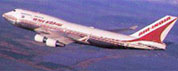 MUMBAI,
Dec 28: Air-India will transport relief material, donated
by various agencies and NGOs, for the victims of the
tsunami floods, free of cost to India from various points
on its global network. Organisations wishing to donate
relief material may contact state-owned carrier's offices
in their city, an AI spokesman said here today.
MUMBAI,
Dec 28: Air-India will transport relief material, donated
by various agencies and NGOs, for the victims of the
tsunami floods, free of cost to India from various points
on its global network. Organisations wishing to donate
relief material may contact state-owned carrier's offices
in their city, an AI spokesman said here today. NEW
DELHI, Dec 19: The Air India Chairman and Managing Director,
Mr V Thulasidas, is a man with a mission. His priority
is to ensure that Maharaja regains its past glory in the
least possible time. To ensure this he has set his targets
and is keeping an eagle eye over them. One of his top
priorities in restoring the health of the airline is to
ensure that Air India gets new aircraft, a decision that
has been pending for over a decade. Mr Thulasidas, who
completes his one year as CMD on December 21, has reasons
to be happy. During his short tenure, the national flag
carrier has taken decisions on pending issues of the past
several years. The airline is set to launch a low-cost
carrier, Air India Express, in April next year. It is
also set to launch a cargo carrier next year. And
to top it all the Air India Board has approved acquisition
plan for 50 aircraft. Its subsidiary, Air India Charters
Limited, has decided to acquired 18 Boeing 7367-800W aircraft
for use by Air India Express.
NEW
DELHI, Dec 19: The Air India Chairman and Managing Director,
Mr V Thulasidas, is a man with a mission. His priority
is to ensure that Maharaja regains its past glory in the
least possible time. To ensure this he has set his targets
and is keeping an eagle eye over them. One of his top
priorities in restoring the health of the airline is to
ensure that Air India gets new aircraft, a decision that
has been pending for over a decade. Mr Thulasidas, who
completes his one year as CMD on December 21, has reasons
to be happy. During his short tenure, the national flag
carrier has taken decisions on pending issues of the past
several years. The airline is set to launch a low-cost
carrier, Air India Express, in April next year. It is
also set to launch a cargo carrier next year. And
to top it all the Air India Board has approved acquisition
plan for 50 aircraft. Its subsidiary, Air India Charters
Limited, has decided to acquired 18 Boeing 7367-800W aircraft
for use by Air India Express.  NEW
DELHI, Dec 3: After
a gap of four years, Indian Airlines has made a turnaround,
posting a net post-tax profit of Rs 44.17 crore in 2003-04
as against the net loss of Rs 196.6 crore the previous
year. The IA Board, which met in Mumbai on Friday, approved
the annual accounts of the public sector carrier, which
also made an operating profit of Rs 125.10 crore compared
with an operating loss of Rs 134.72 crore in 2002-03,
according to Mr Sunil Arora, Chairman and Managing Director
of Indian Airlines.
NEW
DELHI, Dec 3: After
a gap of four years, Indian Airlines has made a turnaround,
posting a net post-tax profit of Rs 44.17 crore in 2003-04
as against the net loss of Rs 196.6 crore the previous
year. The IA Board, which met in Mumbai on Friday, approved
the annual accounts of the public sector carrier, which
also made an operating profit of Rs 125.10 crore compared
with an operating loss of Rs 134.72 crore in 2002-03,
according to Mr Sunil Arora, Chairman and Managing Director
of Indian Airlines. KUALA
LUMPUR: The 32nd annual convention of Air Cargo Agents
Association of India (ACAAI) in Kuala Lumpur was a grand
success by all standards. The ACAAI President, Mr Sam
Katgara, had a beaming smile at the end of three-day fruitful
sessions. And why not? As many as 320 delegates from India
had attended the convention which was addressed by experts
and 'who is who' of the cargo industry. . "Mission
accomplished," he said.
KUALA
LUMPUR: The 32nd annual convention of Air Cargo Agents
Association of India (ACAAI) in Kuala Lumpur was a grand
success by all standards. The ACAAI President, Mr Sam
Katgara, had a beaming smile at the end of three-day fruitful
sessions. And why not? As many as 320 delegates from India
had attended the convention which was addressed by experts
and 'who is who' of the cargo industry. . "Mission
accomplished," he said.  NEW
DELHI, Nov 9: Eurocopter, the world's number one manufacturer
of helicopters, today handed over two new Dauphin AS 365
N3 helicopters to Pawan Hans. Mrs. Marie-Agnes Veve, Head
of Dauphin, presented a memento to Pawan Hans Chairman and
Managing Director, Mr Nagar V Sridhar, commemorating the
occasion. With these new additions, Pawan Hans expands its
fleet to 23 Dauphins, thereby, becoming the biggest fleet
of Eurocopter helicopters in India.
NEW
DELHI, Nov 9: Eurocopter, the world's number one manufacturer
of helicopters, today handed over two new Dauphin AS 365
N3 helicopters to Pawan Hans. Mrs. Marie-Agnes Veve, Head
of Dauphin, presented a memento to Pawan Hans Chairman and
Managing Director, Mr Nagar V Sridhar, commemorating the
occasion. With these new additions, Pawan Hans expands its
fleet to 23 Dauphins, thereby, becoming the biggest fleet
of Eurocopter helicopters in India.  NEW
DELHI: Under the dynamic leadership of Mr Nagar V Sridhar,
Chairman and Managing Director, Pawan Hans is gaining strength
day by day and setting new standards. The public-sector
undertaking achieve new heights this year when it paid the
highest ever dividend of Rs 17.50 crore for the financial
year 2003-04. This dividend is at the rate of 15.38 per
cent of its paid up equity to its shareholders i.e. President
of India, Ministry of Civil Aviation and ONGC. The dividend
is 33.21 per cent of the net profit after tax.
NEW
DELHI: Under the dynamic leadership of Mr Nagar V Sridhar,
Chairman and Managing Director, Pawan Hans is gaining strength
day by day and setting new standards. The public-sector
undertaking achieve new heights this year when it paid the
highest ever dividend of Rs 17.50 crore for the financial
year 2003-04. This dividend is at the rate of 15.38 per
cent of its paid up equity to its shareholders i.e. President
of India, Ministry of Civil Aviation and ONGC. The dividend
is 33.21 per cent of the net profit after tax. Models
in designer outfits as flight attendants, latest audio and
video in flight entertainment on every seat, attractive
aircraft interiors and competitive fares. That is how liquor
czar Vijay Mallya is going to place his Kingfisher Airlines
that is set to get into flying mode in the first quarter
of 2005.
Models
in designer outfits as flight attendants, latest audio and
video in flight entertainment on every seat, attractive
aircraft interiors and competitive fares. That is how liquor
czar Vijay Mallya is going to place his Kingfisher Airlines
that is set to get into flying mode in the first quarter
of 2005. 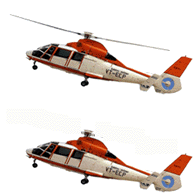 NEW
DELHI, Oct 10: An aircraft or helicopter crash, no matter
how many casualties it results, always hits the news headlines
-- be it the front pages of newspapers or television news
networks or Internet websites. On the other hand the rail
or road mishaps, though the bigger killers, do not catch that
much media attention. This is not to belittle the aviation
accidents. Any accident -- be it air, rail or road -- that
claims lives is sad.
NEW
DELHI, Oct 10: An aircraft or helicopter crash, no matter
how many casualties it results, always hits the news headlines
-- be it the front pages of newspapers or television news
networks or Internet websites. On the other hand the rail
or road mishaps, though the bigger killers, do not catch that
much media attention. This is not to belittle the aviation
accidents. Any accident -- be it air, rail or road -- that
claims lives is sad.  At
Pawan Hans standing instructions of the Managing Director,
Mr Nagar V Sridhar, are do not clear the machine for flight
even if there is an iota of doubt. “We are a public sector
undertaking and we follow stringent guidelines on maintenance
and with us safety comes before economic considerations,”
said Mr Sridhar.
At
Pawan Hans standing instructions of the Managing Director,
Mr Nagar V Sridhar, are do not clear the machine for flight
even if there is an iota of doubt. “We are a public sector
undertaking and we follow stringent guidelines on maintenance
and with us safety comes before economic considerations,”
said Mr Sridhar. The
additional flights indicate that Malaysia considers India
as a lucrative tourist market. The Malaysian Tourism Minister,
Dr Leo Michael Toyad, said Malaysia is targeting 400,000 Indian
arrivals by the year 2007. The total Indian arrivals to Malaysia
in 2002 were 183,000 and in 2003 were 145,000.
The
additional flights indicate that Malaysia considers India
as a lucrative tourist market. The Malaysian Tourism Minister,
Dr Leo Michael Toyad, said Malaysia is targeting 400,000 Indian
arrivals by the year 2007. The total Indian arrivals to Malaysia
in 2002 were 183,000 and in 2003 were 145,000.  Said
Mr Balbir Mayal, TAAI President, "demand for the bank
guarantee is unreasonable. No embassy or High Commission has
ever asked for such guarantees. Today its Malaysia, tomorrow
it could the US and others. There are over 100 embassies in
India and if travel agents start giving bank guarantees, the
amount would run into Crores, and that is not a feasible proposition."
Said
Mr Balbir Mayal, TAAI President, "demand for the bank
guarantee is unreasonable. No embassy or High Commission has
ever asked for such guarantees. Today its Malaysia, tomorrow
it could the US and others. There are over 100 embassies in
India and if travel agents start giving bank guarantees, the
amount would run into Crores, and that is not a feasible proposition." Air
Deccan managing director G R Gopinath said "our seats
are booked to 60 to 70 per cent capacity. This is a good load
factor and the continued demand has helped us achieve better
operational efficiencies." He said "Air Deccan,
keeping with its philosophy of offering lowest fares and empowering
every Indian to fly, has decided to drop fares by 20 per cent
and increase its passenger loads."
Air
Deccan managing director G R Gopinath said "our seats
are booked to 60 to 70 per cent capacity. This is a good load
factor and the continued demand has helped us achieve better
operational efficiencies." He said "Air Deccan,
keeping with its philosophy of offering lowest fares and empowering
every Indian to fly, has decided to drop fares by 20 per cent
and increase its passenger loads." The
big boss Indian Airlines has also sounded the fare war bugle
and has decided to take the private players by the horn on
this. Though some of the private airlines are talking of Rs
500 a ticket, Indian Airlines announced that it would match
any fare offered by any airline. “Of course there will
be no compromise on our service standards and safety,”
said Mr Anil Goyal, Commercial Director of the public sector
Indian Airlines.
The
big boss Indian Airlines has also sounded the fare war bugle
and has decided to take the private players by the horn on
this. Though some of the private airlines are talking of Rs
500 a ticket, Indian Airlines announced that it would match
any fare offered by any airline. “Of course there will
be no compromise on our service standards and safety,”
said Mr Anil Goyal, Commercial Director of the public sector
Indian Airlines.  NEW
DELHI: Sept 12: Though Uttaranchal is one of the youngest
States, it is one of the fastest growing States as far as
tourism is concerned. The State under the leadership of Chief
Minister, Mr N D Tiwari and under the able guidance of the
Tourism Minister, Lt Gen T P S Rawat, and Tourism Secretary,
Dr N N Prasad, is doing everything possible to make Uttaranchal
a world class tourism destination.
NEW
DELHI: Sept 12: Though Uttaranchal is one of the youngest
States, it is one of the fastest growing States as far as
tourism is concerned. The State under the leadership of Chief
Minister, Mr N D Tiwari and under the able guidance of the
Tourism Minister, Lt Gen T P S Rawat, and Tourism Secretary,
Dr N N Prasad, is doing everything possible to make Uttaranchal
a world class tourism destination. NEW
DELHI, Sept 5: With the reports of the two national carriers
having a relook at its fleet acquisition plans, the US aircraft
giant, Boeing, has launched a fresh pitch with Air India and
Indian Airlines.
NEW
DELHI, Sept 5: With the reports of the two national carriers
having a relook at its fleet acquisition plans, the US aircraft
giant, Boeing, has launched a fresh pitch with Air India and
Indian Airlines. NEW
DELHI, July 27: Keeping in view the long-pending demand of
Indian Airlines and Air India, government has agreed in-principle
to infuse funds to expand the equity base of the two public
sector carriers for their fleet acquisition plans. It also
agreed to "look into" the demand for reconsidering
the 48 per cent Withholding Tax (WHT), a budget proposal,
imposed on leasing of aircraft by any Indian company from
a foreign firm.
NEW
DELHI, July 27: Keeping in view the long-pending demand of
Indian Airlines and Air India, government has agreed in-principle
to infuse funds to expand the equity base of the two public
sector carriers for their fleet acquisition plans. It also
agreed to "look into" the demand for reconsidering
the 48 per cent Withholding Tax (WHT), a budget proposal,
imposed on leasing of aircraft by any Indian company from
a foreign firm. NEW
DELHI, July 19: The Airports Authority of India (AAI) Chairman,
Mr K Ramalingam, has set up a control room to monitor the
strike called by the employees unions in protest against "privatisation"
of Delhi and Mumbai airports.
NEW
DELHI, July 19: The Airports Authority of India (AAI) Chairman,
Mr K Ramalingam, has set up a control room to monitor the
strike called by the employees unions in protest against "privatisation"
of Delhi and Mumbai airports.  NEW
DELHI, June 29: The Civil Aviation Minister, Mr Praful
Patel, has appreciated Pawan Hans for making all out efforts
for providing connectivity to vital installations and
remote inaccessible areas of the country under hostile
conditions. The new Minister said this while visiting
the Pawan Hans premises. The Pawan Hans CMD, Mr Nagar
V Sridhar, gave a presentation on the operations and activities
of the public sector company.
NEW
DELHI, June 29: The Civil Aviation Minister, Mr Praful
Patel, has appreciated Pawan Hans for making all out efforts
for providing connectivity to vital installations and
remote inaccessible areas of the country under hostile
conditions. The new Minister said this while visiting
the Pawan Hans premises. The Pawan Hans CMD, Mr Nagar
V Sridhar, gave a presentation on the operations and activities
of the public sector company.  Bringing
back the past glory of Air India and Indian Airlines,
modernization of airports and a comprehensive civil aviation
policy are some of urgent tasks the new Civil Aviation
Minister, Mr Praful Patel, has set out for his innings
at the Rajiv Gandhi Bhavan.
Bringing
back the past glory of Air India and Indian Airlines,
modernization of airports and a comprehensive civil aviation
policy are some of urgent tasks the new Civil Aviation
Minister, Mr Praful Patel, has set out for his innings
at the Rajiv Gandhi Bhavan. Jet
Airways Chairman, Mr Naresh Goyal, has been elected to
the Board of Governors of the airline industry's apex
global body, the International Air Transport Association
(IATA) at its 60th Annual General Meeting that concluded
in Singapore recently.
Jet
Airways Chairman, Mr Naresh Goyal, has been elected to
the Board of Governors of the airline industry's apex
global body, the International Air Transport Association
(IATA) at its 60th Annual General Meeting that concluded
in Singapore recently. Aviation
| Business | Defence
| Foreign Affairs | Communication
| Health | India |
United Nations
India-US | India-France
| Entertainment | Sports
| Photo Gallery | Tourism
| Advertise with Us | Contact
Us
© Noyanika International, 2003-2009. All rights reserved.