


BUSINESS
|
India-Kazakh establish strategic partnership in Minerals, Oil & Gas: NazarbayevBy Deepak Arora
Addressing the captains of the Indian industry under joint aegis of ASSOCHAM, CII and Ficci here today, Nursultan Nazarbayev said that his visit to India would result into establishment of long term relationship in areas identified above between Kazakh and Indian industry. The visit saw host of Memoranda of Understanding singed between Government of India and Government of Kazakhstan for exploration of oil and gas as Kazakh offered 5 blocks for discovery of gas and oil to India. He said that oil & gas is highly prospective area for collaboration between India and Kazakhstan as his country has oil reserves for 50 years and gas reserves for 75 years. Soliciting investments from India, the visiting President especially emphasized the need for setting up manufacturing facilities in pharma in Kazakhstan as each year it imports medicines to an extent of US$ 500 million. In pharmaceutical, said Mr. Nazarbayev, Kazakh needed the largest volumes of investments as India has an edge in this sector. Another sector for cooperation identified by the President include IT, financial and banking services. In his keynote address, Mr. V S Shkolink, Minister of Industry and Trade, Kazakhstan said that the export from Kazakhstan to India in January-November 2008 amounted to 149.7 mln. US dollars, which is 3.2 times higher in comparison with the similar period in 2007 (47 mln. US dollars). The import from India to Kazakhstan in January-November 2008 rose to 182.7 mln. US dollars and in comparison with the similar period in 2007 (132.6 mln. US dollars) increased by 37.8%. He also informed that the Indian IT companies working in Kazakhstan are NIIT, 3-i Infotech, Larsen and Toubro, Punj LLoyd, Panjab National Bank, KEC International in the energy sphere. Besides, 74 Indian pharmaceutical companies supply their products to the Kazakhstan market. The Kazakhstan companies in India are Souztranslink Transport Company, KazStroiService Corporation and Kazakhstancaspishelf, which is a sub-contractor of Indian oil company “Shivani” operating in the sphere of seismic research of oil fields in the Indian state of Assam. Dr. Ashwani Kumar, Minister of Industry said that in India, economy has been on the right track, having already touched USD 1 trillion mark. With over a billion population, and a well established network of institutions imparting knowledge in all spheres, India enjoyed one of the largest reserves of educated, skilled and semi-skilled cadres of professional and technical support. Matched with the steady growth of economy and education attainment, India is confidently forging ahead to achieve targets of progress and prosperity for its people. The Minister further said that it was appropriate to mention a few areas where our two countries can enhance active co-operation. These include oil and gas, information technology, health care, transfer of technology, textile and above all tourism. Tourism immensely holds promise for collaborations in developing resorts and various tourism facilities. The establishment of a software technology park in Almaty and establishment of IT centres in the Universities can further be strengthened as the scope for co-operation is enormous. Mr. Sajjan Jindal, ASSOCHAM President said that the economic relations between India and Kazakhstan have also witnessed a steady growth over the years. For instance, from around US $ 80 million in 2004, the bilateral trade presently stand at 225 million. Major commodities of export from India to Kazakhstan are tea, pharmaceuticals, medical equipments, machinery, tobacco and consumer items. He further said that major items of import by India are steel, aluminium, wool, raw hides and soft wheat. The major Indian presence is in pharmaceuticals and tea market. Almost all the major pharmaceutical companies have their operations in Kazakhstan. Mittal steel is a major NRI investment worth nearly US $ 2 billion; Punj Lloyd Kazakhstan Limited and KEC International Limited have signed major contracts for construction of oil pipelines and power grid respectively. Speaking on the occasion, Mr. Shiv Vikram Khemka, Chairman CIS Committee said that Kazakhstan occupied a position of immense political and economic significance. It has vast reserves of oil and gas, besides coal and precious metals. There is also potential in agriculture and the abundance of natural resources in Kazakhstan have attracted considerable interest among international companies including India. In his address, Mr. Yogendra Kumar Modi, former President FICCI said that Kazakhstan economic success can be further intensified with India provided the two countries explore possibilities of investments in mineral, oil and gas, coal, iron ore, copper, zinc, uranium and gold. The cultural relations between India and Kazakhstan should further increase to lead to still better relationship for greater economic ties between India and Kazakhstan. UK falls into recession first time in 18 yrsLONDON, Jan 23: For the first time in nearly 18 years, the United Kingdom has slipped into recession as the nation's economy contracted 1.5 per cent in the fourth quarter of last year, primarily due to a steep plunge in manufacturing activities. With two consecutive quarters of negative growth, UK is officially in recession, joining the likes of US, Singapore and many European nations, including Germany and Italy. In the third quarter of 2008, the country's GDP had shrunk by 0.6 per cent. "Gross Domestic Product contracted by 1.5 per cent in the fourth quarter of 2008, compared with a decrease of 0.6 per cent in the third quarter. The increased rate of decline in output was due to weaker services and production industries output," the Office for National Statistics said in a statement on Friday. The fall in the fourth-quarter GDP was the biggest since the second quarter of 1980. Major countries are witnessing recession in the wake of deteriorating economic conditions, triggered by the American subprime crisis last year. The worsening economy has also forced the British government to come up with two rescue packages in a span of three months, mainly to prop up the country's battered financial system. While the total production output weakened further in the fourth quarter, poor manufacturing output contributed the most to the negative growth. "Manufacturing output made the largest contribution to the slowdown, falling by 4.6 per cent compared with a 1.6 per cent decrease in the previous quarter," the statement said. Except for agriculture, forestry and fishing output, all the components of the economy declined in the fourth quarter as compared to the previous three months. PSU banks cut rates on home loans up to Rs 20 lakhMUMBAI, Dec 15: Public sector banks on Monday announced that home loans up to Rs five lakh would be given at a maximum interest rate of 8.5 per cent, while those between Rs 5-20 lakh would be offered at 9.25 per cent. Besides, the banks would not charge any processing fees and pre-payment charges for loans up to Rs 20 lakh, and would also provide free insurance cover, the Indian Banks Association (IBA) said on Monday. Indian Government unveils stimulus packageNEW DELHI, Dec 7: Unveiling the much-awaited stimulus package to shore up various sectors of the economy from the global downturn, the government on Sunday effected an across-the-board 4 per cent cut in Cenvat to bring down the prices of cars, cement, textiles and other products, and earmarked an additional Rs. 20,000 crore for infrastructure, industry and export sectors for the current fiscal. In what may be dubbed as a mini-budget of sorts to lessen the impact of the global slowdown and recession in the West on the Indian economy, the package, while entailing a revenue loss of Rs 8,700 crore in the remaining four months of 2008-09, seeks to revive various crucial sectors such as housing, exports, automobile, textiles and small and medium enterprises (SMEs). In an all-encompassing measure, the Cenvat on all products — barring non-petroleum goods — have been reduced from 14, 12 and 8 per cent to 10, eight and 4 per cent for various categories. Full exemption from basic customs duty has been effected on naphtha to provide relief to the power sector. While the export duty on iron ore fines has been withdrawn, the levy on export of iron lumps has been cut from 15 to 5 per cent. Apparently, the package, drawn up at the instance of Prime Minister Manmohan Singh, who also holds the Finance portfolio, seeks to boost power, exports, housing, auto, SMEs and infrastructure sectors through additional funding. The 10-point package, with significant incentives for the sectors affected by the slowdown, has also permitted India Infrastructure Finance Company Ltd. to raise Rs. 10,000 crore through tax-free bonds by March as part of the exercise to support the Rs. 1,00,000-crore highways development programme. Briefing journalists here on the package, Planning Commission Deputy Chairman Montek Singh Ahluwalia said: “The market forces would compel manufacturers in a competitive environment to bring down prices and pass on tax benefits to customers.” He pointed out that as part of steps to create demand in the economy, which was expected to grow by over 7 per cent, “the total spending programme in the balance four months of the current fiscal year, taking Plan and non-Plan expenditure together is expected to be Rs. 3,00,000 crore.” Mr. Ahluwalia stressed that the government was keeping a close watch on the evolving economic situation and “will not hesitate to take additional steps that may be needed to counter recessionary trends and maintain the pace of economic activity.” An official statement said: “The government has been concerned about the impact of the global financial crisis on the Indian economy and a number of steps have been taken to deal with this problem.” It also noted that monetary measures effected by the Reserve Bank of India were being “supplemented by fiscal measures designed to stimulate the economy. In recognition of the need for a fiscal stimulus the government had consciously allowed the fiscal deficit to expand beyond the originally targeted level.” “The economy will continue to need stimulus in 2009-2010 also and this can be achieved by ensuring a substantial increase in Plan expenditure as part of the budget for next year,” the statement said. Dr Abdul Kalam calls for Second Green RevolutionBy Deepak Arora
Delivering the 21st Jawaharlal Nehru Memorial IFFCO Lecture on Cooperation, organised by Indian Farmers Fertiliser Cooperative Limited, here, Dr. Kalam lamented that the requirement of land for growing population as well as greater afforestation and environmental preservation activities would create a situation whereby the present 170 million hectares of arable land would shrink to 100 million hectares.
Presiding over the function, the company’s Chairman Surinder Kumar Jakhar highlighted the role of IFFCO in strengthening cooperative movement in the country and providing professional excellence to fertiliser industry in cooperative sector. Precisely because of this, he said IFFCO has emerged a powerful force to reckon with on the map of Indian Cooperative Movement.
He said Dr Kalam, is a great personality, people’s President and an eminent scientist who has been chiefly instrumental in helping launch of Chandrayana from Bangalore recently. While complimenting the recipients of ‘IFFCO Sahakarita Ratna’ and ‘IFFCO Sahakarita Bandhu’ Awards, Dr Awasthi outlined IFFCO’s activities and its saga of success. Dr Kalam said that Pandit Jawaharlal Nehru had laid the foundation for building post-independent India through his visionary action in education sector, particularly in the development of science and technology human resource and infrastructure. Panditji is an embodiment of the principle “small aim is crime”and always executed big things for the country, whether it was industry, education, healthcare or cooperative. Dr Kalam complimented IFFCO over its growth from membership of 57 societies in 1967-68 to over 40,000 societies at present. Its equity also sprang from just Rs 6 lakh to a whooping Rs 424 crore in the same period. This amply shows IFFCO’s deep faith in cooperatives and commitment towards empowerment of rural masses. He exhorted IFFCO to expand its horizon and undertake integrated development of villages due to its penetration in rural areas.
Dr Kalam urged IFFCO to plan and execute Pura complexes in different parts of the country. Pura means providing urban amenities in rural areas. The former President also said by undertaking the job of Pura, "Indian Farmers 'Fertiliser' Cooperative Ltd will get transformed into Indian Farmers 'Flourishing' Cooperative Ltd.” He said Iffco can constitute a Special Purpose Vehicle such as an agriculture and agro-processing special economic zone across the country making farmers of 40,000 cooperatives under its fold partners for execution of these Pura complexes. One of the aims would be to enhance farm productivity in the Pura complex by 3.4 times through technology, awareness and infrastructural infusion, he said. He pointed out that by continuous usage of fertilisers, pesticides and insecticides over a period of time, there is deterioration in the quality of soil. "More thrust needs to be given on adopting methods such as multi-cropping, rotation of crops and organic farming," he said. Farmers in Haldwani of Uttarakhand and Thodupuzha in Kerala have exemplified adoption of unique organic farming techniques for increased and sustainable productivity, he added. Kalam added strategies for on-farm generation of organic fertilisers need to be evolved. "Soil fertility in dry lands can be sustained only through maintenance of organic matter," he said. Commenting on agricultural productivity, the former President warned that the total arable land might shrink to 100 million hectares by 2020 from the current level of 170 million hectares, while the country would require over 340 million tonne of foodgrain by then.
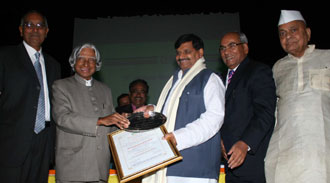
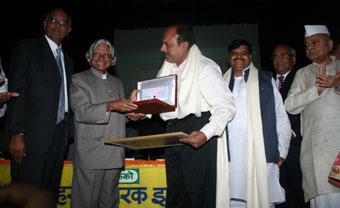
On this occasion, Dr Kalam conferred IFFCO Sahakarita Ratna Award for 2007-08 on Shiv Pal Singh Yadav, former Uttar Pradesh Minister for Agriculture, in recognition of his distinguished services to grass root cooperatives in Uttar Pradesh. Similarly Dr. S. S. Sisodia, former President of National Cooperative Union of India (NCUI), was presented IFFCO Sahakarita Bandhu Award posthumously for his stellar role in strengthening cooperative movement in the country. His son received the award. IFC had instituted these Awards from the year 1982-83 as its humble contribution to strengthen the co-operative movement. IFFCO Pura will lead to rural societal transformation: Dr KalamText of Dr APJ Abdul Kalam's Jawaharlal Nehru Memorial IFFCO lecture
Later, Panditji laid the foundation for building post independent India through his visionary action in education sector, particularly in the development of science and technology human resource and infrastructure and establishment of large enterprises. Panditji is an embodiment of the principle “small aim is a crime”. Always, he executed big things for the country, whether it was industry, education, healthcare or cooperative. I am happy that in the last four decades, IFFCO has steadily grown from a membership of 57 societies in 1967-1968 to 40,000 societies in 2008. The equity capital has also gone up from rupees six lakh to over 424 crore. IFFCO has a deep faith in cooperatives and has commitment towards empowerment of the rural masses. With this commitment, I would suggest IFFCO to take up pro-active integrated measures which will enable accelerated development of rural India and bridge the rural urban divide. Thereby IFFCO will become a partner in national development. Recently, I visited ISRO twice at Bangalore and was with the scientists and engineers from different disciplines, who made the country proud by realizing the Chandrayaan mission. While congratulating them for this wonderful feat and wishing them well in the operation of Chandrayaan in the coming months and year, I reflected on what makes organisation succeed. The vision of the organisation acts as a single point focus, promoting technology excellence and innovation which enables realization of the mission and doing the impossible. We have seen this in white revolution, we have seen in the space, in defence and in atomic energy missions. In agriculture the visionary spirit of political and technology leaders working with farmers has made us succeed in the first green revolution. Now, we have to enhance the agricultural food production by 3.4 times with constraints. Only technology in seeds, in fertilizers and in agricultural practices can help. How is it possible? A systems thinking is essential. Hence, I have chosen the topic “IFFCO PURA will lead to rural societal transformation”. First Green Revolution As you are aware, the First Green Revolution launched by great visionaries Shri C. Subramaniam and Dr. M.S. Swaminathan in partnership with agricultural scientists and farmers liberated India from the situation of what was called “ship to mouth existence.” Through an effort of historical magnitude, India attained near self-sufficiency in food. The contribution of IFFCO in providing quality fertilizer and agricultural consultancy to the farmers during this period is well known. As part of this first green revolution, the country has been able to produce over 200 million tonnes of food grains per year on an average. But there are challenges ahead. Second green revolution India has to now embark upon the Second Green Revolution which will enable it to further increase its productivity in the agricultural sector. By 2020 India would require to produce over 340 million tonnes in view of population growth and increased purchasing power. The increase in the production would have to surmount many impeding factors. The requirement of land for the increasing population as well as for greater afforestation and environmental preservation activities would force a situation whereby the present 170 million hectares of arable land would not be fully available. It might shrink to 100 million hectares by 2020. In addition, there will be shortage of water due to competing demands and reduction in the agricultural work force. Our agricultural scientists and technologists in partnership with organizations like IFFCO, have to work for enhancing the average productivity per hectare from 1.1 tonnes to better than 3.4 tonnes of the available land for cultivation with less need of water. The type of technologies needed would be in the areas of development of seeds that would ensure high yield varieties even under constraints of water and land. The second green revolution is indeed a knowledge graduation from characterization of soil to the matching of the seed with the composition of the fertilizer, water management and evolving pre-harvesting techniques for such conditions. The domain of a farmer’s work would enlarge from grain production to food processing and marketing. While doing so, utmost care would have to be taken for various environmental and people related aspects leading to sustainable development. I would like to discuss about the challenges faced by the Indian agriculture. Challenges Facing Indian Agriculture India’s agricultural sector employs about 50% of the workforce, yet accounts for only about 17% of total GDP. Growth in agriculture has stagnated relative to other sectors: last year the agricultural sector grew at a rate of 2.7%, relative to 11% growth in both the service and industry sector. Agricultural incomes are lower and growing slower than incomes in other sectors. The causes for such a situation are: Increase farmer’s access to markets: Lack of good extension services to farmers is a major factor inhibiting growth. In addition to the lack of the infrastructure in many rural areas, the inability of farmers to directly access markets has sustained the presence of a chain of middlemen through whom most agricultural commodities are circulated before reaching the consumers. This is where IFFCO cooperative can play an important role. Improve agricultural productivity: In spite of the gains of the Green Revolution, Indian agriculture lags behind in terms of technology take-up and production efficiency. Lack of access to credit, poor education and lack of awareness of the benefits of new technology are the major causes of non application of technology. In addition, poor irrigation and infrastructure is also a cause for low productivity. 10% of the agricultural produce is wasted due to lack of storage and timely transport. We have to find methods through which the farmers can adopt better production and storage technology. Improve public education: Even if agricultural productivity does increase, it is still likely to lag behind the high growth IT and service sectors. Hence, the public education system should equip the rural children with the skills necessary to enter the IT, ITES and manufacturing sector employment market in the rural areas itself. Promote non-farm entrepreneurship among farmers: Although India’s certain rural population need skill based education, many of them are capable of operating small businesses that have higher returns than traditional agriculture. However, their ability to start such business is often hampered by lack of access to credit, capital and knowledge. Soil upgradation Over a period of time by continuous usage of fertilizers, pesticides and insecticides, there is deterioration in the quality of soil particularly reduction of carbon content and increase of salinity. Rejuvenation of soil characteristics is an important area for the specialists to tackle, with specific emphasis on recovery of its nutritional value. More thrust need to be given on adopting methods such as multi-cropping, rotation of crops and organic farming. Farmers in Haldwani district of Uttarakhand and Thodupuzha in Kerala has already exemplified adoption of unique organic farming techniques for increased and sustainable productivity. Dry land agriculture Integrated nutrient management continues to be a focal issue in dry lands as the fertilizer use is not likely to pick up significantly unless water supply is assured. One of the reasons ascribed to low response of bio-fertilizers in dry lands is their low status of soil organic matter. Soil fertility in dry lands can be sustained only through maintenance of organic matter and achieving better fertilizer-use efficiency through integration of moisture-conservation practices along with soil-fertility management. Strategies for on-farm generation of organic fertilizers need to be evolved. Quality of Seeds Some of our agricultural universities and institutions have indeed core competence in quality seed development. They are fully equipped to further improve the quality of the seeds for enabling farming in areas where the soil has salinity and the environmental temperature gradient is high. This should be achieved through production of salinity tolerant and temperature tolerant seeds. In addition, seeds also have to be resistant to the stress induced by the residual effect of the pesticides and insecticides. Universities and research organizations have to lay more emphasis on developing and leading to production of the seeds including genetically modified seeds which require less water for supply to the farmers for achieving increased productivity even in critical environmental conditions. Also, future seeds design and development have to enrich the farmer and the village economy. Organizations like IFFCO have to ensure that certified quality seeds alone reach the farmers like fertilizer, so that they are not subjected to unexpected reduced output and related losses. Water management Geography is very closely linked to quality of life in our vast country. Wherever there are people enduring economic hardships there is also problem of the availability of water. It costs energy and money to bring water for specialized agriculture to such dry areas. We need to develop proper agricultural technologies and water conservation methodologies that can help enhance agriculture productivity and lift the people above the poverty line. Solutions may be just beyond agriculture alone spanning to animal husbandry, poultry, agro processing and other related activities. Our agriculture is still dependent on timely arrival and intensity of monsoon. It is high time that we have an overall water management plan for conservation of water, preparation of water shed schemes, rainwater harvesting and recharging of ground water. These measures will help prevent loss of a crop by using the harvested water for nursery development and delaying transplantation in case of late arrival of monsoon. We need a system to popularize the water management techniques in distant parts of the State. Agro-processing and waste management The changing life-styles of the modern generation are giving rise to demand for processed food. For example, special type of corn is required for making corn flakes and unique potato crop for making wafers. The agro-processing industry has to take into account the retention of the nutritional value and safeguarding against possible side effects of additives and preservatives. In addition the agriculture and agro-processing industry in India have to master many new standards and perceptions for cleanliness, generally described as phyto-sanitary requirements. Now let me give two examples for soil upgradation, agricultural productivity increase, dry and waste agriculture for improving the rural economy. Innovative Jatropha farming During September 2008, I visited a village Courtwa Rahimabad in Allahabad district where Dr. DN Tiwari, former Member of Planning Commisison and his team and farmers have done excellent work in Jatropha cultivation, oil extraction and esterification. Under his leadership a team has worked and converted 735 hectares of waste land into Jatropha producing land leading to earning of rupees fifty thousand per hectare. Today the Jatropha plantation has been extended to 30,000 hectares. Also, the village has realized energy independence through the use of bio-fuel. The villagers do not use kerosene for cooking or petrol-diesel for running their generators and jeeps. Jatropha cultivation has also been used as a heat shield for banana plantation during summer. In addition, the soil which was alkaline has now become neutral due to Jatropha plantation. Thus, we can see that innovative use of Jatropha has resulted in social, economic and environmental upgradation of large number of farmers in Allahabad district. National Agro Foundation (NAF) On 15th October, 2008 I visited Illedu village in Kancheepuram District., Tamilnadu. There, National Agro Foundation (NAF) is engaged in uplifting the quality of life of the rural citizens by providing know-how on advanced agricultural practices, characterization of soil, soil upgradation through proper systematic soil testing, matching the seed to soil, systemic approach for the pre and post harvesting methodologies and providing market connectivity. They have realized productivity increase ranging from 40% to 150% in different agriculture produces such as rice, sugarcane, vegetables and other horticulture products. In addition, they have very active self-help group systems which are empowered with diary farming, craftsmanship and making home made products and selling to the nearby cities and villages. They have also launched the literacy movement and achieved 100% sanitation in one of the villages. With the help of NABARD, they have created watersheds with the inlet and outlet channel opened for recharging the ground water. NAF enabled the urban garment export company to get relocated into the rural area and provides value added employment to 60 women from these villages. The members of the NAF have trained the rural women who are providing cutting and stitching support to garment manufacturers in Chennai and other places for export of garments. This activity has considerably changed economic condition of the farmers and craftsmen in the rural setting. There are many successes available across the country. We have to take a systematic approach to reap the benefits of successes by large number farmers in different parts of the nation. I am sure; IFFCO with its network of cooperatives can spread the message effectively and take further necessary action to facilitate the farmers to implement them. Converting agricultural waste into wealth Management of agricultural waste is another important area which can turn out to be a source for revenue generation. Farmers can realize better value from the agricultural residue by paying special attention to its usage into organic farming and making value added products out of it before disposal. Agricultural waste should be put to use by developing appropriate and cost-effective technologies such as generation of biogas, production of vermi-compost and paper for example. So far I have presented certain dynamics of the agricultural community. You will agree with me that the development of six hundred thousand villages implies development of agricultural community namely the farmers by development of villages. The villages must be connected with in themselves and with main towns and metros through by good roads and wherever needed by railway lines and bus routes. They must have other infrastructure like schools, colleges, hospitals and other amenities for the local population and the visitors. Let us call this physical connectivity. In the emerging knowledge era, the native knowledge has to be preserved and enhanced with latest tools of technology, training and research. The villages have to have access to good education from best teachers wherever they are, must have the benefit of good medical treatment, must have latest information on their pursuits like agriculture, fishery, horticulture and food processing. It means, there is a need for mission and education through electronic connectivity. Once the Physical and Electronic connectivity are enabled, the knowledge connectivity is enabled. That can facilitate the ability increase the productivity, the utilization of spare time, awareness of health welfare, ensuring a market for products, increasing quality conscience, interacting with partners, getting the best equipment, increasing transparency and so in general knowledge connectivity When we Provide Urban Amenities to Rural Areas (PURA), we can lead to upliftment of rural areas, we can attract investors, we can introduce effectively useful systems like Rural BPOs, Micro Finance. Periyar PURA (Tamilnadu) Periyar PURA complex pioneered by Periyar Maniammai University, Vallam, Tanjore is functioning near Vallam having a cluster of over 65 villages in Tamilnadu which involves a population of 1 lakh. This PURA complex has all the three connectivities - physical, electronic and knowledge - leading to economic connectivity. The center of activity emanates from the women engineering college that provides the electronic and knowledge connectivity. Periyar PURA has health care centers, primary to post graduate level education and vocational training centers. This has resulted in large-scale employment generation and creation of number of entrepreneurs with the active support of 850 self-help groups. Two hundreds acres of waste land has been developed into a cultivable land with innovative water management schemes such as contour ponds and water sheds for storing and irrigating the fields. All the villagers are busy in cultivation, planting Jatropha, herbal and medicinal plants, power generation using bio-mass, food processing and above all running marketing centre. This model has emanated independent of any government initiative. The committed leadership has been provided by the Periyar University. Recently, 5 of Periyar PURA villages are connected through Wi-MAX Wireless and having minimum 4 mbps connectivity with the Periyar PURA nodal centre. It provides a sustainable economic development in that region. One Village One Product and PURA The members of Periyar PURA in Vallam, Thanjavur district in Tamil Nadu have created a strategic partnership with Japan External Trade Organization (JETRO) of Japan. During the last eight months people of Periyar PURA villages technologically supported by Periyar Maniammai College of Engineering for Women have worked with experts from JETRO on various products for which core competence and raw material is available in Thanjavur district. They developed proto types for 123 products such as bed sheets, table runner, cushion cover, brass drum, curtains, bread basket etc. Interaction with JETRO specialists included comparison of Japanese product, discussion on raw material selection, technical advice on product development and final quality inspection. Based on this intensive interaction, Vallam people produced 123 products and JETRO selected 55 out of them for international market. These 55 finalized products were displayed in an exhibition at New Delhi during February 2007 and later in Tokyo exhibition during June 2007. The feedback from each exhibition has been used for improving the product so that the customer acceptability of the product gets enhanced. The local technical consultancy support for improving the product has been provided by Periyar Maniammai College of Engineering for Women. This co-operative venture has enhanced the innovative ability of the village people and transformed them to develop and produce internationally acceptable product. After acceptance of the product in the interior lifestyle exhibition, it has been converted as a commercial business proposition for enhancing the economic activity in all the 65 villages leading to generation of value added employment and increasing per capita income of the rural citizens in the rural cluster. IFFCO PURA With the networking strength created through the functioning of 40 thousand cooperatives in different parts of the country, I would suggest IFFCO to take up the leadership in planning and execution of PURA complexes in different parts of the country through the local cooperative which will substantially enhance the employment potential, earning capacity and quality of life of the rural citizens. Thus, Indian Farmer Fertilizer Cooperative Limited will get transformed into Indian Farmers Flourishing Cooperative Limited. The aim of the IFFCO PURA would be the following: Enhancing the agriculture productivity of the PURA complex by 3.4 times progressively through technology, awareness and infrastructural infusion. Facilitate creation of physical, electronic and knowledge connectivity in the rural complex in partnership with district authorities and local educational institutions. Organising provision of energy efficient and water efficient, quality housing and infrastructure in the rural setup. Organising research to progressively reduce the use of chemical fertilizers and enhanced used of organic fertilizers leading to better environment. Creating an industrial engine in the rural sector based on the core-competence of the region to facilitate availability of supplementary non-farm employment to the rural youth and women. This could be bio-diesel or ethanol production, agro-processing, dairy and cottage industry. Converting the rural waste into wealth in the form of energy. Assisting the government and the financial institutions such as banks in formulation of policies and procedures which will enable the Indian entrepreneurs and cooperatives to participate in setting up of rural enterprises. Time has come to convert agricultural activities into a corporate enterprise activity with the clear vision for sustainability and growth. I would suggest IFFCO to re-orient its Vision from promoting excellence in production and marketing of fertilizers and related systems to become a partner in promoting overall rural development leading to prosperity of 600,000 villages of our country. IFFCO can constitute a Special Purpose Vehicle such as an agriculture and agro-processing special economic zone across the country making farmers as partners for execution of these PURA complexes. Typical missions for accomplishing the reoriented vision would be: Establishment of 40,000 dynamic agricultural service centres with B.Sc Agriculture graduates and deploying them to cover 100 million hectares of agriculture land in the country (1 agriculture service provider for 2,500 hectares) with the objective of enhancing the food productivity by 3.4 times in that land in partnership with the farmers. Empowered agricultural service centre should be supported by a two tier system through expert teams at the district level and the national level. IFFCO Rural cooperatives will be empowered to produce exportable processed foods based on the core competence of each region and non-farm products. The cooperatives can create a knowledge centers in the villages based on Village Knowledge Centre model to link the farmers directly to the agri-food exporters for marketing the products. Agricultural service centre personnel should become resource personnel for this supply-chain management. Industries located in the regions could be enlisted as strategic partners with the farmers as in the case of ITC in Andhra Pradesh and other states for cereal production, and OSWAL group in Punjab for seed cotton production, providing the knowledge inputs and as a marketing system for the farmers. Conclusion I am sure, IFFCO would consider expanding its horizon from fertilizer production and marketing to facilitate provision of knowledge, management and resources to the integrated development of the rural clusters in partnership with Ministry of Rural Development, local educational institutions and district authorities and the locally elected representatives. This will enable accelerated realization of integrated rural development leading to higher level of income to the farmer, better infrastructural facilities and higher contribution to the GDP of the nation by the agriculture sector. As a first step, I would suggest IFFCO to plan five PURA complexes each in Bihar, Uttar Pradesh, Orissa, Madhya Pradesh and Chattisgarh and two PURA complexes in all the other states of the country. The aim of the PURA complexes should be to ensure increasing of per capita income of the farmer by four times, promoting 100% literacy, provide quality healthcare and ensure value added farm employment to all the eligible members of rural community supplemented with non-farm employment, wherever possible. This will be a unique contribution of IFFCO to the national development mission which will change the overall rural scenario in the country in a time bound manner. Based on the experience of implementing these PURA complexes during the 11th plan period, IFFCO can take up commissioning of 1000 PURA complexes in the country during the subsequent plan periods. I would like to share with you an inspiring message from Maharishi Patanjali in Yoga Sutra: "When you are inspired by some great purpose, some extraordinary project, all your thoughts break their bounds, your mind transcends limitations, your consciousness expands in every direction, you will find yourself in a new great and wonderful world. Dormant forces, faculties and talents become alive and you discover yourself to be a greater person by far than you ever dreamed yourself to be." I am sure, this message will motivate all of you, to take up this challenge and convert Farmer Fertilizer Cooperative into an Empowered Farmer Enterprises for which you will be remembered for, by the posterity. My greetings to all of you for success in your mission of enhancing the quality of life of our rural citizens and be a major partner in national development. May God Bless you. A-Star to contribute half of Maruti's export targetNEW DELHI, Nov 22: Maruti Suzuki on Saturday said the lastest model from its stable -- A-Star -- will contribute to half of the company's export target of two lakh units by 2010-11. With a manufacturing capacity of 1.5 lakh units in the Manesar plant, the company would export one lakh to and the the remaining is earmarked for the domestic market, Maruti Suzuki Regional Manager (South) G P Chadha told reporters at the launch function in Coimbatore. The company would commence exports of A-Star in early 2009 to the European countries, he said. On the trend, he said this model was targeting younger generation. Considering US recession and culling of staff by MNCs, customer profile was changing from bigger segment to smaller segment, he said. With a market share of 56 percent, the company was witnessing yearly growth, against the minus one percent growth decline of the total car industry, Chadha claimed. The company is strengthening its R & D, with nearly 1,000 staff working on remodelling and relooking the modification, suiting customers and the trend, he said. |
|
||||||||||||||||||||
 NEW DELHI, Jan 24: Kazakhstan President Nursultan Nazarbayev on Saturday announced that India and his country has formed strategic partnership for setting up of joint projects in many areas such as construction, oil & gas, minerals, metallurgy as also supply of Uranium to India for peaceful purpose.
 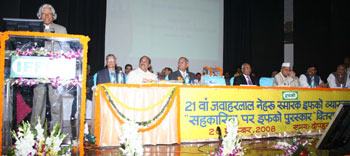 NEW DELHI, Nov 20: Former President, Dr A P J Abdul Kalam, has called India to embark upon Second Green Revolution to further increase its productivity in the agricultural sector. By 2020 India would require producing over 340 million tones food grain in view of population growth and increased purchasing power.
 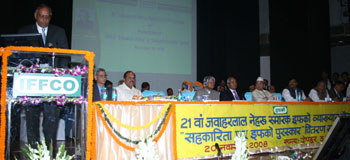 He further emphasised that “agricultural scientists and technologists need to work hard to double the productivity in view of less area being available for cultivation with limited water supply and fall in number of available farmers.”
 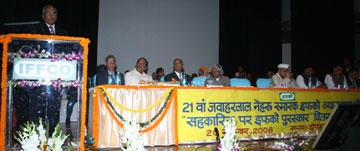 IFFCO Managing Director, Dr U.S.Awasthi, eulogised the contribution of Prof. A.P.J. Abdul Kalam who being 21st century visionary, has accepted IFFCO’s invitation to inaugurate 21st Jawaharlal Nehru Memorial IFFCO lecture at the expense of his time.
  He urged IFFCO to re-orient its vision from excellence in production and marketing of fertilisers and related systems to become a partner in promoting overall rural development leading to prosperity of 6,00,000 villages.
  India's foodgrain production comprising wheat, rice, coarse cereals and pulses stood at a record 230 million tonne in 2007-08.

Aviation
| Business | Defence
| Foreign Affairs | Communication
| Health | India |
United Nations
India-US | India-France
| Entertainment | Sports
| Photo Gallery | Tourism
| Advertise with Us | Contact
Us
© Noyanika International, 2003-2009. All rights reserved.