


India
|
Pranab to visit Pakistan on January 13NEW DELHI , Nov 27: External Affairs Minister Pranab Mukherjee will visit Islamabad on January 13 to invite Pakistan President Pervez Musharraf for the SAARC summit in New Delhi in April - a visit that is also likely to see "substantial discussions" between the two neighbours on the Siachen glacier and Kashmir issue. "I will go to Islamabad next month to formally invite President Pervez Musharraf and the foreign minister (Khurshid Mehmood Kasuri) for the South Asian Association for Regional Cooperation (SAARC) summit," Mukherjee told reporters after an informal lunch with Kasuri at the Hyderabad House in New Delhi. "We will hold substantial discussions at that point of time. This was just an informal meeting," Mukherjee said after his talks with Kasuri on a wide range of bilateral and regional issues. "I look forward to receiving him on January 13," Kasuri, who is here on a private visit to attend the wedding of Panchayati Raj Minister Mani Shankar Aiyar's daughter, said. "Both of us agreed that India-Pakistan relations are very important and both need to develop trust to resolve issues. I developed trust with his two predecessors (Yashwant Sinha and K Natwar Singh) and I hope to do the same with him (Mukherjee)," Kasuri said. "I am glad that a senior Congress leader is in charge of the external affairs ministry. That gives me great hope," Kasuri, who also had one-on-one talks with Mukherjee lasting nearly ten minutes, said. Strong politicians are needed for improving India-Pakistan relations, Kasuri stressed. Although Kasuri's four-day trip to India was meant to be a strictly private visit, both sides used the opportunity to build rapport between the two foreign ministers. This was the first meeting between Mukherjee and Kasuri after the former became external affairs minister over a month ago. JKLF says farewell to arms: Yasin MalikJammu, Nov 27: Jammu Kashmir Liberation Front chairman Mohammad Yasin Malik has declared that his opening of office in downtown Srinagar on Sunday was part of his plans to "motivate youth for resistance through politics rather than guns." He says his inspiration in enrolling the youth of Kashmir for political resistance developing for our cause was Edward Said, a Palestinian–American literary theorist and an outspoken advocate of Palestinian cause. Said was a strong champion of the cause of Palestinians. Yasin Malik's opening of office in densely populated Bohri Kadal in downtown Srinagar, regarded as a stronghold of the Mirwaiz family, triggered violent protests. "JKLF is not a banned group. It has ceased to be a terrorist group. Now we are a political movement and the opening of office should be read in the context of our larger mission," Malik said after having spent the night in his new office in Bohri Kadal. Yasin Malik, who was among the first group of terrorists to launch secessionist violence in Kashmir in late 1980s, had renounced violence and use of guns in May 1994. Since then he claims to be following the Gandhian ways. Regarding Sunday's clashes, he said that "some elements frustrated by the response our rally received, resorted to mischief of disrupting it, which people foiled." Though Yasin Malik did not identify the "frustrated elements", the target figure was clear: All Parties Hurriyat Conference chairman Mirwaiz Umar Farooq. Mirwaiz whose family has had complete sway over the residents in the area, however, denied that his supporters clashed with the JKLF activists. He laughed away over the charge of "frustration", as if dismissing the allegation as inconsequential. "Why should we object to anyone opening any office anywhere. What I am told is that people were furious over certain things, they protested or clashed," he said. Yasin Malik said that JKLF always had a base in the area. He referred to the history of "Sher-Bakra" feud of the times when National Conference founder Sheikh Mohammad Abdullah was alive, and also during the times of Farooq Abdullah. NC activists were known as Sher or lion and that of the Mirwaiz family as bakra or goat. He said there were 70 per cent of NC supporters and rest of 30 per cent were "bakra". When terrorism started, the "NC supporters joined JKLF". "So we have always been there in a huge majority," JKLF chairman claimed. This claim was again laughed away. A colleague of Mirwaiz said that "Yasin is putting the strength other way round. We were 70 per cent, NC 30 per cent." This "Sher-Bakra feud" was brought to an end on the eve of the 1983 Assembly elections after Farooq Abdullah and Mirwaiz Moulvi Mohammad Farooq (APHC chairman's father) entered into an alliance for the sake of "Muslim unity". Their accord came to be known as "Double Farooq" accord. Yasin Malik, when asked whether his rally and entering what is known as "pro-Pakistan bastion in Srinagar" were his rebuff to hardline leader Syed Ali Shah Geelani, as some keen political analysts have noted, he said, "all the surveys done so far, whether by BBC, AFP, Reuters and two reputed Indian magazines - India Today and Outlook, and Pakistani magazine Newsline - all have said one thing: 85 per cent of people of Kashmiris support independence." "If we are talking about wishes of the people, why should we shy away from admitting the reality," Malik said. India, Pak set up joint mechanism to fight terror By Deepak Arora NEW DELHI, Nov 15: India and Pakistan have agreed to set up a joint anti-terror mechanism and initialed an agreement on "reducing the risk from accidents relation to nuclear weapons" as part of the ongoing peace process to normalize ties between the two neighbours. The two sides decided to set up a three-member anti-terror mechanism to be headed by K C Singh, Additional Secretary in the External Affairs and his Pakistani counterpart Tariq Osman Haider. Its mandate would be to consider counter-terrorism measures, including through the "regular and timely" sharing of information, said a three-page joint press statement issued after two days of talks between Foreign Secretary Shiv Shankar Menon and his Pakistani counterpart Riaz Mohammad Khan here. The
two Foreign Secretaries have also agreed to meet in
February next year in Islamabad to launch the next
round of composite dialogue. Though
the statement said the sides exchanged views on Siachen,
two Foreign Secretaries admitted on differences over
the issue due to the complexities involved. Menon
said India raised the cross border links to terrorist
acts in this country with Pakistan and hoped that
the joint anti-terror mechanism will take some action
in this regard. He said during the talks India handed
over some information to Pakistan about some recent
terrorist incidents in India but not about the Mumbai
blasts because a chargesheet is yet to be filed in
the July 11 attack. Menon
said Islamabad has been told that it should take action
to stop the activities of banned organisations like
LeT from undertaking terrorist activities in India.
Khan said "some material" was give by the
Indian side but it did not relate to the Mumbai blasts.
The material referred to certain linkages of banned
groups in India and Pakistan. Menon
said evidence including documents on the Mumbai blasts
was not given to Pakistan because of the legal process
involved like chargesheet yet to be filed in Mumbai
court and the government did not want to commit contempt
of court. But, he maintained, India has been discussing
the Mumbai incidents with Pakistan on various occasions.
To
a question, Menon said terrorist-training camps still
existed in Pakistan and Pakistan knew about these.
The two sides also exchanged views on the Jammu and
Kashmir issue "in the spirit" of the Havana
decision after talks between Prime Minister Manmohan
Singh and Pakistan President Pervez Musharraf. It
was then agreed that the two sides would hold "purposeful"
discussions, build on convergences and narrow down
divergences. Menon
said the troops would be withdrawn from Kashmir after
the violence ends. He said the government was responsible
for the safety and security of the people. "The
troop's level is related to the security situation
in the state… If there is an improvement in the
situation, certainly we will withdraw troops. But
the threat of violence has to go down," he said.
He, however, said India had withdrawn removed some
troops from Kashmir in the past. "The
two sides agreed to fully implement measures to enhance
interaction and cooperation across the line of control
including the early operationalisation of truck service
for trade on agreed items", the statement said.
Experts
from the two countries will meet on December 22 and
23 to decide on the coordinates for joint survey of
Sir Creek and adjoining areas "without prejudice
to each other's position, as well as to simultaneously
conduct discussions on the maritime boundary."
The joint survey is to be completed by February, 2007.
It
was decided on humanitarian grounds that all fishermen
and prisoners of the other country, whose national
status stood confirmed and who have completed their
sentences, would be released by December 25 this year.
To
overcome the complaints of delay in getting visas,
the Foreign Secretaries agreed for an early finalisation
of an updated visa agreement between both sides. Menon acknowledged that there was terrorism in Pakistan and said it was up to both the countries to deal with it. "It is the cross border links that we raised with Pakistan about acts of terror (committed in India). The joint anti-terror mechanism is one way of dealing with it. We hope it will take some action," he said. Pakistan has assured India that it would act on specific information given to it, he said. Belgium honours Sonia Gandhi BRUSSELS,
Nov 12: Belgium conferred double honours of the 'Order
of Leopold', its 2nd highest civilian award, and an
Honorary Doctorate on UPA Chairperson Sonia Gandhi
for her "constructive nationalism." Hours after the Belgian King Albert II hosted a luncheon in her honour at the Royal Lacken Castle, Belgian Prime Minister Guy Verhofstadt presented the Order of King Leopold to an emotionally-moved Gandhi, while the Rector of the Brussels University, Prof B Van Camp, conferred her with the Doctorate. Gandhi told the packed gathering that she was truly overwhelmed by the "singular honours" bestowed on her. "By conferring these distinctions, you are recognising not the individual that I am, but the values that I have imbibed and stand for," she said and gave credit to the Nehru-Indira Gandhi family to which she was married to. Gandhi and Verhofstadt jointly lit a lamp inaugurating an exhibition 'Tejas - Eternal Energy' organised as part of a Festival of India, showcasing various aspects of the country combining new dynamism and cultural heritage. Referring to the growing and buoyant Indian economy, the UPA chairperson asked Belgian companies to actively consider taking advantage of the situation and invest in India. "In
the area of economy and trade, our two countries have
been expanding and deepening their partnership. Belgium
is the second largest trading partner for Hooda woos UP-ites
The Chief Minister asserted that the festivals and culture of the Western Uttar Pradesh and Haryana were uniform and both were like real brothers. He expressed unhappiness that the facilities had not been provided to the people of the Western Uttar Pradesh at par with the Haryana State. Mr Hooda maintained that United Progressive Alliance (UPA) government at Center had formulated a number of welfare schemes for the benefit of the people, so that the economic condition of the poor people living in the rural areas could be ameliorated. Taking a dig on the UP government, he said that the leaders had gained the power on the basis of politics of castes, creed and religion. He lamented that after gaining the power they had forgotten their promises to serve the masses. The Chief Minister said that Haryana Government had waived of the arrear bills of power amounting to Rs 1600 crore belonging to farmers, labourers and poor sections of the society. A number of welfare decisions had been taken keeping in view the welfare of the people. He said that Indira Gandhi Priya Darshnee Vivah Sagun Yojna had been launched in the State under the scheme a sum of Rs. 15,000 was being given to the members of the scheduled castes and widows living below the poverty line. The law and order situation in Haryana had improved a lot. He said that as many as 4100 retrenched employees of MITC had been given the job again. Mr Hooda maintained that UP Government had no policies and programmes so the unemployment was on the rise in the State. He called upon the youth to change the present government as in democracy public was supreme power. He directed the MD Cooperative Sugar Mill, Karnal that a separate sale counter should be setup for the people of adjoining state, so that they could get Urea, Seed and Pesticides. He also assured that a petrol pump would also be setup in the premises of Cooperative Sugar Mill, Karnal. The Chief Minister said that as many as 11,000 teachers would be recruited in the state and 33 per cent reservation would be give to the women besides 50 per cent teachers would be from rural areas. The UP Congress President, Mr Salman Khurshid, said that the Congress President, Mrs Sonia Gandhi, would address a 'Nav Nirman Rally' at Kanpur on August 8. He said that UPA Government had envisaged a number of schemes for the welfare of the people. He said that Congress Party was working in the country to unite the people while other parties were working to divide the country. The AICC General Secretary and former Chief Minister of Rajasthan, Mr Ashok Gehlot, said that during his tenure as a Chief Minister, 1750 MW power was generated in Rajasthan while not even a single MW power was generated in UP during the regime of present government. Several
Congress leaders, including Mr Sachin Pilot (MP),
Mr Rashid Alwee, Mr Harender Malik, Mr Rajesh Pati
Tripathi and Mr Narender Pal Verma, addressed the
rally. The Political Advisor to Chief Minister, Haryana,
Prof. Virender Singh and MLA from Karnal, Mrs Sumita
Singh, were also present on the occasion. Pak Major killed in J&K encounter SRINAGAR, July 29: The Indian Army late on Friday disclosed that a terrorist killed in a gun battle with soldiers two days ago was a Pakistan Army Major. The dead man, one of three killed in Gurez (north Kashmir), was named by a defence spokesman as Mohammad Hyder Turkey of 9th Baluch Battalion. He was identified on the basis of papers on his body. He was initially thought to be Abu Bilal, a resident of Gujranwala in Pakistan, but that name apparently was his call sign. The three infiltrators are believed to be part of a LeT operation to get in more terrorists into Kashmir, the defence spokesman said. Manmohan, Bush discuss nuke deal issues ST PETERSBURG, July 17: Seeking "constructive solutions" to "some concerns" of India in the proposed US legislation granting waivers for nuclear commerce, Prime Minister Manmohan Singh on Monday met US President George W Bush and pressed for "permanent reconciliation" of these issues. Singh also sought Bush`s continued personal support for the successful conclusion of the civil nuclear deal. "There are some concerns which worry US and worry our Parliament," Singh told the US leader at the heavily guarded Konstantinovsky Palace complex during the 40-minute meeting. "We are a democracy and we are accountable to Parliament which zealously keeps a watch on what we do and what we do not do," Singh said. This was the first meeting between Singh and Bush, who is here for the G-8 summit, since the US President`s visit to India in March this year. "I sincerely believe that we can find constructive solutions to all these issues," Singh said. New Delhi has made it clear that it will not accept any legal binding to its voluntary moratorium on nuclear testing and also not make any compromise on its strategic programme. Recalling his visit to India in March, Bush said the nuclear deal was being worked through the Congress. "It`s an important piece of legislation. I am optimistic we`ll get that passed," Bush told Singh. Responding to Bush`s remarks, the Prime Minister said, "I deeply appreciate your involvement. There are some concerns which worry us." The Singh-Bush interaction came close on the heels of the International Relations Committee of the US House of Representatives and the Foreign Relations Committee of the Senate giving their nod to the deal, which would pave the way for nuclear supplies to Indian reactors. India and the International Atomic Energy Agency (IAEA) had earlier this month held "productive" talks in the Indian capital on the proposed safeguards agreement that is required to be put in place to allow the world community to resume nuclear trade with New Delhi. G-8 to reinforce nuclear partnership with India ST PETERSBURG, July 17: The world's eight most industrialised nations including US and Russia have expressed their resolve to "reinforce" their nuclear partnership with India by encouraging New Delhi to integrate into the non- proliferation mainstream. A G-8 declaration on nuclear non-proliferation adopted by the grouping's leaders at their summit here says, "We look forward to reinforcing our partnership with India." "We note the commitments India has made, and encourage India to take further steps towards integration into the mainstream of strengthening the non-proliferation regime, so as to facilitate a more forthcoming approach towards nuclear cooperation to address its energy requirements, in a manner that enhances and reinforces the global non-proliferation regime," it said. The G-8 comprises the US, Russia, Britain, Canada, France, Germany, Italy and Japan. Leaders from India, China, Brazil, South Africa and Mexico are attending an outreach meeting of the G-8. India-Pak Foreign Secy-level talks off By Deepak Arora NEW DELHI, July 14: Tuesday's devastating Mumbai serial blasts have had its impact on the peace process with Pakistan. New Delhi has decided not to go ahead with the Foreign Secretary-level talks that were expected to be held here next week. There was little likelihood of the talks being held in the current situation against the background of the blasts, which have claimed nearly 200 people, according to official sources. The sources said any dialogue was possible only in a conducive atmosphere and this was not the appropriate time. Reflecting India's mood, the Foreign Secretary, Mr Shyam Saran, said that "unsettling events" had taken place, an apparent reference to the Mumbai blasts. "Cooperation is a two-way street. No cooperation can be one sided....India will do what it has to do," he said. Mr Saran, however, said the (peace) process (with Pakistan) was not off. Though there was no schedule of the talks between the foreign secretaries, the two countries had agreed in January that the dialogue could be held on July 21, which was to be confirmed by the two sides. While Pakistan had 10 days ago expressed its readiness for the talks next week, New Delhi had not given any response. Earlier in the day, the Prime Minister, Dr Manmohan Singh, had made a veiled hint of Pakistan's involvement in Mumbai blasts and left Islamabad in no doubt that it would be "exceedingly difficult" for India to carry forward the peace process if it did not control terrorist elements operating from its territory. The Minister of state for External Affairs, Mr Anand Sharma, has said that the deadly bombings in Mumbai and rising violence in Kashmir show Islamist militants continue to have bases in Pakistan and this could hurt a peace process with India. Mr Sharma's reaction came as police officials in Mumbai named Pakistan-based militant group Lashkar-e-Taiba as prime suspect for Tuesday's wave of blasts in Mumbai. Mr Sharma said while India remained committed to making peace with Pakistan, the peace process was not a one-way street and Islamabad had to fulfil its part of the deal and curb militants. 137 dead as series of blasts rock Mumbai MUMBAI, July 11: At least 137 people have been killed and scores of others wounded in a series of seven terror blasts in first class compartments of suburban trains and on platforms around 6PM during the peak hour traffic in Mumbai. Police Commissioner A N Roy said the blasts took place at seven places and the priority was to rescued the people and rush the wounded. The blasts occured between 6Pm and 6.30PM at Matunga Road, Khar, Jogeshwari, Borivali, Santacruz, Bandra and Bhayender railway stations. Fifty bodies were brought to Bhaba hospital in Bandra, 20 to Sion in central Mumbai and ten each to KEM and V N Desai hospitals. A few more injured were reportedly taken to the government hospital at Sion in central Mumbai, the Bhabha hospital and V N Desai hospital in the western suburbs from the blast sites, hospital sources said. Several people had come with major injuries and fractures and doctors KEM Hospital said all the injured there are out of danger. At Matunga station, the blast was so powerful that it not only ripped through the first class coach but also blew off a portion of the platform shed. Bodies were seen scattered on the tracks while many injured, some of them profusely bleeding, were attended to by fellow travellers on the platform before being rushed to nearby hospitals. Police suspect that it is a pre-planned subversive plot similar to the explosions that had rocked Mumbai in 1993 and 2002 and 2003. All
suburban and long-distance trains on the Western railway
lines were suspended and police cordoned off the major
road intersections, railway stations and exit points. Insat-4C launch ends in watery graveSRIHARIKOTA, July 10: The launch of India's heaviest communication satellite INSAT-4C ended in a fiery disaster on Monday evening, singing India's reputation as a space power. The doomed mission, which could have boosted direct-to-home TV service, also took down with it Rs 256 crore-Rs 160 crore for the vehicle and Rs 96 crore for the satellite. It also puts a big question mark on the future space programmes of a country that is planning an unmanned moon mission and delivery systems for nuclear weapons. "There seems to be a mishap in the first stage separation. Things have gone wrong," Isro chairman G Madhavan Nair said. The launch was dogged by technical problems from the very beginning. Initially, the second operational flight of the Geosynchronous Satellite Launch Vehicle carrying the satellite was scheduled for 4.30 pm. But it had to put off till 5.20 pm due to a technical glitch. It was further postponed till 5.40 pm, but it blasted off at 5.38 pm. However, Nair denied any link between the glitch which delayed the launch and the problem which doomed the mission. The delay was due to a "minor" problem of ground servicing, he said. One of the pumps with the cryogenic fluid had opened and failed to re-seal. A team had to be sent to close it and ensure that all parameters were normal before the lift-off. Nair said the lift-off was normal, but in a few seconds the vehicle was found to be off trajectory and in 60 seconds, some parts had broken up. Immediately, the 'destruct command' was given to ensure the wayward rocket did not fall on a populated area. It crashed into the Bay of Bengal. However, the rocket blew up because, according to Nair, one of the four strap-on engines had failed. While the other three developed normal velocity, the pressure in the affected motor dropped to zero. At this stage, the vehicle was out of control. Normally a deviation of up to 4° is allowed. But in this case, it had deviated by 10°. Isro sources said this was the first time a vehicle had crashed at the first stage. Vehicles had failed earlier either at the launch stage or the last stage of separation. Asked if there could have been sabotage, Nair said this too would be probed. He said during the 60-second flight an enormous amount of data had been collected and would be analysed. He denied that the cause of the failure was the weight of INSAT-4C (2,168 kg). The launch of INSAT-4B, scheduled for take-off in 2007, would be advanced, Nair said. Since it's a much heavier satellite, it would be launched from Kourou in French Guiana. Separate arrangements would be made for the allocation of INSAT transponders after talks with various channels. There are three stages in GSLV. The first stage (GS1) is a core motor with 138 tonnes of sloid propellant and four strap-on motors each with 42 tonnes of hypergolic liquid propellants (UH25 and N2O4). The single plane Engine Gimbal Control (EGC) of four strap-ones are used for pitch, yaw and roll control. The second stage (GS2) is 39 tonnes of the same hypergolic liquid propellants. The third stage (GS3) is a cryogenic stage with 12.6 tonnes of Liquid Oxygen (LOX) and Liquid Hydrogen (LH2). Two swivellable vernier engines using LH2 and LOX provide pitch, yaw and roll control during this thrust phase and cold gas system during coast phase. In April 2001, the first launch of GSLV-D1 was first aborted but took place a few days later. This is the first failure for the ISRO after the disaster of PSLV-D1 on September 20, 1993. It is also the first time that a GSLV was being launched from the state-of-the-art second launch pad (SLP), designed to reduce occupancy time for the integration and launch, commissioned in May 2005 with the launch of PSLV-C6. GSLV is a 49-metre tall, 414 tonne, and three-stage vehicle. The three-axis attitude (orientation) stabilisation of GSLV is achieved by autonomous control systems provided in each stage. GSLV employs S-band telemetry and C-band transponders for vehicle performance monitoring, tracking, range safety/ flight safety and Preliminary Orbit Determination (POD). Nathu La pass reopens for Indo-China border trade after 44 yrs GANGTOK, July 6: Nathu La, a part of the ancient silk route, was reopened on Thursday for resumption of border trade between India and China, the two great economic powers of Asia. Resumption of border trade through the Himalayan pass symbolises further strengthening of bilateral relations and closer ties between the two countries. Sikkim Chief Minister Pawan Chamling and Chairman of the Tibet Autonomous Region (TAR) of China government C Phuntsok declared the border open after cutting the ceremonial ribbon at a function organised here to mark the historic event. Chinese Ambassador to India Sun Yuxi, TAR Vice-Chairman Hao Peng and General Officer Commanding of 17 mountain division K T Parnaik were among a host of dignitaries present on the occasion. Braving inclement weather on the icy heights around 700 invitees, including ministers from Sikkim, top central and state government officials, security personnel and media representatives of various national and international organisations assembled at Nathu La, located at 14,200 feet high altitude to witness the historic event. After the reopening of the Nathu La trade route, Mr Chamling inaugurated the Sherathang trade mart constructed at five km down the line from Nathu La in a separate function. VP Singh to challenge Mulayam By
Deepak Arora NEW DELHI, June 23: Former prime minister Vishwanath Pratap Singh is ready to begin his second innings in active politics. The newly floated Jandal of Singh will challenge the ruling coalition in Uttar Pradesh Saturday at a rally in Meerut in western region of the State. Singh, who had announced retirement from active politics nearly a decade and a half back, will be the star speaker at the rally. The selection of Meerut as venue for the Jandal's maiden rally is deliberate as the western regions of the state is considered a stronghold of incumbent chief minister Mulayam Singh Yadav and his principal ally Ajit Singh. Incidentally Singh had handpicked Yadav as the Uttar Pradesh chief minister in 1990 while he headed the Janata Dal government at the centre. The Communist Party of India general secretary A.B. Bardhan, union minister Ram Vilas Paswan who is also the Lok Janshakti Party president, and Jandal president Raj Babbar will also be present at the rally. Rally organisers say leaders of all three factions of the Bharatiya Kisan Union including famous farmer leader M.S. Tikait would attend the rally. This is seen as a significant development since Singh is paying special attention to the plight of Uttar Pradesh farmers. The former premier had been involved with farmers through his parent organisation Jan Morcha for the past few years. He formally launched Jandal as its political organ at the state capital Lucknow on June 6 with an aim to give both the Samajwadi Party and its principal rival Bahujan Samaj Party run for each vote during upcoming Assembly polls. Singh will follow the Meerut rally by driving a tractor at nearby Dadri on the land acquired by the government as a symbolic gesture to lodge his protest. Farmers of Dadri are up in arms against the state government saying they have been compensated inadequately for their fertile land that has been handed over to Anil Ambani of Reliance group for setting up a power generation unit. Curiously, power crisis is threatening to become one of the major issues during February polls with several areas of the state facing blackout to the extent of 16 hours a day. Jandal
has announced its decision to put up its candidates
on all 402 seats of the Uttar Pradesh legislative assembly
by forming a coalition with other likeminded parties.
Political circles feel that given Singh's appeal amongst
the Muslims and backward castes, his party may make
a deep dent into the traditional vote banks of the Samajwadi
Party and the Bahujan Samaj Party. Singh
had earned goodwill amongst Muslims by preferring to
sacrifice his government due to his uncompromising stand
on the now razed Babri Masjid at Ayodhya, leading to
the Bharatiya Janata Party withdrawing support to his
minority government. At
the same time, he established instant rapport with members
of the backward castes by implementing reservation in
jobs for them. Builder
lobby opposing Haryana SEZ project NEW DELHI, June 17: Haryana's decision to create a massive Special Economic Zone (SEZ) adjacent to Kundli-Manesar-Palwal expressway is guided by Chief Minister Bhupinder Singh Hooda's vision of making his State as Numero Uno in the country. However, it is learnt that builder lobby, backed by former chief minister Chautala, is opposing the project on personal selfish motives. Explaining the salient features of the proposal to induct Reliance Industries Ltd (RIL) into the project, Mr Hooda said this the SEZ would fetch the State Rs 10,000 crore per annum and would help create five lakh jobs. Mr Hooda said "when Chautala was the chief minister Rs 2 lakh per acre were given to the farmers for land acquisition. Now Rs 24 lakh per acre are being given for acquiring the land." The Chief Minister said the State was also getting 5 per cent equity in the project in lieu of 25 per of land. "Rest of the 75 per cent land will be acquired by the company." He said Rs 25,000 crore Reliance SEZ project was a major effort to attract top industrial houses and foreign investment in the State. Attacking the Opposition, Mr Hooda, who is known for his transparency, said "those who do not know the meaning of 'Vikas' (development) are opposing the project." It is said that the land mafia and builders lobby backed by Chautalas were behind the opposition to the project. "It is the builders lobby, which made crores by colonizing areas, that have made old politicians active," said a source. The Reliance SEZ project would help in industrialization of the State as it would help recognize Haryana as one of the most respected global destination. The large size SEZ would be a fully integrated city having air, rail and road linkages and adequate supply of power, water and communication facilities. "A world class infrastructure along with an investor friendly growth oriented economic environment will attract significant investments from both domestic and international companies," confided an official. The project would generate user investments of over Rs 1,25,000 crore and exports in excess of over Rs 50,000 crore in the next five years. An MOU for the project is to be signed on June 19. The
plan for development of such an infrastructure goes
hand in hand with the shared vision of creating a major
economic hub in North India. "This will cater to
the needs of the region and also act as the trading
and warehousing interchange of North India." Congress
issues show cause notice to Bhajan's son, Bishnoi
This follows an identical action against senior Congress leader in Punjab , Jagmeet Singh Brar, for opposing the State government's green signal to another project of Mukesh Ambani-controlled RIL. The notice to Bishnoi was issued for taking a public position against the state government's decision to allow Reliance Industries for setting up the multi-product Special Economic Zone (SEZ) that could see a total investment of Rs 1,25,000 crore over the next five years. The AICC General Secretary in charge of Haryana, Mr Janardan Dwivedi, issued the notice to Bishnoi on Tuesday for his latest attack against the Chief Minister, Mr Bhupinder Singh Hooda. Bishnoi charged that prime land had been handed over to Reliance for which the farmers were not paid adequate compensation. The party sources said the party was left with little choice but to issue a notice as Bishnoi had ignored all previous warnings. Bishnoi, who was in Haridwar, said that he would reply to the notice after his return from the holy town on Friday. The party also denied that the signing of a joint venture agreement between the Haryana Government and the Reliance group for a mega special economic zone (SEZ) was put off following the Congress President, Mrs Sonia Gandhi's intervention. While denying that New Delhi had intervened in the matter, Mr Janardan Dwivedi said reports suggesting that Mrs Gandhi had sought an explanation from Mr Hooda were incorrect. The Haryana Chief Minister said that the project was very much on and a MoU would be signed on June 19. The agreement on this joint venture was to be formally sealed last Monday but the signing of the MoU was postponed as RIL Chairman, Mr Mukesh Ambani, had returned from the US the previous day and needed a few more days and June 19 was decided as a mutually acceptable date for signing the MOU. The RIL and HSIDC signed an agreement for the SEZ last October. Attacking the Opposition, Mr Hooda said the SEZ would fetch the State Rs 10,000 crore per annum and would help create five lakh jobs. Mr Hooda, who is known for his transparency, said "those who do not know the meaning of 'Vikas' (development) are opposing the project." The Chief Minister said the State was also getting 5 per cent equity in the project in lieu of 25 per of land. "Rest of the 75 per cent land will be acquired by the company." Mr Hooda said "when Chautala was the chief minister Rs 2 lakh per acre were given to the farmers for land acquisition. Now Rs 24 lakh per acre were being given for land acquisition." Sources
said Bishnoi appears to have landed himself in deep
trouble for conducting a sustained campaign against
the Chief Minister. "He was told in no uncertain
terms that he was breaching party discipline by going
public with his criticism," sources said. Even
the PCC president, Mr Bhajan Lal, had also been asked
to discipline his son but to no avail. 8 labourers killed in J&K JAMMU, June 12: Twelve suspects have been picked up for interrogation in connection with the 3 grenade blasts in Jammu in which one person was killed and 31 injured, while in a separate incident 8 Bihari labourers were shot dead and 5 injured by armed gunmen in Jammu and Kashmir. Official
sources said that six people were killed instantaneously,
while seven others were injured in Budroo village in Kulgam
area of the district in the afternoon. Later, two persons
succumbed to injuries in hospital, they said. A
Defence spokesman said the labourers were shot dead by
ultras. Police said that they were hope of some leads and would pick up more suspects in the case. Senior Superintendent of Police Mukesh Singh said that they were investigating the attack on the buses, one of them carrying Vaishnodevi pilgrims. Singh, who was monitoring the situation after the grenade strikes, said "the grenade pins and other evidence are being analysed to determine whether the grenades were thrown from bus stand area or from the road above it". No militant outfit has claimed responsibility for the attacks but there was a possibility of Hizbul Mujahideen and Lashker-e-Taiba militants being involved, police officials said. They said they had received intelligence inputs that militants wanted to disrupt the Amarnath yatra. Militants
hurled the first grenade at the General Bus Stand in the
city around 0732 hours, hitting a bus headed for Katra,
the base of the Vaishnodevi shrine, followed by two other
similar attacks within seconds which hit three other buses,
police said. An unidentified person was killed on the
spot and 31 people, including two Amarnath pilgrims, were
injured. Summer
camp at Rail Museum NEW DELHI, June 5: To mark the World Environment Day, the children at Rail Museum's summer camp made a colourful presentation and sang songs to motivate young and old alike to plant trees. This was part of a cultural programme by the children on successful completion of two-week summer course. Complimenting
the children for a successful performance, Mr R R Bhandari,
Member (Mechanical), Railway Board, who was the chief
guest, said as many as 273 children from different strata
of society attended the "Creative Express" programme
where children were given exposure of various skills like
dance, music, handicraft, pottery and glass painting,
informed. Another
summer camp programme "Gateway to Success" was
attended by about 190 children, informed Mr Sandeep Mehra,
Director, Rail Museum. "The programme helped us create a sense of belonging and pride in our railway heritage," said Noyanika, a 10-year-old student from Carmel Convent, who completed the two-week course. She
and other students were looking forward to attend other
workshops like science, photography and Origami that are
part of the summer camp. Kaberi's
"Gateway to Success" has been designed to address
the issue to induce confidence among children through
various scientifically proven techniques of improving
concentration, memory, behaviour, time management and
positive thinking, said Mr Mehra. He said "the purpose
of this training is to enable students and faculty to
improve their performance in all fields, through simple
and subtle techniques." Besides friends and family of the participating children, those who graced the occasion included Mr Pratap Shrivastav, Additional Member (Production Units), Indian Railways and Mr V S Verma, Director General, Bureau of Energy Efficiency, and Chairman of Central Electricity Authority.
Congress reviews Rural Employment Guarantee Scheme Sonia tells Oppn not to do politics in development By
Deepak Arora
"I appeal to you to go to the people and tell them that this Right (of employment) has been given to them by Mrs Sonia Gandhi and the Congress Party," Dr Singh said addressing a day-long Convention of DCC Presidents of 200 backward districts where the National Rural Employment Guarantee Act is being implemented. Mrs Gandhi, who inaugurated the Convention, said that the ambitious scheme was only in the Congress Manifesto and in the Common Minimum Programme (CMP) of the UPA. The Congress President as also the Prime Minister emphasized that 90 per cent of the funds under the "revolutionary" scheme were being given by the Centre and wanted party men to project the true picture before the people. "This legislation is historic. This is because in nowhere in the world such an Act was there. It is for the first time in the world that our Government has given a legal right of employment to workers living in rural areas and has given guarantee to provide 100 days work," the Prime Minister said. The
Convention was also addressed by the Chief Ministers of
Congress-ruled states where the programme is under implementation,
besides PCC presidents and CLP leaders, ministers and
party general secretaries' in charge of the programme
in various states. Hooda
hails rural job guarantee scheme
Speaking
at a convention on implementation of the National Rural
Employment Guarantee Scheme here, he gave credit for its
successful implementation to UPA Chairperson Sonia Gandhi
and Prime Minister Manmohan Singh and said that the inclusion
of a small State like Haryana "showed their greatness.''
Mahendragarh
and Sirsa districts were chosen for implementation of
this scheme. An unmistakable message had been sent to
the poor and weaker sections of society that there was
a party that cared for them. He said that all necessary steps for the registration of households, issuance of job cards, applications for work, identification of the Shelf of Projects, providing work to those demanding employment, preparation of muster rolls, training awareness and setting up of administrative infrastructure had been completed in both the districts. About 76,760 households had been registered under the scheme and out of these, 9,533 had demanded jobs and 5,765 had been provided jobs. The Global Indian
At
the WTO negotiations in Hong Kong last December, the exuberant
minister, along with Brazilian minister Celso Amorim, emerged
as the voice of the developing countries. Not everyone,
however, agreed that he was able to protect the interests
of the poor nations. Critics
at home and abroad pointed out that the Hong Kong deal extracted
substantial concessions from developing nations while giving
them hardly anything in return. In fact, some commentators
asserted that India and Brazil had jettisoned the interests
of the developing countries and joined the Big Boys' Club
comprising the US and EU. The Left and the BJP felt that
the minister failed to safeguard the interests of millions
of small farmers in the country, leaving them without a
shield against the assault of the big agricultural corporations
of the developed world. Foreign Direct Investment (FDI) in India's emerging retail sector has been another area in which Kamal Nath has tried to project himself as the savior of the small retailers and jobs at home but has ended up making comradely gestures to the big boys of retail from overseas. "We are in agreement with Left parties that FDI should not replace or displace jobs. We are yet to evolve a model...the main problem is between large and small players and not domestic versus FDI," the minister told a conference in New Delhi last year. It
was in view of the concerns raised by the Left and sections
of the ruling Congress that the government, while opening
up the retail sector to FDI recently, allowed only single-brand
chains from abroad to have up to 51 per cent holdings in
their Indian operations. This kept out big names like Wal-Mart
and Tesco. While it is still not clear how the government will protect the interests of small shopkeepers and the jobs of those employed by these stores, the minister is already talking about opening another "window" for FDI in retail. ''We will announce another window for FDI in retail in the next six weeks,'' Kamal Nath told newsmen on the sidelines of the Hannover Fair 2006 last week. In the global scenario Kamal Nath is the Indian, the world and the businessmen across the world most want to associate with. He enjoys the distinction of being a business man and a CEO first and a politician thereafter. With all the power with him, Kamal Nath cannot disappoint the his core constituency i.e International Trade and Industry. Terrorists massacre 32 in Jammu and Kashmir JAMMU, May 1: At least 32 Hindus were killed and five were injured, including women and children, by Lashkar-e-Taiba men in Kulhan area of Doda district late on Sunday night, reports reaching here said. According to reports, the terrorists pulled the victims out of their homes in the district, about 200 km north-east of Jammu, and showered them with bullets and also used sharp-edged weapons. The police have confirmed the incident. "We have sent parties to verify the details. The areas is hilly and far off, it will take a while to confirm the exact details," Deputy Inspector General of Police LD Mohanty said. Mohanty said initial reports suggested the victims were Hindus. These killings come close on the heels of the killings of four Hindu shepherds in Lallalan Galla, a mountainous pass in Udhampur district on Sunday. The fate of three other shepherds is still not known. "We are on the job," Inspector General of Police SP Vaid said. The killings of Hindus started in Jammu region in August 1993, when for the first time 16 Hindu bus passengers were segregated from others and shot dead near Kishtwar in Doda. This trend continued till late 2002. Thereafter, there were a few isolated incidents, till the back-to-back killings this weekend. Rahul
on bullock cart to woo voters
The star campaigner, who represents neighbouring Amethi in the Lok Sabha, is camping to ensure that Congress president Sonia Gandhi is voted to parliament with a thumping majority in the re-election on May 8 -- necessitated after she quit as MP over the office of profit controversy. And
as he gets into the heat and dust of canvassing, Rahul is
trying hard to prove critics, who dismiss him as a high
profile clan's scion and far too elitist to understand grassroots
realities, wrong. So on Thursday people were simply overwhelmed
when the young Gandhi got off his air-conditioned Honda
CRV and hopped on to a bullock cart to negotiate his way
into a village where large crowds had gathered to hear him. Even though he travelled barely a kilometre on the cart, locals in Kundwal village were bowled over with the readiness with which he disembarked from his vehicle in the scorching sun. "Tell
me who would do that?" asked Saraswati, who followed
him into the village with her baby in her arms. Much like his father late prime minister Rajiv Gandhi, he doesn't hesitate to halt anywhere and everywhere to have a word with his teeming admirers, who seem awestruck by just their physical proximity to him. "He is so simple and affable that you are just willing to do everything for him," commented Suresh, a roadside bicycle repairer. Agreed tea stall owner Ram Niwas: "He is so much like his father; he readily mingles with the crowds and is always ready to lend them a ear without bothering about his security." Excited crowds hail him with slogans like "Desh ka Neta kaisa ho Rahul bhaiya jaisa ho" (what should the country's leader be like ; he should be like brother Rahul). His speeches are brief and crisp, reminiscent of Rajiv Gandhi's initial days in politics in the early 1980s. Rahul simply focuses on his family's half a century association with Rae Bareli. Rahul also makes it a point to tell the crowds about how his mother chose to resign her Lok Sabha membership on account of controversies about her holding "office of profit", disallowed under the Indian constitution. "It was in pursuance of upholding provisions of the Constitution, that she decided to step down and seek re-election, even though the position she held did not fall in the ambit of office of profit." He reminds people of how his grandmother Indira Gandhi gave Rae Bareli the status of a city from an undeveloped semi-rural town and the efforts his mother had made to revive the dying Indian Telephone Industries (ITI) unit set up by her. Taking potshots at the present government, he blames Chief Minister Mulayam Singh Yadav for the poor development of Rae Bareli over the years. "We have been writing to the Uttar Pradesh government for improvement of power supply in this area, but they do not respond; our demand for more roads and better roads has also gone unheeded," says the man, who has expressed his willingness to take over the campaign when the state goes to polls in 2007. Abducted Indian engineer killed by Taliban; India outraged By Deepak Arora
This is the second killing by the Taliban of an Indian in Afghanistan in the past four months. Indian officials said the Taliban never had any intention of negotiating since the body, after it was found, showed that he must have been killed on Saturday evening. In swift condemnation, Prime Minister Manmohan Singh expressed grief and sorrow and asked the nation to remain united in the fight against terrorism. President Abdul Kalam joined in, calling it "highly condemnable". Foreign secretary Shyam Saran blamed the Taliban and "its sponsors" for the "dastardly and inhuman act of terror...which has resulted in the tragic and untimely death of an innocent Indian citizen, who, like many of our other compatriots, had been making a contribution in Afghanistan's reconstruction". In Kabul, President Hamid Karzai condemned the killing and ordered the security forces to hunt down those responsible. Reiterating India's stand on the Taliban, Saran said: "The government of India regards Taliban a terrorist organisation and calls upon the international community to recognise its true colours and join hands together to defeat this scourge to humanity." Suryanarayana (41), a telecom engineer, was working for a Bahrain company Al Moayed on a telecom project in Afghanistan. His beheaded body was found on the road between Qalat and Ghazni on Sunday morning. Al Moayed is currently undertaking a project for Roshan Telecom, an Afghan mobile telephone service provider.
Outraged by the "brutal murder" of Indian engineer,
India asserted that it would "never bow before such
acts of terror" and asked the international community
to join hands in defeating it. "The government and people of India will never bow to such acts of terrorism and will continue their fraternal assistance to the people of Afghanistan in their endeavours to bring peace, stability and economic recovery to their country ravaged by years of conflict," said Mr Shyam Saran. Ghulam Nabi Azad wins Bhaderwah seat SRINAGAR, April 27: Jammu and Kashmir Chief Minister Ghulam Nabi Azad on Thursday won the Bhaderwah assembly seat by defeating BJP nominee by a huge margin of over 58,000 votes. While, National Conference's Sheikh Mustafa Kamal on Thursday defeated ruling PDP's Maulvi Iftikhar Hussain Ansari in the Pattan assembly constituency by a margin of 3700 votes. The by-elections to Pattan, Sangrama, Rafiabad and Bhaderwah constituencies of the state were held on April 24 and over 60 per cent voters had exercised their right to franchise. Russian nuke supply to Tarapur is no violation: India NEW DELHI, March 15: Virtually rejecting US reservations, India on Wednesday asserted that Russia's decision to provide the urgently-needed uranium to Tarapur plant entailed "no violation" of NSG guidelines and was being done under its Safety Exception Clause. "There is no violation of NSG guidelines and Russia has approached NSG (45-country Nuclear Suppliers Group) under the Safety Exception Clause (of the NSG Guidelines)," according to Mr Navtej Sarna, a spokesman of the Ministry of External Affairs. Sarna was reacting to reservations expressed by US State Department over Russia's move to supply 60 tonnes of uranium to units I and II of Tarapur Atomic Power Station (TAPS) to enable it to continue to function. "The US is aware of the urgent need for fuel to Tarapur," the spokesman said. US
State Department spokesman Adam Ereli, earlier said that Russia
should not supply uranium to Tarapur till India fulfills its
obligations under the deal between New Delhi and Washington.
Indian
spokesman said, "India has had to seek urgent and limited
supplies of uranium fuel to enable Tarapur to continue its
operations in safety." Sarna said India had made a request
to the US to supply fuel for Tarapur but this was not possible
under the current American laws. Official sources said a similar
request was made to Russia, to which it responded positively.
Referring
to the July 18, 2005 Indo-US Joint Statement issued after
talks between Prime Minister Manmohan Singh, and US President
George W Bush, the spokesman said it noted that Washington
would seek to adjust its laws and seek a change in NSG guidelines
to enable full civil nuclear cooperation with India, including
fuel supplies for the safeguarded reactors at Tarapur. The Joint Statement also commits the US, in the meantime, to encourage its partners to consider India's request for such fuel supplies expeditiously, he said. Official sources pointed out that the fuel was being supplied to unit I and II, which are already "safeguarded". Hooda
announces Rajiv Gandhi insurance policy
Addressing
a mammoth rally to mark the first year of Congress-ruled Government
in the State, Mr Hooda said that the Rajiv Gandhi Insurance
Policy would entitle Rs one lakh compensation to the family
members of each adult between 18 and 65 years of age killed
in an accident.
The Chief Minister promised to make Haryana numero uno State of the country. A huge roar of approval and clapping from the huge gathering of over one lakh people reverberated the Mahavir stadium here each time Hooda announced new initiatives. The people had come from nook and corner of the State. This correspondent witnessed a new "josh" (enthusiasm) among people who were heading for the rally in cars, jeeps, trucks and buses with the Congress flag fluttering on all vehicles.
He, however, promised total transparency in governance through which he intends to intensify his avowed fight against rampant corruption. "My yardstick for being counted as a developed state is availability of electricity. I am not promising round the corner power supply but each village will get at lest 20-22 hours of supply every day in the next three years," Mr Hooda said. His government intends to achieve the target by augmenting electricity generation by additional 5,000 mega watts as against the current capacity of mere 4,000 mega watts. Likewise, creation of additional 10 lakh jobs in the state within the next five years, he said, is his top priority so as to provide job to at least one member of each family. "Path to development may be difficult but it is no impossible if one works with sincerity and dedication," Mr Hooda reassured a mammoth cheering crowd. Earlier, Mr Janardhan Dwivedi, the Congress party's general secretary in-charge for Haryana, complimented the Hooda government for brining development back on the track, saying the non-Congress governments in the state had done little on this front in the past. "The amount of development-oriented works done in one year cannot be matched by any other state. At this rate, entire face of Haryana will get changed in the next few years," Mr Dwivedi said. Incidentally, the rally was organised by the state unit of the Congress party, although the state administration was entitled to celebrate its anniversary. This was suave Hooda's way to convey the message that he was serious about saving the taxpayers' to accelerate overall growth of Haryana. Besides Central Ministers from Haryana, Ms Selja and Rao Birender Singh, several Members of Parlimament, State Ministers and MLAs were present and addressed the rally. 50 killed in Chhattisgarh Naxal attack RAIPUR, Feb 28: Maoist rebels detonated a powerful land mine killing at least 50 tribal villagers in Chhattisgarh on Tuesday. The outlawed Communist Party of India-Maoist ambushed two trucks packed with tribals campaigning against the rebels in the Darmagura area of Dantewada district, about 500 km south of this state capital, police said. The
massacre, one of the worst incidents of violence by Maoists,
took place around 11 am. "Maoists set off the landmine
in an area bordering Andhra Pradesh," Chhattisgarh's
Additional Director General of Police SK Paswan said. He said
the death toll could go up. The tribals were returning from
Dornapal after attending an anti-Maoist rally organised by
the BJP government. NRIs may soon get to vote in India HYDERABAD, Jan 8: Indian Prime Minister Manmohan Singh on Saturday said that the demand for voting rights by NRIs in the Gulf has a convincing basis and that the proposal for granting voting rights to Indians living abroad is at an advanced stage of consideration. "Of all the categories, overseas Indians in the Gulf are unique. They are NRIs who will never become citizens of those countries," Singh said inaugurating the fourth annual Pravasi Bharatiya Divas in Hyderabad. "We hope to take appropriate measures in this regard soon," Manmohan Singh said to all-round applause from over 1,200 delegates at the Hyderabad International Convention Centre at the HITEC city. "Most of them have immediate families back in India and have thus a vital stake in local governance, including the issue of who would represent them in the state assembly or the national parliament," the PM said. "Their demand seeking voting rights at home has, therefore, a convincing political basis. This proposal is at an advanced stage of consideration by our government. We hope to take appropriate measures in this regard soon," the Prime Minister said. Some 3.6 million Indians live in the Gulf. The largest number, 1.5 million, live in Saudi Arabia, one million in the United Arab Emirates, almost half-a-million each in Oman and Kuwait, and around 100,000 each in Bahrain and Qatar. Last month, Minister of Overseas Indian Affairs Oscar Fernandes had said that NRIs may get voting rights and the ultimate decision in this regard shall be taken by the Union Cabinet. Addressing
over 1,500 strong Indian disapora, Singh further said that besides granting voting
rights, the government proposed to improve the efficiency of financial and consular
services for NRIs. He announced an easy-to-use remittance facility -- affordable
and efficient. The Ministry of Overseas Indian Affairs in partnership with the
Unit Trust of India will develop the electronic integrated gateway, which was
launched by Finance Minister P Chidambaram on Saturday. He said if India was viewed today as a knowledge economy, it was because of the reputation that many NRIs and persons of Indian origin (PIOs) had earned for the country's knowledge institutions. He also talked about the idea of setting up a University of People of Indian Origin that will help to "secure access to educational opportunities" in India for children of NRIs and PIOs. He
said India needed "organisations like the British Council" that will
act as an institutional interface between the country and students coming to India
from abroad. Calling PIOs the world over as symbols of the "spirit of a free people", he said the idea of connecting with NRIs and PIOs was the "most important element of our globalisation". Saying this was the time to think big and think boldly, he told delegates that they should see India as a land of opportunity "that places premium on enterprise and creativity" whose government is "committed to create a hospitable climate for investment and enterprise". Meanwhile, minister of Overseas Indian Affairs, Oscar Fernandes, invited the Indian diaspora to forge a dynamic relationship and to participate and bring back to their motherland their high spirit of initiative and enterprise. Defining the theme of the conference as 'Coming Together, Working Together', Fernandes said: "The sun never sets on the Indian diaspora. With the most prominent community among the diaspora being overseas Indians from Andhra Pradesh, it is significant that the state government is the partner for this flagship event," he said. Stressing that the basic aim of PBD is to highlight the contribution of the Indian diaspora in the political, social, academic and cultural fields, MOIA secretary Krishna Kumar said, "we aim to experiment with new themes and expect partnerships to realise the PM's dream. Indianness is what holds the Indians and the diaspora together." India receives 8,000 forms for NRI citizenship HYDERABAD, Jan 8: India has received some 8,000 applications for overseas citizenship from its Diaspora and the forms will be processed soon, Minister of State for Overseas Indian Affairs Oscar Fernandes said. "More than 8,000 have applied and we expect around 50,000 more applicants for overseas Indian citizenship (OCI)," Fernandes told a press conference on the margins of the 4th Pravasi Bharatiya Divas. "The applications are mainly from the US," he added. Earlier, Prime Minister Manmohan Singh handed over the documents related to the grant of overseas Indian citizenship - comprising a passport and a card - to two Indian Americans - Nivruti Rai and Iftekhar Shareef. The prime minister recalled that he had declared at last year's event his government's intention to make sure that every person of Indian origin living anywhere could aspire to become an Indian citizen. "As an important first step, we have delivered on our promise to grant the status of overseas citizen of India to eligible applicants," Manmohan Singh added. Meanwhile, both Rai and Shareef said they were happy receiving the overseas citizenship of India, especially from the Prime Minister himself. "It is like reconnecting myself to Indian roots. I have been living in the US for 15 years. I got the US citizenship two years ago. I am really excited to have the dual citizenship," said Rai. "We have been waiting for the dual citizenship for a long time," she said. Rai expects the OCI card would facilitate her multiple entries to India. Rai was not bothered about the lack of the voting right. "It does not really matter whether we get voting rights or not," she said. Rai is presently based in Bangalore and works as senior manager with the Chipset group of Intel India. Hailing from Lucknow, she plans to shift back to the US. Shareef was also proud to receive in his hometown the OCI card. "The need to have lifelong visa to visit India was being felt for long. The OCI card has fulfilled this need. "Every time we visit India, we have to go through many formalities and report to police during our stay but with the OCI we will be saved from all this," said Shareef, president of the Chicago-based National Bankcard Corporation. Indian
Parliament expels 11 MPs caught on camera NEW
DELHI: In an unprecedented move to crack down on corruption in high places, Parliament
has expelled ten Lok Sabha members and one member of the Rajya Sabha after finding
them guilty of accepting bribes. The expulsion of the ten LS MPs was opposed by the NDA, barring the JD(U), and the BSP as they contended that the proper procedure was not followed while initiating action against the MPs who were caught on camera by cobrapost.com-Aaj Tak news channel while accepting money, in a sting operation which came to light on 12th Dec. The NDA members, barring the JD(U), walked out of the Lok Sabha when the motion moved by Leader of the House and Defence Minister Pranab Mukherjee was put to vote after a five-hour debate on the last day of the Winter Session of Parliament. The expelled Lok Sabha members are Annasaheb M K Patil, Y G Mahajan, Chandra Pratap Singh, Pradeep Gandhi and Suresh Chandel (all BJP), Rajaram Pal, Narendra Kumar Kushwaha and Lal Chandra Kol (all BSP), Ramsevak Singh (Cong) and Manoj Kumar (RJD). BJP's Chhatarpal Singh Lodha also lost his membership of the Rajya Sabha. In the Upper House, though the BJP wanted that the matter be referred to the Privileges Committee, the party supported a resolution moved by the Government while accepting the report of the Ethics Committee of the House when it came up for voting. The lone voice of dissent was Sharad Joshi of the Swatantra Bharat Party, who opposed the resolution.
Shortly before the voting, Leader of the Opposition L K Advani said expulsion was too serious a punishment to the ''stupidity'' committed by the members charged with taking money and as such the NDA constituents would not be a party to the move and led the members out of the lower House. Replying
to the debate, Mukherjee said when the scam broke out on 12th December, the mood
of the House was to take some immediate action in the matter and all the members
agreed to the constitution of the House committee chaired by P K Bansal and the
ten-day time given to it to submit its report. The expulsion was made through
adoption by voice vote a motion moved by the Leader of the House and Defence Minister
Pranab Mukherjee. India rejects Pak's 'self-governance' idea for J-K
"No proposal of the so-called self-governance was provided to which a response was expected," External Affairs Ministry spokesman Navtej Sarna said. He was reacting to a statement by Pakistan Foreign Office spokesperson that Prime Minister Shaukat Aziz had made the proposal for self-governance and demilitarization in J-K during his meeting with Prime Minister Manmohan Singh in Dhaka on the sidelines of the SAARC Summit on November 13. During the meeting, Sarna said, Aziz had "conveyed that in seeking a resolution to the J-K issue, the two countries could inter alia explore ideas such as self-governance and demilitarization." He said it was mentioned in "passing". Sarna said Prime Minister Manmohan Singh had conveyed to Aziz that J-K "already enjoyed autonomy under the Indian Constitution and has in place a popular government elected through free and fair elections. On the other hand, there was "clearly a lack of autonomy in Pakistan-occupied Kashmir (Pok), the MEA spokesman quoted Singh as having told Aziz. "And there has been no popular elections at all in Gilgit and Baltistan to determine the wishes and aspirations of the people there," he said. Now
Sania's pre-marital sex comments trigger protests HYDERABAD, Nov 18: Tennis star Sania Mirza's remarks on safe sex, "before or after marriage", have evoked sharp reactions in her hometown with some calling them "un-Islamic" and others demanding an apology. A
day after Sania backed Tamil film star Khushboo - who has been dragged to court
for comments on pre-marital sex - activists of Akhil Bharatiya Vidyarthi Parishad
(ABVP) took to the streets at various places and set afire her posters. A Muslim cleric, who had earlier termed Sania's on-court 'dress code as 'un-Islamic', also said if she had supported pre-marital sex she would have nothing to do with Islam. "Fornication is a major sin in Islam. A Muslim man or woman can't even mingle freely before marriage, not to talk about having sex. If a Muslim promotes fornication, he or she is considered expelled from Islam," said Moulana Haseebul Hasan Siddiqui, general secretary, Sunni Ulema Board, an organisation of clerics. He
said protests from various organisations against Sania's remarks were a natural
reaction. "When we asked her to follow the Islamic dress code many people
criticised us but today even those people are not happy with her statements. This
is because pre-marital sex is not only against Islam but also against Indian and
Asian traditions. If you promote sex before marriage there will be no difference
between a man and an animal," he said. Raising slogans of "Sania down down", protestors belonging to the ABVP in Visakhapatnam beat her posters with 'chappals' and set them afire. They demanded that she tender an apology for hurting Indian traditions by favouring sex before marriage. "She has hurt the sentiments of Indian people. She should tender an apology for the comments," said a protestor. Sania was quoted as saying at the Hindustan Times Leadership Summit in Delhi Wednesday: "So there are two issues here, safe sex and sex before marriage. You don't want me to tell you that you have to have safe sex, whether it is before or after marriage. Everyone must know what he or she is doing." Some commoners also appeared to have taken offence. "Her statement is uncalled for. We are a closed and traditional kind of society. Such statements will only send wrong messages to the youth, who are already exposed to many kind of media like Internet and films," said Subha, an employee with a private educational institute. Hameed Ahmed, a student, said: "Her comments are highly condemnable. This is not only against Islam but also our Indian traditions based on high moral values." "There was nothing shocking when a film actress said that there is nothing objectionable in sex before marriage but a young sports person like Sania has shocked us all by backing such views," he said.
Highly placed CBI sources said Salem along with his girl friend Monica Bedi arrived at Chhatrapati Shivaji Airport in Mumbai at 2.00 a m. today from where they were brought to New Delhi. Security at all airports from Lisbon to Delhi had been tightened with the CBI team bringing the duo after a stopover at Frankfurt, the sources said. This is the first extradition from any European nation to India which was ensured only after New Delhi gave an executive assurance to Portugal that neither of the two would be sentenced to death if found guilty of charges. Earlier, a constitutional court in Portugal had turned down an appeal of Salem, who served 39 months in a Lisbon prison for entering the country on forged documents, challenging his extradition. Supreme Court of Portugal had ratified in January this year the order of a Portuguese court in December last year allowing extradition of Abu Salem and Monica Bedi. Natwar Minister sans portfolio NEW DELHI, Nov 7: Indian foreign minister Natwar Singh was on Monday made Minister without portfolio, it was officially announced. "Minister for External Affairs K Natwar Singh today met Prime Minister Manmohan Singh and requested to be relieved of the External Affairs portfolio. "The
Prime Minister has accepted his request and has written to the President that
Natwar Singh will be Minister without portfolio in the Union Council of Ministers,"
a press release issued by the PM office said. Though
the PMO statement did not make any mention of who the new External Affairs Minister
will be, under the Cabinet system any portfolio that has not been allotted remains
with the Prime Minister. The
External Affairs portfolio is likely to be retained by Prime Minister Manmohan
Singh till the two probes set up by the government into the Volcker committee
report on Iraqi oil pay offs are completed, sources said. Though
the terms of reference of the judicial commission are yet to be announced, the
official statement said Pathak, a former judge of the Hague-based International
Court of Justice, will "head the inquiry into matters relating to the report
of the Independent Inquiry Committee (headed by Paul Volcker) appointed by the
UN Secretary General to inquire into the UN oil for food programme" in Iraq
during 2001. Earlier in the day, Singh met the Prime Minister, hours after the government announced setting up of a one-man judicial commission headed by former Supreme Court Chief Justice R S Pathak to inquire into allegations of kickbacks in Iraqi oil deals. Virendra
Dayal to probe Volcker charges NEW
DELHI, Nov 7: Indian Government on Sunday night announced the appointment of Virendra
Dayal, former Under Secretary in the United Nations, as Special Envoy to head
the inquiry into the payoffs alleged by the Volcker Committee to External Affairs
Minister K Natwar Singh, Congress and Indian entities in the oil-for-food scam. The
Special Envoy will be given full powers and authority of the Government of India
to execute the responsibility entrusted to him, an announcement by the Prime Minister's
Office said. A
statement read out by Prime Minister's Media Advisor Sanjaya Baru said Dayal,
a former Chef de Cabinet, will liaise with the UN and its members to gather relevant
materials including those on the "unverified references" in the Volcker
Committee report regarding the involvement of Indian entities and individuals. The statement said Dayal's appointment will be for an initial term of three months or until the completion of this task, whichever is earlier. The statement said the government was contemplating "other steps" as well which would be announced shortly. The appointment of Dayal was in continuation of the earlier statements made by Prime Minister Manmohan Singh on the Volcker report regarding getting to the root of the matter establishing the truth or otherwise of the unverified references made in that. The "other steps", sources indicated, could be a domestic probe which could be judicial in nature. Azad sworn-in as CM, to lead 12-member coalition
Bhim Singh-led Jammu and Kashmir Panthers Party, which has four MLAs, chose to keep out of the Azad-led government after having been a constituent of the previous ministry headed by Mufti Mohammad Sayeed for three years. The party said it would support the new dispensation from outside. Besides Azad, those who took oath as cabinet ministers are five PDP leaders, including Muzaffar Hussain Baig, four Congressmen, including Mangat Ram Sharma, Deputy Chief Minister in the previous government, two independents from Ladakh and one from Peoples Democratic Forum, floated by independent MLAs. The oath was administered by Governor S K Sinha at the picturesque Sher-e-Kashmir international convention complex on the banks of famous Dal lake here this evening. Azad's elevation to the top post marked the passing of the baton from People's Democratic Party to the Congress under power sharing agreement worked out by the two parties after the 2002 Assembly elections. Under the accord Mufti mohamamd Sayeed had headed the government for three years. You
are going to be missed here, PM tells Azad NEW DELHI, Nov 2: Prime Minister Manmohan Singh has expressed a "tinge of sadness" at Ghulam Nabi Azad's departure from the Union Cabinet to Srinagar, where he has taken over as the first Congress chief minister of Jammu and Kashmir in 30 years. In
a letter to the senior leader, who was sworn in as chief minister on Wednesday
evening as part of a power sharing arrangement with the People's Democratic Party
(PDP), the prime minister said the Central Government would support all his initiatives
in the state. Lauding
Azad's contributions as Urban Development and Parliamentary Affairs Minister,
Dr Manmohan Singh said: "Although there is a tinge of sadness on your departure
from the union cabinet and you are going to be missed here, there is also a sense
of joy that you are taking on a challenging assignment as the chief minister of
Jammu and Kashmir." Azad
took over from PDP's Mufti Mohammed Sayeed, with whom the Congress had entered
into a post-poll arrangement in October 2002 to head the state government for
three years, half of the six-year term of the state assembly. Dr Singh expressed confidence that Azad would be a success in the State that had been wracked by a 16-year-old insurgency. "I am sure you will be able to leave your imprint on the State. I wish you well in your future efforts and assure you of the continued support of the union government to all initiatives that will be taken in Jammu and Kashmir under your command," he said. Pointing out that Azad was a "valued colleague" in the Cabinet, the Prime Minister said his work in the departments he had been handling was "indeed commendable". The letter said "the policy initiatives launched in the urban development sphere, including ground work done for the launch of the Urban Renewal Mission are going to leave a lasting impact on our urban landscape." Dr Singh said "as a minister of parliamentary affairs, you have contributed a great deal to the smooth and successful conduct of government business in parliament and ensured excellent coordination with all concerned," the prime minister wrote. Five killed in Srinagar car bomb attack SRINAGAR,
Nov 2: Hours before Congress leader Ghulam Nabi Azad, takes over as Chief Minister
of Jammu and Kashmir, a suicide car bomber today struck close to the venue of
the swearing-in ceremony on the outskirts of the city killing five persons and
injuring 15 others. The
bomber, belonging to Jaish-e-Mohammed, blew up the explosives-laden car about
15-km from the Sher-e-Kashmir International Convention Centre, the venue of the
swearing-in ceremony, and near the private residence of outgoing Chief Minister
Mufti Mohammed Sayeed, when challenged by security forces during a random search.
The driver refused to stop the vehicle and as a constable tried to block his way, the militant blew up the car at around 11.10 am. Besides the driver of the vehicle, a policeman and three civilians, including a woman, were killed in the attack, senior Superintendent of Police Munir Khan, said. Hospital
sources said at least 15 people, including some traffic constables, were injured
in the blast, that shook the entire civil lines area of the city. Ultras had fired rifle grenades towards Sayeed's private residence when he took oath of office in 2002. A caller, identifying himself as a spokesman of Jaish-e-Mohammad, told a local news agency that its member Mohammad Mubashir, was on a "mission" with the explosives-laden car but had to blast it prematurely after he was intercepted by security forces. Mubashir was a resident of Abbaspora village in Rawalakot area of Pakistan-Occupied Kashmir, he said. Delhi
blasts: Links traced to Muzaffarabad in PoK
At
least four terrorists were involved in triggering the three blasts in the national
capital in quick succession on Saturday that killed 59 people and injured 210.
Immediately after the third blast at Govindpuri in South Delhi, a call was made
from a mobile phone from the area at around 6.05 pm to another mobile phone in
Srinagar, the sources said. The mobile phone, which received the call in Srinagar, was immediately used to make a call to Muzaffarabad in Pakistan-occupied Kashmir, they said. Investigators
believe that the call from Delhi was made by the terrorist to inform about accomplishment
of the task of triggering blasts to his master in Srinagar who, in turn, conveyed
the message to a bigger master based in Muzaffarabad. The sources said the phones used in Srinagar and Muzaffarabad are believed to belong to LeT. Several calls were made to the mobile phone, suspected to be used by terrorists in Delhi, from Saharanpur in western Uttar Pradesh both before and after the blasts, the sources said. Calls
were made from Delhi to Saharanpur also, they said. The terrorists stationed in
Delhi received calls from Srinagar from a particular mobile phone a day prior
to the blasts. These calls are believed to have been made to instruct the module
in the capital to carry out the blasts, the sources said. Investigators
believe that an elusive LeT commander based in India identified as Salar alias
Hamid alias Afaq could be connected with the explosions. Salar,
whose name first appeared in connection with a terrorist act in 1993, is said
to maintain continuous mobility, particularly between Saharanpur and Hyderabad.
He is suspected to be enjoying political patronage in Uttar Pradesh. Delhi
Police, closely working in coordination with intelligence agencies, have sent
several teams to Kashmir and UP to track down perpetrators of the triple blasts.
Police are also planning to question at least 20 LeT terrorists held in the capital
in the past one year to get more leads that could help crack the case, the sources
said. Police on Wednesday issued sketch of a man suspected to be involved in the blasts. The sketch of the youth, who had allegedly left behind the bag containing the bomb in a bus, was prepared on the basis of questioning of passengers and the conductor. Azad
to be sworn in as 10th J-K Chief Minister today
Azad
will be sworn into office by Jammu and Kashmir Governor Lt. General (Retired)
S K Sinha at the Sher-i- Kashmir International Convention Complex (SKICC) in Srinagar
at 5 p.m. The
oath-taking ceremony is expected to be attended among others by UPA Chairperson
Sonia Gandhi and several senior central Ministers and Congress leaders. Fifty-six-year-old
Azad will be the first Chief Minister of the state from the Jammu region, fulfilling
a long- pending demand of the people of that division. Azad
hails from Soti, a remote village in the Doda district's Bhalessa area. Jammu
and Kashmir has had the tradition of a Chief Minister always belonging from the
Kashmir Valley. He was formally elected the CLP leader here on October 30, the
second time in the past three years. Soon after the 2002 elections, Azad was elected
the CLP leader and continued on the post for a month. On Monday, Governor Sinha
invited him to form the new government in the state. Azad's swearing in as the Chief Minister will mark the return to power of the Congress in Jammu and Kashmir after about 30 years. PDP Legislature Party leader Muzaffar Hussain Baig is also likely to take oath tomorrow as the new Deputy Chief Minister in place of Mangat Ram Sharma of the Congress. Under the power sharing agreement reached between the PDP and the Congress soon after the 2002 state Assembly elections threw up a hung House, each party would rule the state for three years. The two parties agreed to hold the posts of Chief Minister and the Deputy Chief Minister on a three-year rotational basis. The state Assembly has a six-year term. Despite being a senior partner in the coalition with 20 seats in state assembly, the Congress allowed the PDP with 17 assembly seats to govern the state for the first three years, the term which expires on November 2. The agreement was brokered by Dr Manmohan Singh, who held negotiations with the PDP and other political parties as Sonia Gandhi's special representative. This
is the second time that the Jammu and Kashmir Chief Minister will oath at the
SKICC. In 1996, National Conference leader Farooq Abdullah was sworn-in by then
Governor G C Saxena at the venue. Azad is likely to head a five-member ministry
initially. India readies for festivals, police hunt bombers NEW DELHI, Oct 31: India prepared for uneasy celebrations for the biggest festival of the Hindu year, marking the triumph of good over evil, as police hunted for those behind three deadly blasts in the capital. Officials say they have several leads over the bombs that killed at least 50 people in Delhi on Saturday and are checking an obscure Kashmiri militant group's claim of responsibility. With
many still trying to trace dead or missing relatives and friends on Monday, the
city of 14 million was slowly getting back on its feet on the eve of Diwali and
a few days before the Muslim Eid al-Fitr. Prime
Minister Manmohan Singh, who visited survivors on Sunday and chaired an emergency
cabinet meeting, blamed the coordinated blasts on terrorists but would not speculate
who. Analysts say the Inqilabi Mahaz (Islamic Revolutionary Group), which claimed responsibility, is likely a front for the better known Pakistan-based Lashkar-e-Taiba (Force of the Pure). The
blasts could be aimed at derailing the peace process between India and Pakistan,
which came close to war over Kashmir in 2002, and moves to open border crossings
in the Himalayan region to help victims of this month's earthquake, they say.
Saturday's blasts came as Indian and Pakistani officials in Islamabad agreed to open the Kashmir frontier to help victims of this month's devastating Kashmir quake, the latest step in a sometimes unsteady peace process opposed by some Kashmiri rebels. India has blamed previous militant attacks on Pakistan-based rebels. However, the country is also racked by scores of revolts and in May two blasts blamed on Sikh separatists killed one person and wounded dozens at Delhi cinemas. Speculation centres on Lashkar and other Kashmiri groups seen as having the skills and resources needed for such an attack. But Kashmir's largest rebel group, the Hizb-ul-Mujahideen, has said Islamic militants would never strike at civilians. Delhi's chief minister has appealed for people to stay away from public areas for the next few days ahead of Diwali and Eid. 55 killed, 150 hurt as serial blasts rock Delhi
The first blast was reported at around 5.40 pm from the crowded Paharganj area, popular with foreign backpackers, and among the most congested areas in central Delhi close to the New Delhi Railway Station. The other explosion occurred soon after in SarojiniNagar, another busy shopping area in south Delhi, popular among the middle class and even foreigners. Soon after there were reports of similar blasts from a few other areas, including Govindpuri, also a teeming market, in south Delhi. Police immediately ordered all shopping centres in the capital to shut and appealed to the people to go back home, throwing a damper on the celebratory mood ahead of the grand festival of lights. "I appeal to the people to please go back to their families immediately. They will feel secure when they see their relatives," Home Minister Shivraj Patil said. The almost simultaneous explosions occurred within hours after a city court deferred sentencing a Pakistani national and his six Indian accomplices who have been convicted of staging a terrorist attack at the Red Fort December 2000, in which three people were killed. Additional
Sessions Judge OP Saini had on Monday convicted Asfaq Ahmed of Pakistan and his
Indian accomplices Nazir Qasim and Yusuf Farooqui of waging war against India,
a charge that carries the death penalty. The sentencing has been deferred to Monday.
Four others have been convicted of lesser charges. Four people have been acquitted
in the case. Minister
of State for Home Sriprakash Jaiswal did not rule out the hand of terrorists,
saying it was the "handiwork of those who were backed by anti-India elements." As the
news of the blasts spread, the security around Prime Minister Manmohan Singh --
who was about to board a flight from Agartala in northeastern India for Kolkata
-- was stepped up, his aides said. He expressed "deep shock" over the
incident and talked to Delhi Chief Minister Sheila Dikshit, appealing to the people
to remain calm. "No terrorist can win over the people of India," Manmohan
Singh said. "From
preliminary observations, it can be said the explosives were kept in a cycle rickshaw
or a motorcycle. At least 40 are injured and six to eight people have expired,"
Delhi Police Commissioner KK Paul told reporters in Paharganj. Asked if there was a pattern in the blasts, Paul said: "It is too early to say that but we will work it out." The primary task before the police is to ensure that there is no panic and the injured are tended to immediately, he added. Home Secretary VK Duggal said the government was monitoring the situation as a red alert was sounded in the capital. "An alert had been sounded in all states, including Delhi, for possible terrorist attacks during the festive season," Duggal added. Azad to be new JK Chief Minister By
Deepak
Arora
According to her, Mr Azad will be sworn-in as the chief minister in place of Mufti Mohammad Sayeed on November 2. Mufti's three-year tenure as head of the coalition government ends on Wednesday. The Congress party and Mufti's Peoples Democratic Party (PDP) had entered into an agreement to share power on a rotational basis after the state elected a hung assembly in October 2002. A meeting of the Congress Legislative Party has been convened in the state capital Srinagar on Friday to formally elect Mr Azad, 56, as its leader. Mrs Soni, who is general secretary in-charge for Jammu and Kashmir, said the Congress President, Mrs Sonia Gandhi, took the decision after detailed discussions with all concerned. "Congress President had detailed discussions in this regard with Mufti and PDP chief Mehbooba Mufti, senior central leaders, local Congress leaders and state lawmakers over the past few days. She decided that the Congress will head the coalition government for the next three years under Mr Azad's leadership," she said. Mrs
Soni said PDP had been given the first chance to head the government even though
Congress leaders were of the view even at that time that the government should
be led by it. The decision to give first chance to PDP was taken by Mrs Gandhi
at that time in the larger interest, she said. Both
Mr Azad and Mrs Soni talked to Mufti over phone before the formal announcement
was made in this regard. Mrs Soni said Mufti welcomed Mr Azad's nomination as
his successor. Appreciating
the good work done by the Mufti government, Mr Azad told this correspondent that
his top priority would be further strengthen the peace process and ensure timely
aid to the earthquake survivors. Mr
Azad said "I will take all parties together to take further the peace process
in the sensitive State." "We will ensure that food and all other necessary and required aid reaches the quake survivors before the on set of winter." Mr Azad said "Development of Jammu and Kashmir will be his priority. We treat the entire state as one regardless of region and religion," he said. Incidentally Azad will be the first state chief minister belonging to the Jammu region of the state. Expressing her happiness, Mrs Azad hoped that he would do a good job to ameliorate the living standards of people of the State and in times to come people would remember his good work. Mrs Gandhi was virtually forced to make up her mind on the vexed issue after a near rebellion by her party lawmakers of Jammu and Kashmir. 21 of them had forwarded their conditional resignation from the assembly to the Speaker making it clear that they opposed to Mufti's continuation in the post beyond the stipulated three-year tenure. The Congress party was initially inclined to allow Mufti continue in the office for some more time in view of the unfinished rehabilitation work following October 8 earthquake. PDP, however, forced Mrs Gandhi's hands by asserting that either Mufti quits by November 2 or he be allowed to continue in the office for the full six-year term. The devastating October 8 earthquake had put the Congress party in a fix. While it did not want to be seen as power-hungry by assuming power while survivors are yet to be settled, it did not want to let go the opportunity go to face voters as the ruling party in another three years. The party was divided over the issue with one section favouring Mufti's continuation while an equally powerful section insisting on transfer of power, arguing that the party is best placed to reap rewarding political harvest by helping survivors when they need it badly. Mrs Gandhi was initially supposed to announce her decision on Srinagar. Her proposed visit to state, however, has been delayed since the security agencies are yet cleared her visit. J&K Education Minister Ghulam Nabi Lone shot dead SRINAGAR, Oct 18: Jammu and Kashmir Minister of State for Education and PDP leader Gulam Nabi Lone was on Monday killed when heavily armed terrorists attacked his house in the high security Tulsibagh area. Two security personnel and a terrorist were also killed and a civilian injured in the attack which took place at around 9 am. Officials said two heavily armed terrorists firing indiscriminately and lobbing grenades first tried to enter the house of CPI (M) MLA Mohammad Yousuf Tarigami. After being challenged by security personnel there, they barged into the neighbouring house of Lone and killed him. Sixty two-year-old Lone, who represented Sangrama Assembly constituency, was a doctor by profession and joined active politics during the last elections. Tarigami, meanwhile, put the blame of the attack on tardy security measures. "They
managed to enter what is regarded as a high security zone with big guns without
being frisked. This reflects severe lax in security," he said. Union Minister of State for Home SP Jaiswal described the incident as "unfortunate". He, however, refused to comment further, saying the details about the attack were awaited. India,
Pak exchange 585 prisoners at Wagah WAGAH, Sept 12: There was excitement in the air with hundreds of families gathering at this border check post in Punjab as India and Pakistan undertook the biggest ever exchange of prisoners between the two countries. Over 585 prisoners from both sides were exchanged through Monday. This is the biggest such exercise after 1974 when war prisoners were exchanged between the two countries. Pakistan is scheduled to release 435 Indian prisoners, including 371 fishermen (mostly from Gujarat) and 64 other civilians. India is releasing 150 Pakistani prisoners, including Mohammed Babar who has been in Indian jails for over 15 years. We're willing to cut troops in Kashmir: PM NEW DELHI, Sept 6: Prime Minister Manmohan Singh on Monday told Hurriyat leaders that his government would consider troop reduction, among other measures, to boost the peace process in Jammu and Kashmir. At a marathon three-hour meeting with the moderate faction of the All Party Hurriyat Conference at his 7 Race Course Road official residence, Manmohan Singh offered his government's readiness to consider a series of steps, including a review of arrests made under various anti-terror laws. "If violence reduces, we can consider troop reduction. I am committed to peace, self-respect and dignity of the Kashmiri people. The only way to end violence is through dialogue," Manmohan Singh was quoted as saying by Sanjaya Baru, his media advisor. The Hurriyat leaders too appeared upbeat about the outcome of the talks, with Mirwaiz Umar Farooq, who led the separatist delegation, reiterating the demand for the inclusion of the Kashmiri people in the India-Pakistan peace process. "The meeting went off well. We were on the same frequency. The Kashmir issue needs to be resolved through dialogue. More important is the involvement is the people of Kashmir in the dialogue process," Farooq told reporters after the meeting. The Hurriyat delegation included former chief Abdul Gani Bhat, Shia leader Maulana Abbas Ansari, Bilal Lone of the People's Conference and Fazal-ul-haq Qureshi of the People's Political Front. Manmohan Singh was assisted in the discussions by Home Minister Shivraj Patil. This was the Hurriyat's first round of talks with Manmohan Singh since the Congress-led government came to power in May last year. It came ahead of Manmohan Singh's meeting with Pakistan President Pervez Musharraf in New York on the sidelines of the UN General Assembly in the middle of September. The previous Bharatiya Janata Party (BJP)-led government had held two rounds of talks with the Hurriyat early last year. Military satellite to give India ‘eyes in space’ NEW DELHI: Specialised forces in the US and Europe have taken on added importance in the post-Cold War era. By relying on satellite-based military surveillance and reconnissance system, these forces contribute to all phases of military operations — electronic warfare and suppression of enemy air defenses, and aerial reconnaissance and surveillance. Despite its limited resources, India is also ready to take the next step by putting in place a military satellite reconnaissance system. “The programme is in advanced stage of development and is expected to be operational by 2007,” defence minister Pranab Mukherjee said. A joint venture between the Indian Space Research Organisation (ISRO) and Defence Research and Development Organisation (DRDO), the project was to be operational by 2005. However, validation of technologies had taken more time than anticipated, the minister said. Experts said, the setting up of extensive ground-based surveillance system, hooked up to the country’s remote sensing satellites, would give the country a capability to keep a watch on all explosive spots, missile silos and movements in the neighbourhood as well as sudden military build-ups. Interestingly, India has not launched any military satellites to date. Sources in ISRO said it is not mandated to launch military satellites, unless there is a directive from the government or a major shift in the policy laid down when ISRO was set up in 1972. In practice, however, this has not been an issue. ISRO’s activities have not always been entirely civilian and there have been instances of trade sanctions imposed against it for missile proliferation activities. ISRO launched the 1-meter resolution Technology Experiment Satellite (TES) in 2001, making it the only civilian space agency to possess this technology besides the US-based, privately-owned Ikonos satellite. Although at the time of the launch, ISRO officials said that the satellite was meant for civilian use, it went on to successfully relay high-quality images of the war in Afghanistan and of Pakistani troop movements along the border. India successfully launched Resourcesat-1 (IRS-P6) on October 17, 2003, which is considered to be the most sophisticated remote sensing satellite to date. Its maximum resolution is approximately 6 meters. Earlier this year in May, ISRO went on to launch the 2.5-meter resolution Cartosat-1 satellite, which has two cameras to point at an object from two different angles. The next in the series, Cartosat-2 will have a 1-meter resolution and a 120 GB storage capacity for captured images, and is scheduled for launch by the end of the year. Officially, the Cartosat platforms will be used for cartographic purposes, as well as urban and rural development. Unofficially, they are effectively dual-use even though they fall short of the 10-15 cm capabilities of the best military satellites today. One way to leverage all this work would be to build a facility to collect input from these diverse platforms, integrate them with other sensors and information, and display the same for analysis and monitoring. This could provide a strong surveillance capability just by combining existing civilian assets already in place. u Alternatively, ISRO may indeed be preparing a military-quality high resolution satellite for launch. Even in this eventuality, however, a complementary integrated ground system may offer India the best option for immediate growth in their Satellite Reconnaissance and Surveillance (SRS) system’s overall capabilities. Experts said that there is another option for India to include elements of foreign cooperation in its system. Israel has been considering an Indian offer to lease the Israeli Ofek-5 military remote-sensing satellite since September 2003. India stands firm: no redrawing of borders ISLAMABAD, Sept 2: Taking forward the peace process with Pakistan, India today proposed two additional bus routes between the two countries, but firmly ruled out redrawing of boundaries or fixing "artificial deadlines" for resolution of the Jammu and Kashmir issue. The two sides decided to continue the composite dialogue process and commence the third round by the end of this year, and also agreed to sign an agreement on pre-notification of ballistic missiles when both the foreign ministers meet here early in October. The Indian side has proposed bus routes between Lahore and Sir Hind (Ludhiana), and Kargil and Skardu, Foreign Secretary Shyam Saran said, after wide-ranging talks with his Pakistani counterpart Riaz Mohammad Khan, to set the stage for the meeting between Prime Minister Manmohan Singh and President Pervez Musharraf in New York on September 14. He said both sides have agreed "in principle" to increase the frequency of the Srinagar-Muzaffarabad bus service and that a hotline between the two foreign secretaries would be set up soon. The two sides have also agreed to hold technical-level talks for operationalising the Poonch-Rawalkot bus link, Saran said. Saran said India was prepared to explore "all possible means" with Pakistan to come to a "mutually acceptable solution" to the Kashmir issue. It was also conveyed that "as far as India is concerned the parameters within which we can address the issue of J&K are well known. The prime minister has himself articulated these parameters. It is not possible to look at the redrawing of boundaries or concessions in territorial terms," Saran said. India , he said, believed both countries had an obligation to minimise the "negative consequences" of the lines drawn on the map on the people on both sides of the border to makes their lives easier. Asked about Musharraf's statements insisting on a timeframe for a resolution of the Kashmir issue, he said the Pakistan President "has not put any deadline to us on any issue between India and Pakistan" and added "putting artificial deadline is not the way to go about it". Not running parallel judiciary: Muslim law board New Delhi, Aug 28: In an effort to resolve the controversy surrounding Darul Qazas (Islamic courts), the All India Muslim Personal Law Board (AIMPLB) on Sunday denied allegations that it was running a parallel judiciary. After a special meeting on Sunday, AIMPLB assistant general secretary Abdul Rehman Qureshi said, “There is no question of any conflict and confrontation. Whatever rights the constitution has provided, the Darul Qazas are functioning under it.” On a PIL that Islamic courts were “challenging” the country's judicial system, the Supreme Court had on August 16 issued notices to the Centre, AIMPLB, Islamic seminary Darul Uloom and seven states where such courts exist. The PIL sought dissolution of Islamic and Shariat courts. At the AIMPLB special meeting here on Sunday, the Board inducted Islamic scholar Maulana Wali Rehmani on its legal committee to respond to the Supreme Court notice. “So far we have not received any notice from the Supreme Court. Whatever we have come to know is only through the media. But on Sunday we have discussed the issue and decided to give an appropriate reply to the apex court when we finally receive the notice,” said Qureshi. “The Board is taking it in a positive manner. This is our strength. We will convert this into an opportunity to get recognised. We are sure that the Supreme Court will give recognition to Darul Qazas, which is working under the Shariat Application Act, 1937,” he said. Qureshi added that Darul Qazas were civil courts dealing with only family issues and did not interfere in criminal cases. “These courts never try to come in way of the country's judicial system, but only try to help out the Muslims in settling their family and other domestic disputes,” he said. Besides Maulana Wali Rehmani, others in the Board's legal committee are Maulana Rabe Hasan Nadvi, Zafaryab Jilani, Yusus Muchchala, Maulana Atiq Bastwi and Maulana Jalaluddin Hussain. Asked about the Imrana case in which a fatwa was issued prohibiting her from staying with her husband after she was allegedly raped by her father-in-law, AIMPLB member Yusuf Hatim Muchhala said, “That was a personal opinion of the ‘Mufti’ which was not binding.” India offers Bangladesh help over blasts NEW DELHI, Aug 19: India on Thursday offered to help neighbouring Bangladesh hunt for Islamic militants who set off hundreds of crude bombs, killing two people and wounding more than 100 across the country. "We urged the government of Bangladesh to identify the perpetrators of these terrorist acts and offered any kind of assistance," India's foreign ministry spokesman said in a statement. "A stable, prosperous, secular and democratic Bangladesh is not just in the interests of the people of Bangladesh, but also of India and the region as a whole." Over 460 homemade bombs exploded on the streets, at courts and near key government buildings in at least 60 cities and towns across the Islamic nation. No one claimed responsibility for the blasts, which caused little damage and appeared to be aimed at spreading panic. But copies of a leaflet found at the bomb sites carried a call by a banned Islamic group, Jamaat-ul-Mujahideen, for Islamic rule in Bangladesh. Parliament gives its nod to Citizenship Bill NEW DELHI, Aug 16: Indian Government on Tuesday said it would ensure that people with criminal background and suspicious characters were kept out of the dual citizenship pact it signs with other countries as Parliament gave its nod to the Citizenship (Amemdment) Bill. "Arrangements have been made to see that people with criminal background and suspicious character are not given this facility," Minister of State for Home Sriprakash Jaiswal said in the Lok Sabha before the House passed the Bill. The legislation has already been cleared by the Rajya Sabha. Replying to queries raised by members, Jaiswal said India had no intention of signing dual citizenship pacts with Pakistan and Bangladesh as almost all the people had an option to choose their respective citizenships at the time of partition. "Those who had gone to Pakistan or Bangladesh had done so on their own. That is why they have been kept out of this," he said. Asked whether the government would consider giving voting rights to Malyalees and India labourers in the Gulf, he said those affected should take up the matter with concerned authorities in their respective states. "If their names have been cut out (from voting lists), they can write to authorities so that their names can be included," he said. Jaiswal said the legislation would enable Indians, who had migrated from the country after January 26, 1950, to strengthen their bonds with the motherland. Totally dismantle terror infrastructure: PM to Pak
He also told the rebel groups that if violence continued, "then our response to it will be hard". In his second Independence Day address from the ramparts of the Red Fort, the Prime Minister said in the context of terrorism and extremism, development and security have an intrinsic relationship. "Extremism is a challenge which requires a united response from all of us. However, it is also necessary to look at a political resolution of this problem," he said. The Prime Minister's 50-minute speech covered an elaborate range of subjects from expressing confidence about maintaining seven per cent economic growth this year to plans of building infrastructure like better roads, airports, railway corridors, communication connectivity and launching of a new Green Revolution. UPA Chairperson Sonia Gandhi, Singh's Cabinet colleagues, diplomats and former Prime Ministers V P Singh, I K Gujaral and H D Deve Gowda and BJP leader Jaswant Singh were among those present on the occasion. Referring to Jammu and Kashmir, Singh said terrorists have never been friends of people of Kashmir. As long as they continue their terrorist attacks, the armed forces would be alert and would give them a fitting response in which common citizens might also be affected at times, he said. "I have said before and I am repeating once again that there is no issue that cannot be resolved through the process of discussion and dialogue. Our doors are open and will continue to be open for anyone interested in dialogue," he said. Inviting "everyone" to join the Government to discuss the problems of Jammu and Kashmir so that its people can lead a life of peace and dignity, Singh said "if violence continues then our response too will be hard." "I am aware that the Government of Pakistan has put some checks on the activities of terrorists from its soil. However, it is not possible to achieve success through half-hearted efforts. It is necessary that the entire infrastructure of terrorism is totally dismantled," he said. President pens I-Day poem on Amar Jawan Jyoti
The three-stanza poem consisting of four lines each is as follows: Amar Jawan Jyoti Lights
our hearts with courage Triggers
hope dancing in wind Stately
black granite and fire on all four corners Manmohan, Sonia 'At Home' with Kalam NEW DELHI, Aug 15: President A.P.J. Abdul Kalam Monday interacted with a select gathering of invitees at a traditional reception hosted at the Rashtrapati Bhavan to mark India's 59th Independence Day. The 'At Home' hosted by Kalam on the lush green lawns of the presidential palace was attended by Vice President Bhairon Singh Shekhawat, Prime Minister Manmohan Singh, Lok Sabha Speaker Somnath Chaterjee, UPA Chairperson and Congress President Sonia Gandhi, former prime ministers V P Singh, H D Deve Gowda and I K Gujaral, senior ministers Shivraj Patil, Meira Kumar, Priya Ranjan Dasmunsi, P M Sayeed, Raghuvansh Prasad Singh and Manishankar Aiyar. Delhi Lt Governor B L Joshi and Chief Minister Shiela Dixit also attended the reception. Besides the three Services Chief, diplomats from several countries including Germany, Oman, Iraq, Iran and other neighbouring states were also present. Dressed in a grey bandhgala suit, Kalam joined his guests at 5.30 p.m. to the sounds of fanfare provided by Rashtrapati Bhavan's buglers. He spent close to 45 minutes meeting some of the invitees. Many guests, both young and old, were seen making a beeline for yesteryears Bollywood star Dilip Kumar when he arrived in the company of his wife, actress Saira Banu. Fans were placed all round the lawns criss-crossed by flowerbeds to provide relief from the sultry summer weather and umbrellas were kept ready at several points as the event was held under an overcast sky. The
lavish spread from the Rashtrapati Bhavan kitchen included samosas, brownies,
pastries and south Indian delicacies like vadas and utappam. India
should achieve energy independence by 2030: Kalam
In his address to the nation on the eve of 59th Independence Day, President Kalam said ''We need to evolve a comprehensive renewable energy policy for energy independence within a year. This should address all issues relating to generation of energy through wind, solar, geothermal, biomass and ocean. He said a 25-year mission must be formulated, funds guaranteed and leadership entrusted without delay as public-private partnerships to the younger generation as their lifetime mission in a renewed drive for nation-building. By 2020, he said, the nation should achieve comprehensive security through enhancement of oil and gas exploration and production worldwide. ''By 2030, India should achieve energy independence through solar power and other forms of renewable energy, maximise the use of hydro and nuclear power, establish thorium-based reactors and enhance bio-fuel through large-scale energy plantations like Jatropha.'' Kalam said that energy security leading to energy independence was certainly possible as India had knowledge and natural resources. ''What we need is planned integrated missions to achieve the target in a time-bound manner.'' Remembering the sufferings of the people affected by the recent rains and floods in Maharashtra, Gujarat, Madhya Pradesh, Himachal Pradesh, Karnataka and Orissa, he said Mumbai and other areas in Maharashtra bore the brunt of the nature's fury. He called upon the states to express solidarity with the people of Maharashtra in their time of distress and suffering and collectively help in removing their pain. ''Mumbai needs an urgent reconstruction to face unexpected heavy rains, as it happened this year,'' he said. The President said that the interlinking of the rivers programme should be urgently implemented since it had the promise of freeing the country from the endless cycle of floods and droughts. As a measure for preventing flooding of streets in cities due to heavy sustained downpour, he asked the Union Urban Development Ministry and the state governments to mount a programme to rebuild and modernise the infrastructure and storm-water drainage systems. Pointing out that earthquake was another phenomenon that caused heavy damage without pre-warning, the President stressed the need for accelerating research in forecasting tremors. The country, he said, should have an integrated research team consisting of experts drawn from academia, meteorology and space departments for creating earthquake forecast modeling using pre-earthquake data collected from various earthquake occurrences in the country. ''This can be validated with the proven forecasting data available from other countries.'' Kalam also strongly suggested launching a programme of Earth Systems Science, an interdisciplinary area of research that calls for convergence between earth, climate, ocean, environment, instrumentation and computer sciences. ''Unlike research in strategic areas, wherein nations have to maintain superiority over other nations, Earth Systems Science is the ultimate realisation of humankind to collaborate, since no nation is safe if its neighbours are not safe. Nature's fury knows no borders.'' Expressing concern over power transmission and distribution losses, he said only 600 billion units of the 1000 billion units produced in the country annually reached the consumers. Urgent action was needed to be taken to bring down these losses from the current 30-40 per cent to 15 per cent by close monitoring, improving efficiency and increasing the power factor through modern technology, he said. ''This will help avoid the need for additional investment of around Rs 70,000 crore for establishing additional generating capacity.'' Indian teachers impressed with Australian teaching
The exchange program is organised by the Australian Education International in association with the Asia Education Foundation, Melbourne and funded by the Australia- India Council (AIC). Under the exchange program this year, 11 teachers from Delhi and one from Hyderabad visited Australia in June. At the presentation titled "Australian Schools - an Indian Perspective", the teachers discussed the learning outcomes of their visit to Australia, the similarities and differences between the education systems of the two countries, and about systems they would like to be incorporated into the Indian system. "The program offers opportunities for both Australian and Indian teachers to learn about each other's country, people, culture and education systems and to pass them on to students", said Professor John Webb, Counsellor, Education and Training, Australian High Commission. "With interest in Australian education growing and many Indian students opting for Australia as their destination for higher and technical education, such exchanges can help students interested in Australian education know more about our teaching systems through their teachers", said Professor Webb. Highlighting the outcomes, Mrs Sharmila Chatterjee of Delhi Public School, Vasundhara said "the strategic preplanning combined with organisational skills for class room transaction by the Australian teachers makes the education system in Australia very effective". Another participant, Mrs Susan George of Fr Angel's School, observed, "education in Australia is not restricted by a regimented curriculum of fixed course content or stiff exam/test modules". The teachers toured several schools and educational institutions in Australia and met the Australian teachers who visited them in Delhi in January this year. The Indian group stayed with families of these teachers and also joined them in their classrooms. Running for seven years, the exchange program has involved over 170 Australian and Indian teachers. The exchange program also supports developing curricula about India in the participating Australian schools and vice versa. At the end of the program, the teachers bring back teaching material and resources to aid them to incorporate features of Australian teaching systems in their respective school curricula. The Australia-India Council is a foundation set up by the Australian government to promote bilateral relations. Visa-on-arrival facility for PIOs NEW DELHI, Aug 8: In the wake of procedural delays in granting visas to Persons of Indian Origin (PIO) intending to visit India, the government is considering the option of providing them 'visa-on-arrival'. "In order to meet the demand, we would take up with the concerned Ministries the option of granting them visa-on-arrival," Minister of State for Overseas Indian Affairs Jagdish Tytler said, attributing the delay to "lack of manpower" in the embassies in various countries. Although the Ministry of Home Affairs has expressed reservations against visa-on-arrival facility due to security reasons, his Ministry would try to convince it the need for such an option, Tytler said at the Hospitality India award function here last evening. "Our embassies across the world receive thousands of visa applications annually, but due to the shortage of staff and other reasons, we are able to provide only a few hundred visas," he said "In terms of foreign investments too, the contribution of PIOs is immense as they have invested more than 34 billion dollars last year," Tytler said adding that with a relaxed visa regime the figure could touch a whopping 500 billion dollars. He also said relaxation of visa procedures for an estimated 21 million strong diaspora across the world would benefit the country's tourism and hospitality industry. No compromise on India's strategic needs: PM NEW DELHI, July 29: Rejecting Opposition criticism and allaying fears by Left party allies on the Indo-US nuclear deal, Prime Minister Manmohan Singh on Friday asserted that his Government will never compromise on the country's fundamental and strategic needs. Making a statement in Parliament on his recent official visit to the US, Singh brushed aside opposition apprehensions on the joint statement issued in Washington after his talks with American President George Bush. "There is nothing in this joint statement that amounts to limiting or inhibiting our strategic nuclear weapons programme over which we will retain unrestricted, complete and autonomous control," he stressed. The Prime Minister said "we have never made, nor will we ever make, any compromises insofar as our fundamental and strategic needs are concerned". Observing that the basis for the understanding was a clear recognition that India is a responsible nuclear power, he made it clear that Government will not allow any fissile material shortages or any other material limitations on the country's strategic programmes in order to meet current or future requirements. "I would like to make it clear that our commitments would be conditional upon, and reciprocal to, the US fulfilling its side of this understanding," he said. The Prime Minister, who made identical statements in both Lok Sabha and Rajya Sabha, said the joint statement referred to "our identifying, and separating civilian and military nuclear facilities in a phased manner and taking a decision to place voluntarily civilian nuclear facilities under IAEA safeguards". Asserting that India will never accept discrimination, he said "reciprocity" was key to the implementation of all the steps enumerated in the joint statement. Contending that India expected a close co-relation between the actions to be taken by it and the US, Singh said "Indian actions will be contingent at every stage on actions taken by the other side (the US). "Should we not be satisfied that our interests are fully secured, we shall not feel pressed to move ahead in a pre-determined manner," he said. The Prime Minister said the phased action, in terms of identification and separation of civilian nuclear facilities based solely on India's own duly calibrated national decisions, will be taken at appropriate points in time, consistent with the national security interests. "Before voluntarily placing our civilian facilities under IAEA safeguards, we will ensure that all restrictions on India have been lifted. Our autonomy of decision-making will not be circumscribed in any manner", he asserted. He emphasised that the basis for this understanding was a clear recognition that India was a responsible nuclear power with an impeccable record on nuclear non-proliferation. "Our strategic policies and assets are a source of national security and will continue to be so", he said and assured the House that the government "will not allow any fissile material shortages or any other material limitations on our strategic programmes in order to meet current or future requirements. "The defence and security interests of our country are our highest priority and will continue to remain so", Singh said Rains kill over 100 in Maharashtra
Chief Minister Vilasrao Deshmukh said 900 people were killed in rains in the state. Mumbai and parts of Konkan region remained cut off from rest of the country. The country's financial capital remained totally paralysed as the rains battered the metropolis for the second day bringing rail and air traffic to a halt. Pointing out such heavy rainfall has not occurred in 100 years, Deshmukh said 5,000 personnel of the army, navy and air force joined rescue and relief operations in flood-hit areas and four naval helicopters were pressed into service in Raigad and Thane districts and Mumbai where a special navy helicopter was deployed for carrying diving teams with inflatable boats and rescue equipment in suburban Santa Cruz. Industry chambers today said the torrential rains in Mumbai and other parts of Maharashtra had caused losses of around Rs 1,700 crore with manufacturing and other industrial activities coming to a grinding halt. Strong earthquake hits India's Nicobar Islands PORT BLAIR, July 25: A strong earthquake measuring 7.2 on the Richter Scale struck the Nicobar Islands on Sunday night but there was no immediate report of death or destruction, Met Department sources said. The epicentre of the quake, experienced at 9.12 pm, was Nicobar, the sources said. The quake was experienced as far as Chennai and some other places in South India but there is no tsunami warning yet, Met sources added. The earthquake occurred at 9.12 pm and it lasted for three seconds, police control room sources said. Tremors were felt in Car Nicobar islands also. LoC hots up, infiltration rises NEW DELHI, July 20: The entire 778-km Line of Control has suddenly turned red-hot. While India is facing a drastic spurt in cross-border infiltration, and is tackling it quite successfully with large number of "kills", Pakistan is accusing it of violating the LoC. In the midst of all this, Army chief Gen JJ Singh on Tuesday gave the benefit of doubt to the Pakistani Army, holding that it would not "be fair to blame" it entirely for the stepped-up infiltration. "In the past, the Pakistani Army used to give covering fire to the infiltrators but we cannot say for sure whether it is involved in facilitating it now," he said. Pakistan, however, is in no mood for good atmospherics. Pakistan foreign office on Tuesday summoned Indian deputy high commissioner TCA Raghavan in Islamabad and handed over a protest note to him, alleging Indian forces had intruded into Pakistan-occupied Kashmir and abducted a civilian on Monday. India has already rejected the accusation, with Gen Singh himself also saying there was "no question of us breaking the ceasefire" in place since November 2003. The Army's counter-infiltration measures are, however, taking a heavy toll on the militants trying to infiltrate into J&K. As many as 105 infiltrators have been gunned down since January, with 47 being killed this month alone. The terrorist infrastructure across the border is still very much alive and kicking. "As per our estimates, there are 53 terrorist training camps in PoK and some parts of Pakistan, in which around 2,000 to 2,500 terrorists are present," said Gen Singh. The DGMO, Lt-Gen Madan Gopal, told his Pakistani counterpart that India was concerned about the enhanced infiltration and terrorist activity from across LoC. Hurriyat, Pandits hold talks after 16 years SRINAGAR, July 20: The moderate faction of the Hurriyat Conference and representatives of Kashmiri Pandits on Tuesday began a path-breaking interactive process for the first time in the last 16 years. Both sides agreed to continue the efforts to ensure the safe and honourable return of thousands of Pandit families living outside the Kashmir Valley. After a marathon meeting at the Hurriyat headquarters in Rajbagh, a joint statement envisaged the importance of the Pandit community in the social fabric of Kashmir. "That Kashmiris return to the Valley with a deeper sense of security and dignity unmistakably requires a favourable environment for which the APHC along with all other sensible elements will endeavour to discharge their duty as effectively as is possible and the Pandit intellectuals will on their part also contribute towards the forward movement as handsomely as is needed," the statement said. It was unanimously resolved to support the ongoing dialogue process between India and Pakistan with a view to resolving all issues, including Kashmir, to ensure lasting peace in the entire region. "The involvement of the people of Jammu and Kashmir will further consolidate the process and help build bridges of goodwill, mutual trust and, above everything else, the understanding required under the circumstances." The Hurriyat and Pandit members appealed to all sections to throw their weight behind the efforts made by them so that "the movement forward is translated into reality." Describing the meeting as a significant development, Mirwaiz Umer Farooq, Hurriyat leader, said: "All those Kashmiri groups who believe in `Kashmiriyat' should work for the return of the Pandits." The Hurriyat leaders stressed on the return of the migrants to their original homes and not the security clusters built by the Government. Both sides agreed to carry forward the dialogue to take it to its logical end. Earlier, the Pandit leaders were accorded a warm welcome by the Hurriyat leaders. "It is a great moment for all of us as we are on a mission to restore our relations with the majority community," said Jitendra Bakhshi of the Hindu Educational Society. "The response has been good. It shows the urge of Kashmiri Hindus to return to the valley," Moulvi Abbas Ansari, former Hurriyat chairman said, adding that one of the objectives of the conference was to re-establish communal harmony and restore the composite culture of the Valley. PM for ‘true partnership’ at G-8 Gleneagles Summit
“We welcome the initiative of Prime Minister Tony Blair to engage in purposeful discussions between the industrialised countries, represented in the G-8, and major emerging economies,” Dr Singh said in a statement before his departure to the United Kingdom on Wednesday to attend the G-8 summit. The discussions are expected to focus mainly on climate change and sustainable development, issues of contemporary and pressing importance. The Prime Minister will be participating in the Outreach Session on July 7, with the other invitees being Brazil, China, Mexico and South Africa. “It is our expectation that the Gleneagles Summit will provide an opportunity to consider additional practical measures focusing on clean and affordable technologies to address climate change issues, based on a true partnership between developed and developing countries for ensuring the larger common good,” the prime minister said.Key countries in the ongoing Doha Multilateral Trade Negotiations will also be present in Gleneagles. Ayodhya bounces back into national consciousness
Six suspected Islamist terrorists were killed on Tuesday when security forces foiled an apparent attack near a makeshift Hindu temple in Ayodhya built on the ruins of the 16th-century Babri mosque razed in 1992. The main opposition Bharatiya Janata Party (BJP), its long time political ally Shiv Sena, its ideological mentor Rashtriya Swayamsevak Sangh (RSS) and allied outfits declared nationwide protests against the security lapses that led to the attack. And it is clear that the Ayodhya row over the site of the razed Babri mosque that Hindus claim is the birthplace of Hindu god Ram and which has cast a long shadow on Indian politics for many decades can never be out of public consciousness for long. The issue, which brought some Hindu outfits instant fame, has returned to unite a divided Hindu nationalist family after weeks of internal wrangling. The RSS-led Hindu fraternity called "Sangh Parivar" was till now battling growing rifts over BJP chief L.K. Advani's remarks praising Pakistan founder Mohammad Ali Jinnah during last month's visit to that country. But as news of Tuesday's terror attack poured in, the RSS, which was wrapping up a three-day conclave dwelling considerably on Advani's remarks, allowed the internal rift to temporarily take a back seat. "The nation should rise like one man to condemn the incident," said RSS spokesman Ram Madhav, calling for peaceful protests across the country. The BJP echoed the nationwide protest call, with former external affairs minister Jaswant Singh describing the Ayodhya incident as an attack on a symbol of multiple faiths. Advani said: "Our party's central and state units have decided to observe a nationwide protest day (Wednesday). "This sends the message that if people think that because we are holding talks with Pakistan, cross-border terrorism has come down, they are mistaken. The terrorists are still active, and in the last few years if any organisations have been active, they are Lashkar-e-Taiba and Jaish-e-Mohammad." Advani said Ram Janmabhoomi - the site of the Ayodhya temple - was a sacred spot for the people of India and the response to the attack had to be equally fitting. The Vishwa Hindu Parishad (VHP), which has been obsessively seeking Advani's head for his Jinnah remarks, turned its full attention to an issue that first brought it national recognition in the 1980s. The VHP tore out against Pakistan for abetting terrorism in India and recalled the 2001 attack on parliament. "They attacked the temple of democracy - the Indian parliament - now they have attacked the symbol of national faith, Ayodhya," thundered VHP leader Pravin Togadia, urging the government to suspend peace talks with Islamabad. "This is an attack on India, on a future economic superpower, and a challenge to the nation." Govt softens stand on smoking ban in films New Delhi, July 5: Under pressure from the entertainment industry over the proposed ban on smoking scenes in films and TV serials from October 2, the government on Tuesday appeared to hint that it might be headed for dilution. "The category of exceptions to the ban on smoking scenes could be expanded. It is a continuous process. Whatever comes in the way of aesthetic appeal may be given up," Information and Broadcasting Minister S Jaipal Reddy told reporters after a workshop, which saw participation from filmmakers and TV producers, social activists, Health Ministry officials and medical experts. The four-hour long workshop on certification issues, organised by the Information and Broadcasting Ministry, ended with the government agreeing to more of "self-censorship by the industry" and "expansion of creative freedom." On June 15, the government announced that smoking scenes in films and TV serials would be banned from October 2, though it said that exceptions would be made in case of situations such as treatment of historical personality, historical period and social messaging against smoking itself. India IT market to grow 20%: Gartner
Improved infrastructure, strong demand from the financial sector and rapidly dropping costs will also help expand the $2.14 billion market where the primary source of revenue is from large deals between companies, Gartner said in a statement. "Improving business confidence, a robust economy growing stronger, improved availability and quality of infrastructure at a lower cost and increased presence of multinationals will drive most of the growth," Ravindra Datar, Gartner's principal analyst for the Asia-Pacific region, said. Datar estimated the domestic market would grow to $5.29 billion by 2009 as the government spends more on technology to reduce administration costs and global firms increase their back-office operations in India. Asia's fourth largest economy has already become a globally recognised hub for the outsourcing driven back-office industry that employs about 350,000 people. The booming sector has grown more than 50 per cent a year since 2001/02. Gartner expects the growth in India's domestic IT services market from 2005 to 2009 to outpace the projected 8.9 per cent expansion in the Asia-Pacific market and also the global growth rate of 6.1 per cent. "Emerging markets such as India and China are the main engines of growth across the region in the next few years," the statement said. Briton in police custody in child sex case
London-based Duncan Grant, 54, was wanted by Indian police since 2002, after they received complaints of sexual abuse by young boys staying at a shelter he ran in India's financial capital. Grant's lawyer denies the charges made against his client. Grant, who was extradited from Tanzania to Britain in October following a Interpol red alert, was arrested at Bombay airport after he arrived from London early on Thursday. He is accused of "having unnatural sex" and "using the custody of a minor for sexual and immoral purposes" under Indian laws. The maximum sentence for such offences is life imprisonment. Grant was brought to a Bombay city court by six policemen and was ordered held in police custody until July 8. He told the judge that he had nothing to say, but his lawyer said Grant would plead not guilty when the trial begins in the next three to four weeks. The Anchorage Shelter for homeless boys in South Bombay, where the crimes allegedly took place, was established nine years ago by Grant. Another Briton, Allan John Waters, also accused of sexual abuse of boys in the same case, has been in police custody since September when he was extradited from the United States. An Indian national who was manager of the shelter, William D'Souza, is accused of aiding and abetting Grant and Waters. Muslim order on rape sparks storm in India
"Punish the rapist, not the victim," the women shouted as the 28-year-old burqa-clad Imrana Bibi met a team from the National Commission for Women (NCW) which demanded justice for her under India's secular constitution. "This is a question of the law of the land and the constitution is supreme. We want justice for the woman," NCW chief Girija Vyas told reporters in Muzzafaranagar. The case has sparked nationwide uproar pitting conservative Muslims against Hindu nationalists as well as feminists, communists and moderate Muslims in the Hindu-majority country where the 130 million Muslims follow Islamic personal laws. The debate in India comes after police in neighbouring Pakistan rearrested four men this week convicted in a notorious gang rape case which attracted international condemnation. "Personal laws should be modified and made gender-just and human rights-friendly. No religion punishes the innocent," Subhashini Ali, a senior leader of the All India Democratic Women's Association, told reporters. Imrana Bibi, a poor rickshawpuller's wife in the predominantly Muslim town, was raped by her father-in-law earlier this month, prompting a Muslim village council to decree she had to live as the "wife" of her father-in-law and treat her husband as her son. As uproar mounted, South Asia's most influential Islamic theological school waded in with a fatwa or order saying Imrana, a mother of five children, was prohibited from living with her husband under the Shariat, the Islamic law that governs how Muslims should live. But it did not endorse the village council's stand that she had to become her father-in-law's wife. "Any Muslim who opposes our fatwa is not a true Muslim and is betraying Islam," said Mohammad Masood Madani, a cleric of the Darul Uloom Deoband, known for its conservative views. "She had a physical relationship with her father-in-law. It does not matter whether it was consensual or forced. She cannot live with her husband." The slightly built Imrana, who was accompanied by her husband and sister-in-law, told reporters she would follow the Shariat. Imrana's father-in-law has been arrested. "Whatever the Shariat says, I will follow that," she told a chaotic news conference. India-Pak progress on Tulbul talks NEW DELHI, June 30: India and Pakistan today reported "tangible and good progress" and "better understanding" at the Secretary-level talks on Wullar Barrage-Tulbul Navigation Project in Jammu and Kashmir and agreed to continue discussions to resolve the differences on it.
Asked
whether there was any breakthrough in the talks, Secretary of Water and Power
Ashfaq Mahmood, who led the eight-member delegation from Pakistan, said "there
has been good progress". "We have had discussion in a cordial atmosphere
and we have agreed we will go by the Indus Water Treaty. There has been tangible
and good progress," he said. Asked to specify the progress in the talks,
Secretary of Water Resources J Hari Narayan, who led the Indian side, said "there
is a better understanding of each other's viewpoint". Singapore backs India for permanent UNSC seat NEW DELHI, June 30: Singapore has supported India's claim for a permanent seat in the UN Security Council. The visiting Singapore Prime Minister Lee Hsien Loong conveyed this to External Affairs Minister K Natwar Singh during a meeting here. Nathpa
Jhakri hydro power project shut down SHIMLA, June 25: All the six units of 1500 MW Nathpa Jhakri Hydro Power Project in Shimla were shut down on Saturday following sudden rise in the levels of Sutlej and Ravi rivers affecting Punjab and Haryana the most among the northern states. The Hydro power project was shut down for the second time in three days and power generation in Chamara stage II project in Chamba district was suspended to avoid damage to turbines due to silting, Chief Secretary SS Parmar said. The level of Sutlej suddenly rose this morning as the discharge of water increased to 1500 cusecs due to melting of glaciers. The silt content in the river water increased to 8000 ppm which was much above the maximum permissible 5000 ppm forcing closure of Nathpa Jhakhri, Parmar said. He said constant vigil was being maintained along the 150 km stretch of Sutlej from Sundoh to Rampur to monitor the water level but ruled out any correlation between rise in the water level in these rivers and formation of artificial lake at Parichhu. Parmar said the water level rose because of fast melting of snow due to rise in temperature which was a normal phenomenon. The authorities, however, said that there was no alert or high alert in the region. Pak Minister Rashid's request to visit JK rejected By
Deepak Arora NEW DELHI, June 25: The Government has rejected Pakistan Information Minister Sheikh Rashid's request to travel to Jammu and Kashmir by Muzaffarabad-Srinagar bus on June 30 in the wake of reports that his farm house was used for training militants. Announcing this newsmen here on Friday, a spokesman of the Ministry of External Affairs, Mr Navtej Sarna, said the government has declined to accord permission to Sheikh Rashid to visit Jammu and Kashmir taking into account "all relevant aspects involved." Mr Sarna said the government processed Sheikh Rashid's application and "has declined to accord permission taking into account all relevant aspects involved." The spokesman did not give any further details but it is understood that Rashid has been declined the permission because the government has taken serious note of reports that his farm house was used for training Kashmiri militants. According
to sources, Rashid had not even furnished in his application any address of relatives
whom he wanted to meet, a mandatory requirement. New Delhi had held that it was particularly serious that "people directly involved in such activities continue to occupy high positions in Pakistan". The Government's decision is also a sort of tit for tat to Pakistan for refusing visas to Indian politicians from Kashmir such as Mehmooda (cheque spellings) Syed and Omar Abdullah when they wanted to travel to PoK when the Muzaffarabad-Srinagar bus service was launched. Pakistan had at that time said that the bus service was for common man to meet their relatives and was not for politicians. India receives Rashid's application for travel to JK By
Deepak Arora
Responding to a question, a spokesman of the Ministry of External Affairs said "we have received the application which will be processed in due course." The spokesman comment came following reports from Islamabad which said Pakistani officials had forwarded to the Indian authorities the name of Sheikh Rashid, who intends to visit Srinagar on June 30 amid signals that he might be denied the travel permit. "This
is a test case for India, which claims the Kashmir bus service is aimed to facilitate
reunion of the divided Kashmiri families," Sheikh Rashid said. He
repeatedly denied he ever ran a training camp but former Pakistani Army Chief,
Gen Mirza Aslam Beg confirmed the camp did exist, some 16 km southwest of Islamabad
in early 1990s, but was closed after the then government of ex-Prime Minister
Nawaz Sharif came to know about it. When asked if he was hopeful of getting the permit, Sheikh Rashid said, "I am a politician, who got elected as MP for seven times and does not want to hamper the ongoing peace process." He reiterated that he did not run any training camp, adding that he only looked after Kashmiri refugees, who crossed over the LoC and took shelter in PoK and Pakistan. "The Indian media and political parties unnecessarily played up the issue and it was only because of the irresponsible and baseless statement made by General Beg," he said praying "may God almighty guide Beg in a right direction." Sheikh Rashid asked Gen Beg to withdraw his statement, saying it had created an unnecessary controversy. Indian diaspora may get exclusive university NEW DELHI, June 21: An exclusive university for overseas Indians and steps to protect Indians married to them are some of the welfare measures mooted by the central government for its 25-million strong diaspora. The measures are in addition to dual citizenship and introduction of smart cards for People of Indian Origin (PIO) announced last week. Minister of State for Overseas Indian Affairs Jagdish Tytler on Monday said the launch of budget airlines to the Middle East was one of the steps to make life easier for Indians abroad. He said the Government was contemplating setting up an university exclusively for persons of Indian origin (PIO), keeping in mind their need for quality higher education. "Most countries where PIO are based have good primary and secondary education. But when it comes to higher education, Indians are often left out," Tytler said during a media interaction here. The proposed university, which would be privately financed but certified by the Indian government, would take care of this shortfall. "Though it's still in the conceptual stage, I have spoken to the Human Resource Development Ministry and got a favourable response." Tytler said an estimated 25 million PIO lived across the world. According to the latest balance of payments data of the Reserve Bank of India, remittances by non-resident Indians in 2003-04 alone were $33.27 billion. Steps would be taken to address the problems faced by Indian citizens, especially the women, married to PIO, he said. Another initiative meant to safeguard the interests of Indians who go abroad for work would be the smart card, which would contain details of the migrant, the name and address of the overseas employer, the remuneration promised, a health record and information about the recruiting agency, the minister said. Tytler said land had been acquired for setting up a Pravasi Bharatiya Kendra in the diplomatic enclave of the capital. This would serve as a focal point for interaction with overseas Indians. Earlier, dual citizenship was open to PIO in 16 countries - Australia, Canada, Finland, France, Greece, Ireland, Israel, Italy, the Netherlands, New Zealand, Portugal, Republic of Cyprus, Sweden, Switzerland, Britain and the US. The facility would now be open to PIO in all countries that allowed dual citizenship. "We cannot discriminate between PIO of one country and another. They all have their roots in India. Dual citizenship will be open to all and we have now simplified the application forms too," Tytler said. NRIs' Dual Citizenship dream is now a reality NEW DELHI, June 17: The Union Cabinet on Thursday gave its approval for amending the Citizenship Act 1955 to enable all persons of Indian origin who migrated to other countries after January 26, 1950 to acquire overseas citizenship of India. The cabinet meeting, chaired by Prime Minister Manmohan Singh, also gave its approval to amend the Allocation of Business Rules and to allow Ministry of Overseas Indian Affairs to issue notifications under Section 7B (1) of the Citizenship Act and issue smart cards to registered Overseas Citizens of India. However, the amendment would not be applicable to all persons of Indian origin, their children and grand children, who migrated to Pakistan and Bangladesh after January 26, 1950. It will benefit people who were eligible to become citizens on this date or belonged to the territories, which became part of India after August 15, 1947 to acquire overseas citizenship "as long as their home countries allow dual citizenship in some form or the other". These were among the various proposals approved by the cabinet, Information and Broadcasting Minister Jaipal Reddy told reporters after the meeting. India asks Pak to dismantle terror infrastructure By
Deepak Arora NEW DELHI, June 14: While expressing concern over hand of Pak Information Minister behind terror camps, India has asked Islamabad to dismantle the infrastructure support to terrorism on a permanent basis. Responding to revelation by Yasin Malik that Pak Minister, Sheikh Rashid Ahmad, had set up a camp where around 3,500 jehadis were trained in guerilla warfare, a spokesman of the Ministry of External Affairs said "this is a matter of great concern." The Daily Times of Islamabad has reported in its Tuesday edition the revelations of Yasin Malik that transpired at a meeting during an exhibition in Islamabad on Monday. The spokesman said "It is particularly serious that people directly involved in such activities continue to occupy high positions in Pakistan." He said "Our stand remains that no effective action has been taken by Pakistan to dismantle the infrastructure of support to terrorism on a permanent basis. This is contrary to the assurance given by the Pakistani leadership that Pakistan will not allow any territory within its control to be used to support terrorism in any manner." The spokesman said that India sincerely hope that Pakistan would abide by its commitment. Speaking at the exhibition, JKLF chairman Yasin Malik said that Pakistan Information Broadcasting Minister Sheikh Rashid actively supported the armed struggle in Kashmir when terrorism was at its peak in the Valley by setting up terrorists training camps. Rashid trained around 3500 jihadis in guerrilla warfare around that time, Malik said. "Sheikh Rashid has played a great role for Kashmir's liberation. He used to support the frontline Jihadis, but very few people know about his contributions," the JKLF chief reportedly said at an exhibition of 1.5 million signatures by Kashmiris demanding their involvement in the dialogue process. According
to the Daily Times, the separatist leader praised the Pakistani leader for his
immense contribution to the armed struggle in Kashmir. "I do not know which Sheikh he is referring to. There are so many Sheikhs in Rawalpindi," Rashid said in response to Malik's remarks. The exhibition showed thousands of pictures of Kashmiri people participating in Malik's signature campaign. Pakistan Prime Minister Shaukat Aziz, who also visited the exhibition, called for a solution that helped the Kashmiris and fulfilled their wishes. Committing his country's support to the armed struggle in Kashmir, Aziz said that the Kashmir dispute must be resolved with the consent of Pakistan, India and the Kashmiris. Massive explosion rocks JK, 21 killed
India
develops Nuke reprocessing technology with spent carbide-fuel KALPAKKAM, June 12: In the world's first, the Indira Gandhi Centre for Atomic Research (IGCAR) here has successfully reprocessed the spent Fast Breeder Test Reactor (FBTR) plutonium-rich carbide fuel for nuclear power generation. The plutonium-rich carbide fuel, after high burn-ups of one lakh Mega Watt days per tonne (MWd/t),has been reprocessed for the first time in the world, Dr Anil Kakodkar, Chairman, Atomic Energy Commission & Secretary, Department of Atomic Energy told newsmen at the IGCAR campus here. The development is significant, as it would help India in conserving the scarce energy resources such as uranium and plutonium for the future generations, he said. The reprocessing of 25,000, 50,000 and one lakh MWd/t burn up FBTR fuel have been successfully carried out at the FBTR facility with stage-wise clearances from the Atomic Energy Regulatory Board. "The results of all the campaigns, the recovery and product purity are very good," Kakkodkar said. "The successful reprocessing of FBTR spent fuel after only two years of discharge from the reactor with a high burn-up of one lakh MWd/t is a challenge to the designers and operators. The achievement demonstrates the maturity of reprocessing technology in India," Kakkodkar said. Kakkodkar, who addressed the media along with Baldev Raj, Director, IGCAR, also announced that the indigenously developed unique high plutonium mono-carbide driver fuel at FBTR has reached a peak burn-up of 1,47,800 MWd/t, close to the target value of 1.5 lakh MWd/t today. "A driver fuel reaching such high burn-up levels is truly an international landmark, especially considering the unique nature of the fuel (burn-up carbide-fuel)," he said. The higher the burn-up, better would be the output, officials explained. "The performance of FBTR is significantly good, with the plant availability during the recent campaigns exceeding 75 per cent. The turbine generator remained synchronised to the grid and the FBTR has so far generated more than five million units of electricity. He said it would be possible to enhance the fuel material utilisation in fast breeder reactors (FBR) by the reprocessing technology. The Department of Atomic Energy is constructing a 500 MWe FBR here, which is expected to be commissioned in 2010. Deal done, BJP crisis ends: Advani dumps Jinnah to save job NEW DELHI, June 10: L.K. Advani may have chosen to shed his hardliner image by visiting Pakistan but the BJP is not ready to break its umbilical cord with the Sangh Parivar. Also, Advani is unwilling to let go of his leadership, part ways with the RSS or end its influence on the BJP now - and is willing to wait for the RSS to change its perception of Pakistan. These were the messages that came across as the BJP fell in line with the RSS on Friday to resolve its four-day leadership crisis. In doing so, the party repudiated the impression caused by Advani's praise of Mohammed Ali Jinnah, and declared that whatever may have been his vision of Pakistan -- as noted by Advani during his visit to that country -- the state he founded was theocratic and non-secular. Advani accepted this formulation adopted by the BJP's parliamentary board and announced his decision to withdraw his resignation. As a sop to Advani, who had resigned following the party's reluctance to back him on his estimation of Jinnah as a secular leader, the BJP board put on record the context in which Advani made the observation in the visitor's book at Jinnah's mausoleum in Karachi on June 4. The board said: "Advani had only reminded the people of Pakistan of its founder's address to the country's Constituent Assembly in which he had urged full freedom of faith for all its citizens and no discrimination between its citizens on grounds of religion." This was also because of Pakistan government's decision to invite Advani to lay the foundation stone for the rebuilding of ancient Hindu temples at Katas Raj in Chakwal district. But bowing to the Sangh's diktat and differing with Advani's perception, the BJP board said, "Whatever may have been Jinnah's vision of Pakistan, the state he founded is theocratic and non-secular, the very idea of Hindus and Muslims being two separate nations is repugnant." It reminded all concerned that "the BJP has always condemned the division of India on communal lines and continues to steadfastly reject the two-nation theory championed by Jinnah and endorsed by British colonists." It made it clear that there was no deviation in its perception following Advani's visit to Pakistan. Lest there be confusion, the BJP board said, "There can be no revisiting the reality that Jinnah led a communal agitation to achieve his goal of Pakistan, which devoured thousands of innocent people in its wake and dispossessed millions of their homes and livelihoods." The BJP board's statement was read out by senior vice-president Venkaiah Naidu, with former PM A.B. Vajpayee and chief ministers of BJP-ruled states in attendance. Advani conveyed his decision to withdraw his resignation after Naidu's speech, saying that he was happy the board had clarified the "wrong impression" over his remark on Jinnah. The
statement in its final shape was the result of hectic parleys for the past 48
hours involving Venkaiah Naidu and several senior general secretaries. LK Advani resigns from post of BJP president
According
to reports, Advani in his letter has defended his statement in Pakistan and said
there was no reason for him to detract. Advani called BJP General Secretary Sanjay
Joshi to his residence on Monday morning and handed over to him a letter announcing
his resignation as party President, a statement handed over to journalists gathered
at the Leader of the Opposition's house said. Moments before the BJP chief submitted his resignation, Vajpayee had come out in his support. He said that Advani's remarks were being "misinterpreted". "Whatever has been said, is being misinterpreted. His remarks on Jinnah are being misinterpreted," said Vajpayee. Describing Jinnah as the "Janak (Father)" of Pakistan, Vajpayee said the Qaid-e-Azam had wanted the people of India and Pakistan to live in harmony, but his intentions were not supported by other Pakistani leaders. Senior Congress leaders like Sarojini Naidu had also made similar remarks about Jinnah, who had played an important role in the freedom struggle, Vajpayee said adding that everyone had a right to freedom of expression and he did not mind it. Meanwhile,
an incensed Sangh Parivar fountainhead RSS on Monday night, hardened its stand
and demanded he withdraw his utterances. Though RSS chief KS Sudarshan remained
quiet on this front, his arrival in Delhi was being seen as a significant move
in the wake of the controversy triggered by Advani's utterances. RSS general secretary Mohan Bhaghwat and its other functionaries conveyed the RSS views on Advani's remarks to senior BJP leaders M Venkaiah Naidu, Sanjay Joshi, Arun Jaitely and Bal Apte, who met them at the RSS Jhandewalan headquarters. RSS spokesman Ram Madhav said that "basic ideological questions are involved here and it is not possible for the Sangh to compromise on them or accept them. They (Advani's views) should be reviewed". Answering a question, he said there was no question of an apology from Advani as RSS cannot compromise on fundamental ideological issues. Sonia re-elected Congress President
This will be her third term since she took over the reins of the party in March 1998. Mrs Gandhi's re-election was announced by the chairman of the central election authority, Oscar Fernandes, at the Congress headquarters here amid the bursting of crackers and drum beating. Of the 100 sets of nominations filed in her favour, three were found invalid - those of the All-India Mahila Congress. Soon
after the formality of accepting her "election certificate" from Mr.
Fernandes, Mrs Gandhi told partymen that she would work shoulder-to-shoulder with
them to build the organisation. Stating the Congress had returned to power at
the Centre in the face of numerous challenges, she underlined that there was no
room for complacency. "We need to work harder than ever before," she
emphasised, thanking the workers for their cooperation. Mrs Gandhi was first appointed Congress president on March 14, 1998. In 2000, she faced a challenge from Jitendra Prasad, who managed only 10 votes. Actor and Union Minister Sunil Dutt passes away
The legendary actor took to politics and became the Union Sports Minister in 2004, died at 3 am in the morning in his sleep in his Bandra residence on Wednesday, family members said. Dutt, who represented the Mumbai North-West constituency in the Lok Sabha, was an avid champion of secular values. He had been ailing for a few days. Born on June 6, 1929, in a village called Khurd in present-day Pakistan, Dutt's hit movies included Padosan, Milan, Mother India and Munnabhai MBBS. A popular star in the 1960s, Dutt, along with his late wife Nargis, made a name for themselves in the social and cultural circles contributing their mite for many causes. A five-time MP, Dutt contested his first Lok Sabha elections after joining the Congress in 1984. He was a personal choice of late Rajiv Gandhi winning the Mumbai North West seat in his maiden attempt, he retained it in the 1989 and 1991 elections. He did not contest the 1996 and 1998 elections, as he was preoccupied with a case against his son Sanjay by the Mumbai police. He won the 1999, 2000 and 2004 elections. Paswan declines to spell out strategy for Bihar polls
"There is no hurry. Elections are not going to be held tomorrow. First I will strengthen my organisation all over Bihar and then think of alliances," he told PTI when asked to name the parties with which the LJP would have seat adjustments in the coming elections. A day after the dissolution on the hung Bihar Assembly, Paswan claimed that he had been receiving telephone calls from Muslim leaders thanking him for his "tough stand" to have a Muslim Chief Minister in the State. Paswan said he could have easily bargained for the post of Deputy Chief Minister for his brother Pashupati Paras, but he sacrificed it to press for a Muslim Chief Minister. "If I am to blame for my rigid stand, I stick to it," he said. Asked as to how his party could fare at the coming Assembly elections given the public perception that because of his equi-distance from the BJP-led NDA and RJD the State has been pushed to another polls within a year, Paswas quipped "double than the last elections". The LJP had won 29 seats in the 243-member House. On RJD supremo Lalu Prasad's remark that he would leave more seats for the Congress this time, Paswan said Prasad was behaving as if he was giving alms to a beggar. "I have cordial relations with the Congress and it is for that party to decide on tie ups. I cannot dictate to the Congress that you have un understanding with me or Lalu Prasad," he said. India on high alert after cinema blasts
No group has claimed responsibility for Sunday's blasts that killed one person and wounded dozens. Police have erected temporary barricades on Delhi's roads and put railway stations and airports on alert. Police said a device hidden in a purse exploded beside a road on Monday but believed the attack was not connected to the cinema blasts. "The city is still in a state of high alert. It is too early to say who is responsible. Investigations are going on. Our specialised agencies which deal with terrorist incidents have been put in service," said Ravi Pawar, Delhi police spokesman. Many movie theatres across the country pulled the controversial film as Prime Minister Manmohan Singh, himself a Sikh, visited victims in hospital early on Monday before leaving for a tiger sanctuary in Rajasthan. The blasts, which ripped through cinemas packed with weekend crowds, occurred on the first anniversary of Singh's government, India's first Sikh prime minister. The Liberty and Satyam theatres were showing a film called "Jo Bole So Nihal", the title of which is the first part of a Sikh religious and battle cry which translates as "Blessed is the one who says God is eternal!" The Hindi language film centres around a Sikh policeman, Nihal Singh, who is hoodwinked by a criminal and goes on a global hunt to nab him. Some Sikhs had taken offence at the title and to some scenes that showed characters entering Sikh temples without removing their shoes or covering their heads -- considered sacrilege. Hardline
groups have in the past attacked cinema halls for screening films on subjects
such as lesbianism, which they said violated India's traditional culture. Following
the outcry, the film, released this month, was withdrawn from theatres across
the northern state of Punjab, the Sikh heartland. Prime Minister Indira Gandhi, who ordered the operation, was gunned down four months later by two Sikh bodyguards, triggering a wave of reprisals in which thousands of Sikhs were killed in some of India's worst communal bloodshed. Sikhism, born in India in the 16th century, has about 25 million devotees around the world, making it the fifth-largest religion. The Sikh separatist movement has now all but disappeared. |
| |||||||||||||||||||||||||||||||||||||
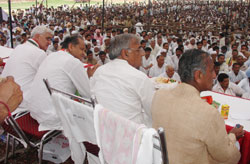 SHAMLI,
Aug 2: The Haryana Chief Minister, Mr Bhupinder Singh
Hooda, has announced that no toll tax would be charged
on scooter, motorcycle and tractor on Karnal-Jhinjhana
tax barrier with immediate effect. Mr Hooda was addressing
a mammoth 'Kisan Majdoor Rally' at village Jhinjhana
near Shamli (Uttar Pradesh) Tuesday evening. The rally
was organised by former MLA, Mr Somansh Parkash. He
urged the people to vote for the Congress party in
the ensuing Assembly elections to get amenities and
facilities at par with the State of Haryana in their
State.
SHAMLI,
Aug 2: The Haryana Chief Minister, Mr Bhupinder Singh
Hooda, has announced that no toll tax would be charged
on scooter, motorcycle and tractor on Karnal-Jhinjhana
tax barrier with immediate effect. Mr Hooda was addressing
a mammoth 'Kisan Majdoor Rally' at village Jhinjhana
near Shamli (Uttar Pradesh) Tuesday evening. The rally
was organised by former MLA, Mr Somansh Parkash. He
urged the people to vote for the Congress party in
the ensuing Assembly elections to get amenities and
facilities at par with the State of Haryana in their
State.  NEW
DELHI, June 15: The Congress has issued show cause notice
to its Haryana MP, Kuldeep Singh Bishnoi, for criticising
the State Government for clearing a Rs 25,000 crore
SEZ project of Reliance Industries Ltd (RIL). Mr Bishnoi,
who is Haryana PCC chief Bhajan Lal's son and is said
to be acting on his father's behest, has been given
two weeks time to reply to the notice.
NEW
DELHI, June 15: The Congress has issued show cause notice
to its Haryana MP, Kuldeep Singh Bishnoi, for criticising
the State Government for clearing a Rs 25,000 crore
SEZ project of Reliance Industries Ltd (RIL). Mr Bishnoi,
who is Haryana PCC chief Bhajan Lal's son and is said
to be acting on his father's behest, has been given
two weeks time to reply to the notice. 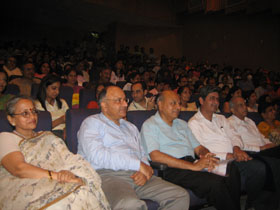
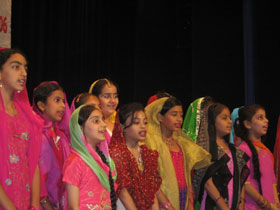
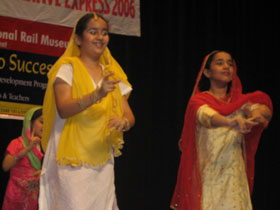
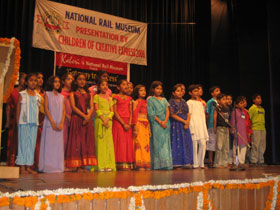
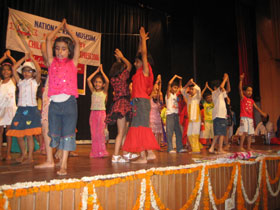
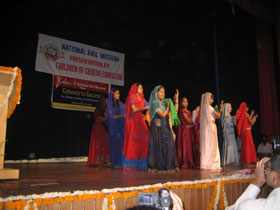
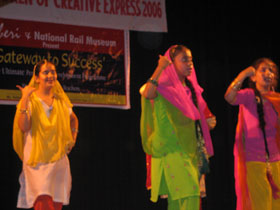
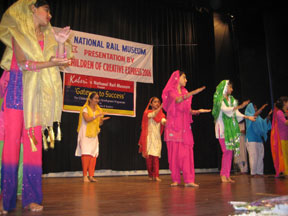
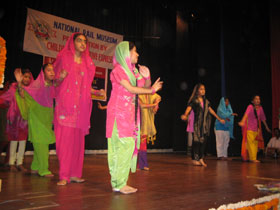
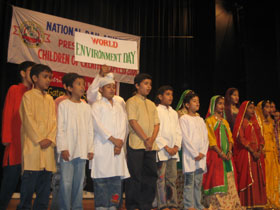
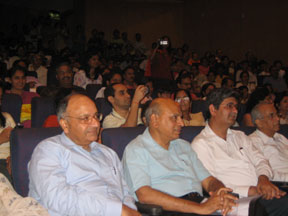


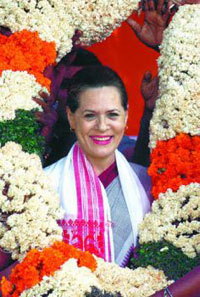 NEW
DELHI, May 26: Apparently concerned over the Opposition
taking credit for the National Rural Employment Guarantee
Scheme (NREGS), the Prime Minister, Dr Manmohan Singh,
and the Congress President, Mrs Sonia Gandhi, on Friday
asked party men to be aggressive in reaching out to the
people to impress upon them that it was a Congress programme.
NEW
DELHI, May 26: Apparently concerned over the Opposition
taking credit for the National Rural Employment Guarantee
Scheme (NREGS), the Prime Minister, Dr Manmohan Singh,
and the Congress President, Mrs Sonia Gandhi, on Friday
asked party men to be aggressive in reaching out to the
people to impress upon them that it was a Congress programme.
 NEW
DELHI, May 26: Haryana Chief Minister Bhupinder Singh
Hooda said on Friday that the National Rural Employment
Guarantee Scheme would prove a milestone in bringing about
a change in the country's rural areas.
NEW
DELHI, May 26: Haryana Chief Minister Bhupinder Singh
Hooda said on Friday that the National Rural Employment
Guarantee Scheme would prove a milestone in bringing about
a change in the country's rural areas.  NEW
DELHI, May 9: When it comes to defending the turf of the
developing nations at World Trade Organisation negotiations
or pitching for Indian pride in Lakshmi Mittal's bid to
take over rival Arcelor, commerce and industry minister
Kamal Nath is India's knight in shining armour.
NEW
DELHI, May 9: When it comes to defending the turf of the
developing nations at World Trade Organisation negotiations
or pitching for Indian pride in Lakshmi Mittal's bid to
take over rival Arcelor, commerce and industry minister
Kamal Nath is India's knight in shining armour. RAE
BAREILI (Uttar Pradesh, India), May 1: Whether it's clambering
on a bullock cart or simply recalling his family's association
with the area, Congress MP Rahul Gandhi has people eating
out of his hands as he campaigns furiously for his mother
Sonia Gandhi in Rae Bareli.
RAE
BAREILI (Uttar Pradesh, India), May 1: Whether it's clambering
on a bullock cart or simply recalling his family's association
with the area, Congress MP Rahul Gandhi has people eating
out of his hands as he campaigns furiously for his mother
Sonia Gandhi in Rae Bareli. NEW
DELHI, May 1: The Taliban claimed yet another Indian on
Sunday, killing and beheading Indian telecom engineer K
Suryanarayana, less than 48 hours after abducting him from
Zabul province on the main highway linking Kabul and Kandahar.
NEW
DELHI, May 1: The Taliban claimed yet another Indian on
Sunday, killing and beheading Indian telecom engineer K
Suryanarayana, less than 48 hours after abducting him from
Zabul province on the main highway linking Kabul and Kandahar.
 HISSAR
(Haryana), March 5: The Haryana Chief Minister, Mr Bhupinder
Singh Hooda, on Sunday announced a group insurance policy
for all adults in the State and promised uninterrupted power
supply in the next three years.
HISSAR
(Haryana), March 5: The Haryana Chief Minister, Mr Bhupinder
Singh Hooda, on Sunday announced a group insurance policy
for all adults in the State and promised uninterrupted power
supply in the next three years.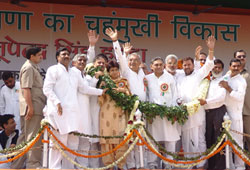 A
jubilant Chief Minister also announced that his Government
would create additional 10 lakh jobs and promised one job
to one member of the family in the next five years. Mr Hooda
also announced number of new initiatives and schemes concerning
girl child, women, education, kisans and Aam Aadmi. Infrastructure
development including uninterrupted electricity and water
were other promises he made much to the delight of the people.
A
jubilant Chief Minister also announced that his Government
would create additional 10 lakh jobs and promised one job
to one member of the family in the next five years. Mr Hooda
also announced number of new initiatives and schemes concerning
girl child, women, education, kisans and Aam Aadmi. Infrastructure
development including uninterrupted electricity and water
were other promises he made much to the delight of the people.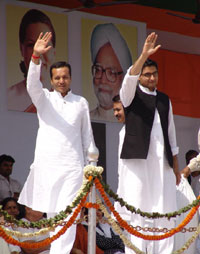 The
Chief Minister listed liberating the state from sense of fear
as the major achievement of the government he formed following
a landslide victory to the Congress party during last year's
assembly polls and was candid in his confession that he has
had limited success in his fight against corruption so far.
The
Chief Minister listed liberating the state from sense of fear
as the major achievement of the government he formed following
a landslide victory to the Congress party during last year's
assembly polls and was candid in his confession that he has
had limited success in his fight against corruption so far.
 NEW
DELHI, Nov 22: India on Monday night virtually rejected Pakistan's idea of 'so-called
self-governance' in Jammu and Kashmir saying while people of the state already
enjoyed autonomy and popular democratic rights which residents of the state's
parts under Pakistan's occupation were deprived of.
NEW
DELHI, Nov 22: India on Monday night virtually rejected Pakistan's idea of 'so-called
self-governance' in Jammu and Kashmir saying while people of the state already
enjoyed autonomy and popular democratic rights which residents of the state's
parts under Pakistan's occupation were deprived of.  NEW
DELHI, Nov 11: The CBI has secured extradition of underworld don and one of the
main accused in 1993 Mumbai serial blasts Abu Salem from Portugal.
NEW
DELHI, Nov 11: The CBI has secured extradition of underworld don and one of the
main accused in 1993 Mumbai serial blasts Abu Salem from Portugal.  SRINAGAR,
Nov 2: Ghulam Nabi Azad was on Wednesday sworn-in as Chief Minister of Jammu and
Kashmir at the head of a 12-member coalition government marking the return of
Congress at the helm of affairs in the state after three decades in a smooth transfer
of power.
SRINAGAR,
Nov 2: Ghulam Nabi Azad was on Wednesday sworn-in as Chief Minister of Jammu and
Kashmir at the head of a 12-member coalition government marking the return of
Congress at the helm of affairs in the state after three decades in a smooth transfer
of power.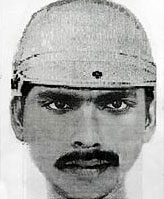 NEW
DELHI, Nov 2: Investigations into the serial blasts in Delhi indicated linkage
of Muzaffarabad in PoK to the incident and Pakistan-based Lashkar-e-Taiba (LeT)
is a strong suspect irrespective of its denial, police sources said on Wednesday.
NEW
DELHI, Nov 2: Investigations into the serial blasts in Delhi indicated linkage
of Muzaffarabad in PoK to the incident and Pakistan-based Lashkar-e-Taiba (LeT)
is a strong suspect irrespective of its denial, police sources said on Wednesday. SRINAGAR,
Nov 2: Congress Legislature Party (CLP) leader Ghulam Nabi Azad will be sworn-in
as the tenth Chief Minister of Jammu and Kashmir on Wednesday, replacing Mufti
Mohammad Sayeed of the PDP at the end of his three-year term.
SRINAGAR,
Nov 2: Congress Legislature Party (CLP) leader Ghulam Nabi Azad will be sworn-in
as the tenth Chief Minister of Jammu and Kashmir on Wednesday, replacing Mufti
Mohammad Sayeed of the PDP at the end of his three-year term.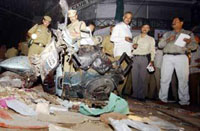 NEW
DELHI, Oct 30: Three deafening blasts rocked crowded shopping centres in India's
Capital on Saturday, three days ahead of the Diwali festival, killing over 55
people and injuring over 150 others, including some foreigners, police said.
NEW
DELHI, Oct 30: Three deafening blasts rocked crowded shopping centres in India's
Capital on Saturday, three days ahead of the Diwali festival, killing over 55
people and injuring over 150 others, including some foreigners, police said. NEW
DELHI, Aug 15: Extending a fresh invitation to anyone interested in dialogue in
Jammu and Kashmir, Prime Minister Manmmohan Singh today made it clear to Pakistan
that the entire infrastructure of terrorism should be "totally dismantled"
as "half-hearted" efforts at curbing terrorists cannot succeed.
NEW
DELHI, Aug 15: Extending a fresh invitation to anyone interested in dialogue in
Jammu and Kashmir, Prime Minister Manmmohan Singh today made it clear to Pakistan
that the entire infrastructure of terrorism should be "totally dismantled"
as "half-hearted" efforts at curbing terrorists cannot succeed.  NEW
DELHI, Aug 15: Paying floral tributes at the Amar Jawan Jyoti at India Gate on
Independence Day today, President A P J Abdul Kalam penned an eloquent ode to
the "alter of heroes" which "spreads the message of sacrifice."
NEW
DELHI, Aug 15: Paying floral tributes at the Amar Jawan Jyoti at India Gate on
Independence Day today, President A P J Abdul Kalam penned an eloquent ode to
the "alter of heroes" which "spreads the message of sacrifice." NEW
DELHI, Aug 14: President A P J Abdul Kalam has ranked energy independence as India's
highest priority which, he said, should be achieved by 2030 as a national mission.
NEW
DELHI, Aug 14: President A P J Abdul Kalam has ranked energy independence as India's
highest priority which, he said, should be achieved by 2030 as a national mission. NEW
DELHI: A group of Indian teachers has returned from a tour of Australia impressed
with teaching practices in Australia. At a meeting hosted by the Australian High
Commission in New Delhi, the participants, who visited Australia under a teachers'
exchange program, shared their experiences and insights gained from their tour.
NEW
DELHI: A group of Indian teachers has returned from a tour of Australia impressed
with teaching practices in Australia. At a meeting hosted by the Australian High
Commission in New Delhi, the participants, who visited Australia under a teachers'
exchange program, shared their experiences and insights gained from their tour.
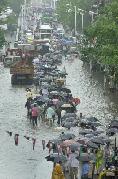 Mumbai,
July 28: The army, navy and air force have been pressed into relief and rescue
efforts as the century's heaviest rains continued to batter Mumbai, Raigad and
parts of Maharashtra's Konkan region claiming more than 900 lives so far.
Mumbai,
July 28: The army, navy and air force have been pressed into relief and rescue
efforts as the century's heaviest rains continued to batter Mumbai, Raigad and
parts of Maharashtra's Konkan region claiming more than 900 lives so far. New
Delhi, July 6: After a long time in the backburner, the volatile Ayodhya temple-mosque
issue jumped back into public focus with Tuesday's terror attack uniting a fractious
Hindu right and galvanising them into activity.
New
Delhi, July 6: After a long time in the backburner, the volatile Ayodhya temple-mosque
issue jumped back into public focus with Tuesday's terror attack uniting a fractious
Hindu right and galvanising them into activity. NEW
DELHI, July 4: India's domestic information technology industry is forecast to
grow a compounded 20 per cent through 2009 as firms increase efficiency through
computerisation, research firm Gartner said on Monday.
NEW
DELHI, July 4: India's domestic information technology industry is forecast to
grow a compounded 20 per cent through 2009 as firms increase efficiency through
computerisation, research firm Gartner said on Monday.  BOMBAY:
A British national accused of sexually abusing boys at a shelter in Bombay was
remanded to police custody on Thursday after he gave himself up, ending a three-year
global hunt by Indian authorities and Interpol.
BOMBAY:
A British national accused of sexually abusing boys at a shelter in Bombay was
remanded to police custody on Thursday after he gave himself up, ending a three-year
global hunt by Indian authorities and Interpol.  MUZAFFARNAGAR:
About 200 women protested outside a city court on Thursday against a religious
order prohibiting a rape victim from living with her husband after she was raped
by her father-in-law.
MUZAFFARNAGAR:
About 200 women protested outside a city court on Thursday against a religious
order prohibiting a rape victim from living with her husband after she was raped
by her father-in-law.  NEW
DELHI: India has said that it has received the application of controversial Pakistan
Information Minister Sheikh Rashid Ahmed for travelling to Jammu and Kashmir by
the Srinagar-Muzaffarabad bus.
NEW
DELHI: India has said that it has received the application of controversial Pakistan
Information Minister Sheikh Rashid Ahmed for travelling to Jammu and Kashmir by
the Srinagar-Muzaffarabad bus.  SRINAGAR,
June 13: At least 21 persons were killed and scores injured in an explosion in
Pulwama town of Jammu and Kashmir on Monday. The explosion took place near the
post office of the town, which is the district headquarter.
SRINAGAR,
June 13: At least 21 persons were killed and scores injured in an explosion in
Pulwama town of Jammu and Kashmir on Monday. The explosion took place near the
post office of the town, which is the district headquarter. NEW
DELHI, June 7: In a surprise move, BJP chief LK Advani submitted his resignation
letter to the party General Secretary on Tuesday. The resignation comes a day
after the top RSS brass took exception to his controversial remarks on Pakistan
founder leader Mohammad Ali Jinnah and asked him to withdraw his statement, which
he refused to do.
NEW
DELHI, June 7: In a surprise move, BJP chief LK Advani submitted his resignation
letter to the party General Secretary on Tuesday. The resignation comes a day
after the top RSS brass took exception to his controversial remarks on Pakistan
founder leader Mohammad Ali Jinnah and asked him to withdraw his statement, which
he refused to do. MUMBAI,
May 25: Veteran Bollywood actor and Union Minister for Sports Sunil Dutt died
of a heart attack in Mumbai on Wednesday. He was 75. He is survived by his son,
actor Sanjay Dutt, daughters Namrata and Priya, sons-in-law and grandchildren.
MUMBAI,
May 25: Veteran Bollywood actor and Union Minister for Sports Sunil Dutt died
of a heart attack in Mumbai on Wednesday. He was 75. He is survived by his son,
actor Sanjay Dutt, daughters Namrata and Priya, sons-in-law and grandchildren. NEW
DELHI, May 24: Keeping cards close to his chest, LJP Chief and Union Minister
Ram Vilas Paswan, on Tuesday declined to spell out his strategy for the Bihar
Assembly elections and said it was for the Congress to decide on having electoral
ties with UPA partners.
NEW
DELHI, May 24: Keeping cards close to his chest, LJP Chief and Union Minister
Ram Vilas Paswan, on Tuesday declined to spell out his strategy for the Bihar
Assembly elections and said it was for the Congress to decide on having electoral
ties with UPA partners.  NEW
DELHI, May 23: India was on high alert on Monday a day after bombs tore through
two cinemas in the capital showing a film considered offensive by some Sikhs.
As police hunted the bombers, another small blast on Monday wounded one person
in Delhi, where Sikh separatists carried out a wave of bombings in the 1980s.
NEW
DELHI, May 23: India was on high alert on Monday a day after bombs tore through
two cinemas in the capital showing a film considered offensive by some Sikhs.
As police hunted the bombers, another small blast on Monday wounded one person
in Delhi, where Sikh separatists carried out a wave of bombings in the 1980s.


Aviation
| Business | Defence | Foreign
Affairs | Communication | Health
| India | United Nations
India-US
| India-France | Entertainment
| Sports | Photo Gallery |
Tourism | Advertise with Us
| Contact Us
© Noyanika International, 2003-2009. All rights reserved.