


United Nations
|
UN chief Antonio Guterres calls for end to attacks on shipping, warns maritime disruptions threaten global food supplyBy Deepak Arora
Speaking with newspersons here on Monday, Guterres said conflicts in different regions were increasingly converging in their impact on the world's most vulnerable populations, with disruptions to maritime traffic restricting the movement of energy, fertilizers, grain and other essential commodities. "In the Strait of Hormuz alone, transits have come to a near standstill," he said, adding that oil prices had risen by about 33 per cent since the start of the conflict, while global container rates were 84 per cent higher than a year earlier. He warned that rising costs of fertilizers and other agricultural inputs could further weaken harvests and intensify food insecurity. "These crises are choking arteries of global trade and squeezing the global food system especially hard," the UN chief said. "The result is clear: higher prices, deepening hunger, weaker harvests, and greater suffering – especially for the world's most vulnerable people." Guterres stressed that navigational rights and freedoms were not merely abstract principles but obligations under international law and essential to international peace and security. He called for full respect for international law, including the law of the sea and international humanitarian law; protection of civilian shipping, infrastructure and seafarers; and an immediate halt to attacks on commercial vessels and civilian infrastructure. He also called for the restoration of navigational rights and freedoms in the Strait of Hormuz and an end to attacks on shipping in the Red Sea and around Bab al-Mandab. "Maritime chokepoints must never become instruments of coercion. And the world's food supply must never become collateral damage of conflict," he said. Guterres said the UN had been working on a practical mechanism aimed initially at facilitating the movement of fertilizers and related raw materials through areas affected by the Strait of Hormuz crisis. He said he established a task force in March, led by the Executive Director of the UN Office for Project Services (UNOPS), and includes the UN Conference on Trade and Development (UNCTAD), the International Maritime Organization and the International Chamber of Commerce. "They have worked with others to develop a practical and time-bound confidence-building mechanism focused initially on fertilizers and related raw materials -- but with the ability to be extended to other products." The proposed mechanism would focus on registration and verification of ships carrying fertilizers and related products, as well as monitoring and deconfliction arrangements. Guterres said the mechanism would not authorize passage through the Strait of Hormuz or change the rights and obligations of states under international law. "Sovereign decisions remain entirely with participating Member States," he said, adding that the UN would act as a neutral facilitator. According to the Secretary-General, the mechanism is designed to reduce immediate risks, promote more predictable transit and help rebuild confidence needed for diplomacy and de-escalation. "It can be operationalized quickly," he said, noting that international support for the initiative had been encouraging, particularly from vulnerable countries. Responding to questions from reporters, Guterres said UNOPS had been in "intense contacts" with all countries involved to explore the implementation of the mechanism. "We have everything ready to do it," he said, while stressing that the arrangement could operate only if all parties to the conflict agreed to participate. He said the mechanism would include the registration, verification and monitoring of vessels, with a deconfliction arrangement based in Oman, to help ensure that essential products could move without impediment. Asked whether the UN had already discussed the proposal with the parties, Guterres said all parties involved had detailed knowledge of how the mechanism would work. Addressing a question about claims by Iran's Islamic Revolutionary Guard Corps that it controls the Strait of Hormuz, Guterres reiterated the UN's position that freedom of navigation must be respected "in all circumstances." He said that if full freedom of navigation could not immediately be exercised, the UN would be prepared, with the agreement of the parties, to operate a mechanism that would not infringe on the sovereign rights of states. Guterres emphasized that such an arrangement would require the sovereign agreement of the states involved. He stressed that the proposed mechanism was not a substitute for restoring navigational rights and freedoms or for finding political solutions to the conflicts. "But it is a practical first step," he said, arguing that it could demonstrate that even during conflict, it was possible to reduce risks, protect civilians and safeguard the movement of essential goods. "The unimpeded exercise of navigational rights and freedoms is a cornerstone of peace, security and shared prosperity and must be respected," Guterres said. "Protecting it is a legal obligation and a humanitarian imperative." He warned that continued disruption would mean deeper mistrust and mounting hardship for people well beyond the regions directly affected by the conflicts. |
|
||||||
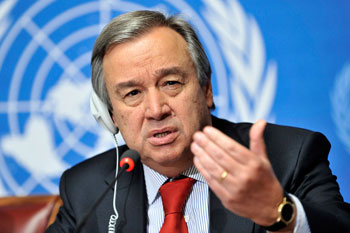 UNITED NATIONS, Aug 24: UN Secretary-General António Guterres has called for an immediate end to attacks on commercial shipping and civilian infrastructure in the Strait of Hormuz, the Black Sea, Red Sea and around Bab al-Mandab, warning that disruptions at key maritime chokepoints are driving up prices, worsening hunger and putting the global food system under severe pressure.
India-US | India-France | Entertainment | Sports | Photo Gallery | Tourism | Link Partners | Contact Us
© Noyanika International, 2003-2024. All rights reserved.