


United Nations
|
Grynspan Leads First UN Security Council Straw Poll for Next Secretary-GeneralBy Deepak Arora
Grynspan received 10 “encourage” votes, one “discourage” and four “no opinion” votes, putting her ahead of Guyana’s Carolyn Rodrigues Birkett, who secured nine “encourage”, two “discourage” and four “no opinion” votes. Argentina’s Rafael Grossi finished third with seven “encourage”, two “discourage” and six “no opinion” votes. Former Chilean President Michelle Bachelet came fourth with six “encourage”, five “discourage” and four “no opinion” votes. She was followed by former Senegalese President Macky Sall, who received six “encourage”, seven “discourage” and two “no opinion” votes. Ecuador’s María Fernanda Espinosa secured five “encourage”, two “discourage” and eight “no opinion” votes, while Ugandan diplomat Olara Otunnu finished last with two “encourage”, five “discourage” and eight “no opinion” votes. The results provide the first numerical picture of the contest to replace António Guterres, whose second five-year term ends on December 31, 2026. The straw poll is informal and non-binding. Council members anonymously indicate whether they encourage or discourage each candidate, or have no opinion. The first round does not reveal which countries cast the individual votes, including whether opposition came from one of the five permanent members, China, France, Russia, the United Kingdom or the United States. That distinction is important because any one of the permanent members can block a formal recommendation through its veto. US Ambassador Mike Waltz said after Thursday's vote that the process was now underway and that Council discussions would remain confidential. He also stressed the need for the next Secretary-General to push reforms aimed at making the UN more efficient and effective. Zénon Mukongo Ngay, the Security Council president for July, confirmed that the first round had been completed. The results were to be conveyed to the countries that nominated the candidates and to the President of the General Assembly, rather than announced publicly by the Council. A strong performance in the early polls can help establish momentum, while a combination of weak support and several “discourage” votes can put a campaign under pressure. There is no formal requirement for a candidate to withdraw, however. The seven candidates are competing for a post that will inherit a UN facing multiple challenges, including conflicts, financial pressures and growing calls for institutional reform. The next Secretary-General will ultimately require at least nine votes in the Security Council and no veto from any permanent member. The successful candidate is then formally appointed by the 193-member General Assembly. Security Council to Begin Informal Polling for Next UN Secretary-GeneralBy Deepak Arora UNITED NATIONS, July 29: The closely watched race to succeed António Guterres as the next Secretary-General of the United Nations enters a crucial phase on Thursday, with the Security Council set to conduct its first informal straw poll to assess the standing of seven candidates. The closed-door exercise will provide the first indication of where the 15-member Council stands on the contenders seeking to lead the world body from next year. The candidates are from Argentina, Chile, Costa Rica, Ecuador, Guyana, Senegal and Uganda. Guterres, who has served two five-year terms as Secretary-General, is due to step down at the end of the year. There is no clear favourite at this stage, and diplomats expect the selection process to involve several rounds of consultations and informal voting before the Council eventually settles on a candidate. The next UN chief will take charge at a particularly difficult time for the organisation. The United Nations is facing pressure to reform its working methods, reduce costs and tackle duplication across its numerous agencies. At the same time, the organisation's role and influence are being questioned amid a series of major international conflicts and crises. The current field includes some prominent figures from international diplomacy and national politics. Argentina's Rafael Grossi, head of the UN nuclear watchdog, is seeking the post after several years in the spotlight over global nuclear security. Former Chilean President Michelle Bachelet brings extensive experience in national government and international affairs. Rebeca Grynspan, former Vice President of Costa Rica, has held several senior international positions and has worked extensively on economic and development issues. Former Ecuadorian Foreign Minister María Fernanda Espinosa, who also served as president of the UN General Assembly, is another experienced contender. Guyana's former Foreign Minister Carolyn Rodrigues-Birkett is campaigning for the post, while former Senegalese President Macky Sall brings experience as a national leader and regional statesman. The most recent addition to the race is Ugandan diplomat Olara Otunnu, who entered the contest last week. The field could still expand, as additional candidates are permitted to enter before the selection process is completed. The first straw poll is an informal and non-binding exercise. Council members will indicate whether they “encourage” or “discourage” each candidate, or have “no opinion”. The voting takes place in private, with only Council members present. The purpose is to give diplomats an early sense of the level of support and opposition facing each candidate. The initial rounds are particularly significant because they do not reveal the individual positions of the five permanent members of the Council. China, France, Russia, the United Kingdom and the United States have veto power. A candidate may therefore receive considerable support in the overall poll but still face a serious hurdle if one of the permanent members is opposed. In the early rounds, permanent and elected members use identical ballots, meaning the results show the overall number of “encourage” and “discourage” votes without identifying their source. That changes at a later stage. The five permanent members use a different-coloured ballot, allowing diplomats to determine whether a candidate has received a “discourage” vote from one of the veto-holding powers. The first straw poll is unlikely to produce a clear winner. Previous UN Secretary-General selections have involved repeated rounds of informal voting as candidates attempt to build support and overcome opposition. The process could continue through the summer and into September or early October. If the Council fails to develop a consensus around a candidate, the search could take even longer. Once the Council agrees on a candidate, it will adopt a resolution recommending that person to the 193-member General Assembly. The recommendation requires at least nine votes in the Council and, crucially, no veto from any of the five permanent members. The General Assembly then formally appoints the Secretary-General. In practice, its approval has traditionally followed the Security Council's recommendation. The Democratic Republic of the Congo, which currently holds the Council presidency, has confirmed that the first straw poll will take place on Thursday morning. The country's UN Ambassador, Zenon Mukongo Ngay, told reporters on Tuesday that the informal voting would go ahead as scheduled. For now, the first ballot will be less about choosing the next Secretary-General and more about establishing the political landscape. The results will show which candidates have an initial base of support, who faces resistance and who may need to rethink their campaign. With no obvious frontrunner, the contest for the UN's top diplomatic post is likely to be a long one. UN says no legal basis for Hormuz transit tollUNITED NATIONS, July 13: The International Maritime Organisation is against charging feeds for any strait used for international navigation, its spokesperson said. The UN shipping agency said it is awaiting further details on the comment made by US President Donald Trump regarding America charging 20 per cent for cargo shipping through Hormuz. The spokesperson said there was no legal basis for introducing mandatory tolls for transit through a strait. UN chief expresses concern over military escalation in West AsiaUNITED NATIONS, July 13: United Nations Secretary-General Antonio Guterres has raised concern regarding the renewed escalation of military confrontation in West Asia. Guterres expressed “deep concern at the serious escalation of renewed military confrontation in the Gulf region, including Iranian attacks on ships on the Strait of Hormuz, attacks by the United States on the Islamic Republic of Iran, and attacks by Iran on targets in neighboring countries”, his spokesperson Stephane Dujarric said. UN chief urges de-escalation, renewal of talks as Iran fighting flaresUNITED NATIONS, July 8: United Nations Secretary-General Antonio Guterres called Wednesday for de-escalation and a resumption of talks, his spokesman said, as fighting between Iran and the United States flared once more. "The secretary-general calls on all parties to exercise maximum restraint, avoid any further escalatory action, and take immediate steps to de-escalate," Guterres's spokesman Stephane Dujarric said at a briefing. |
|
||||||
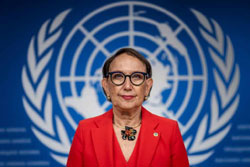 UNITED NATIONS, July 30: Costa Rica’s Rebeca Grynspan emerged as the early frontrunner in the race to become the next UN Secretary-General, securing the strongest showing in the first informal Security Council straw poll held behind closed doors on Thursday.
India-US | India-France | Entertainment | Sports | Photo Gallery | Tourism | Link Partners | Contact Us
© Noyanika International, 2003-2024. All rights reserved.