


United Nations
|
Rodrigues Birkett Leads Second UN Straw Poll as Secretary-General Race TightensBy Deepak Arora
Rodrigues Birkett received 8 “encourage” votes, 3 “discourage” votes and 4 “no opinion” votes from the 15 members of the Security Council. Grynspan, who led the first straw poll, received 7 “encourage” votes, 4 “discourage” votes and 4 “no opinion” votes in the second round. The shift is significant. Grynspan had received 10 “encourage” votes in the first poll, while Rodrigues Birkett had received nine. Both candidates have lost some support, but Rodrigues Birkett has now moved into first place. Argentina’s Rafael Grossi also received 7 “encourage” votes, putting him level with Grynspan. His result comes with a significant downside, however. Six Council members marked him “discourage”, giving him one of the highest levels of opposition among the leading candidates. The results point to a contest that remains wide open. Former Senegalese President Macky Sall received 6 “encourage” votes and 7 “discourage” votes, with two members giving no opinion. His six positive votes show that he retains a substantial base of support, but the seven negative votes make his position more difficult. Olara Otunnu recorded an evenly divided result, with 5 “encourage”, 5 “discourage” and 5 “no opinion” votes. His numbers suggest that he has neither built a clear coalition nor attracted overwhelming opposition. María Fernanda Espinosa received 4 “encourage” votes, 3 “discourage” votes and 8 “no opinion” votes. The eight members who have not taken a position leave her with some potential to gain support in future rounds. The picture is considerably tougher for former Chilean President Michelle Bachelet. She received just 2 “encourage” votes, compared with 6 “discourage” votes and 7 “no opinion” votes. Her support has fallen sharply from the first poll, when she received six positive votes. Ivonne A-Baki recorded the weakest result. She received no “encourage” votes, while eight members marked her “discourage” and seven gave no opinion. Rodrigues Birkett's result strengthens her position as one of the principal contenders for the job. Her eight positive votes are one fewer than in the first poll, but she has maintained a relatively low level of opposition, with three “discourage” votes. That gives her an important advantage over several rivals. Grynspan remains close behind and is still a serious contender. Her seven positive votes give her a strong base, while her four negative votes are manageable compared with the opposition faced by Grossi and Sall. Grossi's position is more complicated. Seven Council members are encouraging his candidacy, but six are opposed. His challenge will be to persuade some of those opposed to move to a neutral or supportive position in the next stages. For Sall, the seven “discourage” votes could prove particularly difficult unless he can broaden his support. The straw poll is informal and does not decide who becomes Secretary-General. Council members indicate whether they encourage or discourage each candidate, or have no opinion. The exercise is intended to show where support and opposition stand before the process moves toward a formal decision. One crucial detail is not visible in the second poll. The results do not identify which individual Council members cast the votes. That is particularly important because China, France, Russia, the United Kingdom and the United States are permanent members of the Security Council and have veto power. A candidate can therefore perform well in an overall straw poll and still face a major obstacle if one of the permanent members opposes their candidacy. The second straw poll has produced a clearer hierarchy at the top, but no candidate has established a commanding lead. Rodrigues Birkett now sits first, followed closely by Grynspan and Grossi. Sall remains within reach, although his seven negative votes are a concern. Otunnu and Espinosa have room to build support, while Bachelet and A-Baki face a much harder task. Grynspan will be looking to recover the support she lost since the first poll. Grossi will need to reduce the opposition to his candidacy. Rodrigues Birkett, meanwhile, will be trying to turn her narrow lead into broader support. The eventual choice will be made through the Security Council's recommendation to the 193-member General Assembly. António Guterres is due to complete his second term as Secretary-General at the end of December 2026. For now, the second straw poll has changed the dynamics of the contest. Grynspan is no longer the clear front-runner. Rodrigues Birkett has moved into first place, Grossi remains in the race, and the field is still far from settled. |
|
||||||
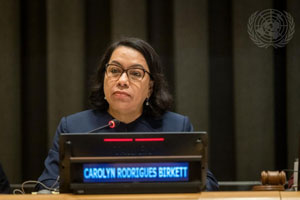 UNITED NATIONS, Aug 22: Guyana’s Carolyn Rodrigues Birkett has emerged as the leading candidate in the second informal UN Security Council straw poll for the next Secretary-General, edging ahead of Costa Rica’s Rebeca Grynspan as the race begins to take a more competitive shape.
India-US | India-France | Entertainment | Sports | Photo Gallery | Tourism | Link Partners | Contact Us
© Noyanika International, 2003-2024. All rights reserved.