UN says Security Council reforms in hands of Member States as Jaishankar renews call for better UN
By Deepak Arora
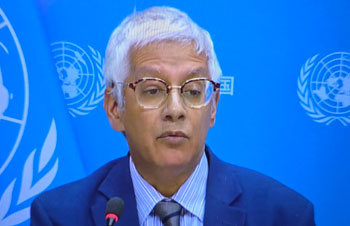 UNITED NATIONS, Oct 5: UN Deputy Spokesperson Farhan Haq said Monday that reform of the Security Council is ultimately in the hands of Member States, after India’s External Affairs Minister S. Jaishankar renewed his criticism of an increasingly ineffective UN and called for a "better UN.”
Haq was responding to questions at the Secretary-General’s daily briefing about Jaishankar’s remarks that the UN has failed to keep pace with a rapidly changing world.
Jaishankar had pointed out that the United Nations was created with 51 members and has now grown to almost four times that number. Keeping the same “board of management,” he said, was no longer workable.
“If you have grown four times and you want to keep the old board of management, it is not going to work,” Jaishankar said.
But he also made clear that India was not arguing for the UN to be abandoned.
“We need a better UN,” Jaishankar said. “We don't need no UN. The idea is not to throw away the UN, but to fix the UN.”
Asked about those comments, Haq said Secretary-General António Guterres has himself repeatedly called for changes to the Security Council to reflect the expansion of the UN’s membership.
“The Secretary-General himself has been on record about exactly the topic that you mentioned,” Haq said.
He said the Security Council needs to be expanded and made “more reflective of the membership as a whole.” Guterres has also specifically called for African representation among the Council’s permanent members.
But Haq stressed that the UN Secretariat cannot make those changes on its own.
“These are all steps, ultimately, under the United Nations Charter that can only be accomplished by the Member States themselves,” he said.
The issue was particularly relevant to India, which has been seeking a permanent seat on the Security Council and has repeatedly called for the body to be made more representative of today’s global realities.
Jaishankar had also met Guterres during the high-level UN General Assembly session last week. Asked about that meeting, Haq said the two discussed “issues of mutual concern.”
Haq added that Guterres has been appreciative of India’s support for the work of the United Nations and has been kept informed about India’s leadership of the BRICS grouping.
The briefing then turned to one of the most difficult issues facing Security Council reform. Jaishankar had said that “a few players” were resistant to reform, without naming them.
Asked what the UN could do if some countries continued to block changes, Haq said the Secretariat could only press governments to recognize the need for reform.
“From our standpoint, all we can really do is emphasize to nations what the need for reform is,” he said.
“But obviously, we don't control the governments of Member States.”
Haq pointed back to the UN Charter, saying it makes clear that responsibility for amendments rests with the Member States. “It is in their hands,” he said, while urging countries to move forward and warning of “the consequences of inaction.”
Pressed on whether resistance by some members meant that the current gridlock would simply continue, Haq was equally direct. “That is something that we could not change,” he said.
He again stressed that both the General Assembly and the Security Council members have a role in any Charter reform.
The exchange brought into sharp focus the gap between the growing calls for a more representative UN and the political reality of changing its structure.
For India, Jaishankar’s message was clear. The answer is not to walk away from the United Nations, but to make it work better.
For the UN Secretariat, Haq made clear that the case for reform can be argued, encouraged and pressed. The final decision, however, belongs to the countries that make up the organization.


