


United Nations
|
UN chief António Guterres calls for end to attacks on shipping, warns maritime disruptions threaten global food supplyBy Deepak Arora
Third UNSC Straw Poll To Select Next Secretary General on Sept 18By Deepak Arora UNITED NATIONS, Sept 5: The third informal UN Security Council straw poll to select the next Secretary General is expected on September 18. And the fourth straw poll is possibly on September 28 or 29, Pass Blue reported this on X quoting diplomats. Revising the schedule from September 17, Pass Blue stated that that UNSC intends to rechedule the next straw poll to Friday, September 18, per diplomats. It may be recalled that Guyana’s Carolyn Rodrigues Birkett had emerged as the leading candidate in the second informal UN Security Council straw poll for the next Secretary-General, edging ahead of Costa Rica’s Rebeca Grynspan as the race begins to take a more competitive shape. Rodrigues Birkett received 8 “encourage” votes, 3 “discourage” votes and 4 “no opinion” votes from the 15 members of the Security Council. Grynspan, who led the first straw poll, received 7 “encourage” votes, 4 “discourage” votes and 4 “no opinion” votes in the second round. The shift is significant. Grynspan had received 10 “encourage” votes in the first poll, while Rodrigues Birkett had received nine. Both candidates have lost some support, but Rodrigues Birkett has now moved into first place. Argentina’s Rafael Grossi also received 7 “encourage” votes, putting him level with Grynspan. His result comes with a significant downside, however. Six Council members marked him “discourage”, giving him one of the highest levels of opposition among the leading candidates. The straw poll is informal and does not decide who becomes Secretary-General. Council members indicate whether they encourage or discourage each candidate, or have no opinion. The exercise is intended to show where support and opposition stand before the process moves toward a formal decision. One crucial detail is not visible in the second poll. The results do not identify which individual Council members cast the votes. That is particularly important because China, France, Russia, the United Kingdom and the United States are permanent members of the Security Council and have veto power. A candidate can therefore perform well in an overall straw poll and still face a major obstacle if one of the permanent members opposes their candidacy. The second straw poll has produced a clearer hierarchy at the top, but no candidate has established a commanding lead. |
|
|||
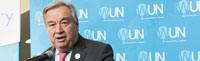 UNITED NATIONS: UN Secretary-General António Guterres has called for an immediate end to attacks on commercial shipping and civilian infrastructure in the Strait of Hormuz, the Black Sea, Red Sea and around Bab al-Mandab, warning that disruptions at key maritime chokepoints are driving up prices, worsening hunger and putting the global food system under severe pressure. Speaking with newspersons here on Monday, Guterres said conflicts in different regions were increasingly converging in their impact on the world's most vulnerable populations, with disruptions to maritime traffic restricting the movement of energy, fertilizers, grain and other essential commodities.

India-US | India-France | Entertainment | Sports | Photo Gallery | Tourism | Link Partners | Contact Us
© Noyanika International, 2003-2024. All rights reserved.