| |
MH370 hunt: Australian navy ship picks new signals
PERTH, April 7: An Australian navy ship has detected new signals 'consistent' with aircraft black boxes, a senior official said Monday as the hunt for missing Malaysian flight MH370 went on.
"The towed pinger locator deployed from the Australian defence vessel Ocean Shield has detected signals consistent with those emitted from aircraft black boxes," Angus Houston, the former Australian defence chief who is leading the search coordination body, said, emphasising that further confirmation was needed.
Some planes and ships searching for a missing Malaysia Airlines jetliner in the Indian Ocean moved on Monday toward waters where a Chinese vessel had picked up "ping" signals at the weekend, raising hopes of finding the airliner's black-box recorders.
The black boxes, thought be to lying on the ocean floor, are equipped with locator beacons that send pings on the same frequency as those detected by the Chinese naval ship, but the beacons' batteries are thought to be running out by now, a month after Flight MH370 disappeared.
"We are running out of time in terms of terms of the battery life," Retired Air Chief Marshal Angus Houston, head of the Australian agency coordinating the operation, told a news conference in Perth on Sunday.
The black boxes record cockpit data and may provide answers about what happened to the plane, which was carrying 227 passengers and 12 crew when it vanished off radar on March 8 and flew thousands of km off its Kuala Lumpur-to-Beijing route.
Chinese patrol ship Haixun 01 reported receiving a pulse signal with a frequency of 37.5 kHz, consistent with the signal emitted by flight recorders, on Friday and again on Saturday.
"The 37.5kHz is the specific frequency that these locator pingers operate on," said Anish Patel, president of Sarasota, Florida-based Dukane Seacom, which made the black box locator.
"It's a very unique frequency, typically not found in background ocean noise," such as whales or other marine mammals, he said.
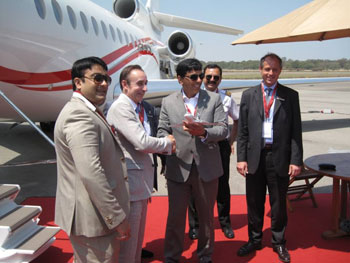 Club One Air takes delivery of Falcon 2000 Club One Air takes delivery of Falcon 2000
By Deepak Arora
HYDERABAD, March 19:
Club One Air became the latest member of the Falcon family in India by taking delivery of a Falcon 2000 at the Hyderabad Indian Aviation Show.
This is the first of the three pre-owned Falcon 2000 aircraft that have been purchased by Club One Air.
The other two will also be delivered over the next few weeks.
Welcoming Club One Air to the Falcon family, Mr. Thierry de Poncins said, “Club One Air had been considering the Falcon for the last few months and they found the 2000 to be the best fit for their charter operations."
 He added that “The Falcon 2000 is cost efficient and is already performing well in India. This selection was quite natural!” He added that “The Falcon 2000 is cost efficient and is already performing well in India. This selection was quite natural!”
“We are very pleased to welcome such a reputable aviation player within our Falcon family,” said Thierry de Poncins.
Bhupesh Joshi, CEO, Club One Air on receiving the aircraft said, “We are extremely pleased to be joining the Falcon family."
Joshi said "we are sure that the Falcon 2000 will be a huge asset to our fleet and our business. We are looking forward to the expansion of our operations with the addition of the three Falcon 2000 into our fleet.”
Dassault Aviation Bullish on Future of Indian Bizjet Market
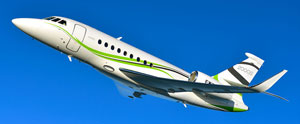 SAINT-CLOUD (France), March 7: Dassault Aviation will present its Falcon fleet of large cabin, long range business jets at India Aviation, India’s biggest civilian air show. SAINT-CLOUD (France), March 7: Dassault Aviation will present its Falcon fleet of large cabin, long range business jets at India Aviation, India’s biggest civilian air show.
The fourth edition of this prestigious event, which opens on March 12 at Hyderabad Begumpet Airport, will feature Dassault’s 5,950 nm /11,000 km range Falcon 7X trijet, the first business jet certified with a fully-digital flight control system.
Dassault is the Indian market leader for large cabin, long range aircraft, with 22 aircraft currently in service and several more on order. Most of the new aircraft orders are for the longest range Falcon models, capable of flying non-stop to London City Airport from anywhere in India.
The Falcon 2000 twinjet is also popular among Indian customers. Two newly introduced versions, the 3,350 nm / 6,200 km 2000S and the 4,000 nm / 7,000 km 2000LXS, will offer takeoff and landing performance unparalleled among wide body jets - comparable to much smaller midsize and super midsize models. Like the 7X and the long range Falcon 900LX, the 2000S and LXS were recently approved for operation at London City.
Dassault also anticipates a warm reception in India for its brand new 5,200 nm / 9,630 km Falcon 5X which will offer the largest cabin cross-section of any business jet and the lowest ownership and operating costs in its class. Initial Indian orders for the large body twinjet are expected this year. The 5X is expected to make its first flight in the first quarter of next year with certification planned at the end of 2016.
“We see improving signs of the Indian market which has been slow recently” remarked Gilles Gautier, Vice president Falcon Sales for Europe, the Middle East and Africa. “India has a real need for expanding business aviation, and we remain bullish about future market prospects.”
Because of their exceptional efficiency and flexibility, Falcons are very popular with Indian operators, particularly in the corporate and charter markets. Their unparalleled operating economy and their ability to combine short and long haul flights and fly out of short hard-to-reach airstrips with full range performance - even at high altitudes and high temperature conditions - make them perfect for local conditions. Lower operating expenses and traditional higher resale values make Falcon ownership costs a real competitive advantage.
The flagship 7X, with its large cabin and advanced systems, largely derived from military aircraft, is particularly prized by Indian customers. Its ultra quiet roomy interior, available with a shower option, allows passengers to disembark fresh and relaxed after a 13-hour flight. And its London City Airport rating can shave two hours off a typical London business trip.
The first Indian Falcon 7X was acquired by Ligare, the biggest Indian Falcon operator. The aircraft has been used since 2010 for Ligare’s charter operations.
“Dassault has been part of the Indian aviation market for more than 60 years, initially in the military domain,” notes Gautier. Our customers understand the benefits that fighter technology brings to business aviation. Soon we will celebrate the 20th anniversary of our first Falcon delivery in India, a Falcon 200 to the Tata group in 1995.”
Indian Falcon operators can also rely on a growing regional servicing and spares network. After beefing up its local representation and support office in Delhi, Dassault recently added a second authorized support facility in Mumbai, in cooperation with Tata affiliate Taj Air, and further partnerships are contemplated.
The Taj Air shop services Falcon 2000 and 2000DX/EX/LXS models. Dassault’s other Indian authorized support facility, Mumbai-based Air Works India, handles 900EX/LX aircraft.
The network, which includes spares warehouses in Mumbai and Chennai, is backed up by offshore facilities in Dubai, Singapore and Paris. Pilot training is available at CAE in Dubai and technical training may soon be offered there as well.
|
|
advertisements

|


