


BUSINESS
|
GST collection falls further to 80,808 cr in NovemberNEW DELHI, Dec 26: The Goods and Services Tax (GST) collection in November fell further down to 80,808 crore from 83,346 crore in October, according to official data released on Tuesday. “The total collection under the GST for November has been ?80,808 crore till December 25, 2017,” the government said. “99.01 lakh taxpayers have been registered under the GST till December 25, of which 16.60 lakh are composition dealers who are required to file returns every quarter. 53.06 lakh returns have been filed for November till December 25.” The government collected 92,283 crore in July, 90,669 crore in August, and 92,150 crore in September. Of the 80,808 crore collected in November, 13,089 crore is under the Central GST (CGST), 18,650 crore under the State GST (SGST), 41,270 crore under the Integrated GST (IGST) and 7,798 crore from the compensation cess. Tax experts say the fall in the collection is along expected lines, due in part to the large number of rate reductions that came into effect on November 15. They reckon that the collection will improve from January. “The dip in collection for November is on expected lines, as the rates of over 175 items were reduced from November 15 and refunds to exporters started recently,” Pratik Jain, leader, Indirect Tax, at PwC India, said in a press note. “Even for December, there could be an impact of the opening credit claim for which the last date is December 27. From January, the collection should stabilise.” “There are reasons. First, the reduction of rate and the second, utilisation of credits,” Abhishek A. Rastogi, Partner, Khaitan & Co., said. “The right number will be reflected in the last quarter of 2017-18, or maybe the first quarter of the next financial year. The reduction was expected, and the government had done these calculations. It is hoped that the level of compliance improves further so that the revenue is back on track.” Others point to more systemic problems in the GST implementation, highlighting that the GST Council had deferred the filing of the GSTR-2 and GSTR-3 forms, and taxfilers were wary of the GST Network portal, which had been hit by glitches initially. “The government has suspended GSTR-2 and GSTR-3 owing to the difficulties in invoice-matching and the date for GSTR-1 has been extended several times,” said Ansh Bhargava, head, Growth & Strategy, Taxmann. “These extensions granted by the government have caused a negative message in the minds of taxpayers that due to the technical glitches, the GST Network is not ready to keep a check of faulty taxpayers.” Mr. Bhargava said that since the simplified GSTR-3B form was on the basis of self-assessment, businesses might not report accurate figures, and this could have contributed to the lower collection. Mere 1.7% Indians paid income tax in AY 2015-16NEW DELHI, Dec 24: Just over 2 crore Indians, or 1.7 per cent of the total population, paid income tax in the assessment year (AY) 2015-16, according to data released by the I-T department. The number of income-tax return filers increased to 4.07 crore in the assessment year 2015-16 (FY 2014-2015) from 3.65 crores in the previous year but only 2.06 crore actually paid tax as the others claimed income below taxable limits. In the previous AY 2014-15, 1.91 crores, out of 3.65 crores who filed returns, had paid income tax. But the total income tax paid by individuals declined to Rs 1.88 lakh crore in AY 2015-16 from Rs 1.91 lakh crore in AY 2014-15. The data, released last week, indicates just over 3 per cent of the 120 crore population filed returns. Of these, 2.01 crore paid nil income tax, 9,690 paid tax of over Rs 1 crore. Only one individual paid over Rs 100 crore in taxes (Rs 238 crore to be precise). As many as 1.84 crore returns were filed for payment of income tax of less than Rs 1.5 lakh or an average of Rs 24,000. Of the 4.07 crore tax returns field in AY 2015-16, close to 82 lakh showed zero or income less than Rs 2.5 lakh. Currently, no income tax is for income up to Rs 2.5 lakh. In AY 2014-15, 3.65 crore filed tax returns with 1.37 crore showing zero or less than Rs 2.5 lakh income. The combined income of all individual tax filers rose to Rs 21.27 lakh crore in AY 2015-16 from Rs 18.41 lakh crore in the previous year. A maximum number of 1.33 crore individuals were in Rs 2.5 lakh to Rs 3.5 lakh income group in AY 2015-16. In all, 4.35 crore income tax returns, including those by individuals, were filed in AY 2015-16. Total income declared was Rs 33.62 lakh crore. In the previous year, 3.91 crore returns were filed with Rs 26.93 crore declared income. Companies filed 7.19 lakh returns with gross income of Rs 10.71 lakh crore. PSBs' NPA hits Rs 7.34 lakh crore at September-endNEW DELHI, Dec 24: Bad loans of Public sector banks (PSBs) stood at Rs 7.34 lakh crore by the end of second quarter this fiscal, a bulk of which came from corporate defaulters, according to Reserve Bank data. However, on the other hand private sector banks' non- performing assets (NPAs) were considerably low at Rs 1.03 lakh crore by September 30. "The gross non-performing assets of public sector and private sector banks as on September 30, 2017 were Rs 7,33,974 crore, Rs 1,02,808 crore, respectively," the finance ministry said citing RBI data. The government said leading corporate houses and companies accounted for approximately 77 percent of the total gross NPAs from domestic operations for the banks. Among the major public sector banks, State Bank of India (SBI) had the highest amount of NPAs at over Rs 1.86 lakh crore followed by Punjab National Bank (Rs 57,630 crore), Bank of India (Rs 49,307 crore), Bank of Baroda (Rs 46,307 crore), Canara Bank (Rs 39,164 crore) and Union Bank of India (Rs 38,286 crore). Among private sector lenders, ICICI Bank had the highest amount of NPAs on its books at Rs 44,237 crore by the end of September, followed by Axis Bank (Rs 22,136 crore), HDFC Bank (Rs 7,644 crore) and Jammu and Kashmir Bank (Rs 5,983 crore). Host of provisions have been restored for the recovery of the bad loans, the ministry said, adding that the network of Debt Recovery Tribunals (DRTs) have been expanded. There are 39 DRTs now as compared to 33 in 2016-17 that will help reduce the pending cases as well as expedite disposal of cases. Mere 1.7% Indians paid income tax in AY 2015-16NEW DELHI, Dec 24: Just over 2 crore Indians, or 1.7 per cent of the total population, paid income tax in the assessment year (AY) 2015-16, according to data released by the I-T department. The number of income-tax return filers increased to 4.07 crore in the assessment year 2015-16 (FY 2014-2015) from 3.65 crores in the previous year but only 2.06 crore actually paid tax as the others claimed income below taxable limits. In the previous AY 2014-15, 1.91 crores, out of 3.65 crores who filed returns, had paid income tax. But the total income tax paid by individuals declined to Rs 1.88 lakh crore in AY 2015-16 from Rs 1.91 lakh crore in AY 2014-15. The data, released last week, indicates just over 3 per cent of the 120 crore population filed returns. Of these, 2.01 crore paid nil income tax, 9,690 paid tax of over Rs 1 crore. Only one individual paid over Rs 100 crore in taxes (Rs 238 crore to be precise). As many as 1.84 crore returns were filed for payment of income tax of less than Rs 1.5 lakh or an average of Rs 24,000. Of the 4.07 crore tax returns field in AY 2015-16, close to 82 lakh showed zero or income less than Rs 2.5 lakh. Currently, no income tax is for income up to Rs 2.5 lakh. In AY 2014-15, 3.65 crore filed tax returns with 1.37 crore showing zero or less than Rs 2.5 lakh income. The combined income of all individual tax filers rose to Rs 21.27 lakh crore in AY 2015-16 from Rs 18.41 lakh crore in the previous year. A maximum number of 1.33 crore individuals were in Rs 2.5 lakh to Rs 3.5 lakh income group in AY 2015-16. In all, 4.35 crore income tax returns, including those by individuals, were filed in AY 2015-16. Total income declared was Rs 33.62 lakh crore. In the previous year, 3.91 crore returns were filed with Rs 26.93 crore declared income. Companies filed 7.19 lakh returns with gross income of Rs 10.71 lakh crore. Taiwan, India sign MoU on Promotion of Industry CollaborationBy Deepak Arora
The MOU was signed by TECC Representative Ambassador Chung-Kwang Tien and ITA Director Sridharan Madhusudhanan. Deputy Director General of Bureau of Foreign Trade of the Republic of China (Taiwan), Dr. Guann-Jyh Lee, and Joint Secretary of Ministry of Commerce and Industry of India, Ms. Vandana Kumar, were also present at the ceremony to witness the signing of the MOU. Under the MOU, Taiwan and India will expand the scope of cooperation in not only trade and investment but industrial collaboration as well. The MOU involves cooperation in research and development (R&D), design and engineering, product manufacturing and after sales services. Taiwan and India will adopt various models for cooperation in order to create synergies and industrial value chains, as well as develop products/services and enhance their added value. In addition, both countries will explore possibility of setting up industrial parks so as to provide platforms for cluster formation and development. The two countries further aim to conduct exchanges on investment regulations and policies, as well as provide one-stop commercial services. The MOU shows the strong determination of the two governments to strengthen bilateral industrial exchanges, as it was signed in the aftermath of 21 MOUs that were inked at the Taiwan-India Industrial Collaboration Summit on October 12, 2017 in Taipei. These MOUs were signed by major industrial associations of Taiwan and India, including Taiwan's Chinese National Federation of Industries and Federation of Indian Chambers of Commerce and Industry. India is experiencing rapid economic growth and enjoys an annual growth rate of 7 per cent plus. With policies such as “Make in India,” “Startup India” and “Smart Cities” as well as its demographic dividend of 1.3 billion population and abundant excellent software talents, India has become an important investment destination for enterprises around the world. Taiwan has a leading role in the world in electronic manufacturing. It possesses formidable industrial value chain, strong product design and R&D, capacities to manufacture key components, and efficient managerial skill for assembly lines. This industrial strength is complementary to India, making Taiwan an ideal partner for India. Existing Taiwanese investors in India include Foxconn Technology Group, Wistron Corp, Delta Electronics, D-Link Corp, and Fair Friend Enterprise Group. The signing of this MOU enables the two countries to institutionalize the industrial collaboration mechanism and platform, which, in turn, helps to enhance closer ties in the fields of industry, investment and technical cooperation on an equal and mutually-beneficial basis. This will be instrumental in assisting Taiwanese companies to tap the ever-growing Indian market and create business opportunities. Modi urges FICCI to help MSMEs boost businessBy Deepak Arora NEW DELHI, Dec 13: Prime Minister Narendra Modi has exhorted corporate India to pledge itself to the creation of a New India - an India that fulfils the aspirations of the poor and needy, gives fillip to domestic industry, big and small, where Micro, Small and Medium Enterprises (MSMEs) are hand-held by large corporates to serve the requirements of the people in every nook and corner of the country. The Prime Minister said orgainsations like FICCI have a key role to play in sectors such as food processing, start-ups, artificial intelligence, solar power, healthcare etc. The FICCI President said, “We expect the growth to cross 7% soon but the need of the hour is to grow 9-10% per year for the next 30 years. This is the imperative if we have to engage the poor in development, reduce inequality and most importantly to generate direct and indirect employment at the speed of 20 million jobs per year. To go from 7% to 9% plus growth, we need a booming export growth of over 25% per year.” Rashesh Shah, President-elect, FICCI, said that the bold reforms undertaken by the Government of India with speed, scale and decisiveness have enthused FICCI. He added that Prime Minister’s vision of ‘New India’ energized, galvanized and inspired the industry. He assured that FICCI would steadfastly work towards making Prime Minister’s vision of ‘New India’ a reality and would redouble to promote its efforts in sectors such as MSME, start-ups and women entrepreneurship. Dr. Sanjaya Baru, Secretary General, FICCI at the outset welcomed the Prime Minister and the huge gathering of business leaders, Ambassadors and business delegates. CBEC join hands with FICCI for the smooth implementation of TIR system in IndiaBy Deepak Arora NEW DELHI, Dec 5: Mr. Sandeep Kumar, Commissioner (Customs & EP), Central Board of Excise & Customs (CBEC) and Dr. Sanjaya Baru, Secretary General, FICCI interacted with the participants of a press meet organized by FICCI in association with CBEC and IRU to discuss the benefits and smooth implementation of TIR System in India. Making his welcome address, Dr. Sanjaya Baru, Secretary General, FICCI talked about the benefits of TIR system and said, “TIR plays an important role in trade facilitation and has been a successful model for reducing trade transaction costs and facilitating higher growth of intra-regional and inter-regional trade. He further stated that based on FICCI’s vast experience on ATA Carnet management, CBEC has chosen FICCI as National Guaranteeing Association for the operation of TIR System in India. It’s a proud moment for FICCI and willbe committed to work towards smooth and successful implementation of the system in India. He also mentioned that given the significance of TIR in boosting regional connectivity, and India’s accession to the convention, it is recommended for other BBIN countries to opt for TIR to improve the effective transit procedures among the four countries and by connecting the BBIN region to other world markets. FICCI will extend its maximum support to CBEC to help other BBIN countries to accede to the convention and reap the benefits. TIR stands for “Transports InternationauxRoutiers”. One of the most successful international transport conventions, TIR makes border crossings faster, more secure and more efficient, reducing transport costs, and boosting trade and development. PHD Chamber hails the mid-term review of the Foreign Trade PolicyNEW DELHI, Dec 5: While appreciating the vital reforms undertaken under the revised Foreign Trade Policy 2015-20, Mr. Anil Khaitan, President, PHD Chamber of Commerce and Industry, said that the policy revisions will facilitate the trade and boost India’s exports. The expansion of assistance under the Merchandize Export from India Scheme (MEIS) and Services Export from India Scheme (SEIS) will certainly improve the competitiveness of various Indian products, especially readymade garments, agricultural products and labour intensive and MSME products to a remarkable extent, said Mr. Anil Khaitan. With 45% of our GDP accounts for trade, covering 8000 of total 12000 lines of items under the various incentives will accentuate our trade and thereby, our GDP in the coming times, he added. Relaxation in norms and delegation to regional authorities for export obligation period extension, installation of machinery and block wise extension under Export Promotion of Capital Goods (EPCG) Scheme would enhance the competitiveness of capital intensive products, said Mr. Anil Khaitan. The new duty exemption scheme with Self Declaration and Self Ratification is a tremendous move forward. The regime will enhance India’s footprint in various international markets, especially in Africa and Latin America, said Mr. Anil Khaitan. Re-export of the goods which are freely importable except SCOMET/Prohibited items will propel the performance of Indian products through expansion in competitiveness, said Mr. Anil Khaitan. Creation of a new trade data analytics under DGFT to analyze the real time data will assist in keeping our trade performance in consonance with various countries across the world, said Mr. Anil Khaitan. Going ahead, the fascinating feature of our Foreign Trade policy is continuity wherein remarkable alterations are pursued in a series of timely micro changes, he said. The revisions will enhance the ease of doing business, improve the trade ecosystem and put India at a higher level in global competitiveness in the coming times, said Mr. Anil Khaitan. |
|
||
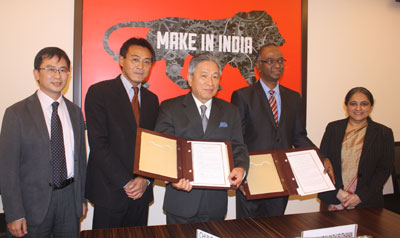 NEW DELHI, Dec 15: The Taipei Economic and Cultural Center in India (TECC) and the India-Taipei Association (ITA) signed the Memorandum of Understanding (MOU) on Promotion of Industry Collaboration here on Thursday as part of efforts to elevate Taiwan-India industrail cooperation to an even higher level.
Aviation
| Business | Defence
| Foreign Affairs | Communication
| Health | India |
United Nations
India-US | India-France
| Entertainment | Sports
| Photo Gallery | Tourism
| Advertise with Us | Contact
Us
© Noyanika International, 2003-2009. All rights reserved.