


DEFENCE
Europeans ahead in $10 b race for jetsNEW DELHI, April 28: With European fighters surging ahead of the American jets in the hotly-contested race to bag the gigantic $10.4 billion project to supply 126 medium multi-role fighter aircraft (MMRCA), India has now virtually shortlisted or "down-selected" two out of the six contenders in the fray. Sources said Eurofighter Typhoon (backed by UK, Germany, Spain and Italy) and French Rafale are the ones most likely to figure in the shortlist of the jets which have met the technical requirements, even though US has been hard-selling its F/A-18 'Super Hornet' and F-16 'Falcon' jets. The other two are the Swedish Gripen and Russian MiG-35. Though there was no official word from the defence ministry on Wednesday, sources said the sealed commercial bids of the shortlisted aviation majors will now be opened for the final negotiations to select the eventual winner in this "mother of all defence deals". Under the project, 18 jets will be bought off-the-shelf, while 108 will be manufactured in India by Hindustan Aeronautics Ltd after transfer of technology. IAF, on its part, had submitted its flight evaluation trials and staff evaluation reports to MoD a year ago after evaluating the six fighters on as many as 643 technical attributes during the gruelling field trials. This will be the first time that India will take into account "life-cycle costs" -- the cost of operating the fighters over a 40-year period, with 6,000 hours of flying -- rather than just pitching for the lowest bidder in a defence contract. The contract also specifies 50% offsets, under which the selected foreign vendor will be required to plough half of the contract forex value back into India. IAF is keen to induct the first lot of these 126 fighters by 2014 to retain its combat edge. It is left with just 32 fighter squadrons (each has 12 to 18 jets) at present, down from the "sanctioned" strength of 39.5 squadrons. This when Pakistan is getting new American F-16s and Chinese fighters, while China assiduously builds new airbases in Tibet and south China India is world's 'largest importer' of arms, says studyNEW DELHI, March 14: India has overtaken China to become the world's largest importer of arms, a Sweden-based think tank says. A report by the Stockholm International Peace Research Institute (Sipri) says India accounted for 9% of all weapons imports between 2006 and 2010. India will continue to be to the leading arms importer in the coming future, the report adds. With a $32.5bn (£20.2bn) defence budget, India imports more than 70% of its arms. It is looking to spend more than $50bn over the next five years to modernise its armed forces, including a $10bn deal to buy 126 new fighter jets. India's increased spending on arms also comes amid rising concerns about China's growing power, and its traditional rivalry with neighbouring Pakistan, with which is has fought three wars. "India has ambitions to become first a continental and [then] a regional power," South Asian defence analyst Rahul Bedi told the Associated Press news agency. "To become a big boy, you need to project your power." A senior fellow at the Stockholm International Peace Research Institute said India would continue to be a top importer for the years to come. "Just from what they have already ordered, we know that in the coming few years India will be the top importer," said Siemon Wezeman. He said China had dropped to second place with 6% of the global weapons as it develops its domestic arms industry. The US remained the world's largest weapons exporter, followed by Russia and Germany, the report says. Last October, India announced that it would buy 250 to 300 advanced fifth-generation stealth fighter jets from Russia over the next 10 years. The deal, which could be worth up to $30bn, is believed to be the largest in India's military history. UK Defence Equipment Minister to lead Defence, Business delegation to Aero India 2011By Deepak Arora
Close to 40 UK companies, many involved in some of the most cutting edge technology in the defence, aviation and security sectors are expected to visit the Aero India 2011 exhibition to show case their capabilities and are intent on forging long-lasting industrial partnerships and joint ventures with Indian companies. He said “there will be much discussion at the show surrounding India’s Medium Multi Role Combat Aircraft programme. In this regard, the UK, German, Italian and Spanish Governments are delighted to offer the Eurofighter Typhoon: the world’s most advanced swing-role combat aircraft. All four Governments are represented at the show by Ministerial teams. Our strategic relationship with India is very important, one we value and we are keen to engage in both the defence and security sectors to enhance this relationship.” The High Commissioner said “This is not a one-way street. Indian companies such as Dynamatic Technologies, Genser and Air Works are now operating successfully in the UK. The British delegation is excited about Aero India 2011 and I hope we will see even more business develop as a result of this important international event.” India, Britain discuss security in Suez CanalBy Deepak Arora
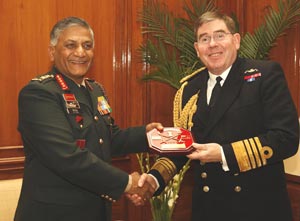
"Suez Canal's security is obviously a top operational concern of navies,'' said visiting British Navy Chief and First Sea Lord Admiral Sir Mark Stanhope, who had meetings with Defence Minister A K Antony, Navy chief Admiral Nirmal Verma and Chief of Army Staff Gen. V.K. Singh, among others. The ongoing upheaval in Egypt has heightened fears about the unrest adversely impacting the Suez Canal, one of the critical shipping trade routes around the globe. Around 95 per cent of international trade of both India and UK, incidentally, is carried by the sea. Admiral Stanhope said "it (Suez Canal) is a really significant issue. We as military men and anybody worth their salt should be talking about it. It is a serious issue. I can see doomsday scenarios."
The canal is owned and maintained by Egypt's Suez Canal Authority. An international treaty enables any vessel to use the canal for shipping. Admiral Stanhope, however, expressed hope that the political upheaval in the African nation would not force it to close down the canal. 'It is like cutting the nose to spite the face if they close the canal. Where is the rationale (to do it)? But I have no solution if they did,' he said. As for defence cooperation, Admiral Stanhope said UK and India were progressively building "interoperability'' between their armed forces as part of their long-term strategic partnership. There are plans, for instance, to increase the complexity and scope of the Konkan series of naval combat exercises which are held regularly between India and UK. "We also talked about the capacity-building of smaller countries of the Indian Ocean Region (IOR) being undertaken by India,'' said Admiral Stanhope, adding that the security of the IOR will "naturally fall'' on India in the years ahead. The British chief is also slated to visit Mazagon Docks in Mumbai, which is currently building destroyers, frigates and submarines, apart from holding discussions with Western Naval Command chief Vice-Admiral Sanjeev Bhasin. UK Chief of Naval Staff Admiral Sir Mark Stanhope to visit IndiaBy Deepak Arora
The increasing frequency of contact between UK and Indian senior military and civilian defence figures is testament to the enthusiasm both sides show to making this ambition reality. Lockheed Martin delivers first civil L-100 Hercules replacement center wing boxMARIETTA, Jan 27: Lockheed Martin has delivered the first replacement Center Wing Box (CWB) assembly for the civil variant of the Hercules, the L-100, to Lynden Air Cargo. This delivery marks the first upgrade of an L-100 with a new CWB. Fifth LOCKHEED MARTIN C-5B inducted to become Super Galaxy
India takes delivery of first C-130J Super HerculesBy Deepak Arora
"There are few mottos that impart such passion as that of the Indian Air Force, which is 'Touch the Sky With Glory'," said Lorraine Martin, Lockheed Martin's vice president for C-130 programmes, during Thursday's ceremony. "Today begins a new glorious, enduring partnership with India as the fourth largest air force in the world proudly joins the worldwide C-130 family," Martin added. This is India's first experience with the C-130 so the package being provided by the US government is comprehensive, a Lockheed Martin statement said. The contract includes six aircraft, training of aircrew and maintenance technicians, spares, ground support and test equipment, servicing carts, forklifts, loading vehicles, cargo pallets and a team of technical specialists who will be based in India during a three-year initial support period. "Also included in the package is an India-unique operational equipment designed to increase Special Operations capabilities," the statement said. The first two C-130Js will be flown to India early next year and will be followed by the remaining four aircraft deliveries in 2011. The fleet will be based at Hindon Air Force Station on the outskirts of New Delhi. The IAF's C-130J Super Hercules "is a highly integrated and sophisticated configuration primarily designed to support India's special operations requirements", the statement said. Equipped with an Infrared Detection Set (IDS), the aircraft can perform precision low-level flying, airdrops and landing in blackout conditions. Self-protection systems and other features are included to ensure aircraft survivability in hostile air defence environments. The aircraft also is equipped with air-to-air receiver refueling capability for extended range operations. "The C-130J is ideally suited to India's mission environment, which often involves operating out of austere, high-elevation airstrips in hot conditions," the statement said. The aircraft is powered by four Rolls Royce AE2100 engines and Dowty six-bladed props which provide it with a great deal of thrust. The C-130J has been operated for the past several years in the mountainous areas of Afghanistan in conditions similar to India and performed exceptionally well, the statement said. Pak owning 'suicide bomber' makes its intentions clear: Army chief
Singh met with school children from Jammu and Kashmir, who came visiting Delhi as part of the Army's 'Op Sadhbhavana' movement, to win the hearts of the people of Kashmir. "All I can say is we have to be more alert and only then we can protect the people and our troops," he said when asked what he thought of Pakistan Army sending 'suicide bombers' to India. "We have tried our best (to prevent infiltration). We are trying to stop infiltration. We will be alert on all fronts," he added. Pakistan Army's website named Zulfikar Ahmed as an ISI agent, who was on a suicide attack mission in India and had died in the city's Ganga Ram Hospital on November 16, 2007. The website www.pakistanarmy.gov.pk also claimed that Ahmed was a 'Naik' in the 'Engineers' arm of the Army and his formation was 'Headquarters 30 Corps/Directorate General ISI'. It had a few days ago listed the Army men who were killed in the war with India over their Kargil intrusions in 1999, thereby owning up that it had carried out the clandestine operation. First C130J aircraft ready for delivery to India
India has placed orders for six of these aircrafts. "The first C-130J for India will be formally delivered on December 16 at a ceremony in Marietta," Lockheed Martin said in a statement. "Two will be flown to India in early 2011, while two more will arrive in early summer and the last two will be delivered in late summer of 2011," it said. Robert Blake, Assistant Secretary of State for South and Central Asia, said on Wednesday that in conjunction with the purchase of six C-130J transport aircraft in 2008 the recent USD 4.1 billion C-17 Indian deal with Boeing will double US-India defense trade and provide the Indian Air Force a strategic airlift and humanitarian response capability that is unique to the region and emblematic of India's ambitions to play an increasingly global role. "Once all the aircraft have been delivered, ladies and gentlemen, India will have the second largest C-17 fleet in the world behind the US - a highly visible manifestation of the US-India defense partnership," Blake said. Lockheed Martin C-130J Hercules is the most advanced airlifter ever built. The C-130J combines the latest in aerospace technology with a proven, rugged airframe design, resulting in an aircraft that gives an operator more capability with greater operational efficiency. The Indian Air Force's new Super Hercules will be the longer fuselage or "stretched" variant of the C-130J, similar to those being delivered to the US Air Force. With this India joins the growing number of nations with C-130J fleets including the US, Australia, Canada, Italy, Denmark, Norway and the United Kingdom. The C-130J carries eight 463L pallets, 97 medical litters, 24 CDS bundles, 128 combat troops and 92 paratroops. Equipped with an Infrared Detection Set (IDS), the aircraft will be able to perform precision low-level flying, airdrops, and landing in blackout conditions. Self protection systems and other features are included to ensure aircraft survivability in hostile air defence environments. In addition the aircraft is equipped with air-to-air receiver refueling capability for extended range operations. Lockheed Martin will integrate this equipment and other capabilities into the Indian configuration as agreed between the governments. S. Korea selects Lockheed Martin's C-130J Super Hercules for new aircraft fleet
“As an experienced C-130 operator, Korea recognizes the unmatched capability that this new aircraft brings to so many missions.” India to have first N-armed sub in 2011: Navy chief
Admiral Verma said the deterrent force will complete India’s nuclear triad (ability to launch strategic weapons from land, air and sea). “It is only a triad when you have the capability to launch a strategic weapon from the platform. I’m saying the triad will be there when it (Arihant) is commissioned,” he said. At present, only three countries -- US, Russia and China -- have fully-operational nuclear weapon triads -- the capability to fire nuclear-tipped missiles from land, air and sea. The Naval chief said the triad will be complete once its crucial underwater leg, the country's first indigenous nuclear submarine aptly named INS Arihant or the "destroyer of enemies", is commissioned. The land and air legs are already in place with the Agni family of road and rail-mobile ballistic missiles as well as fighter jets like Mirage-2000s and Sukhoi-30MKIs jury-rigged to deliver nuclear weapons. "When INS Arihant goes to sea, it will be on a deterrent patrol (read armed with nucelar-tipped missiles). The triad will then be in place... the aim is to make it as effective as possible," Admiral Verma said on Thursday, in the run-up to Navy Day on December 4. This comes barely a day after Wikileaks revealed that American and European diplomats were greatly alarmed about Pakistan's feverish production of nuclear weapons. Estimates show Pakistan already has around 70 to 90 warheads, higher than India's 60 to 80. China, of course, is way ahead with around 240 warheads. While Pakistan is nowhere near getting a nuclear submarine, China has 10 of them in its 62-submarine fleet, with three of them being SSBNs (armed with long-range strategic missiles). India, in contrast, has just 15 conventional and ageing diesel-electric submarines. Consequently, INS Arihant is crucial to India's nuclear deterrence doctrine, which revolves around a clear "no-first use" policy. A robust and survivable second-strike capability is hugely dependent on having nuclear-powered submarines, armed with SLBMs (submarine-launched ballistic missiles), which can operate silently underwater for several months at a time. Admiral Verma said INS Arihant, which was "launched" at Vizag in July 2009, would have potent SLBM capabilities to complete the triad. With INS Arihant's miniature 83 mw pressurised light-water reactor slated to go "critical" within a month or two for sea-acceptance trials, Navy also seems quite confident about ongoing undersea tests of the 700-km K-15 and 3,500-km K-4 SLBMs. The 6,000-tonne INS Arihant, which has four silos on its hump to carry 12 K-15s or four extended range K-4s, is to be followed by another two nuclear submarines under the secretive Rs 30,000 crore Advanced Technology Vessel (ATV) project. Navy, on its part, wants to have three SSBNs and six SSNs (nuclear-powered attack submarines) in the years ahead. The force will also finally induct the K-152 Nerpa submarine, on a 10-year lease from Russia, towards April-May 2011 after several delays. While the 12,000-tonne Nerpa will not come armed with long-range missiles due to international treaties, it will help train Indian sailors in the complex art of operating nuclear submarines. It will also be a lethal hunter of enemy submarines and warships, armed with torpedoes and 300-km Klub-S cruise missiles. To be armed with 12 ballistic missiles, Arihant will provide India enduring nuclear strike and counter-strike capabilities. China has two ballistic missile submarines — the old Xia and latest Jin class — but the warships are not known to have taken up deterrent patrols yet. |
|
||||||
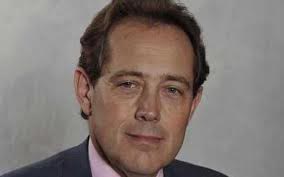 NEW DELHI, Feb 3: The British Minister for Defence Equipment Support and Technology, Peter Luff, will lead a large defence and business delegation to Aero India 2011.
 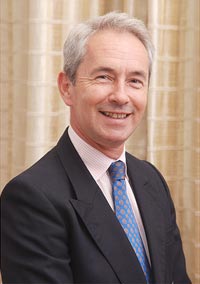 Sir Richard Stagg, British High Commissioner to India added: “British companies in the aerospace industry, large and small, are developing their business across India. British representation at Aero India covers a wide spectrum: from household names with long-standing business interests here such as BAE Systems and Rolls Royce, to specialist companies such as Hyde Group and Nasmyth Group, who are newer to the market.
 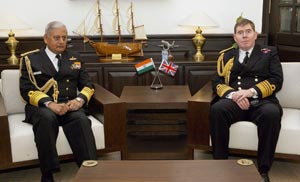 NEW DELHI, Jan 31: The security situation in Suez Canal, the strategic gateway connecting the Red Sea and Mediterranean Sea, as well as maritime cooperation to battle terrorism and piracy figured in the talks between India and UK on Monday.
  Suez Canal is the man-made sea-level waterway in Egypt that connects the Mediterranean Sea and the Red Sea. Opened in 1869, the 193.30 km long, 24 metre deep and 205 metre wide canal is the key maritime navigational link between Europe and Asia.
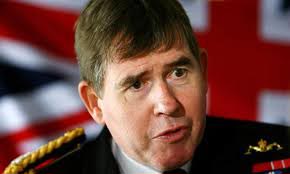 NEW DELHI, Jan 29: UK’s First Sea Lord and Chief of Naval Staff, Admiral Sir Mark Stanhope, will visit India from 30 Jan to 4 Feb 2011.
 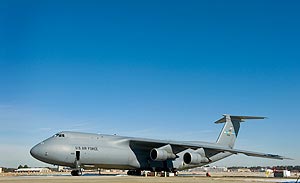 MARIETTA, Ga., Jan. 19: The fifth Lockheed Martin C-5 has been inducted into the Reliability Enhancement and Re-engining Program (RERP) to be transformed into the world’s most capable strategic airlifter, the C-5M Super Galaxy. This C-5M Super Galaxy will be delivered later this year and will be stationed at Dover Air Force Base, Del.
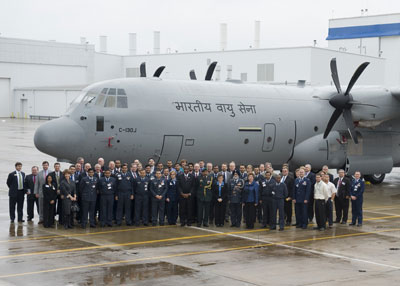 WASHINGTON, Dec 17: At a ceremony in Marietta, Georgia, Lockheed Martin delivered the first of six C-130J Super Hercules airlifters for the Indian Air Force (IAF). The new fleet was ordered under a $1.2 billion US foreign military sale.
 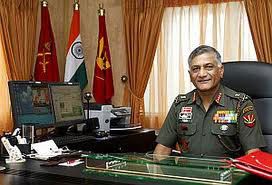 NEW DELHI, Dec 14: Indian Army Chief General V K Singh has said the "intentions and ways" of Pakistan Army have "become clear" with it owning up a 'suicide bomber', who died in India, as one of its soldiers on its website. "I have nothing to say on what they (Pak Army) has put up on its website. But if it has (owned up), then it clearly show what their intentions and ways are and what their next move will be," Singh told reporters here on the sidelines of an Army function here on Tuesday.
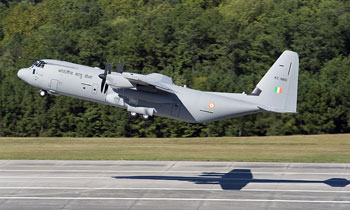 WASHINGTON, Dec 10: The first of the six state-of-the-art C-130J military transport aircraft would be delivered to India on December 16, its manufacturer Lockheed Martin said today.
 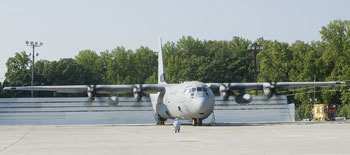 NEW DELHI, Dec 3: Lockheed Martin has signed a contract with the Republic of Korea to provide the nation four C-130J Super Hercules aircraft.
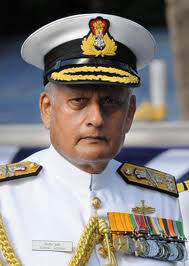 NEW DELHI, Dec 2: India will send its first ballistic missile submarine on patrol armed with nuclear weapons within a year, according to India’s Naval chief Admiral Nirmal Verma. The nuclear-powered submarine, the INS Arihant, will conduct deterrent patrols after it enters service in 2011-12. Strategic deterrence will be based on the K-15 submarine-launched ballistic missiles, capable of delivering nuclear warheads up to 700 km.

Aviation
| Business | Defence
| Foreign Affairs | Communication
| Health | India |
United Nations
India-US | India-France
| Entertainment | Sports
| Photo Gallery | Tourism
| Advertise with Us | Contact
Us
© Noyanika International, 2003-2009. All rights reserved.