


Foreign Affairs
|
India, Malaysia sign CECA; set $15 bn trade targetKUALA LUMPUR, Oct 27: Seeking to give new impetus to the bilateral relations, India and Malaysia on Wednesday formally announced firming up of Comprehensive Economic Cooperation Agreement (CECA) to boost trade and decided on a range of other engagements in various sectors, including defence. The two sides signed five pacts in various areas after wide-ranging talks between Prime Minister Manmohan Singh and his Malaysian counterpart Mohd Najib Tun Abdul Razak and resolved to impart strategic dimension to their relations. Signing a document with regard to announcement of CECA, the two leaders said the agreement, aimed at allowing freer movement of goods, services and investments, would come into effect on July 1 next year. “Today marks a turning point in India, Malaysia relations,” Dr. Singh told a press conference after the meeting. He said the discussions with Mr. Razak had laid the basis for multi-faceted partnership between the two countries. Dr. Singh and Mr. Razak also launched the CEO’s Forum which is expected to help forge closer and deeper economic engagement between business and industry of the two countries. “India welcomes greater investment from Malaysia in infrastructure and manufacturing sector and Indian companies would also want to do business in Malaysia,” Dr. Singh said. Mr. Razak said Malaysia would be happy to share India’s economic success and join its journey for economic development of the country. “We must give new impetus to this relationship. I indicated to Prime Minister Singh that Malaysia is ready for deeper and more intensive relationship,” he said Mr. Razak said the two countries have set a trade target of $15 billion by 2015 and expressed confidence CECA will help achieve it. Noting that expansion of mutual investment would contribute to reciprocal economic growth of both countries, the two leaders agreed to enhance cooperation and support at government level to further strengthen existing bilateral collaboration in infrastructure development. The involvement in infrastructure projects, particularly in the construction industry, is expected to provide bigger opportunities in investment through joint business and governmental collaboration, Dr. Singh and Mr. Razak said. Visa row between India, China ahead of Singh-Jiabao meetKUALA LUMPUR, Oct 27: A visa row has reportedly surfaced between India and China on the eve of a meeting in Hanoi, Vietnam, between Prime Minister Dr Manmohan Singh and his Chinese counterpart Wen Jiabao. The meeting is scheduled to take place later in the week. India and China have been engaged in a war of words over the staple visa issue relating to residents from the state of Jammu and Kashmir. China has again reiterated that its policy on issuing stapled visas for residents of Kashmir remains consistent and unchanged. Chinese foreign office spokesman Ma Zhaoxu said on Tuesday: "As for the Indian Kashmir visa, our policy is consistent and has stayed unchanged." He was replying to questions on whether the issue would come up for discussions at the meeting between Singh and Jiabao. Reacting strongly to the Chinese position, sources said: "India's position has been well articulated, it has been conveyed to China that Jammu and Kashmir is an integral part of India. There should be a uniform practice to issue visas irrespective of domicile and ethnicity". Meanwhile, there are concerns in India over China's growing assertiveness and a hardened stand on Jammu and Kashmir. India has suspended high-level defence cooperation with China over the visa row. It may be recalled that Beijing had refused to issue a regular visa to Lt General BS Jaswal, the General Officer Commanding in Chief of the Indian Army's Northern command, on grounds that he was overseeing operations in Kashmir, which Beijing, like Pakistan, views as a territory under dispute. India has also protested against the presence of Chinese companies involved in infrastructure projects in Pakistan-occupied Kashmir. On Monday, Indian Foreign Secretary Nirupama Rao said New Delhi wants to see the peaceful rise of China and engage with it in a peaceful manner. Last week, External Affairs Minister SM Krishna said China "should be sensitive to India's core concerns". Dr Singh and Premier Wen Jiabao will be meeting in Hanoi on October 29 on the sidelines of the Fifth East Asia Summit. Special Representatives of both countries - Shiv Shankar Menon and Dai Bingguo -are also expected to meet soon. Japan bends, sets ball rolling for civil N-dealTOKYO: India on Monday made significant progress in its efforts to enter into a civil nuclear deal with Japan. Considering the sensitivities of Japan on the nuclear issue, the development marks a major upgrade in the ties between the two nations. A joint statement issued after detailed discussions between Prime Minister Manmohan Singh and Japanese Prime Minister Navoto Kan said the two leaders welcomed the commencement of negotiations between India and Japan on an agreement for cooperation in the peaceful uses of nuclear energy in June 2010. "They affirmed that cooperation in this sector will open up new opportunities for further developing the India-Japan strategic and global partnership. They encouraged their negotiators to arrive at a mutually satisfactory agreement for civil nuclear cooperation," the joint statement noted. Foreign secretary Nirupama Rao later told reporters that the third round of negotiations will be held in Tokyo in the third week of November. There has been considerable pressure from Japanese entrepreneurs for a successful conclusion of the talks for nuclear cooperation as it offers huge opportunities for Japanese companies. Earlier in the day, prime minister Singh had taken a cautious line and had told a meeting of industry captains that his government will not push Japan on the subject. "Co-operation in this area will enable Japanese companies to participate in India's ambitious nuclear energy programme," Mr Singh had said while acknowledging that a deal with Japan on the issue was not all that easy. "We would hope that Japan will be India's partner in the expansion of its civil nuclear industry for peaceful purposes. But I do recognise the sensitivity of Japan and will, therefore, not force the issue." In hindsight, this was an astute pitch to make, considering that Japanese majors in nuclear technology - Marubeni, Mitsui, Toshiba, Mitsubishi and Hitachi - are keen on slices of the pie of Indian nuclear commerce. As a matter of fact, these companies have been pushing the political establishment, wary because of the memories of the devastation atom bombs wreaked on Hiroshima and Nagasaki during World War II, to wrap up an agreement with India. But what can give an edge to their anxiety to open doors for business with India is the competition they are facing from South Korea. Koreans are proving to be quite a challenge, with Doosan Engineering threatening to undercut Japan Steel Works' claim to be the most accomplished in building the core of nuclear reactors. The Koreans signalled their intent when they stole a contract to build nuclear reactors in UAE from right under the nose of the Japanese. Not being shackled by the sensitivity Japan has on the nuclear issue, the Koreans can hope to have an advantage in tapping India's nuclear market, with chances of a bilateral agreement being inked during Prime Minister Singh's visit to Seoul scheduled for early next year high. Given the hunger of the nuclear suppliers for contracts, India can hope to leverage its grand plans to tap nuclear energy to realise its aspirations for sustained double-digit growth. Planning Commission member Kirit Parikh had set the target of 20, 000 MW of nuclear energy by 2020. Nuclear Power Corporation of India has set its sights even higher, with its chairman SK Jain recently declaring that the country can hope to have a capacity of 63,000 MW by 2030. Both may sound unrealistic, but can be used by India as bait. French President Nicolas Sarkozy is anxious to clear the way for business opportunities for his country's nuclear energy firm Areva during his forthcoming visit here and Mr Singh seems to hope that the Japanese can also be lured into joining this race. India, Japan to expand strategic relationsTOKYO: India and Japan on Monday decided to extend their cooperation to areas such as joint ventures in rare earth minerals, some hitherto unexplored areas in defence, and transport and industrial corridors in south India. These will build on a recently finalised economic pact, more intimate security ties, two mega infrastructure projects in north-western India and ongoing talks on a nuclear agreement. Prime Minister Manmohan Singh and his Japanese counterpart Naoto Kan, during restricted and delegation-level talks, resolved to continue talks on a civil nuclear agreement. They instructed officials to ensure the smooth implementation of the Comprehensive Economic Partnership Agreement (CEPA) and accelerate discussions on the reform of the United Nations Security Council (UNSC), to which both countries are aspirants as permanent members. “In the discussions, the point consistently emphasised was that both India and Japan believe they need to develop a strong, vigorous and an all-encompassing relationship in political, economic and security spheres,” Foreign Secretary Nirupama Rao told newspersons after the meeting. She termed the economic pact an alliance between Japanese technology and capital and a young Indian labour force. Dr. Singh and Mr. Naoto Kan also discussed China. “Both discussed need for open and transparent dialogue with China…they agreed that engaging China in more productive dialogue and developing structures of cooperation is the way forward. It requires deep analysis, close engagement and lots of patience…the reality is that both will have to develop in-depth ties with China,” Ms. Rao said. Both sides would move towards long-term cooperation — including the implementation of joint ventures in rare earth minerals — and denied that this was directed against a third country (China recently halted export of rare earth minerals to Japan). On civil nuclear cooperation, India and Japan will hold the third round of talks here in November third week. While Japan is keen on some sort of Indian political commitment on moving closer to the Comprehensive Test Ban Treaty regime, India has pointed out that its civil nuclear agreement with Japan cannot be materially different from agreements signed with other countries. They also touched on trade in high technology, with Dr. Singh hoping that Japan will make its norms in this area “easier and predictable.” India appreciated Japan's paring down of the list of Indian companies on the export control list early this year. The two countries also signed a Memorandum of Understanding on simplifying visa procedures that would supplement the CEPA by catering to India's areas of strength in pharmaceuticals, healthcare personnel and information technology. Indian PM to visit Japan, Malaysia, Vietnam
The Prime Minister will travel to Japan and Malaysia for bilateral visits and Vietnam for the 8th ASEAN-India Summit from 24th to 30th October. In Tokyo, civil nuclear cooperation, enhancing trade ties and UN reforms are expected to dominate the annual Summit talks that Singh will have with his Japanese counterpart Naoto Kan. The two countries have already begun talks on civil nuclear cooperation and have expressed desire to conclude an agreement in this regard as soon as possible. The two sides are also working to conclude an Economic Partnership Agreement before Singh's visit to Tokyo amid expectations that the two-way trade will witness a 10-fold increase from USD 12 billion in 2008-09. Singh and Kan are also expected to discuss ways to re-energise the G-4 grouping that is pushing for reform of the UN, particularly expansion of the Security Council and inclusion of new permanent members. This assumes significance as India recently was elected to the Security Council as a non-permanent member. "The two Prime Ministers will discuss bilateral, regional and global issues," the External Affairs Ministry said on Thursday. Singh and his wife Gursharan Kaur will be received in audience by the Emperor and Empress of Japan. The Prime Minister would also have several meetings with political leaders, parliamentarians and captains of Japanese trade and industry. In the second leg of his tour, the Prime Minister will pay an official visit to Malaysia from 26th to 28th October at the invitation of Malaysian Prime Minister Mohd Najib Tun Abdul Razak. The latter was on a State visit to India in January. Singh and Razak will have in-depth discussions on all facets of bilateral relations, as well as regional and global issues of mutual interest, the MEA said. His other engagements include an audience with the King and Queen of Malaysia, launch of CEOs' Forum, Khazanah Global Lecture 2010, visit to 'Little India' and attending Indian community reception hosted by the High Commissioner. In Vietnamese capital Hanoi, Singh will attend the ASEAN-India Summit and East Asia Summit, whose focus would be enhancing integration of the East Asian region with India in terms of connectivity and trade. He will also have bilateral meetings with a number of ASEAN and other leaders on the sidelines of the summits. India has been keen on greater economic integration with East Asia and creation of a supportive regional financial architecture. New Delhi also desires realization of the Comprehensive Economic Partnership and the Mekong India Corridor. The visits are crucial for India's desire to upgrade its ties with East Asia, particularly in economic sphere. China should respect India's sensitivities: KrishnaNEW DELHI, Oct 17: Making it clear that bilateral defence exchanges will remain suspended, India on Friday asked China to respect its sensitivities on issues like Jammu and Kashmir and Arunachal Pradesh so that the relationship could be developed further. Against the backdrop of certain recent Chinese actions that amount to questioning Jammu and Kashmir's integration with India, External Affairs Minister S M Krishna hoped that Beijing would maintain "neutrality" on the affairs related to the state as it has always done. He said the issue of Chinese assertiveness in the region recently will be one of the issues of discussion between Prime Minister Manmohan Singh and US President Barack Obama during the latter's visit in New Delhi next month. Krishna made it clear that defence exchanges with China, which were put on hold in July after a Lt General was disallowed permission to visit that country because he was serving in Jammu and Kashmir, will remain suspended. "We expect China to be sensitive to our core concerns. That is how relationships are built, relations are nurtured. So we are asking China to respect our sensitivities like on Arunachal Pradesh and other issues," he said during an interaction with a group of journalists in New Delhi. He asserted Jammu and Kashmir is an integral part of India, by virtue of its accession and what has happened over the last 60 years during which a number of elections were held in a democratic and transparent manner. Disagreeing that China's shift in position on J and K had put strain on the bilateral ties, he said Beijing looks at things from a "different perspective" and hoped that "they will go along the Indian perspective". To a question on China issuing stapled visas to those hailing from J and K, he said New Delhi has made it clear to Beijing that it was not acceptable and that there was need to be sensitive to each other's concerns to build relations. "We have conveyed to them (China) that we do not accept the stapled visas and we are not going to accept these," Krishna said. Noting that China also expected India to be sensitive to its issues, he said New Delhi will be so "without compromising our national stand in respect of borders and stapled visas". Afghan President Karzai confirms Taliban 'contacts'KABUL, Oct 11: Afghan President Hamid Karzai has confirmed that "unofficial contacts" with the Taliban have been taking place "for some time" to end the insurgency. In a CNN interview, he said such contacts "have been going on for quite some time". The admission comes shortly after Mr Karzai set up the High Peace Council - the body to start a dialogue with the Taliban. His comments follow growing reports of secret peace talks with the militants. "We have been talking to the Taliban as countryman to countryman, talk in that manner," Mr Karzai told CNN's Larry King Live. "Not as a regular official contact with the Taliban with a fixed address, but rather unofficial personal contacts have been going on for quite some time." However, he stressed that Kabul would fight groups like al-Qaeda, accusing them of "working against Afghanistan". The excerpts of the interview were released on Sunday. The full interview is due to be broadcast later on Monday. Kabul's previous attempts to negotiate with the Taliban have failed, partly over their insistence that foreign troops leave the country first. Taliban fighters continue to inflict casualties on the US-led Nato forces and resist all attempts to defeat them by military means. There are nearly 150,000 foreign troops currently deployed in Afghanistan. Peace Nobel for jailed China rebelOSLO, Oct 8: A Chinese professor serving an 11-year sentence for co-authoring a manifesto for democratic rights won China’s first Nobel Peace Prize on Friday. Beijing promptly denounced the award as a ‘blasphemy’. In his shared prison cell in northeast China, Liu Xiaobo, 54, may not even be aware he has won the prize for his “long and non-violent struggle for fundamental human rights in China”, as the citation by the Norwegian Nobel Committee put it. The announcement was blacked out on international news channels in China. By evening in Beijing, Google searches for Liu were blocked. The state media reported only a terse statement denouncing the prize. In Oslo, the committee — known to have faced pressure from Beijing not to select Liu — said: “China is in breach of several international agreements to which it’s signatory, and its own provisions concerning political rights.” “Through the severe punishment meted out to him, Liu has become the foremost symbol of this widespread struggle for human rights in China.” Beijing’s foreign ministry promptly warned that the prize could harm China-Norway relations. Liu was arrested in December 2008 for co-authoring a manifesto called Charter 08 that sought greater freedom and individual rights for the Chinese. Beijing banned it online but 10,000-12,000 Chinese signed it, risking police interrogation and detentions. Liu was also jailed earlier for leading the Tiananmen student democracy protests of 1989. “Liu’s friends often tell me they wanted him to get the prize more than he did, because they think this is an opportunity to change China,” his wife Liu Xia said. “The Nobel Peace Prize cannot change magically China into a rights respecting country. Only Chinese people can do that...but the award shatters the myth that only the Chinese government speaks for the Chinese people,’’ Nicholas Bequelin of Hong Kong-based Human Rights Watch told HT. Bequelin described Liu as “a really traditional Chinese intellectual in demeanour, not sort of a western-educated liberal...a man of integrity and great moral stature”. India summons Australian HC over shocking racist slursNEW DELHI, Oct 9: Outraged over the racist slurs by top Australian Police officers, India on Saturday summoned its High Commissioner and sought an explanation on the issue, saying such an attitude was "shocking" and a "matter of serious concern". High Commissioner Peter Varghese described the incident as "unacceptable" and said one officer has left the police services and another one involved in the incident is facing disciplinary action in the matter. The Victorian police officers have been caught in a racist e-mail scandal joking about the electrocution of an Indian train passenger and suggesting that it could be "a way to fix the Indian student problem" in Melbourne. In a strong reaction External Affairs Minister S M, Krishna, who is currently in Bangalore, said, "Implication of police officers in such behaviour, specially vis-a vis Indian community in Australia, is shocking and a matter of serious concern." "Such attitude has no place in any society. We understand investigations are already underway. We sincerely hope that apart from taking action against concerned officials, Australian authorities will also take necessary and effective measures to address concerns about safety of all people of Indian origin in Australia," Krishna said. Verghese said the Australian and Victorian governments along with the Victorian police condemned the incident in the strongest possible terms. "The Australian government and the Victorian government, the Commissioner of the Victorian Police condemn it in the strongest possible terms. This is an email which is offensive...it is unacceptable and it is completely contrary to the principles of respect and tolerance we seek to embed in Australian society," he told reporters after meeting Indian MEA officials. Krishna had directed the Ministry to seek explanation from Varghese after emails containing racial slurs against Indians by top Victorian police officers was made public by the Australian media. Varghese said the Commissioner of Police in Victoria had said that he would be taking the matter "very seriously" and disciplinary process was underway. "It involves two officers. One officer has left the police force while the investigation was underway. The second officer is facing serious disciplinary charges," he added. India has come of age: KrishnaLONDON, Oct 2: India has "come of age" and the country is expected to achieve a double digit economic growth in the next couple of years, India's External Affairs Minister S M Krishna said here on Saturday. "India has come of age. In the last few years our growth rate has been above 8 per cent," said Krishna, who was on his way back to New Delhi from New York after attending the annual UN session. "Even when there was a global slowdown India registered a 6.5 per cent growth and the country is expected to achieve 9 per cent or more growth next year and in 2012 we can certainly register a double digit growth," the Minister said at a function to mark the 141st birth anniversary of Mahatma Gandhi. "Today India is emerging as one of the growing global powers. You can walk with your head held high as an Indian. For this continuous hardwork, not only of our leaders, but the population of 1.2 billion is responsible," he said. Paying rich tributes to the Father of the Nation, Krishna described him as one of the greatest human beings who lived and walked on this planet. "Mahatma Gandhi is remembered not only in India but all over the world because he unleashed powerful reformation that checkmated colonialism and checkmated exploitation that was going on," he said at the function organised by the India League at Tavestock Square in the heart of the city. "He was a leader who led millions of people, not only in India but all over the globe -wherever people were subjugated whether in Africa, Latin America or Asia. Mahatma Gandhi was the torchbearer of truth and non-violence," Krishna said. Garlanding a bust of the Mahatma, Krishna said Gandhi reminded us that non-violence was the voice of the brave, not of the weak. "Mahatma Gandhi conquered the mightiest British empire. He did not fire a single bullet but bullets were fired at him," the Minister said, adding he had the privilege of listening to the Mahatma in 1946 at the Birla Mandir in New Delhi. Later Gandhiji visited the erstwhile princely state of Mysore "when he stopped at my village where my father was running a high school, middle school and hostel". Krishna said Gandhiji was indeed surprised when my father told him that there were two Harijan boys in the hostel. Krishna underlined the need to cherish the life and achievements of the Father of the Nation and try to implement his teachings. India's High Commissioner to the UK Nalin Suri, who was also present at the function, said Gandhiji was not only a great statesman but a man of great foresight. Paying tributes to the Mahatma, Maneck Dalal, chairman of the Bharatiya Vidya Bhavan, said though Gandhiji was small in physique but enormous as a moral figure. NATO launches airstrikes into Pakistan, 60 deadKABUL, Sept 28: NATO helicopters in eastern Afghanistan launched rare airstrikes into Pakistan, reportedly killing more than 50 militants after an outpost near the border came under attack from insurgents, officials said on Monday. International forces also pressed forward with a key combat phase in their drive to rout Taliban fighters around the southern city of Kandahar, an operation that is key to U.S. military strategy to turn around the 9-year war and prevent the Taliban from undermining the Afghan government. The airstrikes into Pakistan came after the insurgents attacked a small Afghan security outpost near the border, and NATO justified the strikes based on "the right of self-defense," a spokesman said. Pakistan is sensitive about attacks on its territory, but U.S. officials have said they have an agreement that allows aircraft to cross a few miles (kilometers) into Pakistani airspace if they are in hot pursuit of a target. The first strike took place Saturday after insurgents based in Pakistan attacked the outpost in Afghanistan's eastern province of Khost, which is located right across the border from Pakistan's North Waziristan tribal area, said U.S. Capt. "The ISAF helicopters did cross into Pakistan territory to engage the insurgents," Donald said. "ISAF maintains the right to self-defense, and that's why they crossed the Pakistan border." The strike killed 49 militants, said U.S. Maj. Michael Johnson, another ISAF spokesman. The provincial police chief in Khost, Abdul Hakim Ishaqzie, cited a higher death toll of around 60 militants. He said police at checkpoints at the border came under attack, engaged the miliants in a gun battle and then called for help, prompting the helicopter strikes. "It was a very effective operation against the militants," he said. "Around 60 militants were killed. Police forces collected ammunition and weapons from the battlefield." It was not immediately clear how NATO and the Afghan police chief were able to confirm the fatalities on the Pakistan side of the border. The second attack occurred when helicopters returned to the border area and were attacked by insurgents based in Pakistan, Donald said. "The helicopters returned to the scene and they received direct small arms fire and, once again operating in self-defense, they engaged the insurgents," Donald said. The second strike killed at least four militants, Johnson said. Pakistani intelligence officials said two NATO helicopters carried out a third strike inside Pakistani territory on Monday morning, killing five militants and wounding nine others. The strike occurred in the village of Mata Sanger in the Kurram tribal area, which is directly across the border from the Afghan provinces of Paktia and Nangarhar, said the officials, speaking on condition of anonymity because they were not authorized to talk to the media. Donald said officials were still investigating and could not confirm or deny reports of the attack in Kurram. The Pakistani military could not be reached to comment on the NATO attacks. While airstrikes by unmanned U.S. drones believed operated by the CIA against al-Qaida and Taliban targets are common inside Pakistan's tribal regions, particularly North Waziristan, major strikes using manned aircraft are rare. On Monday, a suspected U.S. missile strike killed two people near Mir Ali, a major town in the North Waziristan, Pakistani intelligence officials said on condition of anonymity because they were not authorized to talk to the media. It was the 20th such attack this month. In south Afghanistan, meanwhile, international and Afghan forces were moving into two or three areas around Kandahar at once to pressure the Taliban "so they don't get the chance to run away," Shah Mohammad Ahmadi, chief of Arghandab district northwest of the city, said on Monday. "Before, when we have tried to get rid of the Taliban, when we cleaned one area we found more Taliban in a different one," he said. A top NATO officer said Sunday that the alliance a few days ago had launched a "kinetic," or combat, phase of "Operation Dragon Strike," a joint military push with Afghan forces around Kandahar intended to rid the area of insurgents and interrupt their ability to move freely and stage attacks. "It is a significant ground operation with air support," German Brig. Gen. Josef Blotz, a NATO spokesman, said at a news conference. "Afghanistan and coalition forces are destroying Taliban positions so they will have nowhere to hide," Blotz said. "Once this is done, insurgents will be forced to leave the area or fight and be killed." NATO said militants have fought back with rocket-propelled grenades and small-arms fire. It said no Afghan or coalition troops have been killed in the operation. The push in Kandahar is seen as key to the Obama administration's strategy to turn around the war as insurgents undermine the ability of an Afghan government to rule much of the country. Kandahar remains particularly dangerous, seven U.S. troops have been killed in Kandahar this month. Another three have been killed in the south, but no further details have been released. "First, they are clearing the area of Taliban and then they are searching the area for mines," said Kareem Jan, district chief of Zhari, west of Kandahar. Twin Baghdad car bombs kill 31, wound dozensBAGHDAD, Sept 19: Two car bombs exploded in Baghdad on Sunday, killing at least 31 people, breaking what has been a period of relative calm since the end of the Muslim holy month of Ramadan. The biggest blasts in the Iraqi capital in a month occurred as commuters were starting their work week, underlining the challenges facing Iraqi security officials in stabilising Baghdad as the US forces end combat operations and Iraq's police and military assume responsibility for protecting the capital. At least 10 people were killed when a car bomb exploded in western Baghdad's affluent Mansour neighbourhood, Army Brig. Gen. Ali Fadhal said. He said another 10 were wounded in the attack, and security officials are investigating whether it was the work of a suicide car bomb targeting a crowded commercial area near an AsiaCell store, one of Iraq's biggest mobile phone providers. An eyewitness, working in an office near the blast site said he heard a huge explosion that shattered windows in his office and brought a section of the ceiling down on one customer. Minutes later another car bomb exploded in Adan square in northern Baghdad's Kazimiyah neighbourhood, killing at least 21 and wounding more than 70 others, police and hospital sources said. Two policemen were killed in the blast. Security officials could be seen roaming the blast site as ambulances and other vehicles blocked the road leading to the checkpoint near a branch office of the Ministry of National Security that police say was targeted. There was no immediate claim of responsibility for attacks that followed President Barack Obama declaration of the end to US combat operations in Iraq on 1st September. Indian Premier says China's territorial ambition must be challengedNEW DELHI, Sept 7: India must prepare to counter China's territorial ambitions in South Asia, Manmohan Singh, India's prime minister, has warned. He was speaking against a background of growing tensions between the world's two fastest growing economies and a number of diplomatic incidents relating to their long-standing border dispute. The two countries fought a war in 1962, and China still claims parts of Indian-controlled Jammu and Kashmir and Tawang district in Arunachal Pradesh. India has become increasingly concerned in recent months at China's growing influence in neighbouring Burma, Sri Lanka, Nepal and Pakistan. Beijing has funded a number of strategic roads and deepwater ports in these countries, known as the "String of Pearls". The Asian rivals most recently clashed over Beijing's refusal to grant a visa to an Indian general from Kashmir, which it regards as disputed territory. New Delhi is also alarmed by Beijing's support for road and power projects in Gilgit-Baltistan in the Pakistan-controlled part of Kashmir which is claimed by India. Retired intelligence chiefs believe China has become more aggressive as India's economy has grown, and following predictions that it will overtake China as the world's fastest growing economy by 2020. They have urged Mr Singh to take a stronger stand against what they regard as "Chinese aggression" since Beijing publicly criticised Singh's election campaign visit to Arunachal Pradesh last year as "provocative". In a rare meeting with India's top newspaper editors, Singh said India had to pursue peaceful solutions but also had to take "adequate precautions" to counter Beijing's "pinpricks" on Kashmir and other issues. "China would like to have a foothold in South Asia and we have to reflect on this reality. There is a new assertiveness among the Chinese. It is difficult to tell which way it will go. So it's important to be prepared," said Singh. Zhao Gancheng, a Beijing-based analyst on Sino-Indian relations, said he did not expect the two countries' border disputes to be an obstacle to developing ties. India reviews security scenario vis-à-vis ChinaBy Deepak Arora NEW DELHI, Aug 31: Indian Prime Minister, the Defence Minister and the External Affairs Minister have in separate meetings reviewed the developments across the border and in the Indian Ocean with regard to Chinese troop’s build up. While Prime Minister Manmohan Singh on Tuesday chaired a meeting of the Cabinet Committee on Security (CCS) to discuss the chill in relations with China, External Affairs Minister S.M. Krishna told the members in the Lower House (Lok Sabha) that New Delhi was closely monitoring China's intention as it was showing “more than the normal interest” in the Indian Ocean affairs. During the day, Defence Minister A.K. Antony also reviewed the security scenario in the wake of reports suggesting the presence of Chinese soldiers in parts of Jammu and Kashmir held by Pakistan and deployment of missiles along India's eastern borders. Mr Krishna said “the Government of India has come to realise that China has been showing more than the normal interest in the Indian Ocean affairs. So we are closely monitoring the Chinese intentions.” Responding to queries during a call-attention motion on “the situation arising out of the recent attacks on Indian fishermen by the Sri Lankan Navy,” Mr. Krishna assured the House that “appropriate action and measures” would be taken to safeguard the country's territorial integrity and the welfare of its fishermen. Prime Minister Manmohan Singh on Tuesday chaired a 90-minute meeting of the Cabinet Committee on Security to discuss the chill in relations with China. New Delhi had put on hold defence exchanges, barring the border personal meeting, country following Beijing's refusal to allow a visit by a senior Indian army officer. The meeting was also attended by India's Ambassador to China S. Jaishankar who briefed the CCS about the developments in the past few weeks. National Security Advisor (NSA) Shivshankar Menon was also present at the meeting. The consultations by the Prime Minister also come in the wake of reports of China posting about 11,000 troops in the Gilgit-Baltistan region of Jammu and Kashmir which has been held by Pakistan. New Delhi has been watching keenly on Chinese position on Jammu & Kashmir that includes issuing stapled visa to the state residents, and Beijing helping PoK projects, reaching a flashpoint with Gen Lt Gen Jaswal being refused permission to visit China. Chinese Ambassador to India Zhang Yang was called in by the Ministry of External Affairs and Chinese defence ministry issued a statement, stating they haven’t stopped defence exchange with India. The meeting, chaired by the Defence Minister Antony, reviewed the preparedness of the armed forces after reports emerged about Chinese military posturing along Indian borders and presence of more than 11,000 Chinese troops in Gilgit and Baltistan in the PoK. India to verify reports of Chinese presence in Gilgit: MEANEW DELHI, Aug 30: India is making "independent verification" of the reports of presence of Chinese troops in Gilgit-Baltistan region in Pakistan-occupied Kashmir, saying it would be a matter of "serious concern" if it turns out to be true. "We have seen media reports...and are seeking an independent verification of these reports. If true, it would be a matter of serious concern and we would do all that is necessary to ensure safety and security of the nation," according to Vishnu Prakash, spokesperson of the Ministry of External Affairs. He was asked about the reports in New York Times about the influx of an estimated 7,000 to 11,000 soldiers of the Chinese People's Liberation Army in strategic Gilgit-Baltistan region in the PoK, which is closed to the world. According to the US newspaper, "China wants a grip on the strategic area to assure unfettered road and rail access to the Gulf through Pakistan," and for this purpose is building high-speed rail and road link. The link up would enable Beijing to transport cargo and oil tankers from eastern China to the new Chinese-built Pakistani Naval base at Gawadar, Pasni and Ormara in Balochistan, just east of the Gulf in 48 hours. "Many of the PLA soldiers entering Gilgit-Baltistan are expected to work on the railroad. Some are extending the Karakoram Highway, built to link China's Xinjiang province with Pakistan. Others are working on dams, expressways and other project," the paper said. China's presence in Gilgit-Baltistan: NYTNEW YORK, Aug 29: In a quiet move, Pakistan is handing over de-facto control of the strategic Gilgit-Baltistan region in the Occupied Kashmir to China in an area witnessing a simmering rebellion against Islamabad. The New York Times said there were two important developments in Gilgit-Baltistan; a simmering rebellion against the Pakistani rule and the influx of an estimated 7,000 to 11,000 soldiers of the Chinese People's Liberation Army in the area, which is closed to the world. “China wants a grip on the strategic area to assure unfettered road and rail access to the Gulf through Pakistan,” said the paper, and is building high-speed rail and road link. The link up would enable Beijing to transport cargo and oil tankers from eastern China to the new Chinese built Pakistani Naval base at Gawadar, Pasni and Ormara in Balochistan, just east of the Gulf in 48 hours. “Many of the PLA soldiers entering Gilgit-Baltistan are expected to work on the railroad. Some are extending the Karakoram Highway, built to link China's Xinjiang province with Pakistan. Others are working on dams, expressways and other project,” said the paper. It said mystery surrounds the construction of 22 tunnels in secret locations, where even Pakistanis are barred. Tunnels would be necessary for a projected gas pipeline from Iran to China that would cross the Karakorams through Gilgit. “But they could be also used for missiles storage sites,” said the Times. So far, the paper quoting foreign intelligence sources, Pakistani media and Pakistani Human Rights groups, said the PLA construction crews had been living in temporary encampments and went home after completing their assignments. But now they are building a big residential complex, clearly designed for a long term presence, and the New York Times said what is happening is a matter of concern for Washington. Oxford, Harvard minds helped N-BillNEW DELHI, Aug 29: The contentious Nuclear Liability Bill, that was finally passed with bipartisan support in Parliament earlier this week, got a helping hand from Harvard and Oxford universities. A group of law students — all of them Indians — from the world's best institutes had briefed the Parliamentary Standing Committee of Science and Technology with suggestions to make the nuclear damages Bill legally sound. The suggestions impressed the MPs so much that a senior BJP leader called up a member of the group for consultation just before the final agreement with the government was struck. The scholars were consulted on which of the four amendments being discussed with the government on clause 17 of the draft Bill would be best. Another senior leader appreciated that the students had come to depose before the committee at their own expense: "They were here to visit the country and came readily to share their knowledge of international law with us." Arghya Sengupta, Shivprasad Swaminathan, Sanhita Ambast and Prashant Reddy are part of the group that wants to use its legal skills to assist Indian policy-making. And their advice is free. "There is a desire to be engaged with India and its policies," Sengupta told HT. He feels that in the absence of bipartisan academic inputs, Indian legislators have to depend on the ideologically-coloured inputs of NGOs and industry bodies. Some of these scholars had earlier been consulted by the the Joint Parliamentary Committee on the Office of Profit and Karnataka's Public Health Bills, when they were students of National Law School University, Bangalore. Israel 'too weak face up to Iran'TEHERAN, Aug 22: Iranian President Mahmoud Ahmadinejad rejected fears of an attack on Iran, taunting Israel as "too weak to face up to Iran militarily," and the US as unable to beat even a small army in Iraq, speaking in an interview with Al-Jazeera Sunday. "Israel doesn't have the courage to do it," Ahmadinejad said, "and I do not think its threat is serious." He also stated that "America is not interested in sparking a military confrontation with Iran." The Iranian president's provocative comments came the same day as he inaugurated Iran's new long-range bomber aircraft, which he called an "ambassador of death" to Iran's enemies, and the day after the Islamic Republic began fueling its nuclear reactor at Bushehr. There has long been speculation that Israel will attack Iran's nuclear facilities, which it insists are for peaceful purposes, but which Israel fears are to build a nuclear weapon to use against the Jewish state. The international community, led by the US and the UN, has levied increasingly harsh sanctions against Iran in a bid to force the Islamic state to halt its nuclear program. Last week, former US ambassador to the UN John Bolton made headlines when he stated that Israel had only days left to strike Iran before its Bushehr nuclear reactor began the fueling process, sparking debate over whether Israel, or even the United States, would attack Iran to destroy its facilities. Ahmadinejad also predicted in his interview that the Arab states in the Gulf would not allow US bases in the region to be used to launch an attack against Iran, saying that "they are more intelligent than that. Gillard confident of forming new govt; approaches independentsRefusing to concede defeat, Australia's first woman Prime Minister Julia Gillard on Sunday intensified efforts to cobble up a coalition to avoid a hung parliament after the cliff-hanger general election failed to bring out a clear winner. Gillard put up a brave face after the election mauling, but Conservative leader Tony Abott who led his Liberal- National Party coalition to an impressive show, said the "savage swing" against Labour meant it had "lost its legitimacy" to govern and the public now expected change. With none of the two major parties securing simple majority in yesterday's polls, Gillard swung into action to woo the independents, congratulating them on their election and saying she respected their role. "I have a good track record in the Federal Parliament of working positively and productively with the independents ... and the Greens in the Senate," she said. After a tense night of vote-counting in a divided election, the country was headed for its first hung parliament in 70 years with independent MPs Tony Windsor, Rob Oakeshott and Bob Katter, all hailing from regional seats, holding the balance of power. When the counting wrapped up last night before its resumption today, Labor and the Coalition each had won 71 seats while independents got three and Greens bagged one. Four other seats were too close to call. 48-year-old Gillard, who ousted Kevin Rudd to become Australia's first woman prime minister in June, also sought to assure her countrymen that she would deliver a "stable and effective" government. Describing Australia as "one of the strongest democracies" in the world, Gillard, whose ruling Labor was dealt a crippling blow in key provinces of New South Wales and Queensland, said she was still hopeful of forming a government with support from independents. Neither Labor nor the opposition Coalition led by 52-year-old Abbott looks like getting the 76 seats in the 150-member House of Representatives needed to form government in its own right, but analysts believe that Gillard's party might get closer to the magic figure. Australian Labor Party (ALP) national secretary Karl Bitar said it "potentially" can win 75 seats "but only if all the cards fall the right way". Gillard said it was now clear that the Labor had won the popular vote and this should be weighed carefully by independents who would now help decide which party governed. Israel has 'three days' to hit Iran nuclear site: US envoyWASHINGTON, Aug 18: Israel has "three days" to launch a military strike against Iran's Bushehr nuclear facility and stop Tehran from acquiring a functioning atomic plant, a former USenvoy to the UN has said. Iran is to bring online its first nuclear power reactor, built with Russia's help, on August 21, when a shipment of nuclear fuel will be loaded into the plant's core. At that point, John Bolton warned Monday, it will be too late for Israel to launch a military strike against the facility because any attack would spread radiation and affect Iranian civilians. "Once that uranium, once those fuel rods are very close to the reactor, certainly once they're in the reactor, attacking it means a release of radiation, no question about it," Bolton told Fox Business Network. "So if Israel is going to do anything against Bushehr it has to move in the next eight days." Absent an Israeli strike, Bolton said, "Iran will achieve something that no other opponent of Israel, no other enemy of the United States in the Middle East really has and that is a functioning nuclear reactor." But when asked whether he expected Israel to actually launch strikes against Iran within the next days, Bolton was skeptical. "I don't think so, I'm afraid that they've lost this opportunity," he said. The controversial former envoy to the United Nations criticized Russia's role in the development of the plant, saying "the Russians are, as they often do, playing both sides against the middle." "The idea of being able to stick a thumb in America's eye always figures prominently in Moscow," he added. Iran dismissed the possibilities of such an attack from its archfoes. Foreign Ministry spokesman Ramin Mehmanparast said Tuesday that "these threats of attacks had become repetitive and lost their meaning." "According to international law, installations which have real fuel cannot be attacked because of the humanitarian consequences," he told reporters at a news conference in Tehran. Iranian officials say Iran has stepped up defensive measures at the Bushehr plant to protect it from any attacks. Russia has been building the Bushehr plant since the mid-1990s but the project was marred by delays, and the issue is hugely sensitive amid Tehran's standoff with the West and Israel over its nuclear ambitions. The UN Security Council hit Tehran with a fourth set of sanctions on June 9 over its nuclear programme, and the United States and European Union followed up with tougher punitive measures targeting Iran's banking and energy sectors. The Bushehr project was first launched by the late shah in the 1970s using contractors from German firm Siemens. But it was shelved when he was deposed in the 1979 Islamic revolution. It was revived after the death of revolutionary founder Ayatollah Ruhollah Khomeini in 1989, as Iran's new supreme leaderAli Khamenei and his first president, Akbar Hashemi Rafsanjani, backed the project. In 1995, Iran won the support of Russia which agreed to finish building the plant and fuel it. India-Canada bilateral trade to increase by 2015TORONTO, Aug 15: Canada has identified India as a priority market in its global commerce strategy and committed to increase its bilateral trade with the country to USD 15 billion by 2015. "Canada would like to take economic relationship with India to a new level in trade. It has identified India as a priority market in our Global Commerce Strategy," Jim Flaherty, Canadian Minister of Finance said on Sunday at a function organised by Indian Consulate to commemorate the 64th India Independence Day. "Our goal is to increase bilateral trade to $15 billion by 2015", he said. Bilateral trade between India and Canada during 2009-10 was USD 3.19 bn. Flaherty said that Canada had added three new trade offices in India in 2010, raising the number of its trade offices in the country to eight. While commending India's 'extra-ordinary' emergence from a nation that was primarily based on agriculture to as an emerging economic superpower, Flaherty said both India and Canada were discussing Global Bank Tax and reforms of international financial institutions. India's dialogue is with Pakistan's civilian Govt: Nirupama Rao
In an interview broadcast on CNN-IBN's "Devil Advocate", Rao was asked by host Karan Thapar if there was a need for India to try and establish a direct line of contact with Pakistan Army chief, General Ashfaq Parvez Kayani. "My answer to that is that we have dealt and we continue to deal with and we will continue to deal with the civilian democratic government in Pakistan, the elected representatives of the people there, and the civilian officials concerned. That is the interface that we have adopted," she said. Asked specifically if a line of contact can be opened to the military alongside with that of the Pakistani government, Rao replied: "I am not prepared to talk about that at the moment. But let me say that the interface as it exists is with the civilian government." The foreign secretary advocated the continuance of dialogue despite the revelation of American website Wikileaks on the involvement of Pakistani spy agency Inter-Services Intelligence (ISI) in anti-India attacks in Afghanistan. "I think the justification for dialogue is by no means diminished despite these revelations. I believe that dialogue is the most effective means to tackle outstanding issues with Pakistan, and the abandonment of dialogue or the interruption of dialogue, by no means serves the interests that we seek to pursue in getting Pakistan to stop its pursuit of terrorism against India," Rao said. When pointed out that ISI's activities against Indian assets in Afghanistan was during Kayani's tenure as head, Rao refused to be drawn in to give an assessment of the Pakistani army chief. "It is not just that the WikiLeaks have come up with that revelation. It has been known to us for a long time. And we have said all along that the acts of premeditated violence against our nationals in Afghanistan are completely unacceptable to us," she said. India, Bangladesh sign USD 1 billion credit dealDHAKA, Aug 8: In the largest-ever loan it has given to any foreign country, India has signed an agreement with Bangladesh to extend a USD 1 billion credit line to Dhaka for developing 14 infrastructure projects, mostly in the communications sector. The loan agreement was signed between the Exim Bank of India and the Economic Relations Department of Bangladesh in the presence of visiting Finance Minister Pranab Mukherjee, who is the first high-profile Indian leader to visit Bangladesh after Prime Minister Sheikh Hasina's trip to New Delhi in January. Under the deal, India would lend the amount, the biggest it has offered to any foreign country, at a 1.75 per cent interest rate with a repayment period of 20 years, including a grace period of five years. Bangladesh officials said the loan amount was the largest the country has received under a single deal. The line of credit will be used by Bangladesh for developing its railway and other communication infrastructure, besides power grid connectivity between Bangladesh and India and establishment of state-run standards and testing institute facilities. The deal was inked in pursuance of the agreement reached between Indian Prime Minister Manmohan Singh and Hasina during her visit to New Delhi earlier in the year. Economic Relations Department (ERD) Secretary M Musharraf Hossain Bhuiyan and Exim Bank of India Chairman and Managing Director T C A Ranganathan signed the deal in the presence of Mukherjee and his Bangladeshi counterpart, Abul Maal Abdul Muhith, at the state guest house of Jamuna. Bangladesh rolled out the red carpet, usually reserved for heads of states or governments, when Mukherjee arrived on a scheduled four-hour visit, which was later extended by one more hour. A special Indian aircraft carried the influential leader of India's ruling Congress-led government. His Bangladeshi counterpart, Abul Maal Abdul Muhith, received him on the VVIP tarmac of the airport. Referring to the close bonds of friendship between the two countries based on common heritage, historic, linguistic and cultural ties, Mukherjee said soon after arrival, "We need to continue to build on these commonalities and promote the well-being of our people to greater economic engagements." Pranab Mukherjee underlined the need for India and Bangladesh to deepen counter-terrorism cooperation, warning that insurgents have the "potential" to affect the bilateral ties. Addressing press in Dhaka on Saturday Mukherjee said, "We deeply appreciate the efforts of the government of Bangladesh to tackle this menace and we will continue to be closely engaged for enhanced bilateral security cooperation." Mukherjee identified "security cooperation" to be an area that engaged the attention of both the countries "given our common desire to root out the forces of extremism and terrorism from our midst". "Insurgents and insurgent groups have the potential to affect our relations," warned Mukherjee. Shoes hurled at Zardari in BritainLONDON, Aug 8: A man threw both his shoes at Pakistan President Asif Ali Zardari when he was addressing a public meeting in Birmingham. The shoes landed just short of him. The Telegraph on Sunday reported that Zardari, who has been criticised for visiting Britain while there were floods in his country, was in the middle of his speech when an elderly man in the crowd hurled both shoes at him. An unidentified man was later taken away from the Saturday evening meeting by police and security officials. "Zardari was in the middle of a long campaign speech when a man towards the back of the crowd hurled the shoes at him," an eyewitness was quoted as saying. "They landed short of him, and it wasn't clear what exactly the man was protesting about." While talking to the British daily, Zardari had dismissed claims that he should have stayed at home. He said that the visit had resulted in the floods receiving far more international attention than they might otherwise have done. Zardari said: "These meetings are planned months in advance, and my coming abroad has drawn more attention to them than I myself would have been able to draw." In February last year, a German student hurled a shoe at Chinese premier Wen Jiabao during his visit to Cambridge University in Britain. Martin Jahnke, a 27-year-old graduate student at the university's pathology department, was arrested on February 2, 2009 for throwing a shoe at Wen, who was giving a speech on the global economy to an audience of mostly Chinese students during an official visit to Britain. The shoe missed Wen by about a metre. Jahnke was emulating an Iraqi TV reporter, Muntazer al-Zaidi, who threw his shoes at former US President George W. Bush during a visit to Baghdad in December, 2008. Explosion near Ahmadinejad dismissed as firecracker, but rumors fly
It was first reported as a grenade, then a bomb and finally a harmless firecracker. But whatever was tossed toward Iranian President Mahmoud Ahmadinejad's motorcade Wednesday, news of the incident went viral across the Internet as his government quickly denied an assassination attempt. Discounting speculation that swept the country, Iran's state-run Press TV said that a source in the president's office "rejected as false the reports of a grenade attack" on Ahmadinejad. Other Iranian media said a firecracker or a repercussion explosive, commonly set off at festivals, had been tossed about 100 yards from the motorcade. International news agencies had reported that the convoy was traveling from the airport in the western city of Hamedan to a sports stadium when a bomb exploded, injuring several people. Ahmadinejad was not hurt. Reuters, quoting a source in the president's office, said one person had been arrested. The story spread from blogs to websites to international satellite TV channels. The conservative Iranian news agency Mehr said "contrary to the negative atmosphere created by some Western media … eyewitnesses have stressed that a homemade [noise] bomb exploded faraway" from the president's car. The agency added that smoke spread over the area and a number of people had been arrested. Not wanting to spark instability and upset financial markets, the Iranian government, as if reciting a mantra, repeated: firecracker. The Iranian Student News Agency reported that a firecracker was set off by a "young man who wanted to express his enthusiasm" at the president's arrival. Ahmadinejad waved and continued to the stadium, where he gave a televised speech to the nation and made no reference to the incident. The news agency alluded to what may have put the wrong message out to begin with: "Unfortunately, a number of domestic media reported it as explosion of hand grenade, causing ambiguity." The president's popularity has been strained by a high unemployment, a troubled economy and a new round of international sanctions aimed to the country's nuclear program. Earlier this week he told a conference that Israel was trying to kill him, insisting that "the stupid Zionists have hired mercenaries to assassinate me.'" Cameron warns Pak against any export of terrorPact signed for supply of 57 Hawk AJT aircraft to IAF, Navy
Cameron also said that it is not right for Pakistan to have any relationship with groups that are promoting terror, in comments seen as endorsing India's stand. "We cannot tolerate in any sense the idea that this country (Pakistan) is allowed to look both ways and is able, in any way, to promote the export of terror, whether to India or whether to Afghanistan or anywhere else in the world," he said. Cameron, who began his maiden visit to India after assuming office, made these remarks while talking to newsmen and in his address at the IT major Infosys campus in the outskirts of the city during a trip to Bangalore. Cameron's remarks came against the backdrop of US documents leaked to Internet whistleblower site WikiLeaks accusing Pakistan's powerful Inter-Services Intelligence (ISI) of secretly helping the Afghan insurgency while the coutnry took billions of aid to fight terror. He said he will discuss with Prime Minister Manmohan Singh the “leakage” of funds provided to Pakistan to terrorists based in that country. Speaking at his first public event in India, on the Infosys Technologies' campus here on Wednesday, Mr. Cameron said he discussed the matter with U.S. President Barack Obama last week. “Although we are for a stable and democratic Pakistan, we cannot tolerate the idea that Pakistan can look both ways and export terror to India, Afghanistan or anywhere else in the world.” Cameron also pitched for closer security relationship between India and Britain saying the two countries must meet the challenge of ensuring global security. He said Britain like India was determined that groups like the Taliban, the Haqqani network or Lakshar-e-Taiba should not be allowed to launch attacks on Indian and British citizens in India or in Britain. "Our interests are your interests so lets work together to realise them," he said.
The tripartite agreement involving HAL, BAE Systems and Rolls Royce was signed on behalf of HAL by P. Soundara Rajan, Director, Corporate Planning and Marketing; Guy Griffith, Group Managing Director, BAE Systems; and Christopher John Awde, Commercial Director, Rolls Royce. Under the terms of the contract, BAE systems will supply products and services to enable HAL to build the Hawk under licence from it, for Rs. 3,640 crore. BAE Systems will provide specialist engineering services, raw material and equipment necessary for airframe production and also the support package for the IAF and the Navy. Commenting on the deal, BAE Systems India Managing Director and Chief Executive Officer Andrew Gallagher said: “The Hawk AJT fast jet training solution enables an Air Force or Navy to provide front line pilots for even the most modern fighter aircraft such as the Eurofighter Typhoon or Sukhoi SU-30.” Rolls Royce is to supply 57 Adour engines, which will power the Hawk aircraft. The deal is valued at Rs. 1,460 crore. The BAE Systems Hawk is to be powered by the Mk871 variant of the Adour, which will be assembled here in partnership with HAL. In 2004, India signed a deal for the acquisition of 66 Hawks for the IAF. Cameron sees vast opportunities for British firms in India's growth storyBANGALORE, July 28: British Prime Minister David Cameron said the rapid growth of the Indian economy presents “enormous opportunities” for British companies to do business in India. Addressing a large gathering of business leaders and Infosys employees on the Infosys Technologies' campus in Bangalore, Mr. Cameron said he had come to India “with a very clear purpose, to take the relationship between Britain and India to the next level.” “My seriousness is demonstrated by the fact that I am leading the biggest visiting delegation of any British Prime Minister in recent years,” he said. The delegation included members of the British Cabinet, leaders of business and industry, social entrepreneurs, civic leaders, people from Britain's “most forward-looking” arts institutions and museums and sportspersons. Mr. Cameron urged India to open up insurance, banking, defence manufacturing and legal services to foreign competition. He expressed the hope that the India-European Union Free Trade Agreement would be signed by the end of the year. He said he was “pushing” for the early conclusion of the Doha Round at the WTO, and suggested making the “deal bigger in order to achieve progress.” Mr. Cameron said Prime Minister Manmohan Singh had “personally provided great intellectual leadership in economic matters” at the recent G-20 Summit. “That is why the time has come for India to take the seat it deserves at the U.N. Security Council,” he said. Referring to the global impact of rapid economic growth in India, Mr. Cameron pointed out that the Tatas were now the biggest employer in the manufacturing sector in Britain. Indian economic growth also presented “enormous opportunities” for British firms — in infrastructure, retail and mobile phone services, he said. “I want the relationship to drive economic growth up and unemployment down in both countries,” he said. “Yes, this is a trade mission, but I prefer to see it as a jobs mission.” UK's George Osborne for new partnership with IndiaMUMBAI, July 28: Britain's Finance Minister on Wednesday rang the opening bell at the Bombay Stock Exchange--Asia's oldest bourse --and hoped of starting a new partnership with India. "This is the beginning of a new relationship," United Kingdom's Chancellor of the Exchequer George Osborne told reporters after kicking-off trading at the BSE in Mumbai. "It is a historic day as I am opening (the trading at) Asia's oldest bourse -- Bombay Stock Exchange," Osborne said. "Britain once again wants to build a new relationship with India which could change the landscape of rural India. We are here to forge a new economic and cultural partnership. We are here to declare Britain open for business with you," Osborne said. Osborne is in India along with Prime Minister David Cameron and a host of other ministers and senior businessmen. "India is progressing in every aspect. We want to attract India's dynamic and innovative entrepreneurs to our kingdom," he said, adding that the "country has a huge opportunity for our financial and manufacturing companies." The minister invited Indian bankers to list in the UK and set up branches. "We will provide licences to banks to start operations in the UK and will give more opportunity to be listed there," he said. "British legal firms and business houses can help India finance its infrastructure needs and bring technology to help rural India," he said. Pak promises to act on Headley leadsISLAMABAD, July 15: India on Thursday secured an assurance from Pakistan that it would act on the leads given by Pakistani-American terrorist David Headley to unravel the conspiracy behind the Mumbai terror attack. At the conclusion of day-long discussions between External Affairs Minister S M Krishna and his Pakistani counterpart Shah Mahmood Qureshi, it was announced that the two ministers would meet next in India in the near future. The two countries also agreed to continue their dialogue Both Krishna and Qureshi stuck to diplomatic niceties at a joint press conference in Islamabad on Thursday night after seven hours of talks which had to be extended apparently due to differences of approach. India is believed to have insisted on Pakistan fulfilling its promises on bringing to justice those responsible for the terror attacks in Mumbai before engaging in other areas of bilateral relations. A curt Qureshi took exception to Home Secretary G K Pillai's remarks two days ago that Headley had revealed to interrogators that ISI and Saeed had played a "much more significant role" in planning and executing the Mumbai terror attacks. Asked about Saeed's statements, Qureshi said that both sides should refrain from negative speeches that vitiate the atmosphere and then asked. "We both (ministers) are of the opinion that it was uncalled for," Qureshi said without any refutation from Krishna. On his part, Krishna firmly handled questions on the current situation and alleged human rights violations in Kashmir, telling the journalists that there was an elected and legitimate government in the state. Also there were mechanisms to deal with any human rights violations anywhere in India. The meeting with journalists was held after Krishna had called on President Asif Ali Zardari and Prime Minister Yusuf Raza Gilani in between three rounds of parleys with Qureshi. He flies back home on Friday. Qureshi stated that Pakistan would pursue seriously the leads provided by Home Minister P Chidambaram on the basis of Headley's interrogation. Pakistan suicide blasts in Mohmand 'kill more than 100'ISLAMABAD, July 10: The death toll in a double suicide bombing in a Pakistani tribal village on the border with Afghanistan has risen to more than 100, officials say. Two bombers struck seconds apart in Yakaghund village in the Mohmand tribal region, devastating government buildings, shops and houses. Indo-Pak talks aim at reducing trust deficit: Krishna
"Let us not pre-judge the outcome. An initiative has been taken by Pakistan Prime Minister Yousuf Raza Gilani and PM Manmohan Singh. This is primarily to reduce the trust deficit. This is a confidence building measure," Krishna told reporters in New Delhi on Thursday. He said this in reply to a question on whether the Sir Creek issue would figure in the Indo-Pak talks. He was speaking on the sidelines of the All India Annual Conference for Haj. Gilani and Manmohan Singh met during the SAARC summit in Bhutan in April which saw restoration of dialogue between the two countries after nine months. India had asked Pakistan to take action against the 26/11 Mumbai attack accused living in the neighbouring country before talks could be resumed. When asked about China's attempt to build a rail link with Pakistan through Karakoram, Krishna said, "Our National Security Advisor (NSA) went to China as Prime Minister's emissary. I have not got a chance to discuss the issue with him yet. But we are closely watching what is happening." NSA Shiv Shankar Menon had visited China last week to discuss bilateral issues. Relations with China not externally driven: India
Menon, who raised the controversial deal in talks with Chinese Foreign Minister Yang Jiechi on Sunday, said: “We have discussed the issue [of China's sale of two reactors] with them on two or three occasions. They have told us that what they are doing will be in accordance with their international obligations. I think we will wait and see where this is going.” The NSA, in China as the Prime Minister's Special Envoy, held talks with Premier Wen Jiabao on Monday. The focus of the talks — and this visit — was on exploring new areas of co-operation to take the bilateral relationship forward, Mr. Menon said. Much of the attention has, however, been on China's recent decision to sell two nuclear reactors to Pakistan. Some countries say the move goes against China's commitments as a member of the Nuclear Suppliers Group (NSG), which prohibits the transfer of technology and equipment to countries which have not signed the Nuclear Non-Proliferation Treaty (NPT). The attention on the deal, according to Menon, was misplaced. “This was not the whole point of the visit,” he stressed, adding: “This took less than two and a half sentences in the whole visit.” Menon pointedly stressed in an interaction with journalists that China's close relationship with Pakistan, its all-weather strategic ally, would have no bearing on New Delhi taking forward its ties with Beijing, despite being a source of mistrust between the neighbours in the past. "We're no longer in an either-or, zero-sum game kind of situation,” Menon said. “Our relationship with China is not dependent on the state of our relations with Pakistan, or vice versa. And judging by what we have seen in practice over the last few years, I think that is also true of China. Nowhere in my talks was there any such linkage [made] by them, or by us.” He said an increasing convergence of interests on the global stage, on issues such as climate change, energy security and trade, was in some sense bringing the countries closer. They had moved into “a new stage of the relationship,” where they were engaging on a broader set of issues of global relevance. Unilateral sanctions on Iran will hurt India: Nirupama Rao
“We are justifiably concerned that the extra-territorial nature of certain unilateral sanctions recently imposed by individual countries, with their restrictions on investment by third countries in Iran's energy sector, can have a direct and adverse impact on Indian companies and more importantly, on our energy security and our attempts to meet the development needs of our people,” Foreign Secretary Nirupama Rao observed while addressing members of Indian and Iranian think tanks. India's reservations about the United States' keenness to implement some of its sanctions against Iran comes days after Washington appointed Robert Einhorn as its new ‘co-ordinator' for implementing the sanctions. The European Union is meeting later this month to sketch out its plans for sanctions against Iran in the light of UN Security Council Resolution 1929 (fourth round) that was voted against by Turkey and Brazil. Maintaining that the International Atomic Energy Agency provided the best framework to resolve questions about Iran's nuclear programme, Ms. Rao pointed out that India's approach to Iran was “embedded within the rationale” that defines its foreign policy — just as the ‘Look East' policy has propelled India's relations with the countries of ASEAN and East Asia. Tehran was important not only because it had large energy reserves, although this aspect was significant because India expects its energy needs to grow by eight to ten per cent in the coming years and Iran, the nearest source, has the world's third largest proven oil reserves and second largest gas reserves. The Foreign Secretary identified maritime security as another potential area of cooperation and welcomed Iran's decision to join the Indian Navy's confidence building initiative — the Indian Ocean Naval Symposium. Iran was also crucial in resolving the Afghanistan issue. Ms. Rao hoped that the upcoming India-Iran Joint Commission meeting would instil fresh momentum in their bilateral relations — especially the long-pending dialogue on energy and trade corridors in Central Asia and greater cooperation and information sharing on counter-terrorism. India, China discuss possibility of joint projects in Afghanistan
National Security Adviser (NSA) Shiv Shankar Menon, who arrived in Beijing on Saturday on a four-day visit as Prime Minister Manmohan Singh's special envoy began his high-level engagements by holding talks with Chinese Foreign Minister Yang Jiechi on Sunday. After one and half hour talks at the Foreign Ministry in Beijing, Yang accompanied by Menon told the Indian media that "talks went off very very well... we have a tour of the whole horizon" of issues. A significant part of the discussions between Menon and Yang reportedly centred on economic issues and the booming trade between the two countries that is expected to touch a new of high of USD 60 billion this year. Apparently issues relating to Pakistan and the visit of Pakistan President Asif Ali Zardari to China beginning from 6th July reportedly to firm up cooperation to build two nuclear power plants figured in the talks. "We also went to specifics about certain aspects of our relationship," Yang said without directly referring to Pakistan and India's concerns to the two nuclear reactors. These issues were expected to figure in Menon's scheduled talks with Chinese Premier Wen Jiabao and State Councillor Dai Bingguo on Monday. India has expressed reservations over China's proposed nuclear deal with Pakistan under which it will provide two nuclear reactors to Pakistan. "We talked a lot about high level exchanges and visits and (steps) to further boost trade volume to create even better conditions for mutual investment, cooperation and even talked about the possibility of cooperation on certain subjects in other countries and let us have three or four party collaborative projects in the economic field as well," he said. Yang's reference to projects in third country was interesting as the two sides apparently discussed collaborative projects including in Afghanistan where they want to tap trillions of dollars worth mineral resources jointly with other countries. Recent reports said huge deposits of iron, copper, cobalt, gold and critical industrial metals like lithium were large enough to transform Afghanistan into one of the most important mining centres in the world. India, China, United States and a vast number of European countries which are present in Afghanistan could work out a joint initiative to tap the resources which could change the face of poverty-stricken Afghanistan reeling under a Taliban insurgency. The two sides also discussed having preparatory meetings before top international conferences like the just- concluded G-20 summit to work out common positions on vital issues. Over all Yang in his brief talk with the media painted a positive picture of ties between the two countries. "What is more important is that over all tone of our relationship is very positive. There is lot in common between us. I believe that His Excellency Menon's visit will really pave the ground to a large extent for further our strategic partnership," he said. "So I am very pleased with this visit. We pay a great deal of attention to his visit. Menon will meet with Prime Minister and State Councillor tomorrow. We attach a great deal of importance to this relationship. We have really enhanced our mutually political trust, look at G-20, climate change, BRIC. You can see we actually work closely together to push forward for common cause that is to serve the interest respective peoples, developing world and mankind," he said. Yang also said China wants more student-related and cultural exchanges between the two neighbours. "I mentioned given the size of respective populations, students and cultural exchange between the two countries so far have not really added too much. There is a lot we can do. Good beginning has been made. But we really have to pitch in and do lot more together to further consolidate the social basis to further our relationship," he said. Yang also paid personal complements to Menon saying, "Menon and I are close and old friends". Earlier in his opening remarks at the talks, Yang said in recent years the China-India relationship has maintained a sound momentum of development, delivering real advantages to both nations. "As major developing countries they contributed to peace, stability and development of the region and the world at large," he said. Menon, also a former ambassador to China, was assisted at the talks by the current Indian Ambassador S Jaishankar. Menon said India was ready to work with China to intensify coordination on international and regional issues, so as to advance the India-China strategic partnership of cooperation, official news agency said. He also spoke highly of the achievements made in bilateral ties, noting the Indian government attached great importance to developing relations with China. Yang in his meeting with Menon, according to the news agency, pledged to give impetus to the development of bilateral ties. As this year marked the 60th anniversary of Sino-India diplomatic ties, China was ready to take the opportunity to work with India to deepen mutual political trust, promote exchanges and cooperation, and enhance communication on major regional and international issues, Yang said. Yang said China was willing to make concerted efforts with India to inject vitality and impetus to the development of ties. JuD a terror outfit, admits PakistanISLAMABAD, July 6: Declaring JuD as a terror outfit, Pakistani authorities have formed special task forces to crack down on 16 radical groups, including the Lashker-e-Taiba, in the wake of the suicide attack on the Data Darbar shrine. The Home Department of Punjab has set up the task forces comprising officials of the CID, Special Branch and Anti-Terrorism Squad in several districts of the province, said a report by BBC Urdu. The groups against which action will be taken include the JuD, LeT, Jaish-e-Mohammed, Lashkar-e-Jhangvi, Sipah-e-Sahaba, and Tehrik-e-Nifaz-e-Shariah Muhammadi, among others. Nine of the groups belong to the hardline Deobandi sect, three are Shia organisations while three are influenced by the ideology of Ahl-e-Hadith. The other groups on the list are Sipah-e-Muhammad Pakistan, Tehrik-e-Jafriya Pakistan, Millat-e-Islamiya Pakistan, Khudamul Islam, Islami Tehrik Pakistan, Hizb-ut-Tehrir, Jamiat-ul-Ansar, Jamiat-ul-Furqan, Khair-un-Naas International Trust, Islamic Students Movement and Balochistan Liberation Army. The BLA is a Baloch nationalist group and the ISM is a radical students' organisation. However, the Tehrik-e-Taliban Pakistan is not among the groups to be targeted by the task forces. Interior Minister Rehman Malik has said the Taliban and al Qaeda are working with the Lashkar-e-Jhangvi and Sipah-e-Sahaba in parts of the country, especially Punjab. The Sunni Tehrik also has been placed under observation by the Home Department. About 4,000 people are currently under surveillance under the provisions of the Anti-Terrorism Act for alleged links with extremist groups. They have to inform police stations in their areas about their movements. The task forces have been advised to establish close contact with intelligence officers in the districts to exchange information on the 17 organisations that will be the focus of the crackdown. An official of the Punjab Home Department told BBC Urdu that orders had been issued to launch crackdowns on the hideouts of these groups and arrest those connected with them immediately. The task forces have also been asked to trace those who are financing these groups and their other sources of funding so that action can be taken under the Anti-Terrorist Act. The task forces led by district police chiefs will report to the Punjab Home Department. Envoys of seven nations present credentials to President of IndiaBy Deepak Arora
The envoys who presented their credentials were: Dr. Ruben I. Zamora, the Ambassador of El Salvador, Mr. Ronald B. Allarey, the Ambassador of the Philippines, Mr. Thongphanh Syackhaphom, the Ambassador of Laos, Mr. Doulat O. Kuanyshev, the Ambassador of Kazakhstan, Dr. Nanguyalai Tarzi, the Ambassador of Afghanistan, Mr. Marco Piccinini, the Ambassador of Monaco and Mr. Byron Escobedo Menendez, the Ambassador of Guatemala. In her interaction with the envoys, the President observed that they represented nations spanning different geographical zones, and with whom India enjoys friendly relations. The President said that India is a country with a wide diversity and offers to many, areas for strengthening mutual cooperation. Developing good relations with nations is one of the main objectives of India's foreign policy, the President said. The President also stated that India believes that promotion of mutual understanding between peoples is essential for world peace, which in turn is conducive for economic growth and progress of nations. She mentioned that in the contemporary world, prospects of peace are threatened by forces of extremism and terrorism. Fighting terrorism requires a firm commitment by the international community to act collectively and decisively. Drugs, gun-running and piracy, with their deep links to terrorism, add to the complexities faced while dealing with terrorism, she emphasized. The President also said that the global economy is recovering from the financial crisis of 2008-09, but the challenges of sustaining growth remains. For developing countries, higher growth rates are important to meet the aspirations of their people. The credential presentation ceremony was attended by the senior members of the missions, senior officials of the Ministry of External Affairs and Rashtrapati Bhavan. Another Australian teenager charged for Nitin's murderMELBOURNE, June 18: A second Australian teenager was charged on Friday over the murder of Indian student Nitin Garg, a day after another teenager was arrested in the same case. Garg, 21, was attacked as he walked through parkland on his way to work at a Melbourne burger restaurant on January 2. He managed to stagger to his workplace before collapsing and dying of stab wounds. Police said a 16-year-old boy had been charged with accessory to the killing, a day after another teenager aged 15 appeared in court charged with Garg's murder. "A 16-year-old male from Yarraville has been charged with accessory to murder and has been bailed to appear at a Children's Court at a date to be set," police said. Garg's murder came after a string of attacks on Indian nationals, who have arrived in increasing numbers attracted by Australia's burgeoning overseas education sector and the prospect of gaining a permanent visa. Australia and India both condemned Garg's killing, with Delhi describing it as a "heinous crime on humanity" and "an uncivilised brutal attack on innocent Indians". Hundreds of muggings and beatings, accompanied by migration scams and colleges charging for substandard courses, prompted street protests by Indians in Melbourne and Sydney last year. The attacks were also greeted with outrage by India's media, with one newspaper cartoon comparing Australian police to the racist Ku Klux Klan for its handling of the Garg case. Israel eases land blockade on GazaDUBAI, June 18: Israel has decided to loosen its land blockade of the Gaza Strip but the measure may fall short of international expectations raised following the Israeli raid on a Gaza-bound aid flotilla on May 31. “It was agreed to liberalise the system by which civilian goods enter Gaza [and] to expand the inflow of materials for civilian projects that are under international supervision,” said an official statement following the Israeli Security Cabinet meeting on Wednesday. The statement did not list the products which can now be sent into Gaza. Israel had imposed the blockade in 2006, soon after Hamas won the Palestinian parliamentary elections. The embargo was reinforced following the Gaza war between Israel and Hamas which ended in January 2009. Observers say Israel has now cleared the path for sending building materials to international organisations, such as the United Nations, whose establishments had suffered damage during the Gaza war. However, the statement clarified that the “existing security procedures to prevent the inflow of weapons and war material” would continue. Besides, the Security Cabinet made no mention about lifting the sea blockade on the impoverished coastal strip. Hamas said it rejected the Israeli announcement. “We in Hamas reject the Zionist decision, which is an attempt to obscure the international decision to completely lift the siege on the Gaza Strip,” AFP quoted senior Hamas leader Ismail Radwan as saying. “This is just an attempt to relieve the pressure ... and to continue the siege of Gaza,” he added. “We demand the complete lifting of the Gaza siege so that all goods are allowed in and there is total freedom of movement without any interference from the Zionist enemy,” he said. On Monday, the European Union reiterated its call for an “immediate, sustained and unconditional opening of crossings for the flow of humanitarian aid, commercial goods and persons to and from Gaza including goods from the West Bank”. International pressure against Israel to lift the blockade has been mounting since the May 31 raid in international waters on the Turkish ship, Mavi Marmara. Nine people, comprising eight Turks and one Turkish-origin American citizen, died during that attack. Analysts say Israel is now making an effort to link the lifting of the blockade with the release of Gilad Shalit, captured Israeli soldier by a Hamas offshoot, an end to rocket firing from Gaza into Israel, and termination of weapon smuggling into the coastal strip. Kanishka probe: Canada Govt. held responsibleTORONTO, June 18: The final report into the 1985 Air India Kanishka bombing Thursday recommended ex-gratia payment to the families of 329 victims, mostly of Indian origin as it blamed the Canadian government for its failure to prevent the country's worst terrorist attack. "A cascading series of errors contributed to our police and security forces" failing to stop the bombing, Justice John Major, the head of the Kanishka bombing inquiry commission recommended Thursday, nearly 25 years after the tragedy. Canadian authorities should have known that Air India Flight 182 was a terrorism target, Major said, adding the failure of the Royal Canadian Mounted Police (RCMP) and Canada’s spy agency Canadian Security and Intelligence Services (CSIS) to prevent the tragedy was "inexcusable." "The government needs to take responsibility to avoid further failure and to prevent a return to a culture of complacency," said Major in his 3,200 pages report. It called for an independent body to be created to recommend an appropriate ex-gratia payment and to oversee its distribution, though it offered little relief to the families of those who were killed in the tragedy. "This was the largest mass-murder in Canadian history," said Major, adding the "finest tribute" that could be paid the victims of the bombing is to create a rigorous aviation security system. Air India Flight 182 on 23rd June, 1985, which was travelling from Canada to India, crashed into the Atlantic killing all 329 people on board. The report blamed the Canadian government for its failure to prevent the tragedy and recommended the appointment of a powerful security czar to resolve disputes between conflicting interests among security agencies. It observed that Air India bombing was a case of institutional failures of Canadian Securities and Prosecution institutions and called for a security czar with direct access to the Prime Minister to sort out disputes between the RCMP and Canada’s spy agency CSIS. Canada's national security adviser should be given sweeping new powers to resolve disputes between the RCMP and CSIS, Major told a live press conference in Ottawa. In the much awaited final report from the commission that investigated the bombing of Air India plane, he observed that national security continues to be badly organized between the RCMP and Canada's spy agency. He also recommended radical transformation in prosecution. The national security adviser, who currently provides advice to the Prime Minister on security and intelligence issues, should also be the final arbiter where the two agencies disagree, Major said. Stephen Harper meets families of Kanishka bombing victims Candian Prime Minister Stephen Harper Friday assured the family members of the victims of the 1984 Air India Kanishka bombing that the government would respond "positively" to the recommendations made by an inquiry committee and said compensation would be offered to all. Harper, who met the families of the victims, mostly Indian-origin hours after the report was made public, told them the government would provide compensation to them. Government spokesman Dimitri Soudas also told the families at a special meeting that the government would respond "positively" to recommendations made by the panel headed by Justice John Major. In an earlier written response, Harper said his government launched the inquiry "to bring closure to those who still grieve and to ensure that measures are taken to prevent such a tragedy in the future." "We thank Commissioner Major for his work and once again extend our deepest sympathies to the families and friends for the loved ones they lost," the Prime Minister said. Major said his report is so important that the government should also establish an oversight or watchdog body to ensure that his recommendations are implemented. Inquiry lawyers said the changes would not necessarily incur "astronomical" costs. Counsel Mark Freiman said the proposals are not aimed at creating a new bureaucracy, but "we need to find a higher level of decision-making" when the legitimate interests of, say, Canadian Security Intelligence Service and the Royal Canadian Mounted Police, collide." He said a "lack of effective decision-making and information available" was key to the sequence of actions that failed to prevent the crash. When the doomed Air India flight crashed off the coast of Ireland, 329 crew and passengers were killed. India, Lanka sign seven pacts, discuss resettlement of TamilsNEW DELHI, June 9: India and Sri Lanka on Wednesday inked seven pacts, ranging from security to development, and discussed steps being taken to rehabilitate displaced Tamils, a process which New Delhi wants to be expedited. During wide-ranging talks here, Sri Lankan President Mahinda Rajapaksa briefed Prime Minister Manmohan Singh about his government's efforts to resettle nearly three lakh Tamils displaced due to the war with LTTE. Singh is understood to have emphasised on speeding up the process of resettlement and devolution of political powers to ethnic Tamils. The two leaders also discussed a host of bilateral and international issues, including an expansion of economic ties, energy security and increased cooperation in areas of development and counter-terrorism. After the meeting, seven pacts were signed to boost bilateral cooperation across a range of areas, including security, power, railways and cultural exchange. Two MoUs were inked on the transfer of sentenced persons and mutual legal assistance in criminal matters that aim at enhancing security cooperation between the two countries. A memorandum of understanding (MoU) on interconnecting electricity grids of the two countries could mean supply of 1,000 MW of power that will go a long way in improving the situation in Sri Lanka which continues to suffer due to war-ravaged electricity infrastructure. A pact on laying Talaimannar-Madhu rail link was also signed. Increased development cooperation was reflected across other pacts that included an MoU on special projects and setting up of a women's trade facilitation and community learning centre by SEWA, an Ahmadabad-based NGO. Rajapaksa arrived in India on a four-day visit on Tuesday evening, his first trip after his sweeping electoral victories in January this year. An estimated 70,000 displaced Tamils still continue to live in relief camps even after a year of Sri Lankan army crushing the insurgency led by LTTE. Although it had promised to resettle all 300,000 war displaced within six months of defeating the LTTE, the deadline for closure of relief camps housing the refugees has been extended to August by the Rajapaksa government. Indo-Canada civil nuclear deal: PM to sign agreementNEW DELHI, June 9: India and Canada will sign a civil nuclear agreement during Prime Minister Manmohan Singh's forthcoming visit to the G-20 Summit in Toronto later this month.The four-day visit commences on June 26. The agreement will be signed after a bilateral meeting between Singh and his Canadian counterpart, Stephen Harper, who will be hosting a special dinner in honour of Indian Prime Minister on 27th June, official sources said on Monday. The two countries will also review their bilateral economic and cultural ties. "We hope to complete the prerequisite of the agreement before Dr Singh arrives in Toronto," they said. The agreement will allow Indian firms to export and import controlled nuclear material, equipment and technology to and from Canada, they added. India has already signed similar agreements with countries like the US, France and Russia. Besides uranium exports, Canada is pitching its 1200-MWe class Advanced CANDU reactor as a good fit for the Indian nuclear programme due to its size and localisation potential. "Negotiations have been concluded. There will be a bilateral cooperation in civil nuclear agreement. Canada is the biggest exporter of uranium in the world. Equally important is that we (India and Canada) are using the same technology and exploring the possibility of setting up nuclear power plants in third countries," they said. Singh will review progress in the proposed comprehensive economic partnership agreement, the Foreign Investment Protection and Promotion Agreement (FIPPA), MoUs signed by the two countries in energy sector and cultural and social security agreements, they said. The Indian prime minister will be accompanied by a high-powered delegation including Planning Commission Deputy Chairman Montek Singh Ahluwalia, Foreign Secretary Nirupama Rao and National Security Advisor Shivshankar Menon. Both countries are keen to strengthen their economic ties and the forthcoming meeting between the two Prime Ministers would be an important historic event, they said. A joint-study group set up to explore the areas of mutual interests for concluding a Comprehensive Economic Partnership Agreement (CEPA) has concluded its study and submitted its report, they said, adding the two leaders are expected to release the study and start negotiations. Both countries will try to triple the bilateral trade and investment volume to CAD 15 billion by 2015 from the current CAD 5 billion, they added. India signs food processing pact with CanadaThe govt on Monday signed a MoU with Canada for cooperation in the food processing sector, which would involve student and faculty exchanges between the two countries. Food Processing Minister Subodh Kant Sahai and Canadian Education and Law Minister Rob Norris signed the Memorandum of Understanding for collaborative research and training in the sector. "We produce a lot of things in the country, but the processing level is very low and therefore we end up wasting output worth billions of rupees. I am hopeful that this cooperation will help in reducing wastages and enhancing processing," Sahai told reporters on the occasion. The understanding would facilitate the exchange of students and faculty between the University of Saskatchewan and the Indian Institute of Crop Processing Technology (IICPT), Thanjavur. Speaking to media persons later, Norris hailed the agreement and expressed hope that it would help in ensuring supply of quality food to people. Asked whether the MoU would enable technology transfer in the field of food processing at a later stage, Norris replied in the affirmative, saying, "This could be a possibility in the future. We will look forward to it." IICPT Director K Alagusundaram said the agreement will focus on processing of horticultural produce like fruits, vegetables and foodgrains. Aid activists arrested in attack on flotilla may have Al-Qaeda link: IsraelJERUSALEM, June 3: Israel has said about 40 of the activists arrested in the attack on the Gaza-bound aid flotilla may have had links to Al-Qaeda. According to the Israeli defence forces (IDF), a special meeting of the security cabinet late on Tuesday heard that a group of 40 people on board the Mavi Marmara ship with no identification papers belonged to Al-Qaeda. "The terrorists were equipped with bullet proof vests, night-vision goggles, and weapons. On board the Mavi Marmara ship that arrived as part of the flotilla to Gaza was a group of about 40 people with no identification papers, who are mercenaries belonging to the Al Qaeda terror organisation," the IDF said on its website. As international debate continues over Israel's deadly raid on the humanitarian vessels, the IDF released a number of videos to show the military's version of the attack during which soldiers shot and killed nine international activists bound for the Gaza Strip. One video, put up on Wednesday on several websites including the site of Israeli daily Haaretz, shows passengers on the Mavi Marmara hurling stun grenades and plates and spraying water at the commandos as they lowered themselves onto the ship. The activists are also seen armed with iron bars and batons which they reportedly used against the soldiers. India condemn Israeli raid on Gaza aid flotillaNEW DELHI, June 1: India and world community strongly condemn the Israeli attack on Turkish Ship Mavi Marmara that killed ten people while the United Nation Security Council convenes an emergency session to discuss the issue. “India deplores the tragic loss of life and the reports of killings and injuries to the people on the boats carrying supplies for Gaza. There can be no justification for such indiscriminate use of force, which we condemn. We extend our sympathies to the families of the dead and wounded. It is our firm conviction that lasting peace and security in the region can be achieved only through peaceful dialogue and not through use of force,” said a Ministry of External Affairs statement. The Pre-dawn attack on the Turkish ship ‘Mavi Marmara’ leading the convoy called ‘Gaza Freedom flotilla” carrying humanitarian aid for the people of Gaza who are facing economic blockade. President urges China to improve market accessSHANGHAI, May 30: President Pratibha Patil on Sunday called on China to do more to improve market access for Indian pharmaceutical and engineering companies, amid growing concerns over a trade imbalance that grew to a record $16 billion in China's favour last year. Officials in Shanghai, China's booming commercial capital, assured the President in talks on Sunday they would encourage more Chinese companies to step up investments in India to address the imbalance, Foreign Secretary Nirupama Rao said. Almost 35 per cent of India's trade with China comes from Shanghai and the south-eastern Pearl River Delta region, the heartland of China's manufacturing industry. In talks with the ruling Communist Party's Shanghai chief Yu Zhengsheng, Ms. Patil sent a strong message to the Chinese government that unless market access for Indian pharmaceutical, engineering and Information Technology companies improved, trade relations, recently under strain, would continue to worsen. “The political message that we are sending to the Chinese side is, please pay attention to [the trade imbalance and market access issues],” Ms. Rao said. “This is important. If you want to address the adverse trade balance, you will need to tackle these issues.” Chinese officials, for their part, acknowledged “it would be unviable to sustain such a trade imbalance in the medium-term and long-term,” Ms. Rao said. The trade relationship between the two countries has, in recent years, been seen by officials in both countries as a crucial driver of overall bilateral relations, amid persisting political strains over the long-running border dispute. China became India's largest trading partner in 2008, with bilateral trade reaching $52 billion. Trade fell to $43 billion on account of the financial crisis, but has rebounded in the first two months of this year with Indian exports, mainly driven by iron ore, rising 75 per cent. Trade relations had, however, come under increasing strain in the past year with India's trade deficit continuing to rapidly widen. India last year filed a record number of anti-dumping investigations against China at the World Trade Organisation, while India's efforts to diversify the trade basket, officials say, have stalled over long-pending market access issues and high import tariffs. India's recent restrictions on the import of Chinese telecom equipment, in light of security concerns, have added to the list of strains. The telecom issue, however, was not raised by China during the President's ongoing visit, Ms. Rao said. During her Shanghai visit, the President visited the Indian Pavilion at the Shanghai World Expo, the biggest and most expensive fair in history. Ms. Patil on Sunday also unveiled a statue of Rabindranath Tagore in the heart of old-town Shanghai, which the poet visited in the 1920s and left a strong influence on a whole generation of Chinese intellectuals and writers. Patil inaugurates first Indian-styled Buddhist temple in ChinaLUOYANG, May 29: President Pratibha Patil on Saturday dedicated the first Indian-styled Buddhist temple in China, situated in the famous White Horse temple complex in Luoyang in China, to the people of this country, describing it as a "testimony" of the friendship between the two neighbours. Patil, who reached this historical capital of China from Beijing Saturday morning, inaugurated the temple, which is a fusion of ancient principles of design with modern technological skills. The temple bridges 2000 years of history and adds a significant chapter to Sino-India cultural ties. Patil was received by Henan province Governor Guo Gengmao, chief abbot of the White Horse temple Yen Li and other senior officials. "Luoyang is widely considered to be a cradle of the Chinese civilisation.... Historically it (the White Horse temple) has the unique distinction of symbolising an intermingling of Indian and Chinese cultures," the President said addressing the monks and others present at the temple complex. "I am confident that the Indian-styled temple will also be perceived by generations to come as a testimony of our friendship," she said during her nearly 40-minute visit to the shrine. Patil also thanked the designer and architects of the Indian-styled temple -- Akshaya Jain, Raka Chakravarty and Dilip Kumar Nag. The President acknowledged this Chinese province's efforts in realizing the monument of the Sino-India friendship. She hoped that the temple will strengthen people-to-people contacts between the two countries. In the temple's visitors book, Patil wrote that the ancient White Horse temple at Loyang embodied the close civilisational ties between India and China. "My visit here has been a special experience and it has been a privilege to dedicate the Indian-styled Buddhist temple as a gift from people of India to friendly people of China," she wrote. The White Horse Buddhist temple was built in 68 AD when Buddhism was introduced in China by Chinese Monk Xuanzan after a 17-year-long voyage. China for greater Indian role in Security CouncilBEIJING, May 27: Chinese President Hu Jintao on Thursday declared Beijing's support for India's candidacy for a non-permanent seat in the United Nations' Security Council for 2011-12. This is expected to lead to China backing India's bid for a permanent seat in SC. Seen as a breakthrough in India-China relations, Beijing's support for "India's aspiration for a greater, substantial role in the UN" followed a meeting between President Pratibha Devisingh Patil and Jintao at the Great Hall of the People in Beijing. The Great Hall, on the western edge of Tiananmen Square, is China's political hub. It functions as the headquarters of the National People's Congress as well as the parliament of the People's Republic of China. "Our President specifically raised the (SC) point. China said it understands and supports India's aspiration for greater role in the UN, particularly the SC. And it has sought India's cooperation for reforming and expanding the SC," Foreign Secretary Nirupama Rao said in a briefing. Expansion of SC means room for India as a permanent member, something New Delhi has been pursuing for years. The shot at the non-permanent seat for 2011-12 has given New Delhi a reason to up the ante. "Our assessment is that the Chinese leadership was not guarded or diplomatic in supporting India's UN aspiration. They said they were listening very carefully to what we say, and that there was a legitimacy in our bid for permanent seat in the SC," Rao said. She added Beijing's tone carried the cooperation India and China initiated at the Climate Change conference in Copenhagen and later at the BRIC (Brazil Russia India China caucus). "The undertone is to carry the cooperation to the next climate change conclave in Cancun (Mexico)." Patil and Jintao "reiterated that the relationship between India and China was a diplomatic priority for both countries". The context of discussions between the two heads of states was "in keeping with" the 60th anniversary of establishment of diplomatic ties between New Delhi and Beijing. Patil did touch up the boundary issue that needles the two countries off and on. Her counterpart agreed both countries needed to maintain peace and tranquility along the border pending settlement of the issues. The meeting also focused on expanding bilateral trade. Beijing "understood" India's concern over increasing the volume of trade and addressing the adverse balance of trade. Bilateral trade, at present, is loaded heavily in favour of China. The Patil-Jintao meeting culminated in the signing of an agreement and two MoUs. The agreement was on visa-free access to airlines staff of both countries. The MoUs were on cooperation in public administration and sports including anti-doping. Earlier, rain saw Patil being given a guard of honour inside the Bei Da Ting (Northern Hall) of the Great Hall of the People. Visiting heads of state are normally welcomed ceremonially on the Dong Guangchang or courtyard facing Tiananmen Square. Thai PM offers olive branch to Red Shirts
"Fellow citizens, we all live in the same house. Now, our house has been damaged. We have to help each other," Prime Minister Abhisit Vejjajiva said in a nationally broadcast address on television. "We can certainly repair damaged infrastructure and buildings, but the important thing is to heal the emotional wounds and restore unity among the Thai people," he said. Abhisit said authorities have restored order in Bangkok, where soldiers overran an encampment of Red Shirt protesters on Wednesday after a week of street fighting. The crackdown climaxed two months of violence, which left 83 people dead and more than 1,800 injured. He acknowledged that "huge challenges" lay ahead in overcoming the divisions, which he said can be achieved through a five-point reconciliation plan that he had announced earlier. "That plan is based on the principle of participation, democracy and justice," he said. The plan includes economic and media reforms and aims to reduce social an economic divisions in Thai society, which the protesters had been railing against. But he made no mention of new elections, a key demand of the Red Shirts. Earlier Friday, Finance Minister Korn Chatikavanij said Abhisit's earlier offer to hold elections on 14th Nov was on hold until political passions have subsided and the security situation has stabilised nationwide. "We need to make sure that emotions have cooled to the extent that candidates from all parties can feel safe in campaigning anywhere in the country. Frankly we would not feel safe doing that today," he told participants at a conference in Tokyo. Abhisit said the government will allow due process of law and parliamentary democracy to resolve the country's problems with the participation of all Thais. "At the same time that plan will include an independent investigation of all the events that have taken place during the protests," he said without elaborating. The Red Shirts streamed into Bangkok in mid-March and set up an encampment in the historic part of the city. Bangkok cleans up after week-long clashesViolence-weary residents of Bangkok worked to clean and rebuild their city on Friday after a week of mayhem left 52 people dead and 401 injured, according to government figures. The city’s Erawan Emergency Centre said 159 people remained hospitalized, 15 of them in intensive care. The violence reached a peak on Wednesday when 15 people were killed and 103 injured during and after an assault by army troops on the central Ratchaprasong district, where protestors calling for the dissolution of parliament and new elections had been camped on the streets and sidewalks since 3rd April. The local government said more than 300 incidents of rioters vandalizing public property had been reported since Wednesday with 36 buildings destroyed or damaged by arson attacks. A curfew of 9 pm to 5 am was in force until at least Sunday morning, and the skytrain and subway transit systems remained out of service. Government offices were closed until Monday. Parts of Rama IV Road, which cuts through the centre of the city and was the scene of fierce clashes between troops and rioters, remained a shambles Friday with burned tyres, trash and the smoldering ruins of many ruined shops and food stalls littering the area. Military officials said it would be at least another day or two until the Ratchaprasong area, home to some of the city’s most luxurious shopping malls and hotels, could be reopened to the public. The Bangkok Post website quoted Lieutenant General Dapong Rattanasuwan as saying security officials entering the area on Thursday found gas tanks that were hidden inside the Four Seasons Hotel, were wired with explosives and ready to go off. A large part of the Central World shopping mall, one of the biggest shopping centres in Asia, collapsed after it was set alight by angry protestors when troops and armoured vehicles moved in Wednesday. Central World is part of the Central Department Group, deemed a supporter of Thailand’s bureaucratic elite, which was vilified by the demonstration’s leaders, who painted their movement as a “class war” and “people’s revolution.” Protestors also set fire to 10 branches of Bangkok Bank, another business group deemed close to the establishment, and an 11th branch was set on fire west of Bangkok Thursday night. The United Front for Democracy Against Dictatorship (UDD), which is supported politically and financially by former prime minister Thaksin Shinawatra, started demonstrating in Bangkok 12th March. Prime Minister Abhisit Vejjajiva offered a “road map” for reconciliation, proposing an early dissolution of parliament and an election in November in return for an end to the Bangkok protests, but UDD leaders could not persuade their hard-line followers to abandon the Ratchaprasong protest site. When the army moved in Wednesday and the UDD leaders surrendered to police, the militants went on the rampage, hitting specific targets deemed to be allied to their enemies. We have great respect for India's armed forces: CanadaNEW DELHI, May 22: NEW DELHI: In an attempt to control damage caused by stinging remarks by one of its diplomats against BSF, Canada today said it has "great respect" for India's armed forces and that it was "reviewing the situation" that has risen. Canada's foreign ministry spokesperson Catherine Loubier said in an e-mail statement that "vibrant people-to-people" connections are one of the "greatest strengths" of India-Canada relations which continue to be strengthened. "I would like to stress that Canada has the highest regard for India's democratic institutions and processes. Canada has great respect for India's armed forces and related institutions," she said in the statement. The statement came in the wake of revelation of remarks of a First Secretary of the Canadian High Commission here that BSF was a "notoriously violent" force which indulged in "systematic attack" and "systematic torture" of suspected criminals. The diplomat had made the comments while rejecting the visa application of a retired BSF constable. The External Affairs Ministry has already taken up the issue with the Canadian government. "We are reviewing the situation," the Canadian spokesperson said but did not elaborate citing "privacy reasons". Loubier said India is a country with growing influence on the global stage and "our past has been marked by friendship and by strong ties that bind us closer than ever. We are also democratic nations that are ethnically, spiritually and linguistically diverse." She noted that the Indo-Canadian community is approximately one million strong and makes significant contributions to the strength of Canada's economy as well as to people-to-people links between our two countries. The Canada-India ties continue to strengthen following the very successful visit to India by a strong delegation led by Prime Minister Stephen Harper last November, she said. With regard to visas, Loubier said decisions are made by public servants following an independent process governed by the Immigration and Refugee Protection Act. Canadian Finance Minister to visit IndiaNEW DELHI, May 16: In order to expand and strengthen bilateral business ties between two countries, Canadian Finance Minister Jim Flaherty is visiting India this month. During his three day visit beginning from 17th May, Flaherty will meet his Indian counterpart Pranab Mukherjee, Deputy Chairman of the Planning Commission Montek Singh Ahluwalia and other political, business leaders and heads of industry in New Delhi and Mumbai. The visit of Flaherty is aimed at further strengthening the growing trade and other ties between India and Canada, as well as highlighting Canada's priorities for the June G20 Leaders' Summit in Toronto, official sources said in Toronto Saturday. In Mumbai, the Minister will speak at a luncheon hosted by the Confederation of Indian Industry (CII). Flaherty is a lead thinker for the Government of Canada on economic issues on G7 and G20. China to build two nuclear reactors in PakistanISLAMABAD, April 30: China has agreed to build two new civilian nuclear reactors in Pakistan, a report said on Thursday, amid persistent concerns about the safety of nuclear materials in the restive south Asian state. Chinese companies will build at least two new 650-megawatt reactors at Chashma in Punjab province, the newspaper said. China began building a reactor at Chashma in 1991 and broke ground on a second one in 2005, which is expected to be completed next year, it said. A statement posted on the website of the China National Nuclear Corporation on 1st March said financing for two new reactors at Chashma was agreed by the two sides in February. A spokeswoman for the corporation, which oversees China's civilian and military nuclear programmes, said she was unaware of the deal when contacted by the news agency on Thursday. "Our Chinese brothers have once again lived up to our expectations," the newspaper quoted an unidentified Pakistani official as saying of the deal, which would help Pakistan cope with a crippling energy crisis. "They have agreed to continue cooperating with us in the nuclear energy field." US President Barack Obama convened a summit in Washington earlier in April that pledged renewed world efforts to secure and safeguard fissile materials from falling into the hands of militant groups. At the summit, Chinese President Hu Jintao said Beijing "firmly" opposed atomic weapons proliferation, while backing civilian uses. Reports have said Washington is concerned over the security of nuclear materials in troubled Pakistan, where the Taliban movement is waging a bloody offensive. In 2004 Abdul Qadeer Khan-revered by many Pakistanis as the father of the country's atomic bomb confessed to sending nuclear secrets to Iran, Libya and North Korea, although he later retracted his remarks. Washington is currently seeking Chinese support for new sanctions on Iran over the Islamic republic's disputed nuclear programme. The newspaper quoted an expert as saying China likely felt emboldened to go ahead with the deal after the United States signed a civilian nuclear agreement with Pakistan's arch-rival India in 2008. The agreement facilitated nuclear cooperation between the world's two biggest democracies despite India's refusal to sign the nuclear Non-Proliferation Treaty. India and Pakistan put dialogue back on trackTHIMPHU, April 29: India and Pakistan agreed on Thursday to the resumption of high-level dialogue, which has been disrupted since the Mumbai terror attacks of November 2008. Meeting on the sidelines of the SAARC summit, Prime Minister Manmohan Singh and his Pakistani counterpart, Yusuf Raza Gilani, decided to ask their Foreign Ministers and Foreign Secretaries to first discuss the modalities of restoring trust and confidence in bilateral ties. That would pave the way for talks on “all issues of mutual concern,'' Foreign Secretary Nirupama Rao told newspersons here. In an hour-long interaction without aides, the two Prime Ministers “focussed on the renewal of dialogue and to understand the factors that have resulted in the current state of affairs in the relationship. The meeting was an exercise in honesty in taking the process forward,'' added Ms. Rao. Ms. Rao said the two sides agreed to meet as soon as possible but it would be “unrealistic to tell the time frame here and now.'' Asked whether the proposed resumption of talks meant resuming the Composite Dialogue process, she said: “We don't have to be stuck with nomenclatures. This does the relationship no good. Dialogue is the only way forward to open channels of communications and restore trust and confidence.'' “The meeting was an exercise in mutual comprehension as lack of trust has impeded normalisation of relations. They agreed to assess the current state of affairs and then to start afresh on the way forward…The focus is on charting a course forward so that the searchlight is on the future and not on the past,'' said Ms. Rao. India's concern on terrorism came up for detailed discussion with the Prime Minister conveying to Mr. Gilani that public opinion in India was exercised about the “terror machine'' that operates from Pakistan and this was the only aspect holding back normalisation of relations. Dr. Singh touched on all aspects of concern to India such as the Pakistan-based terrorist infrastructure, increase in infiltration and the slow progress in prosecuting the perpetrators of the Mumbai attacks. Dr. Singh also spoke of India's “deep and continuing concern'' about the failure to prosecute Lashkar-e-Taiba founder Hafiz Saeed. Pakistan said there were some difficulties in the judicial system to deal with Hafiz Saeed. Mr. Gilani assured Dr. Singh that Pakistan was serious about prosecuting the perpetrators of the Mumbai terror attacks and maintained that all efforts were being made to bring the trial to a speedy conclusion. China admits to Brahmaputra projectNEW DELHI, April 22: After several years of denying the existence of any river project on the Brahmaputra, China has finally admitted to India that they are indeed building a hydropower project on the river. The admission, made for the first time by Chinese officials to India during the recent visit by foreign minister S M Krishna to Beijing, has brought a measure of transparency between the two countries, but also focused Indian interest in China's river activities, particularly Brahmaputra. Satellite pictures had picked up the construction of a dam in Zangmu, in the Lhokha prefecture of Tibet, but even as late as 2009, China denied that such a project was underway. However, the qualitative improvement of ties between Beijing and Delhi as a result of some unprecedented cooperation during the Copenhagen climate summit appears to have cleared the air across the Himalayas. This time, China said it was constructing a hydropower project in Zangmu -- there will be four more -- on the Brahmaputra. But this would not involve storage of water and was a run-of-the-river project, all inside Chinese territory. China also made it clear that they didn't really have to share their plans with India, but they were doing it out of a sense of "trust". The 510 mw project is being built by Gezhouba, one of China's biggest dam-building companies. India and China have no water-sharing agreements, so it will be a first, when next week, Indian and Chinese water experts ink an "implementation plan" to share hydrological data on the Sutlej and Brahmaputra rivers. These agreements were signed in 2005 and 2008, but China had refused to share anything because there was no "plan". The first lot of data will flow from China to India later this year. There have been reports that these projects are the beginning of a much bigger plan by China to divert the waters of the Brahmaputra to feed its parched northeast, an ambitious and technically challenging plan, called the Western Canal, that many Chinese reports say will be completed by 2050. However, China has officially clarified that such reports aren't "consistent with facts". Answering questions on this in Parliament on Wednesday, Krishna said, "In November 2009, the foreign ministry of China clarified that China is a responsible country and would never do anything to undermine any other country's interests." While India will celebrate the improved trust quotient with China, in reality, it cannot make a huge hue and cry over these projects of an upper riparian state. As an upper riparian state on the Indus itself, India is building similar hydropower projects which has Pakistan screaming blue murder and threatening terrorist action. China quake death toll past 1,000BEIJING, April 17: The death toll crossed the 1000- mark in China's quake-hit Qinghai province, where rescuers raced against time to save hundreds of people buried under the rubble, three days after the 7.1 magnitude temblor flattened the remote northwestern region. The death toll had climbed to 1,144 and another 417 remained missing as of this evening, state-run Xinhua news agency said. Thousands of rescuers fought altitude sickness and chilly weather to rescue as many people as possible ahead of the end of the "golden 72 hours" tomorrow morning. Premier Wen Jiabao who has put off his foreign tour, personally led rescue teams goading them not to give up efforts to save lives. "I want to reiterate that peoples lives comes first as long as the slightest hope exists, we will give 100 per cent and never give up especially the first 72 hours of the earthquake," Wen said. The relief turned out to be a major challenge for the well-oiled Chinese government machinery as the Tibetan Autonomous Prefecture of Yushu, located adjacent to Tibet. The region is predominantly inhabited by Tibetans and officials have to press in scores of interpreters to speak to the public who spoke only Tibetan language and not Mandarin. "The central government shares your pain, your loss is our loss, your relatives are our relatives, your disaster is our disaster and we mourn together," Wen told people. President Hu Jintao too has cut short his tour to Brazil where he attended the BRIC summit today and headed home cancelling his rest of the Latin American tour to Venezuela and Chile. Reports from the quake hit areas meanwhile painted a poignant picture as relatives cried, monks prayed, and rescuers clapped specially when a teenage girl was rescued out alive this afternoon after nearly three days under the flattened ruins of a hotel in quake-stricken west China. The 13-year-old was immediately carried away to a medical centre in Gyegu town as delighted rescuers congratulated each other. Thousands of rescuers taking part in the rescue efforts were also affected by the high altitude, thin air, freezing temperatures and electricity shortages are hampering their efforts, Xinhua news-agency reported. The 7.1-magnitude quake hit the Tibetan Autonomous Prefecture of Yushu in southern Qinghai Province early Wednesday. Krishna seeks China's support for convention against terrorismBEIJING, April 6: External Affairs Minister SM Krishna on Tuesday sought China's support for the convention against terrorism proposed by India at the UN, and said all nations should join hands to thwart the evil designs of terrorists. Ahead of his talks with the Chinese leadership, Krishna said in view of the multi-dimensional threats posed by terrorism it has become necessary to step up the fight against the menace under the aegis of the United Nations. "India has come out with a proposal for a comprehensive legislation or a convention in the UN to face terrorism as a universal thereat and every country should cooperate with each other in order to thwart the evil designs of terror and terrorists," he said while speaking to the media on sidelines of his address at an institute of Sino-Indian relations. Krishna, who arrived in Beijing last night, would hold talks with Chinese Foreign Minister Yang Jiechi and Premier Wen Jiabao on Wednesday. Iffco signs pact with Russian firm; India, Russia sign civil nuclear, defence, space agreements
The agreements were signed after nearly two hours of talks between Prime Minister Manmohan Singh and his Russian counterpart Vladimir Putin, who was on a day's working visit to India. Dr Singh told journalists after the meeting that the two sides had held very comprehensive and in-depth discussions on bilateral, regional and global issues. He said India attached the highest importance to his visit and described him as the architect of the strategic partnership between the two countries. "We owe a deep sense of gratitude to him for bringing our two countries so close to each other," he said.
"Ours is a relationship that not only stands independent of any other, but whose significance has grown over time. Our partnership covers areas such as defence, civil nuclear energy, space, science and technology, hydrocarbons, trade and investment," he said. The Prime Minister said that, in the run-up to and during Mr Putin's visit, the two countries had finalised several important and long-pending defence cooperation projects which would deepen their long-standing partnership in this vital sector. Apart from the Inter-Governmental Agreement on Cooperation in Atomic Energy and a roadmap for construction of nuclear power plants, the two sides also signed a memorandum of understanding (MoU) for bilateral cooperation in Russia’s satellite navigation system has been agreed upon. The two countries also agreed to strengthen their cooperation in hydrocarbons through greater collaboration between their oil and gas companies. They also signed agreements in the areas of fertilisers. The two sides identified information technology and telecommunications as focus areas for future economic cooperation.
"The outcomes of Prime Minister Putin’s visit are therefore rich and very substantive," Dr Singh said. Stating that he had detailed discussions with Mr Putin on regional and global issues, the Prime Minister said there was much that India and Russia could do together to advance global peace and stability and the process of global economic revival. He said the two countries had agreed to intensify their consultations on Afghanistan and the challenges posed by terrorism and extremism in their region. "I am very happy to state that my discussions with Prime Minister Putin have reinforced the strong ties of friendship that bind our two countries together," he added. The agreements on civil nuclear energy were signed by Atomic Energy Commission Chairman and Secretary, Department of Atomic Energy Sreekumar Banerjee and Mr Sergey Kirienko, Director General of Rosatom. The MoU on the joint enterprise for production of satellite navigation equipment and services for civilian users was signed between Indian Space Research Organisation (ISRO) Chairman K Radhakrishnan and Mr Anatoly Shilov, Deputy Head of the Russian Federal Space Agency. The MoU between the two Governments on cooperation in the fertilisers sector was signed by Russian Deputy Minister of Industry & Trade Denis Manturov and Fertilisers Secretary S Krishnan. IFFCO Managing Director Uday Shanker Awasthi and Fosagro Director General Maxim Volkov signed a framework agreement on the import of di-ammonium phosphates from Russia. The defence pacts signed today include various supplementary contracts related to aircraft carrier Admiral Gorshkov, currently being retrofitted in Russia for the Indian Navy. The aircraft carrier, rechristened by India as INS Vikramaditya, comes with a price tag of $ 2.3 billion. The two countries have also signed a $ 1.5 billion contract for the supply of 29 more MiG-29K carrier-based fighter jets to India. Mr Mikhail Pogosyan, head of Russian Aircraft Corporation MiG was quoted as saying in media reports that the supplies of the aircraft were scheduled for 2012. He said Russia would complete deliveries of the previously-ordered MiG-29K fighters to India by the end of this year. Mr Putin said that Russia had no plans for developing military cooperation with Pakistan, taking into account the "concerns of our Indian friends". During the day, Mr Putin met President Pratibha Patil and ruling United Progressive Alliance (UPA) Chairperson Sonia Gandhi. Indian PM to discuss security; ink extradition treaty with S Arabia
Singh will lead a high-level delegation of senior ministers, officials and businessmen to Saudi Arabia on 27th February, and will hold talks with King Abdullah on a number of bilateral and regional matters of mutual concern. Indian Ambassador to Saudi Arabia Talmiz Ahmad told the media that the talks will also focus on Palestine, besides the situation in Iraq, Iran, Afghanistan, Pakistan and Yemen. "Security cooperation will constitute the basis of our dialogue. Both countries are extremely concerned about the rise of extremism and violence, directly threatening our security," he said. Ahmed said both India and Saudi Arabia are aware of the connectivity of extremist forces that have sanctuary and safe haven in the Af-Pak border area and are seeking to penetrate other countries of the region, the envoy said. "India is concerned about the situation in Afghanistan and Pakistan, and Saudi Arabia is concerned about the situation in Yemen," he said. The two countries will sign an extradition treaty, a number of MoUs and agreements on transfer of sentenced persons, scientific and technological cooperation, peaceful use of outer space and cooperation in the IT sector, he said. Ahmed said the two countries hoped to put in place an "institutionalised dialogue" to promote mutual interest in foreign affairs, intelligence, defence, energy and other areas of immediate and direct interest to the two nations. Some other bilateral agreements are under negotiation and will be signed at a later date, he said. During his visit Singh will address the Shoura Council or the Consultative Assembly of Saudi Arabia on 1st March, a rare honour for a visiting foreign dignitary. "Dr Singh will highlight the important and constructive role played by Majlis Al-Shoura in the political and economic development of Saudi Arabia," he added. In his address Singh will also share his perspectives on Indo-Saudi ties, and the political and economic challenges facing the regional and international communities, he said. Singh's visit comes four years after the visit of King Abdullah to India in January 2006. "It was a landmark visit because it put in place the vision of a joint partnership between India and Saudi Arabia based on substantial political and cultural exchanges," the ambassador said. Singh will also address the Indian community before leaving Saudi Arabia on 1st March. Heads of private and PSU refiners, including Mukesh Ambani of RIL and Essar's Shashi Ruia, and IT poster boys Azim Premji and S Ramadorai figure in the business delegation accompanying Singh on his maiden visit to Saudi Arabia. Effective action against terror groups by Pak is must for talks: Rao
Foreign Secretary Nirupama Rao said in London that Pakistan has initiated some selective steps to fight terrorism under pressure and is facing with the threat of terrorism in its own country. However, continuing open calls of jihad, hostility and aggression against India are the real and tangible difficulties that India is facing in dealing with Pakistan. She hoped both countries could slowly build better communication and a serious and responsive dialogue to address issues of concern between the two countries. Rao has said the focus of the talks would be on India's "core concerns" over cross-border terrorism. Terming the proposal of talks from India as "another sincere attempt" to initiate dialogue with Pakistan, Rao said "we hope we can build, in a graduated manner, better communication and a serious and responsive dialogue to address issues of concern between our two countries." On whether Kashmir will figure during the talks, Rao has said "the issue of Jammu and Kashmir is something we must discuss bilaterally and resolve peacefully. But at the talks, our core concern is terrorism and it is essential to focus on it. We will move in a manner, slow and deliberately." While making the offer of talks, India had made it clear that composite dialogue could not be resumed until "the environment of terror or the threat of terror" persisted. The composite dialogue was suspended after the terror attacks in Mumbai in 2008 with India pressing for punishment to perpetrators of the attacks and dismantling of terror infrastructure in Pakistan. Describing terrorism as the pivotal security challenge for the country, Rao said terror groups implacably opposed to India continue to recruit, train and plot attacks "from safe havens across our borders. Pakistan Foreign Secretary Salman Bashir, along with a five-member delegation, will reach New Delhi on Wednesday for talks with his Indian counterpart Nirupama Rao, the first formal bilateral talks in 14 months after the Mumbai terror attacks in November 2008. Iran tells UN of enrichment plan as US, France call for new sanctionsTEHRAN, Feb 9: Iran said on Monday it has formally told the UN nuclear watchdog of its plan to produce higher enriched uranium, sparking US and French calls for "strong" sanctions against the defiant Islamic republic. "Iran's official letter about commencing the 20 percent enrichment activity in order to provide fuel for the Tehran reactor has been handed over to the IAEA," Ali Asghar Soltanieh, Tehran's envoy to the International Atomic Energy Agency, told state-owned television from its Vienna base. Iran's atomic chief Ali Akbar Salehi announced late on Sunday that Tehran would begin enriching uranium to 20 percent from Tuesday, and that the IAEA would be informed of its decision beforehand. The announcement was met with a sharp riposte on Monday from world powers, which fear that Iran's nuclear enrichment programme masks a bid to make atomic weapons, despite Tehran insisting its purpose is entirely peaceful. France's President Nicolas Sarkozy and US Defence Secretary Robert Gates agreed in talks in Paris that "strong" new sanctions must be passed against Iran over its nuclear drive, the French presidency said. Sarkozy and Gates "agreed that the time has come for the adoption of strong sanctions, in the hope that dialogue will be resumed," an official at the French presidency said. Gates, whose aides said earlier the United States would ask France to submit a sanctions motion at the council, which it currently chairs, said: "We are very much agreed that action by the international community is the next step." In Washington, a US official said the plan was "a provocative move in defiance of UN Security Council resolutions." "The Iranian government knows that this will not meet the humanitarian needs of the Iranian people, and risks creating more regional instability," the official told AFP, on condition of anonymity. "If the Iranian government takes this step, it would further undermine confidence and raise serious concern about Iran's nuclear intentions." Ehud Barak, defence minister of Israel which is widely believed to be the Middle East's sole if undeclared nuclear-armed power, told a meeting of his Labour party that new sanctions were needed. He said Tehran's enrichment decision was "further proof that Iran is deceiving the whole world and the correct response is to begin a determined campaign of decisive and permanent sanctions against Iran." Neither the United States nor Israel has ruled out taking military action against Iran's nuclear facilities. IAEA chief Yukiya Amano "noted with concern this decision, as it may affect, in particular, ongoing international efforts to ensure the availability of nuclear fuel for the Tehran research reactor," his agency said. French Foreign Minister Bernard Kouchner, meanwhile, insisted that Iran does not have the ability to enrich uranium to 20 percent and accused Tehran of "blackmail." At the IRIS institute for strategic and international relations in Paris, Karim Pakzad saw hardline President Mahmoud Ahaminejad's move as a "bluff, because the Iranian government is weakened domestically." On the domestic scene, Iran's opposition criticised Ahmadinejad's handling of the crisis. "On the nuclear issue, which influential nation do we have on our side?" Mir Hossein Mousavi asked in a talk to university students, his website kaleme.org reported on Monday. "Unlike you, we do not agree to proceed with an adventurist policy, to insult them one day and smile at them the next," he said. Germany and Britain on Monday also warned of fresh sanctions, while Russia, a close ally of Iran, reiterated that Iran should send its uranium abroad for higher enrichment in line with a UN-brokered deal. Salehi's announcement of plans to enrich uranium to 20 percent -- the level required for reactor fuel -- came just hours after he was ordered on Sunday to do so by Ahmadinejad. "The higher enrichment will begin at the Natanz plant from the day after tomorrow (Tuesday)," Salehi said. Iran's main uranium enrichment facility is in the central city where it has continued sensitive atomic work defiantly for years despite three rounds of UN sanctions. Soltanieh told the official IRNA news agency that Iran's letter to the IAEA invited the agency's inspectors "to be present at the site, since all nuclear activities of the Islamic republic are under the IAEA supervision." Atomic chief Salehi, however, said Tehran would stop further enrichment if the long-negotiated UN-drafted deal with world powers is concluded. Lanka ex-army chief Fonseka held, may face court martialCOLOMBO, Feb 9: Former Lanka army chief Sarath Fonseka, who lost last month’s presidential elections to incumbent Mahinda Rajapaksa, was arrested by the military police on Monday. Fonseka is likely to be court-martialled for military crimes, a government official told state TV. He is accused of revealing military secrets and plotting to kill Rajapaksa, the Daily Mirror reported on its website. Opposition leader Mano Ganeshan said the police “carried him (Fonseka) out by grabbing his hands and legs”. Under Emergency laws in Sri Lanka, no warrant is needed to take a person in custody. The government has alleged that Fonseka had planned a coup in case of defeat and plotted to kill Rajapaksa. Fonseka, on his part, said the government wanted him dead. Rajapaksa is in Russia and will be back on Wednesday. Iran to enrich uranium to 20% as nuclear fears grow
Ali Akbar Salehi said the enrichment would take place at Natanz, Iran's main uranium enrichment plant. The move heightens fears Iran is moving closer to weapons-grade uranium. The West has criticised Iran for stalling on a deal over its enrichment programme. The latest development comes days before Iran celebrates the 31st anniversary of the Islamic revolution, which is expected to see pro- and anti-government demonstrations. Witnesses say the situation in the Iranian capital Tehran is increasingly tense, with a series of checkpoints already set up across the city. Speaking on Sunday evening, Mr Salehi said he would inform the UN's nuclear watchdog, the International Atomic Energy Agency (IAEA), of the enrichment plan in a formal letter on Monday. Almost by the day, Iran is stepping up the pace of its nuclear confrontation with the West. If the aim is to have all 10 new enrichment plants running in a year, then it is almost laughably ambitious - it has taken many years to get the first plant at Natanz running and it still has problems. But this flurry of announcements reflects the turmoil faced by President Ahmadinejad's government, as they square up for a major day of pro- and anti-government demonstrations on the anniversary of the revolution on Thursday. The country earlier appeared ready to exchange its low-enriched uranium for higher-grade foreign fuel but wanted changes to a UN-drafted plan. "Iran would halt its enrichment process for the Tehran research reactor any time it receives the necessary fuel for it," Mr Salehi said. Iran currently enriches uranium to a level of 3.5% but requires 20% enriched uranium for its Tehran research reactor, which is meant to produce medical isotopes. A bomb would require uranium enriched to at least 90%. To achieve 20% enrichment would be such a major step for Iran, David Albright of Washington's Institute for Science and International Security told the Associated Press news agency, it "would be going most of the rest of the way to weapon-grade uranium". News of the enrichment move, which was ordered by President Ahmadinejad on Sunday, alarmed Western diplomats. Australian Foreign Minister Stephen Smith called the announcement a "serious provocation" that "risks testing the patience of the international community". A UK Foreign Office spokeswoman said the report was "clearly a matter of serious concern", while US Defence Secretary Robert Gates called for further "international pressure" on Iran. "The international community has offered the Iranian government multiple opportunities to provide reassurance of its intentions," he said on a visit to Rome. "The results have been very disappointing." He added that he believed there was "still time for sanctions and pressure to work" if the international community united on the issue. Canadian PM for stronger ties with India
Outlining the many historical, cultural, social and economic ties between the two countries, Harper said: "These bonds are a solid foundation upon which we can build an even stronger, more productive friendship". The prime minister's message that was read by lawmaker Bob Dechert said the two countries must forge stronger ties in the filed of trade, investment and education, pointing out that Canada and India have a strong shared belief in the values of liberty, pluralism and religious tolerance. He said his country would not be the same without its strong bond with India and outstanding contributions made by the Indo-Canadian community in the economic development. With two-way trade approaching $5 billion, Indo-Canada relations have strengthened over the past few years, Preeti Saran, India's Consul General in Toronto, said and added that both countries were committed to fight against terrorism. "Both countries are united, as free and democratic nations, in an effort to defeat those who pursue political violence against innocent people," Saran said Saran said Prime Minister Manmohan Singh was expected to visit Toronto to attend the G-20 summit in June this year, the dates however were yet to be finalised. 5 ex-army officers hanged for killing Sheikh Mujibur RahmanDHAKA, Jan 28: Five ex-army officers have been hanged to death a little after midnight on Wednesday for assassinating Bangladeshs independence leader and first President Sheikh Mujibur Rahman in a bloody coup staged on 15th August 1975. Dhaka Central Jail officials said Lt Col (retd) Syed Faruque Rahman, Lt Col (retd) Sultan Shahriar Rashid Khan, Lt Col (retd) Muhiuddin Ahmed, Maj (retd) AKM Mohiuddin Ahmed and Maj (retd) Bazlul Huda were hanged 15-minute past midnight. The ex-army officers killed most members of slain Mujibs family and overthrew his three and a half-year old post-independence elected government 35 years ago. Newly independent Bangladesh was placed under a military and quasi-military rule for nearly 25 years with the assassination of Sheikh Mujib. Fool-proof security measures were taken in and around the Dhaka Central jail and all other 66 jails of the country soon after the Supreme Court verdict rejecting the review petitions of five convicts. The Appellate Division upheld the verdict of the High Court that confirmed the death sentence of the former army officers. President Zillur Rahman rejected the mercy petition of the convicts tonight. On 19th November last year, the apex court upheld the High Court confirmation of the death sentence on a total of 12 ex-army officers. Of the rest of the condemned convicts in the case, six have been on the run while one has died in the meantime. LeT behind 26/11 attack; Sufficient evidence against LakhviISLAMABAD, Jan 28: Pakistani investigators in a report to an anti-terrorism court of Islamabad said that all the seven terrorists arrested in Pakistan for their involvement in the Mumbai attack belonged to Lashkar-e-Taiba group. The report presented to the court conducting their trial including LeT operations commander Zakiur Rehman Lakhvi states that there is "sufficient incriminating evidence on record against those arrested for orchestrating the Mumbai attacks. The report further said that evidence collected by Pakistani investigators had corroborated the statement made by Ajmal Amir Kasab, the lone attacker arrested in Mumbai. It also stated that Lakhvi was the mastermind behind the November 2008 attacks and the accused have worked in active connivance of one another in planning, training, aiding, abetting and making preparations to carry out the deadly terror attacks through their co-accused. The dastardly Mumbai terror attacks saw brutal murder of 166 innocent persons and injury to 304 others besides property destruction. Krishna meets Miliband, says nothing like good or bad TalibanLONDON, Jan 28: India has cautioned against accepting the "superfluous distinction" between good and bad Taliban and asserted that as a regional power it would like to be a part of the solution in Afghanistan. External Affairs Minister S M Krishna on Wednesday met his British counterpart David Miliband in London on the eve of a crucial meeting on Afghanistan convened by Britain and told him that "India would like things to get settled" in that country. "I had a bilateral meeting with Foreign Secretary David Miliband. We had a useful exchange of views on few issues which concern both of our countries, in particular a reference to Afghanistan which happens to be in our neighbourhood," he said after the meeting. Krishna told Miliband that al-Qaeda's propaganda of creating a distinction between the good and bad Taliban should not confuse the issues of terror. "I drew Foreign Secretary's attention to the fact that al-Qaeda and its various manifestations and incarnations in different names and in different times should not confuse the issue on terror. "India has seen through the games of Taliban that they were trying to create a superfluous distinction between good Taliban and a bad Taliban," he said. Krishna said Talibanism was "terror driven" and India's assessment on the issue was "somewhat different". Rajapaksa wins Prez poll; Fonseka wants foreign protectionCOLOMBO, Jan 27: Sri Lankan President Mahinda Rajapaksa on Wednesday won a second term in office trouncing united opposition candidate Sarath Fonseka, his one-time army chief in jointly eliminating the LTTE who later parted ways. In dramatic events on a tension-filled day when scores of heavily-armed soldiers surrounded a lake-front luxury hotel in central Colombo, where 59-year-old Fonseka was staying, the defeated candidate sought protection from "a neighbouring country", apparently India, fearing for his safety. Government, however, dismissed suggestions of any foul play against Fonseka, who quit as army chief late last year following differences with the President, with both claiming credit for eliminating the Tamil Tigers. In a bitterly-fought contest after the two war heroes fell apart, 64-year-old Rajapaksa secured 5.9 million votes or 58 per cent against Fonseka's 4.1 million or 40 per cent in the total of 70 per cent votes cast. "It is a resounding victory for the President," the state-run Rupavahini channel said, although the Election Commission has not yet announced the result officially. Presidential office sources said that "by all accounts, His Excellency Mahinda Rajapaksa has won the Presidential elections as one only needs over 50 per cent of the votes." Military Spokesman Brigadier Udaya Nanayakkara said the troops had been deployed at the hotel, where Fonseka was staying, following information that suspected army deserters were among 400 people present inside. "We don't know what is their motive... whether these are suspected army deserters providing security and whether they are associated with Gen (retd) Sarath Fonseka," Nanayakkara said. Fonseka wrote to the Election Commission demanding steps to ensure his security as he claimed that attempts were being made to arrest him, local media reported. He said he had moved to the hotel as there were attempts to surround his office and arrest him, adding that 10 of his guards had been taken into custody. Fonseka's camp said the 10 arrested men were part of the security contingent given to the opposition presidential candidate by Election Commissioner Dayananda Dissanayake. An unnamed senior leader of the main opposition UNP was also quoted as saying by media that Fonseka's movements had been restricted. Mano Ganesan, a close aide of the former army chief, said "We want Sarath Fonseka safe." "I am going to meet a diplomat of a neighbouring country to seek assurances of Fonseka's safety," Ganesan said. "We do not accept the verdict given by electronic media and the result should be declared by the Election Commission. It seems the role of Department of Election is minimal," he said. Rajapaksa's supporters came to the streets in many parts of the country bursting crackers to celebrate his victory. Regional cooperation can bring about energy security for India and ASEAN nations: S M KrishnaBy Deepak Arora
The Delhi Dialogue II has been organized by FICCI in association with the Ministry of External and co-partnered by Institute of Southeast Asian Studies (ISEAS) and Economic Research Institute for ASEAN and East Asia (ERIA), Jakarta and supported by SAEA Research Group, Singapore.
“We are ready to allocate up to US $ 50 million to support these initiatives. We would continue to explore ways to further enhance our cooperation and benefit from our complementarities,” he said. Countries, he said, can prosper and grow only in a secure environment, adding that terrorism is a regional and global problem and we will have to deal with this in a collective manner on a mission mode. Immediately after the inaguration, the first session was held on the topic “A New Asian Century”. It was moderated by Ambassador See Chak Mun, Senior Advisor, Ministry of Foreign Affairs, Singapore. Sam Pitroda, Chairman, National Knowledge Commission, delivered the keynote address. Manish Tewari, Member of Parliament and Spokesperson, Indian National Congress, Prakash Jawakar, Spokesperson, BJP, and Gautam Adhikari, former Editor-in-Chief, Times of India and Consultant World Bank, Washington D.C., also addressed this pre-lunch session. Lao Minister invites Indian companies to set up joint ventureBy Deepak Arora
Union Minister of Commerce & Industry Anand Sharma could not attend the session due to the Cabinet meeting. The session was moderated by Dr Amit Mitra, Secretary General, FICCI and Mr Hidetoshi Nishimura, Executive Director, Economic Research Institute for ASEAN and East Asia (ERIA), Jakarta, also addressed the session. Although bilateral trade between Laos and India was insignificant, “I strongly believe that due to the coming into force of the ASEAN-India FTA, our bilateral trade will expand at a healthy rate,” he said. Latha Reddy, Secy (East), External Affairs Ministry hosts dinner for delegates at Delhi Dialogue II
S M Krishna to inaugurate ‘The Delhi Dialogue II -- Regional security and cooperation Dialogue’By Deepak Arora
Ambassador K Kesavapany, Director, Institute of Southeast Asian Studies, ISEAS, will deliver the concluding remarks of the inaugural session. The first session will be on the topic “A New Asian Century” and it will be moderated by Ambassador See Chak Mun, Senior Advisor, Ministry of Foreign Affairs, Singapore. Sam Pitroda, Chairman, National Knowledge Commission, will deliver the keynote address.
Union Minister of Commerce & Industry Anand Sharma will address the post-lunch session on “India-ASEAN: The Way Forward for Economic Cooperation & Integration after the Free Trade Agreement”. The session will be moderated by Dr Amit Mitra, Secretary General, FICCI. Dr Nam Viyaketh, Minister of Commerce & Industry Lao, PDR and Mr Hidetoshi Nishimura, Executive Director, Economic Research Institute for ASEAN and East Asia (ERIA), Jakarta, will also address the session.
Mr Johnny N Chotrani, Chairman, Philippines-India Business Council, Philippines Chambers of Commerce and Industry; Ms Roopa Kudva, Region Head, Standard & Poor’s, South Asia & Managing Director and Chief Executive Officer, CRISIL; Mr Rodolfo C Severino, former Secretary General, ASEAN and Head of ASEAN Studies Centre, ISEAS; and Mr Deepak Mittal, Chairman, Trade Policy Committee, Board of Trade of Thailand, will address this session. The valedictory session on “Enhancing India’s Connectivity With ASEAN: Challenges and Opportunities” will see the keynote address by Mr. Pushpanathan Sundaram, Deputy Secretary General, ASEAN. Prof. Fukunari Kimura, Chief Economist, Economic Research Institute (ERIA) will address the session. Ms Latha Reddy, Secretary (East), India’s External Affairs Ministry, will deliver the valedictory speech. The session will be moderated by Dr Amit Mitra. Hundreds feared dead as 7.0 quake strikes HaitiPort-Au-Prince, Jan 13: A devastating earthquake measuring 7.0 rocked the impoverished Caribbean nation of Haiti on Tuesday toppling buildings and triggering fears that hundreds had been killed in a wave of destruction. "When we get an idea of the toll it will be measured in the hundreds," said a local doctor, who was bloodied and nursing a injured left arm. Rescue efforts were hampered when communications were snapped in the minutes after the earthquake struck at 2153 GMT. But early pictures sent on the micro Internet network site Twitter showed scenes of devastation with crumbled walls, and crushed cars. A pall of grey smoke hung over a part of one city, as dazed residents stared around them. "I think it's really a catastrophe of major proportions," Haiti's ambassador to the United States, Raymond Alcide Joseph, told CNN television. The US State Department said it also feared there had been casualties, but as they desperately tried to reach embassy staff and aid workers could only provide sketchy details. Quoting an embassy worker, State Department spokesman PJ Crowley said: "A number of structures have collapsed. He has seen walls down, a number of people injured and killed. Can't put a magnitude on it at this point." He added there had been significant damage. A correspondent said the ground shook for more than a minute. Later three aftershocks measuring 5.9, 5.5 and 5.1 on the moment magnitude scale hit, US officials said. Rachel Wolff, international director for World Vision, said when the quake first struck she managed to speak to their national director in Port-au-Prince, but since then they had had no word. "He said he heard quite a bit of screaming the capital where he works, people seemed very frightened, people were out in the streets, there was a bit of a panicked situation," she said. "He also said just outside World Vision headquarters that roads were blocked by buildings, residences that had fallen into the street and traffic was piling up." In Port-au-Prince, local media reported that the presidential palace, parliament, cathedral and several ministries were badly damaged. The headquarters of the UN mission in Haiti (MINUSTAH), which has served as a peacekeeping mission there since 2004, was also destroyed by the temblor, according to a local employee. UN chief Ban Ki-moon late Tuesday said he was "very concerned" over the plight of Haitians and of the UN staff serving in the nation. A correspondent in Petionville, a suburb east of the capital, said one three-story building was toppled by the quake, and a tractor was already at the scene trying to dig out victims as people fled onto the streets in panic. The up-scale area is home to many foreign diplomats and members of the UN mission to the country. The US Geological Survey (USGS) said the powerful quake was initially measured at 7.3 and struck 16 kilometers (ten miles) from the capital Port-au-Prince, and 27 kilometers (17 miles) from Petionville. A tsunami alert for the Caribbean region was immediately issued, but swiftly lifted again. In Washington, President Barack Obama said the United States stood ready to help. "My thoughts and prayers go out to those who have been affected by this earthquake," Obama said. A US Southern Command spokesman in Miami said the agency was "monitoring the situation and coordinating everything to respond rapidly." "We'll work very closely with the Pentagon in terms of flowing significant assistance and manpower to Haiti in the coming days," Crowley said. Already the poorest nation in the Americas, Haiti has been hit by a series of disasters recently and was battered by hurricanes in 2008. Four big storms -- Tropical Storm Fay and hurricanes Gustav, Hanna and Ike -- pounded Haiti in August and September 2008, killing a total of 793 people and leaving more than 300 others missing, according to government figures. The country was also gripped by a tense political standoff in April 2008 amid riots over skyrocketing food prices. UN troops are a regular sight throughout much of the country. The Inter-American Development Bank said it was immediately approving 200,000 dollars in emergency assistance in the wake of the quake. Seventy percent of Haiti's population lives on less than two dollars per day, and half of its 8.5 million people are unemployed. According to official figures, food insecurity already affects more than a quarter of Haiti's population. Failure to check attacks will strain ties: India tells OzNEW DELHI, Jan 11: Conveying its "grave concerns", India on Monday demanded "immediate corrective measures" by Australia to stop assaults on Indians and said "non-redressal" of this "vital issue" will cast a "shadow" on bilateral relations. This was conveyed by External Affairs Minister SM Krishna when he received a phone call from his Australian counterpart Stephen Smith on Monday. Smith had called to convey his condolences on the tragic death of Indian citizens in Australia in recent attacks. Pointing out that the issue had consistently figured in Parliament, Krishna reiterated the need for immediate "corrective measures", according to a statement by Foreign Office in New Delhi. Recalling that Australian leaders had time and again, assured India that they were treating the incidents of assaults with utmost seriousness, Krishna said, however, the incidents seem to be continuing. Krishna emphasised to the Australian foreign minister that "non-redressal of this vital issue will cast a shadow on our otherwise excellent bilateral relations". Australian government should immediately ensure that the concerned State police authorities deal with ongoing investigations with sensitivity and a sense of urgency, Krishna told Smith. Responding to concerns conveyed to him, Smith said he was conscious of the need for an early breakthrough in the ongoing investigations concerning these incidents and his government attached the highest priority to ensure the continued well-being of Indian students. Safety of Indians Australia's prime responsibility: IndiaNEW DELHI, Jan 11: In a strong message, Overseas Indian Affairs Minister Vayalar Ravi on Monday asked Australia to take "all possible steps" to contain assaults on Indians there, saying it was their "primary responsibility". Ravi said Australia will have to convince the Indian government and the people of this country about steps taken to protect Indian citizens. "Australia needs to take all possible steps to ensure security of our citizens. They need to convince not only the government but also the people of the country about steps taken to ensure safety of our citizens." Expressing serious concern about the recent attacks, including killing of 21-year-old student Nitin Garg a week ago, Ravi said "for India, every life of its citizen is precious". "We need preventive steps. Why cannot they identify the anti-social elements responsible for the assaults and arrest them. Police know these elements," he said. "We want them to take certain strong action. I am not saying they are not taking action. But they need to take strong action," Ravi added. Wondering why the Australian government has not been able to contain the attacks, the Minister said "it is their primary obligation to ensure safety of the foreigners. We take all the care to protect foreign nationals here". "This is not the first time these incidents are taking place. These attacks are taking place for the last one year. What they are doing to contain them," he asked. Ravi said some of the attacks have had "racial overtones", adding, the government was putting pressure on Australia to ensure safety of Indians. "In spite of all the assurances by Australian Prime Minister Kevin Rudd and his ministerial colleagues, attacks are taking place. We are really concerned," he added. 40,000 Indians 'missing' in Malaysia, says Prime Minister Mohd Najib Tun RazakPUTRAJAYA (Malaysia), Jan 11: Nearly 40,000 Indian nationals have gone "missing" in Malaysia after the expiry of their tourist visas, Malaysian Prime Minister Mohd Najib Tun Razak said on Monday, indicating that he may take up the issue with New Delhi during his forthcoming visit to India. "Almost 39046 are missing...These people, who came to Malaysia through the visa on arrival facility, could be back in India or be among people here. They have gone missing from our records," Najib told visiting Indian journalists here. Most of the missing Indians in Malaysia belong to Tamil Nadu. "We want Indian people to visit Malaysia as tourists. We have been quiet liberal. We want genuine ones. They are most welcome," Najib, who leaves for a three day official visit to India on January 19, said. The Premier felt that the only problematic exit point in India was Chennai and that there was not any problem with tourists from Delhi, Mumbai and Bangalore. He said that Malaysia had been quiet liberal in allowing priests and barbers from India to come and work in the country. The problem of over-stayers is only from Chennai, he stressed adding that is why immigration was not keen on visa on arrival from the southern city. Bangladesh vows not to allow anti-India terror, gets $1 bnNEW DELHI, Jan 11: Bangladesh on Monday promised not to allow its territory to be used for terror against India as they signed three agreements to jointly combat the menace while India announced a one-billion dollar line of credit to that country. The significant Line of Credit offered by Prime Minister Manmohan Singh during talks with his Bangladesh counterpart Sheikh Hasina marked the highest one-time grant by India to any country. India decided to give 250mw of power to Bangladesh from the central grid while they signed a power-sharing agreement. New Delhi sought to address Dhaka's concerns with regard to non-tariff barriers by agreeing to remove these on more items and assured that India will not take any step on Meghalaya-based Tapaimukh dam which would hurt Bangladesh's interests. At the wide-ranging talks in New Delhi between Singh and Hasina, the two sides reached a number of decisions to revive the traditional links of connectivity, which included Akhaura-Agartala railway line. The discussions covered the entire gamut of bilateral ties, with particular focus on terrorism, security, connectivity, trade and investment, border-related issues and sharing of water and power resources. During the discussions, Hasina told Singh that her government will not allow Bangladesh to be used for terrorism directed at India, an assurance aimed at addressing a major concern here about North East insurgents taking shelter there. The two leaders discussed ways in which the countries could cooperate in checking the menace of terrorism. Indian media must wait for full facts while reporting on 'race' attacks: AustraliaMELBOURNE: Australia today asked the Indian media to exercise restraint and "wait for the full facts" while reporting on alleged racism in this country, but feared the appeal would fall on "deaf ears". Acting Foreign Minister Simon Crean said it was too early to conclude that the recent attacks on Indians were racially motivated, an AAP report said. "We are dealing with sensitive issues here, but the fact is... there is no evidence that they're racially based (attacks)," he said. There has been a series of attacks on Indians, particularly students, in Australia over the last few months and the latest have resulted in two deaths, straining ties between the two countries. Australia, however, has maintained that the latest attacks were not racist in nature, and cautioned against overreacting. "It is far better to... wait for the full facts, we would urge the Indian newspapers to do that," Crean said. "But I think that will fall on deaf ears in a number of cases because we are used to that," he said, referring to the continuous reports in the Indian media following several attacks on Indian nationals. Crean had yesterday expressed satisfaction over the Indian government's "constructive and responsible advice" to the media to exercise restraint while reporting attacks on the community members here. India issues advisory to its students in AustraliaNEW DELHI, Jan 5: In the wake of unabated assaults and killing of its citizens in Australia, India today issued an advisory asking its students studying or planning to study in that country to take certain basic precautions to ensure their security. Pointing to several incidents of robbery and assault on Indians in Australia, particularly in Melbourne including the killing of a young Indian on January 2, the advisory said Indian students studying in Australia as also those planning to study there are advised that they should take certain "basic precautions in being alert to their own security while moving around." "These incidents are continuing to occur despite efforts by the local police to step up anti-crime measures, and are occurring all over Melbourne without any discernable pattern or rationale behind them", the advisory issued by the External Affairs Ministry said. It asked the students to ensure that someone knows where they were going and at what time they were expected to return, not to carry more cash on person than what is required, not to make it obvious that they are in possession of expensive items, such as ipods or laptops. The advisory, which also gave details of the welfare officers in Canberra, Sydney and Melbourne for students to contact, also asked them to always carry some identification with them as well as details of who should be contacted in an emergency. "If in danger, dial 000 to get police help. In case you have a complaint, get in touch with the officer responsible for students welfare in the High Commission or the Consulate nearest to you", it added. India Goes Green, Ontario Gets Green JobsNew partnerships worth $650 m will create Green Tech jobs in OntarioBy Deepak Arora
All together, the 27 businesses and institutions on the mission signed agreements totaling $650 million and with additional Memoranda of Understanding that will see Ontario and India firms continue to develop stronger ties into the future. One major highlight of the trade mission was the International Indian Film Academy’s announcement that their 2011 awards ceremony will be coming to Toronto — the first time this ceremony has taken place in North America. The festival will bring 40,000 visitors to the city, millions in revenue and reach a worldwide television audience of 350 million people.
He also met the faculty at the Indian School of Business in Hyderabad. The Premier held a round-table discussion to promote Ontario with academic and business leaders and students at one of the top-ranked Business Schools in the world. The visiting leader also participated in a tree planting ceremony at the Confederation of Indian Industry (CII) Green Busines Centre in Hyderabad. In Hyderabad, the delegation hosted a dinner that also included a selection of Ontario wines. The event brought Ontario business and academic leaders together with their counterparts in Hyderabad. Ontario’s trade mission features delegates from 27 green technology firms, including new and renewable energy experts. Ontario Trade Mission signs $250 m in new deals, partnerships in MumbaiBy Deepak Arora
In Mumbai, Ontario green tech firms signed more than $250 million in agreements with Indian partners during the fifth day of Ontario’s Clean Technology Mission to India. Premier McGuinty led a signing ceremony between Indian companies and Ontario’s clean technology companies. Together they announced the following: @ RV Anderson of Toronto, Mott MacDonald Limited and PHE Consultants have been working together since 2007 on the design and implementation of the Mumbai Sewage Priority Works Projects, which includes improvements to the City of Mumbai’s waste water system. The project was initially secured during Ontario’s 2007 Trade Mission to India and has now expanded significantly.
@ PCI Geomatics announced an agreement with Rolta Inc. to provide Rolta with world-leading environment monitoring and market access technology. Ontario’s trade mission features delegates from 27 green technology firms, including new and renewable energy experts. Speaking at a function, Ontario Premier Dalton McGuinty said “India’s business leaders are among the loudest proponents of clean, green, sustainable growth. They are natural partners for Ontario’s green tech companies.” Premier McGuinty mission nets $200 m in new deals for Ontario companies in IndiaBy Deepak Arora
McGuinty is leading a week long 'Clean Technology Trade Mission' to India from December 6. He left for Mumbai Tuesday afternoon. Later, he will also visit Hyderabad. More than 100 leading Ontarians -- representing 26 companies, universities and other organizations are participating in the mission. Sandra Pupatello, Minister of Economic Development and Trade, Harinder Takhar, Minister of Consumer Services and several Member of Parliament are part of the delegation. India, Russia sign landmark nuclear deal, 5 more pacts
But it was unclear whether a blunt statement by Russian President Dmitry Medvedev was directed at Iran or at India. "Here, nothing changes for us ... I will be very frank. We’re not interested in increasing the nuclear club," Mr Medvedev said at a joint press conference with Prime Minister Manmohan Singh in the Kremlin’s gilt and green Malakite Hall. Mr Medvedev was responding to a question on terrorism and control of nuclear technologies and to another question about a Group of Eight statement that sought to curb nuclear fuel enrichment and reprocessing technology to non-NPT nations. Officials, when asked about the Russian President’s statement, would not confirm what exactly Mr Medvedev had meant but said he might have been talking about Iran. Mr Medvedev did say later that Moscow was "extremely attentive towards the subject" of Iran’s nuclear programme and other nations developing nuclear weapons. Highly-placed sources, speaking while the actual text of the agreement had not been made public, said the agreement is broadbased and provides for "upfront consent for reprocessing of spent fuel". They said it also includes a provision that "any termination will be without any prejudice to ongoing contracts and fuel supply obligations". In addition, it includes "provisions that are common with other agreements and as application of IAEA safeguards, retransfer mechanisms and non-interference in our unsafeguarded programmes". The "Agreement on Cooperation in the Use of Atomic Energy for Development Purposes" will mean more Russian-built nuclear reactors in India as well as full knowhow transfers. "The successful conclusion of negotiations on an Intergovernmental Agreement on Cooperation in the Peaceful Uses of Atomic Energy is a major step forward in strengthening our existing cooperation in this field," Dr Singh said at the Kremlin. Five other pacts were signed on Monday. They are the Agreement on Programme of Military and Technical Cooperation for the Period 2011-2020, Agreement on After-Sale Support for Arms and Military Equipment supplied by Russia to India, a Protocol to the Agreement on Cooperation in Development and Production of Military Transport Aircraft of 12 November 2007, an Agreement on Dollar Credit-line between Exim Bank of India and Russian Bank of Development and Foreign Economic Affairs and a Programme for Cultural Exchange for 2010-2012. Dr Singh, emphasising that it was the second time he was visiting Russia this year, said: "Relations between India and Russia are characterised by deep mutual trust and confidence... This is a relationship that stands on its own footing and is not influenced by our relations with any other country." On the economic front, he said the two countries had decided to set a trade target of $20 billion by 2015. "We have identified the areas of energy, information technology and communications and pharmaceuticals as the new thrust areas for cooperation," Dr Singh said, adding that he welcomed Russian participation in the expansion of India’s nuclear programme. The Prime Minister said he reiterated to President Medvedev India’s interest in a similar expansion of ties in the hydrocarbon sector. Another thrust area would be trade in rough diamonds. The two leaders also discussed regional security, "including the situation in Afghanistan". Dr Singh said both India and Russia have an interest in a stable and prosperous Afghanistan and have "agreed to regularly consult each other on this important issue". They also agreed to enhance cooperation to meet the challenges of "terrorism and religious extremism that emanate from our region and threaten both our societies". India, Canada conclude negotiations on Nuke deal
The negotiations were firmed up at a meeting between Singh and Harper in Port of Spain on the sidelines of Commonwealth Summit. Canada, which is the world's largest producer of uranium, has become the eighth country with which India has reached civil nuclear agreement since the NSG lifted a 34-year-old ban on India to join global nuclear trade in September last year. The other countries with which India has already signed the civil nuclear deal are the US, France, Russia, Mongolia, Kazakhstan, Argentina and Namibia. The Canadian Prime Minister was in New Delhi on 17th November when the two countries had announced that they are working to complete the civil nuclear deal. Singh said "the civil nuclear agreement is a very important step forward, a milestone for the development of our relationship." "I thank the Prime Minister (Harper) from the core of my heart for having expedited this process beyond my expectations. It augurs extremely well for the development of our relation," Singh said. "Prime minister and I agreed that it should be brought to a conclusion very rapidly," he said. Singh said "we have discussed ways and means of expanding the content of our relationship, to widen it and to deepen it in every possible way." He said "India's needs for nuclear energy are enormous and we need a lot more energy to make our development process a success." Harper said "increased collaboration with India's civil nuclear energy market will allow Canadian companies to benefit from greater access to one of the world's largest and fastest expanding economies". "We have now got an agreement which means this is a tremendous opportunity for both countries," he said. The agreement will allow Canadian firms to export and import controlled nuclear materials, equipments and technology to and from India, a statement issued by Harper's office said. "We will be seeking a little bit of time to complete the normal legal text and the ratification process. But this is a tremendous economies step forward and tremendous step forward in our relationship," Harper said. PM invites Indian diaspora to see new creative India
He said India, whose education system was once an envy of the world, had "lost ground" over last three decades and his government was committed to correct the situation. Addressing a reception for Indian community here soon after his arrival from Washington, Singh told them that India is on the move and is reaching out to the world with confidence and in a spirit of live and let live. Reaching out to the People of Indian Origin, he said, "You are, for millions of Indians, the most visible symbol of our own globalisation process... For us, globalisation is a natural means of linking up with the international community of Indians." Education and business are the "two major areas through which we are reconnecting with the people of Indian origin worldwide," he said in the capital of Trinidad and Toboga, whose almost half of 1.3 billion population is of Indian origin. Noting that India seeks to tap the wellspring of Indian creativity and enterprise from around the world, Singh said his government was committed to cementing a "new bond of mutually-beneficial collaboration" between India and the people of Indian origin around the world. "Our ability to do so will depend on our ability to forge partnerships, on the one hand, and our ability to provide the proper environment for the flowering of such partnerships at home," Singh said at the event attended by Indian-origin Ministers, MPs and business leaders of Trinidad and Tobago. "I want all those people of Indian origin who have never been to India to make a pilgrimage and discover the new creative India that is in the making. I invite you to make use of investment and business opportunities that India now offers," the Prime Minister said. Referring to the education sector, Singh said there was time when the Indian gurukul system and universities at Takshila, Nalanda and Nagarjuna were the envy of the world. "Even after independence, Indian colleges and universities continued to attract students from all over the world. In the last 20 to 30 years, we have lost ground both because both because we failed to incentivise our institutions to become global players and foreign universities became more aggressive in marketing," he said. "I invite you to be active partners of a new India and walk with us in finding new pathways of development and progress. I invite you to feel the love and affection of Mother India and feel the warmth of her embrace," Singh said. He said the cornerstone of India's interaction with its diaspora remains its shared culture -- both ancient and modern -- and that he would like to see children of people of Indian origin get opportunities wherever they are living to learn classical Indian dance and music. "At the same time, we must expand modern means of satellite-based communication so that Indian film, music and television can reach your homes even though you may be distant from India physically," he said. "As I have often said, if there is one phenomenon in the world over which the sun truly never sets, it is the phenomenon of the global community of people of Indian origin," the Prime Minister said. Observing that the 21st century would be the "knowledge century", he said India was proud of its inheritance in this respect and in overseas Indians have played an extremely important role in global brand building in this respect. Indian PM reviews bilateral relations with Stephen Harper
The two leaders also discussed approaches to address climate change with attention to the upcoming negotiations in Copenhagen. Prime Minister Harper strongly condemned the terrorist attacks in Mumbai in November 2008 and expressed the hope that those behind the attacks would be swiftly brought to justice. He also assured that Canada stood firmly with India in dealing with global terrorism. The two leaders announced the setting up of a Joint Study Group that will explore the possibility of a Comprehensive Economic Partnership Agreement. An MoU for Cooperation in the area of energy was also signed. At a joint press conference with Dr Singh here, Canadian Prime Minister Stephen Harper described India as a safe and reliable country and Canada had no reservations in negotiating a civilian nuclear deal with it. Both leaders revealed that they had discussed the case of Canadian born Lashkar-e-Taiba operative Tahawwur Rana and resolved to step up exchange of information on terrorism. While declining comment on the case, as investigations were under way, Dr. Singh said he and Mr. Harper had useful discussion on expanding the area of cooperation in combating international terror. “We work closely with the U.S. [which has Rana and his associates in custody] and have resolved to work closely with India on cooperation and exchange of information in this area,” added Mr. Harper. In a joint statement at the end of delegation-level talks, Mr. Harper reiterated Canada’s commitment to be India’s ally in tackling global terrorism. Both Prime Ministers also called for an early conclusion of the Comprehensive Convention on International Terrorism within the United Nations framework. Although an agreement on civil nuclear energy could not be finalised despite three previous rounds of discussions, India and Canada signed pacts that would advance bilateral trade and sourcing of raw materials for conventional as well as non-conventional energy. With the second largest oil reserves after Saudi Arabia and proven expertise in advanced mining and oil extraction technologies, the memorandum of understanding on energy aims to enhance cooperation in energy research and development as well as in sustainable exploration and production, mining and drilling. Canada is one of the biggest suppliers of uranium and also has substantial reserves of iron ore, nickel, zinc and diamond. With the U.S., Canada’s main market, still facing recession, the formation of a Joint Study Group (JSG) to examine the feasibility of a Comprehensive Economic Partnership Agreement would be the first step in improving the business climate in both countries as well as deepening trade and investment flows. The JSG would identify trade barriers and suggest streamlining of regulations, noted Mr. Harper. He met top Indian corporate leaders in Mumbai on Monday to encourage them to step up investments in his country. Mr. Harper leaves for Amritsar on Wednesday to pay obeisance at the Golden Temple. Dr. Singh and Mr. Harper have met several times in the past, including at CHOGM in Kampala in 2007 and the G-8 summit in Hokkaido last year. There are over 10 lakh people of Indian origin in Canada, and Punjabi is the fourth largest spoken language. The Indian community is politically active, with 12 MPs in the House of Commons and one in the Senate. Canada, a member of the G-8, will host the next G-20 summit. Earlier the Canadian Prime Minister called on President Pratibha Devi Singh Patil, Vice President Hamid Ansari, UPA chairperson Sonia Gandhi and leader of opposition LK Advani. He also held bilateral talks with External Affairs Minister SM Krishna. The visiting Prime Minister paid homage to the Father of Nation. |

| |||||||||||||||||||||||||
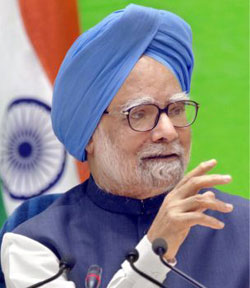 NEW DELHI, Oct 22: Giving a fillip to India's 'Look East' policy, Prime Minister Manmohan Singh will undertake a three-nation tour of Japan, Malaysia and Vietnam from Sunday to discuss greater integration and engagement in diverse fields, particularly trade.
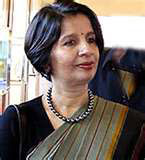 NEW DELHI, Aug 8: India will continue to have a dialogue with Pakistan's civilian government and does not plan to establish any direct contact with its military, Indian Foreign Secretary Nirupama Rao has said.
 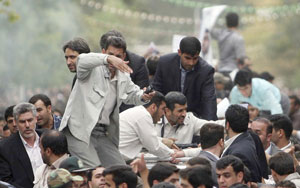 TEHRAN, Aug 4: The Iranian government denies any assassination attempt after a device thrown toward the president's motorcade explodes. The story goes viral on the Internet.
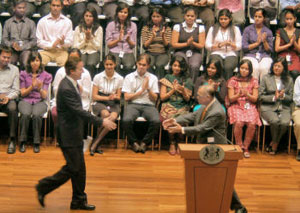 BANGALORE, July 28: Sending a "very clear message" to Pakistan, British Prime Minister David Cameron on Wednesday warned that country against promoting any "export of terror", whether to India or elsewhere, and said it must not be allowed to "look both ways".
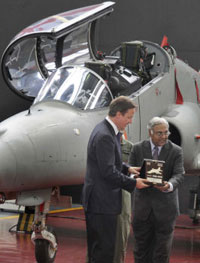 Later, Mr. Cameron witnessed the signing of an agreement at Hindustan Aeronautics Ltd's facility here for the supply 57 Hawk Advanced Jet Trainer aircraft to the Indian Air Force and the Navy. While the IAF will acquire 40 aircraft, the Navy, for the first time, will obtain 17 Hawk AJT aircraft at a total cost of Rs. 5,100 crore.
 NEW DELHI, July 8: External Affairs Minister S M Krishna has said one should not pre-judge the outcome of the new initiative for talks between India and Pakistan as these were primarily aimed at reducing the "trust deficit" between the two neighbours.
 BEIJING, July 6: Observing that India and China have “a relationship which is not externally driven,” National Security Adviser (NSA) Shiv Shankar Menon said here on Tuesday that China's decision to sell two nuclear reactors to Pakistan would have no bearing on the recent warming of ties between New Delhi and Beijing.
 NEW DELHI, July 6: India on Monday expressed its disapproval of “unilateral sanctions” by individual countries that restrict investments by third countries in Iran's energy sector.
 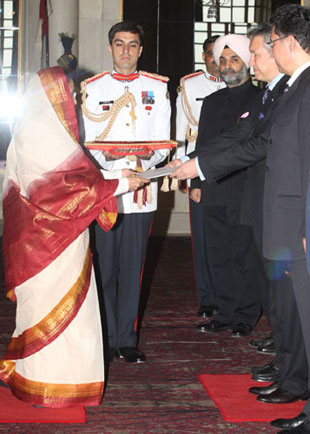 NEW DELHI, June 30: Seven envoys presented their credentials to the President of India, Mrs Pratibha Devisingh Patil, at a ceremony at Rashtrapati Bhavan.
  BANGKOK, May 22: Thailand's prime minister on Friday promised an independent probe into "all events" surrounding the Red Shirt protests, and called for reconciliation to heal deep political divisions that led to widespread violence and 83 deaths in two months.
 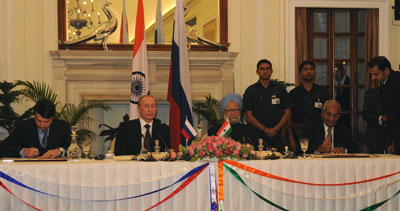 NEW DELHI, March 12: India and Russia today took their strategic partnership to a new level by signing a slew of agreements, including some long-pending defence accords and pacts that will strengthen their cooperation in the areas of civil nuclear energy and space.
 Dr Singh said he had conveyed to Mr Putin that relations with Russia were key pillar of India's foreign policy and that it regarded Russia as a "trusted and reliable strategic partner".
 Russia is building nuclear power stations for India at Kudankulam in Tamil Nadu and the Centre has already said that Russia had been allocated another site, Haripur in West Bengal, for some more nuclear power stations, construction for which is likely to begin by 2017.
 NEW DELHI, Feb 23: Issues of security and combating extremism in the region are likely to dominate parleys between Prime Minister Manmohan Singh and leaders of Saudi Arabia, who are also expected to sign an extradition treaty during the former's three-day visit to this country later this week.
 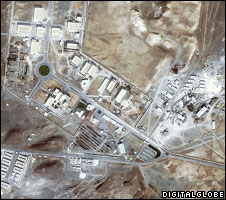 TEHRAN, Feb 8: Iran has announced immediate plans to step up its nuclear programme, which Western nations fear could be used to make a bomb. Its nuclear chief said Iran would start enriching uranium to 20% from Tuesday, and that 10 new uranium enrichment plants would be built in the next year.
  TORONTO, Feb 1: Canada and India must forge stronger trade, investment and educational ties to build a more productive friendship, Canadian Prime Minister Stephen Harper has said. "Canada stands besides India as a steadfast and faithful friend," Harper said in a message to a function organised by Panorama India to commemorate India's 61st Republic Day celebration in Toronto.
 NEW DELHI, Jan 21: India's External Affairs Minister S M Krishna has underlined the need for a regional approach to bring about energy security In India and the ASEAN nations which can accommodate competing demands and constraints while shifting the focus from competition to cooperation based on mutual interests.
 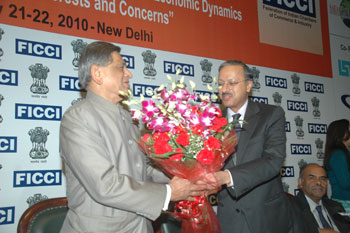 “We strongly believe in sharing our developmental experiences with our fellow developing countries. We have been happy to participate in development cooperation programmes with ASEAN countries, and in the ‘Initiative for ASEAN Integration’ Programme. We have given particular emphasis to human resource development through training, scholarships, establishment of entrepreneurship development centres and language training centres,” Mr. Krishna declared.
 These links included establishment of an India-ASEAN Round Table comprising think tanks, policy makers, scholars, media and business representatives that would provide policy inputs to the governments of India and the ASEAN countries on future areas of cooperation; intensification of negotiations on an open skies policy; further simplification of the visa regime to encourage business and tourist travel; more youth exchange programmes; enhanced cooperation in the agriculture sector to meet the challenges of food security; cooperation in the application of space technologies; holding an ASEAN trade and industrial exhibition in India; among others.
  Mr. K Kesavapany, Director, ISEAS, noted that the target of achieving a US$ 100 billion trade turnover between India and the ASEAN countries by 2015 was a “signpost that we must all aspire for” and concurred with Mr. Singhania that the target was achievable if the borders were kept open and trade was free of barriers.
 NEW DELHI, Jan 21: Dr. Nam Viyaketh, Minister of Industry and Commerce, Lao PDR, today invited Indian wholly-owned or joint ventures in his country as Lao initiates steps to turn the disadvantage of being landlocked into an advantage of being land-linked through the implementation of the north-south and east-west economic corridor projects to link the transport network with the neighbouring countries, and other parts of the world.
 Dr. Viyaketh said that Lao cooperates actively under the sub-regional frameworks that would contribute to the acceleration of ASEAN integration moving towards its goal of establishing an ASEAN Economic Community in 2015.


 The inaugural session will be “India and Southeast Asia in the Changing Regional Economic Dynamics of Asia: Shared Interests and Concerns” and will be moderated by Dr Amit Mitra, Secretary General, FICCI and the welcome address will be given by Harsh Pati Singhania, President FICCI.
  Manish Tewari, Member of Parliament and Spokesperson, Indian National Congress, Rajiv Pratap Rudy, Member of Parliament and Spokesperson, BJP, and Gautam Adhikari, former Editor-in-Chief, Times of India and Consultant World Bank, Washington D.C., will also address this pre-lunch session.
  Friday’s morning session on the topic “India – ASEAN Roadmap in the New Millennium” will be moderated by R Ravindran, former Member of Parliament and Chairman, SAEA Group Research, Singapore.
  HYDERABAD, Dec 11: Ontario’s trade mission wrapped up its eight-day visit to India in Hyderabad on Friday, delivering new deals that will create jobs in Ontario and a greener environment for all.
 While in Hyderabad, Premier McGuinty participated in a plenary session He also visited the Indian School of Business in Hyderabad to promote Ontario with academic and leaders and students at one of the top-ranked Business Schools in the world.
 MUMBAI, Dec 10: Ontario’s trade mission to India moved from Mumbai to Hyderabad today, as the Premier and the delegation met with Indian business leaders who are keen to see their economy grow green.
  @ Ontario’s Canasia Power Corp and Chem Process Systems Pvt. Limited signed a Memorandum of Understanding to produce and develop heat transfer technologies, energized and powered by Canasia designed Solar Power Systems.
 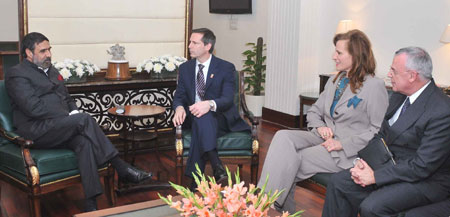 NEW DELHI, Dec 7: Ontario clean technology companies signed more than $200 million in agreements with partners in New Delhi during the second day of Ontario’s Clean Technology Mission to India.
  Together they announced the following:
 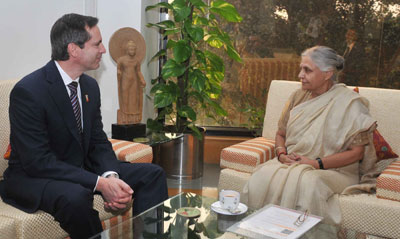 NORR Limited and Studio u + a announced the results of their successful collaboration — the design and delivery of 2.45 million sq. ft. of development in India.
 Speaking here, McGuinty said “Ontario’s expertise in green technology was hard-won. We had to learn from our mistakes. By avoiding the mistakes we’ve made in the past, India and its people can enjoy sustained economic growth that creates jobs in both our countries.”
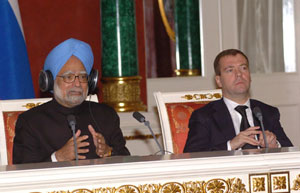 MOSCOW, Dec 7: India inked a nuclear cooperation agreement with Russia in Moscow on Monday that officials said entailed no restrictions of the type envisaged in a similar agreement signed with the United States a year ago. The officials claimed the pact ensures the supply of uranium to fuel nuclear reactors even if a bilateral pact with Russia on the issue falls apart if India tests another atomic weapon. They described the deal as "even better" than the 123 Agreement with the US.
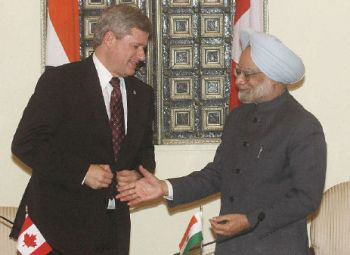 PORT OF SPAIN, Nov 29: India and Canada concluded negotiations on a civil nuclear cooperation with PM Manmohan Singh and his Canadian counterpart Stephen Harper describing the development as a "milestone" opening up "tremendous opportunity" for the two countries.
 Aviation
| Business | Defence | Foreign
Affairs | Communication | Health
| India | United Nations
India-US
| India-France | Entertainment
| Sports | Photo Gallery |
Tourism | Advertise with Us
| Contact Us
© Noyanika International, 2003-2009. All rights reserved.