


Foreign Affairs
|
India, France vow to fight terror jointly
Hollande, who will be the chief guest at the Republic Day celebrations in Delhi, said he was “rather optimistic” an agreement over the aircraft would be signed on Monday as he began a three-day visit to India in Chandigarh where he was greeted by Prime Minister Narendra Modi. “We are going to take another step on the road which we hope will lead us to India’s acquisition of the 36 Rafale jets,” the French President told reporters. “India needs them and France has shown that it has the world’s best aircraft. The commercial contract can only come after the inter-governmental accord... which will be discussed during my visit.” The deal is expected to come up when Hollande and Modi hold talks on Monday as negotiations have dragged on under two successive governments with New Delhi’s insistence that at least 30% of the construction be done on Indian soil emerging as a key sticking point. Indian and French companies signed 16 pacts at a business summit after Hollande touched down in Chandigarh, a city designed by Swiss-French architect Le Corbusier. Speaking at the conference, Hollande said one of the main agendas of his visit was to foster ties between Paris and New Delhi to tackle terrorism as both were affected by the menace. “I will talk about two (things): first, security, because we are affected by regional crisis and also terrorism. Both countries have been hit. So together we will increase our exchanges, cooperation between services and act to reinforce our military equipment. It is part of the agenda for this trip,” he said. “Following the success of the 2015 Paris climate conference in December, we are going to translate our common drive to implement as fast as possible the Paris agreement in launching here the solar alliance.” Modi said he had invited Hollande as a show of solidarity after last year’s shootings and bombings by Islamic terrorists in Paris that killed 130 and evoked memories of the 26/11 Mumbai attacks of 2008. “The day Paris was hit by terror, I decided that our Republic Day parade guest must be France as our people are united against the enemies of humanity,” the PM said in his speech. The two countires are also discussing a plan by French nuclear company Areva to build six reactors in western India, as part of a push to ramp up nuclear capacity. Hollande said India and France have over the years had the willingness to work in the same direction beyond the strategic partnership. “It is an epic adventure, where our companies, which are numerous here, will be welcomed in India first in line. Besides, numerous job opportunities are also in line during this trip on top of the diplomatic, political and military agenda,” he added. Earlier, Modi and Hollande met at the iconic Rock Garden where they greeted each other with a warm hug. Pathankot attack: Examining fresh leads provided by India, says SharifLONDON, Jan 25: Pakistani Prime Minister Nawaz Sharif on Sunday acknowledged that India has given fresh leads relating to the Pathankot airbase attack. Sharif said that Pakistan is verifying the facts to bring the perpetrators to justice. “I have received fresh leads from India on the Pathankot attack and we will look and examine those evidences given by India. We could have hidden it or forgotten it but we asserted that we have received the evidences,” Sharif said on a day when US President Barack Obama termed the Pathankot terror strike as “another example of the inexcusable terrorism that India has endured for too long”. “Pakistan has an opportunity to show that it is serious about delegitimising, disrupting and dismantling terror networks,” Obama said in an interview. “We are probing and verifying that. Once we are done with that we would definitely bring the facts forward. Along with that, we have also formed a special investigating team, they would go to India and collect more evidence,” Sharif said in London on his arrival from Davos after attending the World Economic Forum. “I had a word with Prime Minister Narendra Modi and he had offered every help possible from their side in bringing the perpetrators to justice. We are going on the right lines and I hope the perpetrators will be brought to justice soon,” said Sharif who promised further Pakistani action to combat militants but conceded that progress had often been slow. India gave “specific and actionable information” to Pakistan soon after the Pathankot attack reportedly carried out by Jaish-e-Mohammed terrorists on the intervening night of January 1 and 2 that killed seven Indian soldiers. Pakistani national security advisor Lt Gen Naseer Khan Janjua on January 5 called up his Indian counterpart Ajit Doval during which they discussed “specific and actionable information” related to the Pathankot terror strike. Doval and Janjua talked about various information and leads, like the Pakistani numbers which the attackers had called and their intercepts with India asserting that an effective action on part of Pakistan was important. Sharif was speaking days after a deadly attack by heavily armed gunmen on a university near Peshawar killed 21 people. The attack bore a chilling resemblance to the December, 2014 Peshawar school attack in which over 150 people, mostly children, were killed, prompting the government to launch a National Action Plan (NAP) cracking down on militancy. Sharif said Pakistan would continue the fight against militants. “We will fulfil this responsibility,” he said. 21 killed as Taliban attack university in PeshawarISLAMABAD, Jan 20: Suspected Islamist gunmen stormed a teeming university campus in Pakistan’s volatile northwest on Wednesday, killing 21 people, including a chemistry professor who tried to protect his students by firing at the militants. A security official said the death toll could rise as the army cleared out student hostels and classrooms at Bacha Khan University at Charsadda, around 50km from Peshawar, in the Khyber-Pakhtunkhwa province. Former cricket hero Imran Khan’s Pakistan Tehrik-e-Insaf Party, which rules the province, initially said about 25 people were killed and 50 others wounded in the attack. The death toll was later revised by police officials to 21. The brazen attack coincided with the death anniversary of renowned Pashtun leader Khan Abdul Ghaffar Khan or Bacha Khan, the apostle of peace after whom the varsity is named. The assault was claimed by a Taliban faction led by Umar Mansoor, the mastermind of the 2014 attack on an army-run school in Peshawar that killed nearly 150 people. “Our four suicide attackers carried out the attack on Bacha Khan University today,” said Mansoor. Tsai elected first woman President of TaiwanBy Deepak Arora
Tsai won around 60 per cent of the vote for the DPP, which has been less enthusiastic about economic integration with China, while the KMT's Eric Chu admitted defeat garnering 30 per cent, with two-third of all polling stations reporting results by Saturday evening. KMT had pursued closer economic ties with the mainland over 8 years in office, while the DPP has been less enthusiastic about economic integration with China. China regards Taiwan, an island of 23 million, as a "breakaway" province, although China and Taiwan have been ruled separately since the end of the Chinese civil war in 1949, when the KMT, losing to the Communist Party of China, fled to Taiwan. Outgoing KMT President Ma Ying-jeou fostered closer economic ties with the mainland, with a landmark economic framework agreement boosting trade ties. Ma in 2015 held a historic meeting with Chinese President Xi Jinping in Singapore - the first ever meeting between the heads of China and Taiwan - reflecting a warming of ties. However, perceptions among many sections in Taiwan that the benefits were not being shared - and largely profited elites - led to growing disenchantment, culminating in "Sunflower movement" protests by students last year calling for revising what they described as opaque trade deals. Fears of Taiwan's identity being eroded as it fell into China's economic orbit have also risen. Only around two dozen countries - many of which are small island states - maintain diplomatic ties amid China's growing global clout. In her victory speech, Tsai struck a somewhat conciliatory tone, promising stability in ties with the mainland and "consistent and predictable" cross-Strait ties. At the same time, hinting at a different economic approach, she said she would rule with greater transparency and would protect Taiwan's sovereignty as a priority. Describing the election as historic, Tsai said the "democratic spirit" of Taiwan was the election's biggest significance, hinting at a contrast with one party-ruled China. Taiwanese singer forced to apologise for waving flag, row escalatesTAIPEI, Jan 16: A row over a teenage Taiwanese K-pop star forced to apologise for waving the island’s flag was rapidly turning into an international incident Saturday, stealing the spotlight from Taiwan’s presidential elections. Leadership candidates running for office in Saturday’s pivotal vote demanded answers from China and South Korea after the video apology from a tired and sombre Chou Tzu-yu, 16, went viral, with more than 2.6 million hits. The controversy dominated news coverage in Taiwan on election day, with China ties a key issue for voters. “There is only one China and the two sides are one,” Chou said in the apology, posted on YouTube by South Korean agency JYP Entertainment. “As a Chinese person my improper words and behaviour during my activities abroad hurt my company and the feelings of netizens across the strait,” Chou added. “I have decided to stop my activities in China for now to seriously reflect on myself.” Based in South Korea, Chou is a singer with all-girl band TWICE. She waved Taiwan’s official flag on a recent online broadcast, angering Chinese netizens, with suggestions she was pushing a pro-Taiwan independence agenda. Taiwan has ruled itself since a split with the Chinese mainland in 1949 after a civil war, but has never formally declared independence. “A citizen of the Republic of China (Taiwan’s official name) who shows her recognition for the country should not be suppressed and should not be forced to say the opposite of what she originally meant,” said presidential frontrunner Tsai Ing-wen of the Beijing-wary Democratic Progressive Party. “Our hearts are with all friends who hold the flag and support the flag,” said Eric Chu of the ruling Kuomintang (KMT), set to be punished in the polls for its Beijing-friendly stance. A statement from the office of current President Ma Ying-jeou of the KMT said he had asked officials to “clarify the roles of the Korean and Chinese sides in this incident and demand they seriously face it”. Ma later said waving the flag was not a sign of being pro-independence. Taiwan’s Mainland Affairs Council said it had “firmly expressed” its position to China’s Taiwan Affairs Office. “(We) hope the mainland can view this incident squarely and constrain this behaviour by its people, so that it won’t affect the development of cross-strait relations,” it said in a statement. There was also anger online in Taiwan. “A 16-year-old girl is bullied by China. I sure will go voting today,” said one post on Taiwan’s Apple Daily newspaper website. One analyst said the drama could boost election turnout. “Any boost to the turnout likely helps Tsai and the DPP, particularly since this has gone viral among young people,” said Clayton Dube of the University of Southern California’s US-China Institute. Media reports said a Chinese TV channel had cancelled an upcoming show featuring TWICE and that Chou had also been pulled from endorsing Chinese smartphone vendor Huawei in the South Korean market. Last year, US singer-songwriter Katy Perry caused a stir in both Taiwan and China when she appeared on stage draped in a Taiwanese flag at a concert in Taipei, while donning a glittering gold dress adorned with sunflowers -- the symbol of anti-China student protests in Taiwan in 2014. Top Afghan official says Pak officers behind Indian consulate attackKABUL, Jan 12: Pakistani military officers were behind an attack on the Indian consulate in Mazar-e-Sharif last week, a top Afghan police official said on Tuesday. One Afghan policeman was killed and nine others, including three civilians, were wounded in the attack on January 4 that coincided with an assault by militants on an Indian airbase in Pathankot. Sayed Kamal Sadat, the police chief of Balkh province, said the attackers in Mazar-e-Sharif were well-trained military men “from across the border” who fought Afghan security forces during a 25-hour siege. All three attackers were killed by the Afghan troops. “We saw with our own eyes and I can say 99% that those attackers were from Pakistani military and used special tactics while conducting their operation,” Sadat was quoted as saying by Tolo News channel. “The attackers were military personnel. They were educated and well prepared and had intelligence. They fought us and only by Allah’s grace were we able to control them and eliminate them.” Sadat said efforts are underway to track down, identify and detain those who assisted the attackers to gain access to a building located opposite the Indian consulate in Mazar-e-Sharif, the capital of Balkh. “We are jointly working with the NDS (National Directorate of Security) director and have spoken about this – especially as they came here not able to speak in Dari or Pashtu but speaking in Urdu. It means obviously there is someone who guided those attackers and helped the attackers,” he said. The attackers stormed a multi-storey building and began firing at the Indian consulate with automatic weapons and rocket launchers. Afghan forces eventually gunned down the attackers, who had holed up on the fourth floor. The attackers scribbled a message in blood on the walls of a room that said the assault was carried out to avenge Afzal Guru, who was hanged for his role in the 2001 attack on the Indian parliament. The attackers in Pathankot too spoke of attacking the airbase as revenge for the execution of Afzal Guru. Indian authorities have blamed the Pathankot attack on Pakistan-based Jaish-e-Mohammed. Taiwan President Ma turns Taiping as Island of Peace in South China SeaBy Deepak Arora
It may be recalled that amidst tensions in South China Sea, on May 26 last, President Ma had advocated that all parties should be included in mechanisms or measures that enhance peace and prosperity in the South China Sea and establish a regional cooperation mechanism for the zonal development of resources through integrated planning. With this move, Taiwan has reasserted its territorial claims in a region where China’s land reclamation has ignited international tensions. It’s a different story that Beijing regards Taiwan as a renegade Chinese province. Infrastructure-building in the South China Sea has been a highly divisive issue since early this year when satellite photographs exposed the extent of China’s land reclamation around rocks and reefs it controls in the Spratlys.
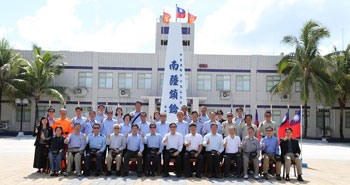
In October, China accused the US of violating its sovereignty after a US Navy ship sailed within 12 nautical miles of the Chinese-built islands. In November, US B-52 bombers also flew near the islands. President Ma’s historic meeting and a handshake with Chinese President Xi Jinping on November 7 in Singapore and now this new peace initiative in South China Sea makes him a serious contender for this year’s Nobel Peace Prize. On December 12, the two ROC Ministers along with officials from the Ministries of Transportation and Communications, Science and Technology, Economic Affairs, and Health and Welfare, as well as the Environmental Protection Administration, flew to Taiping Island in the Nansha (Spratly) Islands to preside over a ceremony marking the completion of the Taiping Island Transportation Infrastructure Project, which involved the renovation of the island’s wharf and lighthouse. It took nearly two years to upgrade the infrastructure projects. The wharf, which can accommodate ships of 3,000 tons, is 318 meter long and 20 meter wide. Taiping Island, which houses a military airfield, is the largest natural island in the Spratlys chain and the only one controlled by Taiwan, whose claims in the area overlap with those of China, Vietnam, Malaysia, the Philippines and Brunei. It said the inauguration of the wharf and lighthouse was historically significant because Saturday marked the 69th anniversary of the return of Taiping Island from Japan to the Republic of China.
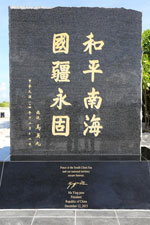
Defense experts say Taiwan has also upgraded its airstrip to allow frequent flights by larger cargo planes. The island’s 1,195-meter (3,944-foot) airstrip is big enough to accommodate Taiwan’s F-16 fighters, C-130 Hercules cargo planes and P-3 maritime patrol aircraft, according to the Center for Strategic and International Studies, or CSIS, in Washington. The officials unveiled a memorial plaque signed by President Ma, which was engraved with the words, "Peace in the South China Sea and our national territory secure forever." Minister Chen stated that, as head of the ministry responsible for administration of the nation’s territory, he was honored to personally witness this historic event. In recent years, tensions have been high in the South China Sea. Parties concerned have claimed sovereignty and maritime rights over islands and reefs in the region in a variety of ways. In particular, the development of the ongoing Philippine arbitration has made the situation the focus of great international concern. With regard to disputes in the South China Sea, the Executive Yuan and Ministry of Foreign Affairs have released numerous statements declaring that, whether from the perspective of history, geography, or international law, the Nansha (Spratly) Islands, Shisha (Paracel) Islands, Chungsha Islands (Macclesfield Bank), and Tungsha (Pratas) Islands, as well as their surrounding waters, are an inherent part of ROC territory and waters, and that the ROC enjoys all rights over these islands and their surrounding waters in accordance with international law. To create a mechanism for the peaceful settlement of disputes, President Ma Ying-jeou proposed the South China Sea Peace Initiative on May 26 this year. This initiative reiterates the ROC government’s longstanding principles of safeguarding sovereignty, shelving disputes, pursuing peace and reciprocity, and promoting joint development. In addition, based on respect for all relevant international laws and regulations, including the United Nations Charter and UN Convention on the Law of the Sea (UNCLOS), it expresses the ROC’s willingness to work with other parties concerned, through consultations conducted on a basis of equality and reciprocity, to jointly ensure peace and stability in the South China Sea, uphold the freedom of navigation and overflight, and conserve and develop resources in the region. Minister Chen pointed out that Taiping Island is the largest of the naturally formed Nansha Islands, with an abundance of natural resources and four groundwater wells. About 65 metric tons of water can be pumped from these wells daily to provide drinking water and meet cooking and everyday needs. Natural vegetation flourishes on the island, providing coconuts, papayas, and plantains. For years, personnel stationed on the island have made use of its various resources, growing fruits and vegetables, and raising poultry and livestock to meet their daily needs. To meet religious needs, a Guanyin Temple was built in 1959, where the Bodhisattva of Compassion is worshipped. From legal, economic, and geographic perspectives, Taiping Island indisputably qualifies as an “island” according to the specifications of Article 121 of the UN Convention on the Law of the Sea, and can sustain human habitation and economic life of its own. It is thus categorically not a “rock.” The ROC government will firmly defend this fact, and maintains that none of the Philippines’ arguments in its ongoing arbitration, nor any other claims which aim to deny it, will impair the status of Taiping Island and its maritime rights based on UNCLOS. Minister Chen said management efforts made by the ROC government in recent years are aimed at gradually transforming Taiping Island into a peaceful and low-carbon island, as well as an ecological reserve, in the spirit of the South China Sea Peace Initiative. The ROC Coast Guard Administration was established in January 2000 and its personnel then replaced marines on the island. This was, in effect, an ROC declaration to the international community of its determination to use Taiping for peaceful purposes. After the CGA took over administration of the island, medical services were increased at the Nansha Hospital with assistance from the Ministry of Health and Welfare. The hospital now has 10 beds, two doctors, a dentist, and two nurses. A telemedicine service system has been set up with Kaohsiung Armed Forces General Hospital for long-distance consultation so as to provide medical care to personnel stationed on the island as well as fishermen from different countries operating in neighboring waters. In case of emergency or severe illness, the hospital will have a vessel transport patients to Taiwan for treatment. It also provides emergency medical care and rescue services to passing vessels and crews. Over the past decade, it has offered humanitarian assistance to 21 people in 20 cases, including Philippine and Myanmar nationals, fully demonstrating its dedication to humanitarianism. The ROC’s aims in renovating this lighthouse are also peaceful. The South China Sea is a crucial thoroughfare for ships passing between Asia, Europe, and Africa, but replete with shoals and submerged rocks. The lighthouse on Taiping Island will help the ROC fulfill its international responsibilities by allowing the safe passage of ships through the surrounding waters, preventing shipwrecks, loss of life, and marine pollution, and contributing to the safe seaborne transport of goods and the provision of humanitarian aid. Taiping Island is a very important place ecologically, with extremely rich marine biodiversity and fisheries resources, Minister Chen said. To protect these natural resources, the Kaohsiung City government established a turtle refuge on Taiping Island in 2007, while the Ministry of the Interior began a survey on biological diversity on Taiping Island in 2009, the results of which were made public when it was completed last year. These efforts show the ROC government’s determination to protect the marine environment of the South China Sea. At the end of 2014, the Ministry of Economic Affairs set up solar panel banks with output of 160 kWp. Paired with storage batteries, the system can provide up to 200,000 kWh of power annually, reducing carbon dioxide emissions by 107 metric tons. With the assistance of the Ministry of Science and Technology, the system’s efficiency and output will be enhanced in the future. As a result, Taiping Island is now on its way to reaching the goal of becoming a low-carbon island. Looking ahead, the ROC will continue surveys on the natural resources in the waters around the island as a reference for jointly developing these resources with others. In addition, to promote international cooperation in the South China Sea, the EPA has, since 2009, been testing water quality at Taiping Island, and has opened a background monitoring station on Tungsha Island that cooperates with the Aerosol Robotic Network (AERONET) of the US National Aeronautics and Space Administration (NASA). In 2010, the EPA cooperated with the US National Oceanic and Atmospheric Administration (NOAA) on monitoring greenhouse gases, attesting to the nation’s commitment to joint international monitoring as well as its important role in regional monitoring efforts. The importance of Taiping Island, located as it is in the middle of the South China Sea, cannot be overstated. The EPA will continue its current monitoring efforts, and increase the frequency of seawater sampling. The agency will adapt its Tungsha Island model for conservation science research on Taiping Island. The Ministry of Science and Technology, meanwhile, is evaluating the establishment of a scientific research station on Taiping Island for research projects in such fields as seismology, weather, oceanic currents, and ecological conservation. The station could also provide advance-warning and information-sharing systems concerning potential natural disasters resulting from climate change, as part of a future international cooperative mechanism for disaster prevention. The Republic of China hopes, through this infrastructure project, to make Taiping Island a peaceful and low-carbon island, as well as an ecological reserve, as a way of further implementing the South China Sea Peace Initiative and showing the international community the ROC’s resolve to be a peacemaker in the South China Sea by shelving disputes and jointly developing resources, to transform it into a “Sea of Peace and Cooperation.” ROC urged to contribute to peace in S. China SeaWASHINGTON: The U.S. government on Saturday called on all the claimants of the South China Sea to work to reduce regional tensions and said it hoped that a visit by Taiwan's Interior Minister Chen Wei-zen to Taiping Island in the area that day would contribute to the peace objective. The statement came from Jennifer Foltz, a spokeswoman for the Bureau of East Asian and Pacific Affairs at the U.S. Department of State, who was responding to Chen's visit to Taipei Island, the largest of the disputed Spratly Islands in the South China Sea, which is controlled by Taiwan. "As a matter of longstanding policy, we call on all South China Sea claimants to work to lower regional tensions," Foltz said. "We hope that Minister Chen's planned visit contributes to that objective." Chen and Coast Guard Administration Minister Wang Chung-Yi traveled to Taiping Island Saturday for the opening of a renovated wharf and a newly constructed lighthouse. North Korea says it conducts successful powerful hydrogen bomb testSEOUL, Jan 6: North Korea said it conducted a powerful hydrogen bomb test on Wednesday, a defiant and surprising move that, if confirmed, would be a huge jump in Pyongyang’s quest to improve its still-limited nuclear arsenal. South Korea’s spy agency and outside nuclear experts cast strong doubt, however, saying the estimated explosive yield from North Korea’s fourth nuclear explosion was much smaller than what even a failed H-bomb detonation would produce. The doubts didn’t stop jubilation and pride in Pyongyang. A North Korean television anchor, reading a typically propaganda-heavy statement, said a test of a “miniaturised” hydrogen bomb had been a “perfect success” that elevated the country’s “nuclear might to the next level”. State media later crowed that its “H-bomb of justice” lets it stand firm against U.S. aggression. A large crowd celebrated in front of Pyongyang’s main train station as the announcement was read on a big video screen, with people taking videos or photos of the screen on their mobile phones and applauding and cheering. In Seoul, and elsewhere, there was high-level worry. South Korean President Park Geun-hye ordered her military to bolster its combined defense posture with U.S. forces and called the test a “grave provocation” and “an act that threatens our lives and future.” Japanese Prime Minister Shinzo Abe said, “We absolutely cannot allow this.” Washington and nuclear experts have been sceptical about past North Korean claims about H-bombs, which are much more powerful and much more difficult to make, than atomic bombs. A confirmed test would further worsen already abysmal relations between Pyongyang and its neighbours and lead to a strong push for tougher sanctions on North Korea at the United Nations. The Security Council quickly announced an emergency meeting. Whatever the type of the test, North Korea’s fourth nuclear explosion will likely push Pyongyang’s scientists and engineers closer to their goal of building a bomb small enough to place on a missile that can reach the U.S. mainland. A successful H-bomb test would be a big new step for the North. Fusion is the main principle behind the hydrogen bomb, which can be hundreds of times more powerful than atomic bombs that use fission. In a hydrogen bomb, radiation from a nuclear fission explosion sets off a fusion reaction responsible for a powerful blast and radioactivity. A South Korean lawmaker said the country’s spy agency told him in a private briefing that Pyongyang may not have conducted an H-bomb test given the relatively small size of the seismic wave reported. An estimated explosive yield of 6.0 kilotonnes and a quake with a magnitude of 4.8 (the U.S. reported 5.1) were detected, lawmaker Lee Cheol Woo said the National Intelligence Service told him. That’s smaller than the estimated explosive yield of 7.9 kilotonnes and a quake with a magnitude of 4.9 that were reported after the 2013 nuclear test, he said, and only a fraction of the hundreds of kilotonnes that a successful H-bomb test’s explosion would usually yield. Even a failed H-bomb detonation typically yields tens of kilotonnes, the NIS told Mr. Lee, who sits on the parliament’s intelligence committee. A miniaturised H-bomb can trigger a weak quake magnitude, but only the U.S. and Russia have such H-bombs, Mr. Lee cited the NIS as saying. While also noting the quake magnitude was likely too small for an H-bomb test, Jaiki Lee, a professor of nuclear engineering at Seoul’s Hanyang University, said the North could have experimented with a “boosted” hybrid bomb that uses some nuclear fusion fuel along with more conventional uranium or plutonium fuel. After North Korean leader Kim Jong Un bragged of H-bomb capabilities in December, nuclear expert Jeffrey Lewis also questioned Pyongyang’s ability to build such a bomb. But, he wrote on the North Korea-focussed 38 North website, “The North has now had a nuclear weapons program for more than 20 years. This program has yielded three nuclear tests. North Korean nuclear scientists have access to their counterparts in Pakistan, possibly Iran and maybe a few other places. We should not expect that they will test the same fission device over and over again.” It could take weeks before the true nature of the test is confirmed by outside experts if they are able to do so at all. North Korea goes to great lengths to conceal its tests by conducting them underground and tightly sealing off tunnels or any other vents though which radioactive residue and blast—related noble gases could escape into the atmosphere. The U.S. Air Force has aircraft designed to detect the evidence of a nuclear test, and such aircraft could be deployed from a U.S. base on the Japanese island of Okinawa to search for clues. Japanese media said Tokyo has also mobilised its own reconnaissance aircraft for sorties over the Sea of Japan to try to collect atmospheric data. North Korea’s previous nuclear test was in early 2013, and Kim Jong Un did not mention nuclear weapons in his annual New Year’s speech. Some outside analysts speculated Kim was worried about deteriorating ties with China, the North’s last major ally, which has shown greater frustration at provocations and a possible willingness to allow stronger U.N. sanctions. Chinese Foreign Ministry spokeswoman Hua Chunying told reporters that Beijing “firmly opposes” Pyongyang’s purported test and is monitoring the environment on its border with North Korea near the test site. Just how big a threat North Korea’s nuclear program currently poses is something of a mystery. North Korea is thought to have a handful of rudimentary nuclear bombs and has spent decades trying to perfect a multistage, long-range missile to eventually carry smaller versions of those bombs. Some analysts say the North hasn’t likely achieved the technology needed to manufacture a miniaturised warhead that could fit on a long-range missile capable of hitting the U.S. mainland. But there is a growing debate on just how far the North has advanced in its secretive nuclear and missile programmes. North Korea needs nuclear tests for practical military and political reasons. To build a credible nuclear programme, the North must explode new nuclear devices including miniaturized ones so its scientists can continually improve their designs and technology. Nuclear-tipped missiles could then be used as deterrents, and diplomatic bargaining chips, against its enemies and especially against the United States, which Pyongyang has long pushed to withdraw its troops from the region and to sign a peace treaty formally ending the Korean War. “This is indeed a wakeup call,” Lassina Zerbo, the head of the Vienna-based U.N. Comprehensive Test Ban Treaty Organisation, which has a worldwide network of monitoring stations to detect nuclear testing, told AP by phone. “I am convinced it will have repercussions on North Korea and international peace and stability.” China again lands planes on disputed island in South China Sea: XinhuaBEIJING, Jan 6: China on Wednesday landed two test flights on an island it has built in the South China Sea, four days after it angered Vietnam with a landing on the same runway in the disputed territory, the Xinhua state news agency said. The two flights are likely to spark further condemnation from Vietnam, which launched a formal diplomatic protest over the weekend, and the Philippines, which said it was planning to do the same. Both countries have claims to the area that overlap with that of China, which claims almost the whole of the South China Sea. Xinhua said the two planes landed on an artificial island in the Spratly Islands on Wednesday morning. “The successful test flights proved that the airport has the capacity to ensure the safe operation of large civilian aircraft,” Xinhua said, adding that the airport would facilitate the transport of supplies, personnel and medical aid. Xinhua did not give any more detail about what type of aircraft had landed. The runway at the Fiery Cross Reef is 3,000 metres (10,000 feet) long and is one of the three China has been building for more than a year by dredging sand up onto reefs and atolls in the Spratly archipelago. On Saturday, China landed a civilian plane on the same runway in the Spratlys in its first test, which was also the first time it had used a runway in the area. The United States has criticised China’s construction of the islands and worries that it plans to use them for military purposes, even though China says it has no hostile intent. The United States said after the first landing it was concerned that the flight had exacerbated tension. The runways would be long enough to handle long-range bombers and transport aircraft as well as China’s best jet fighters, giving it a presence deep in the maritime heart of Southeast Asia that it has lacked until now. More than $5 trillion of world trade is shipped through the South China Sea every year. Vietnam, Malaysia, Brunei, the Philippines and Taiwan have rival claims. Fire engulfs Dubai hotel near Burj Khalifa
It was not immediately clear what caused the fire, which ran up at least 20 stories of The Address Hotel in Downtown Dubai near the Burj Khalifa, the world’s tallest skyscraper. Burning debris rained down from the building as firetrucks raced to the scene. It was not immediately clear if anyone was wounded in the blaze. Dubai planned to wow spectators with three separate firework displays. The show was to begin at the Burj Khalifa, which organizers said was fitted with 400,000 LED lights. They said 1.6 tons of fireworks would be used in the display. From there, the fireworks were to light up the sky around the sail-shaped Burj Al Arab and later down near the Dubai Marina. Fireworks also will be on display in Abu Dhabi, the capital of the country of seven emirates. Former Jammu and Kashmir chief minister Omar Abdullah, who was near the hotel at the time of fire, tweeted out pictures. Omar Abdullah @abdullah_omar Omar Abdullah @abdullah_omar |

| |||||||
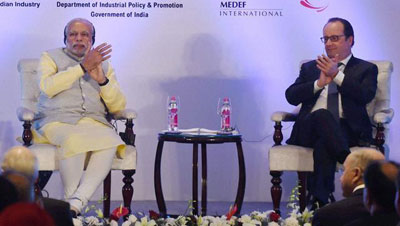 CHANDIGARH, Jan 24: French President Francois Hollande indicated on Sunday a long-awaited $9 billion deal for three dozen Rafale warplanes to India may not be clinched soon even as the two countries pledged increased cooperation to combat terror and climate change.
 TAIPEI, Jan 16: Tsai Ing-wen, 59, of the Democratic Progressive Party (DPP), has been elected as Taiwan's first woman President defeating the China-friendly Kuomintang (KMT).
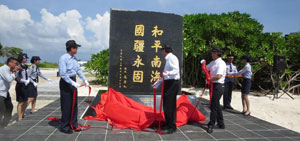 TAIPEI: In a historical move, Republic of China (Taiwan) President Ma Ying-jeou took forward his South China Sea Peace Initiative early December when his Interior Minister Chen Wei-zen and Coast Guard Administration Minister Wang Chung-yi opened a wharf and lighthouse on Taiping Island, the largest of the disputed Spratly Islands, which is controlled by Taiwan. It also demonstrated the ROC’s commitment to making Taiping Island a peaceful and low-carbon island, as well as an ecological reserve.
 The US and several of China’s neighbors have expressed concern that Beijing could use the artificial islands, which include at least one completed airstrip, to enforce its territorial claims and establish control over one of the world’s busiest shipping routes.
 Taiwan took control of Taiping Island in 1946, established a permanent base in 1956 and sent 100 coast-guard personnel to replace its marines there in 2000, according to the CSIS Asia Maritime Transparency Initiative, which monitors territorial disputes in the area.
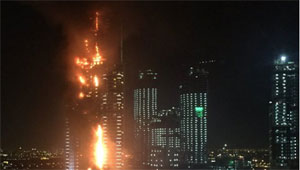 DUBAI, Jan 1: Fire broke out on Thursday in a hotel near Dubai’s massive New Year’s Eve fireworks display.
Aviation
| Business | Defence | Foreign
Affairs | Communication | Health
| India | United Nations
India-US
| India-France | Entertainment
| Sports | Photo Gallery |
Tourism | Advertise with Us
| Contact Us
© Noyanika International, 2003-2009. All rights reserved.