


Foreign Affairs
|
90 killed in Kabul blastKABUL, May 31: A powerful bomb hidden in a sewage tanker exploded in the highly secure diplomatic quarter of Kabul on Wednesday morning, killing 90 people and demonstrating that the holy month of Ramzan would provide little respite from the violence across Afghanistan. The blast in the heart of the Afghan capital injured 400 people and damaged the embassies of India, Bulgaria, France, Japan, Turkey and the UAE. It also destroyed or damaged more than 50 vehicles and shattered windows of buildings located hundreds of metres away. India’s ambassador Manpreet Vohra said the bomb went off nearly 100 metres from the country’s embassy, causing “considerable damage” but all members of the staff were safe. The National Directorate of Security said on Wednesday evening the attack was planned by the Haqqani Network in Pakistan with the “direct help” of the Inter-Services Intelligence agency, according to Afghan media. The Taliban denied responsibility and said they condemned attacks that have no legitimate target and killed civilians. The government’s media centre said: “In this powerful attack, 90 people have been killed and 400 wounded, including many women and children.” Health officials warned the toll could climb further. The target of the explosion in Wazir Akbar Khan area was not immediately known and officials said it was caused by 1,500 kg of explosives hidden in the sewage tanker. The attack took place at the peak of Kabul’s rush hour, when roads were packed with commuters. The bomb killed an Afghan security guard at the German embassy and injured some staff, foreign minister Sigmar Gabriel said on Twitter. BBC News said an Afghan driver was killed and four journalists were wounded but their injuries were not life threatening. Tolo News tweeted a technical staff, Aziz Navin, was killed. Some reports said a suicide bomber detonated the explosives-packed vehicle in Zanbaq Square around 8.30am. The NATO-led Resolute Support mission said Afghan security forces prevented the vehicle from entering the heavily protected Green Zone that houses many foreign embassies as well as its headquarters, suggesting it may not have reached its intended target. Bodies littered the scene and a huge plume of smoke rose from the area. Witnesses described dozens of cars choking the roads as wounded survivors and panicked schoolgirls sought safety, with men and woman struggling to get through security checkpoints to search for loved ones. Video shot at the scene showed burning debris, crumbled walls and buildings and destroyed cars, many with dead or injured people inside. Indian ambassador Manpreet Vohra said: “We are all safe, all our staff, all our personnel are safe. However, the blast was very large and nearby buildings, including our own building, have considerable damage in terms of broken glass and shattered windows and blown doors.” “By God’s grace, Indian embassy staff are safe in the massive #Kabul blast,” external affairs minister Sushma Swaraj tweeted. Germany, Japan and Pakistan said some of their embassy employees and staff were hurt in the explosion. “The attack took place very close to the German embassy. It hit civilians and those who are in Afghanistan to work for a better future for the country with the people there. It’s especially contemptible that these people were the target,” German foreign minister Sigmar Gabriel tweeted. At the Wazir Akbar Khan hospital a few blocks away, there were scenes of chaos as ambulances brought in wounded and frantic relatives scanned casualty lists and questioned hospital staff for news. “It felt like an earthquake,” said 21-year-old Mohammad Hassan, describing the moment the blast struck the bank where he was working. His head wound had been bandaged but blood soaked his white dress shirt. Prime Minister Narendra Modi condemned the blast in Kabul and underlined the need for defeating forces supporting terrorism. Modi, who was in Spain on a visit, said India stands with Afghanistan in fighting all forms of terrorism. “We strongly condemn the terrorist blast in Kabul. Our thoughts are with the families of the deceased & prayers with the injured,” Modi tweeted. India, Spain commit cooperation in combating terrorism
A joint statement issued following a meeting here between visiting Indian Prime Minister Narendra Modi and his Spanish counterpart Mariano Rajoy said both leaders “recognised that terrorism poses the gravest threat to international peace and stability and expressed their strong commitment to combat terrorism in all its forms and manifestations”. “They stressed that there should be zero tolerance to terrorism and that there can be no justification whatsoever for any act of terror,” it stated. “We reiterate that the fight against terrorism requires a robust international cooperation, and we call on all the states to fully implement SC (UN security council) Resolution 1373 and all other relevant SC Resolutions, by establishing strong legal provisions against terrorism, terrorist networks, incitement to terrorism and financing for terrorism, and by satisfying requests from other states for cooperation against terrorism.” According to the statement, Modi and Rajoy “expressed their strong commitment to reinforce their cooperation in the fight against terrorism, through regular bilateral consultations and cooperation and in the international fora”. The two leaders also called on the international community to end selective or partial approaches to combating terrorism and in this regard jointly called for the early finalisation and adoption of the India-initiated Comprehensive Convention on International Terrorism by the UN general assembly. “They took note with satisfaction of the progress made on the negotiations for an agreement for bilateral cooperation in the fight against international terrorism, transnational organised crime, and traffic of illegal drugs, narcotics, psychotropic substances and chemical precursors, which will establish the grounds for an enhanced cooperation in these areas, and committed to complete negotiations by the end of 2017,” the statement said. It stated that both leaders discussed the challenges present in cyberspace and committed to further their dialogue, both bilaterally, and through a closer coordination in the international fora. Both countries underlined their unwavering commitment to the principles and objectives of the UN and its centrality in international affairs. Modi and Rajoy also acknowledged the need for a comprehensive reform of the UN, including its security council, and shared their views on how to expand its membership to make it more representative of the contemporary geopolitical realities and effective, credible and responsive to the existing challenges to international peace and security. The two leaders reiterated their commitment to the freedom of navigation and overflight and unimpeded commerce based on the principles of international law, as reflected in the United Nations Convention on the Law of the Sea (Unclos). They also underlined the importance of European Union (EU)-India relations and the need to deepen the existing EU-India dialogues. “They acknowledged the positive results of 2016 EU-India Summit in March 2016, which marked a new momentum in the EU-India relations,” the statement said. “They addressed the shared interest of the two sides to further engage on the India-EU Broad-based Trade and Investment Agreement and expressed the need to restart negotiations soon.” During a meeting with Modi, CEOs of Spanish business and industry expressed support for the economic reforms in India and highlighted their keen interest to participate actively in flagship programmes like Make in India, Smart Cities, Digital India, Swachh Bharat, Start-up India and Skill India. Rajoy congratulated Modi on India’s fast economic growth and the Indian government’s various measures to improve ease of doing business and boost manufacturing growth. Modi complimented Rajoy on the turnaround and growth of the Spanish economy and the good prospects in the coming years and the transformation of Spain into an open, competitive, export and quality oriented economy. “Both leaders agreed on the need to preserve and further develop open trade and a business friendly investment scenario in both countries, and considered that policies towards protectionism may weaken international trade and have a negative impact in global economy,” the joint statement said. Stating that climate action was a key priority for both India and Spain, it said: “The two leaders reiterated their commitment to implementation of the United Nations Framework Convention on Climate Change, its Kyoto Protocol and the Paris Agreement.” Modi backs Merkel’s EU leadership as Donald Trump criticises Germany
Modi, whose visit to Germany comes less than a week after Merkel provided the strongest indication yet that the EU and the US under President Trump were drifting apart, said India would play a positive role in boosting unity in the grouping. Modi’s support comes at a crucial time for Merkel, who has been fighting secessionist tendencies within the bloc since Britain decided to leave the 28-member bloc through a referendum in June last year. The Prime Minister praised her “strong leadership” and said a EU-focused vision is what the world needs. “EU unity, proactiveness and strong relations with other countries is extremely important for global development. We want the EU to become stronger and India will play a positive role towards that through the medium of Germany,” he told reporters at a joint briefing with Merkel. Modi said India and Germany were “made for each other”. Merkel last week had said that reliable ties forged since the end of World War II “are to some extent over.” Germany’s foreign minister Sigmar Gabriel also blasted the US, saying the Trump administration’s “short-sighted policies... stand against the interest of the European Union”. The remarks came soon after G7 and NATO summits, where news reports suggested that not all was well between her and Trump, who is leading the US towards a more protectionist stance on economic issues and has called for NATO to pay for their share of expenditure of the Atlantic alliance. The two countries are also not on the same page on climate policies. Trump has vowed to walk away from the historic Paris deal while Merkel supports the agreement. “Europe and the world are facing lots of challenges and to fight those, India believes, the world needs the strong leadership of Chancellor Merkel,” Modi added. Merkel on Tuesday repeated that Europe must “take our fate into our own hands” and went on to say that it should step up as a diplomatic player on the international stage. In Washington, Trump swiftly reacted to Merkel’s comments. Soon after her statement, Trump tweeted, “We have a MASSIVE trade deficit with Germany, plus they pay FAR LESS than they should on NATO & military. Very bad for US. This will change(sic).” Merkel, however, had also said Germany’s relationship with the US was of “outstanding importance” but it must also engage with other important nations. “We live in a globalised world and India...is a partner,” she said. Germany is the largest trade partner for India in the European Union (EU) and one of the leading sources of foreign direct investment (FDI) into the country. 22 killed, 60 hurt in Manchester concert blastMANCHESTER, May 23: Twenty-two people were killed and around 60 injured in what police believe is a suicide attack by a person at a concert arena in the northern English city of Manchester overnight. It is the deadliest terrorist attack on Britain since 2005, when bombings on London’s transport system killed 52 people. It is the latest attack on a European city after last month’s in Paris, the Westminster incident, the Berlin Christmas Market onslaught and the attack in Nice, France. It comes less than three weeks before Britain’s national election on June 8, and all political parties have paused their campaigning till further notice. The attack took place late on Monday evening at Manchester Arena, Britain’s largest indoor arena, at the end of a concert of 23-year-old U.S. singer Ariana Grande, when the audience, which included many young children, were streaming out of the venue. “This was a barbaric attack, deliberately targeting some of the most vulnerable in our society - young people and children out at a pop concert,” said Home Secretary Amber Rudd, who will attend a meeting of COBRA, Britain’s emergency committee, later on Tuesday morning, chaired by the Prime Minister. “Families and many young people were out to enjoy a concert at the Manchester Arena and have lost their lives,” said Manchester Chief Constable Ian Hopkins, and added that significant resources were being deployed into the “fast moving investigation.” The police said they believed the attack itself was conducted by one man, who was carrying an “improvised explosive device, which he detonated.” They would be investigating whether he was acting alone or as part of a wider network. Over 400 police officers have been deployed after the attack. The police appealied to members of the public to stay away from the area around the attack as first responders dealt with the situation. Leaders of all political parties swiftly condemned the attack and hailed the work of emergency services. “I am horrified by the horrendous events in Manchester last night. My thoughts are with the families and friends of those who have died or have been injured,” said Labour Leader Jeremy Corbyn. “A terrible night for our great city,” said Manchester Mayor Andy Burnham. “Broken. From the bottom of my heart, I am so so sorry. I don’t have the words,” tweeted singer Grande after the attack. Police are yet to confirm the names of any who had died but some parents took to social media in a desperate hunt for their children. Members of the public also offered accommodation to impacted people as #RoomForManchester was trending on Twitter. N Korea says missile tests warhead guidance, ready for deploymentSEOUL, May 22: North Korea said on Monday it had successfully tested an intermediate-range ballistic missile to confirm the reliability of the late-stage guidance of the warhead, indicating further advances in the ability to hit US targets. The North’s KCNA news agency said leader Kim Jong Un supervised the test which also verified the functioning of the solid-fuel engine for the Pukguksong-2 missile and ordered it for deployment in field action. North Korea has defied all calls to rein in its nuclear and missile programmes, even from China, its lone major ally, saying the weapons are needed for legitimate self-defence. The North last conducted a ballistic missile test a week ago. “Saying with pride that the missile’s rate of hits is very accurate and Pukguksong-2 is a successful strategic weapon, he approved the deployment of this weapon system for action,” KCNA said, quoting leader Kim Jong Un. The launch verified the reliability and accuracy of the solid-fuel engine’s operation and stage separation and the late-stage guidance of the nuclear warhead which was recorded by a device mounted on the warhead, KCNA said. “Viewing the images of the Earth being sent real-time from the camera mounted on the ballistic missile, Supreme leader Kim Jong Un said it feels grand to look at the Earth from the rocket we launched and the entire world looks so beautiful,” KCNA said. The use of solid fuel presents great advantages for weapons because the fuel is more stable and can be transported easily in the missile’s tank allowing for a launch on very short notice. The Pukguksong-2 missile flew about 500 km (310 miles), reaching an altitude of 560 km, and landed in waters off the North Korea’s east coast, South Korea’s military said on Sunday. S Korea questions re-entry technology On Monday, the South’s military said the test provided more “meaningful data” for the North’s missile programme but whether the North mastered the re-entry technology for the warhead needs additional analysis to verify the North’s claims of advances. The reclusive state has been working to develop a nuclear-tipped missile capable of striking the US mainland. On Saturday, it said it had developed the capability to strike the US mainland, although Western missile experts say the claim is exaggerated. The North has yet to demonstrate it has successfully miniaturised a nuclear warhead to mount on a ballistic missile despite claims to having mastered the technology. On Monday, KCNA said the latest test follows the successful test last week of another missile that has put Hawaii and Alaska within range. Experts say solid fuel engines and mobile launchers make it more difficult to detect signs of launch preparations. “For military purposes, solid-fueled missiles have the advantage that they have the fuel loaded in them and can be launched quickly after they are moved to a launch site,” David Wright, co-director of the Global Security Program at the US-based Union of Concerned Scientists, said in a blog post. “Building large solid missiles is difficult,” he said, adding it took decades for major superpowers such as France and China to go from a medium-range missile to an intercontinental ballistic missile. “So this is not something that will happen soon, but with time North Korea will be able to do it,” Wright said. US, Japan warn of more economic pressure An official travelling with U.S. President Donald Trump in Saudi Arabia said the White House was aware of the latest launch and noted that the missile had a shorter range than the three previous missiles that North Korea had tested. US Secretary of State Rex Tillerson said economic and diplomatic pressure would continue to be applied to North Korea. “We can not absolutely tolerate the missile launch on May 21 and repeated provocative remarks and actions by North Korea,” Japan’s chief cabinet secretary Yoshihide Suga said on Monday. “It is important to lower North Korea’s foreign currency earnings and prevent nuclear missile related shipment and technological transfer in order to prevent North Korea’s nuclear missile development. We will fully implement our own sanctions against North Korea.” The two missile tests in a week complicate plans by South Korea’s new President Moon Jae-in to seek ways to reduce tension on the peninsula. Moon took office on May 10 after winning an election on a platform of a more moderate approach to the North, with which the South is still technically at war since no peace treaty was signed at the end of their 1950-1953 conflict. On Monday, the South’s Unification Ministry spokesman Lee Duk-haeng said while Seoul will respond firmly to any provocations by the North, “it would not be desirable to have ties between the South and the North severed.” Requests by South Koreans to resume exchange with the North will be considered “flexibly” within the range such interaction will not violate any existing sanctions, Lee added. All civilian exchange across the border has been suspended following toughed bilateral sanctions imposed by Seoul last year. The South halted a decade of improving ties in 2010 after the sinking of a South Korean navy ship, which Seoul has blamed on the North. Pyongyang denies any involvement. ICJ orders Pakistan not to execute Kulbhushan JadhavTHE HAGUE, May 18: Kulbhushan Jadhav gained a temporary reprieve on Thursday as the International Court of Justice ordered Pakistan not to execute the former Indian Navy officer convicted of alleged espionage and terrorism, rejecting Islamabad’s argument that it did not have jurisdiction in the case. Pakistan sought to play down the significance of the order, saying it amounted to maintaining “status quo” in Jadhav’s case and that it was determined to take the matter to its “logical end”. It added Jadhav “would be provided every opportunity and remedy” to defend his case and had “ample time to petition for clemency”. Three days after India and Pakistan presented their arguments, Ronny Abraham, president of the United Nations’ highest court in The Hague, read out the order: “Pakistan shall take all measures at its disposal to ensure that Mr Jadhav is not executed pending the final decision in these proceedings and shall inform the court of all the measures taken in implementation of the present order.” In “provisional measures” adopted unanimously, the 12-judge tribunal said it would remain “seized of the matters” in its order until it gives a final judgement. At the hearing on Monday, India described Jadhav’s trial as a “serious miscarriage of justice” because Indian diplomats were not granted consular access to him and he wasn’t allowed to choose his defence lawyer. India argued these restrictions amounted to a breach of the 1963 Vienna Convention on Consular Relations. Pakistan claimed the ICJ did not have the jurisdiction to take up Jadhav’s case as it was a “national security” issue, and that the court did not need to issue an order to stay the execution because it wasn’t imminent. However, the ICJ concluded on Thursday it had “prima facie jurisdiction” as Pakistan’s “alleged failure” to provide consular notifications about Jadhav’s arrest and to allow communication and provide access to him fell within the scope of the Vienna Convention. India’s contention about the violation of Jadhav’s rights to consular access “are plausible”, the ICJ added. The ICJ also agreed with India’s arguments about the urgency of Jadhav’s case, saying “the mere fact that Mr Jadhav is under a death sentence and might therefore be executed is sufficient to demonstrate the existence of a risk of irreparable prejudice to the rights claimed by India”. The ICJ noted that Pakistan had indicated that any execution “would probably not take place before the month of August 2017”. “This means that there is a risk that an execution could take place at any moment thereafter, before the court has given its final decision in the case. The court also notes that Pakistan has given no assurance that Mr Jadhav will not be executed before the court has rendered its final decision,” it said. Former attorney general Harish Salve, India’s lead lawyer at the ICJ, was praised by Prime Minister Narendra Modi and Swaraj for his strong defence of Jadhav. Modi telephoned Swaraj to thank her and appreciate the efforts of Salve, officials said. Salve, who took a token fee of Re 1 to appear in the ICJ, told a TV news channel: “I felt a positive energy when I was arguing the case. I felt judges were connecting. I felt gratified. I did not feel that connection when the other side was arguing.” He added, “It was a complicated subject. We worked hard and prima facie got acceptance on all our points. We are now a lot more emboldened and a lot more invigorated.” Though the ICJ’s order was silent on the issue of Pakistan granting consular access to Jadhav, external affairs ministry spokesperson Gopal Baglay said it was a “unanimous, clear and unambiguous” order that will help remedy the violation of the Indian national’s rights. Baglay noted the ICJ’s order was internationally binding. However, the ICJ has no means to enforce its rulings and they have sometimes been ignored. Pakistan says Jadhav, 46, was arrested in March last year in the restive Balochistan province. In April, a military court sentenced him to death for alleged involvement in spying and subversive activities. India has contended he was kidnapped from the Iranian port of Chabahar and his secret trial was a “farce”. ICJ stays execution of Indian national Kulbhushan Jadhav by PakistanTHE HAGUE, May 9: The International Court of Justice on Tuesday stayed the hanging of Indian national Kulbhushan Jadhav, who was sentenced to death by a Pakistani military court on charges of “spying”. The order by the Hague-based International Court of Justice (ICJ) came a day after India approached it against the death sentence handed down to Jadhav by Pakistan’s Field General Court Martial last month, official sources said. India, in its appeal to the ICJ, accused Pakistan of “egregious” violations of the Vienna Convention on Consular Relations and asserted that Jadhav was kidnapped from Iran where he was involved in business activities after retiring from the Indian Navy but Pakistan claimed to have arrested him from Balochistan on March 3, 2016. Following India’s appeal, the ICJ stayed Jadhav’s execution. India, in its appeal, contended that it was not informed of Jadhav’s detention until long after his arrest and that Pakistan failed to inform the accused of his rights. It further asserted that, in violation of the Vienna Convention, the Pakistani authorities were denying India its right of consular access to Jadhav, despite repeated requests. “Referring to ‘the extreme gravity and immediacy of the threat that authorities in Pakistan will execute an Indian citizen in violation of obligations Pakistan owes to India’, India urges the court to deliver an order indicating provisional measures immediately, ‘without waiting for an oral hearing’,” India’s appeal said. Reacting to the development, external affairs minister Sushma Swaraj said, “I have spoken to the mother of Kulbhushan Jadhav and told her about the order of President, ICJ under Art 74 Paragraph 4 of Rules of Court.” Article 74, paragraph 4 of the ICJ says: “Pending the meeting of the Court, the President may call upon the parties to act in such a way as will enable any order the Court may make on the request for provisional measures to have its appropriate effects.” “Mr Harish Salve, Senior Advocate is representing India before International Court of Justice in the Kulbhushan Jadhav case,” Swaraj said in another tweet. Jadhav (46) was sentenced to death last month by the Field General Court Martial in Pakistan, evoking a sharp reaction in India. New Delhi warned Pakistan of consequences and damage to bilateral ties if the “pre-meditated murder” was carried out. Pakistan claims its security forces had arrested Jadhav from the restive Balochistan province on March 3 last year after he reportedly entered from Iran. It also claimed that he was “a serving officer in the Indian Navy”. India acknowledges that Jadhav had served with the navy but denies that he has any connection with the government. India has also handed over to Pakistan an appeal by Jadhav’s mother, initiating a process to get his conviction overturned. The appeal on behalf of Jadhav was given to Pakistan’s foreign secretary Tehmina Janjua by Indian high commissioner Gautam Bambawale, who also handed over a petition by Jadhav’s mother seeking the Pakistan government’s intervention for his release and expressing the desire to meet him. Global human rights watchdog Amnesty International also the opposed the death sentence. “Under Pakistan’s military courts, no information about charges or evidence against suspects is made public,” Amnesty said in a statement. Pakistan, however, defended the sentence. “You can’t sponsor terrorism and then summon an ambassador to protest over the sentencing of terrorists. Nothing matters more than national security,” Pakistan high commissioner to India Abdul Basit had said in New Delhi last month. Jadhav was arrested in March last year in Balochistan and accused of being a Research and Analysis Wing (R&AW) agent who was fuelling the Baloch separatist movement and attempting to sabotage the $46-billion China-Pakistan Economic Corridor. India denies the charges. Pakistan army had also released a “confessional video” of Jadhav who is purportedly heard saying that he was serving the Indian navy. In the video, Jadhav allegedly says he arrived in Iran in 2003 and started a small business in Chahbahar. Islamabad also repeatedly refused India’s request for access to Jadhav, who allegedly held an Iranian residency permit and a passport in the name of Hussain Mubarak Patel. The place of birth given in this passport was apparently Sangli, Maharashtra. Pakistan has accused India of fomenting unrest in Balochistan, the country’s largest province, but it has never offered any evidence to back up its claims. India last year launched a new offensive by highlighting Pakistan’s alleged human rights abuses in Balochistan. Relations between the neighbours are at their lowest in several years following a string of militant attacks on defence installations in India, which New Delhi blames on Pakistan-based groups. China says it has tested guided missile close to Korean peninsulaBEIJING, May 9: China has recently tested a new type of guided missile in a northeastern sea near the Korean peninsula, the defence ministry said Tuesday, hours after South Korean elections and amid regional tensions. The test in the Bohai Sea was conducted to “raise the operational capability of the armed forces and effectively respond to threats to national security,” the ministry said in a brief statement. The statement did not say when the launch took place, only that it happened “recently.” It did not give any details about the missile nor the type of platform from which it was launched. The Bohai Sea is a body of water off the coasts of Tianjin municipality, Shandong, Hebei and Liaoning provinces. The announcement came on the day that South Koreans elected left-leaning former human rights lawyer Moon Jae-In in a presidential election held after a scandal led to the impeachment of the country’s previous leader. The test also comes as China, the United States and the Koreas are locked in a complex diplomatic spat over Pyongyang’s missile launches and potential new nuclear tests. The US military has installed an anti-missile defence system in South Korea to counter the North Korean threat, but China sees the deployment as a threat to the regional security balance and its own ballistic missile capabilities. The THAAD system is designed to intercept and destroy short and medium-range ballistic missiles during their final phase of flight. The US said the THAAD deployment was aimed at countering any missile attack by North Korea against South Korea, Japan and US itself. China has vowed appropriate response for THAAD missile batteries. China also said its troops carried out exercises close the North Korean border as US President Donald Trump stepped up pressure on the North Korean leader Kim-Jong-un to scale back the nuclear and missile programme. China, an acknowledged missile power, has several short, medium and long range missiles. Its Dong Feng 31 (DF-31) is the longest with a range of 11,700 kms. In 2015, China for the first time demonstrated a whole range of long, medium and short range missiles during a military parade. It included Dongfeng-21D missile, the anti- ship ballistic missile described as the “carrier killer”. It had caused concern among US defence officials as it reportedly has the ability to blow up aircraft carriers from a distance of about 1,500 km to 1,700 kms. Pro-EU Macron wins key French presidential electionPARIS, May 8: Centrist Emmanuel Macron has been elected French president with an estimated 66.06% of the vote, while his rival, far-right Marine Le Pen, took 33.94%. Revisit our live coverage of election night on our blog below. Macron, 39, has become the youngest president in the history of France. France's 47 million voters chose between radically different platforms: the free-trade, pro-EU policies of Macron's En Marche! (Forward!) party, and the protectionist nationalism of Le Pen's National Front. Voting stations opened at 8am (6am GMT) in mainland France Sunday, and most closed at 7pm, while those in larger cities closed at 8pm. Voters overseas began voting on Saturday. Official turnout figures have been lower than in the April 23 first round. The noon turnout was 28.2%, slightly less than the 28.5% in the first round. At 5pm, the turnout was 65.3%, lower than the 69.4% at the same time on April 23. China flexes its muscle in South China Sea, launches first domestically-built aircraft carrierBEIJING, April 26: China launched its first domestically-built aircraft carrier, boosting its blue-water naval capabilities amidst the Communist giant flexing its muscles in the strategic South China Sea and growing regional tension over nuclear-armed North Korea. The 50,000-tonne new aircraft carrier, which will join an existing one bought from Ukraine in 1998, was transferred from a dry dock into the water at a launch ceremony in northeast Dalian shipyard of the China Shipbuilding Industry Corp (CSIC) amid streamers and champagne. The as-yet unnamed vessel was towed from Dalian Shipyard, Liaoning, to a nearby wharf, China's Ministry of National Defence said. The launch came three days after the 68th anniversary of the People's Liberation Army Navy on Sunday, and against the backdrop of a rising China's efforts to beef up its navy to project the world's second largest economy's growing clout abroad. The carrier is touted to be a significant upgrade from the 'Liaoning', which was built more than 25 years ago and is a refurbished Soviet ship bought from Ukraine. China began building its second carrier in November 2013. Dock construction started in March 2015. However, the carrier is not expected to enter active service until 2020. Putting the carrier into water marked progress in China's efforts to design and build a domestic aircraft carrier, state-run Xinhua news agency commented. After the launch, the new carrier will undergo equipment debugging, outfitting and comprehensive mooring trials, the defence ministry said. A blue-water navy is a maritime force capable of operating globally across the deep waters of open oceans. The launch was timed with US sending a naval battle group headed by aircraft carrier USS Carl Vinson to the Korean peninsula in a big show of strength. North Korea has been provoking the US and its neighbours like South Korea and Japan by conducting nuclear and missile tests. The launch ceremony was attended by General Fan Changlong, Vice Chairman of the the powerful Central Military Commission, China's top military body. China has the second largest military budget in the world, estimated at USD 148 billion after a seven per cent spending increase announced in March 2017. China's new aircraft carrier is larger than India's INS Vikaramaditya which is already operational. The launch of the aircraft carrier comes amid China's assertiveness in the resource-rich South China Sea. China claims almost all of the South China Sea, despite objections from the Philippines, Malaysia, Brunei and Vietnam. China has also created artificial islands in the area, outfitting some of them with military features. The launch also comes amid heated rhetoric between the US and North Korea in recent days. The US has deployed warships and a submarine to the Korean peninsula, prompting an angry reaction from North Korea. China, a close ally of Pyongyang, has urged for calm. China's military is also eying more aircraft carriers to enhance its capabilities. Recently state-run People's Daily quoted military experts as saying that the third aircraft carrier to be built in Shanghai may be nuclear-powered. Earlier reports said Chinese navy which now has an expanded role among the military is set to raise its marine forces from 20,000 to one lakh as it started setting up logistic bases in Gwadar port in Pakistan and Djibouti in Africa. China's military build-up has unsettled its neighbours and the US, particularly as Beijing has taken a more robust stance in territorial disputes in the South China Sea. The new vessel still lags behind its US counterparts technologically, but senior fellow at Sydney's Lowy Institute Sam Roggeveen told CNN it is likely just a "stepping stone" to China's next generation of aircraft carriers. "It's probably been designed to just get China in the aircraft carrier game, and while this design was just an incremental advance (on the country's first carrier), with the next carrier, which could already be under construction, it will be much closer to a US carrier," he said. According to Yvonne Chiu, an assistant professor at the University of Hong Kong, China's navy is trying to enhance its ability to operate globally across open oceans. "China seeks to become a major world power, and one of the hallmarks of such a status is blue-water capability and the ability to project military might globally," Chiu said. Li Jie, a Chinese naval expert told the state-run Global Times daily recently that "it will take about one to two years to carry out functional debugging of its devices, weapons and equipment. The new aircraft carrier can begin sea trials by early 2019. Li also said the launch of the new carrier represented only modest progress of China's military modernisation, given the huge technological gap between the PLA Navy and its most powerful rival in Asia-Pacific, the US Navy. "While China is celebrating the launch of its first home-grown aircraft carrier, the country should also be mindful that the United States is possibly deploying its most advanced Ford-class super-carrier to the Asia-Pacific," Beijing-based naval expert Li told the Hong Kong based South China Morning Post today. The Chinese defence ministry said last month that that it the vessel would carry China's J-15 aircraft along with other planes, and that it would use conventional rather than nuclear propulsion. The 001 uses the ski-jump method of taking off from a ski ramp on the front of the carrier just like Liaoning, rather than more advanced catapult technology used by US aircraft carriers. China is looking into catapult technology and the technology will likely be adopted on the 002, China's third aircraft carrier, Li said. "In other words, 002 is entirely different from the Liaoning (001) and 001A, and it will look like US aircraft carrier rather than a Russian one," Li said. China's state-run media has increasingly targeted India's aircraft carrier programme as well as its defence capabilities. "New Delhi is perhaps too impatient to develop an aircraft carrier. The country is still in its initial stage of industrialisation, and there will be many technical obstacles that stand in the way of a build-up of aircraft carriers , an article in the Global Times said two days ago. "New Delhi should perhaps be less eager to speed up the process of building aircraft carriers in order to counter China's growing sway in the Indian Ocean, and focus more on its economy," it had commented. Another article in China Online, the official website of the Chinese defence ministry said, "as a major country by the Indian Ocean, India believes its security and prosperity depends on its control of the Indian Ocean". "And as long as it controls the ocean, it will be able to dominate the ocean and countries along it, and control the vast area between the Mediterranean Sea and the Pacific Ocean". It said though India acquired aircraft carriers earlier than China, India lacked indigenous research and development which has affected its plans to have three aircraft carriers. "The Indian navy's dream of having three aircraft carriers has fallen flat because it overestimated its R&D capability and the country's overall strength, and undertook an excessively massive strategy that eventually got stranded", it had said. "India mistook the deterrence of aircraft carrier for combat capability and was possessed with the "carrier complex", it said. The lessons China can draw from India was that it should attach great importance and provide continuous support to the development of aircraft carriers, the article said. But at the same time China should continue to reinforce its innovation and R&D capability, it said. Unlike China, India operated the aircraft carrier since 1961. INS Vikrant which was purchased as an incomplete carrier in 1957 played key role in enforcing the naval blockade of the East Pakistan in 1971 before it was decommissioned in 1997. Its successor INS Virat was commissioned in 1987 was recently decommissioned after an eventful four decades of service. It was succeeded by INS Vikramaditya a modified version of Russian ship Admiral Gorshkov which became operational in 2013. The second INS Vikrant being built in Cochin Shipyard was expected to be ready by 2018. Emmanuel Macron: France’s presidential candidate who is neither Right nor LeftPARIS, April 24: “Neither of the right, nor the left” in his own words, Emmanuel Macron is a 39-year-old former banker whose sensational political career, unorthodox marriage and promises to modernise France have captivated the country. Running in his first ever election, he was projected to win about 24% in the first round of the presidential poll on Sunday, guaranteeing him a place in a run-off vote on May 7, for which he is favourite against far right National Front leader Marine Le Pen. “We’re turning a page in French political history,” Macron said shortly after the estimates were released. Macron would be the youngest French leader in modern history, upending tradition that has usually seen voters favour experience in their powerful presidents. The result of Sunday’s vote is a vindication of his decision to quit the government of unpopular Socialist President Francois Hollande in August last year to concentrate on building up his own centrist political movement “En Marche” (“On the Move”). “We can’t respond with the same men and the same ideas,” Macron said as he launched his presidential bid in November at a jobs training centre in a gritty Parisian suburb. Since then, he has rarely been out of the headlines, building up his movement to more than 250,000 members and confounding critics who said he would appeal to a narrow band of young, urban professionals. With frustration at France’s political class running high, Macron has tapped into a desire for wholesale change that also propelled far-right candidate Le Pen into the second round. “I’m here because he’s young, he’s dynamic. It’s like a breath of fresh air,” 23-year-old shop worker Marine Gonidou said at a rally in Brittany in January. Although positioned as an outsider, the brilliant student followed a well-worn path through elite French universities including ENA, which has groomed many French leaders. After going into investment banking, where he earned several million euros at Rothschild, Macron became an economic advisor to Hollande in 2012 and then economy minister two years later. Despite the efforts of his opponents, “he seems to have escaped his association with the government,” said Dominique Reynie, head of the Foundation for Political Innovation think-tank in Paris. Throughout the campaign he insisted that France was “contrarian” -- ready to elect a pro-EU, pro-globalisation liberal at a time when rightwing nationalists are making gains across the world. As well as wanting to improve the business environment, Macron stresses the need to boost education in deprived areas and has spoken out against stigmatising Muslims with France’s strict rules on secularism. His championing of tech firms and the “Uber-isation” of the economy, in which people increasingly work as independents rather than as employees, has helped burnish his image as a moderniser. “I want us to be able to start a business more easily, to innovate more easily” is one of his mantras, explained in depth in his pre-election book “Revolution”. Opponents still dismiss him as deliberately vague, with Le Pen landing a blow during a televised debate in March when she attacked him for waffling. “Mr Macron you have an amazing talent, you’ve spoken for seven minutes and I’m unable to resume your thinking. You’ve said nothing!” she said. In politics as well as his personal life, Macron has also broken traditions. The theatre lover from a middle-class family in northeast France fell in love with his secondary school drama teacher, Brigitte Trogneux, in a story that has captivated the French media. Trogneux, a mother of three children 25 years older than him, went on to divorce her husband and marry the young prodigy in 2007. “At the age of 17, Emmanuel said to me: ‘Whatever you do, I will marry you!’,” Trogneux told Paris Match magazine last April. Some have found the relationship difficult to believe despite numerous appearances together in glossy magazines, forcing Macron to repeatedly laugh off rumours he is gay. While at ease among ordinary voters and charismatic, Macron has been accused of being condescending in the past, whether referring to “illiterate” abattoir workers, “alcoholic” laid-off workers or the “poor people” who travel on buses. In an infamous exchange, when confronted by a protester in a T-shirt in May last year, he lost his cool, saying: “The best way to buy yourself a suit is to work.” India strongly condemns Ontario assembly resolution on 1984 anti-Sikh riots during Jaitley-Sajjan meeting
Defence ministry sources said Jaitley very clearly conveyed to Sajjan, during the delegation-level talks, that the Ontario province resolution on April 6 had used "unreal and exaggerated language" which did not reflect the ground reality and conditions in India. Jaitley also said the resolution with "such critical references to India", questioning its human rights record and democratic credentials, militated against the desire of the two countries to expand their bilateral ties with a new thrust in the defence arena. "Jaitley said there was considerable amount of disquiet in India over the resolution. Expressing concern, he said India did not expect something like this from a fellow liberal democracy," said a source. Sajjan, who later in the day also discounted charges of being "a Khalistani sympathizer", in turn, hoped India would not read too much into the resolution because it was "not the position" of the Justin Trudeau government in Canada. "Sajjan said only 34 legislators had voted for the private member's bill in the provincial assembly, which had happed in the context of the elections there and did not reflect the thinking of the province, the Canadian government or the people," said the source. But the fact remains that the private member's motion was moved by Harinder Malhi, who belongs to the Liberal Party of Canada led by Trudeau, and India had lobbied hard to prevent it from being carried by the Ontario assembly. Despite opposition from BJP ally Akali Dal, the external affairs ministry on April 7 had held that India "rejected this misguided motion which is based on a limited understanding of India, its Constitution, society, ethos, rule of law and the judicial process". So, in effect, the much-touted visit of the Indian-origin Sajjan, his first to India as Canada's defence minister after taking charge in November 2015, has been completely overshadowed by the controversy over the Ontario resolution as well as charges against him of being pro-Khalistan. Punjab chief minister Amarinder Singh has already declared he will not meet Sajjan during the latter's visit to Amritsar and Chandigarh since he was among the five Sikh ministers in the Trudeau government who were "Khalistani sympathizers". "I have been given many labels in my life...but one has to be judged by one's actions. I do not want to promote the break-up of any country, nor get sucked into the internal politics of any province or country," said Sajjan talking to journalists later in the day. Rubbishing Amarinder Singh's statement, he added, "I am not going to get into any petty politics of one chief minister of a province... I am very proud of my Indian roots and heritage, and my actions speak for myself. I do not have any problem if he does not want to meet me. Nobody can take away my village (in Hoshiarpur district), my parents. These things do not bother. India abducted retired Pakistani army officer to secure Kulbhushan Jadhav’s release: OfficialsISLAMABAD, April 18: A Pakistani retired army officer was lured to Nepal with a job prospect before being seized by Indian intelligence, which hopes to use him to secure the release of an Indian agent sentenced to death by Pakistan, security officials said Tuesday. According to two senior security officials, Indian agents abducted Lt Col Mohammad Habib, who went missing on April 6 after arriving in Nepal. They said Habib’s abduction was aimed at pressuring Pakistan to release Kulbhushan Jadhav, an Indian naval officer convicted of espionage who was sentenced to death on April 10. Both officials spoke on condition of anonymity because they were not authorized to talk to reporters about the case. Indian officials did not immediately respond to a request for comment. One of the officials said records show that Habib “arrived at the Kathmandu airport on April 6. An Indian national took him to a hotel after receiving him” at the airport. The second official also confirmed the account, saying Indian spy agency Research and Analysis Wing planned Habib’s abduction. The two Pakistani officials said Jadhav has been linked to 1,345 deaths in acts of terrorism in Pakistan. They told The Associated Press that he joined India’s Naval intelligence in 2001 and was later posted in Iran, from where he made secret trips to Pakistan using fake ID documents before his 2016 arrest. The officials claimed that Jadhav had confessed to espionage and terror-linked activities during his interrogation. He has the right to appeal to a military appeals court or petition the army chief for mercy. Also, under the constitution, Pakistan’s president could pardon Jadhav. Pakistan and India have a history of bitter relations, and Jadhav’s death sentence has further strained ties. India has denounced Jadhav’s trial as a farce, insisting he was abducted from Iran and that his subsequent presence in Pakistan was never credibly explained. Canada’s Defence Minister to visit IndiaBy Deepak Arora
While in India, the Minister will be meeting with his counterpart Arun Jaitley, Minister of Finance, Defence and Corporate Affairs, the Minister of External Affairs Sushma Swaraj, and with other leaders and senior officials. In Delhi, he will give a speech at an event hosted by the Observer Research Foundation. In Punjab, Minister Sajjan will visit the Golden Temple and civil society organisations, and in Chandigarh, he will inaugurate the new office of the Consulate-General of Canada. In Mumbai, Minister Sajjan will visit the Mumbai Port, and meet several business and industry leaders. Minister Sajjan said: “I look forward to my first trip to India since becoming Canada’s Minister of National Defence. This visit will further strengthen Canada and India’s bilateral defence cooperation, and expand our partnership in the security and defence sectors.” High Commissioner of Canada to India, Nadir Patel said: “Minister Sajjan’s visit is an ideal opportunity to highlight strong links between Canada and India, and to boost our people-to-people ties. There continues to be enormous potential for more cooperation in all areas of the bilateral relationship.” Pakistan Army Denies Consular Access To Kulbhushan Jadhav
"Under the law, we cannot give consular access to Kulbhushan," claimed Pakistan military spokesperson Major General Asif Ghafoor. However, Indian officials in New Delhi maintained that there was no communication from Pakistan on the denial of consular access. On Friday, Indian High Commissioner in Islamabad Gautam Bambawale had met Pakistan Foreign Secretary Tehmina Janjua and demanded a certified copy of the chargesheet as well as the army court order in the Mr Jadhav's case, besides seeking consular access to the retired Indian navy officer. Addressing the media in Rawalpindi, Mr Ghafoor claimed that Mr Jadhav was involved in anti-state activities. "It was duty of the army (to apprehend and punish him). We have not compromised on it and awarded him punishment. We will not compromise on this issue in future also," he said. The Pakistani official claimed all legal requirements were fulfilled in the trial of Mr Jadhav which resulted in his conviction. "The court martial is based on such evidence which cannot be refuted at any forum," he claimed. Mr Ghafoor said Mr Jadhav can appeal against the judgement in Pakistan's army appellate court and then to the army chief against the decision of the appellate court. The spokesperson further said Mr Jadhav can also file an appeal to Pakistan's Supreme Court and President. "We will defend his conviction at every forum," he said. Pakistan claims its security forces had arrested Mr Jadhav from Balochistan on March 3 last year and alleged that he was "a serving officer in the Indian Navy." The Pakistan Army had also released a "confessional video" of Mr Jadhav after his arrest. However, India denied Pakistan's contention and maintained that Mr Jadhav was kidnapped by the Pakistan authorities. Narrow win for ‘Yes’ camp in Turkish referendum
With political tensions once again escalating in Turkey after a result that opponents fear will hand Mr. Erdogan one-man rule, German Chancellor Angela Merkel called for dialogue to seek calm. The referendum was seen as crucial not just for shaping the political system of Turkey but also the future strategic direction of a nation that has been a NATO member since 1952 and an EU hopeful for half a century. The ‘Yes’ camp won 51.41% in Sunday’s referendum and ‘No’ 48.59, according to near-complete results released by the election authorities. But the Opposition immediately cried foul over alleged violations, claiming that a clean vote would have made a difference of several percentage points and handed them victory. The main opposition Republican People’s Party (CHP) and the pro-Kurdish Peoples' Democratic Party (HDP) said they would challenge the results from most of the ballot boxes due to alleged violations. “There is only one decision to ease the situation in the context of the law — the Supreme Election Board (YSK) should annul the election,” the Dogan news agency quoted CHP deputy leader Bulent Tezcan as saying. The Opposition was particularly incensed by a decision by the YSK to allow voting papers without official stamps to be counted, which they said opened the way for fraud. The referendum has no “democratic legitimacy”, HDP spokesman and MP Osman Baydemir told reporters in Ankara. The Opposition had already complained of an unfair campaign that saw the ‘Yes’ backers swamp the airwaves and use up billboards across the country in a saturation advertising campaign. The referendum campaign was conducted on an “unlevel playing field” and the vote count itself was marred by the late procedural changes that removed key safeguards, international observers said. “The legal framework... remained inadequate for the holding of a genuinely democratic referendum,” the OSCE Office for Democratic Institutions and Human Rights (ODIHR) and the Parliamentary Assembly of the Council of Europe (PACE) monitors said in a joint statement. “Late changes in counting procedures removed an important safeguard,” said Cezar Florin Preda, the head of the PACE delegation, referring to a move by the election authorities to allow voting documents without an official stamp. Erdogan’s victory was far tighter than expected, emerging only after several nail-biting hours late Sunday which saw the ‘No’ result dramatically catch up in the later count. “On April 17, we have woken up to a new Turkey,” wrote pro-government Hurriyet columnist Abdulkadir Selvi. “The ‘Yes’ was victorious but the people have sent messages to the government and opposition that need to be carefully considered.” The new system is due to come into effect after elections in November 2019. However the Parliament faction chief of the ruling Justice Development Party (AKP), Mustafa Elitas said Mr. Erdogan would this month get an offer to rejoin that party he founded but had to leave when he became president. In a bid to get back to business, Mr. Erdogan was on Monday to chair a cabinet and security meeting at his presidential palace that could extend the nine-month state of emergency brought in after the July 15 failed coup, Turkish media said. India announces $5-billion line of credit to Bangladesh, 22 pacts signed
The line of credit was the biggest offered to any country at one go by India and underlined New Delhi’s efforts to wean away Dhaka from China, the biggest supplier of defence equipment to Bangladesh for many years. Prime Minister Narendra Modi kept hopes alive for early signing of the Teesta pact after a 90-minute meeting with his Bangladesh counterpart Sheikh Hasina, who is on a four-day visit to India, her first since the BJP government came to power. “I firmly believe that it is only my government and...your government, that can and will find an early solution to Teesta water sharing,” Modi said at a press briefing. Bengal chief minister Mamat Banerjee was opposed to the pact which is seen as vital for millions of farmers in Bangladesh. A deal was aborted at the very last minute during former Indian prime minister Manmohan Singh’s visit to Bangladesh in 2011. In 2015, Modi signed a historic land border pact with Dhaka, removing a major irritant and infusing a new warmth between the two countries that share a 4,097 kilometre-long porous border. While 22 pacts were signed on Saturday, the two countries are expected to sign another 12 business deals which would entail investments of $9 billion. Out of the $5 billion credit, $4.5 billion is for infrastructure such as roads, ports, airports and setting up power transmission lines. The other $500 million is for buying defence equipment from India. This took India’s total line of credit to Bangladesh to $8 billion in the past six years. “India has always stood for the prosperity of Bangladesh and its people. We are a long-standing and trusted development partner of Bangladesh,” Modi added. “We want to build cooperation in new areas, especially some high-technology areas that have a deeper connect with the youth in both our societies.” The Prime Minister also said both sides agreed that peace, security and development for people of the two countries and for the region will remain central engagement between the two neighbours. On her part, Hasina said her government will take all necessary steps to ensure peace and security along the Indo-Bangla border and asserted that there will be zero-tolerance against terror. Her comments came amid a spate of attacks on the Hindu community in Bangladesh. Later at a function, Hasina honoured 1,661 Indian soldiers killed during the Bangladesh’s war of liberation from Pakistan. India’s intervention on behalf of Bangladesh’s independence fighters proved decisive in that conflict. Hasina, whose Awami League is historically seen as more sympathetic to India than its arch-rival Bangladesh Nationalist Party, said the two countries will jointly produce a documentary on the 1971 War of Liberation of Bangladesh, a move that is likely to irk Pakistan. Terrorism Mentality Blocking Development: Modi
In an oblique reference to Pakistan, a joint statement issued after his meeting with Bangladesh Prime Minister Sheikh Hasina said the fight against terrorism should also identify, hold accountable and take strong measures against States and entities which encourage, support and finance terrorism and falsely extol their virtues. “There is one thought in South Asia which breeds, inspires and encourages terrorism. The thought whose priority is not humanity, but extremism and terrorism,” Modi said, without naming the neighbouring country. He was speaking at a ceremony where families of martyrs of the 1971 Bangladesh Liberation War were felicitated. Hasina, who is on a four-day visit to India, too paid tributes to Indian soldiers who died in the Liberation War that gave birth to her country. “Our region is defined by three ideologies, which are a reflection of the thinking of the society and government. One thought is focused on economic development, to take all social groups along. Bangladesh is an example of this,” Modi said. “The second thought is ‘Sabka Saath, Sabka Vikas’ (bringing everyone together for development). Every neighbouring country of India should also prosper. Development of India alone will be incomplete,” he said. In a reference to Pakistan, he said there was a third type of mentality that keeps terrorism above humanity. “The main aim is to spread terrorism. A mindset in which policymakers feel terrorism is bigger than humanity, destruction is bigger than creation and betrayal is bigger than trust. This mentality is the biggest challenge to peace, social harmony and development. This mentality obstructs development in whole region,” Modi said, adding that both India and Bangladesh were its victims. “We wish that citizens of all countries move towards development. But for this terrorism, and terrorist mentality has to be abandoned,” he added. The joint statement devoted a substantial part on terrorism. “The conviction that the fight against terrorism should not only seek to disrupt and eliminate terrorists, terror organizations and networks, but should also identify, hold accountable and take strong measures against States and entities which encourage, support and finance terrorism, provide sanctuary to terrorists and terror groups, and falsely extol their virtues”, the statement said. They also shared the view that there should be no glorification of terrorists as martyrs. India rejects Ontario assembly motion on Sikh riots
External affairs ministry spokesperson Gopal Baglay said India's views have been conveyed to the government and political leadership in Canada. "We have noted the passage of a private members' motion in the legislative assembly of Ontario on April 6. We reject this misguided motion which is based on a limited understanding of India, its constitution, society, ethos, rule of law and the judicial process." "Our views have been conveyed to the government and political leadership in Canada," he said. He was replying to a question regarding passage of a private members' motion in the legislative assembly of Ontario. The motion by Harinder Malhi, a Liberal member of provincial parliament, reads "That, in the opinion of this House... should reaffirm our commitment to the values we cherish - justice, human rights and fairness - and condemn all forms of communal violence, hatred, hostility, prejudice, racism and intolerance in India and anywhere else in the world, including the 1984 genocide perpetrated against the Sikhs throughout India, and call on all sides to embrace truth, justice and reconciliation." Uzbek man arrested over Swedish truck attack that killed fourSTOCKHOLM: Swedish police arrested a 39-year-old Uzbek man on suspicion of ramming a hijacked beer delivery truck into crowds in central Stockholm, killing four people and wounding 15 in what they called a terror crime. Police were increasingly confident they had detained the driver of the truck that ploughed down a busy shopping street and smashed through a store front in the heart of the capital on Friday, but did not name him. “Nothing points to that we have the wrong person, on the contrary, suspicions have strengthened as the investigation has progressed,” Dan Eliasson, head of Sweden's national police, told a news conference. “We still cannot rule out that more people are involved.” The man had previously figured marginally in intelligence material, but had not been linked to extremists. “We received intelligence last year, but we did not see any links to extremist circles,” Sapo security police chief Anders Thornberg said. Mr. Eliasson said there were “clear similarities” to an attack last month in London in which six people died, including the assailant who drove a hired car into pedestrians on a bridge. Vehicles have also been used as weapons in Nice and Berlin in the past year in attacks claimed by Islamic State. There was no immediate claim of responsibility for the attack in Sweden, which has so far been largely immune from any major incidents of this kind, and police said they tightened security around the nation. “I think it was just a matter of time, but still one doesn't think it will happen,” Cecilia Hansson, a 25 year-old nurse, said. “It's still unreal when it happens this close.” Police said they had found a suspicious device in the vehicle but said they did not yet know if it was a homemade bomb, as reported by public broadcaster SVT. SVT said the bomb may have partly exploded, burning the driver, who escaped in the ensuing chaos after mowing through crowds and ramming into the Ahlens department store. Local authorities in the capital, where flags flew at half mast on buildings including the parliament and royal palace, said that 10 people including a child were still being treated in hospital, with two adults in intensive care. A gaping hole in the wall of the store showed the force of the impact from the truck, which was removed overnight for examination by forensics experts, and dozens of people gathered to pay their respects and leave flowers, stunned by the attack. Crown Princess Victoria was among them, laying a bouquet of red roses. “I feel an enormous sadness, I feel empty,” she told Aftonbladet TV, urging Swedes to unite in their grief. Prime Minister Stefan Lofven also visited the site and struck a defiant tone. “All of us feel anger over what has happened, I also feel the same anger, but we also need to use that anger for something constructive and go forward,” he said. “We want - and I am convinced the Swedish people also want - to live a normal life. We are an open, democratic society and that is what we will remain.” The attack was the latest to hit the Nordic region after shootings in the Danish capital Copenhagen killed three people in 2015 and put the country on high alert and the bombing and shooting in 2011 by far-right extremist Anders Behring Breivik that killed 77 people in Norway. Although Sweden has not seen a large-scale attack, a failed suicide bombing in December 2010 killed an attacker only a few hundred yards from the site of Friday's incident. Swedish police said it was especially difficult to identify "lone wolf” attackers in an open, Nordic society. “It is very hard if it is a single individual who is not part of a wider conspiracy or a more organised planning," Mr. Thornberg, head of the Sapo security police, told Swedish radio. “But we have to find these individuals as well.” Police in Norway's largest cities and at Oslo airport will carry weapons until further notice following the attack. Al-Qaeda urged its followers to use trucks as a weapon in 2010 and Islamic State claimed responsibility for an attack in Nice, France, in July 2016, when a truck killed 86 people celebrating Bastille Day, and one in Berlin in December, when a truck smashed through a Christmas market, killing 12 people. In last month's attack in London, a man drove into pedestrians on Westminster Bridge near Britain's parliament and then stabbed a policeman to death before being killed himself. Six people died in total. In February U.S. President Donald Trump falsely suggested there had been an immigration-related security incident in Sweden, to the bafflement of Swedes. Neutral Sweden has not fought a war in more than 200 years, but its military has taken part in U.N. peacekeeping missions in several conflict zones, including Iraq, Mali and Afghanistan 11 killed in St. Petersburg metro blastMOSCOW, April 3: At least 11 people were killed and several more injured Monday after an explosion rocked the metro system in Russia’s second city Saint Petersburg, according to authorities, who were not ruling out a possible terror attack. President Vladimir Putin said investigators were looking into all possible causes for the explosion -- “accidental, criminal and first of all ... terrorist.” Pictures screened on national television showed the door of a train carriage blown out, as bloodied bodies lay strewn on a station platform. Above ground, emergency services vehicles rushed to the scene at the Technological Institute metro station, a key transport hub in the city centre. |

| |||||||
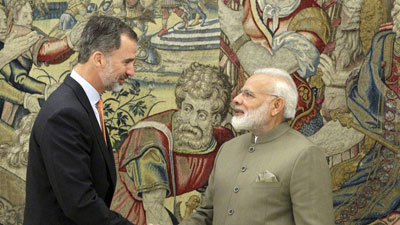 MADRID, May 31: India and Spain on Wednesday committed to cooperate in the fight against terrorism calling it the gravest threat to international peace and stability.
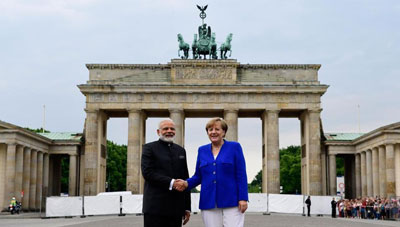 BERLIN, May 30: Prime Minister Narendra Modi on Tuesday backed German Chancellor Angela Merkel’s “strong leadership” in uniting the European Union at a time when the economic grouping was showing signs of strain post Brexit and over the protectionist policies of US President Donald Trump.
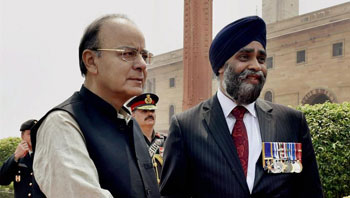 NEW DELHI, April 18: India on Tuesday strongly condemned the recent Ontario assembly motion that described the 1984 anti-Sikh riots as "genocide", with defence minister Arun Jaitley telling his visiting Canadian counterpart Harjit Singh Sajjan that it did not augur well for bilateral relations.
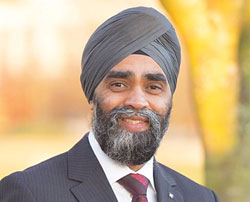 NEW DELHI, April 17: Canada’s Minister of National Defence Harjit Singh Sajjan will visit India from April 17 to 23. During his trip, the Minister will travel to New Delhi, Amritsar, Chandigarh and Mumbai.
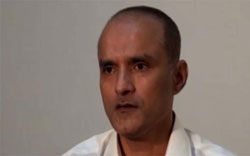 ISLAMABAD, April 17: Paksitan's army on Monday ruled out consular access to Kulbhushan Jadhav, days after India had made a strong case for the access to the former Navy officer, who was sentenced to death by a Pakistani military court last week. The sentence evoked a sharp reaction in India which warned Pakistan of consequences and damage to bilateral ties if the "pre-meditated murder" was carried out. Pakistan has denied India's request for consular access to Mr Jadhav over a dozen times over the course of one year.
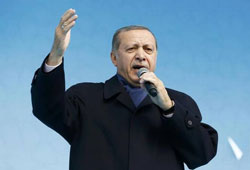 ISTANBUL, April 17: Turkey’s Opposition Monday called for the annulment of a referendum giving President Recep Tayyip Erdogan sweeping new powers, as international monitors voiced concern over the campaign and vote count.
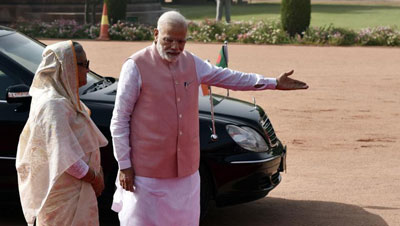 NEW DELHI, April 8: India announced a $5-billion loan to Bangladesh on Saturday and signed bilateral pacts to step up nuclear and defence cooperation between the neighbours, though the contentious Teesta water sharing-deal remained elusive.
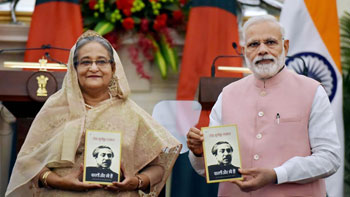 NEW DELHI, April 8: Prime Minister Narendra Modi took a veiled dig at Pakistan on Saturday, saying it breeds, inspires and encourages terrorism.
 NEW DELHI, April 7: The legislative assembly of Ontario has passed a motion extending the official recognition to the 1984 riots as Sikh "genocide" in India, which has strongly rejected the move terming it as "misguided".
Aviation
| Business | Defence | Foreign
Affairs | Communication | Health
| India | United Nations
India-US
| India-France | Entertainment
| Sports | Photo Gallery |
Tourism | Advertise with Us
| Contact Us
© Noyanika International, 2003-2009. All rights reserved.