


Foreign Affairs
|
Jadhav wife, mother made to change clothes; remove bindi, bangles and mangalsutra
The two women, wife Chetankul and mother Avanti, met foreign minister Sushma Swaraj after they returned from Islamabad late Monday. In an official reaction shortly after the meeting with Swaraj, in which foreign secretary S Jaishankar and other MEA officials were present, the government noted with regret that Pakistan conducted the meeting in a manner which violated the letter and spirit of the understanding that the two countries had reached earlier. India listed a series of reasons for its indictment of Pakistan authorities starting with the manner in which the local press was allowed to harass and hector the two women on multiple occasions as well as hurl accusations at them despite the understanding that media would not be allowed close access. Second, in what was described as shocking, Jadhav's wife and mother were made to get rid of Hindu symbols such as bindis, mangalsutra, bangles and forced to change their clothes. "Under the pretext of security precautions, the cultural and religious sensibilities of family members were disregarded. This included removal of mangal sutra, bangles and bindi, as well as a change in attire that was not warranted by security," said the government in a statement. Third, Jadhav's mother who is not fluent in English was prevented from speaking in Marathi, her natural medium of communication, by Pakistan officials who were recording the conversation. "She was repeatedly interrupted while doing so and eventually prevented from proceeding further in this regard," said the government. Fourth, deputy high commissioner JP Singh was initially separated from family members who were taken to the meeting without informing him. It was only after Singh strongly protested and told Pakistan officials that they were violating the mutual understanding that he was allowed inside. However, even then, Singh was kept behind an additional partition that did not allow him access to the meeting as agreed before. Singh later accompanied the two women on their return journey to India. Fifth, as the government said, for some inexplicable reason and despite repeated requests from Jadhav's wife, Pakistan officials did not return her shoes after the meeting. "We would caution against any mischievous intent in this regard," said the Indian government in its statement. According to sources here, India had chosen to not respond immediately on Monday to Pakistan's grandstanding as it wanted the women to safely return from Islamabad and take their feedback first. Officials here described the conduct of Jadhav's mother and wife in the meeting as stoic and added that it was only after concluding the meeting and leaving the Pakistan foreign office that the two women complained bitterly about the conduct of Pakistani officials. "From the feedback we have received of the meeting, it appears that Jadhav was under considerable stress and speaking in an atmosphere of coercion. Most of his remarks were clearly tutored and designed to perpetuate the false narrative of his alleged activities in Pakistan. His appearance also raises questions of his health and well being," said the MEA. "We also regret that contrary to assurances, the overall atmosphere of the meeting was intimidating insofar as family members were concerned. Family members, however, handled the situation with great courage and fortitude," it added. Prior to the meeting, the two governments were in touch through diplomatic channels to work out its modalities and format. Israel minister plans Trump train station after US President’s ‘brave’ Jerusalem decisionJERUSALEM, Dec 27: Israel’s transportation minister is pushing ahead with a plan to dig a railway tunnel under Jerusalem’s Old City, passing near sites holy to Jews, Christians and Muslims — and ending at the Western Wall with a station named after President Donald Trump. Yisrael Katz’s plan, currently in the initial stages, involves constructing two underground stations and excavating over 3km of tunnel beneath downtown Jerusalem and under the politically sensitive Old City. The project would extend Jerusalem’s soon-to-open high-speed rail line from Tel Aviv to the Western Wall, the holiest site where Jews can pray. The route will run close to — but not directly under — the Church of the Holy Sepulchre, where tradition holds that Jesus was crucified and buried, and a contested holy site known to Jews as the Temple Mount and to Muslims as the Noble Sanctuary. Previous excavations by Israel near the holy site — the spiritual epicentre of the Israeli-Palestinian conflict — have sparked violent Palestinian protests. Because of those sensitivities, the proposal will likely meet with heavy resistance from the Palestinians, neighbouring Arab countries and the international community. Katz, a senior Cabinet official who also serves as Israel’s intelligence minister, is a close ally of Prime Minister Benjamin Netanyahu and is seen by many as his likely eventual successor as head of the Likud party. Transportation Ministry spokesman Avner Ovadia said Wednesday the project is estimated to cost more than $700 million and, if approved, would take four years to complete. Katz’s office said the minister advanced the plan in a recent meeting with Israel Railways executives, and has fast-tracked it in the planning committees. Katz said a high-speed rail station would allow visitors to reach “the beating heart of the Jewish people — the Western Wall and the Temple Mount.” He proposed naming the station after Trump “for his brave and historic decision to recognise Jerusalem as Israel’s capital” earlier this month. Trump’s announcement has enraged the Palestinians and much of the Muslim world. The UN General Assembly overwhelmingly adopted a resolution last week condemning the move, with several traditional American allies breaking with Washington to vote in favour of the motion. Israel captured east Jerusalem, which includes the Old City, in 1967, and annexed it in a move not recognized internationally. The Palestinians claim east Jerusalem as the capital of their future state, and a longstanding international consensus holds that the fate of the city should be decided through direct Israeli-Palestinian negotiations. Digging railway tunnels to the Western Wall would also entail excavating in Jerusalem’s Old City, where religious and political sensitivities — as well as layers of archaeological remains from the city’s 3,000-year history — could make for a logistical and legal quagmire. Last year an initiative to convert an already excavated area abutting the Western Wall into an egalitarian Jewish prayer section was hotly contested by Israeli archaeologists, who said such a move would cause irreparable damage to the historic remains of the ancient city. Despite the likely opposition to the project, Ovadia said he expects the plans to be approved in the coming year, barring major complications. The Tel Aviv-Jerusalem high-speed line is expected to open next spring. “There’s no reason why this train won’t be built,” he said. “We already know how to deal with no less difficult opposition.” Katz has previously proposed other ambitious infrastructure projects, including an artificial island off the coast of the Gaza Strip that would serve as an air and seaport for the Palestinian territory, and a railway connecting Israel with Saudi Arabia and other Arab states. Get used to drills, China tells Taiwan; Taipei says it seeks peaceBEIJING/ TAIPEI, Dec 27: Taiwan will gradually get used to Chinese air force drills that encircle the island, China said on Wednesday, while Taiwan’s premier reiterated the self-ruled island’s desire for peaceful relations with its giant neighbour. China considers democratic Taiwan to be its sacred territory and has never renounced the use of force to bring what it views as a wayward province under Chinese control. It has taken an increasingly hostile stance towards Taiwan since Tsai Ing-wen, from the island’s pro-independence Democratic Progressive Party, won presidential elections last year and has stepped up its rhetoric and military exercises. Beijing suspects her of pushing for the island’s formal independence, a red line for China. Tsai says she wants peace with China, but also that she will defend Taiwan’s security and way of life. Chinese state media have given broad coverage to “island encirclement” exercises near Taiwan this month, including showing pictures of Chinese bomber aircraft with what they said was Taiwan’s highest peak, Yushan, visible in the background. Asked about the continuing drills and the footage released by the air force, China’s policy-making Taiwan Affairs Office said it and the defence ministry had repeatedly described the exercises as routine. “Everyone will slowly get used it,” spokesman An Fengshan told a routine news briefing, without elaborating. China’s air force has carried out 16 rounds of exercises close to Taiwan in the past year or so, Taiwan’s defence ministry said in a white paper this week. China’s military threat was growing by the day, it warned. Proudly democratic Taiwan has shown no interest in being run by autocratic China, and Taiwan’s government has accused Beijing of not understanding democracy when it criticises Taipei. Taiwan Premier William Lai told a year-end news conference in Taipei that the US, Japan and South Korea were all paying close attention to the activities of China’s air force. Lai said his government would take its lead from the president, who was in charge of relations across the Taiwan Strait. “Under the president’s leadership the Executive Yuan pushes forward government affairs, stabilising cross-strait relations towards peaceful development,” Lai said, using the formal name for Taiwan’s cabinet. Kulbhushan Jadhav meets wife, motherISLAMABAD, Dec 25: From behind a glass barrier at the Pakistan foreign ministry in Islamabad, Indian death row prisoner Kulbhushan Jadhav on Monday met his wife and mother for the first time since his arrest in March 2016. Pakistani officials said this would not be the last such meeting. But Islamabad insisted that the presence of Indian diplomats at the former naval officer’s 40-minute-long meeting with his wife Chetankaul and mother Avanti did not amount to consular access. In what appeared to be choreographed moves, the Pakistani foreign office released photos of the meeting, a pre-recorded video of Jadhav, sentenced to death for alleged espionage, thanking the Pakistani government, and a medical report that claimed he was in good health. Doubts were immediately raised in India that the video may have been shot under duress, and the credibility of the medical report issued by a doctor of the Saudi German Hospital, Dubai, was questioned. The video showed Jadhav saying Pakistani authorities had treated him in a dignified, respectful and professional manner, for which he said he was thankful. In the pre-recorded video, Jadhav ‘confesses’ to the crimes he has been charged with in Pakistan. Avanti and Chetankul Jadhav were accompanied to the ministry by Indian deputy high Commissioner JP Singh and three Indian foreign ministry officials. Only Jadhav’s family was allowed into the room where he was sitting, while Singh and Pakistani officials, including Fareha Bugti of the India desk of the foreign ministry, monitored the meeting from outside the room. Jadhav’s family stopped over at the Indian high commission after arriving in Islamabad on an Emirates flight from Dubai on Monday morning. Avanti and Chetankul Jadhav are expected to catch a flight back to India via Muscat on Oman Air on Monday evening. An official statement for India’s foreign ministry was awaited. Earlier, Indian high commissioner Ajay Bisaria said he hoped the meeting would take place in a cordial atmosphere. India requested that the family not have any interaction with the media, Pakistani foreign office spokesman Muhammad Faisal said. Faisal reiterated that the meeting did not mean any change in Pakistan’s stance regarding Jadhav, who he termed “a spy and terrorist who has been sentenced to death”. The foreign office spokesman said Pakistan permitted Jadhav to meet his kin on humanitarian grounds on the birthday of Muhammad Ali Jinnah, the founding father of Pakistan. The move should not be seen as according consular access to Jadhav, he said, adding that Pakistan had consistently denied consular access to him as the Vienna Convention does not apply to those involved in espionage. “The presence of JP Singh at today’s meeting should not be considered as consular access,” Faisal said. Faisal’s comments came hours after his boss, Pakistan foreign minister Khawaja Muhammad Asif appeared to contradict him on TV. Asked by Geo TV?specifically if the presence of an Indian official at the meeting would constitute consular access, Asif said “Yes”. Rare as it was, Pakistani officials said this meeting would not be the last between Jadhav and his family. In preparation for the meeting, Pakistan had deployed security personnel, including sharpshooters, and traffic police within and outside the foreign office building, located near the country’s parliament . TV footage showed a convoy of around seven vehicles escorting Jadhav’s family in the capital Islamabad. The Pakistani high commission in New Delhi had issued a visa to Jadhav’s wife earlier in the month. India made the acceptance of the offer conditional to permission for his mother and an Indian diplomat to accompany her. After extensive deliberations, the Indian request was allowed and December 25 was proposed as the meeting date. Minutes before the meeting, Faisal tweeted a picture of Jadhav’s wife and mother, adding they were “sitting comfortably in the Ministry of Foreign Affairs Pakistan. We honour our commitments”. Jadhav was at the ministry before his family arrived. It was not known where he had been kept before being transported to the ministry. Jadhav was sentenced to death by a Pakistani military court on charges of espionage and terrorism in April, following which India moved the International Court of Justice in May. The ICJ halted his execution on India’s appeal pending the final verdict by it. Pakistan claims its security forces arrested Jadhav alias Hussein Mubarak Patel from its restive Balochistan province on March 3 last year after he reportedly entered from Iran. India, however, maintains that Jadhav was kidnapped from Iran where he had business interests after retiring from the Indian Navy. Pope Francis Seeks Peace In JerusalemVATICAN CITY, Dec 25: Pope Francis in his traditional Christmas address on Monday called for peace in Jerusalem and highlighted the plight of children scarred by conflict, having earlier urged the world's Catholics not to ignore the conditions migrants face. Tens of thousands of worshippers gathered at the Vatican to hear the pontiff's fifth "Urbi et Orbi" (To the City and The World) message. It was delivered hours after a Christmas Eve mass where he spoke on how migrants had been "driven from their land" because of leaders willing to shed "innocent blood". On Monday, Francis's message sought "peace for Jerusalem and for all the Holy Land. "We see Jesus in the children of the Middle East who continue to suffer because of growing tensions between Israelis and Palestinians," he said. "Let us pray that the will to resume dialogue may prevail between the parties and that a negotiated solution can finally be reached, one that would allow the peaceful coexistence of two states within mutually agreed and internationally recognised borders." The pontiff's plea came as fresh tensions simmered in the Israeli-occupied West Bank after US President Donald Trump's recognition of Jerusalem as Israel's capital. Trump's announcement on December 6 triggered demonstrations and clashes, including in Bethlehem in the West Bank where Christians marked the birth of Jesus at a midnight mass. "May the Lord also sustain the efforts of all those in the international community inspired by good will to help that afflicted land to find, despite grave obstacles the harmony, justice and security that it has long awaited," the pope said. The pontiff also mentioned other global flashpoints such as Syria, Iraq, Yemen, South Sudan and Venezuela, after stressing that the "winds of war are blowing in our world". "Let us pray that confrontation may be overcome on the Korean peninsula and that mutual trust may increase in the interest of the world as a whole," the 81-year-old said. Earlier, celebrating midnight mass in the ancient town, Archbishop Pierbattista Pizzaballa, apostolic administrator of the Latin Patriarch of Jerusalem, used his homily to lambast the wars that "the Herods of today fight every day to become greater, to occupy more space". Criticising Trump's announcement, Pizzaballa insisted "Jerusalem is a city of peace, there is not peace if someone is excluded. Jerusalem should include, not exclude," stressing the principle that the city is for both peoples and the three Abrahamic faiths. Hundreds had gathered in the cold on Bethlehem's Manger Square to watch the annual scout parade towards the Church of the Nativity, built over the spot where tradition says Mary gave birth to Jesus. But the square was noticeably quieter following recent violence between Palestinian protesters and the Israeli army. Twelve Palestinians have been killed since Trump's declaration, including a 19-year-old who died of his wounds on Sunday nine days after he was shot during a Gaza protest. Israel seized east Jerusalem in the 1967 Middle East war and later annexed it, in moves never recognised by the international community. Palestinians view east Jerusalem as the capital of their future state, and interpreted Trump's statement as rejecting their right to a capital in east Jerusalem, although the Americans deny this. Christmas decorations have meanwhile become more visible in Christian areas of Syria's capital Damascus this year. In the central Syrian city of Homs, Christians will celebrate Christmas with great fanfare for the first time in years after the end of battles between regime and rebel forces -- with processions, shows for children and even decorations among the ruins. In Iraq too, this year marks a positive turning point for the Christian community in the northern city of Mosul. In Europe, Britain's Queen Elizabeth II paid tribute to the cities of London and Manchester which this year suffered what she called "appalling" terror attacks. "This Christmas, I think of London and Manchester, whose powerful identities shone through over the past 12 months," the 91-year-old monarch said in the pre-recorded televised message. And just two hours before the pope delivered his traditional message Monday, there was a disruption on St Peter's Square as a bare-breasted woman shouting "God is a woman" stormed the Christmas Nativity display and seized the baby Jesus statue. Police said a 25-year-old Ukrainian woman, reportedly a member of the feminist movement Femen, was arrested. Femen, founded in Ukraine, has staged anti-Kremlin protests and now in western Europe has focused on the Catholic Church which it accuses of suppressing women's rights. Elsewhere, a tragic Christmas weekend in the Philippines was compounded Monday by the deaths of 20 people in a bus collision while travelling to mass. Justin Trudeau’s visit could help overcome irritants in India-Canada tiesTORONTO, Dec 25: A flourishing relationship between India and Canada ought to be a no-brainer given the common threads that run through the two democracies. Instead, this underperforming engagement continues to be a head-scratcher for analysts on both sides. That could change with Canadian Prime Minister Justin Trudeau’s visit to India in February. After an underwhelming trip to China where Beijing turned down an offer to start work on a free trade pact, the Canadian prime minister could be far more motivated to deepen bilateral ties. More importantly, it could provide impetus to a relationship that has lagged behind after starting off with plenty of energy in the early months of the Trudeau administration. “We just had three ministers from the Canadian government in India in November and I think that was a very successful visit. It’s always a great lead-up to a prime ministerial visit because it sets the agenda in many ways,” said Stewart Beck, President and CEO of the Vancouver-based Asia Pacific Foundation of Canada. “India and the Indian market of a billion people plus, growing 7% a year, and being able to diversify and expand our trading relationship, is really quite critical,” he added. Beck, who had earlier served as the Canadian high commissioner to India, said such high-profile encounters allow the principals to overcome obstacles: “From my experience, we had two visits prior to the prime minister (Stephen Harper) in 2012 and they helped set the framework for a lot of the work we did around nuclear, the agreement around administrative arrangements and ultimately it resulted in the sale of uranium to India.” He noted that the two sides were finally able to put to bed 45 years of issues around the nuclear file. Ramesh Sangha, Liberal Party MP from Brampton Centre seconds that optimistic view. “It will be a big thing because we want to have good relations between both the countries. My feeling is that both sides are interested,” said Sangha, who is also the chair of the Canada–India Parliamentary Friendship Group. “It will be a good step in making progress. It’s the need of the day today.” A pair of bilateral trade and investment pacts will be discussed and there is hope that at least one may emerge as a tangible deliverable. “My hope is we can settle on language between now and the time of the prime minister’s visit,” Beck said. The major roadblock to smooth ties has been the resurgence of the Khalistan movement in Canada and what is perceived in India as Ottawa ignoring the separatists on its territory. That may be a matter Trudeau will have to directly deal with in New Delhi. “I think he has to indicate to his Indian counterparts, whether it’s the Prime Minister or other people, that this is not the case, this is not something that’s being supported at the governmental level,” Beck said. But the personality Trudeau possesses, could be a real deal-maker. As Sangha said, “The way he presents himself and the country, it’s really a delight.” Beck agreed, “India being India, and there is a gravitation towards Bollywood stars, people with a high profile, I think certainly the prime minister will capture an awful lot of attention. (Indian Prime Minister Narendra) Modi has his own gravitas and appeal, I think the two of them together will make an interesting combination at the time of the visit.” In fact, a rockstar reception for Trudeau could help further ties, as Beck said, “I think it sends a good message here domestically if it’s a good visit. It will put India on people’s radar screens here in Canada and I think that will be good for India.” Hafiz Saeed opens MML party office in Lahore, eyes 2018 elections in PakistanLAHORE, Dec 24: Mumbai attack mastermind Hafiz Saeed has opened the first office of the Milli Muslim League (MML) in Lahore, days after the Pakistan government said the group would breed violence and extremism in politics while opposing a plea seeking its registration as a political party. Saeed has confirmed that his organisation Jammat-ud-Dawah (JuD) would contest the 2018 general elections under the banner of the MML. The MML is the offshoot of the banned Lashkar-e-Taiba (LeT) and JuD, according to the government. The MML had challenged the Election Commission’s order in October that had declined its registration as a political party. Saeed on Sunday inaugurated the office in Lahore’s National Assembly-120 constituency from where a JuD member had contested by-polls in September. Despite refusal from the interior ministry to register the MML as a political party, Saeed pressed ahead with his plans to take the political plunge. The Pakistan government has requested a court in Islamabad not to consider Saeed-backed MML’s plea seeking its registration as a political party, saying the group would breed violence and extremism in politics. The interior ministry has categorically made it clear that the state will not allow mainstreaming of jihad outfits. Saeed’s visit and opening of political office in Lahore indicate that he has ambitious plans to enter into politics. During his visit on Mohni Road area adjacent to Data Sahib shrine, he listened to civic problems of people. People welcomed Saeed by showering rose petals on his vehicle in the area. The JuD headquarters in Chauburji also falls in NA-120. The MML had secured the fourth position with 6,000 votes, double than that of Pakistan Peoples Party (PPP) and Jamaat- i-Islami combined. Saeed, who carries a bounty of US $10 million announced by the US for his role in terror activities, walked free on November 24 after the Pakistan government decided against detaining him further in any other case. He was under detention since January this year. The banned JuD is believed to be the front organisation for the LeT which carried out the 2008 Mumbai terror attack in which 166 people were killed. Blind Baba Vanga who predicted 9/11 and ISIS has two stunning prophecies for 2018LONDON, Dec 24: The renowned blind mystic woman from Bulgaria who had famously predicted the shattering 9/11 attack and Brexit tragedy, has also made some mind-boggling predictions for the upcoming 2018 year which might come true. And if the predictions come true, then it will be complete turnover for residents of Earth. Baba Vanga who died at the age of 85 back in August 1996 has a large pool of followers owing to her successful predictions of Barack Obama’s Presidential term, the rise of ISIS group, tsunami, global warming and several others. If the Baba Vanga is to be believed then in the upcoming year, China will rise as a supreme power replacing the United States of America. Also, scientists will find success in discovering a new form of energy on Venus that will be crucial for the survival of human race. Seeing the latest happenings, one cannot negate the possibilities of predictions coming true. The US space agency NASA is all set to launch a robotic spacecraft in July next year that has been designed to probe the outer corona of the Sun. The space shuttle will use Venus’s gravitational pull to fly past Sun multiple times, and scientists believe that the probe might discover a new source of energy in completing the task. Also, currently USA contributes the most to global GDP with 16.7% share which is expected to fall to 14.9% by mid of next decade. While China added 15.6% to world’s economy in 2015 and many economists believe that possibility is there that China might overtake the USA and become the superpower of the world. The prophecy has divided people into two groups — first who believe in the prediction of the blind woman known as the ‘Nostradamus from the Balkans’ and second who consider it just as a hoax. People who believe in Baba Vanga have reasons she had an excellent track record. Russians consider her as a holy figure as she has 85 percent accuracy. In 1980, she successfully predicted about the mishap of Kursk — a Russian ship that sank in the Barents Sea on August 12, 2000, killing all aboard. In 1989 Baba Vanga said: “Horror, horror! The American brethren will fall after being attacked by the steel birds. The wolves will be howling in a bush, and innocent blood will be gushing.” Similar things happened during 9/11 attack. She also predicted the rise of Barack Obama as the President of America, rise of ISIS terror, terrorism in Syria “Muslims would use chemical warfare against Europeans”, she said. According to prophecies of Baba Vanga, Donald Trump was destined to become President but he will bring the country down. “Everyone will put their hopes in him to end it, but the opposite will happen; he will bring the country down and conflicts between north and south states will escalate.” If other future predictions of the mystic woman are to be believed that people would die of hunger in 2028, glaciers and ice caps will melt down by 2045 due to global warming (which scientists also predict seeing the current trend), people will fly to Mars and make a colony on the red planet by 2256 and the Earth becoming unhabitable from 2341. She has predicted happenings till the 51st century after that the world would end. Jolly demands removal of Youtube Video supporting KhalistanBy Deepak Arora NEW DELHI, Dec 27: Senior BJP Leader Vijay Jolly in a letter to Union Minister for Information & Broadcasting has demanded removal of a Youtube video promoting anti-India propaganda and supporting Khalistan movement on social media. Jolly termed these videos "provocative & inciting". BJP leader Jolly wrote to Smriti Z. Irani that he himself witnessed one such video titled "Murh Aawe Bhindrawala". This video has been made by Dharam Seva Records. It has been presented on Youtube by Virsa Photo Art Gallery. It has 19,000 regular subscribers. More than 17 lakh people have already seen this video, alleged Jolly. The name of the connecting website is : www.virsagallery.com Senior BJP leader Jolly stated that the video is misleading. It is seem to be promoting Khalistan stir and its leaders. The youth can be easily lured. This is the plank of such mischievous propaganda hosted on social media today, revealed Jolly. This video eulogizing Khalistan movement is a direct challenge to India's unity and integrity, alleged Jolly. In a separate letter to Delhi Police Commissioner Amulya Patnaik, BJP leader Jolly demanded that all such anti national and seditious videos on Youtube be immediately banned. And anti social elements involved in making and circulating such mischievous videos on social media should be prosecuted under Section 124A (Sedition) and 120B (Criminal Conspiracy ) of Indian Penal Code. Best friends for 60 years find out they are actually brothersHONOLULU, Dec 27: Two Hawaii men who grew up as best friends recently learned that they are actually brothers and revealed the surprise to family and friends over the holidays. Alan Robinson and Walter Macfarlane have been friends for 60 years. Born in Hawaii 15 months apart, they met in the sixth grade and played football together at a Honolulu prep school. Macfarlane never knew his father, and Robinson was adopted. Separately, they sought answers about their ancestry. Macfarlane turned to family history and DNA-matching websites after unsuccessful searches on the internet and social media, Honolulu news station KHON-TV reported . “So then we started digging into all the matches he started getting,” said his daughter, Cindy Macfarlane-Flores. A top match — someone with identical X chromosomes — had the username Robi737. Robinson’s nickname was Robi and he flew 737s for Aloha Airlines, Macfarlane-Flores said. It turned out Robinson used the same website to find answers about his family. They later learned they have the same birth mother. “It was a shock,” Macfarlane said. They revealed the relationship to friends and family during a party Saturday night. “It was an overwhelming experience, it’s still overwhelming,” Robinson said. “I don’t know how long it’s going to take for me to get over this feeling.” They have plans to travel and enjoy retirement together. “This is the best Christmas present I could ever imagine having,” Robinson said. US tip-off helped Russia halt terrorist attack in St Petersburg: KremlinMOSCOW, Dec 17: Russian President Vladimir Putin telephoned US President Donald Trump on Sunday to thank him for a tip-off that helped prevent a terrorist bomb attack on a cathedral in the Russia city of St Petersburg, the Kremlin said. Information provided by the Central Intelligence Agency (CIA) allowed Russian law-enforcement agencies to arrest the would-be attackers before they could carry out their plan, the Kremlin said in a statement posted on its Internet site. There was no immediate confirmation from U.S. authorities that they had shared the intelligence with Russian officials. The foiled attack was to have been carried out on Kazansky Cathedral, in Russia’s second city of St Petersburg, and on other locations in the city where large numbers of people gather, the Kremlin statement said. The cathedral is a popular tourist site. Russian media reported last week that the Federal Security Service had detained followers of the Islamic State group who had been planning a suicide bomb attack on Kazansky Cathedral on Dec. 16. “The Russian President thanked his American colleague for the information passed on by the Central Intelligence Agency, which helped detain a group of terrorists preparing explosions in St Petersburg’s Kazansky Cathedral and other busy sites in the city,” the Kremlin said. The Kremlin did not give any details of the identity of the people who were detained. In their phone call, Putin asked Trump to pass on his thanks to the CIA officers who had gathered the intelligence, according to the Kremlin statement. Putin said Russia would alert US authorities if it received any information about any attack being planned on the United States, the Kremlin said. Relations between Washington and Moscow are fraught because of disagreements over Ukraine, Syria and arms control as well as allegations from Washington — denied by Russia — that the Kremlin meddled in last year’s U.S. presidential election. However, Russian officials say Putin believes Trump is not to blame for the tension, and has tried to keep personal lines of communication open between the two men. The Russian leader has said restoring ties between Moscow and Washington is vital because the two countries need to work together to counter global challenges, in particular the threat from violent Islamist radicals.
|

| |||||||
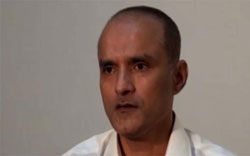 NEW DELHI, Dec 26: India on Tuesday brushed aside Pakistan's "grand gesture" of allowing Kulbhushan Jadhav to meet his wife and mother as an exercise that lacked credibility and one which was meant to bolster the false and unsubstantiated narrative of Jadhav's alleged activities in Pakistan.
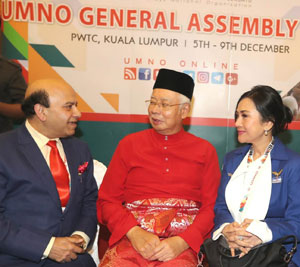 Vijay Jolly Promotes India Across 13 Nations in 2017; Culminates with Successful Malaysia Tour
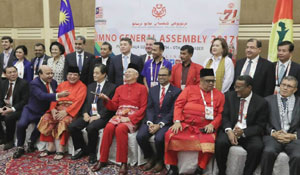 Jolly met several heads of states and persons of eminence. Prominent among them were namely Nepal PM Pushpa Kamal 'Prachanda', National Security Advisor South Korea Chung Eui-yong, Cambodia Prime Minister Hun Sen, Fiji Prime Minister Frank Bainimarama, Malaysia Prime Minister Dato' Sri Najib Abdul Razak and King of Bhutan Jigme Khesar Namgyel Wangchuck. Meetings were also held with Ministers, Parliamentarians, Mayors, Ambassadors, Counselors, Journalists, Women, Youth and Religious leaders besides Social media activists.
 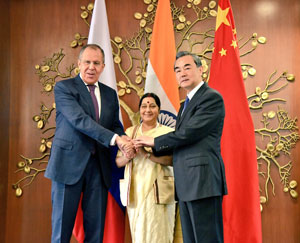 NEW DELHI, Dec 11: India, China and Russia on Monday resolved to step up cooperation to counter terrorism, including choking terror funding and dismantling terrorist infrastructure, as the Indian side flagged concerns over increasing acts of terrorism by Pakistan-based terror outfits such as Lashkar-e-Taiba (LeT).
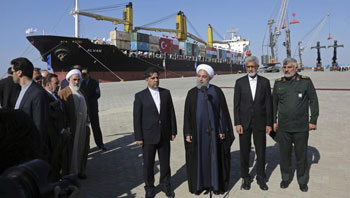 ISLAMABAD, Dec 11: The participation of a Pakistani minister at the inauguration of the first phase of Iran’s Chabahar port - even though the country is not part of the strategic project - represents a “significant shift” in the two neighbours’ ties, a media report said on Monday.
Aviation
| Business | Defence | Foreign
Affairs | Communication | Health
| India | United Nations
India-US
| India-France | Entertainment
| Sports | Photo Gallery |
Tourism | Advertise with Us
| Contact Us
© Noyanika International, 2003-2009. All rights reserved.