


Foreign Affairs
|
Kim Jong-un vows to dismantle nuke sites in MaySEOUL, April 29: Cheong Wa Dae said Sunday that North Korean leader Kim Jong-un promised to close down the country's main nuclear test site at Punggye-ri in May before the eyes of security experts and journalists from South Korea and the United States. During his summit with President Moon Jae-in, Friday, Kim even disclosed that two of the four underground tunnels at the test site were still "usable" but that they would be sealed off as well. Kim abruptly made the offer and President Moon accepted it, Moon's top press secretary Yoon Young-chan said. "The two leaders reached an agreement after Mr. Kim made the proposal during the summit," Yoon said during a follow-up briefing. "Some say we are terminating facilities that are not functioning, but you will see that we have two more tunnels that are bigger than the existing ones and they are in good condition," Kim said according to Yoon. A Cheong Wa Dae official said Kim's offer was impromptu, and not coordinated in advance when the Seoul and Pyongyang officials discussed issues to be included on the summit agenda. His promise is seen as bid to clear doubts on North Korea's plan to scrap its nuclear program ahead of Kim's planned summit with President Donald Trump in May or June. Skeptics claim Kim would not abandon his nuclear ambitions and may try to deceive the U.S. and the rest of the world as his country has done in the past. "Although I am inherently resistant toward America, people will see that I am not the kind of person who fires nuclear weapons at South Korea, the Pacific or America," Kim said. "Why would we keep nuclear weapons and live in difficult conditions if we often meet with Americans to build trust and they promise us to end the war and not to invade us?" Kim said he will not repeat the "painful history of the Korean War," adding, "Concrete measures are necessary to stop any accidental military confrontation from happening." North Korea carried out six nuclear tests in Tunnels 1 and 2 at the Punggye-ri test site from 2006 to 2017. They are believed to have either collapsed or being on the verge of collapsing. Moon and Kim also agreed to unify the time zones used in South and North Korea. North Korea turned back the clock 30 minutes and created its own time zone in August 2015 to mark the Korean Peninsula's liberation from Japanese rule "I feel sad to see that there are two clocks hung on the wall of the Peace House, one for Seoul time and the other for Pyongyang time," Kim said. "Since it is us who changed the time standard, we will return to the original one. You can make it public." Market watchers and security experts said unifying the time zone is a part of efforts to better prepare for economic cooperation with the South and also to restore ties with Japan. The inter-Korean summit was seen as critical in setting the tone for Kim's upcoming talks with Trump. Trump has repeatedly hinted at the U.S. walking away from the table if North Korea is believed to be insincere about denuclearization. During his telephone conversation with Moon, Saturday, Trump hailed the historic summit and Moon's and Kim's reaffirmation of a shared goal of complete denuclearization of the Korean Peninsula. Moon and Trump have agreed to closely coordinate to ensure the upcoming North Korea-U.S. summit adds to an agreement on concrete measures to denuclearize the North. "The two leaders agreed that South Korea and the United States should continue to closely coordinate so that the planned U.S.-North Korea summit could generate an agreement on concrete measures to realize complete denuclearization," Cheong Wa Dae said. Trump also expressed his consent to inter-Korean agreements to push for a formal end to the 1950-53 Korean War by the end of this year. In a separate announcement, the White House said Moon and Trump stressed the need for complete, verifiable and irreversible denuclearization of North Korea. It said the two leaders "agreed that the unprecedented pressure applied by the United States, the Republic of Korea and the international community through the global Maximum Pressure Campaign has led to this significant moment." On Sunday, Moon had a telephone conversation with Japanese Prime Minister and Russian President Vladimir Putin. Cheong Wa Dae said Moon offered to help in resuming dialogue between North Korea and Japan. Moon told Abe that he had relayed Japan's hopes to normalize ties with Pyongyang during the summit and said Kim was willing to meet Abe. Modi arrives in Wuhan, to have one-to-one meetings with XiWUHAN, April 26: Prime Minister Narendra Modi has arrived in China on Thursday night where he will have a two-day heart-to-heart meeting with President Xi Jinping. Their meeting is scheduled to take place on Friday at Wuhan, a favourite holiday spot of revolutionary hero Mao Zedong. Their first informal meeting took place at the Sabarmati Ashram of Mahatma Gandhi in Gujarat in 2014. Officials say that during the informal summit, the two leaders would spend most of the time interacting with each other with one-on-one conversations focusing on global, regional and bilateral issues. The summit is being seen as an effort by India and China to rebuild trust and improve ties that were hit by the 73-day-long Doklam standoff last year. Modi and Xi will try to work out a general framework for relations to move ahead without much of great expectations about the outcome, Indian officials said. Conceived on the lines of the 1988 ice-breaking visit to China undertaken by the then prime minister Rajiv Gandhi and his far-reaching talks with China's paramount leader Deng Xiaoping setting a new tone for the relations post-1962 war, Xi-Modi dialogue at Wuhan was aimed at a working a new paradigm for the bilateral relations for the next 15 years, they said. The talks will focus on adhering to the principle that both countries should be sensitive to each other's concerns and aspirations, the sources said. It is a leadership driven summit providing a leadership driven direction and a way forward to more stable bilateral ties, they added. This will be fourth visit of Modi to China after he came to power in 2014. He is again due to visit China to take part in the SCO summit to be held at Qingdao city on June 9-10. In a pre-departure statement, Prime Minister Modi said he and President Xi will review the developments in Sino-Indian relations from a strategic and long-term perspective. 'President Xi and I will exchange views on a range of issues of bilateral and global importance. We will discuss our respective visions and priorities for national development, particularly in the context of current and future international situation,' Modi said. The summit is being seen as an effort by India and China to rebuild trust and improve ties that were hit by the 73-day-long Doklam standoff last year. The famous East Lake in the central Chinese city of Wuhan where the two leaders would spend most of the time was a favourite holiday spot for Mao. Kim Jong Un Halts Nuclear, ICBM TestsSEOUL, April 21: Kim Jong Un has declared that North Korea would halt nuclear tests and intercontinental missile launches. The Saturday announcement has been welcomed by US President Donald Trump ahead of a slated summit between the two men in May. Pyongyang’s declaration, long sought by Washington, will be seen as a crucial step in the fast diplomatic dance on and around the Korean peninsula. It comes less than a week before the North Korean leader meets South Korean President Moon Jae-in for a summit in the Demilitarised Zone that divides the peninsula, ahead of a much-anticipated encounter with Trump himself. The North had developed its weapons in what he called a “great victory”, and so “no nuclear test and intermediate-range and inter-continental ballistic rocket test-fire are necessary for the DPRK now”. “The mission of the northern nuclear test ground has thus come to an end,” he added at the gathering of the central committee of the Workers’ Party, according to the official KCNA news agency. The party decided that nuclear blasts and ICBM launches will cease as of Saturday -- the North has not carried any out since November -- and the atomic test site at Punggye-ri will be dismantled to “transparently guarantee” the end of testing. Within minutes of the report being issued, Trump tweeted: “This is very good news for North Korea and the World - big progress! Look forward to our Summit.” Seoul too welcomed the announcement, calling it “meaningful progress” towards the denuclearisation of the Korean peninsula. “It will create a very positive environment for the success of the upcoming inter-Korean and North-US summits,” the South Korean presidential office said in a statement. Pyongyang has made rapid technological progress in its weapons programmes under Kim, which has seen it subjected to increasingly strict sanctions by the UN Security Council, the United States, the European Union, South Korea and others. Last year it carried out its sixth nuclear blast, its most powerful to date, and tested missiles it said are capable of reaching the US mainland. Kim and Trump traded threats of war and personal insults as tensions ramped up, and even when there was an extended pause in testing, US officials said that it could not be interpreted as a halt without an explicit statement from Pyongyang. South Korean envoys have previously cited Kim as promising no more tests, but Saturday’s news is the first such announcement directly by Pyongyang. Kim Jong Un meets Chinese official, calls for stronger ties
Kim met with Song Tao, head of the Chinese Communist Party Central Committee’s international department, who was leading an art troupe to attend a spring festival in the North’s capital. The delegation arrived just weeks after Kim made a surprise visit to Beijing and met with Chinese President Xi Jinping, signalling an attempt by both leaders to shore up a key alliance ahead of a period of high-stakes diplomacy. Kim is expected to hold summits with South Korean President Moon Jae-in this month and US President Donald Trump in the following weeks. The North’s official KCNA news agency said Kim welcomed Song and his delegation in a meeting on Saturday, where Song conveyed Xi’s “warm greetings”. The two exchanged “profound views on the important matters of mutual concern” between their parties and the international situation, KCNA said, without providing details. “The Supreme Leader said that he would positively carry forward and develop the traditional DPRK-China friendship into a fresh phase of development as required by a new era,” it added, using the North’s official acronym. Beijing is North Korea’s sole major ally, an alliance dating back to the 1950-1953 Korean War, but relations deteriorated after China backed United Nations sanctions to punish Pyongyang over its nuclear weapons programme. More high-level exchanges and cooperation will follow between Beijing and Pyongyang, the report cited Kim as saying. In response, Song vowed to make “a fresh contribution to promoting the prolonged and stable development of the China-DPRK relations”. Song is leading a Chinese art troupe attending a spring art festival in Pyongyang held as part of the commemorations for the anniversary of the birth of the North’s founder Kim Il Sung on April 15, 1912. Both North Korean and foreign artists take part, and this year’s week-long event includes concerts, dance performances and acrobatics. KCNA also issued a rare separate report on Kim’s wife who attended a performance by the Chinese art troupe yesterday in the absence of her husband. “First Lady Ri Sol Ju enjoyed a ballet choreodrama ‘Giselle’ given by the National Ballet of China,” KCNA reported, adding she held “friendly talk” with the guests ahead of the performance. China has sent art troupes to every festival since 1986, except in 2016. India, China talk disarmamentBEIJING, April 11: India and China held the fifth round of the Disarmament and Non-Proliferation Dialogue here against the backdrop of Beijing continuing to block New Delhi’s entry to the Nuclear Suppliers Group (NSG) citing proliferation issues. The low-key bilateral dialogue is a platform for both sides – grappling with the NSG impasse and other nagging diplomatic problems – to find common ground on international disarmament issues. The countries exchanged views on developments related to disarmament, non-proliferation, nuclear issues and the role of science and technology in international security, disarmament and outer space, the Indian embassy said in a statement. “Both sides underlined the importance of the bilateral dialogue as an important mechanism between the two countries for consultations on important issues,” it said. The statement was silent on India’s NSG bid. The Indian team was led by Pankaj Sharma, joint secretary (disarmament and international security affairs) in the external affairs ministry while the Chinese side was led by Wang Qun, director general of the department of arms control at the foreign ministry. The first dialogue under this mechanism was held in 2015 but there is little evidence of China diluting its stand on India’s entry into the 48-member club that controls global trade in nuclear material and equipment. China has repeatedly said it will not support India’s entry to the NSG till the bloc evolves a universal formula to accept applications from countries that haven’t signed the nuclear non-proliferation treaty (NPT). China has suggested a two-step approach for such countries – evolving a universal formula and then taking up each country’s applications. It is seen as an attempt by Beijing to tie India’s case with that of its “all-weather ally” Pakistan, which too has not signed the NPT. Analysts say China is keen that Pakistan joins NSG despite Islamabad’s suspect proliferation record. India has in the past said that expect for China, all NSG members are in favour of its candidacy. India also has no plans to sign the NPT as a pre-condition to joining the NSG, the government told Parliament in March. More bilateral visits are slated this month. Defence minister Nirmala Sitharaman, external affairs minister Sushma Swaraj and national security adviser Ajit Doval are expected in China. Prime Minister Narendra Modi will be in the coastal city of Qingdao in June for the Shanghai Cooperation Organisation (SCO) Summit. India and Pakistan joined SCO, established in 2001 to fight threats posed by radical Islam and drug trafficking to Afghanistan, last year. The bloc has since expanded to include trade and security. India rail link to Kathmandu: Modi
Prime Minister Narendra Modi said India would also help Nepal in the field of agriculture through organic farming, soil testing and education in farming. Modi also said both sides would like to jointly start a new rail link connecting Kathmandu, Nepal’s capital, with India. Khadga Prasad Oli, who recently took over as Nepal’s prime minister, is on a three-day visit to India. He promised to build a strong edifice of trust with his much larger neighbour. “We need support and cooperation of friends. Our future lies in expansion of economic engagement and bilateral trade,” he said in a statement. India’s main worry is that Nepal may now lean more toward China as Oli heads a government of communist parties. But India surrounds Nepal on three sides and provides oil and other goods to the country. India extended a $1 billion credit line to Nepal for infrastructure development in 2015. On Friday, Oli told Indian business leaders that Nepal needs massive investment in every sector. “We have enacted laws and policies on foreign investment, public-private partnerships, industrial enterprises, banking and intellectual property,” he said. Allaying fears that his communist government may discourage the private sector, Oli said he was committed to a liberal economy with the private sector as a key partner. “We have no intention to reverse the trends. Rest assured, we cannot go against the global trends,” he said. Two-way trade between India and Nepal stood at $4.8 billion in 2015-16. Nepal’s main imports from India are petroleum products, motor vehicles and parts, rice, medicine and coal. Nepal exports jute products, vegetables, fruits, fruit juices, processed food and cardamom to India. Indian firms are the biggest investors in Nepal, accounting for nearly 40% of foreign direct investments in the tourism, manufacturing, banking, insurance, dry port, telecommunication and power sectors. London police calls emergency meeting after six stabbings in hoursLONDON, April 6: London police called an emergency meeting of community leaders on Friday after six stabbings in a matter of hours, as they tried to stem a wave of knife crime that threatens to dominate the city’s politics ahead of local elections in May. They said they heard first-hand concerns of communities in the meeting, a day after the stabbings, which took place in five separate incidents on Thursday evening. “(We) have been absolutely clear that we cannot tackle knife crime alone, we cannot enforce our way out of this and will do all we can to mobilise communities behind us and to help protect London,” the Metropolitan Police said in a statement. London’s murder rate in February and March was higher than New York’s for the first time in modern history, and more killings this week have taken the total to 50. Most were stabbings. Prime Minister Theresa May — a former interior minister — has attracted criticism over the escalating crime wave, with the opposition Labour party blaming cuts in police numbers and probation services, which have been part of the Conservative government’s long-running austerity policies. The Conservatives are set for their worst local election performance in London in decades, according to a YouGov poll in February ahead of the vote on May 3. But the Mayor of London, Labour’s Sadiq Khan, has also faced calls to do more. The devolved London Assembly has asked him to appear at an urgent meeting next Wednesday to discuss the issue. London police chief Cressida Dick said the recent rise in knife crime made her angry, but that London remained a safe city. “I am not happy about that, it is too much, but it is not this enormous epidemic that people are talking about,” Dick told the Evening Standard newspaper. Victims of Thursday’s stabbings included a 13 year old boy and three 15-year-old boys, two of whom were injured in the same incident. All the boys were in a stable condition, and across all the incidents there were no reported deaths. China says it hopes US, N Korea leaders meeting can advance smoothlyBEIJING, April 3: China hopes that a planned meeting between the leaders of North Korea and the United States in May can advance smoothly and that all sides maintain focus and avoid “disruptive factors”, a senior Chinese diplomat said on Tuesday. China has traditionally been secretive North Korea’s closest ally but ties have been frayed by Kim’s pursuit of nuclear weapons and missiles and Beijing’s backing of tough UN sanctions in response. Wang Yi, a State Councillor and China’s Foreign Minister, said there had been positive changes on the peninsula and that all sides were engaging in “sincere exchanges”. “China hopes all sides can cherish this hard to come by situation, maintain the momentum of contact and dialogue, and create conditions to smoothly restart dialogue,” Wang said during a joint news briefing with visiting Swiss Foreign Minister Ignazio Cassis. Wang said he hoped the meeting between North Korean leader Kim Jong Un and US President Donald Trump would “increase mutual understanding”. “But historical experience tells us that at the moment of easing of the situation on the peninsula and as first light dawns on peace and dialogue, frequently all manner of disruptive factors emerge,” Wang said. “So we call on all sides to maintain focus, eliminate interference, and firmly follow the correct path of dialogue and negotiation.” Kim pledged his commitment to denuclearisation and to meet US officials, China said last month after his meeting in Beijing with President Xi Jinping. Kim is scheduled to meet Trump in May to discuss denuclearisation, although a time and place have not been set. North and South Korea will hold their first summit in more than a decade on April 27, South Korea said. Kim’s predecessors, grandfather Kim Il Sung and father Kim Jong Il, both promised not to pursue nuclear weapons but secretly maintained programmes to develop them, culminating in the North’s first nuclear test in 2006 under Kim Jong Il. North Korea has said in previous, failed talks aimed at dismantling its nuclear programme it could consider giving up its arsenal if the United States removed its troops from South Korea and withdrew its so-called nuclear umbrella of deterrence from South Korea and Japan. China had largely sat on the sidelines as North Korea improved relations with South Korea recently, raising worries in Beijing that it was no longer a central player in the North Korean issue, reinforced by Trump’s announcement of his proposed meeting with Kim. The two Koreas have seen a significant thaw in relations since the North’s participation in the South’s Winter Olympics in February. Kim Jong Un proposed another concert in South Korea later this year with performers from the North in response to this week’s shows in Pyongyang by K-pop artists, South Korea’s Culture Minister Do Jong-whan told reporters in Seoul. Kim and his wife on Sunday made a surprise appearance at the first of two concerts performed by the South Korean art troupe this week in Pyongyang, titled “Spring is Coming”. It was the first time a North Korean leader had attended a South Korean performance in the capital. Saudi crown prince says Israel has ‘right’ to its landWASHINGTON, April 3: The crown prince and de facto leader of Saudi Arabia said Israel has a “right” to a homeland, a notable shift in the kingdom’s position published Monday. Saudi Arabia and Israel still have no formal diplomatic relations, but behind the scenes, improvements in their ties have accelerated in recent years. Both countries see Iran as their biggest outside threat and the United States as their key ally, and both see danger from armed Islamist extremists. Israel’s conflict with the Palestinians has long proved an obstacle to a full rapprochement, however, as Riyadh still supports their claim to sovereignty. But now Crown Prince Mohammed bin Salman -- speaking to the editor-in-chief of US news magazine The Atlantic -- appeared to put the rival land claims on an equal footing. The prince was asked by Jeffrey Goldberg whether the “Jewish people have a right to a nation-state in at least part of their ancestral homeland?” “I believe that each people, anywhere, has a right to live in their peaceful nation,” said the prince, who is on a three-week US tour. “I believe the Palestinians and the Israelis have the right to have their own land,” he added. “But we have to have a peace agreement to assure the stability for everyone and to have normal relations.” Since 2002, Saudi Arabia has been the main sponsor of the Arab Peace Initiative, which envisions a two-state solution to the Israeli-Palestinian conflict. But no such senior Saudi official is known to have previously accepted that Israel has a “right” to any land beyond the practical need to secure a lasting deal. If, as expected, the crown prince succeeds his octogenarian father King Salman and ascends to the Saudi throne, he will also become guardian of Islam’s holiest shrines. But he told Goldberg he had no “religious objection” to Israelis living alongside Palestinians, so long as the main Muslim holy site in Jerusalem -- the Al-Aqsa mosque compound -- is protected. “We have religious concerns about the fate of the holy mosque in Jerusalem and about the rights of the Palestinian people,” he said. “This is what we have. We don’t have any objection against any other people.” |

| |||||||
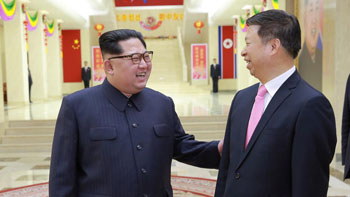 PYONGYANG, April 15: North Korean leader Kim Jong Un personally greeted a top Chinese official in Pyongyang and called for stronger ties with Beijing, state media said on Sunday, as the traditional allies seek to heal battered relations.
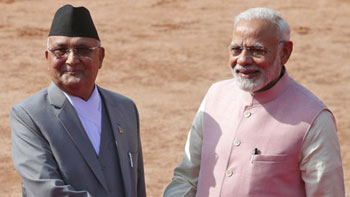 NEW DELHI, April 7: India pledged on Saturday to upgrade road and cross-border rail links with Nepal and develop inland waterways to provide sea connectivity to the landlocked Himalayan nation.
Aviation
| Business | Defence | Foreign
Affairs | Communication | Health
| India | United Nations
India-US
| India-France | Entertainment
| Sports | Photo Gallery |
Tourism | Advertise with Us
| Contact Us
© Noyanika International, 2003-2009. All rights reserved.