Baby-faced dad, 13, raises 'broken Britain' fears
 LONDON, Feb 16: Ahhh, Britain. The land of Shakespeare and the Beatles, Churchill and the Queen. Rolling green hills, groovy London shops, hip plaids splashed over raincoats and umbrellas. Cut to the reality of 2009: the highest teen pregnancy rate in western Europe, a binge drinking culture that leaves drunk teens splayed out in the streets and rising knife crime that has turned some pub fights into deadly affairs. LONDON, Feb 16: Ahhh, Britain. The land of Shakespeare and the Beatles, Churchill and the Queen. Rolling green hills, groovy London shops, hip plaids splashed over raincoats and umbrellas. Cut to the reality of 2009: the highest teen pregnancy rate in western Europe, a binge drinking culture that leaves drunk teens splayed out in the streets and rising knife crime that has turned some pub fights into deadly affairs.
Ahhh, Britain.
In the latest symbol of what some are calling "broken Britain," 13-year-old Alfie and his 15-year-old girlfriend Chantelle became parents last week. The news sparked a flurry of handwringing from the media - and even ordinary folk admitted it didn't help that Alfie barely looked 10, let alone 13, as he cradled his newborn daughter.
Alfie's father, who reportedly has nine or 10 children of his own, gamely promised to have a "birds and the bees" chat with his son to prevent him from producing a second child before he grows facial hair.
Somehow that was not reassuring.
Sir Bernard Ingham, once press secretary to former Prime Minister Margaret Thatcher, said that people from across Britain's political spectrum are in despair over the country's social breakdown.
"It's an indication that we've lost our way, that people don't know the difference between right and wrong," he said of young Alfie. "The plain fact is society can't proceed on this basis. I think this is an indication of broken Britain."
Ingham said Britain's binge drinking and youth violence reflect the same general fall in standards and discipline. "I think in time there will be a swing against this permissiveness," he said, noting a shift from British debauchery in the 18th century to Victorian straight-laced standards 100 years later.
Binge drinking has produced a rise in liver disease among Britons in their 20s and the unpleasant reputation of British "lager louts" at holiday resorts across Europe.
On any given night, London residents can see drunken teens staggering through the Underground subway system. Usually their friends help them, but sometimes collapsed teens are left on their own until police or transit staff intervene.
The rise in knife crime harkens back to the 1950s "West Side Story" era in the United States. The number of robberies carried out with knives rose 18 percent for the third quarter of 2008 compared to the year before, according to government figures released in January.
Too often now, public disputes have ended in teen stabbing deaths. Rob Knox, an 18-year-old actor in a "Harry Potter" film, was killed in May, while Ben Kinsella, the 16-year-old brother of a television soap actress, was stabbed to death in June. Both were trying to break up fights in London.
Other, less well-known youths have also died in knife fights. All this was bemoaned, but the final straw came this week, when Britain's intensely competitive tabloids focused on the young, clueless Alfie.
Alfie's daughter Maisie was reportedly conceived when he was 12. Chantelle's parents let the lad spend the night with their daughter, 14 at the time, at their public housing unit near Eastbourne, 70 miles (113 kilometers) southeast of London.
There are still some questions about the birth. The Sun newspaper did not say whether any tests were conducted to prove the boy's paternity, and The Sunday Times reported that at least two other teens claimed to have slept with the young mother. Alfie told The Sun he plans to look after his newborn daughter. But in a heartbreaking interview, the boy admitted he didn't know what the word "financially" meant and acknowledged he doesn't even get an allowance.
While some saw a larger portrait of society's ills in Maisie's birth to underage parents, others called it an aberration. "I think it's really shocking and sad," said Duncan Lees, 36, a caterer. "I think it's really wrong. But it's not like it happens everyday. The fact that it's making such a headline is something in itself. I think it's good that everybody is saying that it's wrong."
He did blame the youngsters' parents for failing to properly look after their children.
"You have to ask what their responsibilities are to their children," he said.
There was also an element of class consciousness in many reactions - not surprising in a country where status is often based on where you live, what car you drive and whether your children go to private school.
"I think it's very sad," said retiree Risdon Nicholls. "But they lived in a poor part of Eastbourne. That's not common practice in the rest of Eastbourne, which is a very smart town." Nicholls said the British media was exploiting a one-time situation.
"They make it sound as if we're going to the dogs, and we're not," he said adamantly. "This is still a wonderful country - but it's clear standards have dropped."
Sex is the way to shed weight!
WASHINGTON, Oct 22: Forget treadmills, long walks and Atkins diet, an expert has come up with a new way of staying in shape—and it has nothing to do with cutting out on carbs – it’s indulging in plenty of sex.
Yes, you heard it right, "sexercise" makes a person slimmer – if you do enough of it.
Combining sex and fitness is like killing two birds with one stone. Sex gets you fit. And being fit makes you want to have more sex. This is, in large part, because of all of the benefits a good sexercise routine offers, like: improved blood flow in strengthening your heart, better cholesterol, changing more of your bad cholesterol (LDL) to good cholesterol (HDL), weight control, better sleep and greater energy, including longer life and a better quality of life.
According to Fox News, women, in particular, feel more attractive with sexual fitness, since they produce more estrogen. This makes for shinier, smoother hair. Both sexes glow as their skin pores become cleansed, thanks to sweating. They feel sexier than ever.
But how do you start this sexercise routine? Well, sex educator Dr. Yvonne Kristín Fulbright has come to your rescue.
Get a physical if you haven’t in a while. While it may be laughable to do this, you’re going to be physically active, accelerating your heart rate, pulse, and blood pressure.
You’re also going to be testing and developing your strength, stamina, and flexibility. As with any form of exercise, you need to make sure that you’re good to go.
Aim for half-hour romps 3-5 times a week. This may seem like a lot, but this is actually not very time-consuming. Consider the amount of time you put into your favorite TV show.
Remind yourself of the rewards. Sex for 30 minutes burns anywhere from 15-350 calories, depending on how physically active you are. This is the equivalent of calories burned during a half an hour of brisk walking, running, or lifting weights.
Vigorous or longer sex sessions five times per week can burn up to 1,650 calories! The active partner — typically the one on top — tends to burn more.
Don’t lose focus. You can easily get distracted with all of sex’s delights. But your goal is to make it burn. In a matter of weeks, you can notice improvements in the tone and strength of your stomach, back, buttocks, legs and arms. But this will only happen if you’re mindful about keeping your heart rate up for a prolonged period of time.
Aim for variety. Your sexercise routine doesn’t have to be routine. You can’t take it for granted that sexercising won’t be boring, at least not in the same way as your treadmill. So get creative. Try new things. As you get in better shape, experiment with sexual positions, like wheelbarrow or crouching tiger.
Watch what you eat and maintain moderate exercise out of the bedroom.
Take care of each other post-workout. After working up a good sweat, you’ll have to hit the shower.
An extra-marital affair 'can kill you'
LONDON, Oct 4: Men, beware! An extra-marital affair can do more than just killing your marriage -- it could kill you too, particularly if you are prone to bad headaches.
Researchers have found that the strain of juggling married life and a secret lover leads to stress and tension for the cheating partner, which can can lead to migraine pain that could cause ballooning in a blood vessel in the brain.
In their study, the researchers found out that some of the worst affected were having affairs.
"What we found is that it was mostly men who suffered worst from this phenomenon, which is all to do with stress and hypertension (high blood pressure).
"It would appear that men have a more severe feeling of guilt when cheating which leads to increased stress and tension," lead researcher Lorenzo Pinessi was quoted by the 'Daily Mail' as saying.
According to Pinessi, the President of the Italian Migraine Society, those who had headaches were more likely to develop migraines, and a small percentage went on to suffer fatal aneurysm.
His advice for frazzled adulterers was to "take a time-out from the affair and have a brain scan".
And, according to him, headache-prone cheats should "avoid the Karma Sutra and stick to simple sexual intercourse" to limit pressure on the heart.
"The sexual position chosen can also have affect as the more physical the more pressure on the heart -- it is probably best to avoid positions where the male is on his feet," Pinessi said.
Panel to probe deaths of 49 children at AIIMS
NEW DELHI, Aug 19: The All India Institute of Medical Sciences on Tuesday set up a special committee to probe deaths of 49 children during clinical trials at the premier hospital.
The five-member committee, headed by neuro department head Madhuri Bihari, would submit its report within a week, official sources said.
The committee was set up after Union Health Minister Anbumani Ramadoss directed the AIIMS Director to probe the deaths expeditiously.
The issue had come up for discussion in the Governing Body meeting.
In reply to an RTI application, the AIIMS administration had said that as many as 49 children have died during clinical trials of new medicines in the premier institute here during the past two-and-a-half years.
The AIIMS administration, however, said all the 49 children were mortally sick and died naturally and not due to any drugs used in the trials.
A miracle gel to beat heart attack
TEL AVIV, Aug 12: It’s an amazing news for the heart patients as a team of Israeli scientists have developed a miracle gel which could save thousands of life suffering from major heart attacks.
A gel derived from ordinary brown seaweed can be used for saving the heart patients from further heart attacks as researchers claim.
The team of Israeli scientists led by Professor Smedar Cohen has claimed to discover such an incredible gel which substances can be used for strengthening the scar tissues of heart when it is injected in the heart through groin vein in liquid form.
The liquid transforms into thick gel when it meets with the scar tissues of heart and also leads the tissues to be thick, which in general are found to be in thin form in heart patients.
The thick heart tissues heal gradually and function as normal tissues, which shrinks the chances of further heart attack and enhance the life-term of patients.
Usually, in heart patients, the tissues of the heart become week and left ventricle also becomes dangerously enlarged after first heart attack. As a result it has to work harder for pumping blood around the body thereby multiplying the chances of further heart attacks.
At present, there is no treatment of healing the scar tissues of heart.
According to British Doctors, after entering in the market commercially that is expected to arrive by 2011, this miracle gel can save as much as 20,000 lives every year.
The researchers have tested it on the animals and found amazing result. According to them, 90 per cent of animals injected with the gel survived a heart attack compared to just 40 per cent who received no treatment at all.
The trial on human has been initiated in Germany, Belgium and Israel, as per sources.
RIL along with UN to launch partnership to fight HIV
NEW DELHI, May 26: Mukesh Ambani-led Reliance Industries along with United Nations will be launching an innovative partnership to fight against HIV/AIDS in India.
RIL would be launching the initiative along with UNAIDS, the joint United Nations programme on HIV/AIDS.
The partnership would support India's efforts to scale up towards Universal Access to HIV prevention, treatment, care and support, among others, RIL said in a statement on Monday.
Specific focus would be on expansion of healthcare outreach to rural populations, especially serving those people living with HIV, it added.
"I am convinced that such a business model will enable countries to quicken the pace of action in scaling up programmes and meet the needs of hard to reach populations," UN Assistant Secretary General and UNAIDS Deputy Executive Director Programmes Michel Sidibe said.
Screen infants to detect thyroid imbalances, say experts
NEW DELHI, May 26: Screening of newborns can help detect the onset of thyroid disorders as well as help greatly in prevention of the stunting of physical and mental growth of children and even mental retardation according to medical experts. "In India it is not considered standard to screen babies for thyroid, which if left untreated could lead to the severest form of retardation called as cretinism in children," according to Dr R K Marwah of Institute of Nuclear Medicine and Allied Sciences under the Ministry of Defence.
Located in the base of the neck, a butterfly sized gland responsible for secreting hormones into the bloodstream, the thyroid, is responsible for regulating the body's metabolism like eating and sleeping. "Many countries do screen infants for thyroids but in India it is not mandatory and it is a point of debate whether pregnant woman should be screened for the disorder," says Dr Unnikrishnan of the Indian Thyroid Society.
Most newborn babies born with Iodine deficiency are found to be deficient in IQ. Their IQ levels are 12 to 14 per cent lower that normal children and you might not be able ot make out but it hampers their physical and mental growth.
"Ideally the cord blood of the mother is used for diagnosis. Earlier the prevalence of congenital hypothyroidism was found to be more like one in 4000 but recent work by experts in India have found that it has reduced to one in 2000," says Dr Marwah.
"The best way to diagnose is after 72 hours after birth and usually diagnosis is done taking the cord blood. Since most mothers usually leave the hospitals by that time it is often difficult to diagnose thyroid disorders in infants.
There is need for creating more awareness about this in the country," says Dr Marwah.
Eat lentils to control diabetes
NEW YORK: In children and adolescents with type 1, or insulin-dependent, diabetes, consumption of a low glycemic index diet may improve blood sugar control, according to results of a National Institutes of Health-sponsored study.
Glycemic index, or GI, refers to how rapidly a food causes blood sugar to rise. High-GI foods, like white bread and potatoes, tend to spur a quick surge in blood sugar, while low-GI foods, such as lentils, soybeans, yogurt and many high-fiber grains, create a more gradual increase in blood sugar.
Dr. Tonja R. Nansel of the National Institute of Child Health and Human Development and colleagues tested the effects of high GI and low GI meals on blood sugar levels using continuous blood sugar monitoring in 20 type 1 diabetics who were between the ages of 7 and 16 years.
The findings, reported in the journal Diabetes Care, suggest that a low GI diet can improve blood sugar control "to a clinically meaningful degree above that obtained by careful carbohydrate counting and contemporary insulin regimens," Nansel noted in comments to Reuters Health.
"When consuming the low GI diet, blood glucose (sugar) levels were in the target range 66 percent of the time compared to 47 percent of the time when consuming the high GI diet," she explained. "This difference was statistically significant."
When consuming the low GI diet, study subjects also demonstrated significantly lower daytime average blood sugar levels compared to the high GI diet and fewer blood sugar excursions.
"It is plausible" based on the results of this study, Nansel said, "that a low glycemic index diet may reduce the dose of insulin required while improving blood sugar control.
Birdflu spreads in West Bengal
KOLKATA, Jan 17: The dreaded birdflu among chickens on Thursday spread to new areas of Birbhum and Murshidabad districts of West Bengal even as culling of the birds in places affected by the disease continued at a slow pace.
Animal Resources Development minister Anisur Rahaman told reporters that the bird flu had spread to Kirnahar in Birbhum district and Barwan in Murshidabad district in the last 24 hours.
He said there were also reports of poultry deaths in neighbouring Burdwan, South 24 Parganas and Nadia districts but bird flu symptoms had not been not found.
Though West Bengal government maintained that 26,000 birds have been culled in birdflu-hit districts of Birbhum and Dakshin Dinajpur, figures available indicate only over 4,500 have been slaughtered.
Dakhshin Dinajpur District Magistrate Swapan Chattopadhay said 3059 birds had been culled in his district yesterday. Of this, 2,000 were culled at the government-run poultry farm.
He was unable to give the figure for today but said 26 teams were on the job and the target was 26,000 birds.
In Birbhum, chairman of the worst-hit Rampurhat-II panchayet Samiti chairman Zakir Hussain said 1600 birds had been culled on Wednesday.
He said people were reluctant to give their birds for culling and were demanding cash instead of the official receipts being given to them for compensation.
The West Bengal government has set a target of culling 3.76 lakh birds.
"While 26,000 chickens and chics have been culled at poultry farm at Balurghat in Dinajpur district, 10,500 have been culled in of Birbhum," the Animal Resources Development minister claimed after a high-level meeting.
Many poultry owners in Birbhum had sent their birds for sale outside the affected area despite there being a ban on movement of poultry, reports from the districts said.
In Dakshin Dinajpur too, chickens were being sold on the outskirts of Balurghat, the district headquarters.
Meanwhile, P Krishnan, heading a high-level delegation of the Union Health Ministry, said "there is no cause for panic as the deadly virus has not infected any human as yet."
He said the Centre would cooperte with the state government in containing and preventing spread of the avian influenza.
There would be no dearth of assistance in compensating the affected farmers whose birds had been culled.
Rahaman denied delay on part of the West Bengal government in informing the Centre about the bird flu outbreak.
Rahaman, who would visit Birbhum tomorrow, said the Centre had assured financial assistance for culling and compensation for poultry farmers. "If central funds are not forthcoming, the state government has adequate provisions."
Meanwhile, in North 24 Parganas district, as a precaution against avian flu, anti-virus sprays were used on goods-laden trucks and buses entering India from Bangladesh across the Petrapole border.
"We have resorted to this drill as a precautionary measure. Those coming by road from Bangladesh are required to pass through a disinfected path before entering Indian territory," official sources said.
Blood samples of birds in poultries along the border, have also been sent for examination at the Animal Husbandry and Veterinary Sciences University at Belgachia.
"If necessary, the samples will be sent to the High Security Animal Disease Laboratory, Bhopal," they said.
Indian girl born with 8 limbs makes progress after surgery
BANGALORE, Nov 11: An Indian girl born with four arms and four legs is drinking fluids and spending time with her mother days after surgeons removed the extra limbs, a doctor said Sunday.
The 2-year-old Lakshmi _ revered by some rural people as a reincarnation of the four-armed Hindu goddess she was named for _ was born joined at the pelvis to a "parasitic twin" that stopped developing in her mother's womb. The surviving fetus absorbed the limbs, kidneys and other body parts of the undeveloped twin.
Lakshmi has made steady progress, said Dr. Mamatha Patil, a spokeswoman for the hospital in the southern Indian city of Bangalore where the surgery took place.
She was taken off a respirator Friday afternoon and her parents were allowed to visit. On Saturday, she was fed milk and water, Patil said, and her mother spent two hours with her.
"Her mother was very happy and Lakshmi was also happy to be with her," Patil added. "She is certainly doing well."
A team of more than 30 surgeons finished a 24-hour operation last Wednesday, removing the extra limbs, transplanting a kidney from the twin and reconstructing Lakshmi's pelvic area.
The doctors who performed the complicated surgery have said it was very successful, meaning she would not need further major reconstructive surgery. However, Lakshmi will need further treatment and possible surgery for clubbed feet before she will be able to walk.
Patil said that it was too early to say when Lakshmi would be ready to go home.
"It was a very complex surgery and we're monitoring her very carefully," she said. "We can't speculate."
Children born with deformities in rural India like the remote village in the northern state of Bihar where Lakshmi comes from are often viewed as reincarnated gods.
Talking HIV/AIDS through fun games
NEW DELHI, Nov 11: A 'Bunti Aur Babli' visual trick game, a 'jadoo' photograph that changes colour and a chaupal dice game -- these are all part of a massive initiative to inculcate awareness about HIV/AIDS among villagers in a fun way. And it is showing results.
The initiative, launched by the central government's National Literacy Mission in tandem with the Unesco, involves tactful weaving in of facts on HIV/AIDS and women's empowerment through games during adult literacy classes in rural areas.
'The idea is to engage the people in lively discussions on HIV/AIDS through games. The games help conquer the initial shyness of people on the subject and encourage them to ask questions and learn facts about HIV,' said Shankar Choudhary, programme officer of the HIV/AIDS department of Unesco.
Demonstrating the 'Bunty Aur Babli' game, he shows how the simple and innovative method, consisting of two curved plastic pieces placed side by side with the pictures of a man on one and a woman on the other, helps people in realising that a man (Bunty) is thought to be bigger and superior because people are conditioned to think so. When Babli's picture is placed on the left, she appears bigger.
'People in rural areas relate very quickly to the game. We introduce discussions on topics like why should a woman be considered inferior, her role in home building and on the need for men to be faithful,' said Choudhary.
The games, as well as easy-to-read storybooks, have been included in the kit of instructors of the Jan Shikshan Sansthan (JSS) who impart vocational training as well as the State Resource Centre (SRC) who conduct literacy classes in the rural areas as part of the National Literacy Mission.
The chaupal game has questions on HIV/AIDS with every throw of the dice, which the participating groups have to answer correctly to be allowed to move forward on the chequered board. The magical photograph is a black-and-white drawing of a group - a worker, a doctor, a young man, a woman, housewife, and a well-heeled person. With a flip of the back panel, the instructor changes the photograph into colour. The aim is to drive home the point that everyone falls in the risk category unless they take care.
According to Choudhary, JSS instructors -- who teach vocational skills like radio repairing, mobile repairing and tailoring to young people -- include the games and books in their syllabus.
'Much also depends on the instructor's skills of communication and how lively they make the discussion. We are going to introduce it all over the country. The response has been very good,' he said.
Vandana Jena, director of the National Literacy Mission, said the games act like 'ice breakers'.
'HIV/AIDS is a huge problem where prevention is the only solution. It is not socially acceptable to talk on the subject. Games help break the ice. People begin discussing the subject a lot through the games and their reservations are removed,' said Jena.
'More importantly, the discussions have helped remove the feeling among people that those who indulge in risky behaviour get what they deserve.
'It is necessary to educate the high risk group, but what about the rest of the population? This is where the JSS and SRC workers come in and they have done a wonderful job,' Jena added.
There are 52 JSSs working on the initiative and 28 SRCs. 'We have involved the more experienced JSSs and SRCs in the initiative. They work in the more vulnerable states. In the south, there is more awareness about HIV/AIDS, but in the Hindi heartland it is low,' she said.
Chaudhary said Unesco is also planning to include AIDS affected people as resource persons in the initiative because when such people talk of their experience, it will have more impact.
Says Chaudhary: 'The faces of the HIV/AIDS epidemic today are young women. Around 70 to 80 percent get it from unfaithful partners or husbands who are migrant workers. So to get across our message to people it is necessary for a convergence between education and health.'
US among worst in world for infant death
NEW DELHI, Nov 11: The rate at which infants die in the United States has dropped substantially over the past half-century, but broad disparities remain among racial groups, and the country stacks up poorly next to other industrialized nations.
In 2004, the most recent year for which statistics are available, roughly seven babies died for every 1,000 live births before reaching their first birthday, the Centers for Disease Control and Prevention says. That was down from about 26 in 1960.
Babies born to black mothers died at two and a half times the rate of those born to white mothers, according to the CDC figures.
The United States ranks near the bottom for infant survival rates among modernized nations. A Save the Children report last year placed the United States ahead of only Latvia, and tied with Hungary, Malta, Poland and Slovakia.
The same report noted the United States had more neonatologists and newborn intensive care beds per person than Australia, Canada and the United Kingdom — but still had a higher rate of infant mortality than any of those nations.
Doctors and analysts blame broad disparities in access to health care among racial and income groups in the United States.
Not surprisingly, the picture is far bleaker in poorer countries, particularly in Africa. A 2005 World Health Organization report found infant mortality rates as high as 144 per 1,000 births — more than 20 times the U.S. rate — in Liberia.
'Stress can raise breast cancer risk'
LONDON, Oct 1: Advices for working women, particularly those who do the graveyard shift, just don’t let job stress wreck your health.
Yes, according to a study by researchers in Europe, women who feel stressed at work could be at a dramatically increased risk of developing breast cancer, the Daily Mail reported on Monday.
In fact, the study found women in demanding jobs and those who do the night shift are 30 per cent more likely to develop the disease than those who feel on top of their work.
"Work stress could also potentially weaken the immune system," lead researcher Dr Hannah Kuper, from the London School of Hygiene and Tropical Medicine, was quoted by the daily as saying.
The researchers came to the conclusion after examining the data on 36,000 Swedish women aged between 30 and 50 who were in work when the study started in 1990.
The research followed the women until 2004, by which time 767 of them had been diagnosed with breast cancer.
According to the findings, the risk of breast cancer increased by around 30 per cent for women with stressful jobs after other factors, such as alcohol consumption, number of children, weight, and age, were taken into consideration.
The reason why stress might increase the risk is unclear, although the study indicates that it may raise levels of the hormone oestrogen which heighten the risk of cancer.
Another theory is that stress changes women's behaviour, making them adopt unhealthy habits such as smoking and not doing regular exercises.
However, the results of the latest study contradict previous research which has not found a link between stress and breast cancer.
Study: Chocolate reduces blood pressure
CHICAGO, July 4: Here's some good and bad news for chocoholics: Dark chocolate seems to lower blood pressure, but it requires an amount less than two Hershey's Kisses to do it, a small study suggests. The new research from Germany adds to mounting evidence linking dark chocolate with health benefits, but it's the first to suggest that just a tiny amount may suffice.
Volunteers for the study ate just over 6 grams of dark chocolate daily for almost five months — one square from a German chocolate bar called Ritter Sport, equal to about 1 1/2 Hershey's Kisses. People who ate that amount ended up with lower blood pressure readings than those who ate white chocolate.
University of Cologne researcher Dr. Dirk Taubert, the study's lead author, said the blood pressure reductions with dark chocolate were small but still substantial enough to potentially reduce cardiovascular disease risks, although study volunteers weren't followed long enough to measure that effect.
The research involved just 44 people aged 56 through 73, but the results echo other small studies of cocoa-containing foods. Cocoa contains flavanols, plant-based compounds that also are credited with giving red wine its heart-healthy benefits.
One problem is chocolate bars containing cocoa tend to have lots of calories, so Taubert and his colleagues tested small amounts containing just 30 calories each.
The study appears in Wednesday's Journal of the American Medical Association. It was funded by University Hospital in Cologne.
The results are interesting but need to be duplicated in larger, more ethnically diverse populations, said Dr. Laura Svetkey, director of Duke University's Hypertension Center.
RIL bags TERI Corporate Award
By Deepak Arora
 NEW DELHI, May 23: Reliance Industries Limited (RIL) has received the TERI Corporate Award for Business Response to HIV/ AIDS 2007 in recognition of its corporate leadership for HIV / AIDS intervention in Indian industry here on Wednesday. NEW DELHI, May 23: Reliance Industries Limited (RIL) has received the TERI Corporate Award for Business Response to HIV/ AIDS 2007 in recognition of its corporate leadership for HIV / AIDS intervention in Indian industry here on Wednesday.
RIL bagged the prestigious TERI Corporate Award for Business Response to HIV/ AIDS 2007 in the Corporate Category III (for companies with turnover above Rs.500 crores per annum) on its unique initiatives undertaken to combat HIV / AIDS infections.
This Award was based on a nationwide selection process conducted by eleven member jury panel chaired by Justice J. S. Verma, former Chief Justice of India.
Finance Minister P. Chidambaram presented the award to H S Kohli, Executive Director, RIL who accepted the award on behalf of the company.
The TERI Corporate Awards ceremony is a unique opportunity to give recognition to the outstanding and little recognized work of organizations and people who find innovative and effective ways to address HIV / AIDS.
Dhirubhai Ambani Foundation has been working in partnership with RIL in most of its social initiatives.
Mrs Nita Ambani, President, Dhirubhai Ambani Foundation said: "We are thankful to TERI for acknowledging the efforts of Reliance Industries Limited in its initiatives to combat HIV AIDS. We are committed in our endeavour to fight the dreadful menace that faces mankind today."
RIL’s HIV/AIDS prevention programmes in its workplace, community, supply chain etc. covers awareness generation, prevention, treatment, care, and support and has been cited in a study undertaken by TERI in association with World Bank South Asia Finance and Private Sector Unit, Washington DC. The aim of this case study is to disseminate success stories to create awareness and motivate other companies for implementation.
For the past several years, TERI (The Energy and Resources Institute) has been addressing issues related to sustainable development with the Indian corporate sector. Towards this, the Institute has drawn up an India sustainability Charter under the TERI - Business Council for Sustainable Development (BCSD) whose main objective is to provide a basis to companies improve at the corporate level under 5 themes: Energy, Water, Health, Climate Change and Sustainable livelihoods.
Australia contributes to HIV/AIDS prevention in the North-East
By Deepak Arora
NEW DELHI, May 22: Australian High Commissioner to India, Mr John McCarthy, today announced additional funding for HIV/AIDS and drugs prevention in Nagaland, Meghalaya, Manipur and Mizoram.
The project, "Prevention of Drugs and HIV/AIDS in India" will be implemented by the UN Office on Drugs and Crime (UNODC) with additional funding of USD 330,000.
“The Australian Government has committed its aid program in India to preventing drug abuse and HIV/AIDS particularly in the North-East”, said Mr McCarthy.
“The main objective of this project is to strengthen the capacity of government and civil society organisations in preventing drug abuse. This will also scale-up interventions that reduce the harmful consequences of drug use, especially HIV”, he added.
“The HIV/AIDS epidemic is a serious cause of concern not only in India, but across the world. With this project, Australia hopes to contribute to the efforts of organisations such as the United Nations towards preventing the epidemic”, said Mr McCarthy.
The project strategy includes engaging a community and social action to spread awareness among young people about HIV/AIDS. This includes the introduction of drug awareness programs for schools and the establishment of self-help groups for young women affected and afflicted by drug use and HIV.
The Government of Australia has supported UNODC on this project since 2005, with total Australian funding under the project being USD 854,000.
Australia’s previous involvement in the North-East region through HIV/AIDS initiatives include the SHALOM project (a three-year long project initiated in Manipur between 1994-97 for the prevention and control of HIV/AIDS); the India-Australia capacity building training project (a series of teaching modules on HIV/AIDS); and the Prevention of transmission of HIV among drug users in SAARC countries project (aimed at strengthening the capacities of State governments and civil society organisations to prevent the spread of HIV/AIDS amongst injecting drug users in the SAARC region).
Alarming rise in HIV/AIDS cases in Bihar
 PATNA, May 22: There has been an alarming rise in HIV/AIDS cases in Bihar during the past six years even as the state government has spent crores of rupees to contain the deadly disease. PATNA, May 22: There has been an alarming rise in HIV/AIDS cases in Bihar during the past six years even as the state government has spent crores of rupees to contain the deadly disease.
Quoting the Sentinel Surveillance Report for 2006-07 carried out by the State Aids Control Society, its Executive Director K P Ramaiah confirmed "alarming" rise in HIV/AIDS cases.
"The situation is turning from bad to worse," he said.
The dreaded disease was spreading to new areas as ten districts, where no case of HIV/AIDS was detected earlier, were now having high prevalence of it, he said.
 The districts include Banka, Lakhisarai, Madhepura and Rohtas while the East Champaran and West Champaran districts on the Indo-Nepal borders were the "worst-hit," Ramaiah said. The districts include Banka, Lakhisarai, Madhepura and Rohtas while the East Champaran and West Champaran districts on the Indo-Nepal borders were the "worst-hit," Ramaiah said.
According to the report, the number of cases of HIV positive patients rose to 4,254 during 2006-07 as against 2,786 in 2005-06.
In 2001-02, only seven HIV/AIDS cases were detected in the state, while it went upto 348 in 2002-03, 812 in 2003-04 and 824 in 2004-05, the report showed.
Though huge amount was spent every year since 2001-02 to check the disease, the situation went on "aggravating", the report said, adding in addition to the aforesaid figures, 112 full-blown cases of AIDS have been reported from various parts of the state.
Apples and fish protect unborn children
SCOTLAND, May 22: Apples and fish sound an unlikely food combination, even for a pregnant woman, but new evidence suggests they can protect unborn children against allergic diseases.
Researchers found that children whose mothers enjoyed munching apples while pregnant were less likely to have suffered from wheeze or been diagnosed with asthma by the age of five.
Similarly, the sons and daughters of mothers who ate fish once or more a week during pregnancy appeared to be protected against the skin allergy eczema.
Scientists believe the effects may be due to powerful antioxidants in apples called flavonoids, and omega-3 fatty acids in fish.
A range of other foods studied, including vegetables, fruit juice, citrus and kiwi fruit, whole grains, dairy fat and margarine, did not produce the same protective effects.
The investigation was conducted at the University of Aberdeen in Scotland. Researchers studied 1,212 children born to women who had filled out food questionnaires during their pregnancy.
When the children reached the age of five, the team questioned the mothers about their offspring's respiratory symptoms, allergies, and diet.
The children were also given lung function and allergy tests.
Children whose mothers ate the most apples were less likely to have experienced wheeze or asthma than those whose mothers had the lowest apple consumption.
Mothers who ate fish once or more a week while pregnant had children who were less likely to have had eczema than children of mothers who never ate fish.
Previous studies involving the same group showed that taking vitamins E and D and zinc during pregnancy helped reduce a child's risk of wheeze and asthma.
Researcher Saskia Willers, from Utrecht University in the Netherlands, said a mother's pregnancy diet may have more influence on a child's respiratory health than the child's own food consumption - at least until the age of five.
She said: "Other studies have looked at individual nutrients' effect on asthma in pregnancy, but our study looked at specific foods during pregnancy and the subsequent development of childhood asthma and allergies, which is quite new.
"Foods contain mixtures of nutrients that may contribute more than the sum of their parts."
The findings were presented today at the American Thoracic Society's annual meeting in San Francisco.
Drink milk to quit smoking
NEW YORK, April 5: Milk not only does the body good it may also help you quit smoking, says a study.
Consuming milk makes the taste of cigarette bad and by making a few modifications to the diet one can make quitting a bit easier, said the study published in April 2007 issue of the journal Nicotine and Tobacco Research.
The study is said to be the first to explore the taste-altering effects of food and beverages on cigarette palatability.
The study examined 209 smokers and asked them to name items that worsen or enhance the taste of cigarettes.
Nineteen per cent of them reported that dairy products, such as milk or cheese, worsen the taste of cigarettes; 14 per cent reported non-caffeinated beverages, such as water or juice; and 16 per cent reported fruits and vegetables.
Forty-four per cent of them reported that alcoholic beverages enhance the taste of cigarettes; 45 per cent reported caffeinated beverages, such as tea, cola and coffee; and 11 per cent reported meat.
Identifying which components of foods and beverages ruin the taste of cigarettes could lead to new treatments to deter smoking, said co-investigator Jed E Rose of the Duke University Medical Center study.
The researchers are now looking at the possibility of using the chemical silver acetate, known to alter the taste of cigarettes, to help smokers quit.
The additive could be given in the form of a gum or a lozenge as part of smoking cessation treatment, according to a science portal, EurekAlert.
Press here to stop smoking
NEW YORK, Feb 3: AN area the size of a one-dollar coin deep in the brain may hold the secrets to helping people quit smoking.
It is a discovery inspired by a stroke survivor, who simply forgot his two-pack-a-day addiction - no cravings, no nicotine patches, not even a conscious desire to quit.
'The quitting is like a light switch that went off. This is very striking,' said Dr Antoine Bechara of the University of Southern California, who scanned the brains of 69 smokers and ex-smokers to pinpoint the region involved - a little-known brain region called the insula.
The finding, reported in the recent edition of the journal Science, points scientists towards new ways to develop anti-smoking drugs and in dealing with other addictions.
The insula is apparently where the brain turns physical reactions into feelings, such as anxiety when your heart speeds up. When those reactions are caused by a particular substance, the insula may act like the headquarter for cravings.
Nicotine is one of the most addictive substances known, and it is common for smokers to suffer repeated relapses when they try to quit.
So imagine Dr Bechara's surprise when the stroke patient he code-named 'Nathan' nonchalantly mentioned that his body 'forgot the urge to smoke'.
Mr Nathan, 38, had smoked since 14, and said he enjoyed it so much he had no intention of quitting. His last puff was the night before his stroke and his surprised wife said he never even asked for a smoke while in the hospital.
It is not unusual for a health scare to prompt an attempt at quitting, but Mr Nathan experienced what Dr Bechara calls a 'disruption of smoking addiction'.
There are nicotine receptors in the insula, meaning it should be possible to create a nicotine-specific drug to help smokers quit, Dr Bechara said - albeit years from now.
Human egg high in demand
PARIS, Jan 28: Chemotherapy beat back her ovarian cancer, but took Sophie Valot's fertility with it. Her doctor said she had just one option to start a family of her own: Find an egg donor, have children and get a hysterectomy - in five years or less, or risk relapse.
But French fertility clinics were in crisis, unable to meet the demand for donated eggs. Strict egg donation laws have caused a severe shortage of donors, and backlogs at clinics reach five years. So Valot took her search abroad.
After two trips to Spain in 2002 and 2003, Valot has two young boys and the family she always desired. She is among thousands of women and couples willing to travel and pay for eggs. A thriving global fertility industry welcomes them with open arms, promising babies. More money is sometimes offered to donors with a proven track record for producing highly fertile eggs, or for donors with hard-to-recruit ethnicities like Indian or Arab.
Belgian, Spanish and Greek clinics court women on the Internet, flashing images of pregnant bellies, nursing mothers, and frolicking families. They boast large donor pools and competitive rates.
Online forums buzz with women discussing the reputations of foreign clinics and offering advice and support. Associations have sprung up across France that, for a small annual fee, help women connect with clinics abroad and provide discounts to certain centers.
American women use seasoned French organizations to hook them up with clinics in Greece or Spain. Even with air fares and hotels, the costs can be just 10 per cent of treatments in the United States.
Couples looking for black donors, a rarity in any country, fly to African clinics in Cameroon or Burkina Faso.
Frozen sperm and eggs can be bought online, ordered from U.S. storage banks by phone and shipped to clinics.
Experts caution that buyers need to be careful about the sources of eggs.
"Women need to do a little checking into the background of the donor. I feel confident that there is deception out there on the part of some people who misrepresent themselves to brokers, and then brokers who don't do a thorough job checking their donors," said Dr. Arthur Caplan, professor of bioethics at the University of Pennsylvania. "We see a wide variability in success rates, which aren't always explained to customers."
In France, treatment is free. The state foots the bill for recipients and donors, who get only the satisfaction of having helped a couple, become pregnant. The government has taken a firm ethical stance against payment for eggs, arguing that human parts are not commodities.
But the ethical high road comes at a cost. French women wanting donations wait years with no guarantee they'll end up pregnant and no clear indication of where they are in the queue. Doctors give patients priority at their discretion. Recruiting a donor is a known strategy for jumping ahead on the list - an incentive aimed at alleviating the shortage.
Bird Flu Spreads In Egypt As Tenth Person Dies
CAIRO, Dec 27: Authorities have confirmed that a tenth person has died of H5N1 bird flu infection in Egypt. A man, aged, 26, is the third person to die so far over the last four days. He was admitted to hospital with bird flu like symptoms, and died ten days later in hospital. Bird flu also killed a 15-year-old girl last Monday as well as a woman, aged 30, on Sunday. All three victims were biologically related and lived in the province of Gharbiya.
All three victims lived in the same house, along with 27 other relatives, said Egyptian authorities. The backyard of the house had a large number of ducks. According to the World Health Organization (WHO), the family members became ill after slaughtering the ducks in an attempt to stem the spread of bird flu in the area. Tests revealed that at least three of the ducks were infected with the virulent H5N1 bird flu virus strain.
Last February Egypt experienced a wave of bird flu infections, which died down around May. Many thought the problem had gone. The current outbreak is a major setback for many people in the country who depend on backyard poultry for their sustenance.
So far, other family members who live in the same house are healthy, according the the Ministry of Health and Population. The Ministry is carrying out further investigations.
Egypt is in the flight path of several migratory birds. This concerns scientists and health care professionals as it could mean a greater risk of the H5N1 virus strain finding its way into other countries.
Controlling the spread of an outbreak is more difficult in countries where backyard poultry is common. All households need to be educated, and then cooperate with authorities. If mass culls need to be done, it is only effective if every household cooperates.
There is no evidence from this latest outbreak that the H5N1 bird flu virus strain has mutated and become more transmissible from human-to-human
Optimists may have longer lives
New York, Dec 24: Optimists may enjoy longer lives than people with a dimmer outlook on the future, a long-term study suggests.
Researchers found that of nearly 7,000 adults followed since their college days in the 1960s, those who were optimistic in their youth had a lower risk of dying over the next 40 years than their more pessimistic peers.
On average, the most pessimistic study participants were 42 percent more likely to die of any cause than the most positive participants, according to findings published in the Mayo Clinic Proceedings medical journal.
The results echo those of a number of past studies on personality factors and health, including research that has linked optimism to longer life. One study of elderly adults found that those with a positive view of the future were less likely than pessimists to die over the next decade -- regardless of their health at the start of the study.
The current findings could be explained by any number of factors, according to the study authors, led by Dr. Beverly H. Brummett of Duke University Medical Center in Durham, North Carolina.
For example, they say, optimists are less likely to suffer from depression than are pessimists, which could, in turn, affect their physical health. They may also maintain a healthier lifestyle, paying more attention to their diet and exercise habits.
These latest findings are based on a 40-year follow-up of 6,958 men and women who entered the University of North Carolina, Chapel Hill in the mid-1960s. At the time, they took a standard personality test that gauges a person's tendency to be optimistic or pessimistic.
Reliance developing specialty blood products
NEW DELHI, Dec 12: Reliance Life Sciences, the biotechnology venture of Mukesh Ambani's Reliance Group, is developing specialty plasma proteins or blood products and building a world class manufacturing unit to produce them.
It has been encouraged to set up a manufacturing unit due to the response to its Factor VII product, which is proving a boon for hemophiliacs who have deficiency of Factor VII in their blood that leads to serious blood clotting disorders.
'Encouraged by the market response, we are now developing specialty plasma proteins as well as building a large scale plasma protein manufacturing facility,' K.V. Subramaniam, president and CEO of Reliance Life Sciences said in a statement Monday.
Plasma is the storage and transport medium of clotting factors. Its protein content is necessary to maintain the oncotic pressure of the blood, which 'holds' the serum within the vessels.
Until recently plasma proteins including Factor VII were mostly being imported.
Reliance Life Sciences is now meeting this demand through indigenous research and development.
It is manufacturing many of the plasma proteins - Albumin, Intravenous Immunoglobulin G, Factor VII, Fibrin sealant and Virus inactivated plasma - in its pilot scale facility in Mumbai.
The new facility is expected to be operational in the second half of 2007, said Subramaniam.
On Nov 29, a hemophiliac patient was able to undergo a total knee replacement at a hospital in the capital using 40,000 international units of Factor VII manufactured by Reliance Life Sciences, he said.
The availability of indigenously manufactured plasma protein, particularly Factor VII which was earlier totally imported, has helped patients due to the lower prices, and also removed uncertainty in supplies and the short expiry of imported products.
Pill can fend off risk of diabetes, say scientists
LONDON, Sept 18: A once or twice daily pill that makes the body more sensitive to insulin can help prevent type 2 diabetes, scientists said, potentially helping to stem the soaring numbers of people with the disease caused by the obesity epidemic.
At the end of a three-year trial, an international team of researchers announced that giving people at high risk a pill called rosiglitazone, marketed under the brand name Avandia by the British company GlaxoSmithKline, along with advice on diet and exercise, can prevent two-thirds of them developing diabetes.
People with diabetes have too much glucose (sugar) in their blood because the pancreas is not making enough insulin - a natural hormone - to process it properly. Rosiglitazone is currently used to treat people with type 2 diabetes. It is called an "insulin sensitiser" because it causes the body's cells to become more responsive to insulin, so that they remove more glucose from the blood.
Canadian investigators said in a paper published online by the Lancet that a three-year trial aimed at preventing diabetes had shown a substantial reduction in cases among those taking the tablets.
The trial recruited 5,269 adults at high risk of diabetes across 21 countries. They were randomly divided into two groups to receive either 8mg of rosiglitazone daily or inactive placebo pills. All patients received advice about diet and lifestyle. After three years, 280 individuals taking the drug and 658 on the placebo developed diabetes. A small risk of non-fatal heart failure was seen in the rosiglitazone group. Sixteen patients were affected.
The researchers, led by Hertzel Gerstein from the Population Research Institute in Hamilton, Ontario, said the data on them needed to be further analysed so that people at risk could be identified.
The authors say: "Balancing both benefits and risks suggests that for every 1,000 people treated with rosiglitazone for three years, about 144 cases of diabetes will be prevented, with an excess of four to five cases of congestive heart failure."
Dr Gerstein said the pill would add to options available in the battle to combat obesity, but was not the answer on its own. "It is important for everyone to determine if they are at risk of type 2 diabetes. If they are, they should explore the list of ways to reduce that risk."
Diabetes UK said the results were interesting, "but it would be wrong to assume that we can solve the epidemic of Type 2 diabetes by taking a tablet".
More than 65% of men and 55% of women in the UK are overweight or obese. Over the past 20 years this has led to a parallel rise in numbers of patients with type 2 diabetes, which is obesity-linked - unlike type 1, which is genetic. Most of the now more than 2m diagnosed cases of diabetes - 85-95% - are type 2. Once it was unknown in childhood, but it is now being seen in children as young as seven.
WHO recommends indoor use of DDT insecticides
NEW YORK, Sept 17: The World Health Organisation has strongly recommended indoor use of DDT insecticide, maligned for over 30 years, for killing mosquitoes that spread malaria, which has caused deaths of one million people, mostly children in Africa alone.
Using DDT within a room or hut works like a mosquito net but is more effective over long periods and kills the disease carrying mosquitoes while people are asleep.
DDT went into disrepute over its widespread use outdoor which adversely impacted the environment. However extensive research and testing has since demonstrated that well-managed indoor residual spraying programmes using DDT pose no harm to wildlife or to humans, WHO said.
In the past, India was able to use DDT effectively in indoor residual spraying to cut dramatically the number of malaria cases and fatalities.
Announcing the new policy, WHO has said it would recommend the use of indoor residual spraying (IRS) to reduce the number of infections caused by mosquitoes not only in epidemic areas but also in areas with constant and high malaria transmission, including throughout Africa.
"The scientific and programmatic evidence clearly supports this reassessment," Dr Anarfi Asamoa-Baah, WHO Assistant Director-General for HIV/AIDS, TB and Malaria said.
Indoor residual spraying is the application of long-acting insecticides on the walls and roofs of houses and domestic animal shelters in order to kill malaria-carrying mosquitoes that land on these surfaces.
"IRS has proven to be just as cost effective as other malaria prevention measures, and DDT presents no health risk when used properly," he added.
WHO actively promoted indoor residual spraying for malaria control until the early 1980s when increased health and environmental concerns surrounding DDT caused it to stop promoting its use and focus instead on other prevention means.
"Indoor spraying is like providing a huge mosquito net over an entire household for around-the-clock protection," US Senator Tom Coburn, a leading advocate for global malaria control efforts said.
Environmental Defense, which launched the anti-DDT campaign in the 1960s, now endorses the indoor use of DDT for malaria control, as does the Sierra Club and the Endangered Wildlife rust.
The recently-launched American President's Malaria Initiative (PMI) announced last year that it would also fund DDT spraying on the inside walls of households to prevent the disease.
"I anticipate that all 15 of the country programs of President Bush's 1.2 billion dollar commitment to cut malaria deaths in half will include substantial indoor residual spraying activities, including many that will use DDT," Admiral R. Timothy Ziemer said.
WHO says programmatic evidence shows that correct and timely use of indoor residual spraying can reduce malaria transmission by up to 90 per cent.
South Africa has again re-introduced DDT for indoor residual spraying to keep malaria case and fatality numbers at all-time low levels and move towards malaria elimination.
Bird flu spreads further in Asia
BEIJING, Nov 11: Three Asian nations reported more outbreaks of bird flu in poultry on Thursday, a day after health experts unveiled a $1 billion global plan to halt the spread of the virus. China, Vietnam and Thailand said they had more outbreaks as the region heads into the northern winter, when the H5N1 avian flu virus seems to thrive.
Vietnam, where the virus has killed 42 people, will send soldiers and police to help contain avian flu and Agriculture Minister Cao Duc Phat called on provincial authorities to do more. "We must launch a campaign to build each hamlet, each commune into a stronghold for fighting the epidemic," Phat was quoted as saying in Nong Nghiep Vietnam, a newspaper run by his ministry. "In an emergency, the army will be deployed to isolate the infected area," he said.
Adding to the unease, the sudden death of a flock of ducks also suggested a more virulent strain was at work, another Vietnamese official said.
Experts fear H5N1 could mutate into a form that passes easily among people, just like human influenza. If it does, millions could die because they would have no immunity.
Chinese state media reported two new outbreaks in poultry in the northeast, bringing the total number of outbreaks to six since the start of last month. Thailand said tests confirmed the presence of H5N1 in two provinces next to the capital Bangkok, a city of 10 million people.
Health and veterinary officials from around the globe ended a three-day meeting in Geneva on Wednesday and announced a strategy aimed at rooting out bird flu among poultry and stopping it from spawning a pandemic. "What is important to me is there has been consensus and clarity, (and) much better coordination. We'll be much quicker to control avian influenza as a result," David Nabarro, the U.N.'s chief bird flu coordinator, told reporters after the meeting at the World Health Organisation.
WHO chief Lee Jong-Wook said the strategy aimed to boost early warning systems, strengthen veterinary services, make it easier for rich and poor nations alike to get antiviral drugs and step up research into pandemic vaccines. "Investments are urgently needed at the national level, potentially reaching $1 billion over the next three years," he said.
The H5N1 virus is endemic in poultry across Asia, where it is known to have infected 124 people and killed 64. It has been found in birds in eastern Europe and there are fears migrating flocks could take it to the Middle East and Africa. Indonesia reported its sixth death on Wednesday, but this is still subject to final test results.
Officials in Kuwait said on Thursday the country had culled two birds infected with avian flu, the first confirmed cases in the Gulf Arab region.
They said the birds -- an exotic bird imported from Asia and a migratory flamingo -- were found to be carrying H5N2, a less virulent strain of avian influenza.
It remains hard for people to catch bird flu but health officials say it is crucial to stop the virus spreading in birds before it infects more people.
China, the world's most populous nation, is showing just how hard it is to control the virus, which has so far defied a mass culling campaign involving thousands of paramilitary police.
Xinhua news agency said the new outbreaks occurred in villages near Heishan in Liaoning province, where last week's outbreak was reported.
China has already killed 10 million birds in Liaoning and Premier Wen Jiabao warned this week that the country was facing a "very serious situation". China has yet to report a human case of bird flu, though the WHO is helping probe a possible human case in Hunan province, which had an outbreak in October.
The virus is also spreading fast in Vietnam and the urgency there was reinforced by Veterinary Institute head Truong Van Dung, who told a government meeting that bird flu might have become more virulent. He cited the death of a flock of ducks in Bac Giang province within three to four hours even though none showed symptoms of the virus while alive but tested positive afterwards.
Asia-Pacific leaders will put prevention of a bird flu pandemic high on the agenda of their annual summit next week, and discuss plans on how to coordinate and minimise damage from an outbreak. "It is critical that APEC member economies recognise this regional threat and prepare to mitigate the impacts of an avian influenza pandemic," a draft proposal reads.
Afghanistan, a stopover point for birds during their annual migration from Siberia to warmer Indian subcontinent, said on Thursday it had banned duck hunting and imports of live poultry. The country has not reported any cases of H5N1.
Happy faces lead to longer lives!
WASHINGTON: If you actually believe in the proverb, 'Every cloud has a silver lining' and live accordingly, you not only increase your chances of success, but also improve your health, as a study published in the latest issue of Mayo Clinic Women's HealthSource has claimed that optimists, as compared to pessimists, live longer and lead healthier lives.
Researchers at Mayo clinic reviewed the records of people who completed the Minnesota Multiphasic Personality Inventory in the early 1960s, and after 30 years found that those who stress on negative views, had an increased risk of death in comparison to glass half-full ones. The more pessimistic the personality, the greater the risk. In a follow-up study, optimistic people had better health in all areas.
However, even if you are not born with an affirmative outlook, you may learn to be so, and improve your health by following some suggestions offered by the magazine, for becoming more optimistic, which are:
* Stop negative self talk. When you catch yourself thinking that you won't enjoy an event or do well on a project, stop the thought. Instead, identify the positives in the situation.
* If you're irritated with your spouse or partner, think back to those qualities that you found so attractive when you fell in love. Keep those qualities in the forefront of your mind.
* Find joy in your work. No matter what kind of job it is, find some aspect that's personally satisfying.
* Surround yourself with positive, upbeat people.
* Deal with situations that you can control, and try to accept those you can't.
* Put things in perspective. Life may take you on difficult paths. Try to find the adventure. A bump in the road is only temporary.
* Each day, write down three positive things that happened that day as well as speculations about why those good things happened.
Australian
pair wins medicine Nobel for ulcer work
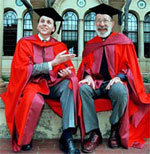 STOCKHOLM,
Oct 3: Australians Barry J Marshall and Robin Warren won the 2005
Nobel Prize in physiology or medicine for their work on how the
bacterium helicobacter pylori plays a role in gastritis and peptic
ulcer disease, the Swedish Nobel Assembly said Monday. STOCKHOLM,
Oct 3: Australians Barry J Marshall and Robin Warren won the 2005
Nobel Prize in physiology or medicine for their work on how the
bacterium helicobacter pylori plays a role in gastritis and peptic
ulcer disease, the Swedish Nobel Assembly said Monday.
The
coveted award honouring achievements in medical research opened
this year's series of prize announcements. It will be followed by
prizes for physics, chemistry, literature, peace and economics.
"Warren, a pathologist from Perth, Australia, observed small
curved bacteria colonizing the lower part of the stomach in about
50 per cent of patients from which biopsies had been taken,"
the Nobel Assembly said. "He made the crucial observation that
signs of inflammation were always present in the gastric mucosa
close to where the bacteria were seen."
Marshall
became interested in Warren's findings and together they initiated
a study of biopsies from 100 patients. "After several attempts,
Marshall succeeded in cultivating a hitherto unknown bacterial species
-- later denoted Helicobacter pylori -- from several of these biopsies,"
the assembly said. "Together they found that the organism was
present in almost all patients with gastric inflammation, duodenal
ulcer or gastric ulcer. Based on these results, they proposed that
Helicobacter pylori is involved in the aetiology of these diseases."
Oats
may hold the secret to a smooth skin!
 WASHIONGTON,
Oct 3: Women who get paranoid about ageing and scream at the sight
of a wrinkle can now find some consolation in the fact that an innovative
study by the University of Alberta has dispelled a hard-held belief
about the natural ingredient, beta glucan, found in oats. WASHIONGTON,
Oct 3: Women who get paranoid about ageing and scream at the sight
of a wrinkle can now find some consolation in the fact that an innovative
study by the University of Alberta has dispelled a hard-held belief
about the natural ingredient, beta glucan, found in oats.
The
study, published in the current issue of International Journal of
Cosmetic Science, is the first to show that oat beta glucan can
penetrate the skin despite years of doctors and scientists believing
that the large molecule was too big.
The
finding is significant, not only in the treatment of skin disorders
and removing fine lines and wrinkles but in the promotion of wound
healing and reduction in scaring following surgical procedures,
says Dr Mark Redmond, president and CEO of Ceapro Inc.
Beta-glucan
is the soluble fiber found in the cell walls of oat kernels. Oat
has a long history of safe use in providing fast, temporary relief
of itching and pain associated with minor skin irritations, has
reported to improve the appearance of smoother skin and has helped
wound healing. But it has been long believed that such a large molecule
as beta glucan was too big to penetrate the skin.
"Interestingly,
the glucan penetrates in the same way that water penetrates a brick
wall it does not go through the brick, it goes through the concrete
binding the bricks together," Redmond was quoted as saying.
Indonesia
confirms new human bird flu case: WHO
GENEVA,
Sept 23: The World Health Organisation (WHO) on Thursday announced
a fresh case of human bird flu in Indonesia, an eight-year-old boy
in Jakarta who remains hospitalised.
But
the United Nations agency said in a statement that investigations
involving several other patients were continuing, but there was
no evidence that the H5N1 virus was spreading easily-from person-to-person
in the populous country. Bird flu has killed four people since July
and 11 are under observation in the capital, according to Indonesian
officials.
"The
Ministry of Health in Indonesia has today (Thursday) confirmed a
further human case of highly pathogenic H5N1 avian influenza. The
case, in an eight-year-old boy, was confirmed as positive for H5N1
infection by a WHO reference laboratory in Hong Kong," the
Geneva-based agency said. The WHO said it was monitoring the situation
in Indonesia closely but had not raised its current level of alert
for a feared global human influenza pandemic which could kill millions.
"Given
the experience of other H5N1 affected countries in Asia, the detection
of further human cases in Indonesia or elsewhere would not be surprising,"
it added.
Bird
flu has killed 64 people in Asia since late 2003 and has since been
found in birds in Russia and Europe.
This
honey is about money
PARIS:
When two French beekeepers, husband and wife Thierry and Camille
Sergent, heard rumors about a mythical wild honey gathered on a
tiny island somewhere in the Indian Ocean, they knew adventure was
beckoning. Famous throughout the Arabic-speaking world for its alleged
virtues as a medicine and an aphrodisiac, the honey in question
sells for upward of $180 a kilo. It is even mentioned in the Koran.
The
trail led to the forgotten island of Socotra, 350 kilometers (220
miles) off the coast of Yemen, and the Sergents were both enthralled
and appalled at what they found. They golden nectar was there, and
unlike anything they had ever tasted: a heady distillation of the
island's unique and densely diverse flora. What shocked them was
the way the honey was collected and the destruction of the ecosystem
that produced the island's only source of cash income.
"There
is no sustainable apiculture here," said Camille. "The
inhabitants scramble up the granite cliffs with bare feet and hands,
sometimes risking their lives, to collect this wild honey which
they sell for 15 euros a kilo only to be resold for 150 in the emirates,"
she said.
Even
worse, the island's 80,000 inhabitants failed to prevent roaming
and ravenous goats from devouring the tender shoots of Socotra's
850 plant species, one of the richest floral ecosystems in the world.
Camille, also an ardent amateur biologist, rattled off some of the
names: Boswellia (also known as the "incense tree"), the
Dortenia fig, the juju berry, and sandragon, a "honey bush"
that takes centuries to mature.
The
French beekeepers decided to try to save Socotra's flora, and offered
to teach the island's inhabitants how to keep bees and make honey.
Everybody would come out a winner. With seed money from the French
embassy in Yemen, the couple have made three trips to Socotra in
the last 18 months, to train the men and women of the Bedouin tribes
living there.
They
brought 200 beehives and protective clothing, and taught 15 men
how to use them. In a more delicate operation, Camille - who was
born in Lebanon and speaks Arabic - convinced the men to let the
women take care of the equipment and the wax.
As
they wait for the first harvest of the sandragon honey, the Sergents
are preparing the next phase of their adventure. "With an additional
200,000 euros (250,000 dollars) already pledged, we hope to launch
a veritable business in 2006 in the form of a cooperative,"
Camille said. The honey-coated story of Socotra is told in a documentary
film by Richard Hamon, to be premiered on French television in September.
Wonder
drug promises sexathon
WASHINGTON,
June 9: If Viagra has made sex possible for men suffering
from impotence, a new drug introduced in the United States
aims to make it last longer, much longer. The new wonder medicine
named dapoxetine unveiled at an annual meeting of the American
Urological Association is designed to help millions of men
around the world cope with premature ejaculation wreaking
havoc on their sex lives.
Although
much less publicized than erectile dysfunction, premature
ejaculation affects a significantly greater number of men,
scientists said. According to the association, between 27
per cent and 34 per cent of males of all age groups are suffering
from this condition, which is usually diagnosed when sperm
release occurs two minutes or less into the sexual act, or
even before penetration.
Erectile
dysfunction treated by Viagra and similar drugs affects an
estimated 10 to 12 per cent of all men, usually in the older
age group. "The impact premature ejaculation can have
on men and their partners can be devastating for a relationship
and, currently, there are no truly optimal therapies for PE,"
said Doctor Jon Pryor, the chief urologist at the University
of Minnesota and lead researcher during dapoxetine's clinical
trials.
The
test involved 2,614 men aged between 18 and 77, who maintained
monogamous sexual relationships of more than six months and
suffered from premature ejaculation. Each received 30 milligrams
or 60 milligrams of dapoxetine over 12 weeks in two identical
placebo-controlled trials.
The
results showed the drug helped them lengthen intercourse three
to four times. What's more, dapoxetine increased their staying
power with the first dose and helped maintain the increases
over the whole study period. The
US Food and Drug Administration is reviewing an application
for the pioneer drug, which was developed by Ortho-McNeil
Pharmaceutical, an affiliate of Johnson and Johnson
'Trust'
this drug to help you bond
PARIS,
June 9: Imagine someone who has a social phobia or is autistic
but who, with a whiff of a wonder drug, can build the trusting
relationships that have eluded him all his life. Now imagine
a casino or a romantic restaurant where the same molecule
is discreetly sprayed as you walk in - and it transforms you
into a carefree poker player or convinces you that your blind
date is The One You Have Been Looking For.
Such
are the controversies set to flow from new research by a Swiss
team who have disovered that a natural hormone which helps
new mothers to breast-feed is also a "trust drug"
that dramatically lowers the threshold of suspicion. The
hormone, called oxytocin, acts like a cerebral switch, they
believe. In both men and women it turns on neural networks
that govern emotions, particular those of trust and social
attachment.
The
University of Zurich investigators were intrigued by previous
findings that lab mammals which had been given oxytocin became
far less cautious about striking up affiliations with each
other. Exploring
whether this might also be true among humans, the scientists
set up an ingenious experiment using the pharmaceutical equivalent
of oxytocin, a drug that is sometimes prescribed to induce
labour or stimulate lactation.
The
team recruited 178 male students and got them to play games
that involved trust and risk. Half
of the volunteers were given a single nasal inhalation of
oxytocin, while the others were given a harmless lookalike
placebo. Divided
into pairs, the recruits played a real-life money game in
which one was an investor and the other was a trustee.
The
investor was given a wad of cash, and whenever he handed some
of it over to the trustee, the transferred sum was tripled
by the research team. The trustee then had the possibility
of keeping some or all of this juicy bounty or sharing
it with the investor. Thus
the investor, before forking over the cash, had to have faith
that the trustee would not be selfish and would choose to
share in their joint gains.
After
the volunteers had played against each other, the results
showed that oxytocin boosted investors' trust remarkably.
Amongst investors who had taken a toot of the hormone, 45
per cent showed "maximal trust level" - they handed
the trustee the maximum permitted transfer and did this more
frequently, too.
In
the placebo group, only 21 percent did this. The researchers
then took a different path. The students were given investment
cash as before and were told to use it according to the same
principles of risk and reward. But
this time, they were matched against a computer that was randomly
programmed to either hand back some or all of the gains or
greedily keep it all.
The
outcome: there was no difference at all between the oxytocin
group and the placebo group, for both were equally wary about
handing over too much money. In other words, oxytocin only
boosted trust in contacts between humans, not between man
and machine.
In
animal research, oxytocin has been previously associated with
pair bonding. For instance, virgin sheep injected with the
hormone showed maternal behaviour
towards foreign lambs. In addition, levels of this hormone
are said to be higher amongst people who say they are in love.This
latest research, though, provides some striking clinical evidence
as to how the hormone may work in the creation of trust.
The
study appears on Thursday in Nature, the British science weekly,
where lead author Ernst Fehr says the findings could one day
help unlock pharmaceutical cures for people who have a genetic
illness which cripples them when it comes to social interaction.
But,
he admits: "This finding could be misused to induce trusting
behaviours that selfish actors subsequently exploit."
University of Iowa expert Antonio Damasio agrees, sketching
the scenario that future politicians may "generously
spray" an election rally with oxytocin to get the adoring
crowd response they want.
On
the other hand, Damasio points out, modern politicians already
aim at the natural release of oxytocin, using cleverly-crafted
ads, images and soundbites to flood our brains with the huggy
hormone. "Civic
alarm at the prospect of such abuses should have started long
before this study, and the authors cannot be blamed for raising
it," Damasio says.
Viagra
ingredient approved for hypertension
CHICAGO,
June 7: Pfizer Inc. has said US regulators approved the active
ingredient in its impotence drug Viagra to treat pulmonary
hypertension. The compound, called Revatio, contains the same
active ingredient -- sildenafil citrate -- in Viagra.
Pulmonary
hypertension is a rare disease where high pressure in the
blood vessels moves from the heart to the lungs, Pfizer said.
The drug will compete with Swiss biotech company Actelion's
Tracleer.
U.S.
regulators said last week they had received reports of blindness
among patients taking Viagra and some rival impotence drugs.
Pfizer said there is no proof the two are linked. Viagra was
originally designed to treat chest pain caused by clogged
arteries but did not prove successful. Researchers then stumbled
on its effectiveness for impotence.
India
begins human trials of HIV/AIDS vaccine
NEW DELHI, Feb 7: Indian scientists on Monday began the country's
first human clinical trials of a vaccine designed to prevent
AIDS. The vaccine trials are part of an international partnership
among the state-run Indian Council of Medical Research, the
International AIDS Vaccine Initiative and US-based Targeted
Genetics Corp., Health Minister Anbumani Ramadoss, told reporters
in the western city of Pune.
``Doctors
in Pune have today inoculated the first group of volunteers
with the potential vaccine,'' Ramadoss said moments after
the first subject was injected. The testing involves 30 male
and female volunteers between 18 and 45 years of age who are
free of HIV/AIDS and other major illnesses, doctors involved
in the trials said.
During
the trials, which are expected to take about 15 months, the
vaccine will be given to the volunteers to induce a response
from their immune systems that may protect them against HIV
infection, said N.K. Ganguly, Director of the ICMR. ``The
volunteers have been made aware of the risks involved, they
have been counselled and their health status will be monitored
all the time,'' Ganguly said.
Seth
Berkley of the International AIDS Vaccine Initiative, speaking
in a video conference call from New York, said the trials
were part of a global drive to end the HIV/AIDS epidemic which
has infected about 40 million people worldwide. The New York-based
IAVI has conducted trials of the vaccine at university clinics
in Bonn and Hamburg, and also at Belgian hospitals in Brussels
and Antwerp, Berkley said.
The
first-phase testing which began a year ago in Germany and
Belgium is aimed at determining the safety of the vaccine
and whether it produces immune responses. Known as tgAAC09,
the vaccine targets HIV subtype C -- prevalent in South Africa,
India and China and responsible for a large part of the world's
HIV infections. The vaccine was developed by Seattle-based
Targeted Genetics Corp. and the Columbus Children's Research
Institute.
``This
is a marathon which requires the commitment of the world's
political leaders to make the best science and the best facilities
available,'' Berkley said. India was ``essential'' to the
global vaccine effort because of its advanced biomedical research
facilities, and its strong pharmaceutical industry would be
able to deliver a cheap and effective vaccine to the millions
infected with HIV, Berkley said.
India
has more than 5 million people living with HIV/AIDS, the world's
second-highest number of infections after South Africa. Almost
one-fourth of them are children and young people under the
age of 25. However, many experts have argued that the official
estimate leaves out many people in the vast country of more
than 1 billion who could be carrying the virus without knowing
or reporting it.
``There
are 68 new cases of HIV every hour,'' said S.Y. Qureshi, who
heads India's National AIDS Control Organization, one of the
partners in the vaccine project. ``Those numbers alone should
strengthen our resolve to press ahead with the vaccine project.''
66-year-old
gives birth to baby girl
BUCHAREST,
Jan 18: A 66-year-old Romanian, Adriana Iliescu, gave birth
to a baby girl on Sunday. Adriana got pregnant with twin girls
after being artificially inseminated but one of the babies
died in the womb and doctors decided to perform a caesarean
section in the 33rd week of pregnancy to save the other.
"Happiness
is too small a word, what I feel now is much more than that,
said Adriana. Doctors say both the mother and the child, who
weighs 1.4 kg, are in stable condition. The birth has sparked
debate in Romania over the ethics of women beyond a certain
age having children. The
Romanian Parliament is considering a bill that bans fertility
treatment for women who are above the normal reproductive
age.
Human
nose is more complicted than a jumbo jet!
 WASHINGTON,
Jan 8: Winter colds can give you a blocked up nose that stops
you from smelling fresh winter air, roasting nuts, warm gajar
ka halwa and other seasonal fragrances. Now researchers funded
by the Biotechnology and Biological Sciences Research Council
(BBSRC) have not only discovered how air moves through the nose
bringing you those smells but their work may lead to new ways
of unblocking it and helping you to breathe more easily. The
researchers have also found out that the airflow through the
human nose is more complicated than that over a jumbo jet's
wing. WASHINGTON,
Jan 8: Winter colds can give you a blocked up nose that stops
you from smelling fresh winter air, roasting nuts, warm gajar
ka halwa and other seasonal fragrances. Now researchers funded
by the Biotechnology and Biological Sciences Research Council
(BBSRC) have not only discovered how air moves through the nose
bringing you those smells but their work may lead to new ways
of unblocking it and helping you to breathe more easily. The
researchers have also found out that the airflow through the
human nose is more complicated than that over a jumbo jet's
wing.
The
scientists at Imperial College London have combined biological
mechanics and aeronautical engineering to construct transparent
3D models of the nose, and by running water or a special refractive-index-matched
fluid through the models they have been able to map the flow
pattern through the nasal cavity to work out where air goes
when taken in.
"From
quiet breathing to rapid sniffing, we want to know exactly what
is happening," said Professor Bob Schroter, leadauthor
of the study. "People are used to the flows around an aeroplane
being complicated but that is in some ways simpler than understanding
the flows inside the nose. The geometry of the nose is highly
complex, with no straight lines or simple curves like an aircraft
wing and the regime of airflow is not simply laminar or turbulent,"
added Denis Doorly, co-author of the study.
The
research is a significant step forward from what had been learned
about the nose from studying cadavers and animals, and may soon
be helping surgeons plan their operations and drug companies
to develop new ways of delivering drugs through the nose straight
into the bloodstream, as well as new products to unblock the
nose.
Mandela's
son dies of AIDS
JOHANNESBURG,
Jan 6: Former South African President Nelson Mandela on Thursday
announced that his eldest son had died of AIDS. Makgatho
Mandela, an attorney, was admitted to Linksfield Park Clinic
in Johannesburg last month. He
died on Thursday at the age of 54.
At
a news conference at his Johannesburg residence, Mandela said
he had not been aware of his son's illness when he began lobbying
for more openness about the pandemic some three years ago. "I
had no idea when I started this campaign three years ago that
it will also affect a member of my family," the former
President said.
"I
was stating a general principle that we must not hide the cause
the death of our families because that is the only way we can
make people understand that HIV is an ordinary disease, that's
why we called you here today to announce that my son has died
of AIDS," he added.
More
than five million of South Africa's 45 million people are infected
with HIV - more than in any other country. Mandela,
a frequent visitor at his son's bedside, was surrounded by sombre
relatives at Thursday's news conference, including Makgatho's
only surviving sister and two of Makgatho's sons. Makgatho
Mandela was one of four children from Mandela's first marriage
to Evelyn Mase, who died in May 2004 at the age of 82.
A
daughter died in 1948 before she was a year old and another
son was killed in a car crash in 1969 while Mandela was in prison.
Last year, Makgatho Mandela's wife, Zondi, died of pneumonia.
The couple had three sons. Mandela also had a son from an earlier
marriage. Makgatho
Mandela will be buried January 15 in the family's home village
of Qunu in the Eastern Cape province. A
memorial service has been scheduled for January 11 at a venue
to be decided.
India
aims to stabilise new HIV infections by 2007
NEW
DELHI, Dec 2: India, home to the second largest number of people
living with HIV/AIDS, expects its growth rate in new infections
to stabilise by 2007, according to S. Y. Quraishi, Director
General of the National AIDS Control Organisation (NACO). "Our
goal in the national AIDS control policy is to achieve zero
rate of growth in new infections by 2007," said Dr Quraishi
at a US embassy function.
"It
is a tall order. We need to scale up the effort and we are moving
in that direction," he said, without giving a projected
figure for the number of people living with HIV/AIDS by 2007.
India has over 5.1 million people currently HIV-infected with
only South Africa ahead in terms of those living with the disease.
In 1986, India discovered its first case of HIV/AIDS. Globally,
39.4 million people are infected.
Earlier
this year, the Indian government raised funding for anti-AIDS
efforts by 55 percent to 4.76 billion rupees ($108.1 million)
for the fiscal year ending March 2005. "The amount is still
inadequate," said Dr Quraishi adding NACO will push the
government in coming weeks to further hike anti-AIDS funding.
Agencies
fighting AIDS say the most worrying trend is the spread of the
disease to the countryside with rural India now accounting for
59 percent of infections with many married woman being infected
by husbands who have had other sexual partners. The government
said it plans to use trains early next year where coaches will
have a medical clinic, an AIDS exhibition and carry dozens of
volunteers who will fan out to rural areas to spread awareness
about the disease.
"We
expect to cover around 70 percent of rural India by these trains
where travelling performers will get off and stage plays warning
people against AIDS," Quraishi said. The US Central Intelligence
Agency has forecast the number of Indians with HIV/AIDS could
soar to 20 million by 2010 but NACO has rejected claims India
is facing a galloping epidemic. India's HIV prevalance rate
is still less than one percent while some African nations have
a rate of more than 35 percent.
Bush
calls for global fight against AIDS
 WASHINGTON,
Dec
2: US President George W Bush has called for a global fight
against HIV/AIDS. "HIV/AIDS
is the greatest health crisis of our time. Its defeat requires
the cooperation of the entire global community," Bush said
in a message on the occasion of World AIDS Day. WASHINGTON,
Dec
2: US President George W Bush has called for a global fight
against HIV/AIDS. "HIV/AIDS
is the greatest health crisis of our time. Its defeat requires
the cooperation of the entire global community," Bush said
in a message on the occasion of World AIDS Day.
He
said to defeat the pandemic, "we also must discover new
treatments and cures. "My
administration also supports efforts to encourage testing because
in the United States alone, one-quarter of those infected with
HIV each year do not know that they are infected.
"And,
because abstinence is the only sure way to avoid sexually transmitted
diseases, my administration has more than tripled funding for
abstinence-only programmes since taking office," he said.
He
said his administration had made "turning the tide"
against HIV/AIDS a priority. "This year, we also recognise
the challenges HIV/AIDS poses to women. Through the 'Emergency
Plan', the United States supports drug therapy and counselling
to prevent mother-to-child transmission of HIV/AIDS," he
said.The
US government had last year earmarked nearly $15 billion over
a five-year period for the 'Emergency Plan for AIDS Relief,
he added.
IndianOil
-- Creating AIDS awareness
By
Sushma Arora
NEW
DELHI, Dec 1: IndianOil,
India's top Fortune 500 Company, has pledged support to eradicate
HIV/AIDS disease by spreading awareness. In March this year,
IndianOil signed a Memorandum of Collaboration with the Bill
and Melinda Gates Foundation (BMGF) to address the spread of
HIV/AIDS in India. The Memorandum was signed in New Delhi in
March 2004 by Mr T L Jain, Executive Director (Retail Sales),
IndianOil and Mr Alkesh Wadhwani, Deputy Director, Bill &
Melinda Gates Foundation (BMGF) 'Avahan' - India Aids Initiative.
IndianOil
has come forward to work with BMGF, in helping to address this
epidemic, which threatens to be one of the worst health calamities
the world has seen in recent history. As India's largest integrated
Energy Company, IndianOil is keen on working closely with Truck
Drivers and Helpers, which is one of the 'High Risk' groups
affected by the AIDS epidemic. IndianOil's large retail infrastructure
of over 9,000 petrol stations, with most of them located on
the Highways, will be the focal point for creating HIV/AIDS
awareness and preventing the spread of this dreaded syndrome.
IndianOil
will stock and distribute condoms from its select petrol stations,
launch communication campaigns, train petrol station staff as
'Peer Educators' and offer space at select petrol stations for
setting up clinical services for truckers. One such recent initiative
was the distribution of condoms at retail outlets in Karnataka.
By the end of October 2004, over 100 retail outlets in Karnataka
have started stocking and selling condoms. Similar programmes
at IndianOil retail Outlets in other states are being launched.
People Service International (PSI), an NGO, being funded by
the BMGF for fighting against AIDS will be supplying condoms
at wholesale rates to our Retail Outlet dealers who will sell
the same to customers, especially truckers who fall in the high-risk
category.
The
Bill & Melinda Gates Foundation (BMGF), which has made a
global commitment to help address the spread of HIV/AIDS, has
committed substantial funds in India to address HIV/AIDS prevention.
The Foundation has established a liaison office in New Delhi,
known as Bill & Melinda Gates Foundation 'Avahan' -- India
AIDS Initiative. The Foundation has launched all-India initiatives
to fight HIV/AIDS, form partnerships with Corporations, NGOs
and other key stakeholders and is focusing on ensuring the sustainability
of programmes initiated.
The
foundation was created in January 2000, through the merger of
the Gates Learning Foundation, which worked to expand access
to technology through public libraries, and the William H. Gates
Foundation, which focused on improving global health. Led by
Bill Gates' father, William H. Gates Sr., and Patty Stonesifer,
the Seattle-based foundation has an endowment of approximately
$27 billion.
And
the Doctor said... "So what..?"
 The
next time you trust your doctor with the most sensitive parts of
your body and the inevitable question " Can I trust him with
it?" creeps into your mind. Don't just kill the thought there.
Go ahead and ask him all you ever wanted to, not just because it
is your right to be informed but also because some seemingly 'trivial'
issues could bring about an irreversible change in your life. The
next time you trust your doctor with the most sensitive parts of
your body and the inevitable question " Can I trust him with
it?" creeps into your mind. Don't just kill the thought there.
Go ahead and ask him all you ever wanted to, not just because it
is your right to be informed but also because some seemingly 'trivial'
issues could bring about an irreversible change in your life.
Tarun
Adlakha, 26, suffers a fall and an injury in the lower back. A year
later, Dr H S Chhabra, the Additional Director and one of the best
known surgeons at one of the most respected Institutes, Indian Spinal
Injuries Centre, Delhi, advises the use of a certain steroid, Depo
Medrol, in his back as a solution to the back pain. Ofcourse, not
to forget, the same is done only after getting a Consent form signed
by him on the pretext that the use of Depo Medrol is a practice
followed across the country. But none tells him about the risks
involved and the complications that result therein. The anesthetist
gives him the shot in the spine that is finally meant to bring his
life back to normal again.
For
Tarun life could never be the same again, because this time the
pain is not only here to stay, it has aggravated to an unbearable
extent. There are days when he can't even stand on his feet. The
days he works a little, the 'Fatigue' sets in immediately, so much
so, that he feels completely devoid of energy. Like any other 27
year old, he's dreading it this time, he reads about it on the internet
but he's still not ready to confront his new found illness, which
is so little known of in India but which is capable of confining
him to bed for the rest of his life. His fears finally do come to
rest, but only when another doctor(at Appollo) confirms Arachnoiditis.
Hard
Facts: Depo Medrol, the drug administered is not approved for epidural
use and even the manufacturer insert clearly warns against its use
in the epidural routes.
In
an open letter to the US Food and Drug Administration, Dennis James
Capolongo, Director, EDNC - The End-Depo-Now Campaign, writes "
we hope to open the door for a successful battle against the widespread
practice of epidural steroid injections using this unapproved and
non-recommended steroid suspension. Our research clearly indicates
that patients, who have complained and suffered as a result of their
Depo-Medrol epidurals, were widely ignored by their physicians who
then suppressed the data from the manufacturer. The potential for
this abuse appears to be global in scale and for the lack of a better
term; it's downright criminal in our opinion."
Adhesive
Arachnoiditis is a devastating affliction of chronic intractable
pain, neurological deficits and disability for which no cure till
date is available.
There is no area of medicine today where greater, or crueler suffering
has been created in large populations of patients throughout the
globe than those directly related to Adhesive Arachnoiditis. Whether
due to sloth, disinterest, indifference or self-protective behavior
by the medical, scientific and governmental communities Adhesive
Arachnoiditis continues to remain essentially unknown, unreported,
and unrecognized among both physicians and patients.
Because
clinically significant Adhesive Arachnoiditis is typically associated
with a lifetime of continuing agony it represents a serious potential
disaster for any patient in whom unsafe materials are injected.
This circumstance demands that when epidural injections are performed
patients be informed regarding the potential risks of such a therapy.
Some
justify the ill-advised introduction of toxic substances into the
epidural space by blind technique as being a "standard of care".
It must be clearly understood that a harmful procedure can never
be considered a "standard of care".
The
Doctors at Indian Spinal Injuries Centre, when contacted, maintain
that Depo Medrol has always been used as a solution for lower back
pain, and some rare cases here and there cannot change an already
accepted medical practice.
Dr
A N Jha,(Apollo), who diagnosed the illness for him, states that
the steroid Depo Medrol was something he wouldn't recommend even
as a temporary relief for the lower back pain as its results are
too short lived in addition to the 'devastating' side effects.
For
Tarun, though, life has new challenges now. There are new horizons
to be sought and justice surely stands foremost amongst them.
Do
prayers heal?
In
2001, two researchers and a Columbia University fertility expert
published a startling finding in a respected medical journal: women
undergoing fertility treatment who had been prayed for by a religious
group were twice as likely to have a successful pregnancy as those
who had not. Three years later, after one of the researchers pleaded
guilty to conspiracy in an unrelated business fraud, Columbia is
investigating the study and the journal reportedly pulled the paper
from its website. No evidence of manipulation has yet surfaced,
and the study's authors stand behind their data. But doubts about
the study have added to the debate over a controversial area of
research: whether prayer can heal illness.
Critics
express outrage that the federal government, which has contributed
$2.3 million in financing over past four years for prayer research,
would spend taxpayer money to study something they say has nothing
to do with science. "Intercessory prayer presupposes some supernatural
intervention that is by definition beyond the reach of science,"
said Dr Richard J McNally, a psychologist at Harvard.
"It
is just a non-starter, in my opinion, a total waste of time and
money." Prayer researchers, many themselves believers in prayer's
healing powers, say scientists do not need to know how a treatment
or intervention works before testing it. Dr
Richard Nahin, a senior adviser at the National Centre for Complementary
and Alternative Medicine in the US, said the studies were meant
to answer practical questions, not religious ones.
Since
2000, at least 10 studies of intercessory prayer have been carried
out by researchers at institutions including the Mind/Body Medical
Institute, a non-profit clinic near Boston run by a Harvard-trained
cardiologist, as well as Duke University and the University of Washington.
State
financing of intercessory prayer research began in the mid-1990's
and has continued under current President George W Bush.
Stress
can trigger stomach ache in kids
WASHINGTON: A
study carried out by Lee Hui Chieh of the National University Hospital
(NUH) in the US has revealed that change of school or learning stress
can trigger recurrent stomach pain in children. Associate Professor
Quak Seng Hock, chief of the NUH paediatrics department, said he
was struck by how a child was likely to react to a parent losing
his job. "We didn't expect this to have an impact on the child,
and it's not something that we ask about when we see patients, so
this would be something to take note of now," he said.
The
study showed that one in four children in the age group of 6-16
get this searing pain at least once a month over three months or
more, and these students in pain miss school two days in a year.
A
typical case would be like Jonathan Tang, 10, a patient at NUH.
He had stomach ache two to three times a day for the past three
months, and he ended up in hospital, for two days each time, and
missed school for eight to 10 days in three months.
Jonathan's
mother Alison Tang said, "The pain sometimes lasts up to six
or seven hours and can be so bad that he'd be bent over double and
can't do anything."
The
study also showed that girls are almost twice as likely as boys
to have the problem. But Dr Oh Meng Choo, a registrar at NUH's paediatrics
department, said that when there are no underlying medical illnesses,
parents should not ignore the possibility of stress and other psychosocial
factors possibly plaguing their kids. Parents
should consider teaching children stress management techniques,
concluded Meng Choo.
|


