


India
|
Karunanidhi ends fast as Sri Lanka ends combat operationsTamil Nadu Chief Minister M. Karunanidhi ended Monday a hunger strike in support of a ceasefire in Sri Lanka after Colombo said it was ending "combat operations" against the Tamil Tigers. The 85-year-old DMK patriarch accepted a soft drink from his wife to signify the end of his protest, hours after he dramatically went on a fast at the memorial of party founder C.N. Annadurai at Chennai's Marina beach. One of India's most experienced politicians, Karunanidhi told reporters in the morning that Sri Lanka was indulging in "cruel acts" against the Tamils and sought an end to the military offensive against the Liberation Tigers of Tamil Eelam (LTTE). "I have decided to add my life to the increasing numbers of lives lost due to the Sinhalese regime's continuing cruel acts against the Tamil minority in Sri Lanka," Karunanidhi said. Karunanidhi was joined in the protest by his wives Dayalu and Rajathi Ammal, son and Local Administration Minister M.K. Stalin, daughter and Rajya Sabha MP Kanimozhi, grand nephew Dayanidhi Maran and Electricity Minister Arcot N. Veerasamy. As thousands gathered in support and sporadic violence erupted in parts of Tamil Nadu, Prime Minister Manmohan Singh and Congress president Sonia Gandhi frantically telephoned the DMK chief and assued him that New Delhi was doing its best to persuade Colombo to halt its military offensive that has claimed the lives of hundreds of civilians besides combatants. Soon after, Sri Lanka's National Security Council met in Colombo and announced it was ending all "combat operations" and that soldiers would in future only be engaged in rescuing civilians trapped in the small area still with the LTTE in the coastal belt of Mullaitivu district. Karunanidhi broke his fast after Home Minister P. Chidambaram telephoned him to convey the Sri Lankan decision. "Sri Lanka has ordered a ceasefire. So I am breaking my fast," the chief minister told reporters from a bed that had been placed for him at the protest site where doctors kept a close watch on his health. In Colombo, the government said that its combat operations against the LTTE had reached their conclusion and security forces would end the use of high calibre guns, combat aircraft and aerial weapons "which could cause civilian casualties". In its official statement, the Sri Lankan Governemnt said, "The Government of Sri Lanka has decided that combat operations have reached their conclusion. Our security forces have been instructed to end the use of heavy caliber guns, combat aircraft and aerial weapons which could cause civilian causalities." "...Our security forces will confine their attempts to rescuing civilians who are held hostage and give foremost priority to saving civilians. An official statement said the security forces would end the use of heavy calibre guns, combat aircraft and aerial weapons that could cause civilian casualties." Chidamabaram said later that Indian leaders had been in touch with Sri Lankan authorities "very closely over the last 72 hours". He said Colombo had decided that their combat operations had reached their conclusion, that security forces had been instructed to stop using high calibre weapons and that the military "will confine itself now to rescuing civilians who are held in hostage" by the LTTE. "It is our understanding that this amounts to a cessation of hostlities. We have been demanding a cessation of hostilities. We should all be relieved that hostilities have come to an end. "For the present, the whole country must feel relieved that hositilites have come to an end." Congress general secretary M. Veerappa Moily said in New Delhi earlier that the prime minister was concerned about Karunanidhi's health. An emotive issue in Tamil Nadu, the Sri Lankan issue took a political turn after AIADMK general secretary J. Jayalalitha said Saturday that the establishment of a separate Tamil state was the only way to end the Sri Lankan crisis. The ferment in Tamil Nadu comes amid Colombo's determination to crush the LTTE, now confined to less than 10 sq km land area. The widespread civilian suffering caused by the war has raised international concern. On Sunday, Colombo rejected the LTTE'S ceasefire offer, calling it a "joke". Facilities much better than those provided for refugees in India: Sri Sri
Sri Sri, who visited the Sri Lankan camps recently, was also of the view that “the relief materials sent by India to Sri Lanka are completely insufficient” and regretted that “Indian businessmen have not rushed to support the people there.” Sri Sri also asked: “How will the political drama and commotion happening in the State [Tamil Nadu] help the refugees in any case? Fasting or street demonstration or self-immolations will not help to bring solace to thousands of people in the camps. Instead of reaching out and helping the people who are in need, these incidents will only create fear and anger in society.” The press release, dated April 26, 2009, reads as follows: “His Holiness Sri Sri Ravi Shankar had visited the Internally Displaced People (IDP) welfare centres in Vavuniya, Sri Lanka on April 21st, 2009. “Following his visit, His Holiness Sri Sri Ravi Shankar has appealed to the Government of India and the civil society to give as much relief materials like food, medicines, clothes etc to Sri Lanka. Sri Sri also said that the relief materials sent by India to Sri Lanka are completely insufficient. He feels it is unfortunate that during this time of crisis the Indian businessmen have not rushed to support the people there. Spiritual leaders could have provided mental solace to the civilians in these camps. “Sri Sri acknowledged that the facilities in the camps are much better compared to those that the Indian Government has provided for the Kashmiri pundits and those provided for Sri Lankan Tamils in Tamil Nadu. Sri Sri appreciated the selfless service of Col. Induneel de Silva and his dedicated team of army personnel in the Vavuniya Menik farm welfare centres. They had extended complete co-operation for Sri Sri and the Art of Living to distribute clothes and other relief materials in the camps. “Sri Sri also met with H.E President Mahinda Rajapaksa and appealed to him that the refugees in the camps should not be kept longer and that they should be sent back to their own homes as soon as possible. H.E. President Mahinda Rajapaksa said that he is fully responsible for the security of these innocent civilians. After de-mining the entire area, the civilians can be re-settled in their home towns. “Sri Sri is of the opinion that Tamil-speaking Indian officials (the Indian Ambassador to Sri Lanka or any other official) could have instilled more faith and hope in the refugees. When the tsunami occurred, everyone came forward to help. I would say that this is nothing less than a human tsunami. ‘Why hasn’t anyone come to help even at this moment of huge influx of people to the camps?’, Sri Sri asked. “How will the political drama and commotion happening in the state help the refugees in any case? Fasting or street demonstration or self-immolations will not help to bring solace to thousands of people in the camps. Instead of reaching out and helping the people who are in need, these incidents will only create fear and anger in society, Sri Sri said.” India launches surveillance satellite
Indian space agency ISRO's workhorse, PSLV-C12 rocket soared majestically into a clear sky at 6.45 am from the spaceport in Sriharikota and placed its first Radar Imaging Satellite (RISAT 2) and micro-educational satellite ANUSAT into orbit about 19 minutes later in a textbook launch. The 300 kg RISAT-2 will primarily keep an eye on the country's borders round-the-clock and help in anti-infiltration and anti-terrorist operations. A jubilant ISRO Chairman G Madhavan Nair said "the year 2009 has started off well. The final moments of the launch were more thrilling than a cricket match as we hit a few boundaries and bowled some googlies." Nair said the performance of the PSLV-C12 launch vehicle was "precise and on the dot". "Again, we have set a record. As in the past, we declared the launch date, time and we made it happen." He said RISAT2 would be a good asset to national resources and "I am sure it is going to serve the country well." RISAT2 has all-weather capabilities to take images of Earth and would also be beneficial in mapping and managing natural disasters, such as floods and landslides. The 40 kg micro satellite ANUSAT, the co-passenger of RISAT 2, has been built by Anna University, to demonstrate the technologies related to message store and forward operations. ANUSAT, the first built by an Indian University, is a 'store-and-forward' communication satellite that will help transfer confidential academic material and also monitor drought and wasteland, urban planning and other studies. RISAT2 has a lifespan of three years and ANUSAT, one year. Different from previous remote sensing satellites, RISAT2 uses Synthetic Aperture Radar (SAR), equipped with many antennas, to receive signals which are processed into high-resolution pictures. The SAR, developed by Israel Aerospace Industries, equips RISAT with defence capabilities. The SAR payload can take images during day, night and in all weather conditions, including under cloud cover, a capability that Indian satellites do not have. Nair said ISRO has "big goals" to achieve this year, referring to the line up of ISRO launches. "All this put together... it is going to be almost like the fireworks season at Sriharikota." Today's is the 15th flight of PSLV, which has so far launched 30 satellites-- 14 for India and 16 for foreign countries -- since 1993. PSLV had also launched the Chandrayaan-1 spacecraft on 22nd October last year. Chile backs India for permanent seat in UN Security Council
Chilean President Michelle Bachelet, during talks with Prime Minister Manmohan Singh, condemned the "heinous and cowardly terrorist attacks" which posed a threat to human safety on a global scale. She expressed hope that the "intellectual and actual perpetrators" would be identified soon and brought to justice. Singh and Bachelet called for enhanced international cooperation and exchange of information to enhance the ability of the governments to fight terrorism. A joint statement issued after the talks said the two leaders reiterated that early conclusion of the Comprehensive Convention on International Terrorism was imperative to consolidation of counter-terrorism efforts within the UN. The two sides also signed four pacts, including one on cooperation in exploration and utilisation of outer space for peaceful purposes. Bachelet, Chile's first woman President, declared her support for India's permanent membership of an expanded UN Security Council. India and Chile signed a Memorandum of Understanding on Cooperation in the field of New and Renewable energy and an agreement on cooperation in the exploration and utilisation of outer space for peaceful purposes. The two sides also signed a pact for cooperation in the field of education and an MoU on Cooperation in the field of Geology and Mineral Resources. Bachelet and Singh agreed on the commitment to continue negotiations within the framework of the Bali action plan to reach an agreed outcome for the implementation of the UN Framework Convention on Climate Change. The two countries also agreed to promotion on joint initiatives in R&D on advanced clean technologies with the objective of finding concrete and innovative solutions to the issue of climate change. In the field of science and technology, Chile has invited India to join its 2009-10 Scientific Antarctic Expedition by sending an expert to participate in an ice coring research project. Bachelet and Singh evinced interest in exploring the feasibility of entering into a Free Trade Agreement and expressed satisfaction on the initiation of a process to broadening and deepening of the existing Preferential Trade Agreement in force since August 2007. India expects Pak to act fast against 26/11 perpetratorsNEW DELHI, March 17: India on Tuesday said it expected Pakistan to act fast in bringing the perpetrators of Mumbai attacks to justice and promised cooperation in this regard. "Certainly, we would hope that those things (bringing perpetrators to justice and dismantling terror infrastructure) would happen and happen as soon as possible and we will do everything we can to encourage that process," Foreign Secretary Shivshankar Menon told reporters in New Delhi. He said India had replied to the 30 questions as part of the process to help Pakistan take action against those behind the Mumbai attacks. "We will continue down that road with whoever is willing to help us to achieve our goal," Menon said. He said that Pakistan understands what India expects it to do and the responses New Delhi has received from authorities in Islamabad "represent the first step in the direction for meeting those goals." "We will do what we can to encourage them to do the right thing. But I cannot say that everything has happened yet and perpetrators have either been brought to justice or there has been credible action against the infrastructure of terror in Pakistan," Menon said. On the situation in the neighbouring country, he said Pakistan has shown ability to address the situation. "We would wish them well and we hope, as we have often enough, for a stable democratic Pakistan, which is at peace with itself," Menon said. Neelam Kapoor set to be youngest PIB chief
The information and broadcasting ministry has cleared the appointment of the 51-year-old Ms. Kapoor, a 1982 batch Indian Information Service officer, who is currently director general of the Directorate of Advertising and Visual Publicity (DAVP). Her appointment is, however, yet to be approved by the Appointments Committee of the Cabinet (ACC). Ms. Kapoor is expected to take charge of the PIB as the principal director general April 1, sources in the ministry said. If her appointment is approved by the ACC, she could hold the position for the next nine years, which will make her the longest-serving spokesperson of the government. However, there is nothing that prevents the government from appointing another senior officer from other allied services if it chooses to, but it will have to find credible reasons for doing so, reliable sources said. Ms. Kapoor, who will replace Umakant Misra, a 1973 batch IIS officer, will get the top job in the PIB largely due to a quirk in the recruitment process in the late seventies. Between 1974 and 1982, there was a freeze on recruitment to the IIS due to court cases involving direct recruits to the IIS promotees to the services. The freeze in those years has made Ms. Kapoor the seniormost IIS officer and, therefore, a natural choice for the top position in the PIB that is equivalent to the rank of special secretary in the Government of India. In the much-coveted Indian Administrative Service (IAS), an officer of 1979 batch has yet to be promoted to the rank of additional secretary. Pak has to dismantle terror infrastructure: PranabKOLKATA, March 1: Keeping up the pressure on Pakistan to stop terrorist activities originating from its soil, External Affairs Minister Pranab Mukherjee has said Islamabad has to cooperate fully to bring to justice those responsible for the 26/11 Mumbai terror attack. "Pakistan must dismantle the infrastructure used by terrorist organisations in its territory to root out terrorism from the region," Mukherjee said inaugurating an international conference on 'Cooperative development, peace and security in south and central Asia' at Kolkata on Sunday. "Terrorism, extremism and fundamentalism are posing a serious threat in our region. The 26/11 attack is one more example of terrorism in our region," he said. It is an imperative that all governments act to see terrorism rooted out, he said. Pointing out that internal stability in the neighbouring countries is in India's interest, Mukherjee said growth and peace were related to development. The minister said physical connectivity, banking facilities and simplifying transit facilities were imperative for development of the region. Physical connectivity of all SAARC countries and its observer countries like Myanmar are on the roadmap for increasing trade and ensuring development. While the Kabul-Herat Road has been completed connecting Afghanistan to Iran in its west, work was on for a road connection to Myanmar and Thailand through Mizoram in the North-East of India, Mukherjee said. On Nepal, where a Maoist government come into power after years of unrest in the Himalayan country, Mukherjee said, "We remain committed to supporting the government of Nepal and the transition to a democratic form of government." Commenting on the Indo-Pak relations, he said, "The Mumbai terror attacks have placed the dialogue process with Pakistan in stress, but we have consciously decided not to discontinue people-to-people contact, rail and bus connections." Saying India has friendly and cooperative relations with central Asian countries, the minister observed that the importance New Delhi puts on its cooperation with them is reflected in the fact that Kazakhstan President Nursultan Nazarbayev was the chief guest at this year's Republic Day parade and celebrations in the national capital. India concerned over Pakistan's deal with Taliban: Pranab
Speaking to reporters on the sidelines of a programme at the Indian Statistical Institute (ISI), External Affairs Minister Pranab Mukherjee said, "There should be no compromise with terrorist organisations like the Taliban." "Islamabad's deal with Taliban is a matter of concern," he said. Mukherjee said Pakistan was still in the denial mode on cross-border terrorism. "We all know it." He said Islamabad was unwilling to hand over to India some of those terrorists arrested in Pakistan who were believed to have played a role in the November terror attacks in Mumbai. Modi likens Rahul to aquarium fish, Cong calls Modi piranha
Modi, addressing a poll rally in Goa, said Bharatiya Janata Party (BJP) leaders like him and his counterparts in states ruled by the party are like "ocean fish" who weather big storms, unlike those "floating around in aquariums". In an obvious dig at Rahul Gandhi, the 38-year-old Congress general secretary who is being projected as a youth icon by the party, Modi said: "We are not small fish floating around in the comfort of aquariums, but we weather huge storms to win." "We are not flowers cultivated by gardeners of the rich, we have grown up in the forests on our own," Modi said, asking: "Which young people are they talking about?" He continued: "Aren't there young people living in the slums and in the homes of poor? But they are not considered young for their fathers are not rich, because their fathers were not prime ministers or their mothers are not big people." Modi claimed that compared to the Congress, the BJP had younger chief ministers. The Congress reacted sharply to Modi's "fish" remarks, with spokesperson Manish Tewari saying in New Delhi: "If Rahul is a fish in the aquarium, then Modi is a piranha who devours human beings." He was referring to the 2002 communal riots in Gujarat when hundreds of Muslims were killed and the state government was accused by rights activists and victims of having a hand in it. He said Modi had no right to speak about the poor, for unlike Rahul Gandhi, he had never spent a day in a Dalit's shanty. "The chief minister of Gujarat has lost it completely," remarked Tewari. He said the "Congress party has a history of empowering the youth; it is not a new development." Rahul visits Kutch, interacts with women artisansGANDHINAGAR, Feb 22: Congress General Secretary Rahul Gandhi on his second visit to the state this month met artisans of internationally acclaimed handicrafts hub Bhujodi in Kutch district and interacted with women from rural areas and lower income groups on Sunday. The young Gandhi scion, who is criss crossing the state to attract youngsters, sat among women and asked about their issues, their problems, their lives, their expectations from the government and how they do business in handicrafts. "Rahulji, after 45 minutes interaction with women, was impressed by them for their understanding, simplicity and their work during his interaction on a range of issues," said Shaktisinh Gohil, Congress legislative Party (CLP) leader, who was accompanying the young Gandhi. Rahul asked them what the politicians should do for resolving the problems of rural areas. Gohil added that women were equally impressed by Rahul, who talked to them freely and he was interested in their issues. After Kutch, he had flown to Rajkot, where he attended a women's convention and youth Congress enrolment drive. During his interaction with youngsters, in replay to a question, he said that youth from Gujarat will be given more responsibility during forthcoming parliamentary elections. In Rajkot, breaking his security cover, he went among youngsters and mingled with them. He answered many questions asked by the youngsters and asked them many questions on variety of issues. Subsequently, he had flown to Patan town in North Gujarat, where he met and interacted with people and mostly youngsters belonging to the scheduled castes. "Here also, he talked to them freely and inquired about their business, education and other issues," Gohil said, adding that he sought their views on various issues and what the government should do about the welfare schemes and how to promote education among downtrodden communities. In Palanpur, he mingled with tribals and talked about Forest Rights Act enacted by the UPA government and how it would benefit them. Rahul will stay overnight at famous Ambaji temple in Banaskantha district and in the morning, he is likely to visit hepatitis-hit Sabarkantha district. Subsequently, he is scheduled to attend many programmes in Gandhinagar and Ahmedabad and would leave for Delhi on Monday night. Rahul’s statement on BJP irks ModiSURAT/NEW DELHI, Feb 21: Gujarat chief minister Narendra Modi on Saturday criticised Congress leader Rahul Gandhi, asking him not to comment on the state’s economic initiatives. The Congress responded by saying that Mr Modi’s Bharatiya Janata Party (BJP) was pro-corporate and had little concern for the masses. "Some people come from Delhi and give us advice on the Tata Nano project without full information," Mr Modi said in Surat. He was reacting to Mr Gandhi’s criticism of the Gujarat government. Mr Gandhi, while visiting Surat on February 14, had said that the Modi government had doled out special favours to the Tata Motors for shifting its small car project from West Bengal to Sanand. Referring to the downturn in the Indian diamond polishing industry, most of which is concentrated in Surat, Mr Modi said, "It is for the Central government to take care of the diamond industry. My government has already given VAT concessions." In reply, the Congress said the basic problem with the BJP is its ideology which is pro-corporate and has nothing to do with the masses. "It is the fault of the party ideology which supports the corporate world. It is extremely sad that in the land of Mahatma Gandhi, the corporate world is favoured who are earning crores of rupees," Congress general secretary Digvijay Singh said in New Delhi. "The Modi government has nothing to do with the medium and small scale industries," he added. We cannot interfere, says Anand Sharma
Responding to queries at a press conference here on Saturday, he said though the country had no direct involvement in the “immediate neighbour’s affairs,” it was firm that the rights of the Tamils in Sri Lanka should be protected. The violent reaction in Tamil Nadu to the ongoing crisis was unfortunate, but “we can only counsel and not interfere. It is another country.” The government had been consistent and clear that a negotiated settlement should be evolved for which devolution of powers to Tamils was needed. At the same time, the country was firm that the LTTE was a terrorist organisation and it did not represent the Tamils of Sri Lanka. On Pakistan, he said the UPA government kept channels of diplomacy as well as people’s interaction open with Pakistan. However, when there was continuity or sudden aggression in the form of terror, there was no channel that would work. “We cannot say ‘back to business as normal’ in such event,” he said. There was need for the basic element, trust, to be restored by Pakistan and it should take “effective action” like dismantling of terror infrastructure and bringing the perpetrator to justice. These forces irrespective of their name tag form part of the same syndicate and they need to be neutralised. “It is a huge mistake to make any distinction between such forces. There cannot be a brutal Taliban and a benign one,” he said. Ghulam Nabi Azad appointed Congress general secretary
Azad, former Jammu and Kashmir Chief Minister who has had one of the longest tenure in the Congress Working Committee, was given charge of Karnataka, Tamil Nadu, Orissa. Azad had in the past been general secretary in charge of a number of states. The work allocation of the nine general secretaries has also been changed. Rahul Gandhi will continue to look after Youth Congress and NSUI and Digvijay Singh remains in-charge of Uttar Pradesh, apart from looking after Publicity. Mohsina Kidwai has been given the charge of Punjab, Himachal Pradesh and Chandigarh while Mukul Wasnik will be in-charge of the party affairs in Delhi, Rajasthan and would also Sewa Dal. Prithviraj Chavan will continue to be AICC General Secretary in-charge of Jammu and Kashmir. In addition, he has been made the party in-charge of Haryana. Janardan Dwivedi will continue to look after Organisation. He also gets new charges like organisational elections, training and programme implementation. Congress tresurer Moti Lal Vora gets another responsibility as party in-charge of administration. Rahul Gandhi's instant rapport with students in Gujarat
However, the permission was withdrawn on Thursday late night. The permission was withdrawn by MSU authorities after the Akhil Bharatiya Vidyarthi Parishad - students wing of BJP - members raised objections saying that campus should not be allowed to be used for political activities. Congress has alleged that the permission was withdrawn by the MSU authorities under "political pressure". "Due to political pressure, university authorities withdrew permission to use the open space for Rahul Gandhi's interaction with students," Suresh Patel, city unit president of Congress alleged. "The visit of the Congress leader to the campus was organised for the academic purpose as he wanted to interact with students. There was no political reason in it, Congress party in charge B K Hariprsad, accompanying Rahul said. "Education is a major issue and efforts have to be intensified to spread it. Thus we can solve many problems," Rahul Gandhi said after interacting with students. "I want these youths to play a constructive role in shaping the bright future of the country," Gandhi said. Despite an unscheduled visit to the campus, Rahul was successful in attracting huge crowds of students. Several students said their interaction with Rahul was "unforgettable", adding, "Gandhi deserves to be the prime minister and is very charming leader like his father". Interacting in a casual manner, Rahul asked students what issues they thought were of paramount concern. Answers to his question ranged from terrorism to unemployment, unavailability of jobs, poor quality of education and corruption. To a student stating that Rahul was one of the few politicians who was not corrupt, the AICC general secretary said, "I am lucky to be amongst the list of exceptions". Rahul is on a three-day visit to the state. He visited Mahatma Gandhi's birthplace at Porbandar on Thursday and is scheduled to tour Anand, Panchmahals and Dahod districts. “He will tour Surat and Bharuch districts tomorrow,” official sources said. Pak must unveil full conspiracy: IndiaNEW DELHI, Feb 13: Welcoming Pakistan's response to the Mumbai dossier, India said it will monitor further actions by Islamabad with regard to ending cross-border terror and underlined that the neighbour has to choose what kind of ties it wants with New Delhi. Making a statement in Lok Sabha on Pakistan's admission that the conspiracy was partly hatched in that country, External Affairs Minister Pranab Mukherjee said on Friday that much on the future of bilateral ties will depend on what actions Islamabad takes to take the Mumbai case to its logical end. He said the "substantial gains" in the process of normalisation achieved during the last five years are at "grave risk" as the dialogue process is premised on the commitments given by Pakistan that territories under its control would not be used for terrorism against India in any manner. "In their official response, the Pakistan authorities have admitted that elements in Pakistan were involved in the terrorist attacks on Mumbai... This is a positive development," Mukherjee told the House, a day after Islamabad conveyed its response. He noted that Pakistan is still in the process of investigating the attacks and have taken certain actions, including the arrest of some of those who were involved and filed FIRs in Pakistan. Mukherjee noted that Pakistan has sought further information and material relating to the investigation and said India will share whatever it can after examining the issues raised in Islamabad's response. Noting that the 26th November, 2008 attack was not the first terror strike in India having emanated from Pakistan, he said "nonetheless, with Mumbai, a threshold was crossed and it was imperative that Pakistan act credibly against that infrastructure to prevent further attacks." He gave details about developments and India's approach in the aftermath of Mumbai attacks, including sharing of evidence with the world to build pressure on Pakistan. "We are at a point in our relationship where the authorities in Pakistan itself have to choose the kind of relationship that they want with India in the future," he said, adding "much depends on actions in the Mumbai case reaching their logical conclusion". He said India "will continue to review the situation including Pakistan's responses and will take further steps that we deem necessary in order to protect our people." Mukherjee pointed out that India has been constantly guided by the two objectives of ensuring that those who planned, organised and trained the attackers of Mumbai are brought to justice and that the infrastructure of terrorism which exists in Pakistan is dismantled so that there is no recurrence of such attacks. Responding to the Indian dossier of evidence given on 5th January, Pakistan on Thursday admitted that part of the conspiracy had been hatched in that country and said it had filed cases against nine terrorists and arrested six of them. Pakistan, while yielding to the massive world pressure, also acknowledged that Lashkar-e-Taiba was involved in the Mumbai attacks. Mukherjee said handing over of the dossier was the fourth formal communication made to Pakistan by India. He listed the three previous ones as his telephonic talk with Pakistan Foreign Minister Shah Mehmood Qureshi, issuing of demarche and forwarding a letter written by Ajmal Amir Kasab, the lone Pakistani terrorist held during the attacks. He said Pakistan earlier tried to divert attention from the terrorist attack and its responsibilities to other issues. Pakistan engaged in "prevarication, denial, diversionary tactics and misplaced sense of victimhood" after the Mumbai attack, the External Affairs Minister said. "Pakistan's political leadership did condemn the terrorist attack and promised us full cooperation in investigating the conspiracy in Pakistan," he said. "I do not discount in any way either their intent or their sincerity but the fact remains that the overwhelming response of official Pakistan to the Mumbai attack was not appropriate to a terrorist attack where innocents were massacred in cold blood," he said. Police crackdown: Muthalik, 140 others held ahead of Valentine's DayBAGALORE, Feb 13: Sri Ram Sene chief Pramod Muthalik has been taken into custody by the Gulbarga police. 140 of his supporters were also taken intopreventive custody ahead of Valentine’s Day on February 14. Muthalik was arrested at Kamalapura when he was travelling from Bidar towards Gulbarga, while in Bangalore city around 140 Sene activists were rounded up and remanded to judicial custody till February 16, PTI reported. Convenor of the outfit, Prasad Attwar and four others have also held in Mangalore. Bangalore police commissioner Shankar Bidari said, "We have so far arrested about 140 suspects who can cause disturbances tomorrow and remanded to judicial custody till February 16. Arrests are continuing", The group has threatened to disrupt Valentine’s Day celebrations and marry off couples dating on the day in Karnataka. In the backdrop of these threats, police have also beefed up security in Bangalore and kept other leaders of the outfit under the scanner. In Bangalore, 18,000 police personnel had been deployed to provide security cover, Bidari said, adding all pubs, bars and restaurants, schools, colleges and even shops selling Valentine Day cards will be provided security. "All precautionary measures have been taken and all station house officers have been asked to be alert so that there is no untoward incident tomorrow," Karnataka home minister V S Acharya said, adding "It is our responsibility to see that no one takes law into their hand." Official sources said the government had issued instructions to police to deal sternly with trouble-makers. The outfit was first involved in an attack on women at a pub in Mangalore last month. Unfazed by the nationwide condemnation of the pub assault, Muthalik issued threats to disrupt Valentine's Day celebrations and warned that couples dating would be married off by Sene activists on that day. Honour killing: Eight of a family beheaded in BiharNAUGACHHIA (BIHAR), Feb 11: In an honour killing of arguably the worst kind, eight members of a family were shot, beheaded and their bodies thrown into the Ganga in Binoba riverine area of Bihar's Naugachchia police district on Monday. An eerie calm now prevails in the village where 21-year-old Ratan and 18-year-old Kanchan once met each other clandestinely. On January 14 this year, the duo eloped and tied the knot at Mandar temple at Baunsi in neighbouring Banka district. While Ratan is almost illiterate, Kanchan has studied up to Class VI. Both belong to poor families and hail from Gangota caste. Yet, the elopement caused acute tension in the small village. For, the two families happened to be sympathisers of two rival gangs of criminals. "That's why we earlier thought it to be a gang war of attrition," a police officer said on Wednesday. While one gang was led by Bhajjo Mandal, the other is led by Kongresi Mandal. Bhajjo, in fact, was uncle of Ratan while Kanchan's father Masudan Mandal is said to be an associate of Kongresi. Masudan and his men started threatening Ratan's father Rupan with dire consequences if Kanchan did not return home. Villagers sympathising with Masudan later approached Rupan and Bhajjo and persuaded them to attend a "panchaiti" (a self-styled village court) for an amicable settlement of the matter. However, when Bhajjo and his men reached for panchaiti , hundreds of armed men of Kongresi gang, who were called by Masudan, rained bullets on them. "Kongresi was more keen on eliminating Bhajjo and his men than assisting the girl's family settle the matter," Naugachhia SP Gopal Prasad said, adding that the deceased included Bhajjo. An FIR has been lodged on the basis of statements of Bhajjo's brother and Ratan's father. "My son would never have married the girl had he known it would lead to so much of bloodbath," Ratan's mother says. The lovebirds, meanwhile, remain incommunicado. India capable of facing any security threat: Antony
"One thing I can tell you. Whatever threat coming from any quarter, our armed forces are always ready to face them," Antony said on the sidelines of a function here. He was replying to a question on reports about a top al-Qaida commander warning India of more Mumbai-style terror strikes if it tried to attack Pakistan. Antony, however, said he had not come across this particular report. Commenting on Pakistan's demand for more information from India to complete its probe into the Mumbai terror attack, Antony said he had nothing more to add than what external affairs minister Pranab Mukherjee had said on the matter. "My senior colleague Mukherjee had already made India's position clear on the matter. He had already explained this categorically. We are one Government, one voice," he added. The al-Qaida commander who was reported killed in a US drone strike last year, has appeared in a video warning India of more Mumbai-style attacks if it tried to attack Pakistan. "India should know that it will have to pay a heavy price if it attacks Pakistan," Mustafa Abu al-Yazid, believed to be al-Qaida's military commander in Afghanistan and ranked behind No 2 Ayman al-Zawahiri, said in a 20-minute video in Arabic received by BBC. Yazid, who the Pakistani military said may have been killed in fighting last August in the Bajaur tribal region, said: "The Mujahideen will sunder your armies into the ground, like they did to the Russians in Afghanistan. "They will target your economic centres and raze them to the ground. Pakistan should not confuse but act: Anand Sharma
Minister of State for External Affairs Anand Sharma asked the international community to see whether Pakistan is sincere in bringing perpetrators of the Mumbai carnage to justice besides dismantling the terror infrastructure. Pakistan should not delay, deflect or confuse but act on the evidence provided to it in the dossier on January 5, he said while responding to Pakistan's contention that it would not be able to pursue investigations till it got "substantial" information from India. New Delhi maintains that the dossier provided by it contains concrete and substantial details of how the 10 Pakistani terrorists came from Karachi to launch well-coordinated attacks in Mumbai on November 26 last year. The dossier also contains enough details about how the Mumbai attackers were in touch with their handlers in Pakistan even during their engagement with security forces. Sharma said identity of the individuals, who masterminded the dastardly act in Mumbai is very well known to Pakistan, to India and to the entire international community. "The organisations (behind the attack) stand identified and named by UN Security Council itself." Indian Constitutional Assembly member Ranbir Singh Hooda dead
He was 95 and is survived by his son and Haryana Chief Minister Bhupinder Singh Hooda. Ranbir Singh Hooda, who was imprisoned several times during the freedom struggle and was praised by Mahatma Gandhi for his "selfless service", was ailing for the past several days, official sources said. He was undergoing treatment in Rohtak and breathed his last this afternoon, they said. Hooda, an eminent parliamentarian and a minister in Punjab government for a number of years, will be accorded a state funeral at Rohtak on Monday. Haryana Government has declared three-day state mourning. Expressing sorrow on Hooda's demise, Haryana Governor Ar Kidwai described him as an able Parliamentarian, legislator, a diligent social worker and a true democrat who served the country in many capacities. All government offices and educational institutions in the state will remained closed tomorrow and the budget session has also been put off till Thursday. Born on 26th November 1914 at Sanghi, a small village in Rohtak, Hooda was an alumnus of Ramjas College, University of Delhi. During the freedom struggle, he underwent nearly four years of rigorous imprisonment and remained under house arrest for two years. He was lodged in eight jails- Rohtak, Ambala, Hisar, Ferzepur, two in Lahore, Multan and Sialkot. He was made a member of the Constituent Assembly in July 1947. He successfully contested the Rohtak seat in the first and second Lok Sabha elections and in 972 was elected to the Rajya Sabha. A young Hooda courted arrest for the first time during the individual Satyagraha Movement and was sentenced to one year rigorous imprisonment in 1941. However, he was released in May itself. He again went to jail in the same year and was released on 24th December 1941. Joining the Quit India Movement, Hooda courted arrest in September, 1942. Lodged in a jail at Multan (now in Pakistan), his health suffered. He was later shifted to Lahore jail for treatment and subsequently released on 24th July 1944. Ranbir accompanied Gandhiji on his peace tours to the districts of Rohtak and Gurgaon. Gandhi had praised him for helping in the rehabilitation of the displaced persons. Ranbir took active part in the drafting of the Constitution and drew the attention of Constituent Assembly to the problems faced by villages, workers and peasants. He was also a member of the Provisional Parliament from 1950 to 1952. In 1962, Hooda shifted to state politics in Punjab and won from Kalanaur constituency. He was inducted into the Council of Ministers and held two important portfolios of Power and Irrigation. Hooda made substantial contribution in the coming up of the Bhakra Dam. Following the carving out of Haryana on 1st November 1966, Hooda shifted to this state and was made a cabinet minister in the Bhagwat Dayal Ministry. In the 1968 mid-term Assembly elections, he contested from the Kiloi constituency in Rohtak district and won with a handsome margin. In 1972, he again shifted to the central arena as Rajya Sabha member. Hooda was the Haryana Pradesh Congress Committee (HPCC) President in 1977 and 1980 and was also made member of the Congress Working Committee (CWC). He also held the responsibility of Deputy Leader of the Congress Parliamentary Party in the Rajya Sabha. It was at his suggestion that Indira Gandhi introduced pension for former members of Parliament. Hooda had married Hardei in 1937. President Nazarbayev’s visit gives new impetus to ties with New DelhiIndia, Kazakhstan sign Civil Nuclear Cooperation, Space agreementsBy Deepak Arora
President Nursultan Nazarbayev, who arrived here on Friday, will be the chief guest at the Republic Day Parade which is an indicator of growing Indo-Kazakh relations. This will be the first time that a leader from the Central Asian region will be gracing Republic Day celebrations as Chief Guest. The visiting President was given a ceremonial welcome at the forecourt of the Rashtrapati Bhavan on Saturday morning. President Pratibha Patil welcomed Nazarbayev on the forecourt of the majestic Presidential Palace.
Prime Minister Manmohan Singh on Saturday underwent a bypass surgery at the All India Institute of Medical Sciences (AIIMS). "Our prime minister is indisposed, hence I am receiving you," Mukherjee, the senior most minister in the Union cabinet, told the Kazakh President while greeting him. After Nazarbayev inspected the tri-services Guard of Honour, Mukherjee introduced to him cabinet ministers who had assembled there for the ceremonial welcome. These duties are actually carried out by the prime minister.
Later, Pranab Mukherjee lead the delegation level talks with the Kazakh president at the Rashtrapati Bhavan. The two sides signed five agreements, including civil nuclear cooperation and Space cooperation, in the presence of President Pratibha Patil and Nazarbayev after the talks. The two countries also signed an Extradition Treaty and a Protocol on the accession of Kazakhstan to the World Trade Organisation. The two sides also signed an agreement between ONGC Mittal Energy Limited (OMEL) and National Company Kazmunai Gas (KMG). Vice President Hamid Ansari, Petroleum Minister Murli Deora were among the leaders who called on the visiting President of Kazakhstan. On Friday evening, IFFCO signed an MoU with Kazphosphate, llc, a leading chemical and fertilizer manufacturing company of Kazakhstan, for supply of rock phosphate from its huge, extensive and proven reserves of rock phosphate. Dr. U S Awasthi, Managing Director, IFFCO and Mr Maxutbck Sh. Yessenov, Chairman, KAZPHOSPHATE, signed the agreement. Kazakhstan is known to have the world's second largest reserves of uranium which India needs to ensure that its atomic plants continue running. The nuclear deal not just be confined to uranium supply but also include joint exploration of nuclear fuel and setting up of atomic plants.
Kazakhstan, which is the third largest producer of uranium, is planning to step up excavation to become the largest producer by 2010 by raising output to 15,500 tonnes, according to Dr Karat Umarov, Kazakhstan Ambassador to India. Indo-Kazakh Joint Declaration on Strategic PartnershipNEW DELHI, Jan 24: Mr. Nursultan Nazarbayev, the President of the Republic of Kazakhstan, paid a State Visit to India from 23rd to 26th January 2009 at the invitation of Smt. Pratibha Devisingh Patil, President of the Republic of India. He is participating as the Guest of Honour at the Republic Day Parade. He is accompanied by a high level delegation and a group of businessmen and industrialists. 2. During the State Visit, the President of India held talks with His Excellency President of Kazakhstan and hosted a State Banquet at Rashtrapati Bhavan. The Vice President of India, the External Affairs Minister, the Leader of Opposition in Lok Sabha and the Chairperson of United Progressive Alliance called on the President of Kazakhstan. 3. The State Visit provided an opportunity to reaffirm bilateral ties at the highest political level and to exchange views on regional and global issues of mutual interest. The two Sides noted with satisfaction the excellent state of friendly relations and cooperation between India and Kazakhstan and expressed their firm commitment to further strengthen bilateral relations and diversify areas of cooperation. 4. His Excellency President Nursultan Nazarbayev strongly condemned the terrorist attacks in Mumbai and reiterated the need for intensifying global cooperation in combating international terrorism. He also conveyed assurance that Kazakhstan stood firmly with India in dealing with the scourge of global terrorism. The two Sides expressed hope that the perpetrators of the heinous crime are brought to justice at the earliest. Both Sides also called for early conclusion of the Comprehensive Convention on International Terrorism within the UN framework. 5. The Indian Side appreciated the support extended by Government of Kazakhstan in the meeting of the Nuclear Suppliers Group which took the decision to enable India to resume full civil nuclear cooperation with the international community. Both Sides noted that this opened immense possibilities of cooperation in nuclear civil energy sector including in the mining of uranium. The two Governments welcomed the signing of Memorandum of Understanding between Nuclear Power Corporation of India and National Atomic Company Kazatomprom JSC and recommended early conclusion of an Inter Governmental Agreement for Cooperation in Peaceful Uses of Nuclear Energy. 6. The Governments expressed satisfaction on the successful completion of negotiations and signing of the Heads of Agreement between ONGC Mittal Energy Ltd. and National Company KazMunaiGaz JSC in respect of Satpayev Block and underlined the need for expeditious conclusion of the contract in accordance with the existing law. The Indian Side conveyed that Kazakhstan ranks high in securing India's energy security and hoped that the conclusion of the Agreement is the beginning of a long term mutually beneficial cooperation in the hydrocarbon sector. 7. The two Sides agreed that the trade volume between the two countries is far below potential and urged that the Governments and business enterprises of the two countries should address the issue. A joint study by designated agencies of the two Governments and apex business chambers was recommended with a view to identify products and projects, which would deepen economic engagement. His Excellency President Nursultan Nazarbayev welcomed signing of Bilateral Protocol of Accession of Kazakhstan to the World Trade Organization and thanked the Government of India for their support on this issue. 8. The two Sides noted that relations between India and Kazakhstan had its roots in history. Both Sides expressed confidence that concluding of Agreements under consideration, highlighting the historical and cultural legacy that the two nations share, would facilitate exchange of artistes, intellectuals and philosophers, academics and students and build vibrant relations at people to people level. The two Sides also decided to organize Days of India in Kazakhstan and Days of Kazakhstan in India in the near future. 9. With a view to foster and nurture cultural and civilisational linkages, both Sides expressed interest in joint study of common historical heritage and developing the sites existing in India and Kazakhstan to attract tourists. 10. Recalling the discussions that were held during the visit of the Vice President of India to Kazakhstan in April 2008 wherein agriculture was identified as a promising area of cooperation, the two Sides recommended signing of Agreement on Cooperation in Agriculture and Allied Sectors between the relevant Ministries as an important step in this direction. The two Sides would explore the possibility of collaboration in research and development activities and the setting up of a Regional Research and Training facility in Kazakhstan catering to the Central Asian region under the framework of the proposed Agreement. 11. The two Sides also welcomed the signing of the Extradition Treaty which underlined the commitment of the Governments’ law enforcement agencies to develop mutually beneficial cooperation, render required assistance and support to each other. 12. The Sides expressed satisfaction at the diversification of areas of cooperation and noted that cooperation in the fields of Health and Medicine, Science and Technology, Space Activities, Information Technology and Education are actively being pursued. 13. With a view to intensify economic engagement and extend cooperation in areas in which India had gained considerable expertise, the Indian side proposed setting up of a gas based fertilizer plant and establishment of an Entrepreneurship Development Centre in Kazakhstan. It was recommended that feasibility studies on the two projects by Indian agencies should be undertaken immediately and considered by the two Sides for implementation. 14. The Governments expressed satisfaction at the functioning of the institutional mechanism which have steered bilateral cooperation to desired levels and identify new areas of cooperation. The two Sides appreciated the role of the India-Kazakhstan Inter-Governmental Commission on Trade, Economic, Scientific, Technical, Industrial and Cultural Cooperation in establishing and enhancing trade and economic cooperation as well as cultural cooperation. It was emphasised that the meetings of Commission and established Joint Working Groups should be held regularly. 15. The two Sides shared the view that relations between the two countries had entered a new phase and a qualitatively higher level. Recognizing the vast array of existing areas of cooperation, including the critical areas of energy and food security and the immense possibilities that existed for their expansion, the two Sides agreed to establish and develop a strategic partnership based on the principles of sovereignty and equality. The strategic partnership foresees comprehensive cooperation in all spheres, including political, economic, science and technology, military and technical cooperation, counter-terrorism mechanism, education and human resources development. 16. The Indian side conveyed that India holds Kazakhstan in high esteem and appreciates the overall development of Kazakhstan in relatively short period of time. The Indian side noted the far-sighted vision and unflinching commitment of His Excellency President Nursultan Nazarbayev in nation-building was largely responsible for the high status of Kazakhstan in the world today. 17. The President of Kazakhstan conveyed that Kazakhstan values highly impressive achievements of the Republic of India in its socio-economic development, active policy in the international arena, facilitating strengthening of peace, stability and mutual understanding between peoples, and its ever-increasing political, economic and scientific potential. 18. The Indian side conveyed appreciation for the Conference on Interaction and Confidence Building Measures in Asia (CICA) initiative of His Excellency President Nursultan Nazarbayev which is emerging as an important multilateral forum fostering peace and stability in Asia. The Indian side reiterated India’s commitment to the CICA process. The Kazakh side acknowledged and appreciated the contribution of India in the CICA process. 19. The Indian Side also appreciated other initiatives of Kazakhstan aimed at reinforcing peace, stability and mutual understanding on the Asian Continent. In this context, it was befitting to the status of Kazakhstan to have been elected the Chair the Organisation of Security and Cooperation in Europe (OSCE) in 2010. 20. The two Sides reiterated their call for strengthening of the UN role in international affairs utilizing the UN framework in maintaining equitable relations among the members of the international community and ensuring stability and security in the world. President Nursultan Nazarbayev reiterated support of Kazakhstan for India’s candidature as Permanent Member of the UN Security Council. The two Sides agreed to mutually support each other’s candidatures in the UN and other multi-lateral fora. 21. India conveyed its support to Kazakhstan candidature for the membership of ASEAN Regional Forum as and when the expansion of membership of the Forum is considered by the member states. 22. The Indian side welcomed the decision of member states of the Shanghai Cooperation Organisation (SCO) for an enhanced role for Observers and conveyed that India looked forward to greater participation in the activities of the SCO. In particular, India expressed interest in participating in the activities of the Regional Anti Terrorist Structure (RATS), SCO Contact Group on Afghanistan and SCO Business Council. 23. The two Sides expressed concern over the deterioration of the global financial and economic situation adversely affecting development of national economies. The two Sides agreed that only through coordinated actions of all the members of the international community would it be possible to overcome the world economic crisis. 24. The need for shaping a new global political and economic order based on the mutual respect for interests, display of tolerance for national, religious and cultural traditions of all members of the international community was underlined. It was stressed that a new global order would contribute to enhancing stability and security, achieving universal equality and cooperation in the world. 25. The two Sides expressed satisfaction with the results of the State Visit and concluded that it had contributed positively to the strengthening of the friendly ties between the two countries. The President of India expressed deep appreciation for presence of His Excellency President Nursultan Nazarbayev at the Republic Day celebrations which underlined importance India attached to Kazakhstan, and the Central Asian region. This was truly befitting as India enters the 60th year as a Republic. 26. His Excellency Mr. Nursultan Nazarbayev, President of the Republic of Kazakhstan, expressed deep gratitude to Smt. Pratibha Devisingh Patil, President of Republic of India, for the kind reception and warm hospitality extended to him and accompanying delegation. 27. His Excellency President Nursultan Nazarbayev invited the President of India to visit Kazakhstan at a mutually convenient time. The invitation was accepted with pleasure. India celebrates 60th Republic DayNEW DELHI, Jan 26: Kaleidoscopic images of India's rich cultural diversity and the might of its military were on full display on the magnificent Rajpath as the nation celebrated its 60th Republic Day amid an unprecedented security cover. An impressive and colourful parade, a traditional attraction of the national event, marched down the thoroughfare connecting the Rashtrapati Bhawan and the historic India Gate as President Pratibha Patil took the salute from marching contingents. Armed forces in battle regalia proudly marching before their supreme commander, scintillating show of air power, fascinating tableaux depicting the diverse culture and hundreds of colourfully-dressed dancing school children were part of the parade. The march-past was watched by the Republic Day chief guest Kazakhstan President Nursultan Nazarbayev, Vice President Hamid Ansari, Defence Minister A K Antony and the country's top political and military brass, including UPA Chairperson Sonia Gandhi, besides a large enthusiastic crowd that had gathered on either sides of the Rajpath. As Prime Minister Manmohan Singh is recuperating from his bypass surgery in All India Institute of Medical Sciences, Antony performed all the customary duties of the Prime Minister during the Republic Day celebration. Minutes before the parade began, Antony and chiefs of Army, Navy and Air Force laid wreaths at 'Amar Jawan Jyoti', the British-era World War-I memorial at India Gate, where an eternal flame burns in memory of those who laid down their lives while defending the nation's frontiers. Kakodkar, Sister Nirmala, Bindra, Dhoni, Surinder Mehta honoured with Padma AwardsNEW DELHI, Jan 25: Atomic Energy Commission chairman Anil Kakodkar, noted environmentalist Sunderlal Bahuguna, Olympic individual gold medalist Abhinav Bindra, cricket captain M.S. Dhoni and actress Aishwarya Rai Bachchan are among the 133 personalities honoured with Padma awards this year. Dr Kakodkar, who was actively involved in bringing the Indo-US civil nuclear deal to fruition, and 82-year-old Bahuguna, popular for his Chipko movement to save trees, were among the 10 distinguished persons to get Padma Vibhushans, the nation’s second-highest civilian award. The other Padma Vibhushan recipients included Isro chief G. Madhavan Nair, the man beyond the historic unmanned moon mission Chandrayaan-1, Sister Nirmala of the Missionaries of Charities and the first chancellor of the Sweden-based World Maritime University, Chandrika Prasad Srivastava. Noted historian D.P. Chattopadhyaya, Jasbir Singh Bajaj (Punjab) and Purushotam Lal (UP, both medicine), former governor and noted civil servant Govind Narain and industrialist A.S. Ganguly (Maharashtra) were the other Padma Vibhushan awardees. The Bharat Ratna has already been announced for vocalist Pandit Bhimsen Joshi in November last year. Shooter Abhinav Bindra, information technology and National Knowledge Commission chairman Sam Pitroda, economist Isher Judge Ahluwalia, author and historian Ramachandra Guha and noted journalist Shekhar Gupta were among the 30 personalities awarded the Padma Bhushan. Among the 93 persons chosen for the Padma Shri were M.S. Dhoni, spinner Harbhajan Singh, singer Udit Narayan, Bollywood actors Aishwarya Rai Bachchan and Akshay Kumar, world billiards champion Pankaj Advani, R.K. Krishna Kumar of the Taj Group of Hotels, Surinder Mehta for technology solutions and veteran broadcaster Ameen Sayani. Also conferred Padma Shris are veteran Malayalam actor Thilakan, Carnatic singer Aruna Sairam, Bollywood yesteryears star Helen Khan, Pt Hridaynath Mangeshkar, brother of the Mangheshkar sisters, ghazal singer Penaz Masani, Abhay Chhajlani (journalism, Madhya Pradesh), Dr Arvind Lal (medicine), Shyamla Pappu (public affairs) and Begum Bilkees Latif (social work), wife of former Air Force Chief I.H. Latif. Nine eminent personalities from the Northeast have been selected, including two posthumously, for this year’s Padma awards. North-Eastern Council member Inderjit Kaur Barthakur from Meghalaya has been selected for the Padma Bhushan for public affairs. She was conferred a Padma Shri in 1992. Eight others from the region have been named for the Padma Shri. They are Assam’s Tafazzul Ali (posthumous, art) and Birendranath Datta (literature and education); Norden Tshering (literature and education) and Keepu Tshering Lepcha (social work) from Sikkim; Skendrowell Syiemlieh (posthumous, art) from Meghalaya; Manipuri playwright Gurumayum Gourakishor Sharma (art), Lalthangfala Sailo (literature and education) from Mizoram and former Nagaland MP K. Asungba Sangtam (public affairs). List of Padma winnersThe following is the full list of Padma awardees on the occasion of Republic Day: Bharat Ratna: Pandit Bhimsen Joshi - Hindustani classical music (announced November 4, 2008). Padma Vibhushan: Chandrika Prasad Srivastava (civil service - Maharashtra), Sunderlal Bahuguna (environment conservation - Uttarakhand), D.P. Chattopadhyaya Padma Bhushan: G. Sivarama Krishna Murthy alias Krishna (art - Andhra Pradesh), Ramanlal C. Mehta (art - Gujarat), Shamshad Begum (art - Maharashtra), V.P. Dhananjayan & Shanta Dhananjayan (duo - art - Tamil Nadu), Vaidyanathan Ganapathi Sthapati (art - Tamil Nadu), S.K. Misra (civil service - Haryana), Shekhar Gupta (journalism - Delhi), Alappat Sreedhara Menon (literature & education - Kerala), C.K. Prahlad (literature & education - NRI/ PIO), D. Jayakanthan (literature & education - Tamil Nadu). Isher Judge Ahluwalia (literature & education - Delhi), Kunwar Narain (literature & education), Delhi, Minoru Hara (literature & education - foreigner), Ramachandra Guha (literature & education - Karnataka), Brijendra Kumar Rao (medicine - Delhi), Vaidya Devendra Triguna (medicine - Delhi), Khalid Hameed (medicine - NRI/ PIO), Lt. Gen. (retd) Satish Nambiar (national security affairs - Delhi), Inderjit Kaur Barthakur (public affairs - Meghalaya), Kirit Shantilal Parikh (public affairs - Delhi). Bhakta B. Rath (science & engineering - NRI/ PIO), Conjeevaram Srirangachari Seshadri (science & engineering - Tamil Nadu), Gurdip Singh Randhawa (science & engineering - Delhi), Sam Pitroda (science & engineering - Delhi), Sarvagya Singh Katiyar (science & engineering - Uttar Pradesh), Thomas Kailath (science & engineering - NRI/ PIO), Naganath Nayakawadi (social work - Maharashtra), Sarojini Varadappan (social work - Tamil Nadu), Abhinav Bindra (sports - Punjab), Anil Manibhai Naik (trade & industry - Maharashtra). Padma Shri: Thilakan (art - Kerala), A. Vivekh (art - Tamil Nadu), Aishwarya Rai Bachchan (art - Maharashtra), Akshay Kumar (art - Maharashtra), Ameena Ahmed Ahuja (art - Delhi), Aruna Sairam (art - Tamil Nadu), Devayani Chaymotty (art - foreigner), Geeta Kapur (art - Delhi), Govind Ram Nirmalkar (art - Chhattisgarh), Gurumayum Gourakishor Sharma (art - Manipur). Hashmat Ullah Khan (art - Jammu & Kashmir), Helen Khan (art - Maharashtra), Hemi Bawa (art - Delhi), Hridaynath Mangeshkar (art - Maharashtra), Iravatham Mahadevan (art - Tamil Nadu), K.P. Udayabhanu (art - Kerala), Kanneganti Brahmanandam (art - Andhra Pradesh), Kiran Seth (art - Delhi), Kumar Sanu Bhattacharjee (art - Maharashtra), Leela Omchery (art -Delhi). Mattannoor Sankarankutty Marar (art -Kerala), Niranjan Goswami (art - West Bengal), Bhai Nirmal Singh Khalsa (art - Punjab), Penaz Masani (art - Maharashtra), Prakash N. Dubey (art - Maharashtra), Pratapaditya Pal (art - NRI/ PIO), Ram Kishore Chhipa (art - Rajasthan), Saoli Mitra (art - West Bengal), Skendrowell Syiemlieh (posthumous - art - Meghalaya), Subrahmanyam Krishnaswamy (art - Tamil Nadu). Suresh Dutta (art - West Bengal), Tafazzul Ali (posthumous - art - Assam), Udit Narayan (art - Maharashtra), Vadakka Manalath Govindan alias Kalamandalam Gopi (art - Kerala), S.B. Ghosh Dastidar (civil service - Haryana), Ameen Sayani (commentary & broadcasting - Maharashtra), Abhay Chhajlani (journalism - Madhya Pradesh), A. Sankara Reddy (literature & education - Delhi), Alok Mehta (literature & education - Delhi), Bannanje Govindacharya (literature & education - Karnataka). Birendranath Datta (literature & education - Assam), Geshe Ngawang Samten (literature & education - foreigner), Jalees Ahmed Khan Tareen (literature & education - Puducherry), Jayanta Mahapatra (literature & education - Orissa), John Ralston Marr (literature & education - foreigner), Lalthangfala Sailo (literature & education - Mizoram), Laxman Bapu Mane (literature & education - Maharashtra), Mathoor Krishnamurty (literature & education - Karnataka), Norden Tshering (literature & education - Sikkim), Panchapakesa Jayaraman (literature & education - NRI/ PIO). Ram Shankar Tripathi (literature & education - Uttar Pradesh), Ranbir Chander Sobti (literature & education - Chandigarh), Ravindra Nath Srivastava literature & education - Bihar), Shamsur Rahman Faruqi (literature & education - Uttar Pradesh), Shashi Deshpande (literature & education - Karnataka), Sunny Varkey (literature & education - NRI/ PIO), Suresh Gundu Amonkar (literature & education - Goa), Utpal K. Banerjee (literature & education - Delhi), A.K. Gupta (medicine - Maharashtra), Alampur Saibaba Goud (medicine - Andhra Pradesh). Arvind Lal (medicine - Delhi), Ashok K. Vaid (medicine - Delhi), Ashok Kumar Grover (medicine - Delhi), Balswarup Choubey (medicine - Maharashtra), D. S. Rana (medicine - Himachal Pradesh), Govindan Vijayaraghavan (medicine - Kerala), Kalyan Banerjee (medicine - Delhi), P.R. Krishna Kumar (medicine - Tamil Nadu), R. Sivaraaman (medicine - Tamil Nadu), Shaik Khader Noordeen (medicine - Tamil Nadu). Thanikachalam Sadagopan (medicine - Tamil Nadu), Yash Gulati (medicine - Delhi), K. Asungba Sangtam (public affairs - Nagaland), Shyamlha Pappu (public affairs - Delhi), Syed Iqbal Hasnain (research on Himalayan glaciers - Delhi), Goriparthi Narasimha Raju Yadav (science & engineering - Andhra Pradesh), Pramod Tandon (science & engineering - Meghalaya), Bansilal Rathi (social work - Madhya Pradesh), Bilkees I. Latif (social work - Andhra Pradesh), Cheril Krishna Menon (social work - NRI/PIO). Rev. Fr. Joseph H. Pereira (social work - Maharashtra), K. Viswanathan (social work - Kerala), Keepu Tshering Lepcha (social work - Sikkim), Shyam Sunder Maheshwari (social work - Rajasthan), Sunil Kanti Roy (social work - West Bengal), Balbir Singh Khullar (sports - Punjab), Harbhajan Singh (sports - Punjab), Mahendra Singh Dhoni (sports - Jharkhand), Pankaj Advani (sports - Karnataka), Surinder Mehta (technology solutions - Delhi). Arunmugam Sakthivel (trade & industry - Tamil Nadu), Bavaguthu Raghuram Shetty (trade & industry - NRI/ PIO), R.K. Krishna Kumar (trade & industry - Maharashtra). Two suspected terrorists shot dead in NoidaNOIDA, Jan 25: Two suspected Pakistani militants were shot dead in a pre-dawn encounter with the UP anti-terrorism squad and Noida police on Sunday in Noida, foiling a major terror strike aimed at marring Republic Day celebrations in Delhi. The police identified the suspected militants as Abu Ismail of Rawalkote, and Farookh, alias Ali Ahmed, of Okara, Pakistan. They were travelling in a white Maruti car (UP14E 9531) from Lal Kuan area in Ghaziabad and were planning to move to Delhi a day ahead of Republic Day to carry out a "major terror strike", the police said. "We received a tip-off and a team of ATS and Noida police personnel intercepted the car in Noida’s Sector 97, a few km from Amity University, at 2.15 am," said a senior official of the UP police. Sources in the ATS said the militant module had been under surveillance for the past one-and-a-half months and the ATS was now trying to identify their local contacts. Four Kashmiris were detained by the ATS on Sunday for questioning in the matter but were later released. "The militants, belonging to Pakistan, opened fire at the team which fired back. In the exchange of gunfire, which lasted 15 minutes, the duo sustained gunshot injuries. One of the ATS officers, Vinod Kumar Singh, sustained a bullet injury," he said. The militants were rushed to a hospital where they were declared brought dead. The police claimed that a passport recovered from Ali Ahmad "proved" that the alleged militants belonged to Pakistan. Sources in the ATS said the type of weapons seized indicated the two could belong to the terrorist outfit Lashkar-e-Tayyaba and that they had planned to target the Republic Day parade in New Delhi. However, the official said there was no confirmation of this. "A confirmation can be made only after the completion of the inquiry," the official said. Sources said the chassis number of the car in which the alleged militants were travelling had been erased and the police was trying to verify its owner. The registration number used on the vehicle was that of a Bajaj Chetak scooter in the name of Pawan Verma of Ghaziabad and the latest owner of the scooter was one Shakeel, a resident of Dadri. The police has detained Shakeel for questioning. The police claimed to have recovered two AK-47 rifles, four magazines, 120 used and live cartridges, five hand grenades, nine rods of RDX containing about 1.5 kg of the explosive, Rs 18,000 in cash, a passport containing the name of one Farooq and bearing the address of one Rahimyar Khan, a fake identity card in the name of one Sameer Chaudhary, a diary containing telephone numbers and two airbags from their possession. PM getting better fast, say docsNEW DELHI, Jan 25: Prime Minister Manmohan Singh is recovering well after a successful re-do multiple bypass surgery at AIIMS. Dr Ramakant Panda, who led the surgery team, said, "The PM is fine. He is conscious, responding, reco-vering quickly." "His progress is better than we expected it to be and we hope it continues at the same pace," Dr Sampath Kumar told reporters. The doctors withdrew ventilator support after they found that the PM was improving fast. Dr Vijay D’Silva said Dr Singh would be put on a solid diet from Monday. Special prayers at gurdwaras for Indian PM's surgery, recovery
"At the Bangla Sahib gurdwara (near Connaught Place), the Sisganj Sahib gurdwara (in Chandni Chowk) and Gurdwara Singh Sabha at (G.T. Karnam Road), special 'Sangat' (mass prayer) was being offered early in the morning at 8.45 am for the prime minister's successful operation and his speedy recovery," Paramjeet Singh Sarna, president of the Delhi Sikh Gurdwara Management Committee (DSGMC), said. "Offering these kinds of prayers is very rare. All that we prayed for is the almighty's mercy on the prime minister," he added. Manmohan Singh was wheeled into the operation theatre of the All India Institute of Medical Sciences (AIIMS) at 7.30 am, Saturday for a heart surgery that could last several hours, hospital authorities said. The surgery is being conducted by a team of doctors led by well-known cardio-thoracic surgeon Ramakant Panda, vice-chairman of Mumbai's Asian Heart Institute. Kuldip Singh Bhogal of the Shiromani Gurdwara Parbandhak Committee (SGPC) said that when Sikhs went for their morning prayers Saturday, they especially prayed for the prime minister. "Everyone is praying for the success of the prime minister's operation, and we are doing that too. He is our leader and we are praying for the best for him," Bhogal added. Sarna added that there special prayers would also be conducted when Manmohan Singh returns home after the surgery. "We call it 'Shukrana' or prayer of thanks. When he returns home after the operation, we will again offer special prayers thanking the almighty for his mercy," Sarna said. Pak must act tough against terror: Anand Sharma
“I think we are talking here about what is firmly established about the dastardly attack in Mumbai carried out by organisations which have been identified and named and individuals who are nationals of Pakistan,” he said. “I have to say that the whole world is watching how effective actions would be to dismantle the infrastructure of terrorism and also bring to justice those who are responsible for masterminding the carnage in Mumbai,” he said. Anand Sharma also added that let Pakistan make full disclosure of its investigations. He further urged Pakistan to conduct an independent investigation into its probe into the 26/11 probe. Asking Pakistan not to divert attention of the world from the biggest terrorist attack on the country, Sharma reiterated that India has enough proof linked to the Mumbai attacks. PM personally visits RTO office to get license renewed
The 76-year-old Prime Minister, whose license expired about 45 days ago, drove to the RTO office in Indraprashtha and completed formalities like getting himself photographed and fingerprinted required for the new biometric license. The Prime Minister had got the license from the same RTO in the 1990s, when he was Finance Minister in the PV Narasimha Rao government. Earlier, he got it renewed in 2003 when he was leader of the opposition in Rajya Sabha. "The Prime Minister along with his wife went to the RTO office and both of them got their licenses renewed," Prime Minister's media advisor Deepak Sandhu said. One day Rahul Gandhi will be PM: Salman KhurshidNEW DELHI: It was "very obvious" that Congress general secretary Rahul Gandhi would be India's prime minister one day, but for now Manmohan Singh remained the prime ministerial candidate, party leader Salman Khurshid has said. He also said that Muslims were leaning towards the Congress in Uttar Pradesh but would vote for it only if they felt it was in a position to win, and so an electoral tie-up was needed with the Samajwadi Party ahead of the Lok Sabha polls. Responding to a question if Rahul Gandhi would be the next prime minister of the country, he said "Rahul Gandhi is going to play a very major role in these elections." "I think we have to let him make up his mind. He would make up his mind or his mother will decide for him. He doesn't seem to be in a hurry. He knows what he is doing and he is enjoying it. "Yet, it is very obvious that one day he is going to be prime minister, I hope he becomes a very young PM, why not? I think it is very clear that he is amongst top leaders and it is also very clear that he strongly believes in a sense of propriety and democracy. "Let the appropriate time come, he will be anointed or he would step forward to take (up) the responsibility," Khurshid said. "Right now he is trying to build the party. We should appreciate him for that." So who is the Congress' prime ministerial candidate this time? "I think we have a very good prime minister today and we have not been told that he is retiring," Khurshid said. "We have a prime minister, therefore we don't need a candidate. He is a highly respected man; he has steered us in a very difficult time." Khurshid said the need of the hour in Uttar Pradesh, India's most populous state, was a tie-up between the Congress and the Samajwadi Party, which came together last year after years of bitter rivalry. Arguing that people were inclined to vote along caste lines and that Muslims held the trump card, Khurshid said the winner in Uttar Pradesh would be determined by which way the Muslim vote went. "So, in order to revive our fortune, we will have to understand the equation of caste along with the Muslim vote. I think this is a long process and cannot be done overnight. "Muslims are undecided, but they are more with the Congress now than in the past 10 years. They would be willing to go along with the Congress, but they want to see a winnable position. They will vote for the Congress only if it wins. That's why an alliance with the Samajwadi Party is very important for us." Khurshid insisted that a Congress-Samajwadi Party tie-up in Uttar Pradesh "will have a far-reaching impact on the fortune of both the parties... Moreover this alliance will not only impact the Congress but also (decide) what happens to the next (central) government and what happens to the country. I think both the parties understand this sense of responsibility". "Having said that, I think this is not an easy proposition. We haven't worked with each other for years. It would be a very sad thing if we don't have an alliance." Khurshid said he had no idea why film star Sanjay Dutt, sister of Congress MP Priya Dutt, had reportedly consented to fight the elections on the Samajwadi Party ticket from Lucknow. "It is his choice." He said anyone contesting in Lucknow, now represented in parliament by former prime minister Atal Bihari Vajpayee, would have to be high-profile. The Congress was considering some names, he added. Khurshid said he disagreed with those who felt that aggression was good in politics. "Everything is not an 'akhara'," he said. "People think politics is an akhara, but politics is not necessarily an akhara." India may snap business, transport links with Pak: ChidambaramNEW DELHI, Jan 13: Home Minister P Chidambaram has warned that India may break off business, transport and tourist links with Pakistan if it fails to help to investigate the Mumbai attacks. Talking to Times daily on Tuesday he said that there are many, many links between India and Pakistan, and if Pakistan does not cooperate soon, those ties will become weaker and weaker and one day snap. "Why would we entertain Pakistani business people? Why would we entertain tourists in India? Why would we send tourists there?" Chidambaram refused to discuss when such measures might be introduced, but said: "We need cooperation soon." Accusing Islamabad of doing nothing to bring to justice the perpetrators of the Mumbai attacks blamed on the Pakistan-based Lashkar-e-Toiba, Chidamabaram said Islamabad has provided "nothing" so far after New Delhi handed over a dossier of evidence linking elements within that country to the Mumbai terror attacks of 26th November. Asked what Pakistan was doing to help with the investigation, Chidambaram said: "Zero. What have they provided? Nothing." Dutt gets SC nods to go abroad as UN's Goodwill AmbassadorNEW DELHI, Jan 14: Bollywood actor Sanjay Dutt, out on bail in the 1993 Mumbai serial blasts case, was on Wednesday allowed by the Supreme Court to go abroad to fulfil his commitments as United Nations' Goodwill Ambassador and for his film shoot. A Bench headed by Chief Justice K G Balakrishnan gave the green signal to Dutt on his application to go abroad from 16th January to 15th February asking him to surrender his passport on return to the CBI's Special Task Force, Mumbai, by 28th February. Senior advocate Fali S Nariman told the court that as a consequence of being appointed as UN's Goodwill Ambassador on malnutrition, Dutt's presence was required in United States in the first week of February. He said the Director General, Head of Observer Delegation to United Nations Economic and Social Council, has addressed a letter to Dutt in this regard. The actor will also be needed for the shooting of his two new films Luck and Lamha in Bangkok, South Africa and United Kingdom, the advocate said. Dutt, who was convicted and sentenced to six years imprisonment under Arms Act for possessing illegal weapons in connection with 1993 Mumbai blasts case, was granted bail after he filed an appeal against the verdict of the TADA court. He was, however, absolved of the serious offence under the TADA. Dutt, 50, has been regularly allowed to go abroad for his films after filing an affidavit stating that he would return to the country after completing his work. While granting bail to the actor on 27th November 2007, the court had directed him to surrender his passport and asked him not to leave the country without its permission. The CBI had not opposed his bail maintaining that he was entitled for the relief since he was guilty of a less serious offence. The Bollywood star, who was sentenced in July 2007, had spent 18 months in jail during the pendency of the trial. Terrorism will not be allowed to destabilise India: Manmohan
Referring to the recent attacks in Mumbai, he said, these were a grim reminder of the grave threat posed by extremism and terrorism to our pluralistic and liberal traditions. He said there are some who would not like to see India succeed. The government, he said, has taken several measures to strengthen national security, and will continue to work with the international community to ensure that there are no safe havens and launching pads for terrorists. Addressing over 1500 delegates from across the world, the Prime Minister announced that henceforth Overseas Citizens Cardholders who are qualified professionals – doctors, dentists, pharmacists, engineers, architects and chartered accountants – will have the benefit of practicing their professions in India. He said further details to operationalize this will be worked out. Dr Manmohan Singh also announced the launch of a Smart Card on migration that will contain all details of the worker, his work contract, his employer, his insurance etc. The objective of this project will be to transform emigration process into a simple, transparent, orderly and humane process. This data will also be available to the Government of India as well as Indian missions overseas, he said. The Prime Minister asserted despite global economic recession, India is all set to register a growth rate of about 7 percent, the highest in the world, and as its economic fundamentals are very strong. He said, India is actively involved in the meetings of the G-20 countries, which are deliberating on creation of a new international financial architecture. He added that the new global mechanism should be suited to the new challenges and vulnerabilities facing the world economy. The Prime Minister also launched today a new initiative called ‘The Global Indian Knowledge Network’. This Network will connect people of Indian origin from a variety of disciplines to users at the national, state and local levels in India. He hoped that the Network will facilitate transfer of knowledge and serve as a ‘virtual think tank’ to generate new ideas on issues such as development, education and health-care. The Chief Guest, Mr. Ramdien Sardjoe, Vice President of Suriname reiterated the support of his country for India to get a permanent seat in the reformed United Nations Security Council. He also pledged Suriname’s unwavering support for India in all global forums in its fight against terrorism including the Mumbai terror attack. He also recalled the close association Suriname had with India in global institutions like the WTO, the UN etc. He praised the advances made by India in the fields of IT, BPO, manufacturing and services sectors. Speaking at the convention, the Overseas Indian Affairs Minister Vayalar Ravi announced that the government will organize a conference of Parliamentarians of Indian Origin in the near future. He said, efforts are focused on establishing an institutional framework that can support sustainable engagement and can benefit from networks with and among overseas Indians. The Minister lauded the role of the Indo-American community in passing of the Indo-US civil-nuclear deal and cited it as a good example for synergy between India and its diaspora. He emphasised the need to respond to human issues relating to people of Indian origin living abroad with empathy and sensitivity. Ravi also stressed the importance of keeping the diaspora youth connected with India. He said, as a new India seeks to become a global player of significance, the time has come for a strong and sustained engagement between India and overseas Indians. The time has also come for overseas Indians to benefit from the exciting opportunities that India provides, he added. The Chief Minister of Tamil Nadu, Mr. M. Karunanidhi, said that violence-driven extremism is a major challenge being faced by the whole world and the downturn in the global economy is another major issue. He said that he was convinced that India has to play a special role to tackle these problems. India is rich in human resources and talent bringing respect for the nation, he said. For the ascension of People of Indian Origin in their adopted countries to the level of rising to prominent positions, he attributed the inherent ability of them to live harmoniously in any surrounding. The three-day event is being attended by several eminent speakers and experts from about 50 countries. It is jointly organized by the Ministry of Overseas Indian Affairs, the Government of Tamil Nadu and the Confederation of Indian Industry (CII). It was also addressed by Mr. K. Mohandas, Secretary, Ministry of Overseas Indian Affairs and Mr. K.V. Kamath, President, CII. India wants Pak action, not 'war hysteria'NEW DELHI, Dec 23: India has asked Pakistan to avoid "war hysteria" and simply act to dismantle the terrorist infrastructure operating in its country. Speaking to newsmen in Parliament, Prime Minister Manmohan Singh said "the issue is not war, the issue is terror and territory in Pakistan being used to promote, aid and abet this terror. Nobody wants war." India has blamed Pakistani militants for last month's attacks on Mumbai that killed 179 people and says Pakistan is not fulfilling a promise to crack down on extremists and prevent them using its soil to attack other countries. As tension between the nuclear-armed South Asian neighbours simmered, Pakistani Prime Minister Yousaf Raza Gilani warned on Monday that the armed forces were fully capable of defending the country and the people would be united if war was imposed. But Indian Foreign Minister Pranab Mukherjee said Pakistan should focus on the issues. "The issue is not creating war hysteria or raising accusing finger against others". "(The) question is there has been a sinister, heinous terrorist attack on Mumbai from the elements in Pakistan. India has requested Pakistan to take action against the perpetrators," he said. Mukherjee has previously said "all options" were open to India to pressure Pakistan after the Mumbai attacks, but analysts said a military strike remains very unlikely, as it would strengthen the hand of hawks and extremists in Pakistan. Instead India is trying to build an international diplomatic consensus to put pressure on Pakistan, and has received support from the United States and the United Nations. Pakistan strenuously denies any state links to the Mumbai attack. Pak soldier among three held in terror plotJAMMU, Dec 23: Pakistani involvement in terrorism in India resurfaced on Tuesday with the police announcing the arrest of three alleged terrorists, including a sepoy in the Pakistani army, in Jammu on December 21. All three were trained at a Jaish-e-Mohammed (Army of Mohammed) camp run by Mufti Abdul Rauf, the brother of Maulana Masood Azhar, the terror group’s founder. Azhar had been held in a Jammu jail for five years before he was let off in December 1999 in exchange for hostages on an Indian Airlines flight hijacked to Kandahar. Azhar is one of India’s most wanted men; his custody has been demanded from Pakistan after the 26/11 attacks on Mumbai. Director-General of Police Kuldeep Khoda said the three captured men planned to set off a massive explosion in India on the lines of the truck bomb that destroyed the Marriott Hotel in Islamabad on September 20. With the three men confessing that they were trained at a camp near Rawalpindi in Pakistani Punjab, the arrests, police said, had provided “clinching evidence” that terror training camps still operate in Pakistan. “After their training, the terrorists went to Dhaka from Karachi, finally crossing over into West Bengal,” said Khoda. “They took a train from Kolkata to Jammu.” Gulam Fareed, from Ruperi village in Pakistan-occupied Kashmir’s (PoK’s) Bhimber district, was identified as the Pakistani soldier (Belt No 4319184, 10 Azad Kashmir Regiment). Before joining the army in 2001, he was a member of the Harkat-ul-Jehad Islami, another terror outfit, moving to the Jaish in 2007. Khoda said the other two terrorists were identified as Mohammad Abdullah, from Serian village in North West Frontier Province’s Haripur district, and Mohammad Imran, of Dera Nawab in Pakistani Punjab’s Bahawalpur district. Imran, said Khoda, joined the Jaish in 2005, followed by Abdullah a year later. “One of them was trained to carry out a suicide attack by ramming an explosives-laden vehicle into a target.” Khoda said the trio was ordered in August to report to the Jaish’s Karachi office, located next to the Muleer army cantonment. They were provided air tickets and visas for Bangladesh by Pakistan’s Inter-Services Intelligence (ISI) operatives identified as Hamzala and Osama. “They arrived in Bangladesh on September 15 and were received by another ISI operative identified as Nadeem,” said Khoda. He said the trio stayed in Khulna for about three months. “On December 15, the terrorists began their journey to India. They crossed over into India on December 18 and boarded the Jammu Tawi Express from Malda,” said Khoda. On reaching Jammu on December 20, they initially stayed in a hotel near the station but later shifted to one near the bus stand. Fareed got himself registered as Gulshan Kumar, Abdullah as Akhilesh Parsad and Imran as Inder Kumar. All three gave Delhi addresses. The police had been receiving inputs about a possible attack and on December 21 teams of the Special Operations Group and a Central Reserve Police Force nabbed the trio from their hotel room. Khoda said they were supposed to get a consignment of arms and the location of their target from a local guide. The guide was to have been in Jammu too but was delayed because the national highway was blocked. Khoda said the police were still trying to find out whether the trio had met Azhar, but did manage to confirm that a vast terror network is operating in Bangladesh and PoK under the guidance of Pakistan. Mumbai attack: US backs Indian proof of Pak handNEW DELHI, Dec 23: The US has endorsed the evidence gathered by Indian agencies about the complicity of Pakistan's state actors in the terrorist attack on Mumbai, on what can result in stepped up international pressure on the Zardari regime to take action against the mentors of Lashkar-e-Taiba. Top US intelligence official John Michel McConell is learnt to have expressed complete satisfaction with the strength of India's case against Pakistan, based on FBI's examination of call records of satellite and cellular phones used by Mumbai attackers and their Pakistan-based handlers. McConell confirmed that one of the numbers logged on the satellite phone the terrorists used while navigating their way to Mumbai belonged to known Lashkar terrorist Abu Al Qama. Indian intelligence officials are familiar with the satellite phone that Qama uses. The US, using its leverage with Sharjah where Thuraya is headquartered, corroborated this fact, and also the fact that Qama was passing instructions to the attackers from Pakistani soil. India's case about the Pakistan hand has also been borne out by the data the Americans retrieved, using their superior technology, from the damaged mobile phones used by terrorists while they were carrying out the massacres in Taj and Trident hotels. The phones had got severely damaged in the fire that broke out during the gunfight. "We are committed to get to the bottom of this case," US officials are learnt to have told their Indian counterparts during their interaction spread over 48 hours. The Americans are planning to confront the Pakistanis, still in denial mode, with the evidence that their own investigation has thrown up. Sources said the UK has also passed on electronic intercepts, described by a senior source as "one clinching piece of evidence", to India. McConell, along with FBI officials who have been camping in India in connection with the probe into 26/11, has held meetings with home minister P Chidambaram, national security advisor M K Narayanan and senior Indian intelligence officials. Indian experience with the US intelligence agencies has so far not been satisfactory, with the latter winking at evidence against Pakistan because of its dependence on Islamabad for success in Afghanistan. Indian agencies, however, feel that the response could be different this time because of the fact that Mumbai casualties included US nationals. The FBI is mandated to take the probe to the logical culmination, which will include charging the names of Lashkar leaders and their collaborators in ISI that come up in the probe. Mumbai attack was challenge from Pak ArmyNEW DELHI, Dec. 23: Foreign secretary Shivshankar Menon has made a reference to a dimension of the recent terrorist attack in Mumbai which, taken to its logical conclusion, makes an appropriate Indian response inescapable. Addressing Indian ambassadors and high commissioners from around the world on the opening day of their two-day conference here on Monday, the foreign secretary noted that the terrorists had made no effort whatsoever to cover their tracks. Sources familiar with the heads of mission conference said this indicated, according to Mr Menon, that the calculated brazenness was intended to convey the message to New Delhi that the Army was fully in control in Pakistan, and was daring India to do whatever it could. According to the Indian reading, the Pakistan Army controls all levers of power, though there has been a visible decline, over time, in the popular esteem that it enjoys. Inviting an Indian reaction to the Mumbai assault is seen as a stratagem to rally national opinion around the armed forces. Such a move is also said to signal that the Indians must get used to deal with the Pakistan Army once again, rather than with the notional civilian government. Sources said the foreign secretary conveyed the sense that India needed to respond in a manner that would have a long-term effect on its dealings with Pakistan. The conference of ambassadors is the first since 1969. It was originally scheduled for October but had to be postponed by two months for reasons of logistics and availability of all concerned. It was addressed by the President, the Prime Minister and the external affairs minister, among others. It was not linked to the Mumbai terrorist strike. Lashkar is behind Mumbai attacks: BrownNEW DELHI, Dec 15: British Prime Minister Gordon Brown supported India’s contention that the Lashkar-e-Taiba was behind the Mumbai terror attacks and observed that Pakistan had a “great deal to answer for.” Mr. Brown arrived here on Sunday morning for a rescheduled visit. A meeting with Prime Minister Manmohan Singh and senior officials was the only item on the agenda. Promising to convey New Delhi’s concern over Pakistan continuing to be a sanctuary for those planning and committing terrorist crimes in India, Mr. Brown wanted the world community to ensure that there were “no safe havens for terrorists” and “no safe place for those who finance terrorist activities.” Mr. Brown was to arrive here on December 18 for a day-long visit. He pushed forward his tour to the subcontinent in order to make his interaction with the top leadership of Pakistan and India relevant in the context of the crises in bilateral ties following the Mumbai attacks. India is understood to have acquainted him with the main features of the investigation into the Mumbai strikes which it is convinced were choreographed from Pakistani territory. “The Indian police is interviewing people. We also know there have been arrests in Pakistan. We also know that the group responsible is LeT and they [Pakistan] have a great deal to answer for,” he said, when asked about his interaction with Dr. Singh. “I am travelling to Pakistan and will meet President Zardari. I will explain the concerns that the Indian people have about what has happened and about issues related to Pakistan,” he observed. “I hope the world can see how it can work together to combat terrorists,” he said. He had informed Dr. Singh of Britain’s commitment to help both countries jointly combat terror. “We will work together to build international support to tackle terrorism and roots of terrorism in this world.” The British Prime Minister acknowledged that no country should go through what India experienced during the Mumbai attacks and felt the world community must focus on choking the funding of non-state actors who have resorted to repeated acts of violence on unarmed civilians. The world must also “continue to expose the perverse and unacceptable messages that are sent out by extreme terrorist groups who are perversionists and misuse religion,” he added. Congress unveils Rahul Gandhi as party's new mascotNEW DELHI, Dec 9: Gaining two States – Rajasthan and Mizoram`-- and retaining Delhi in the just concluded elections, the Congress was quick to give the credit to Rahul Gandhi and launch him as party's new mascot, claiming that he played a crucial role in party's performance. AIIC Media Cell Chairman Veerappa Moily declared that Rahul Gandhi, party’s General Secretary, had proved himself as an effective campaigner. "In Rajasthan and everywhere else, Rahul Gandhi has been the star attraction," he said. AICC General Secretary Prithviraj Chavan referred to Rahul Gandhi as the "third pole" in the party after its President Sonia Gandhi and Prime Minister Manmohan Singh for rejuvenating the campaign style of the 123-year-old party. “Rahul will play a bigger role in the future,” he said. Chavan said, "Sixty-five per cent people are young in this country. Rahul has emerged as a lead campaigner for the party. He has great appeal for the youth of the country and Youth Congress workers." Gandhi campaigned in Chhattisgarh when the party president was not well and took an active role in getting party tickets for Youth Congress leaders. Top sources in the party said that Moily's remarks reflected the thinking in the party to raise Rahul Gandhi's profile in the build up to the coming Lok Sabha elections. Rahul Gandhi was the only central leader to have campaigned in all the BJP-ruled states, though only because of sudden indisposition of Party President Sonia Gandhi during the campaign and she had to curtail her public meetings. His exertions may appear to have produced, at best, only a mixed result in an affair dominated largely by regional leaders and local issues. But the satisfying score gives the party a window to cast him for a larger role. The party has thus far been wary of exposing what it considers to be its 'prized asset', limiting his role on tough terrains to strategic appearances. It has preferred a calibrated build up also to guard against any perception about its being keen to hand him the reins of PMO immediately. It would have put off its plan to unveil him for bigger responsibilities, if the BJP had defeated, as the party feared at the beginning of the campaign, the Congress in Delhi. But with a flattering scorecard which can rebut the perception of Congress necessarily being on its way out, and with the apprehensions of the issues of terror and price rise hurting the party not coming true, party seems to have decided to raise his billing. Talking to reporters, Moily declared: "This is the beginning of the BJP's decline." Verdict, Moily said, refuted the BJP propaganda that the UPA government had been soft on terror. He said that the Centre was determined to wipe out terror and recalled the previous NDA government's 'role' in aggravating it. |
|
|||||||||||||||||||||||||
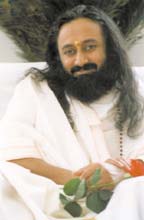 CHENNAI, April 26: India's religious Guru, Sri Sri Ravi Shankar has acknowledged that the facilities in the Internally Displaced People (IDP) welfare centres in Vavuniya in Sri Lanka’s Northern Province are much better” than “those the Indian Government has provided for the Kashmiri pundits and those provided for Sri Lankan Tamils in Tamil Nadu.”
 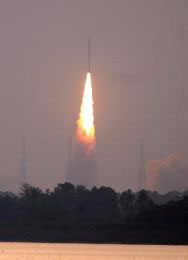 SRIHARIKOTA, April 20: Giving a big boost to its defence surveillance capabilities, India today successfully launched an all-weather Israeli-built spy satellite that will help security agencies keep a vigil on the country's borders.
 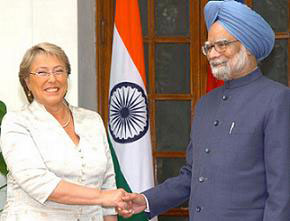 NEW DELHI, March 17: Chile has backed India's efforts for a permanent seat in the UN Security Council and expressed solidarity in the aftermath of the Mumbai terror attacks by demanding that its perpetrators be brought to book.
 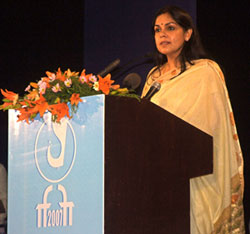 NEW DELHI, March 18: Neelam Kapoor is set to be the youngest chief of the Press Information Bureau (PIB), a position that will make her the principal spokesperson of the Government of India.
  NEW DELHI, Feb 22: India on Sunday said Islamabad's peace deal with the Taliban militia in the troubled Swat Valley of North West Frontier Province in Pakistan was a "matter of concern".
 NEW DELHI: The war of words between Gujarat Chief Minister Narendra Modi and the Congress grew shriller on Sunday, with Modi likening Congress MP Rahul Gandhi to "small fish" in an aquarium, and the Congress retorting by describing him as a "piranha who devours human beings".
 HYDERABAD, Feb 21: “We cannot be interventionist, we can only speak,” Union Minister of State for External Affairs Anand Sharma said regarding the ongoing crisis in Sri Lanka.
 NEW DELHI, Feb 18: Ahead of Lok Sabha elections, Congress on Thursday night carried out a major organizational reshuffle bringing senior leader Ghulam Nabi Azad back as party general secretary and given charge of four states changing the work allocation of almost all other general secretaries.
  THIRUVANANTHAPURAM, Feb 10: India is capable of facing any threat to its security coming from any quarter, defence minister A K Antony said in wake of a warning from a top al-Qaida commander.
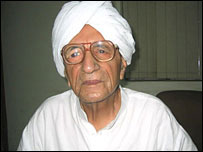 ROHTAK, Feb 1: Ranbir Singh Hooda, an eminent parliamentarian and lone surviving member of the Constitutional Assembly, on Sunday died at his native place in Rohtak.
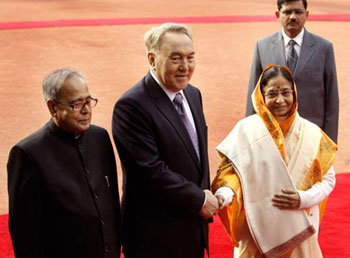 NEW DELHI, Jan 24: Kazakhstan President, Dr Nursultan Nazarbayev’s four-day visit to India has given a fresh impetus to the ties between the two countries. The President’s visit saw two countries signing nuclear and business pacts on Saturday.
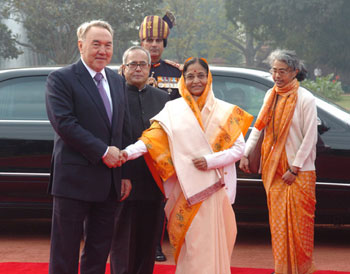 External affairs minister Pranab Mukherjee performed the first protocol duties of the prime minister on Saturday as he received President Nazarbayev along with President Patil at the majestic Rashtrapati Bhawan (Presidential Palace).
 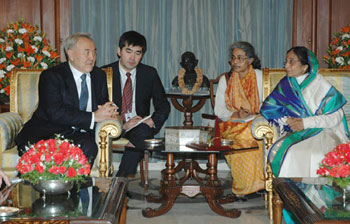 The visiting President is accompanied by a high level official delegation including Foreign Minister Marat Tazhin and a high-level business delegation representing various sectors.
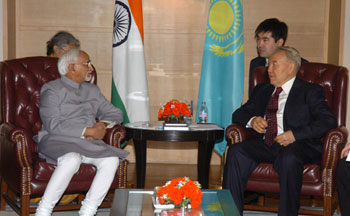 In the afternoon, President Nazarbayev addressed captains of the Indian industry at the Maurya Hotel.
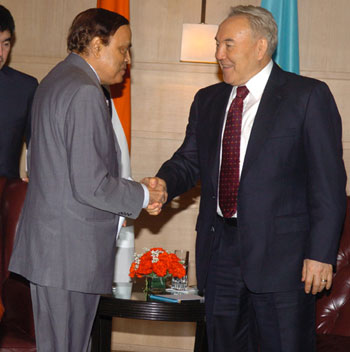 Kazakhstan is the fourth country after the US, France and Russia with which India have civil nuclear cooperation.
 NEW DELHI, Jan 24: Special prayers were offered in gurdwaras across the national capital early Saturday for the success of Prime Minister Manmohan Singh's heart sugery andhis speedy recovery.
 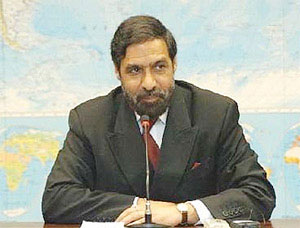 NEW DELHI, Jan 20: India's Minister of State for External Affairs Anand Sharma on Tuesday said that the world was watching Islamabad's action in dismantling terror infrastructure on its soil and it must act tough against perpetrators of the Mumbai terror attacks.
Aviation
| Business | Defence | Foreign
Affairs | Communication | Health
| India | United Nations
India-US
| India-France | Entertainment
| Sports | Photo Gallery |
Tourism | Advertise with Us
| Contact Us
© Noyanika International, 2003-2009. All rights reserved.