


India
ISRO does a Google EarthNEW DELHI, Aug 12: The Indian Space Research Organisation (ISRO) on Wednesday added another feather to its cap, with the launch of its own version of Google Earth. This would provide a sharper picture of Indian terrain barring sensitive locations such as military and nuclear installations. Called ‘Bhuvan,’ the new web-based 3D mapping tool uses images taken over a year ago by ISRO’s seven remote sensing satellites, including Cartosat-1 and Cartosat-2. The satellites can capture images of objects as small as a car on a road. The degree of resolution showcased is based on the level of popularity of a place or an area. Most of the terrain is covered up to a resolution of at least six metres. The least spatial resolution is 55 metres. Like Google Earth, the geo-portal, http://bhuvan.nrsc.gov.in, allows users to view cities and other places of interest looking perpendicularly down or at an oblique angle, with different perspectives. The user can also navigate through 3D viewing environment. One can “fly” to destinations of choice and even draw 3D objects such as placing of expressive 3D models, 3D polygons and boxes. The site, among other things, offers tools to measure horizontal, vertical and aerial distances. Minister of State in the Prime Minister’s Office Prithviraj Chavan launched the portal at a daylong workshop of the Astronautical Society of India on “21st Century challenges in space – Indian context.” Later speaking to journalists, ISRO Chairman Madhavan Nair said the space agency had started the preparations for a mission to Mars within the next six years. It was looking at launch opportunities between 2013 and 2015. Three envoys present credentials to President Pratibha PatilBy Deepak Arora
The envoys who presented their credentials were: Mr. Timothy J. Roemer, the Ambassador of the United States of America, Mr. Krit Kraichitti, the Ambassador of Thailand, and Mr. Ahmad Tariq Karim, the High Commissioner of Bangladesh. In her interaction with the envoys, the President said terrorism constitutes a grave threat to world peace, prosperity and stability and the international community needs to act swiftly and collectively to defeat it. The President also said India is focusing on strengthening its infrastructure as well as social sector to bring about equitable development. The President added that India seeks friendly relations with all countries and to build cooperation in diverse sectors, including in education. The President queried about steps being taken in the three countries to tackle the H1N1 influenza. The credential presentation ceremony was attended by the senior members of the missions, senior officials of the Ministry of External Affairs and Rashtrapati Bhavan. US Ambassador Timothy noted that President Barack Obama places high priority to the ties between the two countries. He also conveyed to Patil the personal greetings from Obama and goodwill of the people of the US, according to an official release by the US Embassy. Speaking after the ceremony, the new ambassador said "as our governments work together on areas of significant mutual interests, I am struck by the commonalities between our nations -- in our values, our democratic ideals and in the challenges and opportunities that we face. President Pratibha Patil meets childeren on Raksha Bandhan
The students, who had assembled at the sprawling Rashtrapati Bhavan here, came from various public schools, NGOs and even special education institutes. The children of various age groups included some who are mentally and physically challenged, visually impaired and thalassaemic and are from Delhi and towns of Rewari, Gwalior, Panipat, Kapurthala and Faridabad. The President spent a considerable time with the children and also distributed sweets and gifts to them. The children also got an opportunity to take a tour of Rashtrapati Bhavan. "It was nice to come here and meet the President.I said thank you to her. This place is very big and beautiful," young Ishita of Sapphire International School, who came dressed as 'Jhansi Ki Rani' said. A boy came dressed as Prime Minister Manmohan Singh while another came dressed as Subhash Chandra Bose. Sandeepa Sood, Principal of Saffron Public School of Kapurthala, Punjab who had last year visited the White House along with some of her children, said "Our Rashtrapati Bhavan is more magnificent than White House. It is nice for the kids to come here and interact with the President." A young blind girl, who also tied rakhi on the President's wrist said, "I could not see her but felt her touch on my cheeks. Wish I could see that moment." Almost 85 students had come to tie rakhi on the President, who has sent rakhi to all her four brothers. In her greetings on the occasion of Raksha Bandhan, President said said Raksha Bandhan symbolizes love, affection and mutual trust between siblings. "May this unique festival strengthen fraternal feelings and the spirit of oneness in our society as we work collectively for the well-being of our people,” she said. Union minister Virbhadra Singh, wife booked for corruptionNEW DELHI: In a development that is certain to come as a major embarrassment to the Manmohan Singh government, steel minister Virbhadra Singh and his wife Pratibha Singh have been booked for corruption by the Himachal Pradesh vigilance department. The move against the senior Congress leader and five-time HP chief minister, popularly known as "Raja Saab", was made on the basis of an audio CD allegedly containing portions of his conversation with an IAS officer on some money transactions. The CD was released by a former Congress minister Vijay Singh Mankotia, who had demanded registration of the case against Mr Singh and others. Mr Mankotia, a political adversary of Mr Singh, had released the CD before the Hamirpur parliamentary by-election in May, 2007. The development is certain to come as a big embarrassment to the Manmohan Singh government, and is certain to undermine its resolve to fight corruption. It at the same time is going to ratchet up the confrontation between the two leading national parties both in HP and beyond as Mr Singh is one of the seniormost leaders of Congress. "Mr Virbhadra Singh and his wife Pratibha Singh were booked on Monday night by the state vigilance and anti-corruption bureau under relevant sections of the IPC (Indian Penal Code)," Inspector General of Police (Vigilance) S R Mardi said on Tuesday. He said they were booked on the basis of the audio CD released by Mr Mankotia. In the CD, Mr Singh was heard referring to some monetary transactions during a phone conversation with former IAS officer Mahinder Lal, who has already passed away. The CD also contained recordings of his wife, a former MP from Mandi in Himachal Pradesh. However, the minister dubbed the case as political vendetta by the BJP government in the state. Soon after it was made public that an FIR has been lodged against him, Mr Singh put out a statement dubbing it as an exercise in fabrication. The minister said he had filed a criminal complaint against Mr Mankotia. "The desperate act of the state government is nothing but an act of political vendetta. The first time this CD was released, Prem Kumar Dhumal was going to contest the Lok Sabha elections in 2007. Now, the Vidhan Sabha by-elections are imminent. It seems BJP remembers this CD only before elections," he said. Haryana govt seeks Rs 1K cr relief package from centreCHANDIGARH, Aug 4: In view of the drought like conditions in the state, the Haryana Chief Minister, Bhupinder Singh Hooda, has sought a special relief package of Rs 1,000 crore from the central government to compensate the state power utilities for the costly purchase of additional power to facilitate sowing of the kharif crops. In addition the government has asked for a bonus of at least Rs 100 per quintal on paddy and Rs 50 per quintal on bajra, over and above the MSP. In a communication to the Prime Minister, Dr Manmohan Singh, today, Mr Hooda said that during the current kharif season, the state had not received uniform and well distributed rains. The deviation from the normal rainfall so far has been minus 47.5 per cent. Against the target of sowing of 30.15 lakh hectares this kharif season, sowing has taken place only in 26.33 lakh hectares so far. In order to ensure transplantation of paddy, sowing and survival of other crops, the state power utilities have ensured eight hours of power supply per day to the agriculture sector by purchasing costly power from various sources according to government officials. The power utilities have entered into procurement contracts for 4,638 MW of power for the sowing season at the cost of Rs 1977.15 crore. But for the efforts made by the state government, a significant area would have either remained unsown or the crops would have withered away, the Chief Minister pointed out. The state power utilities have spent Rs 1007.5 crore on the cost of additional power purchased for the current kharif season. “I would accordingly request that the state government should be provided a grant of Rs 1,000 crore as a special package so that the power utilities can be compensated”, Mr Hooda demanded. Apart from meeting its own food grain requirements, Haryana also meets the food grain requirement of other states by contributing to the central pool in a big way. In order to utilize the area which may remain unsown due to the failure of the monsoon, the farmers would be encouraged to grow toria crop. “I would, therefore, also request you that 5,000 quintal seed of toria crop may be supplied to the farmers free of cost through mini kits to cover about one lakh hectare of unsown area”, the chief minister said. India will achieve uranium self-sufficiency by 2013: Kakodkar
With the Jadugoda Uranium mill in Jharkhand expanded and the proposed expansion of Turamdih mill expected to be over next year, uranium production would go up. Besides, exploration of uranium is underway at Tummalapalle in Andhra Pradesh and it is expected to go on stream by 2013, he told reporters here. Kakodkar was here on the occasion of five years of the propellant reaction project at the Indira Gandhi Centre for Atomic Research attaining criticality. "We are also working to explore uranium at Gogi near Gulbarga in Karnataka," he said and expressed the hope that a proposed project at Meghalaya would also be cleared soon. With the completion of proposed projects, the country would overcome shortage of uranium by 2013. Stating that the existing reactors were of world class, Kakodkar said, "We will also put in continuous efforts to further improve their performance through our research and development team." Centre had given approval, in principle, for setting up a 4X700 MW nuclear power reactor unit. "We want to quickly get (final) approval and start constructing these projects. There are also plans to set up another 4x700 MW power unit," he said but did not divulge details. President, invitees watch special screening of Slumdog Millionaire
Oscar awardee Resul Pookuty and Vikas Swarup, on whose novel ‘Q and A’ the movie is based, also attended the screening. According to a Rashtrapati Bhavan spokesperson, the two-hour special screening was organised for the President and selected invitees. The film bagged eight Oscars early this year at the 81st Academy Awards. “The film reminds us about the lives of the people,” Rahman, who along with Gulzar, won the Oscar for the Best original song, ‘Jai Ho’ in the movie, told journalists after the screening. The show of the movie in Hindi was also attended by Minister of State in the Prime Minister’s Office Prithviraj Chavan, Union Tourism Minister Kumari Selja, Minority Affairs Minister Salman Khursheed and CBI Director Ashwani Kumar. President of India completes two years in officePratibha Patil works towards building compassionate, people centric societyBy Deepak Arora
Soon after assuming office in 2007, the President expressed the wish to modernise everything possible, from infrastructure to the style of working at the Rashtrapati Bhavan to make it closer to the Aam Aadmi (Common man). She also wanted the Rashtrapati Bhavan to made into an ecofriendly township. Roshini is one such initiative taken on the directions of the President to make the President's Estate a green, energy efficient and a zero waste model township, informed Dr Christy Fernandez, Secretary to the President. Ever since assuming office, in the year when India celebrated its 150th Anniversary of the First War of Independence and the 60th Anniversary of attaining independence, President Pratibha Patil’s vision has been to build an inclusive society, a nation where the best interests of the people are served and where compassion is shown towards sections of society which need care. Soon after India successfully completed its 15th General Elections the President swore in the Prime Minister and the Union Council of Ministers in May this year, thereby enabling a smooth transition of power keeping in mind the mandate of the people. The President highlighted the cause of the unemployed, farmers, youth and women whose welfare is important for the overall balanced growth of the country. At the Governors’ Conference held at Rashtrapati Bhavan in September 2008, the President took up the need to reassess issues relating to women’s empowerment and to address the concerns of the North-Eastern region of the country.
Creating SHG-NGO Synergy for Women’s Economic Empowerment Emphasizing People Centric Administration
Sensitive, Responsive, Efficient and Affordable Justice Delivery Strengthening Food Security without affecting Natural Eco-Systems While praising the role of our farmers and agricultural scientists in achieving food security for all, the President suggested measures to mitigate the difficulties of farmers and advocated debt waiver, innovative farming practices like dryland farming under the National Rural Employment Guarantee Act (NREGA). The President also emphasized the necessity to maintain natural eco-systems while increasing food production. Helping the Environment through Individual Contribution
In its second year, the ‘Roshini’ Programme in Rashtrapati Bhavan has become a multi-dimensional project seeking to change the President’s Estate into a sustainable and eco-friendly township. Activities under the programme range from waste management, rain water harvesting, energy conservation and use of non-conventional sources of energy. Six women’s SHGs have been formed within the President’s Estate, each with an area of specialization, thereby setting an example of women’s empowerment through activities in the day to day life of urban settlement. Encouraging those who Battle Social Evils
Such persons included those who personally took up the battle to change their lives and have now become the vanguard for social change. Such persons and groups were regularly invited to Rashtrapati Bhavan. Some of the persons invited to Rashtrapati Bhavan and felicitated were, Pinki from Chhattisgarh, Rekha Kalindi, Sunita Mahto and Afsana Khatun from West Bengal and Roshani Devi the Sarpanch of a village in Haryana. This was done so that others would be encouraged to take up the cause, whether it is child marriage, the drive against alcoholism, discrimination against the girl child or any other social evil. Towards a Humane and Compassionate Society The President is concerned that even as India progresses economically it must still remain a humane and compassionate society. The President therefore strongly took up the issue of ragging on college campuses. She solicited effective intervention of the Governors, to take steps in their states to prevent this inhuman practice. She has also advocated measures for the welfare of the disabled. Those who have overcome their disability have always received encouragement from her. Visiting Various Regions of the Country Keen to interact with as many people as possible, the President visited over 12 states during the year including some in the North East. The President during these visits went to various defense establishments and Forward Areas where she encouraged troops and appreciated their valour and role in defending the nation’s borders. Projecting the Nation’s International Concerns
As the President completes her second year in office, her work to serve the nation continues. Anti-gay law was an instrument of exploitation: Moily
Mr. Moily while admitting that the anti-gay law had been misused in the past, complimented the Delhi High Court for a "well-research, well-documented, well-argued" judgement decriminalising homosexuality. "If it has been misused earlier, it can be misused in future as well. Any law should not be used as an instrument of exploitation, harassment or allow the authority to misuse it. "This is one such provision that has a tendency of misuse and exploitation, and has been misused," Mr. Moily told Karan Thapar in CNN-IBN's Devil's Advocate programme. "One thing must go to the credit of the Delhi High Court judgement -- It is well-documented, well-researched, well-argued. I must tell the judges...the subject may be difficult, but at the same time this is one judgement, which has really stood out in the judicial annals of this country," he said. Pointing out that several laws enacted in the pre-Independence British Raj contradicted the Constitution and may not stand scrutiny, he said, adding that such laws include some sections of the IPC and the Evidence Act. "We have a Constitution -- many a times the Constitution runs parallel to many laws which were enacted earlier to the Constitution coming into force. This includes many provisions including some of the sections under the IPC or the Evidence Act," Mr. Moily said. "Many of these things (laws), if put to acid test of the Constitution, they may not stand up to the scrutiny. This is the apprehension," he added. The Law Minister said either the Constitution makers did not anticipate this situation or a review of the laws or the Constitution should have taken place for properly synchronising the two. On reasons for the government not asking for a stay of the Delhi HC judgement before the Supreme Court, Mr. Moily said it would have been "preposterous", as it was an important question of law relation to Constitutional rights of liberty and privacy. "They (HC) have given a judgement. As against that, obtaining a stay may be sometimes preposterous, unless we have a final verdict from the Supreme Court," he said. There would occasions when the government would not seek to reverse a judgement, he said, adding that the Supreme Court or the Judiciary have rights to lay down the law. Gayatri Devi cremated with State honoursJAIPUR, July 30: The former Queen Mother, Gayatri Devi, was cremated with State honours here on Thursday in the presence of mourners, who included her former subjects in the erstwhile Jaipur State, her sardars in crisp white turbans, and members of the ruling families of the former Rajputana. The Queen of the late ruler Man Singh II died here on Wednesday at the age of 90 after a brief illness. She was laid to rest next to the memorials of his two other queens. The place is not far from Jal Mahal, a former hunting lodge of the royal family that stands in the middle of a lake. Gayatri Devi used to go for “shikars” in the areas surrounding it during the good old days when the game was in abundance. A city, which took pride in the fact that Gayatri Devi belonged to it, wept and thousands missed their daily routine to catch a last glimpse of a woman who was known for her “elegant beauty” and “enduring grace.” Rajasthan Governor Shailendra Kumar Singh and Chief Minister Ashok Gehlot, along with several members of the State Cabinet, attended the funeral at Maharani Ki Chhatri situated on the way to Amber Fort from the City Palace. Maharani Ki Chhatri, an enclosed area with ornate cenotaphs, is the place where women of the Jaipur royal family are traditionally laid to rest. The royals at the funeral included the former ruler of Jodhpur, Gaj Singh, and Jitendra Singh, MP and member of the Alwar royal family, besides the representatives of the former ruling families of Kota, Sirohi, Kishengarh and Karauli. Gayatri Devi outlived her husband, two “didis” (older wives of her husband), and son Jagat Singh. She had occupied the place immediately next to Kishore Kanwar, the second wife of Man Singh who passed away in 1958. The first two wives belonged to the Jodhpur royal family while Gayatri Devi was the princess of Cooch Behar — born to Mahraja Jitendra Narayan and Maharani Indira Devi (Gaikwad). Cries of “Rajmata Ki Jai” (Victory to the Queen Mother) rented the air as Bhawani Singh, her stepson and a former ruler of the Jaipur State, lit the funeral pyre. There was a steady stream of visitors to the City Palace to pay homage. The heavy VVIP presence at the funeral forced the police to keep a check on the surging crowds. There were no women at the funeral, barring a few photographers and media persons and curious foreign tourists who climbed the terraced enclosure to watch the proceedings. Omar Abdullah resigns as J&K CM
An emotional Mr. Omar Abdullah drove to Governor N.N. Vohra's residence at 3 pm shortly after announcing in the Assembly that he will tender his resignation and stay out of office till his name is cleared. In his resignation letter, Mr. Omar Abdullah also asked the Governor to initiate an enquiry into the allegations levelled against him within a specified time frame. "I would be grateful if in a time bound manner you can enquire into the allegations levelled against me at the earliest," his political Advisor Davender Rana quoted Mr. Omar Abdullah as saying. The whole drama began when PDP leader and former Deputy Chief Minister Muzaffar Beig alleged that Mr. Omar Abdullah was involved in the infamous Srinagar sex scandal, which was investigated by the CBI. Mr. Beig claimed he had a list of people involved in the scandal in which Mr. Omar Abdullah figured at No.102 while his father Farooq Abdullah's name was at serial No. 38. However, CBI sources said there was no such list and all necessary action in the case had been taken. Two former ministers of the PDP-Congress Government — G.A. Mir and Raman Mattoo — and Iqbal Khandey, a former aide of the then Chief Minister Mufti Mohammed Sayeed, were among those arrested. An upset Mr. Omar Abdullah said in the Assembly,"I know it is a false allegation. But I want to resign. Till I am cleared of this false allegation, I cannot work....It is a blot on my character. "Any amount of investigation by the Home Department will not help," the 39-year-old National Conference leader told the State Assembly, a statement that shocked his party MLAs and Ministers. Mr. Omar Abdullah was accompanied by Mr. Farooq Abdullah to the Raj Bhavan besides his political advisor Mr. Rana. The MLAs and ministers physically restrained Mr. Omar Abdullah from going out of the Assembly, telling him not to resign and that the party would not not accept it. Mr. Omar Abdullah, who came to power in January this year at the head of a NC-Congress coalition, was virtually forced to take his seat by the ruffled members but he got up to shout at them saying "allow me to take this first step." Mr. Rana accused the PDP of levelling a "frivolous, fabricated, malicious and baseless" allegation against Mr. Omar Abdullah. "Omar has proved to the world that he is not a politician of the ordinary mill... that he is a man of ethics and high morality and one who is going to change the discourse of politics in this country and the sub-continent," he said. Mr. Omar Abdullah left Chief Ministership on an allegation which he believes is "false, absolutely concocted and malicious", he said. Mr. Rana said the entire legislative party of the National Conference and the Congress tried hard persuade Mr. Omar Abdullah not to resign. "We all stood up for him... but he said no". Referring to the CBI probe into the scandal and asserting that the guilty had not been punished, Mr. Beig said in the Assembly, "I have to say with regret, there is the name of Omar Abdullah, son of Farooq Abdullah, in the list. He has lost the moral authority to rule the State. He must resign." The issue figured shortly after the Question Hour ended in the House which on Monday witnessed pandemonium after PDP leader Mehbooba Mufti wrenched a mike from the Speaker's podium and tried to remove one more, showing her protest over the issue of Shopian rape and murder case. She and other PDP MLAs were promptly marshalled out of the House. In his response, an emotionally-charged Mr. Omar Abdullah, said he had not expected "things to fall to such depths". Mr. Omar Abdullah said, "under the rule of law, one is innocent until proven guilty. It's my misfortune that this false allegation has been made against me by a member of the PDP." He said one could ignore if it was an allegation of dacoity, theft or looting but this was a serious charge. "The allegation made against me is false," he said. The Chief Minister did not talk to the media after leaving the Assembly. He straightaway drove to his house where he confabulated with his party colleagues and also Congress leaders. Mr. Farooq Abdullah, who had left for the airport to catch a flight to Delhi, returned home to join the process of consultations. As Mr. Omar Abdullah and Mr. Farooq Abdullah came out, groups of NC workers blocked the way. They raised slogans against PDP leaders including former Chief Minister Mr. Sayeed, Mr. Beig and PDP president Ms. Mufti. Iqbal Singh sworn in as Lt Governor of Pondy
Chief Justice of Madras High Court H L Gokhale administered the oath of office to him at a function at the Raj Nivas. Iqbal Singh (64) is the 20th Lt Governor of Puducherry after it became part of Indian Union through de jure transfer of power from the French in 1962. Tamil Nadu Governor Surjit Singh Barnala has been holding additional charge of Puducherry since April this year after the demise of Lt Governor Govind Singh Gurjar on 6th April. Union Minister of State for Planning, Parliamentary Affairs and Culture V Narayanasamy, Chief Minister V Vaithilingam and his cabinet colleagues, Speaker R Radhakrishnan, Deputy Speaker A V Sreedharan, leader of the opposition A M H Nazeem and former Speaker M D R Ramachandran were among those present at the ceremony. Singh later inspected a guard of honour by the Puducherry Police and hosted a tea for all the invitees. Hailing from Jalandhar, Singh served as Rajya Sabha member between 1992 and 1998. He was also an AICC observer in Himachal Pradesh, Haryana, Rajasthan, Delhi, Assam, Chhattisgarh, Jharkand, Bihar and Andhra Pradesh, besides being AICC secretary for 12 years. In a message to the people, Singh said that Puducherry, with its peaceful and exotic location, is emerging as a favourite destination for domestic and international tourists. "Puducherry, with its peaceful and exotic location, is fast emerging as a favourite destination for domestic and international tourists. Tourism infrastructure should be further improved to make Puducherry a most sought after destination," he said. Asserting that Puduchery is at the forefront in education, health care and welfare sectors, the new Lt Governor said that the union territory had attained "a high level of human development indices with peaceful civic life". He said the uniform floor rate of tax is posing a challenge to trading sector. Singh said his priority would be to cooperate with the elected representatives and accelerate economic growth with equitable opportunities to women and weaker sections. "It will be my endeavour to make the Union Territory of Puducherry a model of inclusive growth," he said in his message. India should spend more on health: Bill Gates
"The Indian government must accelerate its progress toward its health spending targets, so that innovations benefit the poor people who really need them," he said while receiving the Indira Gandhi Prize for Peace, Disarmament and Development for the year 2007 on behalf of the Bill and Melinda Gates Foundation from President Pratibha Patil at Rashtrapati Bhavan. Pointing out that the country "bears a massive burden of disease", he drew a roadmap for the next five years to attack the most pervasive health problems. Gates said, "It will take a major investment of effort and money to add vaccines, but it is a sound investment." In a tacit censure of a sloppy delivery system, he said, "It is also imperative that new money for health be spent wisely -- and in transparent ways...keeping good data and analyzing it rigorously to determine the impact your investments are having." Calling for steps to hold people accountable for results, he said, "India is one of many countries where the reported vaccine coverage rate is much higher than the actual coverage rate." However, he assured India of sustained and strong support from his Foundation and said the entrepreneurial spirit and technological sophistication of India convinced him of the country's ability to reach its health goals in the coming years. Conferring the award on Gates, President Pratibha Patil said that like Indira Gandhi, the philanthropist, too, has seen the "road ahead". "Like Indiraji, Bill Gates has demonstrated that he has the foresight and ability to plan for the future. Those who travel with the desire to make their own lives more meaningful by working for the welfare of humanity are leaders remembered forever. Both Indiraji and Bill Gates saw "the road ahead", which is the title of the book written by Bill Gates, and made an impact on the collective journey of humanity." President Patil said computers have changed the way we work and connect with each other, making the world a global village and promoting a Knowledge Society. "It is, therefore, fitting that the foundation bearing the name of Bill Gates is being presented an award named after Indira Gandhi who had a firm belief that science was at the very core of human advancement." Prime Minister Manmohan Singh hoped that Gates' transformation from a successful businessman to a philanthropist would inspire many business tycoons in India to take up similar work. "More of our business leaders and our wealthy will learn to share their wealth with the people of their country, by investing in their education, their health and the care of the elderly and the disabled," he said. Congress president Sonia Gandhi said that Gates' "extraordinary success as a businessman has been overtaken by your even more extraordinary impact as a philanthropist". Work for a strong nation: President
The President was speaking after receiving a book on the ‘Constitution of India,’ authored by All-India Bar Association chairman Adish C. Aggarwala, at the Rashtrapati Bhavan. Chief Justice of India, K.G. Balakrishnan said: “The text of the Constitution does not exist in a vacuum. It is in the hands of dynamic public institutions which understand and respond to the changing concerns of society that the constitutional discourse comes to reflect the preferences and aspirations of the people. In such a scenario, the higher judiciary’s power to examine and modify legislative provisions is an important part of its role in protecting the fundamental rights as well as the scheme of Centre-State relations.” Justice Balakrishnan, who has also written the foreword to the book, said: “Over the last three decades or so, the expansion of the idea of ‘judicial review’ has raised the popular profile of the judiciary in India. Courts have granted creative remedies under their writ jurisdiction to not only recognise socio-economic rights but also monitor the implementation of measures for securing the same.” Mr. Aggarwala said, “The Constitution of India has been adopted from the experiences of other democratic nations. The provisions were suitably modified to adapt to Indian conditions and they have stood the test of time. But simply having a written Constitution is not enough. We must have constitutionalism and for this we as jurists share special responsibility.” The function was attended by Justices Tarun Chatterjee, V.S. Sirpurkar and P. Sathasivam of the Supreme Court; Haryana Chief Minister Bhupinder Singh Hooda, Judges of Delhi High Court, International Council of Jurists Director S. Prabhakaran, members of Parliament, Ambassadors and High Commissioners of various countries. Petitioning President a click awayBy Deepak Arora
The portal — http://helpline.rb.nic.in — promises to process petitions and direct them to relevant departments within seven working days. "This portal is the beginning of a new chapter in Rashtrapati Bhavan. We receive an average 400 petitions per day from people. We have set up this portal so that people have a mechanism by which they know what is happening to their petition," according to Dr Christy Fernandez, Secretary to the President. “We hope to process the applications within seven days of receiving them. And everybody who sends us a mail will be provided a unique registration number (URN), which will help them keep track of their application,” said Dr Fernandez. The portal, Dr. Fernandez said, was the President’s idea. “On assuming office, the President expressed the wish to modernise everything possible, from infrastructure to the style of working.” The portal offers citizens a platform to voice their grievances. Of the total applications that the President’s Office receives, 70 per cent are through snail mail and the rest electronically. “People who are left with no options write to the President. There are some limitations that the office faces as far as keeping track of these applications, updating their status and preserving these applications is concerned. But with the launch of this portal, we hope to address these issues,” he said. The new system is being integrated with the Centralised Public Grievance Redress and Monitoring System which will monitor the progress of the petition. The portal, currently available in English, will gradually be available in Indian languages as well. It will allow lodging of lengthy e-petitions and enable supplementary attachment of scanned documents. The portal seeks to make the process of sending grievances to the President easier. The portal is user friendly and its highlights are as follows: - Lodging of request/grievance by clicking "Lodge a Request/Grievance" from any place any time (24X7) basis. - Generation of Unique Registration Number (URN) for every request/grievance. - Citizen can track the status of their request/grievance real time online. - Acknowledgement by e-mail, if provided. - Instant and easy communication between nodal Public Grievance officers of Government Organizations. - Integration with Centralised Public Grievance Redress and Monitoring System (CPGRAMS). - Automatic Online Data transmission between Ministries/Department/Organization and the subordinate organizations. - Constant update on the status of request/grievance received and acted upon by the President's Secretariat. Its special features are: - Enables lodging of lengthy e-petitions. - Enables supplementary attachment of scanned documents. - Additional mode of acknowledgement through e-mails. - On submission of registration form, petitioner gets a Unique Registration Number (URN). Once the request/grievance is scrutinized by the Helpline Main Desk at Rashtrapati Bhavan, the following actions would take place:- - Scrutinize requests/grievances and assign appropriate grievance category. - Decide on action required. - Online forwarding of requests/grievances to Ministries/Departments/State Governments. - Reminders sent electronically. - Action taken is update on the 'Updates Action Form' at Centralised Public Grievance Redress and Monitoring System (CPGRAMS) level. - The action taken report is reviewed by the higher authority before closure under the Centralised Public Grievance Redress and Monitoring System (CPGRAMS). Thousands throng to Bihar's Taregna for eclipse
The eclipse will first be sighted at dawn on Wednesday in Gulf of Khambhat, just north of the metropolis of Mumbai, before being seen in a broad swath moving north and east to Nepal, Myanmar, Bangladesh, Bhutan and China. The eclipse -- visible only in Asia -- will reach its peak at about 6:20 a.m., and will last 6 minutes and 39 seconds at its maximum point. It is the longest such eclipse since July 11, 1991, when a total eclipse lasting 6 minutes, 53 seconds was visible from Hawaii to South America. There will not be a longer eclipse than Wednesday's until 2132. Wednesday's eclipse will be seen for 3 minutes and 48 seconds in Taregna, where scientists say residents will have the clearest view. Over the past week, this village has been swamped by researchers who will study scientific phenomena ranging from the behaviour of birds and other animals to atmospheric changes affected by the eclipse. Hotels in Patna were fully booked while taxis raised their rates -- sensing a brief opportunity in the sudden interest in the village. Scientists set up telescopes and other equipment in Taregna a day in advance to make the most of the window of opportunity provided by the eclipse. ``We are hoping to make some valuable observations on the formation of asteroids around the sun,'' Pankaj Bhama, a scientist with Science Popularization Association of Communicators and Educators, said on Tuesday. A 10-member team of scientists from the premier Indian Institute of Astrophysics in Bangalore and the Indian Air Force will be flying and filming the eclipse as it becomes visible in different parts of the country, an air force press release said. Thousands of people lined up outside a planetarium in Patna on Tuesday to buy solar viewing goggles. In Punjab, authorities ordered schools to begin an hour late to prevent children from venturing out and gazing at the sun. Others saw a business opportunity: one travel agency in India scheduled a charter flight to watch the eclipse by air, with seats facing the sun selling at a premium. Additional police and paramilitary troops were posted around Patna and Taregna after Maoist rebels called for a strike on Wednesday to protest increases in the price of gas and other essentials. ``Adequate numbers of forces have been deployed at Taregna where top scientists and researchers are gathering to view the celestial wonder,'' said R. Mallar Vizhi, a senior superintendent of police in Patna. Pahadia new Governor of Haryana; Dwivedi for GujaratNEW DELHI, July 18: The former Chief Minister of Rajasthan, Jagannath Pahadia, and the former Union Minister of State, Margaret Alva, were appointed Governors of Haryana and Uttarakhand respectively on Saturday in the second round of gubernatorial appointments made by the new United Progressive Alliance government. Ms. Alva will replace B.L. Joshi, who has been moved to Uttar Pradesh in place of T.V. Rajeswar, whose term ended earlier this month. Congress veteran Devendra Nath Dwivedi will take over from Nawal Kishore Sharma on July 23 when the present incumbent of the Gujarat Raj Bhavan completes his term. Jharkhand Governor Syed Sibtey Razi will occupy the Assam Raj Bhavan, which fell vacant with the death of S.C. Mathur. Mr. Razi will be replaced by Nagaland Governor K. Shankaranarayanan. Besides, Congress leader Iqbal Singh has been appointed Puducherry Lieutenant Governor, according to a Rashtrapati Bhavan communiqué. Mr. Joshi, Mr. Razi and Mr. Shankaranarayanan will hold office for the remaining part of their existing terms, while the other three have a full term ahead. Selja seeks amendment to town planning for slum-free India
In a letter written to all chief ministers, Housing and Urban Poverty Alleviation Minister Kumari Selja has sought the amendment to town planning for reservation of land for affordable housing. "You may kindly consider amending town planning, urban area development, municipal and other related laws to provide for reservation of land for affordable housing, basic amenities and informal sector activities of the poor," Ms. Selja stated in her letter. Stressing the need for a complete database on existing slums, she has sought proper surveys of all slums in cities and towns within three months and develop an authentic database on the prevailing field conditions. "The legal framework may also cover innovative land assembly techniques including land pooling, use of Floor Space Index as a resource, incentive zoning and other measures to promote affordable housing to the urban poor," the letter stated. Referring to the Presidential address on June 4 in which the Rajiv Awas Yojana for the slum dwellers and the urban poor was prominently mentioned, Selja said her ministry was currently in the process of formulating the parameters of the scheme. Dalit woman spearheads struggle against hooch menaceNEW DELHI, July 11: As the Ahmedabad hooch tragedy assumes alarming proportions, a dalit woman spearheading a four-year fight against spurious liquor in Haryana, was on Saturday honoured by President Pratibha Patil for showing the way to tackle the menace gripping many parts of the country. "The work which Roshani Devi and her two fellow women activists Usha and Tripti have done shows how courage, dedication and confidence can overcome even the most difficult of problems," President Patil said while presenting shawls and mementos to Devi, the first dalit sarpanch of her village, and her two associates, at the Rashtrapati Bhawan here. A beaming 35-year-old Devi said she was proud of the honour but her battle against liquor continues. "I feel proud that President has honoured me but this is not the end. My battle will continue," she said. It all started when Devi, the first Dalit graduate of her village in Mahendergarh District of Haryana decided to contest the Panchayat elections in 2005 with a promise that she would ensure that no one drinks alcohol in public places. Her appeal immediately struck a chord with women voters for whom drinking of liquor by men especially at public places was a menace which they had to face every day. "Addicted to hooch, the villagers would often come drunk and beat their wives and children. Most of them used to open bottles at public places which would make it difficult for women to venture out," Devi said. Gujarat hooch tragedy toll rises to 107AHMEDABAD, July 10: Twelve more people lost their lives due to consumption of spurious brew, taking the death toll in the hooch tragedy to 107 on Friday even as the crackdown on illicit liquor dens continued across the state. More than 150 people are still under treatment in various hospital of the city, police said, adding that more people have been admitted to the hospitals overnight. Twelve people, who were undergoing treatment, died on Thursday night. People from different parts of the city like Majoor Gam, Odhav, Amraiwadi, Raipur, Rakhial, Bapunagar and Raipur have been affected. Police continued its crackdown on illicit liquor dens in districts like Ahmedabad, Surat, Valsad, Bharuch, Vadodara besides other districts bordering neighbouring states where liquor is not prohibited. Over 800 bootleggers have been rounded up across the state. Gujarat hooch tragedy toll climbs to 65AHMEDABAD, July 8: With 17 more people dying during treatment at various hospitals in the city after consuming spurious liquor, the death toll in the hooch tragedy rose to 65 on Thursday. "The death toll touched 65 as more people died since last night", police said. Several others are still undergoing treatment. Police has detained one suspected bootlegger Harishankar Kahar alias Hariom, who allegedly supplied spurious liquor in the Majoor Gam and Odhav areas where most of the deaths have occurred. Six police officials including two DySP rank officers and four PIs have been suspended and transfered in wake of the deaths. Minister of State for Home Amit Shah had yesterday announced the formation of a enquiry commission headed by Retired High Court Justice Kamal Mehta to probe into the hooch tragedy and the report has to be submitted by November 30, 2009. Vice President, Lok Sabha Speaker pay homage to Babu Jagjivan Ram
AICC thanks Govt for enhancing defence pensions
Speaking to this correspondent, Praveen Davar, Secretary of the Department, said this is an extremely laudable step towards the welfare of Ex-Servicemen who retire at a very early age (between 35 to 45 years) in case of PBOR and find it difficult to get alternative employment and adapt themselves to civilian life after spending the prime of their youth in military service. The UPA government had earlier enhanced the pay and emoluments of serving soldiers, both officers and PBOR, to almost three times of their pre–2006 pay packets. Even though retired officers, whose pensions had gone up after VIth pay commission, are not covered in this scheme they too are happy as “welfare of men they command” takes priority over their own welfare as per Army ethos and traditions. With this step the morale of both serving soldiers (future ex-servicemen) and present ex-servicemen has gone up skyhigh as a steep hike in pensions will substantially improve their quality of life. Mamata spares passengersNEW DELHI, July 3: Better amenities, concessions for the masses and students and a record number of new trains, including low-cost trains for the youth, have been balanced with a slew of commercially viable projects by Railway Minister Mamata Banerjee in the first Railway budget of the new UPA government. It is for the first time in six years that passenger and freight charges have been left untouched. Ms. Banerjee took the opportunity to outline the Railway’s road map by setting up a series of committees to prepare the blue print for the path ahead and held back announcement of new projects for want of clearance from the Planning Commission. These would be announced in due course of time. Ms. Banerjee proposes to initiate a record 57 new train services, extend the services of 27 other trains and increase the frequency of 13 others. This includes a dozen trains, which would run without any halt from point to point under the nomenclature “Duronto (superfast) trains,” the low-cost air-conditioned trains with seating arrangements dedicated to the young generation and the low-income group and women-only EMU trains to be introduced in Delhi, Chennai, and Kolkata suburban during rush hour. She also proposed to introduce air-conditioned double-decker coaches for inter-city passengers. Ms. Banerjee announced a new scheme for labourers earning less than Rs.1,500 a month allowing them to travel up to 100 km to their place of livelihood at a concessional monthly season ticket (MST) of Rs. 25 per month under the scheme “Izzat,” which she said was to accord dignity to workers of the unorganised sector. The budget proposes to extend the existing MST for students to those studying in madrasas, higher and senior madrasas. The MST available to students in Kolkata will be applicable in Metro Rail Kolkata also. She announced the revision of the Tatkal Scheme under which the period of booking the ticket has been reduced from five days to two days. The minimum charge would be Rs. 100 instead of Rs.150 and the fare would be charged for the destination instead of the entire route of the train as of now. On the other hand, she intends to set up 50 multi-functional complexes at railway stations serving pilgrimage, tourist and industry centres, encourage private ownership of special purpose rolling stock for commodities and private operation of freight terminals, introduce premium service for container movement with assured transit time, super fast premium parcel service on pilot basis on three routes, set up mega logistics hubs alongside Eastern and Western Dedicated Freight Corridors, and setting up of cold storage chain for the benefit of farmers and the rural economy. She announced setting up of an Eastern Industrial Corridor, a new factory at Kanchrapara-Halisahar, which would produce 500 EMU and MEMU and Metro coaches annually, a 1,000-MW power plant at Adra, besides developing 50 stations as world class stations, 375 stations as ideal stations and set up automated laundries at metropolitan cities, takeover of units of Burn Standard and Braithwaite. She has promised to introduce onboard housekeeping scheme, introduce toilet facilities in DEMU and MEMU trains with journey time of more than two hours, install automated vending machines at 200 large and medium-sized stations and sell tickets through post offices and mobile vans. The Railway Minister declared a surplus of Rs.17,400 crore in 2008-09 and a payment of dividend of Rs. 4,717 crore to the government, leaving the Railways with an investible surplus of Rs. 12,681 crore. India, Pak Foreign Secretaries to meet on July 14NEW DELHI, July 2: With the two sides failing to agree on a common date or venue, the much-vaunted ‘preparatory’ meeting on terrorism between The Prime Minister Manmohan Singh and his Pakistani counterpart are also expected to meet on the sidelines of the summit at the Egyptian resort town. Dr Singh will attend the concluding sessions of the nonaligned summit, which ends July 16. At their meeting in Yekaterinburg last month, Dr. Singh and Pakistan President Asif Ali Zardari had agreed to instruct their Foreign Secretaries to prepare the ground for a second one-on-one in Egypt during the NAM conclave. Since then, Pakistan clarified that Prime Minister Yusuf Raza Gilani would be attending the summit, not Mr. Zardari, a decision which Pakistani diplomats say predates the Yekaterinburg sitting and is unrelated to the perception in Islamabad of Dr. Singh having snubbed Mr. Zardari by making some tough remarks in the presence of the media. A meeting in which Menon and Bashir identify no common ground would set the stage for a frosty encounter between their principals the next day, there being no time for another iteration at the intermediate level. That is why officials in both New Delhi and Islamabad are working to prepare the ground for the two Foreign Secretaries to conclude that some progress has been made on the terrorism front. Having scaled back its initial demands for the dismantling of terrorist infrastructure as a precondition for the resumption of dialogue, India now wants evidence of Pakistan’s professed commitment to stop terrorists from staging cross-border strikes. Since India has its own assessment of what Pakistan has done so far and will essentially decide whether or not it wants to resume the peace process based on that assessment, the purpose behind the impending meeting is not just to receive a classified briefing about the steps being taken against the Lashkar-e-Taiba or the Jaish-e-Mohammed. Rather, it is to get Islamabad to recognise that New Delhi is serious about benchmarking the progress made against anti-India terror groups and linking that to the pace and scope of future dialogue. Thus, India would like to receive from Pakistan a detailed account of all the steps its investigative agencies have taken so far to identify and prosecute those involved in the Mumbai conspiracy case. Indian officials say they have heard about some of these steps “verbally” or have seen reports in the press but would like to see things put down on paper. It is learnt that the Pakistani side is considering the merits of such an approach and that a document of some sort could be prepared in time for the Sharm-el-Shaikh meeting of the Foreign Secretaries. Indian officials say the Prime Minister is serious about meeting Pakistan “more than half the way” but that Islamabad needs to realise he cannot move forward unless they provide details of the action they have taken so far against the Mumbai conspirators. Well-placed sources also said Dr. Singh did not deliberately intend to begin his meeting with Mr. Zardari in Yekaterinburg in the presence of the media, although they acknowledged that the incident had played into the hands of those in Pakistan who sought to portray the civilian government there as being “soft” on India for seeking the resumption of dialogue “at any cost.” But if the Indian side is going to Sharm-el-Shaikh in the hope of receiving signs of Pakistani cooperation, they may also need to prepare themselves for questions their interlocutors might ask. If India is so keen for Pakistan to act quickly against the LeT men linked to Mumbai, why did it hand over voluminous documents in Marathi on May 20 knowing full well these would not be admissible in a Pakistani court? And why did it take the Indian system 20 days to hand over an English translation — and that too of only around two dozen pages of the original set of 800-odd pages — when the same could have been done within hours? The Pakistani side is also likely to persist in its questioning of India on the progress of investigations into the Samjhauta Express train bombing of 2007 in which dozens of Pakistani nationals were killed. Though there is absolutely no evidence linking Samjhauta to Mumbai, the possibility of that blast being the handiwork of a Hindutva terrorist network has given Islamabad a handle to raise the issue. Change laws, strengthen judiciary to clear backlog: Prez
"One of the major issues confronting the judiciary is the huge backlog of cases... Cases have taken inordinately long time to come to conclusion and litigants have not been able to lead normal life unsure of the verdict in their case," she said. The President was inaugurating Maharashtra Judicial Academy in Uttan. She said solution should be found for those waiting for justice since long and added, "this could include revising many of our legal codes and laws which are old and outdated as well as strengthening institutional aspects of judiciary." Addressing the audience which included Chief Justice of India K G Balakrishnan, Chief Justice of Bombay High Court Swatanter Kumar and several High Court judges, she said, "Cost of access to justice has become high and expensive whether it is in terms of court fees or lawyers' fees. This has given rise to worrisome doubt about access to justice especially for the weaker sections of society." "It should be our bounden duty to ensure that justice was accessible to all," Patil said, adding that options like mobile courts for remote areas, wide network of legal assistance for the poor and predictable schedule of hearings can be useful in tackling the issue. Govt. to regulate coverage of Mumbai attack-type incidents: SoniNEW DELHI, June 27: Information and Broadcasting Ministry will regulate the coverage of incidents like Mumbai terror attack and set up a nodal agency to disseminate "authoritative news" in such cases. Noting that broadcasters' coverage of Mumbai attacks in November last year "helped those(attacking us)", Information and Broadcasting Minister Ambika Soni said "everybody has access to TV channels and if we do put in (a precaution)..., this would be more of a help so that it (the footage) would not be detrimental to national interest...We all felt that certain things in the coverage (of Mumbai attacks by channels) helped those who were attacking us." "We would be able to correct you all, correct the information or send a little message that we have to be careful," she told a news channel. Sarabjit gets a new lawyer, to file fresh review petitionAMRITSAR/ISLAMABAD, June 27: Indian death row prisoner Sarabjit Singh, who is languishing in a Pakistani jail for the last 18 years, has got a new lawyer, days after the Supreme Court in Islamabad dismissed his appeal against capital punishment. Sarabjit's sister Dalbir Kaur on Saturday said she "no longer had faith" in Rana Abdul Hamid, who was representing him till now, questioning the lawyer's non-appearance during the two recent hearings of the review petition challenging the death sentence handed out to Sarabjit in 1991 for alleged involvement in four blasts in Pakistan. Sarabjit's new lawyer Owis Sheikh said it was due to Mr. Hamid's "negligence" that the review petition was dismissed ex-parte and said he will file a fresh petition in the court. "I'm filing a review petition, his restoration application before the Supreme Court. This is one remedy available. If this is rejected, then the only remedy available is to file a mercy petition before the President of Pakistan," Mr. Sheikh said in Islamabad. The lawyer said carrying out the death sentence will "badly affect" relations between Pakistan and India. "It will create a good atmosphere if he is pardoned. This is a very crucial case, internationally known. The President is keen to create good atmosphere and promote peace with India," Mr. Sheikh said, adding he was optimistic that the capital punishment will not be carried out. Mr. Hamid, however, claimed that he was still Sarabjit's lawyer. He said as his tenure as Additional Advocate General of Punjab province ended on June 26 and he was again representing the Indian prisoner. Azhagiri meets Pranab for fundsNEW DELHI, June 16: After taking over the reins of the chemicals and fertilsers ministry, M.K. Azhagiri met Union finance minister Pranab Mukherjee on Tuesday seeking funds for setting up of industries in southern Tamil Nadu. Although the visit was officially described as a courtesy visit, sources in the ministry said that he had discussed the allocation of funds for the ministry in the Budget set to be presented on July 6. Highly-placed sources said that they also discussed various issues related to pharmaceutical industry, prices of life-saving medicines and ensuring subsidised fertilisers are available to farmers especially when the sowing of crops is about to begin before the monsoon season. DMK Union minister reportedly assured Mr Mukherjee that the ministry would protect the interests of pharma companies while ensuring the price of life-saving drugs would not rise. The two Union ministers also discussed fertiliser subsidies which will figure in the Union Budget. The Union minister for chemicals and fertilisers has already conducted several rounds of meetings with top officials of the ministry and has prepared a 100-day action plan as requested by Prime Minister Manmohan Singh of every ministry. "There will not be any drastic changes in the policy immediately. More study will be needed to do that. But we have set some objectives to be achieved in three months. Maximising production of fertiliser units, reopening sick units are some of our priorities. JuD chief Saeed's top aide arrested in New DelhiNEW DELHI, June 5: Arrested Pakistani national Mohd Omar Madni is a top aide of Jamaat-ud-Dawa chief Hafiz Mohd Saeed, a prime accused in the Mumbai attackscase, police said on Friday. Madni was arrested on Thursday evening by Delhi Police's elite anti-terror wing Special Cell from near the Qutab Minar in South Delhi. "He is a close aide of Hafiz Saeed and has been operating from Nepal from the past one year," a senior Delhi police official said. Madni has been a close aide of Saeed since 2000 and was involved in "talent scouting" for the Lashkar-e-Taiba outfit, he said. The UN Security Council had banned JUD, declaring it a front for LeT. Saeed, a prime accused in the Mumbai attacks case, was set free on Wednesday by the Lahore High Court after a six-month detention. Madni sent many youth to terror training camps in Pakistan occupied Kashmir (PoK) besides using the porous Indo-Nepal border to send his people, the official said. Police have recovered a Nepali citizenship card from Madni, who entered Bihar from Nepal, but they believe he is a Pakistani national. A railway ticket from Aligarh to Delhi was also found in his possession. Police also recovered USD 8,000, Rs 15,000 (Indian) and Rs 4,000 (Nepalese) besides an identity card and driving license from him. Priority to judicial reforms: Moily
Interacting with reporters on assuming office, Mr. Moily said, “The next five years will be the era of judicial reforms. We have to ensure that the rule of law is for every individual.” Mr. Moily said, “Judicial reforms cannot be done in a partial or fragmented way. There has to be a holistic approach. To usher in various reforms, one does not necessarily have to undertake constitutional amendments or make substantial changes in laws. Many of the issues of legal and judicial reforms can be brought about by good governance alone.” “The Law Ministry will have to address a number of imminent and immediate problems,” Mr. Moily said. A 100-day programme of the Ministry would be unveiled in a week. “Everything is equal under the rule of law, but how to make it equal for everybody would be the priory of the Law Ministry.” On the backlog of cases in various courts, Mr. Moily said: “The last man in the queue should be able to get justice without delay. It should not be the case of justice delayed, justice denied. The ‘aam admi’ (common man) should not feel orphaned.” Mr. Moily said he would also examine the proposals on electoral reforms sent by the Election Commission to Prime Minister Manmohan Singh in July 2004 and now pending with the Law Ministry. He would also consider the demand for increased financial allocation to the judiciary. On his predecessor H.R. Bhardwaj giving a clean chit to the Italian businessman Ottavio Quattrocchi for removing his name in the Interpol’s ‘most wanted’ list, Mr. Moily said he would see “if any course correction is required to be taken.” He did not elaborate. On the impeachment proceedings against Justice Soumitra Sen of the Calcutta High Court as per the recommendations of Chief Justice of India K.G. Balakrishnan, the Minister said, “The government has no vested interest in protecting the corrupt, whether inside or outside the judiciary. The matter is now pending in the Rajya Sabha.” To a question whether he was in favour of enacting a law to make judges disclose their assets, he said, “At present, judges are governed by the in-house mechanism. We will consult the judges, take them into confidence and if necessary enact a law for disclosure of assets.” Mr. Moily said “if the police investigation system is strengthened, the load on the judiciary will decrease. To provide police stations with equipment like mobile forensic labs we do not need constitutional amendments.” Cong-DMK deadlock overCHENNAI, May 25: After the complex negotiations between DMK and Congress, Karunanidhi's daughter Kanimozhi dropped out of contention for a ministerial berth. Now Raja will handle IT and communication, Azhagiri will be in charge of the chemicals and fertilisers portfolio and Maran will be minister for textiles. Others who will be inducted as ministers of state are S S Palanimanickam (Thanjavur), S Jagathrakshakan (Arakkonam), S Gandhiselvan (Namakkal) and actor Napoleon (Perambalur). Palanimanickam was previously MoS finance. After having left Delhi in a huff on Friday, Karunanidhi seems to have surrendered. Narayanan met Karunanidhi on Saturday night. He called on the CM again for more than an hour on Sunday morning. It is understood that his old connections with the DMK chief may have proved useful in negotiating some of the portfolios. The changed coalition dynamics after Congress won 206 seats in Lok Sabha were clearly reflected in negotiations with DMK, with Singh himself saying in his brief media interaction after being sworn in as PM that he wanted to "focus on infrastructure and reorder some ministries". He had pointed out that some allies were no longer with Congress but suggested that their outside support gave UPA more than enough cushion in Lok Sabha. Former Union minister and aggressive Sethusamudram advocate T R Baalu, who was re-elected president of DMK parliamentary party, had to be dropped from the list, as the Congress refused to budge from its stand on numbers, sources said. With Kanimozhi, who is also a Rajya Sabha MP, opting out, the choice of candidates indicates Karunanidhi has kept regional and caste equations in mind. That the DMK had to settle for the same number of Cabinet and junior ministerial berths offered to it, reflected its reduced bargaining power this time. The DMK government in Tamil Nadu is dependent on Congress for its survival and with the national party making big gains, many parties are queuing up to offer outside support. Manmohan Singh sworn-in for second consecutive term as Indian PM
Officially, the allocation of portfolios among the new Ministers is not likely to be announced till the ‘expansion’ due in a few days. Usually reliable sources suggest that S. M. Krishna is pencilled in for External Affairs. The other three masters of the Raisina Hill universe — Pranab Mukherjee, A.K. Antony and P. Chidambaram — retain Finance, Defence and Home respectively. Other Ministers’ likely responsibilities, according to sources, are: Agriculture and Food & Civil Supplies for Mr. Pawar, Railways for Ms. Banerjee, Health & Family Welfare for Ambika Soni, Human Resource Development for Kapil Sibal, Information & Broadcasting for Anand Sharma, Petroleum for Murli Deora, and Surface Transport for M. Veerappa Moily. The first set of Ministers to take oath of office and secrecy along with Dr. Singh also included Ghulam Nabi Azad, Sushil Kumar Shinde, S. Jaipal Reddy, Kamal Nath, Vayalar Ravi, Meira Kumar, B.K. Handique and C.P. Joshi. As per a release issued by the Prime Minister’s Office ahead of the swearing-in, the Council of Ministers will be expanded in the next few days. This expansion — aimed at giving “due representation to allied parties” — will include Ministers of Cabinet rank besides Ministers of State with independent charge and other MOSs. The new Ministry includes seven members of the Rajya Sabha — Mr. Antony, Mr. Krishna, Mr. Azad, Mr. Ravi, Mr. Deora, Ms. Soni and Mr. Sharma. Barring five — Ms. Banerjee, Mr. Krishna, Mr. Azad, Mr. Moily and Mr. Joshi — all were members of the last Council of Ministers. Of the earlier lot, two — Mr. Handique and Mr. Sharma — have been promoted from Ministers of State to Cabinet rank. The oath-taking ceremony was a crowded affair with representatives from across the political spectrum — perennial foes, friends-turned-foes and estranged allies — turning up to witness the start of India’s second tryst with the same coalition arrangement. Despite the bitterness that has crept into its relationship with the Congress over portfolio allocation, the Dravida Munnetra Kazhagam was represented by outgoing Minister A. Raja and a couple of other members of the party. While the Congress was out in full strength, the gathering included L.K. Advani (BJP), Lalu Prasad (RJD), Ram Vilas Paswan (LJP), Mulayam Singh and Amar Singh (Samajwadi Party) and Sitaram Yechury (CPI-M). The Prime Minister got a standing ovation when he entered the Ashoka Hall of Rashtrapati Bhavan minutes before President Pratibha Devisingh Patil arrived to administer the oath of office and secrecy to him and his ministerial colleagues. Manmohan rules out talks with Pak, hopes for cooperation
"It is my sincere hope that Pakistan will cooperate with India by not allowing its territory to be used for terrorism," Dr. Singh told reporters at Rashtrapati Bhavan after being sworn in. He was replying to a question on terrorism emanating from the Pakistani soil. "Terrorism remains a problem," he said. Asked whether he would hold any discussions with the Pakistani leadership, Dr. Singh said "I have no immediate plan to talk to Pakistan leaders". India has put on halt the composite dialogue with Pakistan since Mumbai attacks on 26th November last year for which it blamed terror groups based in Pakistan. New Delhi has made it clear that the dialogue process can resume only when Islamabad takes credible and transparent action against those behind the attacks. Pakistan has recently said that it was hoping that the dialogue would resume after the new government takes over in New Delhi. PM to persuade Rahul to join the ministry
"So far he (Rahul) has not agreed but I have not given up hope," Singh told reporters after the swearing-in ceremony on Friday. However, when asked why he was not joining the ministry, Rahul said, "Elections come and go but I would continue working for the party. I hope to give good place to the youth in politics." On the induction of the young faces from so called "Rahul Brigade", the AICC General Secretary said, "You will see that in a few days and nobody can neglect the youth." The ministry expansion is expected to take place on Tuesday and many young leaders are likely to figure in the exercise. Making it very clear that it was up to Rahul to take the call on his future course of action in politics, his mother and UPA Chairperson Sonia Gandhi said, "It is for Rahul to take a decision. I have taken my own decision. My mother-in-law took her own decision." She was responding to a question on whether Rahul will join the ministry. Singh has been publicly maintaining that he was keen on having Rahul in his ministerial team but the young Gandhi has been reluctant to take up a position in the cabinet and voiced preference for party work. |
|
||||||||
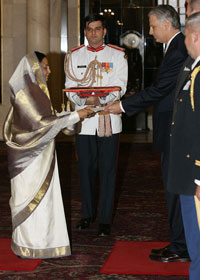 NEW DELHI, Aug 11: Three envoys presented their credentials to the President, Mrs Pratibha Devisingh Patil, at a ceremony at Rashtrapati Bhavan.
 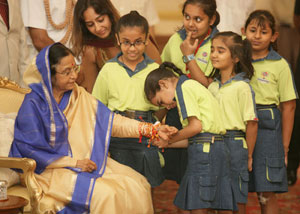 NEW DELHI, Aug 5: It was a joyous occasion for President Pratibha Patil as 105 children from 17 different organisations and schools, one dressed as 'Jhansi ki Rani' and another as Prime Minister Manmohan Singh tied 'rakhi' on her hand on the occasion of Raksha Bandhan.
  CHENNAI, Aug 1: India is expected to achieve self-sufficiency in uranium production to feed its existing nuclear power projects and proposed plants by 2013, Atomic Energy Commission Chairman Anil Kakodkar said today.
 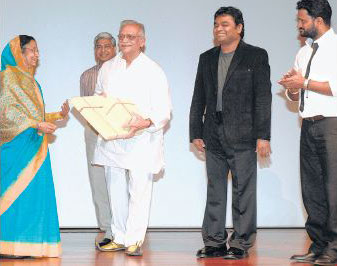 NEW DELHI, Aug 2: President Pratibha Patil, Vice-President Hamid Ansari, music composer A.R. Rahman and lyricist Gulzar on Sunday saw the Oscar-winning movie, Slumdog Millionaire, at the Rashtrapati Bhavan auditorium here.
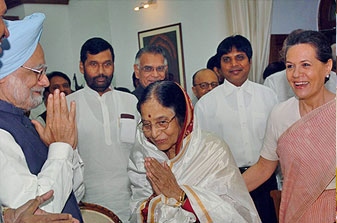 NEW DELHI, July 27: Citizen centric administration and modernization and greening of Rashtrapati Bhawan infrastructure among others have been the hallmark of President Pratibha Devisingh Patil’s first two years in office.
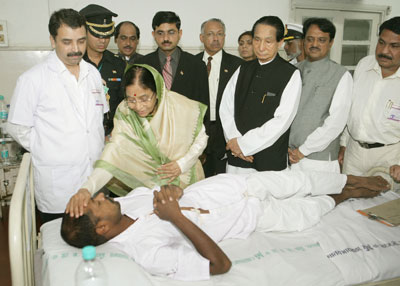 The Conference set-up a Committee to identify strategies for speedier socio-economic development of women. The Committee interalia recommended the establishment of the National Commission for the Empowerment of Women, which has since been accepted and is being set-up.
 People’s aspirations can be met through an administration which is people centric in governance. While interacting with officials of different All India Services and other civil services at various levels, the President has emphasized the urgent need to have a result oriented system of administration wedded to performance, in which the citizen would have confidence and a voice. Speaking to IAS Officers at the Lal Bahadur Shastri National Academy of Administration, Mussoorie the President said transparency and accountability were necessary if benefits of development and welfare schemes were to reach the target groups.
 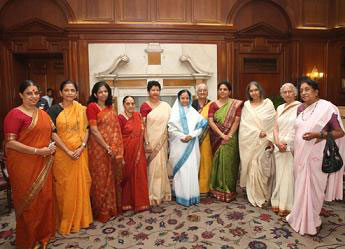 The environment was another key area of focus. The President believes in setting examples through individual contribution. She inspired the residents of the President’s Estate to join in efforts to conserve water, electricity and by pro-active action for using renewable energy sources as well as energy efficient equipment.
 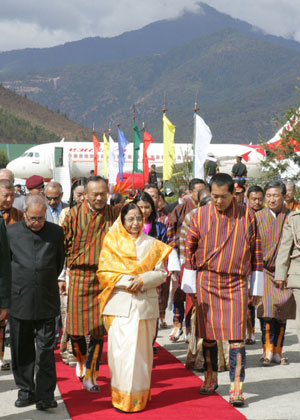 Throughout her second year in office, the President interacted with and encouraged those who battle social evils.
 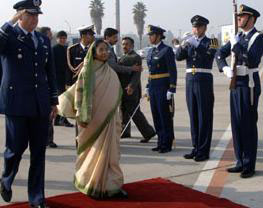 The President undertook overseas visits to the East (Vietnam and Indonesia) and the West (Spain and Poland) during the year. In her interactions during these visits, as well as during her interactions with foreign dignitaries at Rashtrapati Bhavan, she has conveyed India’s keen desire for friendly relations, highlighted issues of concern particularly terrorism and called for the early correction in the composition of international institutions like the UN, the IMF and the World Bank to bring them in tune with current realities.
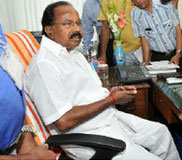 NEW DELHI: Apprehending misuse of Section 377 of the Indian Penal Code (IPC) against homosexuals in the future, Law Minister Veerappa Moily has said the law should not become an instrument of exploitation by authorities.
 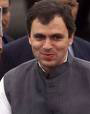 SRINAGAR, July 28: On a day of dramatic developments, Jammu and Kashmir Chief Minister Omar Abdullah on Tuesday resigned after a senior PDP leader alleged in the State Assembly that he was involved in the 2006 sex scandal, a charge dismissed by him as false.
 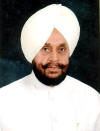 PUDUCHERRY, July 27: Iqbal Singh has been sworn in as the Lt Governor of the Union Territory of Puducherry on Monday.
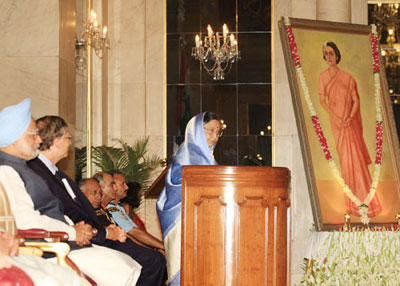 NEW DELHI, July 25: Reminding India that it faces "some of the toughest health problems in the world", Microsoft founder Bill Gates on Saturday urged the country to drastically increase health spending to eliminate the most persisting diseases plaguing its people.
 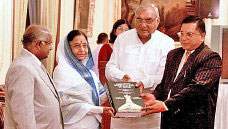 NEW DELHI, July 25: President Pratibha Patil on Thursday called upon the people to rededicate themselves to constitutional ideals and work for building a strong and prosperous nation. The Constitution was the touchstone of our governance, she said.
 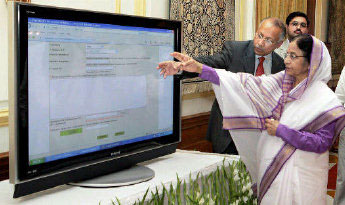 NEW DELHI, July 24: Rashtrapati Bhavan has come further close to “Aam Aadmi” with a little help from technology. President Pratibha Patil launched a helpline portal that will not only allow citizens to register their grievances online but track them to various ministries as well. The portal will allow people to petition the President directly.
 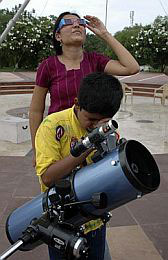 TAREGNA, July 22: Scientists, students and nature enthusiasts prepared Tuesday for the longest total solar eclipse of the 21st century, while millions planned to shutter themselves indoors, giving in to superstitious myths about the phenomenon.
 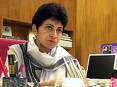 NEW DELHI: Seeking reservation of land for affordable housing and survey of all slums in cities across India, the Centre has asked all state governments and Union Territories to amend town planning and other related laws for this.
 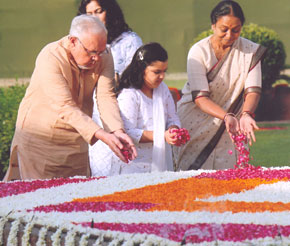 NEW DELHI, July 7: The Vice-President of India and Chairman, Rajya Sabha, Mohd. Hamid Ansari and Lok Sabha Speaker Meira Kumar paid homage to Babu Jagjivan Ram on his 23rd death anniversary on Monday at Samta Sthal here.
 NEW DELHI, July 7: The AICC Ex-Servicemen Department has thanked the UPA Government for allocating Rs 2100 crore for the enhanced pensions of PBOR (Personnel below officer rank) which considerably narrows the gap between pre-2006 and post 2006 pensioners.
 UTTAN, June 27: Huge backlog of cases in the courts is a major issue and the solution lies in changing laws and strengthening judicial institutions, President Pratibha Patil said in Uttan today.
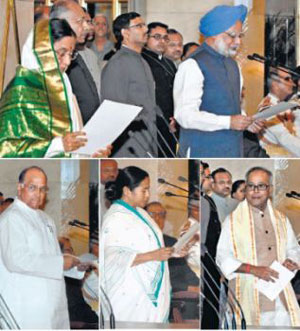 NEW DELHI, May 22: Manmohan Singh was sworn in Prime Minister on Friday evening for a second successive term along with 19 Cabinet colleagues as part of the first phase of government formation. Majority of the new Ministers are from the Congress, with only Sharad Pawar of the Nationalist Congress Party and Mamata Banerjee of the Trinamool Congress making it to the first list.
  NEW DELHI, May 22: Prime Minister Manmohan Singh hoped that Pakistan would cooperate with India on the issue of terrorism but ruled out any immediate plans of talks with the Pakistani leadership.
 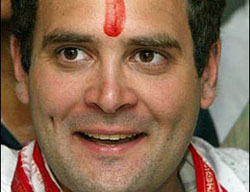 NEW DELHI, May 22: Rahul Gandhi has not agreed to join the Union Cabinet so far but Prime Minister Manmohan Singh has said he has not given up hope of persuading the young leader to do so.
Aviation
| Business | Defence | Foreign
Affairs | Communication | Health
| India | United Nations
India-US
| India-France | Entertainment
| Sports | Photo Gallery |
Tourism | Advertise with Us
| Contact Us
© Noyanika International, 2003-2009. All rights reserved.