|
DGCA asks SpiceJet to refund fare for delayed flight
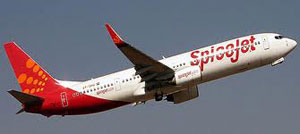 NEW DELHI, July 28: In a first-of-its-kind action, DGCA has directed SpiceJet to refund fare to all passengers of a Mumbai-Delhi flight that was delayed by about five hours last month, according to officials on Monday. NEW DELHI, July 28: In a first-of-its-kind action, DGCA has directed SpiceJet to refund fare to all passengers of a Mumbai-Delhi flight that was delayed by about five hours last month, according to officials on Monday.
The aviation regulator also asked the no-frills airline to refund the money it charged from passengers of this delayed flight by selling food and beverages, instead of offering it free in accordance with the laid-down rules.
The Boeing 737—800 aircraft (VT—SGO), carrying 172 passengers including two infants, suffered engineering problems which led the pilots to abort take off and return to the bay.
Another plane was pressed into service, replacing the 189-seater aircraft, to operate Flight SG—419 on June 16 after a delay of over four-and-a-half hours.
Acting on a complaint of a passenger, the Directorate General of Civil Aviation (DGCA) conducted an investigation and found that the flight was delayed due to “technical problems twice on account of ‘leading edge flap transit light’ and rejected take off due to ‘take off configuration’ warning, the officials said.
The warning flashed on the cockpit flight panel, indicating there would be no air-conditioning through the entire flight after take off. This led to the flight being aborted and the aircraft changed.
The DGCA probe found that during the entire delay at Mumbai, SpiceJet sold food and beverages in the aircraft in violation of rules — Civil Aviation Requirement (CAR) Section 3 — that specify the facilities airlines should provide to passengers affected by the cancellation of or delay in flights for more than two hours.
Responding to the DGCA action, an airline spokesperson said “SpiceJet, like most airlines, serves food on the ground during the delay in cases like this, and we will be responding shortly to the DGCA.” He, however, did not comment on the flight delay.
The officials said the cabin crew as well as an airport manager informed DGCA in their statements that they were “not aware” of the provisions of the applicable CAR.
Following this finding, DGCA directed the airline to provide adequate training to the cabin crew and airport ground handling staff to make them aware of the provisions of CAR and follow them when such situations arose.
During the investigation, the aviation regulator also found “serious engineering issues with aircraft in the fleet of Spicejet” and ordered a special engineering audit by a DGCA team within a fortnight, the officials said.
Air Algerie plane with 116 on board crashes in Mali
ALGIERS, July 24: The wreckage of an Air Algerie plane missing since early Thursday with 116 people on board has been found in Mali near the Burkina Faso border, an army coordinator in Ouagadougou said.
"We have found the Algerian plane. The wreck has been located ... 50 kilometres (30 miles) north of the Burkina Faso border" in the Malian region of Gossi, said General Gilbert Diendiere of the Burkina Faso army.
A witness had earlier reported seeing the plane "falling" in the region of Gossi and the general said they were taking the reports seriously as they matched radar images of the flight path.
Flight AH5017, which originated in Ouagadougou and was bound for Algiers with 51 French nationals aboard, according to Foreign Minister Laurent Fabius, went missing amid reports of heavy storms, company sources and officials said.
It had been presumed to have been lost even before Fench President Francois Hollande went on TV to announce: "Everything leads us to believe that the plane has crashed."
He said the plane's Spanish crew had signalled they were altering course "due to particularly difficult weather conditions".
No link to Russian govt in plane downing MA 17: US
WASHINGTON, July 22: Senior US intelligence officials said on Tuesday that Russia was responsible for "creating the conditions" that led to the shooting down of Malaysia Airlines Flight 17, but they offered no evidence of direct Russian government involvement.
The intelligence officials were cautious in their assessment, noting that while the Russians have been arming separatists in eastern Ukraine, the US had no direct evidence that the missile used to shoot down the passenger jet came from Russia.
The officials briefed reporters Tuesday under ground rules that their names not be used in discussing intelligence related to last week's air disaster, which killed 298 people.
The plane was likely shot down by an SA-11 surface-to-air missile fired by Russian-backed separatists in eastern Ukraine, the intelligence officials said, citing intercepts, satellite photos and social media postings by separatists, some of which have been authenticated by US experts.
But the officials said they did not know who fired the missile or whether any Russian operatives were present at the missile launch. They were not certain that the missile crew was trained in Russia, although they described a stepped-up campaign in recent weeks by Russia to arm and train the rebels, which they say has continued even after the downing of the commercial jetliner.
In terms of who fired the missile, "we don't know a name, we don't know a rank and we're not even 100 percent sure of a nationality," one official said, adding at another point, "There is not going to be a Perry Mason moment here," a reference to a fictional detective who solved mysteries.
White House deputy national security adviser Ben Rhodes said the US was still working to determine whether the missile launch had a "direct link" to Russia, including whether there were Russians on the ground during the attack and the degree to which Russians may have trained the separatists to launch such a strike.
"We do think President Putin and the Russian government bears responsibility for the support they provided to these separatists, the arms they provided to these separatists, the training they provided as well and the general unstable environment in eastern Ukraine," Rhodes said in an interview with CNN.
He added that heavy weaponry continues to flow into Ukraine from Russia following the downing of the plane.
The intelligence officials said the most likely explanation for the downing was that the rebels made a mistake. Separatists previously had shot down 12 Ukrainian military airplanes, the officials said.
The officials made clear they were relying in part on social media postings and videos made public in recent days by the Ukrainian government, even though they have not been able to authenticate all of it. For example, they cited a video of a missile launcher said to have been crossing the Russian border after the launch, appearing to be missing a missile.
But later, under questioning, the officials acknowledged they had not yet verified that the video was exactly what it purported to be.
Despite the fuzziness of some details, however, the intelligence officials said the case that the separatists were responsible for shooting down the plane was solid.
Other scenarios such as that the Ukrainian military shot down the plane_ are implausible, they said. No Ukrainian surface-to-air missile system was in range.
From satellites, sensors and other intelligence gathering, officials said, they know where the missile originated _ in separatist-held territory _ and what its flight path was. But if they possess satellite or other imagery of the missile being fired, they did not release it Tuesday. A graphic they made public depicts their estimation of the missile's flight path with a green line. The jet's flight path was available from air traffic control data.
In the weeks before the plane was shot down, Russia had stepped up its arming and training of the separatists after the Ukrainian government won a string of battlefield victories. The working theory is that the SA-11 missile came from Russia, although the US doesn't have proof of that, the officials said.
US Ambassador to the U.N. Samantha Power said last week that "because of the technical complexity of the SA-11, it is unlikely that the separatists could effectively operate the system without assistance from knowledgeable personnel. Thus, we cannot rule out technical assistance from Russian personnel in operating the systems," she said.
Asked about evidence, one of the senior US intelligence officials said it was conceivable that Russian paramilitary troops are operating in eastern Ukraine, but that there was no direct link from them to the missile launch.
Asked why civilian airline companies were not warned about a possible threat, the officials said they did not know the rebels possessed SA-11 missiles until after the Malaysian airliner was shot down.
Six more airlines to commence operations in India
NEW DELHI, July 22: The Civil Aviation Ministry has cleared the entry of six more airlines in the Indian skies. The No Objection Certificates (NOCs) to six entities include Air One, Premier Air, Zexus Air (all national), Turbo Megha, Air Carnival and Zav Airways (all regional). This is in addition to the Tata-Singapore Airlines joint venture that is likely to start operations by this year-end. These applications have been pending for long. At present India has eight airlines.
The grant of NOC was confirmed by officials but Director-General of Civil Aviation (DGCA) Prabhat Kumar was not available for comment.
Another new airline, AirAsia India, commenced domestic operations last month. Air Pegasus is also likely to get Air Operators Permit, the final nod to start operations, soon.
Air One, which is now into air charter business, wants to be national scheduled airline.
“We have applied for pan-India licence, and if the five years and 20 aircraft rule goes away, then we will fly international as well. We plan to start operations in the first quarter of 2015,” said Alok Sharma, promoter and director, Air One.
Earlier, Alok Sharma was President of Air Sahara before it was acquired by Jet Airways.
At present, India has eight airlines — Air India, Jet Airways, Jet Lite, IndiGo, SpiceJet, Go Air, Air Costa and AirAsia India.
In 2005 three new airlines — Kingfisher Airlines, Go Air and SpiceJet (re-launched) — commenced operations. In 2006, IndiGo joined them offering low fares.
Thus, after nearly a gap of 10 years, India will have several new airlines.
“The current cartelisation of incumbent airlines need to break, and it can only be possible with the entry of new players. During peak season, airlines are charging up to Rs.50,000 for a return ticket to a prime domestic destination. Consumers are being exploited. With the entry of new players, fares will come down by 20-25 per cent,” said Subhash Goyal, President, Indian Association of Tour Operators (IATO) and Chairman of STIC Travel Group.
“Having so many new airlines is excellent from passenger point of view. More airlines and more aircraft will drive growth. There is opportunity and competition will drive growth,” said Sharat Dhall, President, yatra.com, an online travel company.
“In the last two years, air fares have gone up by 20-25 per cent, and this has resulted in a stagnated growth. With the new players, we hope fares will see a correction of 20-25 per cent, which will help the market to revive,” Mr. Dhall said.
 Air India launches direct flights to Moscow Air India launches direct flights to Moscow
By Deepak Arora
NEW DELHI, July 21:
National carrier Air India has launched direct non-stop operations between Delhi and Moscow, the Russian capital and Europe’s second largest city, on July 18, with the B787 Dreamliner aircraft.
Air India is offering attractive promotional fares on this route in both directions.
The non-stop service on the Delhi-Moscow-Delhi sector will operate four days a week on Mondays, Wednesdays, Fridays and Saturdays.
 Flight AI-155 will leave Delhi at 0155 hrs to arrive in Moscow at a very convenient time of 0615 hrs early in the morning. Flight AI-155 will leave Delhi at 0155 hrs to arrive in Moscow at a very convenient time of 0615 hrs early in the morning.
The return flight will leave Moscow at 0820 hrs as AI-154 and reach Delhi in the afternoon at 1530 hrs.
A long-standing need of Indians settled in Russia as well as of Russian locals visiting the Indian sub-continent, has now been met with the resumption of this service, which had been suspended 15 years ago due to operational reasons.
The decision to resume operations came close on the heels of the recent meeting between the Prime Minister of India and the President of Russia.
 To mark the resumption of services, a function was held at Domodedovo International Airport (DME), Moscow, which was attended by the members of the Federal Assembly of Russia, State Duma, Mr Dorokhin Pavel Viktor, Deputy Chairman of the State Duma’s Committee on Industry, Mr P S Raghavan, the Ambassador of India to Russia, and Director of DME Airport Authority, among others. To mark the resumption of services, a function was held at Domodedovo International Airport (DME), Moscow, which was attended by the members of the Federal Assembly of Russia, State Duma, Mr Dorokhin Pavel Viktor, Deputy Chairman of the State Duma’s Committee on Industry, Mr P S Raghavan, the Ambassador of India to Russia, and Director of DME Airport Authority, among others.
Speaking on the occasion, Mr Rohit Nandan, Chairman and Managing Director, Air India said that the new service assumed significance in view of the strong relationship that India and Russia have shared for the last 60 years in tourism, education, industry, culture etc.
He said tThe new service will cater to different segments of air travellers.
 He said pPresently, about 10,000 people travel between the two countries every month including a large number of Government of India officials. He said pPresently, about 10,000 people travel between the two countries every month including a large number of Government of India officials.
The flight will serve Indians travelling to St Petersburg as well as the over 1000 Indian students in Russia.
Moscow is one of the fastest growing tourist destinations in the world and the second most populous city in Europe. Air India is in dialogue with other carriers of Russia to provide services from other cities of Russia to India.
Also, once the Air India service becomes financially stable, Air India will examine connecting other cities in Russia.
 The flight will be a boost to tourism as well. Air India offers convenient connections from its hub in Delhi to places of interest and tourism like the Taj Mahal, the backwaters and beaches on Kerala and Goa, the majestic and memorable sights in Rajasthan, Puri in Orissa and many more such destinations. The flight will be a boost to tourism as well. Air India offers convenient connections from its hub in Delhi to places of interest and tourism like the Taj Mahal, the backwaters and beaches on Kerala and Goa, the majestic and memorable sights in Rajasthan, Puri in Orissa and many more such destinations.
This flight has generated a lot of enthusiasm in the Indian Diaspora in Russia.
Incidentally, on July 11, Air India became the first airline from India to join Star Alliance, the world’s most prestigious consortium of 27 leading international carriers. This gives Air India a huge opportunity to offer several benefits to passengers like seamless transfers, more frequent flyer mileage points, and access to facilities at over 1000 lounges worldwide.
Passengers will further benefit from a wider choice on routes connecting North America, Europe, Asia and Australia via the Indian subcontinent.
Air India pilots avert disaster over New York skies
By Deepak Arora
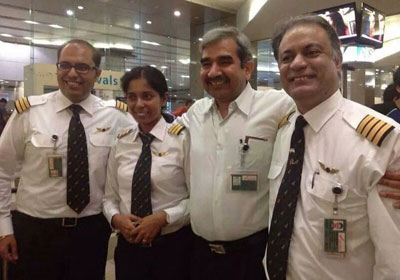 NEW YORK, July 13: Air India pilots averted a major disaster over New York skies on Sunday when the Boeing 777 aircraft engine caught fire on take-off. The pilots -- Captain Gautam Verma and his crew Second Commander Capt Niranjan Singh and First Officers Capt Pankaj Wadhawan and Capt Shilpika Das -- showed tremendous grit and presence of mind when they successfully landed back the aircraft on Newark runway. The handling skills and good cool airmanship displayed by the Pilots was the primary reason of this emergency being converted into just an incident. NEW YORK, July 13: Air India pilots averted a major disaster over New York skies on Sunday when the Boeing 777 aircraft engine caught fire on take-off. The pilots -- Captain Gautam Verma and his crew Second Commander Capt Niranjan Singh and First Officers Capt Pankaj Wadhawan and Capt Shilpika Das -- showed tremendous grit and presence of mind when they successfully landed back the aircraft on Newark runway. The handling skills and good cool airmanship displayed by the Pilots was the primary reason of this emergency being converted into just an incident.
Capt Gautam Verma and his crew displayed airmanship and professional competence of the highest order in handling a most difficult situation competently and successfully.
It was a Sunday evening. The Air India's flight AI-144, a Boeing 777, was ready for a routine flight from Newark to Mumbai with 300 passengers and 15 crew members. The weather in New Jersey was heavy passing showers here and there.
It was a routine departure at about 5 pm for a long 15 to16 hour flight to Mumbai. The aircraft naturally was at its maximum take off weight, as it was fully loaded with the fuel required for this long transcontinental flight.
The take off run was a normal routine one. Immediately on lift off the worst nightmare of a pilot, the loss of an engine at maximum take off weight happened. The left engine caught fire, and at the same time the cockpit engine fire warnings did not function. The passengers and crew sitting on the left side were horrified to see flames from the left engine. Other airplanes and Air Traffic Control warned the Pilot of the engine being on fire. The Pilots till that time unaware of the engine fire, checked up and carried out the emergency drills as per the required procedures. The B-777 is a twin-engine aircraft, and loosing one engine (50 per cent power) at the maximum account weight on take off is a nightmare for the best of Pilots and in the best of circumstances.
In such an emergency, the Pilots will first think of making the aircraft light, which is done by dumping the extra fuel. For this Pilots need to climb up to a designated minimum height and dump the fuel in areas already specified by the local airport authorities. The time to reach the dumping height and area could have taken 15 to 30 minutes, because of heavy weight and loss of an engine. The actual fuel dump can take another 30 to 40 minutes, depending on the amount of fuel to be dumped out. The exercise of dumping fuel to lighten the aircraft would have taken any thing around 60 to 70 minutes, a valuable time they did not have.
The Pilots had a serious emergency of an engine having been on fire at hand. This could have caused secondary as yet unknown failures. They had to take an instant decision, which they rightfully took to land as soon as possible, rather than use up precious time to try and dump fuel.
The immediate landing back, of course had its own problems -- the very high landing weight. This in turn will need the aircraft to be landed at a much higher speed. The immediate anxiety of the Pilots in this case would have been three fold. Firstly, will the airplane stop in the available runway length, landing at about 200 Knots (which is 370 kms/hr), and the minimum speed required at the weight. Secondly, will the landing gear take the load of landing at such a high speed and weight (85 tonnes more than the maximum design landing weight). Thirdly, they were flying only on one engine, which has its own problems of aircraft handling and control.
The Pilots averted a major emergency into becoming a possible catastrophe by landing the aircraft successfully back. The handling skills and good cool airmanship displayed by the Pilots was the primary reason of this emergency being converted into just an incident.
Air India joins Star Alliance
By Deepak Arora
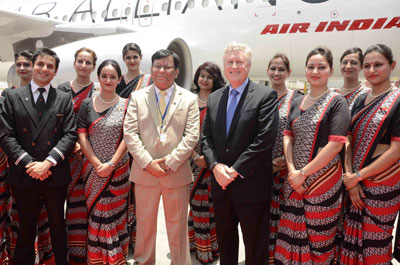 NEW DELHI, July 11: Air India has scripted a new chapter in India’s aviation history by becoming the first airline from India to be inducted into the world’s leading global airline consortium, Star Alliance. This opens India's national carrier’s strong domestic network in the fifth largest aviation market to Star Alliance customers worldwide. NEW DELHI, July 11: Air India has scripted a new chapter in India’s aviation history by becoming the first airline from India to be inducted into the world’s leading global airline consortium, Star Alliance. This opens India's national carrier’s strong domestic network in the fifth largest aviation market to Star Alliance customers worldwide.
Air India now offers all Star Alliance customer benefits to the more than 600 million passengers who travel on the network every year and Air India’s customers enjoy the same benefits when they travel on any of the other 26 member airlines across the network.
“This is an important day for us. We have said for many years that we needed a strong home carrier in the Indian market and by welcoming Air India to our Star Alliance family, we have achieved this goal” said Star Alliance Chief Executive Mark Schwab.
“We know that the ‘new’ Air India is looking forward to providing the Star Alliance customer benefits to many more travelers," he added.
Rohit Nandan, Air India Chairman and Managing Director said, “Air India is proud to be a member of this prestigious airline Alliance. From today, we open up a completely different world for our passengers, who can now travel to over 1,300 destinations right across the network and enjoy world-class service, better connectivity and seamless travel wherever they go."
Air India adds a total of 400 daily flights and over 40 new destinations in India to the Alliance network. The biggest growth will come from its home market which has up to now been served by 13 Star Alliance members flying to 10 destinations and holding a 13% market share.
As a result of the addition of Air India, the Alliance’s market share in India has risen to 30%.
Globally, passengers further benefit from a wider choice on routes connecting North America, Europe, Asia and Australia via the Indian Subcontinent. In total the Star Alliance network counts 27 member airlines, offering more than 18,500 daily flights serving 1,316 destinations in 192 countries.
Air India now offers through check-in to the final destination for connecting flights operated by any Star Alliance member airline for both passengers and baggage, hence providing seamless travel. Passengers benefit as they do not need to collect their boarding passes for connecting flights at the transfer airports and, where permitted by local customs regulations, baggage will also be sent through to the final destinations.
Reciprocal frequent flyer benefits between Air India’s Flying Returns programme and those of the existing member carries are now activated. These provide customers with more options in earning and redeeming, upgrading and obtaining Star Alliance Gold status.
Flying Returns members who hold Maharajah Club or Golden Edge Club status now automatically also have Star Alliance Gold status, giving them access to more than 1,000 lounges across the global network. Gold status customers can also check in at specially designated counters, are offered an increased baggage allowance and receive priority boarding and baggage delivery. All these benefits are also provided by Air India to customers holding Star Alliance Gold status in other frequent flyer programmes.
Air India’s network comprises 50 destinations in India and 33 internationally, serving 23 countries. The addition of over 40 unique destinations domestically offers passengers excellent connectivity between major business centres. New destinations include the industrial hubs of Aurangabad and Vadadora; Indore, which is home to many pharmaceutical producers; textiles and engineering centre Coimbatore and Jamnagar, India’s “Oil City”. Air India also serves popular tourist destinations such as Goa, Kochi, Maduria and Jaipur.
As part of its Star Alliance membership, Air India now participates in several of the Alliance’s fare products and business solutions.
For the business travel sector, Air India flights can be included in Star Alliance Corporate Plus agreements, which are aimed at large multinational companies. For the Conventions and Meetings market, Air India will now offer Star Alliance Conventions Plus and Meetings Plus,the dedicated products for the meetings and conventions industry that would be updated during the current month. Book & Fly, Meetings Plus and Conventions Plus will be updated to include all Air India flights during the month of July.
Air India also boosts the attractiveness of the Alliance’s most popular fare product, the Star Alliance Round the World Fare (RTW). Available in First, Business and Economy Class, this fare allows customers to travel around the globe making use of the 27 member airline network.
Customers can now make use of all Air India flights when booking their RTW fare, either through the Book & Fly online booking tool, via an airline or through a travel agency.
Some of Air India’s flights will also be included in the Star Alliance Circle Pacific Fare which allows circular round-trips covering the Asian countries bordering the Pacific, the main international hub airports on the Pacific Coast of Canada and the USA, as well as the South Pacific (mainly Australia and New Zealand).
And finally, Air India is now included in the Asia Airpass alongside all other Asia based Star Alliance member airlines. This special coupon and mileage based fare is available to all overseas visitors to the region travelling on a Star Alliance member airline and allows customers to travel around Asia, selecting from a total of 277 destinations.
Air India occupies a special place in the global and Indian aviation scenario. It pioneered aviation in India and its history is synonymous with the history of civil aviation in India. Air India is not a mere airline that transports passengers, baggage and cargo. It is a multi-faceted organization. The aviation infrastructure it has created over the years is a testimony of its contribution. Apart from servicing of all its aircraft in-house with its own engineering facilities, Air India also undertakes ground handling services of many airlines in many cities in India.
Air India has grown to become a mega international airline with a network of 33 destinations across the USA, Europe, Canada, Far-East and South-East Asia and the Gulf. The airline’s domestic network covers more than 40 destinations, including far-flung areas of the North-East, Ladakh, Andaman and Nicobar Islands. Air India, today, flies one of the youngest, state-of-the-art, fleet of aircraft comprising a mix of the wide-body Boeing B777s, B747s, Airbus A330s, latest acquisition- the B787 Dreamliner and the narrow body Airbus A321s, A320s and A319 aircraft.
The Star Alliance network was established in 1997 as the first truly global airline alliance to offer worldwide reach, recognition and seamless service to the international traveller. Its acceptance by the market has been recognized by numerous awards, including the Air Transport World Market Leadership Award and Best Airline Alliance by both Business Traveller Magazine and Skytrax.
The member airlines are: Adria Airways, Aegean Airlines, Air Canada, Air China, Air India, Air New Zealand, ANA, Asiana Airlines, Austrian, Avianca, Brussels Airlines, Copa Airlines, Croatia Airlines, EGYPTAIR, Ethiopian Airlines, EVA Air, LOT Polish Airlines, Lufthansa, Scandinavian Airlines, Shenzhen Airlines, Singapore Airlines, South African Airways, SWISS, TAP Portugal, Turkish Airlines, THAI and United. The integration of Avianca Brasil is currently in progress. Overall, the Star Alliance network currently offers more than 18,500 daily flights to 1316 destinations in 192 countries.
Boeing ahead of Airbus in plane orders
 PARIS, July 4: US aerospace group Boeing is leading over its European rival Airbus in booking new plane orders in the first half of the year, figures released here on Friday by Airbus showed. PARIS, July 4: US aerospace group Boeing is leading over its European rival Airbus in booking new plane orders in the first half of the year, figures released here on Friday by Airbus showed.
Boeing had reported a net 499 new orders between January 1 and June 30, including 54 cancellations.
Airbus meanwhile suffered 225 cancellations, limiting it to 290 net aircraft orders in the six-month period.
Boeing was slightly ahead in terms of deliveries as well, with 342 new planes flown to clients, compared with 303 for Airbus.
The two groups dominate the global market for passenger airliners and their orders give a good idea of how the civil aviation sector is faring.
In May, Airbus commercial chief John Leahy had forecast that Airbus and Boeing would finish the year neck-and-neck.
He told media at the ILA Berlin Air Show: "I think we'll end up this year even, maybe Airbus even slightly ahead."
AirAsia CEO Tony Fernandes received worst reception in India
BANGALORE, July 4: AirAsia chief executive Tony Fernandes feels that he received the worst negative reception in any South East Asian market when his airline entered India.
"I found the reaction of the airline industry quite hostile and quite counterproductive, something I have never experienced before," said Fernandes, who has steered the budget airline from carrying 200,000 passengers per year, 13-years ago, to 51 million passengers at present.
He said his lawyer in India was the happiest man, because he made so much money from all the court cases that were filed against AirAsia India by its peers over the last 14 months.
"When an airline comes into Malaysia, I compete, I don't try and block them because it's a waste of energy. Put people first and let people decide. The days of monopoly and cartels have gone," said Fernandes.
AirAsia India began operations last month with two routes -- connecting Bangalore to Chennai and Goa. Fernandes said that the company would add six more aircraft to its current fleet of one aircraft, by the end of this year. The airline has revised its growth plans. It previously planned to operate to nine cities by the end of this year, now that plan is for 13 cities, including in the North and North East markets.
Fernandes added that the company has plans to fly to international destinations such as the Gulf region, Africa, South East Asia, and island nations like the Maldives. However, this is subject to the government revising the existing 5/20 rule, which allows Indian airlines to fly abroad only after completing five years of operations and having a minimum fleet of twenty aircraft.
"If the tax regime for the airline industry changes, in particular on ATF (aircraft turbine fuel), and if there is a revision to the 5/20 rule, then India can grow faster than Malaysia. AirAsia India can be one of the biggest companies for us and we could have 500 aircraft here," said Fernandes.
AirAsia India is a joint venture between Tata Sons, Telestra Tradeplace and AirAsia, which holds 49% stake. Fernandes, along with Ratan Tata, chairman emeritus of Tata Sons, was taking the AirAsia India flight from Bangalore to Goa on Thursday.
The 50-year-old Malaysian-Indian stressed that he wanted to bring 'democracy in air travel' and that the Indian aviation regulator, Directorate General of Civil Aviation (DGCA), must not restrict innovative business practices. Last year DGCA had allowed airlines to 'unbundle fares' — giving them an option to levy charges for seats and other frills -- but clamped down on AirAsia India when it asked passengers to pay for check-in baggage.
"That's a really big step backwards, but I'm sure it will change soon. You come to the airport with six bags and I come with none, I'm subsidizing you because the airline needs people to carry your bags and has to pay more for fuel," Fernandes said. |


