Ambassador Gurjit asks Indonesians to invest in India
By Deepak Arora
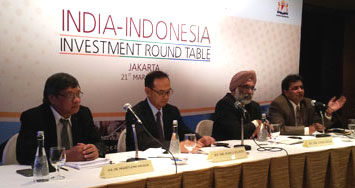 JAKARTA, March 22: Indian Ambassador Gurjit Singh has exhorted the Indonesian companies to invest in India, adding that Indian economic partnership including investment in Indonesia has the potential to grow from the present US$20 billion to US$ 100 billion. JAKARTA, March 22: Indian Ambassador Gurjit Singh has exhorted the Indonesian companies to invest in India, adding that Indian economic partnership including investment in Indonesia has the potential to grow from the present US$20 billion to US$ 100 billion.
Addressing the India-Indonesia Investment Roundtable, organized jointly with KADIN Indonesia and INVEST INDIA, he said that there are abundant opportunities for Indonesian companies to invest in India. He further said that Indonesian companies especially in the food processing and construction sector have strength and capability to invest in India.
Ambassador Gurjit Singh called upon increasing B2B engagement for enhancing bilateral business and investment cooperation which would lead to transfer of technology. He said that while there is need for more manufacturing units for inclusive development and creation of employment opportunities, this would require human resource and capacity development. Citing success stories of Indian joint ventures in Indonesia, he said that they have followed a model which generates employment and contributes to exports.
Promising to work together with Indonesia, he said several initiatives are needed by Indonesia for enhanced bilateral economic engagement, the most important being the initiation of CECA consultations. Other priorities should include more B2B engagement, highlight success stories, create level playing field, create dispute settlement mechanism and look for investment opportunities in India. He also hoped for an early realization of direct flight between the two countries which will go a long way in increased private sector interaction.
Mr. Suryo Sulisto, KADIN Chairman, while mentioning about excellent relations between the two countries, said that Indonesia can learn from strong industrial sector in India and welcomed engagement with companies and universities that might facilitate technological cooperation, scientific research and production of sophisticated equipment and technologies. He added that the focus sector of the Roundtable i.e. infrastructure, food processing and automotive components, are all key sectors in Indonesia and encouraged strong B2B partnerships.
The Investment Roundtable was also attended by Dr. Prasetijono Widjojo, Deputy Minister for Economic Affairs in the State Ministry of National Development Planning (BAPPENAS). He shared the medium term development plan for 2010-2014 which has 14 national development priorities, including improvement of investment and business climate. He said that as Indonesia is very much concerned with increasing investment to sustain economic growth and increasing distribution of investment across regions to reduce inequality.
The Investment Roundtable showcased immense potential for investment in India and sought more investments from Indonesia. The Indian Business Delegation presented opportunities for investment and collaboration for Indonesian companies in the food processing sector, especially in the food parks and in the auto components space. The Roundtable also discussed opportunities for collaboration in the infrastructure sector.
The Investment Roundtable elaborated investor-friendly policies of the Government of India and provided a platform for mutually beneficial interactive session with Indonesian business community.
An 11-member Business Delegation led by INVEST INDIA is in Indonesia and took part in the Investment Roundtable which was attended by more than 100 businessmen from Indonesia. Major Indian business groups like IL&FS and GMR are part of the delegation along with Automotive Components Manufacturers Association and Karnataka State.
During their visit to Jakarta, the Indian Business Delegation also interacted with senior officials of the Indonesian Ministry of Trade and with researchers in ERIA. The delegation also made a field trip to the Indofood factory.
Rahul Gandhi to address CII meet
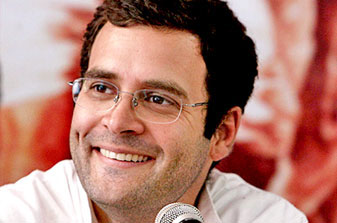 NEW DELHI, March 30: The Congress Vice President, Mr Rahul Gandhi, will address the two-day Annual General Meeting and National Conference of Confederation of Indian Industry (CII) with focus on imperatives of growth, security and governance for India. NEW DELHI, March 30: The Congress Vice President, Mr Rahul Gandhi, will address the two-day Annual General Meeting and National Conference of Confederation of Indian Industry (CII) with focus on imperatives of growth, security and governance for India.
The two-day event would have a galaxy of speakers deliberating on a range of issues that are of importance to India and Indian Industry at the present moment. Dr Manmohan Singh, Prime Minister of India, will inaugurate the National Conference which will bring together Union Cabinet Ministers, Chief Ministers, key policy makers, Government functionaries, strategic thinkers, industry leaders and media.
Announcing this, Mr Chandrajit Banerjee, Director General, CII revealed that the theme for this year’s Conference is ‘India of Tomorrow: Imperatives of Growth, Security and Governance’. “The theme has been designed keeping in mind the great need for focusing on issues where industry can play a greater role in nation building and creating an enabling business environment,” Mr Banerjee said.
The CII Release highlighted that Day 1 of the high-profile National Conference will feature discussion on key issues including future of industrialization, overcoming the challenges of governance, enforcement and implementation; and Indian economic reforms vis-à-vis the world. With the highpoint of the day being the inauguration and address by the Prime Minister, the Conference is slated to witness a packed house, with a galaxy of erudite speakers to follow.
Mr Anand Sharma, Minister of Commerce & Industry and Textiles will share his perspective on industrialization while Mr Kapil Sibal, Minister of Communications & Information Technology will deliberate on the challenges of governance, said the CII release. Professor K V Thomas, Minister of State (I/C) for Consumer Affairs, Food and Public Distribution would lead the discussions on India’s food security.
The States and the impact of economic reforms would also be under discussion with Dr Raman Singh, Chief Minister of Chhattisgarh and noted economists like Dr Surjit Bhalla and Dr Janmejaya Sinha. Key economic Secretaries to the Government of India, led by Mr Ajit Seth, Cabinet Secretary would present their perspective on the issue of implementation, which is often considered to be an area of challenge for India.
A special plenary session will kick-off the deliberations on Day 2 with Indian National Congress Vice President, Mr Rahul Gandhi. This will be followed by discussion on topics like role of the public sector with Mr Praful Patel, Minister for Heavy Industries and Public Enterprises and possible alignment of economics and politics by luminaries like Dr Montek Singh Ahluwalia, Deputy Chairman, Planning Commission, Mrs Sheila Dikshit, Chief Minister of NCT of Delhi, Mr Bhupinder Singh Hooda, Chief Minister of Haryana and Mr Ravi Shankar Prasad, Deputy Leader of BJP Parliamentary Party in Rajya Sabha and Chief Spokesperson, BJP.
The power-packed deliberations will befittingly be concluded with a dialogue with Mr Arun Jaitley, Leader of the Opposition in Rajya Sabha and Member of Parliament, Bharatiya Janata Party, who would be delivering the valedictory address.
The CII release said that while stalwarts like Dr Sam Pitroda, Chairman, National Innovation Council; Mr Arun Maira, Member, Planning Commission; Mr Harish Salve, Senior Supreme Court Counse would address the Conference, the audience will also have an opportunity to understand the viewpoints of young MPs like Mr Manickam Tagore, Mr Tarun Vijay, Mr B J Panda and debutantes like Mr Kavin Bharti Mittal, Head of Strategy/New Product Development, Bharti Softbank Holdings Pte. Ltd. Key policy makers, thought leaders, corporate and media leaders would participate in the delberations, said the CII release.
The Annual Session being a much awaited flagship event of CII, over 1500 participants from the industry across the country are expected to attend the Conference.
R K Dubey inaugurates 19 branches of South Malabar Gramin Bank
By Deepak Arora
 MALAPPURAM, March 27: Mr R K Dubey, Chairman and Managing Director, Canara Bank, inaugurated 19 branches and 10 ATMs of South Malabar Gramin Bank by way of soft launch here on Wednesday at Malappuram. Mr Dubey also presided over the Customers’ Meet organized by South Malabar Gramin Bank. MALAPPURAM, March 27: Mr R K Dubey, Chairman and Managing Director, Canara Bank, inaugurated 19 branches and 10 ATMs of South Malabar Gramin Bank by way of soft launch here on Wednesday at Malappuram. Mr Dubey also presided over the Customers’ Meet organized by South Malabar Gramin Bank.
On this occasion, he launched the following schemes of SMGB:
In-built OD facility in Basic Savings Bank A/cs; Micro insurance scheme for SHG members; Financial Literacy Centres in three blocks; and Tie-up arrangements for vehicle loans with M/s Maruthi Suzuki India ltd.
In this Mega event, the Chairman handed over sanction letters to 200 Self Help Groups.
Also present on the occasion were Mr K S Prabhakara Rao, General Manager, Head Office, Bangalore, Mr K R Balachandran, Deputy General Manager, Circle office, Calicut and Mr K V Shaji, Managing Director of South Malabar Gramin Bank.
South Malabar Gramin Bank is active partner in Economic development of the operational area by providing credit support to agriculture, SME, Education, Housing loans etc. Bank is already extending Tech products like RTGS/NEFT, SMS alerts to the customers. Bank has earned a household name in the area and requested the people to support the Bank.
During his interaction with the customers, Mr Dubey assured the customers that the bank will be offering new products for all the customers, ATM cards, RuPay Kisan Credit Cards, more thrust on Educational and Retail loans and shall consider the rephasement of the loans in genuine cases. Bank has been extending educational loans liberally to the needy students. However due to increase in the delinquency rate in the recent days, he appealed to the customers to repay the loans promptly.
Canara CMD Dubey discusses bank's expansion with Maharashtra Chief Minister Chavan
 MUMBAI, March 25: MUMBAI, March 25:
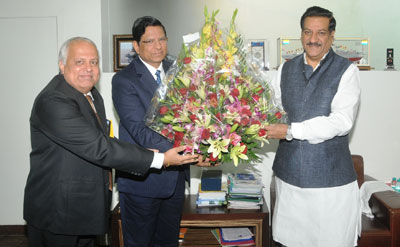
Canara Bank's Chairman & Managing Director R.K.Dubey called on the Maharashtra Chief Minister Prithviraj Chavan here on Friday.
Mr Dubey discussed with the Chief Minister, Mr Chavan, issues regarding expansion of Canara Bank Branches in Maharashtra.
Accompanying him were K. Balachandra Rao, General Manager of Canara Bank, Mumbai Circle Office.
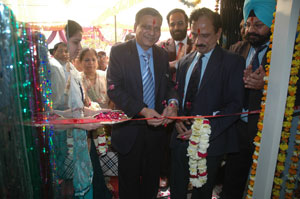 A K Gupta inaugurates Canara Bank branch in Amritsar A K Gupta inaugurates Canara Bank branch in Amritsar
AMRITSAR, March 25:
Mr A K Gupta, Executive Director of Canara Bank, inaugurated the Verka branch of the bank at Amritsar on Monday.
The present on the occasion were Mr.R. Madhusudhan, General Manager of the Chandigarh Circle.
This is the 3702nd Branch of Canra Bank.
Education a tool for inclusive growth in a Knowledge economy: Hooda
By Deepak Arora
NEW DELHI, March 25: The Haryana Chief Minister, Mr Bhupinder Hooda, has said that the share that the lowest strata of the society gets from growth and development in a state, indicates the level of governance.
Addressing the Confederation of Indian Industry (CII) Northern Region's Conference on ‘Driving Growth of the North: Good Governance, Sustainability & Social Inclusivity’ alongside its Annual Regional Meeting here on Monday, Mr Hooda said good Governance emerged as a vital link for economic growth, sustainability and social inclusivity.
The Chief Minister added that Haryana has done exceedingly well on the four key development indicators ie Per Capita Investment, Per Capita Income, Per Capita expenditures and resource mobilization.
Elaborating on the importance of education in the knowledge economy of today, Mr Hooda said that education can be an important tool for empowerment and inclusive growth.
He further elaborated on his plans of making Haryana a global education hub. He also released ‘Endeavour’, a compendium of CII’s Affirmative Action initiatives in Northern Region.
Lack of trust in the institutions of the country is making the process of economic reforms more cumbersome, said Mr Arun Maira, Member, Planning Commission, Government of India. The focus should be on reforming the institutions, as else it could impact the India growth story. This in turn could lead to social unrest in the long run. Citizens should be part of the governance reform process, he added.
Focus on capacity building of leadership and strengthening the institutions is critical to improving the governance levels, said Mr Jayant Chaudhary, Member of Parliament – Lok Sabha. The need of the hour is to build consensus among the political parties of the country and reforming the delivery institutions, he added.
Mr R Sri Kumar, Vigilance Commissioner, Government of India said that in the democracy, public interest is supreme and participation of the concerned stakeholders is critical. He called for proactive, predictive and participative vigilance in place of preventive vigilance. Citizen empowerment programme like VIGEYE may help in checking the corruption level, he added.
Emphasizing on the importance of good governance, Mr Ajay S Shriram, Vice President, CII & Chairman & Senior Managing Director, DCM Shriram Consolidated Ltd said that simplification of procedures, speedy and timely decision making process, capacity building in executing, better coordination amongst the political parties and centre – state coordination are key to reforming our governance structure.
Addressing the session, Mr Sunil Kant Munjal, Chairman, Hero Corporate Service Ltd, said that with one million people entering the workforce every month, it is important to provide gainful employment and also appropriate education, skills and training to the youth.
Appreciating the Government’s National Manufacturing policy, Mr Munjal said that going forward the onus of providing additional employment and livelihood opportunities will lie on the manufacturing sector, and hence the policy should be implemented in a mission mode.
Dwelling on environmental sustainability Mr Harpal Singh, Chairman, Nanhi Chhaan Foundation said that often products and services are priced at less than the ecological cost, and the poor often end up paying for this gap. Therefore the accounting for sustainability needs to be explored. Highlighting the issues of gender imbalance, Mr Singh said that the sex ratio which has declined from 980 at independence to 914 is a great cause of concern. India cannot achieve its development goals without leveraging the potential of half of its human capital – its women.
Mr Shekhar Gupta, Editor-in-Chief, The Indian Express emphasized that sustainability and social inclusivity need to go hand in hand. Addressing the issue of whether there was a tradeoff between enhancing efficiency and generating employment, he summed up that efficiency leads to growth which leads to prosperity, which in turn leads to further employment creation.
India has made its mark in the information technology sector, and IT should be increasingly leveraged to make our governance process transparent and accountable said Mr Malvinder Mohan Singh, Chairman, CII Northern Region & Executive Chairman, Fortis Healthcare Ltd while addressing the delegates at the Annual Conference.
He emphasized on good governance as a necessary condition for economic growth and sustainable development and a catalyst for achieving social inclusivity.
Mr Jayant Davar, Deputy Chairman, CII Northern Region and Co-Chairman & Managing Director, Sandhar Technologies Ltd pointed out that economic growth which does not suitably address ecological issues is no longer a sustainable growth model. He pointed out that studies have shown that a 4% increase in global temperature could negatively impact the GDP by 1.5-5%, it could even be as high as 10% in some of the developing economies. He emphasized on the need for focusing on renewable energy, low carbon economy and water conservation.
The deliberations brought out the specific road map of key drivers to achieve growth and development in northern region. These include focus on good governance, gender equality, environment, green and clean growth, civil society & education.
Jayant Davar is New Chief of CII Northern Region; Zubin Irani takes over as Deputy Chairman
NEW DELHI, March 25: Mr Jayant Davar has been elected as the new Chairman of Confederation of Indian Industry (CII), Northern Region for the year 2013-14, while Mr Zubin Irani has been elected as the Deputy Chairman.
Mr Davar is the founder and currently the Co-Chairman & Managing Director of Sandhar Technologies Ltd and Mr Irani is the Senior Managing Director-Commercial Companies of United Technologies India Private Limited.
“CII NR’s theme for the year would be ‘Reviving Growth in North - Present & Future’. CII’s endeavours would primarily focus on accelerating economic growth by attracting investments, building Brand North, state level policy reforms, leveraging sectoral competencies and strong societal connect in the region”, shared Mr Davar.
“NR needs a holistic approach to achieve long term sustainability by special focus on Innovation, Transformation, Inclusion and positive governance”, Mr Davar further highlighted.
Mr Davar is a Mechanical Engineer and alumnus of Harvard Business School. Presently Mr Davar is associated with many distinguished organizations. He is a Governing Council Member – National Testing and R&D Infrastructure Project (NATRIP), Govt. of India; Governing Council Member of Innovation Council, Government of Haryana; Founding Member of Automotive Skills Development Council, Government of India; Advisory Committee of Fraunhofer, Germany; Member - CII National Council and Member of CII National Committees for Public Policy, Affirmative Action & Trade Fairs; and Chief Mentor – YBLF Committee, ACMA.
He has also served as Chairman of Regional Committee on Manufacturing Competitiveness, CII NR; Chairman, CII Haryana State Council; President, Automotive Component Manufacturers Association, ACMA and Chairman – Globalization & Trade Fairs Committee, ACMA.
Mr Davar’s company Sandhar Technologies Ltd manufactures a range of auto components and operates out of 3 countries and 27 plant locations. Since its inception in 1985, Sandhar has grown to be a medium sized auto component supplier to most of the Automotive OEM’s and Tier 1 suppliers. The company employs about 6,000 people with the gross sales revenue of US $ 300 million in 2012-13.
Mr Zubin Irani, the newly elected Deputy Chairman of CII NR is the Senior Managing Director-Commercial Companies, United Technologies India Private Limited, which owns Carrier India as part of UTC Climate Controls and Security and Otis Elevators. UTC was ranked 37th on the 2010 Fortune 1000 List of America's Largest Corporations.
Mr Irani is responsible for developing and leading strategies to accelerate growth of UTC’s businesses in India. Earlier Mr Irani had joined Carrier Corporations’ Asia Pacific Office, Singapore in 2005 as Director-Marketing, Product Management and Strategy. He moved to Carrier India as Managing Director in March 2006 where he was responsible for Carrier’s heating, cooling and refrigeration business segments in India. During his 4 year tenure, with Carrier, Mr Irani delivered exceptional growth making Carrier the leader in the commercial HVAC segment.
Prior to joining Carrier, Mr Irani had worked for 6 years with McKinsey and Co, a leading global consulting firm, in the US, Europe and India as an Associate Principal managing growth strategies and transformation programs for many large global Fortune 500 companies. He is an alumnus of Massachusetts Institute of Technology (MIT) and B.Tech from the Indian Institute of Technology (IIT), Kanpur.
Mr Irani has been actively involved with CII and has served on the National and NR Councils of CII. He has led the CII Delhi State Council, Power & Water Committee & Manufacturing Committee of CII NR. He is also the current chair for the Energy, Co-operation Program (ECP) which has been jointly set up by the US and Indian governments to promote knowledge building and sponsor projects in the areas of renewable energy, smart grids and energy efficiency. He also serves on the boards/ executive committees of UTC India, American Chamber of Commerce (AMCHAM) India and India Green Building Council (IGBC).
FICCI, TAITRA sign Carnet Protocol
By Deepak Arora
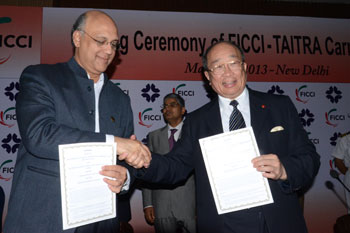 NEW DELHI, March 20: Mr Sheu, Yu-Jer, Deputy Minister of Finance, Government of Taiwan, has said that trade between India and Taiwan is expected to grow rapidly in the years to come. NEW DELHI, March 20: Mr Sheu, Yu-Jer, Deputy Minister of Finance, Government of Taiwan, has said that trade between India and Taiwan is expected to grow rapidly in the years to come.
He was speaking at a function held here on Wednesday to sign the FICCI – TAITRA Carnet Protocol to facilitate temporary duty free admission of goods and exhibits between India and Taiwan. The agreement was signed between FICCI and Taiwan External Trade Development Council.
Earlier, Mr Sidharth Birla, Senior Vice President, FICCI, in his welcome address said that trade between India and Taiwan has increased rapidly. In 2011-2012 it stood at U.S $ 8.54 Billion.
With the signing of the agreement the growth is expected to receive a further boost.
It includes Indian exports to Taiwan at US$ 3.35 billion dollars and imports from Taiwan at US$ 5.12 billion dollars.
 In a bid to facilitate duty free temporary admission of goods and exhibits between India and Taiwan, the Federation of Indian Chambers of Commerce and Industry (FICCI) and the Taiwan External Trade Development Council (TAITRA) signed a FICCI-TAITRA Carnet Protocol similar to the ATA Carnet backed by an agreement between India-Taipei Association (ITA), Taipei and Taipei Economic and Cultural Centre (TECC), India. In a bid to facilitate duty free temporary admission of goods and exhibits between India and Taiwan, the Federation of Indian Chambers of Commerce and Industry (FICCI) and the Taiwan External Trade Development Council (TAITRA) signed a FICCI-TAITRA Carnet Protocol similar to the ATA Carnet backed by an agreement between India-Taipei Association (ITA), Taipei and Taipei Economic and Cultural Centre (TECC), India.
The FICCI-TAITRA Carnet Protocol was signed on behalf of FICCI by Mr Sidharth Birla, Senior Vice President, FICCI, and on behalf of TAITRA by Mr Chao, Yuen-Chuan, President & CEO, TAITRA.
In terms of the FICCI-TAITRA Carnet Protocol, FICCI in India and TAITRA in Taiwan will facilitate the grant of ATA Carnet like document to Indian and Taiwanese businessmen for temporary movement of goods/exhibits for exhibitions/fairs in India and Taiwan.
ATA Carnet is an international uniform Customs document issued in 72 countries including India, which are parties to the Customs Convention on ATA Carnet. The ATA Carnet permits duty free temporary admission of goods into a member country without the need to raise customs bond, payment of duty and fulfillment of other customs formalities in one or a number of foreign countries.
The ATA Carnet System is administered by ICC-WCF World ATA Carnet Council (WATAC), Paris in cooperation with the World Customs Organization (WCO). FICCI has been appointed as the National Issuing and Guaranteeing Association for the operation of ATA Carnet System in India.
The goods being imported from Taiwan are not presently covered under the ATA Carnet System as Taiwan is not a signatory to the Convention. However, Taiwan has signed similar carnet protocol with more than 35 countries including United States, Canada, Japan, Singapore, Australia, Malaysia, South Africa, the EU, etc. These protocols grant duty free admissions for exhibition goods which are brought for exhibition purposes on a temporary basis.
The FICCI-TAITRA Carnet Protocol will pave the way to enhance the bilateral trade co-operation between India and Taiwan through the use of Carnets.
Chidambaram opens new Canara bank branch in Tamil Nadu
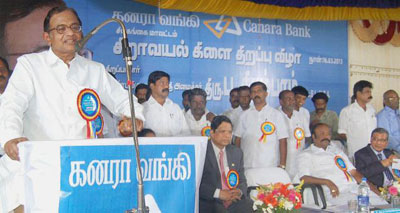 SIVAGANGAI, March 16: The Union Finance Minister, Mr P Chidambaram, declared open a new Canara Bank Branch at Siravayal in Sivagangai district of Tamil Nadu here on Saturday in the presence of Mr R.K.Dubey, Chairman and Managing Director of the Bank, Mr A. K. Gupta, Executive Director, and Mr G. V. Manimaran, Officer Director. This is the 146th branch in Madurai Circle and 3697th branch of the Bank. SIVAGANGAI, March 16: The Union Finance Minister, Mr P Chidambaram, declared open a new Canara Bank Branch at Siravayal in Sivagangai district of Tamil Nadu here on Saturday in the presence of Mr R.K.Dubey, Chairman and Managing Director of the Bank, Mr A. K. Gupta, Executive Director, and Mr G. V. Manimaran, Officer Director. This is the 146th branch in Madurai Circle and 3697th branch of the Bank.
After inaugurating the branch, Mr Chidambaram addressed a large public gathering of more than 750 people. He appreciated the efforts of Canara Bank, especially in the area of rural upliftment and Financial inclusion.
On the occasion, the Union Finance Minister handed over loan sanction letters to Kisans, Artisans, Women Self Help Groups, Students, Physically challenged persons and DRI loans.
Totally, the branch disbursed loans worth Rs 129 lakh numbering around 100 beneficiaries.
During the meeting, Mr Chidambaram emphasized the need for all Women Bank. He explained the steps initiated for setting up the Women Bank and informed that initially a few Women Bank branches will be opened and expanded later on.
He also informed that a capital of Rs 1,000 crores has been set aside for the purpose by the Government of India.
Canara CMD Dubey opens 23 new branches in Bellary
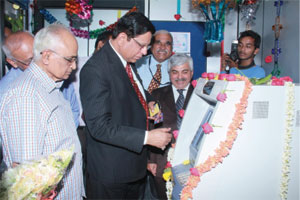 BELLARY, March 13: Canara Bank Chairman & Managing Director R K Dubey inaugurated here a mega financial inclusion event involving opening of 23 new branches, 30 ATMs, 7 Financial Literacy Centres and the Bank’s partnership with NGOs-SKDRDP & SAMUHA for extending credit linkage to Women SHGs. BELLARY, March 13: Canara Bank Chairman & Managing Director R K Dubey inaugurated here a mega financial inclusion event involving opening of 23 new branches, 30 ATMs, 7 Financial Literacy Centres and the Bank’s partnership with NGOs-SKDRDP & SAMUHA for extending credit linkage to Women SHGs.
Speaking on the occasion, Mr Dubey said “Rural people are equally entitled to get all technology products and services from the banking system as any urban customer is receiving.”
The event was organized by Pragathi Gramin Bank, a RRB sponsored by Canara Bank.
Complimenting the bank, Mr Dubey said that Pragathi Gramin bank is no less than
commercial bank and should have ATMs in all its branches especially in rural areas.
He called upon banks operating in rural areas especially RRBs to partner with the
technology providers to achieve this.
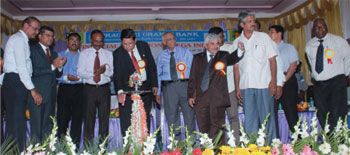 Mr R K Dubey declared open 23 new branches, 30 ATMs and 7 Financial Literacy
Centres of Pragathi Gramin Bank. 20 ATMs out of 30 are in villages. Mr R K Dubey declared open 23 new branches, 30 ATMs and 7 Financial Literacy
Centres of Pragathi Gramin Bank. 20 ATMs out of 30 are in villages.
Earlier in the day, Mr Dubey planted a sapling at Pragathi Gramin Bank Head Office premises and inaugurated an ATM at Gandhinagar, Bellary. He called upon the bank and M/s Integra Service provider to work together to take the bank to every village in the area of operation of the bank.
Bank also extended association with SKDRDP in promotion and credit linkage of SHGs to 2 new districts namely Shimoga and Bellary. Talur village in Bellary district was declared as Total Solar Village by granting 151 Loans.
Mr M G Bhat, Chairman of Pragathi Gramin Bank welcomed the guests. M K S
Prabhakara Rao, General Manager of Canara Bank, Mr. Puneet Bhirani, Executive,
M/s Mphasis ATM Service provider, Mr Jayashankar Sharma, Director SKDRDP, Mr
V Narayanaswamy, Director SAMUHA, Shri Manjunath, Country Head, SKDRDP
lauded the efforts of the RRB. Mr M Nagaraja, General Manager proposed vote of thanks.
Canara Bank announces women friendly schemes on International Women's Day
By Deepak Arora
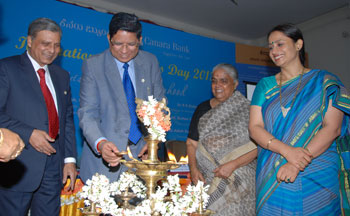 BANGALORE, March 8: Canara Bank celebrated the international women’s day here on Friday by awarding successful eminent women personalities, women entrepreneurs and
women employees. The bank also initiated a series of financial and non financial
packages for women entrepreneurs and for rural women. BANGALORE, March 8: Canara Bank celebrated the international women’s day here on Friday by awarding successful eminent women personalities, women entrepreneurs and
women employees. The bank also initiated a series of financial and non financial
packages for women entrepreneurs and for rural women.
Presiding over the function organized at its Head Quarters, the Canara Chairman and Managing Director, Mr R K Dubey, announced several initiatives taken by the Bank such as:
• Waiver of Promoters Contribution and providing 100 % finance for Micro and
Small projects upto Rs 1 lakh.
• Waiver of processing charges and upfront fee upto a loan of Rs 5 lakh under
Micro and Small projects for women entrepreneurs.
• Reducing interest on loans to women on Micro and Small Enterprises upto Rs 5
lakh to base rate of interest i.e. 10.25% at present.
• Waiver of processing charges for house and vehicle loans for women for the period
from March 1, 2013 to May 31, 2015.
• In order to encourage entrepreneurship and reward successful women entrepreneurs, the CMD launched an annual award Scheme for successful women entrepreneurs financed by the Bank with three cash awards of Rs 25,000, Rs 50,000 and Rs1,00,000.
• To give focused attention to the needs of women clientele, bank is dedicating 10 all women employee branches.
• As a CSR initiative, Bank would also take up a project for construction of toilets in 130 girl schools, 5 each in all its 26 lead district with a financial outlay of Rs. 1 crore.
The chairman also recalled the contributions made by Mrs Indira Gandhi and
the other popular women political leaders, Mothers and Sisters in the family.
Women employees will be provided the best support to advance in their careers
and contribute for the women’s empowerment, he said during the occasion.
Earlier, the bank honoured women achievers who excelled in their respective
fields. Mrs Shalini Rajaneesh, IAS and Secretary, DPAR, Govt. of Karnataka,
Dr. Vanaja Ramaprasad, Found Trustee of Green Foundation and organic farming
expert, Mrs B Kamala, the elderly citizen and first women General Manager of the
Canara Bank.
Thanking the bank for the honour, Mrs Shalini Rajaneesh stressed on extending time bound service to the citizens and called upon the Bankers to take a lead in empowering women as financial security is critical. She highlighted that the
repayment from the women category is one of the highest and banks should not be
reluctant to consider their proposals.
Dr. Vanaja Ramaprasad expressed concern over deteriorating quality of seeds which have now become totally dependent on externally induced chemicals. She appealed to the farming community, financiers and policy makers to encourage organic farming for sustaining the skill of agriculture and food security. She highlighted the role played by women in the farm sector which is to the extent of 60 to 70%.
Mrs B Kamala, retired GM of the bank narrated her experience of implementing social banking concepts in the bank and expressed happiness in seeing so many women occupying the top positions in the bank.
Mr A K Gupta, Executive Director of the Bank, highlighted the role played by
Bank in empowering women through self employment training, promoting formal
education, assistance to SHGs and financial inclusion. He cited the role played by
late Dr. Verghese Kurien who empowered women in the 15 Districts of Gujarat
and building a international brand “Amul”.
Mrs Lalitha Lakshmanan, CGM welcomed the gathering and Mrs Mythily
Krishnamurthy, CGM of the bank proposed the vote of thanks.
The programme was attended by over 500 people from Bangalore Urban and Bangalore Rural District, of which more than 400 were women. Top Executives, employees and
invitees were also present on the occasion.
Chidambaram to meet heads of PSU banks on March 18
 NEW DELHI, March 10: Amid moderation in economic growth, finance minister P Chidambaram is likely to prod banks to step up lending at a meeting with heads of public sector banks on March 18. The broad agenda of the meeting include direct benefit transfer, deteriorating asset quality and credit growth. NEW DELHI, March 10: Amid moderation in economic growth, finance minister P Chidambaram is likely to prod banks to step up lending at a meeting with heads of public sector banks on March 18. The broad agenda of the meeting include direct benefit transfer, deteriorating asset quality and credit growth.
Non-performing assets of the banks have been on the rise for past several months due to slowdown in the economy. The gross NPAs of some public sector banks, including State Bank of India, Punjab National Bank and Central Bank of India, have crossed four per cent of the total assets at the end of December, 2012.
Gross NPAs of PSU banks jumped to Rs 1,84,193 crore in December 2012 compared to Rs 1,37,102 crore in March 2012.
The gross NPAs in corporate lending rose to Rs 98,884 crore in December 2012 as against Rs 68,221 crore in March 2012, while in case of farm loan, the gross NPAs rose at Rs 30,800 crore in December 2012 as against Rs 24,827 crore in March, 2012.
Hit by poor performance of farm, mining and manufacturing sector, economic growth in the October-December period of the current financial year slipped to 4.5 per cent -- decade's lowest quarterly growth.
Chidambaram is likely to ask banks to increase lending at the meeting on March 18, official sources said.
The meeting will also dwell upon steps to increase credit flow to micro, small and medium enterprises (MSMEs), farm sector, infrastructure and housing sector, sources added.
The high-profile meeting will be held a day before mid-quarter review of monetary policy by the Reserve Bank of India (RBI). It is widely expected that RBI may reduce the interest rate to prop up growth.
In its third quarter policy review on January 29, RBI had lowered key short-term lending rate by 0.25 per cent and also injected Rs 18,000 crore liquidity through similar reduction of Cash Reserve Ratio.
The repo rate, at which RBI lends to banks, was eased after a gap of nine months as the central bank fought the stubbornly high inflation through tight money policy, leading to high interest rate regime.
Following the monetary action by RBI, many banks including State Bank of India, Punjab National Bank, Oriental Bank of Commerce (OBC) reduced their lending rate.
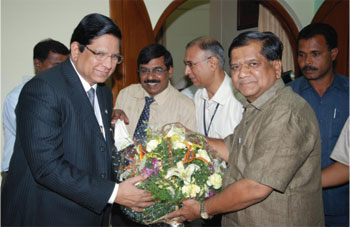 Canara CMD Dubey calls on Karnataka CM Canara CMD Dubey calls on Karnataka CM
BANGALORE, March 9: Canara Bank Chairman and Managing Director, MR R K Dubey, called on Karnataka Chief Minister, Mr Jagadish Shettar, and discussed with him various developmental issues connected to the State and assured him fullest cooperation from Canara Bank.
The Chief Minister congratulated Mr Dubey on his taking the charge of Canara Bank as Chairman and Managing Director and assured him all support from the Government of Karnataka.
 Canara CMD Dubey inaugurates Kamla Nehru Hospital Cancer ward Canara CMD Dubey inaugurates Kamla Nehru Hospital Cancer ward
By Deepak Arora
ALLAHABAD, March 6: Canara Bank Chairman and Managing Director Rajiv Kishore Dubey on Wednesday inaugurated Cancer Ward of Kamla Nehru Memorial Hospital here on Wednesday.
The CMD also handed over a cheque for Rs 6.15 lacs to the hospital for purchase of 20 beds for Cancer ward.
 On his maiden visit to Uttar Pradesh after assuming charge, Mr Dubey also inaugurated the renovated premises of Kalyani Devi branch of Canara Bank. On his maiden visit to Uttar Pradesh after assuming charge, Mr Dubey also inaugurated the renovated premises of Kalyani Devi branch of Canara Bank.
He also addressed the customers of Allahabad, Varnanasi and Mirzapur branches in the evening.
He also visited Lucknow and interacted with the customers.
He addressed the staff members and motivated them with his inspirational speech.
Mr S K Chaudhry, DGM was also present on the occasion.
Chidambaram should initiate tax reforms in Union Budget to herald India’s growth story
By Rakesh Nangia
 NEW DELHI, Feb 21: The Indian economy had witnessed a lot of challenges in the past year and the Government had taken various steps to push the economic reforms in the country. Every year, the Union Budget comes with lot of anticipations, anxiety and hopes for the countrymen. Not only does it interest the masses, it also interest investors across the globe who have made investment or plan to invest in the growing Indian market. This year also, the Union Budget is no different and is awaited with lot of interest by everyone, especially the common man, who has been the victim of soaring inflation in the country. NEW DELHI, Feb 21: The Indian economy had witnessed a lot of challenges in the past year and the Government had taken various steps to push the economic reforms in the country. Every year, the Union Budget comes with lot of anticipations, anxiety and hopes for the countrymen. Not only does it interest the masses, it also interest investors across the globe who have made investment or plan to invest in the growing Indian market. This year also, the Union Budget is no different and is awaited with lot of interest by everyone, especially the common man, who has been the victim of soaring inflation in the country.
With the parliamentary elections coming next year, the budget 2013-14 is expected to strike a balance between regaining the fiscal discipline and making the tax regime people friendly.
The Finance Minister, Mr P Chidambaram, will have a tough task in his hand to meet the expectations of the common man and also address the economic and industry issues, at the time when the Indian fiscal regime is yet to settle the changes proposed in the last union budget, which inter-alia included the provisions on the General Anti-Avoidance Rules (‘GAAR’) and retrospective amendment in capital gains taxation on indirect transfer of Indian assets.
Some of the challenges that the Indian economy is presently facing and for which the
Government needs to take corrective measures are enumerated below:
• Boost to the infrastructure space and other key sectors of the economy
• Incentivize foreign investment in India and encourage investor’s confidence in the
country
• Improve industrial growth rate
• Reducing the fiscal deficit - give momentum to export growth and monitoring imports
• Tax friendly regime and reduce ambiguities – fast resolution to tax litigations
• Removing the regulatory bottlenecks
We, through this article, highlight some areas where we expect the changes in the direct tax arena and some direct tax propositions which can be considered by the Parliament in the upcoming budget session:
Individual Taxation:
@ Increase in the basic exemption limit for individual tax payers to bring parity with the high inflation in the country
@ Enhance the housing loan interest deduction to promote housing finance and address the cash-crunch problem for the real-estate developers
@ Increase in the tax incentive/ deductions, specially the limit of exemption under section 80C of the Income-tax Act, 1961 (‘Act’), which has been stagnant for several years. This would also boost the savings in the economy, which can be channelized to promote key industry sectors in the country
@ Restore the tax-incentive on infrastructure bonds to fund the infrastructure space
@ Raise the existing nominal transport allowance exemption limit for salaried employees
@ Increase the tax deduction limit on payment towards health care or medical insurance of self and relatives
@ Bring the National Pension Scheme (‘NPS’) under the exempt-exempt-exempt (‘EEE’) regime to encourage private Indian corporate houses avail the scheme and provide benefits to the salaried employees
@ Extend the presumptive taxation scheme for small service providers (which at present is available only to persons carrying on any business)
@ Reintroduction of inheritance / super-rich tax – Bringing back the erstwhile estate duty regime in the country is aimed to address concerns like wealth - accumulation in a few hands and fiscal inequality. While this may result in achieving the stated issues and also a possible increase in contribution to the national exchequer, in our view, this may not be the right time to reintroduce the inheritance tax/ superrich tax because this would require lot of legislative changes and may create issues relating to valuation, point of taxation and increased litigation. Instead, our country needs series of reforms to boost the economic growth which benefits all classes of society.
Corporate Tax:
@ Convergence of tax rules with IFRS based accounting
@ Rationalize the provisions of GAAR and codify the recommendations of the Shome Panel on GAAR in the Act
@ Exemption on applicability of Minimum Alternative Tax (‘MAT’) provisions on foreign companies specially in sectors where there is a need to promote foreign investment/ technology
@ Imposition of MAT on Special Economic Zone (‘SEZ’) units be withdrawn
@ Reintroduction of 10(23G) to provide MAT exemption for infrastructure companies to
incentivize investment in infrastructure space
@ Extension of tax incentive under section 80-IA of the Act by postponing the sunset clauses. Extend tax holiday under section 80IA of the Act for some key sectors like real estate projects, SEZ, integrated townships, cement industry etc.
@ Introduce tax provision for allowing the carry forward of foreign tax credit which remains unutilized in the previous year in which the foreign income is accrued or taxed in India and set-off the same against the tax liability in succeeding years
@ Deduction of non-compete fees - While the taxability of receipt of non-compete fees is clearly provided for under the Act, the deductibility of the same as revenue expenditure or depreciation on capital expenditure is still unclear. The provisions to bring clarity on the same may be introduced
@ Provide for specific deductibility of expenses incurred on increasing share capital
@ Roll back the provisions of taxing the consideration in excess of the fair market valued received by a closely held company on issue of shares as per section 56(2)(viib) of the
Act. This has resulted in lot of commercial issues in case the existing promoter is able to raise funds at a higher valuation
@ Provide specific capital gains tax exemption under the Act on conversion of sole proprietorship or a partnership firm into a Limited liability Partnership (‘LLP’)
@ The turnover threshold of INR 6 million for a tax-neutral conversion of a private company or an unlisted public company into an LLP may be done away with or increased
to promote formation of LLP in the country
@ Provide for a specific clause on tax depreciation on goodwill in case of a slump sale transaction to avoid any unnecessary litigation
@ Provide specific exemption of capital gains tax on conversion of one class of shares into another - to promote foreign investment in Indian companies through convertible instrument
@ Applicability of Tax deduction at Source (TDS) to be determined ‘net of service tax’ since the same represents tax and not any income
@ Remove applicability of TDS on pure reimbursement of expenses since there is no element of income involved
@ Applicability of Advance Pricing Agreements should be extended to domestic transfer pricing provisions for reduced litigation
Mergers and Acquisition
@ Define clearly the term ‘substantial’ used in Explanation 5 to Section 9(1)(i) of the
Act relating to indirect transfer of Indian assets and provide for a clear methodology to compute capital gains tax in India on such deemed transfer [as provided under explanation 5 to Section 9(1)(i)]. Further, it is suggested to adopt/ codify the other recommendations of the draft report of Shome Panel on retrospective amendments relating to indirect transfer of assets in India
@ Allow carry- forward of losses under section 72A in cases of amalgamation for all sectors against the present case where the benefit is available only to certain industrial undertaking
@ Specific clause may be introduced under the Act to allow carry forward of MAT credit of the amalgamating company to the amalgamated company
@ Specific clause may be introduced under the Act to allow deductibility of certain expenses (provided under section 43B of the Act) of the amalgamating company or
demerged company or transferor company to the amalgamated company or resulting company or transferee company on payment basis
@ Introduce a new clause for capital gains tax exemption upon receipt of shares by an
Indian tax resident in case of amalgamation / demerger in respect of two foreign companies
@ Section 79 of the Act provides that a change of more than 49% voting rights of a closely held Indian company would result in denial of carry forward and set-off of business losses. However, in case when change in the shareholding of the Indian company occurs on amalgamation / demerger in respect of foreign holding company, the provision of Section 79 may not trigger. Such a relaxation from provision of Section 79 of the Act is not there for amalgamation/ demerger of Indian holding companies. This exception should also be inserted for change in shareholding pursuant to merger / demerger of Indian companies.
In light of the present global scenario and economic environment in the country, it would be interesting to see how and to what extent these recommendations are adopted and how the Indian Government is able to restore the global investor’s confidence in the Indian markets and push the tax reforms in the country which had been initiated in the recent past specially through Goods and Service tax and the Direct Tax Code. One can only hope that that the tax reforms are enacted soon to create a significant positive impact on the nation’s overall growth story and benefit everyone.
The views of the writer are personal..!!
Sharp launches air purifiers for India market
 NEW DELHI, Feb 27: Sharp, the leading consumer Japanese brand with over 100 years of lineage in white good industry, with various patent technologies on their name is proud to announce the success of its Plasmacluster segment. Sharp launched Plasmacluster ion Technology equipped products Air Purifiers for India Market a little over six months earlier. This range of Air Purifiers has been a quiet achiever for the brand with its patent technology. Sharp also announced it’s achievement of 4 Crore satisfied users till June 2012 for Plasmacluster Ion Technology, the highest in the world for Air Purification. NEW DELHI, Feb 27: Sharp, the leading consumer Japanese brand with over 100 years of lineage in white good industry, with various patent technologies on their name is proud to announce the success of its Plasmacluster segment. Sharp launched Plasmacluster ion Technology equipped products Air Purifiers for India Market a little over six months earlier. This range of Air Purifiers has been a quiet achiever for the brand with its patent technology. Sharp also announced it’s achievement of 4 Crore satisfied users till June 2012 for Plasmacluster Ion Technology, the highest in the world for Air Purification.
With recent, Global Burden of Disease (GBD) count, a global initiative involving the WHO has ranked outdoor air pollution as the sixth-most dangerous killer. It is now three places behind indoor air pollution, which is the second-highest killer in Asia.
As Sharp Business Systems India Limited’s Product Head, Shuvendu Mazumdar sees it, Purifiers are the need of the day, as we buy Mineral Water, RO or even better water filters. For what? To save us from some petty disease like upset stomach etc. But what about airborne diseases? H1N1, Bird Flu, Swine Flu, Tuberculosis, and so many others are killing millions in India every year. We are blissfully ignoring this, while taking 20,000 odd Breaths every day! Just consider, 1.34 million premature deaths occurred in 2008 as per WHO from respiratory diseases!
SHARP enjoys a competitive edge when it comes to Air purifiers in India. Same conclusion is derived by Tech Sci Research who predicts the Air purifier Market to reach Rs 560 Crores by the year 2016.
 Plasmacluster Technology can best be described as the next generation of Air Purifiers. They work by using an electrical discharge to create both Positive and Negative ions, which are then surrounded in water and then released into the air. Sharp says this process can clean the air and surface from irritants including dust, fungi, viruses, pollen and mould etc. Plasmacluster Technology can best be described as the next generation of Air Purifiers. They work by using an electrical discharge to create both Positive and Negative ions, which are then surrounded in water and then released into the air. Sharp says this process can clean the air and surface from irritants including dust, fungi, viruses, pollen and mould etc.
According to Shuvendu Mazumdar, National Manager, Sharp Business Systems India Limited, “Sharp has undertaken a number of live product demonstration sites during the festive season at major Retail Outlets. This activity allows Sharp staff to interact directly with consumers and get feedback as to the consumers needs — the overwhelming reaction has been very positive. Generating awareness and providing solutions is the need of the time”.
Sharp will partner with a retailer when carrying out these activities: the most recent ones are Vijay Sales, Reliance Autozone & Other Regional retails in Delhi, Mumbai, Kolkata & Bangalore which achieved over 400 unit sales in just over three weeks. The effective demonstration program strongly communicates to customers, while the Retailers are happy with the solid margin they get in this product category.
“Clearly there is a consumer need that is not currently being met by most Retailers. We will use the knowledge gained from consumers to further advance the penetration into this thinly tapped market” he added.
The Plasmacluster Ion Air Purifiers is an example of Sharp’s efforts to keep supplying retailers with high value products, with unique and one of kind features and benefits.
Regarding the profits that retailers can avail with Sharp’s range of products, Mazumdar said, “At a time of eroding profitability and declining demand in mainstream consumer electronic products, the Sharp Plasmacluster Air Purifier range can bring retailers new sales opportunities. Retailers should talk to one of the Sharp sales team about range, training and display.” |


