


BUSINESS
|
GAIL commences construction work for West Bengal stretch of PM Urja Ganga Pipeline ProjectBy Deepak Arora NEW DELHI, Jan 29: GAIL (India) Limited has started pipeline construction work in the state of West Bengal for providing gas supply to Matix Fertilizers, Durgapur. This project is being executed as a part of ‘Pradhan Mantri Urja Ganga’ pipeline project i.e. Jagdishpur-Haldia and Bokaro-Dhamra Natural Gas Pipeline (JHBDPL) project and is being executed on a fast track basis. A total of 555 Km long pipeline with an approved cost of approximately Rs. 2700 crore in West Bengal will pass through eight districts like Puruliya, Bankura, Burdwan, Nadia, Hooghly, Howrah, East Medinapur and 24 North Paragana. Further project activities for execution of pipeline in the state of West Bengal upto Haldia and City Gas Distribution in Kolkata are also expected to commence shortly. The prestigious 2655 Km long JHBDPL project was inaugurated by Prime Minister of India in July 2015. The project is progressing in full swing. The pipeline will pass through the states of Uttar Pradesh, Bihar, Jharkhand, West Bengal and Odisha. The project is being executed in a phased manner. Phase I consists of pipeline network from Phulpur – Dobhi with spurlines to Varanasi, Gorakhpur, Patna and Barauni (755 Km) and is scheduled to be completed by Dec ‘18. Phase II of the project beyond Dobhi (Gaya) towards Durgapur Haldia & Bokaro – Ranchi and Angul – Dhamra (1900 Km) is scheduled to be completed progressively by December 2020. The project will usher Industrial development in Eastern part of India by supplying environmentally clean Natural Gas to Fertilizer and Power plant, Refineries, Steel plants and other Industries. Further, the arrival of the Pradhan Mantri Urja Ganga will provide direct and indirect employment to thousands of people. The project will also provide clean energy to households and transportation in the cities en-route the pipeline. The City gas Network laying activity in Varanasi, Bhubaneswar, Ranchi and Cuttack has already commenced and activities in other cities namely Patna and Jamshedpur will start by next month. The pilot project in Bhubaneshwar for providing PNG and CNG has already been inaugurated in October 2017 & December 2017 respectively, by Hon’ble Minister of Petroleum & Natural Gas and Skill Development and Entrepreneurship. Rahul Gandhi slams govt over GDP, job creation numbersNEW DELHI, Jan 29: Congress President Rahul Gandhi on Monday took a swipe at the Modi government after the Economic Survey was released, saying 'Acche Din' are here, except for "minor hiccups" such as a decrease in the growth of GDP, agriculture and job creation. Reacting to the survey, former finance minister and senior Congress leader P Chidambaram hit out at the government over the "depressing" report and predicted a growth rate of 6-6.5 percent for 2017-18. In a jibe at the government, Gandhi tweeted, "The Economic Survey 2018 says, 'Acche Din' are here, except for these minor hiccups: Industrial Growth is (down). Agricultural Growth is (down). GDP Growth is (down) and Job Growth is (down). Don't worry Be Happy!" He also tagged a video of the song "Don't worry be happy" with the tweet. Chidambaram said though the survey says growth rate for 2017-18 will be 6.75 percent, implying a second-half growth rate of 7.5 percent, it offers little evidence in support of this claim. "The growth rate in the first half was 6 percent, and the year is likely to end with a growth rate of between 6 and 6.5 percent....Altogether, it is a depressing report of the fiscal year that will come to an end in two months," he said. Agriculture is India's lifeline and the Economic Survey recognises that, but "causing 'agrarian distress' has become the designed objective of the Modi government", he said. "With another year to go for the general elections, even if the agriculture-GDP growth jumps to 4 percent in 2018-19, the five-year average will still be 2.3 percent, the lowest since the economic reforms began," the former finance minister said. He also said the agriculture-GDP growth under the Modi government has plunged to just 1.9 percent, half of what was achieved in the first four years of the UPA. "Reason is deliberate betrayal of India's farmers by PM on the promise of cost plus 50 percent of MSP," he said. Congress's communications in-charge Randeep Surjewala said, "All in all it has turned out to be 'much ado without direction, cohesion and vision'!" "With one year to go for next general elections, prime minister Modi has plunged the 'state of India's economy' towards despondency, dejection and dire straits," he alleged. He said that 'Modinomics' had 'decoupled' India's robust economy by "myopic vision and the double whammy of demonetisation and ill-conceived GST". Surjewala alleged that the Economic Survey establishes that Modi government has become synonymous with "distorting" macroeconomic indices and "slowing down economic progress". "Economic Survey 2017-18 has affirmed the utter mismanagement of India's economy by Modi government in the last four years. No amount of new announcements in the presidential address and the forthcoming budget can undo the damage the BJP government has done to a robust economy like India," Surjewala said. He claimed the GDP growth is down, agriculture is in "utter disarray", rural wages were declining, industrial growth was plunging, job creation figures were invisible, fresh investment was low, education and health spending is in crises. He also claimed that that the 'Make in India' was "floundering", price rise was raising its ugly head, and due to demonetisation and a 'flawed' GST, the informal sector, which by the Economic Survey's own admission, has been severely impacted. Surjewala said though the Budget 2017-18 predicted a GDP growth of 7.5 percent for 2017-18, the finance minister has turned out to be more than a full percentage point off the mark. "This year again, the Economic Survey predicts GDP Growth at 7-7.5 percent for 2018-19, we sincerely hope that this prediction does not become another lame duck prediction, considering the constantly diminishing past track record of GDP growth in the years 2015-16 (8 percent), 2016-17 (7.1 percent) and 2017-18 (6.5 percent)," he said. Chidambaram said the future course of the economy is conditional "on many ifs" and the survey seems to prepare grounds for "failure" and the "outlook is therefore uncertain, if not bleak". "The survey has thrown the burden on private investments and exports. It is obvious that the government has thrown in the towel and hopes that the private sector will come to the rescue of the economy! There is not much gas left in the government," he said. Samsung Electronics to close one of two assembly plants in SlovakiaBRATISLAVA/SEOUL, Jan 27: South Korea's Samsung Electronics said on Saturday that it would consolidate its TV production plants in Slovakia, closing one of the two facilities in the European country. Samsung has two assembly plants in Slovakia - at Galanta and Voderady - primarily making LCD TVs. Samsung said combining the two plants was to improve efficiency. All workers at the Voderady plant would be offered the chance to move to Galanta on a voluntary basis with equal working condition, the company said. "Samsung Electronics is consolidating its production facilities in Voderady and Galanta in order to enhance its synergy and efficiency, " it said in an emailed statement. Canara Bank celebrates Republic DayBy Deepak Arora
Addressing the gathering, Rakesh Sharma reminded the need for remembering the He narrated that it is the responsibility of every citizen to serve the country and keep it safe and healthy for future generation. He also declared the adoption of BBMP high school and junior college, Chamrajpet , Bangalore for overall development for a period of one year. He distributed scholarship to the toppers in the school in the previous year examinations. On this occasion, Miss Kruthika N S, a topper at National Law School with three Gold Medals, Miss Geetha N, a M Sc Agriculture graduate with 17 gold medals, a noted Kannada writer, Dr Naa Someshwara, and Security personal Sri Premraj were honoured. The function was well attended by staff and their family members. MoU signed to promote trade with PhilippinesBy Deepak Arora NEW DELHI, Jan 26: PHD Chamber of Commerce and Industry (PHDCCI) and Federation of Indian Chambers of Commerce (Phil) Inc. on Friday signed a Memorandum of Understanding (MoU) as per which the two organizations have agreed to promote development of bilateral economic relations with specific focus on MSMEs among others by providing a platform for business meet, discussions and exploration of business opportunities in trade, investments, technology transfer, services and other sectors. The MoU also provides for aggressively working with Governments of India and that of Philippines to also enhance people to people interaction which would develop into a mutually beneficial friendship between the two countries The MoU has been signed here today respectively by Presidents of PHD Chamber of Commerce and Industry and Federation of Indian Chambers of Commerce (Phil) Inc. (FICCI) Anil Khaitan and Rex Daryanani. The Principal Director of the PHD Chamber, Dr. Ranjeet Mehta, was also present on the occasion among others. As per other stipulations of the MoU, the two Chambers have also agreed to develop strong institutional, trade and business relations in order to establish a sustainable mechanism of dialogue and platform for discussions as also concurred to exchange information on general economic status, taxation investment opportunities, trade policies and legislative changes of their respective countries in a bid to strengthen trade technological and industrial collaboration between India and Philippines. It also provides for to regularly exchange information publications and material concerning economic development, foreign trade and investment policies of their respective countries. In addition, it has also been agreed to establish effective and systematic consultation and cooperation particularly on the trade and investment policies of India and Philippines including specific policy developments in Members Countries. Besides, it was also agreed between the two Chambers to co-operate on all program of trade promotion and commercialization between India, Philippines and other ASEAN Countries and assist each other in development of Pilot Projects in MSME sector in designated area in India, Philippines and ASEAN coordinated by both PHD Chamber and FICCI. Richest 1% in India got 73% of wealth generated last year, shows surveyDAVOS, Jan 22: The richest 1% in India cornered 73% of the wealth generated in the country last year, a new survey showed on Monday, presenting a worrying picture of rising income inequality. Besides, 67 crore Indians comprising the population’s poorest half saw their wealth rise by just 1%, as per the survey released by the international rights group Oxfam hours before the start of the annual congregation of the rich and powerful from across the world in Davos. The situation appears even more grim globally, where 82% of the wealth generated last year worldwide went to the 1%, while 3.7 billion people that account for the poorest half of population saw no increase in their wealth. The annual Oxfam survey is keenly watched and is discussed in detail at the World Economic Forum Annual Meeting where rising income and gender inequality is among the key talking points for the world leaders. Last year’s survey had showed that India’s richest 1% held a huge 58% of the country’s total wealth -- higher than the global figure of about 50%. This year’s survey also showed that the wealth of India’s richest 1% increased by over Rs 20.9 lakh crore during 2017 -- an amount equivalent to total budget of the central government in 2017-18, Oxfam India said. The report titled ‘Reward Work, Not Wealth’, Oxfam said, reveals how the global economy enables wealthy elite to accumulate vast wealth even as hundreds of millions of people struggle to survive on poverty pay. “2017 saw an unprecedented increase in the number of billionaires, at a rate of one every two days. Billionaire wealth has risen by an average of 13% a year since 2010 -- six times faster than the wages of ordinary workers, which have risen by a yearly average of just 2%,” it said. In India, it will take 941 years for a minimum wage worker in rural India to earn what the top paid executive at a leading Indian garment firm earns in a year, the study found. In the US, it takes slightly over one working day for a CEO to earn what an ordinary worker makes in a year, it added. Citing results of the global survey of 120,000 people surveyed in 10 countries, Oxfam said it demonstrates a groundswell of support for action on inequality and nearly two-thirds of all respondents think the gap between the rich and the poor needs to be urgently addressed. With Prime Minister Narendra Modi attending the WEF meeting in Davos, Oxfam India urged the Indian government to ensure that the country’s economy works for everyone and not just the fortunate few. It asked the government to promote inclusive growth by encouraging labour-intensive sectors that will create more jobs; investing in agriculture; and effectively implementing the social protection schemes that exist. Oxfam also sought sealing of the “leaking wealth bucket” by taking stringent measures against tax evasion and avoidance, imposing higher tax on super-rich and removing corporate tax breaks. The survey respondents in countries like the US, UK and India also favoured 60% pay cut for CEOs. The key factors driving up rewards for shareholders and corporate bosses at the expense of workers’ pay and conditions, Oxfam said, include erosion of workers’ rights; excessive influence of big business over government policy- making; and the relentless corporate drive to minimise costs in order to maximise returns to shareholders. About India, it said the country added 17 new billionaires last year, taking the total number to 101. The Indian billionaires’ wealth increased to over Rs 20.7 lakh crore -- increasing during last year by Rs 4.89 lakh crore, an amount sufficient to finance 85 per cent of the all states’ budget on health and education. It also said India’s top 10 per cent of population holds 73% of the wealth and 37% of India’s billionaires have inherited family wealth. They control 51 per cent of the total wealth of billionaires in the country. Oxfam India CEO Nisha Agrawal said it is alarming that the benefits of economic growth in India continue to concentrate in fewer hands. “The billionaire boom is not a sign of a thriving economy but a symptom of a failing economic system. Those working hard, growing food for the country, building infrastructure, working in factories are struggling to fund their child’s education, buy medicines for family members and manage two meals a day. The growing divide undermines democracy and promotes corruption and cronyism,” she said. The survey also showed that women workers often find themselves at the bottom of the heap and nine out of 10 billionaires are men. In India, there are only four women billionaires and three of them inherited family wealth. “It would take around 17.5 days for the best paid executive at a top Indian garment company to earn what a minimum wage worker in rural India will earn in their lifetime (presuming 50 years at work),” Oxfam said. Buffett says cryptocurrencies will come to bad endingNEW YORK, Jan 11: Billionaire investor Warren Buffett told CNBC on Wednesday the recent craze over bitcoin and other cryptocurrencies won't end well. "In terms of cryptocurrencies, generally, I can say with almost certainty that they will come to a bad ending," the chairman and CEO of Berkshire Hathaway said. "When it happens or how or anything else, I don't know," he added in an interview on CNBC's "Squawk Box" from Omaha, Nebraska. "If I could buy a five-year put on every one of the cryptocurrencies, I'd be glad to do it but I would never short a dime's worth." Also on the show, Buffett's right-hand man, Charlie Munger, also blasted frothiness in bitcoin — and in venture capital funding. Earlier Wednesday, the Omaha-based conglomerate announced the appointment of two new vice chairs. Gregory Abel, 55, will be vice chair of non-insurance businesses. Ajit Jain, 66, will be vice chair of insurance operations. Buffett said he would not take a short position on bitcoin futures. "We don't own any, we're not short any, we'll never have a position in them," he said. "I get into enough trouble with things I think I know something about," he added. "Why in the world should I take a long or short position in something I don't know anything about." Exchange operators such as CME Group and Cboe Global Markets have opened their platforms to allow bitcoin futures trading. The price of bitcoin declined 3.69 percent to $13,907 Wednesday, according to data from industry website CoinDesk. The digital currency is up more than 1,500 percent in the past 12 months. Buffett's comments came a day after J.P. Morgan Chase Chairman and CEO Jamie Dimon backpedaled his earlier criticisms of cryptocurrencies. In September, Dimon called bitcoin a fraud. |
|
||
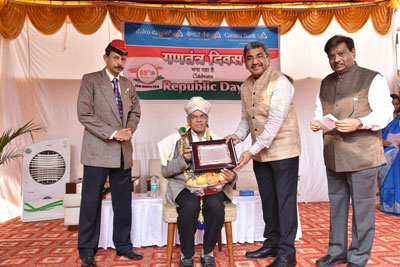 BANGALORE, Jan 26: Republic day was celebrated at the Canara Bank Head Office here on Friday. Canara Bank's Managing Director and CEO Rakesh Sharma received the guard of honour from security personnel and unfurled the national flag. The function was attended by a large number of staff and their family members along with the invited guests.
Aviation
| Business | Defence
| Foreign Affairs | Communication
| Health | India |
United Nations
India-US | India-France
| Entertainment | Sports
| Photo Gallery | Tourism
| Advertise with Us | Contact
Us
© Noyanika International, 2003-2009. All rights reserved.