


Foreign Affairs
|
North Korea threatens 'sacred' N-warPOCHEON (South Korea), Dec 24: North and South Korea beat the drums of war on Thursday, with each threatening the other with immediate retaliation if attacked. Seoul has staged days of military drills in a show of force meant to deter North Korea, including live-fire exercises earlier this week on a front-line island shelled by the North last month. Angered by the exercises, North Korea threatened on Thursday it would launch a "sacred" nuclear war if Seoul hit it and warned that even the smallest intrusion on its territory would bring a devastating response. The two sides are still technically at war because their 1950-53 conflict ended in a truce not a peace treaty, and a US governor who recently made an unofficial diplomatic mission to the North has said the situation on the peninsula is a "tinderbox" and the worst he had ever seen it. Still, the latest rhetoric seemed likely to be just that, words aimed at stirring pride at home and keeping the rival at bay. Kim told a national meeting in Pyongyang that the North's military will deal "more devastating physical blows" to its enemies if they cross into the North's territory even slightly, the official Korean Central News Agency said in a dispatch. Will support India against friendly neighbour: MedvedevMUMBAI, Dec 22: Russian President Dmitry Medvedev on Wednesday said his country would support India if they ever had to take a hard decision against "a friendly neighbouring country". Addressing a packed hall at IIT Bombay, Medvedev, looking comfortable in an open neck blue shirt and black suit, said India and Russia have special relations "and it is not a figure of speech". "I'm not disclosing a state secret but when I visited India four days after the Mumbai terror attacks I told them (the government)...we are ready to provide weapons, modern technology and know-how," said the dynamic 45-year-old President. The President had requested to visit IIT Bombay because it was established with the help of the then USSR government. Though he walked in almost an hour late, a loud applause greeted Medvedev. "It was not that I woke up late but the airport was shut for an hour," he said. He started off by requesting students not to be "strict with their questions". The request fell flat when a student asked him how Russia would react if they had a terror attack like Mumbai and if their agencies were sure that the attack was rooted in Pakistan. "You don't ask complicated questions but extremely complicated questions. But complicated questions have simple answers." He did not rule out the use of armed force to protect the interest of the country: "…If Russia is attacked from a foreign state and we are sure the terrorists are housed by that foreign state, we will defend our national interests and even employ armed force". Referring to Russia's glorious days, a student asked the President whether Russia would have been a superpower if the USSR had not disintegrated. "If a state starts to feel and say they are a superpower and not…care about anyone else then it is the first step to failure... an attempt to be a superpower can be counter productive," he said. "USSR, too, had the illusion that they were self sufficient, could develop on their own and did not need anyone and this did not work." India, Russia ink 30 pacts
During their nearly two-hour long annual summit meeting which encompassed a whole range of crucial bilateral, regional and global matters, Prime Minister Manmohan Singh and Russian President Dmitry Medvedev also took stock of the situation in Pakistan and Afghanistan which impacts on the security of both the countries. Besides deciding to enhance cooperation in crucial spheres of military, energy sector, science and technology, space research and pharmaceuticals, the two sides agreed to step up efforts to achieve the target of bilateral trade of USD 20 billion by 2015. Apart from 11 pacts, which were signed after the talks, 19 agreements, including those between private companies of both the countries were inked on the margins of the summit. The key pacts include Preliminary Design Contract for FGFA envisaging joint design and development by Hindustan Aeronautics Limited and Russia’s Sukhoi Design Bureau and Rosoboronexport, Framework Agreement on Cooperation in hydrocarbon sector and MoU for joint research and development in reactor technology and related fields for peaceful uses of atomic energy. Other agreements pertained to simplification of visa procedure for certain categories, including for businessmen, enhancement of cooperation in oil and gas sector, MoU for cooperation in the pharmaceutical sector, MoU on combating irregular migration and agreement on cooperation in the field of emergency management. “Our talks have been comprehensive and result-oriented. We have signed several important agreements covering a large number of sectors. This reflects our mutual desire to bring our cooperation in other areas at par with our traditionally strong cooperation in the defence and nuclear fields,” Dr. Singh said at a joint press interaction with Mr. Medvedev. The two leaders also discussed construction of additional Russian designed nuclear reactors at Kudankulam, where two units are ready to be commissioned. While first unit will be commissioned by end of this month or early next month, the second unit will be commissioned by next year-end. Recalling their Moscow declaration on International Terrorism of 2001, the two leaders agreed that there is no justification whatsoever for any act of terrorism. “The sides agreed that all terrorist networks must be defeated. They called upon Pakistan to expeditiously bring all the perpetrators, authors and accomplices of the November 2008 Mumbai attacks to justice,” the joint statement, issued after the talks, said. Describing Russia as “a time tested friend of India that has stood by us in our times of need in the past”, Dr. Singh said . “Ours is a special and privileged strategic partnership. It is a partnership that has and will continue to develop independent of our relations with other countries“. On his part, Medvedev said Russia supports India as a “deserving and strong candidate” for a permanent seat in the UN Security Council as and when a decision for its expansion is taken. Noting that the reform of the UNSC should be carried out in a manner that reflects contemporary realities and makes this body more effective in dealing with both present-day and emerging challenges, the two sides decided to work closely in the Security Council during the 2011-12 period when India occupies a non-permanent seat in it for a two-year term. They also agreed to consider cooperation in the peaceful uses of nuclear energy with third countries. Reviewing the efforts to establish joint cooperation ventures between companies of the two countries in the oil and gas sectors, it was agreed that the inter-governmental pact on cooperation in the hydrocarbon sector signed today, must serve as an effective enabling legal mechanism to expedite governmental clearances to facilitate the creation and operation of such joint ventures. The two countries agreed to promote specific projects to encourage direct business-to-business dialogue between Indian and Russian oil and gas companies, to ensure that the contacts result in concrete and mutually beneficial commercial agreements. They expressed satisfaction at the extension of the Integrated Long Term Program (ILTP) for scientific and technical cooperation for another decade and its focus on identifying innovation—led technology programs. The two sides agreed to make efforts to continuously upgrade joint military exercises in all forms including in the field of counter-terrorism. The Russian side also expressed its readiness to assist and promote a discussion and positive decision in the NSG on India’s membership in the 46-nation grouping. Russia also took into positive consideration India’s interest in full membership in MTCR and the Wassenaar Arrangement. Apart from this, the Russian Federation agreed to make efforts along with other Shanghai Cooperation Organisation (SCO) members to accelerate the process of India’s entry into the organisation. The sides expressed concern at the deteriorating security situation in Afghanistan, where successful stabilization will be possible only after the elimination of safe havens and infrastructure for terrorism and violent extremism that are present in Afghanistan and Pakistan, the joint statement said. Dr. Singh also said that India and Russia should cooperate in intelligence and information sharing and devise effective counter-terrorism strategies. During the talks, Mr. Medvedev also extended an invitation to Dr. Singh to visit Russia next year which was accepted by the Prime Minister. The two leaders also discussed global economic situation and agreed that to progress towards the shared goal of strong, sustainable and balanced growth it is essential for G20 countries to fully implement the Seoul Action Plan adopted at the recent G20 summit. They welcomed the reform of the World Bank and reiterated their commitment to the successful completion of the reform of the International Monetary Fund as agreed to at the G20 Seoul Summit which will be a significant achievement in the general reform of the international financial architecture, the joint statement said. On climate change issue, the statement ‘celebrating a decade of the India-Russia Federation strategic partnership and looking ahead’ said the sides stressed the importance of enhancing international efforts to combat the change under the aegis of the UN Framework Convention on Climate Change. They expressed satisfaction with the outcome of the Cancun Climate Conference and agreed that the post Cancun negotiations should be part of a comprehensive package covering all the pillars of the Bali Action Plan. Mr. Medvedev, who is on a three-day visit, will travel on Wednesday to Agra followed by Mumbai where he will go to film-city and IIT. During his interaction with press, the Russian President talked about the popularity of the Indian movies and songs in his country. Russia to build more reactors, sign 5th generation jet dealNEW DELHI, Dec 18: India and Russia are set to sign over a dozen agreements, including a key pact on a fifth generation fighter aircraft and another one on expanding civil nuclear cooperation, during Russian President Dmitry Medvedev's two-day visit here next week. Medvedev touches down here with a large business delegation and senior ministers Tuesday morning for an annual summit with Prime Minister Manmohan Singh. Manmohan Singh and Medvedev Tuesday will discuss a range of bilateral and international issues including the expansion of civil nuclear cooperation, economic ties and terrorism. He will go to Agra and Mumbai Wednesday. In Mumbai, Medvedev will stay at the Taj Mahal Palace and Tower, one of the targets of attack by Pakistani terrorists in 2008, and pay homage to victims of the savagery. More than 15 agreements will be signed during the visit. Russian ambassador to India Alexander Kadakin Friday said the much-awaited deal on the joint production of the cutting edge jet fighter and an agreement on Russia building more nuclear reactors in India will be signed Tuesday after talks between Manmohan Singh and Medvedev. According to a draft of the pact, Russia will share its technology with India for the fighter and both countries will design the aircraft jointly. India and Russia are expected to ink an agreement on scientific cooperation to extend the existing framework by another decade. A bilateral pact to offer signals from the Glanost Satellite is under negotiation. Kadakin said Russia was upbeat about building 14-16 nuclear reactors in India over the next few years, but asked New Delhi to bring its civilian nuclear liability legislation in line with global norms. The two countries would ink an accord under which Russia would set up two more 1,000 MW units at Kudankulam. "We are prepared for serial construction of nuclear units, at least 4-6 more units, at Kudankulam to meet India's growing energy needs." He indicated that Russia might be allotted an alternate site in Orissa for setting up nuclear reactor. "We have not received yet an explanation from the Indian side as to how it will work. So far we are working on the basis of agreements that we had signed before this bill was passed," Kadakin told reporters here. "So far we do not think it will be an impediment. But we do think India will adhere to the international agreements it has signed. International agreements take supremacy over domestic laws," he said. The envoy, however, underlined that the civil nuclear liability legislation will not be "a hurdle to expanding civil nuclear cooperation" and added that Russia was looking to build 14-16 nuclear reactors in India in the long term. In October, India signed the Convention on Supplementary Compensation for Nuclear Damage (CSC) to allay concerns of foreign suppliers, including the US. India's nuclear liability legislation caps the operator's liability at Rs.1,500 crore ($331 million) and gives the operator the right to seek damages from suppliers if there is an accident. Medvedev is expected to forcefully underline Moscow commitment to supporting New Delhi's bid for permanent membership in the UN Security Council. "Our position is all along clear. As Foreign Minister (Sergei Lavrov) said, the whole world will benefit if India becomes the permanent member of the UN Security Council. I am surprised why the world is taking so long to realise it," said Kadakin. "We have been saying this for the last two decades." Kadakin said officials from both sides were working on a serious and concentrated document that could map out the next steps in the Indo-Russian strategic partnership. Representatives of the India and Russian business councils and the Indo-Russian CEOs Forum are scheduled to have meetings on the sidelines of the summit Monday and Tuesday. Voicing concern over terrorism emanating from Pakistan as "cancer," the Russian envoy urged Islamabad to do away with 43 terrorist training camps and said cooperation in combating terrorism will figure in the talks. Wen critical of Indian mediaNEW DELHI, Dec 17: Faced with negative headlines on the outcome of his talks with the Indian leadership, Chinese Premier Wen Jiabao was on Friday sharply critical of the Indian media, saying it was causing "damage" to bilateral ties. Winding up his three-day visit in New Delhi, Wen told a group of editors and scholars before emplaning for Pakistan that he understood that the press in India had freedom but it should play a role in promoting friendship. Citing the Indian media's coverage of the situation on the Sino-Indian border, the Chinese leader said that "not a single shot had been fired" nor had there been any "exchanges in border areas" between the troops. Still, the boundary question has "repeatedly been sensationalised" by the media after which leaders of the two countries have had to "repair the damage and harm", he said. His advice to the media was that it should play a more active role in enhancing friendship. "A good neighbour is a blessing. We must be good neighbours," Wen emphasised. Wen's talks with Prime Minister Manmohan Singh on Thursday resulted in a negative press with the media pointing out that India's key concerns on stapled visas to people from Jammu and Kashmir, terrorism emanating from Pakistan and its aspirations to be a permanent member of the UN Security Council had not been addressed. Underlining the importance of media's role, Wen said that in his eight years as Premier he had given only one interview to a departing foreign journalist, who was from India (PTI). Answering questions, the Chinese Premier said it was undeniable that in the long history between the two countries there was "a page of twists and turns", an apparent reference to the 1962 Sino-Indian war. But that was a "short page" and it was time the two countries "turned over that page", he emphasised. Both India and China had gone through "a lot of history" and surmounted "a lot of difficulties". Both had great ethnic, cultural and religious diversities and therefore both have to be "inclusive societies". Pointing out that India and China had jointly initiated the five principles of peaceful co-existence; Wen said that at the core of these principles was respect for each other. Deadly US Missiles kill 50 terrorists in PakistanISLAMABAD, Dec 17: Suspected U.S. missile strikes killed at least 50 people in the Khyber region of northwestern Pakistan. Pakistani officials say American missiles, fired by unmanned drone aircraft, struck three locations Friday in the Tirah valley. The area is a base for a local militant group, Lashkar-e-Islami, which is allied with the Pakistani Taliban. The French news agency quotes Pakistani officials as saying at least one compound belonging to the group was hit. A day earlier, Pakistani officials said another U.S. missile strike in the area killed seven alleged militants. Most previous suspected U.S. missile strikes have occurred in North Waziristan, an area near the Afghan border where al-Qaida and Taliban militants are believed to be residing and operating. This week's review of U.S. strategy in Afghanistan and Pakistan says greater cooperation is needed from Pakistan to deny a safe haven for terrorists in the border region. In another development, the U.S. Central Intelligence Agency has withdrawn its station chief from Islamabad following threats against his life after his name was revealed in a Pakistani lawsuit. The station chief's identity was revealed this week in a legal complaint by a Pakistani lawyer on behalf of clients who are relatives of individuals who died in suspected U.S. drone attacks -- operations which are run by the CIA, not the U.S. military. The lawsuit also names CIA Director Leon Panetta and U.S. Defense Secretary Robert Gates as part of the case. U.S. officials do not comment on the drone strikes except to say they are an integral part of the war against al-Qaida terrorists who use Pakistan's tribal regions as a strategic base. Media reports say the Islamabad station chief plays a key role in the drone strike program and serves as the top liaison to Pakistan's spy agency, the Inter-Services Intelligence agency, the ISI. George Little, a spokesman for the CIA who spoke to media outlets on Friday would not confirm details of the case, but did say that " CIA station chiefs encounter major risks... and their security is a top priority for the CIA, especially when there is an imminent threat." India, China relationship is a key milestone defining 21st century: Manmohan
After holding talks on key security and strategic matters, Prime Minister Manmohan Singh and his Chinese counterpart Wen Jiabao issued a joint statement which said, "There is enough space in the world for the development of both India and China and indeed, enough areas for India and China to cooperate." Noting that resolution of the boundary question is one of the ten-pronged strategies agreed by leaders of the two countries, the leaders decided that pending its resolution, the two sides shall work together to maintain peace and tranquility in the border areas in line with the previous agreements. The two sides also noted the good cooperation between China and India in the field of trans-border rivers with the Indian side appreciating the assistance provided by the Chinese side on the flood-season hydrological data and emergency management.
"They committed themselves to countering terrorism through joint efforts that include disrupting the financing of terrorism," the statement said. Recognizing common interests and similar concerns on major regional and international issues, the two sides decided to enhance their coordination and cooperation in multilateral forums. "China attaches great importance to India's status in international affairs as a large developing country, understands and supports India's aspiration to play a greater role in the United Nations, including in the Security Council," the statement said. The two sides also agreed to further broad-base and balance trade and economic cooperation and identify new opportunities to realise the vast potential for future growth. Indo-China sign six pactsIndia and China signed six pacts, including one in the field of green technology on Thursday, after talks between Prime Minister Manmohan Singh and Chinese Premier Wen Jiabao. Besides the MoU on green technology, the two sides also signed an MoU each on exchange of hydrological data of common rivers, media exchanges and cultural exchanges. Two pacts were signed in the banking sector. These were an MoU each between Reserve Bank of India and Chinese Bank Regulatory Commission and EXIM Bank of India and Chinese Development Bank. India great neighbour, visit to take ties to higher level: Wen JiabaoSetting a positive tone, Chinese Premier Wen Jiabao on Thursday hailed India as a "great neighbour" and expressed confidence that the two countries would reach "important strategic consensus" during the visit and take bilateral ties to an "even higher level". "I hope that my visit will help increase our cooperation in wide-range of fields and raise our friendship and cooperation to an even higher level," Jiabao told reporters after being accorded a ceremonial welcome at the forecourt of the majestic Rashtrapati Bhawan in New Delhi. With Prime Minister Manmohan Singh by his side, Wen said that China and India now faced good opportunities to expand cooperation and pursue common development goals. "I have the confidence that with the joint efforts of the Prime Minister and I, we will be able to reach important strategic consensus during the visit and the visit will yield important outcomes," he said speaking through an interpreter. On his second visit to India in five years, the 68-year-old Wen said he would have "indepth exchange of views and strategic communications" with Singh and other Indian leaders with the purpose of deepening friendship, expanding practical cooperation and increasing people-to-people exchanges. "I believe with our joint efforts through the visit, we will be able to raise our cooperation and friendship to a higher level in the new century," he said. Terming India as a "great neighbour", Wen said the two countries have time-honoured tradition of friendship."Entering the new century, the two countries have established strategic and cooperative partnership for peace and prosperity," he said. Noting that this year marked the 60th anniversary of the establishment of diplomatic relations between China and India, he said the two countries "now face good opportunities to expand cooperation and pursue common development" (goals). "Finally, I would like to extend through you journalists, cordial greetings and best wishes from the Chinese people to the people of India," Wen said. Chinese, Indian leaders call for enhanced friendshipNEW DELHI, Dec 16: Chinese Premier Wen Jiabao and Indian Prime Minister Manmohan Singh on Thursday called for continuous efforts to enhance the friendly relations between the two countries. "In the past 60 years, China and India have overcome various difficulties in making strides forward and have gained rejuvenation," said Premier Wen when attending the celebration activities of the 60th anniversary of the establishment of the diplomatic relations between China and India and the closing ceremony of the "Festival of China 2010 in India." Wen said that both sides have upheld the Five Principles of Peaceful Co-existence which they initiated together, sought good neighborliness, treated each other equally and worked for cooperation of mutual benefits, adding that these are the precious experiences obtained in the development of bilateral ties in more than half a century. The Chinese premier called on both sides to carry on the friendship generation after generation despite changes on the world arena and difficulties that may lie ahead. Wen stressed both China and India are in a key period of development, and that they should enhance political and strategic mutual trust, expand pragmatic cooperation in economy, trade and science and technology, strengthen coordination in regional and international affairs, upgrade the status and influence of developing nations, so as to make greater contributions to building a harmonious world featuring lasting peace and common prosperity. The premier meanwhile expressed his gratitude to the people on both sides who have worked hard for the success of the Festival of China in India, and wished the Indian people happiness and healthiness in the coming new year. When addressing the ceremony, Singh said China is India's biggest neighbor, and that it is a consistent diplomatic objective of India to develop ties with China. He also hailed the China-India cooperation as a cornerstone for a century of Asia, saying it also has global and strategic significance. China and India are friends, not rivals, and there is enough room in the world for China and India to develop at the same time, Singh said. He added that the two countries should jointly enhance exchanges and cooperation in a bid to make new achievements in the China-India strategic and cooperative partnership. Wen arrived here Wednesday for a three-day official visit at the invitation of Singh. Suicide blasts kill 50 in PakistanPESHAWAR, Dec 6: Two suspected suicide bombers killed at least 50 people in an attack at the office compound of a senior government official in an area along Pakistan's Afghan border on Monday, officials said. "The blasts destroyed many rooms in the compound and our reports are 40 people were killed and many wounded," a senior security official in the region said. Amjad Ali Khan, the top government official in the Mohmand region who appeared to be the target of the attack, earlier told Reuters by telephone that it appeared to be a suicide attack. "There were two bombers. They were on foot. The first blew himself up inside the office of one of my deputies while the second one set off explosives when guards caught him." Mohmand is one of the lawless tribal regions in Pakistan's northwest. Pakistan's army has said its offensives have weakened al Qaeda-linked Pakistani Taliban militants seeking to destabilise the U.S.-backed government. But analysts say they often melt away during assaults. If peace talks fail, I’ll ask Israel to take over: Abbas
Mr. Abbas told Palestine TV in an interview late Friday that such a step is a last resort. However, his comments were seen as the most explicit threat yet that dissolving the Palestinian Authority is a possibility. Such a step would require Israel, as an occupier, to resume full responsibility again for 2.2 million Palestinians in the West Bank. With the establishment of the Palestinian Authority in 1994, generously funded by foreign aid, Israel was relieved of that burden. At the same time, Israel kept full control over 60 per cent of the West Bank. Mr. Abbas could face domestic opposition to the dissolving the Palestinian Authority, which employs some 150,000 Palestinians. US aid won't stop Pak army from backing terrorLONDON, Dec 1: Pakistan's Army and ISI are covertly sponsoring four militant groups, including LeT, and will not abandon them for any amount of US money, the American envoy to Islamabad wrote in a secret review in 2009, diplomatic cables released by WikiLeaks show. According to a report in The Guardian on Wednesday, the review said that Pakistan had received more than USD 16 billion in American aid since 2001, but "there is no chance that Pakistan will view enhanced assistance... as sufficient compensation for abandoning support to these groups", Anne Patterson wrote in the review of Afghanistan-Pakistan strategy in September 2009. Secret cables, which were leaked by WikiLeaks, show that US diplomats and spies believe Pakistan army and its Inter-Services Intelligence (ISI) continue to quietly back four militant groups - the Afghan Taliban, its allied Haqqani and Hekmatyar networks on the western Afghan frontier, and LeT on the eastern border with India. Some ISI officials "continue to maintain ties with a wide array of extremist organisations, in particular the Taliban, LeT and other extremist organisations," US Secretary of State Hillary Clinton wrote in December 2009. Resolving the 63-year-old Kashmir conflict "would dramatically improve the situation", Patterson said. Patterson also underpinned the need for the US to reassess India's role in Afghanistan and the growing Indo-US relationship. "We need to reassess Indian involvement in Afghanistan and our own policies towards India, including the growing military relationship through sizeable conventional arms sales, as all of this feeds Pakistani establishment paranoia and pushes them closer to both Afghan and Kashmir-focused terrorist groups while reinforcing doubts about US intentions," she said. The latest cache of WikiLeaks documents also lay bare the deep concern of the US over the safety of Pakistan's nuclear weapons and the fact that Islamabad is producing them at a "faster rate than any other country in the world". Painting a damning picture of its "ally", American officials expressed serious misgivings about the possibility of elements within the Pakistan establishment smuggling enough material out to eventually make a rogue nuclear weapon. The US diplomatic cables also revealed that hundreds of millions of dollars in American military aid to Pakistan earmarked for fighting Islamist militants was not used for the desired purpose, but diverted to the government's coffers, the paper said. According to The Guardian, Pakistan's army chief General Ashfaq Kayani said that the money, including USD 26 million for barbed wire and USD 70 million to defend against non-existent Taliban warplanes, had been diverted into the Islamabad government's coffers. Rare insight into secretive China-N Korea tiesLONDON, Nov 30: The documents released by Wikileaks provide a fascinating insight into the relationship between two of the world's most secretive nations - China and North Korea. Official statements from both countries rarely stray from well-worn diplomatic language and are often hard to interpret. But these leaks - using bold and clear language - lay out what appears to be China's growing frustration with North Korea. Although China has declined to comment on the content of the reports, it will no doubt be embarrassed by many of the revelations. The reports are a series of documents sent between the United States and its foreign embassies. In them, China appears to be coming round to the idea that both North and South Korea might one day reunite - under the South's control. In one report China's Vice-Foreign Minister He Yafei apparently played down a visit to Pyongyang by Premier Wen Jiabao. "We may not like them," he is reported to have told James Steinberg, deputy US secretary of state, but "they are a neighbour". There appears to be a split among China's senior leaders about how to treat North Korea. “We may not like them [North Korea] but they are a neighbour”, China's Vice-Foreign Minister He Yafei In that despatch Mr Chun reportedly says some Chinese officials were willing to "face the new reality" that North Korea was of little value to China as a buffer state. But others appear not to welcome this position, including Wu Dawei, the senior Chinese official involved in talks aimed at getting rid of North Korea's nuclear weapons. In another report from February Mr Wu is described as "an arrogant, Marx-spouting former Red Guard", referring to the youngsters who spearheaded Mao Zedong's chaotic Cultural Revolution in the 1960s. Chinese diplomat Wang Jiarui said he could not see any scars on Kim Jong-il's head China is North Korea's only real ally, providing it with economic and diplomatic support, but there appears to be a limit to how much information even it gets from Pyongyang. North Korean leader Kim Jong-il is believed to have had a stroke in 2008, but China was still looking for signs of it the following year, according to the leaks. Senior Chinese Communist Party official Wang Jiarui met Kim Jong-il in 2009, says a US diplomatic cable out of Seoul. "Wang could not detect any scars on [Kim Jong-il's] head after his widely reported surgery after suffering a stroke," read the despatch. With a failing economy, North Korea seems keen to attract as much Chinese aid as possible. One report says Kim Jong-il - described by one Chinese official as a man who likes a drink - visited China earlier this year to get more economic assistance. The country also wants as much Chinese investment as possible. Another document, sent from the US consulate in Shenyang earlier this year, says some North Korean officials are selling mining and fishing rights to Chinese businesses in exchange for funds for construction projects. It goes on to say that this arrangement sometimes allows the children of high-ranking officials in both countries to "hijack the most favourable investment and aid deals for their own enrichment". Beijing has kept its comments on the reports brief. "China takes note of the relevant reports. We hope the US side will properly handle the issue," said Chinese foreign ministry spokesman Hong Lei at a regular press briefing on Thursday. "We do not want to see any disturbance to China/US relations," added Mr Hong, ignoring a question about whether there had already been any disturbance because of the leaks. It was another diplomatic side-step by a well-briefed official speaking in public. But these leaks show that China's government employees are capable of being far more candid in private. The Chinese ambassador in Kazakhstan, Cheng Guoping, was apparently relaxed and eager to engage when he spoke to his US counterpart about North Korea and other subjects. He provided, wrote the US ambassador Richard Hoagland, a "fascinating, wide-ranging, three-hour tour d'horizon". South Korea vows to protect islandsSEOUL, Nov 25: South Korea's president has pledged to boost security around islands near the site of a North Korean artillery attack as the North warned of more retaliation for any "reckless military provocations". Seoul and Washington also increased pressure on China to use its influence on ally North Korea to ease soaring tensions that erupted after an exchange of fire on Tuesday that left four South Koreans dead, including two civilians. China urged both sides to show restraint. The North's bombardment of a tiny South Korean island along a disputed maritime frontier has alarmed world leaders including US president Barack Obama, who reaffirmed plans for joint manoeuvres with Seoul in the Yellow Sea starting on Sunday. "We should not let our guard down in preparation for another possible North Korean provocation," South Korea's president Lee Myung-bak said during an emergency meeting on security and economic repercussions from the attack, according to Yonhap news agency. The US-South Korean drills involving aircraft carrier USS George Washington, although previously scheduled, are sure to infuriate North Korea. The North made no specific mention of those exercises in its statement but warned that its military would "launch second and third strong physical retaliations without hesitation if South Korean warmongers carry out reckless military provocations". The North's statement said Washington was to blame for South Korean artillery exercises near disputed waters which prompted the North to respond with its artillery barrage on Yeongpyeong island. Washington "should thoroughly control South Korea", it said. The warning was issued by North Korea's military's mission at the truce village of Panmunjom and was carried by the country's official Korean Central News Agency. The Obama administration urged China to rein in North Korea, with the chairman of the Joint Chiefs of Staff, Admiral Mike Mullen, saying: "We really think it's important for the international community to lead, but in particular China." Chinese premier Wen Jiabao called on all sides to show "maximum restraint" over recent tensions on the Korean Peninsula and said his country opposed all forms of military provocation. Mr Wen also urged the international community to work to ease tensions, repeating Chinese calls for renewed six-nation talks aimed at persuading North Korea to dismantle its nuclear programmes. Residents of Yeongpyeong who evacuated the island and began arriving at the South Korean port of Incheon on Wednesday told harrowing tales of fiery destruction and narrow escapes. About 10 homes suffered direct hits and 30 were destroyed in the barrage, according to a local official who spoke by telephone from the island just seven miles from the North Korean shore. About 1,700 civilians live on Yeonpyeong alongside South Korean troops stationed there. India asks North and South Koreas to respect intl obligationsNEW DELHI, Nov 24: Expressing sympathy at the tragic loss of lives and injuries caused to the civilians of Yeonpyeong Island in the military conflict between North and South Korea, India asked the two countries to respect international obligations and return to negotiations. "Government of India has closely followed developments in the Korean Peninsula over the last two days.....We urge both sides to maintain peace and stability in the region, and stress the need to respect international obligations and for return to negotiations," a statement by the External Affairs Ministry said in New Delhi on Wednesday. President Patil inaugurates Indian Islamic centre in Abu DhabiABU DHABI, Nov 23: President Pratibha Patil on Tuesday said a "cultural osmosis" over centuries had enriched both the Indian and Arab civilisations as she opened the Indian Islamic Centre in Abu Dhabi, 28 years after its foundation stone was laid by the then Prime Minister Indira Gandhi. The construction of the building has been marked by an inordinate delay and Patil thanked the UAE government for their "generous assistance" to the realisation of the project. Inaugurating the institution during her five-day official visit to the UAE, Patil said it is a tribute to the collective efforts of community leaders and would prove to be a valuable cultural bridge between the UAE and India. "It is, indeed, a reflection of the strength of character of the Indian Diaspora, in nurturing its links with the mother country, while successfully adapting to the local conditions in the host countries," she said. Extolling the centuries of exchanges between India and the Arab world, the President said there was a process of "cultural osmosis" between the two civilisations. "It is not an exaggeration to say that there is part of both the cultures in all of us, whether Arab or Indian," she said speaking after inaugurating the building. She said the Islamic heritage of India is an integral part of Indian culture and that the "sustained interface" of its culture since the 8th century "had a profound impact in all spheres of life in India". "The Centre has an illustrious history. Its foundation stone was laid in 1982 by the then Prime Minister of India Smt Indira Gandhi, who strengthened the secular fabric of India, that we are privileged to witness today," she said. Dwelling upon the richness the Arab and Indian civilisations brought to each other, Patil pointed out that the immense contribution of the Arab world is evident in India's monuments, its literature and its arts and culture. "There was a process of cultural osmosis," she said. She also lauded the Indian community's hard work and dedication that has contributed "very positively to the development of the UAE". "India and the UAE have much in common in their promotion of religious harmony and tolerance towards different shades of thoughts and beliefs. The rulers of this country have adopted benevolent policies, and provided generous support to Indian community organisations belonging to all religions," she said. Prez urges people to work for national integrationPresident Pratibha Patil has urged the people to take inspiration from the teachings of Guru Tegh Bahadur and work unitedly for national integration and communal harmony. In her message sent from the United Arab Emirates, where she is on a state visit, Patil said, "On the sacred day of the martyrdom of Guru Tegh Bahadurji, let us resolve to prove worthy his legacy. May his teachings inspire us to work unitedly to promote the causes of national integration, communal harmony and service to humanity." The martyrdom day of the ninth Sikh guru will be observed on Wednesday. India welcomes exclusion of J&K from UN listNEW DELHI, Nov 15: India has welcomed the reported exclusion of Jammu and Kashmir from the list of unresolved international disputes. “It has been reported that United Nations has dropped Kashmir from the list of unresolved disputes. I think, if this step has been taken, I welcome it,” said Preneet Kaur, Minister of State for External Affairs, here on Monday. “We have always firmly maintained that Jammu and Kashmir is an integral part of India... this a very welcome step and we hope that in [the] same way the U.N. addresses our bilateral issues,” he said. Reports have quoted Pakistan's Acting envoy to the U.N. Amjad Hussain B Sial, as stating that the J&K dispute was not mentioned in the context of unresolved long-running situations. “We understand this was an inadvertent omission, as Jammu and Kashmir is one of the oldest disputes on agenda of the Security Council,” he had said. India pushes security council case with ChinaWUHAN, Nov 14: A week after the US endorsed a permanent seat for India on the UN Security Council, India raised the issue of its bid with China in 70-minute bilateral talks on Sunday. China did not spell out direct support for India's bid but Chinese willingness for 'closer consultations' on the issue was seen as a positive signal. The talks held on the sidelines of a Russia, India and China summit in the central Chinese city of Wuhan were a key step to prepare for Premier Wen Jiabao's visit to India next month. China said it hoped to expand political consensus with India when Wen visits. External affairs minister SM Krishna told Chinese counterpart Yang Jiechi of 'overwhelming support' for India's bid and the need for UN members to focus intensively on the issue. Following US endorsement of India's candidature, China remains the only permanent UNSC member that has not backed India's bid. Yang repeated Beijing's official statement about understanding India's 'desire' for a bigger role in the UN. However, Yang also added China recognises that there had been fundamental changes in the world situation and that UNSC reforms need 'active consideration.' "China is willing to have 'closer consultations' with India on the issue of UN reform, which is incrementally speaking a positive indicator," said foreign secretary Nirupama Rao after the meeting. "They are alert to this issue and increasingly focus on it," said Rao. There was no breakthrough in resolving the stapled visa dispute but China said it hoped to expand political consensus with India when Wen visits. India once again asked for mutual sensitivity on core concerns and raised objections to Chinese stapled visas for Jammu and Kashmir residents. Yang replied that the Chinese policy on Kashmir had not altered, and that China always held the view that the Kashmir issue should be resolved through dialogue between India and Pakistan. Sunday's talks were the first of a series of high-level dialogue with Beijing this month. Rao will hold the fourth strategic dialogue with her Chinese counterpart Zhang Zhijun in Beijing on Tuesday. National Security Advisor Shivshankar Menon will travel to Beijing later this month for the 14th round of boundary dispute negotiations with state councillor Dai Bingguo, Chinese special representative on the talks. Yang accepted Krishna's invitation to visit India early next year. India equates Jammu & Kashmir with Tibet?WUHAN, Nov 14: Barely a month ahead of Chinese Premier Wen Jiabao’s visit to India next month, New Delhi has made it clear that it expects Beijing to set the record straight on Jammu & Kashmir by reciprocating just the way India has done in the case of Chinese sensitivities in Tibet and Taiwan. This was conveyed by External Affairs Minister S M Krishna to his Chinese counterpart Yang Jiechi in the course a 70-minute bilateral conversation on the margins of the Russia-India-China trilateral meet here on Sunday. However, Yang continued to be ambiguous in his response and did not even raise the issue of New Delhi having frozen high-level military exchanges after Beijing conveyed that the Northern Army Commander would have to be considered for a stapled visa as he is in-charge of a “disputed area”. Giving out details of these talks, Foreign Secretary Nirupama Rao put it bluntly on record: “Our minister (Krishna) referred to the need to show mutual sensitivity and that the Chinese side needs to be sensitive to our concerns in J&K like India has been sensitive to Chinese concerns on Taiwan and Tibet.” China attaches great significance to ties with India: FMWUHAN, Nov 15: Ahead of Premier Wen Jiabao's India visit next month, China has said it attached great significance to its ties with New Delhi as the relationship had global influence and strategic importance. Chinese Foreign Minister Yang Jiechi stated this during his meeting with External Affairs Minister S M Krishna in Wuhan at China Sunday night on the sidelines of the trilateral talks among Russia, India and China, which form the RIC grouping. The two countries' communication and coordination are also becoming closer on the international and regional issues and China attached great importance to the strategic cooperative partnership with India, Yang was quoted as saying by the state-run Xinhua news agency. The Chinese Foreign Minister noted that this year marked the 60th anniversary of the establishment of Sino-India diplomatic relations and praised the continuing development of bilateral ties over the past six decades, featuring frequent high-level exchanges and continuously enhanced bilateral cooperation in all areas. Apparently referring to the perception of India and China being rivals, he said leaders of the two countries have agreed that the world is large enough to accommodate the common development of both sides, and broad enough for them to improve their cooperation. Yang stressed that China was willing to work with India to seriously implement the consensus reached by their leaders and strengthen bilateral communication, coordination and cooperation to promote the development of ties in areas of politics, economics, trade and culture. The two ministers, whose meeting came ahead of Premier Wen's India visit in December, also noted that bilateral trade has increased with an annual growth rate of more than 30 per cent since 2004. Additionally, official statistics showed that the trade volume of the two countries had reached around USD 45.43 billion from January to September, up 43.7 per cent compared with the same period last year. The two countries have set the target of USD 60 billion by the end of this year. Krishna, while inviting Chinese investment and expertise in India's massive infrastructure projects, also sought openings for Indian goods and services, specially IT and pharmaceuticals, in Chinese markets to reduce the trade imbalance. Karachi blast: At least 18 killed, over 100 injuredKARACHI, Nov 11: A group of heavily armed Pakistani Taliban militants today detonated an explosives- laden truck at the office of the CID spearheading the drive against terrorists in the southern port city of Karachi, killing at least 18 people and injuring 115 others. Advani targets China, says atrocities committed in Tibet
"I wish China realised that its expansionist statements such as those in relation to Arunachal and its tacit support to Pakistan's hostile attitude towards India are stumbling blocks in the way of restoring normalcy between our two countries," he said in his latest blog posting. He claimed that the relationship between India and China will be one of the key determinants of the course of world history in the 21st century. Chinese Premier Wen Jiabao will visit India next month for talks with Prime Minister Manmohan Singh and other leaders during which the two sides are expected to take up bilateral irritants and ways to sort them out. India, China relations grossly under-utilised: Krishna
He said the divergence of views between the two sides was often “exaggerated” and the two sides should not just cooperate but “must be seen doing so by the rest of the world.” Speaking at a seminar on Sino-India relations, Mr. Krishna said a hotline between the Prime Ministers of the two countries was expected to be made operational soon. “While we accept that there are outstanding issues between the two large countries, we have to address each other’s concerns and sensitivities on issues impinging each other’s security and well being,” he said at the event jointly organised by Communist Party of China (CPC) and Congress. The seminar was organised to coincide with the visit of senior Chinese Communist Party leader Zhou Yong Kang here. Opining that Sino-India relations were “grossly under-realised”, Mr. Krishna said, “unless we address some of the issues of bilateral concern, our relationship will not attain its true potential for building of a common future in this Asian century.” He said if India and China work “purposefully” in the field of economic and infrastructural integration, “the world stands to their feet. After all we are working to uplift the living standards of almost one third of the humanity.” Noting that the two countries could benefit from closer cooperation as they were facing similar challenges, Mr. Krishna said, “We should ask, as neighbours, are we making the best of these opportunities? Can we not leverage each other’s strengths and be more sensitive to each other’s concerns?” He said a “strong and stable” relationship between the two sides will have consequences for the whole world. Turning to the upcoming visit of Chinese Premier Wen Jiabao here, he said India would offer a warm welcome to him. |

| |||||||
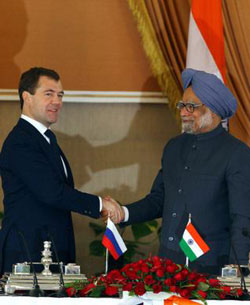 NEW DELHI, Dec 21: Imparting a new impetus to their “special and privileged” ties, India and Russia on Tuesday inked 30 pacts in several key areas such as civil nuclear cooperation and defence, including development of Fifth Generation Fighter Aircraft (FGFA) to augment country’s military capabilities.
 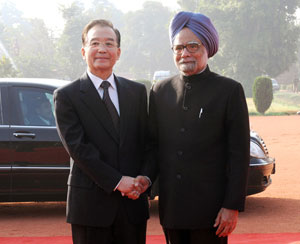 NEW DELHI, Dec 16: Indian Prime Minister Manmohan Singh on Thursday said that India and China will march together as friends and not rivals in the years to come and stressed while addressing the gathering that partnership between the two countries will be a key milestone in defining 21st century.
 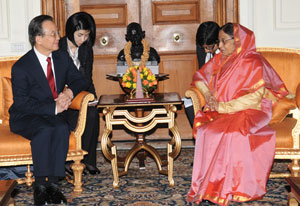 Underlining their unequivocal opposition to terrorism in all its forms and manifestations, the two countries stressed that there is no justification for any act of terrorism anywhere.
 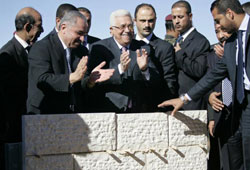 RAMALLAH, Dec 4: Palestinian President Mahmoud Abbas says if deadlocked peace talks fail, he may dissolve his self-rule government and ask Israel to resume full control of the West Bank.
 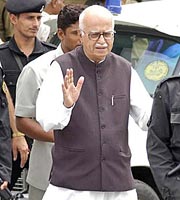 NEW DELHI, Nov 8: In unusually strong remarks, senior BJP leader L K Advani today said China's "expansionist" statements such as those on Arunachal Pradesh are creating obstacles in restoring normalcy between the two neighbours.
 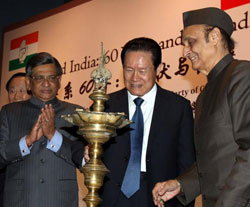 NEW DELHI, Nov 1: Observing that Sino-Indian relations are “grossly under-utilised”, External Affairs Minister S.M. Krishna on Monday said the two countries should leverage their strengths while being sensitive to each other’s concerns to realise the true potential in the ties.
 Aviation
| Business | Defence | Foreign
Affairs | Communication | Health
| India | United Nations
India-US
| India-France | Entertainment
| Sports | Photo Gallery |
Tourism | Advertise with Us
| Contact Us
© Noyanika International, 2003-2009. All rights reserved.