


Foreign Affairs
| Highly radioactive water leaks from Japanese nuclear plantTOKYO/FUKUSHIMA, March 28: Highly radioactive water has leaked from a reactor building at Japan's Fukushima nuclear plant, the operator of the crippled facility said on Monday, fuelling fears that the liquid may be seeping into the environment. The embattled operator, Tokyo Electric Power Company (TEPCO), also sought help from France's nuclear power-related firms in resolving the crisis at the plant. TEPCO sought support from firms like Electricite de France SA, Areva SA and the Nuclear Energy Agency, Kyodo news agency quoted French industry and energy minister Eric Besson as saying. The plant's operator also said that the contaminated water inside No.2 reactor was found to have radiation levels some 100,000 times the normal level, the operator. It said samples collected 30 metres from one of the plant's water outlets yesterday contained 46 becquerels per cubic centimetre of iodine-131, which was 1,150 times higher than the regulated standard level. The leak in a tunnel linked to the No.2 reactor has raised fears of radioactive liquid seeping into the environment. Earlier in the day, the government blasted TEPCO for its "absolutely unacceptable" mistake of giving an extremely high radiation reading. TEPCO was criticised by chief cabinet secretary Yukio Edono for describing the radiation levels as 10 million times higher than normal in water leaking from the No.2 reactor's turbine building, before correcting the figure to 100,000 times. "Considering the fact that the monitoring of radioactivity is a major condition to ensure safety, this kind of mistake is absolutely unacceptable," Edano said, more than two weeks after the monster magnitude-9 quake and tsunami struck Japan's northeast leaving nearly 30,000 people dead or unaccounted for. As efforts continued to remove highly radioactive water from the plant, he said he has strongly instructed TEPCO to avoid the release of erroneous data on radiation leaks. Edano said radiation analysis served as the basis for ensuring safety at the plant, where workers were struggling to safely cool the reactors and other machinery. TEPCO on Sunday apologised for the "mistake" and said a worker who took the reading in a part of No.2 reactor's cooling system had no time to confirm with a second reading because the radiation level was so high that he had to leave the area. "The number is not credible. We are very sorry," TEPCO spokesman Takashi Kurita said. NATO to take command of Libya campaignBRUSSELS, March 25: NATO members have struck a deal in principle to take over command of military operations in Libya within days from the coalition led by Britain, France and the United States. "NATO countries are in agreement to launch final planning, enabling it to take over the command from the coalition on Monday or Tuesday," said the diplomat, who asked not to be named. Another diplomatic source cautioned however that details remain to be worked out over a no-fly zone enforced by the coalition since Saturday, due to Ankara's continued objections to strikes against Muammar Gaddafi's regime. After days of difficult talks, discussions continued late on Thursday at NATO's Brussels headquarters. In Ankara, Turkish Foreign Minister Ahmet Davutoglu also announced the NATO takeover after a conference call with his US, French and British counterparts. "The coalition formed after a meeting in Paris is going to give up its mission as soon as possible and hand over the entire operation to NATO with its single command structure," Davutoglu said, according to Anatolia news agency. Several NATO allies, including Britain and Italy, wanted the 28-member alliance to run the show. But Paris argued that flying the mission under NATO's flag would alienate Arab allies suspicious of the Western military machine. Few Arab states have joined the military campaign, with Qatar the only nation contributing fighter jets. Turkey, NATO's sole Muslim member, has offered a submarine and vessels to enforce an arms embargo on the seas. In Ankara, parliament on Thursday approved the dispatch of a naval force, as the Islamist-rooted government moved reluctantly to join military action despite anger at Western-led air raids. Prime Minister Recep Tayyip Erdogan has slammed coalition strikes, saying "we have seen in the past that such operations are of no use and that on the contrary, they increase the loss of life, transform into occupation and seriously harm the countries' unity." As Washington pressed for a transfer of command, NATO envoys have been meeting at headquarters for several days to discuss the issue. One compromise under discussion would allow countries opposed to the strikes, such as Turkey, to opt out of such operations while others could take part in the attacks, diplomats said. Italian Defence Minister Ignazio La Russa on Thursday evoked two possible aerial missions over Libya, one run by NATO and a second "no-fly zone plus" with a broader mandate that would permit strikes against targets on the ground. Allies still have to hammer out the political structure of the more offensive operation, he said. Italy accused the French of being "intransigent" and threatened to take back control of the seven air bases it offered for no-fly zone operations if the command handover is not sealed. British Foreign Secretary William Hague said London wanted "transition to NATO command and control as quickly as possible" and said it expected "to get that soon." Dutch Prime Minister Mark Rutte warned his country would only take part in a no-fly zone headed by NATO. "For me it's the key," Rutte said. European Union leaders, torn over Libya after Germany broke ranks with allies by refusing to back the UN Security Council resolution approving the strikes, were working to overcome divisions at a two-day summit that opened Thursday. Germany went into the talks calling for a "total" oil embargo on Gaddafi's regime, as others urged an upgrade in recognition of Libyan rebels. "There's a form of give-and-take being negotiated between these positions", a diplomatic source said. The countries taking part in military action, such as Britain, France and Italy, are less inclined to step up sanctions, said an EU diplomat who asked not to be named. France, however, is expected to press for the EU to add political weight to anti-Gaddafi insurgents in the interim transition council, by recognising them as "legitimate" rather than merely "political" interlocutors -- the status decided at an EU summit earlier this month. Israeli planes raid GazaJERUSALEM, March 25: Israeli jets have staged three air strikes over Gaza, hours after a bomb struck a crowded bus stop in West Jerusalem, killing at least one person and wounding 30 in what authorities said was the first major attack in the city in several years. Hamas, the Palestinian group which controls the Gaza Strip, said on Thursday that the strikes targeted smuggling tunnels along the Gaza-Egypt border, as well as one of its training camps in central Gaza. A third strike hit a power transformer, causing blackouts in the area, witnesses said. Medical workers said no one was injured in the strikes. Hamas said it ordered its personnel to evacuate their positions. An Israeli defence spokeswoman confirmed the sorties, saying: "The air force targeted two tunnels at the south of the Gaza Strip and a terrorist target in Gaza." The military said the strikes were a response to the recent barrage of rockets. Wednesday's bombing of the bus stop came several hours after two Grad rockets fired from Gaza hit the southern Israeli city of Beersheva. Al Jazeera's Nisreen El-Shamayleh, reporting from Jerusalem, said that one person, a 60-year-old woman, died following the blast at the bus stop. "There was no immediate claim of responsibility. [...] The normal reaction is for people to blame Palestinian groups when there is an explosion in Jerusalem, but the police are carrying out an investigation and aren''t ruling out any possibility," our correspondent said. Micky Rosenfeld, a police spokesman, told Al Jazeera that a device in a bag that was left in a phone booth near the bus station exploded when the bus passed. "This was not a suicide attack," Rosenfeld said. Benjamin Netanyahu, the Israeli prime minister, warned militants not to test Israel's "iron will," and vowed a tough response to the bombing. Netanyahu said that Israel would act aggressively and responsibly after the attack in Jerusalem. "Israel will act aggressively, responsibly and wisely to preserve the quiet and security that prevailed here over the past two years," Netanyahu said before boarding a plane to Moscow where he will meet Russian leaders. Meanwhile, Nir Barkat, the Jerusalem mayor, said the city would rebound quickly, vowing that Jerusalem's first-ever marathon would take place as planned on Friday. Bombings have been rare in Jerusalem in the past several years. Palestinians carried out dozens of bombings in the city at the height of an uprising that began in 2000. More than 100 killed in Syria protest city: Rights activistDAMASCUS, March 25: More than 100 people were killed by police gunfire in Syria's southern protest city of Daraa, human rights activists and witnesses said on Thursday. "There are definitely more than 100 dead and the city will need a week to bury its martyrs," said human rights activist Ayman al-Asswad in Daraa, reached by telephone from Nicosia. Asswad said security forces had "used real bullets" when firing against demonstrators on Wednesday in Daraa, 120 kilometres south of Damascus, and a second activist put the figure as high as "more than 150" killed. Syrian authorities on Thursday told reporters 10 people died in the security forces crackdown on Daraa, a town of 75,000 people that has become a hub for anti-regime protests since 18th March. US says it is troubled by violence in SyriaTroubled by the recent violence and death of civilians in Syria, the United States has called on the Syrian Government to exercise restraint against its peaceful protesters. "The United States is deeply troubled by violence and civilian deaths in Dara'a at the hands of security forces," the State Department spokesman, Mark Toner, said. "We are concerned by the Syrian Government's use of violence, intimidation and arbitrary arrests in Dara'a to hinder the ability of its people to freely exercise their universal rights," he said. The United States condemns these actions and extend its deepest condolences to the families and friends of those who have been injured or lost their lives. "We call on the Syrian Government to exercise restraint and refrain from violence against peaceful protesters," Toner said. Tsunami alert sounded in NE Japan, evacuation beginsSOMA, March 14: Soldiers and officials along a stretch of Japan's northeastern coast warned residents that the area could be hit by another tsunami on Monday and ordered them to higher ground. But the Meteorological Agency said there was no risk of another deadly wave. The warning came as an explosion rocked the nearby Fukushima Daiichi nuclear power plant. The blast was felt 30 miles (50 kilometers) away by journalists in the coastal town of Soma, where residents fled the town for safety after being herded quickly through muddy, debris-strewn streets. TV footage showed a massive column of smoke belching from the Fukushima Daiichi nuclear plant's No. 3 unit, about 125 miles (190 kilometers) north of Tokyo. Japanese officials said they believe it was a hydrogen explosion similar to an earlier one at a different unit in the facility. The problems at the plant stem from failed cooling systems caused by damage from Friday's earthquake and tsunami. More than 180,000 people have evacuated the area, and up to 160 may have been exposed to radiation. Before the power plant blast, sirens around Soma, which was battered by Friday's tsunami, went off and public address systems ordered residents to safety. Farther south along the coast, helicopters flew over coastal communities warning residents to head to higher ground. In Sendai, the biggest city in the area, police announced warnings on a public address system. In Tokyo and elsewhere, authorities began rolling blackouts to conserve power as they tried desperately to stabilize the nuclear reactors at risk of meltdown in the aftermath of the earthquake and tsunami. The disasters sent Tokyo's stock market plunging as it opened, raising fears of a steep economic toll on top of the already overwhelming human suffering. The planned blackouts of about three hours each in Tokyo and other cities are meant to help make up for the loss of power from key nuclear plants. Trade Minister Banri Kaieda said Sunday that the power utility expects a 25 percent shortfall. Some 1.9 million households were without electricity, but many people were without even more basic necessities. At least 1.4 million households had gone without water since the quake struck, and food aid was slow in reaching many areas. Friday's quake and tsunami, which swallowed towns and tossed large ships like game-board pieces, caused tens of billions of dollars in losses, according to preliminary estimates. And the first day of stock trading since the disasters opening underlined the challenges Japan's already fragile economy will have in bouncing back. The benchmark Nikkei 225 stock average shed 494 points, or 4.8 percent, to 9,760.45 just after the market opened Monday. Japan's central bank quickly responded by injecting 7 trillion yen (US$85.5 billion) into money markets. The most urgent crisis remained at a nuclear plant along the ravaged northeastern coast, where operators worked frantically to try to lower temperatures of crippled reactors. Four nuclear plants had at least some damage, but two reactors at the Fukushima Dai-ichi nuclear complex were at the greatest risk of meltdown. Operators dumped seawater into the two reactors in a last-ditch cooling effort. More than 180,000 people have evacuated the area, and up to 160 may have been exposed to radiation. Officials have confirmed about 1,800 deaths from the earthquake and tsunami _ including 200 people whose bodies were found Sunday along the coast _ and said more than 1,700 were missing and 1,900 injured. The death toll seemed certain to get much higher after a report from Miyagi, one of the three hardest hit states. The police chief estimated that more than 10,000 people were killed there, police spokesman Go Sugawara told The Associated Press. Only about 400 people in the state of 2.3 million have been confirmed dead so far. US asks Gaddafi aides to leave him or face consequencesWASHNGTON, March 8: The US has asked close associates of Libyan leader Muammar Gaddafi to leave their leader or be ready to face the consequences of human rights violations against their own people. "Those who are around Colonel Gaddafi and making that existential choice right now about whether they want to be on the side of the Libyan people or on the side of a leader and a regime that no longer has any legitimacy, they should be fully aware of the fact that the world is watching what they do and they will be held accountable for their actions," White House spokesman Jay Carney said. The United States knows a number of the people around Colonel Gaddafi, he said, adding the Obama Administration was working to have a fuller list of people who can and will be held accountable for the actions that the regime was taking against its own people. "We have tried to make is that we are using the full spectrum of our intelligence capabilities to assist us in identifying those who must be held accountable for the actions that they're taking," Carney said. US was having a broad range of contacts, including with members of the Libyan government in Libya. "It is both true and very important to have it be perceived true that the unrest in Libya, the drive to force Colonel Gaddafi from power, and the unrest throughout the region is organic; it is not inspired by the United States or other Western or foreign countries. "That's an important factor here in the historic developments we see in these last weeks and months," he said. Responding to questions, he, however, did not say that restoring diplomatic relationship with Libya by the previous Bush Administration was a mistake. "I think we're focused right now on the crisis that has unfolded in Libya in the last several weeks. The fact that the Libyan government took actions to rid itself of weapons of mass destruction was obviously a positive thing. "But right now we are focused on the crisis at hand and not the past," Carney said. Two-thirds of Indians in Libya pulled out: MEANEW DELHI, March 8: With another 1,400 Indian nationals having been flown out of Libya in the preceding 24 hours, the total number of Indian evacuees has crossed 12,000, which is more than two-thirds of the country's population in the strife-torne country. MV Red Star One returned to Malta from Misurata with all the 301 Indians desirous of leaving Libya and the passengers returned to India on Sunday night on special Jet Airways and Kingfisher flights, the Ministry of External Affairs said in New Delhi on Monday. Giving an update on the evacuation process taken up since 26th February, the Ministry said MV Red Star One would again sail for Sirte (Libya) and is expected to evacuate 600 persons to Malta. "Presently, we have 1600 of our nationals in Sirte, many of who may be heading for Tripoli by road for being air lifted from there," it said. The Ministry said the arrival of MV Scotia Prince, which was on its way back to Alexandria, Egypt, with 972 persons from Benghazi (Libya) on board, has been delayed due to some engine trouble and is now expected to reach Tuesday evening. All passengers will be flown back to India on three Egypt Air and an IL-76 flights on 9th March. 2 killed in attack on US military bus at Frankfurt airportFRANKFURT, March 2: Two US airmen have been shot dead and two wounded at Frankfurt airport. The gunman, believed to be from Kosovo, opened fire on a bus containing US airmen in front of Terminal 2. The bus driver and a passenger were killed and two others were seriously injured. Police said it appeared an argument had broken out on board the bus before the suspect opened fire. The dead soldier was found outside the bus, which had a US government licence plate marked "AF", for air force. The two injured had been shot in the head and chest, police said. The gunman fled from the scene and a suspect was arrested inside the terminal shortly afterwards. Police would not give out any information on the suspect, but Kosovo said he was one of its citizens. Kosovo's interior minister, Bajram Rexhepi, said German police had identified the suspect as 21-year-old Arif Uka, from the northern town of Mitrovica. "This is a devastating and a tragic event," Rexhepi said. "We are trying to find out was this something that was organised or what was the nature of the attack." The Pentagon and the US air force had no immediate information on the incident. Patrick Meehan, a member of the US homeland security committee, said it looked like a terrorist attack. The worst previous attack on US soldiers on German soil was in 1986, when a bomb was planted in a Berlin disco. Two soldiers died along with a Turkish woman, and 230 people were injured, including 44 Americans. The US blamed Libya and bombed Tripoli and Bengazi in retaliation. In the 70s and 80s, the leftwing German terror group Red Army Faction repeatedly targeted US soldiers in Germany. Pakistan Minister Bhatti gunned downISLAMABAD, March 2: Pakistan's Minister for Minority Affairs Shahbaz Bhatti was gunned down near his residence here on Wednesday morning. The assassination is being linked to the blasphemy issue that consumed the life of Punjab Governor Salman Taseer in the federal capital itself just two months ago as Mr. Bhatti advocated changes in the blasphemy law. Pamphlets of the Tehreek-e-Taliban Pakistan were found at the site of the assassination in the I-8/3 residential area. They referred to the blasphemy issue, lending further credence to the belief that the Minister — a Christian by faith — was assassinated for supporting the amendments to the blasphemy law proposed by Pakistan People's Party legislator Sherry Rehman. Mr. Bhatti himself had voiced fears for his life, stating that threats had increased ever since Taseer's assassination. The Minister was on his way to a Cabinet meeting when his car was intercepted by a vehicle and the assailants opened fire. Initial reports suggested that the driver was pulled out of the car before the Minister was fired upon. However, Inspector-General of the Islamabad Police Wajid Durrani quoted the driver as saying that three assailants first aimed at him before pumping bullets into Mr. Bhatti. At the time of the incident, Mr. Bhatti had no security cover. Though he was assigned two escort vehicles — one manned by the police and another by the Frontier Constabulary — Mr. Durrani claimed they were told to wait for Mr. Bhatti at his office. Obama, Sarkozy call for end to violence in LibyaPARIS, Feb 25: French President Nicolas Sarkozy and US President Barack Obama have jointly called for violence against civilians in Libya to end, on the 10th consecutive day of protests calling for leader Muammar Gaddafi's ouster. The two leaders exchanged information on the crisis in the north African country during a telephone conversation Thursday. Sarkozy said he intends to request another emergency meeting of the UN Security Council on the matter, a statement issued by his office said. Concrete steps are needed to insure humanitarian aid to Libya and the punishment of those responsible for attacks on the protesters, Sarkozy said. The two leaders also agreed to maintain 'close contact' over the Libyan crisis. India preparing for 'mammoth' Libya evacuation
The Bangladeshi government has also restated its plans to repatriate 50,000 mostly manual labourers in Libya. The Pakistani embassy in Libya says that 18,000 Pakistanis there are safe. "We have not received any report regarding untoward incidents against Pakistanis. We have no consulate or a commercial section in [the eastern city of] Benghazi but we are in contact with Pakistani people living there and according to them they are safe," said Pakistan's acting ambassador to Libya, Ali Javed. "So far we have not received any reports about injuries or deaths of Pakistanis," he said. The Nepalese embassy in Libya meanwhile says that it is continuing with efforts to evacuate immediately about 600 Nepali migrant workers stranded in the city of Darnah. It says that plans have been initiated to bring the workers 800km (497 miles) from Darnah to Cairo after the South Korean construction company which employs them said that it was unable to arrange for their evacuation because of the turmoil in Libya. "We will rescue the workers by Thursday," First Secretary Tirtha Aryal said in Kathmandu. "We have already initiated a process to obtain legal permission from the Egyptian authorities to rescue our citizens." There are about 2,000 Nepali labourers in Libya. Ms Rao said an Indian passenger ship was on standby in the Red Sea which could carry 1,000 people to safety. The Indian foreign ministry on Wednesday condemned the violence, saying that it gave cause for "serious concern". "The government [of India] deplores the use of force which is totally unacceptable and must not be resorted to," it said. The Bangladeshi government says it will do "everything it can, whatever it takes, to ensure the safety and security of our workers, but the situation is very, very volatile". 400 killed in New Zealand quakeCHRISTCHURCH, Feb 23: New Zealand rescuers worked frantically through the night to reach trapped survivors after a catastrophic earthquake left nearly 400 people dead or missing in Christchurch. Prime Minister John Key, declaring a national emergency after New Zealand's worst natural disaster in 80 years, said the region around the country's second largest city had suffered "death and destruction on a dreadful scale". Rescuers had to amputate limbs from survivors to free them from smouldering ruins of buildings reduced to debris in minutes, while dazed survivors were plucked from the rubble in a desperate overnight rescue mission. Christchurch resident Tom Brittenden said he saw a woman die with her baby in her arms when she was hit by falling debris in the city's Cashel St Mall. Her baby survived but she was killed instantly. "We tried to pull these big bricks off (her)... she was gone," he told the Christchurch Press. Rescuers have recovered 75 bodies since the 6.3 magnitude quake struck at lunchtime on Tuesday, and about 300 people are still missing, officials said. The quake was the deadliest to hit New Zealand since 256 people died in a 1931 tremor, and it came six months after a 7.0 magnitude quake weakened buildings in Christchurch, but miraculously resulted in no deaths. The latest tremor toppled many buildings and left central Christchurch strewn with debris. The city's landmark cathedral lost its spire. Dozens of aftershocks rocked the city on Tuesday and overnight, hampering rescue efforts. Police Superintendent Russell Gibson warned that the toll was certain to rise as more than 500 emergency workers combed through shattered buildings, listening out for any signs of life. "There is incredible carnage right throughout the city," he told Radio New Zealand. "There are bodies littering the streets, they are trapped in cars and crushed under rubble." Most of the city remained without power and Gibson said rescue crews working through the night had freed 20 to 30 people, some at desperate cost. Defiant Gaddafi vows to die as martyr, fight revolt
"I shall remain here defiant," said Gaddafi, speaking outside one of his residences, which was heavily damaged in a 1986 U.S. bombing raid that attempted to kill him. Outside the building stood a monument of a giant fist crushing a U.S. warplane. In a trademark rambling address, Gaddafi urged his supporters to take to the streets, saying protesters warranted the death sentence. He also promised a vague overhaul of government structures Earlier, witnesses streaming across the Libyan border into Egypt said Gaddafi was using tanks, warplanes and mercenaries in an effort to stamp out the growing rebellion. In the eastern city of Tobruk, a Reuters correspondent there said sporadic blasts could be heard, the latest sign that Gaddafi's grip on the oil and gas exporting nation was weakening. "All the eastern regions are out of Gaddafi's control now ... The people and the army are hand-in-hand here," said the now former army major Hany Saad Marjaa. The White House offered its condolences for the "appalling violence" in Libya and said the international community had to speak with one voice on the crisis. The U.N. refugee agency meanwhile urged Libya's neighbours to grant refuge to those fleeing the unrest, which was triggered by decades of repression and popular revolts that toppled leaders in Tunisia and Egypt. On the Libyan side of the border with Egypt, anti-Gaddafi rebels armed with clubs and Kalashnikov rifles welcomed visitors. One man held an upside-down picture of Gaddafi defaced with the words "the butcher tyrant, murderer of Libyans", a Reuters correspondent who crossed into Libya reported. Hundreds of Egyptians flowed in the opposite direction on tractors and trucks, taking with them harrowing tales of state violence and banditry. Gaddafi’s son warns of civil war in Libya
Seif al-Islam Gaddafi, in the regime’s first comments on the six days of demonstrations, warned the protesters that they risked igniting a civil war in which Libya’s oil wealth “will be burned”. The speech followed a fierce crackdown by security forces who fired on thousands of demonstrators and funeral marchers in the eastern city of Benghazi in a bloody cycle of violence that killed 60 people on Sunday, according to a doctor in one city hospital. Since the unrest began, more than 200 people have been killed, according to medical officials, human rights groups and exiled dissidents. Libya’s response has been the harshest of any Arab country that has been hit by protests that toppled long-serving leaders in neighbouring Tunisia and Egypt. But Mr. Gaddafi’s son said his father would prevail. “We are not Tunisia and Egypt,” he said. “Muammar Gaddafi, our leader, is leading the battle in Tripoli, and we are with him. “The armed forces are with him. Tens of thousands are heading here to be with him. We will fight until the last man, the last woman, the last bullet,” he said in a rambling and sometimes confused speech of nearly 40 minutes. Although the elder Gaddafi did not appear, his son has often been put forward as the regime’s face of reform. Western countries have expressed concern at the rising violence against demonstrators in Libya. British Foreign Secretary William Hague said he spoke to Mr. Seif al-Islam by phone and told him that the country must embark on “dialogue and implement reforms,” the Foreign Office said. In his speech, the younger Gaddafi conceded the army made some mistakes during the protests because the troops were not trained to deal with demonstrators, but he added that the number of dead had been exaggerated, giving a death toll of 84. He offered to put forward reforms within days that he described as a “historic national initiative” and said the regime was willing to remove some restrictions and begin discussions for a constitution. He offered to change a number of laws, including those covering the media and the penal code. Dressed in a dark business suit and tie, Mr. Seif al-Islam wagged his finger frequently as he delivered his warnings. He said that if protests continued, Libya would slide back to “colonial” rule. “You will get Americans and European fleets coming your way and they will occupy you.” He threatened to “eradicate the pockets of sedition” and said the army will play a main role in restoring order. “There has to be a firm stand,” he said. “This is not the Tunisian or Egyptian army.” Protesters had seized some military bases, tanks and other weapons, he said, blaming Islamists, the media, thugs, drunks and drug abusers, foreigners, including Egyptians and Tunisians. He also admitted that the unrest had spread to Tripoli, with people firing in central Green Square before fleeing. The rebellion by Libyans frustrated with Mr. Gaddafi’s more than 40 years of authoritarian rule has spread to more than half-a-dozen eastern cities, but also to Tripoli, where secret police were heavily deployed on the streets of the city of two million. Armed security forces were seen on rooftops surrounding central Green Square, a witness said by telephone, speaking on condition of anonymity for fear of reprisal. The witness added that a group of about 200 lawyers and judges were protesting inside a Tripoli courthouse, which was also surrounded by security forces. An exiled opposition leader in Cairo said hundreds of protesters were near the Bab al-Aziziya military camp where Mr. Gaddafi lives on Tripoli’s outskirts of Tripoli. Faiz Jibril said his contacts inside Libya were also reporting that hundreds of protesters had gathered in another downtown plaza, Martyrs Square. In other setbacks for Mr. Gaddafi’s regime, a major tribe in Libya was reported to have turned against him and Libya’s representative to the Arab League said he resigned his post to protest the government’s decision to fire on defiant demonstrators in Benghazi, the second-largest city. Khaled Abu Bakr, a resident of Sabratha, an ancient Roman city to the west, said protesters besieged the local security headquarters, driving out police and setting it on fire. Mr. Abu Bakr said residents were in charge and had set up neighbourhood committees to secure their city. The Internet has been largely shut down, residents can no longer make international calls from land lines and journalists cannot work freely, but eyewitness reports trickling out of the country suggested that protesters were fighting back more forcefully against the Middle East’s longest-serving leader. “We are not afraid. We won’t turn back,” said a teacher who identified herself only as Omneya. She said she was marching at the end of the funeral procession on a highway beside the Mediterranean and heard gunfire from two kilometres away. “If we don’t continue, this vile man would crush us with his tanks and bulldozers. If we don’t, we won’t ever be free,” she said. Protesters throwing firebombs and stones got on bulldozers and tried to storm a presidential compound from which troops had fired on the marchers, who included those carrying coffins of the dead from Saturday’s unrest in the eastern city, a witness said, speaking on condition of anonymity because of fears of reprisal. The attempt was repulsed by armed forces in the compound, according to a witness and the official JANA news agency, which said a number of attackers and solders were killed. Later, however, a Benghazi resident said he received a telephone text message that an army battalion that appeared to be sympathetic to the demonstrators and led by a local officer was arriving to take over control of the compound, and urging civilians to get out of the way. Arab world undergoing 'earthquake': Israeli PMJERUSALEM, Feb 14: Israel's prime minister says an "earthquake" is under way in the Arab world but that he "hopes for the best." In a reference to unrest throughout the region, including the toppling of Egyptian President Hosni Mubarak by popular protests, Benjamin Netanyahu said Monday that Israel hopes to strengthen its existing peace agreements and sign new ones, but remains "prepared for any possibility." Israel and Egypt signed a peace agreement in 1979. The accord has been a lynchpin of regional stability for three decades. After forcing Mubarak to step down, Egypt's ruling military council said over the weekend that it would honor the accord — easing jitters in Israel. Egypt's military rulers dissolve parliament, suspend constitutionCAIRO, Feb 13: Egypt's military leadership Sunday dissolved both the upper and lower houses of the parliament and suspended the constitution. Earlier Sunday, scuffles broke out between Egyptian soldiers and protesters at Cairo's Tahrir Square after the military tried to remove activists from the epicentre of Egypt's uprising, eyewitnesses said. The military rulers will run the country for six months or until presidential and parliamentary elections are held, the Higher Military Council said in a statement, in which it also announced the dissolving of the parliament. Defence Minister Hussein Tantawi, who heads the council, will run the domestic affairs of the country and represent Egypt in the international arena, it said. The council has ordered Prime Minister Ahmed Shafiq to stay in office until a new cabinet is formed. The military leadership said it will abide by all the agreements and international treaties signed by Egypt. Hundreds of protesters continue to stay put in the square, as organisers say they will not leave until more of their demands, among them the installation of a civilian government, are met. For 18 days Tahrir Square was the epicentre of the nationwide protests demanding the resignation of president Hosni Mubarak, 82, who ruled Egypt for almost 30 years. Mubarak stepped down Friday and handed the power to the country's Higher Military Council. A spontaneous demonstration against Egyptian soldiers, who were trying to force a path for traffic to start flowing through Tahrir Square, broke out Sunday. 'The army is the basis of Egypt. Your objective is not to push us aside, but fulfill our demands. Otherwise, we will return,' the protestors chanted as the military made efforts to disperse them. The protesters are also demanding lifting of the state of emergency and constitutional amendments. Over one million people celebrated in Tahrir, or Liberation, square after Mubarak stepped down Friday following 18 days of massive protests across the country. Mubarak steps down; Egypt's army takes over
“Taking into consideration the difficult circumstances the country is going through, President Mohammed Hosni Mubarak has decided to leave the post of president of the republic and has tasked the supreme council of the armed forces to manage the state's affairs,” Suleiman said. A free and fair presidential election has been promised for September after a momentous 18 days that rocked Egypt. Earlier, the 82-year-old strongman had flown out of Cairo to his holiday retreat at Sharm el-Sheikh on the Red Sea, his ruling party said. As news spread cries of “Allahu Akbar” (God is greatest) and howls of victory rang out in the streets of the capital and firecrackers exploded. World oil prices slid and European stock markets bounced following news of the resignation of Mubarak. In Tahrir Square, several protesters fainted with the emotion of the moment following two weeks of protest. The plaza has become a focal point of the revolt since it was occupied by protesters in late January, and earlier in the day had been thronged by hundreds of thousands of Egyptians, who prayed and chanted abuse at Mubarak. "People here don't care if he's in the palace or not. We want him to quit the presidency,” said 40-year-old Mohammed Hamdan, who works for an oil firm. On Thursday night, hundreds of thousands had crowded into the square to hear a speech that was widely expected to be Mubarak's last as president. Instead, he delegated some of his powers to Suleiman, while vowing he would stay in office until September and one day die in Egypt, ruling out a flight into exile. Mubarak had also been on a collision course with the international community, and in particular Egypt's key ally and donor, Washington. US President Barack Obama reacted with a flash of anger of his own, saying Mubarak had failed to map out “meaningful or sufficient” change, or to speak clearly enough to Egypt and the world. India welcomes Mubarak's decision to step down
"We welcome the decision of President Mubarak to step down in deference to the wishes of the people of Egypt," External Affairs Minister S M Krishna said in a statement while reacting to the development in Egypt. He said: "We also welcome the commitment of the Supreme Council of the Armed Forces to ensure a peaceful transition of power in a time-bound manner to establish and open a democratic framework of governance." Noting that India had traditionally close relations with Egypt, he wished the people of Egypt peace, stability and prosperity. Now, call to storm Egypt ParliamentCAIRO, Feb 10: Protests against President Hosni Mubarak's regime have spread to more parts of Egypt with two people reportedly being killed in clashes with the police in a remote area in the South West. In Cairo too, activists broadened the area of demonstration beyond Tahrir Square with a breakaway group settling next to the national Parliament building. Organisers in Tahrir say that a big push is planned for Friday that could include storming the Parliament and shutting down the state run television building — both of which are located just blocks off the Liberation Square. The move could spark violence as both the establishments are guarded by the Army that has placed multiple barricades using tanks. By Wednesday evening, hundreds of protesters geathered near the Parliament, demanding that it should be immediately dissolved. While Tahrir in Cairo saw the largest gathering on Tuesday, with similar reports emerging from Alexandria and Suez, news has now come in from the south-western Al-Wadi al-Jadid town about a violent clash on the same day between pro-democracy demonstrators and the police that has left at least two dead and over 40 injured. UK's Cameron: Authorities should ‘meet aspirations of Egyptian people’By Deepak Arora
The British Premier has urged the Egyptian government to "take bold and credible steps" to show protesters and the world that it is serious about a move toward democracy. The two spoke by phone on Monday. He said Britain and the U.S. want to see opposition figures brought into the government and a date announced for Egypt to publish a roadmap to new elections. Updating the British Parliament on Monday on the February 4 European Council conclusions on Egypt, Cameron said: "The Egyptian authorities should “meet the aspirations of the Egyptian people with political reform not repression. "The European Council was clear that this has to involve the building blocks of free and open societies and democratic institutions, such as freedom of assembly, the rule of law, freedom of speech and free and fair elections. He urged "the leaders in Egypt now to show that there's an irrevocable change taking place." He also repeated the message "to avoid repression, harassment of journalists, abuse of the internet because these things are hugely damaging to Egypt and the wider world and they are wrong in principle." Cameron calls for doubling India-UK trade; seeks opening of FDIBy Deepak Arora
Speaking at the first meeting of the UK-India CEO Forum at Downing Street, Cameron called for doubling the bilateral trade which now stands at $ 11 billion. “Cooperation on trade is the single biggest stimulus we could give our economies right now.” To be fair, he said things were improving. “India-UK trade went up by more than two-thirds between 2004 and 2009, and now stands at more than $11 billion a year. But things could still be so much better. “Today, the UK still trades more with Sweden than it does with India. Is that good enough? I don’t think so. That’s why yesterday, at the UK-India CEO Summit, I agreed a new bold target to double trade between our two countries by 2015,” he added. The British Prime Minister said setting the target was one thing, getting there was quite another. “There are some relatively simple steps we can take, like streamlining customs red tape to save time and money — and we’re committed to it.” Other things, he said, would take more time — not least, working for international trade agreements at Doha and between the EU and India. The British Prime Minister hosted the first meeting of the UK-India CEO Forum on Thursday at Downing Street to discuss how best to improve trade between the two countries. Considerable scope to do more with SAARC: Nirupama Rao
Ms. Rao's opening observations came at the SAARC Foreign Secretaries' conclave to evolve a Periodical Analytical Report for the consideration of their Foreign Ministers, who will meet on Tuesday and Wednesday. Ms. Rao lauded the progress in cooperation in areas such as environment, energy, agriculture, rural development and trade, but wanted SAARC to devote more energy to ensure the early ratification of the Agreement on Trade in Services signed at the previous summit here in April last. India has already submitted its sector-specific request list of services to various members and hopes that the ‘request-offer process' can soon gather pace at the meeting of the Expert Group scheduled for the end of March. Both Ms. Rao and Pakistan Foreign Secretary Salman Bashir dwelt on developing substantive cooperation with observers including other regional organisations and extra-regional states that have showed interest in SAARC. At the same time, Ms. Rao felt that SAARC must not lose sight of fundamental principles of cooperation that should continue to be based on mutual self respect of each other's identity. “Such engagements need to be rooted in SAARC's charter and its objectives and priorities, and be based on concrete assessed regional developmental needs in mutually agreed areas,” she said. “Having just completed 25 years of SAARC, we can say that the process is maturing and we are now gradually focusing on providing more services for the economic and development needs of our people.” Bangladesh Foreign Secretary Mijarul Quayes laid stress on greater connectivity, economic integration and cooperation in security. Mr. Bashir also emphasised cooperation in the areas outlined by Ms. Rao. He identified the priority sectors as environment and climate change, energy and food security, and promoting project-based cooperation. Pakistan fully supported trans-regional economic, energy and development cooperation, he added. “South Asia today is witnessing vibrant democracies at work. The formulation of the SAARC Democracy Charter was an important achievement,” Mr. Bashir said. The charter is an initiative of Bangladesh Prime Minister Sheikh Hasina and is being piloted at a time when all SAARC members happen to be democracies. Nirupama calls for patience with India-Pakistan talks
"I think it would not be in order to do that. …as they say, in life as in diplomacy, ripeness is all. We have to wait for this process to mature,’’ she explained the rectitude among both Pakistani and Indian officials to release further details about the meeting. "All in all, I think it was a very useful meeting. Both of us adopted an open and constructive attitude and I am satisfied with the meeting,’’ observed the Foreign Secretary. "We had a good meeting. It was a useful meeting. We were able to discuss a number of issues of relevance to the relationship between both countries.’’ It was not a discussion dominated by one issue. Both Foreign Secretaries talked about the process and to chart the way forward and what the best modalities would be. "So that was really the focus of what we discussed during the meeting.’’ On the question of what next, the Foreign Secretary reiterated the standard Foreign Office line of cautious optimism because there were many issues that needed to be resolved. "As the nature of the relationship has been very complex, so we have to be realistic and should be aware of the realities. But we should have a vision for the future and that is what our Prime Minister feels. And I believe from what Mr. Bashir told me, their Government is also committed to taking the dialogue with India on all outstanding issues forward in a constructive way," she said. Egyptian regime, opposition agree on forming reform committeeCAIRO, Feb 6: The campaign against Egyptian President Hosni Mubarak took a decisive turn on Sunday as the regime and opposition groups including the outlawed Muslim Brotherhood agreed to form a committee to study constitutional reform to chart a way towards a transition of power. Egypt's opposition groups and the ruling regime entered into landmark negotiations today that came after 13 days of unrelenting street protests by Egyptians seeking an end to Mubarak's 30-year rule and a move towards a representative government. The first day of talks resulted in an agreement over a the setting up of a committee comprising political and judicial figures to study possible constitutional amendments on putting term limits for the presidential tenures and defining rules for who can run for the presidency, according to the state media. However, there is so far no confirmation on this from the opposition camp. This is the first time that Egypt's ruling regime has entered into any kind of negotiations with the Brotherhood which has a vast organisational network in the country and is widely expected to fill the political space in a post-Mubarak democratic Egypt. The committee has been asked to finish its task by the first week of March following which the future course of action will be decided. However, so far there appears to be no indication that Mubarak would step down immediately as demanded by the thousands of protesters who have been camping at Cairo's Tahrir Square. The opposition groups met Vice President Omar Suleiman to press for their "legitimate demands", even as central Cairo remained flooded with demonstrators who observed a 'Day of Martyrs' to honour those killed in the anti-government unrest. The landmark talks aimed at bringing a peaceful end to the mass uprising came a day after the top leadership of Egypt's ruling National Democratic Party resigned en masse. The top executive of the NDP, which includes Mubarak's son Gamal Mubarak who is head of the powerful policies committee, resigned from the party. According to the Brotherhood's website, group's senior leaders began the talks, demanding an immediate elimination of Emergency Law and guarantees for peaceful protests. "We are starting a round of talks to know how serious they are about responding to the demands of the people," said Brotherhood spokesman Gamal Abul Nasser. Brotherhood, which is officially banned in Egypt but enjoys popular support, said it would drop out if demands expressed by the protesters that President Mubarak must step down is not met. The talks were joined by a number of other smaller opposition groups, including Wafd and Tagammu. Key opposition figure Mohamed ElBaradei, however, was not present at the talks. The talks are backed by US Secretary of State Hillary Clinton who said the government's dialogue with the opposition must be given time. Meanwhile, the demonstrators rejected the shuffle in NDP as a cosmetic move as they managed to keep their position in the Tahrir Square -the hub of anti-regime protests in central Cairo despite a heavy army presence and attacks by pro-government supporters. The protesters described Sunday as "Day of Martyrs", to honour those killed in the protests. They have called for fresh multi-million-strong marches on Tuesday and Friday. Meanwhile, a semblance of normalcy returned to the Egyptian capital as banks and shops opened after over a week and people queued up to withdraw money and purchase necessities. The Egyptian army has tightened security around the square and prevented food from reaching the protesters. At least 300 people are believed to have been killed and thousands injured since the protests began on January 25, according to the UN high commissioner for human rights. In a late-night shake up, Hossam Badrawi was named the new secretary-general of the NDP, replacing Safwat El-Sherif, a Mubarak loyalist. Badrawi, seen by many as a liberal, will also replace Gamal Mubarak as head of the party's policies bureau. Other new appointees include Mohamed Ragah Ahmed, Mohamed Ahmed Abd El-Illah, Maged Mahmoud Younes El-Shirbiny, Mohamed Ahmed Abd El-Salam Hebah and Dr Mohamed Mostafa Kamal, Al Jazeera channel reported. Stepping up diplomatic efforts to resolve the crisis in Egypt, US President Barack Obama has spoken to several world leaders about the unrest in the Arab state, emphasising the need for a quick beginning of an "orderly peaceful transition" there. Obama, who is closely monitoring the situation in Egypt, spoke to Crown Prince Mohammed bin Zayed of the UAE, British Prime Minister David Cameron and Chancellor Angela Merkel of Germany on phone, the White House said. Obama emphasised the importance of "an orderly, peaceful transition, beginning now, to a government that is responsive to the aspirations of the Egyptian people, including credible, inclusive negotiations between the government and the opposition," it said, adding that the leaders agreed to stay in close contact. Separately, Vice President Joe Biden called his new Egyptian counterpart Suleiman to stress the need for "immediate steps" which demonstrate the Egyptian government's commitment to reforms, the White House said. 5 killed, 900 hurt in fresh Cairo square violence
Sustained bursts of automatic weapons fire and powerful single shots began at around around 4am local time (2.00GMT) and was ongoing more than an hour. Pro-democracy protest organiser, Mustafa el-Naggar, who's in Tahrir Square, said the gunfire came from at least three locations in the distance. He said the Egyptian military entered the square with tank squads to try to keep some order, but did not intervene. An Al Jazeera online producer in Tahrir Square witnessed doctors attending to two gunshot victims, one who was shot in the head. "There was a puddle of blood on the concrete beneath the man ... but he still had a pulse and might survive," our producer said. The gunfire marks an escalation of tensions, which began on Wednesday when supporters of embattled president Hosni Mubarak charged into Tahrir Square - some on horses and some on camels - clashing with pro-democracy demonstrators gathered there. Protesters from both sides fought pitched battles in Tahrir Square, the epicentre of ongoing demonstrations against Hosni Mubarak, which entered their tenth day on Thursday. Pro-Mubarak supporters also threw Molotov cocktails and homemade bombs at opposition protesters, who erected makeshift barricades around the square. Our online producer there visited an ad hoc 'prison' where protesters had already captured around six pro-Mubarak supporters. Hillary Clinton, the US secretary of state, condemned the "shocking" bloody clashes that rocked Cairo, in a call to Vice President Omar Suleiman. "The secretary urged that the government of Egypt hold accountable those who were responsible for violent acts," the state department said in a statement. Protesters reject Mubarak speech
Hundreds of thousands had gathered across the country in the biggest rally since protests began last week. US President Barack Obama said an orderly transition "must begin now". In a statement after Mr Mubarak's address, Mr Obama said the US would be happy to offer assistance to Egypt during that process. But opposition leader Mohamed ElBaradei dismissed Mr Mubarak's move as "a trick" to stay in power, and protesters in Cairo's Tahrir Square have vowed to continue their demonstrations until Mr Mubarak quit. After Mr Mubarak's announcement, some in central Cairo chanted: "We will not leave! He will leave!" Abdelhalim Kandil, leader of Egypt's Kifaya (Enough) opposition movement, said Mr Mubarak's offer not to serve a sixth term was not enough. "I will tell you very simply that there is an unprecedented popular movement that rejects the presence of the president on a scope that has not been seen before, that is calling for the will of the people to be imposed," he said. If Mr Mubarak does not step down, demonstrators are planning to march on the presidential palace. About 300 people have died so far in protests, according to the UN. Some demonstrators said they did not trust their 82-year-old leader to enact the necessary constitutional changes. US President Obama said he had spoken to Mr Mubarak and the Egyptian leader understood "change must take place". The transition must "begin now", should include opposition voices, and lead to free and fair elections The US would "continue to extend the hand of partnership and friendship to Egypt" and provide assistance. The US leader also praised the Egyptian army for allowing the demonstrations, as well as the "passion and dignity" of the protesters. However, other Egyptians said they believed that Mr Mubarak's offer could be a suitable compromise. Omneya Okasha, a resident from Alexandria, said she believed that sudden change could lead to "more drastic consequences". "I find this a stable solution something that suits both sides - a win-win situation. But a lot of people will still protest and they will still want him to leave," she said. In his address on Tuesday, Mr Mubarak said he would devote his remaining time in power to ensuring a peaceful transition of power to his successor. He criticised the protests and said his priority was to "restore peace and stability". "This is my country. This is where I lived, I fought and defended its land, sovereignty and interests, and I will die on its soil," he said. In a short statement, Mr Obama said that it was not his country's right to dictate the path for Egypt, but that any transition must include opposition voices and lead to free and fair elections. "It is my belief that an orderly transition must be meaningful, it must be peaceful and it must begin now," Mr Obama said he had told Mr Mubarak during a 30-minute phone call between the leaders. Indian national jailed in UK for sham marriageBy Deepak Arora NEW DELHI, Feb 1: An Indian man was jailed for 16 months by a UK court last month for conspiring to breach the UK’s immigration laws by entering a fake marriage in order to stay in the UK. The woman he was trying to marry was jailed for 14 months. This prosecution was part of the UK Border Agency’s enforcement action against people smuggling, illegal working and fake marriages. The would-be-bride, Latvian national Irina Iljina (22), of Alexandra Road, Peterborough, and the groom, Indian Parminder Singh (22), had previously pleaded guilty at Peterborough Crown Court to charges of conspiracy to breach immigration laws. Recorder Nicola Padfield jailed Iljina for 14 months and sent Singh to prison for 16 months and ordered his deportation from the UK after his sentence is completed. Prosecutor Craig McDougall said Iljina had previously been a model citizen after arriving in the UK from Latvia in June 2006 but had fallen on “hard times” after ill health saw her lose her job and her boyfriend his and she was targeted for her “vulnerability” He said: “They were struggling to keep up the with the rent but when Iljina approached her estate agents they suggested she pay off the arrears by taking part in a sham marriage and being paid £3,000.” The court heard that Singh, who had a valid working holiday visa, hoped to gain long-term residency in the UK with more rights to work and claim benefits Iljona’s barrister Vivenne Tanchel said she had not entered into the agreement through greed but desperation. And defending Singh, Lawrence Bruce, said Singh, a college student from a remote Punjabi village, wanted to return home as soon as possible. The court heard the scam was rumbled when they visited Peterborough Register Office on November 30 last year to make arrangements for their December 17 wedding when the registrar became suspicious when they appeared to know very little about each other. On the eve of the wedding on December 16 officers from the UK Border Agency’s immigration crime team stepped in, arresting Iljina at a house in Alexandra Road, Peterborough, where she was found in bed with a man who was not her husband-to-be. There was no sign of Singh when officers visited his given address and he was arrested by Thames Valley Police in Maidenhead. Sentencing the pair Recorder Padfield said: “This offence must be marked with a custodial sentence to make it a deterrent. “It is possible to have some sympathy for both of you but this court has to bear in mind that without those willing to participate in sham marriages those who run sham marriages businesses would not have businesses to run.” Sam Bullimore, UK Border Agency assistant director, said: “The farcical circumstances in which Iljina was arrested must not distract us from the seriousness of her and Singh’s crime. Sham marriages are a shameless abuse of the immigration system and products of serious organised crime.” Egypt Could Fall To Extremists: William Hague
Mr Hague said he wanted to urge the leader to begin that process "whatever that means for President Mubarak personally". The Egyptian leader is expected to name the rest of his Cabinet soon, and while the Foreign Secretary said he hoped it would include figures from the opposition as that would show the politicians are united in support of reform. A broad-based government is "preferable to Egypt falling into the hands of extremism or a more authoritarian system of government," he told Sky News' Murnaghan programme. "It is peaceful reform to a more open and democratic society that is in the interests of Egyptians and in the interests of the wider world." The Foreign Secretary added: "It is not for us to try to pick who should be the president of Egypt. It is a sovereign nation." Mr Hague advised British nationals in Cairo, Alexandria and Suez to leave the country on commercial flights unless they have vital reasons for staying. While he also said it was inadvisable to travel to Luxor, the Red Sea resorts are currently "calm". "We will watch over it very, very carefully, I'm sending extra resources to our embassy there to cope with the needs of British nationals in Egypt," Mr Hague added. The Foreign and Commonwealth Office is updating its official guidance for tourists on its website daily. Dismissal of NLD appeal in Burma ‘deeply disappointing’: William HagueBy Deepak Arora
The Burmese Supreme Court last week dismissed an appeal by Aung San Suu Kyi’s party, the National League for Democracy, against its dissolution in May 2010 under draconian election laws. He said “their exclusion from the political process, along with other opposition and ethnic groups, strips all credibility from the regime’s superficial reforms. There will be nothing to celebrate when Burma’s military-dominated parliament meets for the first time on January 31.” Burma's highest court ruled the NLD would remain an unlawful association because it refused to register for the recent election. A lawyer for the NLD said the party could mount no further legal challenge.
The NLD won a resounding victory in Burma's last elections in 1990, but was kept from power by the military junta. The party refused to re-register in order to take part in November's election, complaining that the conditions set by the junta were unfair and undemocratic. Military-backed parties won by far the largest number of seats. The ruling generals said the election marked a transition to democracy but opposition groups and Western nations have condemned the elections a sham. The new parliament opens in the capital Naypyidaw on January 31. It will mark the implementation of the new constitution and see the transfer of power from the military government to a parliament and president. It is not yet clear whether senior leader Than Shwe is eyeing this role. Under the junta-drafted constitution, the military is allocated 25 per cent of seats in both houses of parliament and the state assemblies. Representatives of military-linked parties - many of them former officers who stood down to stand in the polls - are expected to dominate the chambers. But there will also be a small number of lawmakers representing Burma's ethnic parties and its pro-democracy opposition. Egypt's Mubarak opens door to talks with rival political parties
According to a transcript of his comments to leaders of his new government read on state-run Nile TV, Mubarak acknowledged what he called "peaceful demonstrations" as well as grievances about the economy. Thousands of protesters have hit the streets of Cairo, Alexandria and beyond calling for the president's ouster as well as substantial reforms. "The current stage requires us to reorganize the country's priorities in a way that acknowledges the legitimate demands of the people," he said. The president, again recognizing the depth of the unrest, urged those charged with shaping the new Cabinet -- specifically, his newly appointed Prime Minister Ahmed Shafiq -- to pursue "a wide range of dialogue with all the (political) parties." Such discussions, he said, "will achieve the democratic process." Mubarak called on new government leaders to "stand against anyone committing any forms of corruption" and stressed "the necessity to continue with fair, serious and effective new steps for more political, constitutional and legislative reforms." Mass Anti-Government Protests Rock Egypt
Security forces fired tear gas and rubber bullets at protesters in central Cairo, where some of the larger demonstrations were held. Trucks of police armed with water cannons lined Cairo avenues as government forces attempted to disperse crowds. Internet service, a key tool for activists, was shut down across the country shortly after midnight. Cell phone text messaging and data plans were also disabled. Telecom company Vodafone says the Egyptian government ordered all mobile telephone operators to suspend service in parts of the country. U.N. Secretary-General Ban Ki-moon appealed for Egypt's leaders and its people not to let violence escalate. He says world leaders should view the protests as a chance to hear the "legitimate concerns" of their people. Earlier, Egypt's largest opposition group, the outlawed Muslim Brotherhood, says at least five senior leaders and five former members of parliament were arrested in raids. The group has said it will join protests, but has not organized the demonstrations headed by young people angry at poor living standards and authoritarian rule. At least five people have been killed and the government says 800 people have been detained since Tuesday. Human rights groups say there have been more than 2,000 arrests. The 82-year-old Egyptian president has not been seen or heard from since the protests began Tuesday with tens of thousands marching in Cairo and other cities. In Washington, U.S. President Barack Obama said political reforms were "absolutely critical" to Egypt's "long-term well-being," boosting pressure on Mr. Mubarak to implement changes while acknowledging he is a critical US ally. In his first comments on the unrest in Egypt, Mr. Obama on Thursday urged the government and the protesters to refrain from violence. India, Indonesia sign 18 pacts, eye $ 25 billion trade by 2015By Deepak Arora
“I very much welcome the signing of 18 business MoUs,” said Indonesian President Susilo Bambang Yudhoyono while addressing a joint meeting under aegis of ASSOCHAM, CII and FICCI here. He also mentioned that as members of the G20, India and Indonesia are strong economies in a dynamic Asia. India GDP amounts to $ 1.8 trillion and Indonesia’s GDP register at $700 billion so the combined GDP thus amount to $2.5 trillion. “We are growing stronger as economic partners. Our bilateral trade tripled in the last five years from $4 billion in 2005 and is expected to reach $12 billion in 2010. Our next target is to double this in the next five years to $25 billion,” said Dr Yudhoyono. Dr. Yudhoyono also highlighted the fact that the Indian’s investment in Indonesia has grown from USD 11.6 million in 2007 to USD 44 million in 2010 and also invited Indian industry to invest in his country as it offers conducive industrial environment with handsome return on overseas as well as domestic investments GVK Power and Infrastructure signed two MoUs with the Indonesian government to develop green field international airports in Bali and Java. Both countries have also set a target for bilateral trade to touch $25 billion in the next five years. Steel Authority of India Limited and chairman of the International Coal Ventures Private Limited C.S. Verma signed a MoU with the Governor of Central Kalimantan, Indonesia, Agustin Teras Narang, for development of mineral deposits and the setting up of a mineral processing facility, steel plant, and required infrastructure in the province of Central Kalimantan. India, Indonesia agree to negotiate CECA
“Both leaders are pleased to announce the commencement of negotiations on the Indonesia-India Comprehensive Economic Cooperation Agreement, building on what has already been achieved under the India-ASEAN FTA,” a joint statement issued here after a meeting between Prime Minister Manmohan Singh and visiting Indonesian President Susilo Bambang Yudhoyono said.
Both leaders expressed the hope that the pact would further contribute to building a higher-level and mutually beneficial economic cooperation between the two countries, the statement said. The decision to embark on negotiations would take forward the shared goal in the New Strategic Partnership of increasing the volume of bilateral trade and investment, it said. Under the Strategic Partnership, Dr. Singh and Mr. Bambang Yudhoyono set a target of $25 billion by 2015, the statement said.
Both countries agreed to have a Biennial Trade Ministers Forum, including the establishment of a Trade and Investment Forum between the trade ministers to exploit the potential of trade and investment opportunities in both countries, it said.
During the day, the visiting dignitary held wide ranging talks with Prime Minister, Dr Manmohan Singh. As many as 17 government to government agreements were also signed. Earlier, the Indonesian President was accorded a ceremonial welcome at the forecourt of the Rashtrapati Bhavan where he was received by Preisdent Pratibha Patil and Prime Minister Manmohan Singh. India and Indonesia also signed 18 business MoUs worth $15.1 billion in infrastructure, mining and manufacturing that include private companies such as Tata Power, Adani Global, Trimax Sands, BHEL, SAIL and other companies. Adani, Reddy Lead India's Billionaires in $15 Billion Indonesia ExpansionNEW DELHI, Jan 25: Indian companies led by billionaires Gautam Adani and G.V. Krishna Reddy signed accords worth $15 billion for projects including airports, steel plants, ports and railroads in Indonesia. A GVK Power & Infrastructure Ltd.-led venture will spend as much as $4 billion to build two airports in Indonesia and Adani Group signed a deal to build a railway and port worth about $1.8 billion, the companies said separately yesterday. Indian companies including Tata Power Ltd. signed 18 agreements with Indonesia, according to a government statement. Indian companies that have built utilities, sea ports, airports and factories at home are leveraging their experience to win projects overseas. Indonesia has supplies of coal that companies such as Tata Power may seek to tap, said P. Phani Sekhar of Angel Broking Ltd. “There is great similarity” between India and Indonesia, said Sekhar, a fund manager at Mumbai-based Angel Broking. “There is domestic opportunity and the natural resources of Indonesia are far too tempting.” GVK Power signed an agreement with Badan Koordinasi Penanaman Modal, a board set up by Indonesia to facilitate investments, and PT Pembangunan Bali Mandiri, which promotes airport development, to build two airports in North Bali and Yogyakarta, Java, the Hyderabad-based company said in a statement yesterday. GVK Power, which is building an airport in Mumbai and manages an airport in Bangalore, also operates power generation plants across India, according to its website. “Our capabilities, expertise and strong track record in the airports sector is well established in India,” said Reddy. “This agreement will yield significant synergies.” Adani Enterprises Ltd. signed an agreement for setting up a rail link and a port project with the regional government of Sumatra Selatan and PT Tambang Batubara Bukit Asam, a coal mining company, the Ahmedabad, India-based company said in a news release yesterday. The project involves the construction of a 250-kilometer (155 miles) railroad linking a coal mining area with a port that will also be built by the collaborating companies, Adani said. The Adani Group, which operates ports, power plants, sells edible oils and distributes gas, in August purchased coal assets in Australia. Earlier this month, the company bought two ships to transport coal from its mines in Indonesia and Australia. “These initiatives in Indonesia, Australia and even in India will bring us closer to achieve our stated goal of 20,000 megawatts of power generation, 200 million metric tons per annum of coal mining, 200 MMTPA of cargo handling and owning 20 capesize ships by 2020,” Chairman Gautam Adani said in a statement yesterday. International Coal Ventures Ltd., which consists of Indian state-run metal and energy companies, plans to invest $3 billion to build a steel plant in Indonesia. “Indonesia is prioritizing the development of power generation, transport networks, ports and airports,” President Susilo Bambang Yudhoyono told reporters in New Delhi. “We have revitalized the investment climate for infrastructure building by the private sector.” Yudhoyono said India and Indonesia have pledged to double bilateral trade to $25 billion by 2015 from the current level of about $12 billion. This is Yudhoyono’s first state visit to India since 2005 when the countries announced a strategic partnership aimed at enhancing trade and political ties. He will be the chief guest at Republic Day celebrations today. Egypt unrest rages; web shut ahead of big protestCAIRO, Jan 28: Egyptian demonstrators fought security forces into the early hours of Friday in the city of Suez, and the Internet was blocked ahead of the biggest protests yet planned against President Hosni Mubarak's 30-year rule. Emboldened by this month's revolt that toppled the authoritarian leader of Tunisia, Egyptians have staged mass protests since Tuesday. The biggest demonstrations yet are planned for Friday afternoon after weekly prayers. "This is a revolution," one 16-year-old protester said in Suez late on Thursday. "Every day we're coming back here." Nobel Peace Prize winner Mohamed ElBaradei, who returned to Egypt from Vienna on Thursday, has called for Mubarak to resign and said he would join the protests on Friday. Internet access was shut down across the country shortly after midnight. Mobile phone text messaging services also appeared to be partially disabled, working only sporadically. Activists have relied on the Internet, especially social media services like Twitter and Facebook, to organize. U.S. State Department spokesman P.J. Crowley said in a "tweet" message on Twitter: "We are concerned that communications services, including the Internet, social media, and even this tweet are being blocked in Egypt." A page on Facebook social networking site listed more than 30 mosques and churches where protesters were expected gather. "Egypt's Muslims and Christians will go out to fight against corruption, unemployment and oppression and absence of freedom." In Suez, which has been ground zero for some of the most violent demonstrations, police fired tear gas at protesters who hurled stones and petrol bombs into the early hours of Friday. Fires burned in the street, filling the air with smoke. The city fire station was ablaze. Waves of protesters charged toward a police station deep into the night. Demonstrators dragged away their wounded comrades into alleys. Security forces shot dead a protester in the north of the Sinai region on Thursday, bringing the death toll to five. Members of the Muslim Brotherhood, including at least eight senior officials of the opposition group and its main spokesmen, were rounded up overnight. A security source said authorities had ordered a crackdown on the group. ‘Black widow’ suspected in Moscow airport blastMOSCOW, Jan 25: A suspected ‘black widow’ is said to be behind the suicide blast in Russia’s busiest Domodedovo International Airport in which at least 35 were killed and 178 injured, reports said on Tuesday. One of the eyewitnesses questioned by the investigators said he had seen how the hand baggage of a woman dressed in black exploded, according to Interfax news agency. “The eyewitness declared that the young woman was dressed in black and the explosives were in the bag or suitcase on the floor next to her,” a source was quoted as saying by the agency. It said the security agencies were aware of the possible terror attacks, and were looking for ‘Black Widows’ of the slain militants from the Caucasus, who had carried out all suicide attacks in past, including twin blasts in Moscow metro stations in March 2010. “Security agencies were misguided as Domodedovo attack was carried out by men,” Interfax quoted another source in the secret services. Insufficient security measures in Moscow’s Domodedovo airport are to blame for yesterday’s deadly blast, which left dozens dead, a spokesman for Russia’s national anti—terrorism committee (NAC) said on Tuesday. “Security measures in the Domodedovo airport were insufficient, otherwise the terrorist attack would have never taken place,” Nikolai Sintsov told the Rossiya 24 TV channel. According to state—run Rossiya 24 news channel, the police are also looking for four men suspected of involvement in yesterday’s blast in the international arrival lounge of the airport. “They were spotted on the CCTV footage,” the TV said. The absence of security check at the International Arrival’s gate was used by the alleged terrorists to sneak in with explosives, the TV channel reported. RIA Novosti had said there was at least one suicide bomber with explosives with five kilo TNT equivalent. Investigation Committee spokesman Vladimir Markin said the power of the blast was between 5—10 kg equivalent of TNT. Interfax did not rule out that the explosives were in a suitcase. President Dmitry Medvedev has vowed to track down and punish those behind the suicide bomb attack, that bore the hallmarks of militants fighting for an Islamist state in the North Caucasus region. Police sources have hinted that the Domodedovo airport bombing may be linked to Russia’s most volatile region. Eyewitnesses told Russian TV that before a bomber detonated the equivalent of 7kg (15lb) of TNT, he had shouted: “I’ll kill you all!” “Hundreds of people are in hospitals as of 2:00 Moscow time [23:00 GMT]. We estimate... that 48 of them are in serious and critical condition,” Deputy Health Minister Maxim Topilin said. The bodies of five victims have already been identified. President Dmitry Medvedev has ordered the creation of a special investigation group to investigate the incident. He recalled that a number of safety and security laws had been adopted lately. “We need to find out how they were observed and how they are observed,” he said. “What happened shows that not all of these laws are enforced properly in some places,” the President added. He said the explosion at Domodedovo Airport was a terrorist act. Indonesian president arrives to warm welcomeBy Deepak Arora
He was received at the airport by Minister of State for External Affairs E Ahamed. Yudhoyono will be accorded a ceremonial welcome at Rashtrapati Bhavan Tuesday morning before he joins Prime Minister Manmohan Singh for delegation-level talks. The two sides are expected to sign a record 34 government to government and business to business agreements. The accords will include an extradition treaty and expanding cooperation in combating terror, money laundering and exchange of information on criminal activities. Agreements dealing with economic cooperation, science and technology as well as culture and education will also be signed. Before leaving Jakarta, Yudhoyono Monday announced that he hoped to help secure investment deals worth $15 billion during his trip to India. 'The investment value is $15 billion, which includes cooperation in infrastructure, manufacturing, natural resources and services,' he said. 35 killed as suicide bomber strikes at Moscow airportMOSCOW, Jan 24: At least 35 people were killed and about 60 injured in a suicide attack at Moscow's largest, and Russia's busiest, airport on Monday. The terrorist set off a powerful bomb in a crowd near a cafe in the arrival section of the Domodedovo airport at 1632 Moscow time (1902 IST), sources in the transport police were quoted as saying. The place is rather congested and is typically packed to capacity by people meeting their friends and relatives. The smoke that filled the room was making it difficult to establish the exact number of casualties, the sources said. President Dmitry Medvedev cancelled a trip to an economic forum in Davos, Switzerland. He told security chiefs at an emergency meeting at the Kremlin to tighten security at all airports and rail stations. Russia's Investigative Committee confirmed that it was a terrorist attack that was probably linked to Russia's troubled North Caucasus. Experts said the bomb, packed with bolts for a deadlier effect, was equivalent to 10 kg of TNT. Scores of ambulances have been rushed from nearby towns and Moscow about 40 km away. Medical authorities said 58 wounded people were hospitalised, and at least 20 of them were in a grave condition. Several incoming flights were redirected to other airports, but later Domodedovo resumed receiving and dispatching flights as normal, the airport's press service said. This is the first terrorist attack in Moscow after the March 2010 double suicide bombing in the metro, staged by North Caucasus terrorists, that killed 40 people. Indonesian Prez visit to open new era of ties with IndiaBy Deepak Arora
In an exclusive conversation with this correspondent, Ambassador Ghalib said "the upcoming visit of the Indonesian President will further strengthen the strategic and economic and trade ties between the two countries. The visit would witness signing of 17 Government to Government and 17 Business to Business MoUs and open a new era of relationship between India and Indonesia." The importance of the visit can be gauged from the fact that the President arrives with a 325-member strong delegation including 12 Ministers and 140 businessmen. The President will also be accompanied by his wife, First Lady Ani Bambang Yudhoyono.
There have been three Indonesian Presidential visits in the past decades – Abdurrahman Wahid in 2000, Megawati Sukarnoputri in 2002 and Yudhoyono in 2005. During his visit in 2005, President Yudhoyono and Prime Minister Manmohan Singh signed the Joint Declaration on establishing a Strategic Partnership between the two countries. Since that time, bilateral relations between the two countries in political, security, defence, commercial and cultural fields developed rapidly. Ambassador Ghalib said one of aims of the Strategic Partnership in trade sector was to raise bilateral trade from US $ 4 billion in 2005 to US $ 10 billion by 2010. However, he said the US $ 10 billion target was achieved in 2009 and the bilateral trade stands at US $ 12 billion in 2010. The bilateral trade is expected to reach US $ 25 billion by 2015.
Indian Minister Kamal Nath had said in a recent meeting that in the next seven years, Indian companies would be the biggest investor in Indonesia. Echoing similar sentiments, Ambassador Ghalib said the large number of business delegation accompanying the President shows that Indonesians are also keen in increasing investments in India. Explaining an Indonesian proverb, he said “never go far away before going first to your neighbour”. The Ambassador said Indian food, films, music and culture are very popular in Indonesia. Similarly, Mahabharata and Ramayana are very popular in Indonesia. He said as an effort to boost economic relations, a joint group of officials from both countries has finalized a study on the feasibility of a Comprehensive Economic Cooperation Agreement (CECA) and the two countries might start negotiations during Dr Yudhoyono’s visit.
He would be accorded a ceremonial reception at the forecourt of Rashtrapati Bhavan on January 25. Besides External Affairs Minister S M Krishna, Leader of Opposition Sushma Swaraj; Vice-President of India Hamid Ansari and UPA Chairperson Sonia Gandhi would separately call on the visiting dignatory. He would also address captains of Indian industry on Tuesday and also witness signing of Business to Business agreements. In the evening, the visiting dignitary would have a meeting with President Pratibha Patil, who also would be hosting a banquet in his honour. On the Republic Day, President Yudhoyono would be the Chief Guest at the Celebrations. He would also the ‘At Home’ reception hosted by the President and later in the evening departs from New Delhi. Indian spokesperson Vishnu Prakash said the cultural and economic ties between the two countries go back to over two millennia. “Close relations with Indonesia is a key component of our Look East Policy, and we do enjoy excellent relations. Indonesia is also one of our closest friends and neighbours in the ASEAN region which has always advocated close cooperation between ASEAN and India, as well as, had supported our membership of the East Asian Summit,” he added. Similarly, the spokesperson said Indonesia lent us valuable support in the finalization of the India-ASEAN FTA, which has already been operationalised. Arun K. Goel, Joint Secretary (South) in the Ministry of External Affairs, said Indonesia has also become an attractive destination for Indian investments especially in sectors like textiles, steel, automotive, banking, power, railways, hospitality and natural resources. Goel informed that at least 20 leading Indian industrial groups have already set up manufacturing joint ventures in Indonesia and more are in the pipeline. These include household names like the Aditya Birla Group, Bombay Dyeing, Jindal Stainless Steel, Essar, TVS, Bajaj, BEML, Godrej, Balmer Lawrie, Tata Group, Tata Power, GMR and Adnani. From this, he said one can see the kind of interest that Indian industrial groups have in Indonesia. Ambassador Ghalib said as many as 17 agreements will be signed in various fields such as business, energy, science, education and culture. The two countries will also sign an extradition treaty, a mutual legal assistance treaty and another pact to check financing of terrorism and money laundering. The Ambassador said terrorism was our common enemy and the President will explore ways to collaborate with India to root out terror from the world. Indonesia has the largest Muslim population in the world and the third biggest democratic nation after the United States and India and the third fastest growing economy in Asia after China and India. Indonesia is also one of the founding fathers of ASEAN and has resumed Chairmanship of ASEAN this year. Therefore, Indonesia will certainly become a more essential and vital partner of India in South East Asia region. Indonesian Prez visit to usher in new paradign in bilateral ties: Vishnu PrakashBy Deepak Arora
Speaking to newsmen here, the spokesperson said we also expect wide-ranging discussions between the visiting dignitary and the Prime Minister of India, and other interlocutors of his, on bilateral, regional and international issues. Mr Vishnu Prakash said President Yudhoyono is the first Head of State or Government this year to be paying an official or state visit to India. “He will also be the Chief Guest at our Republic Day Celebrations, which is reflective of the great importance that we attach to this relationship. The spokesperson said “we are quite satisfied with the growing synergies in a host of areas including agriculture, energy, trade, investments, pharmaceuticals, IT, biotechnology, education and defence. Every year we offer 125 ITEC (Indian Technical and Economic Cooperation) training slots, which are utilized. India has also set up a vocational training centre in Jakarta and is in the process of setting up one at Aceh.” He said the bilateral trade has tripled in a period of five years to 11.8 billion dollars last year making Indonesia our second largest trading partner in the ASEAN region. We are the largest buyer of Indonesian crude palm oil, and also have been sourcing important products like minerals, petroleum, paper, pulp and textiles. “We believe that the India-ASEAN FTA, which became operational from October 1, 2010, would give a sizeable boost to our bilateral trade relations. What is more, both sides have also completed the joint study for initiating negotiations on the Comprehensive Economic Partnership Agreement,” he added. He said that India has already concluded or is likely to conclude very soon, a slew of similar agreements in the region including with Singapore, Thailand, RoK, Japan and Malaysia. Joint Secretary (South) in the Ministry of External Affairs, Arun K. Goel, said Indonesia has also become an attractive destination for Indian investments especially in sectors like textiles, steel, automotive, banking, power, railways, hospitality and natural resources. Arun Goel said at least 20 leading Indian industrial groups have already set up manufacturing joint ventures in Indonesia and more are in the pipeline. These include household names like the Aditya Birla Group, Bombay Dyeing, Jindal Stainless Steel, Essar, TVS, Bajaj, BEML, Godrej, Balmer Lawrie, Tata Group, Tata Power, GMR and Adnani. So, he said one can see the kind of interest that Indian industrial groups have in Indonesia. He said a bilateral defence cooperation agreement was signed between the two countries in June 2001. The last meeting of the Joint defence Cooperation Committee at Defence Secretary level was held in New Delhi in June 2010. “We also have a good programme of science and technological cooperation, especially in areas like space sciences, IT, and renewable sources of energy.” The spokesperson said the cultural links between the two countries date back two millennia. Cultural agreements between the two countries were signed way back in 1955. Two Indian cultural centres are functional in Jakarta and Bali. Indian epics are widely popular in Indonesia, and so is Bollywood and Bollywood stars. Indian cultural traditions have found an echo, a resonance in performing arts of Indonesia including dance and music, in their language, their attire and cuisine. Iran N-talks limp towards stalemateISTANBUL, Jan 22: World powers began a final day of talks with Iran on its nuclear programme on Saturday with little sign of any headway that could rescue the Istanbul meeting from failure. Progress on the first day was thin, with Iran insisting on preconditions, including the lifting of sanctions and recognition of its right to enrich uranium. It blamed the big powers -- the United States, Britain, France, Russia, China and Germany -- for the impasse. "The outcome of these talks should pave the ground for the next talks ... Unfortunately the other party has no clear and convincing agenda for talks and they just want to hold talks," said Abolfazl Zohrevand, an aide to Iran's chief negotiator Saeed Jalili. "Today we want some tangible ways to be found for active cooperation in various fields." The West suspects Iran plans to develop nuclear weapons while Tehran says its atomic energy programme is peaceful. The standoff has dragged on for eight years. A Western diplomat at the talks said the powers hoped for signs that Iran wanted to engage seriously this time, rather than set unacceptable preconditions. "Iran's preconditions -- asking us to accept Iran having a full fuel cycle and lift sanctions upfront before any progress -- were summarily rejected," he said. "Today, we'll see if they are ready to get serious." Negotiators went into the Istanbul meeting with low expectations of a breakthrough in a meeting that is a follow-up to one held in Geneva last month, which was the first time the two sides had met in more than a year. India says committed to working for democratic, stable Nepal
This was stated by Foreign Secretary Nirupama Rao, who arrived in Kathmandu on Tuesday on a three-day visit during which she is expected to discuss the political situation in Nepal. Rao, the first high-ranking Indian official to visit Kathmandu this year, will call on President Ram Baran Yadav, caretaker Prime Minister Madhav Kumar Nepal and Constituent Assembly Speaker Subhash Nemwang later today. Tomorrow, she will hold talks with top political leaders, including opposition Maoist chief Prachanda. On Thursday, the Foreign Secretary will meet Deputy Premier and Foreign Minister Sujata Koirala. During her meetings, she will discuss the entire gamut of bilateral relations and issues of mutual interest for expanding and strengthening ties between the two sides, Rao said on her arrival at the airport in Kathmandu. "India is committed to working with political leaders here for a democratic, stable, peaceful and prosperous Nepal," she said. Her visit to Kathmandu came days after President Yadav asked Nepalese political parties to reach a consensus on forming a national government before 21st January. It also followed the UN Mission in Nepal's (UNMIN) exit from this country's peace process on the midnight of 15th January. Demonstrate sensitivity to core interests: India to China
"There will be both competition and cooperation but a stable dynamic equilibrium can be maintained within the larger matrix of dialogue and diplomacy. But China has to demonstrate sensitivity to India's core interests," she said while delivering a speech at a seminar recently. The remarks come in the backdrop of India's serious concern over Chinese policy of issuing stapled visas to residents of Jammu and Kashmir which New Delhi feels is impingement on the country's "sovereignty and territorial integrity". China also refused visa to a high-ranking Army officer, commanding Jammu and Kashmir and this led to suspension of defence exchanges between the two countries. Recently China also issued stapled visas to two Indian sportsmen from Arunachal to take part in the Weightlifting Grand Prix at Fujian province. On global issues, Rao said India and China have several areas where cooperation has been possible - ranging from WTO trade matters, environment to energy security. Suicide bomb at Iraq police centre kills 50TIKRIT, Jan 18: A suicide bomber blew himself up among a crowd of police recruits in the Iraqi city of Tikrit on Tuesday, killing 50 people and wounding 150, an interior ministry official said. The blast was the deadliest to hit Iraq since an 31st October siege at a Baghdad church left 53 people dead, and was the first major attack in the country since the formation of a new government on 21st December. "Fifty people were killed and 150 wounded by a suicide bomber at a police recruitment centre in Tikrit," the official said in Baghdad. "A suicide attacker blew himself up at a police recruitment centre in the middle of Tikrit this morning," a police officer in the city said. Among the dead were recruits and policemen, he said, without giving details. Policemen and soldiers had cordoned off the blast site and several ambulances were rushing wounded people to a nearby hospital. Witnesses, said the recruits had been queuing to enter the centre since 6:00 am, with the attacker detonating his payload at the entrance to the site at around 10:15 am (0715 GMT). 18 dead in Pakistan bus explosionISLAMABAD, Jan 17: A powerful blast in a bus killed at least 18 people and injured nine others in northwest Pakistan today though the cause of the explosion could not immediately be determined, police said. The blast, which destroyed the bus, occurred at Alizai Jozara near Hangu, a key city in Khyber—Pakhtunnkhwa province. The minibus was heading to Kohat, another city located close to the restive tribal belt. District police chief Abdur Rashid told PTI the blast was apparently caused by the explosion of gas cylinders. He did not rule out the possibility of terror attack and said a bomb disposal squad had been called in to investigate the incident. “A bomber might have been present in the bus,” another police official said. Reports said the explosion apparently occurred after the bus collided with a pick—up truck though this could not be independently confirmed. The injured were taken to a hospital in Hangu 14 killed as violence grips Karachi againKARACHI, Jan 16: As many as 14 people have been killed and dozens others injured as a spate of target killings and widespread violence gripped Pakistan's biggest city since last night. The fresh bout of violence erupted in Pakistan's financial hub after an attack on a leading leader of the Awami National Party last night in which he was wounded and his bodyguard killed in Gharibabad area. Shortly after the attack on Bashir Jan, a young reporter of Geo News television, Wali Babar was killed in Liaquatabad area and since then the violence escalated with the police and para-military rangers failing to control the situation in many parts of the city. The target killings left the city tense, with people preferring to stay indoors out of fear for more violence. "The killings have taken place in different parts of the city including Korangi, Malir, Khwaja Ajmer Nagri and Banaras," a senior police official said. A bus in Banaras was fired at, killing six commuters on the spot and two men were killed in separate incidents of firing in Liaquatabad and Banaras metroville. Another man was shot dead by unidentified gunmen in Korangi Chakro. Late at night in Orangi Town, a man was killed by firing, while the body of an unidentified man was found near Jam Sadiq bridge Saturday morning. Maj (Retd) Iqbal Kashmiri, who was the pilot of Sindh Chief Minister Syed Qaim Ali Shah's helicopter, was shot at and killed by unknown attackers in front of Rabia City, Gulistan-e-Jauhar. The ANP and the Mutthaida Qaumi Movement blamed each other for the violence and target killings. Chinese President Hu looks for 'common ground' with US
"There is no denying that there are some differences and sensitive issues between us," Hu said in written answers to questions from The Washington Post and The Wall Street Journal. He said "We both stand to gain from a sound China-U.S. relationship, and lose from confrontation." To enhance what he called "practical cooperation" on a wide range of issues, Hu urged an increase in dialogues and exchanges and more "mutual trust." He said, "We should abandon the zero-sum Cold War mentality" and, in what seemed like an implicit rejection of U.S. criticisms of China's internal affairs, said the two should "respect each other's choice of development path." Hu, the Secretary General of the Chinese Communist Party since 2002 and China's president since 2003, rarely speaks in interviews or gives press conferences. His last extensive comments to American media outlets came in 2008, in a joint meeting around the time of the Beijing Olympics. His last interview with Western media was in written format last November to a French and a Portuguese newspaper. Under the ground rules, Hu decided which questions to answer from lists submitted separately by the Post and the Journal. Hu made an official visit to the White House in 2006, but President George W. Bush denied him the privilege of a full state visit, offering only a lunch. He was in Washington in April for President Obama's nuclear security summit. The Obama administration plans to use the summit to refocus attention on China's record on human rights and political freedoms, after spending much of the last two years seeking to engage the Chinese leadership on a broad array of global issues like climate change, helping stabilize the global economy, and dealing with the nuclear ambitions of Iran and North Korea. Brazil flood deaths rise to 388
Torrents of mud and water set off by heavy rains left a trail of destruction through the mountainous Serrana region near the city of Rio de Janeiro, toppling houses, buckling roads and burying entire families as they slept. "It's like an earthquake struck some areas," said Jorge Mario, the mayor of the Teresopolis municipal area, where at least 168 people died. "There are three or four neighborhoods that were totally destroyed in rural areas. There are hardly any houses standing there and all the roads and bridges are destroyed." The mudslides swept away the homes of rich and poor alike in and around Teresopolis and other towns, but the brunt of the disaster was borne by poorer rural residents in houses built in risky areas without formal planning permission. Television images showed rescuers desperately trying to haul residents from raging flood waters, and going through the ruins of homes in search of survivors, often finding only corpses. One success came when a six-month-old baby was rescued alive from the rubble of a house, drawing cheers from local residents. One woman held a dog in the ruins of her house as powerful waters tore at the remaining walls. She grabbed a rope thrown by residents from a nearby rooftop and was eventually pulled to safety, after dropping the dog into the vicious current. In Nova Friburgo, a rural town first settled by Swiss immigrants, 168 people died, according to local officials. Heavy rains earlier this week killed 13 people in Sao Paulo state, bringing the total number of deaths in southern Brazil to at least 401. The disaster poses an early challenge for new President Dilma Rousseff, who took office less than two weeks ago and was due to fly over the region on Thursday. Beside the loss of life and property, the damage from the rains that have hit much of southern Brazil could further boost rising food prices. a major concern for the government. The small Serrana region is an important producer of fruit and vegetables for the Rio area, but the floods have not affected Brazil's main crops such as soy, sugar cane and coffee. Hillsides and riverbanks in the area about 60 miles north of Rio, which will co-host the 2014 World Cup and host the 2016 Olympics, collapsed after the equivalent of a month's rain fell in 24 hours from Tuesday. Folha de Sao Paulo newspaper said it was the worst natural disaster to hit Brazil in four decades. More heavy rain is forecast for the coming days, complicating rescue efforts and raising the risk of further mudslides. Raging flood waters and rivers of mud totally submerged some houses and left cars crumpled like tin cans. More than 13,500 people were made homeless in the region, the Civil Defense agency said. Situation in Afghanistan very disturbing : Krishna
Fully backing the peace process, the minister said India will extend all its support for reconstruction of Afghanistan and complimented President Hamid Karzai for taking steps in this regard. Krishna, who was interacting with visiting foreign journalists after his return from two-day visit to Afghanistan, said those who are willing to disassociate with terrorism must be encouraged to participate in the peace initiative. However, expressing concern over the security situation there, he said "What is happening in Afghanistan is something which is very disturbing...The Taliban is an umbrella organisation which shelters LeT and other terrorist organisations." Asked about threat perception to Indian embassy in Kabul, he said precious lives were lost in attacks earlier and steps have been taken to tighten security. On India's developmental role in Afghanistan, he said there has been "considerable appreciation for what India has been doing in Afghanistan and it will continue to play its role in the country". "India has civilisational and historical relations with Afghanistan for centuries and India continues to believe that it can play a very useful role in Afghanistan in terms of capacity building for which we have committed USD 1.4 billion for development of Afghanistan." Praising Karzai for his strong resolve to bring peace in the country, Krishna criticised those Western countries which questioned his election. He said the electoral process had taken place notwithstanding the threat of Talibans. During his meeting with Karzai in Kabul, Krishna had voiced India's concerns over growing involvement of Pakistan in the transition process in Afghanistan. Karzai had assured him that his government will not make any move that is detrimental to India interest. The Afghan President had said that India was "uppermost" on his government's priorities and appreciated New Delhi's contribution to the post-war reconstruction and rebuilding efforts in his country. During his interaction, Krishna also said there was "urgent" need for reforms of the UN Security Council, saying the country deserves to be in the top world body considering its total population and its "track record". "I don't know what the criteria was when UNSC was formed in 1945. But if people matters, then India with one billion people has to be part of the organisation," he said. Krishna said support of 187 member countries out of 192 in UN for India's candidacy for a non-permanent seat in UNSC reflected India's stature. Indonesian President Yudhoyono to be Chief Guest at India’s R-Day celebrationsBy Deepak Arora
Dr Yudhoyono, who will arrive here on January 24, will also hold talks with Prime Minister Manmohan Singh and President Pratibha Patil. Several agreements, including an extradition treaty, mutual legal assistance treaty and an MoU for combating drug trafficking and money laundering, will be signed during the Indonesia President’s visit, according to Lt Gen (Retd) Andi M Ghalib, Indonesian Ambassador. It may be recalled that Indonesia’s first President Soekarno was the first Chief Guest at India’s first Republic Day parade in 1950.
The Chief Guest in 2010 was South Korean President Lee Myung-bak. In 2009 it was President Nursultan Nazarbayev of Kazakhstan, in 2008 President Nicolas Sarkozy of France and in 2007 President Vladimir Putin of Russia.
He said the two countries will ink a number of agreements in the fields of business, energy, science, education and culture during Dr Yudhoyono's three-day visit. During his 2005 visit to New Delhi, President Yudhoyono and Prime Minister Manmohan Singh had signed a joint declaration on establishing a Strategic Partnership between the two countries. Ambassador Ghalib said the two countries would exploit trade opportunities to raise the volume of business from the current $10 billion (Rs 45,000 crore) to $20 billion (Rs 90,000 crore) by 2015.
He would be accompanied by a large delegation including Ministers, senior officials, business leaders and members of the media. Responding to a question, the Ambassador hoped that New Delhi would extend visa on arrival to Indonesian citizens as Indonesia has been providing visa on arrival to Indians since 2000. “This would help boost tourism between the two countries,” he added.
During talks with Indian leaders in New Delhi, terrorism will be one of the issues on the table, he said. The extradition and prevention of drug trafficking pacts “will provide the foundation for future cooperation in counter-terrorism, given that such crimes are transnational in nature today”, Hutabarat said, recalling that India and Indonesia had signed a memorandum of understanding on counter-terrorism in 2004.
“The country clocked 5.6% growth last year and is looking to grow at 7% in the next few years,” said Hutabarat. He said Indonesia was also looking at the way India’s National Human Rights Commission, National Disaster Management Authority and Election Commission work and would be interested in closer cooperation in these areas to bolster its institutions. Prince William to tie the knot on April 29
The service, at 11 am on April 29, will be conducted by the dean of the Abbey, the Very Reverend John Hall, St James Palace announced on Wednesday. The Archbishop of Canterbury Rowan Williams will marry the couple and the Right Rev Richard Chartres, the Bishop of London and a longstanding friend of the royal family, will give the address. The Palace says Miss Middleton will travel to the ceremony by car along the traditional processional route of the Mall, Horse Guards Parade, Whitehall and Parliament Square. The new-wed couple will return along the same route, but in a carriage procession. The Queen will host a reception at the Palace, followed by a private dinner and dancing in the evening. The Royal Wedding will be marked with an official public holiday across the UK. The couple, both 28, got engaged while on holiday in Kenya in October last year. Prince William proposed with his mother Diana's diamond and sapphire engagement ring. Punjab Governor Salman Taseer assassinated in Islamabad
Mr Taseer, a senior member of the Pakistan People's Party, was shot when getting into his car at a market. Interior Minister Rehman Malik said the guard had told police that he killed Mr Taseer because of the governor's opposition to Pakistan's blasphemy law. Many were angered by his defence of a Christian woman sentenced to death. Prime Minister Yousuf Raza Gilani declared three days of national mourning and ordered flags lowered to half-mast. He also ordered an immediate inquiry into Mr Taseer's killing and appealed for calm. Dozens of PPP supporters have taken to streets in Punjab's capital, Lahore, burning tyres and blocking traffic. It is the most high profile assassination in Pakistan since the killing of former Prime Minister Benazir Bhutto, the PPP's leader, in 2007. Mr Taseer, 66, was shot several times at close range by his Elite Force guard as he got into his car at the Kohsar Market, a shopping centre in Islamabad popular with Westerners and wealthy Pakistanis, Mr Malik said. Salman Taseer was politically close to the president "The governor fell down and the man who fired at him threw down his gun and raised both hands," according to Ali Imran, a witness. Unconfirmed reports say up to five other people were wounded when Mr Taseer's other bodyguards opened fire following the attack. It is believed Mr Taseer had been returning to his car after meeting a friend for lunch at a nearby restaurant. He had previously been to the presidential palace, the Senate and the interior ministry. At a news conference in the capital, Mr Malik said: "The police guard who killed him says he did this because Mr Taseer recently defended the proposed amendments to the blasphemy law." "This is what he told the police after surrendering himself." "But we are investigating to find out whether it was his individual act or whether someone else was also behind it," he added. Mr Taseer made headlines recently by appealing for the pardon of a Christian woman, Asia Bibi, who had been sentenced to death for allegedly insulting the Prophet Muhammad. Friends of the governor say he knew he was risking his life by speaking out. "I was under huge pressure sure 2 cow down b4 rightist pressure on blasphemy. Refused. Even if I'm the last man standing," he wrote on Twitter on 31 December. Asked earlier that month by the BBC Urdu Service about fatwas, or religious decrees, issued against him, he criticised "these illiterate" clerics. "They issued fatwas against Benazir [Bhutto] and Zulfikar Ali Bhutto [her father, an executed former president], and even the founder of the nation, Muhammad Ali Jinnah. I do not care about them," he added. Mr Qadri was 26 years old and from Barakhao, a town on the outskirts of Islamabad, he added. "Salman Taseer is a blasphemer and this is the punishment for a blasphemer," Mr Qadri said in comments broadcast on Dunya television. Mr Malik said Mr Taseer's Elite Force security detail was provided by the Punjab government, and that its members had been thoroughly screened. However, they have all been arrested as part of the investigation. Iran invites EU, others to nuke sitesTEHERAN, Jan 4: Iran has invited Russia, China, the European Union and its allies among the Arab and developing world to tour its nuclear sites, in an apparent move to gain support ahead of a new round of talks with six world powers. In a letter made available on Monday, senior Iranian envoy Ali Asghar Soltanieh suggests the weekend of 15th Jan and 16 for the tour and says that meetings "with high ranking officials" are envisaged. While no reason was given for the timing of the offer, it comes just weeks before Iran and the six powers follow up on recent talks that ended with agreement on little else but to meet again. The new round between Tehran, and the permanent UN Security Council members the US Russia, China, Britain, France plus Germany, is tentatively set for Istanbul, Turkey in late January. It is meant to explore whether there is common ground for more substantive talks on Iran's nuclear program, viewed by the US, and its allies as a cover for secret plans to make nuclear arms something Tehran denies. Instead, the Islamic Republic insists its uranium enrichment and other programs are meant only to generate fuel for a future network of nuclear reactors. Diplomats from delegations at the table with Iran during the December talks in Geneva said Tehran made no commitments to talking about UN Security Council demands that it freezes uranium enrichment which can turn out both fuel and fissile warhead material. And Iranian negotiators flatly ruled out discussing such demands at the Istanbul meeting. International worries are great because Tehran developed its enrichment program clandestinely and because it refuses to cooperate with the UN's International Atomic Energy Agency probe meant to follow up on suspicions that it experimented with components of a nuclear weapons program. The offer of a visit comes more than three years after six diplomats from developing nations accredited to the IAEA visited Iran's uranium ore conversion site at Isfahan, which turns raw uranium into the gas that is then fed into enriching centrifuges. Participating diplomats then told reporters they could not make an assessment of Iran's nuclear aims based on what they say at that facility in central Iran. But the new offer appeared more wide ranging, both as far as nations or groups invited and sites to be visited. Dated 27th Dec, the four paragraph letter offered no details beyond offering an all-expenses paid "visit to Iran's nuclear sites." |

| |||||||
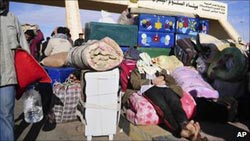 NEW DELHI, Feb 23: The Indian government has said that it is preparing for a "mammoth operation" involving planes and ships to evacuate its nationals from Libya. Foreign Secretary Nirupama Rao said Delhi was in the process of obtaining permission from Libya for its aircraft to land in the country.
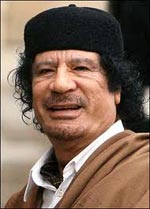 TRIPOLI, Feb 22: Muammar Gaddafi vowed to die in Libya as a martyr in an angry television address on Tuesday, as rebel troops said eastern regions had broken free from his rule in a burgeoning revolt. "I am not going to leave this land, I will die here as a martyr," Gaddafi said on state television, refusing to bow to calls from his own diplomats, soldiers and protesters clamouring in the streets for an end to his four decades at the helm.
 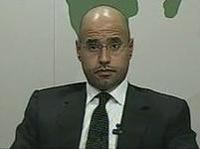 CAIRO, Feb 21: After anti-government unrest spread to the Libyan capital and protesters seized military bases and weapons on Sunday, Muammar Gaddafi’s son went on state television to proclaim that his father remained in charge with the army’s backing and would “fight until the last man, the last woman, the last bullet.”
 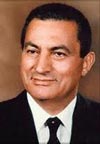 CAIRO, Feb 11: Cairo's streets exploded in joy on Friday when President Hosni Mubarak stepped down after three-decades of autocratic rule and handed power to a junta of senior military commanders. A grim-faced and ashen vice-president Omar Suleiman announced the handover on state television after an extraordinary national outpouring of rage brought more than a million furious demonstrators onto the streets.
 India has welcomed Egyptian President Hosni Mubarak's decision to step down and the commitment of the Supreme Council of the Armed Forces to ensure a peaceful transition of power in a time-bound manner.
 LONDON, Feb 8: British Prime Minster David Cameron has told Egypt's Vice President Omar Suleiman political reforms must be "irreversible, urgent and real."
  Separately, the British Foreign Minister William Hague outlined the UK's support for a stable democratic future for Egypt in an interview with the Andrew Marr show (the most popular political talk show in the UK) on BBC1 on February 6.
 Earlier, British Foreign Office Minister for the Middle East and North Africa, Alistair Burt, condemned intimidation and arrest of human rights defenders, lawyers and journalists in Egypt.
 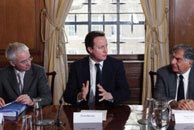 NEW DELHI, Feb 4: British Prime Minister David Cameron has called for greater cooperation in enhancing trade and has asked India to open up the foreign investment in legal services, defence, banking and insurance.
 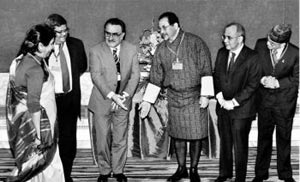 THIMPHU, Feb 6: Indian Foreign Secretary Nirupama Rao on Sunday praised the positive role played by the South Asian Association for Regional Cooperation (SAARC) in promoting greater cohesion between countries of the region. At the same time she drew attention to the “considerable” scope to do more.
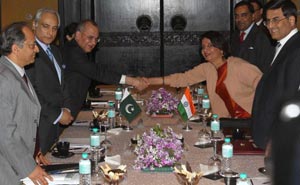 THIMPU, Feb 7: Foreign Secretary Nirupama Rao counseled patience in order to allow the India-Pakistan dialogue process to mature. Speaking to the media a day after Foreign Secretary level talks, the first ice breaker this year, Ms. Rao did not want to disclose further details "at the moment’’ about her 90-minute meeting with her Pakistani counterpart Salman Bashir late last night.
 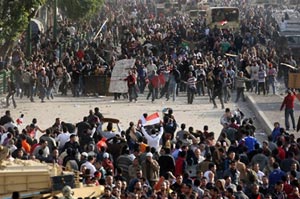 CAIRO, Feb 3: Bursts of heavy gunfire aimed at anti-government demonstrators in Cairo's Tahrir [Liberation] Square, left at least five people dead and several more wounded, according to reports from the Egyptian capital on Thursday.
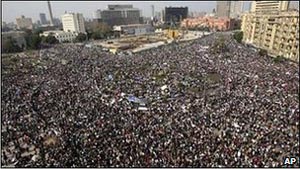 CAIRO, Feb 2: Protesters have rejected a speech by President Hosni Mubarak in which he said he would not stand for re-election in September, demanding that he step down immediately. Mr Mubarak has promised to leave at the next polls, and pledged constitutional reform.
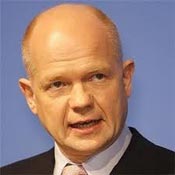 LONDON, Feb 1: British Foreign Secretary William Hague has called on President Hosni Mubarak to initiate a democratic "transformation" in Egypt to prevent the country falling into the hands of extremists.
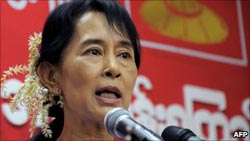 The court's decision leaves Aung San Suu Kyi and her party outside formal politics in Burma. A new parliament, with substantial military presence, convened on Monday for the first time.
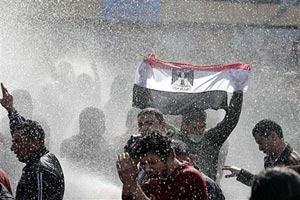 CAIRO, Jan 28: Tens of thousands of protesting Egyptians flooded into the streets after Friday's prayers in mounting demonstrations calling for an end to President Hosni Mubarak's 30-year rule.
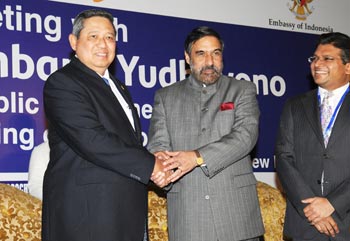 NEW DELHI, Jan 25: India and Indonesia on Tuesday signed 18 agreements worth $15.1 billion in sectors such as mining, infrastructure and manufacturing. The MoU was signed in the presence of Mr. Yudhoyono, Minister for Commerce and Industry Anand Sharma and Minister of State for External Affairs E. Ahmed.
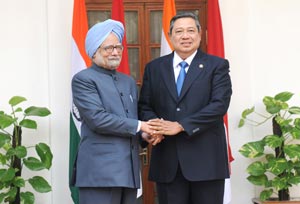 NEW DELHI, Jan 25: India and Indonesia, seeking to take their partnership to the next level, have agreed to begin negotiations for concluding a Comprehensive Economic Cooperation Agreement (CECA) and set a bilateral trade target of $25 billion by 2015 against $11 billion last fiscal.
 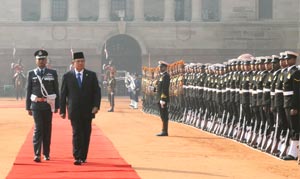 The agreement is aimed at reducing or eliminating tariffs on goods and services between the countries. It would also cover investments.
 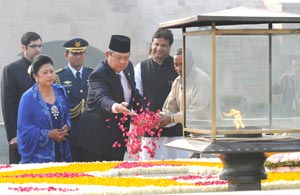 Taking its FTA with the 10-nation ASEAN bloc a step further, India implemented a free trade pact with Indonesia in October last that slashes import duties on thousands of products, such as seafood, chemicals and apparel. Besides, Indonesia stresses on India as a potential partner because India's investment realisation there has steadily increased during the last 20 years, the statement said.
 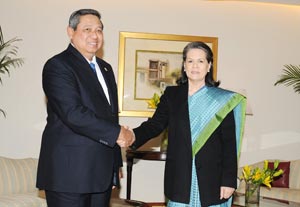 To address food security, the two leaders encouraged the implementation of the memorandum of understanding in agriculture and allied sectors that were signed on December 31, 2008 along with the implementation of a work plan for 2009-13 in agricultural development and joint research in agriculture science, the statement said.
 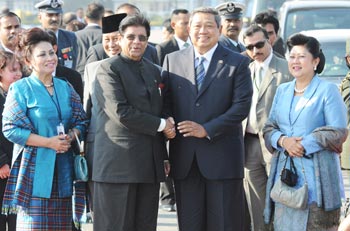 NEW DELHI, Jan 24: Indonesian President Susilo Bambang Yudhoyono arrived here Monday on a three-day visit that aims to take strategic, bilateral trade and investment ties to new heights. He is also the chief guest at the Republic Day parade Wednesday.
 NEW DELHI, Jan 21: “Kita Bersandara”. We are brothers. This is how Indonesian Ambassador Lt Gen Andi M Ghalib described his country’s historic ties with India. New Delhi will role out the red carpet for Indonesian President Susilo Bambang Yudhoyono at the Republic Day parade as the chief guest.
  Historically, India has had close and special ties with Indonesia. During Indonesia’s struggle for independence from the Dutch colonialism, the first Indonesian President Sukarno maintained close relations with Jawaharlal Nehru and other Indian leaders. After the independence of both countries, Nehru and Sukarno laid the foundation of the Asia-Africa conference and Non-Aligned Movements in 1955.
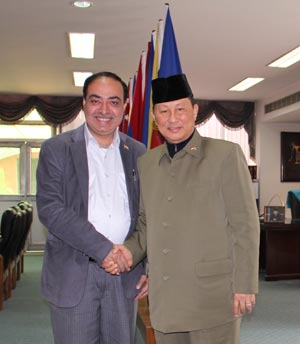 Otto Riadi, Counsellor at the Indonesian embassy, informed that Indian businessmen are bullish on investments in Indonesia. He said Indian businessmen have already committed an investment of US $ 20 billion in Indonesia in 2011 and 2012.
 President Yudhoyono, who arrives here on January 24, will hold wide-ranging talks on bilateral and international issues with Prime Minister Manmohan Singh and President Pratibha Patil, according to Vishnu Prakash, spokesperson of the Ministry of External Affairs.
 NEW DELHI, Jan 21: India attaches significant importance to the visit of Indonesian President Susilo Bambang Yudhoyono. We expect that its outcome would take our new strategic partnership to a higher plane and it would usher in a new paradigm in our bilateral relations, according to Vishnu Prakash, spokesperson of the Ministry of External Affairs.
 KATHMANDU, Jan 18: Amid a deadlock over govt formation in Kathmandu, India on Tuesday said it is committed to working with Nepalese political leaders for a democratic, stable and peaceful Nepal, which is being run by a caretaker administration for over six months.
 NEW DELHI, Jan 16: Asking China to demonstrate sensitivity to its core interests, India has said that Asian countries would judge China's "peaceful rise" not so much by the intentions of its leadership as by their "actions". Foreign Secretary Nirupama Rao said China's rise, which presents both challenges as well as opportunities, will be "watched" closely.
 BEIJING, Jan 16: Chinese President Hu Jintao, who travels to Washington this week for a state visit after a year marked by disputes and tension with the United States, said the two countries could mutually benefit by finding "common ground" on issues from fighting terrorism and nuclear proliferation to cooperating on clean energy and infrastructure development.
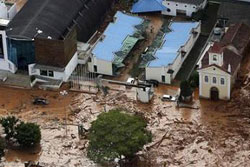 TERESOPOLIS (Brazil), Jan 13: Rescue workers dug desperately for survivors on Thursday and struggled to reach areas cut off by raging floods and landslides that have killed at least 388 people in one of Brazil's worst natural disasters in decades.
 NEW DELHI, Jan 7: Indonesian President Susilo Bambang Yudhoyono will be chief guest at India’s Republic Day parade.
 India commemorates Republic Day every January 26 to mark the implementation of the Indian Constitution replacing the Indian Government Law of 1935 as a document that governed India as of January 26, 1950.
 The Ambassador said the visit would give a boost to the Strategic Partnership signed between the two countries in 2005.
  The President will be accompanied by his wife, Mrs Ani Bambang Yudhoyono.
  Leonard Hutabarat, First Secretary in the Indonesian embassy in here, said Indonesian authorities have uncovered links between incidents of terrorism on Indonesian soil and Afghanistan in the past.
  Indonesia is also a member of the Group of Twenty grouping of developed and developing countries formed in the wake of the global economic crisis three years ago.
  London, Jan 5: Britain's royal palace on Wednesday released fresh details of the upcoming wedding of Prince William and Kate Middleton, announcing that the couple would be married by Rowan Williams, the Archbishop of Canterbury, at a Westminster Abbey service on April 29.
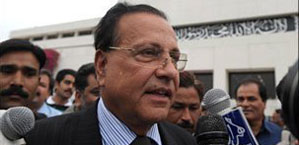 ISLAMABAD, Jan 4: The influential governor of Pakistan's Punjab province, Salman Taseer, has died after being shot by one of his bodyguards in the capital, Islamabad.
Aviation
| Business | Defence | Foreign
Affairs | Communication | Health
| India | United Nations
India-US
| India-France | Entertainment
| Sports | Photo Gallery |
Tourism | Advertise with Us
| Contact Us
© Noyanika International, 2003-2009. All rights reserved.