|
Islamic State threatens to invade Saudi Arabia
WASHINGTON, Jan 31: Islamic State militants have released a video saying that the group intends to invade Saudi Arabia while the kingdom's throne is changing hands.
According to Fox News, Saudi militants who have joined the IS group in Iraq and Syria issued the statement.
IS militants have also called upon the sympathizers in the country to attack from within.
Experts said that the terror threat shows the organization's desire to annex the wealthiest Middle East nation.
China reacts sharply to India-US statement on South China Sea dispute
BEIJING, Jan 26: China on Monday reacted sharply to an India-US joint statement referring to the disputes in the South China Sea, saying that only the involved countries should work together to resolve the problems.
The reaction from the Chinese foreign ministry to the “US-India Joint Strategic Vision for the Asia-Pacific and Indian Ocean Region” was brief but sharp.
“We have made our position clear on this issue many times. China is staunch supporter promoter and contributor to regional peace and stability. We believe relevant disputes should be resolved by parties directly concerned through peaceful talks and consultation,” Hua Chunying, foreign ministry spokesperson said at the regular press briefing on Monday.
China is involved in maritime disputes with several countries in the South and East China seas over the ownership islands, said to be sitting huge reserves of oil and gas.
Hua said China was closely following President Barack Obama’s visit to India and hoped that it could contribute to peace and prosperity.
“At the current stage, the situation in the South China Sea is generally stable and there is no problem with navigational freedom and freedom of flights,” she said.
“Regional prosperity depends on security. We affirm the importance of safeguarding maritime security and ensuring freedom of navigation and over flight throughout the region, especially in the South China Sea,” the Indo-US statement said on the situation.
On the issue of India joining the Nuclear Suppliers’ Group (NSG), she said India was welcome to join the Nuclear Suppliers’ Group (NSG) provided New Delhi fulfils all the required conditions.
“New members have to follow certain rules,” Hua Chunying, foreign ministry spokesperson, said at the regular press briefing on Monday.
Hua added that the expansion of the group, of which China is a member, needed detailed discussions and consensus among the members.
Hua said the inclusion of new members will require “prudence and caution” and “thorough discussion” on the part of the existing ones.
China, she said, supports the inclusion of India in the group but only if New Delhi fulfils requirements.
According to the website of the group, the NSG is an organisation of “...nuclear supplier countries that seeks to contribute to the non-proliferation of nuclear weapons through the implementation of two sets of Guidelines for nuclear exports and nuclear-related exports.”
Hua played down the thinking in certain circles in China that the US was attempting to use India to contain China.
“I do not think that kind of cold war mentality will work in the 21st century. And, India too is unlikely to be part of any such alliance,” Hua said.
She added that Indo-China relations have seen a major upswing in the last one year.
With foreign minister Sushma Swaraj slated to be in Beijing later this week, that bilateral interaction between the two countries is likely to intensify.
'China is delighted with India’s achievements'
Top Chinese leaders on Monday congratulated their Indian counterparts on the occasion of 66th Republic Day, pledging closer ties.
In his message to Indian President Pranab Mukherjee, Chinese President Xi Jinping said both China and India, as two ancient civilizations, were pursuing a “great dream of national rejuvenation”.
Xi was quoted by the official news agency, Xinhua as telling Mukherjee that China was “delighted” with India’s achievements.
“Noting this year marks the 65th anniversary of the establishment of diplomatic relations between the two countries, Xi said China is willing to make concerted efforts with India to lift their strategic cooperative partnership oriented to peace and prosperity to a higher level,” the Xinhua report said.
In a message to Indian Prime Minister Narendra Modi, Chinese Premier Li Keqiang said that in recent years, China and India have kept a stronger momentum in joining hands for cooperation and seeking common development.
China is ready to work with India to deepen their mutually beneficial cooperation in various fields and build a closer partnership of development, he said.
US, UK tell Pakistan to give India Lakhvi for better ties
ISLAMABAD, Jan 20: The US and the UK have asked Pakistan to hand over Mumbai attacks accused Zaki-Ur Rehman Lakhvi to India, possibly being the reason the Nawaz Sharif government has thwarted the Lashkar militant’s release after he was given bail in the 2008 terror case.
The two western powers additionally gave Pakistan the option to hand over Lakhvi to them for an international trial.
Although no official statement has been made either by White House or 10 Downing Street, the development may have significant repercussion for India-Pakistan dynamics since New Delhi has long been insisting Islamabad be forced to hand over terror suspects like Lakhvi and other Lashkar e-Taiba militants for carrying out attacks on Indian soil.
A government lawyer told the Islamabad high court, which is hearing appeals on Lakhvi’s bail, that "two countries had demanded handing over of Lakhvi to India".
The prosecution lawyer, however, did not name the countries in the court.
But a Pakistani interior ministry source identified the two countries as the US and the UK. The two nations said Lakhvi should either be handed over to India in order to "improve ties" or to them for his "independent trial" as several nationals of different countries were killed in the 2008 attacks.
The prosecution also requested the division bench headed by justice Shaukat Aziz Siddiqui to expedite the case, prompting the judge to remark, "Shift the case to the military court if the government is in such a hurry."
The judge also said handing Lakhvi over to any country was a "diplomatic issue" concerning the government and the court had nothing to do with it.
Prosecution chief Chaudhry Azhar said that Lakhvi's lawyer did not attend Monday’s hearing.
"The court in last hearing had issued summons for Lakhvi but his counsel did not appear. On this, the court adjourned the hearing," he said.
The court office will fix the next date for hearing.
In the last hearing, the prosecution told the HC the trial court had ignored testimony in the 26/11 case while granting bail to Lakhvi on December 18, 2014.
Lakhvi will remain in jail under the Maintenance of Public Order (MPO) till February 18 after the government extended his detention for another month.
Lakhvi and six others - Abdul Wajid, Mazhar Iqbal, Hamad Amin Sadiq, Shahid Jameel Riaz, Jamil Ahmed and Younis Anjum - have been charged with planning and executing the Mumbai attacks in November, 2008 that left 166 people dead.
Lakhvi was arrested in December 2008 and was indicted along with the other accused on November 25, 2009.
After Paris attacks, EU leaders call for more sharing of information, intelligence
BRUSSELS, Jan 19: In the wake of this month’s terrorist attacks in Paris, European leaders are calling for significant changes to what has long been a paradox of their borderless continent: Their citizens can move freely, but information about them does not.
There is no European no-fly list, because there is no European database of air travelers. People inside a 26-nation zone can speed from the tip of Portugal to the border with Russia without once having their passports scrutinized. Many E.U. citizens enter and exit Europe without ever being checked against police databases.
The gaps can lead to delayed security responses at best and flawed ones at worst, critics say, and attackers have sometimes exploited the issues to their advantage. Now, after the bloody assaults that claimed 17 victims in Paris and after dozens of suspected Islamist militants were rounded up around Europe, European leaders are pushing to fix what they say are flaws in the system.
E.U. nations plan “to share information, intelligence, not only with the European Union but also with other countries around us,” E.U. foreign policy chief Federica Mogherini said Monday after a meeting on counterterrorism with E.U. foreign ministers and top diplomats from several Middle Eastern nations.
Even as officials have stripped away barriers to free travel among European countries, individual nations have continued to hold sway over their intelligence and law enforcement agencies, and there are relatively few E.U.-wide databases in which information about people is stored. In Belgium, for example, police rely on the honor code when they ask new residents with E.U. citizenship whether they have criminal records in other countries.
The Paris attackers were able to use these gaps to their advantage, counterterrorism officials say. One of them, Amedy Coulibaly, drove his common-law wife and others to the Madrid airport before he embarked on his deadly attacks, allowing them to flee to Turkey without immediately drawing the attention of French authorities, who had been monitoring them domestically.
At least one of the brothers who attacked the offices of a satirical Paris newsweekly had traveled to Yemen for training, authorities say. But without a European database that might have helped track their movements, French officials weren’t easily able to watch their air travel, database advocates say.
Gilles de Kerchove, the E.U.’s counterterrorism coordinator, said he is seeking to require that all passports be checked by computer, which would enable agents to run them against databases and track who enters and exits Europe.
An air traveler database, also known as a passenger name record database, or PNR, “would have allowed the police to detect that one of the two brothers went to Oman and then to Yemen,” de Kerchove said of the men who carried out the attack at the Charlie Hebdo newsweekly. “It would have made it possible to detect [Hayat] Boumeddiene, the girlfriend of Coulibaly.”
The key proposal from E.U. leaders is a European air traveler database that proponents say would allow security officials to track information about fliers across the continent. Some E.U. leaders have sought such a database for years. But the European Parliament, which is charged with adopting E.U.-wide legislation, rejected it because of privacy concerns.
E.U. justice and interior ministers will meet this month to take up new proposals. Air travel databases such as those used in the United States track information including credit card numbers, addresses and passport information.
“We are convinced of the irreplaceable usefulness of this tool, on a European scale, to follow those who go to the theater of terrorist operations to fight, and also those who return,” French Interior Minister Bernard Cazeneuve said last week, after a meeting with several other E.U. law enforcement chiefs and U.S. Attorney General Eric H. Holder Jr.
Other proposals include more-rigorous checks at the E.U.’s external borders, improved efforts to restrict terrorist financing, and more robust inter-European criminal and intelligence databases.
Yemen's al Qaeda claims responsibility for Paris attack, says more to come
CAIRO, Jan 15: Yemen's al Qaeda branch on Wednesday confirmed it carried out last week's deadly assault on a French satirical newspaper to avenge cartoons depicting the Prophet Mohammad, as it called for unity among jihadi ranks and vowed more attacks on the West.
In an 11-minute video posted on the group's Twitter account, Nasr al-Ansi, a top commander of al Qaeda in the Arabian Peninsula, said the attack on the office of the Charlie Hebdo weekly - in which two gunmen massacred 12 people - was in "revenge for the prophet."
He warned of more "tragedies and terror" in the future, saying "you will look for peace and stability but you will not find it because of the deeds of those carrying out martyrdom operations and heroes of lone jihad."
Prophet on cover, first Charlie Hebdo issue since attack published
PARIS, Jan 15: French satirical magazine Charlie Hebdo on Wednesday published its first edition since Islamist gunmen killed 12 people in an attack on its offices, with a cartoon of the Prophet Mohammed on the cover. Three million copies of the weekly, featuring on the front a weeping prophet holding up a sign saying "Je suis Charlie" ("I am Charlie") under the headline "All is forgiven", have been printed. The magazine was sold out in many parts of the capital minutes after going on sale.
"Je suis Charlie" is the slogan taken up by millions of supporters in France and around the world after eight of the magazine's journalists and cartoonists and four other people were shot dead last week. The gunmen who carried out the attack appear to have been motivated by the magazine publishing cartoons of the prophet in the past.
There are no other depictions of the prophet in the new edition, but many of the cartoons lampoon Islamist gunmen. The print run dwarfs Charlie Hebdo's normal run of around 60,000 copies, and the edition will also be available in English, Spanish, Italian, Arabic and Turkish. Newspaper sellers said demand was high.
"It was incredible. I had a queue of 60-70 people waiting for me when I opened at 5.45 am. I've never seen anything like it. All my 450 copies were sold out in 15 minutes," said a woman working at a kiosk in Gambetta metro station in Paris.
The magazine's surviving staff moved into the offices of Liberation newspaper to compile the edition, which they admitted had been an emotional experience.
Cartoonist Renald "Luz" Luzier said he cried after drawing the front cover. The first issue since the attack has stirred Muslim anger in some countries. Al-Azhar in Cairo, Sunni Islam's most prestigious centre of learning, warned that Charlie Hebdo's cartoons "stir up hatred" and "do not serve the peaceful coexistence between peoples."
Charlie Hebdo returns, Muhammad on new cover
PARIS, Jan 13: French satirical magazine Charlie Hebdo defied the attackers in last week's bloodbath by putting a cartoon of the Prophet Muhammed on its next cover, as the government on Monday announced the deployment of 10,000 soldiers to boost security.
The weekly released the front page of what it called the "survivors' issue", due out Wednesday, featuring a crying Muhammed in a white turban and holding a sign that reads "Je suis Charlie" under the words: "All is forgiven".
The issue will be the first since two Islamist gunmen stormed Charlie Hebdo's Paris office on January 7 and massacred 12 people, saying they were taking revenge for previous publications of Muhammed cartoons — considered deeply offensive to many Muslims.
In a further show of defiance, the magazine announced it would print three million copies — not the usual 60,000 — when it reappears on news stands this week.
Charlie Hebo has become an international symbol of free speech since the massacre and a second attack two days later at a Jewish supermarket. A total of 17 people were killed in the twin rampages.
Nearly four million people — including 1.5 million in Paris in the biggest rally in French history — demonstrated across France on Sunday to denounce the killings.
Many carried signs with the now internationally familiar slogan "Je suis Charlie" (I am Charlie).
Seeking to reassure a jittery nation in the wake of the attacks, French officials announced the unprecedented deployment of thousands of soldiers to boost security, including at Jewish schools.
"We have decided... to mobilise 10,000 men to protect sensitive sites in the whole country from tomorrow (Tuesday) evening," defence minister Jean-Yves Le Drian said after an emergency security meeting.
"This is the first time that our troops have been mobilised to such an extent on our own soil," he added.
Another 5,000 security officers were also part of the reinforcements.
As investigators looked into possible intelligence failures that allowed the attacks to happen, a debate gathered pace over whether France's security bodies need greater powers to combat home-grown terrorism and the flow of jihadists back and forth from Syria.
Prime Minister Manuel Valls said one of the Islamists responsible for last week's attacks that rocked France — Amedy Coulibaly who gunned down a policewoman and four Jewish shoppers at a kosher supermarket — likely received help from others.
"We think there are in fact probably accomplices," Valls told French radio. "The hunt will go on."
But Le Monde newspaper warned against the "temptation" of enacting a French version of the US Patriot Act, rushed in after the September 11 2001 attacks to give security agencies sweeping new surveillance powers over US citizens.
Such was the secrecy around the US law that only the revelations of whistleblowing intelligence agent Edward Snowden 12 years later laid bare the extraordinary scope of government snooping.
'Charlie' draws historic crowd, world leaders to Paris
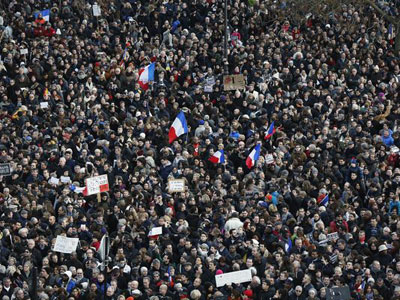
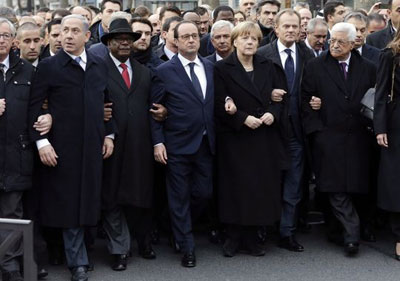 PARIS, Jan 11: A historic crowd of more than a million people including more than 40 world leaders jammed the streets Sunday, proclaiming "Je suis Charlie," expressing solidarity against terrorism and paying homage to victims of last week's deadly attacks. PARIS, Jan 11: A historic crowd of more than a million people including more than 40 world leaders jammed the streets Sunday, proclaiming "Je suis Charlie," expressing solidarity against terrorism and paying homage to victims of last week's deadly attacks.
French President François Hollande, British Prime Minister David Cameron, German Chancellor Angela Merkel were among the leaders who linked arms to start the march amid intense security. The U.S. representative was Jane Hartley, the ambassador to France.
The gathering brought together leaders of nations and causes often at odds, such as Ukrainian President Petro Poroshenko and Russian Foreign Minister Sergey Lavrov, and Palestinian leader Mahmoud Abbas and Israeli Prime Minister Benjamin Netanyahu.
The emotionally charged rally came just days after 17 people and three Islamic extremist gunmen were killed in three horrifying days of terror in France.
France's Interior Ministry described the demonstration as the largest in the nation's history. More than 3.7 million marched throughout the country, including between 1.2 million and 1.6 million in the capital. The ministry said a precise number was impossible to determine given the enormity of the turnout.
"Today, Paris is the capital of the world," Hollande said. "Our entire country will rise up toward something better."
Hollande and Netanyahu later visited the Grand Synagogue in Paris, which for security reasons did not hold Sabbath services this weekend for the first time since World War II.
 "Today I walked the streets of Paris with the leaders of the world to say enough terror -- the time has come to fight terror," Netanyahu said. He also stressed that the enemy is not Islam, but extremists. "Today I walked the streets of Paris with the leaders of the world to say enough terror -- the time has come to fight terror," Netanyahu said. He also stressed that the enemy is not Islam, but extremists.
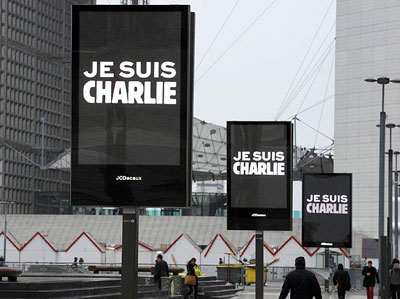
The attackers' primary target was the Paris office of Charlie Hebdo, a satirical weekly publication that has published spoofs of the Islamic prophet Mohammed. The slogan "Je suis Charlie" — I am Charlie — has swept across France and around the globe.
Twelve people were killed when brothers Said, 34, and Cherif Kouachi, 32, stormed the offices magazine's offices Wednesday. Two days later police tracked them to a printing house near Charles de Gaulle Airport where they were killed.
On Thursday, Amedy Coulibaly, 32, shot and killed a policewoman. On Friday he killed four people -- all Jewish -- at a kosher market and threatened more violence unless the police let the Kouachis go. He was killed later in the day during a police assault.
French prosecutors said Coulibaly is also linked to the shooting of a jogger on the same day as the Charlie Hebdo massacre. Video emerged showing Coulibaly pledging allegiance to the Islamic State and claiming he coordinated the attacks with the Kouachi brothers.
In Paris, the military and police were out in force, with more than 2,000 police officers patrolling the area, French officials said. Another 2,000 officers and 1,300 soldiers were protecting key buildings, landmarks, transportation hubs and Jewish sites.
The rally, featuring family members of those who died in the attacks, drew French celebrities, Christian, Jewish and Muslim community leaders, and politicians from across the French political spectrum.
Paris public transport operator RATP made travel on its metro, bus and tram network free to reduce traffic in the center of the capital. Crowds began gathering hours before the rally started at 3 p.m. local time (9 a.m. ET) in central Paris.
The boulevards and streets leading to Place de la Republique soon became blocked by the throngs, but a cheerful spirit pervaded among demonstrators. "Today is not the day to be grumpy Parisians," said one woman sporting a bright-red French beret.
Hawkers sold buttons and banners reading "Je Suis Charlie" as well as "Je Suis Ahmed" and "Je Suis Juif (Jewish)." Banners and signs in honor of those who died, cartoons drawn on posterboard and plastic, and mosaics on the ground made from pens, were also being sold.
Charlie Hebdo suspects shot dead, hostages freed
 PARIS, Jan 9: Two brothers wanted for a bloody attack on the offices of French satirical newspaper Charlie Hebdo were killed on Friday when anti-terrorist police stormed their hideout, while a second siege at a Jewish supermarket ended with the deaths of four hostages. PARIS, Jan 9: Two brothers wanted for a bloody attack on the offices of French satirical newspaper Charlie Hebdo were killed on Friday when anti-terrorist police stormed their hideout, while a second siege at a Jewish supermarket ended with the deaths of four hostages.
"These madmen, fanatics, have nothing to do with the Muslim religion," President Francois Hollande said in a televised address. "France has not seen the end of the threats it faces."
An audio recording posted on YouTube attributed to a leader of the Yemeni branch of al-Qaeda (AQAP) said the attack in France was prompted by insults to Prophet.
Sheikh Hareth al-Nadhari said in the recording, "Some in France have misbehaved with the prophets of God and a group of God's faithful soldiers taught them how to behave and the limits of freedom of speech."
Modi speaks to Hollande, condemns terror attack
NEW DELHI, Jan 9: Prime Minister Narendra Modi strongly condemned the terror attack on the office of satirical magazine Charlie Hebdo in Paris and conveyed condolences on behalf of the people of India in a telephone conversation with French President Francois Hollande on Friday.
Expressing solidarity with the people of France, Modi expressed confidence that “President Hollande and the people of France will deal with this moment of grief and challenge with fortitude and that they will succeed in combating the forces of terrorism,” an official source said.
Modi also reaffirmed his commitment to counter-terrorism cooperation as a key element of the growing strategic partnership between India and France.
Thanking Modi for the solidarity and support, Hollande said, “This support from the world’s largest democracy meant a lot to the people of France.”
The French President underlined his commitment to deepen defence and security cooperation between India and France and said he was looking forward to Modi’s visit to France this year, the source added.
Charlie Hebdo attack: France probes terror suspect links; new attacks may be ahead
PARIS, Jan 10: What started as a hunt for two terror suspects grew into something worse - fears of a nest of terrorists that could strike again in the heart of Paris. The suspects in three attacks knew each other, had been linked to previous terrorist activities, and one had fought or trained with al Qaeda in Yemen, which claimed ownership Friday of this week's newspaper massacre.
Investigators are now trying to determine to what extent the attacks were coordinated.
The Kouachi brothers had been the subject of a vast manhunt following the armed attack on the Charlie Hebdo weekly that claimed 12 lives on Wednesday. The brothers died on Friday when police attacked the building near Charles de Gaulle airport outside Paris where they had barricaded themselves.
An acquaintance of at least one of the Kouachis, Amedy Coulibaly, 32, was identified as the suspected killer of a policewoman in suburban Paris the previous day -and as the man armed with a semi-automatic rifle who opened fire Friday in a kosher market near Paris' Porte de Vincennes and holed up with hostages there.
He threatened to kill his captives if the Kouachis weren't freed. Like the brothers, he was killed when police moved in.
According to French judicial documents, the connections among the terrorist suspects date back to 2010, when Coulibaly was sentenced to five years in prison for an abortive attempt to free another terrorist from prison. Smain Ait Ali Belkacem was serving a life sentence for a bombing attack on the Paris rapid transit system in 1995.
Cherif Kouachi, 32, the younger of the brothers, was detained in that investigation, but freed later without being tried. A former pizza deliveryman, he appeared in a 2005 French TV documentary on Islamic extremism and was sentenced to 18 months in prison in 2008 for trying to join up with fighters battling in Iraq.
The French judicial documents said Coulibaly and the younger Kouachi knew each another, and traveled with their wives in 2010 to central France to visit a radical Islamist, Djamel Beghal, who had been sentenced to 10 years in prison on a terrorism-related charge.
Police issued a bulletin on Friday asking anyone with information about Coulibaly's wife, 26-year-old Hayat Boumeddiene, to contact them, saying she was potentially "armed and dangerous."
According to the judicial documents, a police search of Coulibaly's residence in 2010 turned up a crossbow, 240 rounds of 7.62mm ammunition, films and photos of him during a trip to Malaysia, and letters seeking false official documents.
In a police interview that same year, Coulibaly identified Cherif Kouachi as a friend he had met in prison and said they saw each other frequently, according to a transcript of the interview obtained by the Journal du Dimanche newspaper and posted on the newspaper's website.
According to the newspaper, he told the police that people he met in prison used the nickname "Dolly" for him. He said he was employed as a temp worker at a Coca-Cola factory.
"I know a lot of criminals because I met heaps of them in detention," he is quoted as telling the police.
Michel Thooris, secretary-general of France's police labor union, said he didn't believe these were "three people isolated in their little world."
"This could very well be a little cell," he said. "There are probably more than three people," he added, given that Cherif Kouachi and Coulibaly had had contacts with other jihadist groups in the past.
French Prime Minister Manuel Valls, speaking in a TV interview late Friday, also indicated authorities are bracing for the possibility of new attacks. "We are facing a major challenge" and "very determined individuals," Valls said.
Francois Molins, the Paris prosecutor, said authorities increasingly grew to see links between the attackers after they discovered that Boumeddiene and the companion of one of the Kouachi brothers had exchanged about 500 phone calls.
Speaking to reporters late Friday, he said that 16 people had been detained in the investigation. Officials were continuing to look for "possible accomplices, the financing of these criminal actions, the source of these weapons and all the help that (the terror suspects) might have benefited from, in France as well as overseas, in Yemen," Molins said.
The latest US assessments show that the brothers led a normal life for long enough in recent years that the French began to view them as less of a threat and reduced the surveillance. They are continuing to investigate whether the brothers' steps away from radical Islam were part of a plan of misdirection, or whether it was real - and that they simply had another change of heart and decided to turn to violence.
On Friday, a French TV news network said it spoke directly to Coulibaly before his death, and he said he and the brothers were coordinating and that he was with the Islamic State extremist group. BFM, the network, said it also talked to the younger Kouachi brother, who claimed to be financed and dispatched by al Qaeda in Yemen, normally a rival organization.
Al Qaeda in the Arabian Peninsula said on Friday it had planned the assault on the Charlie Hebdo newspaper staff - but did not mention the other terrorist acts.
Separately, officials in Yemen and the US said Said Kouachi, 34, the older of the brothers, had trained with al Qaeda in Yemen. Yemeni authorities suspect he fought with the Islamic extremist group at the height of its offensive in the country's south, a Yemini security official said Friday.
Another senior security official said Said Kouachi was in Yemen until 2012. Both officials spoke on condition of anonymity because of an ongoing investigation into the older Kouachi brother's stay.
A US law enforcement official said Friday that investigators believe Said Kouachi traveled to Yemen to receive weapons training from al Qaeda. The official, who was not authorized to discuss an ongoing investigation by name, said the brothers had raised enough concern to be placed on the US no-fly list because one had traveled to Yemen and the other had been convicted of terrorism charges.
Though the brothers claimed affiliation to al Qaeda, the US official said, investigators were still trying to determine whether al Qaeda had ordered the attack on the Charlie Hebdo offices or if the brothers had done it on their own.
The official said investigators have been searching for any contacts that the brothers maintained with individuals in the United States, but had not yet found any.
French authorities knew Kouachi traveled to Yemen, but it's not clear whether they knew what he did there, US officials believe. Still, French authorities placed both Kouachi brothers under close surveillance when he returned.
Nigeria: 2,000 feared killed by Boko Haram in 'deadliest massacre'
YOLA (NIGERIA), Jan 10:
Hundreds of bodies - too many to count - remain strewn in the bush in Nigeria from an Islamic extremist attack that Amnesty International suggested on Friday is the "deadliest massacre" in the history of Boko Haram.
Mike Omeri, the government spokesperson on the insurgency, said fighting continued on Friday for Baga, a town on the border with Chad where insurgents seized a key military base on January 3 and attacked again on Wednesday.
"Security forces have responded rapidly, and have deployed significant military assets and conducted airstrikes against militant targets," Omeri said in a statement.
District head Baba Abba Hassan said most victims are children, women and elderly people who could not run fast enough when insurgents drove into Baga, firing rocket-propelled grenades and assault rifles on town residents.
"The human carnage perpetrated by Boko Haram terrorists in Baga was enormous," Muhammad Abba Gava, a spokesperson for poorly armed civilians in a defense group that fights Boko Haram, said.
He said the civilian fighters gave up on trying to count all the bodies. "No one could attend to the corpses and even the seriously injured ones who may have died by now," Gava said.
An Amnesty International statement said there are reports the town was razed and as many as 2,000 people killed.
If true, "this marks a disturbing and bloody escalation of Boko Haram's ongoing onslaught," said Daniel Eyre, Nigeria researcher for Amnesty International. In Washington, US state department spokesperson Jen Psaki condemned the attacks.
"We urge Nigeria and its neighbors to take all possible steps to address the urgent threat of Boko Haram. Even in the face of these horrifying attacks, terrorist organizations like Boko Haram must not distract Nigeria from carrying out credible and peaceful elections that reflect the will of the Nigerian people," Psaki said in a statement.
The previous bloodiest day in the uprising involved soldiers gunning down unarmed detainees freed in a March 14, 2014, attack on Giwa military barracks in Maiduguri city. Amnesty said then that satellite imagery indicated more than 600 people were killed that day.
The 5-year insurgency killed more than 10,000 people last year alone, according to the Washington-based Council on Foreign Relations. More than a million people are displaced inside Nigeria and hundreds of thousands have fled across its borders into Chad, Cameroon and Nigeria.
Emergency workers said this week they are having a hard time coping with scores of children separated from their parents in the chaos of Boko Haram's increasingly frequent and deadly attacks.
Just seven children have been reunited with parents in Yola, capital of Adamawa state, where about 140 others have no idea if their families are alive or dead, said Sa'ad Bello, the coordinator of five refugee camps in Yola.
He said he was optimistic that more reunions will come as residents return to towns that the military has retaken from extremists in recent weeks.
Suleiman Dauda, 12, said he ran into the bushes with neighbors when extremists attacked his village, Askira Uba, near Yola last year.
"I saw them kill my father, they slaughtered him like a ram. And up until now I don't know where my mother is," he told The Associated Press at Daware refugee camp in Yola.
France in mourning after Charlie Hebdo attack
PARIS, Jan 8: French anti-terrorism police converged on an area northeast of Paris on Thursday after two brothers suspected of being behind an attack on satirical newspaper Charlie Hebdo were spotted at a petrol station in the region.
France's prime minister said on Thursday he feared the Islamist militants who killed 12 people could strike again as a manhunt for two men widened across the country.
Two police sources said that the men were seen armed and wearing cagoules in a Renault Clio car at a petrol station on a secondary road in Villiers-Cotterets some 70 kilometres from the French capital.
Amid French media reports the men had abandoned their car, Bruno Fortier, the mayor of neighbouring Crépy-en-Valois, said helicopters were circling his town and police and anti-terrorism forces were deploying en masse.
A policewoman was killed in a shootout in Paris earlier in the day, but police sources could not immediately confirm a link with Wednesday's killings at the Charlie Hebdo weekly newspaper that marked the worst attack on French soil for decades.
National leaders and allied states described the assault on Charlie Hebdo, known for its lampooning of Islam and other religions as well as politicians, as an assault on democracy.
The bells of Notre-Dame cathedral rang out during a minute's silence observed across France and beyond.
Many European newspapers either re-published Charlie Hebdo cartoons or mocked the killers with images of their own.
 Montrouge Mayor Jean-Loup Metton said the policewoman and a colleague were attending a reported traffic accident when Thursday's shooting occurred. Witnesses said the assailant fled in a Renault Clio and police sources said he wore a bullet-proof vest and had a handgun and assault rifle. Montrouge Mayor Jean-Loup Metton said the policewoman and a colleague were attending a reported traffic accident when Thursday's shooting occurred. Witnesses said the assailant fled in a Renault Clio and police sources said he wore a bullet-proof vest and had a handgun and assault rifle.
Prime Minister Manuel Valls was asked on RTL radio after an emergency cabinet meeting with President Francois Hollande whether he feared a further attack. "That question is entirely legitimate, that's obviously our main concern, and that is why thousands of police and investigators have been mobilised to catch these individuals."
Police released photographs of the two French nationals still at large, calling them "armed and dangerous": brothers Cherif and Said Kouachi, aged 32 and 34, both of whom were already under watch by security services.
Late Wednesday, an 18-year-old man turned himself into police in Charleville-Mézières near the Belgian border as police carried out searches in Paris and the northeastern cities of Reims and Strasbourg.
A legal source said he was the brother-in-law of one of the main suspects and French media quoted friends as saying he was in school at the moment of the attack. French social media carried numerous reports of police helicopters across northern France. Police tightened security at transport hubs, religious sites, media offices and stores.
There were scattered, unconfirmed reports of sightings of the assailants and police increased their presence at entry points to Paris. One police source talked of a type of "psychosis" setting in with various reports and rumours, but police had to take each of them seriously.
France held a day of mourning for journalists and police officers shot dead by black-hooded gunmen using Kalashnikov assault rifles. French tricolour flags flew at half mast.
Tens of thousands took part in vigils across France on Wednesday to defend freedom of speech, many wearing badges declaring "Je Suis Charlie" (I Am Charlie) in support of the newspaper and the principle of freedom of speech.
Britain's Daily Telegraph depicted two masked gunman outside the doors of Charlie Hebdo saying to each other: "Be careful, they might have pens". Many German newspapers republished Charlie Hebdo cartoons.
Security services have long feared that nationals drawn into Islamist militant groups fighting in Syria and Iraq could return to their home countries to launch attacks - though there is no suggestion that the two suspects named by police had actually fought in either of these countries.
Britain's Cobra security committee met on Thursday. London's transport network was target of an attack in 2005, four years after 9/11. There have been attacks in countries including Spain, Kenya, Nigeria, India and Pakistan that have raised fears in Europe.
A total of seven people had been arrested since the attack, he said. Police sources said they were mostly acquaintances of the two main suspects. One source said one of the brothers had been identified by his identity card, left in the getaway car.
Cherif Kouachi served 18 months in prison on a charge of criminal association related to a terrorist enterprise in 2005.
He was part of an Islamist cell enlisting French nationals from a mosque in eastern Paris to go to Iraq to fight Americans in Iraq and arrested before leaving for Iraq himself.
Satire has deep historical roots in Europe where ridicule and irreverence are seen as a means of chipping away at the authority of sometimes self-aggrandising political and religious leaders and institutions.
Governments have frequently jailed satirists and their targets have often sued, but the art is widely seen as one of the mainstays of a liberal democracy.
French writer Voltaire enraged many in 18th century France with caustic depictions of royalty and the Catholic Church. The German magazine Simplicissimus in its 70-year existence saw cartoonists jailed and fined for ridiculing figures from Kaiser Wilhelm to church leaders, Nazi grandees and communists.
"Freedom assassinated" wrote Le Figaro daily on its front page, while Le Parisien said: "They won't kill freedom".
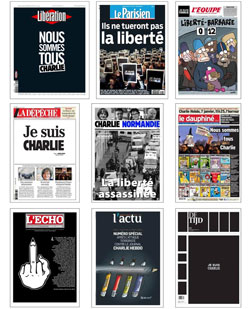 French newspapers don black after attack on Charlie Hebdo French newspapers don black after attack on Charlie Hebdo
PARIS, Jan 8:
Most French newspapers on Thursday donned black to express the mood after Wednesday’s terrorist attack at the Charlie Hebdo magazine's offices in Paris that left 12 people dead.
While many people walked with the placard “Je suis Charlie” (I am Charlie), French daily Libération put “Nous sommes tous Charlie” (We are all Charlie) as the sole element on its black front page. The word “liberté” or freedom haunted headlines on most dailies.
Figaro, Le Parisien, l'Equipe and many other publications dwelt on the assassination of freedom.
Expressing solidarity with Charlie Hebdo, regional publications also put the news on the front page, Paris Normandie renamed itself as Charlie Normandie, while Le Dauphiné and La Dépêche put the coverage on page one too.
Top editor, co-founder among 12 killed in Paris terror attack
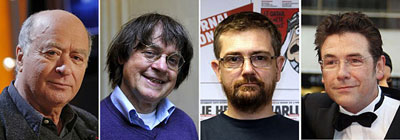 PARIS, Jan 7: Masked gunmen shouting 'Allahu akbar!' stormed the Paris offices of satirical newspaper Charlie Hebdo Wednesday, killing 12 people before escaping. It was France's deadliest terror attack in at least two decades. PARIS, Jan 7: Masked gunmen shouting 'Allahu akbar!' stormed the Paris offices of satirical newspaper Charlie Hebdo Wednesday, killing 12 people before escaping. It was France's deadliest terror attack in at least two decades.
With a manhunt on, French President Francois Hollande called the attack on the weekly, whose caricatures of the Prophet Mohammad have frequently drawn condemnation from Muslims, "a terrorist attack without a doubt". He said several other attacks have been thwarted in France "in recent weeks".
"Today France is confronted with a shock, a terrorist attack, there is no doubt about that... Against a magazine that had been threatened repeatedly and that was being protected."
There was no immediate claim of responsibility for the attack, which the Paris prosecutor's office confirmed killed 12 people, including cartoonists.
Ten members of the Charlie Hebdo staff died in the attack, prosecutors said.Sources at the weekly said the dead included co-founder Jean "Cabu" Cabut, editor-in-chief Stephane "Charb" Charbonnier, and cartoonists Tignous and Wolinski.
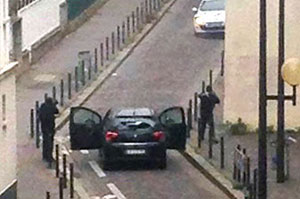 France raised its security alert to the highest level and reinforced protective measures at houses of worship, stores, media offices and transportation. Top government officials held an emergency meeting. Schools closed their doors. France raised its security alert to the highest level and reinforced protective measures at houses of worship, stores, media offices and transportation. Top government officials held an emergency meeting. Schools closed their doors.
France's interior minister Bernard Cazeneuve promised to give the people of France the highest level of protection.
Just before noon, multiple masked men armed with automatic weapons attacked the newspaper's office in central Paris, nearby worker Benoit Bringer told the iTele network. The attackers went to the second floor and started firing indiscriminately in the newsroom, said Christophe DeLoire of Reporters Without Borders.
"This is the darkest day of the history of the French press," DeLoire said.
Video images on the website of public broadcaster France Televisions showed two gunmen in black at a crossroads who appeared to fire down one of the streets. A cry of "Allahu akbar!" -- Arabic for "God is great"-- could be heard among the gunshots.
A source close to the investigation said the gunmen "armed with a Kalashnikov and a rocket-launcher" stormed the building in central Paris.
Luc Poignant of the SBP police union said the attackers left in a waiting car and later switched to another vehicle that had been stolen.
The gunmen fled towards the suburbs, according to police. "There is a possibility of other attacks and other sites are being secured," Police union official Rocco Contento said.
The last major attack in Paris was in the mid-1990s when the Algerian Armed Islamic Group (GIA) carried out a spate of attacks, including the bombing of a commuter train in 1995 which killed eight people and injured 150.
The satirical newspaper gained notoriety in February 2006 when it reprinted cartoons of the Prophet Mohammad that had originally appeared in Danish daily Jyllands-Posten, causing fury across the Muslim world.
Attackers shouted "we have avenged the prophet" after Wednesday's strike, according to witnesses cited by a police source.
In November 2011, the French satirical weekly's offices were fire-bombed when it published a cartoon of Mohammad under the title "Charia Hebdo".
Despite being taken to court under anti-racism laws, the weekly continued to publish controversial cartoons of the Muslim prophet.
In September 2012, Charlie Hebdo published cartoons of a naked Mohammad as violent protests were taking place in several countries over a low-budget film, titled "Innocence of Muslims", which was made in the United States and insulted the Prophet.
Obama, Modi, Merket condemn attack
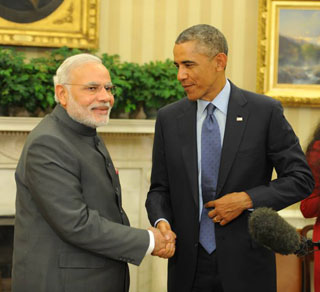 NEW DELHI, Jan 7: After Wednesday's strike, world leaders including US President Barack Obama, German Chancellor Angela Merkel and Indian Prime Minister Narendra Modi condemned the attack, but supporters of the militant Islamic State group celebrated the slayings as well-deserved revenge against France. NEW DELHI, Jan 7: After Wednesday's strike, world leaders including US President Barack Obama, German Chancellor Angela Merkel and Indian Prime Minister Narendra Modi condemned the attack, but supporters of the militant Islamic State group celebrated the slayings as well-deserved revenge against France.
The Islamic State group has repeatedly threatened to attack France.
Just minutes before the strike, Charlie Hebdo had tweeted a satirical cartoon of that extremist group's leader giving New Year's wishes.
Another cartoon, released in this week's issue and entitled "Still No Attacks in France", had a caricature of an extremist fighter saying "Just wait - we have until the end of January to present our New Year's wishes".
Elsewhere on the internet, the hashtag #JeSuisCharlie was trending as people expressed support for weekly and for journalistic freedom.
Speaking on MSNBC, White House spokesperson Josh Earnest said, "Everybody here at the White House are with the families of those who were killed or injured in this attack."
Condemning the shooting, US President Barack Obama said in a statement, "Our thoughts and prayers are with the victims of this terrorist attack and the people of France at this difficult time."
British Prime Minister David Cameron said, "While details are still unclear, I know that this house and this country stands united with the French people in our opposition to all forms of terrorism and we stand squarely for free speech and democracy."
Indian Prime Minister Narendra Modi tweeted, "Condemnable & despicable attack in Paris. Our solidarity with people of France. My thoughts are with families of those who lost their lives."
The Arab League and Al-Azhar, Sunni Islam's most prestigious centre of learning, both condemned the deadly attack.
"Arab League chief Nabil al-Arabi strongly condemns the terrorist attack on Charlie Hebdo newspaper in Paris," the Arab League said in a statement.
Al-Azhar condemned the "criminal attack," saying that "Islam denounces any violence".
The New York-based Committee to Protect Journalists described the attack as a brazen assault on free expression. The scale of the violence is appalling," said CPJ deputy director Robert Mahoney. "Journalists must now stand together to send the message that such murderous attempts to silence us will not stand."
France last year reinforced its anti-terrorism laws and is already on alert after calls from Islamist militants to attack its citizens and interests in reprisal for French military strikes on Islamist strongholds in West Asia and Africa.
Wednesday's attack comes the same day of the release of a book by a celebrated French novelist depicting France's election of its first Muslim president. Hollande had been due to meet with the country's top religious officials later in the day.
Ex-Punjab CM Beant's assassin held in Thailand
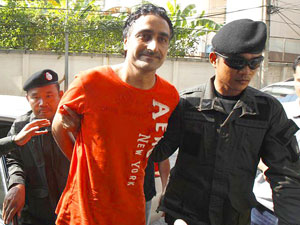 CHANDIGARH, Jan 6:Thai police arrested one of the assassins of former Punjab chief minister Beant Singh from a house in Pattaya, 11 years after he escaped from an Indian prison, according to government sources on Tuesday. CHANDIGARH, Jan 6:Thai police arrested one of the assassins of former Punjab chief minister Beant Singh from a house in Pattaya, 11 years after he escaped from an Indian prison, according to government sources on Tuesday.
Jagtar Singh alias Tara was on the run since 2004 after he and three other prisoners made a sensational escape digging a tunnel out of Chandigarh’s Burail Model Jail. He was arrested in 1996 for planning the assassination of the then Punjab chief minister and 12 members of his staff by a human bomb.
Tara, who was a member of militant group Babbar Khalsa at the time of the assassination and later joined the Khalistan Tiger Force (KTF), was hiding in Pakistan for several years after his escape before going to Thailand, police sources said.
In a joint operation, central Indian agencies and Thai police arrested the KTF chief on Monday from the house of one Khalat Bari, who had been sheltering Tara at the behest of Pakistan’s Inter Services Intelligence (ISI), officials said. However, he will spend a month in Thai police’s custody before he is extradited to India.
Punjab police sources said they had handed Thai authorities five arrest warrants against Tara in September last year after they received information that he was living in Thailand on a Pakistan passport as Gurmeet Singh.
“Even an amended, secret red corner notice was issued through Interpol when Punjab police specifically mentioned about the fake identity Tara was using in his Pakistan passport while hiding in Thailand,” a top police source said.
A Punjab police team left for Thailand in September to track his movements. However, Tara went underground and was hiding in the house of Bari, said to be the brother of Pakistan-based ISI agent Sultan Bari, until his arrest on Monday.
The hunt for Tara led Punjab police to many wanted terrorists on foreign soil.
Khalistan Liberation Force chief Harminder Singh alias Mintoo and his aide Gurpreet Singh alias Gopi were arrested in November 2004 in Thailand. In November 2014, police nabbed KTF member Ramandeep Singh alias Goldy in Malaysia.
Australia cautions visitors to India, cites high threat of terror attacks
MELBOURNE, Jan 7: Australia has revised its travel advisory for India asking its citizens to exercise high degree of caution while travelling to that country, citing high threat of terrorist activities.
The department of foreign affairs and trade (DFAT) updated its advice on Tuesday warning the Australians travelling to India that militants could be planning another terror attack against upmarket hotels in India's largest city.
"We continue to advise Australians to exercise a high degree of caution in India overall because of the high threat of terrorist activities, civil unrest and crime and the high rate of vehicle accidents," DFAT said.
"We continue to receive reports that terrorists are planning attacks in India and assess that attacks could occur anywhere at any time with little or no warning, including in locations frequented by Australians," it said.
"This advice contains new information in the Summary and under Entry and exit (India will no longer issue medical visas to Australians planning to commission surrogacy who reside in Australian states/territories where overseas commercial surrogacy is illegal) and Safety and security (information of mid-December 2014 indicates that militants may be planning attacks against upmarket hotels in Mumbai," it said adding however, the information was still under investigation).
DFAT in its update, also advised those travelling to Indonesia, urging Australians to "exercise a high degree of caution in Indonesia, including Bali".
It said the alert level had not changed, but had been updated to include a high threat of terrorist attack.
Pak plans to execute 500 terror convicts: Officials
ISLAMABAD, Dec 22: Pakistan plans to execute around 500 militants in coming weeks, officials said Monday, after the government lifted a moratorium on the death penalty in terror cases following a Taliban school massacre.
Six militants have been hanged since Friday amid rising public anger over Tuesday's slaughter in the northwestern city of Peshawar, which left 149 people dead including 133 children.
After the deadliest terror attack in Pakistani history, Prime Minister Nawaz Sharif ended the six-year moratorium on the death penalty, reinstating it for terrorism-related cases.
"Interior ministry has finalised the cases of 500 convicts who have exhausted all the appeals, their mercy petitions have been turned down by the president and their executions will take place in coming weeks," a senior government official told AFP on condition of anonymity.
A second official confirmed the information.
Of the six hanged so far, five were involved in a failed attempt to assassinate the then-military ruler Pervez Musharraf in 2003, while one was involved in a 2009 attack on army headquarters.
Police, troops and paramilitary Rangers have been deployed across the country and airports and prisons put on red alert as the executions take place and troops intensify operations against Taliban militants in northwestern tribal areas.
Sharif has ordered the attorney general's office to "actively pursue" capital cases currently in the courts, a government spokesman said.
"Prime Minister has also issued directions for appropriate measures for early disposal of pending cases related to terrorism," the spokesman said without specifically confirming the plan to execute 500.
Pakistan has described Tuesday's bloody rampage as its own "mini 9/11", calling it a game-changer in the fight against extremism.
The decision to reinstate executions has been condemned by human rights groups, with the United Nations also calling for it to reconsider.
Human Rights Watch on Saturday termed the executions "a craven politicised reaction to the Peshawar killings" and demanded that no further hangings be carried out.
Pakistan began its de facto moratorium on civilian executions in 2008, but hanging remains on the statute books and judges continue to pass death sentences.
Before Friday's resumption, only one person had been executed since then -- a soldier convicted by a court martial and hanged in November 2012.
Four more death-row convicts executed in Pakistan, more in line
ISLAMABAD, Dec 21: Four more death-row convicts were executed on Sunday in Pakistan for their involvement in an attack on former military ruler General Pervez Musharraf after the country lifted a ban on the death penalty following last week's deadly Taliban attack on a Peshawar school.
Zubair Ahmed, Rasheed Qureshi, Ghulam Sarwar Bhatti and Russian citizen Akhlaque Ahmed were hanged at the district jail in Faisalabad in Punjab province, two days after two prisoners were hanged in the same jail.
The four death-row prisoners were shifted to the district jail under the security of army personnel because the lever used to open the trapdoor to carryout hangings was not available in the central jail in Faisalabad.
Family members of the prisoners were allowed to meet the convicts for the last time prior to the hanging.
Security was tightened in the city to avoid any untoward incident. Additional contingents of security personnel were deployed while containers and barricades were placed on the routes leading to the district jail.
Preparations were also underway in Lahore for the execution of four death row prisoners in Kot Lakhpat Central Jail. The executions are expected to be carried out within the next 24-36 hours. All routes leading to the jail were sealed with the deployment of military personnel and installation of cellphone jammers around the jail premises.
In Sukkur, authorities called in the relatives of two terrorists, belonging to the banned Lashkar-i-Jhangvi who had been sentenced to death 10 years ago in a sectarian killing case, to hold a final meeting on Monday.
An anti-terrorism court on Friday had issued death warrants for Attaullah alias Qasim and Mohammad Azam alias Sharif, who had been sentenced to death for a sectarian killing in 2001.
Both terrorists were arrested from Karachi and are to be executed on Tuesday.
Earlier on Friday, two former military men were executed in the Faisalabad district jail. Usman, a former soldier of the army's medical corps, was executed for an attack on army headquarters in Rawalpindi in 2009.
Arshad Mehmood, a trooper, was also hanged and was among five convicts who were sentenced to death for their role in an al-Qaeda-inspired assassination attempt on Musharraf's life in late 2003.
The hangings on Friday were the first death sentences carried out after the government ended a six-year moratorium on executions on Wednesday, in response to the suicide attack on a Peshawar army school that killed 148 people, mostly children.
Mumbai attack planner Lakhvi given bail by Pak court
LAHORE, Dec 18: The anti-terrorism court in Pakistan gave bail to LeT operations commander Zakiur Rehman Lakhvi, a key planner of the 2008 Mumbai attacks, despite evidence against him in the case which was nearing its end, prosecution said on Thursday, disclosing that they will challenge the decision.
"As the trial was near conclusion the Anti-Terrorism Court Islamabad Thursday granted bail to Lakhvi despite evidence against him," said prosecution chief Chaudhry Azhar.
As seven judges of the Mumbai case have been replaced since the start of the trial in 2009, Jutsice Kausar Abbasi Zaidi is the eighth one holding the in camera proceedings at Adiala Jail Rawalpindi due to security concerns.
"We have so far produced 46 witnesses in the court who testified against all seven accused - Zakiur Rehman Lakhvi, Abdul Wajid, Mazhar Iqbal, Hamad Amin Sadiq, Shahid Jameel Riaz, Jamil Ahmed and Younis Anjum. Only 15 more witnesses have to testify against them in coming days. And the trial is likely to be concluded in three to four weeks," he said.
The 46 witnesses included the officials of the Federal Investigation Agency, Crime Investigation Department, National Database Registration Authority, government doctors and people who have testified against the accused for running training camps, bank transactions, giving directions on phone to some of the 10 terrorists operating in Mumbai, buying inflatable boats used for transporting the terrorists and etc.
The prosecution lawyers including Chaudhry Azhar had received threats from Jamaat-ud-Dawah and reported the same to the judge and requested for their security.
Jamaat-ud-Dawah is led by Hafiz Saeed, who is on India's most wanted list for masterminding the Mumbai attacks that killed 166 people during a 60-hour siege in November 2008.
The seven accused - Lakhvi, Abdul Wajid, Mazhar Iqbal, Hamad Amin Sadiq, Shahid Jameel Riaz, Jamil Ahmed and Younis Anjum - are facing trial at the Adiala Jail in Rawalpindi.
The prosecution lawyers had recently filed an application in the trial court requesting that the hearing should be held through a video-link or allow the witnesses to submit their recorded statements in the court. But the court dismissed it.
The government would challenge Lakhvi's bail in the Lahore high court.
"After going through the court order in Lakhvi's bail case we will decide to challenge it," Azhar said, expressing surprise over the court's move to grant bail as some 15 more witnesses are yet to testify against the accused including Lakhvi.
An interior ministry spokesperson said that the government would certainly file an appeal against the trial court's decision.
"We have a strong case against the seven accused of the Mumbai terror attacks and we challenge Lakhvi's bail in the high court," said the official who requested anonymity.
The official further said that the government may not release Lakhvi under 16 MPO (Maintenance of Public Order) law.
The trial court has asked Lakhvi to submit surety bonds worth Rs. 500,000 surety before he can be released.
"There has been many cases like Lashkar-e-Jhangvi chief Malik Ishaq who could not be freed from jail despite granted bail by the court because they may create law and order situation. The government is seriously pondering to detain Lakhvi under 16 MPO for a month or three months," the official said.
Lakhvi, the operational head of the banned Laskhar-e-Taiba, was one of the key planners of the Mumbai attack.
Nine of the terrorists involved in the attack were killed by Indian security forces. The only surviving attacker, Ajmal Kasab, was hanged after conviction by a trial court that was confirmed and upheld by higher courts in India.
Meanwhile, the Pakistani electronic media literally gave "no coverage" to Lakhvi's bail news.
The news channels avoided broadcasting the news in the backdrop of the Peshawar tragedy in which 132 children were massacred by Taliban the other day.
Hardly a few channels ran the news in tickers.
Taliban slaughter 130 kids in Peshawar school attack
PESHAWAR, Dec 16: At least 130 people, most of them children, were killed on Tuesday when about six Taliban gunmen stormed an army-run school in northwest Pakistan, in one of the bloodiest terror attacks in the country in years.
The bloody Taliban raid on the school in Peshawar ended after almost eight hours, police said, with all six attackers dead.
"The combat operation is over, the security personnel are carrying out clearance operation and hopefully they will clear the building in a while," police official Abdullah Khan said.
"Dead bodies of six terrorists have been found in the building."
Senior police official Shafqat Malik confirmed the combat phase of the response had ended, while chief army spokesperson General Asim Bajwa said on Twitter that the operation was "closing up".
Bajwa said explosive devices planted in school buildings by the militants were slowing clearance efforts. Special forces soldiers had rescued more than a dozen staff and students, he added.
The attack that also left more than 120 injured began around 11.30am (India time) after the group of militants entered the Army Public School when about 500 students and teachers were believed to be inside.
A student who managed to escape the carnage said, "An army doctor was teaching us about first aid when attackers came from behind our school and started firing."
"Our teachers locked the door and we ducked on the floor, but they broke down the door. Initially they fired in the air and later started killing the students, but left the hall suddenly. The attackers had long beards, wore shalwar kameez and spoke Arabic."
Another student who survived the attack said soldiers came to the rescue during a lull in the firing. "When we were coming out of the class we saw bodies of our friends lying in the corridors. They were bleeding. Some were shot three times, some four times."
Hours into the siege, three explosions were heard inside the school, and heavy gunfire was heard as troops surrounded the building to rescue hundreds of students and staff taken hostage by the militants. According to the military, the bulk of the hostages have been evacuated.
The hard-line Tehreek-e-Taliban Pakistan (TTP), fighting to topple the government and set up a strict Islamic state, claimed responsibility for the attack as retaliation for a major military offensive in pro-Taliban tribal strongholds of Khyber-Pakhtunkhwa.
TTP spokesperson Muhammad Khorasani said the six attackers "include target killers and suicide attackers". "They have been ordered to shoot the older students but not the children."
"It's a revenge attack for the army offensive in North Waziristan," he said, referring to the anti-Taliban military offensive that began in June.
"We selected the army school for the attack because the government is targeting our families and females," said Khorasani. "We want them to feel the pain."
More than 1,600 militants have been killed since the launch of Zarb-e-Azb in June, according to data from regular military statements.
Sydney seige ends; 'lone wolf', 2 hostages killed
SYDNEY, Dec 16: Amid a barrage of gunfire, police stormed a cafe in the heart of Sydney early on Tuesday to end a 16-hour hostage siege by an Iranian-born gunman.
Police said three people were killed - the gunman and two of the hostages - and four others were wounded.
Police raided the Lindt Chocolat Cafe after they heard a number of gunshots from inside, said New South Wales state police commissioner Andrew Scipione.
The gunman was identified as Man Haron Monis, who once was prosecuted for sending offensive letters to families of Australian troops killed in Afghanistan.
Man Haron Monis was a self-styled sheikh with his own Wikipedia entry. He was on bail when he emerged as a lone wolf gunman.
Born in Iran, the 50-year-old was named in reports hours before being gunned down as the "cleric" who triggered a security lockdown in the heart of Australia's biggest city by unfurling an Islamic flag and holding several people captive in a chocolate cafe.
Arriving in Australia as a refugee in 1996, Monis was no stranger to controversy.
Convicted over sending offensive letters to the families of dead soldiers, he was on bail on charges of being an accessory to the murder of his ex-wife and for sexual and indecent assault, multiple Australian outlets reported.
Scipione wouldn't say whether the two hostages who were killed - a 34-year-old man and a 38-year-old woman - were caught in crossfire, or shot by the gunman. Among the four wounded was a police officer shot in the face.
"Until we were involved in this emergency action, we believe that no one had been injured. That changed. We changed our tactic," he said, adding that there had been a total of 17 hostages taken in the cafe when the siege began.
Two Indians, Ankireddy Vishwakanth and Pushpendu Ghosh - both Infosys employees, were among the hostages, but escaped safely.
By Deepak Arora
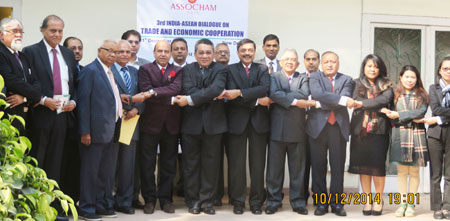 NEW DELHI, Dec 11: Mr Vijay Jolly, Senior BJP Leader and Advisor Global Political Affairs, GOPIO International on Thursday hailed the "Act East Policy" of Indian Prime Minister Narendra Modi on ASEAN, while delivering the Keynote address at the 3rd India-ASEAN Dialogue Roundtable on Trade & Economic Cooperation at New Delhi. NEW DELHI, Dec 11: Mr Vijay Jolly, Senior BJP Leader and Advisor Global Political Affairs, GOPIO International on Thursday hailed the "Act East Policy" of Indian Prime Minister Narendra Modi on ASEAN, while delivering the Keynote address at the 3rd India-ASEAN Dialogue Roundtable on Trade & Economic Cooperation at New Delhi.
The "Look East Policy" of India during the past 20 years with its slow pace has enabled China to make deep inroads in the ASEAN region, stated BJP leader Jolly.
The economic Indian agenda of development for closer business ties with ASEAN majors namely Indonesia, Malaysia, Thailand, Myanmar, Brunei, Singapore, Cambodia, Laos, Philippines and Vietnam was stressed by Jolly in his keynote address.
Development of seven Sister North Eastern Indian States, rail network, road network, power infrastructure, apparel manufacturing centres, creating natural economic zones and scholarship schemes shall connected Indian North Eastern states with "Act East Asean" policy of India, stated Jolly.
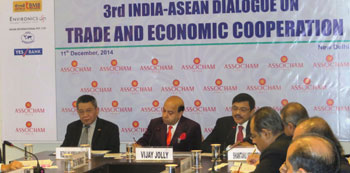 The trilateral 3200 km long highway linking India, Myanmar and Thailand and its completion by 2018 was also highlighted. Shipping Corporation of India direct shipping service from India to Myanmar, Jet Airways commencing direct flight from New Delhi via Bangkok to Ho Chi Minh City in Vietnam along with two additional flights to Thai Capital this winter were the direct results of Modi's "Act East Asean Policy", said Vijay Jolly. The trilateral 3200 km long highway linking India, Myanmar and Thailand and its completion by 2018 was also highlighted. Shipping Corporation of India direct shipping service from India to Myanmar, Jet Airways commencing direct flight from New Delhi via Bangkok to Ho Chi Minh City in Vietnam along with two additional flights to Thai Capital this winter were the direct results of Modi's "Act East Asean Policy", said Vijay Jolly.
Mr Rizali W. Indrakesuma, Chairman of the ASEAN New Delhi Committee and Indonesian Ambassador, was the guest of honour.
In his address, Ambasador Rizali Indrakesuma said the volume of ASEAN intra-trade reaching to nearly 25% of total member states’ trade volume, and yet is still expected to increase by 40%. The steady growth of 10.5% intra-trade in two decades (1993-2013) was closing at the amount of US$ 608.6 billion (2013).
While dialogue partner, such as China’s trade with ASEAN is reaching US$ 350.5 billion, with India is still standing at US$ 67.7 billion, mentioned Ambassador Rizali.
The day-long ASSOCHAM program was also addressed by Brunei Darussalam High Commissioner Dato Paduka Sidek Bin Ali, Malaysian Minister Counsellor Aida Safinaz Allias, Jane Ramos of Philippine Embassy and ASSOCHAM Secretary General D S Rawat.
The program was chaired and conducted by Shantanu Srivastava, Chairman India-Asean Business Promotion Council.
In his address, Shantanu Srivastava said “we are eagerly looking forward to the next major steps in our relations as the negotiations for regional Comprehensive Economic Partnership, a Trade Agreement comprising 16 countries including India and ASEAN will be completed soon. These positive developments represent valuable milestones in our relationship and pave the way for creation of one of the world’s largest free trade areas.”
Business leaders such as Rajeev Kumar Gupta from BHEL, Ravi Bassi from TATA Consultancy Services and Ajay Poddar from Environics also addressed the gathering.
Rahul Sharma, President, Transcontinental Enterprises (ARK) Inc proposed a vote of thanks.
India, Russia sign 20 pacts
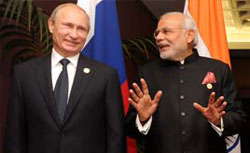 NEW DELHI, Dec 11: India and Russia on Thursday inked pacts on 20 nuclear reactors, oil and gas among 20 pacts as Prime Minister Narendra Modi underlined the primacy of Moscow in New Delhi's strategic calculus when he said Russia was would remain India's most important defence partner. NEW DELHI, Dec 11: India and Russia on Thursday inked pacts on 20 nuclear reactors, oil and gas among 20 pacts as Prime Minister Narendra Modi underlined the primacy of Moscow in New Delhi's strategic calculus when he said Russia was would remain India's most important defence partner.
This, he said, was despite the fact that India now had more options, in what was seen as an oblique reference to its growing military and defence ties with the US.
Modi's remark came after his summit meet here with President Vladimir Putin, who offered India lucrative energy deals and sought to provide a leg-up to Modi's "Make in India" campaign.
After the talks, the two countries signed as many as 20 agreements — seven inter-governmental and 13 commercial — including a strategic vision for cooperation in peaceful uses of atomic energy. Another agreement was signed for partnership in oil and natural gas.
Modi, who addressed the media in English, said apart from the 4 reactors at Kudankulam, the two countries outlined an "ambitious vision for nuclear energy of at least 10 more reactors" and would look at exporting it to third countries.
Putin, in fact, said in his statement that Russia would help build 20 reactors in India.
In a boost for Modi's "Make in India" initiative, Putin also offered to build one of Russia's most advanced helicopters in India. Putin said the joint initiative could consider exporting the helicopters to other countries. Modi thanked Putin for the offer, saying Indian authorities would follow up on it quickly.
Modi described Putin as a leader of a great nation with which "we have a friendship of unmatched mutual confidence, trust and goodwill".
"We have a strategic partnership that is incomparable in content. The steadfast support of the people of Russia for India has been there even at difficult moments in our history. It has been a pillar of strength for India's development, security and international relations," said Modi. One of the agreements signed will facilitate training of Indian armed forces personnel in the military establishment of Russia's defence ministry.
While it is not clear if the Indian side took up the issue of Russia's agreement with Pakistan which could facilitate supply of arms to India's neighbour, Modi suggested in his statement that he expected both sides to be sensitive to their concerns.
"President Putin and I agreed that this is a challenging moment in the world. Our partnership and the strong sensitivity that we have always had for each other's interests will be a source of strength to both countries," he said.
Putin also mentioned the joint fifth-generation fighter jet project which has failed to make much headway in the recent past. "I would also like to note that projects to jointly develop multi-purpose fighter aircraft and multirole transport planes is another step in our joint work," he said. Modi also proposed that Russia locate manufacturing facilities in India for spares and components for Russian defence equipment.
A joint statement titled "Druzhba-Dosti" said the two countries will study the possibilities of building a hydrocarbon pipeline system, connecting the Russian Federation with India. Modi said cooperation between the two nations in the hydrocarbon sector had been disappointing until now and that they will pursue an ambitious agenda for partnership in oil and natural gas.
Putin also said Russia is ready to cooperate in peaceful space exploration, specifically in the development of close-orbit satellites and use of the GLONASS satellite navigation system.
The leaders condoled the loss of lives in "senseless terrorist acts" in recent days in Jammu & Kashmir and Chechnya (Russia).
Kazakhstan Ambassador Bulat Sarsenbayev, 4 other envoys present credentials to President Pranab Mukherjee
By Deepak Arora
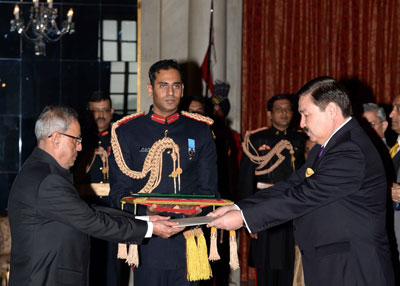 NEW DELHI, Dec 9: NEW DELHI, Dec 9:
Envoys of Serbia, Egypt, Hungary, Kazakhstan and Bangladesh presented their credentials to the President of India, Mr Pranab Mukherjee, at a ceremony held in Rashtrapati Bhavan on Tuesday.
The envoys who presented their credentials were: Mr Vladimir Maric, Ambassador of Serbia; Mr Hatem El Sayed Tageldin, Ambassador of Egypt; Mr. Szilveszter Bus, Ambassador of Hungary; Mr. Bulat Sergazyuly Sarsenbayev, Ambassador of Kazakhstan; and Mr Syed Muazzem Ali, High Commissioner of Bangladesh.
During a brief meeting, which took place after the presentation of credentials, the Kazakhstan Ambassador conveyed to Pranab Mukherjee the wish of Kazakh side to further develop the strategic partnership between the two countries.
In addition, the Ambassador of Kazakhstan, shared with the President of India, the main provisions of the last Message of the President of the Republic of Kazakhstan "Nurly Jol - way of the future" and spoke about the special role of these messages in determining the future of the country.
In turn, President Pranab Mukherjee wished all the best for Elbasy and expressed willingness to work together on the further development of bilateral cooperation.
Vijay Jolly appointed Advisor to GOPIO International
By Deepak Arora
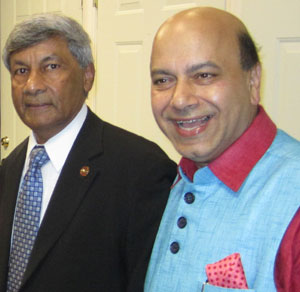 NEW DELHI, Dec 9: Global Organization of People of Indian Origin, International, has appointed Senior BJP Leader of India Vijay Jolly as Advisor Global Political Affairs, GOPIO Internaitonal. NEW DELHI, Dec 9: Global Organization of People of Indian Origin, International, has appointed Senior BJP Leader of India Vijay Jolly as Advisor Global Political Affairs, GOPIO Internaitonal.
Guyana born Ashook Ramsaran, President GOPIO International with headquarters in New York, USA wrote a letter to Jolly and confirmed his new appointment.
GOPIO formed in 1989 represents the interests of Overseas Indian Community exceeding 28 million Non Resident Indians (NRIs) and People of Indian Origin (PIOs) in more than 25 nations across the globe.
The letter from GOPIO President states that Vijay Jolly with his vast experience and interest in the betterment of the society thru democratic political means shall further expand the outreach of GOPIO among the global Indian diaspora and countries of domicile.
Jolly is Former President of Delhi University Students Union. He is alumni of prestigious Sriram College of Commerce, Delhi. A post graduate in commerce, he is a well known BJP leader in Delhi. Jolly was elected MLA from Saket in Delhi Assembly in 2003. He fought a valiant electoral battle in New Delhi Assembly elections in 2008 against then Delhi Chief Minister Sheila Dikshit.
Jolly is credited to spread the organizational network of BJP from two nations in 2011 to more than 45 nations up till 2014 as Global Convenor BJP Overseas Affairs. He is currently Special Invitee in BJP National Executive. He also is the President of Delhi Study Group, a prominent NGO in Delhi. Jolly has travelled overseas extensively and in more than 82 nations across the globe.
ISIS may possesss Dirty Bomb: Report
LONDON, Dec 1: Islamic State terror group may have developed a nuclear device by using radioactive uranium stolen from Iraq's Mosul University after seizing control of the city last June, a British media report says.
Militants boasted of the device on social media, with one even commenting on the destruction such a bomb would wreak in London, four months after the chemical went missing from Mosul University, Mirror newspaper reported.
One of the extremists making online threats to the west is British explosives expert Hamayun Tariq, who fled his home in the UK for the Middle East in 2012.
Using the alias, Muslim-al-Britani, he tweeted, "O by the way, Islamic State does have a dirty bomb. We found some radioactive material from Mosul University."
He wrote: "We'll find out what dirty bombs are and what they do. We'll also discuss what might happen if one actually went off in a public area."
A dirty bomb is a speculative radiological weapon that combines radioactive material with conventional explosives.
It is claimed the device includes uranium from a stash of 40 kilograms looted by IS.
Iraq's UN ambassador Mohamed Ali Alhakim informed UN secretary general Ban Ki-moon of the theft in a letter on July 8.
He wrote: "Terrorist groups have seized control of nuclear material at the sites that came out of the control of the state."
If the bomb does exist, militants are far more likely to use it in Syria or Iraq, rather than trying to smuggle it into a western country, the report said.
The IS militants have captured swathes of territory in Iraq and Syria. It is a splinter group of the al-Qaida which has distanced itself from the outfit, chiding it for its aggressive and brutal expansion.
The IS gained international attention in August, when its fighters and those from other militant groups swept through the northern Iraqi city of Mosul, then overran swaths of territory north and west of Baghdad.
|


