


Foreign Affairs
|
Saudi's strikes in Yemen will go on until rebels withdraw: Arab summitSharm El-Sheikh (Egypt), March 29: Saudi-led airstrikes in Yemen will continue until Shiite rebels there "withdraw and surrender their weapons," a summit of Arab leaders decided Sunday, as they also agreed in principle to forming a joint military force. The decision by the Arab League puts it on a path to more aggressively challenge Shiite power Iran, which is backing the Yemeni rebels, known as Houthis. A Saudi-led coalition began bombing Yemen on Thursday, saying it was targeting the Houthis and their allies, which include forces loyal to Yemen's former leader, Ali Abdullah Saleh. Current and former Yemeni military officials have said the campaign could pave the way for a possible ground invasion. At the summit, held in the Egyptian resort city of Sharm el-Sheikh, Arab League chief Nabil Elaraby read a final communique outlining the leaders' views. "Yemen was on the brink of the abyss, requiring effective Arab and international moves after all means of reaching a peaceful resolution have been exhausted to end the Houthi coup and restore legitimacy," Elaraby said. The Houthis swept down from their northern strongholds last year and captured the capital Sanaa in September. Embattled President Abed Rabbo Mansour Hadi, a close US ally against a powerful local al-Qaida affiliate, fled first to the southern city of Aden and left the country last week. Speaking at the summit Saturday, Hadi directly accused Iran of being behind the Houthi offensive, raising the specter of a regional conflict. Iran and the Houthis deny that Tehran arms the rebel movement, though the Islamic Republic has provided humanitarian and other aid. Asked at a news conference to explain vague references to "foreign powers" being behind conflicts in different Arab nations, Elaraby said: "I will answer this question indirectly. There is meddling by some neighbors, Israel on one side, Turkey and Iranian interference in several countries." Speaking after Elaraby, Egyptian President Abdel-Fattah el-Sissi said leaders also agreed in principle to creating a joint Arab military force. He said a high-level panel will work under the supervision of Arab chiefs of staff to work out the structure and mechanism of the force. Elaraby said the chiefs of staff would meet within a month and have three more months to decide on the structure, budget and mechanism of the force before they present their proposals to a meeting of the Arab League's Joint Defense Council. "It is an important resolution given all the unprecedented unrest and threats endured by the Arab world," Elaraby said. A summit resolution said the force would be deployed at the request of any Arab nation facing a national security threat and that it would also be used to combat terrorist groups. "There is a political will to create this force and not to leave its creation without a firm time frame," Egyptian foreign minister Sameh Shukri told a news conference. Egyptian military and security officials have said the proposed force would consist of up to 40,000 elite troops and be headquartered in either Cairo or Riyadh, the Saudi capital. The force would be backed by jet fighters, warships and light armor. However, it is unlikely that all 22 member nations of the often-fractious Arab League will join the proposed force. Creation of such a force has been a longtime goal that has eluded Arab nations in the 65 years since they signed a rarely used joint defense agreement. Iraq, whose Shiite government is closely allied with non-Arab and Shiite Iran, has said more time is needed to discuss the proposed force. Now in its fourth day, the Saudi-led air campaign has pushed Houthi rebels out of contested air bases and destroyed any jet fighter remaining in Yemen, Saudi Brig. Gen. Ahmed bin Hasan Asiri said. The strikes also continued to target Scud missiles in Yemen, leaving most of their launching pads "devastated," according to remarks carried Saturday by the state-run Saudi Press Agency. However, he warned that the rebels could have more missiles. His account could not be immediately corroborated. India prepares to evacuate stranded expatriates in war-torn YemenNEW DELHI, March 29: India said on Sunday it will begin airlifting its nationals from war-torn Yemen after getting permission to fly from the capital Sanaa even as 15 people were killed as combat jets of a Saudi-led coalition targeted the headquarters of the Houthi rebels. Swaraj’s remarks came hours after the Saudi-led coalition’s warplanes bombed the runway of Sanaa’s international airport and several bases of the rebels. The airstrikes killed 15 pro-rebel troops in Sanaa, media reports said. Though one end of the runway of Sanaa airport was damaged, it had been repaired and the airstrip was now functional, she said in another tweet. Swaraj said there are 4,144 Indian citizens in Yemen, including 3,100 in the capital, 500 in the southern port city of Aden and the remainder at other places. Eighty Indians flew out of Sanaa in a commercial flight on Saturday. 142 killed in Yemen mosque bombings, Islamic State claims responsibilitySANAA, March 21: Suicide bombings claimed by the Islamic State jihadist group killed at least 142 people Friday at mosques in the Yemeni capital, in an attack targeting Shiite worshippers including Huthi militiamen. The multiple blasts were among the deadliest attacks yet in Yemen, which is grappling with growing instability and divisions along sectarian lines. They came a day after clashes between forces loyal to President Abedrabbo Mansour Hadi and those allied with the Huthi Shiite militia in the southern city of Aden, where the leader fled last month. The suicide bombers targeted two mosques attended by Huthis, who have seized the capital Sanaa. One struck inside Badr mosque in southern Sanaa while another targeted worshippers as they fled outside, witnesses said. A third suicide bomber targeted Al-Hashush mosque in northern Sanaa. Nashwan al-Atab, a member of the health ministry's operations committee, said that 142 people were killed and at least 351 were wounded. The Huthi militia's Al-Massira television said hospitals in the capital had made urgent appeals for blood donations. The imam of the Badr mosque was among the dead, a medical source said. Footage aired by Al-Massira showed bodies lying in pools of blood outside the mosques, as worshippers rushed the wounded to hospitals in pick-up trucks. Another suicide bomber blew himself up outside a mosque in the northern Huthi stronghold of Saada, a source close to the militia said. Only the assailant was killed in that explosion, and tight security at the mosque prevented the bomber from going inside, the source added. "Infidel Huthis should know that the soldiers of the Islamic State will not rest until they eradicate them... and cut off the arm of the Safavid (Iranian) plan in Yemen," the statement said. The Huthis are accused of receiving support from Iran. IS, a radical Sunni Muslim organisation, considers Shiites to be heretics. It is the first time that IS has claimed any attack in Yemen where al Qaeda remains the most prominent jihadist group. 19 killed in terrors attack in TunisiaTUNIS, March 18: Tunisia's president promised to wage a "merciless war against terrorism" after gunmen killed 17 foreign tourists and two Tunisians in a daylight attack in the birthplace of the Arab Spring. As the international community denounced Wednesday's assault on the National Bardo Museum in Tunis, which also left more than 40 people wounded, President Beij Caid Essebsi vowed Tunisia would fight "to our last breath". "I want the Tunisian people to understand that we are in a war against terrorism and that these savage minorities do not frighten us," said Essebsi, who visited some of the dozens being treated for wounds in a Tunis hospital. "We will fight them without mercy to our last breath." The gunmen, dressed in military uniforms, opened fire on the tourists -- including visitors from Italy, France, Australia, Colombia, Poland and Spain -- as they got off a bus then chased them inside the museum, said Prime Minister Habib Essid. A Japanese survivor described how she and her mother were shot in the hail of bullets. "I was crouching down with my arms over my head, but I was shot in the ear, hand and neck," 35-year-old Noriko Yuki said from her hospital bed in comments aired by Japanese broadcaster NHK. "My mother beside me was shot in the neck. Mother couldn't move by herself when the police came over," she added. Among the dead were five Japanese, four Italians, two Colombians and one each from Australia, France, Poland and Spain, Essid announced on television, in what he said was a definitive toll. However, differing figures were given by other governments and there was conflicting information over the breakdown, with some of the dead identified as joint nationals. The nationality of a 16th victim was not given, while the identity of the final fatality had not yet been established. The Colombian tourists were a mother and child visiting Tunisia on a family holiday, their government said. The father survived the attack. Police killed two gunmen and the authorities were still hunting for possible accomplices, said the prime minister. A Tunisian bus driver and a policeman were also reported dead in the attack on the Bardo, famed for its collection of ancient artefacts. The government announced more than 40 people were wounded, with health minister Said Aidi saying they included citizens of France, South Africa, Poland, Italy and Japan. It sparked outrage, with hundreds of people gathering later in a major thoroughfare of the capital, singing the national anthem and shouting slogans against the attackers, labelling them terrorists. The assault also drew strong condemnation from world leaders, who vowed support for Tunisia. US Secretary of State John Kerry denounced the "wanton violence" while British Prime Minister David Cameron said he was "appalled" by the attack and French President Francois Hollande expressed "solidarity" with the country. United Nations Secretary-General Ban Ki-moon slammed the "deplorable" and "heinous" act and conveyed his "deepest sympathies" to the families of the victims. Meanwhile the UN Security Council stressed that "no terrorist attack can reverse the path of Tunisia towards democracy". Iraqi forces enter IS-held Tikrit: ArmyTIKRIT (Iraq), March 11: Iraqi forces entered a northern neighbourhood of Tikrit on Wednesday, marking a new stage in the operation launched 10 days ago to wrest the city back from jihadists, army officers said. "We are now doing combat missions to cleanse the neighbourhood of Qadisiyah," said a major general on condition of anonymity. "We were able to control Tikrit military hospital, which is close to the centre of the city," he said. "But we are engaging in a very delicate battle because we are not facing fighters on the ground, we are facing booby-trapped terrain and sniper fire. Our movement is slow," the senior officer said. He said the forces that entered Qadisiyah on Wednesday morning included army and police, as well as members of the large volunteer force called Popular Mobilisation units. Iraqi forces have been closing in for days but had largely refrained from entering the city, launching only small-scale operations on the edges of Tikrit and laying siege to it. Several other military and political sources confirmed that Iraqi forces had retaken control of a significant part of Qadisiyah, a large neighbourhood stretching north of the city centre. 3 Al-Jazeera journalists arrested in Paris for flying dronePARIS, Feb 26: Three Al-Jazeera TV journalists were arrested in Paris on Wednesday after flying a drone from a park on the edge of the city, a judicial source said. "The first was piloting the drone, the second was filming and the third was watching," the source said. There is so far no suggestion the journalists are linked to a series of night-time drone sightings over the city this week. US, India concerned over ex-Maldives prez Nasheed's arrestMALE/MALDIVES: The United States and India have voiced concern after former Maldives president Mohamed Nasheed was forcibly dragged into court to face terrorism charges, and denied legal access and medical treatment. Nasheed, who was ousted three years ago, was denied bail in a brief hearing Monday after being arrested on what critics have labelled "trumped-up charges" designed to shut down growing opposition to the government of President Abdulla Yameen. Police hauled the former leader into the court in the capital Male, ignoring his plea to be allowed to walk in himself. Nasheed told the court that his arm hurt after police violently pushed him to the ground, but the three-judge bench brushed aside his complaints, only asking police to grant him "necessary treatment" after the hearing. Instead of taking him to hospital in Male, however, Nasheed was seen being taken away by boat to the nearby prison islet of Dhoonidhoo. His shirt buttons were missing and he looked to be in pain throughout the hearing. India has expressed concern over the "arrest and manhandling", with the foreign ministry in Delhi urging "all concerned to calm the situation and resolve their differences within the constitutional and legal framework of Maldives". US Assistant Secretary of State for South and Central Asia Nisha Biswal also voiced concern over Nasheed's arrest when she spoke to the Maldivian foreign minister on the weekend, a State Department spokeswoman said. "She (Biswal) urged the government to take steps to restore confidence in... their commitment to democracy, judicial independence, and rule of law, including respect for the right to peaceful protest and respect for due process," spokeswoman Jen Psaki said. The charges, which carry a maximum penalty of more than 10 years in prison, relate to the January 2012 arrest of then-criminal court chief judge Abdullah Mohamed, when Nasheed was still president. He resigned as the Maldives' leader the following month, after a mutiny by police and troops that followed weeks of protests over Mohamed's arrest on corruption allegations. Since stepping down, Nasheed has been plagued with court action over the 2012 saga, with the most recent arrest coming just days after the state prosecutor dropped charges of abuse of power against him. His Maldivian Democratic Party (NDP) has argued that the "trumped-up charges of terrorism" are aimed at cracking down on the opposition before a planned protest rally on Friday. Nasheed's lawyer, meanwhile, said the charges against him were "blatantly politically motivated" and condemned authorities for refusing him legal access. The MDP, which said it could not expect a fair trial, said Nasheed had been told that his lawyers should have registered to represent him two days before Monday's hearing -- even though he was only arrested and charged on Sunday. Israel says security ties with India out of the closetNEW DELHI, Feb 19: Israel's security relationship with India is out in the open after years of being under wraps, the Israeli defence minister said on Thursday, vowing to play a bigger role in Prime Minister Narendra Modi's drive to build an industrial base. Israel has emerged as one of India's top three arms suppliers, delivering items such as ship defence missiles and unmanned aerial vehicles, but such transactions have been unpublicised, largely because of India's fear of upsetting Arab countries and its own large Muslim population. The Bharatiya Janata Party (BJP) has long seen Israel has a natural ally against Islamist militancy and Modi has openly cultivated warmer ties, beginning with a meeting with Prime Minister Benjamin Netanyahu in New York last year. Various government ministers and top officials, since the BJP came to power, have been exchanging visits and on Wednesday, Moshe Ya'alon arrived in India, the first visit by an Israeli defence minister since the establishment of diplomatic ties in 1992. "We used to have our relationship, security wise, behind the scene," he said in a speech in New Delhi after attending an airshow in Bengaluru. "And now I am here ...in Delhi to meet Prime Minister Modi and other ministers." The visit comes as the two sides hold talks on a major deal for the supply of two airborne early warning radars to be mounted on India's Russian-made aircraft. Three such Phalcon AWACS that give the air force the "eyes in the sky" to detect flight movements across a wide arc were inducted in 2004, signalling the beginning of a strategic partnership. Israel was dissuaded from selling the same system to China because of pressure from the United States, officials said. Ya'alon said Israel was ready to share defence technology with India. "We see India as a partner and a friend. That is why we are ready to share technology," he said, adding that he was looking for ways to upgrade the defence relationship. Under Modi, India has speeded up an arms modernisation drive to counter the rising weight of China, but the government wants to cut dependence on foreign supplies and instead build a domestic industrial base under a Make-in-India drive. India seals N-Energy pact with Sri LankaNEW DELHI, Feb 16: India sealed a nuclear energy agreement with Sri Lanka on Monday, its first breakthrough with the new government of the tiny Indian Ocean island where China has been building ports and highways in a diplomatic push in recent years. Under the deal, India will help Sri Lanka build its nuclear energy infrastructure, including training of personnel, the Indian foreign ministry said. Later, India could also sell light small-scale nuclear reactors to Sri Lanka which wants to establish 600 MW of nuclear capacity by 2030, a Sri Lankan official and an Indian analyst said. The deal came as Sri Lankan President Maithripala Sirisena began a visit to India, his first trip abroad since he swept to power in January, which has provided New Delhi with an opening to repair ties that had become tense under his predecessor. "The bilateral agreement on civil nuclear cooperation is yet another demonstration of our mutual trust," Indian Prime Minister Narendra Modi said in a statement. India had grown increasingly wary of former president Mahinda Rajapaksa's pursuit of closer ties with China, which became a key supporter of the island's economy after its 26-year-civil war ended in 2009. China has built a seaport in the south of the country and signed a deal to develop a $1.5 billion port next to the commercial port in Colombo, raising fears Beijing is seeking influence in the island state with which New Delhi has had historical ties. Ties worsened further after the Rajapaksa government allowed Chinese submarines to dock last year. Modi said the two countries also agreed to expand defence cooperation, but gave no details. "This is my first visit and it has given very fruitful results," Sirisena said. Since coming to power last year, Modi has reached out to neighbours, offering to build power stations and ports, in a bid to push back against China. Next month he plans to travel to Sri Lanka and the Maldives where too Beijing is seen to be expanding its diplomacy as part of a strategy to build a network of ports in the Indian Ocean through which much of its trade and energy supplies transit. Sirisena has pledged to pursue a more global foreign policy. "It does introduce a kind of balance in Sri Lanka's external relationships," said Neelam Deo, director of Gateway House, an India-based think tank. "Nobody thinks that the relationship with China will diminish, but this is a better balance." China said last month it hoped for continued "cooperation" with Sri Lanka despite a pledge by the new government to review Chinese infrastructure projects awarded under the Rajapaksa administration. ISIS beheads Christians; Egypt Warplanes retaliateCAIRO, Feb 16: Egyptian warplanes struck Islamic State targets in Libya on Monday in swift retribution for the extremists' beheading of a group of Egyptian Christian hostages on a beach, shown in a grisly online video released hours earlier. An armed forces spokesperson announced the strikes on state radio, marking the first time Cairo has publicly acknowledged taking military action in neighbouring Libya, where extremist groups seen as a threat to both countries have exploited the chaos following the 2011 uprising against dictator Moammar Gadhafi. The statement said the warplanes targeted weapons caches and training camps before returning safely. It said the "intense strikes" were "to avenge the bloodshed and to seek retribution from the killers." "Let those far and near know that Egyptians have a shield to protect and safeguard the security of the country and a sword that amputates terrorism and extremism," it said. Egypt is already battling a burgeoning Islamist insurgency centered in the strategic Sinai Peninsula, where militants have recently declared their allegiance to the Islamic State and rely heavily on arms smuggled across the porous desert border between Egypt and Libya. The strikes also come just a month before Egypt is scheduled to host a major donor's conference at a Sinai resort to attract foreign investment needed to revive the economy after more than four years of turmoil following its own 2011 uprising. Libya's air force commander, Saqr al-Joroushi, told Egyptian state TV that the airstrikes were coordinated with the Libyan side and that they killed about 50 militants. Separately, a Libyan security official said by telephone that Egyptian warplanes struck four IS positions in the eastern city of Darna, an extremist stronghold that was taken over by an Islamic State affiliate last year. Two Libyan security officials said civilians, including three children and two women, were killed in the strikes. The officials spoke on condition of anonymity because they were not authorised to speak to the media. Libya's air force meanwhile said it had carried out its own strikes in Darna, without providing further details. The video purporting to show the mass beheading of the Coptic Christian hostages was released late Sunday by militants in Libya affiliated with the Islamic State group. The killings raise the possibility that the extremist group - which controls about a third of Syria and Iraq in a self-declared caliphate - has established an affiliate less than 500 miles (800 kilometers) from the southern tip of Italy. One of the militants in the video said the group now plans to "conquer Rome." The militants had rounded up 21 Egyptian Coptic Christian laborers from the coastal city of Sirte in December and January. It was not clear from the video whether all 21 hostages were killed. It was one of the first beheading videos from an Islamic State group affiliate to come from outside the group's core territory in Syria and Iraq, and displayed the sophisticated techniques used in previous videos. Libya in recent months has seen the worst unrest since the 2011 uprising that toppled and killed Gadhafi, which will complicate any efforts to combat the country's many Islamic extremist groups. China backs bigger role for India, Brazil at UNSCBEIJING, Feb 13: China on Thursday said it respects the aspirations of India and Brazil to play bigger roles at the UN Security Council, while keeping mum on Japan's candidature. About the Indian and Brazilian applications to become permanent members, China respects the willingness of the two countries to play a bigger role in the UN body, foreign ministry spokesperson Hua Chunying said. Hua, however, told reporters that Beijing would like to reach a "broadest consensus through diplomatic means" on UNSC reform. She was replying to a question whether Beijing backs Brazil to become a permanent member of the UNSC in the backdrop of China and Russia supporting India's candidature at a recent Russia, India, China (RIC) foreign ministers meeting in Beijing. The joint statement after the meeting attended by external affairs minister Sushma Swaraj said: "foreign ministers of China and Russia reiterated the importance they attached to the status of India in international affairs and supported its aspiration to play a greater role in the United Nations." Hua said China pays high attention to the desire of Brazil to play bigger role in the UNSC. India along with Brazil, Germany and Japan together staked their claims for permanent membership of the UNSC as part of a larger reform of the United Nations. While China has backed India for a bigger role at the UN, it has expressed reservations in the past over Japan becoming a permanent member in view of the political and historical issues between the two countries. China-Japan ties have deteriorated following a row over the Senkaku Islands in the East China Sea, and also over some history-related issues. In December 2013, Japanese Prime Minister Shinzo Abe visited the Yasukuni Shrine -- which honours not only the nation's 2.5 million war dead but also 14 Class-A war criminals from the World War II. The shrine is seen by China, North Korea and South Korea -- all victims of Japan's wartime atrocities -- as a symbol of Japanese imperial military past. All three countries suffered under Japan's military aggression in World War II. Millions of Chinese civilians and soldiers, and hundreds of thousands of Koreans, died. The UNSC has 15 members, but only its five permanent members -- the US, the UK, France, China and Russia -- have the power to veto the council's resolutions. No change in nuclear liability law: MEA
In a press release, the Ministry has answered 19 frequently asked questions (FAQs) that make it clear that the government is not making changes to the Civil Liability for Nuclear Damages Act (CLND) 2010, but will read the Act to mean that supplier’s liability is not a mandatory part of the contracts to be signed. The need for supplier’s liability has been raised in the recent past after the Fukushima nuclear plant disaster in Japan raised questions about the manufacture of the reactor and parts, and the possible damages of as much as $200 billion. However U.S. manufacturers and even Indian suppliers have raised concerns over India’s CLND law saying that it would be unviable for them to conduct nuclear business in India with the risk of that kind of liability being “channelled” to the suppliers. The Ministry of External Affairs makes it clear that immediate liability for any incident would be channelled only to the operator, in this case PSU Nuclear Power Corporation of India Ltd. (NPCIL). Key takeaways 1. Supplier’s liability is not necessary In Answer 8, the MEA writes about section 17(b) which gives the operator a “right to recourse” i.e. suing the supplier. The MEA says this will be possible only if under section 6a, if it is written in the contract between NPCIL and the supplier. The explanation goes on to say that while the “right to recourse” is permitted, it is not required or necessary. Section 17 states that the operator shall have a right of recourse. While it provides a substantive right to the operator, it is not a mandatory but an enabling provision. In other words it permits but does not require an operator to include in the contract or exercise a right of recourse. Interestingly, in an article written in September 2013 entitled “Diluting Nuclear Supplier’s liability”, Finance Minister (then leader of opposition) Arun Jaitley had written against just such an understanding. “If a Public sector company wilfully enters into an agreement with a foreign vendor and abdicates its’ right to recourse which section 17(b) otherwise provides for its’ benefit, it would not only be violating the provisions of the Civil Liability for Nuclear Damages Act but also section 13(1)(d) of the Prevention of Corruption Act wherein a wrongful loss would be caused to the revenue of a Public Sector company,” he had written in an article available on the BJP website. 2. The tort law or civil damages suit clause for victims does not apply to suppliers In Answer 12, the MEA writes about section 46, which refers to the right of victims to sue in case of a nuclear accident according to ‘tort’ law. The MEA says parliament debates over the CLND had rejected amendments to include the supplier, and therefore the supplier cannot be liable under this kind of “class-action suit”. The CLND Act channels all legal liability for nuclear damage exclusively to the operator and Section 46 does not provide a basis for bringing claims for compensation for nuclear damage under other Acts. That this section applies exclusively to the operator and does not extend to the supplier is confirmed by the Parliamentary debates at the time of the adoption of this Act. However, Left-party members, who had tried to push for those amendments counter this. “The NDA government is clearly trying to do everything that it accused the UPA government of. Victim’s rights are simply not being upheld in all of this,” CPI leader D. Raja told The Hindu shortly after the MEA release was put out. 3. Amount of liability will be capped, and paid for from Insurance pool The MEA’s FAQs also speak of the liability in case there is a nuclear incident, which will be capped at $300 million SDRs or Rs. 2610 crores. In addition, the operator NPCIL is only liable up to Rs.1500 crores, and the Union government would pay the balance RS 1110 crores. Any damages above this would come from an international fund, once India ratifies the international Convention on supplementary compensation for Nuclear liability or CSC. This effectively means that the supplier will not be liable , and even the operator will be liable only for a small fraction of what victims will need, given the recent example of $200 billion for the Fukushima disaster. The insurance pool in this regard will in any case be paid for half and half by the government and government-owned insurers, i.e., from public taxes. According to the MEA, the text for administrative arrangements between India and the U.S. has been “finalised”, and will now head straight for negotiations. “It will be now up to the companies to follow up with their own negotiations and come up with viable techno-commercial offers and contracts consistent with our law and our practice so that reactors built with international collaboration can start contributing to strengthening India’s energy security and India’s clean energy options,” says the release. However, on Friday, U.S. Assistant secretary of State Nisha Biswal in an answer to a question from The Hindu said the two sides were still “trading papers” on the issue. The MEA has also not clarified on the “tracking” requirements of the U.S. on nuclear material in India in its press release. When asked specifically about the reports on data sharing with the U.S., the MEA spokesperson Syed Akbaruddin would only say, “There will be no bilateral safeguards.” In a reply to The Hindu he said, “Our approach is consistent with our practice and international legal obligations. Nuclear material obligated to the U.S. will remain under IAEA safeguards.” The MEA did not respond to the possibility of a “new offer” of data sharing under annual meetings between India and the U.S. officials, as The Hindu had reported last week. The MEA’s press release on Sunday seeks to dispel some of the worries over the negotiations with the U.S. Its answers may raise more questions, particularly in Parliament when it meets later this month. Modi asks envoys to advance India's interest abroadBy Deepak Arora NEW DELHI, Feb 7: Prime Minister Narendra Modi on Saturday said that the present global environment represents a rare opportunity, when the world is keen to embrace India, and India is moving forward with confidence. Addressing Heads of Indian Missions from across the world, the Prime Minister urged them to use this unique opportunity to help India position itself in a leading role, rather than just a balancing force, globally. Urging them to shed old mindsets, the Prime Minister said they should be quick to adapt to changing global situations. Emphasizing the role of "Heads of Missions" in projecting India to the world, the Prime Minister described them as "shining vibrant representatives" (tejasvi, jeevant anshpunj) of India's glorious heritage. He urged them to work ceaselessly and with a clear mind, on India's development priorities, and to advance India's interests abroad. Speaking of conflicts in the twenty-first century, the Prime Minister said there were new "actors" and new "threats" to global peace and prosperity, and added that India, which always stood for "Vishva-Bandhutva" and peace – the brotherhood of the world – had a great responsibility in helping the world counter these challenges to peace. On the challenge of climate change, the Prime Minister said protecting the environment is part of India's cultural heritage, and therefore, India must take the lead in countering this challenge, and also work towards a change in global attitudes towards the challenges of climate change. He said Indian culture was replete with illustrations which indicated "prakriti-prem" – "love for nature." The Prime Minister credited the Indian diplomatic community for their success in the International Day of Yoga being adopted by the United Nations in record time, with a record number of co-sponsors. He said Yoga should be projected as a possible solution to common everyday problems of people across the world, including stress management. The Prime Minister said the NITI Aayog has recognized the Indian diaspora as a great strength of our nation, and Heads of Missions must come up with innovative ways, in which to positively build upon this strength. The Prime Minister called for preparing a compendium of best practices of Missions across the world, and spreading them horizontally. He called upon Missions to contribute towards developing a culture for "Swachhta" – cleanliness, and to remain ahead of the curve on digital diplomacy. He urged Missions to maintain digital libraries showcasing the best of Indian culture, and maintaining regular contact with prominent individuals from countries abroad, who visited or planned to visit India. He said relationships have been important for all mankind throughout history, even as humanity has struggled to deal with challenges. Minister of External Affairs Sushma Swaraj said that the Prime Minister has shown a special interest in issues that served as the focus for the conference, with the theme “Diplomacy with Development”. These included the development agenda of the government as well helping Indians worldwide on consular issues, preparing for the international Yoga day in June this year, ‘Swachch Bharat’ and the clean ganga initiatives. The HoMs had been instructed to understand the new policies and identify areas of opportunity in the countries they were posted. She told Ambassadors to step up efforts to speak to their host governments, as well as local businessmen for investment to facilitate the initiatives. Ms. Swaraj assured the ambassadors that if Indian laws or bilateral agreements needed to be amended to push ahead with these initiatives, then the government would work on those. Others present on the occasion were Minister of State for External Affairs V.K Singh and Foreign Secretary S. Jaishankar. We can’t choose our neighbours: Pranab MukherjeeNEW DELHI, Feb 8: President Pranab Mukherjee on Sunday urged the government to take the initiative of inviting SAARC leaders for its swearing-in to ‘its logical conclusion’, through incisive diplomacy. He also reminded the government of the old adage in international politics that one can choose one’s friend but not one’s neighbour. Mukherjee was speaking at the sixth annual conclave of the Indian heads of missions. His remarks are being read as a signal to the government to review its policy on Pakistan, with which Delhi has refused to talk ever since Pakistan high commissioner met Kashmiri separatist leaders. Mukherjee added that a strong message had been conveyed to the neighbours that the region must decide whether to live in perpetual tension or understanding. Under the neighbourhood first policy, the Modi government has reached out to the neighbours in the last eight months. The President also highlighted the other diplomatic achievements of the government including high-level visits. Referring to terrorism as an ‘industry of evil’ and highlighting recent terror attacks in Peshawar, Paris, and Syria, the President said India was among the oldest victims of terrorism. He asked the heads of missions to think of ways in which this challenge could be addressed, and how world opinion could be mobilised to take concerted action. Government appoints envoys to Canada, AustraliaNEW DELHI, Feb 8: The government appointed Navdeep Suri, currently Ambassador to Egypt, as ambassador to Australia and Vishnu Prakash, Ambassador in South Korea, as the new envoy in Canada, where the PM is expected to visit later this year. There has been no decision on who would be the envoy to US — foreign secretary S Jaishankar’s old job. In the backdrop of Prime Minister Narendra Modi making better relations with Australia among his priorities, and heading to Canada on an official visit later this year, the government has appointed new ambassadors to the two countries. Navdeep Suri was earlier with the Public Diplomacy division at the MEA headquarters in New Delhi. Vishnu Prakash has also served as the ministry’s official spokesperson in Delhi. The government has not yet decided on Foreign Secretary S Jaishankar’s replacement as India’s ambassador in Washington. While current envoy to France, Arun Singh, is the top contender, there is speculation of a political appointment of either a retired diplomat or someone outside the services. But MEA has traditionally liked to protect its turf and it is not yet clear who will be the chosen one. The fact that all Indian heads of missions are currently in New Delhi for their annual conclave has given the new FS to interact with them, and discuss personnel issues with concerned stakeholders, sources said. More appointments and a reshuffle can be expected within the next few weeks. Jordan hangs two Qaeda militants in response to pilot's killing by ISAMMAN, Feb 4: Jordan hanged two Iraqis on Wednesday, including a female militant, hours after Islamic State released a video appearing to show a captured Jordanian pilot being burnt alive, a security source and state television said. Islamic State militants had demanded the release of the woman, Sajida al-Rishawi, in exchange for a Japanese hostage who was later killed. Jordan has promised an "earth-shaking response" to the killing of its pilot, Muath al-Kasaesbeh. Authorities also executed a senior al Qaeda prisoner, an Iraqi man who was sentenced to death in 2008 for militancy. The fate of Kasaesbeh, a member of a large tribe that forms the backbone of support for the country's Hashemite monarchy, has gripped Jordan for weeks and some Jordanians have criticised King Abdullah for embroiling them in the U.-led war that they say will provoke a militant backlash. The prisoners were executed in Swaqa prison, a large facility 70 km (45 miles) south of the capital, Amman, just before dawn, a security source who was familiar with the case said. "They were both calm and showed no emotions and just prayed," the source added without elaborating. Rishawi, in her mid-forties, was sentenced to death for her role in a 2005 suicide bomb attack that killed 60 people. It was the worst Islamist suicide attack in Jordan's history. Scores of Jordanians, infuriated by Kasaesbeh's killing, gathered at midnight in a main square in the capital calling for revenge and her quick execution. Holding placards showing images of the pilot, several youths chanted "Death, Death to Daesh," using a pejorative Arabic acronym for Islamic State. Jordan said on Tuesday the pilot had been killed a month ago. Disclosing that information appeared to be an attempt to counter domestic criticism that the government could have done more to strike a deal with Islamic State to save him. In Karak, Kasaesbeh's hometown in southern Jordan, dozens of protesters had attacked a government building late on Tuesday, blaming the authorities for failing to do enough to save him. Tribal elders calmed the crowd down. The second executed militant was Ziyad Karboli, an Iraqi al Qaeda operative, convicted for killing a Jordanian, said the security source, who declined to be identified. Jordan is a major US ally in the fight against hardline Islamist groups and hosted U.S. troops during operations that led to the invasion of Iraq in 2003. It is home to hundreds of US military trainers who arrived in the last few years to bolster border defences with Syria and Iraq. King Abdullah cut short a visit to the United States to return home following word of Kasaesbeh's death. In a televised statement, he said the pilot's killing was an act of "cowardly terror" by a deviant group that had no relation to Islam. He urged Jordanians to unite and said the militants were "criminals" who had distorted the Islamic faith. The executed woman came from Iraq's Anbar province bordering Jordan. Her tribal Iraqi relatives were close aides of the slain Jordanian leader of al-Qaeda in Iraq, Abu Musab al-Zarqawi, from whose group Islamic State emerged. Islamic State had demanded her release in exchange for the life of Japanese hostage Kenji Goto. However, Goto, a veteran war reporter, was later beheaded by the group, with images of his death released in a video last Saturday. Jordan had insisted that they would only release the woman as part of a deal to release the pilot. Several politicians and lawmakers have called on the government to pull out of the coalition. The authorities said his death would not weaken resolve to fight militant Islamist groups. The Jordanian pilot is the first from the coalition known to have been captured and killed by Islamic State. Xi, Putin back India on UN terror charter against Pak
In order to corner Pakistan for sheltering and facilitating terrorists involved the 26/11 carnage and other attacks in the country, India seeks to move a resolution in the UN to punish those who shelter and finance terrorism. And on Monday, it enlisted the support of China and Russia for the same. "I see this as a major achievement," Exteral affairs minister Sushma Swaraj told newsmen after a summit of the foreign ministers of Russia, India and China (RIC). This is a rare occasion when China, a close ally of Pakistan, has taken a stand on an issue that is bound to rattle Islamabad. Beijing's move not only reflects the importance it accords to New Delhi, but is also an acknowledgment of its own problem of terrorism in Xinjiang province. China has often said that 'foreign forces' are helping terrorists in Xinjiang. After the RIC summit - attended by Chinese foreign minister Wang Yi, his Russian counterpart Sergey Lavrov and Swaraj - a joint communique was issued which "underlined the need to bring to justice perpetrators, organizers, financiers and sponsors of terrorist acts".
"The ministers reiterated that there can be no ideological, religious, political, racial, ethnic, or any other justification for acts of terrorism," the resolution said. Russia and China also agreed to support a larger role for India in the United Nations, Asia Pacific Economic Coperation (APEC) and the Shanghai Cooperation Organization (SCO). There are clear signs that China and Russia are making an extra effort to sway India towards them after the new-found bonhomie between New Delhi and Washington in the wake of US president Barack Obama's recent visit to India. Among other things, Obama had agreed to back India's membership in the APEC and the Nuclear Suppliers Group. "China and Russia welcomed India's application for full membership of SCO and supported India to join the SCO after completing all necessary negotiations and legal processes," the joint communique said. Incidentally, Pakistan is also seeking a membership of SCO but it was not mentioned. The joint statement also said, "China and Russia would welcome India's participation in APEC." But it did not specify if India would be considered for full membership. Prime Minister Narendra Modi had earlier refused to attend the APEC summit in Beijing after Chinese president Xi Jinping invited him as an observer. However, China and Russia did not specifically commit themselves on India's demand for a seat in the UN Security Council. "RIC has reaffirmed the need for a comprehensive reform of the United Nations, including its Security Council, with a view to making it more representative and efficient, so that it could better respond to global challenges," the communique said, and further added: "Foreign Ministers of China and Russia reiterated the importance they attached to the status of India in international affairs and supported its aspiration to play a greater role in the United Nations." India, China bound by 'unbreakable bond': Modi
Citing the legacy of ancient civilization, he said India and China have had "some bond of relationship" for thousands of years. "In this century, once again we have to give something to the world, say something. For this, it is important that we look at each other, know and understand (each other)," he said in a video message to the "Visit India Year 2015" event being held in Beijing. "Currently, we are bound by the unbreakable bond," he said, adding when the two countries come together, people will travel to and fro in large numbers. Modi said he has personal connection with China as he hails from village in Gujarat's Vadnagar which the famous Chinese traveller Hiuen Tsang had visited. "These things are not just history but reflect a special bond," he added. Modi said he had been to China earlier and his experience had been very good. "I had read a lot of books about China but my experience was unique". The Prime Minister said while President Xi Jinping visited India last year, he will be visiting China this year. Modi to visit China in May: Sushma SwarajBEIJING, Feb 1: Prime Minister Narendra Modi will travel to China in May. The announcement was made Sunday by external affairs minister Sushma Swaraj, who is on a three-day official trip to the neighbour country. "Modiji is going to come in May. This is a preparatory visit," she told media after addressing the Indian community. Setting the stage for PM Modi's first visit, Swaraj said that India was committed to an early settlement of the dragging boundary dispute between the two countries. It included an action-oriented approach, broad-based bilateral engagement, convergence on common regional and global interests, developing new areas of cooperation, expanding strategic communication and fulfilling common aspiration to usher in an "Asian Century". She added: "A particularly significant new area of collaboration is in railways. This includes heavy haulage, speed upgradation, station development and capacity building. Another major thrust is in establishing industrial parks in two Indian states that would contribute to the 'Make in India' initiative." Following an extensive meeting with Chinese counterpart Wang Yi, Swaraj also announced that an alternate route for the Kailash Mansarovar yatra, through the Nathula pass in Sikkim, will be opened in June. "Another recent development worth noting is the establishment of our first sister-province ties between Gujarat and Guangdong. But what is of special resonance in my country is the understanding to open an additional route through Nathula for the Kailash Mansarovar Yatra." Five batches of 250 pilgrims will be able to travel on the new route which is less arduous and goes through a motor-able road on the Chinese side. "Wang Yi had been told about the new route when he had come to India," Swaraj said. The two foreign ministers also discussed other key matters like the resolution of the boundary issue, trade deficit and inviting Chinese investment into India. "Both countries now have strong leaders with will power. We both agree that the boundary issue should not be left as a legacy for future generations. I am hopeful (about a resolution)," Swaraj said. She added that New Delhi had conveyed to Beijing that President Xi Jinping's Maritime Silk Road project should be synergy based. Under the project, Xi envisages a sea trade route connecting continents. "It has to be synergy based… cannot be a blanket end (on the Indian side). We want our connectivity." Sushma Swaraj in Beijing; China allays fears of regional hegemony
This is the 62-year-old leader's first visit to Beijing after she took over the office last year. Swaraj is expected to finalize arrangements for opening the second route of the Kailash-Manasarovar Yatra in Tibet for which China agreed last year to open it for Indian pilgrims. The route through Nathu La in Sikkim which facilitates comfortable travel by buses through Tibet was expected to be opened in the next few months. Swaraj is accompanied by new foreign secretary S Jaishankar, among other senior ministry officials. This is Jaishankar's first foreign trip after being appointed two days back, replacing Sujatha Singh whose tenure was abruptly "curtailed". He served as India's ambassador to China for nearly four years before being appointed as ambassador to the US in 2013. During the trip, that comes within a week of US President Barack Obama's three-day visit to New Delhi, Swaraj will "discuss bilateral, regional and global issues of concern to both sides" with her Chinese counterpart Wang Yi, ministry of external affairs said in New Delhi on Friday. The two sides will also explore the possibility of a visit by Prime Minister Narendra Modi later this year. Swaraj is also expected to meet Xi, who along with Wang, had visited India last year immediately after the installation of the Modi government. During her stay here, Swaraj will speak at the India- China Media Forum, interact with the Indian Community of Beijing (ICB) and inaugurate the "Visit India Year" aimed at attracting more Chinese tourists to India. Earlier, Chinese foreign ministry spokeswoman Hua Chunying told media that China attaches "great importance" to Swaraj's visit and bilateral ties between the two largest developing countries and major emerging economies were progressing in a "sound and stable way". Ahead of her visit, a number of articles in Chinese official media came out with critical commentaries accusing Obama of attempting to create a wedge between China and India to further US Asia Pivot strategy to contain the communist nation's influence. Swaraj will also attend the RIC meeting with her Chinese and Russian counterparts. Hua said being emerging markets, the three countries share similar views on major international and regional issues and hence, "will exchange views on practical cooperation and issues of common interest". "We believe a range of consensus will emerge from the meeting to further our political trust and our practical cooperation," she said. China admits mistrust about mega Silk Road projectVigorously pushing its mega New Silk Road and Maritime Silk Road plans over which India has reservations, China admitted "mistrust" among other countries over its "strategic motivations" and sought to allay concerns of "regional hegemony". Refuting comparisons between Silk Road plans for which President Xi Jinping has allocated $40 billion and that of the US' post-World War-II Marshall Plan aimed at advancing Washington's influence, state-run Xinhua news agency said the "One Belt and One Road" was not aimed at furthering China's "regional hegemony". "Nevertheless, there remains mistrust in China's strategic motivation behind the Silk Road proposals. It is not surprising, as these are novel initiatives, especially to major powers," it said. The Silk Road involving a maze of roads including the ancient Silk route connecting China with Europe through Central Asia, the Bangladesh-China-India-Myanmar (BCIM) economic corridor connecting China and Pakistan through the Pakistan-occupied Kashmir (PoK) and Maritime Silk Road (MSR) connecting China with different ports evoked mixed response. While India is taking part in the discussions of the BCIM it has not reacted to the MSR amid apprehensions that it was aimed enhancing China's role in India's backyard, the Indian Ocean. Officials say China may broach the issue during Swaraj's visit. She is due to hold talks with Xi and foreign minister Wang Yi. Xinhua said the plan evoked interest in 50 countries. Sri Lanka was the first to approve the project under the previous pro-China Mahinda Rajapaksa government last year but the new government said it is reviewing the China funded $1.5 billion Colombo Port City project which if not approved or downsized could cause a setback to MSR as it was regarded as a main centre for the Indian Ocean region. The MSR also includes Kolkata's port to further trade and commerce integrating regional and global markets. "Unlike the Marshall Plan, no political conditions have been imposed on participants in the Silk Road frameworks. China has always advocated that countries should respect each other's rights to independently choose their own social system and development path," the Xinhua article said. It is open to all countries and aims to achieve win-win situations rather than regional hegemony, it said. The "one belt" and "one road" initiatives are similar to the Marshall Plan a careful view would show fundamental differences in historical context, motivation and potential impact between China's approach and the postwar plan of the US to provide economic and military assistance to its allies of western Europe, it said. "There is no guarantee that the modern Silk Road will be an easy success, but time will prove that it is much more than the Marshall Plan and that China's gain is not others' loss," it said. |

| |||||||
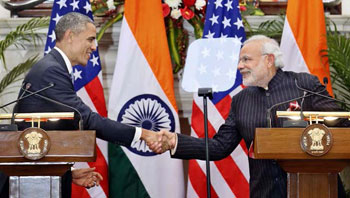 NEW DELHI, Feb 8: Two weeks after U.S. President Obama announced that India and the U.S. have reached a “breakthrough understanding” on the civil nuclear deal, the Ministry of External Affairs (MEA) put out a press release to explain the agreement that India and the U.S. have reached, in order to enable commercial negotiations to begin.
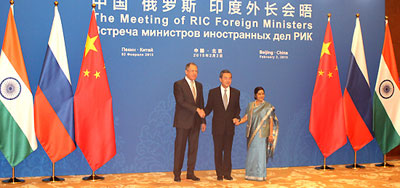 BEIJING, Feb 2: In a significant development, China and Russia on Monday decided to back India for moving a proposal at the United Nations that essentially goes against Pakistan on the issue of terrorism.
 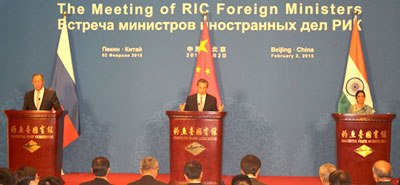 The three foreign ministers called for early conclusion of negotiations on the Comprehensive Convention on International Terrorism. India had moved this resolution 19 years back that has since remained inconclusive, Swaraj explained.
 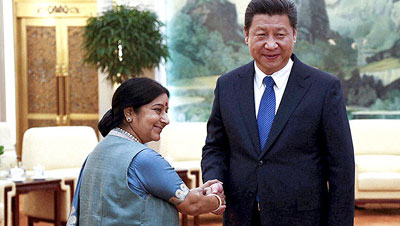 NEW DELHI, Feb 2: India and China are bound by an "unbreakable bond", Prime Minister Narendra Modi said today while advocating that the two countries should know and understand each other better.
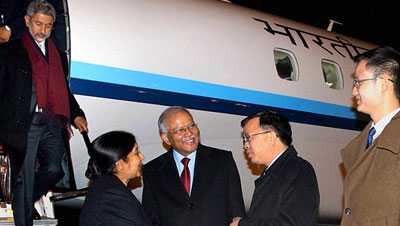 BEIJING, Jan 31: External affairs minister Sushma Swaraj arrived here on Saturday on a four-day visit to China during which she would meet Chinese President Xi Jinping and hold talks with her Chinese counterpart on wide-ranging bilateral and multilateral issues besides attending the Russia-India-China (RIC) trilateral.
Aviation
| Business | Defence | Foreign
Affairs | Communication | Health
| India | United Nations
India-US
| India-France | Entertainment
| Sports | Photo Gallery |
Tourism | Advertise with Us
| Contact Us
© Noyanika International, 2003-2009. All rights reserved.