


Foreign Affairs
|
Delhi Study Group delegation visits ChinaBy Deepak Arora
International delegates from India, Bangladesh and Sri Lanka were invited for the fully covered visit to China. They were hosted at Beijing, Yunnan and Fujian cities. The Dy. Secretary General CAFIU, Liu Kaiyang, and Deputy Director Ms. Mu Jingling briefed them on the topic “China Dream”. It was claimed by Chinese leaders that within the next five years, Shanghai shall produce a fully indigenously manufactured airplane.
The minimum wage in China is 1,650 Yuan and which is equivalent to INR 10. A visit to the Great Wall of China as well as to Chun Lun Tea Factory in Fujian province were the other highlights of the program. Various programs related to China geography, environmental conservation, transport, health, industrial development, foreign trade, religion and culture were discussed at length by Chinese experts. Special visits to the China rural and village areas were organized. Nepal earthquake toll crosses 4,000KATHMANDU, April 27: Thousands of desperate Nepalese took shelter under tents and sought help on Monday, two days after a massive quake killed more than 4,000 people, as overwhelmed authorities struggled to provide for the wounded and homeless. The toll is likely to climb as rescuers struggle to reach remote regions in the impoverished, mountainous country of 28 million people and as bodies buried under rubble are recovered. It has been over 560 hours since an earthquake measuring 7.6 on Richter scale ravaged Kathmandu and several other parts of Nepal, but the aftershocks are still continuing. In the past two days, there have been 90 aftershocks measuring over 4 on Richter scale with one on Sunday afternoon recording as high as 6.9. There have been over 200 minor tremors. "The intensity and frequency of the shocks are likely to gradually come down, but it could take another 24-36 hours or more for that," said Lok Bijay Adhikari, chief of National Seismological Centre. The aftershocks and rumours about another big quake forced residents in Kathmandu and other parts of Nepal spent the second consecutive night in open spaces and under tents. "There is no way to predict the time, place or intensity of any quake. Therefore people should not believe such rumors," said Adhikari. While the tremors are slowly becoming less intense, affected residents were more troubled by the rains that lashed the capital and several other towns on Sunday night forcing those living in the open to seek cover. According to the meteorology department, 4 mm of rainfall was recorded in Kathmandu. More showers are expected in late afternoons and evenings. "The weather will remain cloudy with possibility of brief rain and thundershowers in some places of eastern Nepal and central hilly region," said an official of the department of hydrology and meteorology. There are fears that rains could lead to avalanches and landslides and could hamper search, rescue and relief work. Many people are still feared to be buried under rubble in Kathmandu and elsewhere. Across Kathmandu and beyond, exhausted families whose homes were either flattened or at risk of collapse laid mattresses out on streets and erected tents to shelter from the rain. The sick and wounded lay out in the open in the capital, unable to find beds in the devastated city's hospitals. Surgeons set up an operating theatre inside a tent on the grounds of Kathmandu Medical College. "We are overwhelmed with rescue and assistance requests from all across the country," Deepak Panda, a member of the country's disaster management, said. Canada to sell uranium to India
The deal was termed as the launch of a new era in bilateral cooperation by Prime Minister Narendra Modi after it was announced during a joint signing ceremony in the presence of his Canadian counterpart Stephen Harper. The Prime Minister said, “The agreement on procurement of uranium from Canada for our civilian nuclear power plants launches a new era of bilateral nuclear cooperation. It also reflects a new level of mutual trust and confidence. Further, it will contribute to India’s efforts to power its growth with clean energy.” Harper was also pleased at the completion of the long-pending deal, as he said, “Canada and India have a longstanding and mutual interest in expanding our trade relationship, particularly in the area of energy cooperation. This contract is a clear signal that our countries are open for expanding business partnerships together.” The agreement became possible, according to the Canadian government, after the Canada-India Nuclear Cooperation Agreement (NCA) came into force in September 2013. The deal is worth approximately $350 million at current market rates, and could be renewed after five years. In an interview after the event, Cameco’s president and CEO Tim Gitzel said “We’ve been looking at the Indian market. This is a big deal, for Canada, for Saskatchewan and for Cameco.” Cameco is headquartered in the city of Saskatoon in the prairie province of Saskatchewan and accounts for nearly 16% of the world’s production of uranium. This is a breakthrough, given the decades of distrust between the two countries on nuclear issues. As Modi pointedly said, “This is a symbol of trust. Trust is the biggest source of energy that in the coming days will improve our relations.” External affairs ministry spokesperson Syed Akbaruddin said, “This agreement epitomises a futuristic approach in our ties — where we can take it, rather than where it has come from.” Countries supporting terrorism have to be isolated: Modi in BerlinBERLIN, April 15: The international community should speak in one voice and focus collectively to isolate countries that back terrorism, Prime Minister Narendra Modi said in Berlin on Tuesday in an apparent reference to Pakistan which freed 26/11 Mumbai attack mastermind Zaki-ur-Rehman Lakhvi last week. Speaking to newspersons at the end of his two-day visit to Germany, Modi said terrorism should be dealt with as much sensitivity as the issue of nuclear weapons. Germany and India had a common approach towards terrorism, he said. "We need to work on how we can stop sources from where the weapons are supplied. How we can put pressure on the countries where governments provide shelter to terrorists...We need to isolate such countries and governments," Modi said. German chancellor Angela Merkel said her country had a lot of common ground with India on Afghanistan, terrorism and other global challenges. "Terrorism is a challenge to the whole world...This issue should be dealt with as sensitively as nuclear proliferation," the PM said. Modi's remarks came four days after a Pakistan court released Lashkar-e-Toiba operations commander Lakhvi, which evoked a sharp reaction and concern from several countries including the US, France and Israel. India said the development "eroded" the value of Pakistan's commitment to tackle terror. The Prime Minister said the United Nations should pass a resolution in its 70th anniversary to define terrorism and justice should be done to India by making it a member of the UN Security Council, given New Delhi's long record of peace and contribution to peace-keeping forces and sacrifices made by Indian soldiers during the World War I. Merkel also said she would help restart talks between India and the European Union on a free trade agreement, but said both sides needed to come forward 'to overcome the last hurdle'. India's views needed to be accommodated, she added. German companies were ready to take forward India's development under the Make in India initiative, she said. After the bilateral talks, Modi visited the Berlin Central train station as part of his vision to improve railway stations and the rail network in India and said he was looking forward to Merkel's visit to India in October. He later left for Ottawa on the third leg of his visits to France, Germany and Canada. In his initial remarks at the press interaction, Modi said, "The spread of terrorism is growing and its character is changing. The threat is coming close to us across every region of the world. We need a comprehensive global strategy to deal with this global challenge, in which India and Germany can work together." Merkel also said the two countries agreed to fight against terrorism collectively, describing it as a global challenge. In the coming days, maritime cyber and space security would be a matter of concern to everyone and the two countries should increase the cooperation in this area as well, Modi said. He also talked about instability and violence in West Asia, saying it "affects the security of our citizens at home". Modi Invites the World to Make in Changed IndiaHANNOVER, April 14: Harping on the ‘Make in India’ mantra, Prime Minister Narendra Modi extended an invitation not only to German investors but to the whole world to come and see how India had changed under his government, and promised to ‘make corrections wherever required’. She added: "I think Hannover fair would allow us to turn a new chapter in our relationship. Let me assure you that Germany stands ready to develop this partnership." Detailing steps taken to ensure ease of business, Modi said: "The entire world is looking at India. Demography, democracy and demand are attracting the world to India. Low-cost manufacturing, efficient governance and no-defect manufacturing makes India a global engine in the manufacturing centre." He added: “(In) this year's budget we have rationalized a number of issues which were bothering you…We have removed lot of regressive taxation regimes. In our very first Budget, we said we will not resort to retrospective taxation”. India, Australia explore ways to facilitate flow of uraniumNEW DELHI, April 14: India and Australia today explored ways for early conclusion of the Administrative Arrangements on civil nuclear cooperation to facilitate the flow of uranium amid Australian assurances that they may conclude by this year end. External Affairs Minister Sushma Swaraj held extensive talks with her Australian counterpart Julia Bishop during which Swaraj also raised the killing of an Indian woman IT professional in a Sydney suburb last month. To this the visiting minister assured that the perpetrators of the fatal knife attack will be brought to justice. According to officials, Bishop told Swaraj that a special task force has been set up to investigate the matter. Bengaluru techie Prabha Arun Kumar was stabbed to death while returning home in Sydney on March 8. The 10th India-Australia Foreign Ministers Framework Dialogue was held in a "friendly and cooperative atmosphere with exchange of views on all focus areas of interest", an External Affairs Ministry release said. Recognising the importance of finalising a mutually beneficial free trade pact, the ministers encouraged strong business links and highlighted the role of the CEOs' Forum and Make in India Show to be held in Australia later in the year. "They also explored ways for an early conclusion of the Administrative Arrangements on civil nuclear cooperation to facilitate the flow of Uranium," it said. Australia holds about a third of the world's recoverable uranium resources, and exports nearly 7,000 tonnes a year. The nuclear pact under which Canberra will supply uranium was signed after a meeting between Prime Minister Narendra Modi and his Australian counterpart Tony Abbott here last September. The two sides also expressed satisfaction with ongoing cooperation in defence and security and discussed measures to further enhance regional cooperation in view of recent developments in the Asia-Pacific region. Bishop also invited Swaraj to visit Australia which was accepted by the Indian minister. Australia wants to be India’s ‘partner of choice’: Julie Bishop
Bishop, who is in New Delhi to hold talks with External Affairs Minister Sushma Swaraj on Tuesday, said Australia wants to be “a useful partner for India as it emerges on the world stage”. She said Canberra has been a reliable partner for China’s economic growth and it wants to be “a close friend and strategic and economic partner for India, and be a partner of choice in India’s energy security”. Answering questions on the sidelines of an event marking her address at the inaugural Indo-Pacific Oration, organised by the Observer Research Foundation (ORF), Bishop said she will be holding a “rather long meeting” with Sushma Swaraj on Tuesday during which regional and geostrategic issues would figure. “And I am sure we will discuss China’s foreign policy which is more assertive than we have seen in the past.” She said that during her previous discussions with Sushma Swaraj, “I think we had similar views on China’d territorial ambitions; we don’t take a decision on territorial plans, but we do urge all nations to respect international law, respect global norms and to resolve any territorial or maritime plans peacefully ... there is far too much at stake for this to not occur.” With regard to the South China Sea, where China has been exhibiting increasing assertiveness over the maritime and island resources, Bishop said Australia supports the 10-member Asean (Association of Southeast Asian Nations) grouping in wanting to conclude a Code of Conduct on the South China Sea with China which will govern maritime negotiations. She said that if the Asean nations continue to work as one bloc then the status quo in the South China Sea will continue as “I can’t see many of the maritime disputes (between individual Asean countries and China) being resolved soon; but a Code of Conduct will ensure maritime passageways”. Bishop, who is also deputy leader of the Liberal Party, said it is “important for Australia” and other countries in the region for “unimpeded maritime passageway and maritime access”. She said that in recent times China has exhibited a willingness to support the Code of Conduct process with the Asean. “What India and Australia must do at the East Asia Summit is to continue to promote this position; and if we work together in this regard we can have more influence than working separately,” she added. Bishop also said that Australia is keen to sign the Free Trade Agreement, known as the Comprehensive Economic Cooperation Agreement (CECA), with India soon. She said that with the coming to power of the Narendra Modi government, there is “new energy about India”. She said Modi’s visit to Australia in last November and his warmth “made the wait worthwhile” for a bilateral prime ministerial visit from India. Modi was the first Indian prime minister to visit Australia since Rajiv Gandhi in 1986. It's India's right to get a permanent seat in UNSC: ModiPARIS, April 12: Prime Minister Narendra Modi on Saturday made a strong pitch for a permanent seat for India in the United Nations Security Council, saying it should get it as a "right" for its immense contribution to global peace. "Those days are gone when India had to beg. Now we want our right. No other country has such moral authority," he said while addressing the Indian community in Paris. "This is an opportunity to recognise a peace-loving nation like India," he said, asking the UN to reconsider its stand on the issue when it celebrates the 70th anniversary. Addressing an enthusiastic civic reception by the Indian community on Saturday evening, Modi said that this is the centenary year of World War I, and India gave 14 lakh jawans to fight in a war that was not its, and lost 75,000 men. He said 11 of the Indians won the Victoria Cross for their valour. "I went to get blessings from them," he said referring to his visit to the Neuve Chapelle earlier in the day to pay tribute to the thousands of Indians who were killed in the WWI. "I want to give the message to world, that they should view India differently, that this is a country that gives sacrifice not just for itself but for others," he said. He said India is the largest contributor to the UN peacekeeping force and the Indian soldiers are known for their discipline, valour, intelligence. "India is a country that is for peace, and helps bring peace to the world, and yet we are fighting to get a seat in the UNSC," he said. "I appeal to the world, that in the year that the world is observing the centenary of WWI, it is the time to give the haq (right) to the land of Mahatma Gandhi and Buddha. The time is over when India would ask for a favour, today India is asking for its rights," he said to loud cheers. Addressing the Indian diaspora in the French territories, Modi said: "I am so far away, I give my salute to all of you. I know you feel pride in being Indian."He said his speech was being simultaneously translated into French for the benefit of those living in French territories of Guadeloupe, Reunion Islands and St. Martin. He said though the colour of their passports would have changed over the many decades they have been living outside India, "but the colour of our blood cannot change in all these years". "Bharat thinks about you, not from the colour of the passport but our DNA," he said, reinforcing the close links with their country of origin. He said the government had launched a special session at the Pravasi Bharatiya Divas diaspora conclave to understand the problems of the Francophone countries. Modi said the government will help the diaspora to reconnect with their roots. "We should maintain the connection." Referring to formation of the BJP government last May, he said that his government will live up to the promises that it has made to the people. He also said :"I can say with experience, that there is no reason for India to remain poor." Referring to the close friendship with France, Modi said that both France and India feel for each other whenever there is a terror attack on the other. "There is close relationship between us." Referring to the Make in India initiative, Modi said that in the two days that he has been in France "I would have said Make in India about 10 times, but every leader here said it 25 times; even President Hollande. The meaning is that our message has reached the proper target." India, world powers welcome Iran N-dealNEW DELHI, April 3: India joined the US and other western powers in welcoming the historic agreement on the framework of a deal aimed at curbing Iran’s nuclear programme while Israel claimed the proposed accord could jeopardise its existence if implemented. New Delhi said the announcement underlined the success of diplomacy and dialogue, which India "has always supported and which we hope would lead to a comprehensive agreement by June 30”. Secretary of State John Kerry hailed a "big day" while Iranian President Hassan Rouhani said the drafting of a full accord would begin immediately with the aim of completing it by the deadline. “PM Netanyahu to Pres Obama: A deal based on this framework would threaten the survival of Israel," spokesman Mark Regev posted on his official Twitter account. Regev quoted the Israeli premier as saying in the telephone conversation that the deal, as it appears to be emerging, "would not block Iran's path to the bomb. It would pave it. "It would increase the risks of nuclear proliferation and the risks of a horrific war," Regev added. The White House quoted Obama as telling Netanyahu that the framework deal with Iran represented "significant progress." "The President emphasised that, while nothing is agreed until everything is, the framework represents significant progress towards a lasting, comprehensive solution that cuts off all of Iran's pathways to a bomb," it said. The White House said Obama spoke to Netanyahu from aboard Air Force One to discuss the framework agreement that would see Iran scale back its nuclear programme in exchange for the lifting of sanctions. Israeli officials had earlier branded the deal as a "historic mistake" and "dangerous". Analysts said Obama is eager to resolve at least one intractable conflict in his final two years in office and had his eye on reconciliation with Iran. Thursday's agreement on a roadmap for the final phase of negotiations on a nuclear accord could open a way to a broader realignment that would redraw the map of the Middle East, the analysts said. But they warned that the long-time foes remain far from a rapprochement and any future cooperation would be limited. "In Barack Obama's head, there's this fantasy of a grand bargain, an alliance with Iran, and of reconstructing the architecture of the region for a paradigm shift," said Joseph Bahout, a visiting scholar at the Carnegie Center. Relations between Tehran and Washington are haunted by the 1953 coup, orchestrated by the CIA, which overthrew Iranian premier Mohamed Mosssadegh and restored royal rule. The divide between Israel and the US has been deepened by decades of hostile rhetoric. The US is regularly denounced as the "Great Satan" by Iranian leaders, and Washington has slammed Tehran as a "rogue state" that is part of an "axis of evil." The so-called P5+1 group – the US, Britain, China, France and Russia plus Germany – hope the deal will make it virtually impossible for Iran to make nuclear weapons. Iran, one of the world's major oil producing countries, has always denied seeking the atomic bomb, saying its activities are for energy generation and research. |

| |||||||
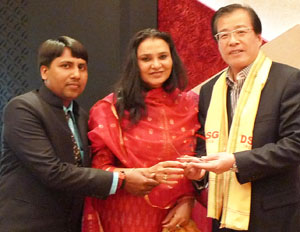 NEW DELHI, April 21: A two-member Delhi Study Group delegation led by Dr Abhilasha Sharma, Editor Delhi Study Group Bulletin, and Vijendar Yadav, Executive Secretary to DSG President, at the invitation of CAFIU (Chinese Association for Friendship and International Understanding) visited China in Second week of April.
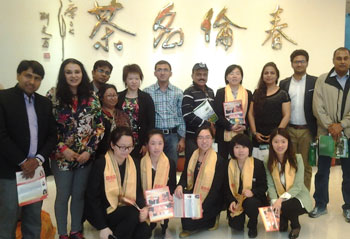 China strives to provide one million jobs each year - claimed participants in the “Know China & Friendly Exchange” program.
 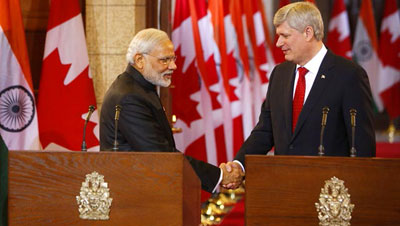 OTTAWA, April 16: A path breaking multi-million dollar contract was announced on Wednesday between India and a Canadian company, Cameco Corporation, to supply over seven million pounds of uranium concentrate, over a five year time-frame.
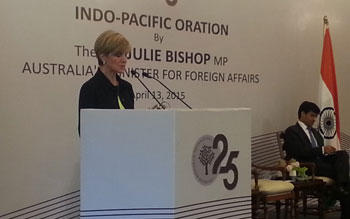 NEW DELHI, April 13: Australian Foreign Minister Julie Bishop on Monday said her country wants to be the “partner of choice for India’s energy security” and, with both countries sharing “similar views” on China’s territorial ambitions and on unimpeded maritime rights, they could work together to push the Code of Conduct in the South China Sea.
Aviation
| Business | Defence | Foreign
Affairs | Communication | Health
| India | United Nations
India-US
| India-France | Entertainment
| Sports | Photo Gallery |
Tourism | Advertise with Us
| Contact Us
© Noyanika International, 2003-2009. All rights reserved.