


Foreign Affairs
|
Taiwan President Ma Ying-jeou proposes Peace Plan for South China Sea
Similar in spirit to the president's East China Sea Peace Initiative proposed in August 2012, the new initiative calls on all parties concerned to exercise restraint, safeguard peace and stability in the South China Sea, and refrain from taking any unilateral action that might escalate tensions. It also calls for parties concerned to peacefully deal with and settle disputes through dialogue and consultations, and jointly uphold the freedom and safety of navigation and flying through the South China Sea region. Ma pledged that Taiwan government is willing to exploit resources in the South China Sea in cooperation with others based on the basic principles of safeguarding sovereignty, shelving disputes, pursuing peace and reciprocity. "We emphasize that while sovereignty cannot be divided, resources can be shared, thereby replacing sovereignty disputes with resource sharing," he said. Several countries, including Brunei, Malaysia, the Philippines, Taiwan, China and Vietnam, claim all or parts of the South China Sea. China has sparked tensions in the region in recent months by unilaterally reclaiming islands in the South China Sea and using them to establish military facilities. In his initiative, Ma advocated that all parties should be included in mechanisms or measures that enhance peace and prosperity in the South China Sea and establish a regional cooperation mechanism for the zonal development of resources through integrated planning. Ma also suggested setting up coordination and cooperation mechanisms for such non-traditional security issues as environmental protection, scientific research, maritime crime fighting, and humanitarian assistance and disaster relief. The president put forth the initiative when he addressed the opening of the 2015 International Law Association (ILA) and the American Society of International Law (ASIL) Asia Pacific Research Forum. Iraq regains ground from IS, mass deaths reported in Palmyra
The fall of Ramadi and Palmyra, on opposite ends of the vast territory controlled by Islamic State fighters, were the militant group's biggest successes since a US-led coalition launched an air war to stop them last year. The near simultaneous victories against the Iraqi and Syrian armies have forced Washington to examine its strategy, which involves bombing from the air but leaving fighting on the ground to local forces in both countries. In a sharp criticism of Washington's ally, US defence secretary Ashton Carter accused Iraq's army of abandoning Ramadi, a provincial capital west of Baghdad, to a much smaller enemy force. "The Iraqi forces just showed no will to fight," he told CNN's State of the Union programme. "They vastly outnumbered the opposing force, and yet they withdrew from the site." Iraq's government, along with Iran-backed Shi'ite militiamen and locally-recruited Sunni tribal fighters, launched a counter-offensive on Saturday, a week after losing Ramadi. A police major and a pro-government Sunni tribal fighter in the area said they had retaken the town of Husaiba al-Sharqiya, about 10 km (6 miles) east of Ramadi. "Today we regained control over Husaiba and are laying plans to make more advances to push back Daesh fighters further," said local tribal leader Amir al-Fahdawi, using an Arabic acronym for Islamic State, also known in English as ISIS or ISIL. "The morale of the (pro-government) fighters is high after the arrival of reinforcements and loads of ammunition," Fahdawi said. "Today's advance will speed up the clock for a major advance to regain control of Ramadi." Planes were bombing Islamic State positions on the opposite bank of the Euphrates river, where the militants were launching mortars and sniper fire to prevent the pro-government forces advancing, Fahdawi and the police major said. Days after taking Ramadi, Islamic State also defeated forces of the Syrian government of President Bashar al-Assad to capture Palmyra, home to 50,000 people and site of some of the world's most extensive and best-preserved Roman ruins. The fighters have killed at least 400 people, including women and children in Palmyra since capturing the ancient Syrian city four days ago, Syrian state media said on Sunday. It was not immediately possible to verify that account, but it was consistent with reports by activists that the Islamist fighters had carried out executions, leaving hundreds of bodies in the streets. The Sunni Muslim militants have proclaimed a caliphate to rule over all Muslims from territory they hold in both Syria and Iraq. They have a history of carrying out mass killings in towns and cities they capture, and of dynamiting and bulldozing ancient monuments, which they consider evidence of paganism. "The terrorists have killed more than 400 people ... and mutilated their bodies, under the pretext that they cooperated with the government and did not follow orders," Syria's state news agency said, citing residents inside the city. Many of those killed were state employees, including the head of the nursing department at the hospital and all her family members, it said. Islamic State supporters have posted videos on the internet they say show fighters going room to room in Palmyra's government buildings, searching for hiding troops and pulling down pictures of Assad and his father. The Syrian Observatory for Human Rights, which monitors violence in the country with a network of sources on the ground, says beheadings have taken place in the town since it fell but has not given an estimate for the toll among civilians. It says at least 300 soldiers were killed in the days of fighting before the city was captured. "A bigger number of troops have disappeared and it is not clear where they are," Rami Abdulrahman from the Observatory told Reuters. Washington supports the government of Iraq but is opposed to Assad's government in Syria, making it more difficult to build a unified coalition against Islamic State, the most powerful force among Sunni Arabs in multi-sided civil wars in both countries. In Iraq, government forces and Iran-backed Shi'ite militia advanced against the Sunni militants north of Baghdad in the Tigris river valley earlier this year, recapturing former dictator Saddam Hussein's home city of Tikrit. But the insurgents responded by going on the offensive west of Baghdad in the valley of Iraq's other great river, the Euphrates, among the most hotly fought areas during the 2003-2011 US occupation. Washington worries that Baghdad's response of sending Shi'ite militia into the area for a counter-offensive could increase sectarian anger and play into Islamic State's claim to defend Sunnis from a Shi'ite dominated government in Baghdad. In Syria, where a four-year civil war has killed 250,000 people and made 8 million homeless, Assad's government has been losing territory in recent months, both to Islamic State and to other Sunni groups, some of which are supported by the West. Indian Delegation to Cambodia Promotes People to People DiplomacyBy Deepak Arora
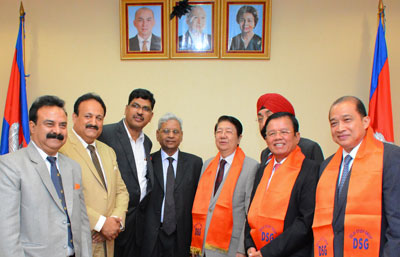
Recently Delhi Study Group delegation from India visited Cambodia to promote “People to People Friendship and Diplomacy” between the two countries, stated Vijay Jolly President Delhi Study Group. There is a lot of scope for Indian Bollywood to capture the scenic beauty and make cinematic films in the background of Hindu temples, stated Leader of the Indian delegation Ashok Garg. Ashok Garg, leader of the delegation, focused on areas of understanding which can benefit the two countries namely education, space, information & technology, tourism, conservation of historical places of worship and exchange of delegations etc. Narendra Chawla member of the delegation also delivered a fiery speech. The lecture was followed by a livid “Question and Answer” session. The session was an eye opener. There is lot of awareness about India, progressive programs and policies of Indian Prime Minister Narendra Modi and their keenness to take relations forward through introduction of direct flights between the two nations. This program was attended by Ambassadors and High Commissioners from more than 50 nations along with large attendance of Cambodian Ministers and citizens. Modi in South Korea: Asian unity will shape the worldSEOUL: Prime Minister Narendra Modi on the last day of his three-nation tour sought unity among Asian countries and said they must work as Asians to shape the world and reform the global institutions of governance, including the United Nations. "If Asia must rise as one, Asia should no longer think of itself in regional fragments," Prime Minister Modi said at the VI Asia Leadership Conference in South Korean capital Seoul. Noting that Asia of rivalries will hold the continent back, he asked the Asian countries to draw upon their shared heritage and youthful energy to pursue a common purpose. "Asia of unity will shape the world," Modi said, adding that India seeks an Asia of shared prosperity, where the success of one nation becomes the strength of the other. "We must work as Asians to reform the global institutions of governance, including the United Nations and its Security Council," he said, underlining that Asia's re-emergence is the greatest phenomenon of this era. Prime Minister Modi said India's progress will be Asia's success story and it will help to make the Asian dream a bigger reality. "My Asian dream is one in which all of Asia rises together...The future I dream for India is the future I seek for our neighbours. Our growth must be more inclusive within and across nations," said Modi, who is here on the last leg of his three-nation tour that also took him to China and Mongolia. Noting that India is located at Asia's crossroads, the Prime Minister said, "We will assume our responsibility to build inter-connected Asia." Modi said as some of the countries in Asia become more prosperous they must be prepared to share their resources and markets with those who need them. "This is the obligation of national governments but also a regional responsibility," he added. Modi lauded Korea as a "pillar of democracy" and said Korea's economic miracle and global leadership in technology has made the promise of the Asian Century more real. "It is now India's turn to sustain Asia's success. India's potential has never been in doubt. And, in the course of the past year, we are translating promise into a reality; hope into confidence," the prime minister said. He said India's growth has rebounded to 7.5 per cent per year and the prospects of further increase are strong. "The world speaks in one voice that India is the new bright spot of hope for our region and the world. The progress of one-sixth of humanity will also be an opportunity for the world. It will also give India the capacity to do more for our world," he told the gathering of Asian leaders. Modi said Asia will succeed more when all of Asia rises together. "It must not be a continent of nations on the rise and others in decline; of regions with stability and others with broken institutions." He said youth should be empowered with skills and education so that they can look to the future with hope. "Over the next 40 years, three billion Asians will lift themselves into a higher level of prosperity. Asia's prosperity and rising population will place a huge demand on our limited resources," he said, adding that our footprint on earth must become lighter as our economic weight increases. Stating that combating climate change is in Asia's enlightened self-interest, he said India has set a goal of 175 Giga Watts of new renewable energy capacity over the next five years. "But, coal and oil will remain the key source of energy for all of us for a long time to come," he said. "We must connect our regions through infrastructure and integrate them through trade and investments. We must also do everything possible to secure lasting peace and stability for Asia. We must build institutions that promote cooperation on the principles of equality, co-existence and international rules and norms," the Prime Minister said. "It is also our collective task against our common challenges - terrorism; trans-national crimes; natural disasters and diseases," he added. Modi in China: 26 deals worth $22 billion inkedNEW DELHI: Prime Minister Narendra Modi's visit to China has yielded $22 billion worth of MoUs showing China Inc.'s strong interest in the Indian story, says a statement released by the Ministry of External Affairs. The MoUs which span a wide range of industries including renewable energy, power infrastructure, and steel and small & medium industries will enhance Chinese companies' commitment to 'Make in India', MEA has said. The business-to-business MoUs include Indian industry giants like Bharti Airtel Ltd, Adani, Sun Group, Wipro and GMR. We take a look at the details of the 21 agreements that have been signed: Among major agreements is Bharti Airtel's tie-up for credit facility of $ 2.5 billion with China Development Bank and Industrial and Commercial Bank of China. The Adani Group also inked an agreement with Golden Concord Holdings to establish an integrated photovoltaic industrial park in Mundra SEZ and to explore investments in gas power generation and natural gas sector. In another pact, Adani Ports & SEZ and Guangzhou Port Authority agreed to establish "sister port relationship" between Mundra Port and Guangzhou Port. Welspun Energy entered into a memorandum of understanding with Trina Solar of China to jointly set up a PV industry park for production of 500 MW of Photovoltaic (PV) cell and 500 MW of PV solar module in India. "(These) are a reflection of the strong interest of Chinese companies to invest in India and contribute towards 'Make in India' initiative," an official statement said. It further said the agreements would also facilitate cooperation between Indian and Chinese companies in the film and entertainment industry and "will help in making more Chinese friends/audiences aware of India's strength in this area." The other significant MoUs include, IL&FS and Industrial & Commercial Bank of China (ICBC); IL&FS Energy Development Co and China Huaneng Group for 4,000 MW Nana Layja Thermal Power (Coal) project; and Jindal Steel and Power and ICBC on development of potential projects. Technology major Infosys also entered into an MoU with People's Government of Qiannan Autonomous Prefecture to jointly build 'China India Information Service Industry Corridor' in Qinnan. Bhushan Power and Steel too signed a pact with China National Technical Import and Export Corporation for an integrated steel project in Gujarat. Speaking at the India China Business Forum, Modi had reached out to Chinese investors asking them to take advantage of the "winds of change" in India with a much more transparent, responsive and stable regulatory regime. Hardly any foreign investment into India, Chinese mouthpiece saysBEIJING: Describing Prime Minister Narendra Modi's "relentless efforts at major power diplomacy" as the main achievement of his first year in office, a leading Chinese government mouthpiece said on Monday there is, however, little evidence of foreign direct investments coming into India. "For the moment, there is little evidence of success for foreign investments from private enterprises," the state-run Global Times stated in an opinion piece, titled "Economy a dilemma for globe-trotting Modi", barely two days after Modi concluded his official visit to China. "In the end, if any country tries to encourage investments to India, most of the programmes will be led by the government itself, with most of the private business sector skeptical about the whole idea," it said. Pointing out that though India enjoyed a favourable diplomatic climate due to its ideal geographical position, the daily in a hard-nosed assessment of the country said that "even if New Delhi keeps persuading investors how promising it is to do business in India, the current situation is far from reassuring". "Power failures happen frequently. There is a lack of decent roads and ports for transportation. Labour unrest occurs from time to time. Attracting investments against such backdrop will prove to be a major problem," it added. The article said despite the fact that Modi's government has brought in a series of measures for investors, such as establishing special economic zones, free tax zones and free trade areas, some of these efforts have come up against resistance by state governments, which "hold great control over adopting policies for local economic development". Saying the US has been trying to cultivate India in its geopolitical strategy to contain China's rise, while Beijing desires to promote friendly ties with its neighbour, the article stated: "Modi has obviously realized this, that's why he started proactive international engagement soon after he assumed office." "But India has long adhered to an independent foreign policy, with no interest in being manipulated to fight in anyone's corner," the mouthpiece said. India, it said, has traditionally acted very prudently, "which can be seen from Modi embracing Putin while trying to cement closer ties with Washington at the same time". 4 Indians among 7 dead in Kabul guesthouse siege, Taliban claim responsibilityKABUL, May 14: The Taliban on Thursday claimed responsibility for an attack during a concert at a Kabul guesthouse that left seven people dead including four Indians and an American. "It was a suicide mission carried out by one of our mujaheddin from Logar. The attack was planned carefully to target the party in which important people and Americans were attending," the militants said in a statement. At least one gunman attacked the guesthouse popular with foreigners in a bold assault that showed Afghanistan still faces security challenges. Authorities cordoned off the area around the Park Palace guest house in Kabul's Kolola Pushta, a diplomatic enclave in the Afghan capital that includes a number of guesthouses used by foreigners, immediately after the attack began at about 8:30pm local time (1600 GMT). A standoff with police ended about five hours later as ambulances raced out of the area. Similar brazen assaults in the past have been carried out by the Taliban and the al Qaeda-linked Haqqani network. The brutal assault was reminiscent of two attacks by Taliban fighters in Kabul last year, one on a restaurant and another on a hotel. A spokeswoman for the US Embassy confirmed that one American was killed in the attack. Three who had lived at the guesthouse were rescued and sheltering at the Indian Embassy, a diplomat said. "Unfortunately a few Indian casualties among others at the Kabul g/house attack today," Indian Ambassador Amar Sinha tweeted but official sources later told the Press Trust of India that four Indians were among the dead. Rahimi said at least 44 people who had been trapped inside the guesthouse - some there for a concert, others who had been having dinner - were rescued by police and special forces. He also said he could verify that there had been just one attacker, although initial reports from police indicated several gunmen were involved. "The attack did not start with an explosion at the main gate or killing of guards - whatever it was it started from inside the hotel," Rahimi said. Kolola Pushta, home to several international guest houses and hotels, is near both the Ministry of Interior and the Indian Embassy. Taliban gunmen killed nine people - including three children - in the upscale Serena Hotel in Kabul last year. Two months earlier, attackers stormed into a popular Lebanese restaurant in the capital and gunned down 21 people, including three United Nations staff and a senior IMF official. Earlier on Wednesday, gunmen opened fire at a meeting of Muslim clerics in the southern province of Helmand, killing at least seven people, police said. The Ulemma Council, the highest religious authority in a deeply conservative country, had repeatedly announced its support for security forces fighting the hardline Islamist Taliban insurgents. The Taliban have stepped up attacks since most foreign forces pulled out at the end of last year. Ousted from power in 2001, the Taliban have been fighting to bring down the US-backed government in Kabul. Vatican recognizes state of Palestine in new treatyVATICAN CITY, May 14: The Vatican concluded its first treaty that formally recognises the State of Palestine, a move that gives legal weight to the Holy See's years-long recognition and that drew fast criticism from supporters of Israel. The agreement, which the Vatican said aimed to "enhance the life and activities of the Catholic Church and its recognition at the judicial level," comes days before Pope Francis is due to meet Palestinian President Mahmoud Abbas and is likely to solidify relations between the Vatican and Palestinians. The text of the treaty, covering Church activities in areas controlled by the Palestinian Authority, has been concluded and will be officially signed by the respective authorities "in the near future," said a joint statement released by the Vatican. Abbas is due to attend a Mass at the Vatican on Sunday to make saints of two 19th and 20th century Palestinian-born nuns. Vatican officials stressed that the Holy See had given official recognition to the State of Palestine since 2012. The Vatican's deputy foreign minister, Monsignor Antoine Camilleri, said in an interview with the Holy See's official newspaper that he hoped the agreement would indirectly help the Palestinian State in its relations with Israel. "It would be positive if the accord could in some way help with the establishment and recognition of an independent, sovereign and democratic State of Palestine which lives in peace and security with Israel and its neighbours," he told l'Osservatore Romano. But European Jewish Congress President Moshe Kantor called the move "unfortunate" and said it would "diminish the chances of a negotiated peaceful resolution of the conflict and embolden extremists". Abraham Foxman of the Anti-Defamation League said the treaty was "premature" and said it would undermine a negotiated, two-state solution to the conflict. The UN General Assembly adopted a resolution on Nov. 29, 2012 recognising Palestine as an observer non-member state. This was welcomed at the time by the Vatican, which has the same observer non-member status at the United Nations. "We have recognised the State of Palestine ever since it was given recognition by the United Nations and it is already listed as the State of Palestine in our official yearbook," Vatican spokesman Father Federico Lombardi said. During a visit to the Middle East a year ago, Francis delighted his Palestinian hosts by referring to the "state of Palestine" and giving support for their bid for full statehood recognition. 2 ambassadors among 7 dead as Taliban shoots down Pak chopper aircraft
The Russian-made helicopter was one of three army Mi-17s carrying a group of diplomats to the Gilgit-Baltistan region as part of a campaign to promote tourism when the chopper collided with the building that was reportedly empty at the time. Leif H Larsen, the Norwegian envoy, and Domingo D Lucenario Jr of the Philippines were killed along with the wives of the Malaysian and Indonesian ambassadors, as well as the helicopter’s two pilots and a crew member, the army tweeted. Polish ambassador Andrzej Ananiczolish and Dutch envoy Marcel de Vink were reportedly among those injured. Pakistani Prime Minister Nawaz Sharif was travelling to the area in a separate aircraft to launch two projects when the incident occurred and he had turned back to Islamabad, officials said. “It was a diplomatic trip with members of 37 countries in total,” said a passenger in one of the helicopters, who requested anonymity, adding that the school had caught fire after the crash. The passenger added that the air convoy was supposed to have included four helicopters but the number was later reduced to three. The fallen Mi-17 was carrying 17 people, including 11 foreigners, the military’s spokesperson major-general Asim Bajwa tweeted. Soon after the incident, the Pakistani Taliban group said it brought down the chopper with a shoulder-launched missile and it had hoped to attack Sharif’s aircraft as well. “A special group of Tehreek-e-Taliban Pakistan had prepared a special plan to target Nawaz Sharif during his visit but he survived because he was travelling in another helicopter,” said a statement in Urdu emailed by the TTP’s chief spokesperson, Muhammad Khorasani. "Nawaz Sharif and his allies are our prime targets." Pakistani security forces have been fighting militants in the country's northwestern tribal regions bordering Afghanistan for the past several years. Pakistan launched a massive operation in the North Waziristan tribal region last year and since then the army says it has killed more than 1,200 militants there. Those injured in the crash were being airlifted to a military hospital in Gilgit, the area’s administrative capital, an official said. "We are making arrangements to send the bodies of the diplomats to their countries with full honour," Pakistan’s foreign secretary Aizaz Ahmad Chaudhry told state-run PTV. Popular for its spectacular mountain ranges and unique culture, Gilgit-Baltistan is a strategically important autonomous region that borders China and Afghanistan but is not known to be a TTP stronghold. The prime minister’s office said Sharif expressed his “deep grief and sorrow over the tragic incident” and he “extended heartfelt condolences to those who lost their lives.” Sharif also announced a national day of mourning, according to his office, which said helicopters were evacuating the injured diplomats and that the bodies were being transported to Islamabad. This is Pakistan’s worst air crash since 2012 when a Boeing 737 passenger plane went down in Islamabad, killing 130 people. In 1988 the then US ambassador to Islamabad, Arnold Raphel, died in the same plane crash that killed military ruler Muhammad Zia-ul-Haq. “The government and people of Pakistan are deeply saddened over the tragic death of foreigners in the unfortunate incident and equally share the grief of the affected families,” President Mamnoon Hussain said in a statement. A board of inquiry has been constituted to investigate the cause of the crash, officials said. Cameron returns to powerLONDON, May 8: Prime Minister David Cameron won an emphatic election victory in Britain, overturning predictions that the vote would be the closest in decades to sweep into office for another five years, with his Labour opponents in tatters. With only 6 of the 650 seats yet to be declared, the Conservatives have crossed the halfway mark with 326 MPs against Labour's 230, UK media reported. The Conservatives are forecast by the BBC to secure 331 seats in the Commons, giving them a slender majority. The BBC forecast is: Conservative 331, Labour 232, the Lib Dems 8, the SNP 56, Plaid Cymru 3, UKIP 1, the Greens 1 and others 19. The sterling currency and share prices soared on a result that reversed expectations of an inconclusive "hung Parliament" with Cameron jockeying for power with Labour rival Ed Miliband. Instead, Cameron was due to meet Queen Elizabeth before noon to accept a swift mandate to form a government. Despite the unexpectedly decisive outcome, initially uncertainty loomed over whether Britain will stay in the European Union - and even hold together as a country. Scottish nationalists swept aside Labour, meaning that Scotland, which voted just a year ago to stay in the United Kingdom, will send just three representatives of major British parties to parliament and be all but shut out of the cabinet. However, addressing media after visiting Queen Elizabeth to start the process of forming a new government, David Cameron said he would press ahead with a planned referendum on the country's membership of the European Union and he promised Scotland the most devolution "anywhere in the world" after his resounding election victory. "Yes, we will deliver that in-out referendum on our future in Europe," Cameron said as he addressed the media after visiting Queen Elizabeth to start the process of forming a new government. Cameron said he would move ahead as fast as possible with a plan to give more powers to Scotland, which voted overwhelmingly for the pro-independence Scottish National Party. "In Scotland, our plans are to create the strongest devolved government anywhere in the world with important powers over taxation, and no constitutional settlement will be complete if it did not offer also fairness to England," he said. Meanwhile, leaders of the Labour and Liberal Democrats parties resigned from their posts. Ed Miliband quit as Labour leader after his opposition party was decisively beaten at the polls by Prime Minister David Cameron's Conservatives. "Britain needs a strong Labour party. Britain needs a Labour party that can rebuild after this defeat so we can have a government that stands up for working people again," Miliband told a party meeting. "And now it's time for someone else to take forward the leadership of this party, so I'm tendering my resignation, taking effect after this afternoon's commemoration of VE day ..." He said the party's deputy leader Harriet Harman would take over until a new leader is elected. A majority would mean Cameron no longer needs the Liberal Democrats, with which he has governed since 2010. The centre-left party was crushed, perhaps reduced to single digits after winning 57 seats five years ago. The leader of Britain's Liberal Democrats Nick Clegg also resigned after his party suffered what he called a "crushing" defeat in a general election. "The results have been crushing," Clegg, who was the deputy prime minister for five years under David Cameron, told supporters. Nepal quake toll could touch 1 lakh: Swiss expert
|

| |||||||
 TAIPEI, May 26: President Ma Ying-jeou called for putting aside differences and promoting the joint development of resources in a "South China Sea Peace Initiative" during a forum in Taipei on Tuesday amid rising tensions in the region.
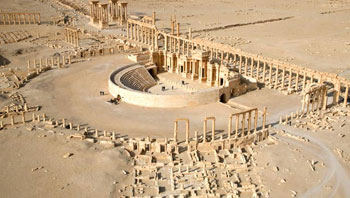 BAGHDAD, May 24: Iraqi forces recaptured territory from advancing Islamic State militants near the recently-fallen city of Ramadi on Sunday, while in Syria the government said the Islamists had killed hundreds of people since capturing the town of Palmyra.
 NEW DELHI, May 22:
 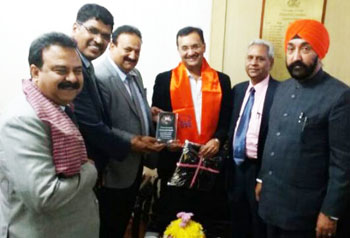 During the visit matters of mutual interests were discussed. Main focus was to revive 2000 years old relationship through People to People contacts.
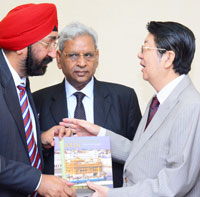 The delegation visited various temples like “Ta Prohm temple” where Government of India and Archaeological Survey of India is helping and financing restoration and “Angkor Wat temple” (largest Buddhist place of worship).
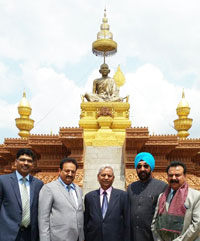 Welcome dinners were hosted by Secretary of State Tekreth Sarach and Director General (Authority for Protection & Management of Angkor) and Region of Siem Reap (APSARA) Bun Narith. It was specially attended by Sok Sangvar, Head, Angkor Tourism Management Plan and other prominent people.
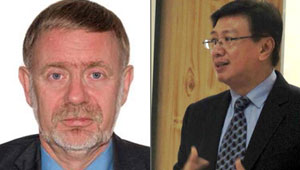 ISLAMABAD, May 8: Two ambassadors to Pakistan were among seven people killed when a military helicopter crashed into a school in the country’s mountainous north on Friday, authorities said, as the local Taliban claimed it shot down the aircraft and had hoped to assassinate the Prime Minister.
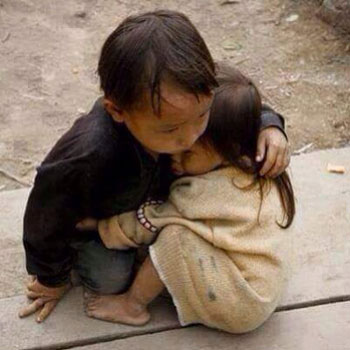 GENEVA, May 3: Last week's devastating earthquake in Nepal has claimed more than 7,000 lives and a Geneva-based agency says the final figure could be anywhere between 26,000 and more than 100,000.
Aviation
| Business | Defence | Foreign
Affairs | Communication | Health
| India | United Nations
India-US
| India-France | Entertainment
| Sports | Photo Gallery |
Tourism | Advertise with Us
| Contact Us
© Noyanika International, 2003-2009. All rights reserved.