|
Taiwan Prez Ma acclaims success in 'viable diplomacy'
 TAIPEI, June 25: The "viable diplomacy" approach has enabled Taiwan to expand its international space while contributing to the development of regional peace and prosperity, President Ma Ying-jeou said yesterday as he inspected the Foreign Ministry to give pep talks to diplomats. TAIPEI, June 25: The "viable diplomacy" approach has enabled Taiwan to expand its international space while contributing to the development of regional peace and prosperity, President Ma Ying-jeou said yesterday as he inspected the Foreign Ministry to give pep talks to diplomats.
Unlike the previous Democratic Progressive Party (DPP) administration that adopted the so-called checkbook diplomacy, Ma said yesterday during his address at the ministry that he has established viable diplomacy as a way of promoting cross-strait peace and friendly ties with the international community since he took office in May 2008.
With more than seven years of dedication and effort, the results speak for themselves, he noted. During the DPP administration between 2000 to 2008, Taipei lost nine allies to Beijing. Since he assumed office, Taiwan has only lost one.
Also, Ma added that 142 countries and territories — up from 54 seven years ago — have entered into visa-waiver agreements with Taiwan.
Ma thanked the efforts and contributions to the Foreign Ministry and all R.O.C. diplomats in helping Taiwan achieve these successes over the past seven years. He called on Taiwanese diplomats to continue their good work and help the name of the R.O.C. to be well-respected around the globe.
Ma further noted that he proposed his South China Sea Peace Initiative last month after the success of his East China Sea Peace Initiative proposed in August 2012 that has attained peaceful resolutions to decades-long fisheries and territorial disputes with Japan.
Similar in spirit to the East China Sea Peace Initiative, the new initiative calls on all parties concerned to exercise restraint, safeguard peace and stability in the South China Sea, and refrain from taking any unilateral action that might escalate tensions, he noted.
Asked by reporters to comment on what Taiwan can do further to resolve disputes in the South China Sea other than the peace initiative proposal, Ma yesterday admitted that the sovereignty disputes in the South China Sea are much more complicated than the East China Sea.
He noted that the sovereignty issue can hardly be resolved with China's outright opposition to any form of third-party arbitration.
Ma said the R.O.C. will soon propose a more concrete roadmap on how all claimants can share resources in the region, thereby replacing sovereignty disputes.
Meanwhile, Ma yesterday said he currently has no plan to visit Taiping Island, a Taiwan-controlled island in the South China Sea, in the near future, when asked to comment on the issue.
But he would not rule out the possibility of visiting since it is only natural to visit R.O.C. territory, he noted.
It was previously reported that Ma could visit Taiping to preside over the opening ceremony of a wharf facilities expansion project on the island this August or September.
Former President Chen Shui-bian was the first R.O.C. leader to set foot on Taiping Island when he visited there on Feb. 2, 2008 for the inauguration of a new airstrip.
According to the Foreign Ministry, this was the president's second inspection tour of the ministry since he assumed office in May 2008. He last visited the ministry in August 2008.
India sees Thailand as valued partner in ‘Act East’ policy: Sushma
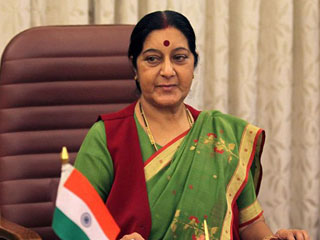 BANGKOK, June 28: India on Sunday described Thailand as a valued partner in its ‘Act East’ Policy and said it envisage a more vigorous and proactive engagement with the strategic and economically vibrant Southeast Asia region as part of its efforts to reposition itself at the world stage. BANGKOK, June 28: India on Sunday described Thailand as a valued partner in its ‘Act East’ Policy and said it envisage a more vigorous and proactive engagement with the strategic and economically vibrant Southeast Asia region as part of its efforts to reposition itself at the world stage.
“Our Government is resolved to move with a great sense of priority and speed to implement the ‘Act East Policy’,” External Affairs Minister Sushma Swaraj said here during an interaction with Indian business leaders.
“We envisage a more vigorous and proactive engagement with this economically vibrant region of our extended neighbourhood,” she said, insisting that the NDA government has engaged closely with India’s neighbourhood, strengthened bilateral ties with major countries, energised engagement with the East and repositioned India at the world stage.
She said that India’s ‘Look East’ Policy of the last two decades has been elevated to ‘Act East’ Policy under the leadership of Prime Minister Narendra Modi.
“I am happy to say that we have reached new milestones in our global outreach and made significant achievements in the last one year in transforming our relations with the outside world,” said Ms. Swaraj, who is here on a three-day bilateral visit and to attend the 16th World Sanskrit Conference.
Describing Thailand as an important pillar of India’s policy and a valued partner, she said the relationship between the two countries has expanded to virtually all areas of bilateral cooperation in recent years.
“Our bilateral relations with Thailand are based on deep-rooted cultural, religious and neighbourly association between the people of our two nations. Our common heritage of Buddhism and the philosophy of compassion, tolerance, non-violence and peace have laid strong foundations for this relationship,” she said.
“I am pleased to see that so many of you are in the leadership positions in corporates in Thailand and the region. In you I see the strength of our people-to-people relations. And in you I also see an influential group of leaders who can contribute to the economic growth of both Thailand and India,” she told the leading Indian business leaders in Bangkok.
She said her government is working on the simple 3C mantra — Commerce, Culture and Connectivity.
“In all these three areas I cannot overemphasise the importance of Thailand. We have embarked on ambitious projects for land connectivity with Thailand through Myanmar. We are also working on enhancing our sea connectivity with Thailand which is a maritime neighbour of India,” she said.
63 killed in terror attack in Paris, Kuwait and Tunisia
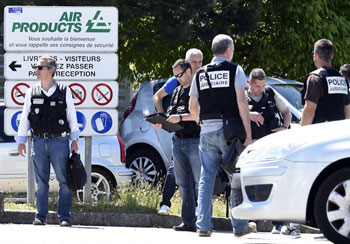 PARIS/KUWAIT CITY/TUNIS, June 26: As many as 63 people were killed and scores injured in a string of terror attacks in France, Kuwait and Tunisa on Friday. The attack in France was on Air Products factory in in the town of Saint-Quentin-Fallavier, around 30 km southeast of the city of Lyon. In Kuwait a suicide bomber ripped through a Shiite mosque that killed 25 people and injured over 200. At least 37 people were killed in an attack on a tourist hotel in the Tunisian beach resort of Sousse. PARIS/KUWAIT CITY/TUNIS, June 26: As many as 63 people were killed and scores injured in a string of terror attacks in France, Kuwait and Tunisa on Friday. The attack in France was on Air Products factory in in the town of Saint-Quentin-Fallavier, around 30 km southeast of the city of Lyon. In Kuwait a suicide bomber ripped through a Shiite mosque that killed 25 people and injured over 200. At least 37 people were killed in an attack on a tourist hotel in the Tunisian beach resort of Sousse.
A severed head covered in Arabic writing was found at a US gas company in southeast France on Friday, police sources and French media said, after two assailants rammed a car into thremises, exploding gas containers.
Speaking from a European Union summit in Brussels, French President Francois Hollande described it at a terrorist attack and said all measures would be taken to stop any future attacks on a country still reeling from Islamist assaults in January.
One suspect had been arrested and was already known to French intelligence sources, Hollande said.
"Two individuals deliberately rammed a car into the gas containers to trigger an explosion," a police source said.
It was not known whether the victim, so far the only known fatality in the incident that also injured two people, was decapitated before or after the car smashed into the building, or whether the victim had been on site at the time of the attack, or killed elsewhere.
"The attack was of a terrorist nature since a body was discovered, decapitated and with inscriptions," Hollande told the news conference.
In April, Prime Minister Manuel Valls said no fewer than five attacks had been thwarted in the country since the Charlie Hebdo killings in January.
Then, Islamist gunmen killed 17 people in the offices of the Charlie Hebdo satirical weekly and a Jewish food store.
The site belonged to Air Products, a US industrial gases and chemicals company, according to a spokeswoman for Air Liquide, a French company in the same sector. It was immediately ringfenced by police and emergency services.
The chairman and CEO of Air Products is Seifi Ghasemi, who in 2011 testimony to a US Senate committee described himself as Iranian-born. Mainly Shi'ite Iran is a sworn enemy of Sunni-dominated Islamic State.
No group claimed responsibility for the attack and the motive was unknown.
Kuwait mosque bombing kills 25; ISIS claims responsibility
The Islamic State group claimed a suicide bombing that ripped through a Shiite mosque in Kuwait that killed 25 people and injured over 200.
The Islamic State-affiliated group in Saudi Arabia, calling itself Najd Province, said a militant named Abu Suleiman al-Muwahed carried out the attack on the mosque, which it claimed was spreading Shia teachings among Sunni Muslims.
ISIS, a radical Sunni Muslim group, considers Shiites to be heretics.
Najd Province claimed similar bombings against Shiite mosques in Saudi Arabia in recent weeks.
At least 37 killed in attack on Tunisian tourist hotel
At least 37 people were killed in an attack on a tourist hotel in the Tunisian beach resort of Sousse, an interior ministry spokesman said on Friday.
Details of the attack, which a local security source at the scene and radio reported was on the Imperial Marhaba hotel, were still emerging.
The body of one gunman lay at the scene with a Kalashnikov assault rifle after he was shot in an exchange of gunfire with police, the source said.
Sousse is one of Tunisia's most popular beach resorts, drawing visitors from Europe and neighbouring North African countries.
Tunisia has been on high alert since March when Islamist militant gunmen attacked the Bardo museum in Tunis, killing a group of foreign tourists in one of the worst attacks in a decade in the North African country.
Sushma Swaraj meets Chinese counterpart, raises Lakhvi issue
 KATHMANDU, June 25: External affairs minister Sushma Swaraj on Thursday raised with her Chinese counterpart Wang Yi China's blocking of India's move in the UN for action against Pakistan over 26/11 mastermind Zaki-ur-Rehman Lakhvi's release, saying it was at "variance" with progress in ties. KATHMANDU, June 25: External affairs minister Sushma Swaraj on Thursday raised with her Chinese counterpart Wang Yi China's blocking of India's move in the UN for action against Pakistan over 26/11 mastermind Zaki-ur-Rehman Lakhvi's release, saying it was at "variance" with progress in ties.
In the meeting held on the sidelines of an international donors conference here, Swaraj told the Chinese foreign minister that Lakhvi was "no ordinary terrorist" as he masterminded the Mumbai terror attack in which more than 166 people were killed.
"The external affairs minister raised the issue of Zaki-ur-Rehman Lakhvi on the stand China has taken on this matter in the United Nations 1267 committee. She said both India and China have been victims of terrorism and therefore there should be no distinction made between good terrorists and bad terrorists," external affairs ministry Spokesperson Vikas Swarup said.
"She said China's stand on the matter appears to be at variance with the excellent progress otherwise being achieved in India-China bilateral relationship," Swarup said.
He said Wang assured Swaraj that China opposes all forms of terrorism and that he will look into the matter.
"He (Wang) assured that there was no reason why India and China could not cooperate more closely on anti-terrorism efforts," Swarup said.
At a meeting of the UN sanctions committee, India had sought action against Pakistan for release of Lakhvi in the 26/11 trial in violation of a UN resolution but the Chinese representatives blocked the move on grounds that New Delhi did not provide sufficient information.
Lakhvi, the mastermind of the 26/11 terror attack, was released from a Pakistani jail in April. The UN Sanctions Committee met at India's request last week.
In a letter to the current Chair of the UN Sanctions Committee Jim McLay, India's Permanent Representative to the UN Asoke Mukherjee last month had said Lakhvi's release by a Pakistani court was in violation of the 1267 UN resolution dealing with designated entities and individuals.
The sanctions measures apply to designated individuals and entities associated with terror groups including al-Qaeda and LeT, wherever located.
Prime Minister Narendra Modi had earlier taken up with Chinese leadership India's concerns over China blocking its move in the UN for action against Pakistan over release of Lakhvi.
Lakhvi, 55, a close relative of LeT founder and Jamaat-ud Dawa (JuD) chief Hafiz Saeed, was arrested in December 2008 and was indicted along with the six others on November 25, 2009 in connection with the 26/11 attack case.
A Pakistani court had on April 9 set free Lakhvi, a development which India said "eroded" the value of assurances repeatedly conveyed to it by Pakistan on cross-border terrorism.
Calling Swaraj's meeting with Wang "very good", Swarup said a number of important issues were discussed including how India and China could strengthen their cooperation and coordination on the reconstruction effort in Nepal.
"There was a very good discussion on Prime Minister's path breaking visit to China where it was acknowledged that it had not only helped strengthen government-to-government coordination but also significantly improved people-to-people relations," he said.
Swarup said there was also a discussion on opening of the Nathu La route for the Kailash Mansarovar pilgrimage and the external affairs minister thanked the Chinese leadership for their initiative in opening this new route.
Swaraj and Wang were here to participate in the international conference on Nepal's reconstruction, organised by Nepal to raise funds for rebuilding of the country, devastated by a powerful earthquake exactly two months back on April 25.
Swaraj also met foreign minister of Norway.
PM Modi conveys India's concerns to China on Lakhvi issue
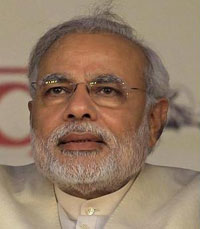 NEW DELHI, July 23: Prime Minister Narendra Modi has taken up with Chinese leadership India's concerns over China blocking its move in the UN for action against Pakistan over release of 26/11 mastermind and LeT commander Zaki-ur-Rehman Lakhvi in violation of a resolution of the world body. NEW DELHI, July 23: Prime Minister Narendra Modi has taken up with Chinese leadership India's concerns over China blocking its move in the UN for action against Pakistan over release of 26/11 mastermind and LeT commander Zaki-ur-Rehman Lakhvi in violation of a resolution of the world body.
The external affairs ministry said that India has raised the issue bilaterally with members of the UN sanctions committee and in case of China it was taken up at the "highest level".
At a meeting of the UN sanctions committee, India had sought action against Pakistan for release of Lakhvi in the 26/11 trial in violation of a UN resolution but the Chinese representatives blocked the move on grounds that New Delhi did not provide sufficient information.
Sources said Modi has taken up the issue with Chinese leadership, adding except China, all other members in the sanctions committee supported India's stand.
"Government had taken up the issue of violation of the 1267 sanctions regime in respect of Zaki-ur-Rehman Lakhvi. Our concerns in this matter were conveyed to the chair of the 1267 committee.
"We also raised this bilaterally with the other members of the committee. In the case of China, this matter has been taken up at the highest level," spokesperson in the external affairs ministry Vikas Swarup said.
Swarup said the 1267 committee has been created under chapter 7 of the United Nations Charter and decisions are binding on all member countries of the UN.
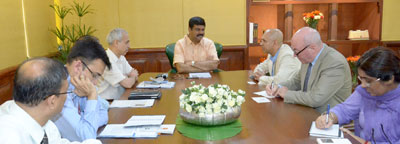 Canada envoy call on Petroleum Minister Canada envoy call on Petroleum Minister
By Deepak Arora
NEW DELHI, June 23: High Commissioner of Canada Nadir Patel and Commercial Minister Brain Parrott called on Union Minister of State for Petroleum and Natural Gas Dharmendra Pradhan here on Tuesday. Both sides discussed bilateral cooperation in field of oil and gas and the forthcoming visit of Minister to Canada for the reconstituted Energy Dialogue.
Mr Pradhan said there is scope to further develop the bilateral trade .
Ambassador Patel emphasised greater engagement in sharing of technology and more
innovation in field of science technology.
Celebrating Yoga in Bhutan
By Deepak Arora
 NEW DELHI, June 22: NEW DELHI, June 22:
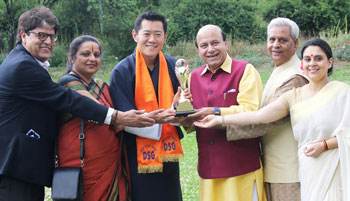
Indian delegation to Bhutan led by Ex-Delhi MLA and President Delhi Study Group Vijay Jolly celebrated “Yoga in Bhutan”.
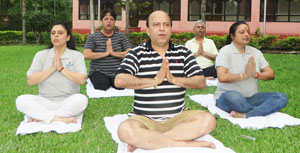
On International Yoga Day on June 21, visiting Indian leaders consisting of Vijay Jolly, Ashok Garg, Vijay Mehta, Prof. Geeta Singh and Kavita Ashok did yoga exercises at Hotel Druk at Phuentsholing, Bhutan.
Indian delegation visited Bhutan to Promote People to People Friendship.
They called on His Majesty The King of Bhutan Jigme Khesar Namgyel Wangchuck, Prime Minister L. Tshering Tobgay, Speaker of Bhutan Parliament T. Jimge Zangpo, Foreign Secretary Tshering Dorji, Economic Minister L. Norbu Wangchuck, Works Minister Mrs. L. Dorgi Choden, CEO “RENEW” Ms. Tandin Wangmo along with a visit to Bhutan Chamber of Commerce & Industry, Royal Thimpu College and Chukha Hydro Power Project.
 The Governor of Punakha Karma Drakpa and Governor of Paro City Chencho Tshering personally received and feted the Indian leaders. The Governor of Punakha Karma Drakpa and Governor of Paro City Chencho Tshering personally received and feted the Indian leaders.
The ruling People’s Democratic Party of Bhutan led by General Secretary Sonam Jatso hosted a grand reception in Paro while Ms. Lily Wangchuck President of Druk Chirwang Tshogpa (One of the five registered political parties) hosted a dinner at Namseling Boutique Hotel in Thimpu.
A historic “MOU” between Indian NGO “DSG” and Bhutan’s “RENEW” led by Queen Mother Ashi Sangay Choden Wanghchuck was signed to work for Empowering Women & Disadvantaged Children.
Leading English National Newspaper of Bhutan “Kuensel” carried a five column article along with picture of DSG President Vijay Jolly with Bhutan Prime Minister Lyonchhen Tshering Tobgay.
A chance meeting with Canadian High Commissioner in India Nadir Patel
and Fiji High Commissioner Yogesh J. Karan were the other lights of the Bhutan trip by Delhi Study Group. The delegates returned back to India yesterday evening.
7 Talibans killed after attack on Afghan Parliament
KABUL, June 22: Seven Taliban attackers were killed when they attacked the Afghanistan Parliament here on Monday. Women and children were among the 31 people wounded, health ministry officials said.
Indian nationals working on a new parliament building nearby were reported to be safe.
"A suicide bomber blew himself up just outside the parliament building and several fighters took positions in a building close to Parliament," Ebadullah Karimi, spokesperson for Kabul police, said shortly after the assault began.
The bomber detonated his explosive-laden car on the busy Darul Aman road near the gates of Parliament, damaging other vehicles and nearby buildings. This was followed by more than half a dozen blasts and the attackers exchanged fire with security personnel who converged on the site.
In a message sent to the media, Afghan Taliban spokesperson Zabihullah Mujahid said suicide bombers had carried out the attack. The Taliban described it as a “coordinated suicide attack”.
Mujahid said: "We have launched an attack on parliament as there was an important gathering to introduce the country's defence minister."
The explosions occurred as the new defence minister, Masoom Stanekzai, was being introduced to MPs for a vote of confidence.
Parliamentarian Harif Rahmani, who was inside the Wolesi Jirga or lower house of parliament at the time of the explosions, told Tolo News channel the MPs were evacuated without serious injuries.
Rahmani said the gunmen were unable to enter the parliament because of the strong security presence.
Lawmaker Shukria Barekzai said: "It was a huge blast that shook the building and shattered windows. We are in a safe place right now."
Dramatic footage aired on TV channels showed MPs screaming after a blast went off as the lower house was in session. The room rapidly filled with smoke as security personnel began escorting the MPs out. Footage on television also showed a car on fire on the road outside the parliament compound, smoke billowing into the sky.
The attack on Parliament came as a second district fell to the Taliban in the north in two days. The Taliban captured Dasht-e-Archi district a day after hundreds of militants took control of the adjacent district of Chardara.
The Taliban launched their annual spring offensive in April and violence has spiralled in Afghanistan since the departure of most foreign forces at the end of last year.
This is the first year that the Afghan security forces are battling the Taliban without the backing of the foreign troops. The fall of the second district has raised questions about the ability of NATO-trained Afghan security forces to fight the Taliban.
The militants are pushing to take territory more than 13 years after the US-led military intervention that toppled the Taliban from power. The withdrawal of foreign troops and a reduction in US air strikes have allowed the Taliban to launch several major attacks in key provinces.
Taiwan Will Have a Female President in 2016
TAIPEI, June 16: For the first time ever, two female candidates will square off in Taiwan’s presidential election. Taiwan’s ruling Kuomintang (KMT) has all but selected its candidate for the 2016 presidential elections. Hung Hsiu-chu, the deputy legislative speaker, is the sole contender for the KMT nomination, and was just formally granted the go-ahead by the party’s Central Standing Committee. That sets up a showdown between Hung and Democratic Progressive Party chair Tsai Ing-wen for the presidency – and guarantees Taiwan will have its first-ever female president.
Hung passed of the last hurdles for the nomination on Wednesday, when the Standing Committee formally affirmed her bid. Prior to that, Hung had to prove she had a higher than 30 percent public approval rating, a requirement for the KMT’s candidate. Hung passed that bar easily, gaining 46 percent approval. With those requirements met, Hung will “for sure be appointed” the KMT candidate during the party congress on July 19, KMT spokesman Yang Wei-chung told The Wall Street Journal.
Tsai wants to institutionalize cross-strait relations and make the process more transparent, which in practice will mean slowing down the pace of new agreements. Hung, meanwhile, has previously said that she will make seeking a peace accord with the mainland one of her top priorities – a promise that is sure to spark heated debates during the campaign. Even current President Ma Ying-jeou, seen as very much in favor of expanding cross-strait ties, has tread lightly on the issue of a formal peace accord, shelving a previous promise to pursue such an agreement in the face of opposition.
Hung has also vocally opposed the idea of Taiwanese independence, saying, “This separatist ideology is a threat to Taiwan’s national security.” She accused the DPP of “destroying the peaceful foundation for cross-strait relations,” language typical of her outspoken style (she’s nicknamed “Little Hot Pepper” for that very reason).
Tsai, meanwhile, has carefully avoided being pinned down on concrete issues in cross-strait relations, such as whether she would accept the 1992 Consensus (in which KMT and Chinese Communist Party leaders agreed that Taiwan is part of “one China,” while maintaining different interpretations of what “one China” refers to). The KMT is hoping that Hung’s direct style will force Tsai to pin down her stance on cross-strait issues, potentially alienating either her base or observers already predisposed to worry about cross-strait relations under a DPP administration. However, Hung’s directness could backfire if Taiwanese are in fact, as Tsai has repeatedly said, satisfied with the “status quo” and not eager for a security agreement with China.
Regardless of who wins, Hung’s nomination means the gender of either candidate will not be the deciding factor. During her visit to Washington, D.C. in early June, Tsai was asked at a public panel for her views on what it means to be a woman running for president in Taiwan. Tsai noted that “there are some people in Taiwan that are still rather traditional and they have some hesitation in considering a woman president,” but overall she was optimistic. “I think in general terms, there is a preference for women candidates these days,” Tsai said. “…[A]mong the younger generation, I think they are generally excited about the idea of having a woman leader. They think it is rather trendy.”
Tsai ended by saying that Taiwan’s people face a “serious test” in the elections: “whether we are advanced and civilized enough to accept a woman leader.” With Hung only the formal party vote away from the nomination, it seems Taiwan’s people will have a “woman leader” regardless. “I hope this battle between two women will bring forth a whole new understanding and set an example of true democracy,” Hung told the press.
Nuclear weapons states continue to upgrade warheads despite disarmament
STOCKHOLM, June 15: Nuclear armed states continue to upgrade their stockpiles despite an international trend towards disarmament, the Stockholm International Peace Research Institute (SIPRI) reported on Monday.
Between 2010 and 2015 the number of warheads fell from 22,600 to 15,850 according to the institute's annual disarmament report which said the US and Russia represented the bulk of the reduction.
The institute also pointed to "extensive and expensive long-term modernisation programmes" in the world's two largest nuclear powers which account for 90% of the weapons.
"Despite renewed international interest in prioritising nuclear disarmament, the modernisation programmes under way in the nuclear weapon-possessing states suggests that none of them will give up their nuclear arsenals in the foreseeable future," SIPRI researcher Shannon Kile said in a statement.
The other three nuclear armed states legally recognised by the 1968 Nuclear Non- Proliferation Treaty -- China (260 warheads), France (300 warheads), Britain (215 warheads) -- are "either developing or deploying new nuclear weapon systems or have announced their intention to do so" according to the Stockholm-based peace institute.
China was the only state among the five global nuclear powers to have a "modest" increase in the size of its arsenal.
While the remaining nuclear states -- India (90 to 100 warheads), Pakistan (100 to 120 warheads) and Israel (80 warheads) -- have considerably smaller stockpiles, India and Pakistan continue to increase their arsenals while Israel has tested long-range ballistic missiles.
North Korea is believed to be developing its arsenal of six to eight warheads but SIPRI said "technical progress" was difficult to assess. Reliable information on nuclear stockpiles varied greatly between states with the US getting top marks for transparency in the report, while Britain and France were more restrictive and Russia divulged nothing officially, except in bilateral contacts with the US.
In Asia, China revealed little about its arsenal and the only information made public by nuclear rivals India and Pakistan was announcements of missile tests.
The five nuclear powers and members of the UN Security Council -- US, Russia, China, Britain and France -- along with Germany, are in ongoing talks with Iran to persuade the Islamic Republic not to develop nuclear weapons in exchange for the lifting of international sanctions.
Delhi Study Group delegation in Bhutan to Promote People to People Relations: Jolly
By Deepak Arora
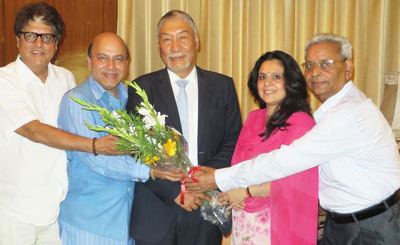 NEW DELHI, June 15: A five-member Delhi Study Group delegation led by Ex Delhi MLA and President Vijay Jolly today left for a six days visit to Bhutan. The other members are Ashok Garg (Advisor), Vijay Mehta (Treasurer), Dr. Geeta Singh (Academician) & Mrs. Kavita Ashok (Executive Member). The Indian delegation shall be hosted by Government of Bhutan. NEW DELHI, June 15: A five-member Delhi Study Group delegation led by Ex Delhi MLA and President Vijay Jolly today left for a six days visit to Bhutan. The other members are Ashok Garg (Advisor), Vijay Mehta (Treasurer), Dr. Geeta Singh (Academician) & Mrs. Kavita Ashok (Executive Member). The Indian delegation shall be hosted by Government of Bhutan.
Delhi Study Group (Prominent Socio –Political– Cultural NGO) has embarked on a ambitious program to promote people to people friendship with neighboring countries as envisaged by the successful Indian foreign policy of Prime Minister Narendra Modi, said Vijay Jolly.
Bhutan is India’s largest trading partner. India accounts for Bhutan’s 98% of its exports and 90% of its imports. Indians do not need a passport and visa to visit Bhutan. India shares a peaceful 605 kilometers border with Bhutan. In the Himalayan region Bhutan has special significance for India. It was amply reflected by PM Narendra Modi’s first foreign trip to Bhutan in June last year, he said.
The Indian delegation shall have audience with His Majesty the King Jigme Khesar Namgyel Wangchuck and Prime Minister Lyonchhen Tobgay in Thimphu. Foreign Secretary of Bhutan Tshering Dorji shall host a dinner in their honor. Indian Ambassador to Bhutan Gautam Bambawale shall meet them at the Indian Embassy.
Meeting the Bhutan Youth Development Fund Chief Ms. Dorji Ohm, interaction with business leaders of Bhutan Chamber of Commerce & Industry, meetings with Economic Affairs Minister Lyonpo Wangchuk and Works and Human Settlement Minister Ms. Lyonpo Dorji Choden, visit to the Bhutan Parliament to meet Speaker Tshogpon Jigme Zangpo is the strategically planned program for the Indian visitors.
Ms. Lily Wangchuk, President of Druk Chirwang Tshogpa (Bhutan Political Party) shall also host the delegation. Special visit to Chukha Hydro Power Plant besides visiting Royal Thimphu College and Yangchenphung Higher Secondary School to interact with young Bhutanese students is also part of the “Know Bhutan program”, said Jolly.
 African Ambassadors Honored African Ambassadors Honored
By Deepak Arora
NEW DELHI, June 13:
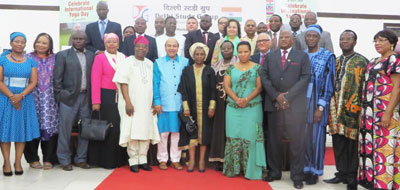
Delhi Study Group today organized a grand program to promote India – Africa relations led by Delhi Ex-MLA and President Vijay Jolly at the Constitution Club here.
Delhi Study Group is a prominent Socio–Political–Cultural NGO.
Taking a cue from Prime Minister Narendra Modi’s foreign policy initiatives, Delhi Study Group honored All African Head of Missions in India.
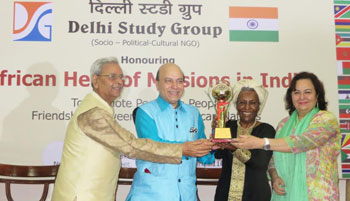 The Chief Guest on the occasion was Mrs. Gennet Zewide, Dean of African Nations and Ambassador of Ethiopia. The Chief Guest on the occasion was Mrs. Gennet Zewide, Dean of African Nations and Ambassador of Ethiopia.
All African Head of Missions were presented flower bouquets and momentos.
Present on the occasion was Patron of Delhi Study Group and Additional Solicitor General of India Pinky Anand.
To celebrate “International Yoga Day”, a special yoga performance was exhibited by Bal Yogi Sanjay Solanki for the assembled African diplomats.
This program stressed closer cooperation between India and Africa in stepping up trade, education, military assistance & economic development.
Rejuvenated India and Rising Africa with People to People Friendship and Understanding can generate US $ 500 billion trade between Africa and India by 2020, said Jolly.
India today is the fifth largest investor in Africa. Year-2015 has been declared by African Union as “Year of Women’s Empowerment”. This is also India’s priority. We have many common goals to achieve. India – Africa Unity shall contribute for the development towards Africa’s agenda – 2063, said Jolly.
African Head of Missions to be Honored: Vijay Jolly
By Deepak Arora
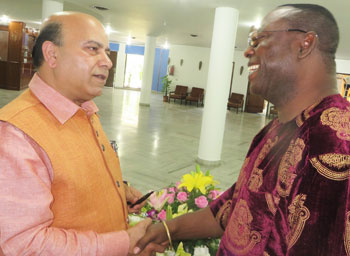 NEW DELHI, June 12: To promote Indian Foreign Policy of Prime Minister Narendra Modi, Delhi Study Group President Vijay Jolly announced that all African Head of Missions in India shall be honored at a public program here. NEW DELHI, June 12: To promote Indian Foreign Policy of Prime Minister Narendra Modi, Delhi Study Group President Vijay Jolly announced that all African Head of Missions in India shall be honored at a public program here.
Prominent Socio–Political–Cultural NGO, Delhi Study Group is organizing a public program to “Promote India –Africa Friendship” on June 13.
African Ambassadors and High Commissioners of more than 35 nations have consented to attend. The Chief Guest on the occasion shall be Mrs. Gennet Zewide, Dean of African Nations and Ambassador of Ethiopia in India. The program shall be presided by Vijay Jolly. All attending diplomats shall be honored with bouquets and momentos expressing “To Africa with Love”.
To celebrate “International Yoga Day” scheduled on June 21, a special short yoga performance shall be exhibited by Bal Yogi Sanjay Solanki, Member Delhi Study Group, for the assembled African diplomats, stated Jolly.
Rejuvenated India and Rising Africa with People to People Friendship and Understanding can generate US $ 500 billion trade between Africa and India by 2020, stated Jolly.
India today is the fifth largest investor in Africa. Year-2015 has been declared by African Union as “Year of Women’s Empowerment”. This is also India’s priority. We have many common goals to achieve. India – Africa Unity shall contribute for the development towards Africa’s agenda – 2063, said Jolly.
India, Bangladesh not just 'pass pass' but 'saath saath': Modi
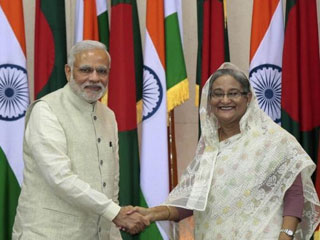 DHAKA: India and Bangladesh are not just "pass pass (close to each other) but also "saath saath (together), Prime Minister Narendra Modi said here on Sunday. DHAKA: India and Bangladesh are not just "pass pass (close to each other) but also "saath saath (together), Prime Minister Narendra Modi said here on Sunday.
Addressing intellectuals in Dhaka at the end of his two-day visit, Mr. Modi said not just Asia but the entire world "will do a detailed post-mortem on India-Bangladesh ties following his visit to see what has been gained.
"But if in one sentence I am to describe the ties, people will think that we are 'pass pass' but now the world will have to accept that we are not just 'pass pass' but 'saath saath', he said to loud applause.
He said his two-day visit has ended, but "I feel that actually the yatra (in ties) has just begun.
"I have an emotional attachment with Bangladesh, he added.
India, Bangladesh to expeditiously implement LBA on ground
Earlier, significantly scaling up bilateral ties, India and Bangladesh said they have decided to expeditiously implement the historic Land Boundary Agreement on the ground and cooperate in a wide array of areas such as civil nuclear energy, petroleum and power.
A joint declaration titled 'Notun Projonmo - Nayi Disha' (New Generation, New Direction), said Prime Minister Narendra Modi and his Bangladeshi counterpart Sheikh Hasina had agreed to "further enhance cooperation in the energy sector particularly in renewable energy and nuclear energy.
"Both Prime Ministers agreed to cooperate in the field of civil nuclear energy, especially training for technical personnel, the statement said giving an insight into the issues discussed during Mr. Modi's meeting with Ms. Hasina on Saturday.
Significantly, the statement said Mr. Modi and Ms. Hasina have given directives to the concerned officials on both sides for "expeditious implementation of the 1974 Land Boundary Agreement and its 2011 Protocol on the ground.
On the first day of Prime Minister Modi's maiden visit in Dhaka on Saturday, the two sides had swapped documents regarding the LBA that paves the way for the operationalisation of the 1974 pact under which 161 enclaves under the control of either countries will be exchanged.
They reaffirmed their commitment to extend all facilities to the residents of the enclaves and ensure that the rights of all citizens are protected, the declaration said.
Elaborating on the energy sector, an area of "growing cooperation, the document said the two countries have decided to initiate an annual India-Bangladesh Energy Dialogue to be led jointly by Secretary (Petroleum) of India and Secretary, Power Division of Bangladesh.
The dialogue will undertake comprehensive energy sector cooperation including in areas of coal, natural gas, LNG, supply of petroleum products in the sub-region, renewable energy, oil and gas pipelines etc.
In an attempt to bolster connectivity in the region, Mr. Modi agreed to consider Bangladesh's proposal to introduce the second Maitree Express between Khulna and Kolkata.
"The two Prime Ministers expressed satisfaction about the ongoing cooperation in the railways sector including the Akhaura-Agartala railway link and revival of the old railway links, the declaration noted.
Mr. Modi and Ms. Hasina welcomed the signing of the 'Coastal Shipping Agreement', which they said would open up newer avenues of cooperation in the areas of bilateral and regional trade and connectivity.
"Both the Prime Ministers agreed on the need for dredging of the Bangladesh-India inland water protocol routes to utilise their full potential, the joint declaration said.
The two Prime Ministers expressed satisfaction at the "unparallelled level of cooperation between the two countries on security related issues and reaffirmed their "unequivocal and uncompromising position against extremism and terrorism in all forms and manifestations, it said.
The two prime ministers expressed satisfaction at the conclusion of the MOUs on Prevention of Smuggling of Fake Currency Notes, Cooperation between Coast Guards and Prevention of Human Trafficking, all of which will augment security cooperation.
The two leaders stressed the need for effective implementation of the Coordinated Border Management Plan (CBMP) for better border management so as to prevent cross border criminal activities, irregular movement, incidents of violence and tragic loss of lives.
They agreed on the need to free the borders from criminal activities.
Both prime ministers also welcomed the finalisation of Standard Operating Procedures (SOPs) for allowing usage of Indian border roads for construction and maintenance of Border Out Posts (BOPs) of Border Guard Bangladesh as well as use of Indian medical facilities in difficult areas in the border area by Bangladeshi personnel, who are deployed in vicinity.
Both prime ministers reiterated that the number of deaths at the border must be brought down to zero and directed the concerned authorities and border guarding forces to work to that effect.
They welcomed the holding of the first round of meetings of deputy commissioners/ district magistrates of clusters of bordering districts and put emphasis on regular holding of meetings.
Ms. Hasina invited India's cooperation in jointly developing the Ganges Barrage on the river Padma in Bangladesh.
Mr. Modi conveyed that he would have the matter examined by the concerned agencies in India, according to the joint statement.
|


