


Foreign Affairs
|
|
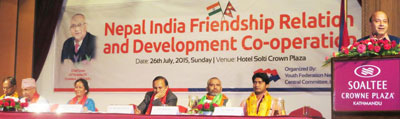 Adopt Nepal Constitution with Consensus: Vijay Jolly
 |
 |
 |
 |
Indian leaders were invited by Youth Federation Nepal, youth wing of Nepal ruling alliance partner CPN (UML) party conference on “Nepal –India Friendship: Relations, Development & Cooperation” organized at Kathmandu.
This program was addressed by Senior Nepali leader K.P. Sharma ‘Oli’, Nepal Industry Minister Mahesh Basnet, Dr. Udit Raj, Delhi BJP leader Gopal Jha and youth leader Vijay Vats.
Vijay Jolly stated that Indian Prime Minister Narendra Modi has special love and affection for the Himalayan Kingdom. During his first nine months, Prime Minister Modi twice visited Nepal. Rupees 10,000 Crore soft loan to Nepal and recent announcement of US$ 1 billion dollars by India for Nepal re-construction, is India’s commitment for Nepal’s development & progress, stated Jolly.
Starting of Kathmandu-Delhi bus service “Pashupati Nath Express” shall accelerate tourism between the two countries, said Jolly.
Taiwan’s ruling party KMT changes strategy to take on opposition DPP in January polls
By Deepak Arora
 NEW DELHI, July 17: Taiwan’s ruling Nationalist Party, or Kuomintang (KMT) in Chinese, is in a dilemma over its Presidential candidate Hung Hsiu-chu who is far behind the Opposition Democratic Progressive Party (DPP) candidate Tsai Ing-wen in the opinion polls. KMT is changing its election strategy for the January polls to give a tough fight to the Democratic Progressive Party (DPP) that is identified with pro-independence.
In a country where people seems to love their independence and identity over the neighbouring China that claims the island as its own, an initial controversial statement of Hung that proposes “one China, same interpretation” as the basis for cross-strait interaction in lieu of the so-called “1992 consensus” has led to her huge slide in opinion polls.
In a reminiscence of bitter Indian politics, the sources close to KMT suggest that DPP has purposely put a red hat (identified with Communist Party of China) on Hung. However, this is not true. She is not pro-China. It is for this reason she has been misunderstood in public.
Hung, who has been Deputy Speaker of the Legislative Yuan (Parliament), has already launched a campaign to correct the pro-China perception about her in the minds of the people.
A worried KMT Chairman Eric Chu has also taken note of the decline in support for Hung, which he said was because of “controversial issues.” Chu is also worried as the legislative elections are to be held simultaneously with the presidential election in January next.
 A July 14 opinion poll show that Hung’s support has dropped by 8.3 percentage points in two weeks to 19.5 per cent. On the other hand DPP Chairperson Tsai Ing-wen support has increased to 54 per cent.
Without deliberating on what he meant by “controversial issues,” Chu said he believed that Hung would regain support if she “gets back on the right track” by adhering to the party platform.
Hung is expected to be appointed the KMT candidate during the party’s national Congress on July 19. Although, there is a murmur of replacing her with another candidate.
Hung’s support rating “plunged in free fall” because her “one China, same interpretation” policy was tantamount to her opposition to the maintenance of cross-strait “status quo” and strident pace toward “unification,” Democratic Progressive Party Legislator Chen Chi-mai said.
However, what’s a status quo? It means, according to Taiwan President Ma Ying-jeou “no unification, no independence, and no use of force,” under the framework of the Republic of China (ROC) Constitution. The 1992 Consensus means: “one China, respective interpretations”.
Explaining its genesis, President Ma said: The ROC Constitution, which was adopted in 1947 on the Chinese mainland before the civil war broke out, was a one-China constitution. The birth of the communist regime in 1949 did not replace the ROC government, which continues to exist, and prosper, on Taiwan. So in terms of international law, no state succession was completed. Both sides claim the whole of China as their respective territory, at least in their respective constitutions. When the two sides of the Strait finally started to deal with each other peacefully and on equal footing, they first had to work out a solution of the “one China” issue before they could move ahead.
 Therefore, representatives of the two sides met in 1992 to negotiate, and eventually reached a consensus on the one-China issue. That consensus provides that both sides adhere to the “one-China” principle, but could have their respective interpretations of the meaning of that “one China.” So “one China, respective interpretations” has been called the 1992 Consensus ever since. For us, “one China” of course refers to the Republic of China, while the mainland has its own interpretation. This is a typical “agree-to-disagree” formula, said President Ma.
But the President pointed out that they also have a legal dilemma. The ROC government, after the two sides became separately governed, could hardly recognize the existence of another nation-state in the ROC mainland territory. On the other hand, it would be unrealistic to ignore the 66-year-existence of a governing authority on Chinese soil only 100 nautical miles away. So we developed the concept of “mutual non-recognition of sovereignty, and mutual non-denial of governing authority,” or “mutual non-denial” for short.
KMT leadership is now forcefully putting this 1992 consensus point across to the people and explaining how Taiwan is safer in the hands of the ruling KMT which has ruled the island since 1949 but for eight years when it lost power to DPP in the year 2000.
The ruling party should also do well in explaining to people as to how the ties between Taiwan and mainland China had hit rock bottom during the eight years of DPP rule.
As an observer one notices that KMT has also not been able to put across to the people the good work done by President Ma in the past seven years or so. President Ma has shown the leadership qualities of the level of the then leaders of the united Republic of China (ROC).
President Ma Ying-jeou raised his leadership status internationally when he brought peace on the East China Sea by signing a fisheries agreement with Japan in April 2013. That agreement settled a fisheries dispute that had lasted for over 40 years. The accord covers about 70,000 square kilometers (or 21,600 square nautical miles) of waters around the Diaoyutai Islands, in which fishermen from each side may operate without interference from coast guard ships of the other party. Moreover, the sovereignty dispute has been set aside for the time being. It has also been praised by high US, European and Australian officials in the last two years as an effective way to promote regional peace.
Similarly, President Ma has unveiled the South China Sea Peace Initiative this year to resolve disputes and jointly develop resources, thereby making the South China Sea a “Sea of Peace and Cooperation” similar to the East China Sea.
During Ma’s Presidency since 2008, cross-strait relations have also made great strides with the signing of 21 agreements covering a wide range of topics. When he took office seven years ago, there were no direct scheduled flights between the two sides of the Taiwan Strait, and travelers had to go through Hong Kong or Japan. But now there are 120 flights a day, covering 54 cities in the mainland and eight in Taiwan. The total number of visitors from the mainland last year reached 3.94 million, a 15-fold increase, and the number of mainland students has jumped 40 times from 800 to 32,000.
However, it may be mentioned that country's political life is divided on the China factor. A section of Taiwanese consider Chinese investments and business connections as an important source of future growth. But Taiwan, which saw anti-China student demonstrations last year, also has a large population rooting for full independence and absence of Chinese influence.
In May, legislator Chang Sho-wen publicly quit the KMT. Another member, Hsu Hsin-ying, left the party after last year's local election loss which forced President Ma Ying-jeou to resign as party chief. The election result was seen as a vote against Ma's China-friendly policies. Democratically minded young and middle-class Taiwanese, unhappy with slowing economic growth and stagnant wages, remain suspicious of China's intentions and see only big business prospering from closer ties.
It will go well with the KMT leadership if it plays their card well in the ensuing elections and creates cohesiveness in its ranks to give a united fight to the challenges from its rival the DPP.
Japan annual defence paper shows increased worry over China
TOKYO, July 22: Japan emphasised China as a threat in escalating regional tensions in this year's annual defence report even as Prime Minister Shinzo Abe's government tries to convince the public of the need to pass legislation to give Japan's military a greater role.
The report, approved on Tuesday by the Cabinet, was delayed for more than a week as Abe's ruling party panel demanded mention of additional examples of China's "one-sided" maritime activities, such as undersea gas and oil development in the East China Sea.
Abe's ruling coalition has been pushing to pass highly contentious legislation allowing Japan's Self-Defense Force to fight for foreign militaries even when it is not under attack, while expanding its role in international peacekeeping.
China by far topped Japan's list of security concerns, taking up one-third of a chapter on global security trends covering eight countries and regions.
The 429-page white paper underscored that Japan's security risk had worsened overall and cited continuing missile and nuclear threats from North Korea and terrorist threats from the Islamic State group as examples.
The report raised concerns over China's recent reclamation work in the South China Sea, saying it had escalated regional tensions. The defence ministry report also added a new section that also refers to maritime activities elsewhere.
China has been building artificial islands in the vast, resource-rich area, alarming neighboring nations.
"China, particularly over conflicting maritime issues, continues to act in an assertive manner, including coercive attempts to change the status quo, and is poised to fulfill its unilateral demands high-handedly without compromise," the report said. "Japan is strongly concerned about China's actions, which we need to keep watching closely."
India sends strong message to Pak on unprovoked firing
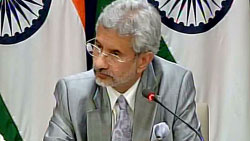 NEW DELHI, July 16: India said on Thursday it was committed to peace along the border with Pakistan but warned the nuclear-armed neighbour of a strong response in case of unprovoked firing.
"It should be clear that any unprovoked firing will be met with an effective and forceful response from our side," foreign secretary S Jaishankar said at a press conference on a day India strongly protested ceasefire violation by Pakistan amid reports that half-a-dozen people were killed in cross-border shelling between the two bitter neighbours.
Earlier in the day, New Delhi lodged its protest as Pakistani troops targeted military posts and villages along the Line of Control (LoC) in Jammu and Kashmir’s Akhnoor sector ahead of Prime Minister Narendra Modi’s visit to the state on Friday.
At the press conference, Jaishankar also said an alleged spy drone Pakistan claimed to have shot down in PoK did not belong to the Indian armed forces. He added it appeared to be of Chinese design and was commercially available.
"At the moment, the issue for us is stabilising the border," Jaishankar said, even as Pakistan insisted the "spy drone" belonged to India and it entered that country’s airspace violating international law and its territorial integrity.
From the picture of the drone wreckage, however, it looked like a China-made DJI Phantom 3 that can be bought off the shelf by anyone, including civilians.
Days after talks between Prime Minister Narendra Modi and his Pakistani counterpart Nawaz Sharif in Russia's Ufa, tension between the countries have escalated with both sides blaming each other for repeated ceasefire violations and heavy firing along the border.
"Today (Thursday) at 1:35am, there was an infiltration attempt...I urged our high commissioner in Islamabad to speak with Pakistan," Jaishankar said, "We sought an end to the firing and corrective steps on their (Pakistan's) part."
For its part, Pakistani foreign secretary Aizaz Ahmad Chaudhry summoned high commissioner TCA Raghavan in Islamabad earlier in the day to protest what it called unprovoked ceasefire violations along the disputed border as well as the alleged airspace violation.
Iran, major powers reach historic nuclear deal
VIENNA, July 14: Iran and six major powers have reached a historic nuclear deal, an Iranian diplomat said on Tuesday.
The diplomat said it includes a compromise between Washington and Tehran that would allow UN inspectors to press for visits to Iranian military sites as part of their monitoring duties.
But access at will to any site would not necessarily be granted and even if so, could be delayed, a condition that critics of the deal are sure to seize on as possibly giving Tehran time to cover any sign of non-compliance with its commitments.
Under the deal, Tehran would have the right to challenge the UN request and an arbitration board composed of Iran and the six world powers that negotiated with it would have to decide on the issue.
Still, such an arrangement would be a notable departure from assertions by top Iranian officials that their country would never allow the UN's International Atomic Energy Agency into such sites. Iran has argued that such visits by the IAEA would be a cover for spying on its military secrets.
On Tuesday morning, the European Union announced that the final plenary of Iran and the six countries negotiating with it will take place at 10:30 Vienna time, followed by a news conference. A Western diplomat said they will endorse the deal, reached in the early morning hours. He demanded anonymity because he was not authorized to comment on the confidential talks.
While access is a key part of monitoring envisaged cuts on Tehran's present nuclear activities, it is also important for the IAEA as it tries to kick-start nearly a decade of stalled attempts to probe allegations that Iran worked on nuclear arms. Washington says that Iran must cooperate with the IAEA's probe as part of any overall deal before all sanctions on it are lifted.
The Iranians insist they have never worked on weapons and have turned down IAEA requests to visit sites where the agency suspects such work was going on, including Parchin, the military complex near Tehran where the agency believes explosives testing linked to setting off a nuclear charge was conducted.
Iran's acceptance in principle of access to military sites will give the agency extra authority in its attempts to go to the site and its demands - previously rejected by Tehran - to interview scientists it suspects were involved in the alleged nuclear weapons work.
Any deal will go to the U.N. Security Council, which is expected to endorse it by the end of the month, to start the mechanics of implementation - long-term, verifiable limits on Iranian nuclear programs that could be used to make weapons in exchange for an end to sanctions on the Islamic Republic.
India welcomes Iran deal
NEW DELHI, July 15: India has “welcomed the successful conclusion of negotiations on the Iranian nuclear issue”, between Iran and the Europe 3+3 (U.S., Russia and China) and the U.N. atomic energy agency IAEA. New Delhi however, struck a note of caution to say it would “wait to see the text of the agreement.”
“India has always maintained that the issue should be resolved peacefully through dialogue by respecting Iran’s right to peaceful uses of nuclear energy while upholding the international community’s strong interest in the exclusively peaceful nature of Iran’s nuclear programme,” the MEA spokesperson said in response to questions shortly after the announcement in Vienna on Tuesday.
Trust deficit biggest obstacle in Indo-China relations: Vijay Jolly
By Deepak Arora
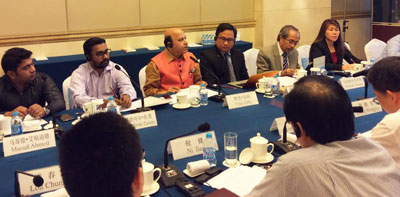 BEIJING, July 14: Indian BJP leader Vijay Jolly has said that the trust deficit is the biggest obstacle in Indo-China relations.
Delivering a key note speech on "One Belt-One Road" proposal of China President Xi Jinping, Mr Jolly said While the concept is laudable and commendable at the same time it is doubtful. Neither the belt nor the road follow any clear line geographically. But it serves more as a roadmap for how China wants to further integrate itself into the world economy and strengthen its influence in these regions.
Speaking at a program organized by CAFIU (Chinese Association for Friendship & International Understanding) for promoting people to people friendship, Mr Jolly, who is the President of the Delhi Study Group, said the National Development Strategy of India and China are similar and to work for Common Prosperity of its citizens and neighbors.
Mr Jolly, who is also the President of the Delhi Study Group, said “One Belt, One Road” also known as belt & road initiative as proposed by People’s Republic of China is commendable since it focuses on connectivity and cooperation among many countries. This initiative touches 65 countries and 4.4 billion people.
 We state that this strategy underlines China’s thrust for a major role in global affairs. The Silk Road Economic Belt (SREB) and Maritime Silk Road (MSR), twin initiatives covered under the umbrella of “One Belt, One Road” shall generate trade to the tune of US$ 2.5 Trillion. This is a real paradigm shift in the global economy under China President Xi Jinping.
The Maritime Silk Road (MSR) proposes to connect China, Kazakhstan, Kyrgyzstan, Uzbekistan, Turkmenistan, Tajikistan, Afghanistan, Iran, Iraq, Syria, Turkey, Romania, Ukraine, Russia, Belarus, Poland, Germany, Austria, Italy, Greece, Egypt, Saudi Arabia, Yemen, Somalia, Kenya, Tanzania, India, Sri Lanka, Malaysia, Indonesia, Vietnam etc.
And the New Silk Road Economic Belt, which will link China with Europe through Central & Western Asia, and the 21st Century Maritime Silk Road, shall connect China with Southeast Asian countries, Africa and Europe.
While the concept is laudable and commendable, he said at the same time it is doubtful. Neither the belt nor the road follow any clear line geographically. But it serves more as a roadmap for how China wants to further integrate itself into the world economy and strengthen its influence in these regions.
He also pointed out on the lack of political will in all democratic and non-democratic countries on this proposed SREB and MSR. Also the general perception that the Chinese policies are proposed, propagated and implemented with back in mind “Expansionist Agenda’s” shall be the biggest impediment and obstacle.
Mr Jolly said One Belt, One Road policy entails significant risks and challenges for China and its neighbors. If the Chinese efforts do not generate long term benefits for the local economies, then local populace can stand in revolt. Geographical and religious animosities shall play a important role in its success or failure.
However well intentioned, he said it shall heighten regional geo-political tensions in the region. Russia, India and Japan are supposed to view it from it diplomatic angle. This shall be viewed as China expanding its growing naval power. The classic example is New Delhi’s concern on China investments in Sri Lanka.
If positive investments and efforts are back tracked by poor track record of Chinese construction companies operating in foreign countries then there is the risk of political backlash. It shall harm Beijing’s image.
Mr Jolly said Our cautions are friendly advise and not averse to China National Development Reform Commission Action Plan which shall play a prominent role in China’s 13th Five Year Plan which starts from 2016 to 2020 and guide China National Investment Strategy.
Besides Jolly, other prominent delegates from India are Yogesh Tandon, Dr Monika Pant and Mukesh Shukla.
Jolly said China President Xi Jinping and Indian Prime Minister Narendra Modi both stand for economic development and poverty eradication.
He said the National Development Strategy of India and China are similar and these work for common prosperity of its citizens and neighbors.
It may be recalled that at this four-nation "Know China" program in Chengdu and Beijing, attended by delegates of India, Indonesia, Bangladesh and Indonesia, Vijay Jolly from India was unanimously elected leader at this international conference.
Mr. Ni Jian (Secretary General CAFIU), Mr. Liu Kaiyang (Deputy Secretary General CAFIU), Mrs. Zhu Jingfang (Director for European & American Affairs), Mr. Lou Chunhao (Astt. Director China Maritime Studies) & Prof. Zhang Shengjun from Beijing University actively participated in today's deliberations.
The CAFIU program is from July 7 to 16. CAFIU and Delhi Study Group are co-partners as prominent NGO's of China and India.
India, Canada to Expand Strategic Energy Partnership
By Deepak Arora
 NEW DELHI, July 7: Indian Minister of State for Petroleum and Natural Gas Dharmendra Pradhan met Canadian Minister of Natural Resources Greg Rickford in Calgary, Alberta on Sunday for the second India-Canada Ministerial Energy Dialogue to discuss enhancing energy cooperation between the two countries in the areas of oil, natural gas, clean energy, power transmission and skill development.
Speaking on the occasion, Pradhan said “India and Canada share common values and ideals and believe in long-term sustained partnerships. Our Energy Cooperation is steadily growing but the potential is much higher – Let’s convert the potential into reality.”
Speaking on the occasion, Rickford said “Canada’s growing energy relationship with India is helping create jobs and long-term prosperity for both of our countries. We stand ready to expand our strategic partnership through greater cooperation based on our complementarity of energy interests.”
Both the Ministers highlighted Canada and India’s growing energy partnership, by strengthening government and business relationships, to help create jobs and long-term economic prosperity for both countries.
Indian Minister of State for Petroleum and Natural Gas Dharmendra Pradhan visited Canada for three days beginning July 4 to participate in the second India Canada Energy Dialogue. The Energy Dialogue was held in Calgary on Sunday. Canadian side was led by Canadian Minister for Natural Resources Greg Rickford.
 During the visit, Pradhan also met Rich Coleman, Deputy Premier and Minister for Natural Gas Development and Michael de Jong, Minister of Finance, Government of British Columbia at Vancouver.
He addressed Business Leadership forum separately in Calgary and Vancouver, attended by prominent CEOs/businessmen in the oil and gas, electricity and coal sector of Canada. He also held one to one meetings with select CEOs of various companies working in the Energy sector and energy project financing in Calgary.
He visited Southern Alberta Institute of Technology, Calgary, University of Calgary and University of British Columbia and interacted with the faculty and students.
Visit of Minister comes as a follow up of the recent visit of Prime Minister
Narendra Modi to Canada in April last which created an excellent momentum to expand energy ties including investment in energy and related technologies and services.
During various meetings, Pradhan offered to jointly underwrite large-scale energy projects such as LNG and refinery and petrochemical plants and highlighted availability of World standard cost effective and quality EPC companies in India with highly talented manpower who can contribute to the Canadian hydrocarbon sector.
He invited Canada’s leading financial institutions to invest in energy infrastructure in India and to cooperate to learn from each other’s experience in energy policy and regulation. He stressed that there is unlimited potential for natural partnership between the two countries.
Discussions were also held to further collaborate in areas such as energy efficiency and innovation, oil & gas development, exchange of regulatory best practices and renewable energy.
The two sides acknowledged that Canada can become an energy exporter to India and India can diversify its sources of supply from Canada. The Minister highlighted the natural synergy between the India and Canada in the energy sector and referred to various ongoing projects in Canada by Indian companies.
It may be noted that IOC is participating in an integrated LNG project in British Columbia, Canada with investment of US$ 1 billion ( which will go up to US$ 4 billion). IOC and ONGC Videsh have already opened offices in Calgary, Canada.
Pradhan referred to the recent IMF studies which showed that India was expected to be the fastest growing economy during 2014-2025. In addition, according to the International Energy Agency’s World Energy Outlook 2014, India’s oil demand growth between 2013 and 2040 would be the highest in the world—with a CAGR of 3.5 %. Most of this huge demand was being met by importing petroleum.
He also informed about India’s current position as the net surplus country in the production of refined petroleum products and willingness to emerge as a major refining hub. He elaborated on the future plans of the Government in the construction of gas pipelines in India to develop a national gas grid; link the smart cities with piped gas and increase use of gas as a substitute for other forms of energy and developing LNG regasification terminals on the east and west coasts of India.
The Minister also witnessed alongwith the Finance Minister of British Columbia the signing of an Agreement of Adherence between IOC and Government of British Columbia at Vancouver which will facilitate IOC’s operation of LNG project in Canada.
Pradhan also met Indian Community representatives in Calgary and Vancouver.
The Indian Minister was accompanied by Indian High Commissioner, senior representatives from Ministry of Petroleum and Natural Gas, Ministry of Power, Ministry of Coal and Ministry of External Affairs as well as Chairman, Indian Oil Corporation (IOC), MD, ONGC Videsh Limited (OVL) and senior representative of Engineers India Limited (EIL).
Canada is a secure, reliable and responsible producer and supplier of energy to the world and has the resources and expertise needed to support India’s growing energy needs. In 2012, India was the fourth-largest energy consumer in the world. Recent International Monetary Fund studies showed that India is expected to be the fastest growing economy during 2014-25. In addition, according to the International Energy Agency’s World Energy Outlook 2014, India’s oil demand growth between 2013 and 2040 would be the highest in the world.
Indeed, the complementarity of energy interests between Canada and India has already resulted in substantive milestones conducive to building our bilateral energy relationship, including:
• In 2009, India received Canadian oil for the first time and in 2014 India received over 1,500 barrels of Canadian crude per day;
• Signed Expression of Intent in 2013 to collaborate between Alberta Petroleum Marketing Commission and Indian Oil Corporation Ltd;
• In March 2014, Indian Oil Corporation Ltd acquired 10 % participating interest in an integrated LNG project - Pacific Northwest LNG proposed at Lelu Island, British Columbia; and
• On April 15, 2015, Canada welcomed the announcement of a contract to supply over seven million pounds of uranium to India over the next five years for the generation of electricity.
Moving forward, Canada could potentially supply a significant amount of the 44 billion cubic metres of natural gas that India is forecasted to import annually by 2025. Indian companies are actively engaged in projects in Canada including projects by Pacific NorthWest LNG and A C LNG.
Furthermore, the Ministers discussed opportunities to increase Indian participation in mining and oil sands activities, to grow Canadian investments in India’s energy infrastructure and further technical collaboration in the areas of clean energy technologies, including solar, wind, power transmission and carbon capture and storage. Canada and India will also work together to enhance skill development and share knowledge to accelerate the adoption of clean energy technologies. The Ministers agreed to intensify, government-to-government as well as business-to-business collaborations in the above noted themes.
The Ministers have committed to continuing to explore opportunities of mutual benefit in the energy sector. They are scheduled to meet again in 2016 in India for their third India-Canada Ministerial Energy Dialogue.
Jolly Elected Leader in 'Know China' Program in Chengdu
By Deepak Arora
 CHENGDU (China), July 12: Indian leader and President Delhi Study Group Vijay Jolly was unanimously elected leader of four-nation "Know China" program in Chengdu.
Social leaders of India, Indonesia, Bangladesh and Philippines are participating in a nine days program organized by CAFIU (Chinese Association of Friendship and International Understanding) in China. Prominent leaders of these nations are participating in dialogue to Promote People to People Friendship in the region, stated Vijay Jolly in Chengdu.
It is heartening to note that a new Indian Consulate is soon to be opened up in Chengdu, China latter this year, stated Mr Jolly from China. An agreement was signed between India and China earlier this year during the historic visit by Indian Prime Minister Narendra Modi, noted Jolly, a prominent Indian and BJP leader from India.
This shall strengthen Indo-China Friendship and Understanding and promote bilateral Trade and Commerce also, stated Jolly.
The other members of the Indian delegation include Yogesh Tandon (Secretary), Dr. Monika Pant (Executive Member) and Mukesh Shukla (Executive Member).
The four-nation delegates are currently visiting Chengdu and Beijing from July 7 to 16. Extensive discussions and dialogues are taking place on the ambitious China President Xi Jinping proposal of “One belt, One road” initiative to connect 64 nations and proposal to generate US 4 trillion trade turnover in the region.
Modi raises Lakhvi issue with Xi
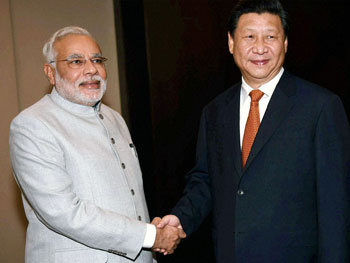 UFA, July 9: Prime minister Narendra Modi met Russian President Vladimir Putin and Chinese Prime Minister Xi Jinping in the Russian city of Ufa on Wednesday as he arrived to attend the Brics and Shanghai Cooperation Organisation summits.
In his fourth meeting in a year with Xi, Modi conveyed India’s disappointment and “anger among the people” at Beijing’s blocking of Delhi’s demand at the UN for action against Pakistan over its release of Mumbai attacks mastermind and Lashkar-e-Taiba commander Zakiur Rehman Lakhvi.
During their 90-minute meeting, Modi also reiterated India’s concern over the $46-billion China-Pakistan economic corridor running through Pakistan-occupied Kashmir.
Furthermore, the two leaders spoke about “accelerating the process” to resolve the long-standing boundary dispute and about India getting a permanent seat in the United Nations Security Council and in export-control regimes like the Nuclear Suppliers Group.
With Putin, the PM discussed defence and civil nuclear energy ties and suggested that this year’s India-Russia summit take place in the Russian city of Astrakhan, a sister city of Ahmedabad that Modi had visited as chief minister of Gujarat in 2006. Putin, on his part, told Modi he wanted to try out yoga, calling it “very appealing kind of sport”.
On the Xi-Modi meeting, foreign secretary S Jaishankar said, “The issue of Lakhvi did come up… and it was discussed in some detail.” Asked about Xi’s response, he said, “The Prime Minister made our concerns very clear. The Chinese side was impressed with the clarity with which the PM raised our concerns.”
At a meeting of the UN Sanctions Committee last month, India has demanded action against Pakistan for releasing Lakhvi but the Chinese had blocked the move on the grounds that India did not provide compelling information and evidence.
Rejecting China’s position that India had provided insufficient evidence on Lakvi’s role in the 2008 terror attacks that killed 166 people, Jaishankar said the “whole world knows about it and many countries have supported the Indian position”.
India had at that time said the Chinese action was at “variance” with the progress in bilateral ties.
Modi is also expected to meet Pakistan Prime Minister Nawaz Sharif on Friday. However, there was no official confirmation of this with Jaishankar only saying he would announce it when it was ready to be announced. He also didn’t deny that it was India that had sought a meeting with the Pakistani leader.
China says its stand on Lakhvi based on 'facts, spirit of objectiveness'
BEIJING, July 9: Virtually defending its move to block India's demand in UN to take action against Pakistan for the release of Mumbai attack mastermind Zakiur Rehman Lakhvi, China on Thursday said its stand was based on "facts" and in the spirit of "objectiveness and fairness".
"As a permanent member of the UN security council China always deals with the 1267 committee matters based on facts and in the spirit of objectiveness and fairness," foreign ministry spokesperson Hua Chunying told reporters here.
She was responding to a question on Prime Minister Narendra Modi taking up the issue with Chinese President Xi Jinping during their meeting at the Russian city Ufa on the sidelines of the BRICS and Shanghai Cooperation Organisation (SCO) summits on Wednesday.
Terming Modi-Xi talks as "constructive and inclusive", she said China has maintained good communication with India and other parties on the Lakhvi issue.
About India's concerns over terrorism, she said, "I can tell you that both India and China are victims of terrorism. China opposes all forms of terrorism and supports the UN playing the leading role in coordinating international cooperation on anti-terrorism. China has actively taken part in global cooperation."
Protesters attack Thai consulate in Istanbul over Uighur expulsions
ISTANBUL, July 9: Turkish protesters attacked the Thai honorary consulate in Istanbul overnight, smashing windows and ransacking parts of the building, in protest over Bangkok’s expulsion of nearly 100 Uighur Muslims back to China.
China's treatment of its Turkic language-speaking Uighur minority is a sensitive issue in Turkey. Many Turks see themselves as sharing a common cultural and religious heritage with their Uighur "brothers" and Turkey is home to a large Uighur diaspora.
Thailand confirmed on Thursday that it had sent nearly 100 Uighurs back to China. Rights groups have expressed concern over Thailand's decision, fearing they could face ill-treatment and even torture.
The Istanbul protesters, using sticks and stones, smashed windows and broke into the consulate late on Wednesday, throwing folders and personal belongings on the floor, pictures and video footage published by local media showed.
Hundreds, possibly thousands, of Uighurs have fled unrest in China's western Xinjiang region, where hundreds of people have been killed, prompting a crackdown by Chinese authorities. They have travelled clandestinely through Southeast Asia to Turkey.
China is home to about 20 million Muslims spread across its vast territory, only a portion of whom are Uighur.
India, Kazakhstan sign five key agreements to bolster ties
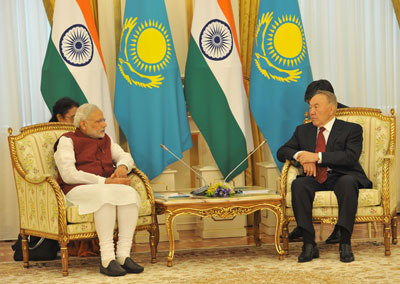 ASTANA, July 8: India and Kazakhstan on Wednesday inked five key agreements including a defence pact to enhance military cooperation and a contract for supply of uranium after Prime Minister Narendra Modi and Kazakh President Nursultan Nazarbayev held comprehensive talks in which they decided to actively engage in the fight against terrorism and extremism.
Modi, who held restricted as well as delegation-level talks with Nazarbayev, noted that they also agreed to work closely to expand bilateral trade by addressing structural impediments between India and hydrocarbon-rich Kazakhstan.
"We have shared perspectives on many international issues, including regional peace, connectivity and integration; reforms in the United Nations; and, combating terrorism," the Prime Minister said at a joint press event here with Nazarbayev.
Noting that the defence and security cooperation was an important dimension of strategic partnership between the two countries, Modi said, "We both want to make it stronger, including in defence manufacturing. We welcome the new Memorandum of Understanding on defence cooperation."
The MoU would further widen the scope of bilateral defence cooperation including regular exchange of visits, consultations, training of military personnel, military- technical cooperation, joint exercises, special forces exchanges and cooperation in UN peacekeeping operations.
Welcoming the signing of a contract between NC "KazAtomProm" JSC and NPCIL for a renewed long term supply of natural uranium to India to meet its energy requirements, Modi said, "Kazaksthan was one of the first countries with which we launched civil nuclear cooperation through a uranium purchase contract.
"We are pleased to have a much larger second contract now. We intend to expand cooperation in other minerals, as well".
A joint statement 'Tej kadam' was also released after talks which said the Leaders noted the rising challenge posed by terrorism in many parts of the world and in their immediate region and underlined the importance of a stable and secure environment for peaceful economic development.
"They agreed to continue their active engagement in the fight against terrorism and extremism including exchange of information," it said.
In this context, they highlighted the importance of regular inter-agency consultations and meetings of the Joint Working Group on Counter-Terrorism. The Leaders also called for early conclusion of the UN Comprehensive Convention on International Terrorism.
Observing that Kazakhstan was India's biggest economic partner in the region, Modi said, "But, our relations are modest, compared to our potential. We will work together to take economic ties to a new level."
The other pacts included Treaty on Transfer of Sentenced Persons, human resources, cultural exchanges and capacity building.
Modi meets Kazakh president
ASTANA, July 8: Prime Minister Narendra Modi on Wednesday met Kazakhstan President Nursultan Nazarbayev here. Modi, who is on a tour of Central Asian countries, met President Nazarbayev on the second day of his visit to Kazakhstan.
A welcome ceremony was held for Modi at the Akorda Presidential Palace.
Nazarbayev, who turned 75 earlier this week, has ruled oil-rich Kazakhstan since 1989.
Nazarbayev, officially titled Leader of the Nation, is a former steelworker who promoted market reforms. He turned Kazakhstan, with an estimated population of 17 million, into the second largest economy in the former Soviet Union and the No.2 oil producer after Russia.
 Bharat, Bhutan Friendship is Historical
By Deepak Arora
NEW DELHI, July 6:
While releasing a booklet on “India-Bhutan Friendship” at Bhutan Embassy here on Sunday, RSS Pracharak Indresh Kumar has said that Bharat and Bhutan Friendship is historical since time immemorial.
Delhi Study Group has embarked on a ambitious program to promote people to people friendship with neighboring countries as envisaged by the successful Indian foreign policy of Prime Minister Narendra Modi, said BJP leader Vijay Jolly.
 Recently Indian delegation led by President of Delhi Study Group Vijay Jolly (Ex. Delhi MLA) visited Kingdom of Bhutan along with Ashok Garg, Vijay Mehta, Prof. Geeta Singh and Kavita Ashok.
They also participated in International Yoga day celebrations in Bhutan border town Phuentsholing.
A dinner reception was organized at Bhutan Embassy and attended by Fiji High Commissioner Yogesh J. Karan, Nepal Ambassador Deep Kumar Upadhyay, Bhutan Ambassador Maj. Gen. V. Namgyel, Delhi MP Udit Raj, NDMC Mayor Ravinder Gupta and VHP General Secretary Prashant Hartalkar.
India, Uzbekistan ink pacts to boost cooperation
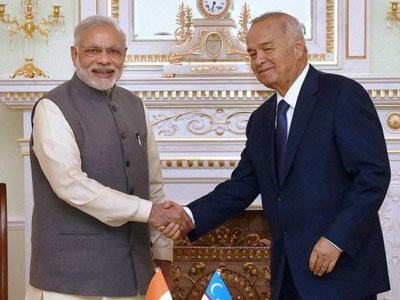 TASHKENT, July 6: On his first visit to Central Asian countries, Prime Minister Narendra Modi on Monday held talks with Uzbekistan President Islam Karimov on key bilateral and regional issues including the situation in Afghanistan as the two countries inked three pacts to boost cooperation between their foreign offices and in the field of culture and tourism.
Mr. Modi, who arrived in the Uzbek capital on the first leg of his eight-day visit to Central Asia and Russia, was received at the airport by his counterpart Shavkat Miromonovich Mirziyoyev and was accorded a ceremonial welcome.
Mr. Modi and Mr. Karimov discussed ways to enhance strategic, economic and energy ties apart from reviewing key regional issues including the situation in Afghanistan.
Addressing a joint press event with Mr. Karimov, Mr. Modi said, “I have begun my journey in Uzbekistan underlining its importance for India, not just in this region, but also in Asia. President Karimov and I discussed various initiatives to further enhance connectivity between India and Uzbekistan.”
On their discussions on regional and international issues, including the situation in Afghanistan, Mr. Modi said, “We also have shared concerns on the rising threat of extremism and terrorism in our extended neighbourhood.
“We agreed to intensify security cooperation and exchanges. The bilateral Joint Working Group on Counter Terrorism will meet later this year. We also agreed to strengthen cooperation in defence and cyber security.”
He said his discussions with President Karimov were “very productive” and aimed towards further deepening of ties.
Noting that the two countries have built a strategic partnership, Mr. Modi said, “This includes expanding economic cooperation, combating terrorism, advancing stability in the region and promoting regional integration.”
The two leaders also discussed ways to implement the contract for supply of uranium from mineral-rich Uzbekistan signed last year. The pact was signed for supply of 2,000 metric tonnes of the yellow cake.
They also explored various initiatives to further enhance connectivity between the two countries and in this context, Mr. Modi briefed Mr. Karimov about the International North South Transport Corridor and proposed that Uzbekistan consider becoming a member. The Prime Minister also sought Uzbek President’s support for India joining the Ashgabat Agreement.
The International North-South Transport Corridor is a ship, rail and road route for moving freight between India, Russia, Iran, Europe and Central Asia while the Ashgabat Agreement is a transit pact established in 2011 between Uzbekistan, Iran, Turkmenistan and Oman.
On ways to raise economic engagement between the two countries, Mr. Modi said, “I conveyed to him that there is a strong interest in Indian business to invest in Uzbekistan. There is immense potential in a broad range of areas in Uzbekistan.
“I have urged him to make the process and the policies for Indian investments here smoother. President responded positively to my suggestion.”
Mr. Modi said President Karimov was also supportive of strengthening ongoing cooperation in the areas of agriculture, information technology and energy.
Noting that the pacts inked on Monday in the field of culture and tourism will bring people of the two countries closer, Mr. Modi said, “Few countries can match Uzbekistan in nurturing Hindi and Indian culture. Tomorrow, I look forward to meeting a vibrant group of Indologists and Hindi linguists.”
Ahead of his talks, Mr. Modi presented President Karimov with a specially commissioned reproduction of ‘Khamsa-i-Khusrau’ by the great 13th century sufi poet Amir Khusrau who was born in Uttar Pradesh and whose father hailed from Uzbekistan.
Written in Persian and profusely decorated and illuminated with various colours, the work is a part of the manuscripts collection of National Museum, Delhi.
“This has been a very rewarding visit. It has sown the seeds of a rich harvest in the years ahead,” he said.
President Karimov and Prime Minister Modi reached understanding on a wide range of issues to further deepen Uzbekistan-India strategic relations, mutually beneficial bilateral cooperation in various fields, as well as international and regional issues of mutual interest, a joint statement issued later said.
The two sides reaffirmed their interest in expanding and further strengthening long-term bilateral cooperation covering diverse sectors such as political ties, security, counter-terrorism, trade and investment, science and technology as well as cultural linkages.
President Karimov noted that strengthening relations with India is one of the top foreign policy priorities of Uzbekistan while Prime Minister Modi emphasised that a strong strategic partnership between India and Uzbekistan is a key pillar of India’s engagement with Central Asia.
“The sides agreed to maintain regular bilateral consultations and political dialogue through exchange of official visits at the leadership and other levels to promote mutual understanding on bilateral as well as regional and international issues,” the joint statement said.
Noting the importance of adequate and timely responses to threats and challenges to national as well as regional security, the two sides expressed their intention to strengthen coordination between the law enforcement agencies and special services, including under the framework of the Uzbekistan-India Joint Working Group on Counter-Terrorism.
They also agreed to expand cooperation in the fields of defence and cyber-security.
The two countries noted the importance of promoting long-term, mutually beneficial partnerships among their business communities, companies and enterprises.
The two sides also called for further promotion of investment cooperation between the two countries. They called for partnership in creating favourable conditions for investment by Indian companies in Uzbekistan, including in the framework of the Special Economic Zones “Navoi”, “Angren” and “Jizzakh”.
They noted prospects for joint investment projects in sectors such as pharmaceuticals, light industry, IT and communications.
During the delegation-level talks, the two countries also agreed to explore various options to enhance surface connectivity between them.
The two sides recognised tourism as an important area of bilateral cooperation and agreed to implement practical measures under the framework of the bilateral agreement on cooperation in tourism signed during the visit.
“The sides discussed the situation in Afghanistan and noted that establishment of peace in that country is of great significance to the security and stability of the entire region. They expressed support for a genuine Afghan-owned and Afghan-led process for peaceful reconstruction and revival of the country,” the statement said.
India and Uzbekistan reaffirmed that the United Nations must play a central role in maintaining global peace and security, assisting common development and advancing international cooperation, it said.
The two countries called for comprehensive reforms of the UN structures, first of all, its Security Council, including expansion in both categories of membership.
Uzbekistan reaffirmed its support to India’s candidature for permanent membership of the UN Security Council, the statement said.
Mr. Modi invited Mr. Karimov to pay a visit to India at his convenience. The dates of the visit shall be agreed through diplomatic channels.
Mr. Modi is in Tashkent on his first-leg of six nation visit including Russia where he will be attending Summits of BRICS and Shanghai Cooperation Organisation (SCO).
From Uzbekistan, Mr. Modi will go to Kazakhstan on Tuesday. He will then travel to Russia on July 8, before flying to Turkmenistan on July 10, Kyrgyzstan on July 11 and Tajikistan on July 12.
Narendra Modi pays tribute to Lal Bahadur Shastri in Tashkent
TASHKENT, July 7: Prime Minister Narendra Modi today described Lal Bahadur Shastri as a proud son of India, as he paid glowing tribute to the former premier who died here following a heart attack in 1966.
"Paying tributes to the proud son of India, the inspiring Lal Bahadur Shastri ji," Modi tweeted after paying tribute to the second Prime Minister of India.
Modi paid tribute to him at a bust erected in Shastri's memory. A prominent figure in the independence movement, Shastri died of a heart attack in Tashkent in 1966 during an official visit at the age of 61. Shastri had taken over the office of Prime Minister after Prime Minister Jawaharlal Nehru's death in 1964.
He is best remembered for his slogan 'Jai Jawan Jai Kisan' which was aimed at encouraging the farmers for a better yield to reduce country's dependence on imported food grains while also to infuse renewed enthusiasm in soldiers fighting the Indo-Pak war of 1965.
"We are thankful to the people of Tashkent and Uzbekistan, for preserving the legacy of our former Prime Minister," Modi had said yesterday.
Modi, who arrived here yesterday on the first leg of his eight-day visit to Central Asia and Russia, also paid tribute at the National Monument of Independence and Humanism.
India steps up efforts to enhance engagement with diaspora
NEW DELHI, July 2: The Ministry of Overseas Indian Affairs on Thursday decided to step up efforts to ensure greater engagement of Indian diaspora in diverse sectors of the economy as well as overall developmental activities.
A meeting of Governing Council of Overseas Indian Facilitation Centre (OIFC) discussed ways to ensure greater participation of diaspora community in various key sectors.
Minister for Overseas Indian Affairs Sushma Swaraj interacted briefly with members of the Governing Council.
OIFC is a not-for-profit organisation set-up by Ministry of Overseas Indian Affairs in 2007 in partnership with CII, to promote two-way engagement with the Indian diaspora.
Reviewing OIFC's Action Plan for 2015-16, the Governing Council directed OIFC to undertake enhanced and sustained engagement with Overseas Indians in a proactive manner.
OIFC's role and activities will be expanded, officials said adding new programmes and initiatives will be initiated to strengthen outreach towards young overseas Indians.
OIFC will organise visits to India by business delegations led by overseas Indians from small and medium enterprises to connect them with business partners and relevant stakeholders in central and state governments.
It will also offer diaspora investors an opportunity to invest in social and development enterprises in India.
An India Corporate Internship programme will be introduced for final year MBA students of Indian-origin, to provide them an opportunity of work experience in India's premier corporate organisations, officials said.
PM's visit to Central Asia could provide new strategic direction
 NEW DELHI, July 3: Along with attending the 7th BRICS summit and the 15th Shanghai Cooperation Organisation (SCO) meeting in Ufa in Russia, Prime Minister Narendra Modi is also visiting all five Central Asian republics of Tajikistan, Turkmenistan, Kazakhstan, Kyrgyzstan and Uzbekistan next week.
This will be the first visit of any Indian prime minister to all the Central Asian countries simultaneously since they became independent in 1991. The visit could provide a new strategic direction to the 12-point ‘Connect Central Asia’ policy announced by the previous government in 2012.
The strategic location, energy resources, competition for pipeline routes and the sheer number of regional and global players were sufficient reasons for many analysts to create theories of the ‘New Great Game’ in Central Asia in the 1990s. Despite the intentions and rhetoric, India was never really part of any competition during the initial phase of the ‘game’ in the region.
With no direct road transportation access, plus difficult market conditions, the region did not become attractive to Indian private companies. Compared to the Soviet period, economic relations with the region had also declined considerably.
Still, India was comfortable in dealing with Central Asian regimes as they had provided stability and were committed to fight religious terrorism.
Moreover, many in India believed that Russia will continue to have a decisive role in Central Asia because of its advantage of history and geography. Now when China has increased its engagement in the region considerably and created a huge profile for itself through trade, energy deals, military agreements and the SCO, India has to work out a different strategy.
Moreover, the post-2014 developments in Afghanistan have added a new dimension to India-Central Asia ties, particularly in the context of difficult India-Pakistan relations.
Any failure of the Afghanistan project will pose common security challenges to both India and Central Asia. Relative stability in Afghanistan, on the other hand, will open up tremendous economic opportunities.
India, Russia, the Central Asian republics and Iran have worked together in the past during the Afghan instability. This is the right moment to discuss the dynamically changing situation in Afghanistan with the Central Asian leaders and also work out strategies for economic and energy cooperation.
Building on its past linkages, India has already signed strategic partnerships with Uzbekistan, Kazakhstan and Tajikistan. With possible membership in the SCO, India’s engagement with the region is likely to be strengthened.
With increasing Chinese dominance and relatively declining Russian presence, India will have to play a much bigger role in the region than it has so far. It has to assert its rapidly growing political, economic and military capabilities in Central Asia, which is strategically vital for Indian interests.
The region is important because of old cultural and civilisational links, energy resources and strategic location (Tajikistan is located only about 20 km from Greater Kashmir). India’s military facility in Tajikistan is very close to bases of anti-Indian terrorist groups as well as near the territory where China and Pakistan are engaged in military and economic cooperation.
Oil and gas resources from Kazakhstan and Turkmenistan along with Russia could improve our energy security. Both India and Kazakhstan are exploring possibilities of India importing crude oil and gas from Kazakhstan, either through a pipeline or as LNG in ships. Hydrocarbons could be transported first to Iran via the Caspian Sea and then transported through Iran via pipeline.
The Chabahar port, built by India in Iran, will also become operational next year. Linking these connections with the Zarang Delaram road built by India in Afghanistan and also with the International North South Trade Corridor will give India access to Afghanistan and Central Asia, bypassing Pakistan.
If there is any further positive movement on the Turkmenistan-Afghanistan-Pakistan-India gas pipeline project, it could further boost India’s links with the region. India and Russia are also discussing bringing Russian hydrocarbons to India via Central Asia or perhaps through China.
So if India plans to play a big role in the region, it has to synchronise these initiatives into a larger strategy of engagement. Obviously, Iran becomes a crucial factor for any Indian strategy for engagement in Central Asia.
Meanwhile, the Chinese ‘One Belt One Road’ project is in full swing in Central Asia.
In 2013, Chinese President Xi Jinping made a 10-day visit to four Central Asian countries and signed an estimated $48 billion worth of investment and loan agreements in the areas of energy, trade and infrastructure.
Chinese trade and investment has already surpassed Russian economic linkages in Central Asia. The Russian economic downturn due to declining oil prices and the impact of economic sanctions has started affecting Central Asia.
The fall of the rouble and decline of Russian growth has also led to a significant decline in remittances in Central Asia, particularly in Tajikistan and Uzbekistan. With declining military engagement in Afghanistan, the US interests in the region are also on the decline.
In these circumstances, Central Asia would be looking for enhanced strategic and economic engagement from India. This also fits in well within the ‘multi-vector’ foreign policies of most Central Asian states, in which they are trying to balance their relations with Russia and China through enhanced engagement with the West and regional players. Modi’s visit will be keenly watched and its outcome may create new dynamics in the region’s geopolitics.
Khobragade reinstated in new division
NEW DELHI, July 3: The External Affairs Ministry has reinstated IFS officer Devyani Khobragade in service and posted her to the newly created ‘States division’.
While serving as Deputy Consul-General in New York, Ms. Khobragade was arrested in 2013 by U.S. law enforcement agencies for making “false claims” on a visa application for her household help. Back in India, the Ministry put her on “compulsory wait”.
On Thursday, sources said that Ms. Khobragade met officials in the Prime Minister’s Office and Foreign Secretary S. Jaishankar to seek her reinstatement. The Foreign Secretary, who is learnt to have posted her in the new division, was instrumental in negotiating her release from the U.S., where she faced trial, and facilitated her return to India.
Even in her new role, the government is reluctant to let her travel abroad since she can be prosecuted for her pending case in the U.S. Washington has extradition treaties with 110 countries. Even those with which it has diplomatic relations can initiate prosecution.
Sources said the Ministry had taken her off her “compulsory wait” a few months. Asked about the internal inquiries against her on the passport issue and the media interviews, Ministry spokesman Vikas Swarup said both cases were now sub judice.
Petroleum Minister Dharmendra Pradhan to visit Canada
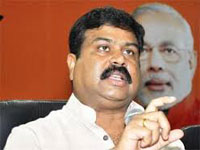 NEW DELHI, July 3: Minister of State Petroleum and Natural Gas Dharmendra Pradhan is visiting Canada on a four-day official visit from July 3.
During the visit, Mr Pradhan will lead the Indian delegation for bilateral energy dialogue with Government of Canada. The bilateral energy dialogue covers areas like hydrocarbon, thermal energy and renewable energy.
On the sideline of the bilateral energy dialogue with his Canadian counterpart in Calgary, Mr Pradhan will also address two business conferences (in Calgary and Vancouver) where CEOs from various companies in energy sector will participate.
Canada is a mineral resource rich country. According to estimates Canada has third largest oil reserves in the world and has substantial natural gas reserves. Indian Oil Corporation has invested in LNG project in Canada.

| advertisement |
Aviation
| Business | Defence | Foreign
Affairs | Communication | Health
| India | United Nations
India-US
| India-France | Entertainment
| Sports | Photo Gallery |
Tourism | Advertise with Us
| Contact Us
© Noyanika International, 2003-2009. All rights reserved.