


Foreign Affairs
|
Delhi Study Group Felicitates UK Minister Baroness Sandip Verma
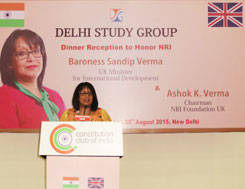
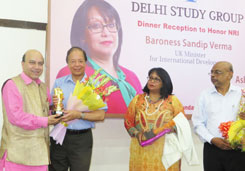
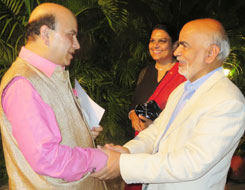
Delhi Study Group (prominent socio- political –cultural NGO) led by President Vijay Jolly and Ex-Delhi BJP MLA felicitated UK Minister for International Development Baroness Sandip Verma at a public program here on Saturday. Also honored were her husband Ashok K. Verma, Chairman NRI Foundation in UK. The co-host along with Jolly was Lion Ram Gopal Goyal of Lions Club International. She is a Conservative Member of the House of Lords. Currently she is Minister International Development in the Cabinet of British Prime Minister David Cameron. The people and the Governdment of UK look forward to accord a grand welcome to Modi ji during his proposed visit later this year to Great Britain declared UK Minister Baroness Sandip Verma. And a short presentation on Delhi Study Group was enumerated by Anita Malik.
Present on the occasion were Pinky Anand, Additional Solicitor General of India, Lord Diljit Rana from Ireland, Jagdishwar Goburdhun, Mauritius High Commissioner, Dr. Alexander Evans, Deputy High Commissioner UK, Roman Masarik, Charge d’Affaires Czech Republic, Aivars Groza, Latvia Ambassador, Y. Yogaindran, Counselor Singapore High Commission, Laimonas Talat-Kelpsa, Ambassador of Lithuania, Simona Vittorini from Italy, Jagmohan, NRI from Canada and S.P. Bhatia, PS to Finance Minister of India. Pakistan could be world’s 3rd biggest nuclear power in 10 yrsWASHINGTON, Aug 28: Pakistan could possess the world's third largest arsenal of nuclear weapons in a decade, or have enough fissile material available for it, according to a new report. It is currently behind US, Russia, France, UK and China — the five nuclear powers — and marginally ahead of India, according to this and multiple other recent estimates. The new report released Thursday projects Pakistan could possess 350 weapons in 10 years. Or, as said before, the ability to make them with available fissile material. And that would make Pakistan vault over France, China and UK — the number three, four and five powers — that have 300, 250 and 225 nuclear weapons respectively. The US and Russia lead the count with an estimated 1,600 each. Pakistan currently possess about 120 weapons (other estimates put in the 100-130 range), followed by India with around 100 (in the 80-100 range) and Israel with 80. But, the report, jointly by think tanks Carnegie and Stimson Center, says Pakistan is on course to more presuming India is sitting on a larger stockpile of fissile material. It has, therefore, fixed a target for itself to produce 20 nuclear warheads a year. Authors put its capacity at between 14 and 27 nuclear weapons a year, to India's two and five. Here is how the math works, in the report: "India has about 600 kilograms of plutonium, while Pakistan has about 170 kilograms of plutonium and 3.1 metric tons of HEU (highly enriched uranium, which is inferior to the lighter plutonium). "Assuming that each nuclear weapon would require five kilograms of plutonium or 15 kilograms of HEU, with existing stockpiles of fissile material India could theoretically construct up to 120 weapons, while Pakistan could construct up to 240. India lags behind, the report argues, because of the "reluctance and ambivalence (of its leadership) to invest greater urgency and more resources in this competition". Also, the authors concede, India is focussed elsewhere — "it pursues high-profile strategic modernization programs geared more toward China than Pakistan". A nuclear Pak knows how to defend itself: Sartaj AzizNEW DELHI, Aug 24: Pakistan’s National Security Advisor Sartaj Aziz has accused “Modi’s India” of acting like a regional superpower and said his nuclear-armed country was capable of defending itself. India, Pakistan blame each other after NSA talks called offNEW DELHI, Aug 22: Planned talks between the national security advisors (NSAs) of India and Pakistan collapsed under the weight of intense diplomatic acrimony, with New Delhi insisting the meeting must focus on terrorism and Islamabad saying parleys with conditions would serve no purpose. US says 'disappointed' that NSA talks between India, Pak called offWASHINGTON D.C., Aug 23: The US has said it was "disappointed" that the proposed talks between the National Security Advisors of India and Pakistan has been called off. "We are disappointed the talks will not happen this weekend and encourage India and Pakistan to resume formal dialogue soon," state department spokesperson John Kirby said on Saturday. The spokesperson, however, said the "constructive" interaction between Prime Minister Narendra Modi and Pakistan Prime Minister Nawaz Sharif in Ufa, Russia, was encouraging. "We were encouraged by the constructive interaction between the leaders of India and Pakistan earlier this year at Ufa, particularly the announcement of dialogue between the countries' National Security Advisors," Kirby said. Pakistan on Saturday night called off the NSA-level talks proposed for August 23-24, after external affairs minister Sushma Swaraj virtually gave an ultimatum to Islamabad to give a commitment that it would not go ahead with meeting separatists. NSA talks cancellation shows govt's foreign policy failure: CongNEW DELHI, Aug 22: The cancellation of India's NSA-level talks with Pakistan "reflects Modi government's foreign policy failure", according to the main opposition, Congress. "Confusion, consternation and casual callousness are the three C's of Modi government's foreign policy which lacks both maturity and vision," Congress chief spokesman Randeep Surjewala said on Saturday evening. He was reacting to Pakistan calling off the talks in the backdrop of India making it clear that discussions on Kashmir and a meeting with separatists will not be acceptable. He asked Prime Minister Narendra Modi "to rise above pure rhetoric and address the issues of internal and external terrorism whose focal points lie in Pakistan." "India awaits a decisive and cohesive enunciation of a mature foreign policy that takes care of our strategic concerns, security issues and peaceful bilateral relationship," Surjewala said. 25 killed in terror blast in Bangkok
Thailand's junta chief Prayut Chan-O-Cha described the bombing as the "worst ever attack" on the country. Twelve people died at the scene of the blast in central Bangkok on Monday evening and ten more died in nearby hospitals, police spokesperson Lt Gen Prawut Thavornsiri told the media. He said 123 people were wounded. Seven tourists from China, Hong Kong, Malaysia and Singapore were among the dead. The Indian envoy had said on Monday that no Indians were among the casualties. "It was like this huge gust of wind and debris flying through you," Sanjeev Vyas, a DJ from Mumbai who was in the middle of the fray, told CNN. "... And then I see bodies everywhere, there are cars on fire, there are bikes everywhere. People are screaming." Earlier, authorities had ordered onlookers back, saying they were checking for a second bomb but police later said no other explosive devices were found. Yet security checks at some major city intersections and in tourist areas had been stepped up. The city's elevated railway, which passes over the scene, was operating normally. Bangkok has endured years of deadly political violence, with a military junta now ruling the nation, and a decades-long Muslim insurgency in the far south that has claimed thousands of lives. Government spokesperson Werachon Sukhondhapatipak told reporters, "It's too early to link the bomb to terrorist attack because no group has come to claim responsibility so far." However, officials said the attack targeted Thailand's tourism industry although it is unclear who stands to gain. Islamic militants have carried out many attacks in other parts of southeast Asia, including on Indonesia's holiday island of Bali in 2002 that killed 202 people, but so far, Thailand had not been a target. Sukhondhapatipak further said that the pipe bomb detonated was not similar to those used by insurgents in the south. United Nations general secretary Ban-Ki-moon condemned the attack and expressed "his condolences to the bereaved families and to the people and government of Thailand". "He hopes that those responsible will be brought to justice," the statement read. Prime Minister Narendra Modi also tweeted about the explosion that took place outside a Hindu temple in the Thai Capital. "I strongly condemn the blast in Bangkok. My thoughts are with the families of the deceased. I pray for a speedy recovery of the injured," the tweet read. The army has ruled Thailand since May 2014, when it ousted an elected government after months of at times violent anti-government protests. The shrine intersection was the site of months of anti-government protests in 2010 by supporters of ousted former Prime Minister Thaksin Shinawatra. Dozens were killed in a military crackdown and a shopping centre was set ablaze. Vijay Jolly Condemns Blast at Lord Brahma Temple in BangkokBy Deepak Arora
India, UAE speak in one voice against terrorism: Modi
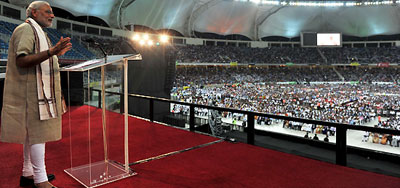
Waiting for hours after a tough desert journey in double-decker buses did nothing to dampen the diaspora’s spirits as onlookers raved about the PM’s “positive energy”. The temperature dropped by 10 degrees Celsius to 36 by the time Modi began his evening address to a wildly cheering crowd. “We (India and the UAE) have spoken in one voice against terrorism,” Modi said without directly naming Pakistan. After a pause, he added, “Those who can understand will understand ... We are victims of terrorism for 40 years. Many innocent people have lost their lives.” “Those who indulge in terrorism must be punished. That is the message resonating here today,” he said and emphasised that gone were the days when a nomenclature of good and bad terrorism would be accepted.
At the beginning of his hour-long speech, Modi lauded the contribution of the diaspora, which he said made the country proud and through its remittances played an important role in the Indian economy when the country was under sanctions following the nuclear tests conducted under then prime minister Atal Bihari Vajpayee’s leadership. In a speech marked by Modi’s signature flourish that began and ended with “Bharat mata ki jai”, he said the visit to the UAE helped build trust and Gulf nations were willing to invest Rs 5 lakh crore in India. “I don’t go by the colour of passports, our blood has the same colour,” Modi said of the hosts. Earlier, he greeted people from Kerala who attended the event in large numbers on the occasion of their new year. Modi urged the crowd to give a standing ovation to the crown prince of the UAE, to which they readily obliged. India, UAE call nations to reject use of terrorism
A joint statement issued at the end of Prime Minister Narendra Modi’s two-day tour of the Gulf nation is seen as a veiled message for Pakistan which New Delhi accuses of fostering anti-India militancy. After his talks with UAE’s Crown Prince Mohamed bin Zayed Al Nahyan, the two nations condemned efforts, including by countries, to use religion to justify, support and sponsor terrorism against other nations. Both countries decided to “work together to control, regulate and share information on flow of funds that could have a bearing on radicalisation activities and cooperate in interdicting illegal flows and take action against concerned individuals and organizations”. This will help India corner dangerous fugitives such as Dawood Ibrahim, who is believed to be holed up in Pakistan and own properties in the UAE. The statement said all “terrorism infrastructure” wherever they exist should be dismantled. “Denounce and oppose terrorism in all forms and manifestations, wherever committed and by whomever, calling on all states to reject and abandon the use of terrorism against other countries, dismantle terrorism infrastructures where they exist, and bring perpetrators of terrorism to justice,” it said. New Delhi has pressed Islamabad for long to dismantle terrorist infrastructure on its soil that plans and directs attacks on India. It has also been pushing Pakistan to expedite the trial against the planners of the 2008 Mumbai attacks. The India-UAE statement came amid relentless Pakistani shelling at Indian border villages in Jammu and Kashmir and ahead of a meeting between the national security advisers of the two neighbours, scheduled for August 23. “We also deplore efforts by countries to give religious and sectarian colour to political issues and disputes, including in West and South Asia, and use terrorism to pursue their aims,” it said. The strong language of the communiqué signals a shift in ties between India and the UAE which have robust economic relations but limited cooperation on security and counter-terrorism measures. The most important takeaway for Modi, the first Indian PM to visit the UAE in 34 years, was an Arab nation’s support to India’s concern over terrorism. The UAE agreed to adopt India’s proposed comprehensive convention on international terrorism (CCIT) in the UN, which could pave the way for the Organisation of Islamic Cooperation (OIC), comprising 57 countries, to follow suit. In his address at the 69th UN General Assembly in September 2014, Modi had appealed for the adoption of the CCIT, which is a proposed treaty to bind together the existing framework of counter-terrorism agreements into a single system and deny safe haven to terrorists. Foreign secretary S Jaishankar shed light on the emphasis to counter-terrorism measures such as a meeting between the national security advisers of India and the UAE every six months, intelligence sharing and extradition arrangements. “The threat of terrorism is common to both countries. This includes not the non-state actors, but states sponsoring terrorism.” The UAE is driven by its own troubles such as radicalisation and threats from Islamic State and al Qaeda offshoots active in the region. For its part, India has all along held that UAE cities were active recruitment grounds for the Indian Mujahideen. Many in India also feel the UAE could have done more in the IC-814 hijack case in 1999 when the aircraft was allowed to land at Al Minhad air force base, 40 miles from Dubai, after much persuasion. Modi woos UAE businessmen; Says India has $ 1 trillion potential
He made a similar pitch during Sunday’s dinner with UAE’s top businessmen, saying “his decisive government has full majority” and is keen on foreign investment. “Infrastructure development and real estate offer tremendous opportunities for UAE businesses in India,” he said at Monday’s round table in the zero-carbon city of Masdar, where he took a ride in a self-driving car. Modi was keen on addressing issues of the past where several UAE businessmen had complained of difficulties in doing business in India. “I want to assure we are solving these problems,” he said and promised to interact more with the UAE. His visit is the first in 34 years since Indira Gandhi’s in 1981. He said commerce and industry minister Nirmala Sitharaman would visit the UAE soon. “If India and UAE work together, they can make the vision of the Asian century (the 21st century as Asia’s century) a reality. UAE would be at the economic focus of the Asian century,” he said at Masdar City, a 5.95-sq km strip located 17km southeast of Abu Dhabi international airport. “Science is life,” Modi wrote on the visitor’s book at Masdar City, intended to be an incubator for a new generation of green start-ups in a region. The Prime Minister also rode a personnel rapid transit or PRT car, a driverless vehicle that runs from point to point on magnetic strips. “Masdar City is an amazing project, illustrating a pathbreaking approach to urban development & clean energy,” he later tweeted. At Sunday’s private dinner hosted by Hamed bin Zayed Al Nahyan, managing director of the Abu Dhabi Investment Authority which is a sovereign wealth fund worth $800 billion, the Prime Minister spoke of his government’s efforts to make India a business-friendly country. The UAE ranks 22 in the ease of doing business index, compared to India’s 142. Modi pitched for his flagship Make in India initiative that aims to turn the country into a global manufacturing hub. For the dinner, celebrity chef Sajeev Kapur cooked an elaborate Gujarati fare, including non-vegetarian dishes. Foreign ministry spokesperson Vikas Swarup said the Prime Minister sought investment in renewable energy, port development and low-cost housing, saying India needs 50 million houses. “The underlining theme of the meeting with businessmen was that investments should benefit the common man,” said TP Seetharam, ambassador to the UAE. Pakistani airstrikes kill 65 militants near Afghan borderISLAMABAD, Aug 18: Pakistani airstrikes killed 65 militants on Tuesday in two tribal regions along the Afghan border, the army said, part of a year-long campaign against insurgents in rugged areas where they have long sheltered. Strikes in two areas of North Waziristan killed 50 militants and destroyed an ammunition cache, while strikes in the Khyber tribal region killed another 15, an army statement said. Militants who carry out attacks on both sides of the border have long been based in Pakistan’s remote western tribal regions. The government launched a massive military operation in North Waziristan in June 2014 and vowed to step up its efforts in the wake of a Taliban attack on a school in December that killed some 150 people, mostly children. The airstrikes came a day after a twin suicide attack at the residence of Punjab provincial home minister Shuja Khanzada killed him and 17 others in the country’s east. Khanzada was a vocal supporter of harsh government tactics against the militants. Last month, he announced that Malik Ishaq, who led the al-Qaida-linked Pakistani group Lashkar-e-Jhangvi, had been killed in a police shootout. Jamatul Ahrar, a splinter group of the Pakistani Taliban, claimed the suicide bombings, saying the attack was revenge for Ishaq’s killing. Only struggle in J-K is against Pak-sponsored terrorism: MEANEW DELHI, Aug 14: Ahead of talks between their National Security Advisers (NSA), India and Pakistan on Friday indulged in a war of words with Islamabad asserting that it will not abandon "the Kashmiris' legitimate struggle for freedom", drawing a sharp reaction from New Delhi which said the only struggle in Jammu and Kashmir is Pakistan-sponsored terrorism. "The only struggle in J-K is against Pakistani-sponsored terrorism. This will be the subject of the upcoming NSA-level talks," external affairs ministry spokesperson Vikas Swarup tweeted. His comments came after Pakistan's high commissioner to India Abdul Basit said his country will not "abandon" the Kashmiris' "legitimate struggle for freedom", stressing that to have normal and cooperative relationship with India it was necessary to settle the decades-old dispute. Basit made the remarks in his address during an event here to mark Pakistan's Independence Day. "Aspirations of the people of Jammu and Kashmir could neither be ignored nor put on the back burner. No matter how much more time their legitimate struggle takes, Pakistan will never abandon Kashmiris and their cause," Basit said. Asserting that "Pakistan has always wanted to have a normal and cooperative relationship with India," he said, "To this end, it was necessary to settle all the outstanding issues, particularly the Jammu and Kashmir dispute to improve relations." National Security Adviser is scheduled to meet his Pakistan counterpart Sartaz Aziz in Delhi for talks on terrorism-related issues for the first time on August 23 in New Delhi, as decided in a meeting between Prime Ministers Narendra Modi and Nawaz Sharif last month in Ufa in Russia. During his brief speech after hoisting the country's national flag at the Chancery amid a sudden spell of showers, Basit also dwelt on the challenges faced by Pakistan on the economic front and its "fight" against terrorism, saying that the country's economy was showing "encouraging" signs of recovery. India is expected to present strong evidence of terrorism emanating from Pakistan highlighted further by recent attacks in Gurdaspur in Punjab and near Udhampur in Jammu and Kashmir. India's case is bolstered by the capture of Mohammed Naved Yakub, a Pakistani national and a LeT operative, who carried out an attack on a BSF bus last week near Udhampur. Modi to seek enhanced energy, trade cooperation during UAE visit
Describing United Arab Emirates (UAE) as a "valued partner", he said the extent of the ties indicates the vibrant bilateral relations India being UAE's second largest trading partner and UAE third largest trade partner for the country. Lauding the immense contribution made by over 2.5 million Indians who have made UAE their home, Modi said he was looking forward to meeting the large community of Indian workers based in UAE. They remit more than $13 billion annually. Noting that it was the first prime ministerial visit in 34 years, Modi said he was certain it will boost people-to-people ties between the two nations. "The economic strides taken by UAE are extremely admirable. UAE is a global economic success story that has attracted people from all over the world. UAE has also emerged as an important logistics hub... During my visit, I seek to enhance cooperation in energy, trade and will talk to investors on why India is an attractive destination to invest," he said. During his overnight visit, Modi will first travel to Abu Dhabi and then to Dubai on August 17. Apart from holding talks with the leadership there, the Prime Minister will address huge Indian gathering in Dubai Cricket Ground, on the lines of the event held in Madison Square Garden in New York last year. "I will hold extensive talks with His Highness Sheikh Mohamed bin Zayed Al Nahyan, Crown Prince of Abu Dhabi, whose enlightened vision and farsightedness has taken UAE to new heights of development. I will meet His Highness Sheikh Mohammed bin Rashid Al Maktoum, the Vice President and Prime Minister of UAE," Modi said. In Abu Dhabi, he will visit Sheikh Zayed Grand Mosque, a key place of worship in UAE and known as a masterpiece of Islamic architecture which can accommodate around 40,000 people. The mosque was constructed from 1996 to 2007. "One of the places that I will visit in UAE is the Masdar City, a zero carbon city, which is an effort towards creating a cleaner and greener tomorrow," he added. He also noted that India and UAE are fantastically connected be it via air or through the sea. Later, official spokesperson in external affairs ministry said UAE, with a sovereign wealth fund of more than $800 billion, was very important from investment point of view and India would like to impress them to invest in infrastructure sector. Security is another major area of cooperation between India and UAE which have treaties and agreements on extradition, mutual legal assistance in criminal and civil matters, combating trafficking in narcotics and information cooperation apart from maritime interaction. 50 killed in massive blasts at Chinese portTIANJIN CITY, Aug 13: The death toll from the fiery explosions at a warehouse of hazardous chemicals in China's Tianjin city climbed on Thursday to 50 prompting Chinese government to send experts to the shattered and smoldering port to assess any environmental dangers from the spectacular blasts. More than 700 people were injured and dozens were reported missing in the explosions shortly before midnight Wednesday that demolished a workers' dormitory, tossed shipping containers as if they were toy blocks and turned a fleet of 1,000 new cars into scorched metal husks. Windows were shattered for miles around by the shockwaves. There was no indication of what caused the disaster in one of China's busiest ports, and authorities tried to keep a tight rein over information by keeping reporters well away from the site. Social media users complained their posts about it were deleted. More than 1,000 firefighters were sent to the mostly industrial zone in Tianjin, a petrochemical processing hub about 120 kilometers (75 miles) east of Beijing. Tianjin is the 10th largest port in the world by container volume, according to the World Shipping Council, and the seventh-biggest in China. It handles vast amounts of metal ore, coal, steel, cars and crude oil. Ships carrying oil and "hazardous products" were barred from the port Thursday, the Tianjin Maritime Safety Administration said on its official microblog. It also said vessels were not allowed to enter the central port zone, which is near the blast site. The municipal government, which gave the death toll of at least 50, said 701 people were injured, including 71 in serious condition. The Tianjin Port Group Co. said dozens of its employees were unaccounted for and a search is under way. Some migrant workers at the port may not be documented. Authorities said the blasts started at the warehouse owned by Ruihai Logistics, a company that says it stores hazardous materials including flammable petrochemicals, sodium cyanide and toluene diisocyanate. An initial explosion apparently triggered an even bigger one. The National Earthquake Bureau said the first blast was the equivalent of 3 tons of TNT, and the second 21 tons. The enormous fireballs from the blasts rolled through a nearby parking lot, turning a fleet of 1,000 new cars into scorched metal husks. Pak army sentences 7 to death for Peshawar school attackISLAMABAD, Aug 13: Pakistani military courts sentenced seven Islamic militants to death over a series of attacks, including a deadly assault on an army-run school in Peshawar that killed more than 150 people, mostly students. An army statement released on Thursday said another militant was sentenced to life in prison. It said army chief General Raheel Sharif confirmed the sentences. The statement said eight militants belonged to the Taliban and two others to local militant groups. The attack on the army-run school in Peshawar, in which nearly all the victims were schoolchildren, shocked Pakistanis and led the country to lift a moratorium on executions in place since 2008. Pakistan has long been accused of turning a blind eye to Islamic militant groups, viewing them as allies against arch-rival India and a way of projecting influence in neighboring Afghanistan. Two stabbed to death at Ikea store in SwedenSTOCKHOLM, Aug 10: Two people were stabbed to death at an Ikea store in the central Swedish town of Vasteras and a third person was wounded, police said on Monday. "Police received a call about wounded people at Ikea ... around 1pm. A man and a woman with stab wounds were found at the scene, they later died of their injuries. Another person is seriously injured. One man has been arrested suspected of murder," a police statement said. The wounded person is a man aged around 35 who immediately underwent surgery at a local hospital, Eva Lindahl, a spokeswoman for the regional health care authority, said. Police disclosed no other information about the identities of the attacker nor the victims. But local daily VLT, quoting the store manager, reported that the victims were "ordinary shoppers" and the attack took place in the store's kitchen accessories section. Swedish television broadcast footage of the store which had been evacuated and was surrounded by police. India set to boycott Commonwealth meet in PakistanIslamabad, Aug 9: India appears set to boycott a Commonwealth Parliamentary Association meet in Pakistan after Islamabad reiterated it will not invite the speaker of the assembly of Jammu and Kashmir, which it described as a “disputed territory”. The CPA, India said, is a “membership organization which has constitutionally been bound for over a century now to invite all its member branches to the CPA annual conference so long as a branch is in good financial standing with the Association”. Pakistan broke protocol on Kashmir speaker, Indian envoy saysISLAMABAD, Aug 9: Pakistan broke protocol by not inviting the speaker of the Jammu & Kashmir assembly for a Commonwealth meeting here, India's envoy here T C A Raghavan has said. The Dawn newspaper on Sunday quoted Raghavan as saying at a book release function here on Saturday night that Pakistan had invited delegations from Jammu & Kashmir in the past. India has said it won't attend the Commonwealth Parliamentary Conference if Pakistan does not invite Jammu & Kashmir speaker Kavinder Gupta, the high commissioner said. The conference is to be held in Islamabad from September 30 to October 8. India has demanded that the venue be shifted to some other country. Kabul blasts kill 35, tests Afghan president's peace planKABUL, Aug 8: Two massive attacks in Kabul on Friday, one striking near a government and military complex in a residential area and the other a suicide bombing outside a police academy, killed at least 35 people, sending the strongest message yet to Afghan President Ashraf Ghani — that militants are still able to strike at his heavily fortified seat of power. No one claimed responsibility for the attacks, though officials indicated they blamed the Taliban. The implications of the assaults, however, undermine claims by security services and the government that the capital is immune from devastating attacks. They also pose a major challenge to Ghani, who has made the peace process with the Taliban the hallmark of his presidency since taking office last year. In the evening hours, a suicide bomber dressed in a police uniform struck outside the gates of a police academy in Kabul, killing at least 20 recruits and wounding 25, Afghan officials said. The attacker walked into a group of recruits waiting outside the academy and detonated his explosives-laden vest, said a police officer, who goes by the name of Mabubullah. Many Afghans use only one name. Another police officer, who spoke on condition of anonymity because he was not authorized to talk to reporters, said there were at least 25 wounded among the recruits. Earlier in the day, a massive truck bomb killed at least 15 people near a government complex and a military base in a residential area of Kabul. That 1am blast flattened an entire city block and also wounded 240 people, officials said. It was one of the largest ever in Kabul — a city of 4.5 million people — in terms of scale, flattening a city block and leaving a 10 meter (30 foot) crater in the ground. The president's office said 47 women and 33 children were among the casualties in that attack. The president's deputy spokesman Zafar Hashemi said about 40 of the wounded would remain hospitalized. It was unknown how the attackers smuggled a large amount of explosives into the heavily guarded city. Ghani threatened a rapid and forceful response to the bombing, saying it was aimed at diverting public attention from the Taliban's leadership struggle. Last week, Afghan authorities announced the death Mullah Mohammad Omar, the one-eyed, secretive head of the Taliban who hosted Osama Bin Laden's al-Qaida in the years leading up to the September 11, 2001, attacks. Mullah Omar had not been seen in public since fleeing over the border into Pakistan after the 2001 US-led invasion that ousted the Taliban from power. The Afghan intelligence agency said Mullah Omar had been dead for more than two years. The Taliban leadership confirmed his death — and even appointed a successor — but the revelation still sparked a leadership struggle among senior Taliban figures, raising concerns of a succession crisis that could splinter the group. Pakistan, which wields significant influence over the insurgent group and which hosted the first round of landmark Afghan-Taliban peace talks last month, denied that Mullah Omar had died in Karachi. The peace talks were indefinitely postponed following the announcement of the leader's death. |

| |||||||||||
 NEW DELHI, Aug 31:
 While addressing the august gathering Baroness Sandip Verma admitted that she was a great admirer and fan of Prime Minister Narendra Modi.
 BANGKOK, Aug 17: The death toll in a powerful bomb blast outside the popular Hindu Erawan shrine in the heart of the Thai Capital rose to 25 on Tuesday with more than 120 injured, even as the country's defence minister said investigators were closer to determining who set off the device.
 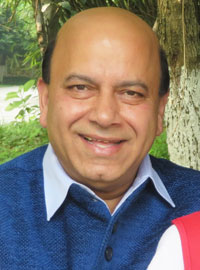 NEW DELHI, Aug 18: Senior BJP leader Vijay Jolly today condemned the bomb blast at Lord Brahma Temple in Bangkok the capital of Thailand. "We share your grief and pain at this hour, stated Jolly in his condolence message to Thai Ambassador in India Chalit Manityakul.
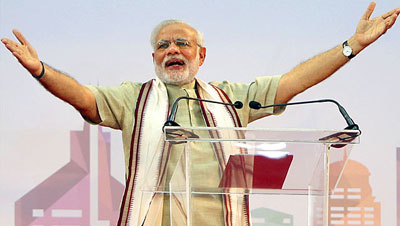 DUBAI, Aug 17: Reminding one of the superb reception Narendra Modi reveived at Madison Square Garden, the Indian Prime Minister was greeted by 40,000 spectators at a Dubai stadium as he delivered a rousing speech on Monday, hitting out at terrorism and making a pitch for collective progress.
 “Good terrorist, bad terrorist, good Taliban, bad Taliban, this won’t work. A decision has to be taken: are you with terrorism or humanity?”
 DUBAI, Aug 17: India and the United Arab Emirates (UAE) on Monday turned to the same page on terror, calling all nations to reject the use of terrorism and bring perpetrators of such violence to justice.
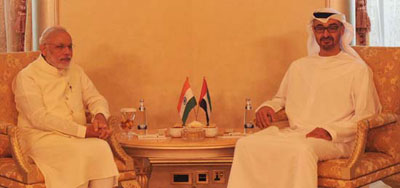 ABU DHABI, Aug 17: Prime Minister Narendra Modi on Monday urged top UAE businesses, including Indians who have made it big in the oil-rich Gulf nation, to invest in India as the country provides a $1 trillion potential.
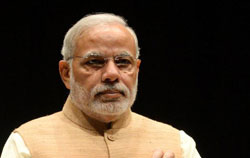 NEW DELHI, Aug 14: A visit to the Sheikh Zayed grand mosque in Abu Dhabi is part of Prime Minister Narendra Modi's visit to UAE from Saturday during which he seeks to enhance cooperation in energy and trade and reach out to investors there to promote India as an attractive business destination.
Aviation
| Business | Defence | Foreign
Affairs | Communication | Health
| India | United Nations
India-US
| India-France | Entertainment
| Sports | Photo Gallery |
Tourism | Advertise with Us
| Contact Us
© Noyanika International, 2003-2009. All rights reserved.