|
Taiwan parties announce Vice-President candidates for Jan 16 polls
By Deepak Arora
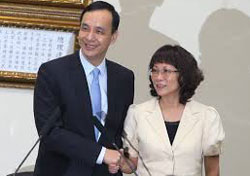 TAIPEI, Nov 20: Stage is set for the January 16 Presidential elections in Taiwan with the ruling and the opposition candidates announcing their Vice Presidential nominees. The ruling party Kuomintang (KMT) presidential candidate and party Chairman Eric Chu has announced that former Council of Labor Affairs (CLA, now the Ministry of Labor) Chairwoman Wang Ju-hsuan as his Vice Presidential candidate. The opposition Democratic Progressive Party (DPP) candidate Tsai Ing-wen has named prominent epidemiologist Chen Chien-jen as her running mate. The Peoples First Party (PFP) Chairman James Soong announced that Minkuotang Chairwoman Hsu Hsin-ying would be his running mate. TAIPEI, Nov 20: Stage is set for the January 16 Presidential elections in Taiwan with the ruling and the opposition candidates announcing their Vice Presidential nominees. The ruling party Kuomintang (KMT) presidential candidate and party Chairman Eric Chu has announced that former Council of Labor Affairs (CLA, now the Ministry of Labor) Chairwoman Wang Ju-hsuan as his Vice Presidential candidate. The opposition Democratic Progressive Party (DPP) candidate Tsai Ing-wen has named prominent epidemiologist Chen Chien-jen as her running mate. The Peoples First Party (PFP) Chairman James Soong announced that Minkuotang Chairwoman Hsu Hsin-ying would be his running mate.
For the first time in Taiwan's electoral history, all three major political parties have fielded running mates that are not of the same party affiliation as their presidential candidate.
KMT's Eric Chu announced on Wednesday at the party's Central Standing Committee (CSC) the name of Wang Ju-hsuan. He said her work with women's movements and disadvantaged groups would compliment his background in finance for the greater goal of pursuing policies to bolster the national economy. Chu said Wang's record on gender equality, workers' rights and other social-empowerment initiatives had been affirmed by the general public.
Speaking to the press after her candidacy was approved by the CSC, Wang said that she struggled initially to take Chu up on his offer. She decided to "roll up her sleeves" and work for the "loving and sincere" segments of society that deserve better treatment.
Wang served as CLA chairwoman under the Ma administration from 2008 to 2012, but also served as a labor and human rights advisor for the Chen administration, the Taipei City Government and other social organizations.
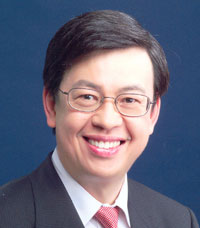 On Monday, the opposition DPP candidate Tsai Ing-wen named prominent epidemiologist Chen Chien-jen as her running mate. Tsai praised Chen, who was Taiwan’s health minister from 2003 to 2005, for leading the battle against the 2003 SARS outbreak. On Monday, the opposition DPP candidate Tsai Ing-wen named prominent epidemiologist Chen Chien-jen as her running mate. Tsai praised Chen, who was Taiwan’s health minister from 2003 to 2005, for leading the battle against the 2003 SARS outbreak.
PFP Chairman James Soong on Tuesday announced that Minkuotang Chairwoman Hsu Hsin-ying would be his running mate. He emphasizing the need for the nation to form a coalition government. Stressing that cooperation with Hsu's party does not entail the two smaller parties merging. Soong stressed the need to transcend partisan struggles in order to find common ground among the people.
Hsu, who founded her party after withdrawing from the KMT as an elected legislator in Hsinchu County, earned a doctorate from National Chiao Tung University and specializes in satellite surveying. She said she was moved by Soong's call to unite the country and not just get behind its political parties. Hsu confirmed in the same press conference that she would drop her bid to run for legislator after joining Soong's ticket.
She said that the country deserves experienced leadership that does not use its citizens as subjects in political experimentation.
Paris Terror Attacks A Wake-Up Call; Vijay Jolly, Delhi Mayors meet Bhutan PM
By Noyanika Arora
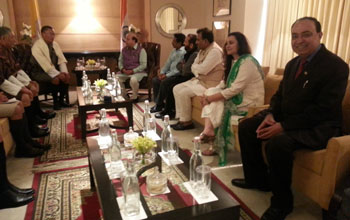
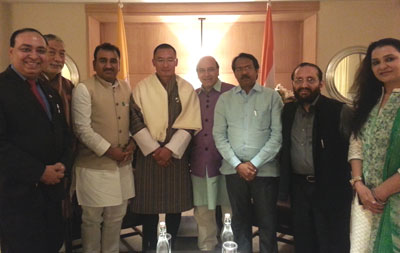 NEW DELHI, Nov 17: A senior delegation of Indian BJP leaders, led by Vijay Jolly, called on the visiting Prime Minister of Bhutan Lyonchhen Tshering Tobgay at ITC Hotel, Maurya Sheraton Hotel, here. NEW DELHI, Nov 17: A senior delegation of Indian BJP leaders, led by Vijay Jolly, called on the visiting Prime Minister of Bhutan Lyonchhen Tshering Tobgay at ITC Hotel, Maurya Sheraton Hotel, here.
All the three Mayors of Delhi namely Subhash Arya (South Delhi), Ravinder Gupta (North Delhi) and Harsh Malhotra (East Delhi) along with Dr. Abhilasha Sharma (Convenor BJP Alternative Medicine Cell) and prominent journalist Deepak Arora (Diplomatic and Political Editor of TheTribuneOnline.com) were present during the courtesy call on the visiting Bhutan Prime Minister.
Paris terror attacks were strongly condemned by the Bhutan Prime Minister and Indian leaders during the meeting.
The Bhutan Prime Minister said “the attacks on France were attacks on humanity. This is a wakeup call for all the democratic nations and forces to join hands against global terror.”
 He reiterated Bhutan’s policy that its territory shall not be used for anti-India activities. He recalled that in June last year Bhutan was the first country visited by Prime Minister Narendra Modi after assuming office. Bhutan Prime Minister and Indian leaders reiterated their commitment to a mutually beneficial relationship between their two countries. He reiterated Bhutan’s policy that its territory shall not be used for anti-India activities. He recalled that in June last year Bhutan was the first country visited by Prime Minister Narendra Modi after assuming office. Bhutan Prime Minister and Indian leaders reiterated their commitment to a mutually beneficial relationship between their two countries.
Mr Tobgay also stated while looking at different civilizations he finds that India is the greatest civilization in the world with its unique identity.
On the Gross National Happiness, Mr Tobgay said 90 per cent of Bhutanese are classed as narrowly, extensively or deeply happy. Joy-wise it’s roughly on a par with Denmark.
The notion of GNH was first introduced by Bhutan’s fourth king in the 70s, when he announced that “gross national happiness is more important that gross national product”.
The GNH index is a number crunched from happiness survey statistics across nine “domains”, of which only one is living standards. Others include health, education, psychological wellbeing, time use, community vitality and cultural diversity.
The Indian leaders Vijay Jolly, Subhash Arya, Ravinder Gupta, Harsh Malhotra, Dr. Abhilasha Sharma & Deepak Arora honored Bhutan PM L.T. Tobgay with flowers, shawls, Delhi MCD replica's.
Members of the Bhutanese delegation, including Bhutan Ambassador, Maj Gen V Namgyel, were present on the occasion.
Paris jittery as PM Valls warns of chemical attack
PARIS, Nov 19: Prime Minister Manuel Valls on Thursday warned of the terrorists behind last week’s Paris attacks using chemical or biological weapons as he urged MPs to agree to extend the emergency in France to three months.
Valls made the remarks against the backdrop of an outward calm in Paris that appeared to crack every now and then. A black suitcase left in a café in Rue de St Martin on Thursday morning sparked panic and calls to the police, who arrived promptly, but mostly it was a picture of normalcy in central Paris during the office rush-hour.
Security forces in Brussels and elsewhere in Europe were on the hunt for Friday’s attackers and their associates.
Seeking an extension of the state of emergency, Valls told MPs: “What is new are the ways of operating; the ways of attacking and killing are evolving all the time.
The macabre imagination of those giving the orders is unlimited. Assault rifles, beheadings, suicide bombers, knives or all of these at once. Carried out by individuals or commandos this time, particularly well organised.”
He added: “And today we must not rule anything out, and I say of course with all the precautions which can be taken, we know and we have to bear in mind there is always the risk of chemical weapons or bacterial weapons.”
The prime minister’s office said Valls’ reference to possible use of chemical weapons was not “new information on the status of the threat, but just a realistic observation”. A spokesman said: “Middle East experts know that Daesh (Islamic State) seeks and uses chemical weapons. To not consider this possibility would be a mistake.”
Reports from Brussels said Bilal Hadfi, one of the three suicide bombers who struck outside the Stade de France, was the focus of ongoing police raids seeking to find his associates. Hadfi was reported to be fighting in Syria as recently as July.
In a related development, foreign minister Laurent Fabius said no marches would be allowed during the international climate talks scheduled here later this month, citing security concerns after Friday’s attacks that killed more than 130 people.
India is one of the key participants in the talks.
Fabius said in a statement all demonstrations organised in closed spaces or in places where security can easily be ensured could go ahead. “However, in order to avoid additional risks, the government has decided not to authorise climate marches planned in public places in Paris and other French cities on Nov 29 and Dec 12,” the statement said.
There were plans by environmental activists to organise marches of nearly 20,000 people to pressure governments to cut greenhouse gas emissions.
Emma Ruby-Sachs, deputy director of the campaign group Avaaz, said: “The police have just informed us that the tragic attacks in Paris have made the march there impossible. Now it’s even more important for people everywhere to march on the weekend of November 29 on behalf of those who can’t, and show that we are more determined than ever to meet the challenges facing humanity with hope, not fear.”
Didier Paillard, the mayor of Saint-Denis, the scene of Wednesday’s raid, called on the town’s citizens to gather in front of the Stade de France, the stadium that was one of the targets of Friday’s attacks, in tribute to the victims.
Officials also said all the victims of Friday’s attacks at a concert hall, cafes and the Stade de France stadium had been identified.
Suspected Paris mastermind died in raid: officials
PARIS, Nov 19: The Belgian jihadi suspected of masterminding deadly attacks in Paris died along with his cousin in a police raid on a suburban apartment building, officials said Thursday.
Paris Prosecutor Francois Molins' office said 27-year-old Abdelhamid Abaaoud was identified based on skin samples, but authorities did not know how he died. His body was found in the apartment building targeted in the chaotic and bloody raid in the Paris suburb of Saint-Denis on Wednesday.
Three police officials say a woman who died in the raid was Abaaoud's cousin. One said Hasna Aitboulahcen is believed to have detonated a suicide vest after a brief conversation with police officers.
The official confirmed an audio recording, punctuated by gunshots, in which an officer asks: "Where is your boyfriend?" and she responded angrily: "He's not my boyfriend!" Then loud bangs are heard.
The exact relationship between Abaaoud and Aitboulahcen was not clear.
The bodies recovered in the raid were badly mangled, with a part of Aitboulahcen's spine landing on a police car, complicating formal identification, according to one of the officials.
The officials all spoke on condition of anonymity because they were not permitted to divulge details of the investigation.
Police launched the operation after receiving information from tapped phone calls, surveillance and tipoffs suggesting that Abaaoud was holed up there. Eight people were arrested in the raid.
India, China to set up framework on terrorism, cyber crime
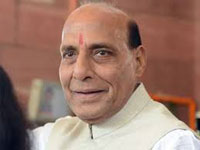 BEIJING, Nov 20: India and China have for the first time agreed to set up a minister-level mechanism to tackle and exchange information on terrorism, trans-border crime, drug-trafficking and cyber crime, India’s home minister Rajnath Singh said on Thursday. BEIJING, Nov 20: India and China have for the first time agreed to set up a minister-level mechanism to tackle and exchange information on terrorism, trans-border crime, drug-trafficking and cyber crime, India’s home minister Rajnath Singh said on Thursday.
Guo Shengkun, state councilor and minister for public security (which deals with China’s internal security), will visit India next year to co-chair its first meeting with Singh.
Singh said it was a first for the two countries to set up such a high-level mechanism; the bilateral one working to resolve the disputed border problem is technically a few notches lower in the official hierarchy.
Singh is on a four-day visit to China, the first Indian home minister to do so in a decade.
Officials said that the leadership from both countries felt that “given the current positive momentum in bilateral relations” there was a need to upgrade cooperation in security matters.
“We have agreed to expand our cooperation in combating international terrorism (including) exchange of information on terrorist activities of groups and linkages. We will also exchange experiences on anti-hijacking and hostage situations. We will coordinate our positions on anti-terrorism endeavours in regional and multi-lateral forum,” Indian ambassador AK Kantha told Beijing-based Indian reporters during an interaction with Singh on Thursday night.
Earlier in the day, Singh had a 40-minute meeting with Premier Li Keqiang.
Expectedly, the problem of the unresolved border between the two giant neighbours camp up during the meeting.
“I expressed my worries,” Singh said when asked whether he raised the issue of incursions across the Line of Actual Control (LAC) by the People’s Liberation Army (PLA).
“This issue, I particularly discussed with the Premier. I said these incursions should stop,” Singh said. “Their response was positive. There are working groups that are already working (on the border dispute). I said their work should be made fruitful,” he added.
Elaborating on the new mechanism, Kantha said it will be assisted by a working-level mechanism (to be handled) by a joint-secretary level official from India and director-general level one from China.
It emerged during Singh’s meetings that there was clear recognition on both sides that “terrorism is a common threat; it is a trans-border threat, transnational threat and requires joint response.”
Both Singh and the Indian diplomats present during the interaction with reporters carefully avoided the mention of Pakistan.
“In principle, we have agreed to move towards a new bilateral document which will provide the contours of cooperation in counter-terrorism, security, trans-border crimes and related matters,” Kantha said.
KMT Candidate to US: 'Cross-Strait Peace and Stability on the Line' in Taiwan Polls
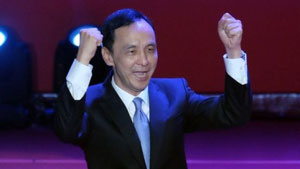 WASHINGTON, NOV 17: Fresh off of a ground-breaking meeting in Singapore between Chinese President Xi Jinping and Taiwan’s President Ma Ying-jeou, the presidential candidate from Ma’s Kuomintang (KMT) party departed on November 9 for a week-long tour of the United States. Eric Chu, the head of the KMT as well as the party’s presidential candidate, visited Los Angeles, Washington D.C, New York, and San Francisco. WASHINGTON, NOV 17: Fresh off of a ground-breaking meeting in Singapore between Chinese President Xi Jinping and Taiwan’s President Ma Ying-jeou, the presidential candidate from Ma’s Kuomintang (KMT) party departed on November 9 for a week-long tour of the United States. Eric Chu, the head of the KMT as well as the party’s presidential candidate, visited Los Angeles, Washington D.C, New York, and San Francisco.
The highlight of his trip was Chu’s time in Washington, where he held meetings with U.S. officials on regional security, economic issues, and cross-strait relations.
Chu met with U.S. Assistant Secretary of State Daniel Russel, National Security Council Asia Director Daniel Kritenbrink, and Deputy Secretary of State Antony Blinken. Neither side was willing to divulge details of the talks, although Chu said, “All that needed to be said was said.”
From Chu’s perspective, the major goal of the trip was to convince U.S. officials that he is best equipped to handle the sensitive issue of cross-strait relations, especially now that the KMT is armed with the historic Ma-Xi meeting as evidence.
The opposition Democratic Progressive Party (DPP) candidate, Tsai Ing-wen, has pledged to keep the “status quo” of cross-strait relations intact, but her political opponents accuse her of not having a concrete plan for doing so. They also like to point to the tense state of cross-strait relations under the last DPP president, Chen Shui-bian.
Chu made his message explicit in an op-ed in the Washington Times: “[C]ross-strait peace and stability is now on the line, as Taiwan’s 2016 presidential election once again pits the pro-de jure independence Democratic Progressive Party against the incumbent KMT party.” By arguing that the United States, China, and Taiwan all need a stable cross-strait relationship to secure their national interests – and by claiming a DPP president would undermine that stability – Chu is overtly arguing that Washington should support the KMT.
“My party and my campaign know well that the fundamental interest of the United States is in a stable and peaceful cross-strait relationship,” Chu concluded in his op-ed.
The main sticking point, Chu argued, is that Tsai has not agreed to hold to the “1992 Consensus,” the agreement by both KMT and Chinese Communist Party that there is “one China” (although both sides disagree on what that “China” is). Both Xi and Ma stressed the point that the 1992 Consensus is essential for the cross-strait relationship during their meeting on November 7. Xi was particularly dramatic, warning that without the common political ground of the 1992 Consensus, “the boat of peaceful development will encounter terrifying waves or even capsize.”
From the U.S. perspective, keeping a stable cross-strait relationship is indeed a priority, as Kritenbrink told reporters in a press conference: “For the United States, we have a deep and abiding interest in peace and stability in the Taiwan Strait. That’s where we focus our interest.”
That’s why Tsai has been working to convince analysts and policymakers in Washington that she has no intention of jeopardizing peace in the Taiwan Strait – that was one of the messages she carried during her own visit to the United States in June. Accordingly, the DPP was none too pleased with Chu’s criticisms. In a statement, DPP spokesperson Juan Chao-hsiung expressed the DPP’s “deep regret” that Chu “has reduced diplomacy to a tool for negative campaigning.”
Meanwhile, U.S. officials have been careful not to seem to favor one candidate or the other, as happened in 2011 when anonymous U.S. officials expressed concern over Tsai’s 2012 presidential candidacy to media outlets. Speaking to reporters alongside Kritenbrink, Russel was quick to point out that “contrary to speculation in the Taiwan press, we treat both representatives from the KMT and the DPP with an equal degree of access, with evenhanded treatment. We don’t play favorites.”
Kritenbrink added that the United States “will not take sides in the election; the outcome of Taiwan’s election is a matter for the people of Taiwan to decide.”
Despite that, given the importance of the U.S. relationship with Taiwan – particularly on the security realm, but also politically and economically – the domestic Taiwanese audience is fascinated by the question of which candidate Washington “prefers.” Thus it was important for Chu to visit the United States, which he did less than a month after becoming the KMT candidate.
Visits to the U.S. also serve as a political battleground – not for who will handle Taiwan-U.S. relations better, however, but for who will be the responsible party on cross-strait ties. Both candidates came here with that topic in mind: Tsai to emphasize she will be responsible on cross-strait ties, and Chu to question the DPP track record on the same subject. Ultimately, however, whatever the setting, their main audience remains the Taiwanese public, which will have to make its decision on January 16.
Entire humanity must stand against terrorism: Modi
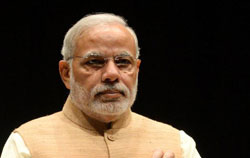 ANTALYA (Turkey), Nov 15: Indian Prime Minister Narendra Modi on Sunday strongly condemned the Paris attacks in which at least 129 people were killed and said the world needs to stand united against terrorism. ANTALYA (Turkey), Nov 15: Indian Prime Minister Narendra Modi on Sunday strongly condemned the Paris attacks in which at least 129 people were killed and said the world needs to stand united against terrorism.
“We stand united in strongly condemning the dreadful acts of terror in Paris,” Modi said, speaking at a meet of BRICS leaders on the sidelines of G20 summit at Antalya in Turkey.
Modi said that India attached immense importance to the BRICS and would want to build on the great work done by other members.
“Build responsive, inclusive and collective solutions...this will be the theme when India assumes presidency of BRICS from February 2016,” he said.
The BRICS meet was also attended by Brazilian President Dilma Rousseff, Russian President Vladimir Putin and South African President Jacob Zuma.
The G20 summit is scheduled to be held later on Sunday in Belek. It will be chaired by Turkish President Recep Tayyip Erdogan.
The summit will focus on the current state of the global economy, sustainable growth, development and climate change, investment, trade and energy.
Participating leaders are also expected to discuss political issues such as global terrorism and the refugee crisis in addition to the economic agenda.
Keeping the recent Paris attacks in mind, the town of Belek has been declared a high-security Red Zone area and a virtual no-go zone for the non-delegates. In a separate incident, four policemen were injured in an explosion during a raid on a suspected Islamic State militants’ hideout in Ankara on Sunday.
Markets and shops around the venue have been shut and thousands of barricades and security personnel are deployed on alongside roads leading to the venue.
Officials said more than 350 mobile cameras with license-plate recording and face-recognition systems have been installed on the highway from Antalya airport to the seaside enclave and around the hotels where world leaders including US President Barack Obama and Russian President Vladimir Putin are staying.
Even after this darkest night, Paris remains the City of Light: Hillary Clinton
 IOWA, Nov 14: US Presidential Candidate Hillary Clinton has said "Even after this darkest night, Paris remains the City of Light. No terrorist attack will ever dim the spirit of the French people or our common commitment to the democratic values we share." IOWA, Nov 14: US Presidential Candidate Hillary Clinton has said "Even after this darkest night, Paris remains the City of Light. No terrorist attack will ever dim the spirit of the French people or our common commitment to the democratic values we share."
Speaking on the devastating attacks in Paris that killed at least 129 people, Hillary Clinton said in her opening statement at the second Democratic debate “Well, our prayers are with the people of France tonight, but that is not enough."
She added "We need to have a resolve that will bring the world together, to root out the kind of radical, jihadist ideology that motivates organisations like ISIS, a barbaric, ruthless, violent, jihadist, terrorist group."
On Friday, gunmen and suicide bombers attacked restaurants, a concert hall and a sports stadium at locations across Paris, the deadliest attack on French soil.
ISIS released a statement claiming responsibility for the attacks. It was published in Arabic, English and French on ISIS' account on Telegram, a messaging platform. The statement ended with a warning that says "this is just the beginning."
At the debate, Clinton said she "will be laying out, in detail, what I think we need to do with our friends and allies in Europe and elsewhere to do a better job of coordinating efforts against the scourge of terrorism."
On Facebook, Clinton posted: "Even after this darkest night, Paris remains the City of Light. No terrorist attack will ever dim the spirit of the French people or our common commitment to the democratic values we share."
Omar Ismail Mostefai identified as first gunman of Paris attacks
PARIS, Nov 14: Omar Ismail Mostefai was known to police as nothing more than a petty criminal before he became the first gunman identified from Friday's attacks in Paris, which left at least 129 dead.
Identified by his finger, which was found among the rubble of the Bataclan concert hall, the 29-year-old was one of three men who blew himself up killing 89 people in the bloodiest scene of the carnage.
Born on November 21 1985, in the poor Paris suburb of Courcouronnes, Mostefai's criminal record shows eight convictions for petty crimes between 2004 and 2010, but no jail time.
Paris prosecutor Francois Molins said Mostefai had been singled out as a high-priority target for radicalisation in 2010 but, before Friday, he had "never been implicated in an investigation or a terrorist association".
Investigators are now probing whether he took a trip to Syria last year, according to police sources.
The killer's father and 34-year-old brother were placed in custody on Saturday evening and their homes were searched.
"It's a crazy thing, it's madness," his brother said, his voice trembling, before he has taken into custody.
"Yesterday I was in Paris and I saw how this shit went down."
The brother, one of four boys in the family along with two sisters, turned himself in to police after learning Mostefai was involved in the attacks.
While he had cut ties with Mostefai several years ago, and knew he had been involved in petty crimes, his brother said he had never imagined his brother could be radicalised.
The last he knew, Mostefai had gone to Algeria with his family and his "little girl," he said, adding: "It's been a time since I have had any news."
"I called my mother, she didn't seem to know anything," he said yesterday. source close to the enquiry said Mostefai regularly attended the mosque in Luce, close to Chartres, to the southwest of Paris.
Myanmar Prez assures smooth transfer of power to Suu Kyi
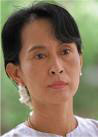 YANGON, Nov 15: Myanmar's President Thein Sein on Sunday said historic polls won in a thumping landslide by Aung San Suu Kyi's party were the consequence of his government's reforms and vowed a smooth transition of power. YANGON, Nov 15: Myanmar's President Thein Sein on Sunday said historic polls won in a thumping landslide by Aung San Suu Kyi's party were the consequence of his government's reforms and vowed a smooth transition of power.
The former junta general, who shed his uniform to lead the country's quasi-civilian regime five years ago, said the November 8 polls were testament to the political and economic changes that have swept the former pariah state since the end of junta rule.
"The election is the result of our reform process and as we promised, we were able to hold it very successfully," he told a meeting of political parties in Yangon, in his first public appearance since the polls.
"We will hand this process (of reform) on to a new government," he said, adding "don't worry about the transition" in comments aimed at calming nerves in the country's first attempt at a democratic-style transition for decades.
Addressing representatives of nearly 90 political parties, many of which were trounced by Suu Kyi's National League for Democracy, the Myanmar leader said elections are the "duty" of a democratic nation.
He appeared sanguine about the resounding defeat of his army-backed Union Solidarity and Development Party, which will slip into opposition in the next parliament - due to sit from February - with some ten percent of the elected seats in the national parliament, compared to the NLD's 80 percent.
"The winning party is responsible for carrying out its duty and other opposition parties should provide checks and balances. That is called democracy," he said.
Thein Sein, a slight bespectacled 70-year-old, has steered the country's dramatic opening up after years of isolation, freeing political prisoners, unleashing a long-muzzled press and welcoming foreign investment.
130 killed in ISIS terror attack on Paris
PARIS, Nov 14: The Islamic State terrorist group has claimed responsibility for the series of attacks targeting young concert-goers, soccer fans and Parisians enjoying a Friday night out at popular nightspots killed at least 130 people in the deadliest violence to strike France since World War II. French President Francois Hollande condemned it as terrorism and pledged that France would stand firm against its foes. The worst carnage was at a concert hall hosting an American rock band, where scores of people were held hostage and attackers ended the standoff by detonating explosive belts.
The Islamic State released an undated video on Saturday threatening to attack France if bombings of its fighters continue. Earlier, on Saturday, Hollande said the attacks were committed by Islamic State, planned and organised from abroad with help from inside France.
Paris Prosecutor Francois Molins said as many as five attackers were killed, though it was not clear how many there were altogether and how many, if any, were still at large.
The attack unfolded with two suicide bombings and an explosion outside the national stadium during a soccer match between the French and German national teams. Within minutes, according to Paris police chief Michel Cadot, another group of attackers sprayed cafes outside the concert hall with machine gunfire, then stormed inside and opened fire on the panicked audience. As police closed in, they detonated explosive belts, killing themselves.
In addition to the deaths at the concert hall, dozens were killed in an attack on a restaurant in the 10th arrondissement and several other establishments crowded on a Friday night, police said. Authorities said at least three people died when the bombs went off outside the soccer stadium.
This offensive follows the Charlie Hebdo terror attack where masked gunmen stormed the Paris offices of the satirical newspaper.
Suu Kyi's party wins historic majority in Myanmar polls
YANGON, Nov 13: : Nobel laureate Aung San Suu Kyi's opposition party on Friday secured a historic majority in Myanmar's parliament, making it possible for them to form the southeast Asian country's first truly civilian government in more than half-a-century.
With the tally still being counted, the Election Commission said that Suu Kyi's National League for Democracy party won 21 additional seats - pushing it over the threshold of 329 seats needed for a majority in the 664-member, two-house Parliament.
The party with a combined parliamentary majority is able to select the next president, who can then name a Cabinet and form a new government.
Suu Kyi's victory had been widely expected, but few anticipated a landslide of such dramatic proportions. The results have shown a resounding rejection of military rule in Myanmar, which has been under army control for half a century.
Elections were not held in seven constituencies, meaning a simple majority could be reached at 329 seats. The NLD has officially won 238 seats in the lower house - which means it now will have the power to pass bills - and 110 in the upper house, for a total of 348.
In comparison, the ruling pro-military Union Solidarity and Development Party has won 40 seats, according to the latest results Friday afternoon.
The military automatically receives 25 percent of the seats in each house under the constitution.
While the army has not conceded defeat for the ruling USDP party, it has acknowledged the massive success of Suu Kyi's National League for Democracy in Sunday's election, and pledged it will respect the final results. Those results seem virtually certain to allow the opposition to take over the government.
The office of army commander Senior Gen. Min Aung Hlaing said the military will hold talks with Suu Kyi after the election results are complete. Suu Kyi issued an invitation on Wednesday for a meeting with the commander, along with President Thein Sein and House Speaker Shwe Mann.
While an NLD majority assures it of being able to elect the president, Suu Kyi remains barred from the highest office by a constitutional provision inserted by the military before it transferred power to Thein Sein's quasi-civilian government in 2011.
Suu Kyi has declared, however, that she will become the country's de facto leader, acting "above the president" if her party forms the next government, and that the new president will be a figurehead.
Myanmar's military, which took power in a 1962 coup and brutally suppressed several pro-democracy uprisings during its rule, gave way to Thein Sein's nominally civilian elected government in 2011 - with strings attached.
It installed retired senior officers in the ruling party to fill Cabinet posts and gave itself key powers in the constitution, including control of several powerful ministries and a quarter of the seats in both houses of Parliament. In a state of emergency, a special military-led body can even assume state powers. Another provision bars Suu Kyi from the presidency because her sons hold foreign citizenship.
While Myanmar's people voted overwhelmingly Sunday to remove the military-backed ruling party from power, it's clear that the army's involvement in politics won't end, and the NLD will need to convince it to cooperate.
Presidents of China, Taiwan meet for first time, shake hands
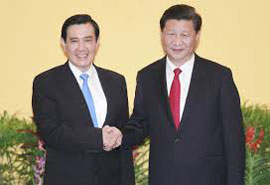 SINGAPORE, Nov 7: The leaders of China and Taiwan met Saturday for the first time since the formerly bitter Cold War foes split amid civil war 66 years ago, and though no concrete agreement resulted, both hailed the meeting as a sign of a new stability in relations. SINGAPORE, Nov 7: The leaders of China and Taiwan met Saturday for the first time since the formerly bitter Cold War foes split amid civil war 66 years ago, and though no concrete agreement resulted, both hailed the meeting as a sign of a new stability in relations.
Chinese President Xi Jinping and Taiwanese President Ma Ying-jeou came together on neutral ground in the Southeast Asian city-state of Singapore, walking toward each other in a hotel ballroom in front of a backdrop of yellow — a traditional color of Chinese emperors.
The two men smiled broadly as they shook hands for more than one minute, turning slightly to the side to accommodate a host of photojournalists in the ballroom. No national flags were present — a necessary work-around to overcome China's refusal to recognize Taiwan's sovereignty or its government's formal legitimacy — and the two men were referred to merely as "Mr. Xi" and "Mr. Ma" to further reduce the chances of bruised sensitivities.
In brief opening remarks in front of reporters before going into a closed-door meeting, Xi said, "History will record this day." He alluded to China's long-cherished goals of unification with Taiwan, saying, "We are one family," and "No force can pull us apart."
Ma said, "Both sides should respect each other's values and way of life," while adding that relations between the sides were "the most peaceful and stable they have ever been."
When they split in 1949, both sides aspired to absorb the other, with each claiming the mantle of the only legitimate government of all of China, Taiwan included. Communist Party-ruled China still demands that Taiwan eventually be unified with the mainland, by force if necessary, while many citizens of democratic Taiwan increasingly prefer to simply maintain the separate status the island has carved out over more than six decades.
Critics of Ma in Taiwan are wary that his meeting with Xi and similar contacts will pave the way for Beijing to assert greater control over the island, further deepening its international isolation.
However, Ma said at a post-meeting news conference that he discussed with Xi the Taiwanese people's desire for greater participation in global society, particularly for nongovernmental organizations. China refuses to acknowledge the island as anything other than a breakaway province, and pressure from Beijing keeps Taiwan out of the United Nations and other major multinational organizations.
Ma said Xi told him that China would "appropriately handle" Taiwanese moves toward greater participation on a case-by-case basis.
Each leader hopes to seal his legacy as one who helped bring decades of division and mistrust to a mutually acceptable end. But the meeting was more about the symbolism of coming together than about substance. Both sides had said no agreements would be signed or joint statements issued.
In all, the two men met for an hour. Afterward, the two sides held separate news conferences, handled for the Chinese side by spokesman Zhang Zhijun of the Taiwan Affairs Office and for the Taiwanese side by Ma himself.
"We are here today so that the tragedies in our history cannot be replayed," Zhang quoted Xi as saying at the meeting.
Zhang said that China understands Taiwan's desire for greater international space, but that Beijing cannot agree to moves that would "split the country," reflecting its insistence that only it can represent the Chinese nation.
Ma also said they discussed upgrading a hotline between their Cabinet-level agencies responsible for contacts between the sides and agreed to study the issue of establishing representative offices on each other's soil, a long-shot proposal that has languished for years.
He said he also told Xi about fears in Taiwan that China might make good on its military threats, as seen in the scores of missiles based directly opposite the island and recent Chinese war games that appeared to simulate an attack on Taiwan's presidential office.
Ma said Xi told him that China's defense was "comprehensive" and not directed at any parties in particular.
Following his news conference, Ma joined Xi at a banquet at the upscale Shangri-La Hotel, where the meeting was held.
Three decades of hostilities followed the 1949 split, occasionally bursting into warfare in the Taiwan Strait — including over the once heavily militarized Matsu and Kinmen island group — making dialogue all but impossible. Tensions eased after China shifted to endorsing the option of "peaceful unification" alongside military threats in 1979, although it wasn't until 1993 that representatives of the two governments met in Singapore to establish the groundwork for future talks.
While subsequent talks achieved little, they began bearing fruit after Ma's election in 2008, resulting in 23 agreements on trade and technical matters. Although that has failed to produce Beijing's desired progress on political matters, Saturday's meeting was seen as moving the relationship into a new stage.
"It is because of what has been accumulated over the past seven years that the two sides of the strait can take this historic step today," Xi said.
In China, where nationalism runs high, many have cheered the meeting as a further step in what they consider an inevitable trend toward unification.
Beijing salesman Huang Xiaojie said the compromise required to arrange the meeting boded well for cross-Strait relations. "At an official level, it will definitely accelerate Taiwan's return," he said.
Many in Taiwan are wary of such a result, and several hundred protesters gathered at the Economic Affairs Ministry in Taipei, waving banners warning that Ma was aiming "to sell out Taiwan."
However, others see Xi's willingness to meet with the top Taiwanese leader on foreign soil as a nod of respect toward the island's government — even if the meeting's negotiated protocol demanded that the two leaders refer to each other with the title "Mr." rather than "President."
"If the two sides meet each other, only then will they understand more and gradually become more familiar with each other," said 50-year-old Taipei resident Peter Sun.
Ma is required to step down after two terms next year, with elections in January to choose his successor. He has denied that the meeting with Xi was aimed at affecting the polls, and the event's effect on voter sentiment remains to be seen.
Zhang, the Chinese official, said China had no interest in meddling in Taiwan's election, but was concerned only that cross-Strait relations continue to develop "in a correct manner."
Xi-Ma meeting: Transcript of Taiwan President Ma Ying-jeou's opening remarks
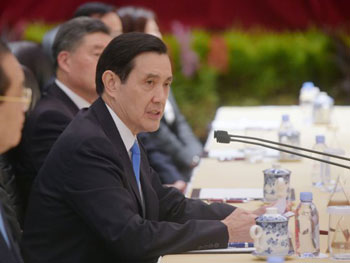 SINGAPORE, Nov 7: Leaders of political rivals Taiwan and China met today for the first time in more than 60 years for talks that come amid rising anti-Beijing sentiment on the self-ruled democratic island and weeks ahead of elections there. SINGAPORE, Nov 7: Leaders of political rivals Taiwan and China met today for the first time in more than 60 years for talks that come amid rising anti-Beijing sentiment on the self-ruled democratic island and weeks ahead of elections there.
Including their historic handshake, brief opening remarks before reporters and a closed-door session, Chinese President Xi Jinping and Taiwanese President Ma Ying-jeou met for an hour on neutral ground in Singapore.
Here's the transcript of what Taiwan President Ma Ying-jeou said in the first 10 minutes of the meeting that was open to the media:
Mr Xi, friends from the two delegations across the straits, and people present today,
Today, I and Mr Xi in our capacities as leader across the straits, we are holding the future of the two sides across the straits and history.
In April 1993, Mr Koo Chen-fu and Mr Wang Daohan held talks and they inked four agreements that laid the foundations of a mechanism for cross-straits dialogue.
When I spoke with the founding Prime Minister of Singapore Lee Kuan Yew, I said that the foundations of the cross-strait relationship should be based on well being of our people.
What is behind us is the long history of the relationship. In the past few years, we decided to replace conflict with people dialogue and we have stuck to the path of prosperity and wellbeing.
We can swear to the whole world our determination to peaceful development of people’s rights. We follow different political systems, but we develop dialogue in terms of military and economic cooperation. This is not done overnight. There are over 40,000 of cross-strait student exchanges annually. There are US$170 billion of trade value across the straits. These are the fruits of our relations.
The ancient book of “shang shu” says we have to really trust each other and seek pragmatic strategies. In the past few years, we have reached a couple of cooperative deals. This is in line with expectations across the straits and also the global community.
Azerbaijan Polls Fair, Democratic: Vijay Jolly
By Deepak Arora
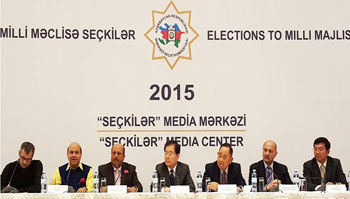 NEW DELHI, Nov 7: Azerbaijan Parliamentary Elections conducted recently under the supervision of Mezahir Panahov, Chairman, Azerbaijan Central Election Commission, were free, fair and democratic, according to Indian leader Vijay Jolly, an International Poll Observer. NEW DELHI, Nov 7: Azerbaijan Parliamentary Elections conducted recently under the supervision of Mezahir Panahov, Chairman, Azerbaijan Central Election Commission, were free, fair and democratic, according to Indian leader Vijay Jolly, an International Poll Observer.
The Yeni Azerbaijan (New Azerbaijan) Party led by President Ilham Aliyev and Prime Minister Artur Rasizade won 70 seats in the 125 seats single-chamber of parliament.
The turnout was 55.7%. Out of 4.68 million registered voters more than 2.89 million voters participated. The rest of the seats were won by Civic Solidarity Party, Azerbaijan Social Prosperity Party, Civic Unity Party, Democratic Enlightenment Party, Great Order Party, Motherland Party, National Revival Movement Party, Party for Democratic Reforms, Social Democratic Party, Unity Party and Azerbaijan Popular Front Party. While Independents won 43 parliamentary seats.
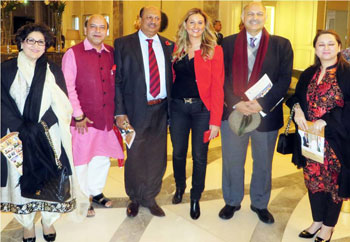 The ICAPP (International Conference of Asian Political Parties) Observers were led by Chairman Jose de Venecia (Ex. Philippines Speaker), Co-Chairman Chung Eui-yong (South Korea), Pakistan Senator Mushahid Hussain Syed (Special Rapporteur ICAPP), Abdul Matin Khasru (Bangladesh Awami League and former Law Minister), Tekreth Samrach (Cambodia Secretary of State) and Vijay Jolly (Ex-BJP MLA, Advisor GOPIO International and President Delhi Study Group). The ICAPP (International Conference of Asian Political Parties) Observers were led by Chairman Jose de Venecia (Ex. Philippines Speaker), Co-Chairman Chung Eui-yong (South Korea), Pakistan Senator Mushahid Hussain Syed (Special Rapporteur ICAPP), Abdul Matin Khasru (Bangladesh Awami League and former Law Minister), Tekreth Samrach (Cambodia Secretary of State) and Vijay Jolly (Ex-BJP MLA, Advisor GOPIO International and President Delhi Study Group).
The ICAPP delegates monitored the process of voting and ballot counting in several polling stations. The overall election environment appeared to be peaceful and orderly.
It did not find any adverse incident affecting the democratic process of elections. The ICAPP noted with particular interest a new on-line webcam monitoring system at the polling stations which enabled the whole process as more transparent.
Jolly has been invited by Azerbaijan Central Election Commission to participate as International Observer in their fifth parliamentary elections which were held on November 1.
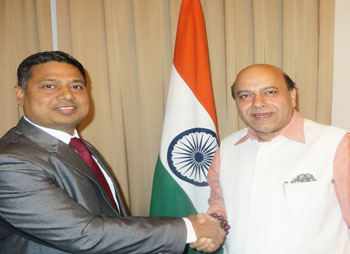 The last elections were held on November 7, 2010. The New Azerbaijan Party (Yeni Azarbaycan Partiysi) led by Prime Minister Artur Rasizade is the ruling party while the Opposition is represented by more than 30 political parties in Azerbaijan. The last elections were held on November 7, 2010. The New Azerbaijan Party (Yeni Azarbaycan Partiysi) led by Prime Minister Artur Rasizade is the ruling party while the Opposition is represented by more than 30 political parties in Azerbaijan.
For 125 seats, 1,246 candidates filed their nominations while 477 were rejected and 769 candidates were finally in the fray. There were 5,415 permanent polling stations in Azerbaijan elections. There were 46,75,572 registered voters.
Indian leader Vijay Jolly visited the Indian Embassy located in Narimanov District in Baku. He had a one hour long meeting with the Indian Ambassador Sanjay Rana who extensively briefed on the current political and business opportunities in Azerbaijan.
Jolly also met Dr. (Mrs.) Suchita Seth, Editor of Namaste Baku only Hindi Magazine, a courtesy call by Azerbaijan citizen and Hindi language lecturer Ms. Saida Mirzayeva and a meeting with famous local actress and Zee Cinema India best dancer award winner Ms. Rasulova Oksana.
The other prominent delegates were Advisor Latvia Girts Fakobsons, Pak Senators namely Mrs. Nuzhat Sadiq, Mrs. Samina Abid, Lt. Gen. S.S. Tirmizi, Farhatullah Babar and Kabir Ahmed, Deputy Speaker Serbia Igor Becic, Ukraine Indian Leader Suresh Chandra Prasad Singh, Secretary General Parliamentary Assembly of Black Sea Economic Cooperation Prof. Dr. Asaf Hajiyev, Bulgaria MP Petar Kanev and Romanian Senator Marian Vasilive. Vice Chairman Youth Union Ali Panahov with Coordinator Umid Abuzarli and youth activists took adequate care of all the guests.
India Can Play Constructive, Positive Role in South China Sea, China Says
BEIJING, Nov 5: : China today asked India to play a “constructive and positive” role in safeguarding peace and stability in the disputed South China Sea, in a guarded reaction to Defence Minister Manohar Parrikar’s call for “ensuring freedom of navigation” in the strategic waters amid escalated Sino-US tensions.
“We hope that countries who really care about freedom of navigation in the South China Sea (SCS) can play (a) constructive and positive role” in peace and stability of the region, Chinese Foreign Ministry spokesperson, Hua Chunying told a media briefing in Beijing.
She expressed concerns over the current round of tensions between US and China over an American naval vessel sailing through artificial islands in the SCS built by Beijing.
China has raised vociferous protests and warned Washington against sending naval vessels and military aircraft to the waters.
The Philippines, Vietnam, Malaysia, Brunei and Taiwan had overlapping claims over a number of islands of the SCS and strongly contest China’s claims of sovereignty over almost all of the SCS.
Speaking at the ASEAN Plus defence ministers meeting, Mr Parrikar expressed hope for a “peaceful resolution of the dispute”.
Asserting that maritime security is a common challenge, he said “the situation in the South China Sea and recent developments there have attracted concern”.
“This is natural since freedom of navigation in international waters, the right of passage and overflight, unimpeded commerce and access to resources in accordance with recognised principles of international law including the 1982 UN Convention on the Law of the Sea, are of concern to all of us,” he added.
Assuring that there is no threat to freedom of navigation in the SCS, Ms Hua said it is a major passage for cargo shipping and energy transportation of China.
“China is the littoral country of the SCS. We, of course, care about freedom of navigation in the region,” she said.
“China is committed to safeguarding peace and stability of the SCS together with all relevant countries. As we can see that overall situation in the SCS is stable and there has never been any problem about freedom of navigation and over flights in the SCS,” she said.
China has been wary about India’s Look East Policy under which New Delhi sought to expand its relations with the South East Asian countries in Beijing’s backyard, specially India’s fast-developing ties with Vietnam and the Philippines.
Beijing also opposes India undertaking oil exploration off Vietnam’s coast, asserting that the area falls within the disputed area of the SCS.
India, however, took up Vietnam’s invitation, stating that it is undertaking only a commercial activity which has no bearing on the dispute.
About the freedom of navigation, China has maintained that there is no threat to commercial shipping and civilian overflights but considers naval vessels and military aircraft travelling through the area as violation of its sovereignty.
Taiwan, Chinese presidents to meet for first time since 1949
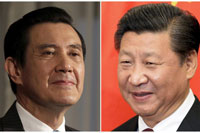 BEIJING: The presidents of China and Taiwan will meet this weekend for the first time since civil war divided their lands 66 years ago, their governments said Wednesday, a highly symbolic move that reflects quickly improving relations between the formerly bitter Cold War foes. BEIJING: The presidents of China and Taiwan will meet this weekend for the first time since civil war divided their lands 66 years ago, their governments said Wednesday, a highly symbolic move that reflects quickly improving relations between the formerly bitter Cold War foes.
The meeting Saturday in Singapore between Chinese President Xi Jinping and his Taiwanese counterpart Ma Ying-jeou could be China's last to press its case for closer economic and, ultimately political ties, before Taiwan elects a new president and legislature in January that could put the brakes on Ma's pro-China initiatives.
For Ma's ruling Nationalists, who have been lagging at the polls, it could boost their credentials for driving progress in relations with China, but also carries the risk of appearing too close to Beijing, further damaging their chances with skeptical voters.
Presidents of the two sides have not met since Chiang Kai-shek's Nationalists lost the Chinese civil war to Mao Zedong's Communists and the Nationalists rebased in Taiwan 160 kilometers (100 miles) away in 1949. The two sides have been separately ruled since then, with Taiwan evolving into a freewheeling democracy. China insists that the two sides eventually reunite, by force if necessary.
Confirmation of the meeting from Chinese Cabinet's Taiwan Affairs Office came hours after the Taiwanese side announced the meeting earlier Wednesday.
The two would be meeting in their capacity as ``leaders of the two sides'' of the Taiwan Strait, office director Zhang Zhijun was quoted as saying in a news release posted on the office's website.
That appeared to afford them equal status, possibly an effort to blunt criticism from the pro-independence opposition in Taiwan who accuse Ma's Nationalist Party of pandering to China's ruling Communists.
``This is a pragmatic arrangement under the situation of the irresolution of cross-strait political differences on the basis of the one-China principle,'' Zhang said, a reference to Beijing's insistence that Taiwan and the mainland are part of a single Chinese nation.
The two sides never talked formally until Ma, president since 2008, set aside old hostilities to allow lower-level official meetings. China and Taiwan have signed 23 deals covering mainly trade, transit and investment, binding Taiwan closer to its top trading partner and the world's second-largest economy.
Taiwanese presidential spokesman Charles Chen said in a statement Wednesday that the two would exchange ideas about relations but not sign any deals.
The choice of Singapore as venue was significant because the Southeast Asian city-state with an ethnic Chinese majority population has strong relations with both Taiwan and China and serves as neutral ground.
Singapore hosted breakthrough talks between unofficial Taiwanese and Chinese negotiators in 1992 that established a formula whereby they acknowledge that there is only one China, of which Taiwan is a part, but differ on the exact interpretation.
Although Beijing insists on the so-called ``1992 consensus'' as the basis for talks, Taiwan's main opposition Democratic Progressive Party has refused to embrace it, calling it meaningless and unrepresentative of popular sentiment on the island.
Ma is stepping down as president next year after his maximum two terms, and the DPP's candidate Tsai Ing-wen is considered the front-runner to replace him. A DPP victory could prompt a sweeping reassessment of its Taiwan polices by Beijing, which has hoped that economic inducements would lead to greater acceptance of eventual political unification.
Ma's government has come under increasing criticism at home for cozying up to China, amid fears Beijing will eventually leverage economic relations to exert more power over the island.
Such sentiments helped the DPP to a landslide victory a year ago in local elections, raising the possibility it might win not only the presidency but also a majority in legislative elections also being held January 16.
Given the chances of a Nationalist defeat, China is likely to proceed cautiously to avoid further alienating Taiwanese voters.
Xi warned Taiwan in 2013 against putting off political differences from generation to generation. China has long advocated a Hong Kong-style one-country, two-system form of joint rule, in which Beijing controls Taiwan but the island of 23 million retains control of its political, legal and economic affairs.
That approach has little currency in Taiwan, where most favor the current state of de-facto independence.
The statement from Ma's spokesman said the two presidents will meet to "solidify Taiwan-mainland relations and keep the status quo across the Taiwan Strait."
``To hold a meeting across the Taiwan Strait is the consistent goal of leaders on both sides,'' Ma's spokesman said in the statement. ``President Ma recently has repeated many times that `at the right time and on the right occasion and in the right capacity' he would not rule out a meeting.''
Taiwanese officials planned to hold a news conference about the Singapore meeting later Wednesday, and Ma planned to hold one on Thursday.
In Washington, White House spokesman Josh Earnest said the U.S. would welcome steps taken on both sides of the Taiwan Strait to try to reduce tensions and improve relations, but added, ``we'll have to see what actually comes out of the meeting.''
Ma is likely hoping for some reassurance from Xi over the use of force and closer economic ties that could help Nationalist Presidential candidate Eric Chu in the polls, said Hong Kong Chinese politics expert Willy Lam. Xi, for his part, likewise hopes a friendly, non-threatening meeting could give the Nationalists a boost, while showing a Chinese domestic audience that he could be the best bet in decades for achieving unification.
``This could be good for his reputation and a feather in his cap,'' said Lam.
While the meeting is meant to showcase the Nationalist's adeptness at dealing with China, it carries significant risks for the party, said Sean King, senior vice president with the consultancy Park Strategies in New York and a frequent commentator on Asian affairs.
``This meeting will only hurt the Nationalists at home, as it will cause them to even more be seen as Beijing's preferred Taiwan party,'' King said. ``This could be the mainland's last chance to liaise with the Nationalist Party, while it's in power, for years to come.''
Indian killed in Nepal police firing amid protests near border
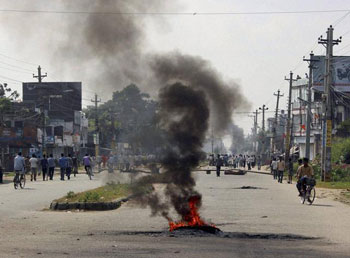 KATHMANDU/ NEW DELHI, Nov 2: Prime Minister Narendra Modi took up the with his Nepalese counterpart KP Oli the killing of an Indian in police firing at the border on Monday and urged him to launch an investigation into the incident. The police fired into a crowd of protesters trying to block a key border checkpoint and killed the Indian civilian as anger over a new constitution boiled over. KATHMANDU/ NEW DELHI, Nov 2: Prime Minister Narendra Modi took up the with his Nepalese counterpart KP Oli the killing of an Indian in police firing at the border on Monday and urged him to launch an investigation into the incident. The police fired into a crowd of protesters trying to block a key border checkpoint and killed the Indian civilian as anger over a new constitution boiled over.
The violence came hours after police forcibly broke up the blockade in the town of Birgunj on the border with India that has led to crippling fuel shortages and cut off access to other vital supplies in the landlocked Himalayan nation.
India also summoned Nepal ambassador Deep Kumar Upadhyaya over the incident, television channels reported. Upadhyaya told ANI a peace dialogue between the protesters and the Nepal government was being held. “This is a bilateral issue between India and Nepal; diplomatically we have to consult each other,” he added.
India asked its freight transporters to exercise caution and not put themselves in danger, an advisory which may deepen the supply crisis to the Himalayan nation. The government also said it was monitoring the situation carefully.
“We are deeply concerned at reports coming in of firing today (on Monday) in Birgunj. An innocent Indian was also killed in the firing. Issues facing Nepal are political in nature and cannot be resolved by force. Causes underlying the present state of confrontation need to addressed by the government of Nepal credibly and effectively,” spokesperson in the external affairs ministry Vikas Swarup said.
He said Indian freight forwarders and transporters have voiced their worries again about the deteriorating situation across the border. “We are advising them to exercise caution and not put themselves in danger. We are monitoring the situation carefully,” he added.
Since the promulgation of the Constitution in Nepal in September, the Indian-origin Madhesi population has been agitating as they believe the country’s new Constitution discriminates against them, denying them equal standing with other Nepalis.
The agitation obstructed supply of essential commodities including petrol thereby creating a crisis in Nepal, which accused India of imposing an “economic blockade”, a charge denied by India.
India maintained that the supply was obstructed due to protests on the Nepalese side and asked the Nepal government to have political resolution of issues facing that country which should have broad-based ownership and acceptance of the Constitution by all section of the society including those disaffected agitating forces.
|


