


Foreign Affairs
|
India reiterates call for peace, stability in Indian Ocean region: Sushma Swaraj
“This region is host to the world’s busiest waterways and three quarters of that traffic is headed for destinations beyond our region,” Sushma Swaraj said while addressing the Third Indian Ocean Conference in Hanoi. “As an important trade and energy waterway, carrying half the world’s container shipment, one third of its bulk cargo traffic and two third of oil shipments, the Indian Ocean clearly assumes importance well beyond its immediate shores and its littorals,” she said. “Nurturing a climate of peace and stability in this region is therefore an important priority for our foreign policy.” Stating that that though there is diversity within the region, Sushma Swaraj said challenges within it are “quite similar”. “Our vision for the region is one of cooperation and collective action,” she said. India, along with the US, Japan and Australia, are part of a quad revived last year that seeks to work for peace and prosperity in the Indo-Pacific region. Sushma Swaraj’s remarks assume significance given China’s belligerent attitude in the South China Sea region and Beijing’s attempts to increase its footprint across the Indian Ocean. “Hanoi is therefore a particularly appropriate setting for us to discuss developments in the Indian Ocean and the Indo-Pacific region,” she said. She said that India sees the Association of Southeast Asian Nations (Asean)regional bloc as central to the regional maritime architecture, reflecting Indian Prime Minister Narendra Modi’s remarks at the Shangri-La Dialogue in Singapore in June. Sushma Swaraj stressed on three priorities that New Delhi accords to the Indian Ocean region and referred to the SAGAR (Security and Growth for All in the Region) initiative of New Delhi. “In its implementation, this approach includes: projects to promote hinterland linkages and strengthen regional connectivity; linking South Asia to Southeast Asia (under India’s Act East Policy); and playing an active and constructive role in strengthening regional maritime security.” Sushma Swaraj said that the first part is India’s focus on developing hinterland linkages and regional connectivity. She said that India is devoting more resources and assigning greater priority to building connectivity, contacts and cooperation in its immediate neighbourhood. “The second element is the expanded interpretation of what constitutes our neighbourhood,” she said. “This is reflected in the renewed emphasis in our Act East Policy and the new Think West policy towards West Asia and the Gulf region.” Sushma Swaraj said that the Act East Policy is at the heart of New Delhi’s eastward orientation and ties in with its broader approach to the Indo-Pacific. She said that India accords high priority to key infrastructure projects such as the Kaladan multi-modal transport linking the Sittwe Port in Myanmar with Mizoram in India’s northeast, and the Trilateral Highway linking India, Myanmar and Thailand. “Our recent agreement with Indonesia to develop port infrastructure in Sabong is yet another step in this direction,” she said. “Coming to the third element, contributing to regional maritime security: we are working to ensure the safety and security of maritime traffic through the ocean by strengthening skills and logistics of our Indian Ocean neighbours,” Sushma Swaraj said. Sushma Swaraj arrived in Hanoi on Sunday on the first leg of her two-nation tour to Southeast Asia that will also see her visiting Cambodia. Nobel Peace Prize to Aung San Suu Kyi won’t be withdrawn: CommitteeSTAVANGER (Norway), Aug 29: The Nobel Peace Prize to Aung San Suu Kyi will not be withdrawn in the light of a United Nations report that said Myanmar’s military carried out mass killings of Muslim Rohingya, the Norwegian Nobel Committee said on Wednesday. On Monday, UN investigators said Myanmar’s military carried out mass killings and gang rapes with “genocidal intent”, and the commander-in-chief and five generals should be prosecuted for the gravest crimes under international law. Aung San Suu Kyi, who leads the Myanmar government and won the Nobel Peace Prize in 1991 for campaigning for democracy, has been criticised for failing to speak out against the army crackdown in Rakhine State. “It’s important to remember that a Nobel Prize, whether in Physics, Literature or Peace, is awarded for some prize-worthy effort or achievement of the past,” said Olav Njoelstad, the secretary of the Norwegian Nobel Committee. “Aung San Suu Kyi won the Nobel Peace Prize for her fight for democracy and freedom up until 1991, the year she was awarded the prize,” he said. And the rules regulating the Nobel Prizes do not allow for a prize to be withdrawn, he added. The Norwegian Nobel Committee consists of a panel of five Norwegians, mostly former politicians and academics, that reflect the different forces in the Norwegian Parliament. The other Nobel prizes are awarded in Sweden. Last year, the head of the Committee, Berit Reiss-Andersen, also said it would not strip the award after previous criticism of Aung San Suu Kyi’s role in the Rohingya crisis. “We don’t do it. It’s not our task to oversee or censor what a laureate does after the prize has been won,” she said in a television interview. “The prize winners themselves have to safeguard their own reputations.” Iran’s Khamenei says govt should be ready to abandon nuclear deal if neededTEHRAN, Aug 29: Iran’s supreme leader warned Wednesday the country could abandon its nuclear deal with world powers if it no longer served its interests, even as economic and political pressure mounted on the government. “Naturally, if we reach the conclusion that (the nuclear deal) is no longer maintaining our national interests, we will put it aside,” Ayatollah Ali Khamenei said in a meeting with the cabinet, according to his website. He said Iran must not “pin its hopes” on Europe, despite European efforts to salvage the nuclear deal following the withdrawal of the United States. The government of President Hassan Rouhani has been battered by the return of US sanctions, which has triggered a rapid departure of foreign firms and ended his hopes of attracting large-scale investment. His political enemies are circling, with parliament announcing that two more of his ministers could be impeached in the coming days. The labour and economy ministers have already been sacked by parliament this month and motions have been accepted to vote on impeaching his industries and education ministers in the coming days. Khamenei insisted the political tumult was a sign of the strength of Iran’s democracy. He praised the tough questioning Rouhani received in parliament on Tuesday as “a glorious show of the power of the Islamic republic and the self-confidence of officials.” Differences between officials are “natural”, he added, though he said they should not be covered by the media “because the people would become worried”. Tuesday’s grilling in parliament was the first for Rouhani in five years as president, and lawmakers slammed his handling of five economic issues, ranging from unemployment to the collapsing value of the currency. In voting at the end of the session, they declared they were unsatisfied with four of his responses. Under parliamentary rules, the issues could then have been referred for judicial review, but parliament speaker Ali Larijani -- a close ally of Rouhani -- said on Wednesday there were no legal grounds for doing so. Parliament can theoretically impeach Rouhani, but he has the protection of Khamenei, who has previously said removing the president would “play into the hands of the enemy”. Instead, Khamenei called on officials to work together “day and night” to resolve the country’s economic problems. Iran’s currency has lost around half its value since the US announced it was withdrawing from the nuclear deal in May, and further pain is expected when sanctions on its crucial oil sector are reimposed in November. Conservative opponents of Rouhani, who have long opposed his outreach to the West, are smelling blood. Next in their sights is his minister of industry, mines and business, Mohammad Shariatmadari, who is accused of failing to prevent high inflation, particularly in the car industry. A motion was also filed on Wednesday to vote on the impeachment of Education Minister Mohammad Bathaei, over a series of issues linked to school budgets, the curriculum and alleged mismanagement. North Korea tells US denuclearisation talks may fall apart: Media reportWASHINGTON/ SEOUL, Aug 28: North Korean officials have warned in a letter to the United States that denuclearisation talks were “again at stake and may fall apart”, CNN reported on Tuesday, citing people familiar with the matter. The letter was delivered directly to U.S Secretary of State Mike Pompeo, and stated that North Korean leader Kim Jong Un’s government felt that the process could not move forward. “The U.S. is still not ready to meet (North Korean) expectations in terms of taking a step forward to sign a peace treaty,” CNN reported, citing sources. The 1950-1953 Korean War ended in an armistice rather than a peace treaty, leaving U.S.-led U.N. forces technically still at war with North Korea. The North has long made clear that it sees an official end to the state of war as crucial to lowering tensions on the Korean peninsula. The United States has been reluctant to declare an end to the Korean War until after North Korea abandons its nuclear weapons programme. The Washington Post reported on Monday that U.S. President Donald Trump called off a visit to North Korea by Pompeo after the latter received a belligerent letter from a senior North Korean official just hours after the trip was announced last week. CNN reported that the letter was sent by the former head of North Korea’s spy agency, Kim Yong Chol, but it was not known how it was sent. The Washington Post said North Korea had been increasingly communicating through its U.N. mission. CNN reported that the letter also mentioned that if a compromise could not be reached and the nascent talks crumbles, North Korea could resume “nuclear and missile activities”. On Sunday, North Korea’s state media accused the United States of “double-dealing” and “hatching a criminal plot” but did not mention Pompeo’s canceled visit. The Washington Post said the exact contents of the message were unclear, but it was sufficiently belligerent that Trump and Pompeo decided to call off the planned trip. The trip had been announced the previous day for this week and Pompeo had intended to introduce a newly named special envoy, Stephen Biegun, to his North Korean counterparts. The White House referred queries on the Washington Post report to the State Department, which did not immediately respond to a request for comment. In cancelling Pompeo’s trip, Trump publicly acknowledged for the first time that his effort to get North Korea to denuclearize had stalled since his June 12 summit with Kim in Singapore. U.S. intelligence and defense officials have repeatedly expressed doubts about North Korea’s willingness to give up its nuclear weapons and they had not expected Pompeo’s trip to yield positive results. A South Korea presidential spokesman said he was not in a position to comment on the authenticity of the letter but acknowledged that talks between Washington and Pyongyang were in a stalemate. “With North Korea and the U.S. remaining stalemated, there is a even bigger need for an inter-Korea summit,” Kim Eui-kyeom, a spokesman for the presidential Blue House told a briefing. South Korea’s President Moon Jae-in said this month his planned third summit with North Korea’s Kim next month would be another step towards the denuclearisation of the Korean peninsula and an end to the Korean War. Indian-origin journalist alleges assault in CanadaTORONTO, Aug 29: Police in Calgary, Alberta, are investigating an alleged assault on an Indo-Canadian journalist by supporters of a candidate vying for a ticket to contest provincial assembly elections due next year. The incident occurred during the Punjabi National Mela in the city on August 19. The journalist, Kumar Sharma, who hosts a radio show devoted to politics, alleged he was assaulted by a group of seven persons who he claimed were supporters of Hardyal Singh Happy Mann. Mann is among the candidates seeking the United Conservative Party (UCP) nomination for the assembly elections next year. During a press conference, Sharma, who has worked as a journalist since 1995, said his alleged attackers were irate over a Facebook post that criticised their candidate. He said they threatened him with “dire consequences”. “The situation became so tense that I feared for my safety. Because of that, I deleted the Facebook post right on the spot,” he said. As he was about the leave the venue where the open air concert or mela was being held, he was “viciously attacked” by the men. He was treated by paramedics and spent the next week recuperating at home. “This has had a very severe impact on my health, on my emotional well-being and on my family,” he said. The press conference was hosted by Conservative MP Deepak Obhrai, who represents Calgary Forest Lawn in the Canadian House of Commons. Expressing his distress over the alleged assault, Obhrai said, “When influential people like US President Donald Trump say journalists are enemies of the people, this creates a poisonous atmosphere towards journalism. The vicious attack on Mr Kumar Sharma is political violence towards a journalist. This is not only an attack on our freedom of speech, but on our democratic principles as well.” According to national broadcaster CBC, Mann has condemned violence of any sort. In a statement, he said, “I wish Mr Sharma a full and fast recovery. However, I am very shocked and surprised to see Mr Sharma and his team to falsely accuse me of being involved in this incident.” Meanwhile, in a release, the UCP expressed the hope that “Calgary Police quickly brings the perpetrators to justice”. The statement also said the UCP was “aware of the allegations linking the event to an aspiring nomination contestant” and stressed that “any individuals using violence such as this are not welcome in our party”. Russia to hold biggest military drills since Cold WarMOSCOW, Aug 28: Russia will next month hold its biggest war games since at least the 1980s, with around 300,000 troops and 1,000 aircraft, the defence minister said Tuesday. The Vostok-2018 exercises will be carried out from September 11 to 15 in the country’s east with the participation of China and Mongolia. “This will be something of a repeat of Zapad-81, but in some senses even bigger,” Sergei Shoigu said of the 1981 war games in Eastern Europe, in comments reported by Russian news agencies. He said “more than 1,000 aircraft, almost 300,000 troops and almost all the ranges of the Central and Eastern military districts” would be involved in the exercises. “Imagine 36,000 pieces of military equipment moving together at the same time -- tanks, armoured personnel carriers, infantry fighting vehicles. And all of this, of course, in conditions as close to combat as possible.” Moscow said last year’s Zapad-2017 military drills, conducted in ally Belarus and regions of Russia, saw the participation of roughly 12,700 troops. But NATO claimed Russia could have been massively underreporting the scale of the exercises, which some of the alliance’s eastern members said involved more than 100,000 servicemen. Canada fires back at Saudi Arabia for preparing to behead a female activist for the first timeTORONTO, Aug 22: Canada responded to news that Saudi Arabia is planning to behead a female activist currently behind bars, in a further escalation of an already-tense diplomatic spat between the two countries. Canada's Foreign Affairs Minister Chrystia Freeland sparked major controversy earlier this month with a single tweet calling out Saudi Arabia for its detention of a prominent activists. The dispute soon escalated - you can read a complete timeline here. The latest development came in a new statement from Canada, repeating its condemnation of how Saudi Arabia treats prisoners in light of reports by Business Insider and other outlets that political activist Israa al-Ghomgham has been sentenced to death. "As Minister Freeland has previously stated, Canada is extremely concerned by the arrests of women's rights activists," a foreign affairs spokesman said in a statement, according to the Globe and Mail. "These concerns have been raised with the Saudi government. Canada will always stand up for the protection of human rights, including women's rights and freedom of expression around the world." Two human-rights groups told Business Insider on Tuesday that Saudi Arabia is about to execute al-Ghomgham, who would be the first woman killed in Saudi Arabia solely for her activism (others have been given the death penalty for different offenses). al-Ghomgham, 29, was arrested along with her husband in 2015 for supporting peaceful protests against the government, rights groups have said, and she now faces the death penalty. Saudi authorities have held five activists facing the death penalty in pretrial detention without legal representation for over two years, Human Rights Watch said. Their next court date is scheduled for October 28, 2018. In a statement, Freeland expressed dismay over Saudi Arabia's continued aggression towards protesters. The statement did not call specifically for al-Ghomgham's immediate release, unlike in earlier statements where Canada named prisoners it wants freed. Saudi Arabia called the earlier statements "reprehensible and unacceptable use of language". And what started with a single tweet has now escalated into a full-blown diplomatic feud. Saudi Arabia has expelled the Canadian ambassador, froze all new investment, cancelled all flights to Toronto, pulled thousands of students from Canadian institutions, barred its citizens from getting medical treatment in Canadian hospitals, and reportedly sold off Canadian assets. Canada in turn, has refused to back down, and both countries seem to be weighing their next moves and remain at an impasse. Rahul Gandhi blames joblessness, demonetisation, GST for lynchingsHAMBURG, Aug 22: Congress president Rahul Gandhi has attributed incidents of lynchings to “anger” emanating from joblessness and “destruction” of small businesses due to demonetization and the “poorly implemented” GST by the ruling BJP. In his address in Hamburg, Germany, the Congress chief alleged that Prime Minister Narendra Modi “demonetised the Indian economy and destroyed the cash flow” of all small and medium businesses rendering millions jobless. “They imposed a badly conceptualised GST which complicated lives further,” Gandhi said. “Large numbers of people who worked in small businesses were forced back to the villages and these three things that the government has done has made India angry. And that’s what you get to read in the newspapers. When you hear about lynchings, when you hear about attacks on Dalits in India, when you hear about attacks on minorities in India, that’s the reason for it,” he stated. Gandhi also accused the BJP government of excluding tribals, Dalits and minorities from the development process. “It is very dangerous in the 21st century to exclude people. If you don’t give people a vision in the 21st century somebody else will give them one. And that’s the real risk of excluding large number of people from our development processes,” he said. “They (the BJP government) feel that tribal communities, poor farmers, lower caste people, minorities shouldn’t get the same benefits as the elite,” the Congress president alleged. Referring to his famous hug, after a no-holds-barred attack during a Parliament debate last month, Gandhi said, “When I hugged PM Modi in Parliament, some within my party did not like it.” The Congress president also talked about his father, former prime minister Rajiv Gandhi’s assailants. “When I saw the man who killed my father lying dead in a field in Sri Lanka, I did not like it, I saw his crying children in him,” he said. Liberation Tigers of Tamil Eelam (LTTE) Velupillai Prabhakaran, responsible for the killing of Rajiv Gandhi, was shot dead by Sri Lankan troops in 2009. Sidhu was ambassador of peace: Imran KhanISLAMABAD, Aug 21: Amid the controversy over Indian cricketer-turned-politician Navjot Singh Sidhu’s presence at his oath-taking ceremony, Pakistan Prime Minister Imran Khan on Tuesday thanked him for attending and termed him an “ambassador of peace”. “I want to thank Sidhu for coming to Pakistan for my oath taking. He was an ambassador of peace & was given amazing love & affection by ppl of Pakistan. Those in India who targeted him are doing a gt disservice to peace in the subcontinent - without peace our ppl cannot progress,” Khan said in a tweet. He also said Pakistan and India must have dialogue and resolve their conflicts including Kashmir to move forward. “The best way to alleviate poverty and uplift the people of the subcontinent is to resolve our differences through dialogue and start trading,” he tweeted. His remarks came shortly after Congress leader and Punjab minister Sidhu, facing criticism for hugging Pakistan’s army chief, said on Tuesday the gesture was made in an “emotional moment” and that his trip was not politically motivated. “Pakistan army chief said they were making efforts to open corridor to Kartarpur Sahib, what followed was an emotional moment,” Sidhu told reporters. Hitting back, the Bharatiya Janata Party (BJP), which has slammed Sidhu’s visit, said that there are the people within the Congress party who are trying to promote the interests of Pakistan in India. Canadian Conservative leader Andrew Scheer to visit to India to strengthen tiesTORONTO, Aug 21: Six months after Prime Minister Justin Trudeau’s state visit to India, his chief opponent is heading to New Delhi to strengthen Canada-India relations. Conservative Leader Andrew Scheer will take his team to India for nine days in October. He has plans to meet with senior government officials, business leaders and civil society and faith leaders. “Standing with a united India is Canada’s gateway to unprecedented human and economic development, and an essential alliance for Canada to strengthen in the face of shared threats,” Scheer said in a statement. He also praised India for being the world’s largest democracy and having one of the fastest-growing economies, saying the country “in recent years is transforming into a rising power in the vast Indo-Pacific region and beyond.” “A Conservative government will dramatically expand the strategic relationship between our countries and our peoples and advance our shared security, prosperity and values. Unfortunately, Justin Trudeau’s disastrous trip to India damaged this key relationship and we must now work to repair it.” There’s no itinerary yet available for what Conservative officials say will be a business-oriented trip by Scheer, with no Taj Mahal photo ops. It’s not yet known whether he will meet with Modi. Brock Harrison, a spokesman for Scheer, said India is “an important strategic partner for Canada for a number of reasons,” adding that Scheer believes there is “work to do” to strengthen the relationship between the two countries. India is one of the world’s fastest-growing economies, displacing France for sixth place among the world’s nations last year, yet trade with Canada remains sluggish. In 2012, the former Conservative government set a goal of increasing two-way trade to $15 billion by 2015. In 2017, it was about $8.4 billion. For eight years, Canadian and Indian officials have been in talks to work towards a free trade agreement. The Conservative government said in 2011 it hoped to conclude an economic partnership agreement with India in 2013. Five years later, there is still no agreement in place. Imran Khan takes oath as Pakistan PMISLAMABAD, Aug 18: Imran Khan took oath as Pakistan’s Prime Minister at a simple ceremony at the President’s House in Islamabad on Saturday, assuming the reins at a time when the country is grappling with a currency crisis and uneasy ties with its neighbours. Khan, 65, wearing a traditional dark sherwani in the style of his hero, Pakistan’s founder Mohammad Ali Jinnah, was administered the oath by President Mamnoon Hussain. Hundreds of guests, including politicians, members of Khan’s Pakistan Tehreek-e-Insaf (PTI) party, civil servants, diplomats and the military top brass, witnessed the ceremony. Khan’s third wife, Bushra Bibi, wearing a white burqa in which only her eyes were visible, was seated in the front row. Army chief, Gen Qamar Bajwa, and former Indian cricketer, Navjot Singh Sidhu, who were seen embracing in television footage, were part of the audience. Wasim Akram and other members of the 1992 cricket World Cup winning team captained by Khan also attended the ceremony. Amid mounting criticism of his behaviour, Sidhu said he had embraced Bajwa after the army chief told him of plans to open the route to Gurdwara Darbar Sahib at Kartarpur in Pakistan for Guru Nanak’s 550th birth in 2019. As the Oxford-educated Khan read out his oath, the president corrected Khan at two points as he faltered and misread words. Khan, who earlier lifted his sherwani and exposed his white trousers, much to the amusement of the audience, while taking out his glasses, had problems pronouncing words and reading them. After taking oath, Khan and his wife greeted several guests. The ceremony, scheduled to begin at 9.30 am, started a little after 10 am. Within about 20 minutes, Khan had been sworn in. Members of Khan’s family were in attendance, though some of his sisters stayed away. There was no major opposition politician in the gathering. President Hussain, who was part of ousted premier Nawaz Sharif’s PML-N party, frowned through the ceremony. Khan appeared to snub him as he shook hands with caretaker premier Nasir-ul-Mulk and ignored the president. Khan’s assumption of office marked the end of decades of rotating leadership between the PML-N and Pakistan People’s Party (PPP) — the two main political forces that have dominated the political scene when the military was not ruling Pakistan. However, no Pakistani premier has completed a full five-year term. Qatar throws Turkey a lifeline as spat widens with USANKARA, Aug 15: Turkey has secured a $15 billion investment from Qatar that could bolster its economy amid a widening dispute with the United States. The pledge was announced Wednesday after a meeting between Qatar's Emir Tamim bin Hamad Al Thani and Turkish President Recep Tayyip Erdogan in Ankara. Qatari state media said the money would go toward economic projects, investments and deposits. The Turkish lira extended its gains against the US dollar to 6% following the announcement, which came on the same day that Turkey announced steep tariff hikes on American products including cars, alcohol and tobacco. The move is a response to trade actions announced last week by the Trump administration. It doubles retaliatory tariffs on American cars to 120% and on alcoholic drinks to 140%, according to a notice published by the Turkish government. Other US products covered by the tariffs include fruit, coal, makeup and rice. Relations between Washington and Ankara have rapidly soured in recent weeks over Turkey's detention of the American pastor Andrew Brunson. The Trump administration announced plans last week to double US tariffs imports of steel and aluminum from Turkey. On Wednesday, a Turkish court rejected a second appeal to release Brunson. The political spat with Washington has added to pressure on the lira. Although the currency has strengthened in recent trading sessions, it is down more than 35% against the dollar this year. Erdogan has accused the United States of stabbing Turkey in the back and on Tuesday called for a boycott of US electronics products. In June, Turkey imposed a first wave of tariffs on US exports, worth a total of $1.8 billion, in retaliation for President Donald Trump's initial tariffs on steel and aluminum. The products targeted Wednesday are the same as in June. The amount of products affected by the tariffs the two countries have imposed on one another are a relatively small part of the $19 billion of goods they traded last year, according to US data. Qatar was among the handful of countries that analysts thought might lend Turkey a hand. Erdogan spoke to Russian President Vladimir Putin on Friday, a conversation that included talk of deeper economic ties and mutually beneficial trade, according to Russian state media. The diplomatic dispute with the United States is just one of the factors that have hammered the Turkish currency. Investors have also been unnerved in recent weeks by a lack of action by the Turkish central bank, which shocked markets last month when it declined to hike interest rates in the face of rampant inflation. Critics said the decision smacked of interference by Erdogan, who indicated during the recent presidential campaign that he wanted more control over central bank policy and described interest rates as "the mother and father of all evil." Although Erdogan says he opposed interest rate hikes, he has not made a clear argument for why Turkey's central bank should keep rates low. "There has been no sign whatsoever that the authorities are considering an orthodox response to the crisis, including tighter monetary and fiscal policy and measures to improve the central bank's credibility," said William Jackson, chief emerging markets economist at Capital Economics. Jackson said the plunge in the lira was likely to push inflation above 20% and tip the Turkish economy into recession in the coming months. One dollar bought just seven lira at one point this week, compared with less than four at the start of the year. "No matter how much money we make it finishes because the prices are going up. Fruit and vegetable prices are going up," said Sevim Pektas, a housewife, told CNN this week. "I do not understand how retired people or people earning minimum wage can afford their rent." North, South Korea agree to hold third summit in Pyongyang in September
The two sides “agreed at the meeting to hold a South-North summit in Pyongyang in September as planned”, the joint statement said, without giving a precise date. A trip by the South’s President Moon Jae-in to the North’s capital would be the first such visit for more than a decade, as the diplomatic thaw on and around the peninsula builds. But despite the rapprochement, international sanctions against the North for its nuclear and missile programmes have kept economic cooperation between the two Koreas from taking off, while little progress has been made on the key issue of Pyongyang’s denuclearisation. “The September summit can be viewed as North Korea’s strategy to find a breakthrough in its stalled talks with the US,” said Asan Institute of Policy Studies analyst Go Myong-hyun. “For South Korea, President Moon wants to improve inter-Korean ties but that’s hard without progress in US-North Korea talks,” he said. At the historic first summit between Moon and the North’s leader Kim Jong Un in Panmunjom in April they agreed the South’s president would visit Pyongyang during the autumn. The first South Korean president to go to the North’s capital was Kim Dae-jung, who met the current leader’s father and predecessor Kim Jong Il in 2000 and later won the Nobel Peace Prize, in part for his efforts at inter-Korean reconciliation. Pyongyang saw a second inter-Korean summit in 2007, when Roh Moo-hyun also met Kim Jong Il. But relations subsequently soured as the North accelerated its pursuit of nuclear weapons and the South elected conservative governments. Monday’s high-level talks, taking place on the northern side of the truce village in the Demilitarized Zone, were proposed by the North last week as it lashed out at Washington for pushing ahead with sanctions. Afterwards the North’s chief delegate Ri Son Gwon said the meeting had gone well and the date for the summit was “ready”, but they had not announced it as “reporting would be more fun when reporters are curious”. Earlier he used a proverb describing a very intimate friend to refer to inter-Korean ties, saying: “We have opened an era where we are advancing hand in hand rather than standing in each other’s way.” South Korea’s Unification Minister Cho Myoung-gyon, leading the delegation from Seoul, said in his opening statement it was important that the two Koreas keep “the same mind”, adding: “Any problem can be resolved with that mindset.” The rapid rapprochement between the two neighbours began this year ahead of the Winter Olympics in the South and paved the way for a landmark meeting between Kim and US President Donald Trump in Singapore in June. Cross-border exchanges between the two Koreas have significantly increased since then, with the neighbours planning to hold reunions for war-separated families next week for the first time in three years. But although Trump touted his summit with Kim as a historic breakthrough, the nuclear-armed North has since criticised Washington for its “gangster-like” demands of complete, verifiable and irreversible disarmament. Meanwhile the US has urged the international community to maintain tough sanctions on the isolated regime -- Seoul has caught three South Korean firms importing coal and iron from the North last year in violation of the measures. Experts say Moon could try to act as a mediator between the US and North Korea, having salvaged the Singapore meeting when Trump abruptly cancelled it. “They are trying to send a message externally that the North-South dialogue momentum has been established and that it will be maintained regardless of the outcome of US-North Korea talks,” said analyst Go. “Whether that is true is in doubt but they are trying to indirectly pressure the US, especially on sanctions, by showing an improvement in North-South ties and that peace has been established between them.” Moon and Kim agreed at their summit in April to officially declare an end to the 1950-53 Korean War, which concluded with an armistice instead of a peace treaty, by the end of the year. But Harry Harris, the US ambassador to South Korea, said Monday it was too soon for such a declaration, Yonhap reported. “It’s too early for that even as we seek improvement in relations between the North and the South and between the North and the United States,” Harris said, adding the allies share the “same goal” of the “final, fully verified denuclearisation” of the peninsula. No one can 'obliterate' Taiwan's existence: Prez Tsai
China, which claims self-ruled and democratic Taiwan as its own, has stepped up a campaign against the island as it tries to assert Chinese sovereignty. Beijing has ordered foreign companies to label Taiwan as part of China on their websites and is excluding Taiwan from as many international forums as it can. Also, China has also been whittling down the number of countries that recognize Taiwan - now just 18 - with Burkina Faso and the Dominican Republic switching relations to Beijing this year. Speaking before her flight to Los Angeles, where she was stopping en route to Belize and Paraguay, Tsai struck a defiant tone. “In going abroad, the whole world can see Taiwan; they can see our country as well as our support for democracy and freedom,” Tsai said. “We only need to be firm so that no one can obliterate Taiwan’s existence.” Tsai arrived in Los Angeles on Sunday and was scheduled to address a banquet for Taiwanese-Americans there on Sunday evening, then pay a visit to the Ronald Reagan Presidential Library outside of Los Angeles on Monday, according to Phi Lin Chuang, a Taiwanese government spokeswoman. China, which believes Tsai wants to push for Taiwan’s formal independence, has already complained to Washington about her U.S. stopovers, which include Houston on her way back. The trip starts one day after Taiwan’s state-run refiner CPC Corp announced a deal valued at $25 billion to purchase liquefied natural gas from the United States over the next 25 years. The deal was aimed at boosting trade relations with the United States by reducing its trade surplus and was also a sign of goodwill ahead of Tsai’s visit, said a person familiar with the government’s thinking. Tsai, who says she wants to maintain the status quo with China, will also be looking to reaffirm Washington-Taipei ties and to shore up support ahead of local elections in Taiwan in November amid the escalating pressure from China. During her U.S. stops, Tsai intends to meet Ed Royce, chairman of the U.S. House of Representatives Foreign Affairs Committee, according to two people with knowledge of the plans. She will also meet with business representatives to discuss how Taiwan could drum up investment and procurement with the United States, they said. Washington has no formal ties with Taiwan but is the island’s strongest ally and sole foreign arms supplier. Tsai’s U.S. stopovers come as China and the United States are engaged in a trade war, adding to Beijing’s irritation with Washington. 98 killed as quake strikes Indonesia’s Lombok, Bali islandsMATARAM, Aug 6: A powerful earthquake flattened houses and toppled bridges on the Indonesian tourist island of Lombok, killing at least 98 people and shaking neighbouring Bali, as authorities said today that rescuers still hadn’t reached some devastated areas and the death toll would climb. It was the second deadly quake in a week to hit Lombok. A July 29 quake killed 16 people and damaged hundreds of houses, some of which collapsed in yesterday evening’s magnitude 7.0 temblor, killing those inside. National Disaster Mitigation Agency spokesman Sutopo Purwo Nugroho told a news conference that damage was “massive” in northern Lombok. A powerful earthquake flattened houses and toppled bridges on the Indonesian tourist island of Lombok, killing at least 98 people and shaking neighbouring Bali, as authorities said today that rescuers still hadn’t reached some devastated areas and the death toll would climb. It was the second deadly quake in a week to hit Lombok. A July 29 quake killed 16 people and damaged hundreds of houses, some of which collapsed in yesterday evening’s magnitude 7.0 temblor, killing those inside. National Disaster Mitigation Agency spokesman Sutopo Purwo Nugroho told a news conference that damage was “massive” in northern Lombok. The quake, measured at magnitude 7.0 by Indonesian authorities and 6.9 by the US Geological Survey, struck at a shallow depth of 10.5 kilometres (6 miles) in the northern part of Lombok. Shallow quakes tend to cause more damage than deeper ones. “We were sitting there having dinner at about 7 o’clock last night, we just felt a really big sort of shaking and the lights went off and everyone just ran,” Australian tourist Kim Liebelt said as he waited with other travellers for a flight out at Lombok’s international airport. “And then the roof started falling down on us, rocks and rubble and then just everyone running to get away,” he said. Videos showed screaming people running in panic from a shopping mall and a neighbourhood in Bali where parked vehicles swayed. On Lombok, soldiers and other rescuers carried injured people on stretchers and carpets to evacuation centres. Many victims were treated outdoors because hospitals were damaged. “People panicked and scattered on the streets, and buildings and houses that had been damaged by the previous earthquake had become more damaged and collapsed,” Nugroho said. The quake triggered a tsunami warning, and frightened people poured out of their homes to move to higher ground, particularly in North Lombok and Mataram, the capital of West Nusa Tenggara province. The warning was lifted later yesterday after only small waves were recorded. On Gili Trawangan, one of three popular vacation islands near Lombok, thousands of tourists and local residents spent the night on a hill fearing a tsunami, said British visitor Saffron Amis. “There was a lot of screaming and crying, particularly from the locals,” said Amis, from Brighton. “We spoke to a lot of them and they were panicking about their family in Lombok. It was just a lot of panic because no one knew what was happening.” Thousands of people are now trying to get off the island, she said, describing the mood as both sombre and panicked. Hundreds of people packed a sliver of brilliant white beach on the 16-square kilometre (6-square mile) island, shouting at rescue personnel trying to ensure an orderly evacuation, video and photos supplied by the local water police showed. Nugroho said authorities had deployed three ships to evacuate people. Reports that seven Indonesian tourists died on the island have not been confirmed, he said. Like Bali, Lombok is known for pristine beaches and mountains. Hotels and other buildings in both locations are not allowed to exceed the height of coconut trees. Indonesia is prone to earthquakes because of its location on the Pacific “Ring of Fire”, an arc of volcanoes and fault lines in the Pacific Basin. In December 2004, a massive magnitude 9.1 earthquake off Sumatra island triggered a tsunami that killed 230,000 people in a dozen countries. Australian Home Affairs Minister Peter Dutton, in Lombok for a regional security meeting, said he and his delegation were eating dinner in their hotel’s 12th floor restaurant when the quake struck, plunging the building into darkness and throwing people to the floor. “Mate, we were knocked certainly to the floor. It was the violence of the shaking of the building — was pretty dramatic,” he said in a radio interview. “Everyone’s a bit shaken, but all well, but people out in the villages or elsewhere haven’t been so lucky, unfortunately.” The Bali and Lombok airports have remained open. Model Chrissy Teigen, who was in Bali with singer-husband John Legend and their two children, live-tweeted the shaking. “Bali. Trembling. So long,” Teigen tweeted to her 10.6 million followers. Several hours later, she asked news organisations not to write more stories about her lively stream-of-consciousness tweets, suggesting media share information to help those who need it instead. Venezuelan Prez Maduro survives assassination attackCARACAS (Venezuela), Aug 5: Drones armed with explosives detonated near Venezuelan President Nicolas Maduro in an apparent assassination attempt that took place while he was delivering a speech to hundreds of soldiers being broadcast live on television, officials said. Caught by surprise mid-speech, Maduro and his wife, Cilia Flores, looked up at the sky and winced after hearing the sound of an explosion pierce the air. “This was an attempt to kill me,” he said later in an impassioned retelling of the events. “Today they attempted to assassinate me.” Information Minister Jorge Rodriguez said the incident took place shortly after 5:30 pm as Maduro was celebrating the National Guard’s 81st anniversary. The visibly shaken head of state said he saw a “flying device” that exploded before his eyes. He thought it might be a pyrotechnics display in honour of the event. Within seconds, Maduro said he heard a second explosion and pandemonium ensued. Bodyguards escorted Maduro out of the event and television footage shows uniformed soldiers standing in formation quickly scattering from the scene. He said the “far right” working in coordination with detractors in Bogota and Miami, including Colombian President Juan Manuel Santos, were responsible. Some of the “material authors” of the apparent attack have been detained. “The investigation will get to the bottom of this,” he said. “No matter who falls.” Venezuela’s government routinely accuses opposition activists of plotting to attack and overthrow Maduro, a deeply unpopular leader who was recently elected to a new term in office in a vote decried by dozens of nations. Maduro has steadily moved to concentrate power as the nation reels from a crippling economic crisis. |

| |||||||
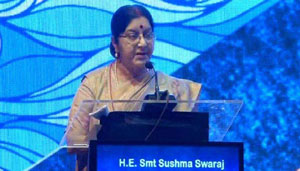 HANOI, Aug 28: Pointing out that the seas around India have nurtured its links of commerce and culture with its extended neighbourhood over millenia, external affairs minister Sushma Swaraj on Monday said that nurturing a climate of peace and stability in this region is an important priority for New Delhi’s foreign policy.
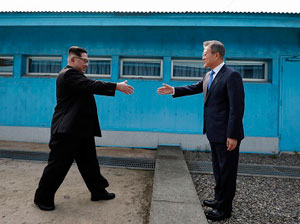 SEOUL, Aug 13: North and South Korea agreed Monday to hold a summit in Pyongyang in September after high-level talks in the Demilitarized Zone that divides the peninsula.
 TAIPEI, Aug 13: Vowing that “no one can obliterate Taiwan’s existence,” President Tsai Ing-wen left on Sunday for the United States and two of Taipei’s remaining diplomatic allies, amid pressure from China to try to stamp out references to the island internationally.
Aviation
| Business | Defence | Foreign
Affairs | Communication | Health
| India | United Nations
India-US
| India-France | Entertainment
| Sports | Photo Gallery |
Tourism | Advertise with Us
| Contact Us
© Noyanika International, 2003-2009. All rights reserved.