


Health
100 new Swine flu deaths: Here's how to save yourself from the virusNEW DELHI, Feb 17: The alarming rise in the number of swine flu deaths in India -- with 100 more casualties reported across the country in three days since February 12, taking the total number to 585 this year -- has put the spotlight on the urgent need to check the spread of the H1N1 virus. According to latest official data, a total of 8,423 people have contracted the flu this year, with Rajasthan, Gujarat, Madhya Pradesh and Maharashtra being the worst-affected states with their respective tolls standing at 165, 144, 76 and 58. On February 15 alone, Rajasthan reported 12 deaths, while there were eight fresh casualties each in Madhya Pradesh and Gujarat. Though Delhi and Tamil Nadu reported a high incidence of cases, the death toll in the two states is relatively low due to more awareness and a better developed health sector. In view of the numbers threatening to spiral in the coming days, here's a primer on the dos and don'ts to fight the virus. Viral Alert Should you panic yet? How can you stay safe? When should you get tested/visit a doctor? Who are at risk? Litchi fruit suspected in mystery epidemic in India, inquiry findsWASHINGTON, Feb 1: A toxin in litchi fruits may be linked to a mysterious and sometimes fatal brain disease that has afflicted children in Muzaffarpur, Bihar, and neighbouring districts since 1995, US researchers claim. An association between the illness and litchi fruit has been postulated because Muzaffarpur is a litchi fruit producing region, according to a report by the US Centres for Disease Control and Prevention. The Indian National Centre for Disease Control (NCDC) and CDC investigated outbreaks of the illness in 2013 and 2014. "Clinical and laboratory findings in 2013 suggested a noninflammatory encephalopathy, possibly caused by a toxin," the report said. A common laboratory finding was low blood glucose on admission, a finding associated with a poorer outcome; 44 per cent of all cases were fatal. A 2014 investigation has found no evidence of any infectious etiology and supports the possibility that exposure to a toxin might be the cause, the report said. The outbreak period coincides with the month-long litchi harvesting season in Muzaffarpur. The 2014 investigation has identified the illness as a hypoglycemic encephalopathy and confirmed the importance of ongoing laboratory evaluation of environmental toxins to identify a potential causative agent, including markers for methylenecyclopropylglycine (MCPG), a compound found in litchi seeds known to cause hypoglycemia in animal studies. During May 17 - July 22, 2013, a total of 133 children were admitted to the two main referral hospitals in Muzaffarpur with illnesses that met the investigation case definition of acute onset seizures or altered mental status within 7 days of admission in a child aged 15 years. Of these, 71 per cent patients were from Muzaffarpur; other patients were from six neighbouring districts. Analysis of risk factors for death among 94 affected children showed that low blood glucose at admission was more common among those who died. Data collected during the 2013 investigation suggested that the illness was more likely to be a noninflammatory encephalopathy than an infectious encephalitis, and raised concern for the possibility of a toxin-mediated illness. Building on the 2013 findings, NCDC and CDC again investigated this syndrome in 2014. During May 26 - July 17, 2014, a total of 390 patients admitted to the two referral hospitals in Muzaffarpur with illnesses that met the same case definition used in 2013. Detailed clinical evaluation of 52 patients within 12 hours of admission elicited a history of generalised tonic or tonic-clonic seizures in 100 per cent, researchers said. "The 2013 and 2014 Muzaffarpur investigations indicate that this outbreak illness is an acute noninflammatory encephalopathy," the CDC said. The consistent finding of hypoglycemia among affected children underscores the importance of examining the possible role of compounds that might acutely result in low blood sugar, seizures, and encephalopathy, including the possible role of MCPG in litchis. World's first dengue vaccine might be available in 2015PARIS, Nov 7: The French pharmaceutical company revealed that it has cleared clinical trials at an international level. The firm has already started production of the vaccine at a new facility located in Neuville-sur-Saône, France, which is expected to produce 100 million doses of the vaccine each year. The dengue virus is transmitted to humans by the Aedes mosquitoes and there are two species of the Aedes mosquitoes: albopictus and aegypti, which are found throughout the world. About 2.5 billion people globally live in high-risk dengue regions. Around 400 million people are also infected with the disease on a yearly basis. Currently, there is no cure for dengue and only supportive treatment is provided to reduce the symptoms. "Until now, we were only able to provide supportive care for patients with dengue. On the strength of the outcome of this phase III efficacy study, we hope this will become an effective preventive measure against dengue," says Dr. Rivaldo Cunha, associate professor in the Faculty of Medicine, Universidade de Mato Grosso do Sul, Brazil and a principal investigator of the study. The Sanofi Pasteur division revealed that the third and final stage of the vaccine's clinical trials lasted for over two years. All clinical trials were conducted on about 31,000 people across Asia, Latin America and the Caribbean. A study also involved about 3,000 people in the Indian cities of Kolkata, Mumbai, Delhi, Pune and Ludhiana. The clinical trials involved injecting the three doses of the vaccine or a placebo to healthy children over a span of a year. The study found that children who received the three doses had about 95 percent shield against severe form of dengue and 80.3 percent reduction in hospitalization risk. Although the dengue vaccine has shown promising results against the severe forms of the disease, it is less effective in serotypes I (about 50 percent) and II (around 42 percent). Medical experts believe that even though the vaccine is not perfect it is promising as it can protect people against severe dengue. Sanofi is said to have spent around $1.7 billion in the last two decades for the development of the dengue vaccine. The company announced that it will file for the vaccine's registration in several countries in 2015 and hopes to make the vaccine available by the second half of 2015. Red wine a substitute for exerciseTORONTO, Nov 4: According to a research, a glass of red wine could provide one with the same benefits an hour's exercise would give. "I think resveratrol could help patient populations who want to exercise but are physically incapable. Resveratrol could mimic exercise for them or improve the benefits of the modest amount of exercise that they can do," said lead study author Jason Dyck from the University of Alberta in Canada. In lab experiments, Dyck and his team found that high doses of resveratrol improved physical performance, heart function and muscle strength in animal models. "We could conceivably create an improved exercise performance in a pill," Dyck was quoted as saying in a Science Daily report. Previous research show that this antioxidant also helps to reduce the chance of developing cataracts, improves memory and even cuts down cancer risk. Ebola vaccine trials to start in Switzerland this week
Swiss regulators announced they would allow trials of an experimental vaccine made by Britain's GlaxoSmithKine, and tests on some 120 individuals were set to get under way at the CHUV hospital in Lausanne Friday, the hospital said. "We have never before received so many volunteers so quickly," Blaise Genton, who heads CHUV's infectious disease division, told reporters. He said the volunteers, who must be between the ages of 18 and 65, were mainly medical students and would all receive 800 Swiss francs (USD 845, 665 euros) for their participation. Genton stressed they would receive payment for their time, since they would be spending "numerous hours with us". Most of the volunteers will receive the experimental GSK vaccine called ChAd3, which is based on a genetically modified chimpanzee adenovirus, but 20 of them would receive a placebo he said. WHO hailed the announcement. "This marks the latest step towards bringing safe and effective Ebola vaccines for testing and implementation as quickly as possible," the UN's health agency said in a statement. There is no licensed treatment or vaccine for the deadly Ebola virus, which has killed nearly 5,000 people in the outbreak centred in west Africa. The experimental GSK vaccine is one of two considered particularly promising by WHO, and trials have already begun in Mali, Britain and the United States. "The trial will test the safety of the vaccine and its capacity to induce an immune response," WHO said. It added that results of the trials in Switzerland and elsewhere will "provide the basis for planning subsequent trials involving several thousand participants, and for choosing vaccine dose-level for efficacy trials." A second experimental vaccine being fast-tracked on the WHO's recommendation, Canadian-discovered rVSV, is set to soon start trials at the University Hospital of Geneva. Trials of that potential vaccine have already begun in the United States and are also set to soon start in Germany, Gabon and Kenya. "If shown to be safe and effective, either of the vaccines could be scaled up for production during the first quarter of next year, with millions of doses produced for wide distribution in high-risk countries," WHO assistant director general Marie-Paule Kieny said in the statement. 10,000 new Ebola cases per week could be seen: WHO
WHO assistant director-general Dr. Bruce Aylward says if the response to the Ebola crisis isn’t stepped up within 60 days, “a lot more people will die” and there will be a huge need on the ground to deal with the spiralling numbers of cases. He said WHO estimated there could up to 10,000 cases per week in two months. Aylward said for the last four weeks, there have been about 1,000 new cases per week, though that figure includes suspected, confirmed and probable cases. He said WHO is aiming to have 70 per cent of cases isolated within two months to reverse the outbreak. India ramps up Ebola screening at airportsNEW DELHI, Oct 14: Indian authorities have ramped up screening for the Ebola virus at airports and ports over the past two months to avert an outbreak of the deadly disease that has killed more than 4,000 people, mostly in West Africa. As part of the heightened surveillance, the government conducts detailed medical examinations of high-risk passengers, including checking their travel history, taking their body temperature and placing under quarantine people with possible symptoms of infection. The government has screened 21,799 people at airports since it began screening for Ebola two months ago, but nobody has tested positive for the disease in India. So far, 1,200 travellers have been identified as suspected cases and 485 passengers have been quarantined at a Delhi facility. The passengers had flown from Ebola-affected countries -- Liberia, Sierra Leone, Nigeria, Guinea, Congo and Senegal -- and had reported Ebola-like symptoms that include fever, fatigue, sore throat, muscle ache, nausea and headache. The government has also identified one hospital with a dedicated isolation facility in each state to admit people with Ebola-like symptoms. These hospitals are equipped to handle sample collection, diagnosis and treatment of Ebola cases. “The health ministry is providing technical and material support to states for preparing health facilities with dedicated isolation wards, enabling them to provide diagnosis, treatment and care, and infection control under proper guidelines,” said Union health minister Dr Harsh Vardhan. “We have an efficient surveillance programme running and are fully prepared to deal with any eventuality.” India has been on high alert since the World Health Organization declared the Ebola outbreak an international public health emergency in August. About 8,400 people have been infected so far in the worst Ebola outbreak on record that began in West Africa in March. With the help from the ministry of external affairs, health officials identify passengers who have travelled to affected countries to screen them at the airport itself. Officials send a list of such passengers to local health departments in their respective states to track and monitor their health for a month. Most of them are in the states of Maharashtra, Kerala, Tamil Nadu, Gujarat, West Bengal and Delhi. Health authorities have also posted teams at the Attari border and airport to screen passengers coming from Ebola-affected countries. |
|
|||||||
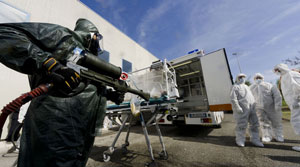 GENEVA, Oct 28: Ebola vaccine trials are set to start in Switzerland this week after receiving the green light from the country's authorities, the World Health Organization (WHO) said on Tuesday.
 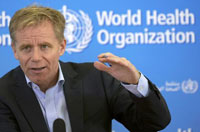 GENEVA, Oct 14: A World Health Organization official says there could be up to 10,000 new cases of Ebola per week within two months.

Aviation
| Business | Defence
| Foreign Affairs | Communication
| Health | India |
United Nations
India-US | India-France
| Entertainment | Sports
| Photo Gallery | Tourism
| Advertise with Us | Contact
Us
© Noyanika International, 2003-2009. All rights reserved.