


India
|
Roadmap of the RTI Act to be discussed at the highest levelBy Deepak Arora NEW DELHI, Oct 16: The Central Information Commission is organising a “Conference of Central Information Commission with the State Chief Information Commissioners and the Information Commissioners” here on Wednesday. The Conference will be also be attended by the Secretaries of the Department of Personnel and Training, the Department of Administrative Reform, Department of Information Technology, Member Secretary, Administrative Reforms Commission, DG, NIC Additional Secretary, Department of Information Technology, Joint Secretary, Department of Personnel & Taining, Joint Secretary, Department of Panchayati Raj. The RTI Act 2005 has completed two years and in these years the Central and the State Commissions have identified certain common areas, which affect the effective implementation of the Act. The suggestions received in this respect from the State Commissions have been grouped into four different Categories viz. “ Enforcement of Section 4 of the RTI Act”, “ Autonomy and other administrative matters relating to the Information Commissions”, “Enforcement of Decisions and penal clauses of the Act” and the “Future Evolution of the RTI Regime”. Section 4 of the RTI Act mandates suo moto disclosures by Public Authorities. Under the Act, the responsibility to provide information to the information seekers lies on the Central Public Information Officer or the Public Information Officers as the case may be, but in the Act responsibility of maintaining the data for the proactive disclosure lies on the Public Authority. This needs discussion amongst the Commissions to take a view as to how to expedite this process, considering the fact that section 4 disclosure has a direct bearing on section 6(1) of the RTI Act. Chief Central Information Commissioner Wajahat Habibullah will make a presentation on the “Enforcement of operationalising Section 4 of the RTI Act.” Senior Consultant to the Department of Information technology will give a presentation on “E-District Projects”. This project may play a pivotal role in bringing about a change in rural areas through RTI Act. The Financial and Administrative autonomy of the Commissions is essential for their effective functioning. Some of the Commissions have observed that they are facing difficulties in ensuring compliance with their decisions and hence different methods will be discussed to ensure that the decisions taken while disposing of complaints/appeals are fully complied. This will facilitate citizens to get complete information in the shortest possible time. It is essential for the Commissions to come together and exchange views, experience and best practices relating to RTI Act. It is hoped that the Conference will help to present to the Government a roadmap of the RTI Act, 2005. Recommendations by the Chief Central Information Commissioner will be presented to Minister of State (PP) Suresh Pachouri after the deliberations are over. The Minister will give the valedictory address. Despite differences with Left, UPA Govt will not fall: Pawar
"Problems do exist between the UPA and Marxists on some provisions of the nuclear deal. They (Left) have voiced some concerns, which we, as the ruling coalition, are obliged to address, but the government will not fall over the issue," he told a press conference. Pawar said the UPA-Left committee constituted to iron out the differences had already held four rounds of "good discussions and we hope both sides would amicably and with full responsibility settle the issue in our future meetings". Asked why then UPA leaders, including Congress president Sonia Gandhi and LJP chief Ram Vilas Paswan were asking their workers to gear up for a mid-term elections when he did not foresee it, the NCP chief said "being in politics we should always be prepared for elections. India recognised as the most advanced nation at the IAEA meet: Kakodkar
Kakodkar, who attended the UN atomic watchdog's 51st General Conference, remained mum on whether there were any discussions with the IAEA on the India-specific safeguards agreement, a pre-requisite for the operationalisation of the Indo-US civil nuclear deal. "I will not say anything on that," Kakodkar said shortly before his departure when asked about his informal discussions with IAEA Director General Mohammed ElBaradei. India also has to secure changes in the guidelines of the Nuclear Suppliers' Group (NSG) to gain access to nuclear commerce. Left parties, which have been stoutly opposing the deal, have demanded that its operationalisation be put on hold for six months failing which the UPA government will have to face "grave" consequences. Describing the week-long IAEA meet as "successful", Kakodkar said it was so particularly this year because of the "greater awareness of the larger role of nuclear energy in meeting the global energy needs". He said the meet was important for several reasons "particularly India's recognition as the most advanced nation in nuclear fuel cycle technology by the world leaders". Experts were curious to know about India's thorium-based power plant and fast-breeder reactors. "We were also the first to pilot a resolution on the development and deployment of Small and medium reactors (SMR) supported by several countries and passed unanimously at the general conference," Kakodkar said. Making a strong pitch for international nuclear energy cooperation with India at the forum, Kakodkar while addressing the forum had made it clear that nuclear power was an "inevitable option" and pressed for "reformation" of global thinking on it. Kakodkar favoured a closed fuel cycle to reduce the risk of proliferation of fissile material, a proposal backed by several countries. Currently, the spent fuel from atomic power plants is stocked in high security facilities. This fuel can be reprocessed to extract plutonium, which can be used to create nuclear weapons. "We cannot put future security at risk through the once-through cycle," he had argued. The one time use of uranium fuel should not promoted as it is important for the world to make use of the spent fuel to maximise the energy production and minimise the radioactive waste, he had contended. Kakodkar also emphasised that in order to meet the huge energy demands of the world community it was important to have inclusive partnership and make sure that those countries which are keen to develop nuclear power for the first time should have basic minimum infrastructure and human resource needed for it. "This will ensure that no uncertainty remains." The IAEA has been generally supportive of the nuclear deal with its chief ElBaradei describing it as "good" and "a step in the right direction". The US, pressing for implementation of the deal by year-end, briefed the NSG on the salient aspects of the 123 Agreement reached with India. "Since we have a timeframe, we want India also to complete the process of safeguards before the deal is placed for Congressional vote," Stratford told the news agency. "Although we respect India's democratic political system," he said, the deal was important from the point of global energy needs. Russia's Atomic Energy Agency chief Kirienko Sergeit said he would like India to have a waiver from NSG which would enable the two countries to have nuclear trade. India was also the first country to ratify the amendments that were negotiated at the IAEA conference for the convention on Physical Protection of Nuclear Materials that concluded on Friday. India donated a teletherapy machine Bhabhatron's latest version developed by Bhabha Atomic Research Centre to IAEA which in turn handed it over to Vietnam. A tripartite agreement was signed in this regard during the conference. Meanwhile, the European Union which has restarted a dialogue at the highest level aimed at adapting the IAEA's integrated safeguards requirements to the 'Partnership Approach' that is the basis for safeguards implementation in the EU member states. Speaking at the conference, Directorate General for Energy Transport of the European Commission Domnique Ristori said the additional protocol is in force in all EU member states proving their commitment to non-proliferation. "The responsibility on non-proliferation has become even more crucial in a context where more and more countries are realising the need to resort nuclear energy as a way to reduce greenhouse emissions while allowing their economies to grow and people to improve their standard of living," he said. The general conference was dominated by four 'I's ---- India, Iran, Iraq and Israel. ElBaradei called upon the western countries especially the US to be soft on Iran and not to use force as such methods have already shown a negative impact in the case of Iraq. He requested Iran to stop its activities on enrichment as it has shown the world its scientific capabilities. Strongly objecting to the IAEA's attitude towards Israel which has the nuclear capability, the Arab nations vociferously pressed the the UN atomic watchdog to have a non-discriminatory approach on safeguards while dealing with the objective of nuclear free zone in the Middle-east. The Arab nations also called upon ElBaradei to order inspection of Israeli's facilities. Left softens stand; Pranab hopeful of resolving N-deal impasseBy Deepak Arora
Mukherjee told newsmen in Kolkata that two meetings had already been held between the UPA and Left, adding that exchange of notes had also taken place. "I am hopeful that the issue would get resolved then (October 5)," he said. Mukherjee, who is the convenor of the committee said, "We have received three notes from the Left on the nuclear deal. We have already replied to two of them, a third note has come which will be discussed at the meeting on October 5." The committee has met for the second time on September 19. Asked whether he would hold talks with US President George Bush during his visit to Washington, Mukherjee said "Whether discussions will take place or not would depend on the engagements." Mukherjee, would visit Washington after addressing the UN General Assembly session in New York on September 27. The Nuclear deal stand off between the Government and the Left seemed to be easing off with Jyoti Basu supporting the need for nuclear energy on Friday. Last week at a CII function, West Bengal Chief Minister Buddhadeb Bhattacharjee had said nuclear energy is critical for the country's development. Basu's and Buddhadeb’s comments strengthened speculation that Communists in the West Bengal did not endorse the party General Secretary Prakash Karat's strident postures. Basu's comments are significant in view of the scheduled CPI-M politburo and Central Committee in Kolkata from Sept 28 to Oct 1. Jyoti Basu said that the nuclear energy is required but it should not be equated with the Indo-US nuclear deal. "The Indo-US nuclear deal is for nuclear energy. Nuclear energy is necessary and there is a need for nuclear power plants. With new industries mushrooming, the demand for power will increase." He also expressed hope that the conflict between Left parties and the UPA government over the Indo-US nuclear deal would ease after the CPI-M's politburo and central committee meetings here. "CPI-M's Politburo and Central Committee would meet in Kolkata from September 28 to October 1, which will be followed by a joint meeting of the UPA-Left committee on the nuclear deal. There could be some easing off of the situation." He said problems have developed between the CPI-M and the UPA because the Common Minimum Programme was not being adhered to. He also said that during his tenure as chief minister there was a proposal for setting up a nuclear power plant at Sagar in South 24 Parganas district. "The Centre had told that nuclear power plants could not be set up at places where coal is available." "We are against American imperialism, but we need foreign capital for industrialization. They are not coming for charity but for profit. We will also get benefit out of it. This would be on the basis of mutual interest." 'India not to put any reactor under IAEA safeguards'MUMBAI, Sept 12: India will not put reactors under International Atomic Energy agency (IAEA) safeguards before it gets Nuclear Suppliers Group's waiver and US Congressional clearance, Member Atomic Energy Commission M R Srinivasan said here today. Getting India-specific safeguards from IAEA and waiver from NSG are two pre-requisites to move forward with the Indo-US deal and the next step is US Congressional approval. "However, India will not put any of its reactors under safeguards before all these things happen," Srinivasan who is also former chairman, AEC said while addressing a public lecture on `Re-entering the international nuclear arena' at Tata Institute of Fundamental Research. Advocating a strong political consensus on the issue, he said it was important for India to re-enter international nuclear arena at this point of time. "Although we could have got a better deal, 123 agreement is a good deal one could get and it is not good for India or any other country to remain in isolation as science and technology is truly international," he said. In the long run India will benefit as Indian technologies will be in great demand internationally "as we have matured technologies developed ahead of many countries," he said. "Even America incorporates new ideas from smaller countries like Finland and Korea and technology society is mature enough to live with the rest of the world". Sonia Gandhi seeks to 'heal' Kashmir woundsSRINAGAR, Sept 10: India's ruling party chief Sonia Gandhi called for Kashmir's "wounded hearts and minds" to be healed during a flying visit to the revolt-hit region. The Congress party leader, who arrived two hours after Muslim rebels bombed a police vehicle in Srinagar on Monday, received a rousing welcome at the city's tightly guarded convention centre where audience chanted "Long live Sonia." "For the past 20 years Kashmir has witnessed umpteen problems and sufferings," Gandhi told thousands of women from the state's social welfare department, non-governmental organisations and Congress party members. "The situation has not only left external scars but wounded more hearts and minds," she said. "It is the prime responsibility for all of us to heal these wounds and bring back peace and tranquility in the lives of the people," she said. Monday's bomb attack, which injured three people, took place several kilometers from the convention site in Srinagar, urban hub of the revolt. Gandhi, who last visited the region in the wake of a devastating earthquake in October 2005, made the trip at a time when violence has ebbed in the region. The improvement has been attributed to a peace process launched by nuclear-armed neighbours India and Pakistan in January 2004 aimed at settling all differences including their dispute over the future of Kashmir. Gandhi lauded the people of Kashmir for "facing the challenges of terrorism boldly," a phrase used by New Delhi for the Kashmir insurgency. "Terrorism cannot survive before the will and unity of the people," she said. Sonia Gandhi among world's 10 most powerful women
Ranking Angela Merkel, the first woman to become chancellor of Germany, No. 1 for the second year in a row, the US business magazine said, "She continued to impress the world with her cool leadership at two back-to-back summits." Placed above Indra Nooyi (No. 5), the Indian American chairman and chief executive of PepsiCo, and Sonia Gandhi were Chinese Vice premier Wu Yi at No. 2, Ho Ching, chief executive of Temasek Holdings, Singapore's largest business conglomerate, at No. 3 and US Secretary of State Condoleezza Rice at No. 4. Gandhi, "the Italian-born leader of India's most powerful political party, the Indian National Congress Party, has come far since entering politics in the 1990s", Forbes said, noting Indian lawmakers recently elected her choice for president, Pratibha Patil. The magazine described it as "a historic vote seen as a step forward for India's women and girls who endure daily discrimination." "Though the position is largely ceremonial, Patil is now India's first female president, and her victory is a sign that the role of women in the country's often male-dominated political scene may improve," Forbes said. "This is a special moment for women across the country," the magazine quoted Gandhi as saying. "It shows India is committed to women." Gandhi, it said, is "widely revered by her fellow countrymen, especially among India's poor as well as its vast agricultural population" and is continuously concerned that India's rapid economic growth is leaving the poor behind, and that her country is not doing enough to help its farmers. "She has opposed a government plan to introduce special economic zones to encourage foreign investment in the country. Recently Gandhi stood up to politically powerful opponents in blocking their attempt to nullify an anti-corruption law meant to curb corruption among the country's massive bureaucracy." Forbes said Nooyi has been steadily consolidating her power at PepsiCo, one of the largest companies in the world with $35 billion in annual revenue and a $105 billion market capitalisation. Last February, Nooyi added the title of chairman to her chief executive position at the food-and-beverage giant, maker of Frito-Lay snacks, Pepsi beverages, Gatorade sports drinks, Tropicana juices and Quaker foods; a whopping 17 PepsiCo brands each generate $1 billion or more in annual sales. Nooyi has pushed PepsiCo to move beyond soda, first by helping to start the company's fast-food chains in 1997, and later by spearheading the purchase of Tropicana in 1998. In an effort to offset slowing business in the Gatorade division, Nooyi advocates vitamin and energy-infused water drinks. "Being a woman, being foreign-born, you've got to be smarter than anyone else," Forbes said citing Indian-born Nooyi who came to the US from India in 1978. Prior to joining PepsiCo in 1994, Nooyi did stints at the Boston Consulting Group and Motorola. Another person of Indian origin on the list is Vidya Chhabria, chairperson Jumbo Group, UAE, at No. 97. Chhabria became chairperson of the $2 billion conglomerate, the Jumbo Group, when her husband, takeover titan Manu Chhabria, died in 2002, Forbes noted. Headquartered in Dubai, the company oversees 28 companies operating in as many as 50 countries, with interests in durables, chemicals, machinery, liquor products and agriculture. The company is best known for its ownership of Jumbo Electronics, one of the world's largest distributors of consumer electronics, information technology, telecom products and home appliances. Two years after divesting most of its businesses in India, the Jumbo Group is considering re-entering India this year. Forbes said while there have been plenty of hand-wringing studies arguing that the corporate glass ceiling for women has turned into concrete, it had no difficulty turning up 66 business executives worthy of inclusion on the list. The remaining 34 are mostly in government. "If women aren't being stopped by any ceiling, it still can be argued that they have a tough go on the way to the top," it said. Land acquisition from farmers under ‘Bhagidari’ by State agenciesHaryana to give Rs 10,000 per acre for 33 yrs: Hooda
|
||||||||||||||||||||||||||||||||||||||||||||||||||||||
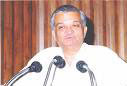
 PATNA, Oct 11: Admitting that differences persisted between the UPA and its left allies on the Indo-US civil nuclear deal, Union Agriculture Minister Sharad Pawar on Thursday said that the Manmohan Singh government would not fall.
  VIENNA, Sept 24: Atomic Energy Commission Chairman Anil Kakodkar has said that India has received recognition as the most advanced nation in nuclear fuel cycle technology at the IAEA meet and there was greater awareness of the "larger role" of nuclear power in meeting global energy needs.
 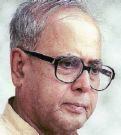 NEW DELHI, Sept 23: Soon after top Left leaders Jyoti Basu and Buddhadeb Bhattacharjee backing the contentious Indo-US nuclear deal, External Affairs Minister Pranab Mukherjee has said that he was hopeful of resolving issue at the crucial meeting scheduled to be held between the UPA and Left on October 5.
 WASHINGTON, Sept 3: Congress party president Sonia Gandhi has been placed sixth in the Forbes list of the world's 100 most powerful women.
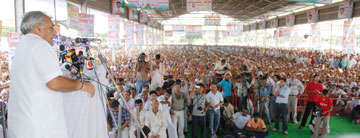 GOHANA (Haryana), Aug 26: In a landmark decision, Haryana Government has decided to to give an additional amount of Rs 10,000 per acre per year for 33 years to the farmers whose land has been acquired by the State agencies.
 NEW DELHI, Aug 20: In an apparent message to parties opposed to the Indo-US civil nuclear cooperation, Prime Minister Manmohan Singh said no government can afford to shirk the responsibility of pursuing a "sound" energy security strategy in which nuclear fuel plays an important role.
  MUMBAI, July 31: Popular Bollywood actor Sanjay Dutt was on Tuesday back in prison, after being sentenced to six years rigorous imprisonment by the special Terrorist and Disruptive Activities Act (Tada) court.
 Shiv Bhatia is Media Advisor to Haryana CM
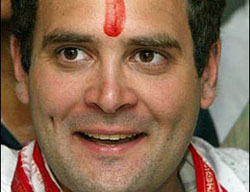 NEW DELHI, June 19: The Congress party's heir apparent Rahul Gandhi turned 37 as jubilant party workers burst crackers and distributed sweets on the occasion.
 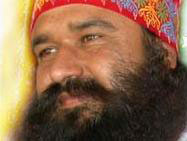 SIRSA, May 28: Dera Sacha Saudh Chief Sant Gurmeet Ram Rahim Singh has apologised to Sikh Guru Gobind Singh which was announced through a press release by the Dera in Sirsa
 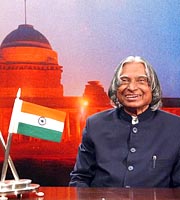 New Delhi, April 25: President A.P.J Abdul Kalam may not be averse a second term in office provided there is a general consensus on his candidature.
  Afzalgarh/Pilibhit (Uttar Pradesh), April 15: Commending Nehru-Gandhi scion Rahul Gandhi to the people of Uttar Pradesh, Prime Minister Manmohan Singh in his first round of campaigning Sunday described him as the state's future leader.
  CHANDIGARH, April 6: Tibetan officials in exile in India have stepped up security for the Dalai Lama following media reports that he faced threats from Islamist militants, police said.
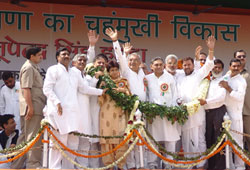 NEW DELHI, March 30 : Even though the West Bengal Government is having tough time handling Special Economic Zones (SEZs), Haryana Chief Minister Bhupinder Singh Hooda has found overwhelming support from the people, especially farmers, over the development of SEZs in the State.
  It says 31 per cent felt that 'initiatives for farmers' welfare' were the biggest achievement of the government. As many as 17 per cent people felt that 'development of rural areas' was the government's biggest achievement. While 15 per cent rated 'industrial government' as the biggest achievement, 12 per cent people opined that 'employment generation' was the crowning glory for the government.
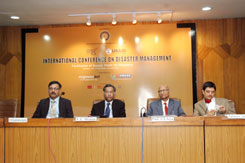
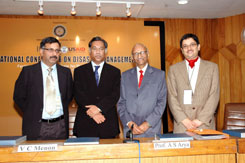
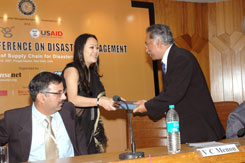
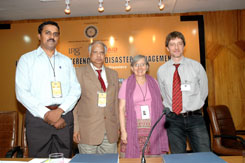
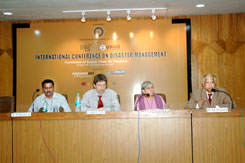
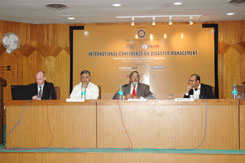
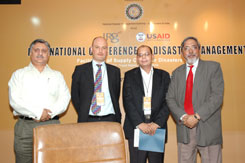
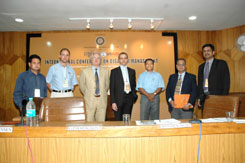
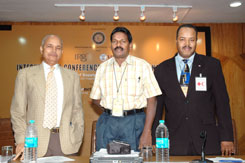
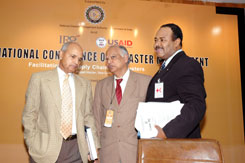
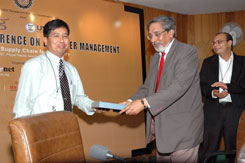
 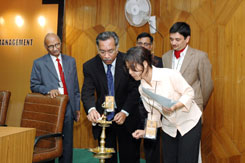 NEW DELHI, March 28: The unpredictable disasters like the 9/11 terror attacks in New York and Washington DC, the Indian Ocean Tsunami, Katrina and recent earthquakes in Jammu and Kashmir, Pakistan, Iran and Gujarat have put immense pressure on the governments and non-governmental organizations for organizing quick humanitarian assistance to the affected people.
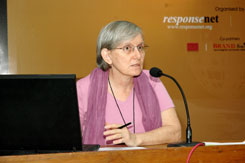 Ms Nina Minka, Senior Disaster Management Advisor, Office of Social Development, USAID India, stated that the Indian Incident Command System, which is being established here, has been started with a pilot program in Gujarat with collaborations between the US and Indian entities. “It will help to improve onsite disaster response,” she added.
  |
 |
 |
 |
 |
 |
 |
 |
 |
 |
 |
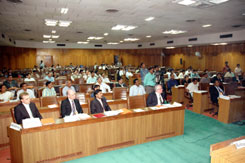 |
Mr. Mohamed Babiker, Head, India Office, the International Federation of Red Cross and Red Crescent Societies, spoke about their preparedness for disaster management and gave details about their vendor management strategies.
Mr Gian Pietro Bordignon, Representative of United Nations World Food Programme, highlighted the importance of food chains at the times of disasters and Mr Bipin Verma of WHO SEARO spoke about emergency medicines supply management.
Other topics like warehousing, transportation, telecommunication were covered by Mr. Yogesh Kochhar, CSR Head, Tata Tele Services and Mr S. D Saxena, Director, BSNL. Mr. Manu Gupta, Director of Seeds India, spoke about structural mitigation solutions.
Angela Nar of Responsenet stressed on the importance of cooperation among the stakeholders and partnerships that need to be built up in the coming years for an effective and efficient disaster preparedness and response.
Chhatisgarh Naxals attack: 50 security personnel killed
RAIPUR, March 15: About 50 security personnel have been reported killed when armed naxals lobbed grenades and opened indiscriminate firing at a police outpost in Bijapur district of Chhatisgarh in the wee hours this day.
Although senior officials were tight lipped about the casualty figure, sources in police said about 50 personnel were killed in the attack at the outpost in Rani Bodli, about 525 km from Raipur.
Thirteen personnel, including an officer, were injured in the pre-dawn attack on the police post, they added.
Twenty-three personnel of Chhatisgarh Armed Force and 55 Special Police Officers were posted there.
"Some bodies and weapons are lying in that area, which we have not yet counted so we cannot give the actual figure of death in the incident," Bastar Range Inspector General of Police R K Vij said.
A large number of naxals attacked the outpost, located in a jungle, from all sides and opened indiscriminate firing besides lobbing grenades and petrol bombs, sources said.
Before fleeing away with the weapons of the forces, the naxalites heavily landmined the area and the barrack, where the policemen were staying, they added.
Many dead bodies are also laying in that barrack, they added.
Bomb Disposal Squad were clearing land mines, the sources said adding CRPF was also helping them in this.
Bijapur is a totally naxal infested area and after the Salwa Judum or anti-naxal operation, the Maoists have become more aggressive and targeting both the civilians and security forces.
At least 676 people were killed in Naxal-related violence in Chhattisgarh over the last two years.
12 killed in Nandigram police firing
Kolkata, March 14: Violence flared again in Nandigram with activists of the Bhumi Ucched Pratirodh Committee, protesting against land acquisition, fighting pitched battles with police. Reports say that 12 persons were killed and scores injured in the firing.
The trouble started since morning when a large contingent of security forces tried to enter various villages in Nandigram area and was faced with stiff resistance from activists of Bhumi Ucched Pratirodh (Land Acquisition Resistence) Committee forcing police to open fire.
Superintendent of Police G A Srinivas, who was supervising the operation, said that police had to open fire after teargas shells failed to control the situation.
He, however, was not clear about the number of casualties but said that "a number of people including some policemen must have been killed in the clashes".
Unconfirmed reports said that at least five persons were killed and nearly 50 others were injured.
Nandigram, about 150km from Kolkata, has witnessed continuing violence since January against the acquisition of land for a proposed SEZ to be set up by Indonesia’s Salim group.
Highest-ever compensation to Haryana farmers
By Deepak Arora
NEW DELHI, March 14: True to his image of a Chief Minister of Aam Aadmi, Mr Bhupinder Singh Hooda on Wenesday announced highest-ever compensation to farmers affected by the recent hailstorm.
After conducting an aerial survey of the hailstorm affected areas in the districts of Mahendergarh, Rewari, Mewat and Faridabad, the Haryana Chief Minister said that the farmers who had suffered cent per cent loss would be given compensation at the rate of Rs 5000 per acre for wheat and Rs 4000 per acre for other crops.
Mr Hooda said those farmers whose crops had suffered 50 per cent to 75 per cent damage would be given compensation at the rate of Rs 4000 per acre for wheat and Rs 3000 per acre for other crops. Similarly, those farmers whose crops had suffered damage from 25 per cent to 50 per cent would be given compensation at the rate of Rs 3000 per acre for wheat and Rs 2000 per acre for other crops.
The Chief Minister personally visited the fields of many villages to assess the damage caused to the crops due to heavy rains and intense hailstorm and gave a compassionate hearing to the affected farmers.
Mr Hooda assured the farmers that they would be given compensation for the damage caused to their crops by April 15 this year.
Besides compensation for damaged crops, he said other facilities would also be provided to the farmers on priority basis.
Mr. Hooda said that directions for the conduct of special Girdawari of the hailstorm affected areas had already been issued and the revenue officials especially Patwaris had been directed to ensure that announcements be made before conducting special Girdawari so that no farmer was left out. He said that
strict action would be taken against any officer or
official who was found lacking in any way for ensuring
the proper completion of Girdawari.
The Chief Minister assured the farmers that he would support them in this hour of their need and said that the compensation being given to them was the highest in the country. He said that being himself a son of a farmer he could fully comprehend their pain and loss.
While addressing the farmers, the Revenue Minister, Capt Ajay Singh Yadav pointed out that the Chief Minister had personally come to share the pain of the affected farmers even though the budget session was in progress.
Parliamentary Secretary, Rao Dan Singh also emphasized that the present Government would distribute adequate compensation to the farmers and would not act in a miserly manner as had been done by the previous government.
He asserted that the present State Government believed in fulfilling the promises made to the people unlike the previous regime which had only given false hopes to them. He assured that farmers would receive full support from the State
Government.
Two arrested in Samjhauta Express blast case
INDORE (MP), March 14: Two persons have been arrested here by the Haryana police for their suspected involvement in the Samjhauta Express train blast, police sources said on Wednesday.
The two, identified as Huzaifa of Abhinandan Bag Centre and the shop manager Poonam Singh Thakur, were taken to Panipat or Chandigarh after seeking permission of the court for further probe, they said adding it was established that the cover of the suitcase in which bombs were planted was stitched by them.
However, it was not established as yet whether the suitcase of 'Kodak brand' was actually purchased from Indore or not as they are of inferior quality costing nearly Rs 150-200 and was supplied by a Mumbai-based firm.
Two powerful explosions ripped through two coaches of the Lahore-bound Samjhauta Express on the night of February 18, killing 67 people near Panipat.
The sources said Huziafa and Thakur were not cooperating in the probe. They were unable to provide the sales record to the probing team.
Even the probe team was unable to establish whether the plastic bottle of Sourabh plastic of Indore found in the suitcase was actually purchased from the city or not as the product is being distributed from here to places situated upto a distance of 400-500 km, they said.
The probe team during investigations has also found an Aligarh connection as the leading newspaper in which the bombs were wrapped was published from Aligarh, Uttar Pradesh, the sources said.
INSAT-4B successfully launched
BANGALORE, March 12: India's communication satellite INSAT-4B was launched early on Monday on board the European Ariane-5 from Kourou in French Guyana and placed successfully in geo-synchronous transfer orbit.
A top Indian Space Research Organisation (ISRO) official said the space agency's Master Control Facility (MCF) at Hassan in Karnataka picked up the satellite's first signals 30 minutes after it was lifted-off from the Arianespace launch facility at 03:33 IST with co-passenger Skynet-5A of EADS Astrium.
"The 3,025 kg satellite is orbiting in 3-axis stabilised mode, with a perigee (nearest point to earth) of 243 km and an apogee (farthest point to earth) of 35,876 km at an inclination of 4.52 degree to the equator. The orbital period is about 10 hours 34 minutes," the official said in Bangalore.
With 12 high-power Ku-band transponders and 12 C-band transponders, INSAT-4B is intended to augment the Indian satellites (INSAT) capacity for Direct-To-Home (DTH) television and communication services.
Even as the MCF took control of the satellite to track and monitor remotely, experts are utilising Inmarsat organisation's telemetry, tracking and command ground stations at Beijing (China), Fucino (Italy) and Lake (Cowichan) Canada, besides the state-owned agency's network station (Istrac) at Biak in Indonesia for initial operations.
INTACH restores water bodies
By Deepak Arora
NEW DELHI, March 9: During the last few years, Indian National Trust for Art & Cultural Heritage (INTACH) has emerged as a major expert body for restoration of water bodies and conserving natural heritage all over the country.
Natural Heritage Division of INTACH at the moment is implementing nearly 17 projects in deserts of Rajasthan as well as in Kumaon Hills to restore water bodies. These include restoration of lakes which have been highly segmented and encroached upon as well as restoration of wetlands which provide a natural habitat for the birds.
These schemes were worked out by INTACH in consultation with environmentalists and implemented in collaboration with local authorities.
The projects completed include Hauz Khas Lake, an ancient reservoir as water harvesting and groundwater recharge structure, in New Delhi. This has resulted in rise of water table in the area and the lake has stabilized as a recreation place for the residents of the area.
The lake has been provided wastewater from Vasant Kunj Sanjay Van area through gravity flow. Fish have been introduced in the lake to consume organic material and the lake which had become a dump has been restored to its natural beauty.
The other projects to be undertaken in Delhi include Jahangirpuri Marshes, Bhalaswa Lake and Creation of water body downstream of Satpula Dam in Khirki. While the Bhalaswa Lake project is being implemented by DDA as recommended by INTACH, the Jahangirpuri Marshes project has not taken off because of a Public Interest Litigation filed in Delhi High Court.
INTACH has also implemented a Watershed Management Programme for Shriram Fertilizers and Chemicals at Kota in Rajasthan which has resulted in creation of three watersheds which have provided habitat to bird life and helped in saving substantial money for the company by reducing the water bills. This has been achieved for building a check dam by using flyash a waste product of the unit.
Another scheme under implementation is water harvesting on Central Ridge Stream in Delhi. This three kilometer stretch known as Kushak Nala is being improved by modifying the stream bed and collecting the rain water and waste water in the area.
The other projects include Water Augmentation at Elephanta Island in Maharashtra, an Urban Water Harvesting programme in Delhi, a blueprint for water augmentation and management programme for Rajkot town, Jamnagar in Gujarat. Anjar town in Kutch district of Gujarat, which was devastated in the earthquake, is being reconstructed with the help of INTACH and other international experts. The plan includes environmental improvement and water harvesting.
INTACH has also been entrusted with Shoreline Development Plan for five lakes in Nainital. The programme at the moment is being implemented in initial stages. The attempt will be to remedy the catchment’s area, arrangement for treatment of water and restoring some of the linkages with the lake.
In Sikkim, INTACH has prepared a plan for trekking and nature tourism at the instance of the Sikkim Government. This is expected to give a big boost to tourism in Sikkim and thus help its economy while preserving the ecological balance of the area.
One of the unique projects under consideration at the moment is development of Biodiversity Park in Mahipalpur in Delhi at the instance of Army which controls the area. The Plan prepared is being considered by the Army.
Efforts to improve ties with Pak bearing results: PM
NEW DELHI, March 8: Prime Minister Manmohan Singh has said efforts are being made to improve ties with Pakistan and they have started yielding "positive results".
Winding up debate on Motion of Thanks on the President's address in both houses of Parliament Dr Singh also said his Government was committed to fight communalism and sectarianism.
Dr Singh expressed confidence that all outstanding issues with Pakistan would be resolved through dialogue.
"We have been working purposefully for all-round improvement of relations with Pakistan," Singh said while delving on the foreign policy of his government.
Underlining that India needs "long-lasting peace, friendship and amity" with Pakistan, he said "efforts we have made are beginning to bring positive results. We will work resolutely (in this direction)."
The Prime Minister said while striving for friendly and mutually-beneficial relations with its immediate neighbours, India's ties with all other countries, including the US, Russia and China, had grown over the last three years covering many new areas.
Sending a tough message in the run-up to UP assembly polls, Dr Singh has said "communalism" and "sectarianism" will be fought in all its forms and manifestations.
He also affirmed the Government's commitment to work for the welfare of Muslims and other minorities because of "current disparities".
Against the backdrop of Congress' debacle in Punjab and Uttarakhand for which price rise was one of the factors blamed, Singh affirmed the Government's commitment to contain inflation and tackle problems of unemployment and poverty while pursuing "inclusive" growth process.
Winding up the debate on the Motion of Thanks on the President's address in Lok Sabha, he said "we will not allow anyone to weaken our democratic tradition. We are committed to Constitutional values....We will fight communalism and sectarianism in all its forms and manifestations".
The Motion was later approved by a voice vote.
The Prime Minister said a targeted programme for districts having minority concentration is being launched for their welfare.
In an apparent reference to the unofficial ban in BJP-ruled Gujarat on screening of 'Perzania", a film based on violence in Godhra aftermath, he said "there is no space for such intolerance."
"India is an open society but not with a closed mind," he said.
"I do share the concerns (on price rise). I am convinced that the important steps put in place on demand and supply side will help us moderate inflationary pressures in the coming months," Singh said.
Turning to internal security, the Prime Minister had a dig at Leader of Opposition L K Advani, saying that the track record of the UPA government was "better" than that of the NDA regime when Advani was the home minister.
"Whether it is the North-East, Jammu and Kashmir or Naxalite-affected areas, the overall internal situation is far better than the previous NDA regime," Singh said.
While comparing incidents of violence after Godhra and the situation in Maharashtra after the Mumbai blasts, he said there had been no breakdown of law and order.
Prime Minister said the government would not hesitate to correct itself if it had erred in the Special Economic Zone policy, which has drawn flak from certain quarters, particularly on land acquisition.
"If we have made any mistake... We will make necessary corrections," he said.
Advocating a more considerate approach to acquisition of land for industrial purposes, he said the accent should be on "more humane rehabilitation and resettlement policy" for those whose land has been taken away.
The country has been debating the rationale of allowing farm lands to be acquired for SEZs and industrial projects, especially in West Bengal, where the Rs one lakh car project by Tata in Singur led to violent protests by farmers.
Similar protests were also witnessed against another SEZ project in Nandigram.
Singh said a Group of Ministers headed by External Affairs Minister Pranab Mukherjee was reviewing the approach to SEZs.
If industrialisation leads to loss of land, these concerns have to be taken on board, the Prime Minister said, but underpinned the need for aggressive industrialisation to ensure inclusive growth.
But growth cannot be allowed to fuel inflation, particularly when it hurts the common man. "...In the process of growth if inflation becomes a problem and that it brings agony and hardships for the poorer sections of our society that also has to be dealt with on a priority basis", Singh said.
The Prime Minister said supply side shortages - the main reason for inflation - could be removed through imports but in the process, interests of farmers could not be harmed."Our effort has been to bring in those imports without affecting profitability of domestic agriculture," Singh said.
"Also international prices of wheat, maize and vegetable oil have gone up partly due to crop shortfall and partly because of increased demand for use in the production of biofuel all over the world. Thus, it becomes difficult to control domestic prices," he said.
He said there are already indications that inflation rate has declined by in the last two weeks. Wholesale prices-based inflation stood at 6.05 per cent during the week ended February 17 compared to 6.63 two weeks ago.
He also said the government was aware of the challenge of near stagnation in agriculture production and that it would "work steadfastly to identify the problems as they vary from one part of the country to another."
"I have already asked the Planning Commission to work out area-specific regional plans for development of agriculture. We will be able to call a meeting of the National Development Council, especially to focus on the problems of agriculture and what needs to be done to revitalise our rural people," he said.
The Prime Minister said growth was a necessary condition for tackling the enormous social and economic problems that the country faces, but it was not the sufficient condition.
"We need to pursue a purposeful strategy which will ensure that the growth process benefits all the sections of our population," he said.
Police releases sketch of two suspects in train blasts
NEW DELHI, Feb 20: Police released sketches of two persons adding it was the handy work of 4-5 people to be behind the Lahore-bound Samjhauta Express train blasts that left 68 people dead.
The duo boarded the train from Old Delhi railway station on Sunday night and had alighted from it about 15 minutes before the explosions when the train had slowed down near the Deewana station, Inspector General Rohtak Range Sharad Kumar told reporters here.
He said the sketches have been prepared on the basis of descriptions provided by passengers.
"The two suspects had a heated argument with the personnel of Railway Protection Force for about 20 minutes in the train and they alighted from it when it slowed down near Deewana station," Kumar said.
Police announced a cash reward of Rupees 1 lakh for any person who provides information on the suspects. Following the blast an ASI, Kashmira Singh of RPF also died while trying to rescue the injured from the burning train.
A team of experts from the Mumbai Police would be coming later in the day to help the investigation. According to the Ministry of Home Affairs and Passport Office there were 724 people who left for Pakistan. 619 boarded the train from the Old Delhi railway station. 105 boarded the train from Amritsar.
During the press conference police also showed various objects, which were used for the blast. Notable among them were bottles filled with kerosene and a piece of cloth, pipe and clock used as a timer. The bottles were manufactured in India.
Seventeen of the 68 killed in the Samjhauta Express blasts have been identified, of whom 13 are Pakistani nationals.
Sixteen people identified were among those who died on the spot when the blasts occurred near Deewana railway station in Panipat on trans-border Samjhauta Express on Sunday night.
Harif Mohjammed, a Pakistani national, succumbed in Safdarjung Hospital in New Delhi, officials said.
The identified Paksitanis included five of a family -- Tasleem Khan, his wife Nafeesa Begum, daughter Mahreen Khan and sons Rool Amin and Mohd Sajid, residents of Pakistan's Hyderabad.
The bodies of Saiyyad Akhtar, a resident of Karachi, his wife Ashraff Jahan and their kids Hasan Ali and Mehak were also identified today by his relative. Akthar's relatives Izhar Hussain and his wife Razia Sultan were also among those identified.
Shafiq Ahmed of Karachi was also one of those who died.
The Indians included Shakina Begum of Seelampur in Delhi and two RPF personnel, Kashmir Singh and Rajender Pal. Yasmin Akhtar, a resident of Srinagar, is also among the dead.
Meanwhile, six medical teams from Western Command of Army has embalmed 57 bodies. The team is led by Brigadier Amarjit Singh, Deputy Director of Medical Services.
66 killed in Samjhauta Express blast
NEW DELHI, Feb 19: In a major terror strike, 66 Pakistan-bound passengers including women and children, were charred to death and 60 injured when two coaches of the Samjhauta Express caught fire following explosions.
A deadly cocktail of low-intensity explosives and kerosene bombs were used to trigger the blasts that converted the two general compartments into an inferno, a day before the visit to India of Pakistan Foreign Minister Khurshid M Kasuri.
Bodies charred beyond recognition, mangled metal of the two coaches, burnt bangles, footwear and other belongings of the passengers bore mute testimony to the ghastly attack that occurred 75 minutes after the train had left Delhi.
Kashmir, an RPF constable from Amritsar, was among the dead, who has been identified.
Two suitcases containing IEDs were recovered from the train and the track, one of which contained petrol or kerosene, Northern Railway General Manager V N Mathur said at the spot adding this was a clear case of sabotage.
Forensic experts who collected samples from the train were of the view that low intensity explosives like sulphur or nitrate were used to trigger the blasts with kerosene-filled bottles acting as catalyst to spread the fire.
While most of the injured were admitted to Panipat Civil hospital, 11 were taken to Safdarjung hospital in Delhi from were the Delhi-Attari special had left at 10.40 pm on Sunday night.
Security experts believe that the explosives could have been planted in Delhi as the train has a non-stop run up to Attari on the Indo-Pak border with a two-minute technical halt at Ludhiana where no one can get in or get out of the train.
The train with other passengers resumed its journey after detachment of the affected coaches.
President A P J Abdul Kalam, Prime Minister Manmohan Singh, Home Minister Shivraj Patil, Railway Minister Lalu Prasad, Congress President Sonia Gandhi and Haryana Chief Minister Bhupinder Singh Hooda condemned the blast and expressed anguish and grief over the loss of life.
The Prime Minister said that the culprits would be brought to book while Patil, who visited the spot and Prasad stated that the attack was aimed at derailing the Indo-Pak peace process.
The Railway Minister announced a statutory inquiry into the incident and compensation to the victims' families.
Pakistan also condemned the attack and hoped that the Indian government would conduct a thorough investigation into it and punish those responsible.
India opened a special visa camp in the Grand Hotel in Lahore to facilitate immediate travel by relatives of those killed or injured in the blast.
The Indian High Commission in Islamabad will coordinate arrangements to enable their expeditious travel to India.
After the blast security around vital installations across the country was tightened.
Special security measures have been taken for the safety of passengers travelling by Delhi-Lahore bus service.
The identification of the dead, who included women, was difficult as the bodies were charred beyond recognition in the fire that followed the explosions, Superintendent of Police (Panipat) Mohinder Singh Sheoran said.
A senior police officer said a Pakistani national Shamsuddin, who was travelling in the train, has given information to the police regarding some explosives being planted in it.
Police is talking to the passenger.
After detachment of the two burnt bogies, the remaining compartments of the train carrying around 500 passengers left for Attari after a thorough check by security personnel.
A woman travelling in the train recounted that there was a sudden ball of fire in the train as it moved in its normal speed with most of the passengers asleep.
A Saharanpur resident, Zubaida, who was going to Karachi in Pakistan, said that around midnight there was noise and shouts of fire from the passengers.
"Initially I and other passengers failed to understand as to what had happened," she said at the railway station in Ambala where the train made a special halt.
Zubaida, who was travelling in the three-tier sleeper bogie adjacent to the one which was burnt said, "after seeing outside I and other passengers found that the bogies behind ours were on fire".
The railways have set up special telephone helplines to provide information related to the Samjhauta Express train tragedy.
Following are helpline numbers:
New Delhi Railway Stations--011-23341074, 23342954,
Head Quarter (New Delhi)--011-23389319, 23389853 and
23385106;
Hajrat Nizamuddin--011-24355954;
Ambala station--1072, 0171-2610329, 2611072,
Amritsar station--0183-2223171, 2564485;
Ludhiana--0161-2760006;
Jalandhar--0181-2223504; and
At site--0180-3297823, 6450342.
Following is the list released by the Safdarjung hospital of those injured in the Samjhauta Express blast in Haryana and admitted there.
The injured comprise 10 Pakistani nationals and two Indians out of whom one was an year-old child.
The condition of almost all of them has been described as critical by the hospital authorities.
1. Ruksana (40) Faisalabad, Pak (critical)
2. Aksa (one), Faisalabad, Pak (critical)
3. Rana Shaukat Ali (46), Faisalabad (Pak) (critical)
4. Harif Mohammed (15), Karachi (critical)
5. Mohammed Shakeel (25), Sindh, Pak (critical)
6. Ramesh Kumar (40), Sialkot, Pak (critical)
7. Mohd Zakir (37), Bijnore district, UP (critical)
8. Ashok Kumar (21), Mohalla Dharuwal, Sialkot (critical)
9. Nadeem (10), Mirpur Khas, Sindh (Pak) (critical)
10. Abdul Khayyum (56), Karachi, (critical)
11. Shamim Mohammed (9), Karachi Pak (critical)
12. Tarsem Lal (51), Gurdaspur, Punjab (shoulder injury)
Rs 10 lakh compensation for kin of those killed in train blast
The Government has announced a compensation of Rs 10 lakh each for the next of kin of those killed in the explosions on trans-border Samjhauta Express.
The announcement was made by Railways Minister Lalu Prasad after he visited the Bhimsen Sachar Civil Hospital, Panipat where the 13 injured in the blasts were initially brought for treatment.
While a Pakistani national Qamruddin (60), a resident of Multan, is being treated at this hospital for minor burn injuries, the remaining 12 injured who suffered around 40 per cent burns have been taken to Delhi.
Prasad, also announced that the Railway Ministry would give jobs to one family member of each Indian killed in the blasts.
A relief of Rs 50,000 will be given to those injured in the blasts.
The bodies of those killed in the explosions, many of which were charred beyond recognition, have also been brought to the hospital, which is around 12 km from the spot where the train had come to a halt on Sunday night.
Rahul notice to website for scurrilous charge
By Deepak Arora
NEW DELHI, Feb 2: The Congress leader, Mr Rahul Gandhi, has reacted strongly to a scurrilous report against him carried by an anonymous website believed to have been emanated from the US.
With the Uttar Pradesh elections in the offing, this is viewed as a malicious attempt to defame him and damage his domestic and global standing as a popular leader.
The website, Hinduunity.org, had hoisted a charge of rape against the Amethi MP.
Mr Abhishek Singhvi, Congress spokesman and a leading lawyer, said that he has sent a legal notice to the two entities, based in the US, who been identified as the culprits after investigating the matter.
Mr Singhvi said the publication (website) exceeds and excels even the worst standards of scurrilous, perverted and gutter writing and is obviously emanation of diseased minds, acting at the behest of maliciously motivated elements who cannot digest his standing and popularity in India and globally.
He said “the contents of this publication are so incredible and outrageous that normally even any response would amount to dignifying and recorgnising the outpourings of unhinged minds.”
However, he said “in view of Rahul Gandhi’s stature as a public figure and to obviate any notion by you (website hosts) that you can get away with such criminal and uncivilised behaviour, we are sending this notice.”
The notice said that all the conspirators would be prosecuted with all criminal and civil liabilities under the law.
He said that his client would seek exemplary punishment and pursue the conspirators and their associates relentlessly and would try to make an example to deter such a wild and irresponsible behaviour.
Mr Singhvi said “it is also time for civil society to sit up collectively and take notice whether such people can do such perversity.”
India committed to Universal N-Disarmament: Sonia
By Deepak Arora
NEW DELHI, Jan 29: Congress president Sonia Gandhi has said that India would continue to carry forward its "profound" conviction about commitment to comprehensive, universal nuclear disarmament.
"Yes, India has nuclear weapons. This became a strategic compulsion for us, born out of the failure to persuade the world to abolish nuclear weapons," said Mrs Gandhi, while inaugurating a two-day International Conference on "Peace, Non-Violence and Empowerment" organised by the Indian National Congress in commemoration of the centenary of the Satyagraha launched by Mahatma Gandhi in South Africa.
Referring to the blueprint for comprehensive, universal nuclear disarmament presented by her late husband and former Prime Minister Rajiv Gandhi at the United Nations in October 1988, Mrs Gandhi said "Just a few days ago, four influential Americans who held very different views while in office, including Henry Kissinger and George Shultz, have drawn attention to his impassioned plea and called for urgent action."
Quoting the words of the Mahatma in the aftermath of Hiroshima that ''...violence cannot be destroyed by counter-violence...Mankind has to get out of violence only through non-violence,'' Mrs Gandhi said ''since then nuclear weapons have become even more of a terrifying reality.”
In this context, she pointed that the world's nuclear weapon states had more than adequate atomic arsenal to destroy humanity many times over.
''An eye for an eye only ends up making the whole world blind,'' she told eminent delegates from 90 countries, while highlighting that these words of the Mahatma had showed that he was decidedly against the idea that violence was the only answer to violence.
The Congress President said "the relevance of Mahatma Gandhi is not the real issue. Our preparedness for him is."
It was on Sept 11, 1906 in Johannesburg that Mahatma Gandhi began his mass movement when he chaired a meeting against a law discriminating against Asians.
While making Mahatma Gandhi an icon would be easy, it would infinitely be more exacting to make him the beacon, she said.
Mrs Gandhi said economic growth could be sustainable only if it was all-inclusive and in harmony with nature and the earth's long-term future.
She said: "Our own country, for instance, has made spectacular gains over the past decades and is being rapidly transformed. But destitution, poverty, malnutrition and illiteracy are still widespread. Inequality is very visible.
"We live in an age of incredible scientific achievement and awesome technological advance. But are not the fruits of this achievement and advance still inequitably distributed?" she asked a crowd including world leaders like former presidents Lech Walesa of Poland and Kenneth Kaunda of Zambia and Nobel laureate Bangladesh's Mohammed Yunus.
External Affairs Minister Pranab Mukherjee, Minister of State for External Affairs and secretary General of the conference Anand Sharma, Walesa, Kaunda, Yunus, Mahatama Gandhi’s granddaughter and South African MP Ela Gandhi and former Palestinian foreign minister Nasser Al Kidwa also addressed the inaugural session.
"Is it not the case that a few enjoy the gains, whole many bear the pains?"
She said economic growth must be accelerated, but we should be mindful of possible adverse consequences of that progress and take steps to deal with them. "Can we not satisfy material wants and aspirations without threatening ecological security and planetary survival?"
"To be equitable, economic growth has to be sustainable. To be sustainable, economic growth has in turn to be all-inclusive. All-inclusive is no longer the greatest good of the greatest number. It is actually Sarvodaya or the rise of all. This Mahatma Gandhi saw as essential to Satyagraha itself," said Mrs Gandhi, who is also the Chairperson of the UPA.
In his video message to the conference from Johannesburg, anti-apartheid icon Nelson Mandela called on the world to reinvent Mahatma Gandhi's non-violent approach to solving conflicts.
Mandela, who spent 28 years in prison for fighting white rule before leading South Africa to multi-racial democracy as the country's first black president in 1994, said Gandhi's non-violent approach which won India freedom from British colonial rule 60 years ago was an inspiration.
"His philosophy contributed in no small measure to bringing about a peaceful transformation in South Africa and in healing the destructive human divisions that had been spawned by the abhorrent practice of apartheid," said Mandela.
In a world driven by violence and strife, Gandhi's message of peace and non-violence holds the key to human survival in the 21st century, said Mandela.
"He rightly believed in the efficacy of pitting the sole force of the satyagraha against the brute force of the oppressor and in effect converting the oppressor to the right and moral point."
All the leaders joined Mandela and gave a call to promote Gandhi's values.
In his speech, Kenneth Kaunda lashed out at the US and Britain for unleashing a war in Iraq. "I would appeal to (US President George W.) Bush and (British Prime Minister Tony) Blair and their allies to stop the war. No one with sensitivity and humanity can watch that senseless destruction on television."
Kaunda ended his speech with a song to purge Africa from the scourge of AIDS, asked all those funding terrorism to channel the money to fight tuberculosis and AIDS.
For this year's Nobel Peace Prize winner, Bangladesh's Mohammed Yunus, Mahatma Gandhi's satyagraha was aimed at eradicating poverty. "The world has now realized that peace and poverty are closely linked," said the founder of Bangladesh's Grameen bank.
"The systematic exclusion of poor from our financial institutions is economic apartheid... So we should work towards a world which our grandchildren and great grandchildren should be proud of and a world where poverty exists only in museum."
Former Polish president and Solidarity movement leader Walesa said Mahatma Gandhi should not be limited to South Africa and India.
Among others attending the conference are Mauritius Prime Minister Navichandra Ramagoolam, Maldives President Maumoon Abdul Gayoom, Slovenia President Janez Drnovesk, Italian Deputy Prime Minister Fransesco Rutelli and Indonesian Vice President Yusuf Kall.
World leaders arrive for Satyagraha celebrations
By Deepak Arora
NEW DELHI, Jan 28: World leaders and freedom fighters will assemble here on Monday to celebrate the centenary of 'Satyagraha', a non-violent form of protest introduced by Mahatma Gandhi to oppose oppression in society.
Leaders, freedom fighters, Nobel laureates and eminent personalities from 90 countries will participate in a two-day conference to share their views on relevance of Gandhi's ideology and values in the present world ridden with violence and conflicts.
The UPA Chairperson and Congress President, Mrs Sonia Gandhi, will inaugurate the conference “Peace, Non-Violence and Empowerment: Gandhian Philosophy in the 21st Century” being organised by the Congress party to celebrate the centenary of one of the greatest movements of the world.
Prime Minister Manmohan Singh will address the conference on Tuesday at the concluding session.
Presidents, Prime Ministers or senior ministers from several countries, including Sri Lanka, Nepal, Bangladesh, Spain, Afghanistan, Italy, Sweden, South Africa and Slovenia will also be attending the conference.
The Congress President on Sunday met several international leaders. As part of the bilateral meeting with South African delegation, Mrs Gandhi met Patrick Lekota, Chairman, ANC; Essop Pahad, Minister; Mrs. Ela Gandhi; Mr. Ahmed Kathtrada; and Ms. Barbara Hogan, MP.
She also met several international leaders including Mr. George Papandreaou, President of the Socialist Party of Greece; Mr. Franesco Rutelli, Deputy Prime Minster, Italy; Afsandyar Wali Khan, President, National Awami Party, Pakistan; and Dr. Kenneth Kaunda .
The official delegation of the Congress Party for the conference includes Margaret Alva, (Leader of the Delegation); Rahul Gandhi, MP; Tushar Gandhi; Dr. Shakeel Ahmed, MP; Kumari Selja, MP; Ajay Maken, MP; Ramesh Chennithala; Bharat Solanki; Jitin Prasada, MP; K. A. Sangtam, Ex-MP; and Ms. Meenakshi Natrajan, according to AICC Secretary Tom Vadakkan.
Significantly, some senior leaders from Pakistan, including chief of Awami National Party Asfandyar Khan and Muttahida Quami Movement leader Farooq Sattar, will take part in the celebrations.
Among the luminaries who have confirmed their attendance at the event are Nobel laureate Archbishop Desmond Tutu, South African freedom fighter Ahmed Kathrada, Bangladeshi economist and Nobel winner Muhammad Yunus, Peruvian economist Hernando de Soto, besides intellectuals like Lord Bhiku Parekh - who has been selected for the Padma Bhushan award this year - and Professor C.K. Prahalad.
On Saturday, Prime Minister Manmohan Singh Saturday inaugurated an exhibition on Mahatma Gandhi's Satyagraha ahead of the international conference.
Manmohan Singh, who lit the lamp to open the exhibition at Vigyan Bhavan here, had a detailed look at posters that had the Mahatma's messages on them, apart from several photographs. Mrs Sonia Gandhi was also present at the occasion.
The conference---which will also adopt the Satyagraha Centenary Declaration--- will discuss four themes: Conflict resolution and peace-building; Gandhian philosophy for poverty eradication, education and people’s empowerment; Dialogue among peoples and cultures; and Towards a nuclear weapons-free and non-violent world order.
Mirwaiz calls for end to armed struggle to resolve Kashmir
ISLAMABAD, Jan 21: In significant remarks, Hurriyat leader Mirwaiz Umer Farooq has called for an end to armed struggle to resolve the Kashmir issue as it has only created "more graveyards" and said the dialogue process should be given a chance.
The Mirwaiz, who is heading a three-member Hurriyat delegation to Pakistan, said "the dialogue process to resolve the Kashmir issue should be given a chance as efforts through military means have not achieved any results except creating more graveyards."
With the new strategy, Hurriyat would convince India to arrive at a more agreeable settlement, he said last night at a dinner hosted by POK Prime Minister Attique Khan. The delegation also met with President Pervez Musharraf.
Observing that peaceful negotiations were the only way out, he criticised the hardline Hurriyat faction led by Syed Ali Shah Geelani, which is opposed to the dialogue process.
"Some people involved in the struggle could still have some reservations but as far as the All Parties Hurriyat Conference was concerned we are not prepared to sacrifice any more of our loved ones," he said.
"We have already seen the results of our fight on the political, diplomatic and military fronts which have not achieved anything other than creating more graveyards," he was quoted by local daily 'Dawn' as saying on Saturday.
The Pakistan President had during last night's meeting with the Hurriyat delegation said "elements" hostile to the peace process, who attempted to create misunderstandings on Pakistan's stand should be "strongly countered and rejected".
Rebels kill 48 migrant workers in Assam
GUWAHATI, Jan 6: Suspected separatist rebels fatally shot 48 migrant workers and wounded at least 19 others in 10 separate attacks launched late Friday and early Saturday in India's remote northeast, officials said.
The attacks targeted poor, Hindi-speaking migrants in the state of Assam, and suspicion immediately fell on the rebel United Liberation Front of Asom, which is fighting for an independent homeland for the region's Assamese speaking people, the state's police chief, R.N. Mathur, said.
The shootings were the worst spate of violence in recent years, and raised fears the ULFA was seeking to broaden its insurgency following the breakdown of peace talks last year.
The most lethal attack was Saturday's pre-dawn shooting of 13 workers while they slept in the remote town of Sadiya, 600 kilometers (370 miles) east of Assam's capital Gauhati, said local administrative officer Absar Hazarika.
On Friday, 35 people were fatally shot in several incidents in the tea-growing districts of Tinsukia and Dibrugarh, 500 to 600 kilometers (310 to 370 miles) east of Gauhati, Mathur said. Details on individual attacks were not immediately available.
ULFA has not claimed responsibility for the attacks, although rebel officials don't usually comment on such incidents.
"Intensive operations against the ULFA militants are being carried out jointly by the army, police and paramilitary (forces)," said Mathur, who added the operations were proceeding slowly because of difficult terrain.
Separately, a bomb exploded Saturday on an express train running from New Delhi to the city of Dibrugarh in Assam, but there were no casualties, railway spokesman T. Rabha said. Officials were not sure if the rebels were behind that attack as well.
ULFA, fighting for an independent homeland since 1979, stepped up its violent campaign after the Indian government called off peace talks and a six-week temporary truce in September and resumed military offensives.
At least 10,000 people, most of them civilians, have died in Assam because of fighting between government forces and ULFA, as well as another separatist group, the National Democratic Front of Bodoland.
Friday and Saturday's attacks also came as Assam was preparing to hold the National Games, India's biggest sporting event, next month.
ULFA has urged spectators and competitors to boycott the games, but authorities insist they will not let the event be disrupted.
"We shall ensure foolproof security during the National Games, which will certainly be held despite the ULFA threat," federal Home Secretary V.K. Duggal told journalists Thursday in Guwahati.
Strange Fallout of Sachar Committee Report
By Dominic Emmanuel
 The Sachar Committee’s report made many heads roll in and out of the government. While the BJP is mum on the subject, the so-called secular parties are inventing ways to please the aggrieved Muslim community. Several Muslim scholars are now writing on the pathetic condition of Muslims on all fronts, highlighting how in every sphere of life, barring prisons, their representation is dismal in proportion to their population.
Immediately following the news of the Sachar Committee, Union Minister for Minority Affairs Mr. A. R. Antulay grabbed the opportunity and declared that he not only agreed with the PM to grant a “fair” share to the minorities but that he was, “for including Dalit Muslims and Christians in the reserved SC/ST category. By just changing their faith, their status, social and economic backwardness and the burden of being downtrodden for centuries, does not change overnight”.
No sooner had Mr. Antulay finished speaking, another Congress leader Veerappa Moily joined in the chorus. Not to be left behind and with eyes on the forthcoming elections in UP Mulayam Singh too is now advocating the case of Muslim reservations. With an almost inaudible whisper he and others are heard uttering the unutterable word ‘Dalit Christians’, an otherwise forbidden term in political circles. All this is like manna from heaven for Dalit Christians who have been fighting an almost losing battle for several decades to be recognized as Dalits.
The agonizing saga of Dalit Christians began when in 1950, the then President of India, Dr. Rajendra Prasad, by a Presidential Order denied granting amenities to the ‘Dalits’ of other religions except Hindus. In 1956, however, reservation privileges were granted to the Sikh ‘Dalits’ by the amendment in Presidential Order of 1950 and in 1990 the same was approved for Buddhist ‘Dalits’.
Earlier reservation to tribal Christians was given on the basis of their geographical location and not religion; and while tribals continue to enjoy their rights after converting to Christianity, the ‘Dalits’ do not.
The Kaka Kalelkar Commission setup by Government of India in 1953 investigated the conditions of socially and educationally backward classes and found that in some parts of South India, the discrimination between the so-called “upper caste” Christians and the ‘Dalit’ Christians was so huge that ‘Dalit’ Christians were not even allowed to share one church and cemetery with them. The Commission had rightly advised the government for reservation to ‘Dalit’ Christians, but it was put in the cold storage by the government.
In another significant case between Soosai Vs. Union of India (1985), the Honourable Supreme Court maintained that to avail privileges mentioned in Presidential Order of 1950, it was not sufficient for people to show that they continued to remain in the same caste even after conversion but it was necessary to establish further that their disabilities and handicaps persisted even after their conversion.
In 1990, the study conducted by the Indian Social Institute in Tamilnadu concluded that the disabilities suffered by the converted ‘Dalits’ and the non-converted ‘Dalits’ are the same. The same Institute conducted another study on ‘Dalit’ Christians in 1994 only to find out that in Tamilnadu they suffered double discrimination, one at the hands of society and the other at the hands of the ‘secular’ state because of their religion.
Much before these studies came to light Mahatma Gandhi advocated in “Harijan”, of 26.12.1936 the right to reservation for ‘Dalit’ Christians. Baba Ambedkar held the same view, which was once again confirmed by Babu Jagjivan Ram in his speech in Hyderabad on 10.02.1979 supporting the cause of ‘Dalit’ Christians.
With Articles 14 (equality before law), 15 (Prohibition of discrimination on grounds of religion, race, caste, sex or place of birth) 16 (Equality of opportunities in matters of public employment) the Constitution of India is so clear that it allows neither the government nor indeed the courts to play hide and seek with the fundamental rights of Dalit Christians.
A PIL filed in 2005 by the Centre for Public Interest Litigation and others, challenging the Constitutional validity of 1950 Presidential Order, under which ‘Dalits’ professing and converting to religions different from Hinduism, Sikhism and Buddhism were deprived of reservation benefits, is pending in the Apex Court.
In 2005 Prime Minister Manmohan Singh constituted ‘The National Commission for Religious and Linguistic Minorities’ with retired chief justice of India, Justice Ranganath Misra as its Head. The Commission will advise the government on the identification of the socially and economically backward sections among the minorities. It will also suggest the necessary changes in the Constitution and legal and administrative setup, based on its recommendations. The Commission is expected to submit its report in April next year.
However some say that if right to reservation is granted to ‘Dalit’ Christians, there will be large public outcry about introduction of caste system in Christianity.
Archbishop Vincent M. Concessao, the Archbishop of Delhi and the President of the National United Christian Forum in a recent statement released to the Press has registered a strong protest, “against Government’s apathy towards Dalit Christians” and has expressed, “As the feast of Christmas is around, it would be truly a Christmas Gift if the Government could positively respond to the repeated appeal of Dalit Christians for what is their due”
It appears that the Sachar Committee Report is having the effect of a double-edged sword. In the process of bringing relief to the Muslim minority community, it could unwittingly be a harbinger of good news to the Dalit Christians and those fighting for their rights.
The Christian Community hopes that it would not have to wait for many more Christmases before their voice for a just cause can be paid heed to.
Uttar Pradesh needs new leadership: PM
Lucknow, Dec 23: With the Uttar Pradesh assembly polls round the corner, Prime Minister Manmohan Singh Saturday took a dig at Chief Minister Mulayam Singh Yadav, saying the state needs a 'forward looking leadership'.
'In recent years, Uttar Pradesh has been held back by a leadership that only thinks about the past,' the prime minister said here while giving away the Laxmipat Singhania-IIM (Indian Institute of Management) Lucknow National Leadership Awards 2006.
To emphasise how Uttar Pradesh lags behind other states on the development index, he said, 'If present trends continue, by 2020 Punjab would be where Germany is today, while Uttar Pradesh would be where Punjab is today. This cannot be an acceptable outcome.'
Manmohan Singh, whose Congress party is desperate to make a comeback in the state, went on to say: 'Uttar Pradesh desperately needs forward looking and modern leadership.
'The people of Uttar Pradesh need a government that will invest in their future. They need a leadership that is thinking about the future,' he said.
Pranab to visit Pakistan on January 13
NEW DELHI, Nov 27: External Affairs Minister Pranab Mukherjee will visit Islamabad on January 13 to invite Pakistan President Pervez Musharraf for the SAARC summit in New Delhi in April - a visit that is also likely to see "substantial discussions" between the two neighbours on the Siachen glacier and Kashmir issue.
"I will go to Islamabad next month to formally invite President Pervez Musharraf and the foreign minister (Khurshid Mehmood Kasuri) for the South Asian Association for Regional Cooperation (SAARC) summit," Mukherjee told reporters after an informal lunch with Kasuri at the Hyderabad House in New Delhi.
"We will hold substantial discussions at that point of time. This was just an informal meeting," Mukherjee said after his talks with Kasuri on a wide range of bilateral and regional issues.
"I look forward to receiving him on January 13," Kasuri, who is here on a private visit to attend the wedding of Panchayati Raj Minister Mani Shankar Aiyar's daughter, said.
"Both of us agreed that India-Pakistan relations are very important and both need to develop trust to resolve issues.
I developed trust with his two predecessors (Yashwant Sinha and K Natwar Singh) and I hope to do the same with him (Mukherjee)," Kasuri said.
"I am glad that a senior Congress leader is in charge of the external affairs ministry. That gives me great hope," Kasuri, who also had one-on-one talks with Mukherjee lasting nearly ten minutes, said.
Strong politicians are needed for improving India-Pakistan relations, Kasuri stressed.
Although Kasuri's four-day trip to India was meant to be a strictly private visit, both sides used the opportunity to build rapport between the two foreign ministers.
This was the first meeting between Mukherjee and Kasuri after the former became external affairs minister over a month ago.
JKLF says farewell to arms: Yasin Malik
Jammu, Nov 27: Jammu Kashmir Liberation Front chairman Mohammad Yasin Malik has declared that his opening of office in downtown Srinagar on Sunday was part of his plans to "motivate youth for resistance through politics rather than guns."
He says his inspiration in enrolling the youth of Kashmir for political resistance developing for our cause was Edward Said, a Palestinian–American literary theorist and an outspoken advocate of Palestinian cause. Said was a strong champion of the cause of Palestinians.
Yasin Malik's opening of office in densely populated Bohri Kadal in downtown Srinagar, regarded as a stronghold of the Mirwaiz family, triggered violent protests.
"JKLF is not a banned group. It has ceased to be a terrorist group. Now we are a political movement and the opening of office should be read in the context of our larger mission," Malik said after having spent the night in his new office in Bohri Kadal.
Yasin Malik, who was among the first group of terrorists to launch secessionist violence in Kashmir in late 1980s, had renounced violence and use of guns in May 1994.
Since then he claims to be following the Gandhian ways. Regarding Sunday's clashes, he said that "some elements frustrated by the response our rally received, resorted to mischief of disrupting it, which people foiled."
Though Yasin Malik did not identify the "frustrated elements", the target figure was clear: All Parties Hurriyat Conference chairman Mirwaiz Umar Farooq.
Mirwaiz whose family has had complete sway over the residents in the area, however, denied that his supporters clashed with the JKLF activists. He laughed away over the charge of "frustration", as if dismissing the allegation as inconsequential.
"Why should we object to anyone opening any office anywhere. What I am told is that people were furious over certain things, they protested or clashed," he said.
Yasin Malik said that JKLF always had a base in the area. He referred to the history of "Sher-Bakra" feud of the times when National Conference founder Sheikh Mohammad Abdullah was alive, and also during the times of Farooq Abdullah. NC activists were known as Sher or lion and that of the Mirwaiz family as bakra or goat.
He said there were 70 per cent of NC supporters and rest of 30 per cent were "bakra". When terrorism started, the "NC supporters joined JKLF". "So we have always been there in a huge majority," JKLF chairman claimed.
This claim was again laughed away. A colleague of Mirwaiz said that "Yasin is putting the strength other way round. We were 70 per cent, NC 30 per cent."
This "Sher-Bakra feud" was brought to an end on the eve of the 1983 Assembly elections after Farooq Abdullah and Mirwaiz Moulvi Mohammad Farooq (APHC chairman's father) entered into an alliance for the sake of "Muslim unity". Their accord came to be known as "Double Farooq" accord.
Yasin Malik, when asked whether his rally and entering what is known as "pro-Pakistan bastion in Srinagar" were his rebuff to hardline leader Syed Ali Shah Geelani, as some keen political analysts have noted, he said, "all the surveys done so far, whether by BBC, AFP, Reuters and two reputed Indian magazines - India Today and Outlook, and Pakistani magazine Newsline - all have said one thing: 85 per cent of people of Kashmiris support independence."
"If we are talking about wishes of the people, why should we shy away from admitting the reality," Malik said.
India, Pak set up joint mechanism to fight terror
By Deepak Arora
NEW DELHI, Nov 15: India and Pakistan have agreed to set up a joint anti-terror mechanism and initialed an agreement on "reducing the risk from accidents relation to nuclear weapons" as part of the ongoing peace process to normalize ties between the two neighbours.
The two sides decided to set up a three-member anti-terror mechanism to be headed by K C Singh, Additional Secretary in the External Affairs and his Pakistani counterpart Tariq Osman Haider.
Its mandate would be to consider counter-terrorism measures, including through the "regular and timely" sharing of information, said a three-page joint press statement issued after two days of talks between Foreign Secretary Shiv Shankar Menon and his Pakistani counterpart Riaz Mohammad Khan here.
The two Foreign Secretaries have also agreed to meet in February next year in Islamabad to launch the next round of composite dialogue.
Though
the statement said the sides exchanged views on Siachen,
two Foreign Secretaries admitted on differences over
the issue due to the complexities involved.
"If there is a desire for indication of the present
positions, that in any agreement, if at all reached,
would be possible to be accommodated. That concern
can be met. But if the intention is to seek endorsement
of certain claims, then it becomes difficult,"
Khan told newsmen. At a separate press conference,
Menon said "Our position is well known…
That is why we are still talking and need to talk."
Menon said India raised the cross border links to terrorist acts in this country with Pakistan and hoped that the joint anti-terror mechanism will take some action in this regard. He said during the talks India handed over some information to Pakistan about some recent terrorist incidents in India but not about the Mumbai blasts because a chargesheet is yet to be filed in the July 11 attack.
Menon said Islamabad has been told that it should take action to stop the activities of banned organisations like LeT from undertaking terrorist activities in India. Khan said "some material" was give by the Indian side but it did not relate to the Mumbai blasts. The material referred to certain linkages of banned groups in India and Pakistan.
Menon said evidence including documents on the Mumbai blasts was not given to Pakistan because of the legal process involved like chargesheet yet to be filed in Mumbai court and the government did not want to commit contempt of court. But, he maintained, India has been discussing the Mumbai incidents with Pakistan on various occasions.
To a question, Menon said terrorist-training camps still existed in Pakistan and Pakistan knew about these. The two sides also exchanged views on the Jammu and Kashmir issue "in the spirit" of the Havana decision after talks between Prime Minister Manmohan Singh and Pakistan President Pervez Musharraf. It was then agreed that the two sides would hold "purposeful" discussions, build on convergences and narrow down divergences.
Menon said the troops would be withdrawn from Kashmir after the violence ends. He said the government was responsible for the safety and security of the people. "The troop's level is related to the security situation in the state… If there is an improvement in the situation, certainly we will withdraw troops. But the threat of violence has to go down," he said. He, however, said India had withdrawn removed some troops from Kashmir in the past.
"The two sides agreed to fully implement measures to enhance interaction and cooperation across the line of control including the early operationalisation of truck service for trade on agreed items", the statement said.
Experts from the two countries will meet on December 22 and 23 to decide on the coordinates for joint survey of Sir Creek and adjoining areas "without prejudice to each other's position, as well as to simultaneously conduct discussions on the maritime boundary." The joint survey is to be completed by February, 2007.
It was decided on humanitarian grounds that all fishermen and prisoners of the other country, whose national status stood confirmed and who have completed their sentences, would be released by December 25 this year.
To overcome the complaints of delay in getting visas, the Foreign Secretaries agreed for an early finalisation of an updated visa agreement between both sides.
Menon acknowledged that there was terrorism in Pakistan and said it was up to both the countries to deal with it. "It is the cross border links that we raised with Pakistan about acts of terror (committed in India). The joint anti-terror mechanism is one way of dealing with it. We hope it will take some action," he said. Pakistan has assured India that it would act on specific information given to it, he said.
Belgium honours Sonia Gandhi
BRUSSELS, Nov 12: Belgium conferred double honours of the 'Order of Leopold', its 2nd highest civilian award, and an Honorary Doctorate on UPA Chairperson Sonia Gandhi for her "constructive nationalism."
Hours after the Belgian King Albert II hosted a luncheon in her honour at the Royal Lacken Castle, Belgian Prime Minister Guy Verhofstadt presented the Order of King Leopold to an emotionally-moved Gandhi, while the Rector of the Brussels University, Prof B Van Camp, conferred her with the Doctorate.
Gandhi told the packed gathering that she was truly overwhelmed by the "singular honours" bestowed on her.
"By conferring these distinctions, you are recognising not the individual that I am, but the values that I have imbibed and stand for," she said and gave credit to the Nehru-Indira Gandhi family to which she was married to.
Gandhi and Verhofstadt jointly lit a lamp inaugurating an exhibition 'Tejas - Eternal Energy' organised as part of a Festival of India, showcasing various aspects of the country combining new dynamism and cultural heritage.
Referring to the growing and buoyant Indian economy, the UPA chairperson asked Belgian companies to actively consider taking advantage of the situation and invest in India.
"In
the area of economy and trade, our two countries have
been expanding and deepening their partnership. Belgium
is the second largest trading partner for
India within the EU," she said.
Hooda woos UP-ites
 SHAMLI,
Aug 2: The Haryana Chief Minister, Mr Bhupinder Singh
Hooda, has announced that no toll tax would be charged
on scooter, motorcycle and tractor on Karnal-Jhinjhana
tax barrier with immediate effect. Mr Hooda was addressing
a mammoth 'Kisan Majdoor Rally' at village Jhinjhana
near Shamli (Uttar Pradesh) Tuesday evening. The rally
was organised by former MLA, Mr Somansh Parkash. He
urged the people to vote for the Congress party in
the ensuing Assembly elections to get amenities and
facilities at par with the State of Haryana in their
State.
SHAMLI,
Aug 2: The Haryana Chief Minister, Mr Bhupinder Singh
Hooda, has announced that no toll tax would be charged
on scooter, motorcycle and tractor on Karnal-Jhinjhana
tax barrier with immediate effect. Mr Hooda was addressing
a mammoth 'Kisan Majdoor Rally' at village Jhinjhana
near Shamli (Uttar Pradesh) Tuesday evening. The rally
was organised by former MLA, Mr Somansh Parkash. He
urged the people to vote for the Congress party in
the ensuing Assembly elections to get amenities and
facilities at par with the State of Haryana in their
State.
The Chief Minister asserted that the festivals and culture of the Western Uttar Pradesh and Haryana were uniform and both were like real brothers. He expressed unhappiness that the facilities had not been provided to the people of the Western Uttar Pradesh at par with the Haryana State.
Mr Hooda maintained that United Progressive Alliance (UPA) government at Center had formulated a number of welfare schemes for the benefit of the people, so that the economic condition of the poor people living in the rural areas could be ameliorated.
Taking a dig on the UP government, he said that the leaders had gained the power on the basis of politics of castes, creed and religion. He lamented that after gaining the power they had forgotten their promises to serve the masses.
The Chief Minister said that Haryana Government had waived of the arrear bills of power amounting to Rs 1600 crore belonging to farmers, labourers and poor sections of the society. A number of welfare decisions had been taken keeping in view the welfare of the people.
He said that Indira Gandhi Priya Darshnee Vivah Sagun Yojna had been launched in the State under the scheme a sum of Rs. 15,000 was being given to the members of the scheduled castes and widows living below the poverty line. The law and order situation in Haryana had improved a lot. He said that as many as 4100 retrenched employees of MITC had been given the job again.
Mr Hooda maintained that UP Government had no policies and programmes so the unemployment was on the rise in the State. He called upon the youth to change the present government as in democracy public was supreme power. He directed the MD Cooperative Sugar Mill, Karnal that a separate sale counter should be setup for the people of adjoining state, so that they could get Urea, Seed and Pesticides.
He also assured that a petrol pump would also be setup in the premises of Cooperative Sugar Mill, Karnal. The Chief Minister said that as many as 11,000 teachers would be recruited in the state and 33 per cent reservation would be give to the women besides 50 per cent teachers would be from rural areas.
The UP Congress President, Mr Salman Khurshid, said that the Congress President, Mrs Sonia Gandhi, would address a 'Nav Nirman Rally' at Kanpur on August 8. He said that UPA Government had envisaged a number of schemes for the welfare of the people. He said that Congress Party was working in the country to unite the people while other parties were working to divide the country.
The AICC General Secretary and former Chief Minister of Rajasthan, Mr Ashok Gehlot, said that during his tenure as a Chief Minister, 1750 MW power was generated in Rajasthan while not even a single MW power was generated in UP during the regime of present government.
Several Congress leaders, including Mr Sachin Pilot (MP), Mr Rashid Alwee, Mr Harender Malik, Mr Rajesh Pati Tripathi and Mr Narender Pal Verma, addressed the rally. The Political Advisor to Chief Minister, Haryana, Prof. Virender Singh and MLA from Karnal, Mrs Sumita Singh, were also present on the occasion.
Pak Major killed in J&K encounter
SRINAGAR, July 29: The Indian Army late on Friday disclosed that a terrorist killed in a gun battle with soldiers two days ago was a Pakistan Army Major. The dead man, one of three killed in Gurez (north Kashmir), was named by a defence spokesman as Mohammad Hyder Turkey of 9th Baluch Battalion. He was identified on the basis of papers on his body.
He was initially thought to be Abu Bilal, a resident of Gujranwala in Pakistan, but that name apparently was his call sign. The three infiltrators are believed to be part of a LeT operation to get in more terrorists into Kashmir, the defence spokesman said.
Manmohan, Bush discuss nuke deal issues
ST PETERSBURG, July 17: Seeking "constructive solutions" to "some concerns" of India in the proposed US legislation granting waivers for nuclear commerce, Prime Minister Manmohan Singh on Monday met US President George W Bush and pressed for "permanent reconciliation" of these issues. Singh also sought Bush`s continued personal support for the successful conclusion of the civil nuclear deal.
"There are some concerns which worry US and worry our Parliament," Singh told the US leader at the heavily guarded Konstantinovsky Palace complex during the 40-minute meeting. "We are a democracy and we are accountable to Parliament which zealously keeps a watch on what we do and what we do not do," Singh said.
This was the first meeting between Singh and Bush, who is here for the G-8 summit, since the US President`s visit to India in March this year. "I sincerely believe that we can find constructive solutions to all these issues," Singh said. New Delhi has made it clear that it will not accept any legal binding to its voluntary moratorium on nuclear testing and also not make any compromise on its strategic programme.
Recalling his visit to India in March, Bush said the nuclear deal was being worked through the Congress. "It`s an important piece of legislation. I am optimistic we`ll get that passed," Bush told Singh.
Responding to Bush`s remarks, the Prime Minister said, "I deeply appreciate your involvement. There are some concerns which worry us."
The Singh-Bush interaction came close on the heels of the International Relations Committee of the US House of Representatives and the Foreign Relations Committee of the Senate giving their nod to the deal, which would pave the way for nuclear supplies to Indian reactors.
India and the International Atomic Energy Agency (IAEA) had earlier this month held "productive" talks in the Indian capital on the proposed safeguards agreement that is required to be put in place to allow the world community to resume nuclear trade with New Delhi.
G-8 to reinforce nuclear partnership with India
ST PETERSBURG, July 17: The world's eight most industrialised nations including US and Russia have expressed their resolve to "reinforce" their nuclear partnership with India by encouraging New Delhi to integrate into the non- proliferation mainstream.
A G-8 declaration on nuclear non-proliferation adopted by the grouping's leaders at their summit here says, "We look forward to reinforcing our partnership with India."
"We note the commitments India has made, and encourage India to take further steps towards integration into the mainstream of strengthening the non-proliferation regime, so as to facilitate a more forthcoming approach towards nuclear cooperation to address its energy requirements, in a manner that enhances and reinforces the global non-proliferation regime," it said.
The G-8 comprises the US, Russia, Britain, Canada, France, Germany, Italy and Japan. Leaders from India, China, Brazil, South Africa and Mexico are attending an outreach meeting of the G-8.
India-Pak Foreign Secy-level talks off
By Deepak Arora
NEW DELHI, July 14: Tuesday's devastating Mumbai serial blasts have had its impact on the peace process with Pakistan. New Delhi has decided not to go ahead with the Foreign Secretary-level talks that were expected to be held here next week.
There was little likelihood of the talks being held in the current situation against the background of the blasts, which have claimed nearly 200 people, according to official sources. The sources said any dialogue was possible only in a conducive atmosphere and this was not the appropriate time.
Reflecting India's mood, the Foreign Secretary, Mr Shyam Saran, said that "unsettling events" had taken place, an apparent reference to the Mumbai blasts. "Cooperation is a two-way street. No cooperation can be one sided....India will do what it has to do," he said. Mr Saran, however, said the (peace) process (with Pakistan) was not off.
Though there was no schedule of the talks between the foreign secretaries, the two countries had agreed in January that the dialogue could be held on July 21, which was to be confirmed by the two sides. While Pakistan had 10 days ago expressed its readiness for the talks next week, New Delhi had not given any response.
Earlier in the day, the Prime Minister, Dr Manmohan Singh, had made a veiled hint of Pakistan's involvement in Mumbai blasts and left Islamabad in no doubt that it would be "exceedingly difficult" for India to carry forward the peace process if it did not control terrorist elements operating from its territory.
The Minister of state for External Affairs, Mr Anand Sharma, has said that the deadly bombings in Mumbai and rising violence in Kashmir show Islamist militants continue to have bases in Pakistan and this could hurt a peace process with India.
Mr Sharma's reaction came as police officials in Mumbai named Pakistan-based militant group Lashkar-e-Taiba as prime suspect for Tuesday's wave of blasts in Mumbai. Mr Sharma said while India remained committed to making peace with Pakistan, the peace process was not a one-way street and Islamabad had to fulfil its part of the deal and curb militants.
137 dead as series of blasts rock Mumbai
MUMBAI, July 11: At least 137 people have been killed and scores of others wounded in a series of seven terror blasts in first class compartments of suburban trains and on platforms around 6PM during the peak hour traffic in Mumbai.
Police Commissioner A N Roy said the blasts took place at seven places and the priority was to rescued the people and rush the wounded. The blasts occured between 6Pm and 6.30PM at Matunga Road, Khar, Jogeshwari, Borivali, Santacruz, Bandra and Bhayender railway stations. Fifty bodies were brought to Bhaba hospital in Bandra, 20 to Sion in central Mumbai and ten each to KEM and V N Desai hospitals.
A few more injured were reportedly taken to the government hospital at Sion in central Mumbai, the Bhabha hospital and V N Desai hospital in the western suburbs from the blast sites, hospital sources said.
Several people had come with major injuries and fractures and doctors KEM Hospital said all the injured there are out of danger. At Matunga station, the blast was so powerful that it not only ripped through the first class coach but also blew off a portion of the platform shed.
Bodies were seen scattered on the tracks while many injured, some of them profusely bleeding, were attended to by fellow travellers on the platform before being rushed to nearby hospitals. Police suspect that it is a pre-planned subversive plot similar to the explosions that had rocked Mumbai in 1993 and 2002 and 2003.
All
suburban and long-distance trains on the Western railway
lines were suspended and police cordoned off the major
road intersections, railway stations and exit points.
Meanwhile, Congress President Sonia Gandhi, Home Minister
Shivraj Patil and Railway Minister Lalu Prasad will
leave for Mumbai tonight for an on-the-spot review of
the situation in the wake of the serial blasts. The
decision was announced by Patil after an hour-long emergency
meeting convened by Prime Minister Manmohan Singh at
his Race Course Road residence.
Insat-4C launch ends in watery grave
SRIHARIKOTA, July 10: The launch of India's heaviest communication satellite INSAT-4C ended in a fiery disaster on Monday evening, singing India's reputation as a space power. The doomed mission, which could have boosted direct-to-home TV service, also took down with it Rs 256 crore-Rs 160 crore for the vehicle and Rs 96 crore for the satellite. It also puts a big question mark on the future space programmes of a country that is planning an unmanned moon mission and delivery systems for nuclear weapons.
"There seems to be a mishap in the first stage separation. Things have gone wrong," Isro chairman G Madhavan Nair said. The launch was dogged by technical problems from the very beginning. Initially, the second operational flight of the Geosynchronous Satellite Launch Vehicle carrying the satellite was scheduled for 4.30 pm. But it had to put off till 5.20 pm due to a technical glitch. It was further postponed till 5.40 pm, but it blasted off at 5.38 pm.
However, Nair denied any link between the glitch which delayed the launch and the problem which doomed the mission. The delay was due to a "minor" problem of ground servicing, he said. One of the pumps with the cryogenic fluid had opened and failed to re-seal. A team had to be sent to close it and ensure that all parameters were normal before the lift-off.
Nair said the lift-off was normal, but in a few seconds the vehicle was found to be off trajectory and in 60 seconds, some parts had broken up. Immediately, the 'destruct command' was given to ensure the wayward rocket did not fall on a populated area. It crashed into the Bay of Bengal.
However, the rocket blew up because, according to Nair, one of the four strap-on engines had failed. While the other three developed normal velocity, the pressure in the affected motor dropped to zero. At this stage, the vehicle was out of control. Normally a deviation of up to 4° is allowed. But in this case, it had deviated by 10°.
Isro sources said this was the first time a vehicle had crashed at the first stage. Vehicles had failed earlier either at the launch stage or the last stage of separation. Asked if there could have been sabotage, Nair said this too would be probed. He said during the 60-second flight an enormous amount of data had been collected and would be analysed.
He denied that the cause of the failure was the weight of INSAT-4C (2,168 kg). The launch of INSAT-4B, scheduled for take-off in 2007, would be advanced, Nair said.
Since it's a much heavier satellite, it would be launched from Kourou in French Guiana. Separate arrangements would be made for the allocation of INSAT transponders after talks with various channels.
There are three stages in GSLV. The first stage (GS1) is a core motor with 138 tonnes of sloid propellant and four strap-on motors each with 42 tonnes of hypergolic liquid propellants (UH25 and N2O4). The single plane Engine Gimbal Control (EGC) of four strap-ones are used for pitch, yaw and roll control. The second stage (GS2) is 39 tonnes of the same hypergolic liquid propellants.
The third stage (GS3) is a cryogenic stage with 12.6 tonnes of Liquid Oxygen (LOX) and Liquid Hydrogen (LH2). Two swivellable vernier engines using LH2 and LOX provide pitch, yaw and roll control during this thrust phase and cold gas system during coast phase.
In April 2001, the first launch of GSLV-D1 was first aborted but took place a few days later. This is the first failure for the ISRO after the disaster of PSLV-D1 on September 20, 1993. It is also the first time that a GSLV was being launched from the state-of-the-art second launch pad (SLP), designed to reduce occupancy time for the integration and launch, commissioned in May 2005 with the launch of PSLV-C6.
GSLV is a 49-metre tall, 414 tonne, and three-stage vehicle. The three-axis attitude (orientation) stabilisation of GSLV is achieved by autonomous control systems provided in each stage. GSLV employs S-band telemetry and C-band transponders for vehicle performance monitoring, tracking, range safety/ flight safety and Preliminary Orbit Determination (POD).
Nathu La pass reopens for Indo-China border trade after 44 yrs
GANGTOK, July 6: Nathu La, a part of the ancient silk route, was reopened on Thursday for resumption of border trade between India and China, the two great economic powers of Asia. Resumption of border trade through the Himalayan pass symbolises further strengthening of bilateral relations and closer ties between the two countries.
Sikkim Chief Minister Pawan Chamling and Chairman of the Tibet Autonomous Region (TAR) of China government C Phuntsok declared the border open after cutting the ceremonial ribbon at a function organised here to mark the historic event.
Chinese Ambassador to India Sun Yuxi, TAR Vice-Chairman Hao Peng and General Officer Commanding of 17 mountain division K T Parnaik were among a host of dignitaries present on the occasion.
Braving inclement weather on the icy heights around 700 invitees, including ministers from Sikkim, top central and state government officials, security personnel and media representatives of various national and international organisations assembled at Nathu La, located at 14,200 feet high altitude to witness the historic event. After the reopening of the Nathu La trade route, Mr Chamling inaugurated the Sherathang trade mart constructed at five km down the line from Nathu La in a separate function.
VP Singh to challenge Mulayam
By Deepak Arora
NEW DELHI, June 23: Former prime minister Vishwanath Pratap Singh is ready to begin his second innings in active politics. The newly floated Jandal of Singh will challenge the ruling coalition in Uttar Pradesh Saturday at a rally in Meerut in western region of the State. Singh, who had announced retirement from active politics nearly a decade and a half back, will be the star speaker at the rally.
The selection of Meerut as venue for the Jandal's maiden rally is deliberate as the western regions of the state is considered a stronghold of incumbent chief minister Mulayam Singh Yadav and his principal ally Ajit Singh. Incidentally Singh had handpicked Yadav as the Uttar Pradesh chief minister in 1990 while he headed the Janata Dal government at the centre.
The Communist Party of India general secretary A.B. Bardhan, union minister Ram Vilas Paswan who is also the Lok Janshakti Party president, and Jandal president Raj Babbar will also be present at the rally. Rally organisers say leaders of all three factions of the Bharatiya Kisan Union including famous farmer leader M.S. Tikait would attend the rally.
This is seen as a significant development since Singh is paying special attention to the plight of Uttar Pradesh farmers. The former premier had been involved with farmers through his parent organisation Jan Morcha for the past few years.
He formally launched Jandal as its political organ at the state capital Lucknow on June 6 with an aim to give both the Samajwadi Party and its principal rival Bahujan Samaj Party run for each vote during upcoming Assembly polls.
Singh will follow the Meerut rally by driving a tractor at nearby Dadri on the land acquired by the government as a symbolic gesture to lodge his protest. Farmers of Dadri are up in arms against the state government saying they have been compensated inadequately for their fertile land that has been handed over to Anil Ambani of Reliance group for setting up a power generation unit.
Curiously, power crisis is threatening to become one of the major issues during February polls with several areas of the state facing blackout to the extent of 16 hours a day.
Jandal has announced its decision to put up its candidates on all 402 seats of the Uttar Pradesh legislative assembly by forming a coalition with other likeminded parties. Political circles feel that given Singh's appeal amongst the Muslims and backward castes, his party may make a deep dent into the traditional vote banks of the Samajwadi Party and the Bahujan Samaj Party.
Singh had earned goodwill amongst Muslims by preferring to sacrifice his government due to his uncompromising stand on the now razed Babri Masjid at Ayodhya, leading to the Bharatiya Janata Party withdrawing support to his minority government.
At the same time, he established instant rapport with members of the backward castes by implementing reservation in jobs for them. Film star Raj Babbar, expelled from the Samajwadi Party, has come in handy for Singh to make a serious attempt to give a viable alternative to both the Samajwadi Party and the Bahujan Samaj Party.
Builder lobby opposing Haryana SEZ project
By Deepak Arora
NEW DELHI, June 17: Haryana's decision to create a massive Special Economic Zone (SEZ) adjacent to Kundli-Manesar-Palwal expressway is guided by Chief Minister Bhupinder Singh Hooda's vision of making his State as Numero Uno in the country. However, it is learnt that builder lobby, backed by former chief minister Chautala, is opposing the project on personal selfish motives.
Explaining the salient features of the proposal to induct Reliance Industries Ltd (RIL) into the project, Mr Hooda said this the SEZ would fetch the State Rs 10,000 crore per annum and would help create five lakh jobs. Mr Hooda said "when Chautala was the chief minister Rs 2 lakh per acre were given to the farmers for land acquisition. Now Rs 24 lakh per acre are being given for acquiring the land."
The Chief Minister said the State was also getting 5 per cent equity in the project in lieu of 25 per of land. "Rest of the 75 per cent land will be acquired by the company." He said Rs 25,000 crore Reliance SEZ project was a major effort to attract top industrial houses and foreign investment in the State. Attacking the Opposition, Mr Hooda, who is known for his transparency, said "those who do not know the meaning of 'Vikas' (development) are opposing the project."
It is said that the land mafia and builders lobby backed by Chautalas were behind the opposition to the project. "It is the builders lobby, which made crores by colonizing areas, that have made old politicians active," said a source.
The Reliance SEZ project would help in industrialization of the State as it would help recognize Haryana as one of the most respected global destination. The large size SEZ would be a fully integrated city having air, rail and road linkages and adequate supply of power, water and communication facilities.
"A world class infrastructure along with an investor friendly growth oriented economic environment will attract significant investments from both domestic and international companies," confided an official. The project would generate user investments of over Rs 1,25,000 crore and exports in excess of over Rs 50,000 crore in the next five years. An MOU for the project is to be signed on June 19.
The plan for development of such an infrastructure goes hand in hand with the shared vision of creating a major economic hub in North India. "This will cater to the needs of the region and also act as the trading and warehousing interchange of North India."
Congress issues show cause notice to Bhajan's son, Bishnoi
By Deepak Arora
 NEW
DELHI, June 15: The Congress has issued show cause notice
to its Haryana MP, Kuldeep Singh Bishnoi, for criticising
the State Government for clearing a Rs 25,000 crore
SEZ project of Reliance Industries Ltd (RIL). Mr Bishnoi,
who is Haryana PCC chief Bhajan Lal's son and is said
to be acting on his father's behest, has been given
two weeks time to reply to the notice.
NEW
DELHI, June 15: The Congress has issued show cause notice
to its Haryana MP, Kuldeep Singh Bishnoi, for criticising
the State Government for clearing a Rs 25,000 crore
SEZ project of Reliance Industries Ltd (RIL). Mr Bishnoi,
who is Haryana PCC chief Bhajan Lal's son and is said
to be acting on his father's behest, has been given
two weeks time to reply to the notice.
This follows an identical action against senior Congress leader in Punjab , Jagmeet Singh Brar, for opposing the State government's green signal to another project of Mukesh Ambani-controlled RIL.
The notice to Bishnoi was issued for taking a public position against the state government's decision to allow Reliance Industries for setting up the multi-product Special Economic Zone (SEZ) that could see a total investment of Rs 1,25,000 crore over the next five years.
The AICC General Secretary in charge of Haryana, Mr Janardan Dwivedi, issued the notice to Bishnoi on Tuesday for his latest attack against the Chief Minister, Mr Bhupinder Singh Hooda. Bishnoi charged that prime land had been handed over to Reliance for which the farmers were not paid adequate compensation. The party sources said the party was left with little choice but to issue a notice as Bishnoi had ignored all previous warnings.
Bishnoi, who was in Haridwar, said that he would reply to the notice after his return from the holy town on Friday.
The party also denied that the signing of a joint venture agreement between the Haryana Government and the Reliance group for a mega special economic zone (SEZ) was put off following the Congress President, Mrs Sonia Gandhi's intervention. While denying that New Delhi had intervened in the matter, Mr Janardan Dwivedi said reports suggesting that Mrs Gandhi had sought an explanation from Mr Hooda were incorrect.
The Haryana Chief Minister said that the project was very much on and a MoU would be signed on June 19. The agreement on this joint venture was to be formally sealed last Monday but the signing of the MoU was postponed as RIL Chairman, Mr Mukesh Ambani, had returned from the US the previous day and needed a few more days and June 19 was decided as a mutually acceptable date for signing the MOU. The RIL and HSIDC signed an agreement for the SEZ last October.
Attacking the Opposition, Mr Hooda said the SEZ would fetch the State Rs 10,000 crore per annum and would help create five lakh jobs. Mr Hooda, who is known for his transparency, said "those who do not know the meaning of 'Vikas' (development) are opposing the project." The Chief Minister said the State was also getting 5 per cent equity in the project in lieu of 25 per of land. "Rest of the 75 per cent land will be acquired by the company."
Mr Hooda said "when Chautala was the chief minister Rs 2 lakh per acre were given to the farmers for land acquisition. Now Rs 24 lakh per acre were being given for land acquisition."
Sources said Bishnoi appears to have landed himself in deep trouble for conducting a sustained campaign against the Chief Minister. "He was told in no uncertain terms that he was breaching party discipline by going public with his criticism," sources said. Even the PCC president, Mr Bhajan Lal, had also been asked to discipline his son but to no avail.
8 labourers killed in J&K
JAMMU, June 12: Twelve suspects have been picked up for interrogation in connection with the 3 grenade blasts in Jammu in which one person was killed and 31 injured, while in a separate incident 8 Bihari labourers were shot dead and 5 injured by armed gunmen in Jammu and Kashmir.
Official
sources said that six people were killed instantaneously,
while seven others were injured in Budroo village in Kulgam
area of the district in the afternoon. Later, two persons
succumbed to injuries in hospital, they said. A
Defence spokesman said the labourers were shot dead by
ultras.
Twelve suspects have been picked up for interrogation
in connection with the three grenade blasts triggered
by militants at General Bus Stand areaa in Jammu in which
one person was killed and 31 injured, 3 of them critically.
Police said that they were hope of some leads and would pick up more suspects in the case. Senior Superintendent of Police Mukesh Singh said that they were investigating the attack on the buses, one of them carrying Vaishnodevi pilgrims.
Singh, who was monitoring the situation after the grenade strikes, said "the grenade pins and other evidence are being analysed to determine whether the grenades were thrown from bus stand area or from the road above it".
No militant outfit has claimed responsibility for the attacks but there was a possibility of Hizbul Mujahideen and Lashker-e-Taiba militants being involved, police officials said. They said they had received intelligence inputs that militants wanted to disrupt the Amarnath yatra.
Militants
hurled the first grenade at the General Bus Stand in the
city around 0732 hours, hitting a bus headed for Katra,
the base of the Vaishnodevi shrine, followed by two other
similar attacks within seconds which hit three other buses,
police said. An unidentified person was killed on the
spot and 31 people, including two Amarnath pilgrims, were
injured.
Atleast six buses were damaged, four badly, in the attack.
Police and CRPF personnel have rushed to the spot and
cordoned off the entire area.
Summer camp at Rail Museum
By Deepak Arora
NEW DELHI, June 5: To mark the World Environment Day, the children at Rail Museum's summer camp made a colourful presentation and sang songs to motivate young and old alike to plant trees. This was part of a cultural programme by the children on successful completion of two-week summer course.
Complimenting the children for a successful performance, Mr R R Bhandari, Member (Mechanical), Railway Board, who was the chief guest, said as many as 273 children from different strata of society attended the "Creative Express" programme where children were given exposure of various skills like dance, music, handicraft, pottery and glass painting, informed.
Another summer camp programme "Gateway to Success" was attended by about 190 children, informed Mr Sandeep Mehra, Director, Rail Museum.
"The programme helped us create a sense of belonging and pride in our railway heritage," said Noyanika, a 10-year-old student from Carmel Convent, who completed the two-week course.
She and other students were looking forward to attend other workshops like science, photography and Origami that are part of the summer camp.
Kaberi's "Gateway to Success" has been designed to address the issue to induce confidence among children through various scientifically proven techniques of improving concentration, memory, behaviour, time management and positive thinking, said Mr Mehra. He said "the purpose of this training is to enable students and faculty to improve their performance in all fields, through simple and subtle techniques."
Besides friends and family of the participating children, those who graced the occasion included Mr Pratap Shrivastav, Additional Member (Production Units), Indian Railways and Mr V S Verma, Director General, Bureau of Energy Efficiency, and Chairman of Central Electricity Authority.
 |
 |
 |
 |
 |
 |
 |
 |
 |
 |
 |
 |
 |
 |
 |
 |
Congress reviews Rural Employment Guarantee Scheme
Sonia tells Oppn not to do politics in development
By Deepak Arora
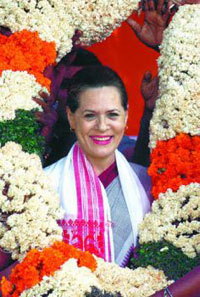 NEW
DELHI, May 26: Apparently concerned over the Opposition
taking credit for the National Rural Employment Guarantee
Scheme (NREGS), the Prime Minister, Dr Manmohan Singh,
and the Congress President, Mrs Sonia Gandhi, on Friday
asked party men to be aggressive in reaching out to the
people to impress upon them that it was a Congress programme.
NEW
DELHI, May 26: Apparently concerned over the Opposition
taking credit for the National Rural Employment Guarantee
Scheme (NREGS), the Prime Minister, Dr Manmohan Singh,
and the Congress President, Mrs Sonia Gandhi, on Friday
asked party men to be aggressive in reaching out to the
people to impress upon them that it was a Congress programme.
"I appeal to you to go to the people and tell them that this Right (of employment) has been given to them by Mrs Sonia Gandhi and the Congress Party," Dr Singh said addressing a day-long Convention of DCC Presidents of 200 backward districts where the National Rural Employment Guarantee Act is being implemented.
Mrs Gandhi, who inaugurated the Convention, said that the ambitious scheme was only in the Congress Manifesto and in the Common Minimum Programme (CMP) of the UPA. The Congress President as also the Prime Minister emphasized that 90 per cent of the funds under the "revolutionary" scheme were being given by the Centre and wanted party men to project the true picture before the people.
"This legislation is historic. This is because in nowhere in the world such an Act was there. It is for the first time in the world that our Government has given a legal right of employment to workers living in rural areas and has given guarantee to provide 100 days work," the Prime Minister said.
The
Convention was also addressed by the Chief Ministers of
Congress-ruled states where the programme is under implementation,
besides PCC presidents and CLP leaders, ministers and
party general secretaries' in charge of the programme
in various states.
Mrs Gandhi noted that the States where non-Congress parties
were in power were trying to exploit political gains from
the scheme. She said the Congress did not discriminate
on political grounds among the states. No wonder a sizeable
section of the beneficiaries of the programme were in
the Opposition-ruled States. ''There should be no politics
in the matter of development.''
She called upon the District Congress Committee presidents
and party workers in the Opposition-ruled states to put
the correct picture of the programme before the people
and to remain vigilant to see to that the scheme was properly
implemented.
''Any government scheme can succeed only with the participation
of the party,'' she emphasised.
Mrs Gandhi said in the Congress-ruled states, where the
NREGS was under implementation, it was the duty of the
Chief Ministers to maintain a 'live contact' with the
party workers to keep themselves informed about its proper
implementation.
Often, she said the report sent by the Government and
by the party about the progress of any scheme varied.
''This should not be so,'' she said and called upon the
ministers at the Centre and states to keep in touch with
party workers and seek their cooperation sparing some
time for them during their tours of different places.
''The ministers could also visit the party offices during
their tours. This will boost the morale of the party workers,''
she added.
Stressing the need for making an assessment of the NREGS,
Mrs Gandhi said if there was any shortcoming in the implementation
that had to be corrected. ''We have to see that the scheme
is benefiting the genuine unemployed and wrong persons
are not taking advantage of it.''
She said the panchayat raj institutions and Self Help
Groups of women could contribute their mite in the proper
implementation of the programme, and see to it that the
scheme achieved its target.
Complimenting the Prime Minister on successful completion
of two years of the UPA government, Mrs Gandhi said running
a coalition was a great challenge, a task which called
for a great deal of patience and understanding. There
were challenges galore but under the "able leadership"
of Dr Manmohan Singh, the Government was successfully
facing the challenges.
Hooda hails rural job guarantee scheme
 NEW
DELHI, May 26: Haryana Chief Minister Bhupinder Singh
Hooda said on Friday that the National Rural Employment
Guarantee Scheme would prove a milestone in bringing about
a change in the country's rural areas.
NEW
DELHI, May 26: Haryana Chief Minister Bhupinder Singh
Hooda said on Friday that the National Rural Employment
Guarantee Scheme would prove a milestone in bringing about
a change in the country's rural areas.
Speaking at a convention on implementation of the National Rural Employment Guarantee Scheme here, he gave credit for its successful implementation to UPA Chairperson Sonia Gandhi and Prime Minister Manmohan Singh and said that the inclusion of a small State like Haryana "showed their greatness.''
Mahendragarh and Sirsa districts were chosen for implementation of this scheme. An unmistakable message had been sent to the poor and weaker sections of society that there was a party that cared for them.
He said that all necessary steps for the registration of households, issuance of job cards, applications for work, identification of the Shelf of Projects, providing work to those demanding employment, preparation of muster rolls, training awareness and setting up of administrative infrastructure had been completed in both the districts. About 76,760 households had been registered under the scheme and out of these, 9,533 had demanded jobs and 5,765 had been provided jobs.
The Global Indian
 NEW
DELHI, May 9: When it comes to defending the turf of the
developing nations at World Trade Organisation negotiations
or pitching for Indian pride in Lakshmi Mittal's bid to
take over rival Arcelor, commerce and industry minister
Kamal Nath is India's knight in shining armour.
NEW
DELHI, May 9: When it comes to defending the turf of the
developing nations at World Trade Organisation negotiations
or pitching for Indian pride in Lakshmi Mittal's bid to
take over rival Arcelor, commerce and industry minister
Kamal Nath is India's knight in shining armour.
At the WTO negotiations in Hong Kong last December, the exuberant minister, along with Brazilian minister Celso Amorim, emerged as the voice of the developing countries. Not everyone, however, agreed that he was able to protect the interests of the poor nations.
Critics at home and abroad pointed out that the Hong Kong deal extracted substantial concessions from developing nations while giving them hardly anything in return. In fact, some commentators asserted that India and Brazil had jettisoned the interests of the developing countries and joined the Big Boys' Club comprising the US and EU. The Left and the BJP felt that the minister failed to safeguard the interests of millions of small farmers in the country, leaving them without a shield against the assault of the big agricultural corporations of the developed world.
Foreign Direct Investment (FDI) in India's emerging retail sector has been another area in which Kamal Nath has tried to project himself as the savior of the small retailers and jobs at home but has ended up making comradely gestures to the big boys of retail from overseas. "We are in agreement with Left parties that FDI should not replace or displace jobs. We are yet to evolve a model...the main problem is between large and small players and not domestic versus FDI," the minister told a conference in New Delhi last year.
It was in view of the concerns raised by the Left and sections of the ruling Congress that the government, while opening up the retail sector to FDI recently, allowed only single-brand chains from abroad to have up to 51 per cent holdings in their Indian operations. This kept out big names like Wal-Mart and Tesco.
While it is still not clear how the government will protect the interests of small shopkeepers and the jobs of those employed by these stores, the minister is already talking about opening another "window" for FDI in retail. ''We will announce another window for FDI in retail in the next six weeks,'' Kamal Nath told newsmen on the sidelines of the Hannover Fair 2006 last week.
In the global scenario Kamal Nath is the Indian, the world and the businessmen across the world most want to associate with. He enjoys the distinction of being a business man and a CEO first and a politician thereafter. With all the power with him, Kamal Nath cannot disappoint the his core constituency i.e International Trade and Industry.
| Archives |
| ISRO does a Google Earth |
Three envoys present credentials to President Pratibha Patil |
| President Pratibha Patil meets childeren on Raksha Bandhan |
Aviation
| Business | Defence | Foreign
Affairs | Communication | Health
| India | United Nations
India-US
| India-France | Entertainment
| Sports | Photo Gallery |
Tourism | Advertise with Us
| Contact Us
© Noyanika International, 2003-2009. All rights reserved.