


India
Indian Govt proposes to provide cheaper foodgrain to poorNEW DELHI, March 18: The Empowered Group of Ministers (eGoM) on Thursday cleared the draft Food Security Bill that seeks to give legal right to the poor to get 25 kgs of foodgrain in a month at Rs 3 per kg. The draft Food Security Bill will "hopefully" go to the Cabinet next week, Food and Agriculture Minister Sharad Pawar told reporters after the eGoM meeting. The group, headed by Finance Minister Pranab Mukherjee, also decided to recommend to the Cabinet for increase in the quantity of foodgrain for the 11.5 crore families above poverty line through ration shops. "Two items which will be taken to Cabinet are enhancing APL quota and the draft Food Security Bill," he said. The Congress had promised in its election manifesto that every BPL family would get, by law, 25 kg of rice or wheat per month at Rs 3 a kg. Once the Cabinet approves the Bill, it will be put in the public domain for feedback before it goes to Parliament. The panel also extended duty-free import of pulses and the ban on their exports till March 2011, Pawar said. PSUs such as MMTC and STC importing pulses would continue to get 15 per cent subsidy to cover the gap between the landed and selling price. The government had earlier allowed duty-free import of pulses till March 2010 to fight food inflation which is ruling at well over 16 per cent. Meanwhile, the Commerce Ministry withdrew its proposal to hike the minimum export price (MEP) of basmati rice. India's nuke establishment backs nuclear liability billNEW DELHI, March 18: The country's atomic establishment day threw its weight behind the civil nuclear liability bill in the face of the stand-off between the Government and the Opposition and said there is a lot of "misunderstanding" about the regime. Pitching for enactment of law to fix civil damages caused by nuclear accidents, Atomic Energy Commission Chairman Srikumar Banerjee said neither the Indian Environmental Protection Public Liability Insurance Act, 1991, nor the Indian Atomic Energy Act had provisions for damages caused due to war or radioactivity. "Therefore, this legislation assumes great significance in the present context," he told. Currently and in the near future, the state-owned Nuclear Power Corporation of India Limited (NPCIL) will be the only operator of nuclear power plants, he added. With the Opposition unrelenting on its opposition to the legislation, the government on Monday beat a hasty retreat and deferred the introduction of the the Civil Liability for Nuclear Damage Bill in Parliament. "India does not have a law for fixing civil liability for damages caused by the nuclear industry. The government wants to introduce the Bill after a very careful study, but unfortunately there is lot of misunderstanding about it among the Parliamentarians which has to be corrected," Banerjee said. Banerjee's views came against the backdrop of the Government launching a bid to salvage the Bill whose passage is a must for full implementation of the Indo-US civil nuclear deal. The views of the country's top boss were also echoed by two former AEC chairmen Anil Kakodkar and M R Srinivasan. "The Department of Atomic Energy has been working on the bill along with legal experts and the Centre for over a decade," Banerjee said and added that of the 30 countries operating nuclear power plants 28, barring India and Pakistan, had such legislations in place. "It is high time India has its own legislation soon." Let's have cool debate: ChavanNEW DELHI, March 18: The government on Wednesday extended an olive branch to the Opposition by maintaining that it was prepared to “coolly” discuss the proposed Civil Liability for Nuclear Damage Bill, including the charge that the compensation limit of Rs. 500 crore payable by the operator in the event of a nuclear accident was too low. The government was forced to defer the introduction of the Bill in the Lok Sabha on Monday after firm opposition from the Left and the BJP. “I think there is a lot of scare being created by certain political parties, particularly by our Left friends. The moment the issue of any likely foreign participation comes up, there is a red flag. These issues could be coolly discussed either in Parliament or on the Standing Committee, or we are willing to discuss it at personal meetings,” Minister of State in the Prime Minister's Office Prithviraj Chavan said on the sidelines of a meeting on nuclear energy organised here by Assocham. BJP suspects nuclear liability bill aimed at bringing in private playersNEW DELHI, March 18: In the wake of NSA Shivshankar Menon's unsuccessful attempt to convince BJP top brass on the civil liability for nuclear damages bill, sources said the party apprehends this may be an attempt to pave the way for entry of private operators in future. "What is the need for such a legislation if the public sector and the government will be the only nuclear operators? What is the purpose of this law or of putting a cap on compensation if it is the government which has to pay?" a senior BJP MP said. BJP fears that once this Bill is passed the government may allow private players later by effecting an amendment only regarding entry of private operators while leaving the Rs 500 crore compensation cap and other provisions intact. "We suspect this law is intended to bring in private players later," the BJP leader said. When told about the UPA government's stand that for allowing private players an amendment would be required in the Atomic Energy Act, the BJP leader said his party was first interested in the present designs of the government and the other issues come later. Menon had briefed leader of opposition in Lok Sabha Sushma Swaraj, her counterpart in Rajya Sabha Arun Jaitley, deputy leader of BJP in Upper House S S Ahluwalia and senior BJP leaders M M Joshi and Yashwant Sinha on the Bill yesterday. The main opposition party also has problems with the government not fixing any liability of the foreign players in the bill. "Moreover, this law is in addition to the normal law as claimed by the government. In such a scenario, the victim would get some immediate compensation and for further compensation would have to go to a civil court. This would lead to multiplicity of legislation and delay in justice," said the senior BJP leader. He alleged the government was acting under international pressure. Menon had earlier too held a meeting with Jaitley. This was followed by Prime Minister Manmohan Singh calling up Swaraj to seek BJP support for the bill. When asked if there was a change in the BJP's stand after yesterday's meeting with Menon or whether he indicated a change in the government's stand since the first meeting with Jaitley, the senior BJP MP said, "The government is where it was and we are where we were." India requests Afghan Govt to investigate attack on Indian MissionNEW DELHI, March 15: India on Monday requested the Afghanistan Government to hold an investigation on the attack on Indian Mission in Kabul last month. This was informed by External Affairs minister S M Krishna while interacting with reporters outside the parliament on Monday. Krishna also informed that security arrangements have been tightened in the Indian Mission in Afghanistan. Government today indicated that the next round of Foreign Secretary-level talks between India and Pakistan will take place in Islamabad to take forward the dialogue process. "The Foreign Secretary of Pakistan came here for the talks. So, perhaps it is the turn of Indian Foreign Secretary to go to Pakistan. So, let us move step by step," External Affairs Minister S M Krishna said in New Delhi on the sidelines of the India-Africa conclave. There is speculation that talks between the two sides could take place later this month. Pakistani Foreign Secretary Salman Bashir had come to India on 24th February for talks with Nirupama Rao during which the Indian side made it clear that Pakistan has to take effective and transparent action to stop acts of terror emanating from its soil. Krishna said, "Prime Minister Manmohan Singh has taken an initiative in good faith to hold Foreign Secretary level talks with Islamabad." Asked if Singh would meet his Pakistani counterpart in Washington in April on the sidelines of the nuclear security summit, the minister was non-committal, saying "Keep speculating." Addressing the conclave, Krishna said India will establish 19 institutions to develop human resources and capacities in Africa. Krishna said under the e-networking project for 47 African countries, half of them were already connected and efforts were underway to integrate the remaining. Indian Cabinet divided over Judicial BillNEW DELHI, March 15: Creation of a mechanism to hold judges accountable for any of their misconduct will have to wait further as a much-delayed Bill in this regard was not approved on Monday by the Union Cabinet, which decided to refer it to a Group of Ministers. The Judicial Standards and Accountability Bill, 2010 was taken up at the Cabinet meeting chaired by Prime Minister Manmohan Singh but there were deep differences over the issue. Of the 90-minute Cabinet meeting, 45 minutes were spent on discussing the issue after Home Minister P. Chidambaram and HRD Minister Kapil Sibal, both lawyers, found flaws in the Bill like the quantum of punishment for a judge if found guilty of misconduct. The Bill proposes that a judge can be warned, taken off work, censured or admonished, depending upon the misconduct. But if the violation is serious in nature, the judge can also be impeached. There was also disagreement on whether the Judges Enquiry Act, 1968 should be repealed altogether as the proposed Bill seeks to do. Law Minister Veerappa Moily tried to convince them but considering the differences of view, it was felt that further deliberations should be held. In this regard, a decision was taken to refer the bill to a Group of Ministers. The Bill, in its present form, lays down a code to deal with cases of corruption against judges of the Supreme Court and the High Courts. It also seeks to repeal the four decade-old Judges Enquiry Act, 1968 which deals with the process of impeachment of senior judges. The Bill also has provision for allowing the common man to complain about the alleged misconduct of a judge. But the citizens will have to reveal the source of their information in complaints filed by them. But a final decision on whether action should be taken against the erring judges will remain with the Government. The Bill, prepared by the Law Ministry, provides for a series of committees to probe the allegations against judges before an impeachment motion is introduced in either house of Parliament. While there will be one Scrutiny Committee for the Supreme Court, the other will be for the 21 high courts. The Bill proposes to set up a National Judicial Oversight Committee, likely to be headed by Vice-President Hamid Ansari in his capacity as the Chairman of Rajya Sabha with distinguished jurists as members that will receive the complaints against the sitting judges. The Bill also lays down certain guidelines or code of conducts for judges. The proposed law expects judges not to delay delivering a judgement beyond a three-month time frame after conclusion of arguments. According to the Bill, the members of the higher judiciary should have no bias in judicial work or judgements on the basis of religion, race, caste, sex or place of birth. The other guidelines laid down say they should not contest election of any club or society; not have close association with individual members of the bar and not allow any member of their immediate family to appear before them in courts. The Bill also proposes to make provisions for declaration of assets and liabilities of judges. Women's Bill abiding commitment of Cong: SoniaNEW DELHI, March 12: Congress President Sonia Gandhi on Friday said the Women's Reservation Bill was part of the abiding commitment of the party to the empowerment of the aam aadmi along with several other legislations of the govt. Addressing the party general secretaries, senior members and PCC presidents on how to commemorate the 125th foundation day of the party, she said, "Our abiding commitment to the empowerment of the aam aadmi must be conveyed with clarity." She said, "The Right to Information marked a revolutionary step for transparent governance...The NREGA empowered the rural masses with guaranteed right to work. The right to education will provide quality primary education to all our children and now, the Women's Reservation Bill - when it comes to fruition it would be realization of Rajivji's vision to empower women politically". Describing the completion of 125 years of the party's existence as a "momentous occasion", she said for the people of India and thousands of Congressmen and women across the country, it is time to recall the struggle. "No other party can claim to have a legacy as rich as ours," she said, referring to the freedom struggle under the leadership of Mahatma Gandhi, Jawaharlal Nehru and his colleagues. Indian Govt readies for terror threat at home, abroadNEW DELHI, March 12: India is ramping up security at its missions in Afghanistan and Nepal, even as it expects a ‘hot year’ of terror attacks, government officials said. Security is being increased following intelligence inputs about increased threats of terrorist attacks in the two countries. A team of 40 Indo-Tibetan Border Police commandos will be flying to Kabul on Saturday, primarily to secure an upcoming building complex where all Indian officials posted there would be moved into. At present, the officials are living in different places and are very vulnerable, a senior government official said. The new complex will be a fortified one, with hi-tech security gadgets, a high boundary wall and close circuit cameras. The first security assessment after the February-end attack in Kabul has spoken about the possibility of kidnappings and killings of officials. There are also inputs of more suicide attacks occurring. Home Ministry officials said security experts would conduct a second, and more detailed security audit of all Indian assets in Afghanistan after National Security Adviser Shivshankar Menon’s final report reaches the home ministry. These measures, however,leave out nearly 4,000 Indians working in Afghanistan for private companies. The government has made it clear it cannot guarantee their security. But an attack on India’s missions abroad is not all that the government has to worry about. The Lashkar-e-Tayyeba is desperately trying to make its presence felt, right from Kashmir to Cochin. Cochin was put on alert on Saturday after intercepts of cross-border conversations indicated the southern city was being targeted by the Laskhar-e-Tayyeba. Home Minister P Chidambaram on Friday asked Islamabad to reinvent itself as a responsible neighbour. Chidambaram assures full security to sportspersons
"All security would be provided to players," Chidambaram told reporters here in response to a question on the Harkat-ul-Jihadi-Islami (HuJI) warning sportspersons against visiting India. The message from Illyas Kashmiri, a HuJI commander in Pakistan having close ties with the Al Qaeda, was sent to Asia Times Online on Monday, two days after the Pune bombing which killed 11 people. "No one would be allowed to dictate terms to us," Chidambaram said at a press conference after reviewing the security situation in Jammu and Kashmir at a meeting of the unified command, a strategic group comprising representatives of the army, paramilitary forces, police and intelligence agencies. The minister, on a one-day visit to the state, also held discussions with Chief Minister Omar Abdullah on the proposed surrender and rehabilitation policy for militants returning from Pakistan administered Kashmir. "We have asked the centre to prepare a draft of this policy," the home minister said. "There is nothing sinister in the policy," said Chidambaram, who arrived here less than a week after announcing the acceptance of the state's policy on the amnesty. Describing the policy as an "assault on nationalist forces", the Bharatiya Janata Party (BJP) also held a demonstration to coincide with the home minister's visit. BJP leader Ashok Khajuria told reporters that he was surprised that the minister visited Jammu for the rehabilitation of militants, but no one had time for soldiers who died while fighting terrorists. It is Chidambaram's third visit to Jammu and Kashmir since he announced "quiet talks" with "all shades of opinion" in Kashmir, including separatists, in October last year. On Feb 7, Omar Abdullah declared that the government should seriously consider the return of militants from Pakistani Kashmir to bring normalcy to the state. "It was the need of the hour," he said. On Feb 11, Chidambaram endorsed the state's policy and said that steps would be taken for its implementation. India mulls Rs 1 cr reward for Pune blast cluesNEW DELHI, Feb 15: The Centre is mulling a reward of Rs one crore to anyone who gives clues about terrorists who may have planted the bomb in the German Bakery, a favourite eating joint of foreigners. Top Home Ministry officials said the reward proposal is being considered at the highest level and may take a decision in favour of it soon. "If we declare the reward, we will tell the people that whoever shares any information about the perpetrators of the blast, his or her identity would be protected. We would not even ask his name but give the reward. But information has to be correct," an official said. The move is being considered in the light of investigators still groping for vital clues about the terrorists behind the powerful blasts. Rahul hits out at Shiv Sena again, says India is for Indians
"In Mumbai (during the terror attacks)s, men in the NSG were from Bihar, UP, Gujarat, Himachal Pradesh and Maharashtra. At that time they (Sena) did not say that those from Bihar and UP should be taken out. India has to move forward and all have to be taken forward," he said addressing a press conference in Patna. Asked about the statement of Thackeray in Sena mouthpiece Saamna that he had insulted 26/11 martyrs by only recognising the sacrifice of soldiers from UP and Bihar, Gandhi said, "India belongs to Indians. Every part of India belongs to every Indian. I am not interested in the views of Bal Thackeray or (MNS chief) Raj Thackeray. "People have a right to go anywhere. I am not going to remain silent and stop people of UP and Bihar from going to Maharashtra," the 39-year-old Congress General Secretary said. Making it clear that he was totally against the campaign that UPiites and Biharis had no place in Maharashtra, Gandhi said, "Those who indulge in violence will be dealt with strictly by the Maharashtra Government. "Strict action will be taken and action is being taken," the Congress leader said. Meanwhile, Sena leader Uddhav Thackeray said that "Rahul Gandhi has insulted the bravery of martyrs like Hemant Karkare, Ashok Kamte, Vijay Salaskar, Tukaram Omble, all daring Marathi policemen, and NSG Major Sandeep Unnikrishan. "Where was Rahul Gandhi when Mumbai was attacked," Uddhav asked, adding that he condemned the anti-Marathi statement of the Congress leader. The AICC General Secretary had on Monday flayed Shiv Sena and the MNS for their constant tirade against people from Bihar and Uttar Pradesh reminding them that the NSG men who vanquished terrorists during 26/11 were also from the two states and other places. President Pratibha Patil hosts 'At Home' on 61st Republic Day
South Korean President Lee Myung-bak and his wife Kim Yoon attended the function. Prime Minister Manmohan Singh and his wife Gursharan Kaur, Defence Minister A.K.Antony, Finance Minister Pranab Mukherjee, Minister for Power Sushil Kumar Shinde, and Minister for Agriculture Sharad Pawar were present on this occasion. Vice President Hamid Ansari and his wife Salma Ansari, Lok Sabha Speaker Meira Kumar, and the Leader of the Opposition in Lok Sabha and BJP leader Sushma Swaraj were also present on this occasion. United Progressive Alliance Chairperson and Congress party President Sonia Gandhi were among the distinguished guests who were present on this occasion. Chief Justice of India K.G.Balakrishnan was also present on this occasion. Delhi Chief Ministers Sheila Dikshit and Orissa CM Naveen Patnaik also attended the "At Home" here. Chief Election Commissioner Navin Chawla was also present on this occasion. It was a gathering of about 400-500 people, which included various diplomats and other important personalities, representing various foreign countries and offices at the function. Cold and fog fail to dampen spirits on Republic Day
Also showcased were other indigenous weapon systems that have been under development for years -- like the controversial Main Battle Tank Arjun. The military might displayed at the 61st Republic Day Parade drew its strength from the intermediate range ballistic missile Agni III, which is some years away from being inducted and the Russian Smerch multi-barrel rocket system. The Defence Research and Development Organisation (DRDO) has often drawn the flak for long delays in some of the key projects. There are some key issues about induction of these equipment into the armed forces. Despite the thick cover of fog, which had reduced the visibility over the sprawling Boat Club lawns on both sides of Rajpath, a large number of people had gathered to witness the spectacle. South Korean President Lee Myung-Bak and his wife Kim Yoon-ok joined the celebrations, presided over by President Pratibha Patil, as guests of honour. Thick blanket of fog just before the start of the parade disrupted magnificence of the spectacle. The Indian Air Force helicopters, which are used to shower rose petals ahead of the marching contingents, failed to take off. The IAF, however, managed to put up a fly past, which is generally one of the main attraction for the crowd. As the visibility improved a little towards the end, IAF’s latest acquisition, Airborne Warning and Control System (AWACS) flew past Rajpath escorted by two fighter jets. Three Su-30 MKI fighter jets performed basic manoeuvres and the Jaguars did a routine fly past, enthralling the audience. Several Cabinet Ministers were present to cheer the marching contingents and children who performed at the parade. United Progressive Alliance chairperson Sonia Gandhi watched the parade in Finance Minister Pranab Mukherjee’s company. Union Home Minister P Chidamabaram and his other cabinet colleagues Railway Minister Mamata Banerjee and Sports Minister M.S Gill, and leader of the Opposition in Lok Sabha Sushma Swaraj were also present. However Swaraj’s predecessor and senior BJP leader L K Advani was conspicuous by his absence. The parade began with President Pratibha Patil awarding Ashok Chakra, the highest peace time gallantry award. She conferred the honour on major D Sreeram Kumar of 30 Assam Rifles. The awards for major Mohit Sharma of 1 para (special forces) and havildar Rajesh Kumar of 11 Rajputana Rifles, who had died fighting terrorists in Jammu and Kashmir, were received by their wives. The security agencies heaved a sigh of relief as the event passed off peacefully. Elaborate security arrangements were put in place in New Delhi for the event. President Patil calls for a second Green Revolution, says India is on edge of deciding decade
“The world overt, as also in our country, there is a rising demand for food grains,” the President said in her televised address to the nation on the eve of the country’s 61st Republic Day that called the beginning of 2010 “the deciding decade, the decade of reckoning.” “This foretells the need for an intense focus on increasing agriculture productivity to ensure food availability , particularly of agricultural produces that are in short supply to control spiralling food prices,” the President said. “I call for urgent steps towards a second Green Revolution. There should be use of new technologies, better seeds, improved farming practices, effective water management, as well as more intense framework for connecting the farmer with the scientific community, with lending institutions and with markets,” she said. With higher income levels, the rural economy would generate demand and provide impetus for growth in other sectors. The President also called for exploring possibilities of partnerships between industry and agriculture and wanted the food processing and agro-based industry to be encouraged. Patil also took note of the rising prices of food grains, an issue that is being raised with some agitation by parties of the opposition as well as some in the ruling UPA. Strongly advocating greater synergy between the corporate world and the agriculture sector, the President said the “possibility of win-win partnerships between industry and agriculture should be explored.” Locating food processing industries close to agricultural areas had transformed the country’s rural landscape, she said. Deepen the reach of democracy: President
The Election Commission’s Diamond Jubilee celebrations on Monday got off to a start with the country’s top leadership expressing serious concern over malpractices ranging from money and muscle power to paid news syndrome vitiating the electoral process. They called for corrective action by the EC and the political parties to cleanse it of the evils even as they praised the contribution in the last 60 years of the Commission which came into existence on this day on the eve of India becoming a republic in 1950. President Pratibha Patil, who inaugurated the 60th anniversary celebrations, said the impediments, lacunae and malpractices in the electoral process would have to be removed with determination to make Indian democracy “cleaner, healthier and stronger.” The ceremony was attended by the who’s who of politics, including Vice President Hamid Ansari, Prime Minister Manmohan Singh, Lok Sabha Speaker Meira Kumar, Congress President Sonia Gandhi, Leader of Opposition Sushma Swaraj, NDA Convener Sharad Yadav, several Chief Ministers and leaders of national and state political parties. The Prime Minister voiced concern that the “best and the brightest” were not attracted to politics and the educated professionals and the growing middle-class often shy away from the electoral process. As the country’s top leadership went into an introspective mode, Vice President Hamid Ansari dubbed as a “blot” the extensive media-related malpractice of “paid news” and “coverage packages”. UPA Chairperson Sonia Gandhi underlined the need to check money and muscle power in elections and prevent persons with criminal background from entering the poll arena. The President said India has impressive democratic credentials, but yet has the challenge of becoming a “role model” for other countries. “This requires that we should be aware of the impediments, the lacunae and malpractices in the electoral process. These would have to be removed with determination, to make our democracy clear, healthier and stronger,” she told the gathering which comprised 30 heads of electoral bodies from various countries and diplomats. Paying a tribute to the EC, the President said that the Commission has been making every effort to create a level playing field between various candidates. “As we carry on with our work, we should not forget that we swear by the Constitution, and, therefore, we must adhere to its values, spirit and principles. Democracy adorns our Constitution. We have to see that the power of voting vested in the people makes them powerful enough to change their own destiny through democracy,” the President said. Emphasising the importance of making democracy fully participatory, the President said efforts should be made to deepen the reach of democracy through the Panchayat Raj Institutions and Local Urban Bodies. Evaluating the contributions of the EC, the Vice President said “six decades on, a fair verdict would be that the glass is neither empty nor full but well above the half way mark” and it faces three challenges. The first was that while the country has traversed a long distance in providing a Constitutional basis for local government, real empowerment and participatory governance at the third tier is still a “work in progress”, she said. Second was that despite stringent efforts, unaccounted election expenses constitute the major expenditure of political parties and their candidates. “These relate to distribution of freebies, liquor and cash during elections, the phenomenon of surrogate advertisements and the extensive media related malpractice of ’paid news’ and ‘coverage packages’,” he said. “Each of these is a blot on the democratic process and on the objective of free and fair elections. Corrective action by the EC and our political parties is imperative,” Mr. Ansari said. Third, he said, the EC has insisted upon and enforced procedural inner party democracy in recognised political parties. “The challenge for the political parties now is to bring about substantive organisational democracy,” he said. The Vice President noted that the country had established and sustained procedural democracy. “And yet, Dr Ambedkar’s foreboding about the contradiction between political equality and social and economic inequality remains valid. The realisation of ‘one person one vote and one vote one value’ continues to be elusive,” he said. The Prime Minister regretted that many of the educated professionals and those from the growing middle-class were not even willing to take the trouble to cast their vote. “Poor turnout in many constituencies undermines to some extent the legitimacy of the victor in a ‘first past the post’ system that we follow,” Dr. Singh said. There was a general worry that people without sufficient means cannot contest elections and that the background of many contestants and quite often the winning ones does not inspire confidence in voters. “There is no easy answer to these questions. While there is near unanimity that something needs to be done about these issues, there is no consensus on how exactly to go about it,” Singh said. The Congress President said the election management in the country has become a model and has attracted the international attention. Today, the country moved from the traditional ballot paper to Electronic Voting Machines on which the EC has made a pioneering work, Gandhi said, adding that the process and procedure followed in the run-up to the elections had received widespread credibility and acceptance. Making a strong plea for increased participation of women in decision—making, Ms. Gandhi said, “We have the first step by introducing the legislation (Women’s Reservation Bill) in the Upper House. But unfortunately we are still some distance away from it becoming a reality.” Besides, she said, there was need to build a consensus on how to prevent individuals with a criminal record from contesting elections. Lok Sabha Speaker Meira Kumar said that the country could feel “justifiably proud” of the EC as it has conducted 15 Lok Sabha polls and 326 general elections to state assemblies which was not a mean achievement. Law and Justice Minister M Veerappa Moily assured the EC of government’s full support in its reform agenda. Leader of Opposition Sushma Swaraj said the fact was that even a powerful person in politics are afraid of the EC was a tribute to its fairness and credibility in conducting polls. NDA Convener Sharad Yadav wanted the EC to ensure that the common man can be able to vote easily and does not face any hindrances. Chief Election Commissioner Navin Chawla, welcoming the guests, said political parties both at national and State level had displayed immense maturity in strengthening democracy in the country. While the President released a commemorative stamp on the occasion, the Vice President released a 250-page book titled “Reinforcing Indian Democracy — Lok Sabha Election 2009”. Rahul Gandhi meets Malaysian Prime MinisterNEW DELHI, Jan 20: In a first of its kind, Congress General Secretary Rahul Gandhi on Thursday had a formal meeting with Malaysian Prime Minister Mohd Najib Tun Abdul Razak who wanted to "touch base" with the next generation leader of India. The meeting was sought by the Malaysian Prime Minister who wanted to have discussions with the young Congress leader about various aspects of his party, sources said. During the hour-long discussions, Razak enquired about the functioning of the Congress and the secrets of its success considering that it has been in power for so long, they said. The Malaysian Prime Minister, who heads a coalition government, also wanted to know how Congress is working with other parties in running the government. The sources said Razak, who is Malaysia's second Prime Minister, wanted to "touch base" with the next generation leader of India. The sources described the meeting as a "casual chat". This was the first formal meeting that Rahul Gandhi has had with any head of government or state in India. He has met foreign leaders during some of his visits abroad. UPA Chairperson Sonia Gandhi had met Razak on Wednesday. President asks NRIs to participate in India’s ‘unfolding’ growth storyNEW DELHI, Jan 9: President Pratibha Patil on Saturday called upon overseas Indians to participate and benefit in India’s “unfolding growth story.” Delivering the valedictory address at the Pravasi Bhartiya Diwas on the day Mahatma Gandhi returned to India in 1915, the President pointed out that overseas Indians, estimated at over 250 lakhs, had come to be recognised as the ‘Knowledge Diaspora.’ With India making its investment environment more conducive, it was time this Indian community with its knowledge, expertise, skills and resources became an important input in “India’s march to becoming a developed country.” India’s investment needs were over dollars 500 billions spanning both the social and physical infrastructure sectors and the country was looking at investment increasingly in the public-private partnership model. While the requirements in physical infrastructure were well documented, Ms. Patil drew attention to the social side with the government focusing on improving the quality of education at all levels and estimating an annual growth arte of about six per cent in healthcare infrastructure. She pointed out Indian banks and financial institutions, based on best practices’ in fiduciary responsibility and well-regulated, had not only coped with one of the worst economic downturns in recent history but also catalysed a quicker recovery than many other countries. She also acknowledged the contribution of Indian blue collar workers abroad who year after year had made huge remittances back home. India’s remittances from overseas Indians, estimated at over dollars 50 billions last year, are the highest in the world. But what is less known, is the fact that nearly forty percent of these remittances - about dollars 20 billions annually - comes from overseas Indian workers in the Gulf consisting of temporary contractual skilled and semi-skilled workers, she pointed out. They often face harsh living and working conditions and are separated from their families for long periods of time. “I take this opportunity to salute Indian workers in the Gulf,” she said. The Government was alive to their contribution and was trying to make life easier for them by setting up Indian Community Welfare Funds established in 18 countries to provide timely succour to overseas Indians in distress. The bilateral Social Security Agreements as well as the Labour Welfare and Protection Agreements that have been concluded will be useful in getting the cooperation of the host governments on issues impacting the Indian community, she hoped. Babu Jagjivan Ram championed social justice in Indian societyBy Deepak Arora
Inaugurating a two-day national seminar on the “Role of Babu Jagjivan Ram in Promoting Social Justice in India” here on Wednesday, Mrs Meira Kumar said it was a sad fact that for a long time, Indian society had treated the socially and economically deprived masses in a very inhuman manner. It had rendered them too feeble and psychologically crippled to even imagine the idea of protesting against the inequalities in our society. She said Babuji had a lifetime dedication and the passion and profound commitment to promote social justice in Indian society. The seminar has been organized by the Centre for Social Welfare Administration and Administration of Justice of the Indian Institute of the Public Administration (IIPA).
As his life unfolded and he felt the trauma of his circumstances, he took upon himself the challenging task of crusading against social injustice and inequality, first through the organizations he set up and later by joining his efforts with the national movement. Babuji was a man of remarkable tenacity, persistence, grit and intellectual vigour with a profound commitment to moral and human values which have always sustained humankind. His social and intellectual sensitivity and passion for knowledge drove him to absorb humanistic ideas from socialist literature which greatly influenced his ideology and convinced him of the imperative of building an egalitarian society. Deeply conscious of the scourge of caste-based discrimination and the resultant marginalization of vast sections of the society, Babuji advocated a path of self-reliance for the Dalits and other depressed classes. He exhorted the oppressed castes to carry on a relentless struggle against social prejudices and degrading treatment meted out to them and wrest their legitimate rights from the unwilling hands of the entrenched interests. While he strove for social reforms and the abolition of casteism and its attendant evils, he also stressed on the overall empowerment of Dalits as well as a change in the mindset of society towards them. The welfare of the people always preceded any other consideration for Babuji. If he advocated strategies for economic growth to strengthen the nation and build a progressive and prosperous country, he was as much concerned about how the benefits should reach the common man. He was an articulate champion of the cause of labourers and oppressed classes. At the same time, he frequently reminded them of their responsibility towards building a vibrant and modern India. “I am sure millions of other secular, democratic and like-minded people would also be proud of the shining social and political legacy he left behind. I am confident that all of us – liberal, progressive and secular compatriots too would agree that Babuji commanded the respect and admiration of the nation for his remarkable role as a freedom fighter, a statesman and a crusader for social justice.” She said the need of the hour is to carry forward his crusade for social justice in all its varied dimensions. I want to change the way politics works in UP: Rahul
Rahul said that his goal was not 2012 UP elections but much beyond. Rahul Gandhi also said that the youth in the state have given good response to his call to join the movement to promote democracy and improve the way politics is practiced in the country. Rahul Gandhi refused to comment on the Liberhan panel report. However, he said that he respected veteran BJP leader Atal Bihari Vajpayee as a senior politician. Gandhi also said that he did not know whether the Liberhan Commission has done the right thing or not by naming Vajpayee in its report on the Babri demolition. ULFA chief Rajkhowa handed over to IndiaDAWKI (Meghalaya), Dec 4: ULFA Chairman Arabinda Rajkhowa was handed over to the BSF by Bangladeshi security agencies at an outpost along the Indo-Bangladesh border in Meghalaya early this morning, official sources said. Rajkhowa, along with ten others, including ULFA’s military operations deputy chief Raju Barua, were handed over at the Dawki outpost in the Jaintia hills district, the sources said. Along with them were Rajkhowa’s bodyguard, his wife and two children, Raju Barua’s wife and son, and wife and daughter of ULFA’s self-styled foreign secretary Sashadhar Choudhury, they said. They were then flown to Guwahati for completion of various legal formalities. Pak ‘hosted’ HeadleyNEW DELHI, Nov 17: Investigators have found that terror plotters David Headley and Tahawwur Hussain Rana were in Pakistan when Mumbai was attacked on November 26 last year, raising further suspicion about their possible involvement in the conspiracy. The Union Home Ministry has also issued fresh security alerts for the country’s nuclear installations after it was revealed that Headley had visited some of these places during his stay in India. Even as Headley’s India network is being probed New Delhi has asked Canada to provide more inputs on Headley's accomplice Rana who is believed to have been in Mumbai just five days before the attack and who, sources said, was suspected to be the man responsible for arranging the finances. Various teams of the National Investigation Agency are on the Headley-Rana trail all across the country and they continue to question people who came in contact with them. The teams were in Mumbai, Ahmedabad and Kochi as these places were the hub of the duo's activities. Officials said that film maker Mahesh Bhatt’s son Rahul, a key figure who was in contact with Headley, had been asked not to leave Mumbai till the probe was over. An alert for tightening security of nuclear plants was issued after investigators found that Headley possibly visited some states where such facilities are located, like Gujarat, Maharashtra and Uttar Pradesh. The six most guarded nuclear plants are Narora in UP, Tarapur in Maharashtra, Kalpakkam in Tamil Nadu, Kakrapar in Gujarat, Kota in Rajasthan and Kaiga in Karnataka. The Bhabha Atomic Research Centre in Mumbai is on the highest security alert, said sources. Rajnath not averse to quitting early as BJP presidentNEW DELHI, Nov 17: Rajnath Singh on Tuesday appeared to be not averse to quitting as BJP president if there is an early consensus on his successor. Amid talk of the RSS backing Maharashtra BJP chief Nitin Gadkari, Singh, whose tenure ends on December 31, made it clear that his term is virtually over and would like an early decision on the succession issue. “In a way, my term as president has come to an end. At the right time, I will hand over the reins to the new president to bring in a change of responsibility,” Singh told PTI. When asked whether he had set a deadline to quit as party president, Singh said, “I have not decided the date as yet.” However, Singh said he would abide by any consensus arrived at by the party on the issue. Singh said he wanted the ongoing organisational elections in the state units of the party to be completed soon. “I want that the organisational elections be completed at the earliest and there should be no undue delay.” The new president can be elected only when polls to 50 per cent of the state units are completed. As of now, this seems unlikely before December 31. Sources close to Singh said in case the process runs into February or March, the BJP chief is unlikely to wait that long. Singh was elected as party president on November 26, 2006 and may treat that as the deadline. There is media speculation that once Singh quits there may be pressure on top BJP leader L K Advani quitting as Leader of the Opposition in the Lok Sabha to be in line with the generational change being ushered in the BJP. No question of conflict with China: Pranab
“I don’t visualise a conflict with China,” he said firmly, pointing out that both countries were determined to maintain “peace and tranquillity” along the border. Speaking to journalists after a conference of G20 Finance Ministers, Mr. Mukherjee said in reply to a question that he did not have a separate meeting with the Chinese Finance Minister because it was not an occasion for bilateral discussions. But he stressed that trade ties with China were growing and would be strengthened further. Mr. Mukherjee said India was opposed to attempts to impose a uniform one-size-fits-all global time-table for withdrawal of fiscal stimuli introduced to combat recession. “It is not possible to set a time-table for an exit strategy. Leave it to the countries concerned though there can be a broad agreement on coordination. But coordination should not mean synchronisation,” he said adding that the approach should be “country-specific, not date-specific.” Mr. Mukherjee ruled out any further stimulus package for the Indian economy. Answering questions on funding for climate change, on which the G20 Finance Ministers failed to reach an agreement, he reiterated India’s position that developed countries would have to contribute substantially to help developing countries switch to a more energy-saving regime. If Maoists halt violence, Centre will facilitate talks: Chidambaram
"We never said lay down the arms...We said halt the violence and talk...If they halt violence, the Centre will persuade the state governments to talk to them on issues like land reforms, land acquisitions," he told reporters here. "If they halt violence, we will facilitate talks. I cannot ask state governments to talk when there is widespread violence," Chidambaram said. He said if the Maoists are "serious champions of the poor", they should come forward for talks. The home minister said Orissa, Chhattisgarh and Andhra Pradesh had attempted to hold talks with the Maoists but the moves were "futile". He said the Cabinet Committee on Security has decided to provide help to the states affected by the naxal violence. Noting that the government has been extending offers for talks, the home minister said the response so far has not been encouraging. Asked whether the Centre would ban the People's Committee against Police Atrocities (PCPA) which had earlier this week hijacked a train in West Bengal, he said it was for the state government to decide as the activities of the outfit are confined only to the state. "We are open to provide help. West Bengal government is competent ....The organisation is confined to West Bengal only," he said. The "most serious threats" to the internal security this month came from the Maoists, Chidambaram said releasing the ministry's report card for October. He also listed the incidents of violence unleashed by the Maoists. "The violence must end. The Central and state governments have a duty to end violence. It is with that objective that we have made a simple and straight forward appeal to the CPI (Maoist) :'halt the violence'," the home minister said. Congress set to form governments in Maharashtra, Haryana, APNEW DELHI, Oct 22: Congress is set to form governments in Maharashtra, Haryana and Arunachal Pradesh, according to latest trends after counting began this morning. Congress, along with ally NCP, was leading in 138 assembly seats in Maharashtra and 46 in Haryana and 24 in Arunachal Pradesh. In the 288-member Maharasthra Assembly, Congress-NCP combine is leading in 138 seats as against Shiv Sena-BJP coalition which is ahead in 98 seats. The Raj Thackeray-led MNS is leading in 15 constituencies. Ruling Congress is ahead of its rivals in 46 seats in Haryana, while Om Prakash Chautala-led INLD is leading in 23 constituencies. Haryana Chief minister Bhupinder Singh Hooda was leading over Satish Kumar (INLD) from Garhi Sampla-Kiloi in Rohtak district. Cricketer Yuvraj Singh's father Yograj (INLD) was trailing behind D K Bansal (Congress) from Panchkula while HJC-BL President Kuldeep Bishnoi was ahead over Krishan Gopal Tyagi (INLD) from Adampur. In Arunachal Pradesh where the ruling Congress won three seats without contest, the party won another three seats today and was leading in 20 others as counting of votes progressed to pick a new 60-member legislature. Polling took place for 57 seats on Oct 13 after three candidates were declared elected unopposed in Arunachal. They included chief minister Dorjee Khandu and two more Congress members, Tsewang Dhondup and Jambey Tashi. According to latest trends and results, Wangi Lowang of the Congress defeated his nearest Nationalist Congress Party (NCP) rival by 2,693 votes in Namsang constituency. Tapang Taloh of the Congress won the Pangin seat by 2,781 votes defeating NCP's Kaling Jerang. Another Congress winner was Karikho Kri who won the Tezu seat defeating Nakul Chai (Trinamool Congress) by 3,845 votes. In Maharashtra , those leading include industry minister Narayan Rane (Kudal), Union minister Sushilkumar Shinde's daughter Praniti (Solapur) and Omraje Nimbalkar (Osmanabad), son of slain Congress leader Pawanraje Nimbalkar. Stakes are high in Maharashtra, where there are several chief ministerial aspirants. Rivals Shiv Sena and its offshoot MNS are fighting for the same political space and the ruling Congress-NCP combine is aiming a hat-trick. There are 1,820 independents, mostly party rebels, in fray. With NCP leader Chagan Bhujbal floating the idea of rotating the post of Chief Minister, senior Congress leader Vilasrao Deshmukh said there was no doubt about his party getting the Chief Ministership in Maharashtra "Whatever the question raised, I think the issue has been clarified by NCP chief Sharad Pawar that the chief minister will be from Congress," Deshmukh said. He was responding to a question on Bhujbal's idea of rotating the post of chief minister in Maharashtra between Congress and ally NCP. "I don't see any controversy on the issue in the wake of the clarification given by the NCP high command," he said. Maharashtra deputy chief minister Chhagan Bhujbal (NCP) was leading by 1,739 votes at the end of first round of counting at Yeola assembly constituency in Nashik district. His son Pankaj is leading in Nandgaon constituency. In Alibaug, Peasants and Workers Party (PWP) candidate Meenakshi Patil is leading over Madhu Thakur of Congress after first three rounds of counting. In Karjat constituency of Raigad district, Suresh Lad of NCP is ahead of Sena candidate Devendra Satam. From Pen seat, Congress candidate Raviseth Patil is ahead of PWP candidate Dhairsheel Patil. In Shrivardhan constituency, NCP's Sunil Tatakare is leading over Shiv Sena candidate Tukaram Surve and in Mahad, Sena nominee Bharat Gogawale is ahead of NCP candidate Manik Jagtap. Govt to review procedures for appointment of judges: Moily
Addressing a press conference in New Delhi, he said the Government would not like to see any "tainted" person becoming a judge. At the same time, he refused to be drawn into a discussion on Karnataka Chief Justice P D Dinakaran whose elevation to the Supreme Court has been kept in abeyance over allegations of grabbing land. "Already there is a memorandum of procedure (on appointment of judges) which we are going by as of today. I am not reiterating that the same thing will continue. Maybe, we have to revisit the procedure. Whatever we do, we need to take the judiciary into full confidence" he said. He was replying to a question whether the Government was contemplating making changes in the procedures for such appointments. Moily referred to the 1993 and 1998 decisions of the apex court which led to the Memorandum of Procedures relating to Supreme Court Collegium that appoints judges to the higher judiciary. There have been demands from political parties that the appointment of judges should revert back to the government. Virbhadra, Anand Sharma to lead Cong campaign in HP bypoll
Besides, the two party stalwarts from the state, leader of opposition in the HP assembly Vidya Stokes and state Congress president Kaul Singh Thakur would also campaign for the candidates in the by-polls to Rohroo in Shimla district and Jawali in Kangra district, a Congress release said on Sunday. The PCC chief in consultation with Singh and Stokes on Sunday assigned duties to different office bearers for the by-polls, the first major event after party's poor performance in the recent Lok Sabha election in the hill state, when it could win the sole Mandi seat out of four constituencies. Former speaker Gangu Ram Mussafir has been made in-charge for Rohroo, while ex-minister Satya Prakash Thakur will be his counterpart at Jawali, the release added. The by-elections on the two seats were necessitated due to resignation of Virbhadra Singh (Congress) and Rajan Sushant of BJP from Rohroo and Jawali seats respectively after getting elected to the Lok Sabha. Congress has denied ticket to Singh's wife Pratibha Singh from Rohroo, which forms part of his erstwhile Bushare royalty and which he represented continuously for 19 years, and opted for a greenhorn Manjit Singh Thakur. Former state minister Sujan Singh Pathania has been chosen for the Jawali seat. Govt to procure high-tech weapons for NSG: ChidambaramMANESAR, Oct 16: The government on Friday said that it will procure high-tech and sophisticated weapons for the elite NSG commandos to help them deal with any terror threat. "The NSG is going to induct high-tech and sophisticated weapons in the coming days," Union Home Minister P Chidambaram said while addressing the commandos at the silver jubilee celebration of the force. The Home Minister said the country would never forget the supreme sacrifice made by the NSG commandos during the Mumbai terror attacks. "We also remember the supreme sacrifice of NSG commandos Major Sandeep Unnikrishnan and Hawildar Gajender Singh and the entire force" who fought valiantly to liquidate the terrorists in Mumbai in November last year, Chidambaram said. Rahul Gandhi prefers to be called RahulThiruvananthapuram, Oct 7: AICC General Secretary Rahul Gandhi today said he preferred being called by his first name to being addressed as Gandhi. "You can call me Rahul and I prefer that" he said when a reporter addressed him as Rahul and later corrected it to add the Gandhi surname during a press conference here today. Asked about his bachelor status, he said in a lighter vein 'I am very busy these days. I need to refocus myself'. "But, a lot of people do tell me that," he added. Rahul Gandhi is on a one-day tour to Kerala as part of his programme to strengthen the youth Congress and National Students Union of the Congress party. Cong brought Haryana back on path of development: Sonia
“I am confident that to ensure development, peace and prosperity you will vote for the Congress and reject those parties which have destroyed Haryana over the years,” Gandhi said in her first election rally here. Recalling the periods of previous non-Congress governments in the state, she alleged the farmers, youth, poor and other sections were in a pathetic condition. “I am satisfied that you will repose faith in the Congress under the leadership of (Bhupinder Singh) Hooda during whose tenure the state progressed on all fronts and come up to the expectation of the people.” The Congress president expressed confidence that in the forthcoming assembly elections voters will again take a similar decision which they had taken in the last assembly elections (in 2005) and the recent Lok Sabha poll in which the party won nine out of 10 seats. She said that the Centre will continue to render all help to Haryana as the state has achieved progress on many fronts, including health and education. A Central University is being set up at Mahendragarh and an AIIMS is coming up at Jhajjar, she added. Gandhi said a defence university and the Rajiv Gandhi Education City were being set up in the state and the Mahatma Gandhi Gramin Basti scheme was launched for the poor. Envoys of Seven Nations present credentials to President of India
The envoys who presented their credentials were: Mr Javier Manuel Paulinich Velarde, the Ambassador of Peru, Mr Peter Joseph Noozhumurry Varghese, the High Commissioner of Australia, Ms Nafsika Chr Krousti, the High Commissioner of Cyprus, Ms Terhi Hakala, the Ambassador of Finland, Mr Janez Premoze, the Ambassador of Slovenia, Mr Adli Shaban Hassan Sadeq, the Ambassador of Palestine and Mr Sami Mohammad SM Al-Sulaiman, the Ambassador of Kuwait.
The President said the international community should work unitedly and collectively to combat terrorism. She stated that terrorism hampers peace and harmony in societies and adversely affects the process of creating prosperity. Referring to the global financial crises, the President emphasized the need for reform in international financial institutions. The credential presentation ceremony was attended by the senior members of the missions, senior officials of the Ministry of External Affairs and Rashtrapati Bhavan. Arunachal is part of India: Australian envoy
Varghese, whose parents were born in Kerala, presented his credentials to President Pratibha Patil on Thursday. The new Australian high commissioner, however, said that he was not here for any “damage control mission”. “My appointment has been in the system for a long time, and it is purely coincidental that it has come at such a time,” Varghese said. “I can assure you it is not a carefully or cleverly thought out strategy.” Although this is the first time Australia has appointed someone of Indian origin as its high commissioner to India, the country had sent Rakesh Ahuja, who was also of Indian origin, as its deputy high commissioner to India in the 1990s. Varghese reiterated his country’s stated policy of zero tolerance to racist violence and said his government was taking all possible measures to deal with it. Australia, which recently joined China in blocking an Asian Development Bank loan for a project in Arunachal Pradesh, does not believe in the Chinese contention that the state is not a part of India, Varghese said. “We always supported the Indian position (on Arunachal Pradesh) and there is no change of our stand,” he said. The high commissioner also said Australia would support India’s bid for a permanent seat on the security council of the United Nations. Indian scientists find water traces on moonNEW DELHI, Sept 24: As news trickled out about Indian maiden lunar mission tracing water molecules on the moon's surface, scientists rejoiced at the discovery and hope that it will pave the way for growing vegetation in the earth's natural satellite in future. "I am really very happy to know that the NASA payload on Chandrayaan-1 has traced water. If it is true then it will pave the way for growing vegetation in moon surface in five or 10 years from now," renowned scientist Y S Rajan said. "Even if there is no water in its complete H20 format, still it's a great feat. It will help make human venturing to moon a more enriching experience. Those going to moon can combine the molecule and get water. "They can also break it and get oxygen which is a major problem for scientists in space," said Rajan, who has written the book India 2020: A Vision for the New Millennium, along with former president A P J Abdul Kalam. He said India's moon mission was a "great success" that proved ISRO's capability and efficiency in managing key space projects. "We have received loads of data from moon via our mission. It has certainly enriched the global scientific community." "The moon has distinct signatures of water," top American scientist Carle Pieters confirmed on Thursday. "The evidence of water molecules on the surface of the moon was found by the moon mineralogy mapper (M3) of the US-based National Aeronautics and Space Administration (NASA) on board Chandrayaan-1," M3 principal investigator Pieters said in a paper published in the journal Science. Amitabha Ghosh, space scientist at NASA, said: "This is a very, very important finding... If somehow water was found on the moon, you could use that water right out there. You could extract it." "Right now, we don't know what temperature it is, and whether there is a cost effective way of extracting it," he added. Mila Mitra, a scientist formerly associated with NASA said: "This is truly significant because it will help find any trace of life on moon." "Now you will see more money being invested in moon missions. There might be manned moon missions. Now you will see more emphasis on such endeavours," she added. S Chandrasekaran, another leading scientist, said: "Yes, we are very happy. I was not part of the mission so cannot give technical details but yes, the discovery is very significant. It is great and very important." Last year, former ISRO chief K Kasturirangan had told the news agency: "For me personally, if Chandrayaan-1 manages to find evidence of water on the moon, then that would be the biggest achievement." Chandrayaan-1 was India's first unmanned lunar probe. It was launched by the Indian Space Research Organisation in October 2008, and operated until August 2009. The spacecraft carried five Indian instruments and six from abroad, including M3 and another from NASA, three from the European Space Agency (ESA), and one from Bulgaria. Refrain from raking up twitter gaffe: Sonia to Tharoor
Shashi Tharoor's "cattle class" remarks on the twitter had created a controversy and even led to demands for his resignation. Tharoor met today the Congress President to explain his cattle class remark. Tharoor also met Finance Minister Pranab Mukherjee and is scheduled to meet Prime Minister Manmohan Singh in the evening. Tharoor meeting with Sonai Gandhi assumed importance as his continuation in the ministry very much depends on Congress President Sonia Gandhi and Prime minister Manmohan Singh. Last week, Tharoor had on Twitter dubbed travel in economy class as "cattle class". Tharoor says 'sorry' for his 'cattle class' remarksBy Deepak Arora
Shashi Tharoor has also removed his picture from the Twitter and is now expected to Tweet less. Tharoor ran into trouble for a message he posted on the social networking site Twitter in which he said sarcastically in response to a query that he would travel "cattle class out of solidarity with all our holy cows!". Congress spokesperson Jayanthi Natarajan had termed the phrase as "unacceptable" and said Tharoor was perhaps not conscious of local sensitivities since he was new to Indian politics. The minister who is in Liberia on an official visit tweeted late night Thursday that he had, "learned belatedly of fuss over my tweet replying to journo's query whether I would travel to Kerala in 'cattle class'." He pointed out that the phrase "cattle class" was used in the query, which he just repeated. "It's a silly expression but means no disrespect to economy travellers, only to airlines for herding us in like cattle. Many have misunderstood," he tweeted. He admitted that if the phrase when translated into Malayalam sounded worse, especially if taken out of context. "To those hurt by the belief that my repeating the phrase showed contempt: sorry," said Tharoor. He also explained that the word "holy cows" was not referring to any individuals. "Holy cows are NOT individuals but sacrosanct issues or principles that no one dares challenge. Wish critics would look it up." The minister said that he had learnt a lesson from the episode. "I now realise I should not assume people will appreciate humour. You should not give those who would wilfully distort your words an opportunity to do so." Besides, Tharoor also mentioned that he had excellent meetings with the Liberian President Ellen Johnson Sirleaf and other dignitaries. He is the first minister in 38 years to visit the West African nation. Meanwhile, Some Congress leaders are also apprehensive that the BJP and other Opposition parties might exploit the minister’s "attitude" to gain political mileage. Some of Mr Tharoor’s alleged misadventures are now being openly discussed in party circles, which range from his "sitting on the chair reserved for the Prime Minister in the Lok Sabha" to calling the Indo-Pak joint statement at the Sharm el-Sheikh NAM summit "not a legal document", as well as his rejecting accommodation at New Delhi’s Kerala Bhavan as the state guesthouse "did not have a gym and did not offer privacy". A senior Congress leader said that "it has been indicated to him that being a Union minister he has to be responsible enough." Mr Tharoor, he added, "should also remember that he is a minister in India and not in any other part of the world." Madhya Pradesh’s BJP chief minister Shivraj Singh Chouhan on Thursday attacked Mr Tharoor for the "cattle class" comment and said he had "no right to continue" as a Union minister. "I believe that in a democracy, the people are God. To refer to them as ‘cattle’ is an insult to them. And I believe that such a person has no right to be a Union minister." Former Planning Commission member and Mumbai University vice-chancellor Balachandra Mungekar also issued a statement condemning Mr Tharoor’s remarks. Demanding an apology from the minister, he said: "Mr Tharoor’s condemning of the poor and hapless Indian masses as ‘cattle class’ must be condemned in the strongest possible words." He went on to add that an "unqualified apology" could "help him (Tharoor) revive the confidence of the cattle class whom he is supposed to represent." It is learnt that the party leadership has already conveyed to him to exercise restraint and refrain from continuing with his Twitter posts, particularly since he is in charge of key departments in a "sensitive ministry". Among other things, he holds direct charge of the MEA’s passport division. Tharoor travelled economy before directiveNEW DELHI, Sept 17: Minister of state for external affairs Shashi Tharoor, who has come under fire for his stay in a luxury hotel, had been travelling economy class much before the austerity measures were announced by the government. Sources close to Mr Tharoor said the minister had taken almost five flights from August 9, travelling to Bengaluru, Chennai and Kochi, and on all occasions booked himself in economy class. "The austerity measures were announced mid-August during the party’s working committee meeting but it came into effect later. However, Mr Tharoor has been on these economy flights earlier. He began taking a Kingfisher flight from Mumbai to Kochi on August 9," said a close aide. Congress disapproves Tharoor's remark on economy class travelNEW DELHI, Sept 16: Minister of State for External Affairs Shashi Tharoor on Wednesday landed in a fresh controversy for reportedly dubbing travel by economy class as "cattle class", a remark which was strongly disapproved by Congress. "We totally condemn it (Tharoor's comments). The statement is not in sync with our political culture. His remarks are not acceptable given the sensitivity of all Indians," AICC Spokesperson Jayanti Natarajan told reporters in New Delhi. "Certainly the party does not endorse it. It is absolutely insensitive. We find it unacceptable and totally insensitive," she said when asked to comment on Tharoor's remarks on Twitter, a social networking website. Tharoor reportedly wrote on Twitter, "Absolutely, in cattle class out of solidarity with all our holy cows." "We do not approve of this articulation. Thousands of people travel in economy class," Natarajan said. She said the Minister's expression may be a slang but his remark was not sensible. Moily talks tough against corrupt govt staff
"There is no gainsaying that the provisions of Article 311 have come in the way of bringing the corrupt civil servants to book. Article 311 would require a revisit...this needs to be done. I am pursuing the matter with the Prime Minister and the government," Moily said. He also referred to the Sanathanam Committee on prevention of corruption which had remarked that Article 311 of the Constitution as interpreted by the courts has made it difficult to deal effectively with corrupt civil servants. The Article grants certain rights and protection to government employees, which enforcement agencies feel, are often used to delay prosecution by corrupt officials. The Law Minister's remarks assume significance against the backdrop of Chief Justice of India K G Balakrishnan pointing at the procedural delays like granting sanction in initiating action against corrupt officials. "Even after Article 311 was amended, the panoply of safeguards and procedures still available is interpreted in such a manner as to make the proceedings protracted, and therefore, effete in the ultimate analysis," Moily said. Moily, who was addressing a seminar on fighting crimes related to corruption, suggested repealing Article 311 and 310 and said a new legislation be passed under Article 309 to provide for terms and conditions of service of public servants, including protection against arbitrary action. "We need to redefine and revisit the criteria to obtain sanction," Moily later told reporters. He said the Law Ministry has initiated steps on many of these issues. "This is the way. There should be a multi-pronged attack on corruption...every loophole has to be plugged. Sometime there is a loophole in the law and sometime in the precedents declared by the courts," Moily added. He said various wings of the government find alibi for their lapses by passing the buck to other democratic institutions. "If one of the democratic institution leaves space, the mafia or extra-constitutional authority occupies that space. Realisation of its own authority and discharging its sphere of responsibility, developing accountability and responsiveness are the real solutions to the conflicting situations of eroding democratic polity," he said. India objects to Pakistan package for PoKNEW DELHI, Sept 12: India on Friday lodged a protest with Pakistan over its package for the Northern Areas through the “Gilgit-Baltistan Empowerment and Self Governance Order, 2009” and also its decision to build a power plant in a part of Jammu and Kashmir that is illegally occupied by Pakistan. Pakistan Deputy High Commissioner Rifat Masood was summoned to the Ministry of External Affairs and handed over the diplomatic letter of protest. In a statement, the Ministry emphasised that the “entire State of Jammu and Kashmir is an integral part of India by virtue of its accession in 1947. The so-called “Gilgit-Baltistan Empowerment and Self Governance Order, 2009” is yet another cosmetic exercise intended to camouflage Pakistan’s illegal occupation.” It said Pakistan had for the past six decades denied basic democratic rights to the people in Pakistan-occupied Kashmir (PoK) . The Northern Areas, a part of PoK, are administered directly by Islamabad. India also lodged a protest over the proposed construction of the Bunji hydroelectric project in another part of PoK. The 7,000 MW project is estimated to cost $6 billion to $7 billion and Islamabad signed a memorandum of understanding with Beijing during President Asif Ali Zardari’s visit to China last month. Pak forces fire rockets at India, BSF retaliatesAMRITSAR, Sept 12: Pakistani forces on Friday night fired two rockets towards Indian territory which fell in agriculture fields in two adjacent villages, drawing retaliation from BSF using machine guns. There was, however, no casualty on the Indian side in the Pakistani action, BSF Inspector General Himmat Singh said. Mr. Singh said Pakistan fired rockets which landed in an open area at villages Modhey and Dhoneya Khurd at around 10 pm IST after which the BSF troops hit back by opening fire from machine guns. He said BSF authorities got in touch with their Pakistani counterparts for a flag meeting where India would lodge a strong protest against the action. The attack happened on a day when the BSF deployed its first batch of women constables at the border to facilitate frisking of women going for work in fields. Sixteen of a batch of 178 women constables of the force were deployed at Rorawari village near Attari border in Punjab on Friday. Dalai Lama to visit Arunachal
A report quoted Chimme Choekyappa, private secretary to the Dalai Lama, as saying in Dharamsala that the visit had been planned for the second week of November. The aide said that the itinerary of the visit, including the places in Arunachal Pradesh the Dalai Lama was likely to visit, was still to be firmed up. The Dalai Lama had to cancel his visit to Arunachal Pradesh last year after New Delhi declined him permission. Last year, the chief minister of Arunachal Pradesh visited Dharamsala to invite the Dalai Lama to visit Tawang to inaugurate a hospital. The Dalai Lama has contributed Rs 20 lakh for its construction. Tawang is home to one of most sacred Buddhist monasteries. The Dalai Lama passed through this region when he fled into exile in 1959. Moreover, the sixth Dalai Lama was born there in the 17th century. The Dalai Lama has lived in India since fleeing China in 1959 after a failed uprising against the Communist rule over Tibet. Meanwhile, minister of external affairs S.M. Krishna also planned to visit Arunachal Pradesh. He told Parliament in July that he intended to visit the state "shortly". President Pratibha Devisingh Patil, Prime Minister Manmohan Singh and former external affairs minister Pranab Mukherjee had visited Arunachal Pradesh in the recent past. India accuses China of illegally occupying 43,180 square kilometres of territory in Jammu and Kashmir, including 5,180 sq km of Jammu and Kashmir which Pakistan illegally ceded to China in 1963. For its part, Beijing accuses New Delhi of occupying some 90,000 sq km of Chinese territory, most of it in Arunachal Pradesh. Govt launches Sakshar Bharat Mission to reduce illiteracy
Speaking on the occasion the Prime Minister said although good progress has been made to make India literate, one third of the population still continuous to be illeterate and half of the women cannot read or write. He said that the number of illiterate people in the country is the highest in the world. Singh said that empowering the disadvantaged groups with literacy is a big challenge for the government. He expressed the hope that the Saakshar Bharat Mission will involve the community, Panchayati Raj Institution and the women self help groups in its endeavour. Outlining a number of progressive programmes and laws enacted by the government to empower the Aam Aadmi, the Prime Minister said that literacy is central to the success of all these programmes. Singh also reiterated the government's commitment to provide quality education to every child in the country and said that resources will not be a constraint in this effort. The objective of this new flagship programme of the government is to provide functional literacy to the adults over 15 years of age. It aims to achieve 100 percent literacy in 365 low literacy districts where the adult female literacy rate is 50 percent less as per the 2001 census. 33 districts affected with left wing extremism will be covered under the programme. Ten percent of the budget of the programme will be spend in north eastern region. The goals of the programme are to achieve the 80 percent literacy by making 7 crore people literate, reduce gender disparity and minimize regional disparities. Modi could be headed for bigger trouble, says Moily
While senior Congress leader and Union Law Minister, M. Veerappa Moily, said "more skeletons may tumble," if "more investigations" were held, the Communist Party of India (Marxist), called for Mr. Modi's resignation. The Gujarat government, for its part, has rejected the report. Mr. Moily said the Gujarat Chief Minister would have been in “some other place” if the Ishrat Jahan fake encounter had taken place in a foreign country. He told reporters that Mr. Modi could be headed for bigger trouble as “there are many such cases which are coming up now. If more investigations are conducted, more skeletons may tumble“. Noting that the law will take its own course, he said the revelations in the Ishrat Jahan encounter was a “very serious matter for the country and....any other foreign country, Narendra Modi would have been in some other place“. Terming the incident as “most unfortunate”, Mr. Moily said “many things are done brutally and inhuman things are being done“. His comments came a day after a judicial probe said the encounter in which college girl Ishrat Jahan and three others were gunned down in 2004 was fake and executed in cold blood by police officers for selfish motives after the four were suspected to be on a mission to “kill” Modi. CPI(M) demands resignation The CPI(M) on Tuesday demanded the resignation of Mr. Narendra Modi, taking moral responsibility for the killing. "The targeted killings of persons belonging to the minority community by the State police reveals the state of affairs under the Narendra Modi government,” the CPI(M) Polit Bureau said in a statement. The encounter in which college girl, Ishrat Jahan, and three others were gunned down in 2004 was fake and executed in cold blood by police officers after the four were suspected to be on a mission to “kill” Chief Minister Modi, the judicial probe had found. "The enquiry has revealed the hand of senior police officials including the then Ahmedabad Police Commissioner and DIG Vanzara who is now facing trial for another fake encounter killing — of Soharabuddin Sheikh and his wife,” the statement said. The Polit Bureau demanded immediate action to arrest and prosecute all the police personnel involved in these murders. “Exemplary punishment has to be meted out in this case as the crime has been committed by those entrusted with upholding the law. Given the spate of illegal encounter killings which took place under the encouragement of the State government, Mr. Modi should take moral responsibility and quit office,” the statement added. Gujarat government rejects report The Gujarat government has rejected the S. P. Tamang report which said that Ishrat Jahan and three others were killed by police in a fake encounter in 2004, terming them as terrorists. The State government's spokesman, Jay Narayan Vyas, said Magistrate Tamang prepared the report in a “hurry”, without giving the Gujarat government a chance to express its views. Probe all encounter deaths in Gujarat: Congress
While Congress spokesperson Manish Tiwari described the Narendra Modi regime as a “maneater government” and demanded that all encounter deaths in the State between 2001 and 2009 be looked at afresh, BJP leader M. Venkaiah Naidu objected to Mr. Modi’s name being dragged in, pointing out that whatever happened in Delhi could not be blamed on Prime Minister Manmohan Singh. Referring to the Gujarat government’s admission in court of the “fake encounter killing” of Sohrabuddin Sheikh, Mr. Tiwari said it now seemed that this case was also one such. BJP spokesperson Ravi Shankar Prasad was silent on the magisterial inquiry report, but he pointed out that it was not proper for a lower court to come out with its report when the Gujarat High Court was seized of the matter and had ordered a special investigation team to look into complaints on the basis of petitions filed by the relatives of those killed. Centre’s affidavit Mr. Prasad described the “encounter” deaths as “correct, legal, and required encounters.” But he did not explain when journalists asked him what he meant by “required encounters;” instead he read out from the Union Home Ministry’s affidavit, filed in the High Court on August 6, 2009, giving details of intelligence on some of those who were killed and the suspicion that they could be involved with the Pakistan-based terror group, Lashkar-e-Taiba. Rebutting this argument, the Congress said sharing of intelligence or suspicion could not be stretched to mean that the Centre asked the Gujarat government to kill the suspects without caring about the law. Mr. Prasad was repeatedly asked whether information of suspicion against anyone justified “fake encounters,” but he parried those questions. He made the following points: One, the matter is under investigation by the High Court; two, the Centre had intelligence information that some Lashkar modules could be planning attacks against Central and State leaders; three, the Lashkar had activated its Indian modules; and four, Ishrat Jehan and Javed Sheikh, another victim, were part of Lashkar modules. Pak deliberately stifling Mumbai probe: Chidambaram
Home Minister P Chidambaram put Pakistan in a spot over Jamaat-ud Dawa chief Hafiz Saeed by citing details about his involvement in the Mumbai attacks, information regarding which has already been given to Islamabad. "...We are thoroughly, totally dissatisfied with the Pakistani response," he told a news channel. Asked why India was not satisfied, he replied "Because they are not arresting the perpetrators of the Mumbai attacks. They are still on Pakistan soil. We know their names...we have shared their names with them. They are not investigating the case. The trial hasn t opened yet. It will be a year on the 26th of November." Questioned whether he believed that Pakistan is "deliberately holding up" the investigation, Chidambaram said "Yes. Regrettably that is the answer but yes." Queried whether he meant to say that Pakistan government was "deliberately stifling" the investigation into the Mumbai attacks, the Home Minister responded by saying "Yes". Questioning Pakistan's sincerity and seriousness to pursue the probe and prosecution into Mumbai attacks case, Chidambaram said "Where is the trial? Where is the chargesheet? When is a trial starting? When is the first witness being examined?" The Home Minister was asked about the dossiers of information given to Pakistan which India says contains "cogent and convincing" evidence linking Saeed, who also heads Lashkar-e-Taiba, to the Mumbai attacks. "The evidence that we have presented tells any investigator, any prosecutor what Hafiz Saeed did, where he was, whom he met, what he told them, what his role was. If that is not evidence to continue investigation against Hafeez Sayeed what else is evidence," said Chidambaram while pointing out that he himself was a "trained lawyer" who should know such aspects. Asked what the evidence against Saeed was, he read out from some document: "December 2007- January 2008 he was in a place where (lone arrested terrorist Ajmal) Kasab and others were trained. "He spoke to the trainees on many occasions. There was another training camp at a place called Chekhalabandi Mountain of Muzaffarabad. "Hafiz Saeed was in the camp and met the trainees. He was accompanied by a person known as 'Major General Saab. Hafiz Saeed finally selected the trainees and gave them new names. Kasab was given a new name 'Abu Mujahib'. That name was given by Hafiz Saeed." Moily welcomes decision of SC judges to disclose assets
"It is welcome. It is for the judges to decide how it should be done because what is best in the interest of the judges, they are the best judges," he said. He was reacting to the decision taken yesterday by apex court judges to declare their asset, an issue that has been haunting the higher judiciary for quite some time. Moily said, "Not that it is new, they were not unwilling but there are certain things for judges unlike (others as) they are not elected people". The Minister said that the government never wanted judges to be embarrassed or inconvenienced. "If they have come forward to disclose it, it is welcome," he said. India shares dossier on Saeed with other countries
“We would urge these countries to bring pressure on Pakistan to launch prosecution against Hafiz Saeed,” Home Minister P. Chidambaram told journalists here on Wednesday, after declaring open Truthlabs, India’s first and only independent forensic science laboratory. Reacting to Pakistan’s Interior Minister Rehman Malik’s statement that India’s dossier on Hafiz Saeed did not have sufficient evidence to prosecute him, Mr. Chidambaram said he was “surprised” at such a statement coming as it did from a responsible Minister. “If the government of Pakistan asks any lawyer about the evidence contained in the dossier, he would then say there is enough evidence to prosecute Hafiz Saeed. It is enough for it to set up a Special Investigation Team and follow on leads in the dossier to bring charges against Hafiz Saeed,” he said. Meanwhile, Interpol on Wednesday issued a Red Corner Notice against Lashkar-e-Taiba militant Abu Hamza, wanted for the Mumbai attacks. Law must be dynamic to fight terror: Moily
“It is a scenario of worrying future because terrorism attacks democratic institutions, human rights and innocent people. Vigilance by jurists and dynamism by lawmakers should be wedded in the process of law-making to deal with the menace.” Mr. Moily was speaking at a conference on the “Constitution and Anti-Terror Laws,” organised jointly here by the Rashtriya Jagriti Sansthan, South Asia Politics and Konrad Adenauer Stiftung, a German organisation. Describing terrorism as “an undeclared war” on humanity, Mr. Moily said ordinary law and encounters were not the answer to delay in delivery of justice. Referring to the constitutional protection vis-a-vis anti-terror laws, the Minister said encounter was not an answer, though some thought it was due to the delays in the criminal justice system. “Unless the criminal justice system is totally overhauled, which we would like to do in the future, it is necessary to build not only capacity of law enforcers, but also the judiciary. There has to be an all-out war on the root, trunk and branches of terrorism.” Realising the need for a federal agency to probe terror-related crimes, the National Investigation Agency (NIA) was created recently. “Looking into the inter-State and international nature of terrorism, the need was felt to create the NIA and it is important to have a federal law, which is quite possible. I have recommended it in the Administrative Reforms Commission [ARC] report,” Mr. Moily said. Terrorist acts were aimed at destabilising nations and citizens. “It is an attack on our institutions of democracy, symbols of national pride, security and strategic infrastructure and on civilians. Terrorism is a reminder for the global community to stop the rhetoric and perform to effectively fight the menace.” The Minister said terrorism posed a new challenge to law enforcers and lawmakers alike, and new approaches, techniques, weapons, expertise and laws were required to fight it. “The lawmakers and enforcers need to change their mindset and will have to attune themselves to these new challenges posed by terror.” Judges free to declare assets: CJINEW DELHI, Aug 23: Seeking to dispel the impression that he was against disclosure of assets by judges, Chief Justice of India K G Balakrishnan has said the members of higher judiciary are free to do so and attacked Karnataka High Court Judge D V Shylendra Kumar as being "publicity-crazy". He also said he has the right to speak on behalf of all judges as head of judiciary and this is the practice in judicial systems in other countries too. "The public has a right to know what is happening in judiciary and I am telling and I stand by what I have said on disclosure of assets by judges," Balakrishnan told a news agency. He said, "If the judges want to declare their assets, no one can prevent (them). How can I prevent. If the law comes everybody has to declare." The CJI said Justice Kumar, who had said that the CJI had no authority to speak on behalf of other judges, wants publicity and that is why he has written on the issue, which is not good for a judge. "He wants publicity and such a thing is not good for a judge. Judges should not be publicity-crazy," he added. Balakrishnan said he has spoken about the declaration of assets by Supreme Court judges which they are doing. In the absence of law to make public the disclosure of assets, there is no agreement among the judges in this regard and a consensus has to be developed, he said. Senior advocate and Constitutional expert K K Venugopal said, "I agree with the judge of the Karnataka High Court that all judges of the Supreme Court and High Courts should make complete disclosure of assets. "This will only enhance the prestige of the Supreme Court and High Courts and also enhance the confidence that public have in administration of justice," he said. While former Law Minister and senior advocate Shanti Bhushan was in agreement with the views of Justice D V Shylendra Kumar of the high court, noted jurist P P Rao said being the head of the judiciary as an institution; the CJI was entitled to speak on the contentious issue. "The CJI can certainly speak on behalf of the judiciary as he is the head of the institution," Rao said. Terror groups in Pak planning fresh attacks: PM
The area of operation of terrorists today extended far beyond the confines of Jammu and Kashmir and covers all parts of the country, Dr Singh said while addressing a conference of the Chief Ministers on Internal Security. "There is credible information of ongoing plans of terrorist groups in Pakistan to carry out fresh attacks," Dr Singh told the conference attended by Home Minister P Chidambaram. Noting that there were signs of revival of over-ground militant activities, he said attempts were being made to "link isolated and unconnected incidents like the one in Shopian, Sopore and Baramulla to create an impression of a groundswell of anti-India feeling. "All this shows that efforts to disturb the current status quo have not been given up. Fortunately, the annual Amarnath Yatra passed off without incident, a tribute to the secular character of Jammu and Kashmir," Dr Singh said. He said the situation in the state during past few years has seen a substantial improvement with figures of violence steadly declining and touching an all time low. "But there are some disturbing trends. Levels of infiltration which had come down very substantially have seen a surge this year, alongside an increase in infiltration attempts. The infiltrators appear more battle-hardened, better equipped, and in possession of sophisticated communication equipment," the Prime Minister said. Dr Singh said while additional measures after the Mumbai terror attack last year, cross-border terrorism remains a most pervasive threat and "there is need for continued vigilance." "The challenges posed by asymmetric warfare and terrorism as also left wing extremism can only be met through new ideas and more resolute actions. We need to be ahead of the curve if we are to succeed," he said. Terming Left-wing extremism as a "complex" problem, he said the state should discharge its responsibilities and obligations and re-establish the rule of law in areas dominated by naxalities and at the same time work for removing causes which lead to alienation of people and problems. On communal situation, he said while no serious communal incident has taken place in past five years, some states like Maharashtra and Karnataka need to exercise greater vigil to maintain communal peace. "Karnataka, in particular, has witnessed a number of communal incidents this year. What is more worrisome is that the incidents were not limited to one of two districts," the Prime Minister said, adding "...we must all be on our guard against attempts by fanatics to accentuate communal problems, disturb peace and weaken the fabric of our inclusive society." Nine Pak men arrested by BSF from Creek area in KutchNEW DELHI, Aug 17: On a day when Prime Minister Manmohan Singh spoke of terror groups in Pakistan plotting fresh attacks in India, the BSF on Monday foiled an infiltration bid by arresting nine Pakistanis from a boat in the Sir Creek area in the Kutch district. "We had information that some people from across the border were trying to infiltrate into Indian territory. So we conducted a special operation and apprehended nine men," Border Security Force (BSF) spokesperson said on Monday. "All of them are middle-aged and arrived in a boat which has been seized." Last year, the terrorists who attacked Mumbai, had hijacked an Indian fishing boat from near the marshy Creek area which is prone to cross-border intrusion before reaching close to the western metropolis in that boat. The apprehended men looked like fishermen but following interrogation it was found they were not fishermen, he said. Arun Kumar Sinha, IG (Gujarat Frontier), said preliminary investigation showed that six of them were engaged in fishing activities while three were not. "This is a rough weather time...generally people do not venture into this area." The nine men are being interrogated by the BSF officials near the Creek area and further details will be available only after the questioning is complete, the spokesperson added. "The statements made by them during interrogation were contradictory and hence they are being questioned further," the official said. He however, did not divulge more details. In the Creek area is the Harami Nala, a sluggish and shallow water channel, spread over 500 sq km which has in the past witnessed intrusions from Pakistani fishermen. The marshy topography makes it difficult for BSF troops to react swiftly against infiltration. There is a territorial dispute between India and Pakistan over the Creek area. Maya not co-operating in Amethi's progress: Rahul
A normally reticent Rahul Gandhi sprang a surprise by joining a tirade unleashed by minister of heavy industries and public enterprises Vilas Rao Deshmukh and his junior colleague Arun Yadav against Behanji’s ‘‘pronounced bias against the Nehru-Gandhi belt’’. The inaugural function of the centralised stamping unit at Bhel, Jagdishpur unit, turned to a Maya-bashing session with the trio training their guns at the CM and her professed ‘‘non-cooperation towards progress and prosperity in Rae Bareli and Amethi’’. ‘‘Rae Bareli, Amethi and Sultanpur are much more than mere UP constituencies.’’ declared a highly charged Deshmukh. ‘‘They have provided leadership to the country and therefore it is our national duty to ensure their development.’’ Even public wants special attention for the region, he claimed after having lodged a public complaint against the Chief Minister for putting on hold a Rs 3,000-crore project in Rahul’s constituency. The Centre had obtained environment clearance and deposited the money, which has been returned by the UP government, Deshmukh charged. Rahul then claimed that the multi-crore project for setting up a paper mill in Jagdishpur was pushed on the back burner by an unsympathetic UP government. India commemorates 62nd Independence Day
Addressing the nation for the sixth consecutive year, Dr. Singh sent out a positive Independence Day message that India had self faith, political stability and economic strength to march towards “a golden future.” He said Indians had immense faith and confidence in themselves and the world's largest democracy was headed to a “new glory” as he sought to allay fears emanating from the global economic meltdown, unending terrorism and the swine flu and assert that India had the strength and resilience to overcome all obstacles. “Some people question whether India will ever be able to attain its true potential,” Dr. Singh, an economist of repute and former Governor of the Reserve Bank of India, said. “I have no doubt about this.” The annual Independence Day address marks the end of British rule in 1947 and partition of the subcontinent into mainly Hindu India and Muslim-majority Pakistan. Asserting that the people had rejected sectarian politics and have “chosen a political arrangement which is secular,” he called for “a new era of cooperation and harmony” and promised to take everyone along to create “an environment of consensus and cooperation”. “You have entrusted a big responsibility on us and we humbly accept that and will fulfill it”, he said, referring to the new mandate his government got in the recently concluded parliamentary elections. Spelling out his philosophy and priorities, the Prime Minister asserted that his government will pay special attention to minorities. He said the government has chalked out a number of programs for the benefit of minorities and allocation for their welfare has been increased. He insisted that caring for minorities is not appeasement -- a charge often spelled out by the main opposition and Hindu nationalist party, the Bharatiya Janata Party (BJP). The Prime Minister said that the Center was coordinating with the state governments in controlling the swine flu pandemic and there was no need for panic and disruption of daily life. He said some parts of the country are facing increased cases of swine flu, but there was no need to panic. Swine flu has claimed 26 lives so far with the maximum number of cases reported from western Indian state of Maharashtra. The Government decided Friday to issue new guidelines for diagnosis and treatment of suspected patients to calm fear among the people. Dr. Singh said yet another Green Revolution was needed to achieve four per cent annual growth in agriculture and to bring farmers not yet brought under irrigation. This, he said, is achievable in the next five years. He said several measures were being taken to overcome effects of poor monsoon, including crop loans. The prime minister said India was confident of returning to its 9 percent growth path despite the global economic crisis. Pointing out that India's economic growth slid to just 6.7 percent in 2008-09, he said “it is only a result of our policies that the global crisis has affected us to a lesser extent than many other countries.” “Restoring our growth rate to 9 percent is the greatest challenge we face,” he said. “We expect there will be an improvement in the situation by the end of this year.” Around 700 invitees, including school children attired in the national tricolour as well as political VIPs and diplomats, packed the seated and open enclosure facing the Red Fort, the majestic Mughal-built 17th century monument that is at the heart of Independence Day celebrations. President, Prime Minister greet nation on 'Janmashtami'
President Patil in her message said: "On the auspicious occasion of Janmashtami, I extend my greetings and best wishes to all my fellow citizens. Let us on this auspicious day remind ourselves of Lord Krishna's message in the Gita, of duty without thought of reward, so that the citizens dedicate themselves to render selfless service to the nation and the welfare of its people".
"May the festival inspire us towards right conduct in the achievement of our goals," the Prime Minister added. According to Hindu mythology, Krishna is the eighth incarnation of Lord Vishnu, the preserver of the universe and one of the trinity of Gods, the other two being Lord Brahma, the Creator and Lord Shiva, the Destroyer. Lord Vishnu is said to have taken birth as a human being to destroy the evil King Kansa who ruled over 5000 years ago. Janmashtami is celebrated on two consecutive days, the day when Krishna was born, and the day when his father Vasudeva brought him to Gokul. President to address the nation on the eve of Independence Day
The address will also be broadcast over all Channels of All India Radio (AIR) in Hindi followed by English from 7 P.M. onwards. In addition AIR will broadcast the regional language versions of the address over its regional channels from 9.30 P.M. onwards. Lashkar threat to Azad, RSS chief; security tightened
NEW DELHI, Aug 13: With intelligence agencies giving inputs that Union Health Minister Ghulam Nabi Azad and RSS chief Mohan Bhagwat could be the target of Lashkar-e-Toiba, the Centre has asked all states to take special security precautions when the two leading figures visit their region. Home Ministry sources said the Centre has informed that Azad, a former Jammu and Kashmir Chief Minister, and Bhagwat are in the hit list of the Pakistan-based terror outfit and they could be targeted by the militants anywhere in the country. Both Azad and Bhagwat enjoy Z-plus security with the former being accorded with the elite Black Cat commando protection with bullet-proof car. The Centre told the states that proper sensitisation should be carried out when Azad and Bhagwat visit. |
|
||||||||
 JAMMU, Feb 17: Assuring security to sportspersons visiting India for the Hockey World Cup and the Indian Premier League (IPL) cricket tournament, Home Minister P Chidambaram said on Wednesday that militants would not be allowed to dictate terms.
 PATNA, Feb 2: Unfazed by Shiv Sena supremo Bal Thackeray's attack on him, Congress leader Rahul Gandhi on Tuesday maintained that India is for Indians and hailed the sacrifice of NSG commandos including those from Maharashtra in 26/11 attacks.
 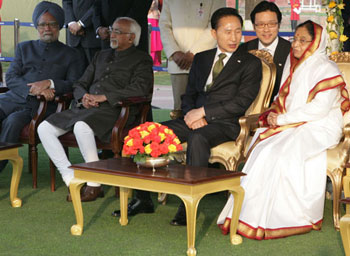 NEW DELHI, Jan 26: President Pratibha Devisingh Patil hosted the customary "At Home" on the occasion of 61st Republic Day on Tuesday evening in the sprawling lawns of Rashtrapati Bhavan here.
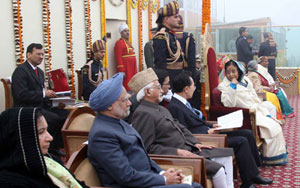 NEW DELHI, jan 26: More than a decade after India’s home built fighter aircraft, Tejas, was first flown, it made it made an appearance at Republic Day, though without a roar. The much-awaited aircraft was driven down the Raj Path instead of being flown.
 NEW DELHI, Jan 25: President Pratibha Patil on Monday asked the nation to think out of the box to bring down prices with focus on farm productivity through a second Green Revolution.
  NEW DELHI, Jan 25: President Pratibha Patil inaugurated the Diamond Jubilee celebrations of Election Commission. Country's top leaders, across the political parties stressed the need to eliminate the election-related malpractices, including the 'paid news.'
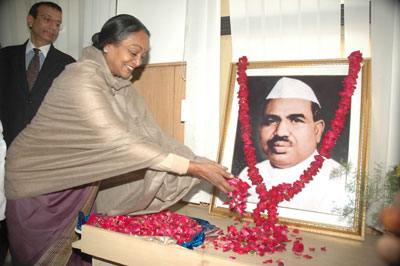 NEW DELHI, Dec 16: Lok Sabha Speaker Meira Kumar has said that Babu Jagjivan Ram promoted social justice in Indian society and to the well-being of the distressed and the dispossessed who have been the victims of social discrimination and oppression for centuries.
 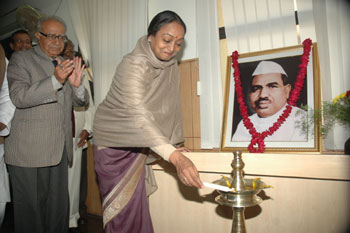 During his lifetime, she said Babuji fought against many abhorrent practices. He was made of sterner stuff and from his early childhood and was determined not to tolerate any injustice against him as also those mired in poverty and penury.
  LONDON, Nov 10: Union Finance Minister Pranab Mukherjee on Monday rejected fears of a “conflict” with China saying that though there were “differences of views” on the border issue the two countries had “institutional” mechanisms in place to ensure that these were resolved peacefully.
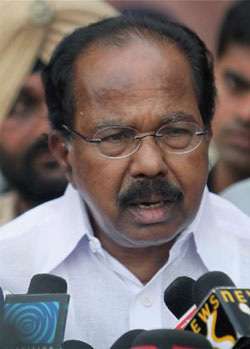 NEW DELHI, Oct 21: Government may have a fresh look at the method of appointment of judges to higher judiciary. It also intends to come out with a comprehensive bill to deal with complaints of corruption against judges, Law Minister M Veerappa Moily said on Wednesday.
 SHIMLA, Oct 18: Union ministers Virbhadra Singh and Anand Sharma will head Congress campaign in the by-elections to two assembly seats of Himachal Pradesh where voting will be held on 7th Nov.
  KARNAL, Oct 4: On the campaign trail in Haryana for the assembly elections, Congress president Sonia Gandhi on Sunday attacked the opposition parties for having “destroyed” the state during their rule and said it was the Congress that brought it back on the path of development after coming to power in 2005.
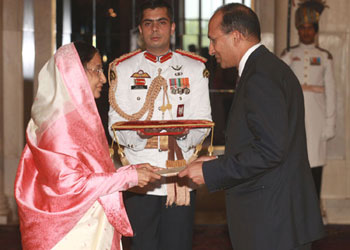 NEW DELHI, Sept 24: Seven envoys presented their credentials to the President of India, Smt. Pratibha Devisingh Patil at a ceremony at Rashtrapati Bhavan.
 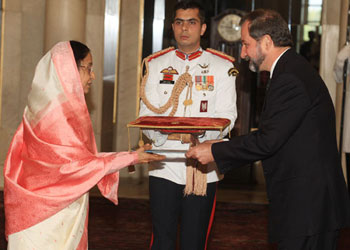 In her interaction with the envoys, the President welcomed them to India. The President conveyed India’s desire to have good relations and to intensify bilateral relations with their countries.
 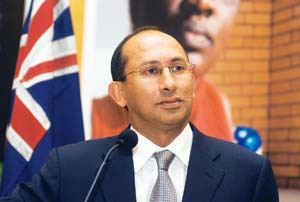 NEW DELHI, Sept 24: Australia's new envoy, Peter Varghese, is the first person of Indian origin to be appointed Australian high commissioner to India.
 NEW DELHI, Sept 22: Congress President Sonia Gandhi on Tuesday asked Minister of State for External Affairs Shashi Tharoor to refrain from speaking further on the twitter issue. According to media reports, Sonia asked Tharoor not to rake up the twitter gaffe.
  NEW DELHI, Sept 18: Reacting on the controversy over his "cattle class" remarks, India's Minister of State for External Affairs Shashi Tharoor on Thursday night said he was "sorry" for hurting any sentiments and that his words had been misunderstood.
 NEW DELHI, Sept 13: Lamenting that certain provisions in the Constitution have made it difficult to deal with corrupt civil servants, Law Minister Veerappa Moily on Sunday said there was a need to "revisit" the article granting protection to government employees and that he was pursuing the matter with the Prime Minister.
  NEW DELHI, Sept 10: Tibetan spiritual leader the Dalai Lama was expected to visit Arunachal Pradesh in November.
 NEW DELHI, Sept 9: The government on Tuesday launched the Sakshar Bharat Mission with the objective to reduce illeteracy especially among the women to mark the International Literacy Day.
 NEW DELHI: The Bharatiya Janata Party has decided to tread cautiously in defending the Gujarat government against Monday’s disclosure by Ahmedabad metropolitan magistrate S.P. Tamang that the June 2004 “encounter” in which teenager Ishrat Jehan and three others were gunned down was fake.
  NEW DELHI, Aug 22: Pointing out that the “exact frontiers” of terrorism are still unknown, Union Law Minister M. Veerappa Moily on Saturday said law should be dynamic to meet the growing challenge posed by terror networks and outfits across the world.
 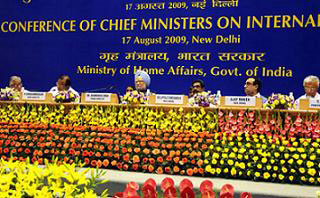 NEW DELHI, Aug 17: Terror groups in Pakistan are planning to carry out fresh attacks in India and there has been a surge in infiltration this year which is "disturbing", Prime Minister Manmohan Singh said in New Delhi on Monday.
 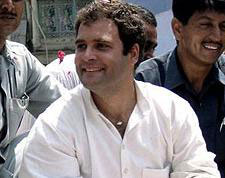 JAGDISHPUR, Aug 17: In Delhi on Monday to bargain over the special drought relief package with Prime Minister Manmohan Singh, Uttar Pradesh chief ministerMayawati may not have been prepared for ominous rumblings coming her way from the home turf.
 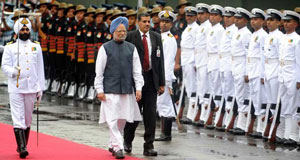 NEW DELHI, Aug 15: The Indian nation celebrated its 62nd Independence Day Saturday with Prime Minister Manmohan Singh unfurling the tri-color from the rampart of Lal Quila, the historic Red Fort, in New Delhi.
  NEW DELHI, Aug 13: President Pratibha Patil and Prime Minister Manmohan Singh on Thursday greeted the nation on the occasion of Janmashtami, which will be celebrated tomorrow.
  In his separate message, Dr. Singh said that the festival of Janmashtami celebrates the life and teachings of Lord Krishna, which have an eternal message for all of us.
  NEW DELHI, Aug 13: The President, Mrs Pratibha Devisingh Patil, will address the nation tomorrow on the eve of the 63rd Independence Day.

Aviation
| Business | Defence | Foreign
Affairs | Communication | Health
| India | United Nations
India-US
| India-France | Entertainment
| Sports | Photo Gallery |
Tourism | Advertise with Us
| Contact Us
© Noyanika International, 2003-2009. All rights reserved.