


United States
|
US Senator Ted Kennedy diesMASSACHUSETTS, Aug 26: Massachusetts Sen. Edward M Kennedy, the liberal lion of the Senate, has died after battling a brain tumor. He was 77. For nearly a half-century in the Senate, Kennedy was a dominant voice on health care, civil rights, war and peace, and more. To the American public, though, he was best known as the last surviving brother of a storied political family. Kennedy was elected to the Senate in 1962, when his brother John was president, and served longer than all but two senators in history. Over the decades, Kennedy put his imprint on every major piece of social legislation to clear the Congress US 'overdid' Shah Rukh's questioning: ChidambaramNEW DELHI, Aug 17: Home Minister P Chidambram on Monday said the Americans had "overdone it" by detaining Bollywood superstar Shah Rukh Khan for two hours at Newark airport in New Jersey, for questioning. "Had it been for ten minutes or even twenty minutes (of detention for questioning), one can understand it. But one fails to understand how could they hold him for two long hours?" said Chidambaram, talking to reporters on the sidelines of the annual meet of the state chief ministers and the police chiefs on internal security scenario in the country in New Delhi at Vigyan Bhawan. "It takes maximum of ten minutes, say twenty minutes, even if you have to frisk a person after stripping him. They have simply overdone it," he said. "And to add to the complications, they allowed SRK to make a call only after two hours. Had they allowed him to make the call in first fifteen minutes, there would have been no controversy," said the minister. Asked if India too would treat visiting US dignitaries or their high-profile citizens in the same manner, Chidambaram said: "We will tell them that we do it (frisking) and checking only in civilised manner." The minister, however, lamented that such an unsavoury treatment was meted out to a high-profile citizen of a country where "we send our joint secretaries officers to the tarmac to receive them (visiting dignitaries.)" Reacting to the incident, Civil Aviation Minister Praful Patel on Sunday said that the government will take up the issue with the US government at its highest level. "We will take the issue with the United States government strongly. Such incidents involving Indians due to their religion or nationality should not happen. We will not accept it," said Patel. Khan was detained for about two hours Saturday morning at the airport in New Jersey where he had arrived to attend India's Independence Day celebrations with Indian diaspora. Khan was released after Congress MP Rajiv Shukla spoke to the authorities in the US and the Indian consulate. Khan had been detained after his name flashed on a computer and was asked several questions about the purpose of his visit. Tourism Minister Ambika Soni too had condemned the incident. Mumbai attackers came from Karachi: FBIMUMBAI, Aug 12: Reinforcing the Pakistan link to the Mumbai terror attack, the FBI told a special court here on Wednesday that its probe had established that the perpetrators came from Karachi. In crucial testimony at the trial of the lone surviving gunman Ajmal Amir ‘Kasab’, an official of the U.S. federal agency, giving evidence for the first time in India in terror cases, said the terrorists had used the GPS, a satellite navigation system to locate targets. Deposing before Special Judge M.L. Tahaliyani, an FBI forensic expert whose identity has been kept secret, said the GPS devices allegedly recovered by the Mumbai police from the slain terrorists indicated plans for a return journey from Mumbai to Karachi and Rawalpindi. ‘Kasab’, a Pakistani national, sat smiling all through the FBI official’s testimony. The planned return journey showed that the terrorists were given practical training in Pakistan to use GPS, according to special public prosecutor Ujjwal Nikam. The FBI official said “Way Point” data retrieved from the GPS devices pointed to the route from Karachi to Mumbai and also positions between these two cities. He said he had examined five GPS devices and a satellite phone. Mr. Nikam said the police were still investigating the numbers from where the calls were made to the recovered satellite phone. According to the prosecution, the terrorists were in touch with their handlers. Bill Clinton meets Kim Jong-II; Two U.S. reporters released
Mr. Clinton’s is the highest-level visit from the U.S. to North Korea in a decade, and is particularly significant as it comes against the backdrop of worsening ties between the two countries after North Korea conducted a nuclear test in May, defying United Nations sanctions. The two countries have no diplomatic ties: the last high-level visit by a U.S. official was, in fact, during Mr. Clinton’s administration, when his Secretary of State Madeleine Albright visited Pyongyang in 2000. State media in North Korea reported that Mr. Kim hosted a dinner for Mr. Clinton, and the two held a “wide-ranging exchange of views on matters of common concern”. It said Mr. Clinton had “courteously” conveyed a message to Mr. Kim from U.S. President Barack Obama. But U.S. officials on Tuesday said Mr. Clinton’s visit was not official, and described it as “a private mission”. Officials said they would not release details “while the mission was in progress”. Mr. Clinton is thought to have made a case for the release of the two jailed reporters. In March, Euna Lee and Laura Ling, two reporters working for Current TV — a news channel started by Al Gore, who served as Mr. Clinton’s Vice-President between 1993 and 2001 — were detained by North Korea along its border with China. The two reporters were filming a news report on the thousands of refugees who cross over into China every year. Pyongyang said they had entered North Korea illegally, and accused them of committing “hostile acts.” Both were sentenced to 12 years of hard labour. There is now an expectation that Mr. Clinton’s visit might also pave the way for talks between the two countries. The last visit by a former President, Jimmy Carter, in 1994 led to a thawing in the relationship, and Mr. Clinton’s visit comes only a week after North Korea declared it was willing to hold direct talks with the U.S. But the U.S. has said it would only engage with the country through the multilateral Six-Party Talks mechanism — an initiative set up in 2003 along with China, South Korea, Russia and Japan aimed at promoting denuclearisation and bringing stability to the region. North Korea quit the Six-Party Talks in April after it conducted a failed satellite launch, followed by a series of nuclear and missile tests. In June, the United Nations Security Council expanded sanctions against North Korea, calling for an arms embargo, freezing financial transactions and tighter inspections of cargo. North Korea is heavily dependent on China, its closest ally, for food supplies and financial support. Some analysts say North Korea’s recent moves are a show of strength by ailing leader Kim Jong-Il as he prepares for the succession of his 26 year-old son, Kim Jong-Un. Last month, U.S. officials reportedly approached China to hold talks for a contingency plan in case the politics of succession led to a collapse of the regime. Chinese officials however rejected the invitation, saying that “allowing the collapse of the regime would be unacceptable” for China. No Pakistan evidence on India hand in Balochistan: USWASHINGTON, July 30: US Special Representative for Afghanistan and Pakistan Richard Holbrooke on Thursday said that Pakistani leaders brought up the issue of India's alleged involvement in Balochistan, but did not give any credible evidence to support their claim. "I would be misleading, if I said it didn't come up," Holbrooke told State Department Press Corps when asked to comment on the meetings he had with Pakistani leaders during his last week's visit to that country. Asked if Pakistan has provided him with any "credible evidence of India's involvement in Balochistan", he said: "The narrow answer to your question is no." However, he did not elaborate any further. He also reiterated that Kashmir is outside his ability to discuss. Responding to questions, Holbrooke said there is no difference with India on the issue of Pakistan and Afghanistan. "You know, India was the first country in the world I was ever aware of. I have a very special feeling for it. And if there's a rift, you have to ask the Indians. I didn't see any rift," the US envoy said. Obama continues Bush's 'good work' in building India ties: HillaryWASHINGTON, July 27: US Secretary of State Hillary Clinton says in building a "most comprehensive engagement" with India, the Obama administration was continuing with the "good work" done by his predecessor George Bush. "We're building on some of the good work that's been done in a bipartisan way with India, starting with my husband (Bill Clinton)" the former first lady said on NBC's "Meet the Press" Sunday. "And in fact, in this case, continuing with President Bush with India. So that we have now announced the most comprehensive engagement we've ever had with that country," she said. Asked what she meant when she said during her trip to Asia that "the United States is back and we're ready to lead", Ms. Clinton said: "Well, what I meant was that in many parts of the world, the priorities that were pursued the last eight years did not seem to include them. "So just going, for example, to Asia, as I did on my first trip, as I just did, was viewed as a very positive statement of participation." When told that Obama Administration policy in Asia was not that different from the Bush Administration policy in Asia Ms. Clinton disagreed. "I mean, part of what we have done is to organise ourselves so that we can concentrate on many important issues at the same time." "And I think the feeling on the part of much of the world was that the prior administration, for understandable reasons, focused so much on some of the specific issues, like Iraq, et cetera, that really grabbed it and required a lot of attention, that much of the rest of the world felt that they were kind of second tier." Indian Govt accused of giving in to USNEW DELHI, July 22: Even as the UPA government was reeling under the charge of compromising national interests by initialling the Indo-Pak joint statement in Egypt, more grief came its way on Tuesday. The charge this time was that it has "mortgaged Indian sovereignty to the US" by signing an End-Use Monitoring Agreement (EUMA) which would allow American inspectors to verify the end use of US sourced high tech equipment of dual use. The issue erupted in Parliament with the opposition claiming that this was the thin end of the wedge after ``giving in'' to the US, India would now be required to make its sensitive military equipment available for inspection to not just the Americans, but all foreign suppliers. The government insisted that this was far from the truth and the EUMA allowed nothing of the sort, but a disatisfied Opposition walked out of the two Houses. Foreign minister S M Krishna said, "Nobody should have anxiety about national interests being surrendered." He said the agreement only "systemises ad-hoc arrangements for individual defence procurements from the US entered into by previous governments." The EUMA is designed to facilitate high-end dual use technology transfer to India. Under US laws no country can get access to high technology of dual use with an EUMA agreement. Since 1984, Indian companies had had to sign stand-alone end-use monitoring pacts to source American high tech. Now the EUMA, signed in the presence of US secretary of state Hillary Clinton's presence on Monday, has become an umbrella agreement that covers the trade of all cutting-edge technology from the US for a whole range of applications. This EUMA is seen by the government seen as a good bargain because while it allows the US to carry out inspections, it gives India the prerogative to decide on the time and venue of the scrutiny. This way, it feels that it won't disclose the exact locational and strategic use of military equipment to American inspectors. The Opposition, however, refused to see it in this light, arguing that the agreement would cover even technologies obtained from other sources. The tone for the skirmish was set right in the morning, within hours of the agreement being signed with Clinton. As Lok Sabha met, BJP leader Yashwant Sinha stood up to accuse the government of buckling under US pressure. Sinha said the pact would allow US inspection even for supplies from third countries if they had used American technology. He further said that inspectors would visit sensitive installations to inspect "immoveables" which could not be put at a safe site for scrutiny. Sharad Yadav of JD(U) added the frisking of former President A P J Abdul Kalam by a US airline was a sign of American abrasiveness. "Remember when Clinton came to India, sniffer dogs were sent to Rajghat," he said. Arun Jaitley said in Rajya Sabha, "Today we have friendly relations (with US) but we cannot forget a situation where the 7th Fleet had entered the Indian Ocean." He added that US also has "very friendly relationship" with Pakistan. SP chief Mulayam Singh Yadav reminded Congress that Nehru had refused to accept foreign interference. "You have forgotten not only Gandhi but even Nehru," he said. CPI's Gurudas Dasgupta called it a "Himalayan blunder". The rhetoric climaxed when RJD chief Lalu Prasad said, "UN inspectors did not find any weapons of mass destruction or chemical weapons but Iraqi leader Saddam Hussein was hung. This was a message to the world that those who fail to toe the US line will meet the same fate." Krishna responded to all this with a bland statement that gave a factual account of the pacts signed with Hillary Clinton. Saying that Clinton's visit would help "broaden and deepn bilateral relationship", the minister said, "We have also agreed to a new bilateral dialogue architecture within which we will continue discussions between our two countries on a wide range of issues." As the Opposition walked out, Krishna said, "I am surprised by the interpretation sought to be given to the bilateral pact between two sovereign countries." He said the end-use monitoring of high-end defence purchases always existed and the fresh pact only generalised them. "We do it for other countries also. It is all straight and it is in the larger interest of the country." India, US agree on end user monitoring pactNEW DELHI, July 20: India and the US have agreed to enter into an understanding on end-use monitoring agreement that will pave the way for greater defence cooperation as New Delhi conveyed its decision to locate two nuclear parks for American companies. After a hectic day of meetings with Prime Minister Manmohan Singh and External Affairs Minister S M Krishna, US Secretary of State Hillary Clinton announced that the two countries have agreed to enter into a strategic dialogue based on five pillars of cooperation. The Prime Minister will make his first state visit to Washington during the Obama administration on 24th November. "We share a common trait by rolling up our sleeves and get things done. We have shown progress also by finalising important agreements today including the end user agreement that will pave the way for greater defence cooperation between our countries and technology safeguards agreement," Clinton told a joint press conference with Krishna. In his remarks, Krishna said that the two countries have agreed on the end use monitoring arrangements that will henceforth be referred to in the letters of acceptance in procurement of defence equipment and technologies. Clinton said the Prime Minister had informed her about India's decision to allocate two sites for American civil nuclear reactors. This, she said, will take forward the civil nuclear cooperation between the two countries, creating jobs in both the nations besides producing the much-needed energy in India. She hoped India would be ready for the Liabilities Agreement in the nuclear field. On the controversy surrounding G-8 decision to curb transfer of enrichment and reprocessing technology (ENR), Clinton made it clear that it would not undermine the Indo-US civil nuclear deal but was aimed at preventing "unauthorised" countries from getting such sensitive knowhow. "We have just completed a civil nuclear deal with India. So if it is done within the appropriate channels and carefully safeguarded, as it is in the case of India, that is appropriate," the Secretary of State said. "But we are very much opposed to unauthorised and inappropriate transfers that unfortunately can take place by certain countries or non state actors doing so. So there is a right way to do it and there is wrong way to do it," he said. She added that the US is "seeking advice and suggestions from India about how we can prevent the unauthorised and dangerous transfer of nuke technology and material which poses a threat to the entire world." N-deal opens pathways for partnership on non-proliferation: USWASHINGTON, July 20: The Indo-US civilian nuclear deal has opened up new pathways for partnership between the two countries on non-proliferation issues globally, the White House said. "Civil nuclear cooperation with India has opened new pathways for a strengthened US-India partnership on nonproliferation issues globally," National Security Council spokesman Benjamin Chang told a news agency. "We look forward to continuing to pursue our commonly held energy security, nonproliferation, and strategic objectives as we join with India to provide strong and dynamic leadership in the international community," Benjamin said, after US President Barack Obama transmitted on Tuesday to the US Congress his first report on the Indo-US civil nuclear deal. "The report covers the period of October 4, 2008, to June 30, 2009. It provides an update on US-India civil nuclear cooperation and developments that relate to India's nuclear-related activities," Obama wrote to chairman and ranking members of the House Committee on Foreign Affairs and the Senate Committee on Foreign Relations. However, the content of the report was not made public, as Obama wrote to them: "Classified information associated with these issues has been provided in a separate classified annex." The report also includes updates on joint efforts by India and the US to prevent the spread of weapons of mass destruction. This is the first report issued by Obama since the entry into force of the 123 Agreement in December last year. The report is being offered pursuant to the reporting requirements of the Henry J Hyde United States-India Peaceful Atomic Energy Cooperation Act of 2006 and the United States-India Nuclear Cooperation Approval and Nonproliferation Enhancement Act of 2008, the latter being the approval legislation for the 123 Agreement. Clinton meets PM
Clinton, who is on a five-day visit to India, met Singh at his office in 7 Race Course Road in New Delhi on Monday. She was accompanied by US Ambassador-designate Timothy Roemer among others. The US Secretary of State will also meet External Affairs Minister S M Krishna during which the two sides are expected to look at ways to take the strategic ties to a new level. A few pacts, including the End User Verification agreement in defence field, under which the US would be able to supply sensitive military equipment, are expected to be signed after the discussions. Terrorism is number one challenge: HillaryNEW DELHI, July 20: US Secretary of State Hillary Clinton on Monday said there has been "real will" on the part of Pakistan to tackle terrorism and that her country will enlist the help of India in fighting the menace. "I have seen a real will on the part of Pakistan government to tackle terrorism...It is their government which is being attacked and people who are being mistreated," said Ms. Clinton while addressing students of Delhi University here. She also said, "We have to look for ways to support those who oppose terror". Emphasising that combating terrorism is the "number one" challenge, Ms. Clinton said the US will enlist the help of everyone including India. Acknowledging India's growing stature, she said the world is now wanting to know where it is headed to. "Military strength does not define greatness of nation... Soft powers are more appealing," she said. Ms. Clinton also noted that the relationship between India and the US was growing day by day and wanted to use diplomatic tools to seek common ground. US for 'new, promising relations' with India: HillaryMUMBAI, July 18: The US is ready for "new and even more promising relations" with India, accordig to Secretary of State Hillary Clinton. Speaking to journalists at the start of a five-day trip to India, Ms. Clinton said the Barack Obama administration was determined to cement bilateral ties further. "We are entering a new and even more promising relations with India. We are looking ... to broaden and deepen our relationship," she said. She said the strength of the India-US partnership "ultimately rests on the deep and enduring ties between the Indian and the American people". Ms. Clinton said the problems of the 21st century demand a new mindset and a willingness to create partnership with governments but also beyond governments. She said she had just ended "an exciting meeting with Indian business leaders". Ms. Clinton, who arrived here Friday night, began the first full day of her visit by meeting the staff of the Taj Mahal Palace & Tower Hotel and the Oberoi-Trident Hotel, which were among the landmarks ravaged by terrorists from Pakistan in November last year. Ms. Clinton is staying at the Taj hotel, close to the Arabian Sea, as a mark of solidarity with those who were killed or wounded in that attack. She said she was deeply touched to meet the staff of both the hotels and "to pay respect to the large number attacked. "This hotel in this city suffered grievously and endured painful losses because of the extremists and violence visited on it. "The great men and women who worked in this hotel and elsewhere in the city... (facing) senseless violence and helped save lives ? they deserve our gratitude." She underlined that the American people stood in solidarity with the people of India when the November terror attack unfolded on TV screens. And referring to Friday's terror bombings in Jakarta, Clinton said it was a "painful reminder (that terrorism) is global, it is ruthless, it is nihilistic, and it must be stopped". Ms. Clinton will fly Sunday to New Delhi where she said she will meet government leaders for discussions on the issues including economic growth, climate change, education, health care, non-proliferation and counter-terrorism. Hillary Clinton meets Indian business leaders
Ms. Clinton discussed an array of issues over breakfast with around 10 of India's top corporate names, including Ratan Tata, Mukesh Ambani, Swati Piramal, Jamshyd Godrej, O P Bhatt, and Chanda Kochhar, at the Taj Mahal Palace and Tower Hotel. India Inc discussed the subject of protectionism and outsourcing, issues which have an impact on them, especially in this period of global economic meltdown, at the meeting with Clinton. The meeting also focussed on Corporate Social Responsibility (CSR), a subject close to Clinton's heart. U.S. Ambassador-Designate Timothy J. Roemer Arrives in New Delhi
Testifying before the Senate Foreign Relations Committee on July 7, Ambassador-Designate Roemer said, "Our relationship with India is a good news story. And while our relationship has gone through different stages, we are certainly moving ahead on an upward trajectory. This is not a zero sum game with winners and losers but a positive sum game-with India as a strong, stable global democracy increasing peace and prosperity for all." Prior to President Barack Obama's nominating him as Ambassador to India in May, Mr. Roemer was President of the Center for National Policy (CNP), a moderate think-tank in Washington, D.C. He represented the 3rd District of Indiana for six terms as a U.S. Congressman, from 1991 to 2003. Ambassador-Designate Roemer served as a member of the 9/11 Commission, as well as the Commission on the Prevention of Weapons of Mass Destruction, Proliferation and Terrorism. He also served on the Washington Institute for Near East Policy's Presidential Task Force on Combating the Ideology of Radical Extremism, and the National Parks Second Century Commission. As a Distinguished Scholar at the Mercatus Center at George Mason University, Ambassador-Designate Roemer worked with Members of Congress and staff to improve public policy outcomes by teaching on the legislative branch and policy analysis. Ambassador-Designate Roemer holds a B.A. from the University of California, San Diego and a M.A. and PhD. from the University of Notre Dame. New US Ambassador to arrive in New Delhi next weekWASHINGTON, July 8: The new U.S. Ambassador to India, Timothy Roemer, is expected to arrive in New Delhi sometime next week, at least a few days ahead of the visit of the Secretary of State, Hillary Clinton. The nomination of Roemer, 53, was confirmed by the Senate Foreign Relations Committee on Wednesday. It now goes to the Senate floor, which is expected to formally confirm the nomination as early as this week. While no date of Ms. Clinton's trip to India has been announced yet, officials in the State Department said the idea is to have Mr. Roemer present in New Delhi when the Secretary of State visits the country in about 10 days from now. A former Congressman from Indiana, Mr. Roemer had testified before the Senate Foreign Relations Committee on Tuesday. Clinton plans to visit India in second half of July
However, no dates have been announced yet, given that Ms. Clinton is yet to fully recover from the surgery of her right elbow, which she had fractured about two weeks ago at the Foggy Bottom headquarters of State Department. "I think you are aware the Secretary does plan to visit India sometime in the second half of July. I do not have any details right now to release on it," State Department spokesman Ian Kelly said in response to a question at his daily press briefing. US House passes historic climate change billWASHINGTON, June 27: The US House of Representatives narrowly passed historic legislation to limit pollution blamed for global warming, Obama immediately hailed the vote, telling reporters at the White House that it amounted to "a victory of the future over the past" as well as "a bold and necessary step." By a 219-212 margin, lawmakers on Friday voted for the first time in US history to limit heat-trapping carbon emissions and shift the US economy to cleaner energy in a move backers said will create jobs and restore Washington's shaky leadership on climate change ahead of global talks set for December. "The American people are demanding that we abandon the failed policies and politics of the past; we no longer accept inaction; that we face up to the challenges of our time. And today, the House has done exactly that," he said. The "American Clean Energy and Security Act" aims to reduce greenhouse gas emissions by 17 percent from 2005 levels by 2020, and 83 percent by 2050, create "green" jobs, and wean the US economy from oil imports. The bitter, day-long debate pitted supporters who argued the bill would put a shine back on the battered US economy and foes who described the measure's more than 1,200 pages as a grim recipe for long unemployment lines. Obama administration will take nuke deal foward: ClintonWASHINGTON, June 17: US Secretary of State Hillary Clinton has said that Indo-US nuclear deal allows the US to move beyond concerns about the status of India's nuclear programme, an issue that dominated the relationship between the two countries for much of the last decade. Terming the nuclear deal as a "landmark agreement" for both the countries, Hillary Clinton said on Wednesday the Obama Administration is fully committed to implement the civil nuclear pact. The agreement carries a strong bipartisan support in both India and the US, Clinton said addressing a meeting of Indian and US corporate leaders at the Synergies Summit of the US India Business Council. "This second stage in our (US India) history continued through the last US and Indian administrations and culminated in completion of the Indo-US civilian nuclear agreement, this past October, under the Bush administration," Clinton said. "This landmark accord, which the Obama administration is fully committed to implementing, provides a framework for economic and technical cooperation, between our two countries, and allows us to move beyond our concerns about the status of India's nuclear program, an issue that dominated our relationship for much of the last decade," Clinton said. The nuclear deal, which was completed through the efforts of former President Bush, Clinton said removed the final barrier to broader cooperation between the two countries. "That brings us to today," she said. When the US-India nuclear deal passed the United States Congress, last year, Clinton said it had strong bipartisan support, including backing from two former Senators Barack Obama and Joe Biden, as well as herself. "The agreement also received support from across the political spectrum in India. The formation of India's new government is an opportunity to strengthen our ties and launch new initiatives," she said. "Now that the government is in place, we are moving quickly to strengthen our ties. Our senior career diplomats, Undersecretary of State Bill Burns and newly minted Assistant Secretary of State Bob Blake, have returned from India this weekend to tell me of the enormous potential for progress in our relationship with New Delhi," Clinton said. Reflecting on the six decades of relationship between the United States and India, she said, it hasn't always had such a promising partnership. "We need to acknowledge the road we have traveled together. We have already come through two distinct eras in U.S.-India relations on our way to this new beginning," Clinton said. "The first era opened with India's founding and lasted to the end of the Cold War. It was coloured by uncertainty about each other's motives and ambivalence about whether to pursue closer cooperation," she said. Though the relationship between our countries was never hostile, Clinton observed it missed opportunities for closer partnership during this period were casualties of old conflicts between East and West and North and South. After the Cold War ended, President (Bill) Clinton opened a new chapter of engagement with India," Clinton said. "Talks between former Deputy Secretary of State Strobe Talbott and his Indian counterpart helped to establish a new foundation for our relationship. And of course, my husband and daughter had an extraordinary visit toward the end of his term in office," Clinton said. The Secretary of State termed the Indo-US nuclear deal as the second era and said the Obama Administration is determined to take it to the third stage. Hillary pledges to expand ties with IndiaWASHINGTON, June 17: Secretary of State Hillary Clinton on Wednesday said she would visit India next month and pledged to work for a “dramatic expansion” of India-U.S. ties giving New Delhi a greater role in solving global challenges. Reaffirming the Obama administration’s commitment to strengthen ties, Clinton said in a world of depressing headlines, the U.S. relationship with India is good news. “We see India as one of a few key partners worldwide who will help us shape the 21st century — the forces of positive change versus those of destruction, the forces that move people forward rather than holding them back. We are both eager to build on this relationship,” she said, addressing American and Indian corporate executives here. “We find ourselves at the beginning of a third era. I will call it U.S.-India 3.0. The new governments in Washington and New Delhi will build this future together. And we will be discussing the details of that partnership, when I visit India next month.” “Today, I can tell you, my hope and President Obama’s hope, that the next stage in our countries’ relationship will see a dramatic expansion in our common agenda and a greater role for India, in solving global challenges. “We will have to confront and transcend the mistrust that has hampered our cooperation in the past,” she said. Obama unveils biggest regulatory overhaul since 1930sWASHINGTON, June 17: US President Barack Obama proposed the most "sweeping" regulatory overhaul since the 1930s, vowing to stop future meltdowns in a financial system humbled by lax oversight, greed and huge debts. The reforms, which must be approved by Congress, will inject the government deeper into financial markets and industries in a bid to tame the recklessness which saw a mortgage meltdown tip the world into deep economic crisis. "We did not choose how this crisis began. But we do have a choice in the legacy this crisis leaves behind," Obama said in remarks released by the White House ahead of his formal announcement of the reforms later in the day. "So today, my administration is proposing a sweeping overhaul of the financial regulatory system, a transformation on a scale not seen since the reforms that followed the Great Depression." Some Obama critics, hoping for a top-to-bottom reconstruction of the greed-laced financial system, have complained the overhaul did not go far enough, but he argued his action would restore the power of the market. Obama blamed a "culture of irresponsibility" a Great Depression-era regulatory system, reckless executive compensation, excessive debt and markets awash in new and risky financial products for sparking the crisis. "An absence of oversight engendered systematic, and systemic, abuse," Obama said. Obama asks North Korea to denucleariseWASHINGTON, June 16: Asserting that a nuclear-armed North Korea is a "profound threat", US President Barack Obama on Tuesday asked Pyongyang to denuclearise and join the international community. "Given their past behaviour, given the belligerent manner in which they are constantly threatening their neighbours, I don't think there's any question that that would be a destabilising situation that would be a profound threat to not only the United States' security but to world security," Mr. Obama said at a joint press conference with the visiting South Korean President Lee Myung-bak. Mr. Obama said North Korea also has a track record of proliferation that makes it unacceptable for them to be accepted as a nuclear power. They have not shown, in the past, any restraint in terms of exporting weapons to not only state actors but also non-state actors, he said. "So what we have said is that there is a path for North Korea to take in which they are joining the world community, becoming integrated into the world economy, able to feed their own people, able to provide prosperity for their people," Mr. Obama said. President Lee of South Korea said the North Koreans must understand that their past behaviour will not stand. "Not only will the US-Korea close partnership, but Japan, China and the rest of the international community takes part in this effort. Now the North Koreans will come to understand that this is different, that they will not be able to repeat the past or their past tactics and strategies," he said. Urging the North Koreans to fully give up their nuclear weapons program and ambitions, Mr. Lee said the Pyongyang regime needs to become a responsible member of the international community. Earlier alleging that North Korea has abandoned its own commitments and violated international law, Mr. Obama said its nuclear- and ballistic-missile programs pose a grave threat to peace and security of Asia and to the world. Reiterating shared commitment to the complete denuclearization of the Korean Peninsula along with President Lee, Mr. Obama said reaffirmed the endurance of their alliance and America's commitment to the defense of South Korea. "We discussed the measures that we are taking with our partners in the region, including Russia, China and Japan, to make it clear to North Korea that it will not find security or respect through threats and illegal weapons," he said. Referring to the resolutions adopted by the UN Security Council, he said: "Now we must pursue a sustained and robust effort to implement this resolution together with our international partners." Burns hints at tech deal during July Hillary visitNEW DELHI, June 11: The US Thursday expressed support for an India-Pakistan dialogue, but left it to the two countries to decide how and when. "The US has always welcomed dialogue," undersecretary of state for political affairs William Burns said after handing over a letter to Prime Minister Manmohan Singh from US President Barack Obama inviting him to visit the US. Mr Burns’ remarks came ahead of Dr Singh’s much-anticipated handshake with Pakistan President Asif Ali Zardari on the sidelines of the SCO summit in Russia’s Yekaterinburg next week. He added that the Pakistan government had a special responsibility to "fully and thoroughly" investigate the 26/11 Mumbai attacks. He said the Obama administration remained firmly committed to the India-US nuclear deal. Washington wanted to begin negotiations on reprocessing of spent nuclear fuel by the end of July. The two countries, he said, were "closer" to signing an end-user verification agreement for validating future military purchases. He was also hopeful that a Technology Safe-guards Agreement would be signed "very shortly", possibly by the time US secretary of state Hillary Clinton visits India around July 20. Asked about Pakistan diverting US assistance to aid and abet terrorism targeted at India, Mr Burns said Washington would "continue to monitor" it and evaluate its use "very carefully". India, US to form Joint Working Group for cooperation in educationNEW DELHI, June 11: Seeking to take forward cooperation in education sector, India and the US agreed to set up a Joint Working Group which will focus on institutional linkages in the fields of secondary, higher and vocational education. The Joint Working Group will be headed by Union Minister of Human Resource Development of India and its equivalent from the USA. This was decided at a meeting between HRD Minister Kapil Sibal and a US delegation headed by William Burns, Under Secretary, Political Affairs at New Delhi on Thursday. The visiting delegation expressed keen interest in pursuing a bilateral dialogue with India for fruitful cooperation in the field of education. The Joint Working Group will meet once every year alternately in India and USA and will focus on having institutional linkages in the area of secondary, higher and vocational education, officials said. Sibal said India with its young population will be a major provider of trained workforce to the entire world in the knowledge driven era. Sibal said the major focus area of the government is to bring up the gross enrolment ratio in higher education from 11 percent at present to beyond 15 percent by 2012. As foreign education providers are keen to set up campuses in India, Sibal said fly-by-night operators would not allowed. The Indo-US education cooperation assumes significance in view of the fact that India tops the list of countries sending students to the USA for higher studies. Nearly 90,000 students annually go to the US from India for studies as per estimates available in recent years. Clinton: Obama can handle that 3 o'clock callWASHINGTON, June 8: Hillary Rodham Clinton says that if the phone rings at 3 a.m. at the White House, she's certain that President Barack Obama will know what to do. Such a phone call in the wee hours _ probably about an unexpected crisis - was a central argument that Ms. Clinton used during her primary campaign against Obama last year. She argued in a TV ad that she was the candidate with the experience to answer that 3 a.m. call. Ms. Clinton is now secretary of state and works for President Obama. She says her boss has shown he is fully capable of handling that kind of crisis call. Ms. Clinton told ABC's ``This Week'' that Mr. Obama's public and private actions show him to be strong, thoughtful and decisive. N. Korea sentences 2 US journalists to 12 years jailSEOUL, June 8: North Korea said its top court convicted two U.S. journalists and sentenced them to 12 years in labour prison on Monday, intensifying the reclusive nation's confrontation with the United States. The North's Central Court tried American TV reporters Laura Ling and Euna Lee during proceedings running from last Thursday to Monday and found them guilty of a "grave crime" against the nation, and of illegally crossing into North Korea, the country's state-run Korean Central News Agency said. It said the court "sentenced each of them to 12 years of reform through labor." The KCNA report gave no other details. Ling and Lee — who were working for former Vice-President Al Gore's California-based Current TV — cannot appeal because they were tried in North Korea's highest court, where decisions are final. The circumstances surrounding the trial of the two journalists and their arrest on March 17 on the China-North Korean border have been shrouded in secrecy. The trial was not open to the public or foreign observers, including the Swedish Embassy, which looks after American interests in the absence of diplomatic relations. U.S. officials and others working for the reporters' release have said they have received no information about the defendants and even lacked independent confirmation about whether the trial had started. There have been fears that the two woman were being used by Pyongyang as bargaining chips in its standoff with South Korea and the United States, which are pushing for U.N. sanctions to punish the nation for its latest nuclear test and a barrage of missile tests. The journalists were arrested as they were reporting about the trafficking of women. It's unclear if they strayed into the North or were grabbed by aggressive border guards who crossed into China. Gore spokeswoman Kalee Kreider said the former Vice-President has no comment. Calls to Alanna Zahn, a spokeswoman for the journalists' families, went unanswered and she did not immediately reply to messages. The U.S. Embassy in Seoul did not immediately comment. The sentences are much harsher than what many observers had hoped for. Choi Eun-suk, a professor on North Korean legal affairs at the Institute for Far Eastern Studies at Kyungnam University in South Korea, had speculated that the reporters would likely be sentenced to more than five years but less than 10 years in a labor prison. Then the negotiations with the U.S. would begin, he said. U.S. Secretary of State Hillary Rodham Clinton said Friday she was "incredibly concerned" about the plight of the two women. In working for their release, Clinton said she has spoken with foreign officials with influence in North Korea and explored the possibility of sending an envoy to the North, but suggested that no one would be sent during the trial. Koh Yu-hwan, a North Korean expert at Dongguk University in Seoul, had said Pyongyang will likely free the reporters and treat their release as a goodwill gesture that should be reciprocated with a special U.S. envoy visiting the isolated state. Another American who was tried in North Korea in 1996 was treated more leniently. Evan C. Hunziker, apparently acting on a drunken dare, swam across the Yalu River — which marks the North's border with China — and was arrested after farmers found the man, then 26, naked. He was accused of spying and detained for three months before being freed after negotiations with a special U.S. envoy. The North Koreans wanted Hunziker to pay a $100,000 criminal fine but eventually agreed on a $5,000 payment to settle a bill for a hotel where he was detained. |
|
|||||||
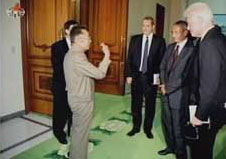 BEIJING, Aug 5: The former U.S. President, Bill Clinton, made a surprise visit to North Korea on Tuesday, where he met Kim Jong-Il seeking the release of two American reporters who had been jailed since March. The two reporters were later released.
 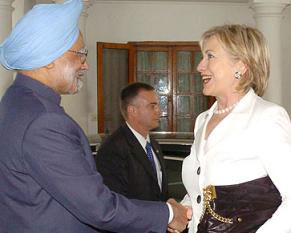 NEW DELHI, July 20: US Secretary of State Hillary Clinton called on Prime Minister Manmohan Singh and is understood to have discussed terrorism and Pakistan, besides ways to enhance bilateral relations.
 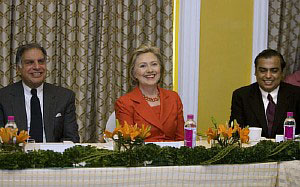 MUMBAI, July 18: US Secretary of State Hillary Clinton met Indian business leaders here Saturday, the first full day of her visit to the country.
 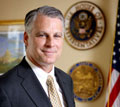 NEW DELHI, July 17: Timothy J. Roemer, U.S. Ambassador-Designate, arrived here last night following his confirmation by the full Senate last week.
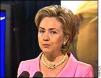 WASHINGTON, July 2: US Secretary of State Hillary Clinton plans to visit India in the second half of this month, the State Department said on Wednesday.

Aviation
| Business | Defence | Foreign
Affairs | Communication | Health
| India | United Nations
India-US
| India-France | Entertainment
| Sports | Photo Gallery |
Tourism | Advertise with Us
| Contact Us
© Noyanika International, 2003-2009. All rights reserved.