Obama announces 2012 re-election bid
WASHINGTON, April 4: US President Barack Obama on Monday formally announced his 2012 re-election bid, saying the country needed "to protect the progress" it had made.
"Today, we are filing papers to launch our 2012 campaign," Obama said in a statement.
He explained that as his administration and supporters across the country "fight to protect the progress we've made -- and make more -- we also need to begin mobilizing for 2012, long before the time comes for me to begin campaigning in earnest."
Obama said that in coming days, his supporters will begin forging a new organization in cities and towns across the country.
"And I'll need you to help shape our plan as we create a campaign that's farther reaching, more focused, and more innovative than anything we've built before," he said.
The announcement was preceded by a video, which featured a group of presidential supporters talking about the importance of continuing the job the president started following his election in 2008.
"This will be my final campaign, at least as a candidate," Obama said in the statement.
"But the cause of making a lasting difference for our families, our communities, and our country has never been about one person. And it will succeed only if we work together."
Egypt failing to meet protest concerns: US
WASHINGTON, Feb 10: Egypt must do more to meet protesters' demands for political change, the United States said on Wednesday in a sharp escalation of rhetoric with one of its most important allies in the Middle East.
Washington is waiting for "real, concrete" moves to speed the transition, White House spokesman Robert Gibbs said after Egyptian Foreign Minister Ahmed Aboul Gheit suggested the United States was eager to impose its will on Cairo.
"What you see happening on the streets of Cairo is not all that surprising when you see the lack of steps that their government has taken to meet their concerns," Gibbs said.
Israeli Defense Minister Ehud Barak held meetings at the White House as the United States and another key ally weighed the impact of Egypt's crisis on stability in the Middle East.
US Vice President Joe Biden on Tuesday set out steps Egypt must take in the face of unrelenting protests against President Hosni Mubarak, bluntly telling his government to stop harassing protesters and immediately repeal an emergency law allowing detention without charge.
The demands appeared aimed at raising pressure on Mubarak's handpicked vice president, Omar Suleiman, the former intelligence chief who is negotiating with opposition figures demanding Mubarak's immediate ouster.
"A lot has changed in Egypt, just within the period of the last week," Ben Rhodes, a deputy national security adviser, told journalists on a conference call. "We believe it can never go back to being the way it was."
Mubarak has given no indication he will step down, saying only that he will not run in September elections.
Aboul Gheit, in an interview with the PBS "NewsHour" program, said Biden's advice was "not at all" helpful and that he was amazed by the suggestion the emergency law should go.
"We have 17,000 prisoners loose in the streets, out of jails that have been destroyed. How can you ask me to sort of disband that emergency law while I'm in difficulty?" he said.
"Give me time, allow me to have control, to stabilize the nation, to stabilize the state, and then we would look into the issue."
Gibbs said Mubarak's administration appeared out of touch.
"I think it is clear that the Egyptian government is going to have to take some real, concrete steps in order to meet the threshold that the people of Egypt, that they represent, require from their government."
President Barack Obama discussed Egypt with Saudi Arabia's King Abdullah on Wednesday and emphasized the U.S. commitment to security in the region, the White House said.
The Obama administration has struggled to calibrate its message on Egypt, where the protests have raised fears of Islamist radicalization that could threaten Cairo's 1979 peace accord with Israel and its role in Middle East peace efforts.
Egypt's strategic importance to the United States includes its role as guardian of the Suez Canal, a route for oil imports to the West, and as a counterweight in the region to Iran.
But Israel -- one of the biggest recipients of U.S. aid -- is also a factor. Israeli officials have said the turmoil in Egypt may require the Jewish state to "bolster its might."
Barak, in his first visit to Washington since the crisis erupted, met Defense Secretary Robert Gates, Secretary of State Hillary Clinton and Thomas Donilon, Obama's national security adviser.
The US officials stressed Washington's "unshakable commitment to Israel's security, including through our continued support for Israel's military, and the unprecedented security cooperation between our two governments," the White House said in a statement after the meeting.
With calls for an orderly transition, the United States hopes the $1.3 billion in annual aid it gives Egypt's military is a stabilizing factor. But the idea of putting conditions on that aid was a hot topic at a hearing in the US House of Representatives on Wednesday.
Howard Berman, the top Democrat on the House Foreign Affairs Committee, said aid should continue "so long as the military is playing a constructive role in bringing about a democratic transition."
A new Reuters/Ipsos poll showed a majority of Americans believe the United States should be cautious about backing democracy in the Middle East because elections could lead to anti-US Islamist governments.
 Biden calls Manmohan, reaffirms US commitment to partnership
WASHINGTON, Feb 5: US vice president Joe Biden spoke with Prime Minister Manmohan Singh on Friday and "reaffirmed the US commitment to building a global, strategic partnership with India."
Without giving much details, a short White House readout only said they discussed "regional and global issues of mutual concern."
"Vice President Biden spoke today with Prime Minister Manmohan Singh to discuss regional and global issues of mutual concern. The Vice President reaffirmed the US commitment to building a global, strategic partnership with India," the White House statement read.
High-level Indo-US meetings in the offing
WASHINGTON, Feb 3: There will be a spate of meetings between top officials of the United States and Indian governments over the next few months, including visits by Secretary of State Hillary Clinton, Secretary of the Department of Homeland Security (DHS) Janet Napolitano, and Commerce Secretary Gary Locke, according to official sources here.
The recent trip to India by Jane Lute, Deputy Secretary of the DHS, between January 11-12, helped lay the ground for a visit by Ms. Napolitano “sometime in April,” according to a senior Indian diplomat here.
Indian Foreign Secretary Nirupama Rao is expected to visit Washington around February 13-15.
During her visit, Ms. Rao will consult with her U.S. counterpart William Burns, Under Secretary of State for Political Affairs, and also with Eric Hirschhorn, Under Secretary of Commerce Department's Bureau of Industry and Security (BIS), who is taking the lead on the matter of relaxation of export control restrictions vis-á-vis bilateral high-technology trade.
The meeting with Commerce Department officials would follow the U.S.' January 21-issuance of an export control notification removing organisations such as the Indian Space Research Organisation and Bharat Dynamics Limited from the BIS' Entity List.
Diplomatic sources here said that some export controls which were retained as of now could follow suit, as there were still “some actions [pending] on [the Indian] side regarding provision of assurances on re-export.” However, such assurances are regularly provided by the Indian government when appropriate.
During the first few weeks of March, top military officials from both sides will meet their counterparts, following which, Ms. Clinton will travel to India to take forward the U.S.-India Strategic Dialogue.
An Indian diplomat here said that there was a “very full agenda” on the bilateral side between now and April.
On the trade front, said officials, revised bilateral trade data suggested that the trade in goods rose by 30 per cent in 2010, following a dip in 2009. Also the trade in services, in 2008, between India and the U.S., had been revised upward from $22 billion to $38 billion.
Of this, a little over $18 billion was comprised exports from India, while nearly $20 billion represented U.S. exports to India, officials confirmed, suggesting that “data shows that bilateral trade is broadly balanced.”
The key bilateral policy initiatives that will be considered in the coming months include a monsoon modelling cooperation initiative that will be housed in the National Oceanic and Atmospheric Administration Agency, sources said.
There was also an intention to take the civil nuclear cooperation agreement forward during the visit of Mr. Locke, who would be accompanied by representatives of U.S. nuclear companies. Discussions in this space would further touch upon the plan to develop a Global Centre of Excellence for Nuclear Energy.
Locke to lead US hi-tech trade mission to India
WASHINGTON, Feb 3: US Commerce Secretary Gary Locke will land in New Delhi this Sunday at the head of a hi-tech trade mission focused on breaking down barriers for American businesses through meetings with top government and corporate officials over the course of his six-day visit.
The trade mission, comprising 24 companies from 13 states, is the first visit by an American Cabinet Secretary to India since US President Barack Obama came calling in November, 2010.
In addition to government and corporate officials, Locke will also meet senior personnel of the Department of Atomic Energy and Nuclear Power Corporation of India. Furthermore, he will hold talks with the top bosses of ISRO -- which was recently removed by the US from a list of entities to be denied access to sensitive technologies.
What is more, he is scheduled to pay a visit to the dabbawallas (tiffin caterers) of Mumbai.
The delegation, which also includes senior officials from the Export-Import Bank (EX-IM) and US Trade Development Agency (TDA), will make stops in New Delhi, Bangalore, and Mumbai.
Locke is expected to highlight export opportunities and efforts to break down tariff and non-tariff barriers for US businesses in the advanced industrial sector, including areas like civil-nuclear trade, defence and security, civil aviation and information and communication technologies.
Locke accompanied Obama on his India visit in November, during which more than USD 10 billion worth of business deals were inked between US companies and Indian private sector and government entities, supporting 50,000 American jobs.
Last week, the Department of Commerce took the first steps toward implementation of the export control policy initiatives announced by Obama and Indian Prime Minister Manmohan Singh in November.
"It was a significant milestone that will reinforce the US-India strategic partnership, strengthen global non-proliferation efforts and facilitate high technology trade and cooperation," a Commerce Department release said.
"The mission will help build on the exporting success US companies had in 2010 -- up 17 per cent compared to the same period in 2009," the press statement said.
The upcoming India visit will mark Locke's second trade mission as Commerce Secretary. In May, he led a clean energy business development mission to China and Indonesia.
The US Commerce Department said Locke will participate in a kick-off event with members of the business delegation on Sunday in New Delhi.
The next day, he is scheduled to deliver a keynote address at a luncheon hosted by the Confederation of Indian Industry (CII).
On February 7, he is also scheduled to meet Commerce and Industry Minister Anand Sharma , Civil Aviation Minister Vayalar Ravi and Planning Commission Deputy Chairman Montek Singh Ahluwalia .
From New Delhi, Locke and his team will travel to Bangalore for a two-day, on February 8 and 9, where he will attend the Aero India show -- a major international military aviation trade show -- where the US pavilion will have its largest presence to date and will be the largest foreign presence at the show.
Locke will be joined by US Ambassador to India Timothy Roemer, the Defense Security Cooperation Agency's Director, Vice Admiral Bill Landay III; and Andrew Shapiro, the Assistant Secretary of Political-Military Affairs at the US State Department.
He will also visit Hindustan Aeronautics Limited (HAL), India's premier aerospace manufacturing company, to see first-hand how US partnerships with HAL are contributing to India's aviation industry and generating high value jobs in both countries, the Commerce Department said.
On February 9, Locke will hold a town hall style event with students at the Indian Institute of Science, focused on innovation and the knowledge economy and attend a bilateral meeting with the Indian Space Research Organisation (ISRO).
Locke will then move to Mumbai, where he will deliver remarks at a luncheon hosted by the Federation of Indian Chambers of Commerce and Industry on February 10.
He would also deliver a keynote address on the same day at the National Association of Software and Service Companies ( NASSCOM )) India Leadership Forum 2011 and meet with Indian CEOs from the US-India CEO Forum.
On the last day of his India trip on February 11, Locke is slated to visit Mumbai's dabbawalas to learn about their unique logistics operations to deliver home-cooked food to thousands of people daily, which has been cited as a model of entrepreneurship and supply chain management at the grassroots level.
In addition, Locke will attend a bilateral meeting with Reserve Bank of India Governor D Subbarao and attend a joint bilateral meeting with the Department of Atomic Energy and the Nuclear Power Corporation of India.
Duped Indian students ignored red flags
WASHINGTON, Jan 30: Hundreds of Indian students who have gotten scammed by a dodgy California-based university had it coming. Tri-Valley University (TVU) had a reputation as a "Diploma Mill" that offered a spurious route to employment and immigration in the US. Inquiring students and professionals knew about it, discussed it in immigration forums, and warned others about it.
But eager beavers looking for a short cut to emigrating to the US through a questionable academic route ignored the red flags. After US authorities busted the scam, an estimated 1500 students, some of them gullible victims, some of them scheming immigrant hopefuls, face financial loss, loss of credits, loss of time, loss of face, and in some cases, even face deportation.
Here's how the scam unfolded: India, from among all countries, has been sending the maximum number of students to US colleges over the past decade – some 10,000 to 15,000 each year. Most aspiring students try and get into the top 50 schools, which have stringent qualifying standards, including exams such as GRE and GMAT, besides TOEFL, an English proficiency test. The process involves gaining admission on the basis of test scores, in lieu of which the university, if it accredited and complaint with US rules, sends an I-20 document to the accepted student, which he or she presents to the embassy or consulate in the home country to get an F-1 student visa.
But in recent years, several dodgy universities have come up which waive GRE/GMAT requirements as long as students can pay thousands of dollars up front in the form of various 'fees.' More pertinently, these colleges dubiously facilitate Optical Practical Training (OPT) and Curricular Practical Training (CPT), the two routes to employment at the end of the college degree, from the first day of enrollment.
Typically, in recognized, well-regarded universities, all students must be enrolled as full-time students for a year before receiving CPT/OPT. For the hundreds of thousands of Indian students who have eventually become US citizens, OPT and CPT are the first steps to employment--based visa (usually H1-B), Green Card, and citizenship, in that order.
TVU and similar schools had a "well-earned" reputation of shortening the process by offering OPT/CPT from day one – which meant "students" could get on the employment track even as they began "college." In fact, TVU didn't even have a campus in the traditional sense. It had a solitary, sorry-looking building, bought in April 2010, which housed everything from administrative offices to classrooms, from which random lectures were transmitted over the internet to "students" across the US, including those working other jobs. Under current US law, students cannot take only online courses while on an F-1 status, a scam TVU managed to perpetrate.
Founded by Susan Xiao-Ping Su and run mainly by Chinese Christians, with a few Indians in the "faculty," the school boasted that its mission "is to make Christian scientists, engineers, business leaders and lawyers for the glory of God, with both solid academic professionalism and Christian faith, therefore to live out Christ-like characters, value and compassion in the world, to make an impact and shine as its light."
If that wasn't enough to set off alarm bells, prospective students could have at least seen the writing on the wall – internet forums -- had they bother to trawl any. In an exchange that began in April 2010, students, both prospective, inquiring ones, and those already committed to TVU, duked it out online about the university and its practices. "Has any one got any experience with Tri-Valley University?" inquired one person on an immigration forum. He had heard they offer "hassle free admission, gre, gmat not mandatory, tofel (sic) is pretty much the only requirement low semester fee, OPT, CPT from the day the course starts. no tests, no mandatory online classes, a perfect way to bypass the visa process!"
In no time, there were red flags galore. "TVU is NOT accredited, so you can NOT get a degree from them. Any 'degree' they issue is worthless," wrote one forum member on May 19. "If you use a 'degree' from them for any immigration purpose, it would be fraud. You can also NOT use OPT or CPT from them. Any such use would be fraud." Unperturbed, the inquirer wrote back: "the degrees are worthless, but i thought that its enough to get CPT."
Other immigration forum members, some of them partisans and flaks for TVU, then argued about how if the university was not accredited, it could generate I-20, a document for prospective students that enables them to apply for and get F-1 student visa in their home country. "You are grasping at straws. Probably because you have signed up with them and now have been told that you got scammed. Scamming victims are often in denial...," wrote a user named Jo1234, warning, "I think TVU will eventually get into trouble with authorities...Their "degrees" are worthless. If you try to use them for an H1 or a GC, you would be committing fraud. Spend your money with a real university, not these fraudsters."
It took till January this year for US authorities to cotton on to the scam – or, to look at it charitably, to put together the manpower for a nationwide crackdown. Although TVU was based in Pleasanton, California, it's 'students' were scattered throughout the country, from the East Coast to Midwest to Deep South. Many of them were illegally employed. Although it was allowed only 30 foreign admissions pending accreditation, TVU had managed to work the system to enroll more than 1500 students. Apparently, there were companies across the US which used TVU's F-1 visa-based CPT/OPT to beat H1-B visa requirements, which regulate salary, insist on not replacing American workers etc.
On January 19, after raiding TVU, getting student records from the school, and shutting it down, immigration officials began knocking on the doors of TVU students across the country or serving NTAs (notice to appear) asking them to get in touch with the local office. In some cases, officials merely made preliminary inquiries. In others, students were interrogated for up to three hours. Some had their passports taken away, if they declined voluntary departure. And in rare cases, where officials found egregious violation of visa terms or questionable visas, students were shackled with electronic monitoring devices till further inquiries.
"It was terrifying," said one student who asked not to be named. "Out of the blue, all our dreams came crashing down."
But while there is the usual outrage and fire-spitting in India over the radio collar issue, it turns out that not all students are as gullible as was initially made out. Speaking on background, community leaders, attorneys, and even some students acknowledged that many people knew the whole process was questionable. One giveaway: According to representatives of the Telugu Association of North America (TANA), an estimated 95 per cent of the TVU admissions from India are from Andhra Pradesh, a fact that has prompted TANA to arrange legal representation for the students. "They are young kids whose future will be ruined. They are our people after all. We have to help them," says TANA's Jayaram Komati. According to one student, most victims paid up to $ 2800 per semester to Tri-Valley, some of them paying as much as $ 16,000 up front for a full course to obtain a shady degree.
The growing sense among officials and even the Indian community is that many students knew what they were getting into but still risked it. "They know what the rules are - problem is, some of them work within the Indian mentality that the rules are made to be avoided and that the government is a nuisance, not a power to be reckoned with," Nandita Ruchandani, a New York-area immigration attorney who has dealt with such cases, told ToI. Still, many attorneys, some of them working pro bono, are offering to help the students. Two attorneys arranged by TANA in the Bay Area are now working on several Tri-Valley cases.
On Sunday morning TANA arranged for a conference call with immigration attorneys at which more than 200 affected students called in. Among the student gripes, how could the US government undermine the process initiated by a college which it recognized enough to allow it to generate F-1 visas? And if it was a sham university as authorities were now claiming, how and why did the US consulates in India issue the visas?
Meanwhile, a steamed up Indian government, aghast at the radio tagging of a few students, has sought to free them of the ignominy even as the more gullible victims are wondering whether to return to India or keep a foot in the academic door through an appeals process. "We are in a dilemma ...Many students are afraid to go to immigration officers...they are taking away passports pending investigation, sometimes even for those going for voluntary self-departure," a Minneapolis-based student told ToI. The student, who transferred to Tri-Valley from another university, found the Pleasanton school dodgy enough to request a transfer late last year. But she says other schools declined to accept Tri-Valley credits. Stuck in the quagmire, she has gone by the advice of US authorities and phoned into the hotline they have established to provide details of her case. She hasn't heard back from them. It will be a long cold winter for many Indian students in the US.
Radio-tagging students inhuman: Krishna to US
BANGALORE, Jan 30: Union Minister for External Affairs S.M. Krishna has taken strong exception to the radio-tagging of Indian students in San Francisco, and has directed the Consuls General at California and New York to provide assistance to them.
Mr. Krishna said: “It is very unfortunate. It is an inhuman act on the part of the authorities to maintain surveillance on the students concerned by tagging them. They have been duped by a sham of a university in California. The Indian Consuls General at California and New York have been asked to provide all assistance and they will be meeting the students on Monday. The students can also go to the court and seek intervention.”
Mr. Krishna added: “We demand that the U.S. government initiate severe action against those officials responsible for this inhuman act. The Indian Ambassador has been asked to get in touch with the highest authorities in the U.S. on this matter. All the students concerned have obtained U.S. visas. It is a fraud played by the university.”
He said the students were not criminals and that the radio tags should be removed immediately. The tags were placed around the students' ankles to apparently keep a tab on their movements.
The Telugu Association is also in touch with Mr. Krishna as the affected students, mostly from Andhra Pradesh, are facing the prospect of deportation.
The U.S. authorities last week shut down the Tri-Valley University in Pleasanton, San Francisco, on charges of a massive immigration fraud.
Mr. Krishna said the students' parents need not worry since the matter had been taken up with appropriate authorities. “The government will also provide suitable assistance to the affected students if they wished to return home,” he said.
Menon meets Clinton to prepare for strategic dialogue
 WASHINGTON, Jan 28: National security advisor Shivshankar Menon is here to review implementation of initiatives launched during President Barack Obama's visit to India and prepare the ground for the India-US Strategic Dialogue in New Delhi in April.
Secretary of state Hillary Clinton, who would lead a high level US team to the dialogue co-chaired by Indian external affairs minister, met Menon over dinner on Thursday.
"Our US-India Strategic Dialogue is premised on our strong support for India's role as an important actor on the international stage," State department spokesman PJ Crowley told reporters on Thursday.
Menon is "here to review the implementation of initiatives launched during President Obama's visit to India and discuss developments in our bilateral relationship in preparation for the upcoming Strategic Dialogue in New Delhi this spring," he said
Menon is meeting Under secretary of state for political affairs, Bill Burns on Friday for a detailed discussion. He will also be at the White House for a series of meetings hosted by Tom Donilon, the US national security advisor, Crowley said.
Clinton has said she looks forward to visiting India in April to advance the two nations' efforts to forge an even stronger strategic partnership to promote a secure and stable world.
"Our people and governments are forging an even stronger strategic partnership to promote a secure and stable world, and support even greater cooperation on economic development, open government, and democratic values," she said in a message greeting India on its 62nd Republic Day on Wednesday.
US removes ISRO and DRDO from entities list
WASHINGTON, Jan 25: The US has removed nine Indian space and defense related companies including those from ISRO and DRDO from its export control 'Entity List' in an attempt to expand high technology trade and strategic cooperation with India.
The US decision meets a long pending Indian demand and is the first step to implement the export control policy initiative announced by US President Barack Obama and Prime Minister Manmohan Singh on November 8 last after their summit talks in New Delhi.
The Federal notification issued in the Federal registry came days ahead of the high-profile visit of Commerce Secretary Gary Locke to New Delhi on February 6. Locke is leading a high-tech trade mission comprising 24 businesses that will also visit Bangalore and Mumbai.
"Today's action marks a significant milestone in reinforcing the US-India strategic partnership and moving forward with export control reforms that will facilitate high technology trade and cooperation," Locke said after the notification was issued.
The nine entities are Bharat Dynamics Ltd (BDL), four remaining subsidiaries of the Defense Research and Development Organization (DRDO) in the US sanction list and another four of the Indian Space Research Organization (ISRO).
The DRDO subsidiares are Armament Research and Development Establishment (ARDE), Defense Research and Development Lab (DRDL), Missile Research and Development Complex and Solid State Physics Laboratory Liquid Propulsion Systems Center, Solid Propellant Space Booster Plant (SPROB), Sriharikota Space Center (SHAR), and Vikram Sarabhai Space Center (VSSC) are the four ISRO subsidiaries.
Removal from the 'Entity List' eliminates a license requirement specific to the companies, and results in the companies off the list being treated the same way as any other destination in India for export licensing purposes, the Commerce Department said in a statement.
The notification removes India from several country groups in the Export Administration Regulations(EAR) resulting in the removal of export license requirements that were tied to India's placement in those country groups.
It further adds India to a country group in the EAR that consists of members of the Missile Technology Control Regime, to recognize and communicate India's adherence to the regime, the US-India strategic partnership, and India's global non-proliferation standing.
"These changes reaffirm the US commitment to work with India on our mutual goal of strengthening the global non-proliferation framework," said Under Secretary of Commerce Eric L Hirschhorn.
Obama during his India visit had assured India that he would remove these companies from the Entity List.
Obama had said that commensurate with India's non-proliferation record and commitment to abide by multilateral export control standards the US will remove all civil space and defense-related entities from the Department of Commerce 'Entity List'.
Pak must make efforts to root out extremism: US
WASHINGTON, Jan 6: Terming the slaying of Punjab Governor Salmaan Taseer as a loss for Pakistan, the U.S. has said the country has to make efforts to root out extremism and bring greater peace and stability.
Taseer was gunned down by his own security guard who claimed he was offended by the Governor’s criticism of the controversial blasphemy law.
“This is an individual who had worked hard to promote tolerance, and his loss is a great one for Pakistan,” White House Press Secretary Robert Gibbs, said.
“We remain committed to the efforts that the Pakistani government is and must undertake to root out violent extremism and to bring greater peace and stability to that country and to that region of the world,” he said.
Gibbs was responding to questions about the assassination, which is said to be a reflection of violent extremism in the country.
Secretary of State Hillary Clinton met Pakistani Ambassador to the U.S. Husain Haqqani on Tuesday to personally convey the President’s condolences, he said.
Meanwhile, Lawrence Cannon, the Canadian Foreign Minister, in a statement also expressed his condolences to the people of Pakistan on the assassination of Taseer.
“On behalf of the Government of Canada, I extend my deepest condolences to the family and friends of Governor Salmaan Taseer, and to the Pakistani people, in the wake of his vicious and cowardly assassination,” Mr. Cannon said.
“His death is a loss to the people of Pakistan and all those who shared his commitment to the promotion of tolerance and legal reforms in that country,” he said.
WikiLeaks won't hit India-US ties, agree Krishna, Clinton
NEW DELHI, Dec 23: Unauthorized release of secret state department cables by WikiLeaks will not affect the growing relationship between India and the United States, the two countries have agreed.
Secretary of State, Hillary Clinton, called minister of external affairs S M Krishna over telephone to discuss a wide range of issues ranging from bilateral relationship, to the situation in the region including Afghanistan and WikiLeaks cables.
The telephonic conversation between the two leaders lasted for about 15 minutes, State Department spokesman P J Crowley said.
"They covered a range of subjects which reflect the depth of US-Indian relations, including President Obama's successful visit and plans for the next strategic dialogue," he said.
"They talked about the importance of ongoing counter terrorism cooperation. They also discussed the situation in Afghanistan, and the minister Krishna expressed condolences over the loss of Richard Holbrooke," he said.
"The secretary and minister agreed that unauthorized release of classified cables would not affect cooperation between India and the United States," Crowley said.
Krishna invited Clinton to visit India for the second round of the strategic dialogue, dates for which will be decided through diplomatic channels, MEA officials said.
The first round of the strategic dialogue was held in the US in June 2010.
Separately, US under secretary for political affairs William Burns had a telephonic conversation with foreign secretary Nirupama Rao on various bilateral issues and regional matters of mutual importance.
Hillary Clinton calls up Krishna, talks Afghanistan, bilateral issues
NEW DELHI, Dec 22: NEW DELHI: India and the US today discussed the status of various initiatives announced during the visit of President Barack Obama a month ago, apart from deliberating on the situation in Afghanistan.
US Secretary of State Hillary Clinton called external affairs minister S M Krishna and had a nearly 40-minute discussion during which both reviewed the situation in the region, including in Afghanistan.
Both sides also talked about the steps to be taken to strengthen the cooperation between the two countries as envisaged by Obama and Prime Minister Manmohan Singh during the US President's visit to India in November. They exchanged their views on taking forward the initiatives announced during Obama's tour.
Krishna also invited Clinton to visit India for the second round of the strategic dialogue, dates for which will be decided through diplomatic channels, MEA officials said.
The first round of the strategic dialogue was held in the US in June this year.
Separately, US Under Secretary for Political Affairs William Burns had a telephonic conversation with foreign secretary Nirupama Rao on various bilateral issues and regional matters of mutual importance.
Krishna also expressed his condolence over the demise of US special representative for Afghanistan and Pakistan Richard Holbrooke.
Krishna and Clinton conveyed season's greetings to each other.
Obama stresses UNSC role in maintaining global peace
NEW DELHI, Dec 14: Three weeks before India joins the United Nations Security Council after a gap of nearly two decades, US President Barack Obama has underlined the significance of the UN's 15-member powerful wing in maintaining world peace and preventing war.
Obama dropped in a White House meeting of the National Security Advisor Tom Donilon, with Permanent Representatives to the UN of 15 current Security Council members, and of the five countries including India whose two-year elected terms on the Council begin in January. The meeting lasted for about 45 minutes.
The Indian Ambassador to the UN, Hardeep Singh Puri, was present at the meeting, wherein Obama congratulated the new members including India on becoming the non-permanent member of the Security Council for a two year term beginning January 2011.
The US Ambassador to the UN, Susan Rice, who holds the presidency of the Security Council for the month of December had convened a day-long series of meetings for these Ambassadors in Washington, which included meetings with the lawmakers at the Capitol Hill and those with the top State Department officials at its Foggy Bottom headquarters.
Obama stressed the importance of the Security Council remaining united in urging all parties to the Comprehensive Peace Agreement on Sudan to abide by their commitments, particularly in light of the upcoming referendum scheduled for January, the White House said in a statement.
"The President also underscored the importance of continued Security Council support for non-proliferation, building on the strong work that has been done to hold North Korea and Iran accountable for their failure to live up to their obligations," it said.
Obama also noted the broader role that the Security Council has in supporting peace, security and development around the world; the White House said.
"The President then led a discussion that covered a wide range of issues facing the council, including nuclear non-proliferation, the Middle East, Haiti, Somalia, Sudan, Iran, North Korea and our shared efforts to combat terrorism," it said.
Indian envoy to UN told to 'take off turban' in US airport search
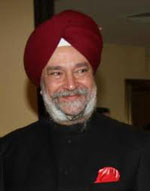 NEW DELHI, Dec 13: Indian envoy to UN Hardeep Puri's turban was patted down at the Texas airport. India has lodged an official protest with the US authorities.
According to TV reports, airport officials asked Hardeep Puri to remove his turban during a security check. Puri refused to let his turban to be searched. Thereafter, Puri was made to wait for over half-an-hour in a 'holding room'.
This is the second instance of an Indian envoy being patted down at an US airport.
On December 4, Indian ambassador to the US, Meera Shankar, was pulled from an airport security line and patted down by an American security agent in Mississippi despite being told of her diplomatic status.
Shankar was subjected to an enhanced security pat-down at the Jackson-Evers International Airport in Mississippi, ostensibly because she was dressed in sari — India's national female attire and her stock-in-trade.
India's ambassador Meera Shankar gets 'humiliating' pat-down at US airport
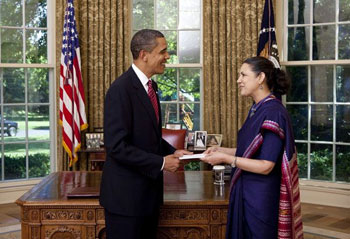 JACKSON, Dec 8: The recent Transportation Security Administration pat-down of Inida's Ambassador Meera Shankar at Jackson-Evers International Airport has upset state hosts and elected officials.
Meera Shankar, Indian ambassador to the United States, was in Jackson last weekend as a guest of the Janos Radvanyi Chair in International Security Studies at Mississippi State University.
While in town, Shankar met with Lt. Gov. Phil Bryant, representatives from the Mississippi Development Authority and members of the Indian community in Jackson, and she spoke to more than 100 people at the Executive Lecture Forum of Jackson.
But her departure is what has many concerned.
New TSA regulations went into effect Nov. 1 allowing federal security officers at airports to switch to more thorough — but often controversial — "pat-downs" for passengers who require hand searches.
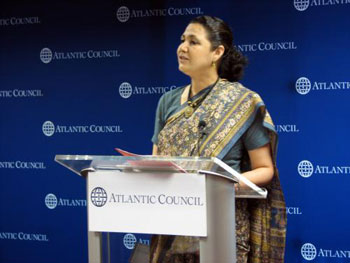 Shankar presented her diplomatic papers to officers and was escorted by an MDA representative and an airport security officer, but witnesses said she was subjected to the hands-on search.
"The way they pat them down — it was so humiliating," said Tan Tsai, a research associate at MSU's International Security Studies center who witnessed the screening. "Anybody who passed by could see it."
Calls and e-mails to the Indian Embassy in Washington were not returned Tuesday.
Gov. Haley Barbour's spokesman Dan Turner said the governor's office is looking into the incident.
"At this time, we're trying to find out exactly what happened — all of the details," Turner said.
Until the office has done a complete review, Turner said it would be inappropriate to comment on what action may be taken.
The new guidelines do not expressly exempt foreign dignitaries but allow for discretion on the part of TSA officers.
Radvanyi also witnessed Shankar's search.
"I know authorities have established stricter rules for the holiday season, but I don't understand why she was singled out," he said.
Tsai said the ambassador was the only person in a group of at least 30 passengers to be pulled aside.
Nationally, less than 3% of passengers receive a pat-down, according to the TSA.
Those who witnessed the ambassador's screening said officers told her that she was singled out because of the way she was dressed. Shankar was wearing a sari — a traditional Indian robe that is draped across the body.
The TSA has guidelines that allow additional screenings when passengers are wearing "bulky" clothing.
"This passenger was screened in accordance with TSA security procedures," TSA spokesman Jon Allen said in an e-mail Tuesday.
According to the policy, individuals can be screened further if the federal officer cannot "reasonably determine" that clothing is free of a "threat item."
"Officers must use their professional discretion to determine if a particular item of clothing could hide a threat object," the policy states.
Under the new guidelines, most who receive the full pat-downs are those who set off metal detectors or decline to use body scanners. Jackson Evers does not have body scanners yet because additional infrastructure is needed.
Shankar did not set off the metal detector, according to witnesses.
The guidelines also allow searches to be conducted in private if a passenger requests. Witnesses said Shankar asked for a private screening, but she was led to a clear box where two officers searched her in clear view.
"She is a very strong woman, but you could see in her face that she was humiliated," Tsai said. "The Indian culture is very modest."
Radvanyi said he worked for three months to get the ambassador to make her first trek to Mississippi.
"We have to make it very clear that Mississippi had nothing to do with it," he said. "It was a federal affair."
Mississippi exported $122 million in products to India in 2009, significantly less than the $232 million in 2008.
Bryant said he discussed increased trade and investment between Mississippi and India during his visit with Shankar.
"Although I understand we need proper security measurers to protect the passengers in U.S. airports, I regret the outrageous way Indian Ambassador Shankar was treated by the TSA while visiting Jackson," he said in an e-mail.
Bryant said he hopes the screening does not deter the ambassador from coming back to Mississippi.
Radvanyi plans to send a formal apology letter to the ambassador, and he expects other state and university leaders will, as well.
"Mississippi had nothing to do with it, but she was very upset," he said. "It's terrible."
Randvanyi said he also will reach out to Mississippi's congressional delegation, the State Department and the Department of Homeland Security.
"This is very bad for Mississippi," he said. "She said she's not going to come back."
Reached by phone Tuesday afternoon, Rep. Bennie Thompson, a Democrat who represents the 2nd District, said he had not heard about the incident.
Thompson, who chairs the House Homeland Security Committee, has raised concerns about the enhanced "pat-down" screenings.
"We've had a number of briefings with our committee," he said. "It raises some concerns with committee members — especially the female members."
Thompson said he would "look forward to hearing a formal complaint" about the ambassador's experience if one were to be filed.
"I know there are people who can be exempt (from the screenings)," he said. "I think obvious considerations can be made."
U.S. expresses regret over frisking of Indian ambassador
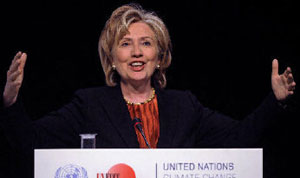 WASHINGTON, Dec 10 Expressing regret over the Indian Ambassador to Washington being pulled out of an airport security line and patted down, the U.S. today promised to ensure that such incidents do not recur.
The Obama administration has regretted the humiliating incident that took place on December 4 at the Jackson-Evers International Airport where sari-clad Meera Shankar was about to board a flight to Baltimore after attending the Mississippi State University’s programme.
“We obviously are concerned about it. We will be looking into it and trying to determine both what happened and what we could do to prevent such incidents in the future,” Secretary of State Hillary Clinton told reporters at the Foggy Bottom headquarters of the State Department in joint press conference with her Nigerian counterpart.
According to the Indian Embassy here, the State Department has reached out to Ms. Shankar and regretted the incident.
“The U.S. State Department has reached out to the Ambassador and has regretted what all had happened. The Embassy is in touch with the State Department on this issue,” Indian Embassy spokesman Virander Paul said.
Mr. Paul confirmed that the Ambassador was subjected to the pat down security check last week at the Jackson-Evers International Airport.
Earlier, State Department spokesman P. J. Crowley said: “It is our understanding the (Indian) Ambassador was pulled out for secondary screening, and DHS (Department of Homeland Security) has indicated they’re prepared to talk about this.”
Mr. Crowley said there are guidelines that have been published on diplomats.
“They are subject to basic security. So everyone at the airport goes through a basic screening,” he said, adding from a TSA standpoint they followed their normal procedures.
“It is the responsibility of the Transportation Security Administration to assess each passenger and then work each passenger through security based on what they see,” he said, adding that as to the rationale that TSA used for this, he will let them explain it.
External Affairs Minister S. M. Krishna has called the pat-down of Shankar “unacceptable” and said the matter would be taken up with the American government.
Pat-down search of Ambassador not good public diplomacy: Rao
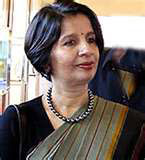 NEW DELHI, Dec 10: India on Friday said that the 'pat-down' search of ambassador Meera Shankar at a US airport was not good public diplomacy and that it was awaiting a report from its embassy in Washington over the incident before it can take up the matter with American authorities.
"We have also asked our embassy in Washington to give us a detailed report on the incident. We haven't as yet received that, but we will be certainly looking at that before we take further action," foreign secretary Nirupama Rao told reporters in New Delhi.
Disapproving of the treatment meted out to Shankar, she said, "It wasn't good public diplomacy and we will certainly be speaking with the American embassy here (New Delhi)".
Rao said that the ministry of external affairs has already been in touch with the American embassy on some previous instances though not exactly of the same nature.
"We have an ongoing discussion with them on this and we will take it up," the foreign secretary said.
Shankar was pulled from an airport security line on December 4 and patted down by an American security agent in Mississippi despite being told of her diplomatic status.
The incident took place at the Jackson-Evers International Airport where sari-clad Shankar was about to board a flight to Baltimore after attending the Mississippi State University's programme.
Shankar presented her diplomatic papers to officers and was escorted by a Mississippi Development Authority representative and an airport security officer, but witnesses said she was subjected to the hands-on search.
In the past, many prominent Indians, including ministers, have faced some uncomfortable moments at US airports.
US cables reveal secret insight to diplomacy
WASHINGTON, Nov 29: Hundreds of thousands of classified U.S. documents emerged on Sunday through WikiLeaks that provide years of insight into U.S. diplomacy and offer unflattering assessments of various foreign leaders.
The New York Times, Guardian and German magazine Der Spiegel along with newspapers in France and Spain obtained the documents from the self-proclaimed whistle-blower website, which has refused to identify its source.
The documents were published despite strong objections from the U.S. government, which insists they were leaked illegally and should be returned. U.S. diplomats, including Secretary of State Hillary Rodham Clinton, have spent the last several days reaching out to countries to contain potential diplomatic fallout.
The release includes 2,51,287 State Department cables. Many were marked classified but none contained the “top secret” label, reserved for the most confidential documents, according to The New York Times.
The documents reveal regular communications between embassies and consulates in some 270 countries back to the State Department headquarters in Washington. While much of it is routine, some of the details and commentary could prove embarrassing.
Most of the papers date back to 2005, although some go much further, The New York Times reported. They portray the efforts of the Mr. Bush and Mr. Obama administrations to combat terrorism, prevent the spread of nuclear weapons, and express worries about Iran’s nuclear activities.
The documents, according to Der Spiegel, show U.S. diplomats assessing Afghan President Hamid Karzai as someone with a “weak personality” who was “driven by paranoia” and “conspiracy theories.” Russian President Dmitry Medvedev was termed “pale, hesitant,” while German Chancellor Angela Merkel “avoids risk, not very creative.” Another referred to Russian Prime Minister Vladimir Putin as an “alpha dog.”
U.S. diplomats in Rome reported in 2009 that Mr. Putin has an extraordinarily close relationship with Italian Prime Minister Silvio Berlusconi that included “lavish gifts” and energy contracts. They further said that Mr. Berlusconi was increasingly becoming the “mouthpiece of Putin” in Europe.
Resolution introduced in US Congress backs India's UNSC bid
WASHINGTON, Nov 22: Lauding India's commitment to global peace and development of the South Asian region, a resolution introduced in the US House of Representatives has appealed to the United Nations to take necessary steps to make New Delhi a permanent member of the Security Council.
The resolution by Congressman Gus Bilirakis gives the sense of the House of Representatives that the UN should forthwith take the procedural actions necessary to amend Article 23 of the Charter of the United Nations to establish India as a permanent member of the UN Security Council.
The resolution, which has been sent to the House Committee on Foreign Affairs for necessary action, noted that India is the largest democratic country in the world in which all political views are freely expressed and respected.
India is the world's second most populous country, with over one billion citizens residing within its borders and is one of the largest contributors of troops to UN-mandated peacekeeping missions, it said.
The resolution also said that India has demonstrated a strong commitment to global peace and promotion of the peaceful development of the South Asian region.
"... it is the sense of the House of Representatives that the United Nations should forthwith take the procedural actions necessary to amend Article 23 of the Charter of the United Nations to establish India as a permanent member of the United Nations Security Council ," it said.
Kashmir is India's 'internal' issue: US envoy
NEW DELHI, Nov 15: With Kashmir reportedly being excluded from the UN list of unresolved disputes, the US today said it was an "internal issue" of India and should be resolved bilaterally through negotiations with Pakistan.
"This is an internal issue for India. It is a bilateral issue between Pakistan and India, to discuss term, scope, character and pace," US Ambassador Timothy Roemer said.
He was asked to comment on UN excluding Kashmir from list of unresolved international issues.
"The (US) President ( Barack Obama), I think was very articulate on this issue of Kashmir. This is an internal issue for India," he said on the sidelines of a function here.
Roemer noted that during his visit, Obama had said that he encouraged Prime Minister Manmohan Singh and people of India to engage with the government and people of Pakistan.
He underlined that whenever India and Pakistan talk, it will be at the "pace and character" of the two countries.
On Obama announcing support for India's bid for permanent UNSC membership, he said the US will now work to realise the promise.
"We are very proud about President's announcement that he is unequivocally and fervently in favour of India having a permanent seat in a reformed United Nations. It was one of the many highlights of (his) visit to India..We will be working to see that happen," Roemer said.
Obama endorses India's bid for Security Council
By Deepak Arora
 NEW DELHI, Nov 8: As reported by TheTribuneOnline.com earlier, the US President Barack Obama has endorsed India's bid for permanent membership of the United Nations Security Council.
Addressing Indian law makers at the Parliament House here on Monday evening, Obama said he welcomes and supports India's entry as a permanent member in the expanded UN Security Council.
This showed another major sign of growing ties between the two nations.
Obama, who is on a 10-day tour of Asia, praised "the father of your nation" Mahatma Gandhi and noted his influence on Martin Luther King and the non-violent resistance that typified the American civil rights movement.
"I am mindful that I might not be standing before you today, as president of the United States, had it not been for Gandhi and the message he shared and inspired with America and the world," the president said.
US Backs India for UNSC seat
By Deepak Arora
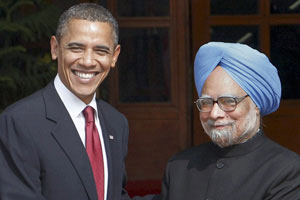 NEW DELHI, Nov 8: US President Barack Obama is expected to back India for a permanent seat in the UN Security Council when he addresses the Indian Parliamentarians on Monday evening.
President Obama gave a hint to this effect when he refused to answer a question on this issue during a press conference at the Hyderabad House. "I will address this question when I will speak to Indian law makers later in the day," replied Obama to a question from an American journalist.
Addressing the press conference, Prime Minister Manmohan Singh and President Barack Obama on Monday said relationship between their two countries would "define" the world in the 21st century. Singh welcomed President Obama to his country, calling the American president a personal friend and "great charismatic leader."
Obama also said he hopes that India and Pakistan over the next few months can "find mechanisms" to work out differences over Kashmir.
Singh announced that India will create new centers to deal with nuclear security and disease prevention, and Obama reiterated moves by the United States to ease export controls affecting trade between the world's two largest democracies.
On Kashmir, Obama said the United States "cannot impose a solution." But he said he has offered to help the two countries work out the problem, saying he believes both "have an interest in reducing tensions."
Calling the Kashmir row a "long-standing dispute between India and Pakistan", Obama said that it was in the interest of both New Delhi and Islamabad to reduce tensions between them.
"The US cannot (provide) a solution to this problem," he said, adding he had indicated to Manmohan Singh that "we are happy to play any role ... that is appropriate to reduce their tensions".
Singh said Obama and his wife, Michelle, have made an abiding impression on the Indian people with their warmth, grace and commitment to promoting relations between the two democracies.
There was also congruance on several contentious isssues like terror when Obama said US would not allow safe haven for terrorists, outsourcing when Obama said he would tell Americans that his India visit has helped create jobs in the US.
Singh also sent out a very strong message to Pakistan in presence of the visiting premiere saying he was not afraid of the “K word”.
We have always maintained that a strong, peaceful, moderate Pakistan is in the interest of South Asia and the world. We are committed to resolving all outstanding issues, including Kashmir. But it is our request is that Pakistan cannot talk with India while the terrorist machinery is still active on its soil,” Prime Minister Manmohan Singh said. He added it is necessary for Pakistan to move away from “terror-induced coercion”.
Obama maintained the adopted line so far by repeating that the US would not impose a solution on Kashmir, but he took a step further when he added that the US would be “happy to play any role in reducing tension” in Kashmir.
Here are key points from the press conference.
Manmohan Singh
US, India have decided to work as equal partners.
US to lift curbs on high-tech exports
Had extended discussion on Pakistan, Afghanistan
US, India to extend cooperation in defence, space, other high-end fields.
US, India partnership based on common vision, values
Protectionism is detrimental for the economies of both our countries
We are not afraid of talks with Pakistan. You cannot be talking at the same time and simultaneously the terror machine
is active as ever before.
Barack Obama
Thrilled to be in India
Ours (Indo-US is not an ordinary relationship)
Prime Minister Manmohan Singh is a man of extraordinary intellect
We (India, US) agreed on the need for all nations in the region to take steps to ensure that there are no safe havens for
terrorists.
India is a world power, can work together for global peace: Obama
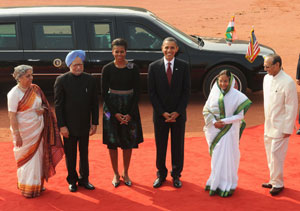 NEW DELHI, Nov 8: US President Barack Obama on Monday said India was now a world power and the two countries can work together on issues like counter-terrorism to promote peace, stability and prosperity for the whole world.
The US President said he has undertaken the trip to India to strengthen what is already an incredible friendship that would be one of the defining partnerships of the 21st Century, to build on commercial ties and strengthen cooperation in bilateral relations and international economy.
Obama was talking to reporters after a ceremonial reception given to him at the forecourt of the majestic Rashtrapati Bhawan formally kick starting his official visit.
He said that the two countries would be able to focus on issues like counter-terrorism in order to ensure that both the US and India are secure well into the future.
"My hope is that during these discussions between myself and Prime Minister, myself and President and other members of the Indian delegation, we will be able to build on the commercial ties that we already have, to strengthen cooperation in bilateral relations and international economy," Obama said.
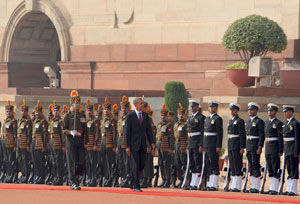 "Given that India is not simply an emerging power but now it is a world power, US and India can work together to promote international principles, rules, relations between nations they can promote peace, stability, prosperity not only for just two nations but for the whole world," he said.
Obama said he and his wife thank the entire people of India for the wonderful hospitality and reception given to them and conveyed the warmest regards from the people of America.
After thanking Indians for their extraordinary hospitality, US President Barack Obama and Prime Minister Manmohan Singh began talks at the Hyderabad House in New Delhi. (Read: Obama, Manmohan hold bilateral talks)
After a meeting with the Prime Minister, both the leaders will take questions from the press. Obama will also address the Parliament.
The US leader and his wife Michelle on Monday visited Mahatma Gandhi's memorial Rajghat and paid tribute to the father of the nation whom he has referred to as his "real hero". (Read: Obama pays tribute to 'hero' Mahatma Gandhi)
Though this is Obama's third day in India, Monday's ceremony was the first opportunity for Indian officials to herald his visit.
Gandhiji’s light continues to inspire the world, says Obama
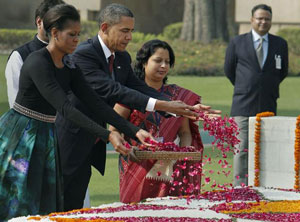 NEW DELHI, Nov 8: U.S. President Barack Obama and his wife Michelle today paid rich tributes to Mahatma Gandhi at Rajghat and said they will always remember “the great soul” who changed the world with his message of peace, tolerance and love.
The Obamas reached the memorial of the Father of the Nation here after being accorded a ceremonial reception at the Rashtrapati Bhavan.
The U.S. first couple placed a wreath at the memorial located on the banks of the Yamuna river.
“We will always remember the great soul who changed the world with his message of peace, tolerance, of love. More than 60 years of his passing (away), his light continues to inspire the world,” the U.S. President wrote in the visitor’s book.
Pak, China top agenda at PM-Obama one-on-one
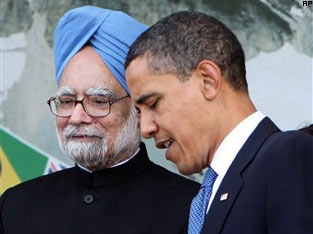 NEW DELHI, Nov 8: The real summit between PM Manmohan Singh and US President Barack Obama happened on Sunday evening.
They were supposed to meet for half an hour before the dinner, but Obama and Singh spent an entire hour closeted together in a one-on-one chat that may turn out to be the most important conversation between the two leaders through this visit.
The meeting focused on the big things that India has been wanting to talk about: maritime security, China, Pakistan, regional security and global geo-politics dominated the conversation. This could be the real breakthrough between India and Obama's US.
As India's foreign policy moves out of South Asia, maritime security, protection of sea lanes and piracy on the high seas is increasingly one of the areas where India and the US are finding easy convergence and finding it easier to work together.
It brings in China, because after July, when China declared the South China Sea to be its "core interest", countries including India, US, Japan, South Korea and Vietnam have declared an equal interest in keeping international sea lanes free for navigation. For US and India, looking to keep seas free from territorial claims, this is shaping up as the new idea in US-India cooperation for the future.
It's part of Obama's "shaping agenda", and one where he will find a more ready Indian partner than ever before.
The two leaders also talked Pakistan and Afghanistan, though details of the conversation were not available.
For those searching for the new ideas in US-India realations, maritime security is only one of the many related ideas in play. If they can play together, space, cyber, naval and air cooperation will signal the next level. It's India's new arena to exercise its global power responsibilities and the US partnership, according to high level sources, is a natural complement.
The complicating factor in all this is the kind of approach the US makes to terrorism from Pakistan, which too figured in the conversation, and the PM was likely to have told Obama that perceptions that the US was either hyphenating India and Pakistan or giving Pakistan a leeway to practise terror against India would make this new partnership difficult.
During Monday's talks, sources said, the US side had originally proposed that after the delegation level talks between the US and India in the morning, the two leaders could have a one-on-one interaction to discuss weighty issues by themselves.
But Indian officials, always keen to insert themselves in high-level conversations, made it clear that the prime minister would be accompanied by at least six officials. So that's how it will be.
The morning's deliberations after the ceremonial welcome at Rashtrapati Bhavan and Rajghat will include delegation-level talks between both sides. This will be followed by a "restricted" session, involving only the top-level officials on either side.
There is great value in one-on-one meetings between leaders. As used to be clear during the Bush years, they break logjams, chart new paths forward, free of the constraints of bureaucracy. It gives a chance for leaders to connect personally and in international relations, this has great value.
However, while officials sought to be let into this one, they had no qualms about the PM meeting his Pakistani counterpart Yousaf Raza Gilani in a one-on-one. In Thimphu, the PM spent almost an-hour-and-a-half closeted with Gilani. The top officials were called in later to work out the details of the agreement. That restarted the dialogue with Pakistan.
India, America join hands to harness solar power
MUMBAI, Nov 7: India and USA teamed up on a space-based energy initiative aimed at turning both countries into net energy exporters, 48 hours before US President Barack Obama landed in India.
The project is led by former president of India A P J Abdul Kalam, who was once a staunch critic of the US, and National Space Society (NSS), a non-profit US-based space organization with chapters all over the world including India. The initiative was announced on Thursday at Washington's National Press Club where Kalam and Isro Satellite Centre director T K Alex were present. Known as the Kalam-National Space Society initiative, the mission envisages harvesting solar power in space for use on earth.
Alex is the project's principal investigator from India. Kalam told the US media that a team from Isro has been formed to carry out a feasibility study for this project. He said Isro chairman K Radhakrishnan asked him to take the idea forward after a discussing the project. Referring to the Manmohan Singh-Obama summit in New Delhi on Sunday, Kalam said both were concerned leaders ''interested in energy-related issues and energy independence''.
Kalam said it was a 15-year-project. The main challenge is to evolve methods to transmit solar power from space to earth and its distribution. To make it economical, the cost of launching a spacecraft, currently $20,000 a kg, has to be slashed to $2,000 a kg.
Manmohan, Obama hold meeting ahead of formal talks
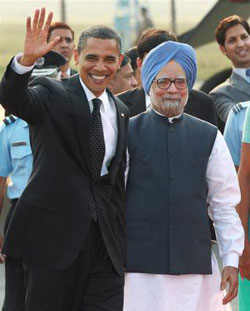 NEW DELHI, Nov 7: On the eve of their formal talks, Prime Minister Manmohan Singh and US President Barack Obama had a meeting here Sunday night during which the two leaders are understood to have taken stock of bilateral ties and ways to push these to higher levels of strategic partnership.
Dr. Singh and Mr. Obama had a one-on-one meeting for about 25 minutes before the private dinner hosted by the Prime Minister for the visiting leader and his wife Michelle Obama at his 7, Race Course Road residence.
The two leaders are believed to have taken an overview of the bilateral relations, which have grown substantially over the last few years.
Dr. Singh and Mr. Obama, who will hold wide-ranging talks tomorrow, are understood to have discussed ways in which the two countries could raise their cooperation to higher levels, particularly in economic, security, agriculture and science and technology.
The two sides will be issuing a Joint Statement tomorrow which will outline new areas of cooperation at bilateral and multilateral levels.
Obamas visit Humayun's Tomb, interact with children
NEW DELHI, Nov 7: US President Barack Obama and his wife Michelle on Sunday had a glimpse of India's rich cultural and historic heritage as they visited the 450-year-old Mughal marvel Humayun's Tomb in New Delhi.
Obama, who kicked off his engagements in Delhi with the visit to the 16th century marvel, went around with his wife intently getting the feel of the monument, which is said to have inspired the creation of Taj Mahal.
49-year-old Obama and Michelle drove to the monument soon after their arrival from Mumbai at the airport in New Delhi, where the US' first couple was personally received by Prime Minister Manmohan Singh and his wife Gursharan Kaur.
Obama became the first American President to visit Humayun's Tomb, the resting place of Mughal emperor Humayun, which is an artistic precursor to the 17th century monument of love Taj Mahal.
"Wonderful. Let's take a look," Obama said as he entered the main building.
Then, ASI Superintendent Archaeologist, Delhi, K K Mohammad, took the First Couple around the monument explaining its history.
The beautiful red-stone monument in Nizamuddin in south Delhi, built over 450 years ago, now sports a new look after a major renovation exercise thanks to the efforts of the Aga Khan Trust for Culture and Archaeological Survey of India.
At the entrance of the monument, Obama was received by ASI Director-General Gautam Sengupta and other officials.
Obama, dressed in white shirt with a tie and black trousers, and Michelle listened intently and were seen enquiring about the various elements of the 450-year-old structure.
Then, Obama and Michelle met 14 kids, children of workers at the monument, and even shook hands with them.
The kids, aged from 4 to 10 years of age, were accompanied by their parents.
Obama was seen striking a chord with the kids as he chatted with them and distributed along with his wife gave them gifts.
The first garden tomb in the Indian subcontinent, the mausoleum was commissioned in 1562 by Humayun's widow Hamida Banu and designed by Mirak Mirza Ghiyath, a Persian architect, a decade after the death of the Emperor.
The monument now sports a new look, thanks to the conservation work being carried out by Aga Khan Trust for Culture and the ASI.
The work which began in 1999 -- six years after Humayun's Tomb was declared a World Heritage Site -- was being done in phases.
The ASI and AKTC have finished reviving the five-century old water channels of the garden surrounding the tomb.
While announcing Obama's visit, the White House said Obama "felt it was important, given the rich civilisation that India has, to pay tribute to that through" his stop at Humayun's Tomb.
US cannot impose itself on Indo-Pak dialogue: Obama
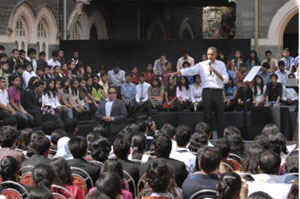 MUMBAI, Nov 7: President Barack Obama on Sunday made it clear that the United States “cannot impose” itself on Indo-Pak relations and called for a “military response” in a "significant ongoing way” against those who perpetrated terror attacks in Mumbai and New York.
Mr. Obama avoided any reference to Kashmir but, endorsing India’s stand, said that less contentious issues should be taken up first in an Indo-Pak dialogue process.
India has been persistently suggesting to Pakistan that less contentious issues could be taken up for bilateral talks before the two countries move on to discussing thorny issues like Kashmir.
Interacting with students of St Xaviers College here in a typical U.S. town-hall style meeting for nearly an hour, Mr. Obama expressed hope that over time, trust develops between India and Pakistan and dialogue begins perhaps on “less controversial issues building upto more controversial issues“.
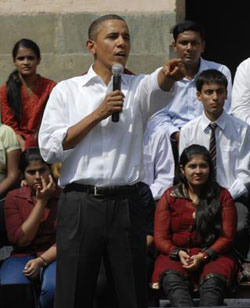 He said the progress made by Pakistan in fighting terrorism was not quick as “we would like” and asserted that they were working with Islamabad to eradicate extremism which is a “cancer” that has the potential to engulf the entire country.
“There are going to be some elements in that are affiliated to the Taliban, that are also affiliated to the al-Qaeda or LeT. These are the organisations, these extremists, they are irreconcilable. They will be there and there will need to be a military response to those who would perpetrate the kind of violence that we saw here in Mumbai in a significant, ongoing way or the kind of one we saw in 9/11 in New york city,” he said.
Mr. Obama also observed that it would surprise Indians when he says this that it is in India’s interest that Pakistan remains “peaceful, stable and prosperous” and that the US will work with Islamabad to reject extremism which is a “cancer” which threatens to engulf it.
The U.S. President made these comments when a girl student asked why Pakistan was not being declared a terrorist state by the U.S. Mr. Obama reacted that it was a good question and said, “I must admit that I was expecting it".
“India and Pakistan can prosper and live side by side, this will not happen tomorrow but needs to be the ultimate goal. The US can be a partner but cannot impose this process. India and Pakistan have their own understanding,” he said
India can become America's largest trading partner: USIBC
NEW DELHI, Nov 7: Business leaders accompanying US President Barack Obama on his visit in New Delhi feel India has the potential to become America's largest trading partner.
"India is the United States' 12th largest trading partner. It could be number one or two if the conditions for trade between these two giant economies continue to improve," said The McGraw-Hill Companies Chairman and CEO Harold Terry McGraw III, who is also the Chairman of the US-India Business Council (USIBC).
The USIBC is the premier bilateral business advocacy organisation between India and the US, whose members include top-tier US and Indian companies.
On Saturday, Obama had sought a level-playing field and an atmosphere of genuine competition for American companies doing business in India, saying current foreign investment rules are "opaque" and customs tariffs complex.
Business leaders from both countries have expressed the need for partnership and fostering deeper ties to ensure prosperity for business and society, he said in a statement.
"We welcome President Obama shining the spotlight on business opportunities for American companies in India," McGraw said.
Business seems to have been at the top of Obama's agenda for his India trip, with more than a dozen export deals worth about USD 10 billion inked so far, which will create approximately 50,000 new jobs in the US.
India is one of the fastest growing economies in the world and President Obama's visit highlights the export opportunities available for US businesses, he said.
Obama met hundreds of American and Indian business leaders on Saturday at the USIBC event.
Along with the USIBC Chairman, the meeting was attended by GE CEO Jeff Immelt, PepsiCo CEO Indra Nooyi, Honeywell Chairman David Cote, Reliance Industries Ltd Chairman Mukesh Ambani and Bharti Enterprises Vice Chairman Rajan Bharti Mittal.
India orders may create 7 lakh jobs in US in 10 yrs: CII
NEW DELHI, Nov 7: Industry body CII on Sunday said sourcing of infrastructure equipment, nuclear hardware and military aircraft from the US by India could create over seven lakh jobs in America in the next ten years.
A CII survey of member firms with operations in the US clearly shows that Indian business is now engaged across a wide spectrum of sectors in America, and not just IT and ITeS.
The Report, 'India - A Growth Partner in the Indian Economy', estimates that, "India sourcing of US military and nuclear hardware and civilian aircraft could create over 700,000 jobs in the US over the next ten years."
On Saturday, US President Barack Obama had announced USD 10 billion worth of deals between Indian and US companies, including a USD 2 billion equipment order from Anil Ambani Group firm Reliance Power and the purchase of 30 Boeing 737 aircraft by low-cost carrier SpiceJet.
These deals would create more than 50,000 jobs in the US.
The report also said that Indian firms operating in the US have been aggressively hiring US workers and a large majority of the workforce for their America operations were local citizens.
It further said that Indian firms having operations in the US are actively engaged as stakeholders in community development programmes for development of libraries, health research and imparting skills to college graduates.
"These examples of deep integration... show that Indian business is in the US for the long-term and see themselves as partners in the resurgence of the US economy," CII Director General Chandrajit Banerjee said.
Obamas celebrate Diwali, dance to Koli song
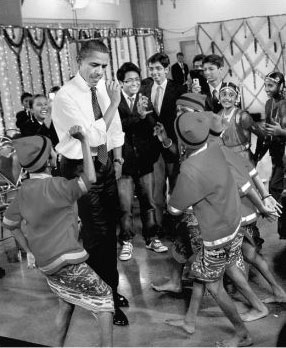 MUMBAI, Nov 7: : The students of Holy Name High School in Colaba remained star struck well after the Obamas had left. U.S. President Barack Obama and First Lady Michelle were unlike any political heads they had ever seen or imagined. They danced to a folk song in Marathi and shook hands and spoke to most of the students present on a Sunday morning and paid minute attention to the science exhibition they had taken a week to put up.
While students of the fourth to seventh standard danced the traditional Koli fisherfolk community's dance “Mee Hai Koli,” Michelle joined in readily and showed she could move gracefully and in tune with her younger performers. Mr. Obama made a fuss that he was not asked to dance and the older boys from the 10th standard dragged him on to the floor. He asked if he would have to remove his shoes. Clad in a white shirt with rolled up sleeves and tie, he too plunged in with gusto.
The President and his wife arrived at the school around 9.30 a.m. After going through the science exhibition, Mr. Obama said he was happy that youngsters were now more aware about the environment than his generation. His own children too were like that, he said. The students had put up an exhibition on green energy and set up models of windmills, rainwater harvesting and green villages.
Mr. Obama asked the students how long it had taken them to prepare the exhibition and he was impressed enough to say that he would like to take tips on public speaking from them. He ticked off the media saying a tree a day keeps global warming away, in case they had missed it.
The President said the school students at the town hall style meeting at St Xavier's too had concerns for the environment.
Mr. Obama lit the lamps for Diwali along with Michelle, and clapped in tune to a Hindi film song, the meaning of which Union Minister Salman Khursheed explained to him.
The programme lasted nearly an hour and, after the Obamas left, students were in awe and couldn't believe they had actually danced with the U.S. President and his wife.
Purnima, one of the students said: “I did not believe this was happening.” The others said the Obamas chatted with them in a very relaxed manner.
The Obamas shook hands, chatted, signed autographs and were happy to pose for pictures with the students and their parents.
Students had put up posters saying “Happy to see you Obama” and were worrying for a week whether they would actually get to meet the President. The Koli song was specially chosen to highlight the tradition of Maharashtra. The Kolis are said to be the original inhabitants of Mumbai.
India expects robust nuclear commerce with US
NEW DELHI, Nov 4: India on Thursday said it will not make any "hasty decisions" on the outcome of discussions with President Barack Obama on "complex" issues of outsourcing, seat for India in UN Security Council and withdrawal of US ban on export of dual-use technology.
Seeking to downplay Obama's remarks on Wednesday in which he did not hold out any assurances on these key concerns, Foreign Secretary Nirupama Rao said it would be wrong to prejudge the US leader's discussions with the Indian leadership.
There has been a good "working progress" on elimination of obstacles created by dual-use controls of the US as governments of both countries were of the view that the issue need to be reviewed in order to reduce and "ultimately eliminate" it, Rao said.
She also disclosed that India has invited US companies to explain to them the provisions of its domestic civil nuclear liability law and address their concerns, if any, and also begin discussions on the next steps of implementation of civil nuclear power projects.
"A commercial delegation from the US is likely to visit India very shortly in this connection," Rao said.
India was hopeful of participation of US companies in India's nuclear field.
Briefing the reporters about the high-profile visit, she said the Prime Minister looks forward to continuing his extremely productive dialogue with President Obama on a range of issues, including the global economic situation, the threat of terrorism, the challenges in India's neighbourhood, and the shared goals of sustained security, stability and prosperity in Asia.
"The US Administration under President Obama has expressed its commitment to strengthen Indo-US bilateral relations further, building upon the existing level of cooperation in various areas of bilateral and global engagement," she said.
India and the US are likely to sign MoUs to deepen cooperation in the field of health, education, agriculture and clean energy, Rao said.
While a pact on weather and corp forecasting was expected in the agriculture area, establishment of a disease detection centre on the lines of American Centre for Disease Control with US help was also likely to be inked, she said.
India-US relationship is founded on shared values, increasingly convergent interests, enormous opportunities for mutually beneficial bilateral cooperation and a shared commitment to work together to address regional and global issues, Rao said.
Asked if India would take up the issue of terrorism emanating from Pakistan, which has recently been given USD two million by the US, she said India will obviously talk about the threat of terrorism directed at it from across the border, also the problem of terrorism in Afghanistan which is directly targeting Indian interests and the role of all major terror groups operating in the region.
About the comments of Home Secretary G K Pillai that India was not given access to full and specific information on David Headley, Rao said "...There has been unprecedented cooperation and there has been excellent and very responsive attitude from the American side on the investigation on Mumbai terror attacks. We have not been denied access to any information on this."
Asked if India will also seek support of US to be included as part of elite groups, including Nuclear Suppliers Group, the Foreign Secretary said all these issues are part of the strategic discussions between the two countries.
Admitting that there were issues such as outsourcing which will be raised during the visit, Rao, however, said but what was different now was that the Indo-US relations have "matured".
She also outlined the schedule of the US President during his stay in India which will include meeting with business community in Mumbai on 6th November, the day of his arrival, talks with the Prime Minister and address to the joint meeting of members of Parliament on 8th November.


